
 Ask ChatGPT



Written by AI. May contain mistakes.

Get the gist, explore an idea or ask about something said.
 Claude
On The Standard, what are the key points of this episode?
Searching your listeningAutomatic transcript. May contain errors.
0:02Hi, I'm Charlie Duffield and welcome back to The Standard Podcast. If you're new here, hit follow and give us a rating. For all the latest news, head to standard.co.uk. Coming up later in the show, why diners are swapping late-night lounging for early evening sobriety. But first, the Met Police will be tested to the limit this weekend in central London as protesters are expected to turn up in huge numbers to support the recently prescribed terror group Palestine Action. This move was taken by Home Secretary Yvette Cooper, who enacted anti-terror laws after the group claimed responsibility for damaging two Voyager planes at RAF Bryce Norton on June 20.
0:52The ban means that membership of, or support for, the Direct Action Group is a criminal offence, punishable by up to 14 years in prison. The Telegraph reports that more than 200 people have been arrested for expressing support for the group since July 5th. We demand that Palestine action is deprescribed. Our government is actively supporting a genocide. Our government is arming a genocide. It is UK-made weapons that are being used to destroy homes, to destroy hospitals, to destroy schools. And now our government is not only arming a genocide, they are using terrorism laws to silence people who speak out.
1:35Palestine Action are campaigning for peace. They are dismantling weapons factories that have been used to make weapons that slaughter whole families generations at a time. This is campaigning for peace. And now people who support this are being told they could get 14 years in prison. But last week, Palestine Action's co-founder, Huda Amouri, won a bid to bring a High Court challenge over the group's ban as a terror organisation. A judicial review over the legality of the group is due to be heard in the autumn and could see the ban lifted. Ahead of this weekend, organisers have said there is safety in numbers.
2:16But a briefing document drafted by the Civil Liberties Movement, Defend Our Juries, told supporters that joining this campaign comes with risk. It added that it would be practically and politically difficult for the state to respond to an action on this scale. Graham Wattone, a retired Metropolitan Police officer, also warned it would create problems for forces across the country. He said, there are a limited number of custody cell spaces available in London. Simply put, they will not be able to arrest and process everyone. Joining us now is Tim Crossland, a former government lawyer who now campaigns with Defend Our Juries.
2:56Tim, tell me a bit about the work you do. We've been campaigning against government crackdown on peaceful protests in this country, which seems to have been motivated partly by lobbying from the oil and arms industries. And can you remind us what the justification is for this prescription of Palestine action? Well, that's a good question. That's probably really a question for Yvette Cooper. Some of the things that she said publicly seem to have been contradicted by the legal process that we've seen. So there were supposed leaks to the press from the Home Office suggesting that Palestine Action was funded by Iran, totally groundless.
3:37We've now seen the government's own evidence that showed that actually Palestine's actions funding is from crowdfunding and selling T-shirts in this country. The government also admitted during a legal process is that Palestine action never advocates for violence against people. The trigger for this ban was spray painting military planes red. This was about a month ago at Bryce Norton to highlight the role that the RAF has been playing in supporting the Israeli genocide of the Palestinian people. And that was the prompt for Yvette Cooper, the Home Secretary, to say she was going to prescribe Palestine action.
4:20Red spray paint. And how did you feel when you heard the news? dumbfounded a lot of people were in one way although we have seen sort of growing move by arms industry lobbyists lobbyists for elbert systems to push the government into taking this kind of action because what we had seen is the palestine actions campaign had been effective in forcing elbert systems to shut down some of its factories elbert systems is the main supplier of weaponry to the Israeli Defense Force, weapons, drones, quadcopters that are being used to slaughter women and children and men in Gaza. So we were aware that the campaign was effective and there'd been meetings between Helbert Systems and the Home Office saying, how are you going to stop this from happening?
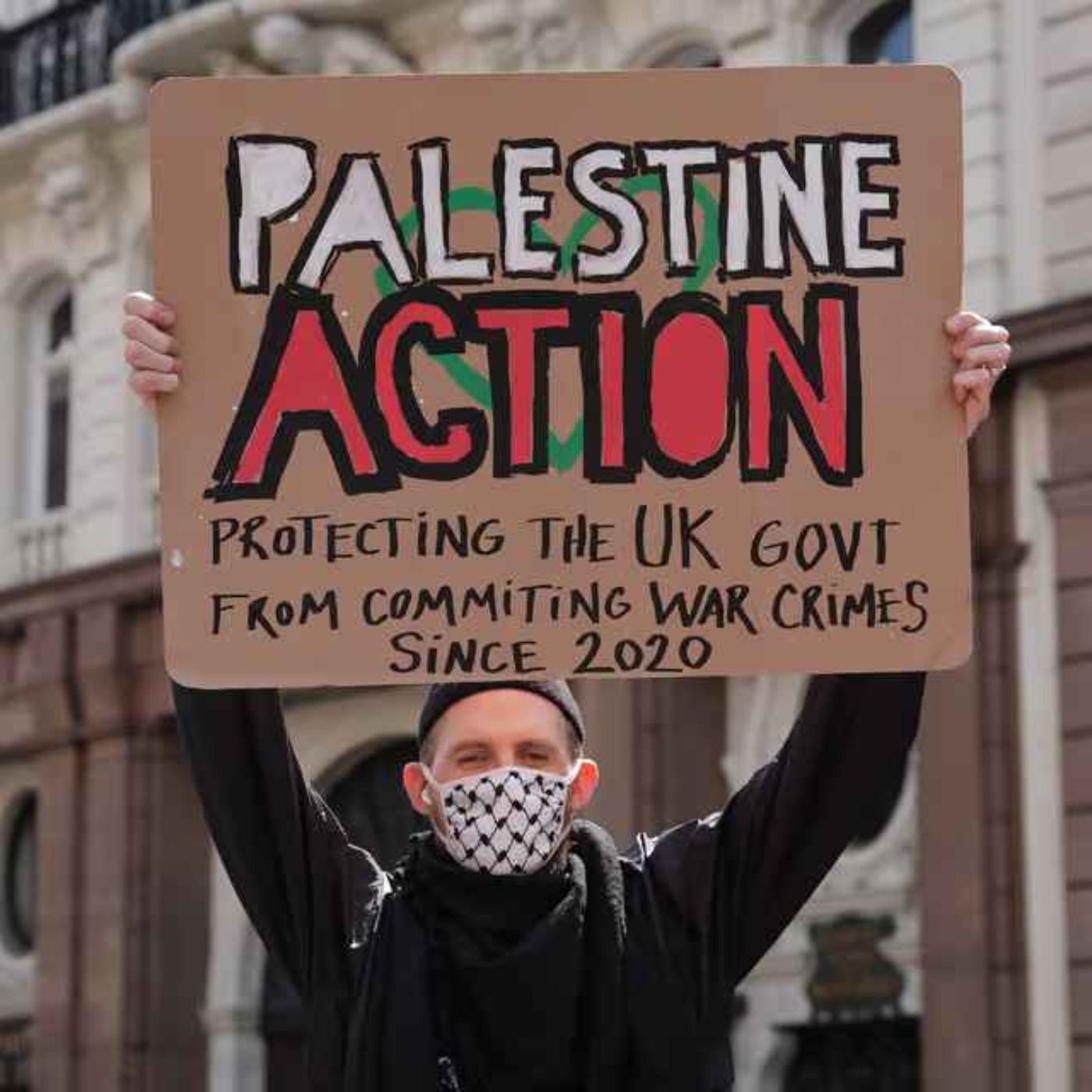
5:09So from that point of view, it wasn't a complete surprise, but surprise that the Home secretary would do something that no government has ever done before, which is to classify a direct action protest movement as terrorists, to classify the people trying to stop violence and genocide as the people causing violence. It's a kind of Orwellian doublespeak. So what's the plan for this weekend's protest? We've had hundreds and hundreds of people commit to holding up a sign in central London on Saturday which says, I oppose genocide, I support Palestine action. And it's a simple cardboard sign. It's a simple expression of people's opinion, freedom of thought, freedom of expression.
5:55But the effect of the order that Yvette Cooper has brought in is that police have been arresting people under the Terrorism Act for holding that sign. So that may be what they do again on Saturday. Today, it's been said that if significant numbers of people do turn up, it could limit the police's capabilities to arrest everyone. What do you make of that? There must come a point, we wouldn't pretend to know exactly where that is, where the cost to the public of arresting and detaining people for holding cardboard signs opposed to genocide becomes so absurd that it's not sustainable. That's even assuming the police have got the capacity to take 500 plus people into police cells on a Saturday.
6:41That will pretty much fill up all the cells across London police stations and mean that people who are maybe accused of committing violent assaults or sexual assaults cannot be held in those police cells. if that's what the police want to do they can do that for a while but eventually if enough people hold these signs it becomes unsustainable. What do we know about this high court challenge? Yeah so the first stage of this process which is called a judicial review which means challenging a government decision through the courts that took place last week you have to get leave to bring a full legal challenge and a lot of cases are filtered out at that point But the High Court ruled in favour of Palestine action last week, said there were reasonable grounds to consider the order unlawful.
7:32Firstly, because it was a disproportionate interference with people's right to free expression and peaceful protest. Secondly, because the Home Secretary hadn't even consulted Palestine action or any civil liberties organisation on what the impact of this order would be. while she was busily consulting with the Israeli embassy and Obit Systems, in other words, the people profiting from the genocide. For both those reasons, the High Court ruled there were reasonable grounds to believe this order is unlawful. And this will now go to a full hearing in front of the High Court in November. There will be a ruling from the High Court on whether the order is lawful or not.
8:12And one of the things the Met Commissioner is going to have to think about this weekend is if the high court ruling goes against Yvette Cooper, then all the arrests that have been made in the meantime will have been unlawful arrests because they were based on an unlawful order. And that will mean all those people arrested and hauled into police vans and kept in police custody will need to be compensated. So this stands to be just a hugely expensive operation if the police don't apply common sense and leave peaceful protesters to make their point about the genocide. And what sort of precedent has been set here by the government by prescribing Palestine action?
8:53What are the broader implications? I think that's a really important question because this is not just about Palestine action. It's not just about what's happening in Gaza. Once you separate that definition of terrorism from violence against a civilian population, which is what most people understand terrorism to be, and you allow it to include causing economic damage to companies, which is the basis of this prescription, well, just think for a minute about what that could mean. That could mean the unions, because when the unions go on strike, it causes economic damage to companies. It could mean people taking direct action about or protesting about racial injustice or climate breakdown.
9:37Because when people get into the streets to protest, or even if they march, maybe that slows down traffic, maybe it causes economic loss, maybe it embarrasses the government. And I think embarrassment to the government with that break into the RAF airfield was an important part of it. So if we let this one go, if we allow it to be the case that people can be classed as terrorists for trying to stop violence instead of causing violence, well, then it will be the unions next. It will be anybody trying to hold the powerful to account who will be next. If we care about our democratic freedoms, then this has got to be the moment to take a stand.
10:19We're asking people to join us this Saturday. If you go to the Defend Our Juries website, this is all completely open. It's completely transparent. It's a campaign to end this ridiculous, oppressive law. You'll find all the details you need there to join us and be part of putting a stop to this. Let's go to a break. Coming up in part two, Find out why the way we eat is changing and what the perfect time to dine is according to Gen Z. We'll see you back here in just a moment.
11:02Welcome back. Now, new data suggests that eating fashionably late could be a thing of the past, with more of us preferring to tuck into an evening meal earlier in the day. The new national average dining time is said to be 6.12pm, with nearly half of all restaurant bookings falling between midday and 6. It reflects broader trends in the ways we work and socialise, for example with working from home leading to earlier start and finish times, as well as more of an awareness of the health benefits of doing so. Joining me now is freelance journalist Arielle Dom, who loves a late night dinner. Arielle, tell us a bit more about these statistics.
11:42I wrote this piece after reading another article in The Times that said that 6pm has become an increasingly popular time for dinner reservations in the UK. Open Table says that 6pm reservations have been up 11 % in London and 6 % UK wide compared to the same period last year. And Zonal, which is a hospitality tech service, says that the new average time to dine in the UK is as early as 6-12pm. So I was interested in the fact that people are eating earlier and young people particularly. And what do you think is driving this behaviour? Well, something I've reflected on a lot, which I feel like has touched many things that I write about from sex to socialising, is changes in Gen Z's lifestyle.
12:31So, for example, Gen Z are statistically drinking less alcohol than previous generations. a lot of them are opting for things like gym dates instead of pub dates there they'd miss a night in the pub or a club so they can wake up early and do a workout the next day so I think it then makes sense if you're prioritizing exercise and health that it's maybe more appealing to go out to eat closer to 6 p.m where you can go back get some rest digest your food and then wake up early, do exercise the next day than it is, you know, going to bed at nine when you're maybe like drinking and then have a more rowdy night and a more hungover or get less sleep the next day.
13:13So what's your case for the late night dinner? So I wrote about in the article, I think during university, I was more militant in my routines, like my friends actually used to laugh at me because I was always so hungry. I wanted to eat lunch at 12 p.m dinner at 6 p.m if my friends were like we don't want to do that I would just eat alone because I was just a mouse and nerd and so into writing my essays and I just didn't want to be constantly snacking but one of my close friends Jake bought me the amazing book Eat Up by Ruby Tando who is a contestant on Great British Bake Off and she basically talks about what is intuitive to a lot of people but unfortunately for a lot of women particularly isn't intuitive the idea that we should eat when we're hungry and we should take pleasure in our food.
14:00And she kind of unravels all the beauty and pleasures of eating and cooking and talks about how our relationship with food and our appetite has become so disjointed and thwarted over time. So I guess that led me and encouraged me to rethink my own relationship with eating and with food. And it encouraged me to really prioritize nourishment and pleasure and process over finding the most efficient way to cook and to eat and be energized by food so I guess that's part of that kind of rethinking the idea about like eating slowly and really indulging and enjoying yourself and then I think it's just the idea that sometimes the best things in life the things that feel the best are the things which aren't necessarily the best for you and obviously balance and moderation is important I think if you're thinking from a health perspective I think there are a few health benefits of eating early like digestion and weight loss and sleep.
14:56I think an important part of life is just doing something that feels good and is fun with something just so enjoyable, particularly on like a summer evening of having an evening drink with friends and then a late night meal. It just feels very indulgent and fun. Is this a uniquely British thing? I have a brief look at the times in which people eat in the evening around the world. And in America, there was data that suggested people eat their dinner between six and seven but in Spain I think it's quite common to eat at 10 p.m and there's also a Spanish word which is untranslatable which I'm not going to pronounce properly but it's sombra meza and the literal translation is upon the table but what the term kind of denotes is the long time you spend after you've eaten a meal with your friends or your family and you chat and laugh afterwards so I guess I'm just interested in the idea of slowing things down and eating food with friends and taking a while with it is like one of the biggest joys.
15:54Finally do you have anything else to add? Now everything is so expensive and not everyone has the privilege or luxury of being able to decide when they want to eat so I guess there's something slightly kind of tongue-in-cheek about the fiery debate it is a luxurious position to be choosing when you want to eat your evening mail.
16:17And that's The Standard. For all the latest news, head to standard.co.uk. If you'd like to get in touch, please do drop us a line at podcasts at standard.co.uk. We'll be back here tomorrow at 5pm. We'll see you then.
The Met Police could be “tested to the limit” as hundreds have been urged to declare support for Palestine Action in central London this weekend. Protesters are being urged to turn up en masse to test whether the state can respond to such a big endorsement for the recently proscribed terror group, with organisers saying “there is safety in numbers”. Tim Crossland, a former government lawyer, who now campaigns with the civil liberties movement Defend Our Juries, has the latest.
And in part two, freelance journalist Arielle Domb joins us to discuss the demise of late night dining.
Hosted on Acast. See acast.com/privacy for more information.


