
 Ask ChatGPT



The Standard podcast, hosted from London, delves into pressing news topics, featuring insights from journalists and celebrity guests. The episode discusses the UK-France migrant deal and the National Gallery's initiative for public engagement in its future.
Written by AI. May contain mistakes.

Get the gist, explore an idea or ask about something said.
 Claude
On The Standard, what are the key points of this episode?
Searching your listeningAutomatic transcript. May contain errors.
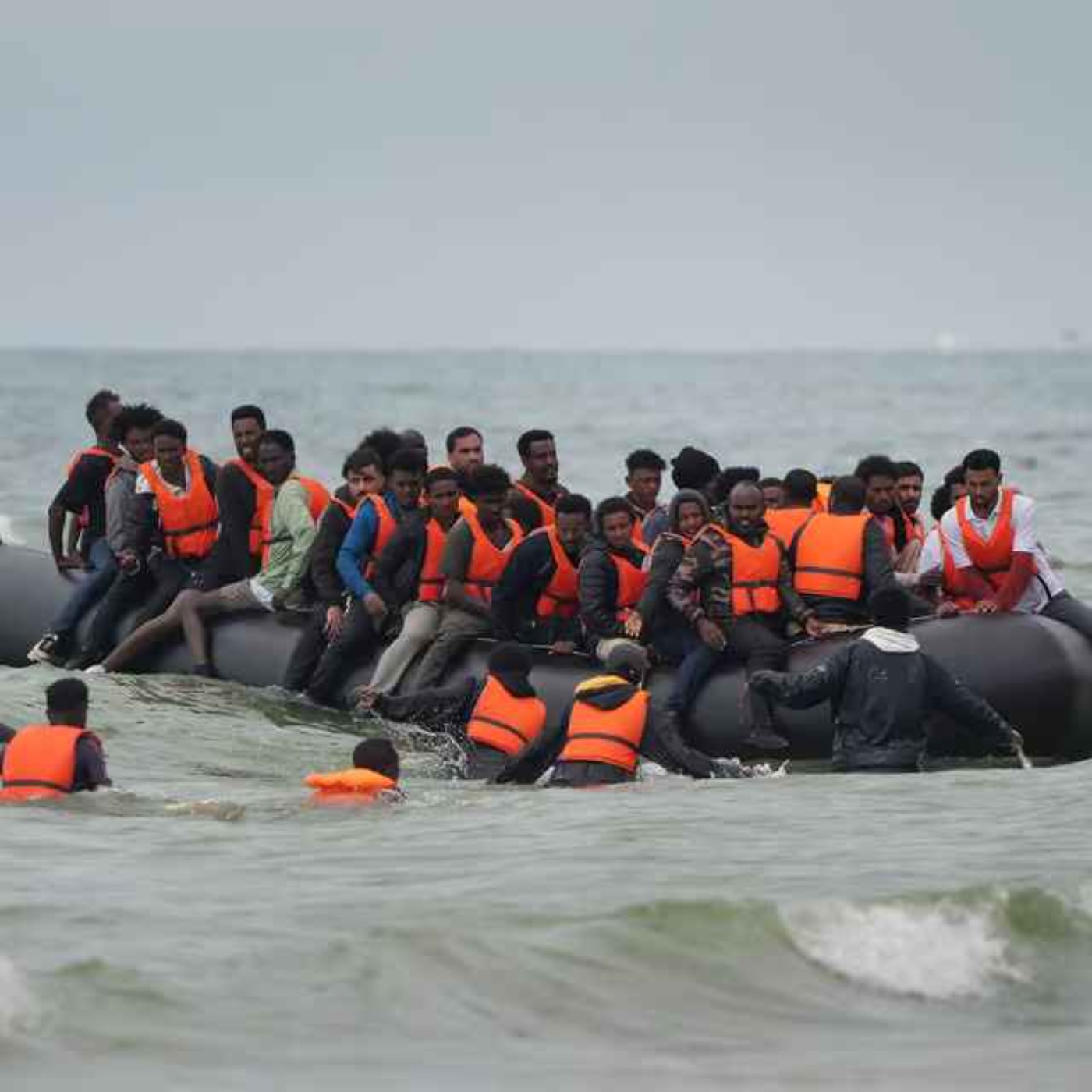
0:02Hi, I'm Charlie Duffield and welcome back to The Standard Podcast. If you're new here, hit follow and give us a rating. For all the latest news, head to standard.co.uk. Coming up later in the show. The National Gallery has invited members of the public to shape its future. But is this a good idea? But first, Sir Keir Starmer and Emmanuel Macron's one-in-one-out migrant deal comes into force today. Home Secretary Yvette Cooper has said that migrants who cross the Channel on small boats will be detained by the end of the week. She has declined to put a figure on the number of migrants who will be returned to France, but it's been widely reported that 50 people per week could be sent back, in contrast to the weekly average of more than 800 people arriving on UK shores this year.
0:58For every person that is detained and deported, the UK will allow the safe passage of one asylum seeker, provided they have not attempted a crossing before and subject to documentation and security checks. Here's the Home Secretary speaking on BBC Breakfast. This is a pilot scheme. The numbers will start lower and then build. But we're clear, this means for the first time, people who arrive on these dangerous and illegal small boats can be returned to France. They will be first detained. They'll be detained immediately on arrival and then detained and held until they are returned to France. And in exchange, we will take people who have applied lawfully, who have been through security checks and a proper legal process.
1:43I think that is the right principle. We're not setting out what the numbers will be at this point for two reasons. First of all, because those numbers will vary and will increase and we haven't fixed an overall number for the scheme. we obviously want it to increase as much as possible. But also secondly, because we're not going to provide operational information about which numbers, which days that the criminal gangs will then simply use in order to continue to ply their vile trade in human beings. Their aim will be to make asylum seekers believe the risk of going back to France is so big that they shouldn't bother parting with their cash and paying smugglers to make the crossing.
2:25Starmer said the plan was a product of months of grown-up diplomacy and would deliver real results. But the Shadow Homes Secretary, Chris Phil, said the deal would return just 6 % of illegal arrivals and make no difference whatsoever. As of July, more than 250 ,000 people had crossed the channel in small boats in 2025, which is about 49 % higher than at the same point in 2024. The deal has been criticised by refugee charities who have urged the government to provide more safe, legal routes for asylum seekers instead. Joining us now is Daniel Sohage, a specialist in international refugee law and protection, and the director of human rights organisation Stand For All.
3:12How will this UK-France migrants' return deal work? The basic plan, as they've announced, is that if people are arriving via small boats, they can now be detained and then removed back to France, in response to which the UK government will then bring somebody else over from France who's already sort of semi-being processed over there for their asylum claim. We're hearing reports that it's probably going to be a maximum at the moment of about 50 people per week that they're looking at for this, and it's included in part of a£100 million deal that they're doing. How effective will it be in deterring people from making the dangerous journey across the channel?
4:14a cycle of people who gangs can prey upon. And not just smuggling gangs, because smuggling gangs take money normally upfront. So it pushes people more towards trafficking gangs who take their payment via long-term exploitation. So rather than resolving an issue, this actually risks creating a new issue, because trafficking only accounts for about 1 % of channel crossings. So it's liable to actually increase that. Tell me more about that. We hear a lot from politicians and the media conflating smuggling and human trafficking, but they are actually two separate things. Smuggling has to take place across an international border, for example.
4:51Trafficking doesn't. So when you conflate trafficking as an immigration issue, you mistake and misrepresent what it is. In the UK, the majority of people who are trafficked are actually UK citizens trafficked in the UK. So it creates a misnomer, a misidentification of what trafficking is. But trafficking itself involves the long-term exploitation of people. So traffickers will, rather than taking an upfront payment, they will take their payment by forcing people into positions once they have arrived. We have a thing where people are not meant to be prosecuted necessarily for actions they're forced into while being trafficked.
5:26But we're seeing that going by the side at the moment and seeing trafficking victims being picked up and penalised for it. But these are people who are forced into it. And trafficking you can think of in a way almost like domestic abuse, the way the same methods are used of coercive control and fear. So traffickers will break people down and make them say, look, we are the only people you can come to. You can't go to the authorities. So it creates this long-term cycle. Whereas smuggling is more of a one-off transaction. It can lead to exploitation because it can cost a lot of money and people go into debt to do it.
5:58But smuggling itself, they are taking payment for that one journey. So what do you want the government to do? We'd like to see the government making it safer and simpler for people to seek asylum in the UK without being forced to rely on gangs. Everybody agrees we need to reduce channel crossings. The number of deaths in the channel has been going up and we want to tackle gangs. But unless you give people an alternative that they see as a viable alternative, then it just keeps pushing more people towards the gangs. Now, what this one-in-one-out policy shows is that the government has the ability to bring people across safely.
6:36So if they were doing that, instead of focusing upon this whole rhetoric of smash the gangs, but actually ensuring that people could reach the UK safely to have their claims processed effectively, then that's going to take away a major part of the business model of gangs. And basically, that is the way to destroy them, while also providing protection for those who need it. What are your thoughts on the asylum seeker protests we've seen this summer? Integration policies. They have been massively underfunded. What's been shown is that these policies, local community schemes, for example, they cost less than some of the other policies we're seeing, but they help reduce tensions within communities, help provide infrastructure and support for the whole community.
7:18There are people protesting outside hotels. They are fearful for what's happening in their communities because of deprivation, a lack of infrastructure, a lack of resources. That's not down to the people who are forced into hotels, because asylum seekers don't have a say where they're placed. And it's not all asylum seekers go into hotels. It's only those who are unable to support themselves. But we're seeing these protests. There are those on the far right who we know are involved in some of these and trying to weaponise this issue and making it worse. Now, the government could be trying to detoxify the rhetoric, put in place policies that help with integration, help reduce community tensions.
7:55And that's where they need to be focusing on this so that everybody is supported. But just this continual rhetoric about smashing the gangs increases the salience of those who are deliberately trying to weaponise this issue to create division in communities. Finally, do you have anything else to add? I think it's really important to mention that we're spending£100 million on the latest, what they're calling a temporary solution. But there is one policy that could really make a huge difference, and that's providing the right to work for those who are seeking asylum. Now, we're seeing delivery drivers being attacked at the moment because of the government saying, oh, people are working illegally.
8:35But if you provide people with the right to work, it's estimated that between reduced government expenditure and increased tax revenue, it could bring in about£8 billion per year. Now, that's money that could be going into communities to solve a huge range of other issues, such as homelessness, such as issues that people are legitimately concerned about. Let's go to a break. Coming up in part two, one of the greatest art galleries in the world wants Ordinary People to help curate its content. We'll see you back here in just a moment.
9:20Welcome back. From Leonardo da Vinci to Vincent van Gogh and Claude Monet to Paul Cezanne, since 1838 London's National Gallery has showcased first-class art for everyone to enjoy in the heart of the capital. From our origins in a private house in Pall Mall to our current home in bustling Trafalgar Square. Over many decades of transformation and development, there's been one steady focus. We acquire, display, research and care for a great collection of paintings for this nation and beyond. Children and families, scholars, tourists and art lovers and all those who explore our collections and exhibitions online from afar.
10:05The National Gallery belongs to all of us. It makes the great heart of the past present to us. It enables us to experience works of remarkable beauty and skill, to learn, to enjoy, to wonder, to be more connected to each other. That was a clip from the documentary mini-series, 200 Years of the National Gallery, featuring the director, Sir Gabriel Finaldi. But now the cultural institution has announced that it will use a citizens assembly to help shape its future as part of a pioneering five-year partnership called ng citizens initially 50 participants will be selected by a civil lottery with invitations sent out to 15 000 households nationwide the final group will reflect the wide diversity of the uk including those who have never engaged with the gallery before joining us now is the Standards columnist and arts critic Melanie McDonough.
11:00Melanie, what was your initial reaction to this news? My initial reaction was dismay because it's eliciting a response that it has probably already decided in advance. So it's not a neutral exercise in that it's embedding this Citizens' Assembly right into the decision-making and almost the governance process of the National Gallery. And I think that could actually be damaging. Do you think Citizens' Assemblies ever work? No, never. You don't actually require the sexicide and suzo democracy. You just ask the people who come through your door. So when a government doesn't, it's because it wants to have some spurious organisation which will give it validation to do something it wants to do already.
11:42If it's simply an open-ended inquiry, then it's not going to be particularly productive when it's done with people who don't necessarily visit galleries already. And as I say, if you want to ask people like that what they think, there are umpteen ways of doing it. Just stand outside a football stadium and ask people to come out saying, why don't you go to the National Gallery? And you can probably find them saying, because I'm more interested in football, which is fair enough. This is no way to run a really important institution. And it is fake democracy. It's like the Catholic Church going through this very odd listening exercise called synodality, which again was self-selecting because it was based on the people who were actually active in the first place and who had time on their hands, who wanted to take part.
12:20And then it was based on people who could actually collate responses and produce the recommendations. And I think that as an exercise, it is spurious and it's a waste of money. It's bureaucratic and it's a waste of time. And there are any number of ways of consulting the public and doing it better. The exception, of course, is when there's some project like the Rodin Centre for the Creative Arts, I think it was. And that's an area where children and groups can come engage with art and do educational sessions in that centre. And there, I think, it's perfectly appropriate to ask children what they think, to ask parents and teachers what they think, because they know what children want and what this sort of setting could best achieve.
13:04And this project follows on from regional initiatives. Tell us more about that. Birmingham Citizens Jury, I think, and that was done for Birmingham Museums. They came up with self-evident approaches like both Wall Street or social media strategy, increase the level of physical promotion, and enable experiences that are educational, improve knowledge and experiences that are fun and entertaining, and offer escapism. Don't want us for the National Gallery to go down to this level where they're offering experiences that are fun and entertaining and escapism. That may be a byproduct of its actual job, which is to display its permanent collection, which is absolutely wonderful, and it's free.
13:39Exhibit that as well as it can do, and then to have exhibitions that genuinely do give us a better insight either into an artist or a period or a movement and how to do that well. What you can do is ask people who've been to the gallery what they think or who've been to an exhibition what they think, but you can't actually expect members of the public to provide any direction for the gallery, any knowledge of art or any cultural formation in those two core activities because they're not actually equipped to do it, which is not any kind of judgment on the people taking part. It is a judgment on the gallery.
14:11People running the show are the people who know what they're doing, namely the director.
14:18And that's The Standard. For all the latest news, head to standard.co.uk. If you'd like to get in touch, please do drop us a line at podcasts at standard.co.uk. We'll be back here tomorrow at 5pm. We'll see you then.
Sir Keir Starmer and Emmanuel Macron's migrant deal comes into force today, with detentions set to begin from tomorrow. The ‘one in, one out’ pilot scheme allows the UK to send some people who have crossed the Channel back to France, in exchange for asylum seekers with ties to Britain. Daniel Sohege, a specialist in international refugee law and protection, and the director of human rights organisation Stand For All, joins us to discuss whether it will deter people from crossing the Channel.
And in part two, The National Gallery has announced that a citizens’ assembly will help shape its future. The Standard’s columnist and arts critic, Melanie McDonagh shares her thoughts.
Hosted on Acast. See acast.com/privacy for more information.


