
 Ask ChatGPT



In this episode of The Standard, host Helena Nawadier discusses two main topics:
Written by AI. May contain mistakes.

Get the gist, explore an idea or ask about something said.
 Claude
On The Standard, what are the key points of this episode?
Searching your listeningAutomatic transcript. May contain errors.
0:04Hi, it's Helena Nawadier and welcome back to The Standard Podcast. Coming up, extreme changes in average incomes in East London. Is the area and our capital becoming increasingly unaffordable? Obviously for any city to work, you need people on a range of income levels, doing a range of different jobs. And if people doing really essential work just aren't able to afford to live in London, what happens to basic services in the city? What happens to people's life in London? We'll be joined by local democracy reporter Noah Vickers to discuss which London neighbourhoods are gentrifying the most rapidly.
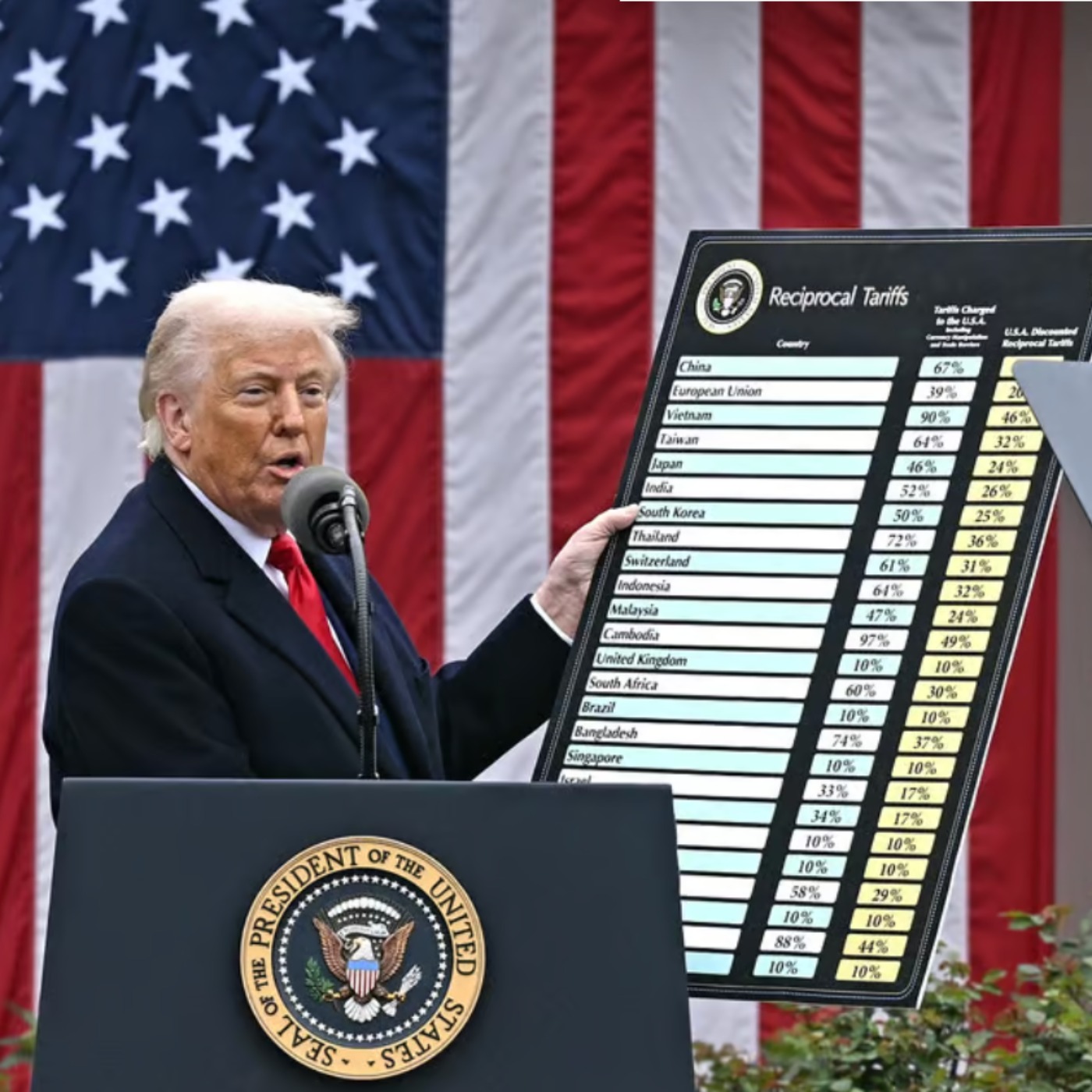
0:47But first, US President Donald Trump unveiled a series of new tariffs today, potentially escalating a global trade war and reversing trade arrangements that have been in place for nearly eight decades. Speaking from the White House Rose Garden, Trump referred to so-called Liberation Day as the day America's destiny is reclaimed. My fellow Americans, this is Liberation Day. Waiting for a long time. April 2nd, 2025 will forever be remembered as the day American industry was reborn, the day America's destiny was reclaimed and the day that we began to make America wealthy again. Going to make it wealthy, good and wealthy.
1:39What does this mean for the UK? Though a post-Brexit Britain has escaped the far harsher tariffs levied on the European Union, a minimum 10 % trade barrier into the world's biggest national market has still been put in place. The Prime Minister, Keir Starmer, said the 10 % tariffs will have an economic impact amid fears of thousands of job losses. In the UK car industry alone, thousands of jobs are feared to be under threat after Trump imposed a 25 % tariff on all motor imports into America. Speaking to business chiefs in Downing Street today, the Prime Minister stressed that the government would fight to strike a trade deal with the US which was in Britain's national interest to avoid the tariffs.
2:27Last night, the President of the United States acted for his country, and that is his mandate. Today, I will act in Britain's interests with mine. Let's find out more now about the move, the responses, and what this means for future trade with the London Standard's business editor, Jonathan Prynne. Hi Jonathan, thanks for joining us. Hi Helena, it's a pleasure. This announcement on tariffs came late last night. How expected was it? Well we knew it was coming. President Trump has been flagging this so-called Liberation Day imposition of tariffs on what he describes as the friends and foes that have been ripping off America for decades.
3:10So we knew there was going to be a big announcement. And I would say that it's possibly been the level of the tariffs is possibly heavier and more punitive maybe than economists had been expecting. So as a result, you've seen stock markets fall quite heavily around the world today. But the general shape of it was well flagged. And how bad is this for the UK versus, for example, China or the European Union? Well, the UK has escaped relatively lightly, actually. I mean, in as much as a 10 % tariff on your biggest single export market is ever light. But 10 % is the lowest rate that the Americans imposed on any country.
3:55A lot of America's big trading partners, particularly Canada, Mexico, European Union, which got 20%, and China, which has got tariffs now over 50%, have been hit far harder. There's a couple of caveats on that. But although it is a general 10 % tariff for UK exports to America, there are some exceptions to that, which are cars and car parts, which are 25%, and steel and aluminium, which are also 25%. Those were separate tariffs that were announced a few weeks ago, so we already knew about them. But for more or less everything else, the one or two exemptions, such as medicines and so on, it's 10 % across the board.
4:40But as I say, that's at the lower end of the range. Our neighbours in Europe, on the continent of Europe, got hit with 20%. So it could have been worse. Can you help us to understand the scale, the magnitude of these new tariffs being put in place? Well, I mean, it's immense. Essentially, since the end of the Second World War, the world has been an increasingly free trade place. The European Union obviously has been a total free trade zone for 20 or 30 years. But generally across the world, the trend that we call globalization, I suppose, has been what has dominated trends in global trade over the last 70 or 80 years.
5:26There's been huge efforts to open up trade. And the general recognition of free trade is better for the world as a whole. It needs to better prosperity and growth, although there are always going to be losers like, you know, the American car industry, which has suffered terribly because of imports from the Far East and Europe in particular. And it's those kind of areas of suffering that Donald Trump is now hoping to fix and get, you know, get them prosperous again, but at a terrible, terrible cost to the global economy, unfortunately. So it's kind of 70 or 80 years of a free trade direction of travel has come to a juddering hole.
6:07And I think most economists would say we haven't really seen anything like this in terms of protectionism since the 1920s and 30s. And that led to a global depression. So let's hope we don't go down that route. How has the Prime Minister Keir Starmer reacted? Well, it's been quite a cautious reaction so far. There's been no imposition of retaliatory tariffs, although that's still a possibility. I think we're still in the middle of very, very delicate talks about a potential free trade deal between America and the UK. So he doesn't want to upset those at this stage. Let's see how things pan out in the next few weeks.
6:49If we can reach a deal with the Americans, then the decision not to retaliate will look like a sensible one. And I think the risk is if we retaliate now, those talks could suddenly be put in jeopardy and all the progress made towards a UK-US deal would be for nothing. And is this the same reaction that we've seen from the European Union? No, the European Union are talking much more aggressively. I mean, the European Union is a really formidable economic bloc between them. They have huge economic power. Obviously, we're not part of that anymore. But Ursula von der Leyen was saying very clearly this morning that, you know, the European Union will draw up some very, very tough retaliatory measures, which I suspect we'll see quite soon.
7:37The danger is, of course, that then that triggers another round of counter retaliation from the Americans. And who knows where it all ends. But yeah, I think I think Brussels will announce some very tough responses in the coming days. Now you mentioned the car industry and the higher tariffs on car parts. Are jobs in the UK at risk in the UK car industry? Sadly they are. I mean the car industry is saying it could be as many as 25 ,000 jobs that are potentially in jeopardy as a result of this. Most of those are not actually close to London. Most of the motor manufacturing or motor component manufacturing in the UK is sort of more in the Midlands or the Northeast.
8:27So it's not at all good for those regional industries. And it's terrible, really. we export about six billion pounds worth of cars and car components to the to the US each year which is significant but not by you know not the biggest sector of UK exports to the US it tends to be more at the higher end the sort of the Jaguars and the Aston Martins and so on but also the minis and some more, slightly more mass market marks will also be affected. So, I mean, we have to wait and see. But on the face of it, it doesn't look good at all for the UK motor manufacturing sector. What is the worst case scenario for the UK after Trump's 10 % tariffs?
9:21Yeah, that's a good question. Well, interestingly, last week at the time of the spring statement, The Independent Office for Budget Responsibility put out three scenarios, a good case, a sort of medium case and a bad case. The bad case has kind of 20 percent U.S. tariffs, followed by 20 percent retaliation sort of pretty much globally. And that could well be where we're heading, although for the U.K. it's only 10 percent. but their worry was that the impact on the global economy would be would be enough would be tough enough and and severe enough to knock about a whole percentage point of uk gdp growth now the worry about well that's bad enough at any time but when your economy is only managing about one percent growth or just over anyway um you know you're you're left with a with an economy that's essentially flatlining.
10:20At the moment, we need all the growth we can get to generate tax revenues and so on to help balance the government budget and so on. So it's, yeah, 1 % loss of growth in, I think they were saying 26-27, would be very, very serious for the UK economy. Okay, and finally, how long are these tariffs expected to last? And could there be a new trade deal on the table? There could. I mean, Donald Trump, ever the dealmaker, he's left it open for countries to come back on a bilateral basis and say, well, OK, we will reduce our trade barriers. And in return, would you lift these punitive tariffs? And I think some countries will definitely do that.
11:10So I think it is possible that in the coming weeks and months, we will see some lifting of some of the barriers on individual countries. It seems unlikely that the really big trading partners of America, China, EU, Canada, Mexico, are going to come and offer to reduce their trade barriers anytime soon. It really does seem like they are all in it for a long term fight to the death, as it were. But I think you will see some individual countries in the UK could well be in that group of doing bilateral deals that kind of gets them off the hook a bit. Hopefully, as ever with Trump, this is a massive negotiating tactic.
11:57And he will hope and the American economy will certainly hope that these will be eased back over the coming weeks. but it's high stakes so nothing is certain. Let's go to the ads. In part two, are families and long-standing communities being priced out of London on an unprecedented scale? We'll be joined by local democracy reporter Noah Vickers to discuss new analysis on a gentrified London. We'll see you back here in just a moment.
12:39Welcome back. New research has revealed the 53 London neighbourhoods which have gentrified the most rapidly over the last decade. The analysis, published by the Trust for London charity, found that areas across the East End, Southwark, Brent and Haringey saw the most extreme changes in average incomes between 2012 and 2020. The report also pointed to the stark threats of gentrification, including an inability to raise children in the capital and diverse communities being priced out of areas they've called home for years. Well, to talk us through the report, which area tops the list and what it means for London more generally, we're joined now by the London Standard's local democracy reporter, Noah Vickers.
13:27Hi, Noah. Thanks for being here. Hi, Helena. So tell us, how has the Trust for London charity conducted this research? Well, this is a really interesting piece of analysis because they basically looked at average incomes in different parts of London back in 2012. And then they've revisited those same areas, looking at the data on how incomes have changed in 2020. So we're looking at an eight year time period. And they're using this because they want to get a better understanding of how gentrification is changing London. And what they mean by gentrification is that it's where you see an influx of more affluent residents in lower income areas relative to the residents that were already there.
14:11And that causing essentially the displacement of the previous population. OK, so tell us what came top of the list? What was the most gentrified borough or area? Top of the list in terms of boroughs really was Tower Hamlets. That's home to 12 of the 53 neighbourhoods that were identified in the research as having gentrified the most. So the top three local council wards are all found in Tower Hamlets in that respect. they are Spittlefields, which saw a staggering 45 % rise in the average pay of people living there, followed by Aldgate with a 29 % increase and Bethnal Green South at 27%. It's worth saying, on average, these 53 areas across London saw an 11 % rise.
14:56But when you compare that to the rest of London, in real terms, so adjusting for inflation, the rest of London has only seen a 1 % increase in their average incomes. And are there any boroughs or areas on the list that caught your attention? I think East London really tells an interesting story about how London has changed. This was previously and still contains significant areas of deprivation, but the area is changing and has changed fast over the last decade or so. You can see that in the analysis that the Trust have produced. Areas not just in Tower Hamlets, but also in Newham, and pushing towards further north-east areas around Hackney, Manor House and Woodbury Down.
15:40So I think it really tells a story about how previously, you know, areas that might not have been considered desirable in sort of estate agents' guidebooks have fast become some of the most desirable parts of London to live in. And the effect it's had is pushing out some of the less well-off residents who simply can't keep up with the afford to, you know, the sharply rising cost of housing in those places. Let's take a look at the trust's population analysis. So there was some interesting analysis here about family life and the number of couples without children. Can you tell us about that? Yeah, there were some really fascinating and slightly dark trends identified in this research.
16:19So looking first at, you know, couples not having children or perhaps choosing to have children later, that's clearly gone up in these gentrified areas. So that's what you see as, you know, housing costs go up and housing in general becomes less affordable. people choose not to have children or they choose maybe to have children later or to move out and have children in a more affordable place or an area where they can afford to you know to have more space a garden possibly so looking at the analysis you can see that the proportion of couples without children increased on average by more than two percent which is disproportionate to the rest of london that ties in with other patterns we've seen in london which tie into that So the decline of primary school applications, for example.
17:03And just last week, we saw the closure of the maternity unit at the Royal Free Hospital in North London as a result of declining birth rates. There was also some analysis about London's communities in terms of race. Can you tell us about those trends? Yeah, this was very stark. So what the analysis found was that in these 53 gentrified areas, there was a 2 % decrease in the proportion of black people living in them. despite the fact that London's black population stayed essentially where it was between 2012 and 2020. So this shows that these places are out of step with the rest of London in that respect.
17:41And actually, I found this really staggering. The Trust found that this 2 % decrease equates to around 10 ,000 black Londoners that we would have seen living in those 53 neighbourhoods if the proportion had stayed the same. Now, it is also true that the white population in these gentrified areas fell by an amount of more than 4%. But this was still a smaller fall than we saw across the rest of London, which was about 6%. So actually, even though the white population decreased by a larger amount, it was still a disproportionately small fall, if that makes sense. So it shows how the demographics in these areas are different to the rest of London.
18:20The patterns that we're seeing across the city aren't necessarily being replicated in these places. Or another way of putting it would be those patterns are being especially accelerated in these 53 areas. Well, finally, what does the research tell us more generally about London's affordability? It shows that London is becoming an increasingly unaffordable place to live. That's definitely the conclusion the Trust have reached. And it also shows that in some ways, London's blend of communities is becoming less diverse in certain places if some of these neighbourhoods only become areas that some people on particular salaries are able to afford.
18:59That affects the sort of makeup of the city more widely. And it also puts the ability to enjoy London and for London to be a sort of functioning city at risk. Because obviously for any city to work, you need people on a range of income levels doing a range of different jobs. And if people doing really essential work, key workers, you know, working in hospitals, cleaning, working in hospitality, just aren't able to afford to live in London, what happens to basic services in the city? What happens to, you know, people's life in London? So it raises some really important questions about how we can keep London as a city for everyone to access and be able to stay in, you know, especially if they've grown up here.
19:41and it'll raise, you know, really important questions for politicians looking at how they can respond to it.
19:51And that's The Standard. For all the latest news and to read more about the stories featured in this episode, head to standard.co.uk. If you'd like to get in touch with us, we'd love to hear from you. Drop us a line at podcast at standard.co.uk.
20:13We'll be right back.
US President Donald Trump unveiled a series of new tariffs today, potentially escalating a global trade war and reversing trade arrangements that have been in place for nearly eight decades. A 10% tariff has been placed on the UK, as a post-Brexit Britain escaped the far harsher tariffs levied on the EU. The London Standard’s Business Editor Jonathan Prynn talks through the responses and repercussions.
In part two, which London neighbourhoods have gentrified the most rapidly? Local Democracy reporter Noah Vickers analyses new research about the capital’s affordability.
Hosted on Acast. See acast.com/privacy for more information.


