
 Ask ChatGPT



The Standard podcast, based in London, features discussions with top news insiders on various topics, including politics, culture, sport, and fashion. The show promises unmatched insight from award-winning journalists and celebrity guests. Episodes are released Monday to Friday at 4 PM.
Written by AI. May contain mistakes.

Get the gist, explore an idea or ask about something said.
 Claude
On The Standard, what are the key points of this episode?
Searching your listeningAutomatic transcript. May contain errors.
0:02Hi, I'm Charlie Duffield and welcome back to The Standard Podcast. If you're new here, hit follow and give us a rating. For all the latest news, head to standard.co.uk. Coming up later in the show, our theatre critic reviews the Tony award-winning Broadway show Goodnight Oscar, which is showing for seven weeks at London's Barbican Centre. What do you do for exercise? I stumble, then I fall into a coma. What people do when they're surprised, shocked and uncomfortable? I have a feeling you're going to tell me. They laugh.
0:53But first, the Bank of England has cut interest rates, taking the cost of borrowing to its lowest levels for more than two years. It's the fifth cut since last August, down to 4 % from 4.25%. Put simply, interest is the extra amount you get charged when you borrow money. A lower base rate can reduce monthly mortgage costs for some homeowners, but it also means a smaller return for savers. Chancellor Rachel Reeves says the government is putting more money in people's pockets. But the Conservatives say rates should be falling faster. It comes amid a growing divide between policymakers over the dangers to the economy from high inflation and rising unemployment.
1:38Joining us now is Theo Harris, an economist at the New Economics Foundation. Theo, how is this interest rate cut going to affect people's finances? There's two ways in which the interest rate cut would affect people's finances principally. The first is that people with savings accounts are likely to see the interest rate decrease ever so slightly in the near term future. And so they'd be receiving less money, less interest. The second is that for borrowers, particularly people with mortgages, for example, they will see a decrease in the interest rates on their mortgages and hence more money in their pocket and cheaper financing to buy houses.
2:12But the important thing to note is that effect of reducing mortgage rates takes a long time to pass through from the bank's decision to cut rates by 0.25%. Many mortgages are fixed for a number of years, and so it will take until people remortgage, until they see their rates go down. So the effect of that in terms of improving people's personal finances is likely to be delayed by six months and even over a year. This is the fifth cut since last August. Will there be more cuts? I would expect to see one more cut this year and another one early next year. But actually, I would argue that the cuts should be happening faster than they currently are.
2:49And I would hope for a 0.5 % cut today, although we're more likely to see a 0.25 % cut. And that's because, as I mentioned before, the impact of interest rates can take time to feed through to the economy. And we've had these very high interest rates up around 5 % for an extended time. And that's not worked all the way through into the economy yet. And so I worry that keeping them too high for too long risks depressing the economy and impacting people's personal finances too deeply for too long. Tell me more about that. The central bank sets a headline interest rate, which then affects all the different interest rates through the economy, like what banks charge on loans or offer on savings or what the government can borrow money at as well.
3:32And for a very long time after the financial crisis, we had extremely low interest rates and then the pandemic as well. But then as we saw the inflationary surge driven by fossil fuel prices and supply chain pressures after the pandemic, inflation went high. And the way our framework for controlling inflation works is that in response to the central bank raises interest rates. So then very quickly, interest rates went from 0.25 % all the way up over 5 % within about a year from late 2022 to mid 2023. And so then interest rates are very high. And that means that, for example, people with mortgages are then paying more interest and have less spending power.
4:08So they're less able to afford those high prices in the economy. And so it makes it harder for those prices to keep rising. And similarly, it makes it harder for businesses to borrow money to invest in new projects. And that often results in them cutting their workforce. And so this tends to lead to a rise in unemployment and to depress wages downwards. And it's principally through these mechanisms of depressing wages and depressing people's spending power that central banks hope to defeat inflation by raising interest rates. And what I would say about that is, while it may eventually be effective in controlling inflation, it's not a particularly fair or arguably democratic way of controlling inflation where you say, OK, we have this high inflation and the way we're going to control that is by making people who are already impacted by the cost of living crisis and high inflation have even less spending power.
4:59So what needs to happen to improve the economy? We're definitely in a bit of a bind when it comes to the economy and in a tricky situation. I think a large part of that is the fact that our inflation targeting framework, where the only tool is to raise interest rates in order to combat inflation, even when that's coming from things which aren't themselves directly impacted by interest rates, like fossil fuel prices or supply chains and international import prices, which we were seeing were the main drivers of inflation after the pandemic. the fact that we're using this interest rate mechanism to try and control this inflation is then purposefully depressing growth, causing higher unemployment, weakening people's wages and spending power.
5:40And that is putting dampening pressure on the economy. And that's the explicit objective of having high interest rates. But it's sort of like the saying, if you have a hammer, every problem you see is a nail. And I would say that the tool of interest rates is a blunt tool in a similar way for dealing with inflation. And it kind of means whatever the cause of inflation, the whole economy is going to pay with high unemployment, weaker growth, lower business investment. And I would argue that what we would need is a more targeted and proactive way of dealing with inflation that is not just the bank, but also requires coordination with the government in terms of intervening in those supply chains and thinking ahead of time for how to prevent inflation arising in the first place.
6:18For example, the main inflationary crises we've seen over the course of decades have all been driven by fossil fuel crises and global oil and gas prices. And so one of the key ways we as a country could be better insulated and protected from external inflation like that would be to be less reliant on fossil fuels. So I also think there is this kind of supply side inflation preparedness aspect, where if we can be less reliant on imported fossil fuels, that would also improve our long term price stability. And then in the shorter term, in terms of what the government could do to improve the economic trajectory and prospects of the UK.
6:54I mean, we at NEF do a lot of work on justifying why green investment and also social spending should be considered as forms of investment, which will be really productive for the economy. And like the economy needs a bit of a kickstart and an injection of dynamism and growth in order to get things moving. And you see like not only physical investments and things like green infrastructure, but also investments in education and people's health in the prosperity of local communities. This can put money into people's pockets, can raise confidence, and obviously in the long run leads to a healthier, better educated population who will be more productive.
7:29So that's what we recommend when it comes to improving the economic prospects of the country. Anything else to add? When it comes to thinking about the Bank of England and its significance over the next few months, which is that we're all hearing a lot at the moment about Rachel Reeves, the Chancellor's fiscal rules, and how she's having to do this complex calculation about how she's going to make good on the shortfall in meeting her fiscal targets, and whether this means tax rises or breaking the fiscal rules and having increased borrowing or cutting spending. But actually, at the moment, the Treasury is sending over£20 billion a year to the Bank of England to make up for the losses that the Bank of England is making on the big quantitative easing program that it introduced in the wake of the financial crisis and during the pandemic.
8:15And this is not something that happens in the European Union with the European Central Bank or in the US with the Fed. In neither of those examples does the Treasury immediately pay the Bank of England for those losses. And that's costing Rachel Reeves at the moment, over£20 billion a year, on average, in our forecasts. Changing this indemnity agreement, which is the sort of formal term for the agreement, which means the Treasury pays that money, would be a way for Rachel Reeves to immediately find herself with more fiscal space and help solve part of that problem that she's facing. Let's go to a break.
8:49Coming up in part two, Will & Grace star Sean Hayes plays the troubled musician Oscar Levant in a Broadway import that explores fame, artistry and the fragility of genius. We'll see you back here in just a moment.
9:12Welcome back. The Will & Grace star Sean Hayes has impressed critics in Doug Wright's Broadway show Goodnight Oscar, which is now showing at London's Barbican Centre. It's 1858, and Jack Parr hosts the hottest late-night talk show on television. His favourite guest is the character actor, pianist and wildcard Oscar Levant. He's famous for his witty one-liners, and when Oscar appears live on national TV, it turns into an episode that Pa's audience and the rest of America won't forget. Here's the trailer.
10:05me or they hate me. What have you been doing with yourself lately? Well, my behaviour's been impeccable. I've been unconscious for the last six months.
10:16To find out more, I spoke to The Standard's chief theatre critic and co-host of the London Theatre Review podcast, Nick Curtis. Nick, what is this play about? What's the story? It's about Oscar Levant, who was a composer, but primarily an interpreter of other people's works on piano, particularly George Gershwin, who always sort of overshadowed him. He was a character actor in films alongside Gene Kelly and Fred Astaire in the 50s. But most importantly for this play, he was also a very well-known and popular raconteur and comedian and one-liner merchant on live TV chat shows of the mid to late 50s.
10:53So what themes does it explore? Levant is being asked onto a chat show, even though he's on a day pass from a mental hospital where his wife has had him committed. Themes about genius versus madness, where the limits lie on television, whether comedy sort of tells truth to power and whether it should therefore be licensed. But it's also about this very one complex individual and his battles with himself, really. And how was Sean Hayes as the lead? Emmys for Will and Grace and has won a Tony for this one and was nominated for other works on Broadway before. He's totally transformed. If you knew him from Will and Grace, you wouldn't really recognise him in this.
11:28I mean, Oscar Levant is described by his own wife as Eeyore in a cheap suit. And that sort of wild-eyed, energetic character played on screen. Here he's this tick-ridden, lumpy, schlubby, multiply-addicted and depressed personality. Just totally, totally different. What did you love most about the production? It's a sort of consummate piece of Broadway entertainment. The play is kind of schematic and it endlessly sort of tees up one-liners for Oscar to sort of thwack away and into a sort of home run. It's very polished. It's very well done. It's a tremendous performance from him, including at the end of the day, Oscar spends most of the play refusing to play the piano because he's too tired and too scared and too worried and too anxious.
12:11But he does finally play Gershwin's Rhapsody in Blue, this song that has haunted him through his life, this piece of music that's haunted him through his life, and does this electrifying performance of it, which Sean Hayes performs live. He was trained as a concert pianist before he became an actor. and so the whole play sort of builds towards that moment which just does bring most of the audience to their feed. And what other recommendations do you have for us this summer? Evita is the show that everyone's talking about at the moment for multiple reasons. Coming up, of course, we have Tutti Gatwa, Doctor Who himself and Edward Blumel in Born With Teeth, the story of William Shakespeare and Christopher Mollo collaborating on a play that's produced by the RSC in the West End.
12:46There's lots of exciting stuff coming up. There's The Lady from the Sea with Alicia Vikander coming up at the Bridge Theatre, very rarely seen Ibsen play But I think it's going to get a lot more attention than it would do if it didn't have Alicia Vikander in it.
13:00And that's The Standard. For all the latest news, head to standard.co.uk. If you'd like to get in touch, please do drop us a line at podcast at standard.co.uk. We'll be back here tomorrow at 5pm. We'll see you then.
13:22Thank you.
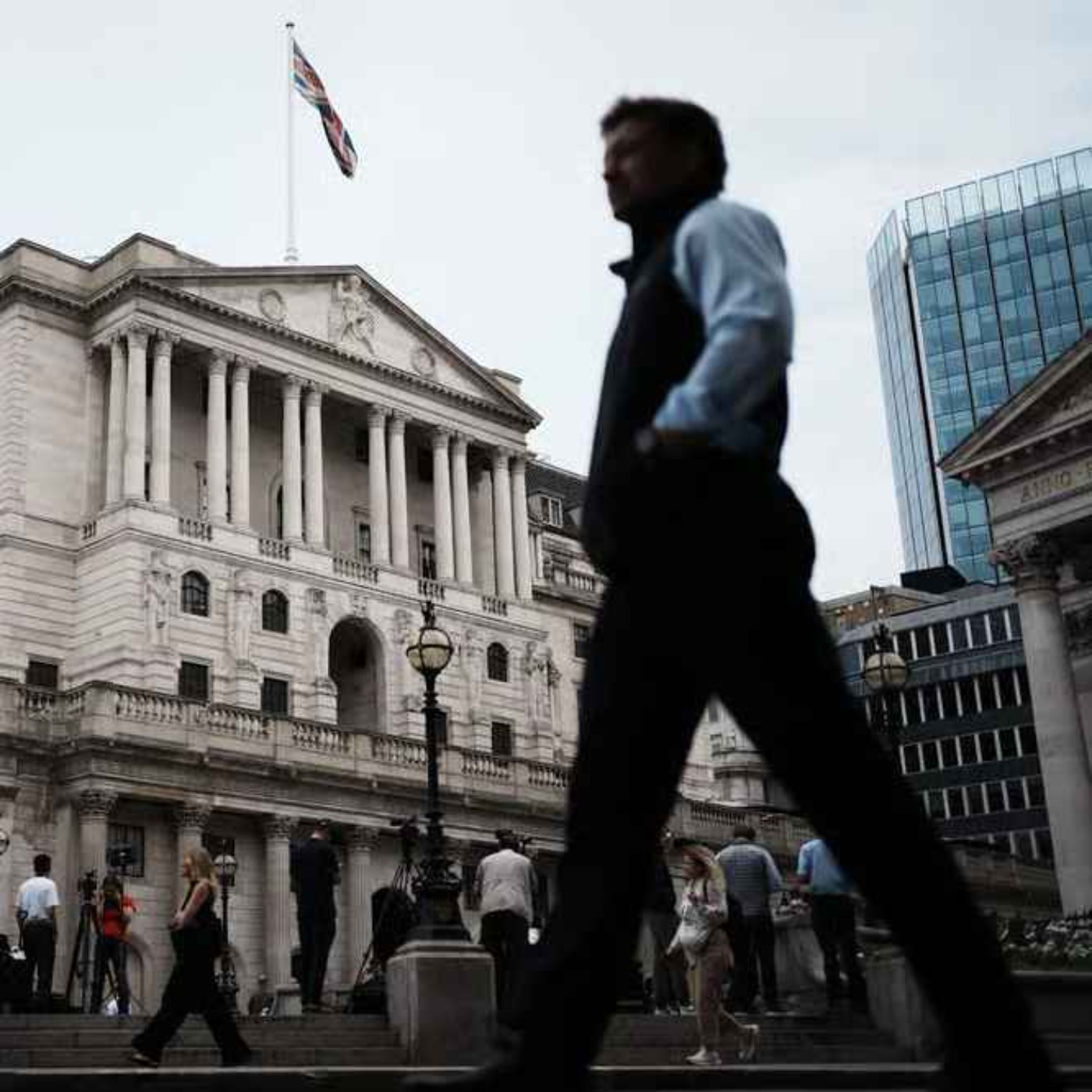
Millions of homeowners were handed a boost today when the Bank of England cut its interest rate from 4.25% to 4%. The reduction is the fifth over the past year, and brings borrowing costs down to their lowest since March 2023. Theo Harris, an economist at the New Economics Foundation joins us to discuss the news.
And in part two, Nick Curtis, The Standard’s Theatre Critic and co-host of The London Theatre Review Podcast, reviews broadway show Good Night, Oscar, which features Will & Grace star Sean Hayes as troubled pianist Oscar Levant.
Hosted on Acast. See acast.com/privacy for more information.


