
 Ask ChatGPT


 The Standard
23 Apr 2026 · 19m · 6 chapters
The episode asks whether Iran is a credible national security threat to Londoners amid recent attacks on Jewish infrastructure, including synagogues and charity ambulances, which the Met Police counter-terrorism unit is investigating. Jonathan Hall KC, a senior barrister reviewing UK terrorism and state-threat legislation, explains the legal line between hate crimes (attacks driven by hatred of protected traits like nationality) and terrorism (attacks carried out to advance a cause). He says online radicalization and proxy networks complicate enforcement, noting Telegram-based recruitment and “dirty work” by intelligence services. He argues the UK hasn’t prescribed Iran’s IRGC as a terrorist group because the Terrorism Act wasn’t meant to cover state components; he recommends new powers. Key examples include Wagner-related proxy prosecutions and the Miznon restaurant harassment in West London.
Written by AI. May contain mistakes.
Jonathan explains the difference between hate crimes and terrorist acts.
“Hi Jonathan, thanks so much for coming on The Standard Podcast.”
Discussion on the complexities faced by the Met Police in identifying acts of terrorism.
“Okay, thank you for making the distinction.”
Exploration of how the Iranian regime utilizes proxies for attacks in the UK.
“Iranian regime like a military, but effectively carrying out its functions.”
Learn why the IRGC hasn't been designated as a terrorist group by the UK government.
“Could you walk us through some of the reasons why the government has not prescribed the IRGC as a terrorist group?”
Explore the dangers of normalizing hatred and its implications for national security.
“And, you know, we've got anti-immigration marches on one side, we've got anti-fascism marches on the other side that actually tolerate extremists.”
Discuss whether current laws are sufficient to protect minorities from hate crimes.
“My worry is that ultimately I should not exist.”

Get the gist, explore an idea or ask about something said.
 Claude
On The Standard, what are the key points of this episode?
Searching your listeningAutomatic transcript. May contain errors.
0:00Have you ever been stuck on a weight loss plateau, trying everything and anything you can to lose that extra weight and reach peak health? We've all been there, but Noom's unlocked a secret to reaching the mountaintop. Go in micro. The Noom GLP-1 microdose program starts at$79 and is delivered to your door in seven days. Start your microdose GLP-1 journey today at Noom.com. That's N-O-O-M dot com. Noom. Microchanges. Big results. Thank you. connected and manual tools. Rippling is totally automated. If you promote an employee, Rippling can automatically handle necessary updates from payroll taxes and provisioning new app permissions to assigning required manager training.
1:11That's why Rippling is the number one rated human capital management suite on G2, TrustRadius, and Gartner. If you're ready to run the backbone of your business on one unified platform, head to rippling.com slash ACAST biz and sign up today. That's R-I-P-P-L-I-N-G dot com slash ACAST biz to sign up.
1:56Startup Angel competition in partnership with The Standard. Your business could be in with a chance of winning£25 ,000 in funding, expert mentoring from founders like me and business insurance for a year thanks to AXA and more. Entering is easy, just send us a short pitch video and answer free questions about your business idea. Search AXA Startup Angel to find out more and enter before 21st of June, 2026.
2:46There are theories circulating that the Iranian regime is paying thugs for hire to carry out attacks on Jewish infrastructure in Britain. So, is the UK equipped to deal with nation-state threat actors? Hi, and welcome back to The Standard Podcast. I'm Tamara Kormornyk. For all the latest news, head to standard.co.uk. Coming up, is Iran posing a credible national security threat to London?
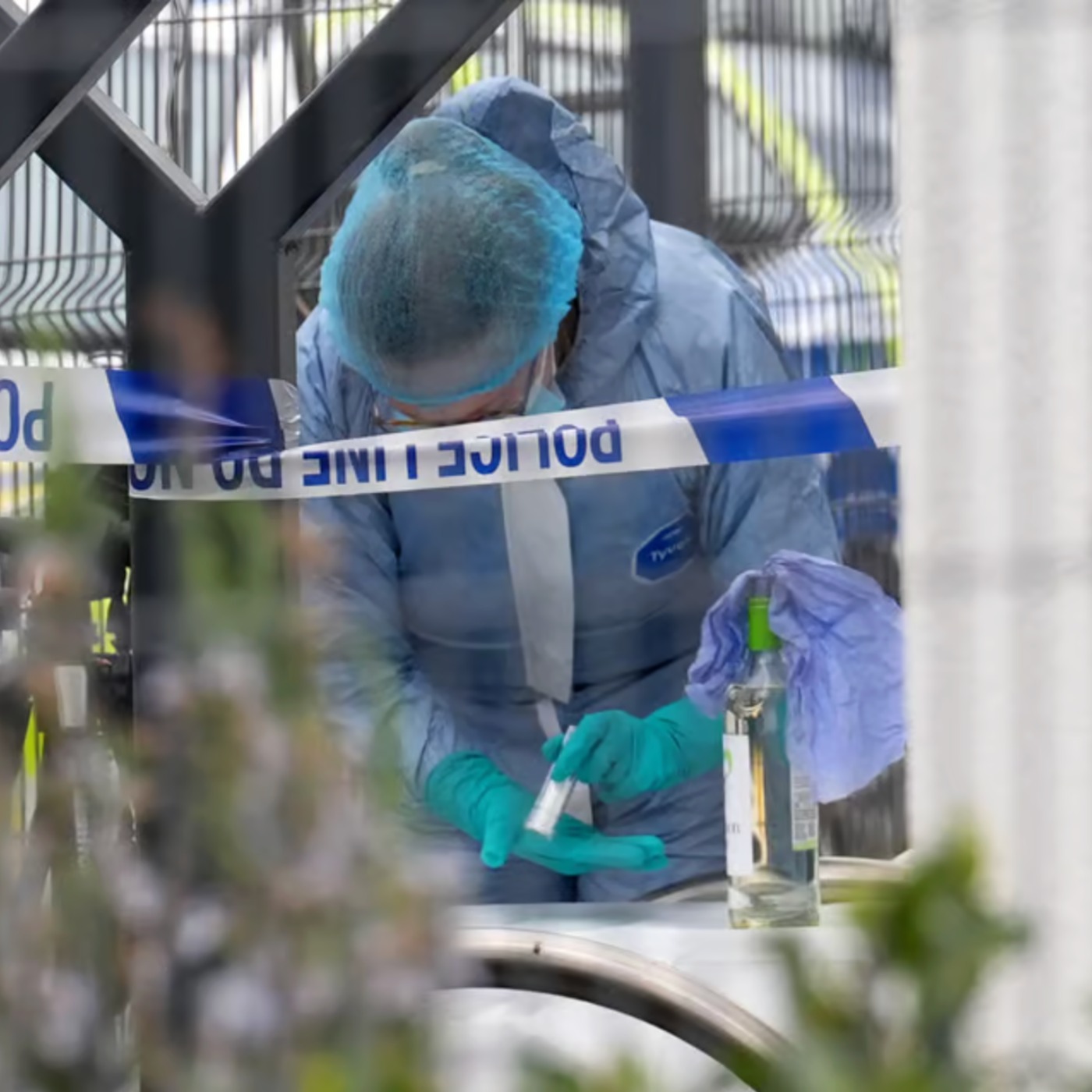
3:23The repeated attacks on Jewish infrastructure in London over the past few weeks has led to the opening of a Met Police counter-terrorism investigation.
3:34In this episode, I speak to Jonathan Hall, KC, who is the senior barrister responsible for reviewing the UK government's terrorism and state threats legislation. I wanted to know more about how the law separates hate crimes from terrorist acts, which tools the police can use to protect citizens against hate crimes and why the Islamic Revolutionary Guard Corps, the military wing of the Iranian regime, is not currently prescribed as a terrorist group by the UK government. Here's my chat with Jonathan.
4:10Hi Jonathan, thanks so much for coming on The Standard Podcast. Really happy you could make it today. Pleasure. So Jonathan, you are responsible for reviewing terrorism legislation and also state threats legislation. So the recent attacks on Jewish sites, including synagogues and charity ambulances, are currently being investigated by the Met's counterterrorism unit. I'd like to start by asking you where the line is between what is classed as a hate crime, for example, an anti-Semitic hate crime and a terrorist act? The answer is it's often hard to disentangle, but I'll have a go. So hate crime is where I go and attack someone, for example, just because I hate their race, ethnicity, nationality.
5:01Note nationality, by the way. It's often overlooked, but it's a hate crime under our law. If I attack someone because they're Israeli or Pakistani, it doesn't have to be just because of their race, it can be their nationality. But I haven't got any sort of bigger goal in mind terrorism is where i'm doing this in order to advance a cause so it might look to the outside world i go and i say i hate you you jew but if when let's say the attack happens and the police carry out an arrest and they get hold of their digital devices on their phone for example they find out the guy is a massive follower of islamic state then it might become apparent, particularly if there was some evidence that they were telling people what they were going to do, that actually they were attacking that Jewish person in order to advance the cause, which is to demonstrate the superiority of their particular view of Islam and to try and clear the Jews out of Britain.
5:55So if you've got a bigger purpose, terrorism, if it's just hatred, hatred. Okay, thank you for making the distinction. So in your experience, is it quite difficult for the Met Police to distinguish what is a hate crime and what is a terrorist act? So there are definitely cases, edge cases. It absolutely is difficult. And if you think back to the sort of origins of terrorism in this country, it used to be Northern Ireland. Now, it would be pretty straightforward, wouldn't it, in the Northern Irish context, back in the 1970s, 80s, 90s, if you had a Catholic band attacked on a bus and blown up, it was pretty clear from the targeting, wasn't it, that this was some ideological thing.
6:42And people were very happy to say, look what we've done and celebrate it. And conversely, the IRA would claim their attacks, people were part of a sort of quasi-military unit. And there were certain hallmarks of the way in which they carried out their attacks which meant that it was very clear that they were terrorists these days it's often much harder i mean we're thinking about the what's happening with hatzola then and the ambiences and the synagogues here you've got the additional complexity which is quite plausible isn't it that the the al-yamim group i'll call it a group it's certainly a presence online they may just be a sort of an aspect of the iranian intelligence system.
7:26And one of the complexities which I think came out very much in relation to the Wagner Group and in relation to Iran's Islamic Revolutionary Guard Corps is that there are distinctions in our law between terrorists and what officials like to call state actors. So traditionally, if you're part of a state, like a military or the spy agency, the UK government and our laws don't tend to say that that is terrorism. They might see it as an armed attack. They might see it as an act of war. They might see it as hostile state activity, but not terrorism. Al-Yamine sort of comes in the middle. I mean, it could be both in truth.
8:08It could be both a terrorist organisation, but also it could be part of the Iranian regime, or they're not part of the Iranian regime like a military, but effectively carrying out its functions.
8:26I know there's an investigation underway. There is noise around, you know, the possibility that the Iranian regime are paying for thugs to attack Jewish sites. I mean, how would the law treat that? You know, are they state actors? Are they terrorists? Yeah, yeah, yeah, yeah. Well, I think the first thing is, it shouldn't be a surprise to anyone that intelligence agencies have always looked for people to do their dirty work. And that is particularly the case where their own intelligence officers find it harder to operate. It's quite hard for countries like Russia and Iran to use their own officials in the UK.
9:12So in a way, they're driven to be creative. And what they do is they use the Internet to advertise on Telegram channels. Telegram is a social media platform. There are things called groups which people can join. They're public. And people will go on these Telegram channels. They will find offers to carry out attacks. So it's just an evolution of how intelligence agencies work. They've always had agents, haven't they? They've always recruited people. This is just a sort of modern form of recruitment. and so I have to say it is one of the really the tricky issues at the moment in terms of national security I think the two ones I would pick out first of all is just the internet generally and the impact that's had on the terrorist landscape people are willing to carry out attacks because of what they see online and become radicalized online and the second really hard problem is how to deal with with proxies now you asked me how the law would deal with someone if they're deliberately helping a Russian intelligence service or an Iranian intelligence service, they will commit a really serious offence under the National Security Act.
10:20And there was a group of individuals who attacked a Ukrainian owned warehouse on behalf of the Wagner group, which was acting as a sort of conduit for Russia. I mean, the leader got over 20 years. Now he was aware. And so he got a big whack of a sentence some other individuals within this group had no idea at all there is provision in the law to also say even if you don't know that you're helping an intelligence agency if you do something that is likely to help an intelligence agency and you realize that then you're also going to commit an offense and i think to be honest that that is quite a useful law here because you would have thought that if you're in north london now and you're going on to a telegram site and someone says oh there's easy money to be made just rock up uh go to a synagogue uh carry out a little bit of surveillance at night put down a plastic bag which we're going to give you with an explosive device then walk away film it send it to a person who then uploads it to the al-yamim channel you'd have thought that person now knows or at the very least or reasonably ought to know that they are doing something that is of assistance to Iran.
11:43We'll take a quick break here. Coming up, I asked Jonathan why the Islamic Revolutionary Guard Corps is not prescribed by the UK government as a terrorist group, and whether the normalisation of extremism is a bigger threat to national security than extremism itself. We'll be back here in just a moment.
12:32com. That's N-O-O-M dot com. Noom. Microchanges. Big results. Initial three-week subscription and four weeks of medication from$79 plus tax and$179 per month plus tax for 12-week subscription thereafter. Final pricing depends on program selection. Noom GLP-1RX program involves healthy diet, exercise, and support. Individual results may vary. Meds and personalization based on clinical need. Not reviewed by FDA for safety, efficacy, or quality. No affiliation with Novo Nordisk Inc., the only U.S. source of FDA-approved semaglutide. Not available in all 50 U.S. states. You're a pro at running your life, at committing to your workout, at showing up every day.
13:08At Bombas, we're pros too. Pros at making socks. Our sport assortment has specialized socks for whatever sport you're committed to. Running, hiking, golf, Pilates, and so much more. Made with sweat-wicking yarns, blister-fighting details, and targeted art support. Bombas Sport is pro-level socks from the pros of socks. For another pro, you. Go to bombas.com slash audio and use code audio for 20 % off your first purchase. That's bombas.com and use code audio.
13:45Welcome back. Let's get back to my conversation with Jonathan. them.
13:53As we speak, the IRGC, that's the Islamic Revolutionary Guard Corps in control in Iran, they are not a prescribed terrorist group. Could you walk us through some of the reasons why the government has not prescribed the IRGC as a terrorist group? Yeah, and I think the government are right, by the way, not to, because my own view, and it's in a report that's public, my analysis of the law is that the terrorism act which is the peace act of parliament that gives the power to the home secretary to ban or prescribe terrorist groups was never intended to apply to states the irgc is a component of the iranian regime as you say um it's under the leadership of the ayatollah um it has a state function and some of the things it carries out are very recognisably you know it's got a military component it's got an aircraft component it has security service components so you know doing things very recognisably part of the state it's got I think up to 600 ,000 reserves let's say I was wrong and the law was intended to allow the home secretary to say that they were terrorists that means that you know over half a million people, including conscripts, would be terrorists simply by being members of the IRGC.
15:16That's why last year I recommended that you needed to have a new piece of law that would allow the government to say of either existing intelligence services who are particularly dangerous, or groups like al-Yameen, who effectively are carrying out an intelligence function for Iran, if that's what in the intelligence or the evidence shows that she should have the power to prescribe them separately from the terrorism act and then that would have certain useful consequences and Jonathan I'd like to talk more broadly about extremism just to wrap up it feels like extremism is becoming a part of everyday life especially online and you know only a few weeks ago wireless Festival announced Kanye West as the festival headliner, despite his continued aggression towards Jews.
16:11And, you know, we've got anti-immigration marches on one side, we've got anti-fascism marches on the other side that actually tolerate extremists. Should we be more afraid of growing extremism or the normalisation and toleration of extremism? I think it's not extremism I think what we really have to worry about is normalisation and normalisation in particular of hatred and what I'm I'm worried about from a national security perspective actually is that we've got a lot of hatred in the public domain and it's become almost normal and I'll give you an example of that it's almost normal taken for granted someone's an Israeli then it's okay to hate them and it seems to me that that is completely I mean It's obviously not only wrong and unlawful, but also it just encourages this atmosphere in which certain people are legitimate targets.
17:03And what we saw with Bondi Beach, not this country, but, you know, in a way, it's still a million miles away. It's a Western democracy, Anglosphere. There was a series of attacks on Jewish property. And then eventually someone says, well, I'm going to act. and then they carried out that horrific attack on Bondi Beach. So I'm very worried about the normalising of hatred, yes. I always think as well on the case that you mentioned of hatred towards Israelis, if you found out somebody was Russian, would you automatically have a feeling and hate them if you weren't a fan of Putin? Or similarly, to link people to the accident of birth of where someone is from to link them to the actions of that government in such a visceral and all-encompassing way is, I find quite challenging really to understand.
18:00I completely agree. I mean, you know, I've been sanctioned by Russia as it happens. I don't hate Russians. I'm worried about China's aspirations in the South China Sea. I do not hate Chinese people. I can't think of any other example of where it is almost acceptable to hate a nationality because of what their government is doing. I find it completely. And the other thing I find, since we're talking about things that seem to be hard to justify, the other one I find hard to justify is that we are rightly very careful. So those of us involved in counterterrorism, academics involved in counter-terrorism oversight bodies like UN rapporteurs courts very careful to draw distinction when you talk about the most prevalent form of terrorism which is Islamist extremism to distinguish between Islamist extremists and Muslim fellow Muslim Brits or Australians or Americans we're very careful about that and we're very careful not to bring stigma by the way in which we use language.
19:05I don't think any of that care and attention is taken when it comes to Israelis, Zionists and Jews. I mean, everyone can see, at the very least, if they're not totally blind and deaf, that people shouting about Zionists are often also being deeply anti-Semitic. Now, you can make an argument and say, well, you know, it's possible to use Zionists without being anti-Semitic. But there's no care there about not frightening our fellow citizens. And I suppose, obviously I'm a national security person, so why am I worried about this? My worry is that ultimately I should not exist. No one should be bothered having to listen to me with boring stuff about terrorism and national security.
19:52We should just be getting on with our lives, doing what we want, going shopping, drinking, dancing, worshipping, whatever, without having to worry about security. We've now got a section of the community who are frightened about everyday life and that seems to be a failure of national security. So I mean I regard even quite low-level antisemitism now as something that is part of a national security issue and of course we've also seen with that real-life attacks and killings. And do you think the law is enough to protect minorities that don't seem to be feeling protected? I think it is. I mean, let me give you an example.
20:37There is one example of an Israeli-owned restaurant called Miznon in West London in Notting Hill. And I think there was at least one night, if not two nights, where individuals turned up, banging drums, shouting, hostility, and trying to basically close the restaurant because it was owned by Israelis. Now, I mean, that seems to me obviously stirring up racial hatred. And no police officer in charge of that part of London seems to me could possibly do anything other than turn up and say, you're nicked. This is not going to go on on my beat. Now, the law does allow. There's plenty of provisions to do that.
21:18Preach of the peace, stirring up racial hatred. You don't even have to get it for terrorism legislation. So I think that there are tools. And I mean, I think the police are on a bit of a journey. I think they, to be fair to them, I think they are beginning to realise it now, that it has taken a bit of time to get there, that they just shouldn't tolerate certain forms of hatred happening in the public domain. And they should be proactive about it, that it's taken a bit of time to get there. Well, thank you so much, Jonathan, for your time. It's been a very interesting conversation. Pleasure.
22:01and that's the standard for all the latest news head to standard.co.uk if you're new here hit follow and give us a rating if you'd like to get in touch email us at podcasts at standard.co.uk we'll be back here tomorrow morning see you then
22:26ActiveCampaign is the marketing automation platform built for big swings and big dreams. Generate ideas in seconds. Import your brand and create full campaigns with simple prompts. Get started for free at ActiveCampaign.com. ¡Feliz cumpleaños, Rafa! ¡Sopla, sopla! When you're 45, you have to get to get a lot of candles and examine you against the colon cancer. Use the Cologard Plus test in your home's privacy and send it back to get your results. The Cologard products are indicated for detection in adults with 45 years or more with a high risk of cancer colorectal. Only with medical recital. Visit Cologard.com for more information.
23:06Ask the Cologard Plus test to your doctor. For more information in Spanish, visit Cologard.com. Breaking news for your home. Wayday. wayfair's big sale is almost here and you can score the best deals in home like up to 80 off everything home yes you heard that right 80 off with free shipping on everything plus surprise flash deals all way day long we're talking outdoor furniture and essentials rugs and more all at wayfair and all up to 80 off during wayday shop wayfair's wayday from april 25th through 27th wayfair every style every home
The repeated attacks on Jewish infrastructure over the past few weeks has led to the opening of a Met police counter terrorism investigation into whether the events are linked.
In this episode, host Tamara Kormornick speaks to Jonathan Hall KC, the senior barrister responsible for reviewing the UK government’s terrorism and state threats legislation. The two discuss how the law distinguishes hate crimes from terrorist acts, why the Islamic Revolutionary Guard Corps, the military wing of the Iranian regime, is not currently proscribed as a terrorist group by the UK government, and whether the normalising of extremism is more worrying than extremism itself.
Hosted on Acast. See acast.com/privacy for more information.


