
 Ask ChatGPT


 The Standard
3 Mar 2026 · 19m · 6 chapters
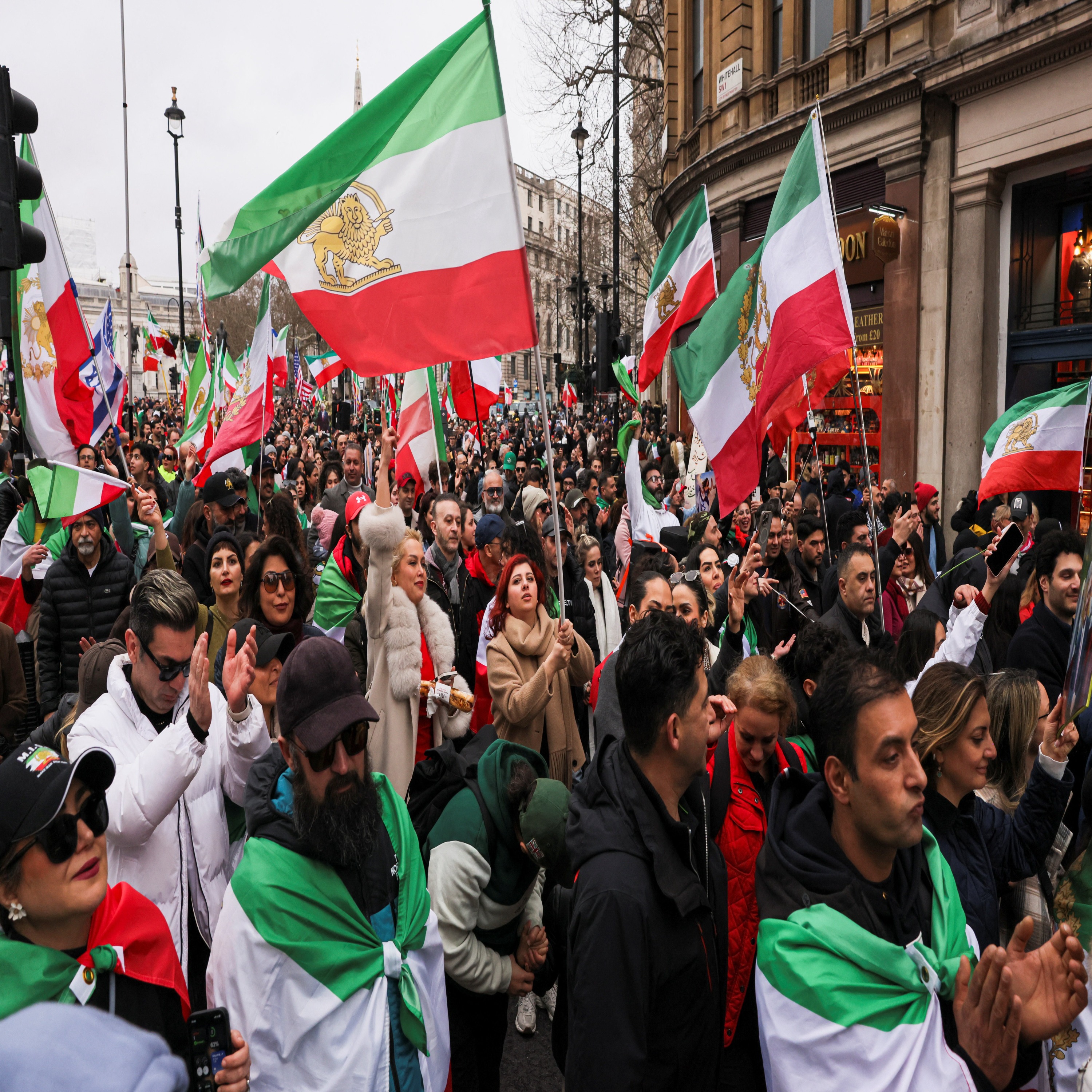
In this episode of The Standard, host Tamara Kormournick engages with chief political correspondent Rachael Burford and Laila Jazayeri, Director of the Association of Anglo-Iranian Women in the UK, to discuss the implications of the recent US-Israeli military actions in Iran, including the elimination of Ayatollah Khamenei. The episode centers on Keir Starmer's decision to limit Britain's military involvement and the potential repercussions for both the UK and Iran.
Written by AI. May contain mistakes.
Discussion on Keir Starmer's decisions regarding military involvement in Iran.
“Coming up, is Keir Starmer right to limit Britain's military involvement in Iran?”
Rachel discusses the political implications of Starmer's military stance and public response.
“Hi Rachel, thanks for coming on the Standard Podcast.”
Leila discusses the impact of Khamenei's death on Iranians in Iran and abroad.
“Here's my chat with Leila Jezieri, who supports the National Council of Resistance of Iran, a broad coalition of democratic Iranian organizations who are vying to lead the country in a radically different direction.”
Explore the controversial figure of Reza Pahlavi and his influence on Iranian politics.
“by holding a fair free election within six months for national legislative and constituents' assembly.”
Discuss the implications of British military involvement in Iran and its security risks.
“And let's face it, in fact, the reason there is this war is because of years of appeasement.”
Hear about the personal aspirations of returning to Iran amidst political turmoil.

Get the gist, explore an idea or ask about something said.
 Claude
On The Standard, what are the key points of this episode?
Searching your listeningAutomatic transcript. May contain errors.
0:00Tamara Kormornick: You know what's wild? Most people are still overpaying for car insurance just because it's a pain to switch. That's why there's Jerry. Jerry's the only app that compares rates from over 50 insurers in minutes and helps you switch fast with no spam calls or hidden fees. Drivers who save with Jerry could save over$1 ,300 a year. Before you renew your car insurance policy, do yourself a favor. Download the Jerry app or head to jerry.ai.acast.
0:36Rachael Burford: The elimination of Iran's supreme leader Ayatollah Khomeini has caused chaos in the Middle East. Showers of retaliatory ballistic missiles from Iran are being targeted at Israel, Dubai, Kuwait, Qatar and the UAE in response to US-Israeli attacks. So, to what extent should Britain support its allies? Hi, and welcome back to The Standard Podcast. I'm Tamara Kormournick. For all the latest news, head to standard.co.uk. Coming up, is Keir Starmer right to limit Britain's military involvement in Iran?
1:17Rachael Burford: Over the weekend, the US and Israel seized on an opportune moment to eliminate senior leaders of the ruling militia in Iran, the Islamic Revolutionary Guard Corps, known as the IRGC. Yesterday afternoon, Keir Starmer defended his refusal to offer British military support for these initial strikes.
1:35Tamara Kormornick: The United Kingdom was not involved in the initial strikes on Iran by the US and Israel. That decision was deliberate.
1:46Laila Jazayeri: President Trump has expressed his disagreement with our decision not to get involved in the initial strikes.
1:52Rachael Burford: But it is my duty to judge what is in Britain's national interest. That is what I've done, and I stand by it.
2:12Rachael Burford: In this episode, I speak to Rachel Burford, the Standards' Chief Political Correspondent, who, a matter of days ago, was covering Labour's defeat in the Gorton and Denton by-election and now Keir Starmer's Middle Eastern military conundrums. Plus, I speak to Leila Jazieri, the director of the Association of Anglo-Iranian Women in the UK, about her reaction to the news of Khamenei's death, leadership options for a post-IRGC Iran, and the actions she believes the UK government should be taking to help Iranians. But first, here's my conversation with Rachel. Hi Rachel, thanks for coming on the Standard Podcast.
2:51Rachael Burford: Thanks for having me. So, Rachel, we're having this conversation off the back of the PM's statement on his decision to allow the US military to use some of Britain's military bases in the Middle East and surrounding areas. So he's come out in defence of his decision in possibly the most star-mary way.
3:19Tamara Kormornick: Yes, a very measured response from the Prime Minister, very diplomatic, I would say. Keir Starmer has very much defended both of his decisions, not getting involved in that and allowing UK bases to be used by the US. There was a drone strike on RAF at Quartiri, the base in Cyprus. um starmer said in the conversation that that strike from iran was not in response to any decisions that um the uk had made but it was launched before the uk's announcement that it would allow the us to use its bases um you know starmer is kind of suggesting that the uk is a target for iran um as an ally of the us and um you know so that he thinks he's made the right decision.
4:07Tamara Kormornick: He's also defended his decision not to get involved in the initial strikes on Iran, although it has obviously angered the President Donald Trump.
4:17Rachael Burford: Yes, Trump has said that he is very disappointed by Starmer's refusal. What kind of response do you think Britain wants to see from its leader? Because Kemi Baden-Ock has said that she's made it very clear that the Tories stand with America and believe the US is taking necessary action against state-sponsored terror. Nigel Farage has said Starmer is pathetic for not joining US strikes. Yeah. So do you think his position at home is being perceived as weak or principled?
4:53Tamara Kormornick: I think it depends on the side of the argument you're on. I think at the moment, I think the British public in general does not want to be dragged into war in the Middle East again. Starmer in his statement said that if he was to get involved, you know, when he looks at the plans, any sort of plan like that, it must always have a lawful basis and be viable and a thought through plan. That is such a lawyer's answer. Yes, it's a very lawyer's answer and be in Britain's interests. Now, obviously, there will be repercussions of what is going on in the Middle East anyway. You know, we saw oil prices go up a lot that is going to push petrol prices up.
5:35Tamara Kormornick: There is perhaps going to be another wave of refugees and people leaving Iran, depending on how this plays out. Many of those people may end up on Britain's shores, but we'll see in a month's time when the repercussions are really hitting, whether or not we'll look back on those decisions and say, well, were they the right ones or not?
5:56Rachael Burford: And do you think Keir's quite nervous to upset those to the left of his party who might align with the anti-war rhetoric of the Green Party who, as we all know, have just won their first seat up north?
6:12Tamara Kormornick: Yes, I think obviously there's a lot of Labour MPs, particularly on the left of the party, speaking out against Keir Starmer and his leadership style. And they, you know, when Hannah Spencer made a victory speech in Gorton and Denton, you had people like Wes Streeting saying that that was a Labour speech. And that is what the kind of thing, you know, the Labour Party should be talking about hope and change. You know, he's got to be looking at the left of his party who are getting larger in number and certainly more vocal about his position as leader. I think also with the Labour Party as a whole, the legacy of the last Labour government and that intervention in Iraq weighs very heavily on their minds.
6:59Tamara Kormornick: And Tony Blair's legacy is essentially joining up with the Americans and that invasion of Iraq. and people look back on that now and think, was that perhaps not the best idea? And certainly for Tony Blair's legacy, people look back at that and it is a sort of black mark on it. So I think that weighs quite heavily on a lot of Labour MPs and certainly the Labour leadership. I think what he's doing at the moment is walking this far line. The US is our ally and we have to support them to a certain extent. And I think Starmer has taken the very middle road here, saying, you know, we're not getting involved in the strikes, but you can use our bases.
7:52Rachael Burford: Do you think Keir Starmer can claw back some of his authority as a leader on this issue? Do you think it kind of carries enough clout with Brits? Because, you know, he keeps talking about these 200 ,000 British people who are in Middle Eastern countries. And the only reason that he's agreed to let the US use the bases is to protect those people. And also that the regime is becoming reckless and dangerous to civilians. These are things that he's said. Does doing the right thing win kudos with the British public?
8:28Tamara Kormornick: He's certainly being cautious, but I don't think in questions of war, maybe that's not a bad thing. The problem is Donald Trump is a man who is a president who changes his mind a lot. He's not a stable sort of character. He's actually the antithesis of Starmer, really. Exactly. Yeah, he's the total opposite. The way Starmer has sought to deal with Donald Trump during his term is with flattery and inviting him on state visits and introducing him to the king at every single opportunity and inviting him round to other palaces and things like that. But when it comes to these kinds of decisions, like now, OK, now you've got to come and invade this Middle Eastern country with me.
9:14Tamara Kormornick: Starmer is rightly really a bit more cautious and go, oh, well. A bit British. A bit British about it. And you can go, you know, as he should be. I don't think there'll be many Labour voters particularly, but many people in general that would want us to be wading into the Middle East again because the Americans are doing it. So there's a lot of suspicion around about it. And I think Keir Starmer at the moment is right to be cautious.
9:42Rachael Burford: Well, let's just see how this plays out over the next few days and keep monitoring the situation. Thanks so much, Rachel, for coming on The Standard Podcast. Thanks for having me.
10:20Tamara Kormornick: Are you noticing your car insurance rate creep up even without tickets or claims? You're not alone. That's why there's Jerry, your proactive insurance assistant. Jerry handles the legwork by comparing quotes side by side from over 50 top insurers so you can confidently hit buy. No spam calls, no hidden fees. Jerry even tracks rates and alerts you when it's best to shop. Drivers who save with Jerry could save over$1 ,300 a year. Don't settle for higher rates. Download the Jerry app or visit jerry.ai slash ACAST today.
11:01Rachael Burford: Welcome back. Here's my chat with Leila Jezieri, who supports the National Council of Resistance of Iran, a broad coalition of democratic Iranian organizations who are vying to lead the country in a radically different direction. Hi, Leila. Thanks so much for joining me on The Standard Podcast. Thank you for having me on.
11:25Rachael Burford: So on Saturday, Ayatollah Khamenei was killed in a US-Israeli attack. And this is clearly a watershed moment for Iran and also the Middle East and the rest of the world. We've seen footage of mourners in public squares. We've seen people dancing in the streets, cars honking horns. In London, I've seen people dancing with flags. So Leila, I want to start by asking you about the experiences of Iranians on the ground, but also in the diaspora. Can you tell me about the reaction, you know, when the news was confirmed on Sunday? What was that like?
12:05Laila Jazayeri: Well, the reaction among the diaspora community has been a reflection of the reaction inside Iran. We've seen basically two emotions. First and foremost, people of Iran are jubilant about the elimination of Khamenei. And I would like to congratulate you, people of Iran, the whole world, for the elimination of the most ruthless, supreme leader of the regime, the most ruthless man on the face of the earth, committing genocide, crimes against humanity. Hundreds of thousands of Iranians have been killed by Khamenei. So great news. At the same time, there is fear of civilian harms, of course.
12:49Rachael Burford: Yeah. And Leila, could you take us through the perspectives of the distinct groups who have different ideas about who should be ruling Iran? There are, of course, IRGC loyalists who are mourning Khamenei publicly. There are those celebrating who are pushing for the monarchy to come back in power, specifically the son of the last monarch who's in exile, Reza Pahlavi. And those wanting democracy, the National Council of Resistance of Iran, led by Mariam Rajavi. Which group is the largest and which group is the loudest?
13:33Laila Jazayeri: A very good question. The NCRI, National Council of Resistance of Iran, provisional government for the transfer of power to the Iranian people, is an organized movement that has a clear transitional roadmap. They say they can move quickly to a six-month provisional government on Iranian soil. And the sole task of this council is to hand over the sovereignty to the Iranian people by holding a fair free election within six months for national legislative and constituents' assembly. Then the assembly would draft the new constitution, define the republican system, and appoint the next government under its supervision.
14:23Laila Jazayeri: The Pahlavi. Yes, Pahlavi tends to be very loud in diaspora media, social platform, claiming to be a leader of the uprising. But who is Pahlavi? He's the son of a shah, a dictator who was overthrown 47 years ago through a just revolution. Now, he's just the son of that guy. Iranian people have said no to monarchy 47 years ago. Look at the program that Reza Pahlavi has offered. He's having the legislative, executive, judiciary power all in his own hands. Just like the supreme leader, what is the difference?
15:17Rachael Burford: Do you get the sense that Iranians in the diaspora, and I mean, yourself as well, like living in London, that the majority of Iranians approve of US and Israeli military intervention?
15:30Laila Jazayeri: Personally, I do not believe you can make change. You cannot bring or impose a new leadership, for example, to the Iranian people. It doesn't work like that, especially a country like Iran with 90 million population and as vast as Iran. It will happen, but it will happen by the Iranian people and their organized resistance movement.
16:00Rachael Burford: And, Leila, do you think enough Iranians remember what life was like before 1979, before the royal family was overthrown? You know, an Iran that wasn't run by, you know, a kind of theocratic dictatorship.
16:15Laila Jazayeri: Well, before Mullahs came to power, I mean, they tried to portray that Iran was advanced, Iran was different during the Shah. There were differences. But let's face it, Shah was corrupt. Shah jailed intellectuals. Shah was the one who made every prison, the most notorious prison. Shah killed intellectuals, executed political prisoners. And during his time, he admitted himself there was corruption. Yet the past was better than now, but it doesn't mean that the past was, we want to go back to this old dictatorship. Why? Why should Iranian children, the youth, the women, get killed for the old form of monarchy to take over?
17:07Laila Jazayeri: We want a democratic republic. We are fed up with over 100 years of monarchical and theocratic dictatorship passing the regime to each other. This time, it's a democratic republic, in fact, with the leadership of women.
17:26Rachael Burford: So, Leila, I know that you lobby the UK government on this issue. So Keir Starmer has agreed to let the US use British military bases. Do you think the UK's involvement threatens British national security?
17:46Laila Jazayeri: Well, that is what you need to ask the prime minister. But we've warned the prime minister for decades to prescribe IRGC. Well, prescribe it as a terrorist organisation? Yes. To this day, they haven't done it. Can you imagine? There is a war going on in Iran. I mean, the only country that hasn't done it is Britain. Canada has done it. United States has done it. EU has done it. I'm shocked. They still haven't done it. And let's face it, in fact, the reason there is this war is because of years of appeasement. Appeasement didn't work. You can recognize there is a resistance inside Iran. Iran is not Iraq.
18:30Laila Jazayeri: It's not Afghanistan. It's not Syria. There is an organized resistance with a history. Recognize them. The rest will take care of it.
18:42Rachael Burford: Leila, just to wrap up our conversation, I want to ask you a personal question. If and, well, what's looking most likely is when the IRGC collapses and the leadership changes and it's looking like a safer kind of environment, would you return to Iran?
19:04Laila Jazayeri: Do you know, Tamara, I dream of that day. I dream. I do dream because I haven't been able to go back since 1981. I've lost my husband and so many other Iranians, but people like us cannot go back. I have two officially announced death sentence on my head. Because I'm supporting Maryam Rajavi and her 10-point plan, they see this platform as an existential threat. So anybody connecting to them is condemned. But yes, of course I will go back. And I think that day is going to happen very soon.
19:52Rachael Burford: well I really hope so thank you so much for speaking with me Leila thank you
20:07Rachael Burford: and that's the standard for all the latest news head to standard.co.uk if you're new here hit follow and give us a rating. If you'd like to get in touch, email us at podcasts at standard.co.uk. We'll be back here tomorrow morning. See you then.
20:33Tamara Kormornick: You know that wellness goal you set at the start of the year? It's not too late to stick with it and make your future self proud, especially with the all-in-one nutrition shake from Kachaba. With 25 grams of protein, 6 grams of fiber, greens, adaptogens, and more. No fillers. No nonsense. Just the highest quality ingredients. Stick with your wellness goals. Go to cachava.com and use code SMOOTHY for 15 % off. That's K-A-C-H-A-V-A dot com, code SMOOTHY. It's time your hard-earned money works harder for you. With the Wealthfront Cash account, your uninvested cash can earn up to 3.95 % APY. That's a 0.65 % boost over an already high rate for three months, just for being a new client.
21:16Tamara Kormornick: Plus free instant withdrawals to eligible accounts. Start today at Wealthfront.com. 3.3 % base APY via Program Banks as of January 30th, 2026. It is representative variable, requires no minimum, and is earned on funds swept to Program Banks. Boost up to$150 ,000. Cash account offered by Wealthfront Brokerage LLC member FINRA SIPC, not a bank.
Over the weekend, the US and Israel seized on an opportune moment to eliminate senior figures of the ruling militia in Iran, including the supreme leader Ayatollah Khemeni. The UK, however, has not been instrumental to the success of this mission so far.
In this episode, host Tamara Kormornick speaks to The Standard’s chief political correspondent, Rachael Burford, about Keir Starmer’s decision to refuse to send British military support for the initial strikes. Plus, a conversation with Laila Jazayeri, the Director of the Association of Anglo-Iranian Women in the UK, to discuss the reaction to Khemeni’s death in Iran and the diaspora, and lay out alternative leadership paths for the country.
Hosted on Acast. See acast.com/privacy for more information.


