
 Ask ChatGPT


 The Standard
4 Oct 2025 · 15m
Written by AI. May contain mistakes.

Get the gist, explore an idea or ask about something said.
 Claude
On The Standard, what are the key points of this episode?
Searching your listeningAutomatic transcript. May contain errors.
0:05Turn a corner in London, exit a tube station, drive through a parking garage and it's impossible to miss. electric vehicle charging stations are becoming a familiar sight. London has bold ambitions for sustainable transport and it's already leading the charge. With over 21 ,000 charging points across the capsule as of April this year the city accounts for nearly a third of the UK's total EV infrastructure. More and more of the vehicles delivering our goods, transporting pastures and serving the city every day are electric and the network to support them is growing fast. But to meet its 2030 net zero targets, London will need between 40 ,000 and 60 ,000 charging stations, doubling or even tripling today's infrastructure.
0:50The cost of installing a single charge point ranges from£1 ,150 to£6 ,000, depending on the model and speed, meaning continued investment at pace and at scale is essential. That means building infrastructure across all boroughs, avoiding a postcode lottery for access to charging, and helping to transition the fleets that keep the city moving. But as momentum builds, upcoming changes to incentives for electric vehicle drivers risk slowing progress and sending mixed signals to the industry. Proposed changes from Transport for London mean that from Christmas Day this year the exemption will end and drivers of electric vehicles will no longer be exempt from paying the city's congestion charge.
1:34Industry leaders warn that this could deter drivers from switching to electric, undermining confidence in London's EV future and stalling much-needed infrastructure investment. If demand plateaus, private companies may delay or scale back plans to install new charge points, particularly in less central or lower income boroughs, slowing down progress just when it needs to accelerate. It's why the Electric London Coalition, following the standards leading the charge campaign, is calling on Mayor Sadiq Khan to reverse the decision and protect EV uptake. In this second episode, we're looking at what it takes to build the electric city, from the companies installing the chargers to the fleets making the switch.
2:15What do they want to see to keep investing in London's transition? Joining us now is Matt Croucher. He's Chief Commercial Officer at Believe, a UK-focused chargepoint operator which owns, installs, operates and maintains a network of publicly accessible charging stations. Matt, how much difference will the recent announcement of a new round of electric car grants make to EV take-up? Yeah, well, it's a very positive move. We'd certainly welcome that. So I think it will help stimulate additional demand. I mean, EV demand has been good and growing for a number of years now, but we are in that phase of growing from beyond the kind of early adopters, moving into the kind of mainstream.
2:57And there will be people who are kind of, you know, on the fence a little bit, a bit unsure. And that little bit of additional financial incentive, it can make the difference with that. So we welcome that. What other measures or incentives would you like to see to increase that take up? Our role obviously is in rolling out the EV infrastructure. So we think a big part of it, when you look at surveys of people, what the key kind of factors are and whether they are going to buy an EV for their next vehicle or not one is price so the measures we just talked about in the grunt is a means of addressing that price and bringing that more in line with the kind of bumper sticker price if you like of buying internal combustion engine vehicle and that the actual whole life costs are already on a par because you save money through the lower operating costs of an EV but people do still put a lot of stock in their upfront purchase price so those grants are important and the other part is making sure that we've got enough EV charging infrastructure out there because that's a recurring thing people will say that is making them delay switching to an EV so we're here ready to do that and we've all got over 2 ,000 charge points across the country including many in London and we're poised to roll out many more and that's a question often of working with local authorities and councils to roll out charges on streets where people live and don't have access to off-street parking, terraced housing and so on, and with private landlords in their car parks and so on.
4:28So planning and delays and consultations, a lack of resource. Council offices are all further efficient things that delay us in being able to roll out that infrastructure. And so that would be the other thing we would welcome support on. How do you rate the quality or availability of EV infrastructure in London specifically. And do you think the EV infrastructure is rolling out fast enough? It's very variable is the kind of truthful answer. So some areas have got pretty good levels of charge point provision, but others have very poor. And so it's a real postcode lottery. There's definitely a lot more to do across London.
5:04So as I said, we've got nearly 2000 charge points across London. We're in eight of the London boroughs and we're rolling out very quickly in those areas but uptake is growing very quickly and people want convenience as well you know people don't want to have to walk free streets down to go and plug into a charger they want a charger near their home so there is a lot more work to do to achieve that. What message do you think it sends to drivers when TfL says that the congestion charge exemption for electric vehicles is proposed to come to an end around Christmas time? Yeah it's mixed messages really isn't it on the one hand there's a kind of nationwide and local level london-wide recognition that we need to make that switch as quickly as we can from combustion engine vehicles into evs but then with things like the car grant to try and help with that but then by removing something like the cleaner vehicle discount or substantially reducing the cleaner vehicle discount for the congestion charge zone is sending the message that that switch isn't as big a priority so that That's going to potentially create confusion in the mind of consumers.
6:10And it's removing a fairly significant financial incentive for people who do travel into the central London congestion zone area to make that switch. So inevitably, that will reduce or slow down the transition to EV, which is a shame. Do you think the cleaner vehicle discount has been significant, encouraging drivers to convert to electric? Yes, I definitely do. There's a popular perception still sometimes with EVs that they're the preserve of chief execs in Teslas. And whilst that is certainly a part of the EV owner demographic, it's by no means representative of the entire EV customer base. Many of our best users are actually Uber drivers or Texan private hire drivers because they're the ones who do the mileage.
6:56You know, they're the ones who drive far more miles and in central London in their vehicles than a chief executive of Tesla who maybe work from home more, travels by train and doesn't put in the same number of miles. And so the cleaner vehicle discount for those drivers is significant. You know, it's worth£3 ,000 a year in savings at the moment for them to make that switch into EV. so when they're doing their calculations as well do I switch to an EV or not as well as all the fuel savings costs you make of having an electric vehicle that£3 ,000 saving is obviously pretty material and so that will have made a difference and by withdrawing it to a large degree that will again change the calculation in people's minds when they're debating do I make the switch to EV yet or not we're very confident they all will eventually I mean these are just better vehicles and in the end everyone will switch and no hesitancy at all around that but our concern would be with a policy change like this is it will just inevitably slow down that transition slightly.
7:59And what do you think of Transport for London's argument that congestion in central London will get worse if EVs don't pay this charge next year? I sympathise with the argument prior to joining Believe three years ago I spent 20 years working in transport planning consultancy advising on all things sustainable transport and very familiar with the kind of challenges around this so there's a travel hierarchy where ideal world in central london you'd only have people walking and cycling but of course the reality is that we need to cater for more mobility options than that and in particular shared mobility and things like taxis and uber really fill an important gap in helping people travel without private vehicles and making those connections across the city in combination with tubes and buses and so on.
8:49So whilst I understand the need to manage the number of vehicles that come into central London, I think at the moment we've got something like 6 % of vehicles are EV. We've got a lot more work to do there to ramp up that number and make that transition. We're moving from the kind of early adopter stage to the early mass market and And that customer segment will, I suspect, be very influenced by the availability of a big cleaner vehicle discount incentive. So my worry would be that by withdrawing that, they would just be withdrawing that too soon. But while strategy and regulation are one side of the coin, the other is implementation.
9:28How businesses on the ground are making the transition to electric fleets and the real challenges they're facing day to day. To explore that, we're joined now by Judy O 'Keefe. As Director of Fleet at Openreach, which manages the UK's largest broadband network, she's leading one of the UK's biggest commercial EV transitions. She shares what it takes to electrify a fleet at scale, the lessons learned and what's still needed to keep momentum going. So the transition to EVs is one of the key enablers strategically to deliver our net zero commitment by March 2031. This is our biggest enabler for that.
10:06That's also the right thing to do for the environment and for the betterment, especially around London and inner London for the clean air environment. Some of the challenge we have around doing this is basically around the charging infrastructure. And in order to combat that or to address that, we have invested heavily in home chargers with our engineers. We've also invested heavily in exchange chargers or TC chargers so that we have them off site so we can leave the vans there overnight. And again, basically, the other challenges is getting our engineers to transition into EVs. And that has taken some time.
10:41But once an engineer gets into an EV, they tend to want to keep it. So how much of an impact will it be for your company when the congestion charge is no longer waived? Give us a sense of the cost. This is really significant. And it's really significant for the business. We do about 33 ,000 visits a week in London by our engineers and£9 incremental additional charge a day is going to be in the thousands. We haven't evaluated the total impact but it is going to be excessive and that means that we're going to have to make key investment decisions around what we do in terms of build. When you started off electrifying your vehicles how much of an incentive was the cleaner vehicle discount?
11:19So really key but with the incentive that the government awarded for Our transition to EVs, as well as the Clean Air Incentive in London, had a major influence in our transition to EVs. Right now, I'm really, really proud of the business. So of our 23 ,000 vehicles, we now have 5 ,000 EVs. And by the end of the year, we'll have 7 ,000 EVs or more because I like to beat my target. Yeah, it's been really, really key in terms of the whole investment and the strategic transition to EVs. And really keen that we can keep that going. Do you think this change in congestion pricing will actually slow down converting your fleet to electric?
11:57The worry is, is that when the decision or whatever decision is made in London will be carried forward to the rest of the country. So we would like not to slow down our transition of EVs. But we have to wait to see what that decision looks like to make an informed decision. Because I'm all about making informed decisions. So we'll do some scenario modelling on what does it look like. But we don't know what we don't know now until those decisions are made and the consultation has been had. What has all this uncertainty around the congestion charge, whether the exemption continues or not, meant for your company?
12:27Because we still don't know for sure what will happen. Yeah, 100%. And I think what's lacking is, you know, when these decisions are made, we need to think of the whole end-to-end decision tree, because obviously we have to think about what we're doing with the OEMs or ordering vehicles with the suppliers and all those timelines. So we're kind of, it's a watch and brief, but we will be doing some scenario modelling to understand if A happens, what do we do? If B happens, what do we do? So we can press to trigger on those strategies quite quick. What is the quality of EV infrastructure like in London for those of your employers who rely on charging stations?
13:04So we definitely have challenges in central London. However, the good thing is that our drivers probably drive on average about 40 miles a day. And that means we only have to charge twice a day. And because it's quite a tight infrastructure, but basically we kind of manage it really well. So I think in terms of public charging versus home charging versus our exchange. We are currently making it work, but there are areas where we definitely have hotspots. If the mayor was here right now, what would you want to say to him in terms of the cleaner vehicle discount? So I'd say to the mayor, look, really, really proud and as a country, super proud of what's been achieved as a result of City and Clans' previous strategy and the deployment of the clean air zone and all of that.
13:49What I'd really ask is please don't go backwards. Please ensure that, you know, for the betterment of the clean air and the people in residence of that for the betterment of our fleet being able to transition to more EV adoption, please seriously consider his decision around increasing that levy. As we've heard today from Matt and Judy, an immense amount of work and investment is going into the EV transition. But there's a serious tension that's come up, one that demands scrutiny. And without careful adjustment, particularly for high-use drivers, low-income drivers and businesses that make real investments, the congestion pricing exemption risks doing more harm than good.
14:28Thanks for listening. In our last episode in this series, we'll look at the real human cost of this policy.
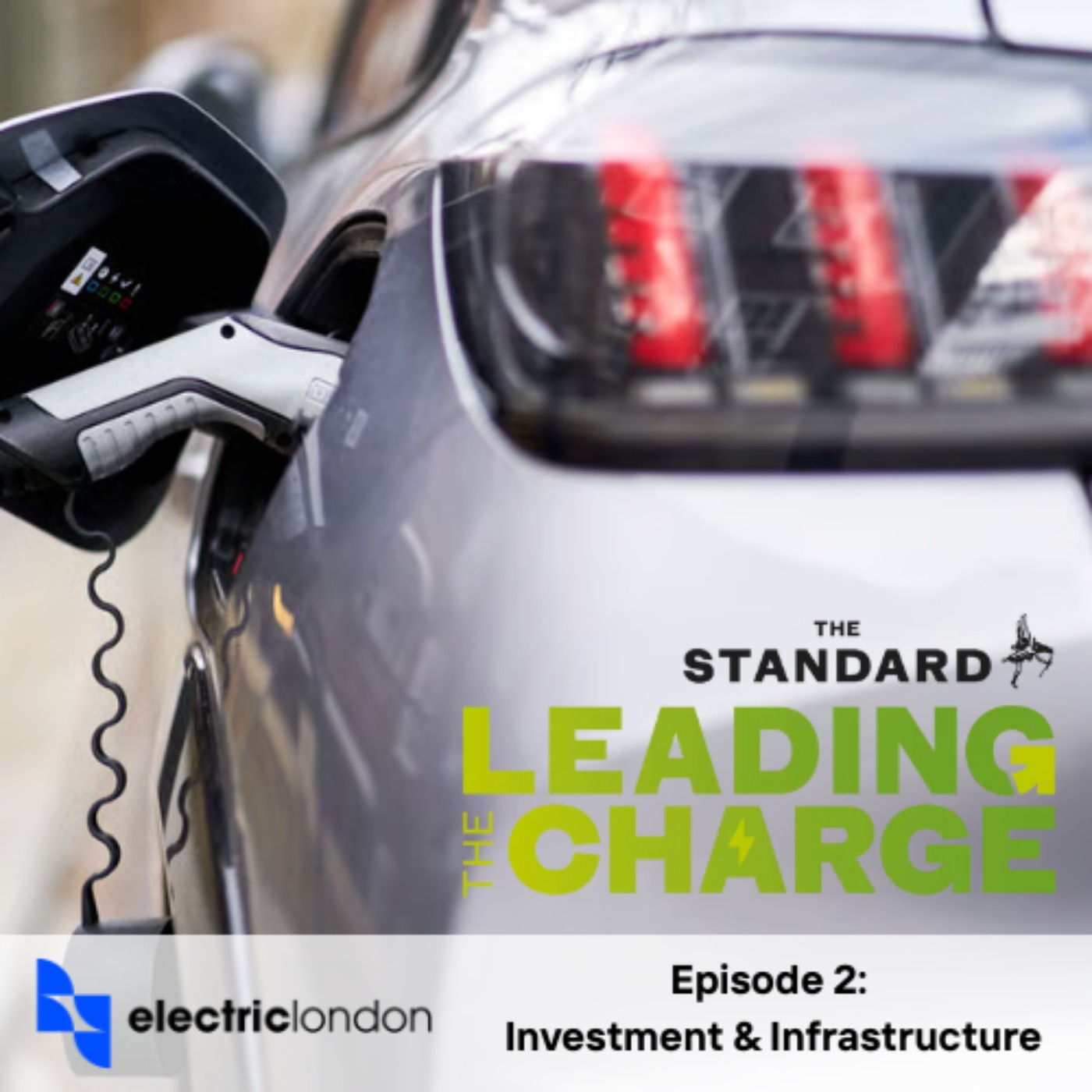
London is rapidly expanding its electric vehicle infrastructure, with over 21,000 charging points across the city – nearly a third of the UK’s total. But to meet its 2030 net zero targets, London will need tens of thousands more, with significant investment required across all boroughs. Upcoming changes to the Cleaner Vehicle Discount, which would end EVs’ exemption from the congestion charge, risk slowing that progress.
The Electric London coalition, following The Standard’s Leading the Charge campaign, is calling on Mayor Sadiq Khan to protect London’s EV uptake and ongoing infrastructure growth.
In this second special episode focusing on investment and infrastructure, The Standard’s Business Editor, Jonathan Prynn, speaks with Matt Croucher, Chief Commercial Officer at ChargePoint operator Believ, and Judy O’Keefe, Director of Fleet at Openreach, who is overseeing one of the UK’s largest commercial EV transitions. They explore what it takes to electrify London at scale, the challenges facing fleet operators and charging providers, and what needs to happen to keep the city on track for a cleaner, electric future.
Hosted on Acast. See acast.com/privacy for more information.


