
 Ask ChatGPT



Written by AI. May contain mistakes.

Get the gist, explore an idea or ask about something said.
 Claude
On The Standard, what are the key points of this episode?
Searching your listeningAutomatic transcript. May contain errors.
0:02Hi, I'm Charlie Duffield and welcome back to The Standard Podcast. If you're new here, hit follow and give us a rating. For all the latest news, head to standard.co.uk. Coming up later in the show, Stephen Fry takes an earnest turn in a new rendition of Oscar Wilde's famous play, which is camper than ever before. He's a Wilde scholar. He played Wilde in the film, you know, some years back. He's an absolutely supreme comedian, so his timing and his modulation are perfect. the production palpably picks up whenever he comes on stage. But first, Scotland Yard Chief Sir Mark Rowley has apologised after serving Met Police officers called for immigrants to be shot, revelled in the use of force and were dismissive of rape claims in an undercover BBC Panorama documentary that aired last night.
0:59Sir Mark Rowley said the behaviour of some at Charing Cross police is reprehensible and completely unacceptable and has vowed to dig out the tumours that still exist within the force. Here he is speaking to BBC Radio London this morning. It's horrific isn't it? So anybody watching that is going to be upset and angry and I'm sure those are the reaction of Londoners seeing the sort of racism, the misogyny and the sort of relishing in using excess force on people who've been arrested. It's completely reprehensible. As soon as we got the letter from the Panorama programme a couple of weeks ago detailing some of the content that they had, we suspended 10 officers and staff and we're now working with the Independent Officer Police Complaints who we invited in to work as quickly as possible to get them off the payroll.
1:50They're suspended, they're not anywhere near the public anymore but I want them off the payroll and gone as quickly as possible. He added that anti-corruption officers with experience of counterterrorism investigations are being utilised to root out racist colleagues, with AI technology being used to spot patterns of misbehaviour by scanning officers' work phones and working practices. The Met Commissioner referred to the officers who were exposed by Panorama as like a cancer in the Met Police, but he has refused to say the force is institutionally racist. Prime Minister Sir Keir Starmer said the behaviour of the officers was shocking and London Mayor Sir Sadiq Khan has said he is disgusted and appalled by the footage.
2:33Meanwhile Zoe Garbutt, a Green Party member of the London Assembly and the Green candidate in the 2024 London mayoral elections, has called for Sir Mark's immediate resignation. Joining us now is Dr Aaron Winter, a senior lecturer in sociology at Lancaster University. What's your immediate reaction to this news? The revelations from the Panorama documentary are quite shocking, but in some way not surprising. It's something numerous reviews, inquiries, and investigations have shown exists within the Metropolitan Police. I think it is important that information is out there, and I hope it is dealt with on a systemic and institutional level, and not cast as a couple of bad apples and a problem that can be dealt with by sacking the individuals and making some promises.
3:26And Sir Mark Rowley continues to deny the Met Police is institutionally racist. What do you make of that? Well, I guess I'm not surprised that the chief says the police are not institutionally racist. I don't know that he can say anything else, but he's also called this, as a quote, a cancer, which says something about how endemic and systemic it actually is. So those two things do not necessarily correspond. Yes, it's important that people are assigned to investigate this and to deal with it. This is not just merely an issue of corruption. This is an issue of racism, misogyny, and extremism. And these are the forces that are entrusted to deal with, for example, far-right rallies and riots and have proven time and time again that they're institutionally racist in the way they treat racialized communities and individuals.
4:19But in addition to which, the misogyny and the shadow of the murder of Sarah Everard and the Casey Review, I mean, you need experts in racism, misogyny, and extremism to deal with this. They're never going to sort the problem out unless there is root and branch review and reform that is undertaken by those with actual expertise in the problems that are being revealed. They cannot face that there's institutional racism, so they can't acknowledge that they need experts on this. In your research, you've examined racism and the far right, and you mentioned the term two-tier policing. What's that in reference to?
5:02The far right has had this myth or this narrative of two-tier policing. This is the idea that the police disproportionately may target white communities instead of racialized ones and Muslim ones in particular for fear of being accused of racism and Islamophobia. And they've deployed this argument in relation to the so-called Asian grooming gang scandals in the North, for example, or the way in which they see the police left-wing protests in much tamer ways than they do far-right protests. Now, two things are important to know. One is both of these are absolutely false. They're absurd, frankly.
5:44The fact is that the police have been accused of institutional racism, not just by the media and by activists or members of communities, but inquiry after inquiry. And we know that there's a disproportionate criminalization and securitization of particularly Black and Muslim communities. And the other hand, the way in which the police and the government as well has dealt with, for example, Black Lives Matter protests or pro-Palestinian protests or even the Sarah Everett vigil in ways that have been extremely harsh and criminalizing and securitizing, in ways they have not been with the far-right riots, which while there were arrests for crimes, those protests were widely seen as expressions of so-called legitimate concerns.
6:33of the ordinary people. And they've been called this by politicians, government, media, and the police are the ones protesting these with often a sort of hands-off approach. And in fact, the far right has, for rallies and riots, have ended or included attacks on police officers, like an armistice day in November 2023, or more recently. And for some reason, the far right seem to think that the police are sort of disproportionately harsh with both the far right, the right, and white perpetrators. And so this, I think these revelations really show that if there is a two-tier system of policing, it works the other way, where you have police officers who are saying and expressing sort of racist sentiments and misogynistic ones, and expressing support for far-right figures.
7:28This is an extremely, extremely dangerous situation to have. So would the resignation of Sir Mark Crowley actually make a difference? I don't think the resignation of a leader solves a problem. It doesn't mean I don't think you should resign. But I think too often, in policing, any wider political and public life, the leader, the chief, whoever, is forced to resign, and then everyone washes their hands of the problem, and then brings in someone else and we repeat the story. The more fundamental problem is that he continues to deny it. And you can't have someone in charge who not only oversees it, but continues to deny it when the evidence is there.
8:08He's doing exactly what everyone's calling for. He's saying, if someone resigns, the problem will go away. And I think a reckoning needs to occur. There is an endemic, systemic, and institutional problem. I hesitate to say we need another inquiry, but the inquiries keep on saying the same thing. Go back to the McPherson inquiry for the murder of Stephen Lawrence. We're still talking about this and the police are still denying it. Finally, do you have anything else to add? I think it's really important because of the power the police hold and because of what they're entrusted to do that we deal with racism, misogyny and extremism in the police and criminal justice system.
8:51But I think it goes beyond that because we're at a time historically and politically where racism, particularly anti-migrant and anti-Muslim racism, is increasingly acceptable on a policy level from politicians in their rhetoric, often under the auspices of fighting the far right and not letting the far right get into power, which is slightly absurd because it just legitimizes their ideas. But if we have a government who's making racialized and marginalized people targets, and then we have a far right who are actively pursuing these targets, and then police who are defending or sharing the ideas of that far right, it's making members of the public who the police and government owe a duty of care to extremely vulnerable and extremely unresponsive.
9:45you're threatened. That's not proper policing and it's not proper democracy. Let's go to a break. Coming up in part two, after a hit run at the National Theatre, director Max Webster's version of Oscar Wilde's play, The Importance of Being Earnest, has moved to London's Noel Coward Theatre. We'll see you back here in just a moment.
10:13Welcome back. Oscar Wilde's importance of being earnest has been revived countless times across many continents since it first premiered over 130 years ago. It's a hilarious story of identity, impersonation and romance, and the play has now arrived in the West End with a new cast, most notably featuring Stephen Fry playing Lady Bracknell. Fry is known to be a world expert and a massive fan of his work, and has even played Wilde in a biopic. To discuss this new iteration of this well-regarded comedy, I'm joined by the standard theatre critic and host of the London Theatre Review podcast, Nick Curtis.
10:55First of all, Nick, for those who haven't seen the play, quickly summarise the premise. It's a play by Oscar Wilde, first aged in 1895, about two young men about town who each have secret identities which allow them to pursue various naughty activities in the country whenever they're away from town. And they meet and fall in love with two young women who also have built sort of secret interior lives, invented fantasy romances, so they can free themselves from Victorian convention as well. Although ostensibly about heterosexual relationships, it's very much a sort of coded drama about homosexuality and having to present a sort of respectable facade to get away with, which is illegal or frowned upon in private.
11:36I would describe it as a sort of surefire, seamless comedy. It's one of the finest comedies written in the English language. And what's different about this one showing in London's West End? What's different about this one, this production was staged last year at the National Theatre, where most productions rely on the audience to get the gay subtext. This one outs it, if one can put it that way, and puts it sort of front and centre. It opens with the lead character, Algernon, playing the piano in the middle of a sort of orgy slash party full of drake queens and kings, himself wearing a sort of cutaway pink flouncy frock.
12:08There's a sense throughout that anyone could end up with anyone, that he could end up with his sort of friend and rival Jack, that the two women, there's a hint that they could end up together. It's just about the sort of turn of the screw, turn of the hormones, whichever switch is flicked at the time. Tell me more about director Max Webster. He's been very busy recently. I mean, he did an incredible sort of lengthy Fanny and Alexander at the Old Vic. He did a Henry V at the Donmar, which personally didn't like that much, but had an extraordinary performance from Kip Harrington in it and another one from Anoushka Lucas as Henry's French bride-to-be.
12:39His productions always have quite a bold aesthetic and striking visual appeal here, and that's the case in this production, which is designed, the set and costumes are designed by Ray Smith, and they are very much a central part of the aesthetic of it. It looks absolutely gorgeous, it looks totally OTT all the way through, all the clothes are absolutely fabulous, and the colours are like a sort of Fragonard painting reimagined by Pierre Agyu. What did you think of the play? How did it compare to other iterations you've seen? When it was done at the National last year, it had Chuti Gatwa as Algernon and the wonderful Sharon D.
13:12Clarke as Lady Bracknell, one of the most famous female roles. It's now been completely recast from top to bottom for the West End run. Olly Alexander from It's a Sin, also a singer and songwriter as well as an actor, has taken over as Algernon. And slightly controversially, Stephen Fry has taken over as Lady Bracknell. He's not the first, he's by no means the first man to play the part. David Suchet did it some years ago. the drag queen, Betty Bourne, did it a few decades back. But I think in this day and age, that sort of casting can be open to criticism. I have to say, though, that he is by far the best thing about this production.
13:45The play is full of lines that you know back to front. It's like, every woman becomes like her mother, that is her tragedy. No man becomes like his, that is his. There's hundreds of quotable lines in it. He obviously knows them back to front. And as a comedian, as well as an actor, he knows how to make them land supremely well. A lot of the witticisms from the other members of the cast don't land particularly well, partly because the production is so OTT, so sort of shouty and hyper-energised that the lines get slightly trampled. What were the most impressive parts and where do you think the play fell short?
14:16I was rather disappointed by the two young men, Olly Alexander and Nathan Stewart-Jarratt as Algernon and Jack. This is one of the great double acts in theatre and here it just feels, as I said, a bit shouty and a bit extreme and a bit effortful. You feel they're trying too hard, really. I was talking to a colleague last night who said he didn't like the two young women in it. I conversely found the two women quite refreshing, really. They're played by relative newcomers, Kitty Hawthorne and Jessica Whitehurst. They're great at putting a sort of modern topspin on these well-known and historic lines.
14:47There's quite a lot of audience interaction. I mean, not only breaking the fourth wall, you don't actually have to get up on stage and do anything. The women are quite often flirting with audience members and, as I said, sometimes at one point quite heatedly with each other. So is this worth checking out? Interestingly, I said earlier it's a surefire comedy. The fact that there have actually been some disastrous productions recently mean it's not necessarily surefire, it can misfire. I think there are some misfires in this one, but I think it looks ravishing. You can't really argue with doing it through an exaggerated queer sensibility since it is a classic of a queer drama.
15:19And I think there's enough exuberance here with Fry and with some of the other performances to make it worth your while. It just could be better.
15:30and that's the standard for all the latest news head to standard.co.uk if you'd like to get in touch please do drop us a line at podcasts at standard.co.uk we'll be back here tomorrow at 5pm we'll see you then
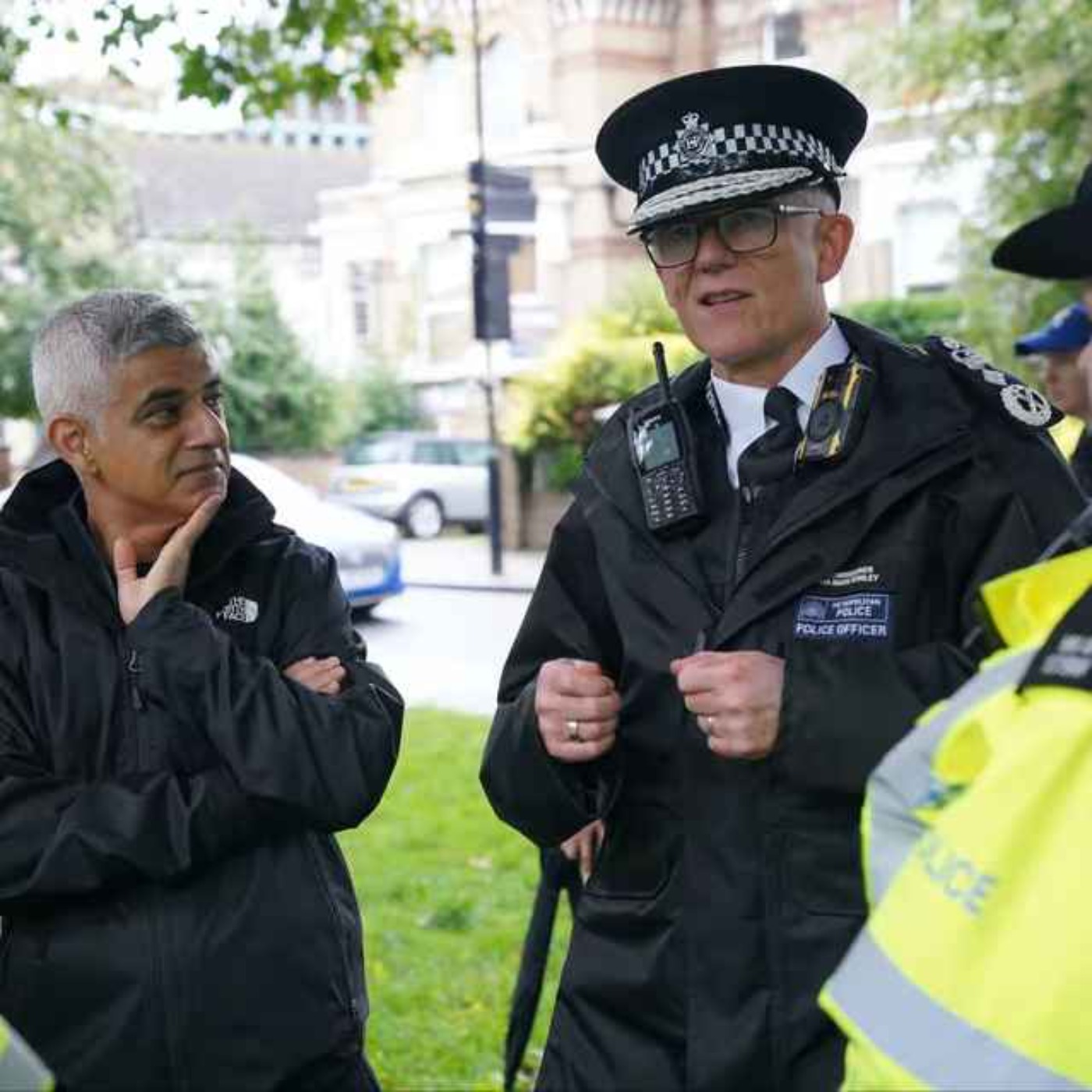
Scotland Yard chief Sir Mark Rowley has apologised after serving officers called for immigrants to be shot, revelled in the use of force and were dismissive of rape claims in an undercover BBC documentary, which was aired on Wednesday night. He said the behaviour of some at Charing Cross Police exposed by Panorama is “reprehensible and completely unacceptable” - but he denied that the Met Police is institutionally racist. Dr Aaron Winter, a senior lecturer in sociology at Lancaster University, responds to the news.
And in part two, The Standard’s Theatre Critic and Host of The London Theatre Review podcast, Nick Curtis, joins us to review a new rendition of Oscar Wilde’s famous play The Importance of Being Earnest, from director Max Webster, which is showing at London’s Noel Coward Theatre.
Hosted on Acast. See acast.com/privacy for more information.


