
 Ask ChatGPT



In this episode, hosted by Charlie Duffield, the focus is on the ongoing humanitarian crisis in Sudan, particularly in the Darfur region, and the involvement of the United Arab Emirates (UAE) in the conflict. Defence Editor Robert Fox provides insights into the complexities of the situation, including the historical context, current events, and international responses.
Written by AI. May contain mistakes.

Get the gist, explore an idea or ask about something said.
 Claude
On The Standard, what are the key points of this episode?
Searching your listeningAutomatic transcript. May contain errors.
0:02Hi, I'm Charlie Duffield and welcome back to The Standard Podcast. If you're new here, hit follow and give us a rating. For all the latest news, head to standard.co.uk. Coming up later in the show, the problem with international foreign policy on Sudan.
0:25But first, on October the 26th, fighters of the Arab militia Rapid Support Forces finally overran the strategic capital of Dafur, Al-Fashur, a region in western Sudan, after 550 days of siege. Then ensued what the UN has called genocidal massacre. Men, women and children were systematically raped, tortured and mowed down and buried in mass graves, hastily dug by bulldozers. Amy Pope of the UN's Institute of Migration has described Sudan now as the largest refugee displacement crisis in the world. Yet few people are taking much notice. On the 5th of November, Priti Patel spoke about the ongoing crisis in the House of Commons.
1:14The atrocities of recent days, including in Al-Fasha, are beyond horrifying. The suffering inflicted on the Sudanese people by this war is an affront to humanity. Red lines have been crossed in the prosecution of this conflict that cannot be allowed to stand. especially by the UK as the penholder on Sudan at the UN Security Council. Britain needs to use its implements to coordinate a robust and stronger international action, to tighten the screws on the ruling parties, press them into a ceasefire and end this barbaric conflict. Those carrying out the atrocities in Sudan need to know that the whole world is watching them.
1:53They can see what they are doing and that there will be consequences. In Dafur, at least twice as many people have been killed than in Gaza since 2023. And as the crisis looks likely to worsen, one nation has questions to answer over its links to the atrocities. Today, The Standard's special report is shining a light on the situation in Sudan and specifically how the United Arab Emirates is involved in its war. Joining me now is The Standard's defence editor, Robert Fox. Robert, could you start by explaining a bit more about how bad the situation is in Sudan, because it's something which a lot of people aren't fully aware of.
2:35It is one of the worst, if not the worst, humanitarian refugee crises in the world today. That is a big claim. But this is complex, it has been long-lasting, and the proportions of population and the sheer numbers are staggering. We have between 12 and 15 million refugees on the move without a stable home, of which at least 2 million are at or on the point of starvation, with very little chance of access. The problem with the crisis in Sudan is that it isn't self-contained. It is of big regional importance to the Gulf, to the Middle East, and it extends even further. It is a major security risk and holds some very grim prospects.
3:23The financial side of it, and there is a big financial side, the smuggling of gold particularly, affects the war in Ukraine. The alliances in the Gulf affect the war in Gaza. And above all, the movement of people, the effect on the region is going to have a huge, slow-burning, but very heavy impact on the migration crisis throughout Europe, and that includes the UK. And in your special report, you say that civil war and military coups have been endemic in Sudan's short history. Can you explain a bit about the origins of the current fighting? Current fighting, to give it focus, has at its top two charismatic generals.
4:08Bohan of the so-called Sudanese armed forces, and somebody in Dalgara known as Hadidli, who is a warlord, but who came up through the forces like Bohan, and he is in charge of a loose group who call themselves the Rapid Support Forces. But they come out of an earlier grouping called the Janjawi, who committed terrible atrocities, sometimes in the name of the government of the day, which was a terrible dictatorship, in the beginning of this century in Darfur. Darfur has been a victim territory, and there are fairly obvious reasons as to why. The Janjaweed slash RSF rapid support forces come largely from nomadic Arab peoples who live by herding animals, particularly camels.
5:01And they've moved into Darfur, where a lot of the African tribes and the African families and the African groups are sedentary, are farmers, are town dwellers, and they prey upon them. And they will continue to prey on them. And actually, this dynamic makes it very, very difficult. It's going to be a terrible problem. It's a problem, as you rightly have said, that the outside world have largely ignored. But a lot of the experts that I've talked to who have deep experience of the region think it cannot be avoided and ignored for too much longer. So how exactly does the United Arab Emirates, the UAE, fit in here?
5:44It's very important for a start. It's quite complicated because the UAE has had a close relationship, particularly with the RSF forces. And we now have evidence that they have been supplying buying arms, in one case, from Bulgaria, which were destined for Ukraine. But various experts I've talked to, like Dr. Michael Jones of the Royal United Services Institute, who deeply versed in such things, that they brought the new brand of light weapons, which are so useful in the desert, particularly drones, surveillance drones, attack drones, drones that can attack in swarms. And a lot of these are of China manufacture.
6:28Let me say right away that the UAE has tried to deny that it is involved in the Hadithi war effort, the RSF war effort. And they've tried to say that they believe in peace and they're trying to, in various pronouncing. So over the last three weeks, two ministers have said on the record, oh, we don't support this, we need peace now. But they have been involved in it deeply, because back to 2015, and this is the fascination of the complexity of the story, is that the UAE got Sudanese forces, and they were forces actually commanded by both these commanders, Bohan and Hadithi, to supply Sudanese forces to fight the Houthis in Yemen after the Houthis made their move to take over the regime in Sana 'a, because the UAE and Saudi Arabia opposed them.
7:17But the UAE didn't want to or didn't have their own forces to put in there. And so that association started from 2015. So it's a 10-year association. There is one element, if you'll permit me, that is deeply important and fascinating in the whole story, and it is gold. Gold revenue is roughly 50 % of the export earning of Sudan itself today, and it is smuggled through various routes and moved partly through Chad and partly through Khalifa Haftar, the warlord, the acknowledged de facto head of East Libya in Benghazi, who's also an ally of Russia and the former Wagner force mercenaries. It goes up, it goes around, and it feeds into Russia and helps paying for the mercenaries in the campaign in Ukraine.
8:15The Sudanese armed forces, the other side, also deal in gold. And here's the interesting thing. A large amount of the gold has to go to Dubai in the UAE, because that has to be traded actually in or through Dubai, because it is the main gold market. You just see how tangled, how complicated it is, because Saudi Arabia, Egypt, the US side up on one side, and you have the UAE on the others. And they formed themselves a few years back into what's known as the quad. We're always seeing quads, but quads mean a four power group. And they've had peace talks. And the last peace talks broke up in October of this year.
9:02But they broke up just as Al-Fasha, this terrible massacre, happened. And the siege was broken by the rapid support forces and this terrible orgy. Palling scenes, as far as we can see. And a lot of people missing from this. 70 ,000 escaped, 70 ,000 were known to be left tracked inside, 200 ,000 altogether in Al-Fatih are completely missing and unaccounted for. Let's go to an ad break. Coming up, is the situation in Sudan comparable to other conflicts? We'll see you back here in just a moment.
9:50Welcome back. And let's just recap. The RSF is funded by this gold revenue. Is that right, Robert? Yes, it is. Because Hadithu himself is the boss of the biggest artisanal, as it's called, mining group in the Darfur region. By artisanal, we make very primitive technology, picks and shovels. It's like Gold Rush movies, planning for gold. You also mentioned the challenge of the region being an information wasteland. Can you tell me a bit more about that? Well, this is terrifying. Outsiders, and very brave ones have tried, outsiders cannot get in. It is simply so dangerous. And it's simply so dangerous for a lot of aid.
10:33Samoa Ibrahim, the great philanthropist, who is partly Sudanese himself, said it's terrifically problematic. Of every 10 trucks of aid, only two get through. Drivers have been killed, and it's very difficult to get drivers. You've got a problem of aid access and information access. So a lot, particularly the stuff that you see on social media, comes from satellite imagery. There have been signs of mass burials. We know there have been orgies of killings which have been taken as selfies by the killers themselves. And these enormous bloodstains, I'm sorry to say there have been several sources confirmed, have been seen from space, have been seen quite easily spreading across the bare Earth.
11:13That's incredibly shocking. Sadly, the path to peace in Sudan is especially difficult, isn't it? You've got to see this large country, but it's a linchpin. It is the capstone for arches and networks, to mix metaphors, that go from the Mediterranean, the Maghreb and the Masaryk, the North African coast, right down the Red Sea, and therefore it leads into the Gulf and the Arabian Peninsula, and then right across Sub-Saharan Africa. And this is what worries people like Sir Richard Doola, a very famous former head of MI6. He said there's so much ungoverned space, as he calls it, that you could get everything mixing there.
11:55And there's a great fear that IS, the Islamic State, is coming back. We know that extreme Islamism feeds across to Boko Haram in West Africa, in Nigeria in particular. But I think there's a bigger problem that Sir William Patey, who's one of the most experienced British diplomats, who has served a lot of times and been there, has experienced Afghanistan. He's been an ambassador, an Arabic speaker. He's been ambassador multiple times. What we're looking at are these young people, and it's mostly young men who are just addicted to violence. These are genocidal maniacs. And it's the view taken, I quote, a very eloquent article written by one of the hands, the travellers, more than an academic on Sudan, Alex Cabal.
12:44He said where genocide is now locally, genocide, you have to frame it like this, is a weapon of war. And I wondered from your perspective how this conflict compares to others. Put it like this, I think that what you have to think about is what you see, which you think you know, contains the outlines of things that you've seen before. or Afghanistan, the explosion of IS in Iraq and Syria, which I've covered a bit, and say what's different, and why this has to be done this time, and why is it important. You can say, what am I missing? What is different this time? Where does it come from? And does that help us understand where it's going?
13:29And this is why I've absolutely determined in looking at this dreadful case, which is extreme in my experience, is that we must not say to ourselves, which I fear a lot of the diplomatic community is saying, this is a wicked problem. This is a problem without a solution. Humanity has got to find some kind of resolution, some kind of pathway into these situations. Finally, you also have this line in your feature that I found so shocking. At the end of last year's G7 summit, Secretary of State Andrew Blinken referred to the outbreak of civil war in Sudan as just a catfight. What do you make of that?
14:06It is such an interesting quote, isn't it? It points to the weakness of Obama and Biden foreign policy and their whole approach. But if they were weak about Ukraine, they didn't calculate what prospects were down the road. They're minimalist. Oh, it doesn't really matter. And they have very intelligent people because Blinken played opposite Scott Sullivan, a very brilliant academically speaking national security advisor, and their watchword was caution. They didn't think laterally. They didn't think where this goes if we get it wrong. And we talked about whether Trump would get involved. But part of the problem, and it's infected British foreign policy, by the way, David Lammy, when he was foreign Secretary was very committed to finding a way into resolving Sudan.
14:55He absolutely got it. And I hear that from all sides, not just from Brits, people who dealt with him. But it's, let's pull back, let's not get involved. And where the Americans are so, so cautious, and it's absolutely vital to the Sudan story, particularly through Haftar in Benghazi, the Americans do not want to get involved overmuch in Libya, where, of course, they lost an ambassador in the denouement and the civil war at the time of the fall of Muammar Gaddafi. And there's a sense of disengagement. It's time to think really new and hard again about the whole region, but above all Sudan.
15:43And that's The Standard. For all the latest news, head to standard.co.uk. if you'd like to get in touch please do drop us a line at podcasts at standard.co.uk we'll be back here tomorrow morning we'll see you then
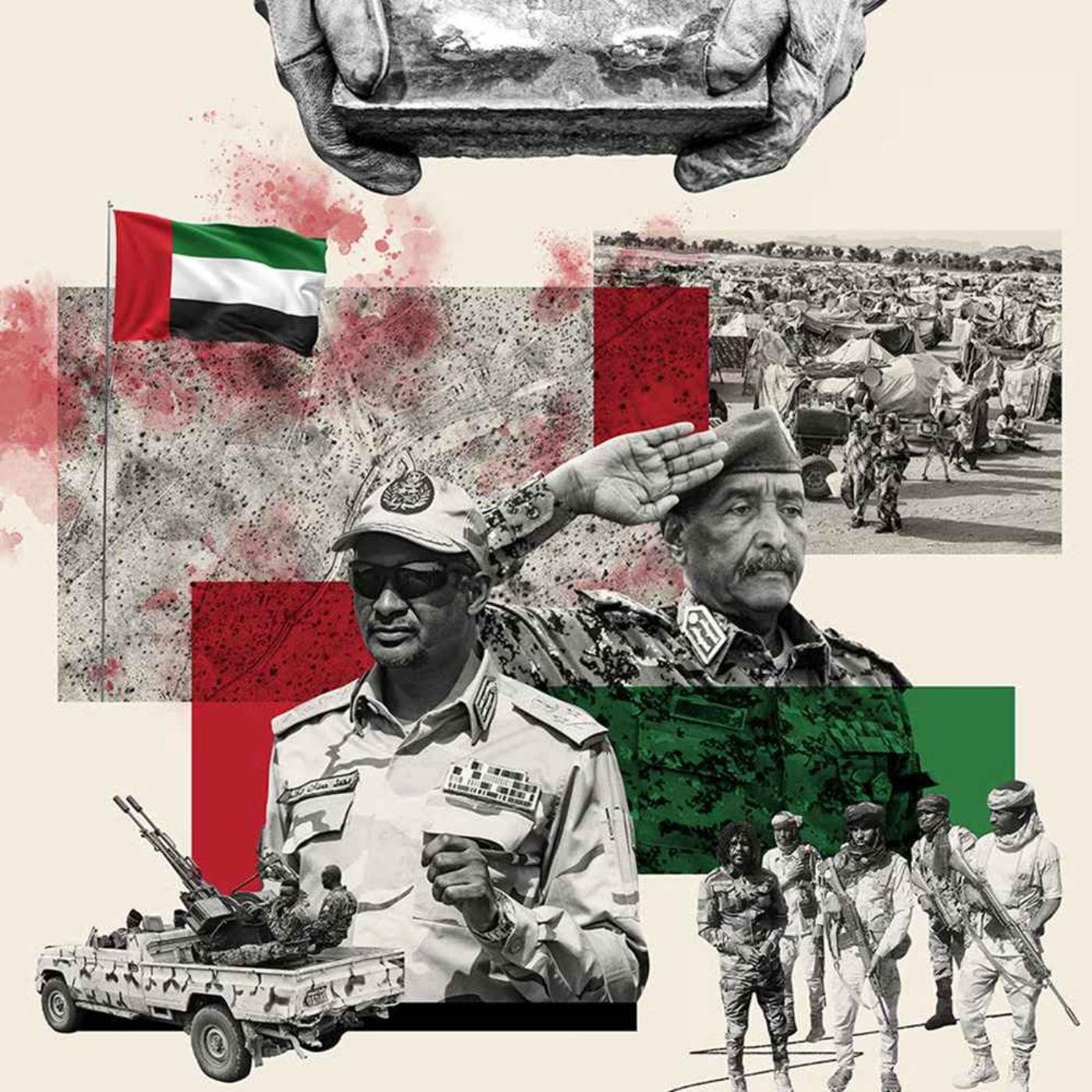
In Darfur, at least twice as many people have been killed than in Gaza since 2023. As the crisis looks likely to worsen, one nation has questions to answer over its links to the atrocities.
In this week’s special report, The Standard’s Defence Editor Robert Fox shines a light on the situation in Sudan - and specifically how the United Arab Emirates is involved in its war.
Hosted on Acast. See acast.com/privacy for more information.


