
 Ask ChatGPT



In this episode, the significance of the 80th anniversary of VE Day is explored through a discussion with Laura Clouting about the historical importance of the event and its relevance in today's society. Additionally, the celebration of Sir David Attenborough's 99th birthday coincides with the release of his new film, Ocean, which addresses the health of our oceans.
Written by AI. May contain mistakes.

Get the gist, explore an idea or ask about something said.
 Claude
On The Standard, what are the key points of this episode?
Searching your listeningAutomatic transcript. May contain errors.
0:03Hi, I'm Julie Banks. Welcome back to The Standard Podcast. If you're new here, don't forget to hit follow and why not leave a review. Coming up. After living for nearly 100 years on this planet, I now understand the most important place on Earth is not on land, but at sea. Sir David Attenborough marks his 99th birthday with the release of a brand new film called Ocean. The London Standards culture writer Vicky Jessop has been to see it and will be with us later to tell us what we can expect.
0:45But first... I think it's very important for my generation to say thank you to all the veterans and everyone who took part in the war. The words there of 10-year-old Alexander Churchill, who is the great-great-grandson of wartime leader Sir Winston and who lit a candle of peace at today's memorial service at Westminster Abbey to mark the 80th anniversary of VE Day. To explore the importance the historic event still holds in today's society and to ask what we can learn from those who endured the Second World War, we're joined by Laura Clouting, who is a senior curator at the Imperial War Museum.
1:26Laura, for anyone whose historical knowledge around Second World War isn't so great, Can you give us a brief overview of the historical importance of VE Day and what came to pass in those final few months of war in Europe? The Second World War had obviously taken over everybody's lives for the last six years and there was a crescendo of violence in Europe over the preceding months. I think there was a feeling in Britain that they felt that Germany was going to be defeated. So the end of the war was not a surprise, but it's a matter of when will this unconditional surrender come? And once all of that is sorted out, a very complex process, that feeling of that imminent threat of danger that people have been living under for so long came to an end.
2:15So VE Day was the end of the war in Europe. Very important to remember that the war had not ended. For example, the war against Japan was still ongoing. VE Day was a kind of declaration of a public holiday. But as we know, it was a feeling of very mixed emotions, I think, for people. For some, it was a huge celebration. But for others, of course, it's incredibly bittersweet. Can you tell us more about that and give us a sense of how people would have been celebrating back in 1945? There were parties, you know, in the city centres. There were the bonfires. There were street parties, lots of kind of illuminations.
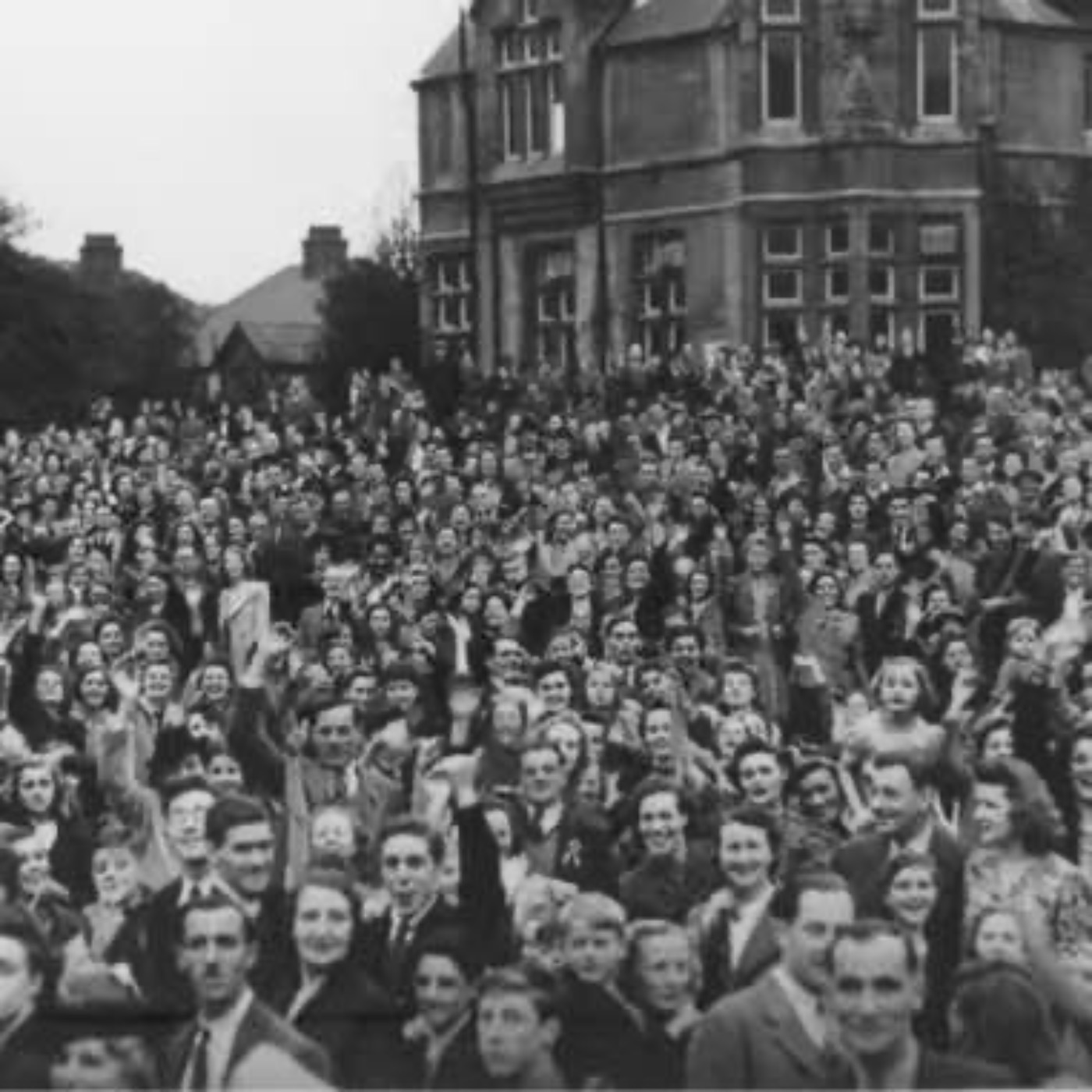
2:54Public buildings lit up for the first time since the coronation in 1937. People did come out to celebrate. And of course, Churchill makes his appearance on the balcony and gives a speech. There is a feeling of rejoicing, thanksgiving for all of the sacrifices that have been needed. But it's kind of tinged with that feeling of sadness, I think, for so many people who have lost loved ones in the fighting. Many British civilians, of course, caught up in air raids. 60 ,000 people were killed in those air raids. The war had really come home for people. I think as well, that nervousness on the part of some people that their loved ones still fighting might be sent off to continue the war against Japan.
3:39There is that feeling, though, that there is going to be a lot of reunions, families brought back together again. In some cases, that was quite difficult. You know, lots of these soldiers had been away for many, many years. Some had never even met their own children. So there is a lot of renegotiation of a return to ordinary life that's required. at the end of this conflict. And VE Day was not an end to some of the war's privations either. Austerity continued. Things like rationing did not come to an end as soon as the peace was declared. So it's a bit of a mixed day, really. Now, as the years go by, there are, of course, fewer men and women left to tell their stories and be visible reminders to us of what took place all those years ago.
4:25How do we best keep their legacies alive in order to honour the sacrifices they made? There is no more fascinating opportunity and such a precious thing to be able to talk to people who have quite literally lived through these events, whether they were young, obviously the most elderly will have slightly more adult memories, which are incredibly precious given the age of these veterans, for example. However, what can still happen beyond the lifespan of people who've lived through these events, So we can still connect with them by keeping hold of precious testimony. The Imperial War Museum obviously has collected the, if you like, memories, the testimonies through letters, through diaries, oral histories, even impressions of war through artwork, for example, and the whole visual record of war through our photography and our film.
5:18And that is a direct way, if you like, to be absorbed in what was it like to live through these world-changing events, these incredibly extreme experiences. And you see within our whole collection the intensity of those experiences, but also some of the mundane preoccupations of people during wartime. It's not just living in a state of heightened anxiety and fear and trepidation that you might think. people do get consumed with their own relational issues, with what's going on in their family. And in a way, that's incredibly reassuring to see. So we have this wonderful archive and the ability to tell stories beyond the lifespan of people who have lived through it.
6:03And that's so vital. I think what you see this week, of course, across the country, the focus rightly is on those who have lived through those experiences. You can see the way that veterans have been put front and centre of events this week. And that's quite right. And finally, Laura, why do you think it's so important that we continue to commemorate VE Day? And what do you think we can learn from the past given these politically uncertain times that we're living through now? We see through, for example, the Imperial War Museum's collection, that war is a reality. It's something that has kept happening over history.
6:38That's as certain as we can be. And it's, I think, incredibly pertinent to see how that affects people. For decision makers, people who are involved in deciding whether or not to use violence as a means to resolve conflicts, that they should be acutely aware of the impact that that has on populations upon people. For those of us who are incredibly anxious about the outcome of world events, I think those anxieties can be absolutely mirrored in what people have gone through before. But also there's some solace perhaps to be found in the fact that people do have to endure these things and find ways to cope.
7:16They find ways to make sense of what they're living through. So I think that engagement with these events and with the realities of conflict, how it affects people's minds, their life outcomes, we have to remain engaged in that so that we understand the consequences of what war really means.
7:37Let's go to a break. Coming up, Sir David Attenborough celebrates his 99th birthday with one of his most important messages to date. We'll see you back here in just a moment.
7:56Welcome back. Sir David Attenborough is celebrating his 99th birthday today and it just so happens to coincide with the release of his new film titled Ocean. The London Standard's culture writer Vicky Jessup has been to see it and joins us now. Vicky, what can you tell us about the film? This is a kind of cinema-led documentary that's being released in cinemas first and then being rolled out across streamers. It's not a BBC production. Basically what it is, the deep dive into how the oceans have changed over the last hundred years. You know, David Attenborough is 99 now and over the course of his life, basically he's just seen massive, massive change.
8:31And I think for him, it seems to have been very important to kind of highlight this change, focusing on like the wonderful discoveries made by scientists and explorers over the last hundred years, but also kind of looking at why the ocean basically is in such poor health right now and how we can maybe start taking steps to restore it to health. So yeah, a kind of combination of the kind of beautiful graphics that we're used to, the beautiful sights of, you know, turtles nibbling on coral reefs, giant whales, seaweed forests, teeming with life basically and then the kind of more sombre element of human activity in the oceans and I think especially in this case it seems to be industrial fishing.
9:08And what has Sir David himself said about the reasons why he wanted to make ocean? Yeah so he's talked a lot about it he doesn't really do a lot of traveling these days but he does appear in the ocean kind of sitting on the very depressing looking grey beach he just says you know the key to saving the planet is not on land but at sea and he says in the show like when I first saw the sea as a young boy it was thought of as a vast wilderness to be tamed and mastered for the benefit of humanity and now as I approach the end of my life we know the opposite is true so you can kind of tell this is a subject that's really important to him I think he goes in a lot on the kind of horrible effects of industrial fishing and you know basically just says if we save the sea we save our world over the last 20 years maybe of course he made his name with these gorgeous nature documentaries and I think for a long time audiences were used to kind of just like enjoying the beauty of nature but I think in the last 20 years an environmental message has crept in more and more to his work and it's you know become ever more strident I think in the last five years possibly because he knows he's approaching the end of his life and he has this amazing platform and I think he you know he knows that stuff that he says is going to be listened to whereas perhaps it wouldn't be listened to if someone else, another nature broadcaster, were to say it.
10:20So yeah, I think it's something that's very close to his heart. Well, the London premiere took place earlier this week, complete with a blue carpet instead of the traditional red. And it was also attended by King Charles, who is equally passionate about environmental matters. The King and Sir David seem to enjoy each other's company. I guess having that level of royal support is a big bonus for the film. these two have very uh what's the word like closely aligned interests i suppose so yeah charles came to the premier which is obviously a great statement of confidence and he himself is known for like his love of nature the climate change i think he first talked about how dangerous plastic pollution was in 1970 when he was 21 years old like this is something that he's always been aware of and he's always been aware is an important thing you know that we need to be taking notice of and you know plastic pollution for maybe the general public consciousness has only been there for the past like 10 years perhaps.
11:14So yeah, he is also very ahead of the curve. And Sir David was good friends with his mother, the late queen. And I think he first met Charles when he was nine. Charles came down to the BBC studios to meet David's cockatoo. And apparently he was worried the pet would wipe Charles's finger off. But obviously it did not. But yeah, I think their relationship, obviously we don't know, but I think they're thought to be quite close friends. So David Attenborough turns 99 today. How much of an impact do you think he's had on the nation's understanding of the natural world? Oh, massively. I mean, he can be credited with, I mean, first of all, basically just introducing the concept of nature documentaries to the British public.
11:54You know, he started working at the BBC all the way back in the 1950s and he hosted a wildlife show called Zoo Quest then, which I think was popular, but his first nature series, Life on Earth, which was released in 1979, like this was massively successful and basically just proof that shows about nature could be popular. All the DV documentaries that he put out over the years after that, these were also massive hits that kind of like cemented his position as a national treasure. You know, there's other stuff that we can credit him to as well. He introduced colour television when he was controller of BBC Two.
12:24So he oversaw one of the first ever colour broadcasts in Europe and introduced that into his nature documentaries as well. And I think, as I mentioned before, in the last 25 years, he's really focused on vulnerable and endangered animal species, you know in platforming them in kind of spreading the word about the damage that we're doing to the environment and i think like it's been massively influential i think probably not even in ways that we consciously realize with stuff like blue planet 2 that was released in 2017 and that was a massive moment that was credited for sparking like a major national conversation on single-use plastics there was this really heartbreaking footage of a whale whose calf had died we were told from like plastic poisoning essentially and it led to i think like the queen banning single-use plastics from buckingham palace and you know i think 750 million people around the world tuned in to watch that like that's big numbers and that created something called blue planet effect which made people go out onto beaches to pick up litter essentially so yeah it's had a massive effect over the years i think you know basically he is a national treasure and i think he is aware that this is the platform he can use to spark a conversation.
13:29I think the creators of this film are hoping it will spark another conversation on industrial fishing. So the show really kind of goes into depth on how terrible industrial fishing is for the environment. You know, we see these big trawlers dragging these nets behind them, like ripping up the seabed and these kind of very ancient ecosystems basically to catch fish that, I mean, we're told, you know, it's quite shocking, but only 25 % of that fish is actually used and sold. You know, the rest is just discarded. So I think Attenborough says, you know, it's like one of the single most boastful things that we're doing today.
14:02So I think they're hoping that it will spark a conversation on that as well. Whether it happens, we will see. But, you know, fingers crossed.
14:13And that's The Standard. For all the latest news, head to standard.co.uk. And of course, if you'd like to get in touch, do drop us a line at podcasts at standard.co.uk. This podcast will be back tomorrow at 4pm. We'll see you then.
After several days of commemoration events to mark the 80th anniversary of VE Day, culminating in a memorial service today at Westminster Abbey, we’re joined by Laura Clouting, Senior Curator at the Imperial War Museum, to explore why the historic event still holds importance in today’s society and what we can learn from those who endured the Second World War.
Plus, as Sir David Attenborough celebrates his 99th birthday, he releases a new film with possibly one of his most important messages to date.
The London Standard’s Culture writer, Vicky Jessop, joins us to tell us what we can expect from ‘Ocean’.
Hosted on Acast. See acast.com/privacy for more information.


