
 Ask ChatGPT



Published: [Date of Episode]
Charlie Duffield
Nick Dearden and Ann Gavaghan
In this episode of The Standard, the discussion revolves around US President Donald Trump's second state visit to the UK, exploring the implications of his visit amidst significant protests and controversial international issues. The episode also transitions into a celebration of the Central Line’s 125th anniversary, featuring a treasure hunt organized by Transport for London.
Written by AI. May contain mistakes.

Get the gist, explore an idea or ask about something said.
 Claude
On The Standard, what are the key points of this episode?
Searching your listeningAutomatic transcript. May contain errors.
0:02Hi, I'm Charlie Duffield and welcome back to The Standard Podcast. If you're new here, hit follow and give us a rating. For all the latest news, head to standard.co.uk. Coming up later in the show. The rich history and heritage of Transport for London's Central Line is being celebrated this weekend with a free treasure hunt. I really just hope that people enjoy learning new things about the Central Line and come away with an appreciation for how much work goes into creating a station and keeping it up over the years and how stations change and grow with London.
0:47But first, today Donald Trump arrives in the UK for a historic second state visit, which is unprecedented for a non-royal, as thousands of people are expected to fill the streets of the capital in protest against the US President. He and his wife Melania will meet King Charles at Windsor Castle and Prime Minister Sir Keir Starmer, but there are no public events planned and he will not spend time in London. Instead, talks between Trump and Starmer are likely to be dominated by topics including trade, Ukraine and Gaza. Back in June 2019, during Trump's last state visit, he took tea with the late Queen, called London Mayor Sadiq Khan a stone-cold loser, backed Boris Johnson in a Tory leadership race and suggested the NHS should be part of US-UK trade talks.
1:41In July, a YouGov poll found that just 16 % of Britain surveyed said they had a positive view of the US president. Joining us now is Nick Durden, Director of Global Justice Now and spokesperson for the Stop Trump coalition. Nick, what will Trump be doing on this state visit and how do you feel about it all? There's going to be a big Republican dinner in Windsor tonight with some of Trump's funders. He's going to be at Windsor for the next day or so once he arrives and then he's going to be going to Chequers. And as Stop Trump, we are really concerned that this is a visit that should never have been agreed, given what he's doing in the United States, driving his country into authoritarianism and also declaring economic warfare to friend and foe alike across the world.
2:25We think that was a mistake. We're also very worried at who he's bringing with him. Some of the really huge corporate bosses from the world of tech and finance who will be agreeing deals with the UK government. And that may look like investment, but we fear in order to get those funds into the country, we're going to have to give up part of our sovereignty and hand over parts of our economy to these giant US corporations. So the business part of the trip is as important, I would say, as the ceremonial. Starmer will be hoping that this visit will be dominated by news of investment deals between the US and the UK.
2:58Tell us a bit more about that. A few of the details have been leaked. So we're expecting investments to build some of the big data centres and the attached nuclear facilities that are going to power some of these data centres and other parts business in the UK. And look, it really worries us because these things are being built primarily with US capital, but they're being built within the US interest. So they're not being built for the interests of the British public. And we're really worried that as part of these deals, we're going to be asked to give up our ability to tax and properly regulate this stuff.
3:28I mean, just on the nuclear side of things, we're really particularly worried. Keir Starmer has said this is going to be a golden age of nuclear power. And one of the things he's doing to bring that forwards to say, we accept US regulatory requirements and certification on new nuclear power plants. Well, that's really worrying because Trump is deregulating and cutting jobs in the nuclear industry in the United States. It's a worry what's happening in the United States. We don't want to be accepting those certifications in the United States at a time like this. And I think that applies right across the board.
4:01We know that big tech does not believe that we should be taxing them through a digital services tax and they want it dropped. We know that they don't like all manner of online safety regulations. And we know that they don't like competition regulations. And they are going to be demanding as their pound of flesh for investing here that we rescind that stuff. And that means that decisions around how we develop our technology industry, how we develop our nuclear industry are not really being made here by our own government. They're being made by and in the interests of American corporations. And a new US-UK technology partnership will be signed as well.
4:36Is that right? The technology partnership is supposedly the thing that holds all of this together. And the investment has been made supposedly on the basis that we've agreed to cooperate under the terms of the technology partnership. I should say at the moment, we don't have any of the details of that partnership. It's been negotiated by Lord Mandelson, former ambassador to the US, of course, with Trump's administration. That in itself, I think, is cause for concern because we should not be agreeing these kind of deals outside of normal parliamentary procedure, outside of the ability of the public to intervene and give their opinion on them.
5:11So that worries us. But we do know what the people engaged in those negotiations think. And that is we need less regulation. And I think that's exactly the wrong direction to be taking this industry. And I think if you look at opinion polls and so on, most British people are concerned about how we develop this new technology. And they certainly don't want to give away our ability to control that development to people who their primary interest is making as much profit as they can and returning that to the United States or their offshore bank accounts. So what about international affairs? Are Starmer and Trump aligned on these?
5:46I don't think that Starmer is aligned with the US on Ukraine. He is trying to push Donald Trump in the direction of further sanctions on Russia. But whether Trump will get there, I mean, I don't believe it. Clearly on Gaza, what we're watching at this point is a complete catastrophe, a genocide, as the UN itself has said this morning. Trump is up to his neck in what is unfolding there. And for me, that is just one more reason we should not be giving this guy a second state visit. I mean, a person who is engaged in some of the worst crimes we've seen in the last 50, 60 years, and it is completely unhelpful to resolving the situation in Palestine and holding Israel to account for what it's doing.
6:27Now, is this a genuine opportunity for Starmer to influence the direction of US policy? Yeah, so Starmer's always sold what he's doing as the best opportunity that we've got, both to get a good deal for ourselves, but also to influence the direction of the US administration. I have to be honest, I think that what we've seen over the last six months does not bear out his justification for that at all. If you look at the fine print of the deal we got on tariffs earlier in the year, most of which hasn't been implemented, we didn't get a better deal than the European Union. In some ways, we got a worse one, in some ways, a slightly better one, but it's more or less the same.
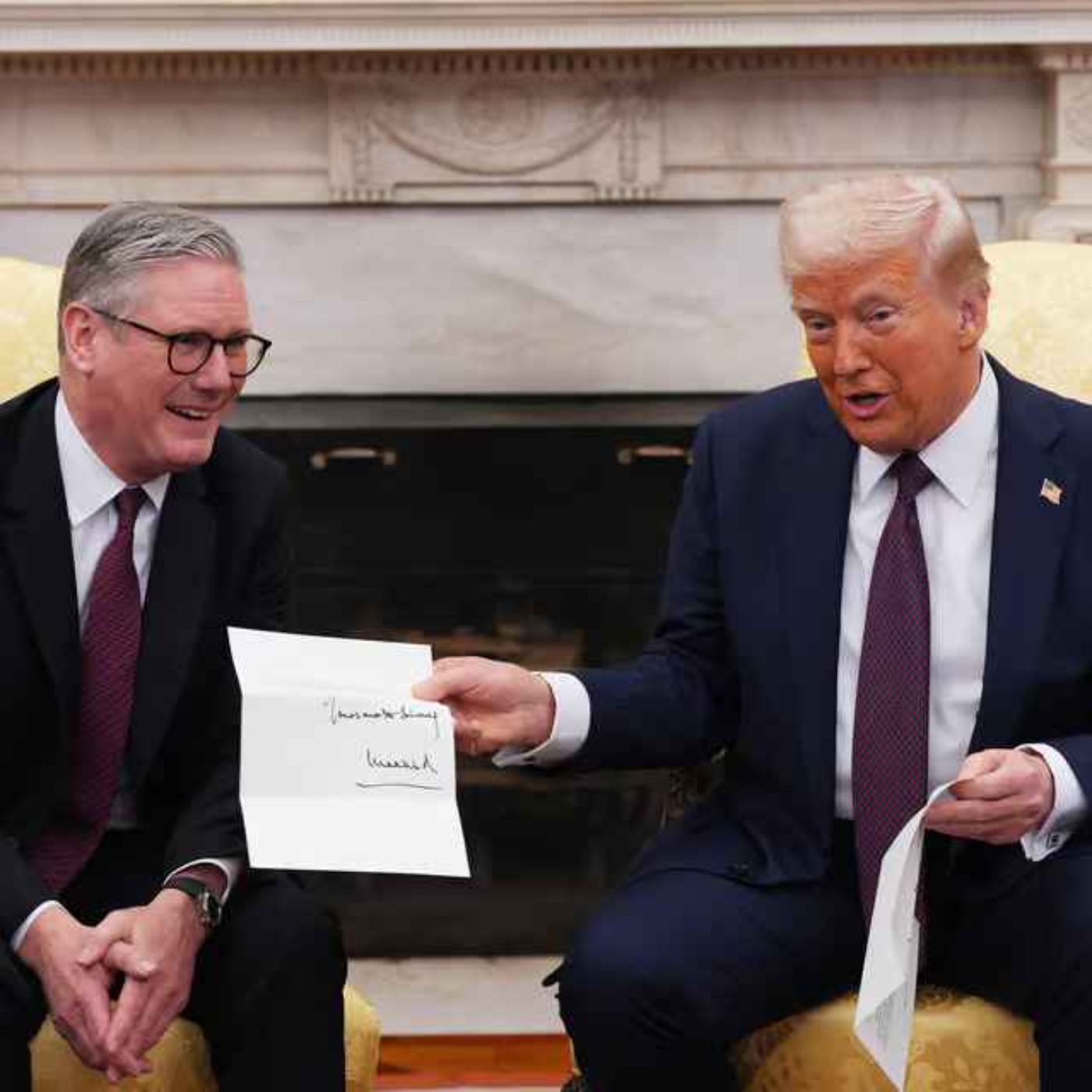
7:04So it did no good at all, Starmer going over to the Oval Office earlier in the year and doing his best impression of a human carpet and crawling and groveling to this guy. We got the same deal at the end of the day, and exactly the same on Gaza, where Starmer said in Scotland that he was putting pressure on Trump. And then the very next day, Trump comes out and says the opposite to what Starmer wanted him to say. So yeah, I don't think it's working. And I think it's a surprise it's not working because Trump is a bully. And as many of us learned at school, with bullies, you've got to stand up to them.
7:36Simply giving in means they will come back and ask for more the next day. And I think that's what we're seeing with Trump now. We thought we had a trade deal agreed earlier in the year. We didn't. Most of it was not finalised. And now Trump is coming back with his friends, the oligarchs from big tech and big finance, and they're going to be demanding more in the UK. Finally, is there anything else you want to add? On Saturday, we had the world's richest man, one-time friend of Donald Trump, addressing an enormous far-right demonstration in London and saying violence is coming to Britain and to the UK government.
8:11And this is the same guy, by the way, that it fuelled and it effectively funded that demonstration. Only a few days later, the UK is rolling out the red carpet to the kingpin, I would say, of that far-right movement internationally. And it will only encourage what I still believe is a small minority of people in this country, but nonetheless growing in significance, who believe that the politics of division and hatred are the way forward. I don't think most people in Britain believe that. I don't think that's where they are. I don't necessarily even think everyone on that demonstration believes that.
8:43But by continually kowtowing to Donald Trump, we are simply empowering Trumpist ideology of hate and division around the world. We need to stop doing that and instead offer people in this country a better deal. They voted for change last year. They have not seen change. By kowtowing to Trump, we're not bringing about that change at all. We are simply fueling discontent and anger that it hasn't happened. And I think the government will really rue the day that it made this invitation earlier in the year in the Oval Office. Let's go to a break. Coming up in part two, the Central Line has connected Londoners for 125 years, but could you identify its key features?
9:28We'll see you back here in just a moment. Welcome back. A treasure hunt is being held this Saturday 20th September to mark the 125th anniversary of the Central Line as part of London's Open House Festival, which is an annual celebration of London's architecture and neighbourhoods and the people and communities that make them. The free drop-in event starts at Shepherdsbridge Station, running along the line's original route to bank from 10.30 to 3.30. The central line opened as the Central London Railway on the 30th of July 1900 and is the longest line on the underground. The treasure hunt held by Transport for London reflects the line's history with answers at each station hidden in posters, plaques and artwork.
10:21Joining us now is Anne Gavigan, Customer Experience Manager at Transport for London. He runs the People and Places program. And why did you decide to partner with the Open House Festival? Because we have so much architectural heritage that we want to share with the public. Over 70 of our two stations are listed and we have many others which are architecturally significant and may not be listed like Canary Wharf or Gantz Hill. Every single station on our network has something that I love and other people love and that we want to kind of highlight and celebrate and share with the public. So that's why we partnered with Open House to be able to say, hey, we know you're architecture enthusiasts.
11:04Here's some things we want to enthuse about with you. So the Central Line officially opened to the public in July 1900. What happened after that? We might call it a soft launch today in June 1900, when the then Prince of Wales rode on the line for the first time with a bunch of other dignitaries, including the American author, Mark Twain, and then they did some running of trains in tunnels without passengers until it did open on the 30th of July, 1900. That first year of the line being in service, the Central London Railway, 14 million people rode the trains. By two years later, 45 million people were riding the line annually.
11:48It was great because it was a set fare, two pennies, the Tuppity Tube, and it was fast. It was electric trains. And because it was electric trains versus steam trains, it was seen as cleaner. You wouldn't get steam or any steam residue on your clothing. And you could travel across London and go to places that people wanted to go, like Oxford Street for shopping, where we previously hadn't had any tube services. A fascinating and fast way to get around London and one of the first, not the first, but one of the first deep tube and electrical tube lines in the city. So the central line just kept going from there.
12:33It extended in 1908 to Wood Lane for the Franco-British exhibition. And that brought it out to something you would associate with leisure activities. So it then started serving the White City area from 1908. In 1912, it gets extended to Liverpool Street. So you're serving that mainline terminus. And then in the 1920s, you have some extensions out to the Actons. In 1935, there are plans to really make it a big deal extension to the West and the East. In the East, to a place called Angar in Essex, and in the West, to a place called Denham in Buckinghamshire. It's part of what was known as the New Works Program.
13:17But then World War II happens. Everything gets put on hold. They start construction, and actually, the Central Line proves to be a useful part of the war effort. Some of the tunnels that had already been built on the eastern end of the Central Line were used as a subterranean factory where they helped to manufacture aircraft parts. But most of the construction of this doesn't happen until post-war in the 1940s, and it actually gets scaled back a bit. The Western extension doesn't go as far as Danim, it goes to West Reislip. And the Eastern extension does go to Angar, but that gets closed in 1994 when it only goes to Epping.
13:59But I think the Central Line is still one of the best bargains you can have in London. It's the longest continuous ride you can take on the underground going from West Reislip to Epping, 34 miles without changing. That's pretty great. There's a lot to love about the Central Line, and I think it takes many Londoners all the places they want to go. What can visitors expect from this TFL treasure hunt? How will it work? You need to show up at Shepherd's Bush Station to pick up a clue pack, which is your ticket for the day. We have clues for several stations which were along the original route of the Central London Railway.
14:35So So you need to visit those stations and answer the questions that are contained within the clue pack. We also have a little history of each station. So you'll get to learn a little bit more about the station and its architecture and the people who built the stations. You can finish all of the stations, answer all the clues, although it's not a race. You could win a tote bag while supplies last. And what do you want visitors to take away or learn from the experience? I'd really like people to start taking a better look at stations during their commutes because there's so much history that's all around them.
15:12And there's so many interesting things in our stations. So do you have a favourite feature of the central line yourself? No, because there are too many interesting things on the Central Line. I mean, looking at the different architectural styles across the line, some of the stations we're not seeing, for example, we're not going to White City, but you go to White City, right to the left of the entrance, there's a little this. It's celebrating the fact that it won a Festival of Britain Design Award in 1951, which I love. Or you go to the eastern part of the line and you go to a place like Loughton station where you get off a train and you go to the platforms and you look at the ticket hall and you see this gorgeous window, this big arched window.
15:55And then you actually go into the ticket hall and it's filled with glorious amounts of light. It just cheers you up so much. It's a beautiful station and a beautiful ticket hall. And pretty much every single station on the central line has something like this to love. The cupola at Barkingside, Oxford Circus Station. You've got some amazing mosaics on the platform and you've got the Victoria line tiles there. So there's little bits of artwork to find at Oxford Circus Station. You can pretty much name a station. I could tell you something that I absolutely love about it.
16:34and that's the standard for all the latest news head to standard.co.uk if you'd like to get in touch please do drop us a line at podcasts at standard.co.uk we'll be back here tomorrow at 5 p.m we'll see you then
US President Donald Trump is set to arrive in the UK for his unprecedented second state visit to the country. The trip has sparked controversy and thousands are expected to take part in a series of anti-Trump protests. He will meet with Prime Minister Sir Keir Starmer for talks on trade, investment, Ukraine and Gaza. Nick Dearden, director of Global Justice Now and spokesperson for the Stop Trump Coalition is here to discuss what’s at stake for the UK.
And in part two, Transport for London (TfL) is celebrating 125 years of the Central line with a treasure hunt open to all on Saturday, at this year’s Open House Festival. We’re joined by Ann Gavaghan, Customer Experience Manager at Transport for London, to find out more.
Hosted on Acast. See acast.com/privacy for more information.


