
 Ask ChatGPT



```markdown
In this episode, hosts discuss the current state of Britain's position in the global space race, particularly in light of the Space-Comm Expo happening in March. The episode features insights from science and technology reporter Will Rogers-Coltman and Nicola Buck, CMO at Castrol, who elaborates on the AstroAnt robot designed for lunar exploration.
Written by AI. May contain mistakes.

Get the gist, explore an idea or ask about something said.
 Claude
On The Standard, what are the key points of this episode?
Searching your listeningAutomatic transcript. May contain errors.
0:03Hi, it's Rachel Abbott. Welcome back to The Standard Podcast. Coming up, the tiny Astro Ant robot that's just been delivered to the moon. It is a micro robot that will move up and down on the rover and send back critical data and temperature measurements to check the health and the performance of the rover. But first...
0:31first. The sound of a SpaceX Starship mega rocket launch on Thursday from Texas, another to add to a string of test flights from founder Elon Musk. And yet again, yesterday's launch in Texas didn't go to plan. Despite catching the first stage booster back at the pad with giant mechanical arms. The spacecraft exploded, losing contact and breaking apart mid-air, sprinkling debris and halting air traffic in parts of Florida. Starship reached nearly 90 miles in altitude before trouble struck and before four mock satellites could be deployed. And we just saw some engines go out. It looks like we are losing attitude control of the ship.
1:16Can confirm we did lose contact with the ship. Clips courtesy of Associated Press there. It's a busy time for the SpaceX boss Elon Musk, as NASA has booked Starship to land its astronauts on the moon later this decade. And Musk is also aiming for Mars with Starship, the world's biggest and most powerful rocket. But with America dominating the headlines, where does Britain stand in the global space race?
1:44The London Standard is the media partner for this year's Spacecom Expo at the Excel which takes place between the 11th and 12th of March Science and technology reporter Will Rogers-Coltman has been writing for this week's edition of the paper and online on the future of British space technology and spoke to Will Whitehorn, ex-president of Virgin Galactic and Doug Liddle, chair of UK Space, who are both attending this year's expo. Will Rogers-Coltman joins me now. So Will, where do Britain currently stand in the global space race? Britain, it would be an overstatement to say they are one of the main players.
2:25On a business side, they contribute about 7 % to the global market of the space industry. and really there's only been six astronauts, most famously Tim Peake recently. And what grabs headlines ultimately is launches and astronauts. And as there's nowhere to launch as of yet, although they're talking about doing it in the UK, in Scotland and Cornwall, it doesn't make media as much as it perhaps does in SpaceX or in America. What we do have is amazing research facilities and some of the best academic centres all across the UK. Obviously, most famously, Oxford and Cambridge. But there's also the Rutherford Appleton Research Institute.
3:06The UK is also quite uniquely positioned in between Europe and the US. So at the moment, we are a member of the European Space Agency. And we're the fourth biggest contributor to this. But at the same time, we also have a really close relationship with the US and their space programs, which is usually quite autonomous. us. So we share defence budgets and we share defence intelligence with them as well. So we're in quite an exciting position. And Will Whitehorn, who is the ex-president of Virgin Galactic and the chair of Seraphim Space Investment Trust, who I interviewed for my piece, he says we're in a unique position as a bridge, which can be really exciting for the future of the British space industry and put us in good stead in the space race.
3:54What's the future like for British space technology? So the future can look bright, but it requires investment ultimately to keep up with the heavy hitters of China or America. And really, the precedent needs to be set in government funding and public spending, which obviously is pretty difficult at the moment. However, with the recent news that the defense budget is going to be increased to 2.5 % by 2027, this could really boost funding for satellites because the space industry and space technology, it's quite funny, it's so entangled with other industries, for example, defense, because intelligence and surveillance is so reliant on satellites.
4:35But there are some really exciting things going on at the moment in the future as well, such as the Rosalind Franklin rover, which is a Mars rover, which is built in the UK with the European Space Agency and is set to launch later in a decade. It was supposed to be done earlier, but because of the Ukraine war, it's been delayed. And why is space technology so important? I think people conflate space tech with space exploration, and they have sort of misty-eyed sentiments about, you know, reaching the stars, Tom Trump's inauguration, manifest destiny, and it becomes quite colonial in a way. But far from the abstract, space technology has real material consequences to our day-to-day lives, which we just don't realize.
5:17UK space came up with a statistic that space technology underpins 16 % of the UK's economy. Now, you could argue underpinned does a lot of heavy lifting there because it's quite vague. But when you consider that we rely on satellites for weather predictions, GPS, Wi-Fi, communications, surveillance, intelligence, it starts to make a lot more sense just how reliant we are on this. And also, these technologies aren't going away. They're only going to become more important. So it's really crucial that if the UK want a grapple hold in a developing technological world, We need to invest in satellite technology and British space technology.
5:58It also has massive implications for the environment. I know many people have worries about jet fuel, and obviously that's completely valid. But the stuff they're doing in space at the moment can genuinely help a climate crisis. Currently, they're predicted to make off-planet solar farms within the next 10 years. And they are super efficient because there's no cloud coverage and they can work 365 days a year. You know, cloud coverage, obviously a bit of a problem in the UK for solar panels. With weather predictions, as the climate becomes a lot more volatile, this can really help countries that are affected by the vacillations of the climate crisis.
6:33Could you tell us about some of the exciting British space technology companies? So there's a very exciting Cardiff-based aerospace startup called Spaceforge. And they specialize in in-space manufacturing, which uses space-unique conditions that are really hard to recreate on Earth, such as microgravity, which is basically just very slight, less gravity. It's not complete weightlessness, but you can imagine in orbit there is a slight gravity. It uses the vacuum and the really extreme temperatures of space, which are really hard to recreate on Earth and really expensive and really energy inefficient.
7:05conditions. Another one is BioOrbit, who similarly are using space as conditions, but this time to create drugs. And there's a really budding pharmaceutical business potentially happening in space in a very short time period. Again, harnessing those unique conditions that are difficult to recreate on Earth. And with the recent revolutions that SpaceX have made with With these companies, it's now way easy and way cheaper to get to space. So the likelihood of these companies who develop these amazing technologies on Earth to do these things in space is going to happen very quickly.
7:45Let's go to a quick break. In part two, we're joined by Castrol's CMO Nicola Buck on AstroAnt, a very small robot that's involved in the latest lunar landing. We'll see you back here in just a moment.
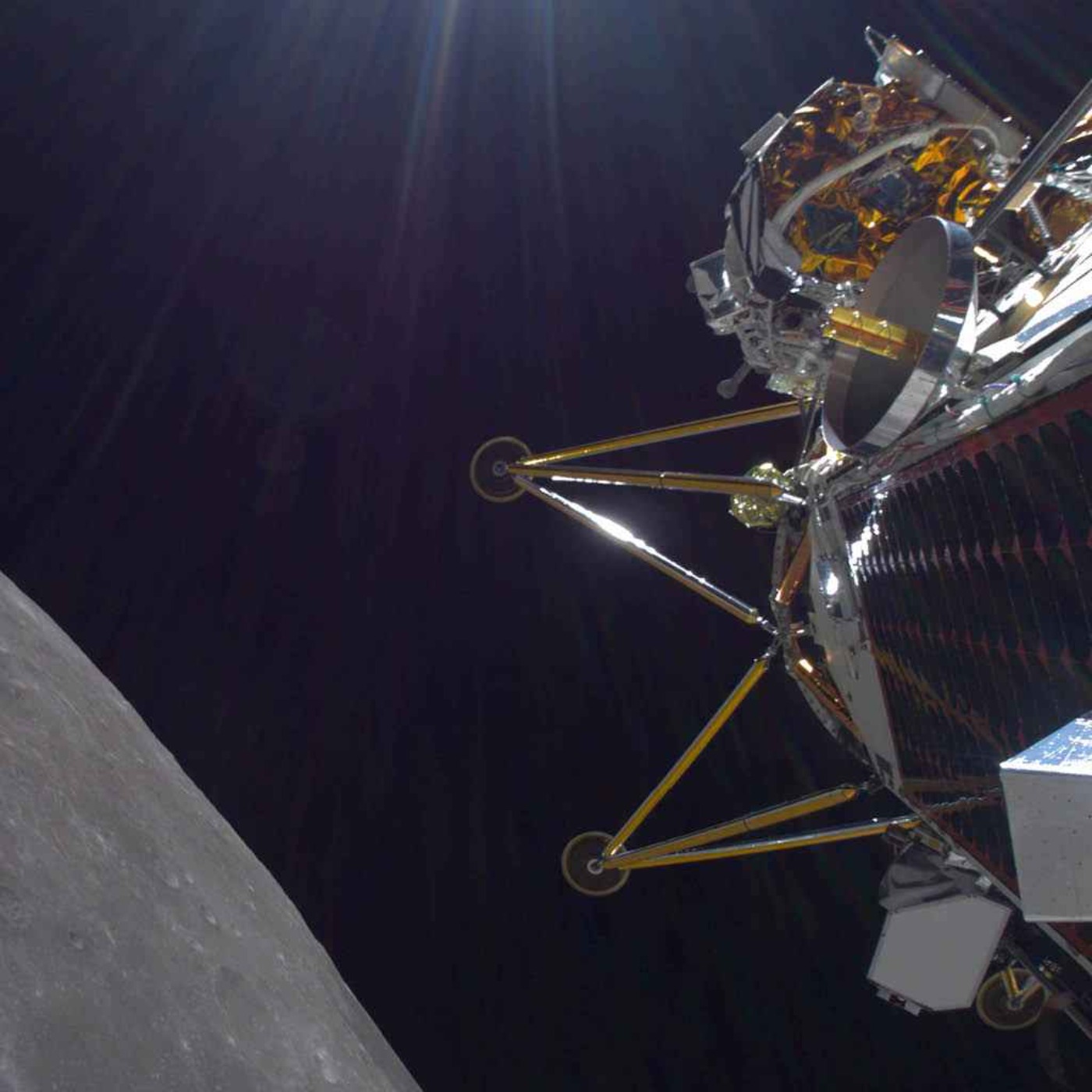
8:06Welcome back. Three, two, five, one, mission, and lift off. That's a Falcon 9 rocket lifting off from Cape Canaveral on Wednesday the 26th of February, carrying Intuitive Machine's second moon lander, Athena. and by Thursday the 6th of March, after an eight-day journey, Athena landed on the lunar surface at around 1730 GMT. However, shortly after its landing, experts discovered that the spacecraft had landed on its side. At the time of this podcast being published, intuitive machines have announced that the lander does not have enough power to complete its mission. The spacecraft is thought to be 100 miles from the lunar south pole.
8:54It's believed that the payloads and scientific instruments, including the MAP rover and AstroAnt, the smallest robot ever to be involved in lunar exploration, may not be able to be used. Prior to the news breaking, we caught up with Nicola Buck, CMO at Castrol, who designed the AstroAnt robot with MIT Media Lab. Castrol will also be attending the Spacecom Expo. Nicola, can you start by telling us about AstroAnt? Yeah, happy to. Thanks, Rachel. Yeah, we were super excited when last week I had the pleasure of going to Kennedy Space Centre and witnessed the rocket going off to space carrying our important payload.
9:34And that is a rover. And on top of that rover is what we call our Astro Ant. Now, the Astro Ant is developed together with our colleagues at MIT Media Lab. We're a research partner of theirs. and the astroant is a micro robot so imagine the micro machine toys that you might remember from when we were we were children it's only about two centimeters squared with a long-term vision of maybe a swarm of these ants that could in future missions make testing data on things like rocket ships much easier because if you can send a tiny micro robot out to check some data it's much easier than sending a person or a big machine or something like that.
10:15And for us at Castrol and that research partnership we have involved us testing our space-grade lubricants in the wheels of the Astro Ant. And the key to that is recognising that once this payload gets to the moon, it has to operate in some pretty tough conditions. So on the moon, you're looking at temperatures down to potentially lower than minus 400 degrees Fahrenheit, bombardment from moon rocks, dealing with all sorts of chemicals because of the thin atmosphere on the moon. So these products have to be really carefully tested to make sure they can withstand those conditions and therefore help the Astro Ant achieve its mission.
10:55So that's what we're up to, Rachel. And what are your lubricants being used for? We have a range of lubricants, our Castrol Braycott lubricants and Braycott greases. They are being used in the wheels of the Astro Ant. So as I said, the Astro Ant is pretty small and they have tiny bearings in the wheels because tiny wheels have to withstand all sorts of things and be able to stay on the rover. And so the greases are in the wheels, helping it to operate as effectively as possible and not stop working effectively. Because you can imagine temperatures like that, if those wheels don't work continuously, it can't perform its mission.
11:30Trying to find a surface like the Moon must be tricky. How and where has the Astro Ant been tested? Great question. So we actually took it to Lanzarote, so one of the Canary Islands in Spain. And that's because the volcanic history of Lanzarote actually makes the surface of it what we believe is one of the most similar to the moon surface of anywhere in the world. And so the kind of dust that comes from the volcanic history of Lanzarote recreates the lunar surface. And so we spent four days there together with our colleagues at MIT Media Lab, testing out the Astro Ant on that surface, learning what works, what doesn't.
12:08And then the team at MIT Media Lab made some tweaks on the back of it to get it ready for its lunar visit. There's four other future missions already in the pipeline with lunar outpost, and we'll obviously optimise that accordingly. As we waited to hear the fate of the mission, I asked Nicola what might happen if the spacecraft's landing meant the rover and Astro Ant could no longer work. Look, operating in spaces is really, really hard. And that's why this mission is a first to take a commercial rover to the south pole of the moon. It's never been done before, so there's a lot to learn. But yeah, we remain hopeful that a way will be found that we can still operate the rover and get the data from the Astro Ant and the casserole lubricants we've deployed.
12:52But obviously, we've got to wait and see. and we're working really hard with our colleagues at Lunar Outpost and the other teams involved in the mission to work that out right now. And that's The Standard. For all the latest news, head to standard.co.uk and if you want to get in touch with us, please do drop us a line at podcasts at standard.co.uk. This podcast returns on Monday and in the meantime, please do have a wonderful weekend.
Hosted on Acast. See acast.com/privacy for more information.


