
 Ask ChatGPT


 The Standard
14 Apr 2026 · 20m · 8 chapters
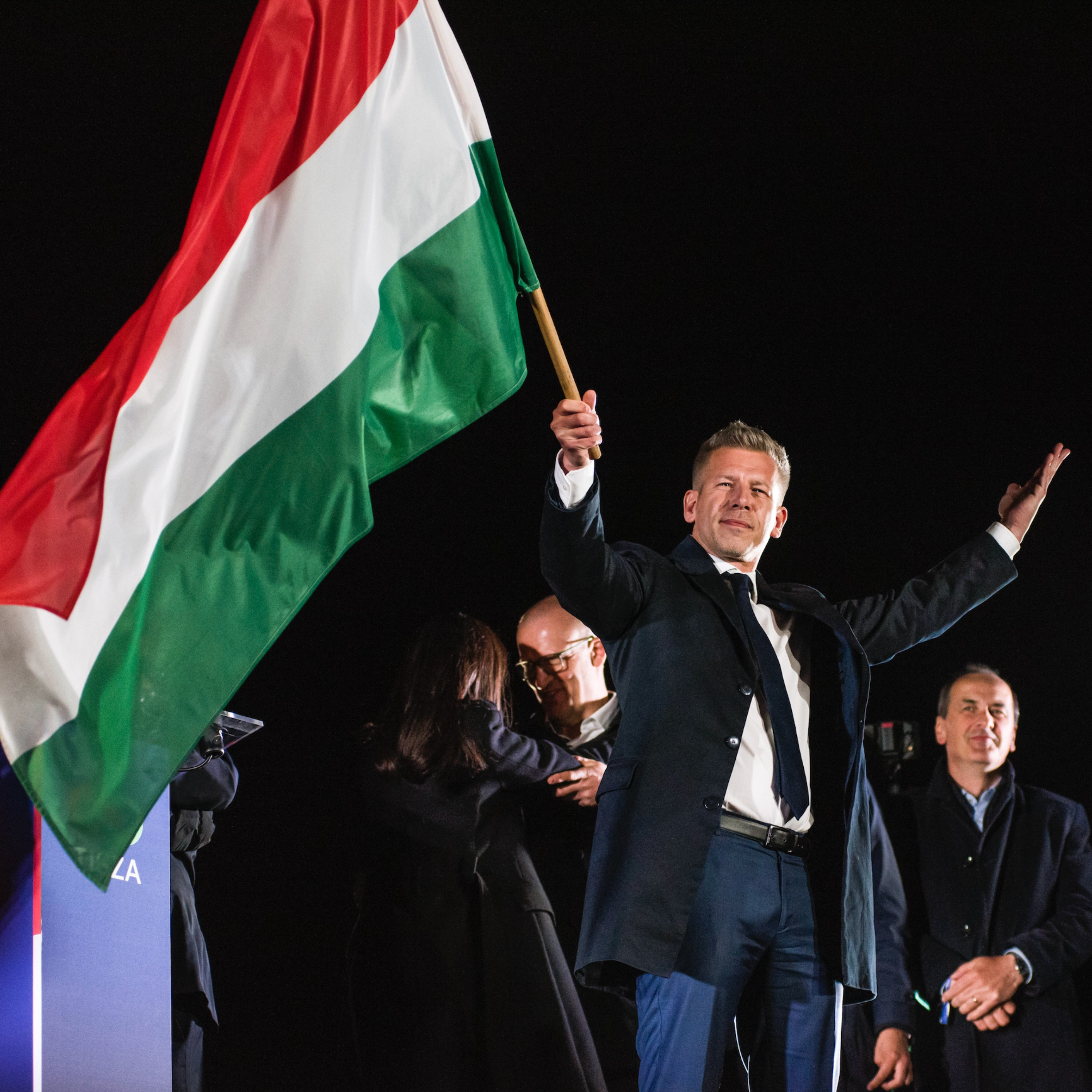
The episode discusses whether Hungary’s historic election result—Viktor Orbán’s Fidesz ending 16 years in power—will lead to real change.
Miklos Hainal, 31, a sitting opposition MP in Hungary’s National Assembly for the Momentum Party (liberal/progressive).
Hungarians voted due to high inflation (20–40% on some goods after COVID and the Ukraine war) and rising corruption; Orbán maintained power by rewriting laws and electoral rules, redrawing the electoral map, controlling most traditional media, and undermining judicial independence (e.g., central bank and prosecution leadership tied to former Fidesz figures).
Budapest “festival of freedom” after results; Momentum’s decision not to run to avoid splitting opposition under first-past-the-post dynamics. He describes Peter Magyar (Tisza) as “unstoppable,” citing his extensive town visits and a platform of stopping corruption, restoring public services, and making healthcare functional. He expects a more constructive EU/NATO stance and warns EU funds are frozen and must be unfrozen.
Written by AI. May contain mistakes.
Analyze the implications of Viktor Orban's election loss.
“Will Hungary's historic election bring about real change?”
Miklos discusses economic challenges and corruption in Hungary.
“Of course, myself personally as well, but everyone around me, I could feel it that not in our wildest dreams could we imagine Viktor Orban not just losing, but losing by a two-third majority against him.”
Explore the electoral strategies and legal modifications by Orban's regime.
“It looks like a massive landslide victory for the TISA party.”
Brief pause before discussing Peter Magyar's campaign.
“And I'm so glad that we did it in a democratic way and we did it with this passage for now.”
Examine the successful campaign strategies of the new leader.
“He was relatively unknown before 2024 when he quit the ruling Fidesz party over a child sex abuse scandal cover-up.”
Explore how Hungary's political changes may affect its relationship with the EU and NATO.
“Because if soap is missing in a hospital, it's not something that you can ignore.”
Discuss the implications of the recent election and potential challenges ahead for new leaders.
“But I would also like to emphasize the fact that we are in a quite difficult economic situation.”
Understand the urgency and challenges in forming a new government in Hungary.
“But making the sacrifice of not running in an election for this result was definitely worth it.”

Get the gist, explore an idea or ask about something said.
 Claude
On The Standard, what are the key points of this episode?
Searching your listeningAutomatic transcript. May contain errors.
0:00Healthcare can feel complicated. That's why Optum uses technology to connect the people and processes that make healthcare easier, more affordable, and more effective. We're making it clearer for you to know exactly what your benefits cover. And to help you better manage your health, we're coordinating care between your doctors and your technology. We believe better, simpler healthcare is always possible. That's healthy optimism. That's Optum. Visit Optum.com to learn more.
0:37do you have a great idea for a business or maybe you've recently started one then why not enter the access startup angel competition where we'll help you start up with confidence i'm izi obeng founder of foundervine and i'm thrilled to be joining this year's access Startup Angel competition in partnership with The Standard. There are six chances to win including two top prizes of£25 ,000, expert mentoring, business insurance for a year, thanks to AXA and more. Entering is easy, just send us a short pitch video and answer three questions about your business idea. Search AXA Startup Angel to find out more and enter before the 21st of June, 2026.
1:46After 16 years in power, Viktor Orban's leadership of Hungary has come to an end. Voter turnout hit a record 77.8%, the highest ever recorded in a Hungarian election. So, will achieving a comfortable majority be enough for opposition leader Peter Magyar to bring inflation and corruption under control? Hi, and welcome back to The Standard Podcast. I'm Tamara Komornik. For all the latest news, head to standard.co.uk. Coming up. Will Hungary's historic election bring about real change?
2:32On Sunday, Viktor Orban's Fidesz party suffered its second biggest loss on record. But after so many years in power, are Hungary's politicians ready to switch course?
2:48In today's episode, I speak to Miklos Hainal, who's a sitting member of parliament in opposition to Viktor Orban's party in the Hungarian National Assembly. He represents the Momentum Party, which leans liberal and progressive, and at 31 years old is the youngest sitting Hungarian MP. Here's my chat with Miklos.
3:16Hi Miklos, it is great to have you with us. Thank you for coming on the Standard Podcast. Hi, thank you for the invite. So Miklos, let's put aside your political duties for a moment. As someone who has lived the majority of your life under Viktor Orban's leadership, what was going through your mind as you watched the election results come through and you realised that Orban's 16 years of leadership was finally over? Yeah, it's really unbelievable for me. I'm the youngest member of parliament currently. I'm 31 years old, and I've lived 16 years in the Orban regime. So it is unbelievable. We waited, I think, an hour or an hour and a half, and then we started seeing the results.
4:04And it was just such a sense of relief. Of course, myself personally as well, but everyone around me, I could feel it that not in our wildest dreams could we imagine Viktor Orban not just losing, but losing by a two-third majority against him. So afterwards, the whole city of Budapest, our capital, really just turned into a festival of freedom this evening. So we're speaking on a London-based podcast. So Miklos, for listeners who are not necessarily familiar with Hungarian politics, What are some of the biggest pain points that Hungarians have regarding Viktor Orban's leadership? I think it's a combination of factors in recent years.
4:51So especially when you look at the state of the economy recently, after COVID and after Russia's invasion and attack on Ukraine, we have had crazy levels of inflation in Hungary. So we're not just talking double digits. we are talking about 20, 30, 40 % inflation on certain goods, which, of course, has put a massive burden on many Hungarian households. So I think, you know, the state of the economy is something that matters in every vote. And that was also the case here. But of course, especially when we talk about Viktor Orban's regime, I think it's also the level of corruption. So once you don't just see the corruption happening in the country, but you also see that at the same time, personally, you're economically doing much worse because of the state of the economy, whilst the level of corruption is skyrocketing.
5:52These two factors at the same time has led to, it looks like an uprising in the polls. It looks like a massive landslide victory for the TISA party. And it's really a historic result. We haven't had this high level of turnout since the regime change in Hungary. And Miklos, you are currently a member of parliament or an MP, as we say in Britain. You represent the Momentum Party in Hungary, which is in opposition to Viktor Orban's Fidesz party. Last year, you made the decision not to stand for re-election. Could you walk us through this decision? Yeah, I know it doesn't sound normal because in a normal democracy, parties and politicians run for office and people get to choose from them.
6:46So I had to do a lot of explaining afterwards when friends internationally and colleagues were asking, why are we doing this? And this vote was really a simple, do you support Viktor Orban's regime or do you want it to go type of referendum. That's what our election was about. so we would risk not just splitting those opposition voters but we would also definitely reduce the margin with which the winner wins that district which means that ultimately it would have been an even closer result potentially not even a win so so i think it's it's it has to do with the electoral system it has to do with fine details and with fine margins, but those fine margins matter because of the way a first post-to-post election works.
7:42And you're an outspoken critic of Hungary's electoral system, which was actually designed by Fidesz, which is the ruling party. What other tactics has Orbán used to stay in power for such a long time? So over the past 16 years, I think they have almost rewritten every single piece of law there is in this country. They have completely redrawn the electoral map and rewritten our electoral rules. They have taken control of almost all traditional media that we have, including print, TV, and radio. So the majority of outlets there are controlled by Orban Victor's close allies and friends. And they have destroyed the independence of the courts.
8:36And generally, I would say that there was an ongoing level of state capture, which was conducted by nominating people close to Viktor Orban or close to his party Fidesz. So even though on paper, formally, you could say that there are checks and balances, and you could say that there are, of course, independent institutions, there might be an independent central bank, but the leader of the central bank is literally his former finance minister. Or you could see that the head of the prosecution, the chief prosecutor's office for many years, has been one of their former party members and one of their former candidates.
9:23So all of these things culminated in a level of state capture that almost made it seem impossible that this regime can be changed or overthrown. And I'm so glad that we did it in a democratic way and we did it with this passage for now.
9:45we'll take a quick break coming up i asked miklos about peter maguiar's campaign strategy and his vision for hungary we'll be back here in just a moment
10:10welcome back let's get back to my conversation with Miklos
10:24So, Miklos, let's turn to the winner of this election, the TISA party and its lead candidate, Peter Magyar, who is expected to become the prime minister of Hungary. He was relatively unknown before 2024 when he quit the ruling Fidesz party over a child sex abuse scandal cover-up. Miklos, how would you describe his character? I think he is unstoppable, if I just had to summarize it in one word. He recently said in a film that he is not an easy character, so to speak. But I don't think that when you're choosing a prime minister, you're really looking for an easy character. You're looking for someone with the willpower, the ability and the energy to do the job.
11:13And the job in this case, of course, is to a large extent, taking this regime down, which is not an easy task. And he has succeeded in it in the election. Of course, there's a lot of work to do now. But he has also, I think, surrounded himself with a lot of professionals. I think his government is expected to include some of the most successful business persons of the country and many experts in their respective fields. I know this might sound a bit weird, but currently we have an interior minister who is a former police chief, and he is responsible for healthcare. We don't have a healthcare ministry in Hungary.
12:04So we have someone with police experience and leading the interior ministry responsible for healthcare and our schools as well. And I'm so looking forward to just living in a normal country where healthcare is in the hands of people who have actually worked in it. And I think that's something that we can all look forward to. At Magyar's most recent press conference, when asked why his campaign was so successful, he said, politics is about people. And this is what many politicians have forgotten. What vision does he and the TISA party have for Hungary? And to what extent do you support that mission?
12:47I haven't seen a politician in Hungary in recent years go to as many towns and villages as Peter Magyar did in these recent months, or as he did in the past three years. I think he visited more towns in the past one week than some other politicians do in a whole campaign. So, you know, he covered seven, eight towns per day. You could see him doing a campaign rally at 7 a.m. in the morning, and there were hundreds of people showing up. That's the extent of voter interaction that you should imagine there. And talking about his vision, I think, so they campaigned with rebuilding the country. They campaigned with the fact that this is a country where now there can be consequences, where now corruption will be stopped and there will be a point when we finally say no to corruption.
13:46They campaigned with restoring our public services and by making the country work and functional and just normal again. I think that's something that even if you are a fan of Viktor Orban, it's hard to say no to these things. And it's hard not to see the problems because the problems have become so evident. Because if soap is missing in a hospital, it's not something that you can ignore.
14:26just zooming out a little bit maga has described the eu as a complicated bureaucratic compromise seeking organization and orban has been referred to as a thorn in the eu side often vetoing critical policies. And, you know, he's got a very close relationship with Putin and also with Trump. So with Magyar in charge, how might Hungary's relationship with the EU change? I think that many voters would agree that they see the EU as something which is a bit too complicated and a bit too distant from them. So I don't think that, you know, it is criticisms from Peter Magyar's side, but it's not the same criticizing the EU and it's not the same being a Russian Trojan horse in the EU, which effectively Viktor Orban's government has been.
15:24So I think the EU has to learn from criticism and has to develop from criticism. And I think the mandate is clear from the voter's side. All of us here want Hungary to stay in the EU. All of us here want the EU to be strong, united and successful. And I also want to add that we want to stay in NATO. We want NATO to be strong and an alliance that defends Europe on the long run as well. So I hope Hungary will be seen as a much more constructive member from now on in the European Union. But I would also like to emphasize the fact that we are in a quite difficult economic situation. And the frozen EU funds now will have to be available and will have to be accessed by the new Hungarian government in order for us to get out from the situation in which we are.
16:31And although Orbán is out of power for now, do you think there's still a threat that the Fidesz party could gather momentum and come back? So I think for Orbán, it has been the biggest defeat that he and his party has experienced since 1994. So it's a long time. It's their second worst result ever. And I think if we build the democracy that Peter Magyar envisions, then there will be not much demand for a system like Viktor Orban's again. So I don't think his chances of coming back will be easy. What I am more worried about is that the level of state capture was so high that even though we have a new parliament with a supermajority, some of the captured institutions might not be accepting the people's vote and might not be realizing what this mandate means.
17:39So he just, in his victory speech yesterday, called for a lot of institutional leaders to resign. Those resignations haven't happened yet. I hope, of course, they will happen soon. But that is one of the big questions that he needs to answer. And also speaking of momentum, where do you see yourself in the future from this point on, from this election? Personally, about my future, I haven't decided on that yet. I still have a few weeks to decide on that. My mandate officially ends when the new parliament is formed. So I'm still taking my time. But the good thing about being young in politics is that our lives don't depend on it.
18:25It's good being in politics. It's good working for your country. But making the sacrifice of not running in an election for this result was definitely worth it. If I can work in politics in the future, great. If not, then I'll do something else like the rest of the country and like normal people do. Well, at this rate, Peter Maguire wants to set up a government very, very quickly. So you might be out of time very soon. Yeah, I hope he succeeds. The sooner the government is set up and the sooner the new parliament is formed, the better. However, of course, there are some electoral deadlines. So there are still a few votes that need to be counted.
19:09Those Hungarians who voted abroad at embassies and consulates, their votes will be counted by the end of this week. So we will hopefully have an official result in a week or so. And then finally things get going. and many of us are hoping for this scenario, that this will not be dragged on for a long time. Well, Mikos, thanks so much for speaking with me and explaining the whole landscape of Hungarian politics in the matter of 10 or so minutes. Thank you so much. And that's The Standard. For all the latest news, head to standard.co.uk. If you're new here, hit follow and give us a rating. If you'd like to get in touch, email us at podcasts at standard.co.uk.
20:03We'll be back here tomorrow morning. See you then.
After 16 years in power, Viktor Orbán’s leadership of Hungary has come to an end. But will a comfortable majority be enough for opposition leader Péter Magyar to bring inflation — and corruption — under control?
In this episode, host Tamara Kormornick speaks to Miklós Hajnal, a sitting Member of Parliament for the Momentum party and an opposition figure in Hungary’s National Assembly. Together, they discuss whether Hungary can truly move beyond Orbán’s rule, and the geopolitical direction the country may take in the years ahead.
Hosted on Acast. See acast.com/privacy for more information.


