
In short
Podcast Summary: The Thoughtful Entrepreneur - Episode 2046
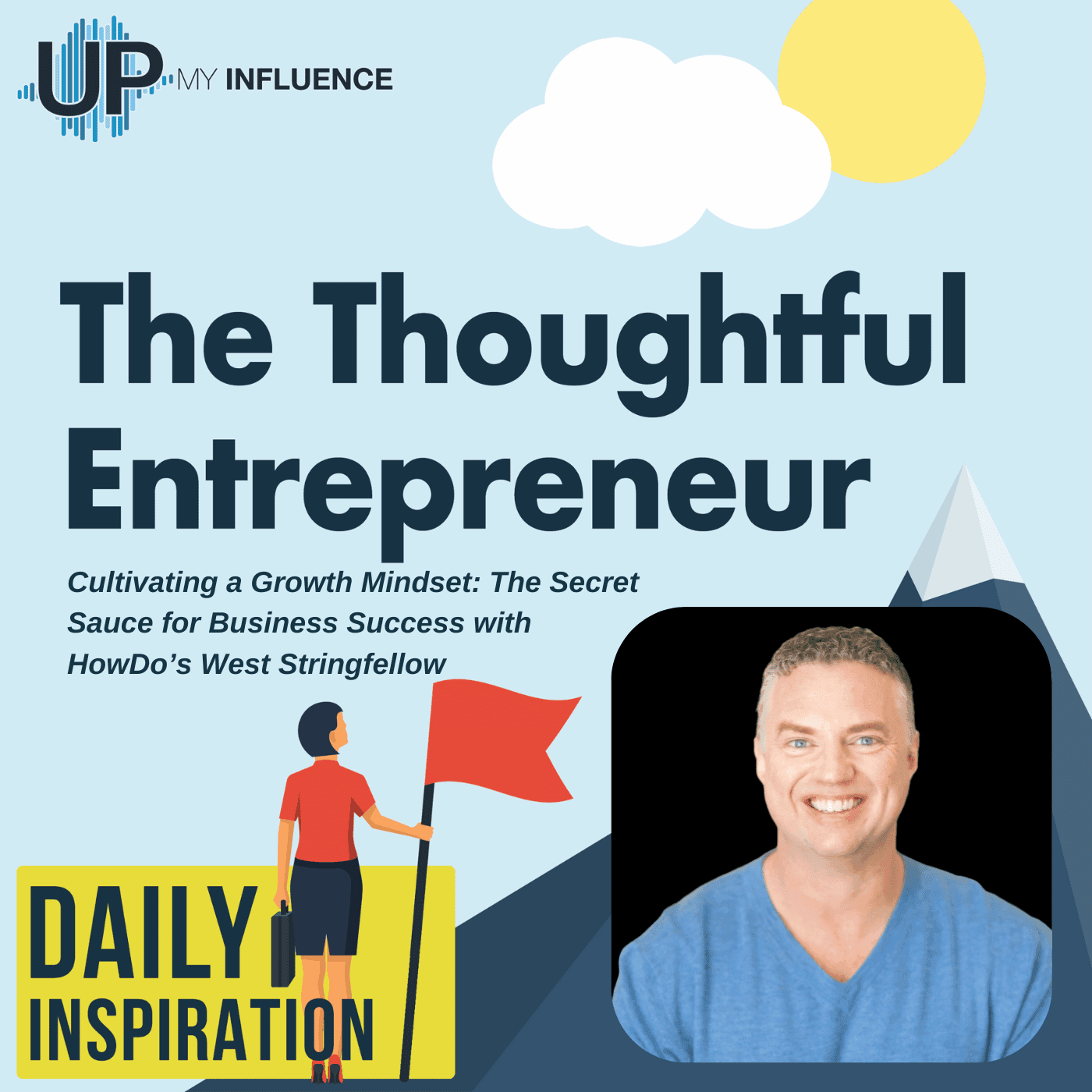
Episode Overview In this episode of "The Thoughtful Entrepreneur," host Josh Elledge speaks with West Stringfellow, the CEO and founder of HowDo. The discussion revolves around cultivating a growth mindset and the importance of innovation for business success. West shares insights from his extensive background leading innovation in major corporations and explains how his platform, HowDo, can help entrepreneurs and business leaders foster growth.
Key Concepts Discussed
- Innovation as a Business Imperative
- Definition of Innovation: West highlights the diluted meaning of "innovation" and clarifies it as the process of evolving and changing within a business context.
- Opportunity in Innovation: He emphasizes that innovation is key to growth, whether through new processes or product launches.
- HowDo Platform
- Open-Source Resource: HowDo provides free resources aimed at helping users innovate.
- Global Reach: The platform has engaged over 400,000 users, with a significant international audience.
- Consulting Services: In addition to free resources, West offers consulting and coaching for those struggling to implement innovative strategies.
- West Stringfellow's Background
- Career Highlights: West has held positions at major companies like Amazon, PayPal, Visa, and Target, where he led innovation projects.
- Entrepreneurship: He founded a startup that was acquired by a Fortune 50 company and subsequently started HowDo to help others.
- The Role of AI in Business
- AI as a Tool for Growth: West discusses the potential of AI for better understanding customers, optimizing processes, and reducing costs.
- Cultural Shift Needed: He emphasizes the importance of developing a growth mindset among teams to leverage AI effectively.
Actionable Insights
- Embrace a Growth Mindset: Business leaders should cultivate resilience and a learning culture to adapt to changes, especially with emerging technologies like AI.
- Utilize HowDo’s Resources: Entrepreneurs are encouraged to explore HowDo’s offerings, including book summaries and masterclasses, to aid their business growth.
- Implement AI Thoughtfully: Organizations should identify how AI can specifically benefit their operations and integrate it into their strategies.
Conclusion West Stringfellow's insights into innovation and the resources available through HowDo provide invaluable guidance for entrepreneurs seeking to enhance their business practices and adapt to a rapidly changing marketplace. The episode reinforces the idea that a proactive mindset and the right tools are essential for sustainable growth.
Links Mentioned
- [HowDo Website](https://howdo.com/)
- [Apply to be a Guest on The Thoughtful Entrepreneur](https://go.upmyinfluence.com/podcast-guest)
Final Thoughts This episode encapsulates the essence of the entrepreneurial journey, highlighting the importance of innovation and adaptability in achieving business success. Listeners are encouraged to engage with the resources available at HowDo and adopt a mindset geared towards growth and transformation.
Written by AI. May contain mistakes. Listen to the episode to check what was said.
Transcript
Automatic transcript. May contain errors.0:05Hey there, thoughtful listener. Are you looking for introductions to partners, investors, influencers, influencers, influencers, and clients? Well, I've had private conversations with over 2 ,000 leaders asking them where their best business comes from. I've got a free video you can watch with no opt-in required where I'll share the exact steps necessary to be 100 % inbound in your industry over the next six to eight months with no spam, no ads, and no sales. What I teach has worked for me for over 15 years and has helped me create eight figures in revenue for my own companies. Just head to upmyinfluence.com and watch my free class on how to create endless high-ticket sales appointments.
0:51Also, don't forget, the thoughtful entrepreneur is always looking for great guests. Go to upmyinfluence.com and click on podcast. I'd love to have you.
1:05With us right now is Wes Stringfellow. Wes, you are the CEO and founder of HowDo. You're found on the web at howdo.com. Wes, it's great to have you. Yeah, thanks for having me, Josh. I appreciate it. Yeah. Well, listen, I'd love a quick overview of what HowDo is and what you do. Sure. HowDo is an open source resource for people who want to innovate. And innovation is one of those words that's been used so much, it's kind of meaningless. but really all it means in business is to change, to evolve. And so I think the biggest opportunity in business right now is to innovate. And that could be either building a new process, launching a new product, or just reevaluating how you do your current business.
1:48And the reason I think that is I had the opportunity to lead innovation for PayPal and Target and Visa as well. I built a bunch of new innovative technology at Amazon, and I saw consistently how these really big businesses kept growing. And then when I had the opportunity, I built my own company as a founder and built a startup that Target ended up acquiring. And going through that process, I realized that a lot of the tools and techniques and strategies that I had used to grow the world's largest companies were really effective as well for the world's smallest companies, the startups and the small to medium businesses.
2:25And, you know, when I think about the opportunity we have in America, I've always wanted to give back. And I thought no better way to give back than to try and help people grow their businesses. And so much of this knowledge on how to grow a business is locked in big institutions like McKinsey or Harvard that are hard to get into and very expensive. So I thought, why not just make all of that free and open source? And so I spent six years researching that and documenting it and put it on howdo.com for free. so like who are typical folks uh that that engage in and are taking advantage of all of these resources it's you know we've had over 400 000 people engaged so far uh and that's yeah it's crazy there's zero i've spent zero dollars on marketing which shows you how hungry people are for this information yeah and it ranges it ranges from number one 50 of the people are from all around the world it ranges from students in burkina faso to educators in italy to here in America, lots of entrepreneurs, lots of people who are in small to medium businesses, and they've hit the kind of growth plateau, and they're trying to figure out how to continue to grow, and people who want to build new products.
3:34If you look at Instagram or Etsy, lots of people are makers, they're creators. They want to figure out how to bring what they want to see in the world to life, and there's a process to do that. There's a process that reduces risk, increases your chance of success. So anyone who's looking to grow their business can do that with the content on how to. Yeah. And so help me understand, what's the model for how to? In terms of the process? Yeah, like your business model. Like if these resources are free, where is money made? That's a great question. No, I mean, I do consulting and coaching on the side.
4:12Yeah. And for me, that's helping people apply the model. But what I found, it's interesting. Most people love reading about things. Not a lot of people actually like doing the hard work. And that's where I can help. So I can help people by getting their teams trained so that the teams can do it. Or if they actually want help directly, I help. Yeah, that's very, very cool. And so when I'm going through how do right now, you're right. I mean, it's just it's very accessible. I'm clicking to our friend that's listening. My recommendation would be to go to howdo.com just so you can see what we're referring to visually.
4:53But you have an interesting background, Wes, that kind of brought you to this point. Do you mind maybe just sharing a little bit about, you know, kind of your background and where this concept came up with and how you were able to put these resources together? Yeah, absolutely. So, you know, I started working in technology in 1997. I was a legal intern and I was unpaid. I had to run around Denver in a suit and find where lawyers lost files. It was at the restaurant. Was it the car? Was it the courthouse? And I was sweating the whole time in Denver in 100 degree heat in a suit. And I thought, this is terrible.
5:26At the same time, I was working at a library in a work study program. And I watched students barely awake carry books in and out and never get lost with books. And I thought, how can students return a book but lawyers can't return a file? also figured out how to build a library management system, which is a simple piece of technology to track where files go, just like libraries track where books go, and became a paid technology consultant instead of an unpaid legal intern. And from there, every company that I went into, I just looked for opportunities to help the company grow, either by reducing costs or by growing revenue or empowering employees so that they could do those things.
6:04And I just consistently grew through startups for seven years. Then I was recruited by Amazon and I did helped Amazon grow for three years, launched a lot of the things that people use today, like digital video. If you've ever watched a video on Amazon, I've launched the first version of that. And then got recruited by Visa where I led innovation there again at PayPal. And then after about 17 years of working, I decided, you know, maybe I should try to do this innovation thing on my own with my own money and set out to do that and created some new technology and was running around Silicon Valley trying to raise capital and ended up meeting with Target and they ended up buying it.
6:41Oh my goodness. Yeah. And then when I got into Target, I thought, yeah, it's such an incredibly awesome company with a really good brand. And I thought, you know, we can see what happens if I use the same processes that I used at Amazon Visa, PayPal in Target and ended up becoming the VP of innovation at Target, where we led a company-wide kind of innovation program, training everyone how to innovate and radically reduce the amount of money they spent on innovation while increasing the return on investment they got for the dollars that they did spend. So we actually got more from spending less.
7:12And it just shows like if you have the right process, you use the right, take the right steps to reduce risk, anyone can use innovation to grow their business. And so I was very fortunate in my career. And as soon as I could, I decided to give back. And The way I built HowDo is I hired a team of researchers. We spent about three years, collected over 50 ,000 data points, and then we hand curated those data points into a knowledge base that we then used machine learning to write articles. So like pre-GPT, pre all the AI that everyone's talking about right now, the way that you would train machines is by doing a ton of research.
7:51And we did that research by hand for years. And that's what you get on HowDo for free. That's all open source. You can just go up there and download the files. And it's the insights that companies would normally pay millions to get. Yeah. And so I see, obviously, in HowDo, you do have some AI, right, is mentioned here. You know, and obviously that's an area that I think is really transforming, I think, a lot of forward-looking leaders. I think that there are a lot of folks that are apprehensive or nervously wanting to not get left behind. Do you mind maybe just kind of commenting on, I would imagine, AI and any other emerging technologies or even thought leadership that you see as becoming pretty critical to keep an eye on over the next six to 12 months?
8:51Yeah, absolutely. I think AI for the next six to 12 months is kind of the, there's a lot of fascinating emerging technologies. There always are. And it's hard to kind of distinguish real value from bright, shiny objects. And AI is real value. When we look at what leaders, I think there's three types of leaders right now. Those who are using AI to get ahead, those who are preparing to use AI to get ahead, and those who are falling behind. You obviously want to be the one of the first two. And in order to use AI, a lot of people think it's this crazy, esoteric technology. In fact, the census reports that over 84 % of businesses think that AI is not relevant to their business today.
9:25That's not true. Every business can use AI to grow revenue by better understanding their customer, better understanding their employees, and reducing costs on their marketing and training. They can also use AI to simply analyze their data better. I mean, it's a very, very powerful tool. If you do anything with numbers or anything with process or patterns, AI can help you get ahead today. It's simply about figuring out what is the right tool for you today and what is the right process to use that tool. And in the coming weeks, in fact, as part of my consistent effort to try and help American companies innovate, I'm going to start open sourcing that as well.
10:00And what I'm doing is I'm taking the same innovation process that I created on HowDo that's free, and I'm going to create a second innovation process that uses AI to take every step of the HowDo innovation process. And by the way, when I say it's HowDo's innovation process, again, we didn't make anything up here. We're not writing history. We're literally researching what the best companies do, distilling that, curating that into easy to access, easy to follow processes and giving that to you. Now I'm going to complement that process with AI so that everyone can understand how to use AI to innovate.
10:38Yeah. And so, Wes, in terms of your work behind the scenes, so you'd mentioned that you consult. Do you mind maybe just sharing a little bit more about that? Because I suspect that there's folks that are familiar with HowDo, and they're wondering how you might be able to help them. What does that look like? I don't know if you can go more into that. Absolutely. So a great example is for the last two weeks, I've been helping five different founders figure out how to find product market fit. And that's how do I take the idea that's in my head and turn it into something that customers want to buy so that I can raise capital, build that idea and launch it into the market.
11:22At the same time, I'm also helping mid-sized companies figure out how to optimize their operational processes. So you have a company right now who does a lot of marketing. They have a huge manual process of writing the marketing, coming up with the ideas first for what to write, and then putting that into the market, testing it with the customer, getting the feedback, blah, blah, blah. The whole process can be automated in minutes by using AI. When I say automated, it's simply giving the people the ability to use prompts to do jobs that previously would have taken hours or days. And by giving people those prompts and also a little bit of cultural training, because if you think about it, AI is the first time we have to work with technology different.
12:08You know, when we got email in the 90s and then that email went from being on a desktop to a laptop to our phone, there was not a lot of difference in how we worked with the technology. We typed, we put it in there, it got sent. Now with AI, there's a big difference in how we use the technology. AI is a thought partner. AI is a colleague. AI is a coach. AI is an accelerator for our ability to take insight and turn that insight into action. And that's how we increase productivity. That's how we increase efficiency. That's how we reduce costs. And by doing those things, we can reallocate the time and the money to growing revenue.
12:48And so I see AI as one of the biggest efficiency and productivity drivers that we've had in the history of business. And again, those who are figuring out how to use it today will get ahead. And that advantage is durable because once you have the culture and the process in place, it's very, very hard for others to catch up. Yeah. Again, howdo.com to our friend that's listening. And again, we're kind of give them a call to action here on some, maybe some immediate resources that you could highly recommend. I see you've got some great book summaries here. of course, the masterclasses are voluminous.
13:30There's a lot of rabbit holes you can go down here. The biggest thing I think right now is mindset, growth mindset. When I look at what holds companies back, when I go help is founders are inherently hungry. They will do anything to survive. And when I mean hungry, they just want that opportunity. They want their idea to come to life. Mid-sized companies, small companies, a lot of times you have a lot of really successful, stable companies, and they don't like change. And the first thing that we have to do to adapt to the coming change with AI, the change that's here today, is get our mindsets into a growth mode where we acknowledge that what we do day-to-day is going to be different.
14:11How we use our computer is different. How we interact with one another is different. And so I'd say, look at the growth mindset. If we can get teams, if you can get your team, speaking to the business leaders right now, Now, if you can get your team to have a growth mindset, to develop resilience, to continuously learn and then use data to make decisions, your team will excel with AI. And those are cultural attributes. And I have free courses for you on how to today. Yeah, that website, how do that's do.com. And it's been great. Wes Stringfellow, founder and CEO for joining us. Thank you so much for this conversation.
14:49Thank you, Josh. I really appreciate it.
14:56Thanks for listening to the Thoughtful Entrepreneur Show. If you are a thoughtful business owner or professional who would like to be on this daily program, please visit upmyinfluence.com and click on podcast. We believe that every person has a message that can positively impact the world. We love our community who listens and shares our program every day. Together, we are empowering one another as thoughtful leaders. And as I mentioned at the beginning of this program, if you're looking for introductions to partners, investors, influencers, and clients, I have had private conversations with over 2 ,000 leaders asking them where their best business comes from.
15:37I've got a free video that you can watch right now with no opt-in or email required where I'm going to share the exact steps necessary to be 100 % inbound in your industry over the next six to eight months with no spam, no ads, and no sales. What I teach has worked for me for more than 15 years and has helped me create eight figures in revenue for my own companies. Just head to upmyinfluence.com and watch my free class on how to create endless high-ticket sales appointments. Make sure to hit subscribe so that tomorrow morning, that's right, seven days a week, you are going to be inspired and motivated to succeed.
16:19I promise to bring positivity and inspiration to you for around 15 minutes every single day. Thanks for listening and thank you for being a part of the Thoughtful Entrepreneur Movement.