
In short
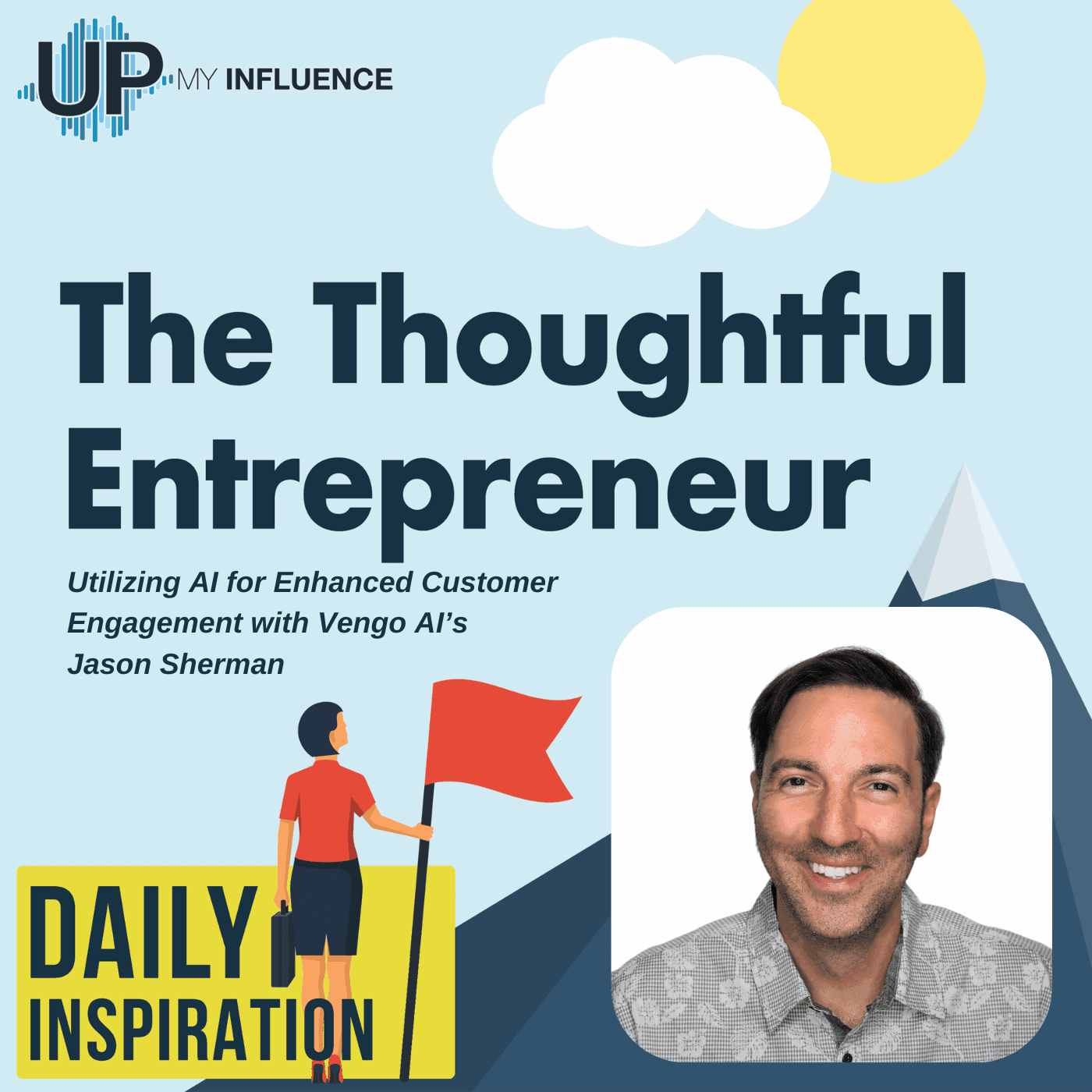
Podcast Summary: The Thoughtful Entrepreneur - Episode 2060
Episode Overview Title: 2060 – Utilizing AI for Enhanced Customer Engagement with Vengo AI’s Jason Sherman Host: Josh Elledge Guest: Jason Sherman, CEO and Co-founder of Vengo AI Duration: 15-25 minutes Release Date: [Insert Date if available]
In this episode, host Josh Elledge interviews Jason Sherman, a tech entrepreneur and co-founder of Vengo AI, who shares insights into entrepreneurship and the utilization of AI for customer engagement. The discussion is rich with practical advice for aspiring entrepreneurs and emphasizes the importance of data-driven decision-making.
---
Key Themes and Concepts
- Entrepreneurial Journey
- Learning from Failure: Jason emphasizes the value of viewing every project as a learning opportunity, regardless of its outcome. He believes that both successes and failures contribute significantly to one’s growth as an entrepreneur.
- Actionable Advice: Jason's book, "Strap on Your Boots," encapsulates his entrepreneurial experiences and provides practical homework assignments aimed at helping others build their businesses without excessive time or financial investment.
- Vengo AI: Revolutionizing Customer Engagement
- Product Overview: Vengo AI allows users to create AI versions of themselves to engage with customers efficiently. This innovation helps entrepreneurs manage repetitive tasks while focusing on creativity and productivity.
- Funding and Development: Jason discusses how backing from companies like Microsoft and OpenAI facilitated the development of Vengo AI, underlining the substantial costs associated with creating AI solutions.
- Data-Driven Decision Making
- Validation of Ideas: Jason stresses the importance of validating business ideas through market research before investing significant resources into development. He uses the analogy of building a roller skate before advancing to more complex products like motorcycles or rockets.
- MVP Approach: Entrepreneurs should start with a minimum viable product (MVP) to gather feedback and iterate based on customer responses, rather than making assumptions about market demands.
- Surrounding Yourself with Expertise
- Mentorship and Advisors: Jason highlights the importance of surrounding oneself with experienced mentors and advisors who can provide insights that might be overlooked by entrepreneurs who are too close to their projects.
- Current Trends in Entrepreneurship
- Identifying Opportunities: The discussion touches on the value of pursuing business ideas that may not appear glamorous but meet real needs in the market. These often-overlooked opportunities can yield significant rewards.
---
About Jason Sherman
- Background: Jason is an accomplished entrepreneur, author, and podcaster with experience in film, technology, and education. He has been featured in numerous media outlets and has a passion for mentoring other entrepreneurs.
- Current Ventures:
- Vengo AI: A platform that creates personalized AI versions of users for enhanced customer interaction.
- Spinnr: A video friendship app for connecting with others who share similar interests.
---
Conclusion This episode of The Thoughtful Entrepreneur provides a wealth of insights into the intersection of entrepreneurship and AI, with practical advice for aspiring business leaders. Jason Sherman’s emphasis on data-driven decisions and learning from failures offers a refreshing perspective for anyone looking to navigate the challenging landscape of entrepreneurship.
---
Resources
- Vengo AI: [vengoai.com](https://vengoai.com)
- Jason Sherman: [jasonsherman.org](https://jasonsherman.org)
- Book: *Strap on Your Boots*
- Podcast: *Strap On Your Boots*
For more insights and actionable tips, listen to the full episode of *The Thoughtful Entrepreneur* [here](#).
Written by AI. May contain mistakes. Listen to the episode to check what was said.
Transcript
Automatic transcript. May contain errors.0:05Hey there, thoughtful listener. Are you looking for introductions to partners, investors, influencers, influencers, influencers, and clients? Well, I've had private conversations with over 2 ,000 leaders asking them where their best business comes from. I've got a free video you can watch with no opt-in required where I'll share the exact steps necessary to be 100 % inbound in your industry over the next six to eight months with no spam, no ads, and no sales. What I teach has worked for me for over 15 years and has helped me create eight figures in revenue for my own companies. Just head to upmyinfluence.com and watch my free class on how to create endless high-ticket sales appointments.
0:51Also, don't forget, the thoughtful entrepreneur is always looking for great guests. Go to upmyinfluence.com and click on podcast. I'd love to have you.
1:05With us right now, it's Jason Sherman. Jason, you're a tech startup founder. You're an author. You're a podcaster. You're the founder of a couple of companies. And we'll be talking about that. You are found personally at jasonsherman.org. will also point out that you are the CEO and co-founder of two tech startups, Spinner, which has been around for two and a half years. And we'll talk about that. And then Vengo AI, which is really kind of cool. And I, you know, listen, I'm personally of the opinion. I think that this is just going to be, I think everyone will have this. It's because of, you know, being able to engage with potential customers and beyond with an AI version of you is going to be an appropriate offering for a certain percentage of your population that's coming to check you out and learn more.
2:04Anyway, we'll get into all that. Jason, thank you so much for joining us. Thanks, Josh, for having me. It's a pleasure. I already started selling your product, my man. Yeah, I know. People are already talking to the AI. Yeah. Well, tell me a little bit about the impact of your work. Obviously, there's your book as well as strap on your boots. And so why don't you just kind of give us an overview of your impact today? Yeah, I mean, for so many years, I've been building businesses and finding problems to solve, but also running into challenges and having my own set of failures and successes. Rather than helping people one-on-one over and over again, which can become very repetitive, as you can imagine, I decided to put all of my knowledge and experiences into a book that would have tangible, workable, like homework assignments that people can do to create their business without spending money and without spending a lot of time.
3:02And by doing so, I kind of completely slashed out all those so-called gurus that are selling masterclasses for$5 ,000, promising you millions when that's really not how it works, right? They're just making money off of your masterclass. So I said, no, no, no, no. I want to give these guys something that's actionable, something that you can replicate, something you can actually do and get results immediately. That's what my book was. And then some PhD students at University of Pennsylvania approached me and said, hey, we like your book. We've been using it in our entrepreneurial classes. Can we make a course out of this?
3:37And I said, yeah, I can make a course out of it. So six months later, I made Startup Essentials and I taught it for a couple of years at a couple colleges, including UPenn, Wharton, to the students there. And the impact was great. I found hundreds and hundreds of students saying our hackathons, all of our big contests were just that much better because we had the course behind it. So I feel like I'm offering something to people and I don't make any money off it really. That's not why I did it. It was more to just help people around me and stop having to repeat myself over and over again. And then it turned into a podcast and, you know, a lot of other things came out of that.
4:18So yeah, I feel like 20, 30 years of me building things. Now I can give it back to people and, and it seems to be helping a lot of people. Yeah. Well, as you could tell in my introduction, I'm, I'm, I'm a little eager to talk about, and I want to get, you know, we'll, we'll kind of close up and talk about your podcast and some of your thought leadership out there. Jason, would you mind maybe just sharing a little bit about Vango? I just think it's very timely. And I think a lot of people have been kind of fooling around with this idea of creating kind of virtual or AI versions of ourselves so that we can be out working while we're sleeping, which I like the idea of that.
4:59Yeah, that's the key, right? We want you to, you know, if you're a business owner or you're a creative person, You're being most productive when you're being creative. When you're typing documents and selling and writing emails and talking to customers over and over and over and over with the same questions, you're going to burn yourself out. And you're also not going to be boosting your sales. You're going to be stuck in a rut. We heard our customers from our original app spinner who said, we want to customize the AI that you built in the app. Originally, we had this community AI that everybody could talk to, and it was helping engage and navigate through the app and help you meet new people, help you find people to do your hobbies with and go to events with.
5:41That's what the AI was. This was for Spinner. But they wanted to customize it. And in that app, you couldn't do that. So we branched out. We built a brand new app called Vengo AI, and we were able to get backing by Microsoft, NVIDIA, and OpenAI. Once we got grants from them, that's it. The floodgates were open and we were like, we can now actually build this thing because it's expensive. That's the number one thing people don't realize about AI. When someone says, well, why, how are you different? Okay, well, let's say you want to do this with ChatGPT. Everybody uses ChatGPT, right? Well, at least people in the tech industry.
6:13You can't. You have to take ChatGPT, take their API, spend$50 ,000 to$100 ,000 or more just to get the basic kind of development process and the features that you're looking for to put your AI onto, like, say, your website. What we've done, we've taken things like ChatGPT and all the Gemini's and llamas out there, voice and transcriptions and video and all these powerful tools that are all over the place and put them all into one platform that a business owner can then train very easily on this do-it-yourself dashboard. So it is a copy of you. It is not an AI per se. It's a copy of you. So it's me.
6:54It's you. And when it talks to the customers, it talks in your personality, your conversational style, your knowledge. And it gives the answers that the customer is looking for, not, well, I'll get back to you later, or check our FAQ, or, you know, here's a link to read more. No, it's more like, here's the answer you wanted. And if you want to book a meeting, here's my calendar link. Oh, hi, Josh, I'll call you at 2pm. Here's your, it's a real person almost, right? So that's what people say they wanted. We built it for them and we're seeing customers. We don't really have to sell it to them as much as you would think.
7:29They're just immediately gravitating towards our offering. Now we are new, right? We just launched pretty recently. So we're still kind of in like a beta phase where we're still learning from our customers and we're still iterating based on the feedback we get. We're very lean startup methodology oriented. That's why I wrote a book on it and I teach a course on it. I practice what I preach 100 ,000%. I'm not like bypassing anything, right? My clients in the past have tried to bypass my methods and they failed. And so I'm not doing that. I'm staying true to what I believe in. Yeah, you know, there's a lot of reasons for someone to want to start a business.
8:11Not all of them are good. I can see in your Startup Essentials course, you talk a lot about just being able to make data-driven decisions, how to validate. Listen, this is so much more valuable, in my opinion, than having a quote-unquote genius idea and then somehow you know what the market wants without checking that out. Ultimately, the market decides what the market wants and needs and what the market is willing to pay for. So I love the fact that you go into this talk about monetization, building a business model. Do you mind maybe just maybe touch? I don't want you to touch on the whole thing, but maybe just identify one or two things that you teach that you think are pretty critical and are really commonly missed steps in the process.
9:12Absolutely. And you just touched it, right? Data-driven decisions. A lot of people don't want to do that. They want to do what they think is right. And I have, like you said, I have a genius idea. It's the next big thing. It's going to be worth a billion dollars. And here's what we're going to build. And they've spent a year. And here's the first thing. They spend a year and God knows how much money building something, some behemoth of a platform that has every bell and whistle. And then they put it out in the market only to find that nobody wants it. Nobody wants to use it. So what is the first thing people miss to do?
9:43Validating their idea, right? You have to validate it before you build it. The greatest analogy I love to give people is you have to build a really good roller skate. Once you get people to really like your roller skate, you can then build a skateboard. And once you validate that, you can build a scooter and then you can build a motorcycle and then you can build a car. Then you can build a rocket ship and go to space. But people always come to me saying they want to build the rocket ship. You can't do that. You have to build the roller skate first. So validate the most simplistic version, your MVP, your minimum viable product, validate that first.
10:17Once you get enough feedback and say 100 people love your product, then you can go to the next step and start building something. That's what people miss. They seem to always miss that. You don't have to spend a lot of time and money on something. You could even get away with just having like a couple of hand-drawn mock-ups on a napkin and just show someone, Hey, what do you think of this idea? And then do a free survey on like survey monkey or type form, ask five questions. And if everybody says they like the features, then there you go. Or maybe the survey says they don't like those features.
10:51Well, then guess what? You have your answer. Data doesn't lie. Data is the truth. That's why I always trust data. The numbers don't lie. Our emotions do. And that's another thing too, is, you know, the importance of surrounding ourselves, not just with, you know, customer data and validation, but also experts, mentors, advisors, you know, team members that bring unique backgrounds and experiences in that are just going to be in our blind spot. You know, again, I think I feel very strongly about, you know, the fact that, you know, when this is your business, you're inside the bottle and it's very difficult to read the outside label from inside the bottle.
11:43You just it's very difficult to make objective decisions if we're not counting on really smart advisors that have done this hundreds of times. And also, you know, again, kind of that validation data that we've been talking about. Any final thoughts on kind of like what it takes or maybe, you know, current trends, you know, you see a lot of people wanting to start a business around X and you're like, whoa, I mean, you can, but that's a lot harder than doing one right now. You know, certainly I think if we're paying attention to trends and what people need, a lot of times, you know, these businesses that end up doing quite well are not obvious services.
12:25Like they're just kind of behind the scenes. They're not super, quote unquote, sexy. But there's stuff that, you know, the B2B world needs or, you know, just something really kind of quiet and behind the scenes. you can really do well if you can identify and find some of those things that aren't getting as much competition or attention from other entrepreneurs. You're bringing up a really fantastic point. You really are. And the reason why I say that is because you just, first of all, let's unpack what you said. You said it might not be sexy, right? You have to be attached to this thing for four or five, 10 years.
13:00Do you want to be the guy who reinvented, you know, the factory process of widgets creation with some new software. And then every day you're visiting factories and dealing with this data about gear shifting. That's not going to be fun for you, right? Or maybe it is. Maybe you're passionate about gears for some reason. The thing you have to remember is you're going to be stuck or maybe not stuck. Maybe you're just liking it in this company for a long time. So you have to enjoy it. So I always choose my ideas. Yes, they fill a need. Yes, there is some sort of gap in the market. Yes, there are people asking for the product.
13:39But I also truly love what it is I'm building. And it's something that I personally need as well. Because all my products, myself and my team included, we use them on a daily basis. And they genuinely make our lives better and easier. That's a fact. So that's the thing I would tell people. Yes, look for that pain point in the market that everyone else is overlooking. Now, I, one time years ago when I was a journalist, got lucky enough to be in an elevator with Peter Thiel, right? He was PayPal's co-founder, Facebook investor. And I was at his book signing and I was covering his event and I was talking to him in the elevator.
14:18I got to do an elevator pitch, like legitimately. Literally in an elevator. In an elevator, just me and Peter Thiel. Nobody else was there. And we were like on this elevator, what seemed like forever. So I got to pitch him one of my ideas and he said he liked it. And here was his advice. And the book that he was giving out was zero to one. Right. So that's the one that he that's the one. Right. So he gave me a copy. He's like, listen, whenever you have an idea, you and mine was definitely one of those. He admitted it was a reverse auction site is what I built versus what's out there. Find the types of ideas out there, the pain points out there that no one is looking for.
14:55because right now everyone's building AI. That's what everyone's building, right? A couple of years ago, everybody was building dating sites. Before that, everyone's building social media sites and everyone's always building the next thing, but it's overly saturated. Now I personally believe AI is nowhere near in a bubble or overly saturated because of what you said earlier. You said there's going to be a day when everybody's using one of these things. We're not there. How many people, and this is for everyone listening or watching, how many people do you personally know who use ChatGPT every day, who know what ChatGPT is, who know how to prompt engineer, who know how to create AI imagery in mid-journey, who know how to use RunwayML to create videos?
15:36I would argue probably not many because personally, I don't know really anybody, right? Because we are one of the 1 % of the world who uses these tools. We're far away from everybody using AI the way that everybody has a smartphone in their hands, the way everybody Googles something or takes a picture with their smartphone. We're very far away from that moment. So I would argue that we're going to see a huge boom in AI use in the next 10, 20 years. And if you follow like Ray Kurzweil's advice, right, the singularity coming right around the corner, it's going to change everything, right? We're just kind of waiting for that moment.
16:22Yeah. So I want to, for our friend that's been listening to our conversation, Jason, I know you do a lot of good stuff in the market. So we've got the links to the three websites that we had mentioned, and that is vangoai.com. You can go and experiment and play around with this. This is, again, creating an AI version of yourself. Do you mind just mentioning briefly, is it much work to populate your genius into this? Sorry, I got about a minute left. How does it work? No, it doesn't. I can actually create one in 30 seconds, right? The hard part, or what I would say, not hard, the time-consuming part is gathering all of your knowledge and your content.
17:09this could be your PowerPoint presentations, your webinars, your blog posts, your Wikipedia page, your company FAQ, your company directory, you know, questions and answers you've had in meetings. It's really, that's the time consuming part is how do you gather all the stuff? So I always tell people gather every PDF, every word document, every text file, every PowerPoint, every, you know, voice file, everything you have that is related to what you're trying to train, get it ready before you start training. Because once you have all that, then training is just a couple clicks and you're good to go.
17:43We built it in a way that takes that work away from you and puts it into a fun drag and drop interface where you choose the picture, you choose the voice, you put in your information. And then yes, you're going to speak to the AI and tell it how to sell for you. How does your salesman sell for you? How do your 50 sales reps sell for you? That's what you're going to tell it. And then it's going to do that for you in your voice. So I would say that if you're using regular AI, like Chachupiti, Llama, Gemini, Mistral, and Perplexity, and all this, God knows how many tools there are. It is difficult.
18:18It is challenging and it's complicated and you can't put it on your website. It's kind of closed source, stuck where it is, can't sell anything for you, no personality for you. It's just there, right? We take it away from that. And we've removed the development cost, the difficulty level and made it simple for you. Your website, vangoai.com and then jasonsherman.org. Jason, for folks that go to your website, jasonsherman.org. I know you've got some resources there, including, by the way, your podcast, which our friends can search for right now in their podcast app. It's called Strap On Your Boots.
18:58but aside from that obviously there's your course there's your books where do folks go from here honestly what I like to tell people is poke around I have so many YouTube videos so many podcast episodes my book and my course you know look at all the resources that I give you guys because at the end of the day it's difficult to be an entrepreneur number one it's hard to find resources that are actionable and that work I know this because I've tried them in the past when I I was trying to learn how to do things, how to build apps. And, you know, there's a lot of cool resources out there. Like to do a simple demo or prototype of an idea you have, use Figma or Canva.
19:39There's a lot of templates available to kind of get your idea to life. And yeah, you can, if you, if you listen to a lot of my stuff or watch a lot of my stuff, you'll see that I give you always actionable items. It's not like just, yeah, it's a story that I tell you based on experience, but it's also actionable. I'm all about telling you how to do something versus like telling you what I did. That's what a lot of other people do in their masterclasses. Like here, I had an uncle who gave me a million dollars and then I bought all these apartment buildings and then now I'm a landlord and I'm making all this money.
20:12Okay. Yeah. But I don't have a rich uncle and I can't buy rental properties. I tell you how to build something and how to actually build it and how to get results and how to analyze that data. Right. And that's really what matters. So I think really by looking at all my stuff, that's what you're going to find that there's a lot of examples of, you know, whether the movies I made or the apps I've built, uh, or the different experiences I had and how you can learn from them. That's really what I always like people to take home. Well, thank you so much again, Jason Sherman, jasonsherman.org and vengoai.com.
20:49Uh, we didn't even talk about your other company, but you will find links and resources to all of the above. Jason, thank you so much for joining us. Thanks a lot.
21:04Thanks for listening to the Thoughtful Entrepreneur Show. If you are a thoughtful business owner or professional who would like to be on this daily program, please visit upmyinfluence.com and click on podcast. We believe that every person has a message that can positively impact the world. We love our community who listens and shares our program every day. Together, we are empowering one another as thoughtful leaders. And as I mentioned at the beginning of this program, if you're looking for introductions to partners, investors, influencers, and clients, I have had private conversations with over 2 ,000 leaders asking them where their best business comes from.
21:45I've got a free video that you can watch right now with no opt-in or email required where I'm going to share the exact steps necessary to be 100 % inbound in your industry over the next six to eight months with no spam, no ads, and no sales. What I teach has worked for me for more than 15 years and has helped me create eight figures in revenue for my own companies. Just head to upmyinfluence.com and watch my free class on how to create endless high-ticket sales appointments. Make sure to hit subscribe so that tomorrow morning, that's right, seven days a week, you are going to be inspired and motivated to succeed.
22:27I promise to bring positivity and inspiration to you for around 15 minutes every single day. Thanks for listening, and thank you for being a part of the Thoughtful Entrepreneur Movement.