
In short
Podcast Episode Summary: The Thoughtful Entrepreneur - Episode 2067
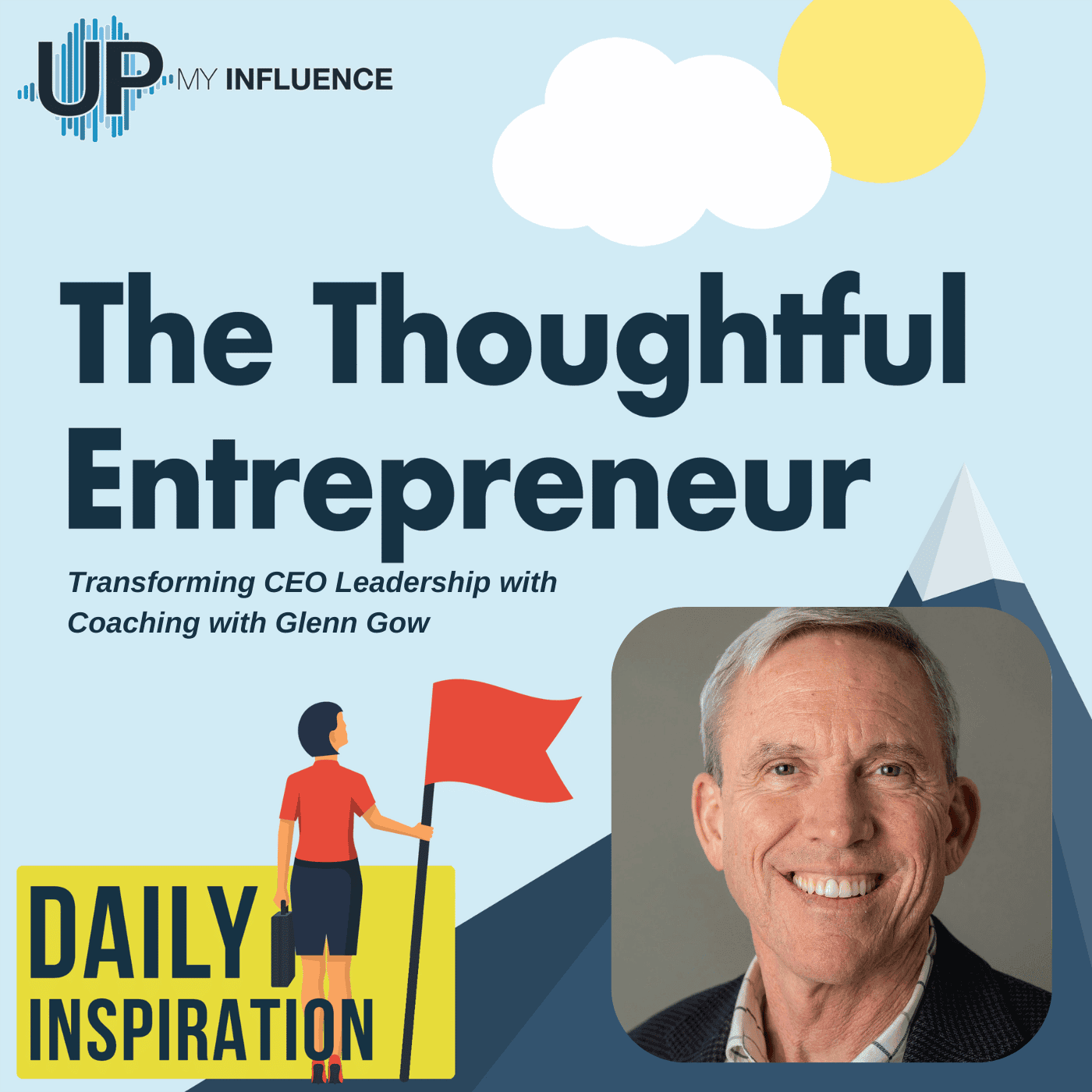
Transforming CEO Leadership with Coaching
Glenn Gow
Episode Overview In this episode of "The Thoughtful Entrepreneur," host Josh Elledge engages in a deep conversation with Glenn Gow, a seasoned CEO success coach with over 25 years of experience. Glenn shares insights on the challenges faced by CEOs today and emphasizes the importance of coaching for effective leadership.
Key Themes and Discussions
- The Role of a CEO
- CEOs often encounter unexpected responsibilities, including managing boards and customer relationships, which may not align with their core competencies.
- Many CEOs express feeling overwhelmed by their diverse responsibilities.
- Common Challenges for CEOs
- Overwhelm and Burnout: Many CEOs struggle with a long to-do list and the pressure to manage various stakeholders, leading to stress and potential burnout.
- Management of People: The complexity of interpersonal dynamics within a team poses significant challenges; no standard operating procedures (SOPs) can fully address these interactions.
- Engagement with Investors: CEOs often face difficulties in communicating with investors, especially when performance does not meet expectations.
- Coaching as a Solution
- Glenn advocates for CEO coaching as a transformative approach to leadership, providing skills enhancement, objective perspective, and accountability.
- He shares that coaching has been a crucial part of his professional journey, helping him and his clients navigate challenges effectively.
- He invites CEOs to consider complimentary coaching sessions to explore the benefits of coaching, regardless of their current performance levels.
- Preparing for Economic Uncertainty
- Glenn advises CEOs to exercise caution in their financial planning, preparing for potential economic fluctuations and adopting a tight budgeting approach.
- He emphasizes the necessity of building a robust leadership team to navigate future challenges and opportunities effectively.
- The Impact of AI on Business
- Glenn discusses the inevitable impact of AI on business operations and the importance of embracing new technologies.
- He shares a story of a CEO encouraging employees to experiment with AI, fostering a learning organization to stay competitive.
Key Takeaways
- Adaptive Leadership Skills: CEOs must develop the ability to adapt their leadership style to meet the unique challenges presented by their teams and the market.
- Importance of Delegation: Effective delegation is essential for managing responsibilities and reducing stress.
- Building a Leadership Team: The primary responsibility of a CEO is to cultivate a strong leadership team, ensuring they have the right people to achieve future goals.
About Glenn Gow
- Experience: Glenn has extensive experience as a CEO and venture capitalist and has coached numerous leading tech companies, including Apple and Google.
- Education: He holds an MBA from Harvard and is a recognized expert in AI and executive coaching.
- Public Speaking: Glenn has spoken at prestigious conferences and contributes to various publications, including Forbes.
Resources Mentioned
- Glenn Gow's Website: [glenngow.com](https://www.glenngow.com/)
- LinkedIn: [Glenn Gow on LinkedIn](https://www.linkedin.com/in/glenngow)
Conclusion Josh Elledge wraps up the episode by encouraging listeners to engage with Glenn's resources and to subscribe to "The Thoughtful Entrepreneur" for ongoing inspiration. He reinforces the podcast's mission to empower entrepreneurs and leaders to share their unique messages and impact the world positively.
For more insights and resources, or to apply to be a guest on the show, visit [UpMyInfluence](https://UpMyInfluence.com/guest/).
---
This summary captures the essence of the episode and highlights the critical discussions around CEO challenges, the importance of coaching, and the implications of AI in the business landscape.
Written by AI. May contain mistakes. Listen to the episode to check what was said.
Transcript
Automatic transcript. May contain errors.0:05Hey there, thoughtful listener. Are you looking for introductions to partners, investors, influencers, influencers, influencers, and clients? Well, I've had private conversations with over 2 ,000 leaders asking them where their best business comes from. I've got a free video you can watch with no opt-in required where I'll share the exact steps necessary to be 100 % inbound in your industry over the next six to eight months with no spam, no ads, and no sales. What I teach has worked for me for over 15 years and has helped me create eight figures in revenue for my own companies. Just head to upmyinfluence.com and watch my free class on how to create endless high-ticket sales appointments.
0:51Also, don't forget, the thoughtful entrepreneur is always looking for great guests. Go to upmyinfluence.com and click on podcast. I'd love to have you.
1:05With us right now, it's Glenn Gow. Glenn, you are the CEO success coach. Your website is glengow.com. Glenn, it's great to have you. I'm super happy to be here, Josh. Thank you for having me. Yeah, absolutely. Well, tell me a bit about the work you do. And again, a CEO success coach sounds like a valuable person to have in your corner, in my opinion. Well, Josh, I'm a very lucky person. I get to work with CEOs all day long. And that comes from my background of having been a CEO for 25 years. And then I went into venture capital and started coaching the CEOs of our portfolio companies. And I fell in love with this work.
1:49I realized that I was in a position to help CEOs become even better than they were already. And some of this comes, Josh, from me having had a CEO coach for 17 years. And what I didn't realize is that person was helping me not only become a better CEO, but learn CEO coaching at the same time. And so I have finally found something that I'm extremely passionate about. And I love working with CEOs every day. Yeah. And I would imagine, I think that there's a lot of really great content out there for leadership. And there's probably even like, I think in academia, you might find some okay stuff, although I would argue maybe not.
2:43It's one of those, it's like I think about the roles that we can step into. And a lot of times we're given full SOPs that include nearly anything that you would encounter within your job. I might be overstating that a bit, But again, CEO is one of those that it's a lot harder to get an SOP for everything you need to do, because a lot of this is just, to me, it feels like it's rooted in wisdom. It's rooted in just experience, which is just such a valuable teacher. But there are, I'm sure, leadership or CEO rules of the road. And so I'm really curious about your take on that. Well, here's a few things to consider.
3:33I'll share with you what some of my CEOs say to me. They say, Glenn, this job is not at all what I thought it was going to be. I have all these different responsibilities that, frankly, I don't even enjoy doing, and yet they're my responsibility. And sometimes I have to manage a board or I have to manage customers when I want to be focused over here because I'm good at these things. And yet as part of my role, I have to do a bunch of things that I'm not enjoying. So how do I get to a place where I can actually enjoy my work every day? So that's a struggle many CEOs have. The other thing is, and I love this, one of my CEOs said, Glenn, this job would be so easy if it weren't for all these people who report to me, because managing people is the biggest challenge.
4:23And to your point earlier, Josh, you can't create an SOP for managing people. There are best practices. There are tools. There are ways of thinking. But each individual interaction is unique. And what I help CEOs do is develop those capabilities to change as they need to as the situation changes. So they're powerful when they're interacting with other people, whether that's their board or their employees. Yeah, and I would imagine that there's probably, what are some more of those common complaints that you might hear from CEOs? Like, is it related to burnout? Is it related to, are there trends that you're seeing that, you know, you just hear this refrain over and over again?
5:12Maybe there's some culture issues that might be coming up. What are you observing? Sure. One example is overwhelm. So the CEO is stepping back, looking at their to-do list and looking at everything they're trying to get done and realizing there's no way they can get all that done. There's just way too much on their plate. And so they're asking, how do I deal with that? How do I deal with that from a stress standpoint? How do I deal with that from a balance of life standpoint? How do I deal with that if I don't have the right team in place? How do I deal with that if I have investors, with communicating with my investors when I realize we're not going to get everything done?
5:58And then how do I want to come into the office or the work situation ready to go as opposed to feeling oppressed because of the pressure I'm feeling? This is a very common theme. And so there are a lot of ways to begin to address those. And that's where I go to work with each CEO, depending on what the issue might be for them. So, for example, they just might not be a very good delegator. And I'll say to the CEO, I'm here to help you become a master delegator. And let's talk about that. Let's use examples. Let me give you tools and ways of speaking, ways of being that can help relieve some of this pressure for you and help your company actually accomplish the goals you want the company to accomplish.
6:46Yeah. Glenn, do you mind maybe sharing a bit about the scope of your work, like who you generally serve? Are you working enterprise? Are you working more SMB level? Who's your typical case? So I work all over the world. I work with CEOs from age 24 to 64. and in any industry. Now, generally speaking, these are relatively smaller companies. I have some large companies, but most of them are smaller companies. Quite a few of them are venture-backed companies, but not all of them. And what's interesting about that, Josh, the reason I don't have a single thing is I focus on what I call the mind of the CEO.
7:32So every CEO has many, many of the same issues. I'm not going to be an expert in every industry. That's not my job. My job is to help the CEO grow, grow themselves. And that's the mind of the CEO. And how do they change the way they view the world so they can be more and more effective every day? Yeah. Glenn, in terms of the road ahead, you know, we're looking into 2025 now. And let's say there was a wiser, smarter, savvy CEO listening to us right now. You know, as they're doing their own internal planning, maybe for themselves personally, or the goals that they have for people leadership, what would you speculate that most CEOs should include in that deep work that they do?
8:28There are two things. um one is if we think macroeconomically let us not assume that the economy is going to continue to roll it might but from a planning standpoint let's assume it might be a bumpy road and i say this because the economy isn't great for everybody josh sure the stock market is up But several of my CEOs tell me the economy is really bad for them. Many enterprises are not buying their services. So we have to think about when we plan, let's not assume everything's going to go well. Let's hope it does, but let's be tight on our budget going forward. OK, that's one thing. The second thing is.
9:17I'll tell every CEO this. The number one job of the CEO is to build a great leadership team. So when you step back and you look at 2025, you want to ask yourself, do I have the right people? In order for us to grow, in order for us to enter new markets or offer new products or up our game. And if I don't have the right team, then my plan for 2025 should be to develop that team, either by bringing in new people or bringing younger people up into management positions and coaching them. I have to be comfortable with making the changes with the very people I work with if they're not ready to help me get to the place and the company get to the place it needs to get to in 2025.
10:10Yeah. So Glenn, to our friend that's listening right now, and they're curious if you might be able to help them, do you mind maybe just sharing a bit about what engagement typically looks like and how you step into that conversation? Like, what are you most curious about when you're meeting with someone that you may be able to help? Well, Josh, this is something I learned from my CEO coach when I was a CEO for 25 years. We open every, I meet on average one hour a week with a CEO. And it's all over Zoom because my CEOs are spread out all over the place. And we open the discussion with how are things going?
10:57That is my question. And what's amazing about that question is that the issue that is most important to that CEO at that time will come up. I had a CEO say to me the other day, Glenn, well, things are kind of good at work, but they're not so good at home. Can we talk about that? And I said, of course, because your world is made up of inside and outside the work world. And if things are not going well somewhere, it's going to impact you in the work world. And so I wasn't anticipating that, but that's what was important at the time. And it was really critical that we address that for the CEO at that time so that they can feel comfortable now moving forward on the things that they have to take care of and deal with some of the issues that they're dealing with at home.
11:47or I might have a CEO come to me and say, Glenn, we just lost our biggest customer. They were massive percentage of our business. I'm not sure what to do. So I never know what issue I'm going to encounter with a CEO, which is part of what I love about what I do, but we're going to go to work on the most important issues that come up. Yeah, well, one of those important issues I see, and I'm only going to bring this up because it's all over your website, but you've been speaking to senior executives about the impact of AI. And that is, I mean, if an organization's not feeling it now, it's, in my opinion, an inevitability.
12:34Like this is going to have operational and people impacts in the months and years ahead. In my opinion, it's inescapable. It's already here. Yeah. So I'll tell you a story, Josh. And I love learning from my CEOs, by the way, every time I talk to one, I learn something. So one of my CEOs said, hey, we're not an AI company. And I don't, as a CEO, I don't know much about AI. But he got up at an all hands meeting and said, I need every single employee here to experiment with AI over the next three weeks. I don't care what you do with it. I don't care how you apply it. I just need you to go in and experiment with it.
13:23And then you're going to report to your boss what you learned. What did you learn about what it does well or what it's terrible at or how hard it is to use or how easy it is to use? I don't care. We need to become a learning organization as it relates to AI because of what you just said, Josh. We're not sure how it's going to impact us, but we know it's going to impact us in a profound way. And we can't be left behind because if our competitors grab hold of this fabulous technology, they're going to beat us in the market. So we need to begin to understand it and not be afraid of it and embrace it.
14:02And then the CEO said, this is a common phrase you might have heard, no one's going to lose their job to AI here. But you might lose your job to a person using AI. So I want you to be the person using AI. Yes. Yeah. Listen, one fan to another, I am probably in chat GPT alone at least 30 minutes a day. At least 30 minutes a day. And a lot of it is stuff that I think is applicable to most leaders. It's decision making. It's, you know, help me work through pros and cons over this. Like, you know, help me, you know, come up with, you know, an interpersonal issue. You know, explore this with me. Help me get clarity.
14:49You know, certainly I think many of us have used it to maybe craft some communication. And that's been real helpful. Now, what I will say, and again, I think most leaders will know this. Those are not your words when AI spits something out. So it's great fodder to work with, right? So do be very judicious. Not that you need my opinion or anyone needs my opinion on this, but please be judicious about always owning your voice. That's right. And don't ever give that up. That's right. That's right. And to support what you just said, what I recommend is if you're going to use a tool like Chachapit or Gemini or Claude or Perplexity, treat it as a college intern that's working at your company.
15:38Yes. Yeah. And they're pretty smart. But you know what? College interns make mistakes. And so you cannot rely on whatever you get from a college intern. You have to look at it and say, is that what I want? Is that how I would express myself? And then you become an editor. Yeah, yes. It's very, extremely powerful. And yes, it goes way beyond just these large language models that we're talking about in ChatGPT. And they're evolving very, very quickly. And so we want to think about how is it going to impact our industry? So let's make sure we're on top of that. Glenn Gow, your website is glengow.com.
16:22And I know you've got some resources here. What would you recommend to our friend that's been listening to our conversation in terms of next steps if they've enjoyed what you've had to share? Sure. I offer for select CEOs a complimentary coaching session. So that means I don't charge for that coaching session. And so on my website, by the way, my name is Glenn with two N's. So it's glengow.com slash apply. If you go to glengow.com slash apply, there's a form you can fill out to get a complimentary session. Not everybody will qualify for that, but I encourage people who are interested in coaching to look at that and apply to see if we can have a free coaching session.
17:07And I want to say one thing about that, Josh. Not everybody believes in coaching. However, if you think about any great athlete, somebody who's at the top of their game, they have a coach. So ask yourself, why does someone who's the very best in the world have a coach? It's because they acknowledge a coach helps them become even better. Absolutely. And if you have that mentality, then coaching can be a phenomenal experience for you. This is why I had a coach for 17 years. It was a transformational experience for me. Glenn Gow, your website, glengow.com. It's G-L-E-N-N-G-O-W.com. Glenn, you, again, I really appreciate your conversation.
18:00You are known as the CEO success coach. Glenn, it's been a great conversation. Thank you for joining us. Josh, thank you so much. I really appreciate it.
18:14Thanks for listening to the Thoughtful Entrepreneur Show. If you are a thoughtful business owner or professional who would like to be on this daily program, please visit upmyinfluence.com and click on podcast. We believe that every person has a message that can positively impact the world. We love our community who listens and shares our program every day. Together, we are empowering one another as thoughtful leaders. And as I mentioned at the beginning of this program, if you're looking for introductions to partners, investors, influencers, and clients, I have had private conversations with over 2 ,000 leaders asking them where their best business comes from.
18:55I've got a free video that you can watch right now with no opt-in or email required where I'm going to share the exact steps necessary to be 100 % inbound in your industry over the next six to eight months with no spam, no ads, and no sales. What I teach has worked for me for more than 15 years and has helped me create eight figures in revenue for my own companies. Just head to upmyinfluence.com and watch my free class on how to create endless high-ticket sales appointments. Make sure to hit subscribe so that tomorrow morning, that's right, seven days a week, you are going to be inspired and motivated to succeed.
19:37I promise to bring positivity and inspiration to you for around 15 minutes every single day. Thanks for listening. And thank you for being a part of the thoughtful entrepreneur movement.