
 Ask ChatGPT


- Podcasts
- The TreppWire Podcast: A Commercial Real Estate Show
- 418. How CRE Lending is Changing: Bigger Deals, Data Center Capital, & AI with Catherine Sierakowski, BMO Capital Markets
The TreppWire Podcast: A Commercial Real Estate Show1 Sep 2026 · 37m · 17 chapters
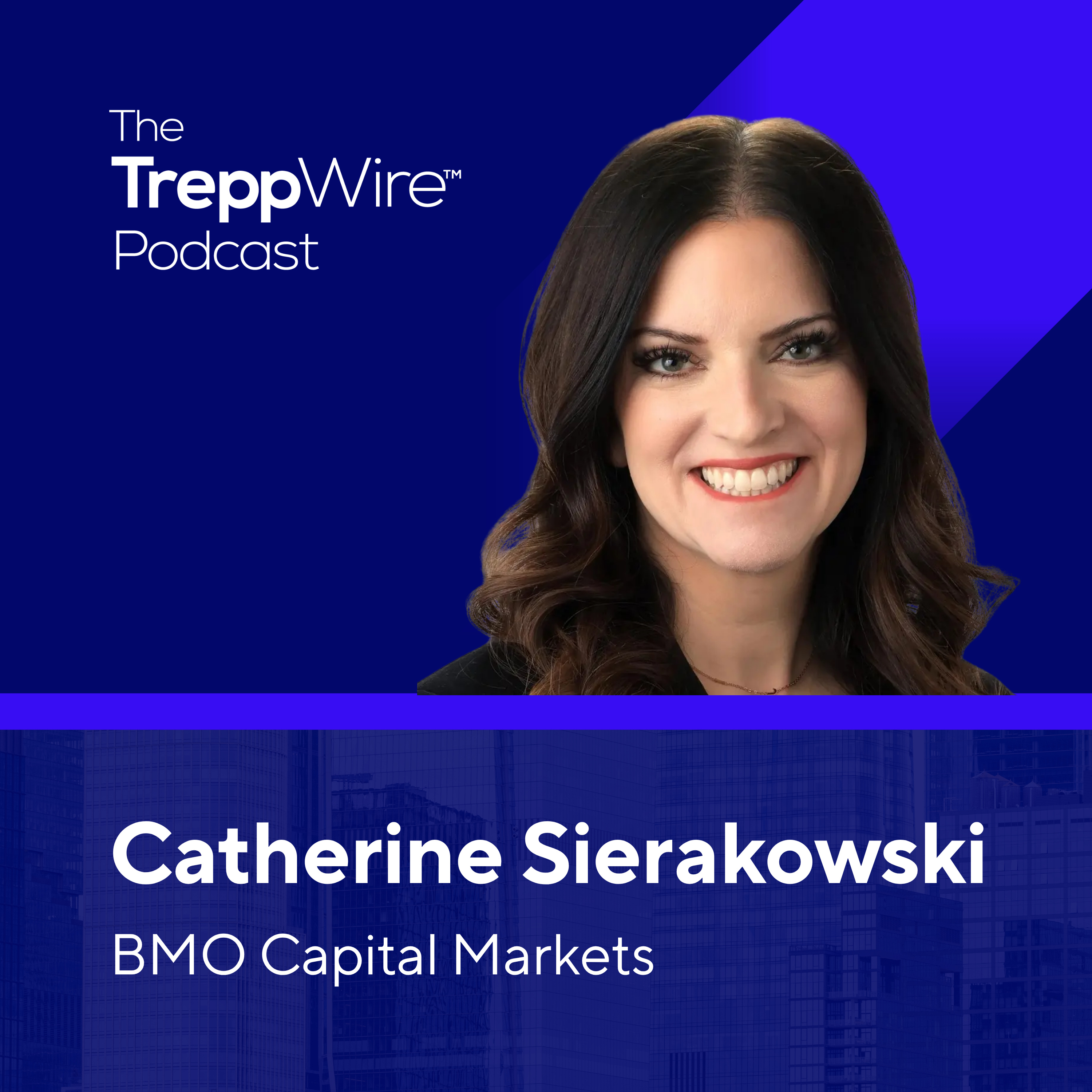
418. How CRE Lending is Changing: Bigger Deals, Data Center Capital, & AI with Catherine Sierakowski, BMO Capital Markets
In short
How CRE lending is evolving from balance-sheet loans to strategic capital solutions, with focus on data center financing and practical AI/data use in underwriting and execution.
Guest backgrounds
Catherine Sierakowski (Managing Director, Group Head of North American Real Estate Corporate Banking at BMO Capital Markets). Nearly 18 years at BMO; started in a rotational lending program during the 2008 Lehman era; helped build BMO’s institutional real estate platform (2015–2023), then moved to run the corporate banking book working with investment banking and global markets across US/Canada.
Key claims
Banks must provide insight, speed, and advice (not just pricing/quotes). Deals are larger and more complex, requiring syndication/partners and de-risking strategies. Data centers are real estate + infrastructure + technology + power + corporate credit; lenders must monitor takeout markets. AI accelerates data analysis and scenario/stress work but doesn’t replace relationship-driven judgment.
Notable examples
“MAGA”/hyperscale data center deals; construction-to-permanent takeout using CMBS/ABS/corporate credit; rate-shock underwriting lessons from COVID-era interest-rate hikes; growth of alternative sectors (logistics, life sciences, student/manufactured housing).
Written by AI. May contain mistakes.
Chapters
0:39
Catherine's Journey in Real Estate
Catherine shares her background and journey in commercial real estate.
“We recently had the opportunity to hear Catherine speak at our very own TREP Connect conference, where she shared valuable insights on today's lending environment and the evolving role of banks in commercial real estate.”
3:42
Challenges and Changes in the Industry
Discussion on challenges faced in the evolution of commercial real estate lending.
“So, you know, maybe before we jump too far away from that, you mentioned some of the timing as being, you know, favorable.”
7:04
The Evolution of Lending Practices
Catherine explains how lending practices have evolved over her career.
“And it's because it is possible as evidenced, but it's unprecedented.”
9:10
Sophistication of Borrowers and Banks
Exploration of how borrowers and banks have become more sophisticated over time.
“It's more of how can you be an advisor rather than just, okay, here's the 10 quotes I want and the biggest loan at the lowest price.”
11:16
Strategic Approaches to Market Opportunities
Catherine discusses proactive strategies BMO employs to capitalize on market opportunities.
“It's like, if it doesn't start with a billion, it's kind of like, is this even really noteworthy?”
14:00
The Importance of Being Proactive in Lending
Learn how proactive communication and consistent performance build trust in lending.
“And so I think that we have really grown in the kind of proactive way of making sure, you know, our clients know what we do, how we do it, and we prove it to them.”
15:00
The Evolving Landscape of Borrower Expectations
Discover how borrower sophistication is changing expectations for lenders
“else that they know can show up and help them get the deal done.”
16:00
The Rise of Data Centers in Real Estate
Understand the significance of data centers and their financing complexities.
“When Catherine was at TripConnect this last May, her panel, I think, was the favorite panel of the event.”
18:00
Opportunities and Challenges in Data Center Lending
Explore the opportunities and challenges in financing large data centers.
“I mean, the one thing that we can all agree on, though, is just the numbers are so much bigger.”
20:00
Navigating the Future of Data Center Investments
Learn how lenders assess opportunities in the evolving data center market.
“You know, how do I want to navigate the market?”
Show all 17 chapters
23:00
Market Trends and Opportunities in Commercial Real Estate
Discover key trends and opportunities across various asset classes in real estate.
“on watching each of these markets, what's being able to be absorbed and looking out to the future to say what's going to be brought out to those markets.”
26:20
The Role of Relationships and AI in Real Estate
Examine the impact of AI on relationships between borrowers and lenders.
“So I don't think you can blanket the space.”
28:00
Market Dynamics and Optimism
Discussion on market supply, demand, and the future of different asset classes.
“And you can work your way through those.”
28:32
AI's Role in Strengthening Relationships
Exploration of how AI can enhance relationships between lenders and borrowers.
“So as we kind of finish up here, Catherine, this has been great.”
29:59
Advice for Junior Professionals in CRE
Advice on how to leverage AI and become a value-add in commercial real estate.
“What is the best way for both parties to move forward in a difficult situation?”
33:01
Shout Outs and Gratitude
Catherine shares appreciation for her team and the TREP platform.
“we think about things, how we move forward and have it as another kind of filter point in the room to help us get through the vast amounts of modeling and information.”
35:00
Networking and Opportunities in CRE
Discussion on the importance of networking and how to connect with Catherine.
“And especially Taylor R., who is a great friend in the industry and a big TREP fan.”

Ask about this episode
Get the gist, explore an idea or ask about something said.
 Claude
On The TreppWire Podcast: A Commercial Real Estate Show, what are the key points of this episode?
Searching your listeningTranscript
Automatic transcript. May contain errors.
0:00I really think the biggest shift is the evolution of banks from just pure balance sheet lenders to strategic capital solutions providers.
0:12Welcome to the Trepwire podcast, the show where commercial real estate meets data and insights. This is a special guest podcast. I'm Haley Keen with Trep, a data modeling and analytics firm for the CMBS commercial real estate and CLO markets. I'm with Lonnie Hendry, chief product officer. Today, we're joined by Katherine Ciarakowski, Managing Director and Group Head of North American Real Estate Corporate Banking at BMO Capital Markets. Katherine began her career at BMO as an analyst and has spent nearly two decades growing alongside the firm's real estate platform. Throughout that journey, she's helped build the institutional real estate business, navigated multiple market cycles, and now leads North American real estate corporate banking at a time when the industry is experiencing significant change driven by new sectors like data centers and advancements in artificial intelligence.
1:03We recently had the opportunity to hear Catherine speak at our very own TREP Connect conference, where she shared valuable insights on today's lending environment and the evolving role of banks in commercial real estate. So we're really excited to be able to bring more of that conversation here today. For our listeners, Catherine, welcome to the show. We're so excited to have you here. Thank you so much, Haley. So excited to be here today. So let's hear it from you. We'd love to hear about your background. We start every show this way. Walk us through how you got your start in commercial real estate and how did that lead to your current role at BMO?
1:39Thanks so much, Haley. I love this question because I'm not one of those people that just started off in real estate and knew it was my destiny, it kind of fell into it, which is always a fun way to get there. So as you mentioned, I've been at BMO about 18 years now. So 18 summers ago was summer of 2008, which was kind of a wild time to start off in banking, going through a training program while Lehman collapses and being grateful to have a job was really my goal was to keep my job. So I went through what was ultimately kind of a rotational lending program and ended up actually in our financial institutions group.
2:14So it was a busy, fun time, started to be lots of growth. And I loved the team I was on, but thought I should try something different. You know, there's a whole bank here. And after finishing my MBA, I thought I should take on a new challenge. Finally, I was kind of hitting a wall. And one of my mentors said, you know, you should really meet Kim Leoteau. She's now taking on a leadership role to lead our institutional real estate team. And I think that you guys would really get along. You'd like her. And I said, wow, okay, I didn't even know we were growing real estate, truth be told. And she was looking to really grow the platform and build out a true national commercial real estate business.
2:52And it just was an incredible time. So that was about 2015 until 2023. So I won't lie, I think the timing of the market and free money really helped because everyone in real estate was growing. So timing does matter. And I was very fortunate and eventually navigated to being asked to come over and work on our capital market side, running the corporate banking book, which has been an exciting challenge. I started three years ago, kind of working hand in hand with our investment bankers and our global markets team across the US and Canada. But luckily, real estate is so holistic at BMO. I spend a ton of time with all of my counterparts, including Kim on our kind of go to strategy for real estate as a bank.
3:35So I've been very fortunate through a happenstance meeting of an incredible leader able to be in real estate today.
3:42Catherine Sierakowski: That's a really great answer, Catherine. And it's a pretty awesome story too. I mean, I think it's great, you know, especially for BMO's perspective, as somebody that starts off, you know, almost 20 years ago and has kind of worked their way up and helped them build, you know, institutional quality type of platforms, which has been very beneficial for them as well as for you personally. So, you know, maybe before we jump too far away from that, you mentioned some of the timing as being, you know, favorable. What were some challenges? I mean, like what have been some of the harder parts of going from not really being focused on commercial real estate to then partnering up with someone that was building a platform?
4:15Catherine Sierakowski: What have been some challenges that you guys have overcome and how has that maybe shaped where you are today? Yeah, that's a great question. I think because there's been so many challenges, there's been opportunities to persevere and succeed, if you will. So I would say on the personal challenge side, jumping in as a relationship manager in an industry where I'm sitting there asking, okay, debt yield, cap rate, all the terminology. You have that credit background of how to look at cash flows and underwrite and lend money, but it's a whole new language. All of us in real estate speak our terms that sound pretty daunting when you really flip them over and understand them.
4:53It is pretty much getting back to basics in lending, but just jumping into something I think was kind of the biggest challenge for me. And it was having good people to go to, having great mentors and leaders, and really just engrossing myself in deals. I think that deals are the way you learn as many as possible. So because of that timing, I saw a ton of deals. But probably what hit on challenges was, A, we were growing a lot and we're a bank. So you got to do that in a measured way, a thoughtful way. We also took on kind of new products in terms of note-on-note lending, in terms of going bigger over time.
5:30BMO has grown tremendously. So just encountering that and kind of navigating the internal workings of getting bigger while also showing up bigger for clients. And how do you kind of bridge all that from a risk perspective? And then, of course, we had lovely COVID hit, which was just a journey for all of us to go through. But I think that starting off in the financial crisis kind of puts you in a mindset of we're going to get through this, right? If we got through that, we can get through anything else. And I laugh because I spent so much time as I was working my way up, you know, having to do all these assumptions of, you know, what happens?
6:08Interest rates go up by 300 basis points and just going, that doesn't happen. Why are we underwriting that, you know, and having all of my colleagues and counterpart, you know, at the time that were the veterans say, remember when rates were well into the double digits. So who knew that, you know, as we came out of COVID, which ended up being quite a boom towards the latter half of COVID, I mean, the most deal volume probably anyone on the lending side did there coming out would be the rate shock that we had appropriately thought about and looked at from a lending perspective. But to live it in reality and to go through it and see the effects was just a great learning experience, I think, for everyone.
6:48But something that having gone through some of those other big shocks helped me realize, OK, we're going to get through this, think through it. We've underwritten great borrowers. You know, we have great sponsorship and support. So we'll navigate these difficult times.
7:03Catherine Sierakowski: You know, they say the interest rate hikes were unprecedented, not impossible. And it's because it is possible as evidenced, but it's unprecedented. in it, but you still have to stress for it. You still have to run some scenario analysis because things like that can't happen. And I think, you know, your perspective of going through 2008, we joke all the time on our weekly show, which we know you're a huge fan of. Thank you for the support, by the way. Oh, yeah. You know, people that joined commercial real estate, say 2012 and beyond, they'd only seen cap rates come down, values go up, interest rates go down.
7:32Catherine Sierakowski: They've not seen anything else than just values continue to go up. And so you bring some perspective, some reality to that cycle part of the real estate market. And I think we need that because it is cyclical. Sometimes cycles are a little longer than others, as evidenced here. And your perspective is spot on. We appreciate your, you know, kind of bank background of like risk management and growing with constraints. Like this is not where you just like say, hey, we're going to grow and you start throwing money around. Like you're still having to operate within the confines of regulatory environment, et cetera, et cetera.
8:03Catherine Sierakowski: You know, what are some of the changes you witnessed through your career? You know, we talked about some of the challenges. You talked about some of the opportunities. You know, just has the market shifted? I would assume underwriting deals slightly differently now. Are you using technology in different ways? Are you using data in different ways? Like from when you started to now, what have been some of the predominant changes? Yeah, I think the one constant is change. So that is, it's probably spot on. I would say, you know, in general, looking at real estate and especially where BMO's played, The institutionalization of the borrowers has been significant, just the size and scale.
8:39I mean, we can talk about it in the current day, which is a whole other animal we'll get to. But just in general, the amount of capital that's being raised and the sophistication in the borrowers, the expansion of private credit. I mean, we can't ignore that. It's a huge part of the ecosystem, the non-bank lending. And I really think the biggest shift is the evolution of banks from just pure balance lenders to strategic capital solutions providers. Clients have choices today. Lenders have to show up with more than just capital. You have to bring insight. You have to be quick. You have to bring advice.
9:14It's more of how can you be an advisor rather than just, okay, here's the 10 quotes I want and the biggest loan at the lowest price. Don't get me wrong. That is still a part of the market and that works for some deals. But I think as borrowers have gotten more sophisticated, lenders have had to really step up as well in our sophistication. And I think going back, you know, even 10 to 12 years ago, you know, it was always the main food groups. And, you know, when I was running our core business and traditional CRE lending, it was, you know, we spoke that way even still, but really it's evolved.
9:52And we're spending so much time in all the kind of adjacent ones. Obviously, there's big ones out there, but even we call it logistics. And then there's the life sciences, the offshoots of housing with student housing and manufactured housing. So it's so much more and you need to be an expert in so much more. So I think it's just really the sophistication of not only the borrowers out there, but the sophistication of the banks to show up as well in much more of an advisory role.
10:21Catherine Sierakowski: That's a really great insight because, you know, we've seen the same thing. Obviously, we track a lot of data and if it's income producing, we have it. I mean, we have some esoteric properties like parking garages and other things, but things that we would have considered alternative five years ago with mobile homes, self-storage, you know, maybe even some of these senior housing developments are built to rent. These things are kind of mainstream now. And to your point, the borrowers are much more sophisticated. The capital is much more sophisticated. The structure is much more sophisticated. And I think banks, you know, have done a good job.
10:49Catherine Sierakowski: And I think BMO in particular, there, you guys have really brought yourself to the playing field with a bunch of tools in your tool belt to say, where can we meet you where you are? We don't have to just be a basic balance sheet lender and we can do some things to get creative within the confines of what we're able to do, but meet the market where the market is. And it is amazing. We talk every week about just the size and scale of these deals. 10 years ago, if you did a$50 million deal, that was a pretty big deal. And the data centers, we'll get to that. That's just on a whole other stratosphere.
11:16Catherine Sierakowski: but even for your traditional kind of multifamily or industrial, like a hundred million dollar deal now, like there's nothing. It's like, if it doesn't start with a billion, it's kind of like, is this even really noteworthy? Which to me, I'm 25 years into this. Like, I just can't get my mind wrapped around that. I completely agree. It has changed dramatically. And that is why I think you're having to see banks kind of up and down the spectrum because not every bank can just show up and write a$500 million check. So it's being able to be nimble in terms of, okay, how am I going to look at this?
11:49Am I going to syndicate it? Am I going to bring in partners? Do I have different de-risking strategies? And the deals are big now. Everything has shifted. Inflation is real. I know you guys talk about that quite a bit, but we all know that has happened and is a part of our reality. And this is where rates are. So how are we getting deals done? And I think that is so key right now on showing up with multifaceted ways to do big deals. And for BMO, I think, looking at us 10 years ago today, having now a top-ranked CMBS platform, we're very dominant in our Canadian commercial business. We're very massive in our U.S.
12:27commercial real estate business. Our investment bank was rated number one North American real estate investment bank this year. So it's because we've brought all those together to say, we don't just look at a large billion dollar deal and say, OK, that's big. It's really OK. We've got all of these different ways to think about that and to show up with our syndication partners, structuring partners kind of across the platform to say, how do we go about taking this deal out to market and getting it done? Which I think is why you can see all sorts of banks competing for some of these bigger deals because you've had to get creative and build up a stronger toolbox.
13:03Catherine Sierakowski: I mean, that's been one of the consensus thoughts that we've heard is just the competitive nature of the lending environment right now is forcing everyone. Spreads are crazy compressed and you're having to get creative. So maybe just one more question on that before we move on. But it sounds like you're being much more strategic in terms of proactively getting yourself in position to take advantage of some of these bigger opportunities versus maybe like in a legacy framework, you would wait for some of these to come in-house and then you would try to figure it out. Is that accurate? I mean, are you guys sitting down and saying like, here's where we think the market is moving.
13:32Catherine Sierakowski: Here's where we think we provide a solution. Now let's go out and try to capitalize on that. Or are you still, you know, waiting for borrowers to come in with these complex scenarios and then trying to solve them because of your nimbleness real time? You're spot on in that we are being as proactive as possible. And I think that that actually leads to being able to respond super quickly when an M &A deal pops up. So being in front of our clients often, that's the one thing that I think has stood the test of time at BMO is that it's always client first, it's risk management, and it's showing up and being there.
14:05And so I think that we have really grown in the kind of proactive way of making sure, you know, our clients know what we do, how we do it, and we prove it to them. And I think that serves us and other banks in general, quite frankly, for when these deals do pop up, because that's how M &A works, is there's a lot kind of going on, and then all of a sudden and it hits and you better figure out that financing very quickly and you better show up with it. So I think it helps from a client perspective of building that so they know you'll be there when the big deal does happen and you've got to show up with the creative financing.
14:40But part two is also that you've continued to prove it to them in other ways and showing up kind of throughout the years. So I think showing up through cycles, focusing on your names is really kind of the key point there because I think we're going to keep seeing more and more transactions, which is exciting, but a lot of work. And the clients are going to go to the banks and the non-banks and everybody else that they know can show up and help them get the deal done.
15:07Catherine Sierakowski: Yeah, that's great perspective. I mean, you're right. We're in a results-oriented business. It's great to say you can do things. It's another thing to actually be able to deliver. And I think with the sophistication of these borrowers, they're doing just as much due diligence on who they're working with beyond just the interest rate, the terms and everything else. Yeah, absolutely. I think that the whole world has really uptiered in terms of where we are and what is expected out of lenders and the work that needs to be done for pretty much every transaction and how you utilize what you have to be able to show up and deliver.
15:40Catherine Sierakowski: I think it all comes back to the availability of data. I mean, data is much more plentiful now. And it used to be, you know, real estate was just a relationship business and And whatever insights and information you had, you kept close to the vest because that was your competitive advantage. And now data is plentiful and people are really having to compete on execution. And I think you guys have done an exceptional job of delivering. But we'd be remiss if we had you on and we didn't talk a little bit about data centers for our audience. When Catherine was at TripConnect this last May, her panel, I think, was the favorite panel of the event.
16:08Catherine Sierakowski: And it was pretty much all about data centers. And Catherine was the star of that panel. And so we said, hey, we're getting you on the podcast. We're not going to have you on and not talk about data centers. So data centers, I think, have taken over the headline from the office demise and, you know, what's going to happen to office. Now everyone's like, oh, my goodness, data centers are here. They're huge. The cost is crazy. The appetite's insatiable. But they don't really dig into, like, how are these deals getting financed? And what does a lender think about these deals? And how do they think about them?
16:36Catherine Sierakowski: Are they real estate? Are they infrastructure? Are they a combination? So you had some really great insights on that. Maybe as we kick this off, just quickly, broadly, data centers, when you hear that as a lender, what do you think? My favorite topic? I think incredible. I think the reaction I immediately have is just to see how quickly it has become the biggest and most prolific thing we're talking about in every area of our lives. Certainly in, you know, the entire kind of real estate ecosystem and beyond. But I think there's just so much coming out of it. And it's incredible. to see how fast things are moving, how big things are, how much money is being spent.
17:16And I think that the second thing that I think of is opportunity. This is going to morph how it's going to morph over time. And there's a lot of unknown. But at present, there is real opportunity here. And it's quite frankly imperative that it is looked at and understood for the complexity that it is, especially on the lending side.
17:37Catherine Sierakowski: That's a great answer. I will say this, Haley, we need to jot this down. Catherine has said the word opportunity a bunch of times because she's an optimist. And when she's talking about growing a platform or she's talking about building a business, you have to have that mindset. So, Catherine, I want to say, like, it's easy to see why you've been so successful because I agree with you. I think every challenge creates opportunity and I think unknown creates opportunity. And we're kind of in the driver's seat here, especially you guys, and framing what data center lending looks like as we go forward.
18:03Catherine Sierakowski: I mean, the one thing that we can all agree on, though, is just the numbers are so much bigger. I mean, like we talked earlier about a, you know, a$40 or$50 million deal, not even raising eyebrows unless it's a billion dollars in today's dollars. But these data centers are tens of billions or hundreds of billions. You know, going back to what you said earlier about potentially partnering or syndicating or, you know, how does this work? I mean, it's almost impossible, I would think, for the size of some of these deals for individual lenders to kind of take these down due to concentration risk and other things.
18:32Catherine Sierakowski: Like, how do you guys approach data centers broadly today? Yeah, that's a great question. I would say that you're exactly right. These types of deals have become so big that all lenders of all shapes, sizes, types, regulated, non-regulated, and I think deal structures we've never even seen before are starting to get done. Because at the end of the day, these deals are so massive that you're needing a very strong credit profile backing them. That's where the market is really trending to now is that to get the massive MAGA deals done, you're going to need some very strong credit support. So I think that's number one.
19:10But I think, too, that thing that gets a little bit missed in the conversation of data centers is, one, they've been around for a long time. So there are operators and developers out there that have been doing this for a very long time. Obviously, it's all pivoted dramatically in the past few years, given the explosion of AI. But the demand for data centers is due to cloud adoption, streaming, enterprise digitization, now AI as well. But that demand was already growing before we kind of saw this explosion. So there's a lot of that core need that is really on the basic stuff of us using our phones.
19:46And day-to-day life that is not dramatically different than what we're doing now, that has driven a strong need for data centers. So if you take that already happening and add on the prolific need for a lot of the AI data centers, I think that's where you get to this kind of massive explosion that is causing all lenders to say, OK, how am I approaching this? You know, how do I want to navigate the market? Where do I want to play? And how do you navigate that unknown in the next 10 to 20 years of what does the data center look like then?
20:17Catherine Sierakowski: It's a very valid point that data centers are not new. I think the scale and the compute power and the cost, that part of the equation is new. But to your point, at a foundational level, people have been lending on data centers for a very long time. I mean, it's not new in that sense. It's just new in the size, scale, and kind of what people are using the data for with the AI boom. And the numbers are just so big. I think the one thing that we would love to hear your perspective on is where do lenders want to be in terms of these deals? I think you had said at TREP Connect, you guys love doing the construction financing on these, and you would love to have them placed somewhere else for the permanent debt.
20:54Catherine Sierakowski: I don't want to put words in your mouth, so if that's not what you said, please clarify. But it feels like there's definitely a bent from the lending perspective of saying like, yeah, we're happy to do the front end of these. We'd love to have somebody else take them out on a permanent side and see what happens because things evolve very quickly in the space. I think that's a fair point. I would say two things. And that is where any bank that is coming at these, I think, especially where BMO has done the work, is to be very thoughtful and selective of where's the opportunity? Where can our strengths and skills play up here?
21:27Where can we be extremely disciplined in our underwriting, close coordination across our partners? and really taking a step back as I love that you asked this question, is it real estate or not on most of the podcast? And my answer is yes to all of the above, because I heard that from one of your previous ones. But truly, it's the intersection of real estate, infrastructure, technology, power, and corporate credit. I think that part needs to be included in how you're assessing looking at data centers, because it really is all of these things. And at BMO, we look at it holistically of using all of our industry expertise across all of these sectors to say, okay, what makes the most sense?
22:09Where are our best clients playing in this space? How do we best serve them? Which as I had mentioned before, was really on helping get these off the ground and get them built. And then utilizing our CMBS, ABS, corporate credit, kind of various takeout platforms to help them execute is that as well, which I think for BMO makes sense. But I think for most banks makes a lot of sense because the incredible need for capital is only going to work if the capital keeps moving. We need high velocity capital for banks to be able to kind of fill up again and keep going, quite frankly. But you also, more importantly, and where we focus a ton of our time is looking at these takeout markets and the investors and where that pricing is, how the market's responding to every single deal, we have a really close group internally that is just extremely focused on watching each of these markets, what's being able to be absorbed and looking out to the future to say what's going to be brought out to those markets.
23:08Because it's one thing to sit here and underwrite the construction of it and say, OK, I've got this great tenant and it's a long term lease and you've got what you need. But the bigger piece of this is what happens to the rest of it as the cycle continues. And so I think really bringing in all of your expertise product partners and looking at it from, you know, start to take out and monitoring that is the most important thing. And that's really where we have focused at BMO.
23:34Catherine Sierakowski: I appreciate your comments on the corporate credit side of this on the deal side, because it's almost like they understood you in the sentence. Like people expect that for these new hyperscalers, like these are the, you know, the magnificent five or whatever in the stock market that you're dealing with. But if that didn't exist, then these deals wouldn't, they wouldn't be able to, they wouldn't be an appetite in the marketplace like there is. Like the credit worthiness of those people backing the loans, I think are very important. And it's interesting, you talk about the CMBS and ABS market as a takeout, and we've seen a huge explosion in the CMBS space.
24:06Catherine Sierakowski: And what's really, you know, nuanced about this is on these really large size deals, we get prospectus documents that have additional carve outs and coverage of those top 15 assets. Like on these, these are single assets, single borrower deals, just one entity usually, whether it be one building or one sponsor with multiple buildings. But a lot of these leases have government tenants that don't want to be disclosed. And so you get to the prospectus document and you're like looking at the tenant roster and it's just like undisclosed, undisclosed, undisclosed. So you don't really get that perspective that you're talking about that the lender would have access to relative to the creditworthiness of some of these places.
24:41Catherine Sierakowski: But I think it's an understated part of the equation. I love that you're talking about it holistically because I definitely agree. You guys may service them in four or five different parts of your bank at different stages, depending on what they need and where they're at. So I don't want to spend too much time on data centers, but I do want to give you your flowers because your session on data centers was incredible. But I would like to, as we kind of like round out here, maybe a couple more questions for me. You know, just in the marketplace, where do you think there is opportunity now? So you talked about, you know, when you started, it was the four major food groups And then now we've seen some alternatives.
25:12Catherine Sierakowski: We've seen data centers. Is there a geographic play? Is there a property type play? Is there something that you're seeing here that says, wow, I think this is going to be a market that has really strong results for the next couple of years? Or do you think that the market generally is moving as one? Our take is that it's not, but I'd love to hear your spot. I think this goes back to what we were discussing earlier in that what was alternatives is now becoming kind of prolific sectors. I mean, we all survived COVID. and been on this premise of all this demand is coming and we're finally seeing it.
25:45So I think you're seeing that boom there. I know you guys have spoke of that sector, but I think there's a lot of pockets like that, that the capital is flowing, people are trying to find the right time to get into it and basically it will finally all pencil out is where we are. And I think the main food group, some of them, I mean, retail certainly has had a nice comeback, went through a long cycle there, but I feel like it's come back And I know I'd be remiss if we didn't talk about office briefly in terms of it's fascinating what's getting done in New York City and the class A. It's tremendous.
26:18And I think it bodes well for certain markets and certain asset classes, but certainly have your bifurcation. So I don't think you can blanket the space. I think that like everything, each asset class is going to require that expertise drilling into that market, you know, drilling into supply and demand overall. and number one, it's working with the best borrowers and working with the best sponsors. So every sector is gonna have that and have better times than not in terms of growth. But being with a borrower that you can partner with over time across any asset class is really where it all starts.
26:54So I think starting there is really the most important, but I think there are several that are gonna continue to do well. And we all know that construction has not been what it was a few years ago. And we know how to do that math and what happens there. And that's across pretty much every sector. So that's going to help, I think, more blanket than anything else of when you just haven't built a lot, that's going to help in terms of supply and demand and pricing pressure. So I think we'll see some of that no matter what, and it will hit others more than some of the broad ones. But I think that's an exciting thing to see over the next few years, for sure.
27:30Catherine Sierakowski: Well, I think it's a great response. And it's true. I mean, the supply and demand imbalance really shifts the marketplace. And And we've seen it very prolific with the apartment space where they had such a deluge of new supply and it's really put downward pressure. But it's actually going to come back in favor of the property owners fairly soon where rent pricing power, et cetera, comes back in their favor because the new construction pipeline has dried up. And so I think we've done a lot of analysis around certain markets where there's really not structural problems. The fundamentals are still strong and they just had too much supply.
28:00Catherine Sierakowski: And you can work your way through those. concessions go up, effective rents come down, cap rates get elevated at some level because there's just too much supply. But in the medium to longer term, you start seeing those markets prevail as winning markets. And I think we're going to see that across multiple asset classes. So I'm with you. I'm very optimistic. I think there's a lot of good to come. I think the office story is certainly unwritten or not finished, I would say. It's not near the end, but there's a return, I would say. But there's going to be winners for the next 10 years. There's going to be losers for the next 10 years.
28:32Catherine Sierakowski: So as we kind of finish up here, Catherine, this has been great. We really appreciate you carving out some time for us because we know that your schedule is packed. But, you know, we talked about data centers. We talked a little bit about AI. I want to drill in a little bit on AI and kind of how you guys view that. So maybe practical use cases. You know, I think in every answer you've said relationships matters without saying that because it does, it starts with the borrower, starts with the lender relationship and that dynamic. How are you guys using some of these tools to, you know, maybe strengthen those relationships or create new ones?
29:00That's a great question. I feel like you also can't talk about anything without talking about AI these days as well. So it's either data centers or AI or both, which I love. I also like that I'm rubbing off on you with the optimism there, Monty. So this is getting more fun by the minute. I think that I'm a huge fan, not a surprise that I'm going to be excited about AI, but what I view it as is it just a critical tool that is going to make everybody better at their job. And I think for lenders, it's not going to take away the need to have a relationship and the need to show up, execute on deals, work together during hard times.
29:36That is all still going to exist. But we're going to be able to get to that point a lot quicker because we're going to have the data. We're going to be able to analyze it quickly, be able to make decisions and have all of that brought together, summarized for us to say, OK, we have all of it. Now let's really have this conversation and critically think about what to do here. What is the best way to structure this deal? What is the best way for both parties to move forward in a difficult situation? So when you think about it, I think it can make us all more elevated, junior people moving up quicker because you're able to get to that critical thinking stage a lot faster.
30:14I always laugh when I'm meeting with, we just had our interns here this summer who were fantastic. And I think about my time when I started to come kind of full circle and, you know, how much time I spent typing in numbers from an audited statement into a system and making sure I didn't make typos and checking to make sure my retained earnings balance, you know, not that that isn't great to understand because you need to understand it, but being able to spend your time having all that put together and modeled and then being able to ask the right questions and critically think will just help you get to the next level faster, in my view.
30:51Catherine Sierakowski: We're totally aligned there. And I think this is just a PSA. You're hearing it from someone that's doing this every day in Catherine and managing large teams. Embrace the technology because it's going to make you better. And if you can partner the technology with some experienced mentors that have been in your shoes in the past, I think that's how you get the winning combination. So I think it's great to hear from someone sitting at your position that you're so bullish on some of the AI use cases, because I agree with you 100%. I think it expedites, even some of the scenario analysis you were talking about earlier, the stress scenarios, you can have AI run simulations at a scale that just was almost impossible for an individual to kind of compute on their own, which I'm very bullish on.
31:30Catherine Sierakowski: So maybe as we finish up, if you were to give some advice to someone that's junior in your office or someone that's trying to get into CRE, I love that you commented on our vernacular and kind of acronyms and the vocabulary because I think it's daunting for some people. But what would be some advice that you would give someone starting out today, seeing what you've seen, being where you are now, and then trying to help them move forward in their CRE career? It's a great question. I've tried to send that message out this summer, so I'll try and say it more broadly now. I think it is an incredible opportunity to show up as value add day one.
32:06You have spent more time in AI, you know, coming in as a junior employee and how to use it and how to think about it. So bring that to those industry veterans and help each other and learn both ways. You know, this was the exact approach I took jumping into real estate was figuring out how I can be value-add and helpful to be able to sit there and ask many people to stay late and walk through deals with me. So take advantage of all the time you have in school to learn and to really understand how to get the most out of AI, how to help you think more critically. Use it to understand terminology, examples.
32:44You know, you can ask, there's no dumb question. You can ask literally anything to learn. But remember to not to outsource judgments. Don't don't do that too early. Make sure that you're spending the time to really critically think through things. I think it's important that we all still have to have the dialogue and the conversations and use it more as a tool of the various ideas and then be able to learn from each other, kind of extract across, you know, the real estate spectrum on how we think about things, how we move forward and have it as another kind of filter point in the room to help us get through the vast amounts of modeling and information.
33:22So I would say use it as much as possible, become an expert and be a big contributor to your team because it can be, I think, a dramatic game changer for a lot of lenders out there.
33:34Catherine Sierakowski: I think this is when you say no notes. That was a perfect answer. So no notes. You're too kind, Lonnie. You're too kind. Well, Catherine, this has been an incredible interview and we're so glad that you're joining us today. We didn't really share with our listeners, but the way we met you was very unique. I think you and Lonnie connected at a conference because you were a listener of this show and you recognized his voice, right? That is correct. I was definitely a very excited fan when I heard him speaking and realized I was in the presence of a quite famous podcaster. That is correct. We love that.
34:10Well, then when we learned what you did, we said, OK, we need to know this person, too. So it's been so great getting to know you over the past year or so, having you at our TripConnect conference. And before we close, as a loyal listener, you know, we always do shout outs on our weekly show. So if you have any shout outs for your team members, I know you started off by giving a shout out to your mentor and your guide at BMO. But if anyone else comes to mind, feel free to give him a shout out here. Oh, thank you so much, Haley. You are truly outstanding. And I think I first would just love to shout out my entire team at BMO, everyone that touches real estate, everybody that supports our clients and makes this platform amazing.
34:50So I am just so fortunate to work with an outstanding team across capital markets and our commercial banking partners. So shout out to everyone at BMO and real estate, specifically Marty K, who is a loyal TREP fan and got me my first TREP t-shirt. So thank you for that, Marty. And especially Taylor R., who is a great friend in the industry and a big TREP fan. And lastly, I'm going to shout out TREP. Thank you for creating a forum where the industry can have these thoughtful conversations about market, data, risk, and where commercial real estate is going. I think it's a tremendous platform, and I'm grateful that I was able to be a part of this conversation.
35:28And thank you guys so much. Thank you so much, Catherine. This has been incredible. As we said, Leslie, just tell our listeners how they can learn more about you and your business or how they can get in touch. Oh, thanks so much. Yes. So I'm very active on LinkedIn. So please feel free to find me there as well as reaching out. I'm happy to take inbound emails. It's firstname.lastname at bmo.com. I'd really love to connect and see if there's ways that BMO can be helpful to clients, partners or anyone really across the industry.
36:00Catherine Sierakowski: I want to jump in real quick, Haley. If you're a listener and you don't reach out to Catherine, you're missing the boat here. If you're someone looking to get a gig, BMO is awesome. She's a walking testimony of someone starting out and now running impactful divisions within that firm and growing their scale and their reach. And her network is immense. And just you can hear it in her voice that she loves what she does every day. I mean, like you can tell she's passionate about this. So, you know, we do a lot of these. And I will say for the most part, I think everyone in commercial real estate generally loves what they do.
36:29Catherine Sierakowski: It's a very rewarding career, but your passion for this industry and kind of where you've landed and been fortunate to grow comes through loud and clear. So I would encourage people. I mean, listen, this is a great opportunity to potentially network with someone that has very significant reach across our industry. So thank you, Catherine, for just making yourself available. And I would just ask our listeners that are looking for someone that can help lead them or maybe provide some opportunities. Catherine would be an invaluable resource for you. Thank you so much, Lonnie. Thank you again, Catherine.
36:57And with that, we'll close this special podcast. Join us later this week as we look at what's happened during the week and how it may be impacting you. If you have a question or just a comment, send an email to podcast at trep.com. Until then, visit trep.com for more info and subscribe to the TrepWire podcast with your favorite provider. Thank you for listening and stay well. All right.
From the publisher
In this special guest episode of the TreppWire Podcast, we sit down with Catherine Sierakowski, Managing Director & Group Head of Corporate Banking, North American Real Estate at BMO Capital Markets. Catherine reflects on her nearly 20-year career at BMO, from starting in banking during the Global Financial Crisis to helping build the firm's institutional real estate platform and now leading its North American real estate corporate banking business.
We discuss how CRE lending has evolved from traditional balance sheet lending to more strategic capital solutions, along with where Catherine sees opportunity in today’s CRE market. We explore the explosive growth of the data center sector and the unique challenges of financing assets that sit at the intersection of real estate, technology, power, and corporate credit. Catherine shares her perspective on relationship-driven lending, effective client engagement, and the importance of balancing AI-driven insights with experienced human judgment. Tune in now.
Episode Notes
• Start at BMO (0:00)
• Real Estate Cycles (4:20)
• BMO Banking Strategy (8:23)
• Massive Data Center Deals Pricing (15:56)
• Where to Find Opportunity in CRE (24:54)
• How Transforms Lending (28:32)
• Shoutouts & Closing (33:40)
Questions or comments? Contact us at [email protected].
Follow Trepp:
X: www.x.com/TreppWire
LinkedIn: www.linkedin.com/company/trepp
More from The TreppWire Podcast: A Commercial Real Estate Show
All episodes
We use cookies.They keep VO running smoothly and help us improve it. Privacy policy