
 Ask ChatGPT

- Podcasts
- The TreppWire Podcast: A Commercial Real Estate Show
- 420. The Art of Storytelling in Commercial Real Estate with Spencer Levy, Host of CBRE’s The Weekly Take
The TreppWire Podcast: A Commercial Real Estate Show8 Sep 2026 · 50m · 27 chapters
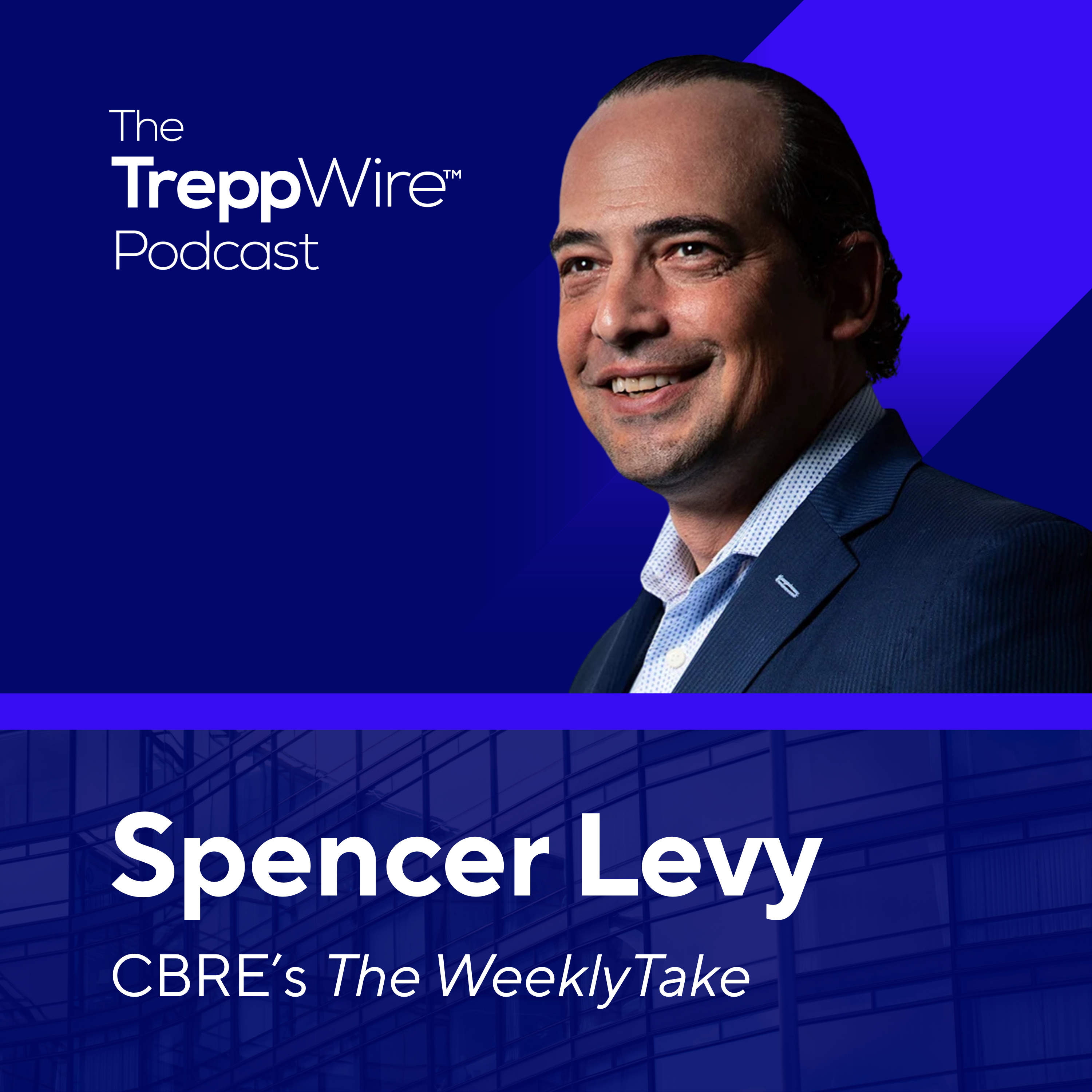
420. The Art of Storytelling in Commercial Real Estate with Spencer Levy, Host of CBRE’s The Weekly Take
In short
How storytelling and communication drive leadership and performance in commercial real estate, plus what’s changing in CRE due to sticky high interest rates, capital-market “weight of money,” and the need for revenue generation (NOI) over cost-cutting.
Guest background
Spencer Levy is CBRE’s global client strategist and senior economic advisor, working daily with CBRE’s largest investor and occupier clients. He has ~30 years across law, investment banking, research, capital markets, and client advisory, and has hosted CBRE’s podcast The Weekly Take since COVID.
Key claims
Real estate is a revenue generator, not a cost center. In this cycle, NOI and operational execution matter more than exit-cap-rate assumptions. Investors and tenants should be handled strategically (portfolio/relationship) rather than tactically (one-off pricing). Persuasion is emotional; data center builders need better storytelling to reduce fear-based pushback. Cap rates are overused; sub-markets matter more than broad market labels.
Notable examples
Steve Ross (West Palm Beach demand creation via Ben Hotel, golf course community, private schools, retail); Andy Powers (Digital Realty’s big-market focus); Liz Schlesinger (Merritt Hill Properties self-storage leader); Rich Carbono (communication-focused leadership).
Written by AI. May contain mistakes.
Chapters
0:45
Spencer Levy's Background and Insights
Spencer discusses his experiences and insights gained from interviewing industry leaders.
“Spencer, we are so excited to have you on the show today.”
1:53
The Role of Real Estate Professionals
Spencer explains the importance of understanding both real estate and corporate dynamics.
“So I'm on stage, as you know, almost every day.”
3:17
Changing Dynamics in Real Estate Capital
Discussion on evolving capital structures and the impact of higher interest rates.
“I mean, obviously you've been in the business a very long time.”
5:46
Operational Challenges in Commercial Real Estate
Spencer shares his views on current operational challenges and market dynamics in CRE.
“Has there been anything else maybe more granular into the CRE conversations that you've had with occupiers, investors, you know, industry leaders, et cetera, that have maybe changed over the last 12 months?”
7:42
Revenue Generation vs. Expense Management
A conversation on the importance of creating demand and revenue generation in real estate.
“I think to your point, looking forward on rent growth metrics doesn't carry the conversation today.”
9:45
The Importance of Relationships in CRE
Discussion on the significance of strategic relationships in commercial real estate.
“I mean, it's incredible what he's done there.”
11:45
Effective Communication in Real Estate
Spencer discusses how to effectively communicate and maintain personal voice in networking.
“now for something completely different to quote Monty Python.”
13:07
Networking Tips for Professionals
Spencer shares practical advice on networking and being prepared for interactions.
“Where has the technology beyond just maybe LinkedIn, right?”
14:01
The Importance of Networking
Learn how preparation can alleviate networking fears.
“But now I'm going to give people the communication 101, something that's really going to help folks, which is networking.”
15:00
The Secret Sauce of Leadership
Explore what separates exceptional leaders through effective communication.
“And everything you're saying here, you know, having a voice, the power of communication, the power of networking.”
Show all 27 chapters
16:56
Understanding Tenant Relationships
Discover how viewing tenants as partners enhances productivity.
“But for me, you know, it feels like when you're sitting across from someone, when you can actually break bread with them, when you can bring that human component you described, that's where real productivity gains lie.”
19:06
The Challenges of Measuring Productivity
Discuss the difficulties of measuring productivity versus efficiency.
“I hate to, I hate to bring up a negative quote, but it's, it happens to be, I think, accurate.”
20:09
The Birth of The Weekly Take Podcast
Learn how COVID inspired the creation of a podcast for better client communication.
“So let's talk a little bit about your show.”
22:49
The Joy of Podcasting
Explore the passion behind producing a weekly podcast.
“And we share some of the same sentiment around our show.”
24:07
The Power of Co-Hosting
Understand the advantages of having co-hosts for engaging discussions.
“Well, I can tell you just a takeaway from this show is, you know, I do 65 to 75 presentations a year.”
25:23
Effective Communication in Presentations
Learn the importance of brevity and clarity in presentations.
“You can talk about the same topic, but we bring our own perspective and our own secret sauce to what we think the data's telling us or what the market's telling us.”
26:29
Highlights of Memorable Guests
Discover the qualities that make certain guests stand out on the podcast.
“They give you everything you need to know instantly.”
28:00
The Importance of Insight in Interviews
Learn how to extract valuable insights from guests in interviews.
“It doesn't end there because there aren't very many women-owned private equity firms in anything, and she's one of them.”
29:16
The Power of Storytelling in Business
Discover how effective storytelling can influence opinions and decisions.
“200 plus speeches a year is because I'm able to take all of this information and regurgitate it where appropriate to show insight.”
31:00
Techniques for Engaging Guests
Understand methods to humanize guests and create a relaxed atmosphere.
“they could do a better job of storytelling because what we have out there is a significant percentage of the electorate that's afraid.”
33:02
Personal Growth Through Hosting
Explore how hosting a show can lead to personal and professional development.
“But something we love and admire about your show is that you really find a way to get your guests to open up.”
36:08
Current Trends in Commercial Real Estate
Examine key changes and trends in the commercial real estate market today.
“And they came up to you and said, hey, I heard your voice.”
38:06
Challenging Conventional Wisdom in Real Estate
Learn about misconceptions in real estate and the importance of market granularity.
“But what I stress to our clients is that the pendulum always swings too far.”
42:01
The Importance of Sub Markets in Real Estate
Learn why focusing on sub markets rather than just overall markets can lead to better investment outcomes.
“And so that's why I've always been a believer in secondary market assets, because you get better cash flow.”
43:40
Understanding Local Market Dynamics
Discover how different asset types demand varying degrees of local focus and the factors that contribute to market success.
“There are certain asset types that are hyper, hyper, hyper, hyper local.”
45:12
Shifting Perspective: From Self to Team
Explore the concept of 'Maximum We' and how collaboration can drive long-term success in real estate.
“And it goes back to your thesis on the human component.”
47:12
Closing Thoughts and Key Takeaways
Wrap up the discussion with reflections on the episode's insights and the importance of engaging with the audience.
“Well, I can assure you have a couple of supporters here on the Trump team that will be buying that book on pre-order once it's ready.”

Ask about this episode
Get the gist, explore an idea or ask about something said.
 Claude
On The TreppWire Podcast: A Commercial Real Estate Show, what are the key points of this episode?
Searching your listeningTranscript
Automatic transcript. May contain errors.
0:00Spencer Levy: If you have human communication, you will create human bonds. And I think that's a key part of leadership and so many other things.
0:10Welcome to the TREP Wire podcast, the show where commercial real estate meets data and insights. This is a special guest podcast. I'm Haley Keene with TREP, a data modeling and analytics firm for the CMBS, commercial real estate and CLO markets. I'm with Lonnie Hendry, chief product officer. Today, we are joined by Spencer Levy. global client strategist, and senior economic advisor for CBRE, where he plays a central role working daily with the firm's largest investor and occupier clients. Spencer is also a fellow podcaster, and I'm sure a lot of our listeners know that already, as he hosts CBRE's award-winning podcast, The Weekly Take.
0:49Over the course of his nearly three-decade career, Spencer has worked across law, investment banking, research, capital markets, and client advisory, and today he sits at the center of some of the industry's most important conversations, advising major investors and occupiers at CBRE, while interviewing many of commercial real estate's top executives and thought leaders. Spencer, we are so excited to have you on the show today. Welcome, and we can't wait for this interview.
1:16Spencer Levy: Haley, Lonnie, I'm delighted to be here. So we normally start every guest podcast by asking people how they got their start in the industry, and we will do that with you here today. But since you're usually the one asking the questions, we wanted to start a little differently. So you've spent years interviewing and advising some of the industry's top leaders. What have you learned about people? I have learned that, well, first of all, most people that we have interviewed are not only top professionals, but good people. And I say good people, I want to start in a kind of a philosophical way, because in addition to my podcasting, I also So I'm on stage, as you know, almost every day.
1:58Spencer Levy: I give over 200 speeches a year and I meet literally tens of thousands of people. And I think the really good news about what can be an interesting world when you read the headlines is that most of the people are good people. And it's something that I think everybody should take into consideration when they're thinking about some of the challenges out there. But the other thing I would say is this. When we get down to the nitty gritty of real estate, wow, there are a lot of smart people out there. And we have a lot of people that are going after the same prize. And that same prize is getting outsized returns versus the market on the investor side and on the occupier side, getting the best productivity out of their space.
2:35Spencer Levy: And I'm very careful about how I say that because I want to be very clear here. This is the core message I give on both sides of the table. I say that real estate is not a cost center. Real estate is a revenue generator. And it is a mind shift. And every time I see it, say it. Sometimes people are like, it's like an epiphany. It's like, yes, that's what it is. But it still takes some time to persuade. So incredibly bright, incredibly driven people. But I think the very good news is that most of them are just really, really good people. We've seen that as well in our show and in our day-to-day business, Spencer.
3:08It's interesting. Haley went through your intro and I got to put the pieces together. I mean, you have law, investment, banking, capital markets, client strategy, now your podcast. How did all that come together? I mean, obviously you've been in the business a very long time. But maybe give us a little bit of background of just how you put all those together, maybe how it makes you who you are.
3:25Spencer Levy: Well, it's a common thread. I've been in real estate 100 % of my career. So it's always been commercial real estate. And I take each element of what I've done, law, banking, capital markets, research, you name it. And I try to look at things from a top-down perspective. And using these different tools in my toolbox, I then bring it to very, very micro. So having been at a law firm, having been at a real estate developer, having been a banker representing lots of companies, I don't just know the real estate. I understand the corporate side of, well, this is how these companies run. This is why it's done this way.
4:01Spencer Levy: But what it does is it's not just how they run the companies. It also brings up different opportunities for capital. So one of the major changes in the capital world that's happened probably in the last, I would say, less than 10 years is that until about 10 years ago, there was really only a handful of firms out there that were in real estate investing that would buy pieces of companies. Now, that is, I would say, the majority of the big real estate private equity type firms will buy not only the real estate, but also pieces of the operating companies. And the timing is excellent for that. The timing is excellent for that because the world of getting lower exit cap rates as the primary driver of your returns, that ain't coming back anytime soon.
4:40Spencer Levy: And so you need other cash flow streams. And so the new structure is an excellent one to be able to capture additional cash flow streams. Another interesting structure, which is not new, but has really taken off in its popularity, are secondaries. Secondaries where you get to buy a piece of an existing deal rather than buy the entirety of the deal. You could do that because a lot of people need liquidity. And that liquidity need is, unfortunately, a lot of them are college endowments, which have been probably more challenged than other capital providers. But nevertheless, you were able to get some of these LP interests at a discount using secondary.
5:16Spencer Levy: So long story short is because I have this diverse background, I'm able to see maybe more of the playing field than others through a variety of lenses. And I try to use that for the benefit of our clients. I think it's a home run. I mean, we talk a lot about perspective and the value it brings to the marketplace. And I think what you just gave us was an overview of how sitting in those different seats gives you perspective that maybe others don't have. And that perspective, when translated, turns into opportunity. And, you know, you mentioned a couple of things that have changed over the last year, maybe from opportunities being presented, you know, in terms of the secondary and, you know, buying some of the Opco stuff.
5:51Has there been anything else maybe more granular into the CRE conversations that you've had with occupiers, investors, you know, industry leaders, et cetera, that have maybe changed over the last 12 months?
6:00Spencer Levy: Well, I think the obvious one is the persistently high interest rates and how that has impacted value, how that has impacted buyer and seller motivations. And so just to put it in very general terms, we've seen very deep and liquid debt capital markets. And the equity markets are good, but they're a little choppier, particularly when you get to the core side where it's harder to get your returns when you have a 10-year, which is above four and a half. And the reason for that is because investors, certain categories of investors, have choice. And that choice isn't to buy retail, multifamily, or industrial.
6:34Spencer Levy: It's to buy that or a bond. And you can get a bond for a high yield. sometimes these bonds are tax-free too. So at certain parts of the capital structure, they're impacted not only the value of your assets, but the depth of the capital markets. The word I use is the weight of money. The weight of money matters a lot. It matters because it will impact not only the depth of your pool, it will also impact the value of your asset. I mean, it's capital markets 101. I often had a debate of fundamentals versus funds flows of what drives value more. I think in some cycles, it is funds flows. I think in some cycles, it's fundamentals, but it's both.
7:08Spencer Levy: In this cycle we're coming up, I think this is a fundamental cycle, meaning that NOI is going to be the boss over capital markets in the near term as people are scrambling to get higher current yield because the exit is not going to be as clear as it was a few years ago. Yeah, we've definitely seen that in the marketplace. It seems like NOI, strong cash flow and operational chops are very top of mind for everyone right now. They don't want top of the market syndicators owning assets that are non-performing anymore. They want those in the hands of people that have experienced a downturn and been able to kind of rectify the property performance, et cetera.
7:43I think to your point, looking forward on rent growth metrics doesn't carry the conversation today. It's what does the property actually produce and what have you done during similar disruptions that show that you can lead a property through tough times, which we've seen, not just the higher interest rates that you mentioned, but operating expenses have gone through the roof in certain categories. Insurance, we're finally seeing a little reprieve, But for the last several years, we've seen insurance, construction costs, repairs and maintenance, all significantly higher than maybe the historical averages have been.
8:11And so we're fully aligned there. I wanted to switch the conversation a little bit. Can we stay on that point for just a second? Of course.
8:17Spencer Levy: I want to stay on that point for just a second because I think the way you described it, Lonnie, is a very good way to describe it. But you described only half the story. You described the expense side of the story where, yes, expenses have gone up. Labor has gone up. Insurance costs have gone up. They've gotten a little bit better in insurance, certainly in multifamily in certain places. But nevertheless, you describe part of the story. The part of the story that really makes me excited is the other part of the story, because I think a lot of people focus on expense management. I focus on revenue generation and revenue generation means don't take demand, make demand.
8:48Spencer Levy: And what does that mean? So I can give you 100 case studies, but I will shamelessly plug my show and one of the guests who showed exactly how it's done. So you take a look. We had Steve Ross on our show about a year ago, and he has really just absolutely taken off in West Palm Beach. Why? He made demand. And how do you make demand? By opening up the aperture and say, well, I'm not just an office person. I'm also a hotel person. As he bought the Ben Hotel next door, he started a world-class golf course community. He started private schools. He did retail. And he did it because he's a real estate person.
9:24Spencer Levy: And that's how you make demand. Don't just take demand. I completely agree with you. Expense management is extremely important, but it's only part of the story. Expense management is a limiting game. Top line growth is unlimited. I think it's a very valid point. And, you know, Steve Ross is someone we would call a market maker for the reasons you just described. That stuff he's got going on at West Palm is really remarkable because, to your point, he is creating the demand. And it's all very high-end, top shelf. I mean, it's incredible what he's done there. And so it's a very valid use case and case study example.
9:58And I know you have 100 others because of just the people that you meet both on your show and in your daily work life. And I'm really going to transition us to the next topic, which is just generally relationships and communication. And I think you've made some pretty strong points about there's a difference between strategic and tactical relationships. And so before we get into the nitty-gritty on that, I wanted to just ask generally, you know, CRE has always been described, at least in the 25 years I've been in the business, as a relationship business. Do you think that still holds true today, given the advance of technology and some other, you know, medium?
10:32Is it still a relationship business in your mind?
10:35Spencer Levy: It is, and it should be more. And I'll tell you, the place where it's clearly relationship is the relationship between the brokerage community and large owners and investors. That's absolutely essential. Some of our top professionals don't have to pitch much because they have just tremendous relationships and they get direct awards. But the place where I wish it was more relationship, and it's not, and I get this every day, is I wish it was more relationship between the landlords and the tenants. Maybe I'm asking for something that we've been asking for for 200 years. But when you see large tenants, large tenants have both brand and very often market power.
11:13Spencer Levy: and they hate being treated tactically. Tactically treating them as like, oh, well, it's going to be a dollar more or less in rent. It's going to be a dollar more or less in the TI package. Deal with them strategically. Deal with them relationally. Deal with them on a portfolio basis rather than on a tactical one-off basis. It's easy for me to say, given a lot of the incentives in place and how so many things have been regionalized. But when I talk to my landlord and my occupier tenants, the landlord that plays it that way, strategically rather than tactically is going to be the long-term winner.
11:44Spencer Levy: But let me take this now for something completely different to quote Monty Python. One of the things I've really prided myself on professionally, certainly in the last decade or more, is not just focusing on relationships. It's focusing on how you communicate with those relationships. And that's why I was very lucky to have the opportunity to host the weekly take for CBRE. But that's one piece of the communications puzzle. The other pieces of my communication puzzle include my active work on LinkedIn, where I'm very, very disciplined about maintaining my voice. People need to maintain their voice.
12:20Spencer Levy: A lot of people on LinkedIn get a little bit too much corporate or too, I don't know how you put it, just too generic. Be you. You are the best you there is and be that person. I then use, of course, my stage work to communicate. And then I'm also very fortunate. I'm probably one of the most active teachers of public speaking there is in the business. I've taught tens of thousands of people along with my good buddy Brian Reed, and these include CBRB people. These also include clients. They love it. Why? Because most people devalue oral communication and overvalue written communication. What I've learned over the years is that people stopped reading my white papers, and they started listening to the podcast, and they started reading my LinkedIn posts.
13:00Spencer Levy: And I said, aha, shorter to the point and maybe a little funny is better. Yeah, I was going to jump in there and just say you kind of answered at the end with the shorter and maybe funny is better. Where has the technology beyond just maybe LinkedIn, right? Where has it created opportunity? Is it to maintain that voice? Is it giving you an avenue to where you can reach people that you otherwise wouldn't? I mean, listen, if you're on the road 200 days a year doing presentations, I mean, you're doing about as much work in front of people as you possibly can. But are there any other opportunities beyond maybe LinkedIn or others that people could take advantage of or that you've seen used successfully, whether short form video or anything else?
13:35Spencer Levy: I like to keep it simple. First of all, and again, I'm not knocking on any podcast. I'm thrilled to be here on Trepp's podcast. But we just had a guest on our show. Her name was Esther Choi, and she wrote two terrific books. One of her books was called Storytelling, and the second book, which I'm going to paraphrase the title, was Winning Without Persuading. And if you listen to those two things, it tells you how to communicate more effectively in the generic sense. But now I'm going to give people the communication 101, something that's really going to help folks, which is networking. I can't tell you how many rising professionals I meet that just are afraid to death of networking.
14:11Spencer Levy: And the reason why is how do I break the ice? What do I say? I'll tell you how you do it. It's one word. It's called preparation. And when I go into a networking event, I always ask for who's going to be there. Give me the names of the people in the audience. And then I do the magic trick of Googling them or going on LinkedIn and finding things about them so I can start the conversation. And I love networking. I didn't always love networking. And as a matter of fact, just being very honest here is that some people in certain functions that are more introverted are really afraid of it. If you prepare, and I'll quote Russell Wilson when he was at his peak on the Seahawks, said, quote, I am not afraid of winning or losing.
14:48Spencer Levy: I am afraid of not being prepared. If you prepare, you will love networking and it will give you results of not just better relationships, but you're going to get more wins down the road. I love this. And everything you're saying here, you know, having a voice, the power of communication, the power of networking. This kind of reminds me of something you mentioned when we first spoke. You talked about the secret sauce that separates really exceptional leaders from everyone else. So can you walk us through that secret sauce and is having your own voice part of it and networking or is there more to it?
15:22Spencer Levy: I think that effective communicate and I just went to a terrific speech last week. And one of the one of the cool parts about my job is I get to meet some really cool people like both of you. And but I also was at a speech with one of my friends and clients, Jordan Schnitzer, last week, and he had this guy on there, Rich Carbono, who was the former Surgeon General of the United States. But if you met him, you wouldn't know it. He was a kid from Harlem who did not have a high school degree, went to the military, got a GED, then became a doctor, a trauma surgeon, got into Harvard and then became the head of SWAT in Phoenix.
15:59Spencer Levy: and while he was in special forces in the military almost rescued John McCain and then he became Surgeon General. Just why? And he was just a completely normal guy and I think you know he gave a whole speech on leadership and his speech on leadership just stressed communication as one of his keys but I think the reason why he was such an effective communicator he was a human communicator and never felt for a moment that he was the Surgeon General of the United States or anything like that. I felt he was just another guy from New York. And we talked about cheesecake half the time. And you know what?
16:33Spencer Levy: We did talk about cheesecake because he's from Riverdale. I'm from Riverdale in the Bronx. It's a long story. But the point is, if you have human communication, you will create human bonds. And I think that's a key part of leadership and so many other things. Do you think that that's what drives some of this real estate not being a cost center and a mechanism of production is that human bond? I mean, it feels like the return to office, You know, you could go back and forth on if it's real or if we're in the eighth iteration or where we're at in that cycle. But for me, you know, it feels like when you're sitting across from someone, when you can actually break bread with them, when you can bring that human component you described, that's where real productivity gains lie.
17:08Spencer Levy: I agree with you. But I think real productivity gains is looking at the whole person in front of you. So, for instance, if you're a landlord and there's a tenant in front of you and you say, oh, well, I just want this tenant to be in my building and pay the highest rent possible. That's not looking at the tenant. You're looking at the tenant as a commodity. What you need to be looking at is a couple of things. You need to be looking at what does this tenant do and how am I going to give this tenant space that's going to make that doing better? Not just more, but better. That's the difference between efficiency and productivity.
17:38Spencer Levy: When you look at a tenant, you say, how can I make you better? And by the time that conversation is over, the winning landlord makes the tenant think, not just because you're pulling the wool over their eyes, you actually think, my space is cheap at$20. price the price. And people need to realize that most tenants pay less than 5 % of their overall cost in rent. It's a very low percent. Now, it's higher in New York. It's higher in San Francisco. Could approach 9 % or so. But nevertheless, most of the time, it is a cost that they're prepared to bear if it makes them better, more productive. But in order to get to that point, yes, relationships matter.
18:20Spencer Levy: Yes. And by the way, that's my, that's my secret. Every time I got a problem with somebody, let's, I said, let's go to dinner or let's go to lunch. And it's, it, it seems to solve a lot of problems, but nevertheless, you need to look at the total person on the other side of the table of view of their business. And I might go one step further. You need to know the person too, you know, how many kids they got, where they go to school, what are their hobbies, things like that. First of all, it's, it's one Google click away. So it's not that hard to find, but that human connection makes the relationship more durable.
18:50I mean, we all like to do business with people we like, and we like to do business with people that we think care about us and we care about them. So I think all of this is fairly elementary at some level, but it's just not practiced at a scale that you would imagine it to be practiced. Because I think a lot of people get stuck in that, that tactical thought process that you mentioned earlier in the strategic obviously is better.
19:08Spencer Levy: I hate to, I hate to bring up a negative quote, but it's, it happens to be, I think, accurate. It was Charlie Munger, who passed away a couple of years ago, who was Warren Buffett's right-hand person. And he said, you show me the incentives, I'll show you the outcome. And that's, I think, the challenge we have here. The challenge we have here is that efficiency is measurable to the penny. Productivity is very difficult to measure. So if you walk in somewhere and say productivity or strategic or certain words like that, they think it's, you know, you're pulling the wool over their eyes. But actually, if you can get to creating demand, maybe that's less touchy-feely.
19:44Spencer Levy: That's what I'm really talking about. I think it's spot on. And Simon Sinek has written four or five books just effectively on that topic of making people feel like they're not a commodity and everything doesn't be measured to the penny. Like people matter and people – I think there's a saying that says people that are appreciated always do more than what's expected of them. And that doesn't show up on a spreadsheet sometimes in terms of pennies and dollars and cents. But in reality, it does matter. So let's talk a little bit about your show. I mean, this is, you know, the weekly take. We've talked about it on the intro and we mentioned it a few times here.
20:16You've got, you know, hundreds of conversations that you've had. And this is a little bit different than the stage work. And Haley has a few questions around that that we might get back to. But, you know, this is pretty intimate. It's like one-on-one with you and somebody else. Give us a little bit of perspective on what was the impetus to starting this? How did it get off the ground? When did you start it? What were you hoping the show to become? And has it met or exceeded expectations for you?
20:37Spencer Levy: So COVID did a lot of things, right? And I can make some jokes about my horse racing habit, which was a COVID baby, like a lot of other things, because there was nothing else on TV. So I started watching it and I liked it. So thank you COVID for that. But COVID also, we needed to communicate with our clients. And what we used to do a lot of is we used to have what we used to call flash calls. And a flash call is, you know, something big happened like COVID. And I think during COVID, we had a flash call where we had literally 15 ,000 people on one call, which was like, you know, stretched all technology.
21:08Spencer Levy: But they said, you know what, this is, it's really hard to do these flash calls. And we do them like three or four times a year. I have a better idea. Let's have bite-sized conversations. Let's do them once a week. And it wasn't just my idea. So I want to credit where credit is due here. Credit to Benji Bear, Jennifer Morgan, Bradley Werner, Ray Coley. I can give the whole list of names to Alex Mamlet. I don't want to miss anybody because it's a team effort, 100 % all the way. And then my right-hand guy who happens to be listening into this conversation has got a little buzzer on me. So when I make a mistake, Brian Reed started it as well.
21:40Spencer Levy: But we really thought we need to communicate with our clients not just differently but better. And better means speak to people the way they want to be spoken to. And a lot of people listen to our podcast on the treadmill while walking in the car on the way to work. I can't read a white paper on the way to work. I can't read a white paper most of the time, but I can listen. And we thought that was a good thing. And let me tell you, the beginning was funny. The beginning was we were begging, barring, and stealing for guests. And the fact that we had only a couple hundred listeners is only because my mother listened to it a couple hundred times.
22:12Spencer Levy: But now the show, I don't have the exact number in front of me, but it's 12 ,000 to 14 ,000 listeners a week. And we've had well over 2 million listeners. We've had well almost 300 episodes. So has it exceeded expectations? conversations i'm going to say even though we've won a lot of awards and things like that and i'm proud of them and they are all a team effort no because i never want to get to the point and say we're great no we can always be better always get a better guest always have a more insightful conversation so i am extraordinarily proud of this team and what we've done but straight up every day what drives us is to be better i love it i mean it's a central theme to this discussion is productivity better.
22:54And we share some of the same sentiment around our show. I mean, we've got over 400 episodes. We started in March of 2020. We put out a weekly show. We haven't missed a week since. It takes a lot of work and effort, but it's something that we love doing. It's the highlight of our week. We tell everyone that it is because it is. It's a human, it's relational, it's real time, and it's our perspective of what's taking place every single week across the marketplace. And to your point, we meet with our teams and we say, we've had some really great accolades, but we're just getting started and we're going to make this so much better.
23:24So let me go back to one word you just said there, Lonnie.
23:27Spencer Levy: And this is a word you don't say a lot in the business community, but I'm going to say straight up. You love it. I love it. I love not just the podcast. I love being, I just want to be with my clients in every way that I could be most effective. And there's tactical selling and then there's strategic selling. And I get it. Selling sounds like, oh, it's just a transact. No, it's not. I'm trying to communicate in a way that is long-term durable. I have people coming up to me all the time saying, Spence, I remember that speech you gave 10 years ago, and I remember what you said. And those are the kind of things that really are gratifying to know that there's a method to this madness of this unusual ways to communicate, but I think they're effective.
24:08Well, I can tell you just a takeaway from this show is, you know, I do 65 to 75 presentations a year. You're at 200. So I have a goal now for my 2027 fiscal. we're going to be talking about how I can increase my reach because what I thought was a lot you have
24:23Spencer Levy: proven to me is not that much and so well Lonnie maybe maybe we'll tag team one of them I do joint prezos all the time in fact I did I did one when I ran it to Haley I was doing one with my good friend Julie Ingersoll CIO of the Americas for CBREIM I love doing joint prezos they're actually more fun because they uh gives you somebody to play off of now here comes something you're probably going to edit out of the show but there was a funny little thing about this one of my favorite actors of all time. He's an old school guy named Jackie Gleason. And Jackie Gleason, obviously, most people know him for the Honeymooners.
24:54Spencer Levy: But his great second career was in the Smokey and the Bandit series. And they were going to put him in his car alone. He said, no, you need to put somebody next to me in the car in Smokey and the Bandit so we could play off of them. And there's truth to that. So there's certainly some stage person ship up there. And having somebody you can go back and forth with actually is not only a lot of fun, but could be a more effective way to communicate. Yeah, we've seen that on our show. I mean, our co-host Stephen Bushbaum that usually joins us, we go back and forth on each other. And it's great. You can talk about the same topic, but we bring our own perspective and our own secret sauce to what we think the data's telling us or what the market's telling us.
25:32And playing off of each other makes it more interesting for the listeners too. And one thing that we've found, and I'm sure you probably heard similar from your listeners is that I think one of the benefits of podcasting is they can listen to it at 1.25x. We even have some people listen to it at like 1.5x. So you can consolidate a 45-minute or an hour-long show into a half hour, depending on how fast you want to ingest it. So to your point, instead of trying to read a white paper, you can get an hour's worth of content in 40 minutes or 45 minutes worth of content in 30 minutes. It makes it much more digestible for folks.
26:04Spencer Levy: Let me address this in a public speaking sort of way. So when we train our students, we play a game, we call the Say Anything game, and they have 30 seconds to give an answer, 30 seconds. And they run over all the time. And they're like, ah, I didn't have enough time. I'm like, of course you did. Abraham Lincoln said, if I had more time, I'd write you a shorter letter. You always have enough time to get that message in quickly. That's why I'm a stickler for executive summaries. They give you everything you need to know instantly. And so shorter is always better. Yeah, don't disagree there. So let's get into the show a little bit because you guys have put on, and I appreciate you mentioning your team that does this because we know from our show as well.
26:44I mean, we get to be the on-air folks, but the reality is a lot of the secret sauce is just in the background where people are making us look and sound good. So it's great to have you give some kudos to your team. But in terms of the guests, who are some of the best communicators you've interviewed? Maybe what made them stand out from that perspective?
27:01Spencer Levy: Sure. And so sometimes the best guests aren't necessarily the most senior people. I mean, sure, we've been very fortunate to have Stephen Ross. We had Silverstein on the show recently. We had Sam Zell. And so I would tell you that they were great because they were not just because they were famous. I mean, these people are truly great people. I mean, these are not just legends for reputational purposes. I met with the teams of some of these folks. they told me just how much in the weeds these people were. Just extraordinary people. But I'm going to name one. And if you're listening, Liz Schlesinger, you're getting another shout out from this guy because she's been one of the very few guests that we've had on twice.
27:43Spencer Levy: Why? Number one, she's got this unbelievable backstory. First of all, Liz Schlesinger is the CEO of Merritt Hill Properties, which focuses on self-storage assets. And unbelievable backstory. She started at W.P. Carey running their self-storage book, started her own company, and now she is absolutely one of the leaders of the self-storage industry. It doesn't end there because there aren't very many women-owned private equity firms in anything, and she's one of them. And so unbelievable backstory, and I'm just proud to know her. But also, she is smart and funny as hell and smart. So that is the kind of guest I want, somebody who's got a great backstory and is just a natural human communicator like Liz.
28:22We're going to have to have her on our show. I mean, that sounds pretty exciting. You've done hundreds of these now. Has there ever been an answer from a guest that maybe you weren't expecting or have they ever challenged you in a way that you weren't expecting since you're usually the one asking the questions?
28:34Spencer Levy: I try to learn something in every show, every show. So I'll give you an example. We had a show a week ago with Andy Powers, who is the CEO of Digital Realty, second largest owner of data centers. And he was telling me about, you know, he only wants to buy in the big markets and he won't buy in the small markets, even though you can do that with cheaper water, cheaper power, better ease of doing business. He said, well, the durability of these big markets is better. And I was like, huh, I hadn't thought about it quite that way. So I would say, while there's never been like an aha, I'm going to think completely differently moment, in every show, I pick up a nugget, every show.
29:10Spencer Levy: And I'm trying to find those nuggets and share those with our listeners, because then I share with others. Part of the reason why I do 200 plus speeches a year is because I'm able to take all of this information and regurgitate it where appropriate to show insight. Because when we teach public speaking, we have a couple supervillains. One of our supervillains of public speaking is Captain Obvious. And, you know, Captain Obvious is that 90 % of the corporate presentations that most people give, what you're going to say is known by the audience before you say it. And it's an uncomfortable fact. Maybe it's not 90, 75, 80, whatever.
29:44Spencer Levy: It's a high percentage. But if that is in fact the case, you got to really drive for insight. So one of the things I've, I always counsel rising professionals, and I think this is a tip I try to follow to this day. In every meeting you have, you should try to have one, not 10, one unique insight. And you're like, oh, that sounds good. You know what? That's really hard. And you know what it requires? Preparation, knowing your client. That's the sort of thing where it's going to separate you because you thought about the client. It's going to create relations. It does everything if you come in with one unique idea.
30:20It goes back to storytelling, you know, and having some of that interesting nugget that's hanging out there that keeps people on edge. You know, you mentioned the data centers and, you know, we're doing a podcast in 2026. So if you mentioned data center, you have to have a follow-up question. On the data center discussion that you had, what were the thoughts? Maybe you covered it, maybe you didn't, but maybe you can infer here. What were the thoughts around the political pushback on the data center stuff? Is this something that has staying power? Is this something that, you know, is due to maybe election cycles or other things?
30:48Like, what is the consensus around this current kind of state of moratorium or pushback around data centers generally?
30:56Spencer Levy: Well, we're out of time here, Lonnie. Thanks for having me. And, you know, the bottom line is this, is that the data center builders are doing a, they could do a better job of storytelling because what we have out there is a significant percentage of the electorate that's afraid. And fear is a hell of a motivator. And that fear factor is saying, oh, AI, that's the end of all of us. You know, here comes the Terminator, you know, things like that. They're just not doing a great job of storytelling. All technology that has happened up to this point in human history has created opportunities, not destroyed them.
31:31Spencer Levy: Not some of it, all of it. And so for people to see this one as this time is different, I would say is because in part the people that are in that segment of the business just aren't storytelling well enough. I was just on the phone moments ago with one of the largest developers in the United States and we were talking about how do you talk to zoning boards? How do you talk to what might be perceived to be a hostile audience? Most of my audiences, most of your audiences, Lonnie, are friendly audiences. And of course, all the people listening to Trep today are a friendly audience, but the hostile, and hostile is maybe too strong a word, but people who are not necessarily have your best interests at heart or have other motivations, or maybe aren't, here's the better one, that aren't real estate experts, that aren't technology experts, and they're acting based on things that have nothing to do with what you're actually doing, but people need to remember this, and this came straight from Esther Choi.
32:26Spencer Levy: Persuasion isn't an intellectual process. It's an emotional one. And unless you think about it that way, you're going to have pushback like we're seeing in the data center space. We need to tell a better story. And by telling a better story, I don't mean making stuff up. I mean, telling it in a way that's compelling rather than telling it in a way that seems transactional. I love your message about storytelling and being prepared. It can sound so simple, but just reminding people that that's all they have to do before they go into a meeting or join a podcast is so important. And it's clear you've talked to so many guests who are very polished and very prepared.
33:03But something we love and admire about your show is that you really find a way to get your guests to open up. And maybe they are really polished and they're supposed to give a corporate answer, but you kind of get into the nitty gritty and allow them to tell a story or share something that they maybe never have. How do you do that?
33:22Spencer Levy: Well, it's by design. And I also should give a shout out to our Corp. Coms department, Steve Iaco, Chris Hudson, who are other members of our team. But this is this is a comment directed in part at them in that I try to humanize our guests and I use techniques that you would use at the dinner table. I use music. I use movies. I use funny little asides. And they may not have it may seem like it has nothing to do with the topic. And unfortunately, sometimes it doesn't have anything to do with the topic. But what it does do, it makes the guests relax. It makes them more human, and people will then react better to the rest of the episode.
34:00Spencer Levy: In fact, this may sound like a non sequitur, but one of the key techniques to public speaking is silence. And what do I mean by that? You need to stop, and then you keep going. And why is that? The audience needs a break. if you're just going on without a break, the audience will start to tune out. The purpose of humanizing the audience by using a song, by using a movie, by using something that seems like it has nothing to do with it, is to give that audience that mental break, put them in a better frame of mind, maybe get to their guts, you know, persuasion, and then we move forward. So that is a deliberate technique I use in every episode so that people stay engaged in the remainder of the episode.
34:41I love it. That's excellent. Now, I want to get a little deep here. Can you tell us, has hosting The Weekly Take changed you personally or professionally? And how did you navigate kind of how the show has grown and who have you become after talking to so many additional people beyond your relationship role?
35:01Spencer Levy: Well, I certainly hope it's made me a better person. I hope everything I do makes me a better person. And as I started today's episode most of the people i've met are very not just smart driven people but good people but what it has done and again this is just matter of fact in every company i've met with in the last god knows how many years somebody knows the show and i try not to personalize it to me because it's a team effort but they know the show or and they like the show and it gives us a level of going back to Lonnie's talking about relationships, it makes getting into a relationship easier.
35:39Spencer Levy: It makes it much easier. And it's humbling because it's been such a big success. But nevertheless, we fight every day to be better. We have to fight every day to be better than we were yesterday. But it's such a wonderful calling card with, I mean, literally the entire industry. I can't remember the last meeting I've been to where somebody isn't an active listener of the show. And it really is a credibility builder. It's a relationship builder. It's been a wonderful experience. You know, maybe you could tell us the first time you were on stage or you got off stage or you got off your show or whatever, and someone just heard your voice.
36:13And they came up to you and said, hey, I heard your voice. And I knew that was you. I didn't even see you, but I heard your voice. Has that happened? I'm assuming it happens to you very frequently because it happens to us. And at first it was a little bit odd. But now it's like, or you get the reaction of someone says, wow, you sound just like you do on the show in person.
36:29Spencer Levy: Yeah, and then they see me and they're disappointed. But the reality is I've got, in addition to when I'm in a office of a client, putting that one aside, which is almost every time, I've been stopped in airports. I've been stopped in train stations. I've been stopped at, I got stopped the other day. I was having a beer with a friend of mine out in California. And some guy just walked up to me, you know, random dude. And aren't you so-and-so? I'm like, yeah. And so it's, it's, it's a little funny. Listen, I am, if there's an A list of celebrities. I'm on the D list. Okay. But nevertheless, within our little circle of commercial real estate, it certainly made me better known.
37:07Pretty awesome. So let's, let's wrap this up a little bit with just kind of what you're hearing with CRE. I mean, you've done a great job of, and I think this is needed in the sense that just sharing the human component and what you've, you've seen makes people successful and how it's changed you hosting a show and all of that. Like the numbers are the numbers in CRE and people can debate and they can have their opinion, but I really appreciate you kind of taking us behind the scenes a little bit of what makes someone personable and what makes people take action and how can companies be more successful by thinking strategically.
37:35Those are all things that we don't talk enough about, in my opinion, just nationally. You know, what has changed in the conversations with your clients or across the industry over the last year or so? I mean, I think we have some of the headline fodder that comes out every day, but in these one-on-one conversations or one-to-many conversations that you're having. What are some things that you've noticed over the last 12 months or so that's really changed from a CRE perspective?
37:57Spencer Levy: And I think I started with the obvious one. And the obvious one is at interest rates have stayed sticky high. And the reason why interest rates have stayed sticky high is in part because of the geopolitical unrest. That's the well-known answer. But what I stress to our clients is that the pendulum always swings too far. Always. Not sometimes, always. And so I had on my show about a year ago, Liz Troney, who runs the core fund for CBRE Investment Management. And she gave me a shout out for calling open air retail six, seven years ago when it was like the least popular asset class. Well, two years ago, I called office.
38:33Spencer Levy: Two years ago, I called San Francisco. And by the way, I don't always get it right. All right. I called inflation wrong. So there you go. I'm honest. I will tell you where I get it right, but I'll tell you where I get it wrong. And I think now when people see headline risk, I say something which is a little unusual. I like headline risk. And why do I like headline risk? I like headline risk because it scares off a high percentage of the institutional investors, which makes an opportunity better, meaning that it's going to reduce the bidder pool and it's going to increase the opportunities for you to get into a thinner bidding situation, means you'll pay less.
39:08Spencer Levy: So I think what we're seeing now is because there's so much noise from a geopolitical perspective, a lot of people are, I think, overreacting to a lot of it and instead should be very clinical about it and say, well, OK, we see these risks in certain markets and certain asset types. How do I play this to my advantage? Because some people are going to be scared off. I mean, let's face it. If you're a big fund manager, most of your investments are pension funds and endowments and maybe high net worth individuals who are not real estate experts. And so they're going to read these headlines and maybe send you, I mean, the biggest fear factor for institutional investors is to get a nasty gram from one of their investors because they did something that seems crazy.
39:50Spencer Levy: Oh, I just bought an office building. Oh, no. Well, you know what our number one investment idea is right now? office buildings and you know why because so many people are scared off by the headline risks so i would say to you that this is the best time ever to be in real estate for two reasons number one the level of uncertainty is high and the really good thinkers operators people who can separate the noise from the opportunity will prevail the second is operators win and i'm not saying i have anything negative about capital markets people heck i'm a capital markets person but the reality is that great operators who think about the top line, and I stress the top line, not just cost savings, those are the ones who are really going to win.
40:30Spencer Levy: People like a Steve Ross or a Larry Silverstein. I mean, these people are thinking big and they're succeeding. Liz Schlesinger, think like her. I mean, these people think big and they succeed because they're not caught up in the tactical minutiae they think more strategically. And they take action. They're market makers or demand creators. So maybe as we, one more question, then we'll head into the closing. You know, are there anything conventional wisdom or kind of just things that we've taken as gospel, right, across commercial real estate that you think the industry maybe has wrong? Has this disruption created a narrative where something that's been, you know, highly regarded as like, this is the path forward that's maybe been disproven or needs to be challenged?
41:12Spencer Levy: Well, this will sound as funny from the guy who used to write the cap rate survey for CBRE, but I've never been a fan of cap rates as a metric. Even though it's used every day as the back of the napkin, this is what we're paying, this is what it is going in, this is what is going out. I never liked it as a metric. We need to be more granular than that. I mean, it all comes down to a better net present value using a variety of assumptions. I mean, I can go into great length. I think cap rates are overused as a metric because that's number one. Number two, I think that exit cap rate liquidity is overvalued.
41:46Spencer Levy: Uh-oh, he now uttered some blasphemy here. And I said that before the rise in interest rates. And the reason why I say that is because when you see a spike in interest rates, those exit cap rate liquidity thing, it becomes ephemeral. It may not actually exist. And so that's why I've always been a believer in secondary market assets, because you get better cash flow. But now for the best sub markets. Now, it is not like I like every market in Columbus, Ohio, but there are some sub markets there I like a lot. I don't like every market in New York either. but I like a lot of sub markets. And that's the way I think we need to think about.
42:19Spencer Levy: So the two pieces of blasphemy I'm going to issue here today is number one, I think cap rates as a metric are too used. And the second thing is I think people look at markets too much and sub markets not enough. People need to get much more granular. In fact, I have some great clients who don't actually buy office, industrial, retail, et cetera. They buy the entire sub market. You say, you got a good sub market with these great characteristics. I'll buy everything in that market. But you say that sort of thing to a lot of real estate investors, they shudder because, oh, no, we're going to get the sharpshooter in an office and industrial and retail and mixed juice has a bad history, which it does.
42:57Spencer Levy: So I'm going to give them to their credit. They're correct. But the bottom line is buy that best sub market, buy the best stuff in that sub market like Ross is doing down in West Palm Beach. I'll tell you what, I wouldn't bet against that guy. No, I think that's a home run advice. I did a poll on LinkedIn about a year ago, and it's interesting. I asked what was the most misused or misunderstood word in commercial real estate, and cap rates was the winner because everyone has a different take on them. So I agree with you totally there. And on our show, we like to say that real estate, a commercial real estate is a local endeavor and sometimes a hyper-local endeavor.
43:30Two buildings on the same street can have different outcomes. And I love the sub-market play that you're pushing there because, especially in multifamily, sub-markets matter extremely. extremely important in multifamily in particular, and it doesn't get enough talking points across the nationals.
43:45Spencer Levy: Let's stay on this. This is one of my favorite topics. I got to extend it for a second. There are certain asset types that are hyper, hyper, hyper, hyper local. Self-storage may be the most hyper local because people actually want to see their unit while they're driving down the street. Multifamily is another one, but then you start to expand that, right? The least local is industrial because if you are sitting on I-80 or I-70, you don't necessarily have to be right next to the big metropolitan in an area. Now, I'm not saying local doesn't matter in industrial. It certainly doesn't matter as much as it does in self-storage.
44:16Spencer Levy: But when you see for virtuous cycle, you're going to find great places and they're often very small. I often use the term my five factors of awesome. Every time I say it, I always think I'm going to forget one of them. So if I do, don't hold me to it. And they are human capital, live work play, infrastructure, and foreign money. See that? I got all five. You see those five factors, pick that sub market and back up the truck. But the other thing is, when I say that fifth factor, that foreign money thing, I think is undervalued. I think that people, if you're even in a secondary market, I give this advice every day, you should be on the next plane to Japan, to South Korea, to all the sources of capital.
44:53Spencer Levy: And your business card should have two sides to it, one in English, one in the language of the people you're pitching. Because I'll tell you what, you go to the money, you've got a good shot of getting that money, because people expect you to visit them in their home countries to get it. And it's right now where getting JV equity isn't as easy as it was a few years ago. You got to look at those pockets too. Yeah. And it goes back to your thesis on the human component. You got to sit in front of people, break bread, shake their hand, get to know them. You started off saying you're the one usually asking the questions.
45:21We kind of did that in the intro. What's one question that you find yourself asking yourself at this point in your career?
45:27Spencer Levy: I think at this stage of my career, and I've been very lucky, the question I ask myself every day is how can we be better? I was very fortunate. I won a nice award about a month ago. And the title of my speech was Maximum We. Now, when I teach public speaking, I teach this concept of maximum me. I need you to be the best Lonnie. I need Haley to be the best Haley you can be. And there's techniques we teach to get there. But how can we be better? Because I think, you know, when you're a hard charge in person, there's a tendency to be selfish at times. I'll say, oh, it's, you know, how do I get better?
46:01Spencer Levy: Well, you have to have a little bit of that of how do you get better. But if you deviate from maximum we, I just don't see how you're going to be a long-term success. I think you have to make it a team sport, a team effort every time. So how do I make maximum we, I would say is what drives me. It's a great concept. I mean, you should trademark that because I think you could do a lot of good with that. And it's true. Hopefully that's the title of my book, which I've been trying to write now for 10 years, but I'm going to get it done. I promise. Maybe if you if you went down to 175 shows a year on the on the stage and then then pull back a little, you might be able to get that book.
46:34Spencer Levy: Here's the here's the problem with my book, Lonnie. I did. I actually wrote my book once and I showed it some people. You sound arrogant. I'm like, well, you know, I'm throwing that away because that's not who I am. But I'm so focused on my voice that because I read a lot of books, every every author that shows up in my show. Yes, I do actually read your book, but I want it to be in my voice and my voice is different. It's just different than a lot of corporate voices out there. I think that when the book editor from some publishing company reads it, they say, what is this? But that's how I speak.
47:05Spencer Levy: That's how my people hear. That's what resonates. So I'm confident I'm going to get it done. And I hope I can maintain my voice the best I can. Well, I can assure you have a couple of supporters here on the Trump team that will be buying that book on pre-order once it's ready. Thank you. I love it. And you mentioned earlier, Spencer, that people come up to you and they quote, things you've said on your show or statements or sentiment. I think you're going to have a few more of those people coming up to you now because you've left a lot of great nuggets on today's show. So thank you so much for joining us.
47:34This has been an incredible episode and we could probably keep rolling for hours, but we said a brief show is better. So we'll stick with what we've done here.
47:44Spencer Levy: Haley, Lonnie, Tripp, thank you. One last question though. We always tell our listeners to contact podcast at trip.com if they have questions, comments, concerns, feedback. Do you have a weekly take podcast or email address or a way to contact you directly? Because I'm sure some of our listeners will have follow-up questions or want to get in touch. Sure. So the easiest way, first of all, it's cbre.com slash the weekly take. And I probably got it wrong, even though I've only said it 400 times, but look up the weekly take CBRE, you'll get to it instantly. But I say this to all of our listeners out there.
48:18Spencer Levy: First of all, it's truly a privilege to have so many listeners on stage for the podcast and the other things that we do. But every single person wants to link in with me, have at it. Anybody who wants to DM me, I respond to them all because I want you to know that you matter. And that's one of the ways I try to run my life. I try to treat everybody I meet exactly the same and it's worked out so far. Awesome. Well, thank you again. There's more to come for the Tripwire podcast times the weekly take. Maybe we'll get you and Lonnie on a stage in a city near some of our listeners soon. We're really excited that we met you, worked on this podcast, and all that's to come for you and your show.
48:55Spencer Levy: Well, good luck with your show as well. And I know with pride, when we look at the top 10 lists, you are always there. Sometimes you're ahead of the weekly take. So congratulations to you on your success and keep it coming. Thank you, Spencer. With that, we'll close this special guest podcast. Thank you, Spencer, for joining us today. join us later this week as we look at what's happened during the week and how it may be impacting you if you have a question or just a comment send an email to podcast.trep.com until then visit trep.com for more info and subscribe to the trep warrior podcast with your favorite provider thank you for listening and stay well all right
From the publisher
In this special guest episode of The TreppWire Podcast, we are joined by Spencer Levy, Global Client Strategist and Senior Economic Advisor at CBRE and host of CBRE's podcast, The Weekly Take. Spencer shares how his diverse career spanning law, investment banking, and capital markets shapes his perspective on the commercial real estate industry and the trends influencing today's market.
Throughout the conversation, Spencer emphasizes the value of relationships, communication, and strategic thinking, particularly in landlord-tenant dynamics and business decision-making. He offers insights into the current commercial real estate environment, discussing the impact of sustained high interest rates and the industry's growing focus on NOI growth and revenue generation over exit cap rates. Spencer also explores the power of storytelling, drawing on his experience hosting The Weekly Take, and explains how podcasting has expanded his network, credibility, and reach across the industry. Tune in now.
Questions or comments? Contact us at [email protected].
Follow Trepp:
X: www.x.com/TreppWire
LinkedIn: www.linkedin.com/company/trepp
More from The TreppWire Podcast: A Commercial Real Estate Show
All episodes
We use cookies.They keep VO running smoothly and help us improve it. Privacy policy