
 Ask ChatGPT


- Podcasts
- The TreppWire Podcast: A Commercial Real Estate Show
- 426. CRE Lending Through Cycles: Stressed Sponsors, Industrial Conviction, & Today’s Debt Market with Stefanie Stewart, Voya Investment Management
The TreppWire Podcast: A Commercial Real Estate Show6 Oct 2026 · 28m · 13 chapters
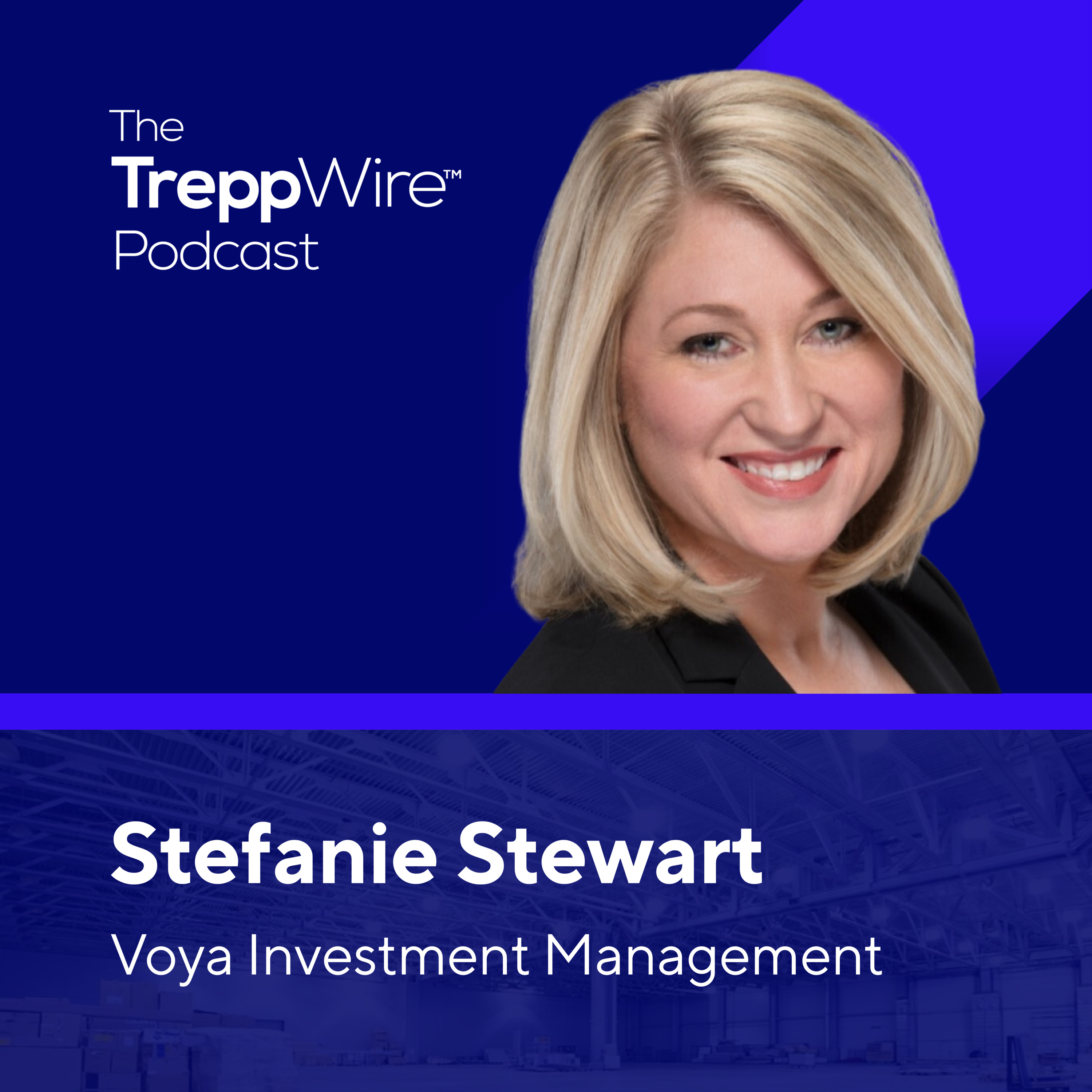
426. CRE Lending Through Cycles: Stressed Sponsors, Industrial Conviction, & Today’s Debt Market with Stefanie Stewart, Voya Investment Management
In short
CRE lending through cycles—how Voya’s platform structures loans in a higher-rate, tighter-spread debt market; lessons from the GFC and 2022 rate hikes; and sector views (industrial overweight, office risk, multifamily supply pause, hospitality and transitional opportunities).
Guest
Stefanie (Stephanie) Stewart, Senior Vice President and Head of Real Estate Investments at Voya Investment Management. Leads origination efforts; ~19 years at Voya/ING. Oversees ~$4B/year in mortgages across fixed/floating core debt, construction, and bridge value-add. Background includes analyst/originator/region roles; speaks on industrial bifurcation/recovery.
Key claims
cycles can run long; structure matters early and back-end outcomes matter; “stressed sponsors” vs “stressed assets”; capital diversification (27–28 managed accounts + debt fund + general account) enables flexibility and faster execution (term sheet in <1 week).
Notable examples
GFC office core loan where the borrower returned keys and the note buyer later profited after refinancing/asset resolution; 2022 analyst team had never seen cap rate/value declines; industrial structures targeting ~12–15% return by funding lease-up/TILC and participating in sponsor upside; hospitality flag-extension capital improvements; avoids data centers as “not real estate” underwriting.
Written by AI. May contain mistakes.
Chapters
0:45
Stephanie Stewart's Journey in Real Estate
Stephanie shares her entry into commercial real estate and her career path.
“across the nation, spanning Voya's lending platform of fixed and floating rate core debt, construction, and bridge value add.”
4:30
Learning from Historical Cycles
Stephanie reflects on lessons learned from various economic cycles as a lender.
“And I don't know if you remember this day, Stephanie, but I remember like early on when things started going bad in the GFC.”
7:18
Evolving Lending Strategies
Discussion on how current market conditions have influenced lending practices.
“I really like the way you put that, the stressed assets versus stressed sponsors, because that sums up so many of the headlines that we've seen today.”
10:46
Current Market Landscape and Opportunities
Exploration of attractive lending opportunities in today's market.
“down the products that we're lending on, and I'll just talk a little bit year to date to kind of give you an idea.”
13:50
Concerns in the Current Environment
Stephanie discusses potential risks and concerns in the current interest rate environment.
“And that matters a lot in the packages you see.”
14:00
Navigating the Current Lending Landscape
Learn about the challenges lenders face in a high-interest-rate environment and the asset performance expectations.
“It's awesome to say we play all four quarters, right?”
15:02
Opportunities in Multifamily and Industrial
Discover insights into multifamily and industrial sectors and the lending opportunities they present.
“I think because of that, you will see less kick the can from lenders, and you're going to start to see these assets pushed off the book.”
16:41
The Case Against Data Centers
Understand why the guest views data centers as less favorable investment opportunities in commercial real estate.
“We're looking in some recent research that we did just about how the capital stack has changed over the last couple of years.”
17:54
Voya's Industrial Strategy
Explore Voya's long-standing focus on the industrial sector and its importance in their investment strategy.
“I think there are other places in the market where it is easier underwritten than it is for my team on the real estate perspective.”
19:19
Industrial Outdoor Storage Insights
Gain insights into industrial outdoor storage and its potential challenges and opportunities in various markets.
“And, you know, in this market, we've seen rent pushes pretty dramatically, right?”
Show all 13 chapters
20:44
Leveraging Data for Competitive Advantage
Learn how data and AI are transforming the lending business and improving decision-making processes.
“I think a lot of people just either don't understand or appreciate that nuance or kind of fully understands the value of all of that extra data that you get.”
22:39
Building Relationships in Real Estate
Discover the importance of relationships in commercial real estate and advice for aspiring professionals.
“And from the time a package comes in, if it's a deal that we like, we can have it through committee with a term sheet in the borrower's hand in less than a week.”
24:38
The Impact of AI on Lending
Understand how AI is changing workflows and enhancing efficiency in the lending business.
“And in real estate, one of my favorite parts about this business, real estate is still a people business and it's still about the relationships.”

Ask about this episode
Get the gist, explore an idea or ask about something said.
 Claude
On The TreppWire Podcast: A Commercial Real Estate Show, what are the key points of this episode?
Searching your listeningTranscript
Automatic transcript. May contain errors.
0:00And, you know, real estate's cyclical. We all know that, but sometimes those cycles run long. Hopefully the good ones run longer than the bad ones.
0:11Welcome to the Trep Wire podcast, the show where commercial real estate needs data and insights. This is a special guest podcast. I'm Haley Keene with Trep, a data modeling and analytics firm for the CMBS commercial real estate and CLO markets. I'm with Stephen Bushbaum, head of applied research and analytics. Today we are joined by Stephanie Stewart, Senior Vice President and Head of Real Estate Investments at Voya Investment Management, where she is responsible for managing all origination efforts. Over the course of her 19 years with Voya, Stephanie has headed an origination team that produces approximately$4 billion of commercial mortgages annually across the nation, spanning Voya's lending platform of fixed and floating rate core debt, construction, and bridge value add.
0:56Stephanie also spoke at our TREP Connect conference in May, sharing insights particularly on industrial assets on our bifurcation and recovery panel. Stephanie, we are so excited to have you back in front of the TREP audiences. Thank you for joining us today and welcome to the show. Thank you for having me. So we always like to start our show asking how people really found their way into this commercial real estate lending industry. So you've been at Voya for nearly two decades now, but maybe you can take us back. How did you get your start in the business world or commercial real estate in the first place?
1:32So it started for me in college. So I went to Florida State. I went to school out of state. And my parents said, that's fine, but you have to get a full-time job. And so I went to work full-time for a student housing group, privately owned, kind of single family duplexes, a couple of small apartment complexes. But that was my first entry into really seeing that real estate can make money, right? And numbers mean more than just the numbers on the paper. And so I found that pretty interesting. I was a finance major at the time and picked up a double major in real estate. So a little shout out to FSU's real estate program.
2:02They have a phenomenal real estate school there. But I had an on-campus interview and it was ING. Boy, it was ING at the time. And that was 20 years ago. And I thought, you know what? It's, you know, great job. Exposure to all product types all across the country. You know, spend a few years here, figure it out. It's 22. Wasn't really sure what I wanted to do. And 20 years later, I'm still here. So I've been an analyst, I've been an originator, I've read regions, and now kind of, you know, head of the originations platform. So good people here, really dynamic investment platform. And we've got an evolving program that's been really fun to be a part of and to watch it change over the years and change with the market.
2:38I love it. That's great background. And I'd really love to dig into those 20 years at Voya. You know, You've now invested through the GFC and extended low rate environment, COVID and the recent rate cycle. So maybe you could walk us through which period taught you most as a lender and as someone in this industry. So I get this question a lot as we hire some of the younger analysts that are entering the workforce. I think I'm very fortunate to have experienced the financial crisis very early in my career. And so I remember, you know, everything was blowing and going for a couple of years before we saw the halt there.
3:14And it was scary times. I mean, liquidity dried up very quickly. You learned then that things can go wrong and how important the structure is, how important it is to get that right on the front end. But then you got to hear about how things are working out on the back end. So for someone in a production role to start off earlier in your career, seeing the impact on the front end and the structure, but also getting to work through those problems on the back end, I think was invaluable. And, you know, real estate's cyclical. We all know that. But sometimes those cycles run long. Hopefully the good ones run longer than the bad ones.
3:45But I remember the rate hike that we had in 2022. I remember looking out at the analyst team here and we'd had 10 years of a pretty good run. And I looked out at the team and I had an analyst team that had never seen a cap rate increase. They'd never seen a value decrease. So I think just seeing that cycle early in my career, it shapes the way that I structure loans going forward. I think about problems that could arise and how we're going to solve those together.
4:10Stefanie Stewart: Now, for our listeners, just a fun little fact. Stephanie and I both worked, well, it was ING, it's now Voya, back in the day. And we started, I think, not too long after one another. I started, I think, in February of 06. And so we were really close. Just a few months before me. And at the time, it was Maurice Moore who was the head of the whole loan group at ING. And I don't know if you remember this day, Stephanie, but I remember like early on when things started going bad in the GFC. This is so vivid in my mind. Do you remember the day when Maurice had called up to the fourth floor just to ask about some like CMBS and RMBS exposure?
4:49Stefanie Stewart: And then he got off the phone. I remember that day. That was wild. That's what sticks out to me in my mind when I think about all the lessons learned. of just how little we knew, right? So I'm just curious, Stephanie, because you were like really, really coming up the curve quick on the origination side at that point in time. Are there any deals that stick out to you that went bad or needed modifications? Just any deal in particular that sticks out from that time period? There was an office deal and we had, it's a core loan, which means fairly stabilized product, right? No real business plan, low leverage, right?
5:24And so I remember we made that loan, institutional borrower. And, you know, it had a little bit of maybe some kind of transition in the way of rents were on the rise, like the market was getting better, but it was still a stabilized, you know, relatively safe as is loan. And so I remember when things went bad, it was in a fund. And that institutional borrower flew to Atlanta, sat in front of us and said, you know, it's an office building, we need capital to roll these tenants. And we have issues, we don't have liquidity from a bunch of different sources. And so essentially, you know, here's the keys back.
5:56At the time, being a, you know, life insurance lender, you wanted to sell those notes, you wanted to get things off the books as quickly as you could. And I remember also following that because I was just so certain that that was a good loan, right? And a money safe loan at the end of the day. But following that over the next year to the group that we sold the note to, who ultimately sold the piece of real estate and made a lot of money off of it. So that still vividly is the one deal that sticks out that I got to see it take its course.
6:21Stefanie Stewart: So now I'm curious, based on the lessons learned or that worked out really, really well, right? The risks taken that did work out sometimes are just as impactful on the things you learn. So how has that shaped some of the deals that you're taking on today or some of the structures that you're using in today's market? Yeah, I think today, you know, look, our business looks different today. Our capital sources are different, right? So we have, and we can get into that a little bit later, but we have the ability to treat things a little bit differently than we used to. So when you know that you have a good deal and you need to hold on to that for a little bit just to get through time to make a good return, we have the ability to do that today.
6:58And we've seen that through this cycle. We actually are seeing really great opportunities in the non-performing loan space that are stress sponsors instead of stress assets. And I think that's a little bit of a key in the cycle is looking at it much longer term, not having to be forced to just move things off the books, right, and take the pain immediately. And I think that is some of the things that we're doing a little bit different today than we did back then, and really just driven by the sources of capital we have today and the ability to do that. Yeah.
7:26Stefanie Stewart: I really like the way you put that, the stressed assets versus stressed sponsors, because that sums up so many of the headlines that we've seen today. And well, just the way some of the deals have broken, right? Strong sponsors that are looking at stressed properties and they're not going to throw a good money for back. Well, I think you have some over-levered properties, but I think the couple instances where we've leaned in has actually been the flip side. It's a stress sponsor that can't feed it and can't hold onto it. And the asset itself, you know, there's still some value there. It just needs a little help along the way.
7:58Stefanie Stewart: Yeah. And I love that. That brings me to, I think, a really important question that can help our listeners understand just how much things have changed over the 20 years. So can you give us a little bit of brief background on just how dramatically different insurance money looks today? Because like, if I think back 20 years ago, what would have been, I think, a much narrower or fairway to hit for deals, I suspect has gotten a lot wider. Sure. I've spent the last 10 years explaining this to borrowers and mortgage bankers when I'm in the market. So we go back 20 years, right? It was ING, it was all life insurance money.
8:35It was the general account. You had one source of capital. Voya is the US spinoff of ING, completely divested from them maybe around 2013, I believe. But we are true third-party investment manager today. And from the real estate side, kind of going back to financial crisis. You had one lender, you had one source of capital, and if they don't want to lend, you don't lend, right? And so kind of coming out of that, it's like, wow, it'd be really nice to have different sources of capital. We were probably a little bit ahead of the game. Fortunately for us is this kind of life insurance morphing into more third-party capital.
9:07But the way that we look today is we have roughly 27, 28 separate managed accounts. That can be pension funds, that can be life insurance, that can be property and casualty insurance. We have a debt fund that has another 20 or so investors in that. That is all your transitional bridge value add. And then we do have our general account. And I tell people this when I'm in the market, because the capital source is changing now allows me to offer a very broad menu of debt products. Somebody asked me recently, what's the most misconstrued notion of life insurance, lending? And I'm like, well, that it's long term, right?
9:41If you look back since the rate hike in 22, I think my average loan term today is just under six years when you look at stabilized product. That's up from five years the year before and up from four and a half before that. So having these different buckets of capital just allows me to go do different things. So I am competing with banks, I'm competing with CMBS, I'm competing with life companies, I'm competing with the debt funds, and I can go offer a lot of products to the borrowers in the market, right? When rates, you know, probably a bad week to talk about how great it is to lending with the rates, treasury and fixed rates up where they are, but I can go pivot and pull that floating rate debt off the shelf.
10:20And so I'm really happy to say in the last 60 to 90 days, you know, the team's deployed a billion dollars of capital and it's been a very hard environment in the last 60 days to do that. And that speaks to just the broad menu of products that I have because the capital sources are so various.
10:36Stefanie Stewart: And that begs a really, I think, important question. What are some of the best risk adjusted yields right now? Like what's, what's attractive to you? Yeah. So, so to break down the products that we're lending on, and I'll just talk a little bit year to date to kind of give you an idea. So year to date for us, about 60 % of the capital that we've deployed has been in the value add bridge transitional. So when I say that that's short-term floating rate debt, that is an asset with a business plan. So in this environment coming out of refis, maybe it's a little bit of leverage and they need time to turn a rent roll.
11:12I'll use multifamily, for example. I think on new multifamily class A products, very good time right now to, if you push leverage a little bit on where the values are today, which arguably values are still down, you know, not significantly, but I'd say on multifamily values are still down 15 % plus or minus. You could push leverage in some of these markets where supply has ultimately dried up and they might just need another turn of that rent roll before they sell, before they refinance you out. So we've seen some good spread there to push the leverage a little bit. On the more transitional side, we do a fair amount of industrial, and we've seen some of those coming off of their existing loan where they're still vacant, or they're still partially vacant, or maybe they didn't hit that rent on one of the suites that they thought.
11:57And again, market-specific, understanding the supply wave, understanding what's going on in that market, we've seen some of that continue to improve. And at a reset basis or at my level, we'll go into those loans, we'll refinance them out of their existing debt, we'll fund some of the TILC to finish up the lease up, and you can still get attractive spreads in that space as well. Hospitality is one on the transitional side that I think is pretty interesting right now. We're seeing that hospitality owners, they made it through COVID, they're trying to play catch up, then rates hike, right, that crushes them.
12:30And we're seeing a lot of these owners that can't hang on because now the flags are coming with their hand out saying, OK, there's a major capital investment for you to keep this flag or to extend the term. So we're seeing some of those trade hands at what we think is a pretty attractive basis. So a reset basis, you know, funding some of those dollars for the capital improvement and adding value by extending the term of that flag. So we think that that's an interesting space where you can get some yield. On the core side, and when I say core for us, stabilized product, no business plan. All markets, just stabilized product.
13:05You know, we're playing in the 150 to 200 spread space. So I'm not chasing the AA plus, you know, when it gets bid down into the low 100s, we just don't see a lot of value there. But we are still seeing some value in that space, especially if you can offer short-term debt with ultimate flexibility. And if you can offer that, there's still some attractive value. But all in all, when I take a step back and think about just the market in general, it's competitive and spreads are very tight, but there's still really good relative value. And that's partially due to historically tight public spreads, but there's still really good relative value out there.
13:43Stefanie Stewart: Yeah. And I'm going to go on a limb here and venture to say it's also because you have expanded that business line width that gets you the look on so many deals. Lending is a game of scale. And that matters a lot in the packages you see. And then longer term, the experience you get from the times you said yes and no. It's awesome to say we play all four quarters, right? And so we are, we're in front of those borrowers. We're in front of those mortgage bankers, right? We can do the core debt, the fixed rate, the float. We can do the transitional. And sometimes, you know, we make a loan on a bridge loan that works out great.
14:18And you can finance them out on a permanent basis. And sometimes you have permanent loans that are rolling off the book. that are running into a capital event and you can flip them and lend on a transitional value add basis. So you're exactly right. We definitely sell that in the market that we're kind of a one-stop shop depending on what product you need.
14:36Stefanie Stewart: So are there any sectors out there or just situations that keep you up at night? Things that you worry about that you see could become tomorrow's headlines? I think hope as a strategy is over. We had a lot of kick the can waiting for rates to come down. And I think what I'm starting to see is everybody has kind of maybe come to grasps with the fact that we're going to be in a higher interest rate environment for a little bit longer. I think because of that, you will see less kick the can from lenders, and you're going to start to see these assets pushed off the book. I still have a little concern over office.
15:13We're still paying attention to that. I mean, you would know best, but the CMBS, delinquency rates, special servicing rates, they're still pretty high. And I think that there's still some pain that needs to be worked through that system. I will say that capital's available. I've been shocked to see how quickly spreads have tightened on both the bridge side and the core side in the office space. So I do think, you know, we all know the class A, the really good product, it's doing well. We've seen a lot of green shoots in that space, but I still think that there's going to be some products that will work its way through the system that will have some impacts in that kind of class B space.
15:46A little bit of a, on a positive note, maybe to kind of flip to, you know, some opportunities or where it gets better. I do think on the multifamily side, just seeing the supply wave come to a complete stop, I think we'll see some improvements in the multifamily space. One particular pocket that I like when it comes into multifamily or industrial, just watching the supply stop, you know, we've got a participating ground up construction program that we've done years past. We put it on the shelf when it's not the right time and we take it off when it is. Equity has still been a little bit difficult to raise, especially for that smaller sponsor or mid-level sponsor.
16:19And so we think that's an interesting product where you can lend a higher leverage loan to cost. You have an industrial loan right now. We're looking at about 85 % loan to cost, but we're going to participate in the ups alongside them. So we can generate a 12 % to 15 % return on our piece. They've only got to raise one equity check instead of multiple. And I think it's a really attractive time right now for some of this.
16:42Stefanie Stewart: Yeah, I agree. I like that structure a lot. We're looking in some recent research that we did just about how the capital stack has changed over the last couple of years. And we heard this at TREP Connect in May that you're just not seeing MEZ out there really at all. And that's because so many other products have come in to fill that gap in a much more attractive way. Yes. If you're a borrower in today's market, there is no shortage of debt products available to you or just capital in general. Now, I think I already know the answer to this question, but I'd be remiss if I didn't ask it because of the string of stories we've had on the show lately.
17:18Stefanie Stewart: Data centers. Player, not a player. Not a player. You know, it's very, I like to say, and I'll probably, you know, catch some grief for this, but I like to say it's not real estate. It's very hard to underwrite as real estate. And so we are not a player in that space. I am right there with you. We just had a deal come to market. It's still in the kind of preliminary stage in CMBS. But when I look at it, I'm like, man, this is really more of just financing a lease and not traditional real estate. Yeah, that's great. You have the real estate for the back end of it, but that's your secondary source.
17:49Stefanie Stewart: You're really banking on the BBB, BBB minus credit to get you home on this thing. Yes. I think there are other places in the market where it is easier underwritten than it is for my team on the real estate perspective. So one particular property sector I wanted to call out for very good reason is industrial, because this has been a longstanding cornerstone of Voya's strategy and platform. So can you give us some kind of historical perspective here first for why Voya has been just an adamant proponent of overweight industrial, say if we roll back the clock 20 years, but then why that still kind of continues to be attractive sectors you guys are leaning into.
18:29Yep. You know our program well. We have always been overweight industrial. Look, we like it because it doesn't take a lot of capital to release, right? So when you do have events and you have tenants roll, you don't have the intensive, you know, CapEx budget or TILC like you do on office, right? You don't have to reconfigure things. So we like it because it's inexpensive to backfill. There's also a component of that, that, you know, look, we are basis lenders, right? And so when we look at a lot of the industrial space for us, it's, you know, who's the lower cost provider, right? Where's the right basis compared to where you can build for today.
19:06And in some of those older properties that I would say aren't necessarily brochure quality, they're not the prettiest, but they are very affordable. They're usually located in dense and fill areas where you can't build or you haven't had the wave of supply. And, you know, in this market, we've seen rent pushes pretty dramatically, right? And that product over the last several years. I like to say all industrials not created equal. You know, when we got into the tariff talk, combined with the supply wave, you know, combined with a high interest rate environment, I think a lot of people were spooked from industrial.
19:38I think everybody painted industrial with the same brush. And I think that some lenders kind of, you know, took a step back and just said, oh, industrial is bad. We did not, we really got into it. We understood the asset, There's different needs for different assets. The shallow bay, for example, that was not impacted by the supply wave like the bulk industrial was. And so we kind of leaned in and markets that we liked, borrowers we liked, basis, and you were able to get some spread premium to do so.
20:05Stefanie Stewart: Now, one really niche sector that has been in the headlines a lot that I'm curious to get your perspective on, industrial outdoor storage. I think that it works well in dense and fill market. We have done it as maybe a part of a portfolio or a part of an asset. We have not done one-off. For me, it's a little bit of does it become a land loan? I like to be careful there. But I'm also surprised at how I've seen it in markets that I'm still curious on, well, how does that work here? I just saw one cross my desk in a suburban market that I scratched my head on. So we've done a little bit, like I said, more part of a portfolio than we're doing those one-off.
20:43Stefanie Stewart: Yeah. And I love that. The fact that you see all of the debt, I'm envious really, if you can't tell that you get to see all of the packages because it really, it gives you a sense of what's going on in the background outside of your book, which is incredibly valuable. I think a lot of people just either don't understand or appreciate that nuance or kind of fully understands the value of all of that extra data that you get. Yeah, I do think it's one of our strengths and it's something that we're trying to do better in this world of AI of now having the ability to capture the data that we have and able to quickly kind of have it at our fingertips, look it up, understand the market, understand what's going on in real time, which has been pretty neat.
21:24Stefanie Stewart: So Stephanie, you've mentioned a couple of times just how much value you can bring to the table for clients, for borrowers, because of how your desk has evolved over the years. So can you expand on that a little bit more and just give us the pitch? Sure. Well, we talked about the different buckets of capital. We've talked about that, you know, we see the entire spectrum. You know, we play all four quarters. A couple of the things that I think differentiates my team and makes us competitive in this lending environment, because this lending environment is, it's not easy, right? There's a lot of capital out there.
21:59We're still struggling for acquisitions. Thank goodness for the refinances that are out there. But, you know, we look, especially when it comes to the floating rate debt fund type product, right? We are holding everything on book. We're not securitizing. And so I think one of our advantages there is we have an asset management and servicing team in-house. So those are plans that are, those are, you know, living, breathing plans. Not one of them looks the same at the end as you thought it was going to at the beginning. And so I think having that kind of customer service aspect has really helped us with that product.
22:32We move fast. So we're a fairly small team. There's 10 of us that'll do$4 billion a year, but we move fast. And from the time a package comes in, if it's a deal that we like, we can have it through committee with a term sheet in the borrower's hand in less than a week. And so certainty of execution in this market, I found, is very important. Borrowers are taking a very long time to make decisions because in this rate environment, no one wants to do anything until they have to. But by the time they have to, moving quick is important. And then just really the ability to offer short-term capital.
23:03in today's environment and to provide that ultimate flexibility. I think that's what borrowers are looking for the most today is flexibility. Yeah.
23:12Stefanie Stewart: And to your point, that's, it's such a long standing misconception that you hear life insure and you think automatically they're only going to offer 10 year money. And that's just not the case. I think they would like longer duration, but I do think where, where spreads are today. And again, relative value, you know, there there's capital available for that. So Stephanie, thank you so much for walking us through your role, the industry, and it's really cool to hear about Voya's mission. I'd like to ask you a few quick takes from kind of your personal experience. You know, after 20 years in the business, what still gets you excited about commercial real estate today?
23:47It's ever-changing, right? I mean, nothing stays the same. So cycles are fun because it creates opportunity, right? And so, you know, I think that's one. I love the fact that a different package crosses my desk, you know, throughout the day. It's a different product type. It's a different market. I tell the team, right, every deal has a problem, but there's a solution to each of those problems. And so we get to kind of work together and figure that out. It keeps me interested. It keeps me on my toes. I love it. And is that something you learned early on in your career at Voya? You know, you started there and then now you're leading a major investment platform.
24:26So maybe you can walk us through. Was there a piece of advice or someone early on who really instilled that in you and maybe some advice you could share with our listeners who hope to be in a seat like yours one day? So I think watching kind of over the 20 years, you know, not to sound like the old lady here, but a lot of what we do now is so it's online and it's through teams and it's through whatever. And in real estate, one of my favorite parts about this business, real estate is still a people business and it's still about the relationships. And I think that's one of the things that was instilled into me early in my career, right, is that relationships are important.
25:01One of the pieces of advice that I do give some of the analysts starting out their career is like, think about if this is what you want to do, think about it as a career and not just a job. And I do think, you know, in this day and age where we all look for instant gratification, we have it at our phone, we have it everywhere. I think that kind of the long haul, right, build those relationships, form those relationships, find out what excites you and makes you tick and be in it for the long haul, right? It takes time. It takes cycles to learn what you don't know. And that would be, I think, one of the things that I felt like was instilled in me early on that I've carried me through that has, you know, I can say 20 years in this career and doing all the things and working my way up.
25:43Stefanie Stewart: So you mentioned AI a little bit with the packages. I mean, of just how much change AI is bringing about in our workflows, in the industry, beyond just the obvious data center impacts. What are some of the things that get you most excited about what AI will transform for the lending business for you? Yeah, it's just the speed at which, you know, all of this information is at our fingertips now, right? And so I don't think it will replace, but it will not replace people. But I think now the scale of which I can grow my team and my business with perhaps the same amount of people are not having to grow it as quickly to keep up.
26:26So I think having those resources at our fingertips, I'm able to keep up with the pace of the market changing, right, faster than you could before. And so I think that's what excites me the most. Like, it's just compiling that data, putting it at our fingertips. You know, look, we're underwriting, right? We're doing all that. People are doing that part of the business. But just having being able to kind of gather those resources and have them right at our fingertips is invaluable. That'll help us continue our, you know, speed of execution, I think. Yes.
26:53Stefanie Stewart: Scale and confidence are so critically important to a balance sheet lender. So that's awesome to hear. So Stephanie, again, thank you so much. This has been so interesting and I'm sure our listeners might have some more questions for you or want to hear more about Voya's platform. How can they get in touch with you or the Voya team? Sure. So reach out to me on LinkedIn, certainly. If you are looking for inquiries about our debt platform or opportunities, you can reach me at stephanie.stewart at boyah.com. And if I can't help you, I will certainly navigate you to the person that can. Thank you.
27:26This has been great. And it's great to have you and Stephen back together talking about the market. And we will definitely follow along and see what you're up to in the next few months. I will say, Stephen, it's much more fun talking to a familiar face than somebody you don't know.
27:40Stefanie Stewart: I'm glad to hear it. With that, we'll close this special guest podcast. Thank you, Stephanie, for joining us today. Join us later this week as we look at what's happened during the week and how it may be impacting you. If you have a question or a comment, send an email to podcast.trep.com. Until then, visit trep.com for more info and subscribe to the TrepWire podcast with your favorite provider. Thank you for listening and stay well. All right.
From the publisher
In this special guest episode of The TreppWire Podcast, we are joined by Stefanie Stewart, Senior Vice President and Head of Real Estate Investments at Voya Investment Management. Drawing on nearly two decades of CRE lending experience, Stefanie discusses how lessons from the GFC continue to shape lending decisions and how Voya’s platform has evolved to meet today’s market. She shares the firm’s approach to deploying capital across stabilized, transitional, and floating-rate debt strategies, why industrial remains a core conviction, and why today’s market requires a stressed-sponsor rather than a stressed-asset approach. We also explore opportunities and headwinds across office and data center lending, as well as the growing role of AI in market analysis and investment decision-making. Tune in now.
Episode Notes
- CRE lending through market cycles (2:51)
- Stressed assets vs. stressed sponsors (7:07)
- Evolution of insurance company lending (8:15)
- Bridge, transitional, and core debt strategies (10:36)
- Office market risks and recovery outlook (14:47)
- Industrial real estate opportunities (18:01)
- Capital markets and borrower flexibility (21:24)
- Career advice, relationships, and industry shoutouts (23:29)
- AI and technology in CRE finance (25:43)
- Closing remarks and contact information (27:13)
Questions or comments? Contact us at [email protected].
Follow Trepp:
LinkedIn: www.linkedin.com/company/trepp
More from The TreppWire Podcast: A Commercial Real Estate Show
All episodes
We use cookies.They keep VO running smoothly and help us improve it. Privacy policy