
 Ask ChatGPT

- Podcasts
- The TreppWire Podcast: A Commercial Real Estate Show
- 429. Multifamily Value-Add, Development, and Opportunity Zone Strategy with Barrett Linburg, Savoy Companies
The TreppWire Podcast: A Commercial Real Estate Show20 Oct 2026 · 37m · 17 chapters
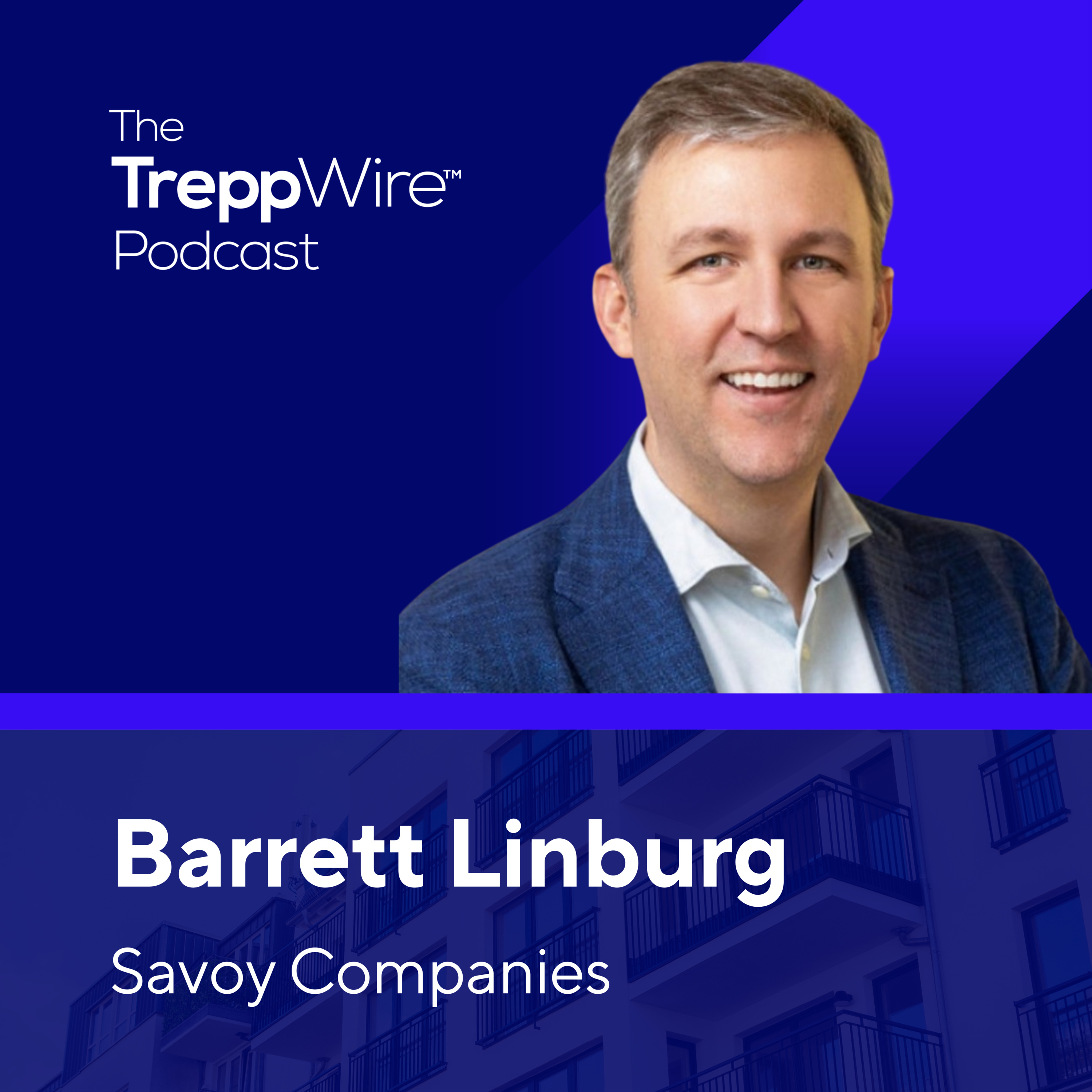
429. Multifamily Value-Add, Development, and Opportunity Zone Strategy with Barrett Linburg, Savoy Companies
In short
Texas multifamily value-add and development strategy, centered on Opportunity Zone investing (OZ 1.0 and “permanent” OZ 2.0), plus Savoy Companies’ gut-renovation playbook and vertically integrated operations using tech/AI.
Guests
Barrett Linburg, founding partner of Savoy Companies (co-founded 2011). Background: started as a mortgage broker in 2005 (arranged financing for apartments/hotels/triple-net), learned deal mechanics through the cycle/GFC, then bought his first multifamily deal in 2012. Leads capital formation/investor relations/strategic growth; focuses on acquisitions, ground-up development, and OZ/tax-advantaged strategies.
Key claims
Gut renovations can raise rents and lower expenses (fewer work orders, cheaper make-readies, lower utilities/insurance), creating “optionality” vs “hot potato” flipping. OZ benefits include capital gains deferral and, if held 10 years, no tax on appreciation and no depreciation recapture. OZ 2.0 makes zones permanent and adds a 5-year deferral/10% reduction.
Notable examples
Bishop Ridge (North Oak Cliff, Dallas) 8-property OZ portfolio bought in 2020; gut renovation plus later additions (22 properties, 800+ units, 90%+ occupancy). Paris, Texas: 10–12 years vacant, near-total rebuild (keep bricks/foundation/curbs), renovate at ~$90–$100/sf vs $200k–$250k development. Savoy tech: “Savoy operating system” with geofencing and task/accountability dashboards.
Written by AI. May contain mistakes.
Chapters
0:45
Barrett's Journey into Real Estate
Barrett shares how he got started in commercial real estate and the lessons learned.
“Barrett, we're so excited to hear from you today.”
1:42
First Investment and Growth
Barrett discusses his first real estate deal and how he scaled his investments.
“I started as a mortgage broker right out of college in 2005.”
4:50
Renovation Strategy in Multifamily
Exploration of Barrett's approach to heavy renovations in multifamily properties.
“Then we bought a 13-unit deal after that, and then 65 units, then 116, and just kind of kept going.”
7:49
Understanding Opportunity Zones
Barrett explains Opportunity Zones and the tax incentives involved.
“We're actively trying to buy several deals right now where we can do gut renovations.”
10:10
Bishop Ridge Case Study
A detailed case study on Barrett's investment and renovation in Bishop Ridge.
“Well, Opportunity Zone is first and foremost places on a map.”
14:00
Transforming Blighted Neighborhoods
Learn how strategic investments have revitalized key urban areas.
“And then we've also bought a whole lot of land and assembled it into nine development sites.”
15:10
Opportunity Zone Legislation Insights
Explore the implications of Opportunity Zone 2.0 on real estate investments.
“And, you know, it's really interesting because this is federal, you know, legislation on the Opportunity Zone.”
17:40
Authority on Opportunity Zones
Barrett Linburg's expertise on Opportunity Zones is unparalleled.
“which is a great thing for us and I think for all of these census tracts as well.”
18:30
Savoy Companies: Structure and Strategy
Discover the operational and strategic components of Savoy's business model.
“And they didn't know what it meant fully or how to maximize it.”
21:30
Gut Renovation Explained
Understand the concept and process of gut renovations in real estate.
“This is a tough market to operate in, and a lot of people haven't had to do that.”
Show all 17 chapters
24:00
Tech Innovations in Property Management
Learn how Savoy leverages technology for efficient property management.
“And, you know, that's the one beautiful thing about Texas, especially in the Texas Triangle.”
28:00
Introduction to Geofencing in Property Management
Learn how geofencing technology improves operational efficiency in property management.
“and the maintenance guy has the app for work orders and make readies, well, the app automatically notices that he's at the 20 unit property and sends him a notification and says, do you want to clock in?”
29:18
Enhancing Transparency in Property Management
Discover the importance of transparency and real-time data sharing in property management.
“We wanted to use our time really effectively to make ourselves the best operators.”
31:05
Lessons Learned from Real Estate Investing
Explore the evolving challenges and insights gained from years of real estate investing.
“I mean, that transparency and I think the timeliness of it is something that the industry needs.”
33:18
Navigating Current Market Challenges
Understand the current challenges in the real estate market and how to manage them effectively.
“I mean, the Opportunity Zone investment, I think, is the best example of that, where you found something that was new, maybe people didn't fully understand, and you went into it, you know, full force.”
33:54
Community Investment and Long-term Impact
Reflect on the long-term benefits of investing in local communities and its transformative effects.
“So, you know, this has been a great interview, Bear.”
34:42
Barrett Linburg's Social Media Journey
Hear about Barrett's unexpected rise on social media and his engagement with the real estate community.
“As Lonnie said, it's clear how much conviction and enthusiasm you have for this market, too.”

Ask about this episode
Get the gist, explore an idea or ask about something said.
 Claude
On The TreppWire Podcast: A Commercial Real Estate Show, what are the key points of this episode?
Searching your listeningTranscript
Automatic transcript. May contain errors.
0:00You don't have to play hot potato. You don't have to sell it because the building that you own is not a ticking time bomb.
0:11Barrett Linburg: Welcome to the Trepwire podcast, the show where commercial real estate meets data and insights. This is a special guest podcast. I'm Haley Keen with Trep, a data modeling and analytics firm for the CMBS, commercial real estate and CLO markets. I'm with Lonnie Hendry, Chief Product Officer. Today we're joined by Barrett Lindbergh, founding partner of Savoy, a vertically integrated Texas multifamily real estate platform. Barrett co-founded Savoy in 2011 with the acquisition of an eight-unit apartment building in Dallas. Since then, the firm has grown into a significant Texas multifamily platform, developing more than$200 million in projects and managing roughly 7 ,100 apartment units across the Texas triangle.
0:53Barrett Linburg: Barrett leads Savoy's Capital Formation, Investor Relations, and Strategic Growth with a particular focus on multifamily acquisitions, ground-up development, an opportunity zone, and other tax-advantaged investment strategies. Barrett, we're so excited to hear from you today. Welcome to our show. Thanks so much, Haley and Lonnie. Thanks for having me and glad to get in the weeds on a little bit of everything that you just mentioned. So let's do it. We're so excited. So I didn't mention this, but you've also built a pretty significant presence online on social media, sharing your perspective on real estate and opportunity zones.
1:30Barrett Linburg: And I know you've shared pieces of your story there before. But for our listeners, can you take us back a little bit? How did you get into commercial real estate and how did that ultimately turn into Savoy? Sure. I started as a mortgage broker right out of college in 2005. So I started arranging financing for not only apartments, but also hotels and triple net for a firm called BMC Capital and started doing it right out of college. And I really thought, man, these are this is easy. Everybody makes a couple hundred thousand bucks a year. Like this is a no brainer. Why isn't everybody in this business?
2:04And after a couple of years, obviously, GFC hit and I realized why everyone isn't in this business. You know, this is cyclical. So I learned a little bit about how cycles work. But I also realized that I really love the business of commercial real estate, Not only the numbers and the physical asset, but also the relationships that are behind it. And I sat down with a mentor of mine, and I was young enough at the time, 25 years old. And he said, you can go into a different business and start over, or you can stick it out, and a new cycle will start. And you'll be one of the few young guys who stays in it to see the beginning of the next cycle.
2:40And if you want to do it, you won't make much money for the next few years. but you'll be there for the beginning of the next thing and you'll do okay. And I took his advice and took the harder path at that moment. And it was the right thing for me to do. Yeah, it's great. I mean, I think the mortgage brokerage thing is interesting because I remember back in the day, I was doing multifamily property management back in like 2005, 2006, and had a few people come to me and say, hey, you should get into this lending business. Like this is where it's at. And then to your point, it just kind of all fell apart during the GFC.
3:10and a lot of them, I'd say almost all of them changed course. They were like, we're not going to stick this out. It was great until it wasn't great. So I know you're just going to give us an outline there. You pivoted. And Haley mentioned on the intro, your first deal was an eight-unit property in Oakland. So maybe give us a little color on when you decided to do something different, what brought you to that deal? What did you like about it? And what did you learn from it? Well, I think just one more thing on the mortgage brokerage. I think it's a wonderful way for people at the beginning of their careers to get a very holistic view into the entire business, right?
3:43You get to work with title companies, attorneys, insurance, and you learn the nuts and bolts of how a deal gets put together, how the sausage is made, and it worked really well for me. I didn't do that first deal, the eight-unit deal in Oakland, until 2012. So I had a long time in the business of learning how a deal is put together by watching other people do it and being very involved by arranging the financing. And that really gave me the knowledge and the ability to go tackle my first deal, albeit a very small one. And my mother-in-law was the equity. My wife was the property manager and construction manager and wouldn't have happened without everything that they did.
4:25I really was just the one who found the deal and said, this one will work. And so we went and we did it. It was very close to our house. We were there every day. And we were able to renovate it. and release it at higher rents. And we sold it literally 366 days later and doubled our money. And we said, hey, maybe this business is fun again. So that's how we did our first one. And we're off to the races. Then we bought a 13-unit deal after that, and then 65 units, then 116, and just kind of kept going. No, that's great. And so that was going to be my next question, is like, how did you scale up from there?
5:01But it sounds like you just kind of reinvested the profits doubled kind of your investment and here you are. I mean, it's so maybe give us a little color. I mean, were there four or five deals in between kind of that first one and where you are now with Savoy or were there 20 deals or what did that look like for you? Yeah. So, so since then and now we've bought and sold 28 deals and, and that's really between my business partner and I, but you know, that's 15 years of time. So it's never been like, oh, we're going to go rule the world and try and buy everything and flip it. It's really been a couple deals a year over a very long period of time running the same playbook.
5:37Find assets that we like in pretty good locations that we can do major renovations on or develop in the path of progress and then figure out what the next right thing to do is, whether it's refinance them and hold them or sell them because we think that the market's paying us a price that is over and above what we want to own them for. Yeah. So we're going to get into some of the stuff you're working on now on the development side, but you mentioned the heavy renovation that you guys do. And I know you've mentioned online that a lot of guys in the multifamily space, it's kind of lipstick on a pig.
6:07They come in and they just do some very light renovation and try to flip it. I think you guys have done the opposite, right? And most of your deals, you've pretty much taken them down to studs or close to it and fully renovated. Is that how you guys approach this and why so if that's the case? Well, those first few deals that we did, we definitely were doing lighter renovations, counters, cabinets, paint, you know, the basic stuff. And then after we did a few, we said, well, what if we wanted to hold these longer? Could we do that? What would it do for operating expenses? You know, we saw a couple people from other markets come in and do actual gut renovations, do the mechanical electric plumbing, windows, doors, foundations, roofs, everything.
6:48And what we realized is by doing that, it does a couple of things. Number one, you can get a little bit bigger rents even on these seventies and eighties deals because it's more of a new product. Number two, it actually makes the expenses go down because you don't have as many work orders. The make readies are cheaper. Your utilities are lower. Your insurance can be lower in some cases. So all those things make your expenses go down. But number three, you just have more optionality because you don't have to play hot potato. You don't have to sell it because the building that you own is not a ticking time bomb.
7:26So we liked all those things about it. Now, the hard part is you have to buy a building that's both cheap enough to justify doing the renovation and it has to be in an area that can justify the rent premium that you want to get for this very well-renovated asset. So it's harder to find deals, but we still love the business model and we still do it today. We're actively trying to buy several deals right now where we can do gut renovations. Yeah, I think right now is going to be a very interesting time for that model, because we've seen a lot of these maybe lesser experienced folks during the run-up in pricing and everything else that raised some investor capital and bought assets and tried to do the light renovation, haven't realized the rent growth, and now they're really in a bad spot.
8:11And the markets are still potentially strong long-term if you have the right quality asset with the right renovations. And so we'll get a little bit more into the kind of the operations because I'm fascinated by this because I could imagine you're buying old master metered properties and individually metering them when you're talking about utilities going down, you're going from a boiler system into something more modern. And I'd love to get into some of that with you. But I wanted to spend a little bit of time on the front end here on the Opportunity Zone discussion because I know, as Haley mentioned, on your social media platform, I mean, that's really what people have gotten to know you for, at least initially, when they find your page, right?
8:46And so Opportunity Zone 1.0 comes out. That was new legislation. Nobody really knew exactly what it meant for CRE in practice. And I think you kind of became the voice of reason and execution there. So maybe give us a little color on Opportunity Zone 1.0, and then I'll be really excited to jump into 2.0 now that we kind of have a little more understanding of what that looks like too. Sure. You said nobody knew what it was. And that included us. So we were buying a portfolio of properties in 2020, 2021. And it was an eight property portfolio that we really liked in an area of Dallas that was kind of in the path of progress.
9:23And we were just excited about the real estate and the opportunity to turn a neighborhood around. And our attorney, longtime transaction attorney said, well, you know, these are in an opportunity zone. And we said, what's that? You know, we didn't know what it was, didn't know how to spell OZ. And all of a sudden, we got a primer from him. He happened to be in a working group that was dealing with Opportunity Zone. And then we got another stroke of luck that our CPA, the owner of the CPA firm, had been an early adopter to OZ, and his family actually had an OZ fund that they had set up. So then we went back to our equity partners, and they naturally were a fit because in 2020, everybody had capital gains.
10:03And so it worked out well for us. So we accidentally became OZ investors early and it's worked out for us now for the last five years. So what is it? Well, Opportunity Zone is first and foremost places on a map. So there's 8000 Opportunity Zone census tracts throughout the country. And they exist because the government wants to incentivize investment into those places. So they're low and medium income areas throughout the country that the government wants more real estate investment. They want more job creation. They want more housing. They want more investment activity generally, and they want it to be long-term patient investment.
10:41And they get that investment by giving investors, private investors, tax incentive. And that tax incentive is kind of twofold. Number one, any investor who's had a capital gain, instead of paying the capital gains tax next year, they get a deferral on their tax bill. So if you sold stock or you sold crypto or you sold real estate or you sold a business, instead of paying the capital gains tax next year, you get to pay it later. Number two, since you're investing in this area, and this is the much bigger tax benefit, since you're investing in one of these census tracts and they want you to make a long-term patient investment, if you hold that real estate investment in this area for 10 years, you're not going to owe any tax after a 10-year investment.
11:31So it's a natural fit for real estate. If you build or renovate an apartment building in one of these census tracts and you hold it for 10 years, you don't owe any tax on the appreciation. And specific for apartment folks or any real estate folks listening, you also don't have to recapture the depreciation, which is a fantastic thing for folks like us. Yeah, no, it's a home run. I remember seeing some of your very first post when I think when you probably had had the initial meetings with the CPA and the others, where you're like, the light bulb was starting to go off. And you're like, I think this could be really powerful.
12:05And there was some pushback where people were saying, I don't want to make investment decisions based on government, you know, involvement. I don't, who knows what's going to happen in 10 years? Are they really going to keep this? Are they not going to keep this? And I think you kind of manage that very well and saying, look, this is what it says that's going to happen. We have a very strong conviction here and we found a portfolio and a market that fits the criteria. And then you've really executed on that. So I know you've talked a lot about Bishop Ridge, which I think was part of that portfolio acquisition where you basically went into a market that's very up and coming.
12:38You found some properties that were in disrepair and needed a lot of work. And in some instances, I think you tore some down and rebuilt and maybe some others renovated. So give us a just kind of a case study, a real life case study that you guys executed on with Bishop Ridge, taking advantage of this opportunity zone that you just described. Well, what we did, I think, is very much in the spirit of the legislation. We went into a neighborhood and you mentioned the name called Bishop Ridge. We made up that name, but it's in North Oak Cliff, just southwest of downtown Dallas, very near the Bishop Arts District.
13:10But it's a little pocket of that neighborhood that was actually very blighted, a lot of vacancy, a lot of problems, but close to a lot of good stuff. So close to where the state and local governments were making infrastructure investment, close to Bishop Arts District downtown, so some big job centers. And we said, man, this neighborhood should be a lot better. It just needs investment. It needs some systemic fixes to this blight and vacancy. And so that eight property portfolio that I mentioned, that was the start of it. It was owned by a Japanese guy and it was managed by a property management firm that had never been to Dallas and the owner had never been to Dallas either.
13:50And so we bought that first eight property portfolio and gut renovated it. And that started turning the neighborhood around. And since then, we've bought eight more old 1960s properties and got renovated those. And then we've also bought a whole lot of land and assembled it into nine development sites. And we've now completed six new construction properties. So total today, we have 22 properties online totaling over 800 units. And we're over 90 % occupied on those units. So it's made an enormous difference in the sub market, really the micro market that we've created. and we'll own down there for another six, seven, eight years.
14:31And every new property that we deliver in that market is accretive to the ones that we've delivered before it. And it's a wonderful thing. And like I said, I think in the spirit of the Opportunity Zone legislation. Oh, it's a home run. And I think there should be like a national case study of what you guys have done because it's exactly what the legislation intended to happen. You take a neighborhood that has potential, but also has impediments and headwinds that it's faced for decades and you've transformed it. And, you know, obviously there's some of the surrounding, the Bishop Arts and other things, they had kind of already been set in motion, you know, maybe before you guys made this.
15:05But that's where, you know, that snowball starts off small and now it's getting much larger as it goes down the hill. And, you know, it's really interesting because this is federal, you know, legislation on the Opportunity Zone. And we've seen this locally where you've had governments try to do public-private partnerships where they try to incentivize redevelopment in blighted neighborhoods or they offer tax abatements or they offer tax increment financing or other types of reinvestment. But it doesn't really move the needle like I think this has in this example. I mean, this has been really great.
15:31And obviously, with this most recent legislation passed with the Trump admin on the big, beautiful bill, they solidified the Opportunity Zone. They've actually rolled out Opportunity Zone 2.0. So what does that mean for you guys? Just more opportunity? Are there some even bigger carrots hanging out there for people that want to take advantage of it? What does OZ 2.0 mean? Yeah, just to put a bow on the Opportunity Zone 1.0 discussion. So Treasury just released some data. And through 2024, so between 2018 and 2024, there was about$112 billion of equity invested through the structure. And that was in all 50 states.
16:11Just under$8 billion of that went to Texas. And most of the equity went to urban census tracts. About three quarters of it went to urban census tracts. And that's in a temporary structure. So everybody investing kind of assumed that, you know, the jig was up in 2026 because it was a temporary program. In 2025, as part of the one big beautiful bill, opportunity zones were made permanent. Even though that was very much a Republican tax bill, opportunity zones have generally been thought of as a bipartisan deal. and it likely will remain permanent. So every 10 years, new Opportunity Zone census tracts will be chosen.
16:53And when it was made permanent, that deferral that I talked about, so anyone who has a capital gain is going to get a five-year tax deferral and a 10 % reduction when they owe their taxes. And that was kind of an enhancement of the program. But I think the bigger thing, because the tax legislation was made permanent is that now RIAs, wealth managers, all different kinds of market participants are really going to have to pay attention to OZ when perhaps in the past they could have just not had to learn a new trick. So like 1031 and LIHTC and new market tax credits, this is now a permanent part of the tax code and everybody's going to have to actually learn it, which is a great thing for us and I think for all of these census tracts as well.
17:45No, no, it's great. And I'm going to give you a little kudos here. So if you're listening to this episode, I mean, Barrett is the authority on this. He's been to Washington, D.C. He's spoken with our Texas legislature folks. I mean, he is not someone that just talks about this online as someone 30 ,000 foot above it. He's living it every day. He's executed on it. And I've seen him speak at a few events. And I've said to the participants at those events, I think he knows more about this and the people that actually wrote it. And so he's definitely an authority. And it's great to have him on our show, but also just to have him doing this for our industry.
18:17Because, you know, I remember when Opportunity Zones first rolled out, and it was, you know, you could see where these census tracts were. And there were a bunch in Austin, and there were a bunch in Dallas. And I was like, man, these are great locations. But nobody really knew how to execute on them. And they didn't know what it meant fully or how to maximize it. And you've shown exactly how to do that. So, I mean, I'm sure you do a lot of outreach to people when they, you know, send you a DM or whatever. I'm sure Barrett would be happy to answer some questions. We're going to give you a way to contact him at the end of the show.
18:46But, you know, he's pushing forward with this. This company is going to continue to benefit from this legislation. And really, he is the authority on this. So I wanted to transition a little bit now that we understand kind of why you maybe picked, you know, the Bishop Ridge and Bishop Arts Oak Cliff Market. you know but in order for you to build these units and and kind of run a business you said you started off with your mother-in-law providing some equity and your wife being the property manager you're not managing all these units with your wife now i wouldn't assume so maybe give us a little color on what is savoy comprised of and what do you guys do beyond just the gut renovation and new development what is what does savoy mean to the multifamily market today well my wife is still an awesome uh you know advocate and still knows a bunch about our business so she's definitely a confidant in every part of it.
19:33But yes, we built a great business, Savoy. My business partner here, Seth Bame, really runs the property management and construction side. And I really run the development and capital formation side. And a long time ago, I was his mortgage broker. He was my property manager and we were competing for deals. And then one day we said, this is dumb. We keep seeing each other on property tours. We're trying to buy the same things. Why don't we team up? And so that was about 10 years ago. And then a couple of years after that, We were out raising money and we were just doing stuff deal by deal. And the guy said, well, what's the name of your firm?
20:07And I said, well, we don't have a firm. What do you mean? We just raise money and do good deals. And that was the genesis of Savoy. So now everything that we own and asset manage is under that umbrella. And also our property management firm, Savoy Residential, now manages almost 8 ,000 units. Most of those are for third parties. And then our construction firm is doing ground up construction and a lot of renovation work. And that is Savoy General Contractors. But really, the reason that it's so important that we're vertically integrated with property management, asset management, construction, and investment development is because of all this opportunity zone work that we're doing.
20:45We're not flipping deals in 366 days anymore. We're stewarding these assets for 10 to 15 years. And because of that, we have to be very thoughtful about every decision that we make, whether it's a deal that I own personally or a deal that we own with a lot of investors. And now we have about 100 investors. We've got to be really thoughtful so that we can make good long-term decisions. And in order to do that, we've got to be the operators. We only do Texas apartments. We deeply understand the submarkets that we operate in and feel like in order to do that, we've got to be the operators. I think in today's market, I mean, what we hear from people across the spectrum today, as we sit here in 2026, is that the operator matters almost more than the property does when you're underwriting or doing the analysis or you're trying to do evaluation.
21:35This is a tough market to operate in, and a lot of people haven't had to do that. And so dealing with concessions, dealing with inflationary pressure on the expense side, cost of capital going up. If you don't have the operational chops, it's really difficult to get money today, whether it's raising equity and or getting a loan. And so for you guys having total control, I think it's really great. You know, it is interesting because I think there's a lot of people in multifamily that call themselves vertically integrated. Like that's kind of a cliche thing in the industry. But you guys are, again, it's not just hyperbole or words.
22:04You're doing it. Like you guys have the teams that actually do every step of this. And I think it's imperative. You guys wouldn't be as successful as you are if you didn't control that entire flow of information, execution, et cetera. You know, I wanted to talk a little bit. We said earlier on the gut renovation. Maybe give me just a, when you say gut renovation, it's almost like, you know, when we talk about expenses or we talk about rental rates, you know, there's a lot of different terminology that almost means the same, but doesn't mean the same. When you say gut renovation, give me some perspective on what that means to Savoy and what you guys have done to these properties that you have already got renovated.
22:38We like buying the ugliest building that you're going to see driving home between your office and your house. So, for example, we're about to finish the renovation of a deal in Paris, Texas. It had been vacant for 10 years, maybe 12. At one point, it was owned by the city. Then it was sold at a sheriff's auction. We will replace pretty much all, not all the framing, but a lot of the framing, many of the roof trusses. So the only thing that will remain is the bricks and the foundation and some of the curbs. Everything else is new. The plumbing, the electric, even the underground sewer lines and water lines are getting replaced.
23:25But that being said, we're still, Paris, Texas, a smaller market, it doesn't make sense to develop new units there at$250 ,000 a unit,$200 ,000 a unit. But it does make sense to renovate at 90 to 100 bucks a square foot. And so for us, we're delivering supply into a market that, number one, is very highly occupied, and number two, there is no new supply. And so for us, we're beating our pro forma rents by quite a bit already, and we just started leasing up. So that's a pretty interesting case study. Yeah, Paris is an interesting market. And, you know, that's the one beautiful thing about Texas, especially in the Texas Triangle.
24:07There's a thousand of these small little, you know, markets or sub markets that really at one point in time had units available and they've gone into disrepair and there's opportunity. And so, you know, I think you guys are doing a great thing. Do you see yourself sticking in this kind of 60s, 70s kind of vintage rehab because that fits the model? Or do you think you might ever move up the chain a little bit into some newer stock? I brought up Paris and it was probably a bad one because it's our only one that's not urban infill. So most of what we do is urban infill and we're really believers in that thesis.
24:3990 % of everything that we've ever done has been in the city of Dallas, within the city limits. We do two things mainly. We buy the 1960s and 70s deals and do the major gut renovation. And then we're also doing ground up development of smaller deals. So anywhere from 40 to 120 unit properties. And then we've centralized management. So we don't have to have onsite staff. And that has been something where we just don't have a lot of competition, but we're good at it. And so we've been able to find some really good deals that way. So when you say centralized, no onsite staff, that means to me technology, AI, some other ways that you're handling that.
25:22So tell me if I'm wrong, but if not, give us the details on what that means and how you guys have executed on that. No, and some kudos to my business partner, Seth, but he started on that very early. So 10 years ago, you know, before AI was a thing, he was building in Microsoft Power Apps. The maintenance guys were running around in Sprinter vans and using barcodes to pull stuff out of the Sprinter van and bill it to the property. They were clocking in and clocking out of 20 unit deals and then coding that to the P &L, right? And that was with Microsoft Power Apps and continued doing that for a long time.
25:58But when Cloud Code and AI became a thing, man, we were able to take the decade of Power Apps and create something really powerful by sucking in all the data via API from all the different SaaS tools that we were using and putting them on one dashboard. So now we have this one dashboard, we call it the Savoy operating system, where everything lives. We can create an accountability layer by assigning tasks to team members. So now we have 200 employees and we can take a task, whether it's a loan covenant or a loan document, insurance, service contract, work order, you know, loan draw on the construction side, anything.
26:39we can create a task for someone. And if they don't do it, it goes to their boss and then their boss and then back to us. And so it's really an accountability layer because ultimately in any service business, but certainly in real estate, the hardest part is getting your entire team to block and tackle. And so we've used AI and CloudCode to build a system that allows us to block and tackle really well. And that's what we've used all these tools to do. You know, it's super exciting as someone that lives in the tech and data space, because we're doing a lot of the same things, obviously, for like enterprise scale that we can try to sell into the market.
27:17But you guys have leveraged all the data you already have and your vendor data and created a working operating system. You're ahead of the curve, I'll tell you. We sit with a lot of folks that have ideas of doing this or they're maybe starting the endeavor, but you guys are already using this in practice. Because I know when we spoke a couple weeks ago offline, you were telling me some stories about how you have actual geofencing and stuff when someone goes on site at a property. So maybe give our listeners just a little bit of understanding of what that looks like and how that works for you all.
27:45Well, in a couple ways. But like I said, we were building power apps a long time ago so that maintenance guys could clock in and clock out of properties. And then that time card would just be allocated to a 20-unit properties P &L because it was centralized maintenance. Well, now there's an app. and the maintenance guy has the app for work orders and make readies, well, the app automatically notices that he's at the 20 unit property and sends him a notification and says, do you want to clock in? And the geo fencing does that. And that can work for any employee, whether it's a leasing person or a manager or maintenance guy or anyone.
28:23The same thing for an asset manager. If he's doing walks of a property, as soon as he gets on a property, it says, hey, are you at this property now? Click yes. Great. Do you want to do a unit walk? Yes. Okay. Here's the picture app. Are you ready to take pictures and narrate while you walk? Yes. Then all that stuff logs directly into our system. And once he's done, he can create tasks to send to the manager or maintenance guy. And then if that person becomes accountable for taking care of those tasks. So that's the kind of geofencing stuff that you use. Yes. I mean, listen, I think you're going to have a licensable product pretty soon that you're going to be able to sell in the marketplace because that's pretty incredible.
29:04We decided as soon as we did it that it was just for us, not because we're gatekeeping it, just because we built it very highly customized using our SaaS tools. And we didn't want to waste our time trying to build something that we could sell. We wanted to use our time really effectively to make ourselves the best operators. I think it's great to see that those are the things in today's market that create a competitive advantage in a multifamily space that has gotten more difficult to drive yield because everyone has access to a lot more data. Everyone has access to more insights. You guys are taking some of this traditional value add reposition, and you've mastered that, but then you're layering on top of it this technological enhancement that you've built.
29:48And I think it really creates a competitive advantage for you guys in the marketplace. I think as property managers, we're trying to do the same thing. and I'm talking about third-party property managers now. What we've noticed is a lot of the other third-party property managers in the space, and look, us too, when we used to third-party property manage for a lot of people, we would just send out a T12 and a GL and a couple other pieces of information, and that was kind of the industry standard. What we're trying to do now is use our operating system to be much more transparent because now our operating system has tons of information.
30:25service contracts, insurance, work order summaries, CapEx summaries, all this stuff that we share internally within our team and with our internal asset managers. Well, now if we third party manage your property, we want to share all that stuff with you so that you can make better decisions. And we've gotten really good feedback on that from other third party asset managers who are saying, whoa, I usually have to beat the property management company over the head to get half of this data that's worse quality. And you can now share this in real time with me. This is cool. So that's been a big thing as well.
31:04Oh, it's great. I mean, that transparency and I think the timeliness of it is something that the industry needs. And it all, like we go back to the snowball. I mean, for you guys, all of this just compounds to the betterment of your operations and to your investment on a go forward basis, because now you have all of this centralized, your underwriting is better, You actually know what rents are. You know what expenses are going to be. I mean, it's pretty phenomenal what you guys have done. So, you know, as we kind of wrap this up, I mean, you've been doing this now plus or minus 15 years. What do you believe about real estate investing today that you maybe wouldn't have believed when you bought that first eight unit property?
31:41Oh, man. Well, it's certainly not as easy as the first deal led me to believe. That's for sure. You mean you don't double your profits every 366 days? That's right. No, I think, look, I had the benefit of having see a cycle in real time early in my career, which was a nice thing. So I don't think I was under the illusion that it was easy from day one. And that was a blessing, right, to see that. Over the last several years, we have definitely seen how hard operations can be and fighting for every dollar, whether it's taxes or insurance. And having the operational skill set to deal with that has been a good thing.
32:26Having my background as a mortgage broker has been a good thing because we've needed it. You know, we've needed every bit of operational ability that we've had over the last five years. So what have I learned? I don't know that there's one big lesson that's been a takeaway, but I think it's 20 years of combined lessons that's helped us over the past few years. Yeah, I think that's a great way to put it. And it's interesting as you kind of talk through this. We interview a lot of folks. We've had a lot of guests on our show. And I'll tell you, you know, without fail, the people that went through 2008, it has shaped their ability to kind of either review the market for what it is real time better than others that didn't go through that.
33:03Some people, unfortunately, I think have gotten locked into the 2008 kind of doomer mindset. Like if you went through the GFC, it's very hard for some people to move past that. But I think what you're an example of is someone that saw the downturn and experienced it, learned from it, pivoted, and, you know, have actually pushed the envelope. I mean, the Opportunity Zone investment, I think, is the best example of that, where you found something that was new, maybe people didn't fully understand, and you went into it, you know, full force. And, you know, it hasn't defined everything you guys do, but it just is indicative of kind of the go forward mindset that I think your firm has exhibited in the market.
33:37And we need that. I mean, especially given where we are in today's cycle. Interest rates are no joke. Inflationary expense pressure is no joke. Property tax assessments keep coming. Insurance is through the roof. Like all of those things individually can really derail a property. You throw all of them together and it gets very difficult. And you guys have done a great job of managing that. So, you know, this has been a great interview, Bear. We really appreciate you spending some time. Haley's going to maybe ask a question and then it'll take us out. But I really wanted to tell you how much I appreciate it.
34:03I love it. You know, being a local, you know, Texas guy myself, it's great to see folks that are investing in our communities that need to see some investment. And I think not just the short-term benefits of that will be realized, but the long-term. I mean, you're going to look back in 30 or 40 years and your kids are going to see, man, my dad, like he completely transformed this part of the city because that's what's happening. Well, that would be nice. I don't get a chance to zoom out very often and really think every once in a while we'll have a grand opening and people will gather and we'll talk about it.
34:34But we don't zoom out enough. So thank you for those kind words. I certainly hope that that's the case.
34:39Barrett Linburg: Yeah, well, thank you, Barrett. This has been incredible. As Lonnie said, it's clear how much conviction and enthusiasm you have for this market, too. So I know our listeners will feel that. But before we close, we've been plugging your social media and your X account throughout this episode. but we didn't really name the account or hear from you on the story behind it. So maybe you can do just a quick plug for your social media presence and give us the story. Did you know this was going to be such a large platform when you launched it? Or was it more of an outlet for all your thoughts about the market?
35:11Just like everything else, Opportunity Zones and otherwise, this was an accident. So I stumbled upon this little niche of people on Twitter that talked about real estate and sounded kind of like I wanted to respond. And so for a little while I listened and then I started replying and then I started posting all on my own and grew a Twitter account from essentially zero to now 170 ,000 followers, just talking about opportunity zones and tax credits and apartment investing in Texas. And it's been a wild journey from people who I've made friends with in real life to meetings that I've been able to have with US senators and other folks.
35:54So it's been a really interesting thing over the past five years. So mostly post on Twitter and my handle is Dallasaptgp. Also post on LinkedIn and then have started a couple of websites. So have barrettlinberg.com and oz-hq.com where I also post stuff.
36:13Barrett Linburg: Love it. So reach out to Barrett and tell him that the Tripwire podcast sent you. Again, thank you, Barrett. This has been incredible and I'm sure we'll have more questions for you on a future episode. Thank you all very much. With that, we'll close this special guest podcast. Thank you, Barrett, for joining us today. Join us later this week as we look at what's happened during the week and how it may be impacting you. If you have a question or just a comment, send an email to podcast.trep.com. Until then, visit trep.com for more info and subscribe to the TrepWire podcast with your favorite provider.
36:45Barrett Linburg: Thank you for listening and stay well. All right. Thank you.
From the publisher
In this special guest episode of The TreppWire Podcast, we’re joined by Barrett Linburg, Founding Partner of Savoy Companies, a vertically integrated Texas multifamily platform. Barrett dives into Opportunity Zones 1.0 and 2.0, discussing his path into this type of investing, the tax benefits that have driven adoption, and what a permanent program could mean for investors, wealth managers, and future development. He also highlights Savoy’s Bishop Ridge redevelopment project in Dallas as a case study in transforming a neighborhood through urban infill development and heavy value-add renovations. We discuss Savoy’s use of AI and proprietary technology to streamline property management operations, and the lessons Barrett has learned while scaling a multifamily platform. Tune in now.
Episode Notes
From mortgage broker to multifamily investor: lessons from the GFC (1:41)
Gut renovations vs. light value-add (6:20)
Opportunity Zones explained and the Bishop Ridge case study (9:06)
Opportunity Zones 2.0 and permanent OZ legislation (15:52)
Building Savoy as a vertically integrated platform (19:25)
AI, geofencing, and the Savoy Operating System (25:28)
Lessons learned and closing remarks (31:40)
Questions or comments? Contact us at [email protected].
Follow Trepp:
LinkedIn: www.linkedin.com/company/trepp
More from The TreppWire Podcast: A Commercial Real Estate Show
All episodes
We use cookies.They keep VO running smoothly and help us improve it. Privacy policy