
In short
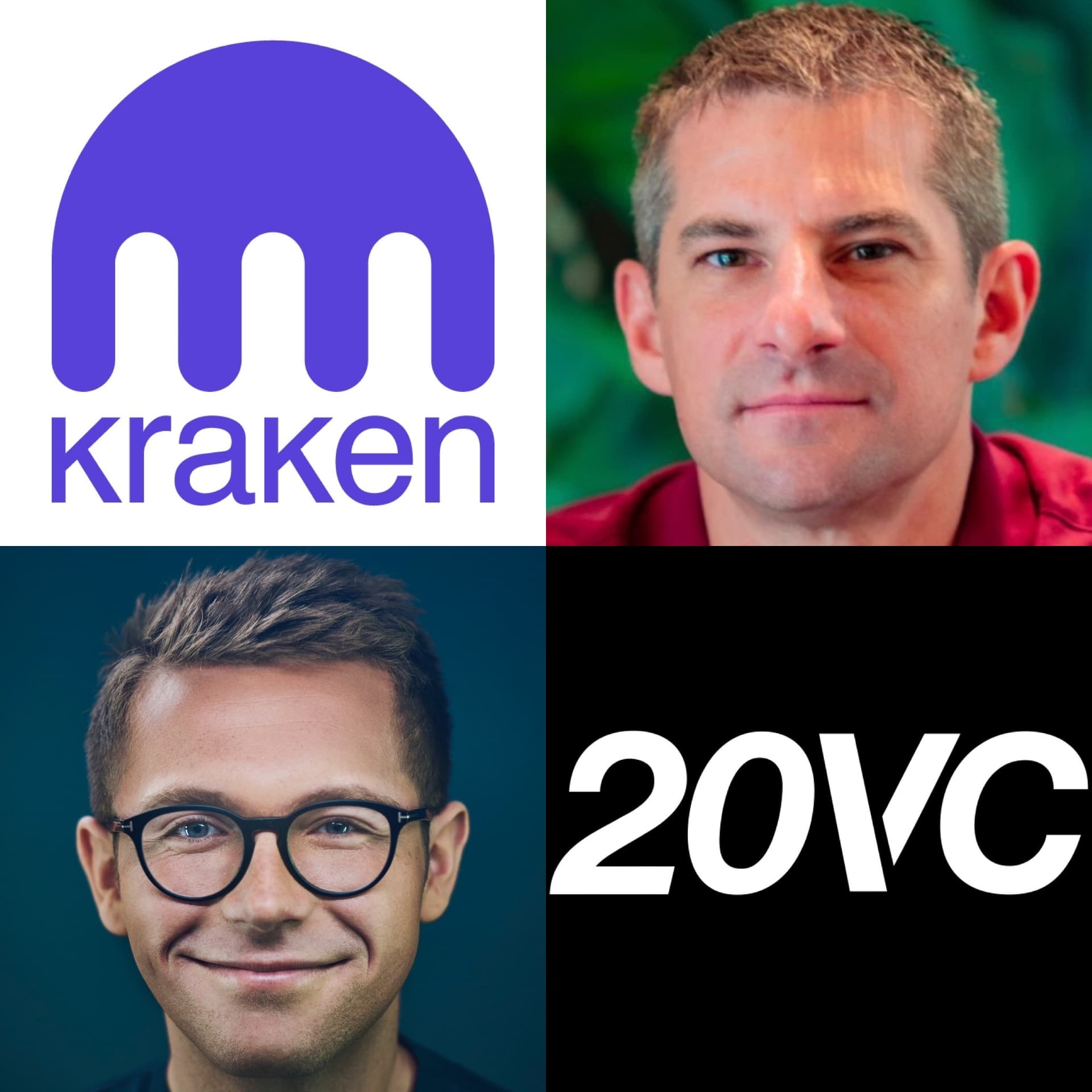
Podcast Summary: The Twenty Minute VC (20VC) - Episode with Dave Ripley, CEO of Kraken
Episode Overview In this episode of The Twenty Minute VC, host Harry Stebbings interviews Dave Ripley, the CEO of Kraken, one of the largest cryptocurrency exchanges globally, valued at $10.8 billion in 2022. The discussion spans a variety of topics related to the cryptocurrency industry, regulatory challenges, and the future of crypto in light of the upcoming US elections.
Key Topics Discussed
- Dave Ripley's Journey to Kraken
- Background: Dave's initial engagement with crypto began while working at the Boston Consulting Group, later co-founding Glidera, which was acquired by Kraken in 2016.
- Transition to CEO: Discusses the challenges of stepping into the CEO role and lessons learned about leadership.
- The Utility of Cryptocurrency
- Applications Beyond Store of Value: Explores the need for crypto in global payments and remittances, questioning current applications and the effectiveness of existing solutions.
- Lack of Compelling Use Cases: Identifies a gap in practical applications that effectively demonstrate the utility of cryptocurrencies.
- Critique of SEC’s Regulatory Approach
- Regulation by Enforcement: Dave argues that the SEC's methods are fundamentally flawed, citing failures in cases such as XRP and Grayscale.
- Call for Better Regulation: Advocates for a more structured legislative process similar to those in Europe and Canada, emphasizing the need for clarity and pathways for compliance.
- Impact of US Elections on Crypto
- Pro-Crypto Candidates: Discussion on how the upcoming presidential election may influence the crypto landscape, noting that many candidates are pro-Bitcoin and pro-crypto.
- Future Prospects: Dave expresses optimism about the potential for a president who supports crypto, which could lead to significant growth in the industry.
- Challenges and Misconceptions in the Crypto Space
- Commoditization of Exchanges: Addresses difficulties in differentiation among crypto exchanges in a competitive marketplace.
- Myths about Cryptocurrency: Dave counters common misconceptions, particularly regarding the intrinsic value of cryptocurrencies and their role as a hedge against inflation.
- The Future of Crypto
- Infrastructure Development: Discusses the evolution of crypto infrastructure and the potential for broader adoption where consumers might use crypto without realizing it due to backend processing by companies.
- Global Adoption: Notes that emerging markets might benefit significantly from crypto solutions, particularly in terms of reducing transaction costs.
- Personal Insights from Dave Ripley
- Balancing Family and Work: Dave shares his experiences managing responsibilities as a CEO and a father, emphasizing the role of support from family.
- Vision for Kraken: Envisions Kraken as a significantly larger player in the crypto space in five years, with enhanced services and a broader client base.
Conclusion The episode offers a rich dialogue on the current state and future of cryptocurrency, regulatory challenges, the socio-political impacts on the market, and personal reflections from a leading figure in the industry. It provides valuable insights for stakeholders in the crypto space, including investors, entrepreneurs, and regulators.
Key Takeaways
- The SEC's current regulatory approach is seen as ineffective and needs reform.
- There's a significant gap in practical applications of crypto outside of being a store of value.
- Upcoming US elections could reshape the regulatory environment for cryptocurrencies.
- Kraken aims to grow substantially in the next five years, focusing on new products and services.
- Family support is crucial for maintaining work-life balance in high-pressure roles.
For more details, visit [The Twenty Minute VC website](http://www.20vc.com).
Written by AI. May contain mistakes. Listen to the episode to check what was said.
Transcript
Automatic transcript. May contain errors.0:00The regulation by enforcement approaches completely flawed, they won't be successful. They've lost an XRP, they've lost the grayscale, kind of continue to not see success with these actions, so they won't be successful. This is 20VC with me, Harry Stebings, and stay -show is a slightly spicier one than usual. I've long questioned the true utility value of much of crypto, and so today I sat down with the CEO of one of the world's leading crypto exchanges to discuss this, whether that SEC is overreaching and the impact of US elections on crypto markets. And so with that, I'm delighted to welcome Dave Ripley, CEO at Kraken, most recently valued at a whopping $10 .8 billion in 2022.
0:41But before we dive into the show's day, there's no shortage of helpful AI tools out there, but using the mean switching back and forth between yet another digital tool, what was supposed to simplify your workflow just made it way more complicated, unless of course, you're in notion. In Notion, you can automate the tedious task, like summarising meeting notes or finding next steps, really freeing you up to do the deep work that we all want to do. And that's why Notion is used by over 50 % of Fortune 500 companies and teams that use Notion send less emails, cancel more meetings and reduce spending on tools.
1:18Try Notion for free when you go to Notion .com slash 20VC. And speaking of amazing products like Notion there, I'd like to talk to you about a company called Digis. There are full service AI accounting company, and if you're in need of an accountant or looking switch, there's no better solution than Digis. Starting at just $350 a month, which is less than half of what you'd pay a traditional firm, Digis is the most accurate, most efficient solution on the market. They've developed proprietary AI technology that automates tedious financial tasks and delivers servers reports to the actual close of the month, not 2 -3 weeks later as always.
1:54And they also allow you to keep track of key metrics like revenue, burn, cash flow and runway in an incredible live dashboard. The best part of all of it, this is vetted and signed off by their in -house CPAs. If you're interested, visit digits .com -4 -20VC to claim your special office day, that's digits .com -4 -20VC. And finally travel in these spents are never associated with cost savings, but now you can reduce costs up to 30 % and actually reward your employees. How? Well, the van rewards your employees with personal travel credit every time they save their company money when booking business travel under company policy.
2:34Does that sound too good to be true? Well, the van is so confident you'll move to their game changing all in one travel corporate record and it spends Super app that they'll give you $250 in personal travel credit just for taking a quick demo. Check them out now at navan .com forward slash 20VC. You have now arrived at your destination. Dave, I am so excited for this. First of all, I want to say thank you for joining me today. Yeah, absolutely great to be here with you, Erie. Now, I want to break kind of the context part into two different parts. One is like, what was your first engagement with crypto?
3:07And how did you first make your way into the world of crypto. So about 10 years for me, just over actually, at the time I learned about crypto, I was at Boston Consulting Group, large strategy consulting firm, and I was interested to get back to the tech industry, also kind of had in the back of my mind, potentially founding a company, individual who I learned about Bitcoin from, happened to end up being my co -founder. So that's actually how I initially learned about it, and then just like many others went down that rabbit hole. I learned first about the tech and then all of a sudden I was like, while that's super interesting, then the economic side, the societal side, the government piece, all these different aspects of crypto and in spend, frankly, months kind of going down the rabbit hole, learning about crypto in every which way also going through the process.
3:52I think a lot of us do of learning about crypto and saying, hey, this can't work because of acts and then kind of go research it and read more about it and then get to the point where it's like, actually maybe this actually would work for XYZ reason. So super excited about it. It definitely aligns with my view on economic freedom and to these pieces. And so just got incredibly excited about it. Okay, so we dive down the rabbit hole. How does Kraken come to be then? And what does that end support like that? Right in 2013, I founded a company, Glidera. And that was a crypto company. We basically provided some tools APIs to let all the Bitcoin wallets at the time add Bitcoin buying and selling into their apps.
4:32And Kraken was one of our partners. We used him on the back end for liquidity because they had a nice, big, full, proper exchange that provided such things. New some of the Kraken team, including Jesse from that angle, it was 2016. We started discussing about what's next for Glidera, what's our next step, another fundraise. You know, we had already done one, not a year plus previous to that timeframe. And we talked about the potential for acquisition. And so Kraken acquired my company, was small at the time, Glidera. And I joined Crack and Found that acquisition. Can I ask you, you were COO then, I think, for six and a half years or whatever it was according to the trusty LinkedIn.
5:09And then take over the range of CO. How was that transition? And what are your biggest lessons and piece of advice on moving into the role of CO? Yeah. We talked about a CO transition for quite some time. Not even just months, but on the order of year plus. That happened last spring. So it's really been probably just over a half year. So we're kind of in the early period, if you will, of me taking over. We've been the hardest things about transitioning into a CEO role. It's always difficult when you're bluntly that ACO brings their own culture, especially a founder seat. We've been the challenges.
5:43It's a good question. One is, when we made the transition, there wasn't actually someone to come in and like fill my overall as COO Day 1. I've made for like an interesting start and we were well down the process to actually doing that, finding someone to fulfill my role. That's one semi one. Yeah. If that was your soul challenge in six months, Dave, you've been in immensely calm mortis. Yeah. Yeah, let's keep going. Probably the other dynamic that you know, has existed, frankly, throughout this year is, you know, we had SPF and FTX and in all the other failures of 2022 in the crypto space, most of them, frankly, tragic and fraud associated with at minimum FTX and so forth.
6:29So really horrendous. Coming into 2023, of course, we see kind of a lot of activity on the regulatory side. In a lot of our geographies, call it Europe, UK, Canada, they were already in progress at putting in new regulatory frameworks. That led to a number of different things we had to do just from like a build out standpoint, but then you move to the US where not in the same place. And so you kind of had this regulation by enforcement approach largely referring to the SEC that has been certainly a challenging dynamics throughout all of 2023 for crackin specifically. And that's definitely from like a kind of market environment challenge is really high on the list.
7:14Do you feel targeted by the SEC because it's like you and Coinbase have been very good at And it feels like a bit of a tallocating to people. It's clear that they do appear to be focusing companies that are US -based companies, at least in the case of the SEC. Do you feel like that overreaching? I think the approach is completely flawed. The regulation by enforcement approach is completely flawed. The right approach, but just like not in the right place on the spectrum. But I think it's more fundamental than that in that their entire approach is completely off. And so the right approach is what we see everywhere, what we see in Canada and Europe and in UK where their parliament or legislatures work to put in place proper laws, the regulators work to implement those laws, the companies come in and actually have a path to register in license and provide services.
8:06That's that right approach. And none of that we've seen from the FCC and they've been fairly resistant to that type of approach. Why are they resistant to that approach when it is very common in other jurisdictions? Yeah, it's a great question. I think this is this is for the most part, you know, we're mostly left wondering, you know Why is this the case if they are as successful in the attempts? What does that mean for a coinbase and for a crack and yeah? In the You mean if the the SEC is successful so it's almost tough to answer that question because you know They won't be successful, right?
8:39They've lost an XRP. They've lost the grayscale kind of continue to not see success with these actions. So I don't think they won't be successful. It's tough to imagine like exactly what it looks like for, you know, a success on their side and what that would even be. In the particular claim against Coinbase, claim against Kratham, they've, you know, identified a handful of tokens in each particular one. We of course list more than that than that, a handful notified. So tough to see exactly the end game that they're headed down. I spoke to mutual friends of ours. They helped me to ask, should Gansler step down as many suggests that he should give him the lack of success that he's had?
9:19Yeah, I mean, look, you know, at least within the cryptocurrencies sphere, we don't see anything positive, any positive steps, any clarity and guidance, any frankly positive steps for investor protection or any of the goals that the SEC is, you know, I think they're mission if you will. And so, you know, that's unfortunate. So just to clarify them, when we move forward to the next three, tip six to nine months, we expect SEC to continue losing on multiple different fronts. I'm not too sure what's the number of cases they have out there right now. We've called out kind of the two that are top of mind for certainly the crack and in complaint in the coin base one.
9:59But yeah, I mean, we're quite optimistic about the path forward for those. But I do just have to ask you as we look towards, you know, wrong native presidential election. How important is the presidential election for crypto in the US? I'm obviously outsized the US to educate me. What impact does that have? Look, the longer term arc, we have a number of these candidates. I mean, almost if you look at that, that suite of candidates that are out there, they're all pro crypto, pro Bitcoin. A lot of the ones that are interesting candidates, you have RFK junior, of course, these independent now started out, Democrat now independent.
10:31And then you go to the other side, the majority of the candidates out there are pro Bitcoin pro cryptocurrency. Of course, we don't frankly see any comments from our current president on Bitcoin. We see it from his team, if you will. So look, I can't tell you who's going to win this election, but over the coming set of elections, we will have a pro Bitcoin pro cryptocurrency president. Crypto and Bitcoin are naturally going to grow, they add amazing value for individuals and they're going to continue to grow. Over time, I've learned to be brutally honest in shows and like Coinbase for me, it seems like the consumer brand where you go to, we have pubs in the UK, but you go to the pub, people know Coinbase, it's all, it's on Super Bowl ads, it's on buses and Kraken's like the one where if you know crypto, you know Kraken.
11:24Yep. Are you happy with that branding? The stadium deals necessary. I'm just fascinated here with also that. I think there's a couple of different things. Just unlike the evolution of crack and products, and one of the things we've done even more recently is actually start marketing. We've almost made it to become an enormous, you know, multi -billion dollar company without frankly doing much marketing at all, which is kind of amazing in of itself. But over the past year, in really almost over the past six to nine months, we've actually started to become a more meaningful player with marketing.
11:57That has been one of the kind of catalysts to drive more growth in those newer products for ourselves and the consumer individual retail site. Do you write about the commoditization of marketplaces? It's just like, if the majority of trades are in like certain markets, Bitcoin, Bitcoin, Ethereum, BitSalon, or Pujima, Lionline, Shae, everyone sells trust, everyone sells peace of mind. Do you find it difficult in the commoditization differentiation? I think it's going in the opposite direction. It's extraordinarily difficult to get all the foundations, right? Security, red compliance, all these different pieces.
12:30So much so that we've seen a lot of companies come, not just go by the wayside but completely disappear. We've almost seen the opposite where we've seen a lot of companies come in, try, not be successful. Speaking of kind of, it's the opposite of what you think of that. I think a lot of people have commonly held beliefs about crypto that they're quite strong on. What do you think of some of the top myths that you so often see that are wrong? It has no value. And right when someone makes that statement, they're like, okay, so this person hasn't done too much reading on history. Which is not that - Do you not argue then?
13:06I sound like Jordan Peterson, you know, which is like, well, how do you define value? Like a piece of paper doesn't have value. It's a promise. It's a gown. Exactly. So exactly. I mean all currency is today and all it ever has been is a system of records a way to record transactions that have Happened and that's all currencies have ever been they have all basically function as this way of a Reliable system of record reliable ledger that fact that you know Bitcoin is a reliable ledger is I mean is just clear I'm gonna give you this fuck it. It's it's not even a Friday's Wednesday's mid -week but I just want to go for it because I have one of this discussion.
13:47I totally understand the point on value. I just didn't see the point on usage. For me, we have great payment rails in Europe for sure. I can't speak to the US, I think, here a little bit more challenge. The financial ecosystem is strong, open banking improves it even more. I don't understand the utility value. Can you help me? I'm sound like... Yeah. As far as where it's superior, as a form of currency, there are a number of different ways. The Delta in which how well it performs is a currency. Frankly, I would assert that it's inherently superior for almost everyone in almost every place. Not yet today because we haven't built out the infrastructure and it's not in people's hands and all those types of things, but we're on the way there.
14:27But there's certainly a range. If you look at an individual, like yourself or myself, US, Europe, payment access that we have as individuals, retail consumers, you know, it's pretty good relative to most places in the world. We look at other places in the world in just with respect to access. It is drastically different. The same level of technology, speed, cost, all these different pieces. Again, I wouldn't say that it's like fantastic in US or Europe. There are certainly challenges. You know, banks operate 9 to 5, not a weekends. There's a number of things that you want to do. There is huge costs.
15:03Somehow, the financial services industry is the most profitable industry out there. That money's coming from somewhere. And so it's coming from us, and you're paying the tax to these companies just simply to hold our money, to allow us to transact with our own money. And it's a significant cost. Okay, so if we gave us that, like, you know, the in -emerging markets are in less, okay, we can kind of play that one out. Actually, Impessa has been an incredible innovation in large parts of Africa. For many years, it's well ahead of a lot of European and US financial products and tools. I kind of wonder like yes a lot of the financial services but I'm not sure if it's not actually bad.
15:43Neo banks are innovating incredibly well on a lot of the traditional challenges. Even your new banks are what I agree, Brazilian banks for a nightmare. New bank is innovated incredibly well. And so I'm like, does it need a new currency? What does it just need new providers, vendors, and products to make it better? And I just, let's keep going. Let's keep going. What else are these currencies supposed to do? So, one of them is the whole value. And one of the things that we've seen, the varying degrees, is substantial inflation. And again, this varies significantly from one part of the world to the next, but this is a meaningful problem, frankly, even just recently for people in the US, but substantially so in many different parts of the world.
16:26That has gone on for a hundred years since the existence of creation of fiat currency, if you will. So this is a hedge against inflation. So we're in Argentina and we have incredibly volatile currency swings, but Bitcoin is a hedge against that. Of course, yeah. Absolutely. I mean, you know, as a currency, as you know, the built into the protocol, right? You know, fixed supply and is inherently not inflationary from that standpoint. Do you not worry that the volatility of the swings mean that actually, you know, transpire and it's not really what you use in transactions, safe someone in an emerging economy in that way.
17:04And actually, it's pretty volatile swings anyway. Well, so there is quite a bit of volatility. First, I'll point out that it's a lot of volatility up into the right across the history of Bitcoin, not a lot of volatility and down into the right as most Fiat currencies perform. When you just look at them by the numbers, the hundreds of Fiat currencies that are out there. One of the things we haven't talked about yet across border transactions, but to the extent that Bitcoin continues to be adopted and grow for all of these different use cases, and there are many. We're talking about payments and store value, which is for sure the biggest one, and we should be talking about that.
17:39But to the extent that adoption continues to grow, the potential here is significant. So, of course, you're going to have a lot of people investing on that potential outcome, albeit maybe farther off in the future. And that's going to lead to a lot of fluctuation in prices. And so we see individuals doing this, we see big Wall Street banks and hedge funds and big investment funds doing the same, investing or even endowments and all of the institutions that have started to come in several years ago and continue to grow in the space. They've all been kind of flimsy and I've kind of pushed back on all of them and we haven't really got one hail Mary, like store of valley for when your currencies in really poor emerging markets have problems with stable sources of value.
18:28That's like, that's one. Yeah, there is some truth to what you're saying here. But again, I think it's a positive. Cryptocurrency has all these benefits. There's many of them. I think one where we see even, you know, our clients using cryptocurrency today, Bitcoin and other stablecoins, our for cross -border payments. And it truly is substantially, factoring substantially less expensive than any other means they have available to them. But look, the fact that there are many different use cases for cryptocurrency. I would almost describe Bitcoin and cryptocurrency what they are as innovations, similar to the internet itself.
19:03Massive, huge, broad and wide, and so what we're really going to see is, yes, like more narrow specific use cases that grow and have to take hold over time as opposed to like the whole thing all at once. Now, one, I'm always intrigued by the cross -border payments thing, because I'm like, ah, it's cheaper in the faster. It really needs cheaper and faster. I mean, it's like I think it's quite a small amount if you're moving large large sums of money Think houses or whatever Doesn't really matter if it's today or tomorrow really and actually your less price sensitive on fees and actually fees It's kind of a commoditization game on who can charge the least and and so I kind of find that one challenging to be honest Can I ask you though?
19:45I have so many people say to me. Ah, Harry the future of crypto is actually Consumers won't know that they're using crypto. It will just be this beautiful infrastructure in rails I think it was Rebecca Kaden at Union Square Ventures who said that Recently, what does that mean and what does that look like for crypto adoption when it's like consumers will be using crypto But they won't know it and it will be infrastructure. I think you know, we're starting to see that in places There will effectively be a You know set of service providers or companies that I'm fused skate away. Frankly, a lot of the complexity that still exists there with crypto and Bitcoin, we talk about these clunky long addresses that are necessary.
20:28There's of course the question on custodial versus self -custody, challenges with self -custody. And so I think a lot of it goes towards like, hey, all of this, the user experience still needs a lot of, you know, work and to make more simplistic and can push a lot of that complexity, hopefully more so to the background, but do it in a secure way. And so on the utility side, what would that look like? If we move away beauty from the financial services space and the infrastructure that is used by consumers in a way that they don't know, what is that? Well, I mean, I think you could be a handful of different things.
21:05I mean, we have payroll and remittance companies that are clients for cracking that run this business. in they simply use crack -handed for back -end liquidity to convert from Fiat to crypto. And they use the crypto side of things to move money from one geography to the next. But for their customers, they are providing a Fiat out and one side versus the other. So just around the time they're using that basic pain that teams in crypto, they're buying it through and then sending it out in crypto. Is that it? Just so I understand the payroll example. Well, yeah, a payroll example would be you have a business crypto payroll company business wants to use them The business mostly operates in dollars or euros say and so they need to find a way to pay out their employees in crypto If that's what they want to do they simply go to one of these payroll companies They give them the dollars in the payroll company help some you know pay out the pay out their employees in crypto You know that payroll company needs some liquidity on the backend crackens the choice Got to do so.
22:10Okay. Do you think we'll see a wave of companies pay that employees in crypto? We certainly do. And there are quite a few. The use case largely we come back to the global piece. You know setting up global payroll is incredibly difficult and complex and only large companies really do it successfully and at reasonable cost. And so I think a lot of smaller businesses is certainly freelancers all use cryptocurrency already to pay their contractors, freelancers or whoever might be helping out these small startup businesses. If we take that as an example, you have like deal and remote, which is set up to do that.
22:48Again, is that not like an innovation on the product side, non -innovation on the currency side? I really, because I try and I love innovation. I'm an avenged capitalist, my job is investment. But I just can't get there. Yeah, no, look, you know, when we talk about like the to be clear, Bitcoin cryptocurrency isn't, you know, coming out and being like, hey, the world has never known transactions or financial transactions or payments or money or what have you right? I mean, this is of course not what's happening. It is the alternative better system, not something, you know, hasn't existed before if you will out of fundamental level.
23:24Dave, how many kids do you have? You have three? I'll do it, yeah. Okay. How on earth do you be a good father and a good CEO with three kids at the same time? Like, what do you know now that you wish you'd known before you had children? Or would you advise yourself? I have three kids, young, five, three, two. I mean, just laying it to your street. I mean, one is my wife Laura, that's probably like an incredibly critical part of this. The reality is I spend an enormous amount of time and energy on cracking. I actually spend a huge amount of time and energy family. I mean of course work from home helps you know a global remote model that we've had forever helps with that.
24:02So I'm gonna love a grenade in for this one Remote from day one. I struggle with this one too. I don't know any role that is better performed remotely I even engineering scrums the collaboration that Davison and Fee Gather with product with sales with customer success I helped me understand why is it my bad at? I hear you, there's probably a tradeoff, you know, to the extent that you can be there in person at any given day, at any given time, you know, there are benefits from that. It's like, okay, so what's the counterbalance to that? There's a bunch of tactical basic stuff, commute time for individuals, allowing them to got a structure their day, week, month, however they see fit, is really helpful from like a flexibility and frankly get work done.
24:46I worry about young people getting depressed. I think you see mental health drastically reduced loneliness increase Companion ship decrease for parents. I totally freaking get it for everyone else So I think it's good to be in office, no? Yeah, I hear you. I there is something and this is like each to zone I want to do a quick fire around so I see a short statement you give me your immediate thoughts does that sound okay? Okay, sure so what's your favorite piece of content most recently? Probably I'm reading the No Rules Netflix book Read Hey Things pretty cool. Why do you think you need to improve my students?
25:20You know, I think that probably the biggest piece is communication. So I see, oh, I'm kind of like communicating with teens and in a more narrow space, but like really communicating to the full company 2000 plus started to do that, need to do more of that. And frankly, this as well, communicating even externally outside of crack. And I don't really have much of a social profile starting to build a little bit of that, but it's pretty weak right now. What concerns you most in the world today? Yeah, you know, I think it's probably the various different conflicts that we see. Are we, you know, are we seeing more or fewer, you know, as we go forward?
25:54What if you change your mind on in the last 12 months? The mind's like actually like the bastardization of food. Food is just completely full of shitty chemicals, because big -ass companies need to preserve it for as long as possible. When you buy chicken, it's 80 % chicken. What is it? like running a person like seriously, like you, I go to America, your apples are enormous. Are you feeding a family with an apple? Like, and it's shiny, apples aren't shiny. Yeah, it's annoying because one of the kids wants to eat an apple, they can't anywhere come near finishing the whole thing. So we have all these half -eaten apples.
Read the full transcript
26:30What's the most painful lesson that you've gone through that you're kind of pleased to have gone through? A big one is, you know, one of the things we've had to do a lot this year is pivot the company to focus on new and different areas as things of all. We did a lot of that, maybe reasonably quickly, which was a good thing, but didn't really communicate and execute it deliberately enough, such that it probably caused a lot of flail for the company. Tell me, what one would you want when your team's dying and why that would? Yeah, our friend. I think it's a little bit simple and basic, but I think that's something that's pretty pretty prominent and important is yes there's all these things that we do to like try and impact the world meaningfully but I think kind of like the individual relationships are just as valuable and important.
27:19Dave we do this in five years time is 2028. Why are we then? Why are you then? Why is Krakhan then? Take me to that. Five years time yeah five years this is a great trajectory I mean look I think we will be an a meaningfully different place as an industry in order of magnitude bigger. I think Kraken will likely be more than in order of magnitude bigger in that time frame. And so this means that we're just going to be serving that many more clients with that much more product and services and really bringing the cryptocurrency to the world. Dave, I can't thank you enough for this. I've so enjoyed the discussion.
27:55I've so enjoyed it out with my British debate, but it's been fantastic. So thank you so much. Fantastic. Thanks so much, Harry. Great being here. Wish you. I mean what a fantastic discussion that was if you want to see the full video you can check it out on YouTube by searching for 20 VCI who is loved to see you there but before we leave you today there's no shortage of helpful AI tools out there but using the mean switching back and forth between yet another digital tool what was supposed to simplify your workflow just made it way more complicated unless of course you're in notion. In notion you can automate the tedious task like summarising meeting notes or finding next steps, really freeing you up to do the deep work that we all want to do.
28:35And that's why Notion is used by over 50 % of Fortune 500 companies and teams that use Notion send less emails, cancel more meetings and reduce spending on tools. Try Notion for free when you go to Notion .com slash 20VC. And speaking of amazing products like Notion there, I'd like to talk to you about a company called Digis. There are full service AI accounting company and if you're in need of an accountant or looking switch, there's no better solution than Digis. Starting at just $350 a month, which is less than half of what you'd pay a traditional firm, Digis is the most accurate, most efficient solution on the market.
29:14They've developed proprietary AI technology that automates tedious financial tasks and delivers reports of the actual close of the month, not two to three weeks later as always. And they also allow you to keep track of key metrics like revenue, burn, cash flow and runway in an incredible live dashboard. The best part of all of it, this is vetted and signed off by their in -house CPAs. If you're interested, visit digits .com -4 -20VC to claim your special office day, that's digits .com -4 -20VC. I'm finally travelling in the expense and never associated with cost savings, but now Now you can reduce costs up to 30 % and actually reward your employees.
29:55How? Well, the van rewards your employees with personal travel credit every time they save their company money when booking business travel under company policy. Does that sound too good to be true? Well, the van is so confident you'll move to that game changing all in one travel corporate card and it spends super app that they'll give you $250 in personal travel credit just for taking a quick demo, check them out now at navan .com -4 -20VC. As always, I so appreciate all your support and stay tuned for an incredible episode this coming Monday with Ryan Aquina on the investment team at MIT. That's this coming Monday.
From the publisher
Dave Ripley is the CEO @ Kraken, one of the world's largest cryptocurrency exchanges, valued in 2022 at a whopping $10.8BN. Prior to Kraken, Dave was the Co-Founder of Glidera, a market-leading Blockchain technology company that Kraken acquired in 2016.
In Today's Episode with Dave Ripley:
1. From Boston Consulting Group to CEO of Kraken:
- How did Dave first make his way into the world of crypto?
- What are the single hardest elements of a CEO transition?
- What does Dave know now that he wishes he had known about CEOship?
2. What is the Usage for Crypto:
- Other than as a store of value, what application usage does crypto serve?
- Global payments are fine as is and are improving, why do they need crypto?
- Global remittance is served by Remote and Deel, why do they need crypto?
- No applications have been provided well, what really is the use case that makes sense?
3. Should Gensler Be Let Go and The SEC is Wrong:
- Why is the approach of the SEC completely flawed?
- Should Gensler be fired for his ineffectiveness?
- What is the right policy stance and approach to take from here?