
 The TWIML AI Podcast (formerly This Week in Machine Learning & Artificial Intelligence)
24 Nov 2026 · 1h 10m

 Add vo to ChatGPT or Claude to ask about everything you hear
vo listened to this episode to put together the overview and transcript, so there may be the odd mistake.
How to build AI that reasons reliably under uncertainty by separating knowledge representation from the reasoning process, using explicit propositions, probabilistic belief updates, and hypothesis testing with evidence (inspired by AlphaGo’s Move 37 and Metis Reasoning’s approach using LLMs as scoped interpreters/tool interfaces).
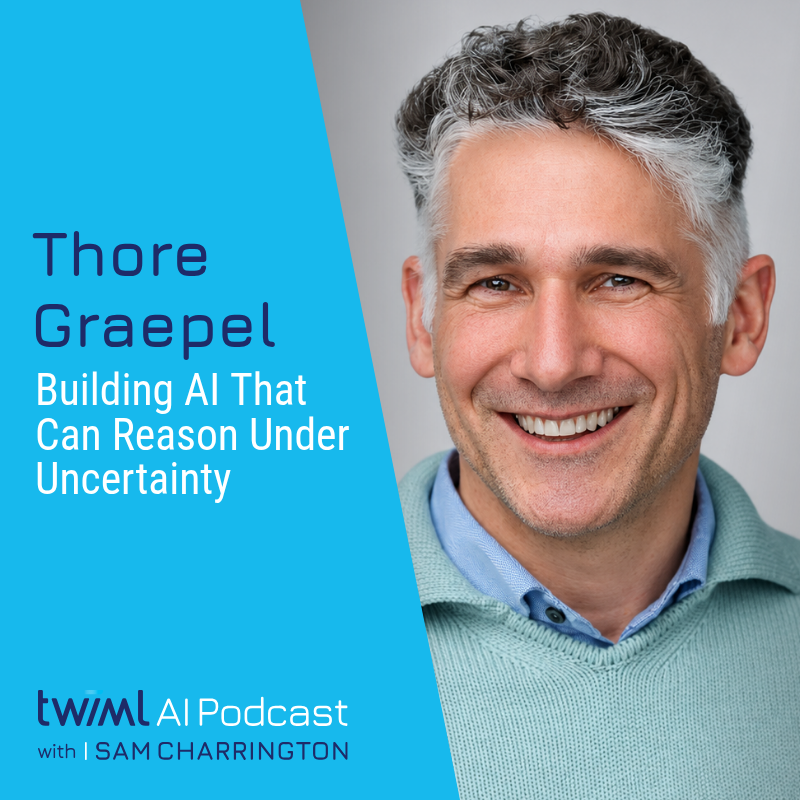
Thore Graepel helped build DeepMind’s AlphaGo (and later AlphaGo Zero). He joined DeepMind in 2015 and participated in the AlphaGo development; he also describes an early “test match” where he lost to Baby AlphaGo.
0:00Today's guest, Thore Graepel, helped build DeepMind's famous AlphaGo system, and he thinks it offers an important lesson for how we're building AI reasoning systems today. That lesson starts with the system's decisive Move 37, a play that surprised expert Go players. Thore argues that generating more tokens won't get us all the way to AI that can make discoveries and reason under uncertainty. For that, we need systems that can represent what they believe, test hypotheses against evidence, and decide what to investigate next. At Metis Reasoning, Thor is developing an approach that uses language models within that larger process.
0:37The system's inspiration comes from a revealing gap between what AlphaGo's neural network predicted and what the system chose to do. The policy network had assigned a very low probability of one in 10 ,000 to this particular move in that position. And so clearly the pattern matching system didn't think it was a good move. So it must have been the other part of the system, namely the GameTree search that selected this move. The GameTree search, of course, looks at future variations and then judges the outcomes of that. I'm Sam Charrington, and this is the TwiML AI Podcast. For over a decade, I've been exploring the ideas and innovations shaping the future of AI through conversations like this one that help you understand what's real, what's next, and what matters.
1:25Let's jump in.
1:35when you talk about the scientific process to what degree is a primary use case here science or scientific discovery like are those two separate ideas or like you're applying the scientific process because the primary application is scientific discovery? Yeah, no, I wouldn't say that. We apply the scientific process because we believe that it's the only reliable process by which new knowledge can be generated. And then what we might call scientific discovery is one application, for example, in biotech or in physics. But equally, you could apply this to questions in finance or law, wherever reasoning is required.
2:20And on the other end of the spectrum, you can even apply it to robotics, which we view as a reasoning problem. And where we think that, you know, ultimately general reasoning and embodied reasoning will converge to allow one to control robots towards long horizon tasks. What are the things that you think that everyone else in AI is getting wrong? Yeah, well, I don't think everyone's getting them wrong, but I think the idea that directing a token stream, you know, a next token prediction is the ultimate solution to AI, I think misses an important bit, namely that we should explicitly represent what the system believes about the world.
3:11So tokens cannot be true or false. They can just be a plausible next token. But if you work, for example, with propositions about the world, then those can be true or false. There are statements about the world. And I believe that reasoning needs to represent these propositions. It's to represent its knowledge about the world. And then we can use evidence and reasoning to either confirm those hypotheses or disconfirm them. But that should be the currency of AI, the proposition about the real world rather than the token. The fundamental approach is more a neurosymbolic one than a pure kind of probabilistic language modeling type of approach that has become very popular.
3:59Yeah, no, I think that's fair. Exactly. I think it's very valuable to go back in the history of AI and recognize that there are these two big strands. There's the symbolic strand about logic, knowledge representation, where you can make exact statements and derivations. And then there's the adaptive learning strand. We have neural networks and you interface with the world, perception, language work well. But ultimately, if we want to build AI systems that reason reliably and can make good decisions for us, then we need to combine these two big strands of AI. In a way, I'm saying the pendulum is swinging back a little bit.
4:41We've made a lot of progress on the neural side, but now it's time to reintegrate with those other aspects of AI. There's so many parallel pendulums swinging in this space. You can see that. Talk a little bit about your background on the AlphaGo team and why that is such a kind of a touchstone for your work and your beliefs about reasoning in AI. That was really quite a transformative experience for me to be on the AlphaGo team. You have to imagine on my first day at DeepMind in 2015, first day of work, I come in and David Silver asks me to play a little test match against baby AlphaGo, which was the product of an internship project that Chris Madison was doing under the supervision of Ilya Zuzkevar.
5:35and they had that program. I am an amateur Go player, one done Go player, and so he asked me, can you play a little test match? And I think it was already Aja Huang, the hand of AlphaGo later on that you can see in the documentary, brilliant developer as well, who controlled the other side and I had this match against AlphaGo and I have to admit, I think I'm the first person who officially lost against Baby AlphaGo. It was a bit of embarrassment on the first day at work, but the great thing was after that, everyone knew me because the table was surrounded by all the 60 DeepMinders at the time that were working at DeepMind.
6:24It was a great entry to the team. And then from then on, Dave and I, with other brilliant people, of course, worked on AlphaGo and then, you know, the match and AlphaGo Zero towards ever more general autonomous systems that are able to reason in these settings. And yeah, that was a fantastic experience. A lot has been said and written about AlphaGo and kind of the famous move 37. What has it told you about reasoning and what's required to achieve reasoning in AI? Yeah, that was a remarkable moment. I mean, just to recall, you know, I was sitting in the audience room. There was a commentator, Michael Redmond, who is a 9-done Go player.
7:21And he put on the commentary board the Move 37. And then he took it back and said, oh, no, this must be a mistake because it was such an unusual move at the time. Right. And so then he put it back on the board and said, oh, you know, maybe this is a good move and so on. And the interesting thing was, okay, it was a move that was effective, as we found, because AlphaGo won the game there. But it was also novel and surprising to people. And you could argue that those are the three hallmarks of creativity, that something is somehow effective, novel and surprising. And then, of course, the question is, where did that come from?
8:06How can such a system create such a novel move? And the interesting thing was that Dave dug into the system a little bit and found that the policy network, you know, the neural network that takes a position and gives a probability distribution over moves and basically allows you to pre-select promising moves, had assigned a very low probability of 1 in 10 ,000 to this particular move in that position. And so clearly the pattern matching system didn't think it was a good move. And that makes a lot of sense because that system was trained on human data. And so if it's surprising to a human, then it would be surprising to a system that's trained on human data.
8:55So it must have been the other part of the system namely the Game Tree search that selected this move. And the Game Tree search, of course, looks at future variations and then judges the outcomes of that. It's a reasoning process in the sense that I think is the right kind of reasoning that AI should be using. And it was then that system that chose this move based on the consequences that unfold from that in its estimation in the game tree and as judged by the value network. And so the general lesson I think that we can learn is that a system that is purely based on imitation and that in our case that was the policy network that was trained on human gameplay, but similarly large language models that are trained to predict the next token on human generated text, that those are very unlikely to produce surprises or truly new knowledge.
10:01And that it is a dedicated reasoning process that looks at the consequences of an action or of a discovery that can break out of this convex hull of human knowledge and truly discover new things. And how broadly applicable do you think that general model is? For example, I'm thinking about there's a class of problems now that we're applying language models to coding, math, that have this quality of verifiability. And we can move much faster in those areas because we've got this closed loop that we can execute and allow the training process to kind of be self-correcting. In other areas where we don't have kind of this verifiability property, it's a lot more difficult to make progress.
11:00You know, when I think about kind of evaluating GoMove's, that feels like a verifiability, like a verifiable kind of thing. Like we've got some metric that we can apply and we can roll that out over lots of different permutations. But, you know, many more situations in life don't have that. You think inherently limit the applicability of the approach that you're proposing? Well, I think that distinction is very important. And I mean, you're absolutely right. Verifiable domains, and I would include these games in that because you can observe win and losses, for example, against another player. That is an important difference.
11:37And it's much easier to train models when you have the verifiability property. But that doesn't mean that you cannot reason or learn to reason in other domains. The key is that you need to be, you need an objective function, as it were. You need to understand what you're trying to achieve with your reasoning. And the natural, I think, very general objective function is to reduce uncertainty. So when you move from a game like Go into the open world with its complexity and its ambiguity, the noise, you know, the stochasticity in the world and so on, then of course the resulting system will have less certainty in its conclusions.
12:28But that doesn't mean that we cannot draw conclusions. I mean humans can reason about new unknown things. They do it all the time in all kinds of domains including science, engineering, medicine and so on. And they use the scientific method. And the scientific method, in my estimation, is the only reliable way to create new knowledge. And the scientific method, of course, works by having a representation of what you currently believe to be true with respect to some question. and then reasoning on that, developing this representation of what you believe further in order to reduce uncertainty about the question at hand.
13:13And you do that by two types of moves. We actually characterize this as a bit of a game in our work. So your internal representation of knowledge is kind of like the board and your moves in Go are like evolving your understanding or your knowledge. Exactly. And because we have an objective function, which is uncertainty about the world that we want to reduce, we can then learn how to play that game well. And you might ask, what are the moves in this game? And the moves are very much what you and I would think of as moves in the reasoning game when we reason through problems. take a problem and what you typically need when you have a question is you need to frame the question in the right context, right?
14:03And once you've done that, you want to form hypotheses that could be the answer. Or if that's still too hard, you want to decompose the problem into sub-problems and then recursively work on those sub-problems, for example, by posing hypotheses that might be answers to those sub-questions. And then you want to pull in external evidence that somehow gives you a way to either confirm or disconfirm those hypotheses. And I don't mean that in a binary sense. I mean, it could very well be that the evidence increases or decreases your belief in a hypothesis being true. And we can quantify that using the calculus of uncertainty, which is probability theory.
14:54And so just as humans would proceed in their reasoning process, we can teach machines to follow similar patterns. We basically formulate a language of reasoning that sets out the different reasoning moves that can be made. And then the system can learn the best policy to reduce uncertainty about any question that we pose to it. When you think about the uncertainty estimation part of this mechanism, do you think of that as a challenging aspect of applying this approach? Or do you feel like that part is mostly solved in the ways that we'd want to apply it? No, I do believe that it is a difficult question, but I think probability theory is the right answer.
15:50You know, Ed Jaynes wrote this book, Probability, the Logic of Science. And so in that sense, I would use probability here as a calculus of uncertainty. And under the hood, it becomes a sophisticated problem. You know, you want to, you have the reasoning process and you set out different hypotheses, you decompose the problem into sub-problems and so on. You find evidence that relates to these hypotheses. And now you need to formulate this in a probabilistic context so that you have consistent hypotheses associated with the different configurations of that system. And for example, there could be a logical relationship.
16:44This hypothesis might imply that other hypothesis. And so then you need that to be reflected in the probabilities that you assign to these hypotheses so that jointly everything is consistent. And when you add more evidence, that you then update those probabilities in a coherent way so that they then, after seeing that evidence, represent a coherent belief state for you. And it is that growing of that belief state through the reasoning process that is really at the heart of what I think reasoning should be. But once you have that, interesting things open up because now you can go beyond binary statements and you can actually give answers with a certain probability, which is very important to make good decisions.
17:42For example, a medical doctor might have a certain probability of thinking that it is one disease or another in the diagnosis task, and that can be very important for making the right treatment decision. But the uncertainty estimates also have the advantage that I can now choose my next reasoning move so as to maximize the reduction in uncertainty. because I can now think about the different options I have and I can choose the option that reduces the uncertainty the most or I can choose the option that for a given cost in time or computation or money reduces the uncertainty the most. I give you the doctor's example again.
18:33You know, the doctor, you know, a patient comes in, the doctor could decide to either ask them a question. So what's wrong with you? What symptoms do you have? Or they could immediately ask, do an imaging scan or a biopsy, right? And why is one better than the other? Well, the question is so good because it gives a lot of information, but it's also extremely cheap. You know, you can just ask the question, you get the answer. And so the bits per buck, so to speak, is very high for that question. And so you want to ask that question first and not first to the imaging, which could be completely pointless in light of the answer to that question.
19:15And so that's the kind of decision process that good reasoning is. It's a complex game that you play with the goal of reducing uncertainty by making the right kinds of choices about deductive and empirical moves that you make. One question that jumps out at me hearing you describe this and the doctor example in particular is, do you envision that in applying this, I'm going to look at my scenario and kind of craft uncertainty estimates or very specifically around my scenario, my medical scenario, for example, is there or do you envision a mechanism where we've got this general capability for a system to create uncertainty estimates about general concepts and kind of mapping to the LLM use case.
20:08We're not telling an LLM to reason about medicine or about, you know, fixing a car or these very specific scenarios. It has this general ability to make token predictions based on, you know, this language, Right language and these examples that have been baked into the training data. Is this kind of neurosymbolic approach that you're proposing, is it equally general or does it have to be very tuned to specific examples or the specific use case? Yeah, no, I think it can be equally general. So in some applications, you will find that you can find out what the probabilities are. For example, a medical test is characterized by basically the false positive at the false negative rate.
20:59And these are the probabilities needed for such a system. But in other cases, of course, that's a little harder. For example, if you do a look up on Wikipedia and you find that something is the case based on what you read in Wikipedia. Now, is that 100 % true? should you assign a 100 % probability to that? You know, I'm a Bayesian. I would never assign 100 % to anything. What's your prior? So I always leave myself with just that tiny bit of wiggle room because that allows, if new evidence comes in, allows me to change my opinion on that. But in those cases, you have to choose a more heuristic approach at first to just say, okay, look, this is a reliable source.
21:49And so what comes out of it is two with higher probability than other sources. And then there are lower quality sources. And there the probability of things being two is lower. And it's very difficult to get those numbers exact unless you see a lot of look cases and can calibrate the system so that those probabilities in the frequentist sense, you know, become calibrated and overall right. So that is definitely a difficulty, but I would argue that's still better than not recognizing your uncertainty at all. You know, here at least we're making an attempt to quantifying the uncertainty and using the rules of probability to manipulate and combine them in the right way And it'll always be important to keep an eye on, you know, garbage in, garbage out problems, right?
22:49If you don't get the right probabilities in, then nothing, no manipulation can get you good probabilities out. But I think in a lot of practical cases, we can assign probabilities that make sense and thereby create a reasoning process that's probabilistically sound. So we've touched on a real world example of a doctor trying to make a medical determination and how an approach like this might help them. Let's go the other direction and talk about like the simplest toy example that we can use as a kind of conceptual model for like how you would apply this. So here's a very simple example. It is almost not reasoning, but I think it demonstrates something interesting about how we think about it.
23:42So if you take a question like, what's the capital of France? You know, if you ask that to a large language model, it'll instantaneously give you the answer and it's highly likely to be correct and what you mean, namely Paris. But where does it come from? It's being produced by potentially trillions of weights interacting in some way. And where do those weights come from? They come from a training data set, which is incredibly large and that you typically don't have access to. So you don't know what's in there. and so for this reason we fundamentally distrust the knowledge that's in large language models and we believe that the crucial step to make to make ai reasoning systems reliable and trustworthy is to separate the knowledge from the reasoning process and that that unlocks a lot of power because now you have an explicit representation of what the system believes.
24:48You have a process that develops that belief forward towards less uncertainty and you get out a reasoning trace that is exactly the way the system actually arrived at its conclusion rather than some arcane chain of thought that somehow was the precursor to an answer that a large language model gave. so that we have this distrust towards knowledge that's in the large language model because it could be stale it could be wrong we have no idea where it came from and so on and so uh let's go back to the paris we were probably going to the same place like what exactly is the scenario is it answering general questions is it answering questions about the capitals of countries Like how do you, what's the bounds of the system here?
25:41Yeah, no, this is just the simplest example that I'm giving, which is more of a knowledge question and we can go into more complex questions. But I just wanted to use this to illustrate that, you know, our system would take the question, it was the capital of France. It would first ask, does France even have a capital? Is France the kind of entity that has a capital? And then it would... How does it know to ask that? At that point, it uses a large language model. So it breaks the problem down into many sub-problems that can be answered with a large language model. So it's only now possible to build such a system because we have LLMs.
26:27So you don't get me wrong, I'm a big fan of this technology. I just think we should use it differently to build trustworthy systems. So the first step is you've got access to an LLM and you've got some prompting that is designed to further inquire into the question, question its premise, that kind of thing. That's all presupposed in this example. Exactly. It's almost like a reasoning pattern of questioning the assumptions of a question. And then you need to frame the question. Are we speaking about France now, in the past, perhaps, in some literary context? But once that is established, then the system puts forward hypotheses.
27:19What might be the capital of France? Perhaps London or Madrid or Paris or even bad options like Mickey Mouse. You know, the solution proposer doesn't necessarily have to be good because at that point we're not accepting knowledge into the system yet. We're making, the system just makes proposals. And so we can trust in LLAP to do that. and then the next step is that the system pulls in external evidence you know what might be able to corroborate or you know confirm or disconfirm these hypotheses that we have and it might then pull some source say a wikipedia page in this case and and now it looks at the Wikipedia statement and the hypotheses and judges if in light of the evidence given by the Wikipedia page, these hypotheses are increased or decreased in probability.
28:18And, you know, likely in that simple case, it will also find that Paris is the capital of France, but it'll not say that with 100 % probability. It will just say, look, this has the highest probability. I have evidence from external sources. And it can then give you an answer that reflects the uncertainty. And then the beautiful thing is, of course, you don't throw that information away. Now you have a little fact, a little claim for which you have evidence and the provenance of a reasoning trace. And now you can save that in an explicit knowledge representation. And next time someone asks you, you have a certified answer that your reasoning system has already produced together with confidence and together with the evidence that's attached to it.
29:07And so in that way, the system becomes smarter and smarter in terms of these certified facts as it reasons more. Are these facts specifically answers to questions that have gone through this entire process? Or is there also an element of kind of passive knowledge acquisition? While the system was looking into France, it also came across Madrid as the capital of Spain, and it applies some probability to these things also and like stores all of that. Yeah, exactly. That's a great point. So it can either be driven by questions that people or other systems ask it, but you can also direct it at a set of claims or questions and it can by itself reason through those and build up a knowledge base about that particular domain.
30:00For example, you could give it a medical paper and, you know, it would take the first claim that the medical paper makes and can now reason through this claim, determine if it believes that to be true or false, develop the reasoning process, potentially decompose it into sub-questions, pull in evidence from different sources, come to a conclusion. and all of this would then be deposited in the explicit knowledge representation. And when I talk about the source of evidence, this isn't just Wikipedia. This could be a tool call. This could be code that's being written and run. This could be simulation.
30:41It could be a call to AlphaFold if it's a question about proteins. Think of evidence as this very general notion of connecting the internal belief structure of the system with the outside world where it can get, you know, knowledge and, you know, evidence from in order to develop its belief state. The belief state is that, like, what does that look like in practice? Is it text files? Is it a dictionary of sorts? When I hear your description of the system, I wonder if a lot of the mechanisms are shared with like a retrieval augmented type of an approach. Like you start with the question, kind of ask a bunch of questions about the question.
31:25You generate more text in this case. You ask, OK, what information might I need to further research this? You got you get that information and then you stick this all into a context and you kind of let the LLM do its thing and like predict the answer. And so clearly that's missing like the fundamental probabilistic mechanism that you're proposing. but it does better than just one-shotting what's the capital of France. One of the questions that comes from that thought process is, you're generating all these claims, what does that look like? Where do you put them? And do you have the same retrieval issues that we see on the rag side in trying to get the right information into the context?
32:10I think a lot of people who develop harnesses are really patching up the same fundamental weakness of LLMs. I was describing a harness, right? Exactly. That we're seeing. But we believe that you need to do this even more at the root, so to speak. You know, you need an explicit knowledge representation about what the system believes to be true, what it believes to be false, what it still doesn't know, so to speak. And that needs to be at the heart of the system. And then you use the large language models really only to interface with the world and to interpret the evidence that comes from the world and perhaps to make suggestions for hypotheses.
33:00But you break down the reasoning process into these very small calls to language models or to other neural operators in the case of robotics to small visual language models, for example. And in that way, you don't need to rely on these systems to do any reasoning. And that's how you avoid hallucinations. Because the calls that such a system makes to these neural operators are so small and well-scoped that there's hardly any way the system could hallucinate. For example, in the case of the capital of France, There might be a Wikipedia page that gives the information that you need. The hypothesis is Paris is the capital of France.
33:50And now you're not asking the system, what's the capital of France? You're asking it, does this text snippet from Wikipedia support the statement that Paris is the capital of France? So it becomes a very well-scoped, small theory. And that also changes the computational profile of the whole method. Because now you don't need a trillion parameter model to do all the kind of processing to get the answer in complex reasoning problems. You decompose the problem and you only need a very small language model to do the semantic interpretations for you. And that is a very attractive profile. For example, if you want to operate on the edge, you know, so you want to run something on your phone or under your desk and things like that.
34:41And also has interesting sovereignty implications because suppose you don't have access to those frontier models, yet you want frontier level reasoning. You know, you can use a smaller base model that you trust and then you can have this reasoning process on top of it. and even be more computationally efficient. It would seem like the recent interest in decision models, JEV, that kind of approach would be a huge boon to your approach, right? Yeah, I think that's super interesting. I mean, I think it was really fascinating to see how that idea took off so quickly. And, you know, it was a brilliant campaign.
35:31And I can only congratulate our colleagues from TypeSave on that. And there was something interesting going on there, right? Because these models are effectively less capable than large language models. I mean, in some very simple way to say a large language model is a string in, string out function. And a decision model is a string in, numbers out or vector out or maybe just one number out model, right? So fundamentally, the output space is much smaller or impoverished, if you like, but totally in line with what certain applications demand. And what you get in return is greater performance in the sense of, you know, less compute, lower latency, and also potentially, depending on the training regime, calibrated probabilities that come out of the decision process.
36:33So I was super excited to see that. And you mentioned it exactly in this context. These are great elements for the reasoning process as well. You could quickly get prior probabilities, for example, on certain possibilities, and then develop those further, decompose further, maybe use such models again to assign probabilities, and so on. So I think it's super promising. And it really also points to the compute profile difference. So instead of making one call to a big model, you make many calls to smaller models. And that gives you a fundamentally different profile. The exact qualities we have to measure out, right?
37:18Maybe, you know, it probably depends on applications. What is more advantageous in different scenarios. But yeah, super, super interesting development, I have to say. Also the principle behind it, the idea that you do less, so to speak, you produce a family of models that clearly almost strictly does less than a more powerful model, but you get the advantages of a system that is then cheaper and smaller and lower latency and so on. It's just beautiful. Are there instances of this? Where are we on the realization curve of these ideas? Equations, actual systems, a couple of examples, tens of examples of production systems?
38:13How mature would you say these ideas are? We've been working on this for a while now within the founder team and with a few developers. And so we have first type systems that actually implement this kind of reasoning system. And so it's super exciting. You can ask them PhD level science questions and you can see how the reasoning process unfolds, how the system decomposes the problem, tries to answer sub-problems, hypothesizes, pulls in evidence, or makes tool calls. What's an example of such a question? For example, we have questions in physics or in chemistry where you ask how many atoms of a particular kind kind are in a complex molecule and the system needs to use chemical tools to figure out what the constituents are and, you know, reason about the composition.
39:20Things like that are possible. To answer a question like that, how much is, are you giving that question to a system that like a generic system that is not preconditioned to answer questions like that? Or have you had to, do you have to tune the system in some way to be able to address that particular kind of question? Yeah, it's quite fascinating. What we found is that these reasoning patterns are rather universal. And I mean, if you think about it, you're also a reasoner where, for example, the problem decomposition is a very natural thing that you do whether you have a complex problem. And then hypothesizing, pulling in evidence, questioning assumptions, calling a tool, reasoning what the question to the tool needs to be in order to answer your question.
40:18And so there's really, in a way, a finite alphabet of reasoning operations and we've characterized what those operations are. These are the moves in your game. Exactly, yeah. And then the actual policy of how to string them together and how to build this complex reasoning structure, which has many potentially fan out of different subproblems that you need to address and re-synthesize and so on. That is something that can be learned to do better. but we find that these reasoning patterns serve us across many different types of problems and then in a way I think it's an interesting point here because we were separating the knowledge representation from the process of reasoning we also get two kinds of scaling axes here on the one hand side you can take your explicit knowledge representation and having that is super valuable because you can actually inspect what you know, you know, inspect what knowledge is in that knowledge base.
41:31You can edit it. You can add guardrails into it if you like and you can do access control on it. Basically, you can do all the things that people do with relational databases and, you know, other ways of managing knowledge. But if you think about it, you cannot do any of that with the knowledge that's hidden away implicitly in the trillion weights of a transformer. There's just no way of doing that. And so that is one scaling axis. And as we reason, for example, more about chemistry questions, the system adds knowledge to its knowledge base about those chemistry questions. And there are these common denominators, things that the system has to reason through for all of these systems.
42:14And there it then basically hits the cache and you get cheaper and faster answers from that accumulated knowledge. On the other side, that's the knowledge side. On the reasoning policy side, because this is now an isolated process, we can learn that process. We can make the system better at reasoning. We have an objective function, which is a reward function in the context of reinforcement learning, which is reducing uncertainty. And so from those reasoning traces that it has completed, it can learn how to, you know, how to reason better, how to come to better conclusions, for example, at lower cost or faster.
42:58And yeah, so the system really runs across different domains as long as it has access to those sources of evidence. You know, you cannot expect it to solve difficult chemistry problems if it doesn't have access to databases about chemical compounds, tools that do certain chemical calculations and so on. Just like a scientist would need those resources. My understanding of the way that you ultimately kind of reconcile all of this uncertainty is that there is another LLM involved analogous to an LLM as a judge. Is that true? And if so, how do you end up on the other side of the uncertainty wall in the sense of like, you know, there's this thing that we don't fundamentally trust and is not designed to make trustworthy assessments or outputs.
43:53And, you know, we've got all this machinery underneath that we do trust, but it's kind of at the tail end of this or like the arbiter. Like, how do we then, you know, make the leap to trusting the output? Yeah, arbiter is a beautiful word. Yeah. And that is, in fact, the crux of the matter. So how do you maintain what I would call the epistemic integrity of the system? You don't want to make the mistake of, say, over judging the relevance of a bit of evidence because then suddenly you're overconfident on a particular hypothesis that may have downstream consequences on other beliefs that you have in the system.
44:35And so that is potentially a source of error. And there one needs to be really careful. For example, one needs to be more careful there than in hypothesis generation. You know, it's a little bit like mutation and selection, right? Right, right. If you miss a hypothesis, it just takes you longer to get there ultimately. But if you have an error in judgment when you're trying to assess or reconcile, then that can be fatal. Exactly. And so that can be a source of failure. I mean, there's no perfect system, but you're right in putting the finger on it as the point where one needs to be most careful.
45:14And the way we're trying to be careful about that is to almost build an epistemic humility bias into the system. Say, look, if uncertain, you know, really represent that uncertainty in a generous way and don't be overconfident. and we try to make these judgment decisions as simple for the system as possible. And so that means, as I said, that we don't want the system to decide if Paris is the capital of France. We just want it to decide if a particular snippet of text, say, supports that statement or not. So we're trying to push all the actual knowledge that's required from the evidence, so to speak.
45:59That needs to come from solid evidence. And the LLM only acts as the interpreter, like the semantic translator into the world of our hypotheses. And so we try to limit its scope as much as possible. And if the system cannot make the judgment call, then often a good strategy is to break the problem down into further sub-problems where those decisions become easier and easier. because, you know, you're further down the tree and it becomes, there are more kind of binary decisions. Those are basically the strategies. But yeah, it's exactly the point. But one more thing that is helpful here is, of course, that this system actually has a representation of its beliefs and how those beliefs evolve.
46:51And so if you find that you arrive at wrong conclusions, then in this kind of system you can actually go back and see where the problem arose. Was it faulty evidence? Was it a faulty judgment by this judgment system? Because you can exactly see how you arrived at your conclusion. And I think that is super helpful and that is very difficult in a system that produces, you know, hundreds of thousands of tokens. It seems to imply that the system will work best when the data sources that it has access to are, I don't know if the right word is, pure or authoritative or even well -designed, canonical in a sense, as opposed to LLMs that are reasoning over the internet.
47:41right and you know what's the capital of uh what's the capital of france well you know paris is the capital of france paris is a city in texas you know the france is the capital of france used to be uh whatever it used to be like how to all of those are true statements like how does the system reconcile all these true statements that are just kind of noise to the central question so reliable sources that it draws on, that is very important. And it is as important as it is for a human reason to draw on reliable sources. What the system can do is it can also reason about the reliability of the sources.
48:25So for example, if you have a situation where maybe an alarm goes off, then perhaps there are different reasons why that may have happened. It could be that there is a burglar or it could be that your alarm is broken and therefore went off. And so deeper reasoning about the problem can often help understand the different sources of error that could be made. So if you just look at the alarm and the burglar problem, then you may not get the full picture about what could have gone wrong. But if you allow for the possibility that the alarm can also be faulty, then suddenly you get a fuller picture of what the possible explanations are for the alarm going off.
49:17And then you can reason about it. So the reasoning process extends also into the reliability of sources, just as that would be the case for humans. And if you look at, for example, different papers for your medical hypotheses, then you would probably try to judge how reliable those papers are based potentially on the institutions or the authors or other information that you've drawn from this source which proved reliable or faulty and so on. So you can reason further, but it's also fundamentally a reasoning process to ascertain how reliable your sources are. And then there's another question which you were alluding to.
50:02You know, maybe there's some truth to it that some other city was the capital of France at some point. So how can that be true? That can be true because there are different framings for questions. and managing frames in knowledge representation is a very important thing. For example, there could be this question, how old is Gandalf? And the natural frame that most people would jump into would be, oh, Gandalf is most prominent as a literary figure from Lord of the Rings. So let's assume that framing for now. And then you can give an answer. I don't know what the answer is, 800 years. Something like that.
50:46Probably pretty old. But it's not the only possible frame, right? It could be that my dog's name is Gandalf. And I was really asking the system about the age of my dog. You know, and this is the case for all kinds of questions. And it's, I think, important not to think of knowledge representation as a representation of truths about the world in some unconditional way. But the more useful way to think about it is to say that these claims that are stated are made within a particular frame. For example, in the frame of Christianity, God exists. There's no doubt about it in that frame. Whereas in a scientific frame, you could say that God doesn't exist or God exists only with some probability and we could maybe investigate the question.
51:43And so a good knowledge representation takes frames into account because if you drill down on it, almost every question, you know, will have this kind of framing problem. And, you know, the correctness of the answer does depend on the frame. And I think we can learn a lot from, you know, the old, what you might call good old-fashioned AI, the other strand of AI that was concerned with symbolic representations, correctness, logic, and knowledge representation. And a lot of research has gone into that. And a lot of recent successes of AI have come from the neural paradigm. I mean, it's been spectacular, right?
52:33particular deep learning and language models and so on, but also vision models and so on. Most of it now are neural models. But there are fundamentally things that we might want from such a system that you cannot achieve with neural systems. And these are statements of correctness, explicit knowledge representation that you can audit, that you can edit, and so on. exact guardrails that you need your system to obey. And I almost think of it as a large language model, a little bit like a stream of consciousness human thinker. And we're also not that great at reasoning. What makes us great at reasoning is if we use tools, like for example, a person versus a person with a piece of paper and a pencil.
53:24You know, the person with a piece of paper and the pencil is typically the better reasoner because they can write down their assumptions and decompose the problem and keep intermediate records of what they're doing and so on. And so in a similar way, I think we need to bring these two big strands of AI research together in order to get reliable, auditable systems for reasoning. Is the representation static or is it dynamic? Meaning there's the shape and the structures of representation and then there's the things that go in the representation, the content. Like are the structures the same across all domains and you just kind of fill them in dynamically as you're kind of processing a question or a problem?
54:20Yeah, I mean, this is a huge research question of how best to represent knowledge. And, you know, we certainly don't have the final answers to that. And it's a good question. So can you build one general schema that could accommodate potentially all of knowledge and allow us to formalize all of knowledge and to reason over all kinds of knowledge? And that's a hugely ambitious goal. my colleague here in Cambridge, William Tunstall Peddo he has been asking in recent posts that he made similar questions and he's talking about a universal language would it be possible to create a formal language that can describe all kinds of knowledge in a way that is formalized where we know exactly that a given identifier in the language stands for a given object in the world?
55:22And can we do this in a coherent way? I'm not sure we can. I think it's a great question to ask. And in the past, history of AI, there have been attempts at making this possible. In particular, the Psyche Project by Doug Lennart was an attempt to create a huge knowledge base of common sense knowledge that would serve as basis for an AI system to be able to answer questions and deal with real world knowledge. And that, I would carefully say, wasn't such a great success. but the landscape has changed. We didn't have large language models that we didn't have the capability that we now have to extract entities from text in a very fluid way to translate from one representation of text to another.
56:23And so maybe it is time to tackle this problem again. I think to make such a reasoning system work, you don't necessarily have to solve all of these problems. You know, for reasoning, often some kind of local consistency is enough and trying to enforce some kind of global consistency on an entire body of knowledge can be a bit of an overkill. That's an interesting distinction, yeah. Yeah, it sounds like you're saying that kind of general knowledge needs what is lean for math. Right. We're doing all of this formal verification and logic and kind of pushing math forward, you know, with AI around this lean language.
57:10But we don't really have that for general representations or general knowledge. Yeah, that's that's a super interesting analogy. I think that's that's right. So we want to create reasoning systems that are as rigorous as is possible in an open, uncertain world. Certainly, we cannot go as far as lean formalizations because we're lacking that property of verifiability that we talked about earlier. And things are just not as black and white in this complex world. But as an ambition to say, look, can we push towards more rigorous reasoning? Can we use formalism to advance our rigor of understanding?
58:00I think it's the right question to ask. And then if you're dealing with uncertainty, then that naturally leads you to probability theory as the calculus of uncertainty. And then once you have made the translation, for example, into probabilities, then you can at least rigorously manipulate those and combine those probabilities. in the right way. And it's actually interesting that you mentioned it because the team I'm working with at Matters Reasoning on these topics actually comes from this very background. You know, our initial project was an AI for mathematics project and, you know, working with lean representations directly and, you know, trying to find proofs in graph-based representations of theorems.
58:53And we can really understand what we're trying to do now as generalizing this rigorous core and trying to see how can we generalize this to the questions people care about in the real open world without losing all the rigor, retaining as much rigor as possible in the reasoning system. How do you think benchmarks change to better kind of accommodate or recognize what you're doing? Like, are they different? Are they the same? Yeah, that's a great question. And I think you're pointing to something interesting, which is that how we define our benchmarks in a way gives us the direction in which we move our research.
59:38And so it's really important to define the right benchmarks about the things that actually matter to us in order to then drive the research in that direction. And so there are a lot of reasoning benchmarks. For example, GPQA Diamond is one of those with, you know, PhD level technical or science questions. and we can evaluate our system on these questions. We need all the tools installed that are necessary to answer the questions. And that is certainly very valuable to do that. It's great that we have them. But what is being measured is perhaps not exactly what needs to be measured. So you can come to an answer, an often a correct answer on a multiple choice test without actually presenting the full reasoning trace.
1:00:39And so I think it would be good to expand these benchmarks such that they not only check the answer, which might also be in the training set, by the way, for the frontier models. That's always a bit murky territory, I think. But what actually matters for a lot of applications is that you can see how the system arrived at that. And so I think these benchmarks are a good starting point, but it would be even better if there was a way of objectively scoring if all the intermediate steps of reasoning, the reasoning strategy, if that was consistent and actually leads to the result. or if there are steps that are being skipped and assumptions that come in that are unjustified and so on.
1:01:29And so I think it's a very good idea to think about how to extend those benchmarks and what is being measured in them in order to pin down exactly if a system does rigorous reasoning or is more or less guessing at the answer at finding post hoc explanations of why it arrived at the answer. Which is, to that last point, a very different approach from what you would apply in an LLM scenario, because those reasoning traces can be anything and are not, you know, they're post-op, right? They're not causal to the answer in any way. Exactly. It's actually quite entertaining to look at them, right? Have you seen the ones where the LLM gets really panicky?
1:02:14Where it says, oh my God, the user is asking me to do this and I don't have the answer yet. I mean, what shall I do? And things like that. And of course, also the frontier model providers are now obscuring the reasoning traces or the chain of thought traces and encoding them because they want to avoid distillation from them. And so, yeah, that is exactly the reason why we think that that isn't proper reasoning because you cannot rely on the trace. In some sense, the reasoning is more than the outcome of the reasoning. Reasoning is also the argument that leads to the result And really the output is that full package that you need in most critical applications.
1:03:04I couldn't name the benchmark, but I would imagine that there's some version or versions of a kind of a show your work kind of benchmark out there. I think some people have have extended things in this way. But, you know, it is a tricky construction because, of course, you then need to use an LLM judge to decide. Right. Like what's your representation of your your work, right? Exactly. Yeah.
1:03:57And now we have these other tools now that, you know, what we call AI today, like LLMs can help us do that. Like they're, you know, we're using them to do the reasoning and they're kind of not great at it. You know, they're okay in some use cases, but they have their issues. But they also can be used to like populate this other way of approaching it. Is that, you know, a fair oversimplification? Does it, you know, does it miss fundamental things? like, it's like, hey, we've got chocolate, we've got peanut butter, like now you've got Reese's, right? I guess it's a little bit like the dog and the tail, you know, the...
1:04:36In a sense, yeah. The key observation is this idea that you can use, you know, what we do is, wouldn't have been possible 10 years ago or even five years ago because these systems weren't available. What we do is only possible because we can ask an LLM to present possible hypotheses for a given question, or because we can ask it to interpret a source of evidence in order to assign probabilities to different hypotheses and so on. And so I think the main insight is don't use the large language model to push all the complexity of the reasoning into it. Because you might get an answer, but it's obfuscated with that chain of thought reasoning trace, very hard to interpret how the system arrived at the conclusion and so on.
1:05:37But turn it around and design a reasoning process that makes use of the semantic interpretation skills of these models, but break it down. And so it fundamentally turns that on its head. But it's really only possible because we have LLMs and VLAs in the visual domain and so on. And we're just saying use them differently. Don't use them outside of the scope of their utility. You know, don't use a large language model to store a lot of knowledge in it and rely on the knowledge in there because it's unreliable. You cannot trust it, but use it for what it is really good at, namely to, you know, manipulate evidence, claims and so on.
1:06:28And then you will get reliable outputs. I think what's really interesting about thinking about it like that is that you may have an approach that you and your team favor that's inspired by AlphaGo, for example, and the structures that you built there. But it also kind of says that, you know, we've got this like neglected treasure box of things that were tried before that didn't work because we couldn't like mechanize them or automate them sufficiently. you know let's open up and like dig through that box and like you know other teams might pick other pieces and like take LLMs and what we have now on this shelf these new tools and like bring them together and like you know there's a promise of a thousand flowers blooming in this new kind of you know hybrid model as the pendulum swings the other way.
1:07:18Yeah I think that's exactly right I mean if you imagine I think the Dartmouth workshop you know the kickoff of all of AI research and so on was about 70 years ago now and there's this rich research history in the field of AI where people didn't have these large language sources and they needed to think about how to formalize things what is knowledge, how to represent it, how can we draw reliable conclusions and so on and now equipped with our adaptive learning systems, going back to that and seeing what can we learn from that? And can we combine these methods together to get the best of both worlds, the reliability, the formalism, and so on for one side, and this fluidity, this phenomenal ability for pattern recognition, pattern completion, and so on from the neural side.
1:08:22And then bringing these two things together, I think it's an incredibly fruitful area for us. Super interesting. You and Metis recently published a white paper that builds out a lot of these ideas. We'll link to that in our show notes. Are there other places that you would point folks to, you know, learn more about this area or start thinking about it more deeply? No, I think that is a great starting point to look at that. And then, you know, in a way, there's really this going back to the AlphaGo architecture because that already encompassed this duality of what Kahneman called System 1 and System 2, the neural System 1, fast pattern completion recognition, System 2, careful planning and so on.
1:09:07And so kind of going back to the roots and understanding why that was so powerful in AlphaGo and then seeing the continuity to what can be done today. And then ultimately going back to the original sources. I mean, I always recommend people, you know, read some of the old papers because there's a lot of wisdom there and it's mostly been forgotten. Well, Thor, thanks so much for jumping on and sharing a bit about what you and your team were up to. It's very, very interesting. Great. Thanks for the great discussion. Thank you.
In this episode, Thore Graepel, CEO and co-founder of Metis Reasoning and Chair of Machine Learning at UCL, joins us to explore an approach to AI reasoning inspired by his work on AlphaGo. We discuss why he believes reliable reasoning requires explicit representations of knowledge and uncertainty, with language models helping to generate hypotheses and interpret evidence. Thore explains how a system could break down complex questions, gather evidence, and choose its next step based on the uncertainty it expects to resolve. We examine how this differs from agent harnesses, where smaller models and decision models might fit, and how knowledge and reasoning strategies can improve independently. We also consider the difficult judgment calls involved in assessing evidence, handling conflicting sources, and avoiding overconfidence. Finally, we discuss the limits of answer-focused benchmarks and what it would take to evaluate whether a system’s reasoning genuinely supports its conclusions.
🗒️ Full show notes: https://twimlai.com/go/786.


Scan the code with your iPhone camera
Listen in the app.