
 Ask ChatGPT
 The Unofficial Shopify Podcast
10 Nov 2026 · 42m · 11 chapters
Shopify Editions Fall ’26 and two Shopify marketing updates: Shop Campaigns (now global) and Campaign Autopilot (now general availability), plus related messaging about email and Sidekick.
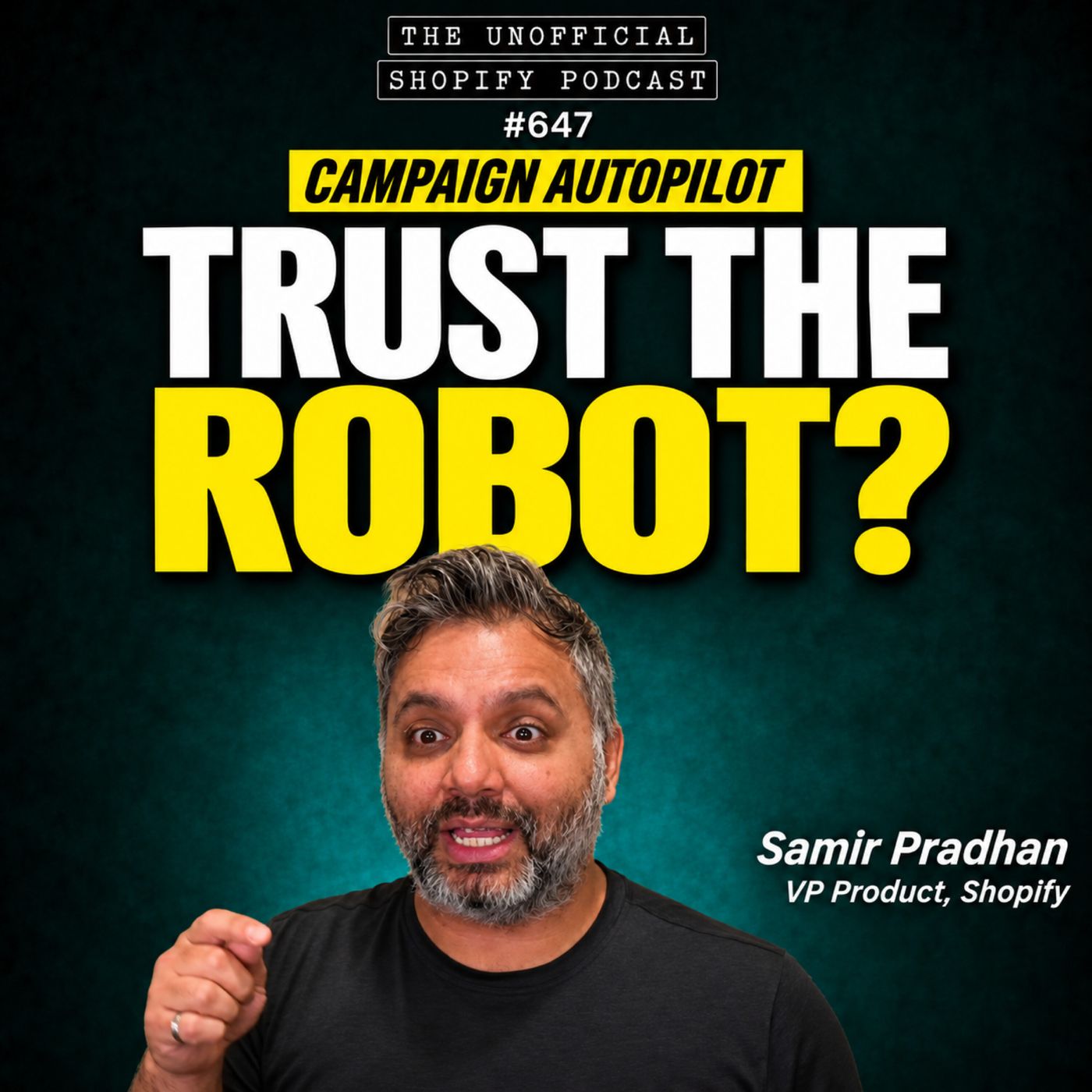
Samir Pradhan, VP Product, Merchant Marketing at Shopify; previously ran ads at Pinterest, Google, and YouTube.
Written by AI. May contain mistakes.
Explore the new features and marketing strategies for Shopify merchants.
“We are joined by Samir Pradhan, VP of Product, Merchant Marketing at Shopify, who, man, this guy's got experience with it.”
Learn about the expansion of Shop Campaigns to 35 countries.
“So we've got, all right, of things in additions, Shop Campaign, Shop Campaigns now available globally.”
Discover how pay-per-sale advertising works and its benefits for merchants.
“I said, it's kind of the easiest sell there is because it's so merchant-centric.”
Explore how Shop Campaigns incentivize buyers and drive sales.
“We take it one step further and we say, you only pay when there's a sale.”
Learn about the importance of customer retention and effective retargeting.
“And we facilitate that in a very natural way that's part of the experience in shop.”
Learn how smaller brands can engage existing customers to drive repeat sales.
“Part of that, especially for smaller, newer brands, is saying, I know someone bought it for me before.”
Explore how Campaign Autopilot utilizes AI to enhance marketing efforts for Shopify merchants.
“And now I try to do everything end-to-end agentic if I can.”
Understand the importance of trust and control in using AI for marketing campaigns.
“Walk me through that process or what those guardrails, what that trust-building exercise with the robot looks like.”
Discover how Campaign Autopilot can help merchants explore new channels and manage their campaigns more effectively.
“And for them, this is probably the strongest growth partner and they're just sitting with them.”
Understand why email is still a powerful marketing channel when used effectively and how it can be personalized.
“I want to throw money at this and see what it does.”
Envision the future capabilities of Campaign Autopilot and its impact on merchant interactions and marketing success.
“And now, you know, even if you're like, all right, I just tried it.”

Get the gist, explore an idea or ask about something said.
 Claude
On The Unofficial Shopify Podcast, what are the key points of this episode?
Searching your listeningAutomatic transcript. May contain errors.
0:00This episode is brought to you in part by Swim. Here's the thing about wishlist apps. Most of them just sit there. A customer saves a product, and then nothing happens. Swim actually activates that data. When someone wishlists a product, you can trigger price drop or back-end stock alerts and feed that intent directly into Klaviyo or your CRM. You're not guessing what people want because they've told you. Plus, customers can share wishlists for gifts, and your team can view them to offer personalized service online or in-store. And unlike card abandonment, wishlist data is permission-based. These are people raising their hands saying, hey, I want this, just not right now.
0:39Swim's been around for over a decade. It powers 45 ,000 stores and installs in about five minutes. You can try it for free today at getswim.com slash kurt. That's G-E-T-S-W-Y-M dot com slash kurt.
1:11okay but severe you run ads for shopify but shopify is not an ads company as far as i know yeah i mean you know i think i think shopify um looks at ads very differently than most companies that build ads related products. The key part of it is to kind of be very, very merchant centric. A lot of merchants, when you talk to them, you listen to what they're saying, all kind of say the same thing, which is want to grow. Growth is our biggest challenge. And our answer to that is, well, how can we help you start selling in more places? And so when we think about ads, we think about helping the merchant be in control.
1:54it might be a new merchant that has never tried ads before and helping them get started in the easiest way possible with as little risk as possible and so you're right we're not an ads company but we think ads is a great way for merchants to start selling finding new customers re-engaging existing customers and the products we built kind of have that merchant centricity so that they can start on with that i love it that's what we're going to talk about today on the unofficial Shopify podcast. We are joined by Samir Pradhan, VP of Product, Merchant Marketing at Shopify, who, man, this guy's got experience with it.
2:32You ran ads at Pinterest, Google, and YouTube, right? Yes. Yeah. Yeah. I mean, so great experience here. And welcome back. We last talked, I believe, last April about campaign autopilot. And at that time, it was in limited availability. Today, it's general availability, but we'll get into that. and man like that i'm excited about because but you know i think i'm for as deep into ai as i am i need you to convince me to trust the robot on this one but we'll get there so okay absolutely we'll we'll we'll talk about all the ways you can trust the robot yeah we'll get there uh samir so all right shopify editions fall 2026 just dropped within it what uh what are you in charge of?
3:16What are you responsible for and proud of? I'm proud of all of it. I think if you look at the sum total of all what the company's worked on in service of merchants, it's frankly just incredible. And our theme this year is exponential. It just represents the idea that when you start adding in all the features and the layers to go from your store to how you grow it, how you optimize it, et cetera, that value compounds and really can help a merchant take off. Within that, what I oversee is the marketing section. And that's from a merchant's perspective. So how does a merchant use marketing to start growing their customer base?
4:01They're going from having no customers to a set of customers that buy the first time, from a set of customers that buy once to buying again. And there's a bunch of different, you know, things that we launched from like making that easier to do, allowing merchants to do it in more places, understanding the impact of their marketing. We're excited to talk about it with you today. So we've got, all right, of things in additions, Shop Campaign, Shop Campaigns now available globally. Yes. Previously, where was this? Was this North America only, US only? US, Canada. Yeah. Okay. And now who's got it?
4:41Well, now it's in 35 countries. It's basically anywhere where ShopPay is. So, you know, we went from US and Canada. We've got Australia. We've got a large part of EU, you know, Italy, France, UK, et cetera. Gibraltar is one of the countries that we now support. So it's a lot of countries. And, you know, we see merchants, of course, you know, selling more through shop campaigns. and advertising in their home markets, but also, of course, merchants sell internationally. And so we've opened up access to that buyer network in all these markets as well. So if I'm in the US and I sell internationally, can I advertise in those countries?
5:20No. And then if I'm in, you know, I'm in Gibraltar, I could run these campaigns as well. You do it. Perfect. Okay. So we've got our availabilities expanded all around. Right. Walk me through. I want to walk through shop campaigns again because it works differently. Yes. When we talk about digital advertising, typically we're referring to PPC, pay-per-click. This is PPS. It's pay-per-sale. Which I think could be tough for people to wrap their head around because they're not used to it. Someone recently asked me, how do you convince someone to run shop campaigns? I told them, I was joking with them.
5:53I said, it's kind of the easiest sell there is because it's so merchant-centric. If you think about it, new merchants, but also merchants that are scaling. I think all of us have, you know, if you've ever advertised, you have this thing in the back of your mind, like I'm spending money. How do I know I'm going to get a good return? I think there's that old adage, like, you know, 50 % of my marketing money is wasted. I just don't know which 50%. I don't know if you've heard that before. It's always stuck with me. You know, it's about the, if you knew what worked, you could spend better. Well, I think we approach that from the perspective of merchant that isn't an expert and doesn't have to be.
6:35And we kind of say like, look, on other platforms, kind of just the ads industry is going to grow up saying you can buy impressions, you can buy clicks, you can optimize towards sale. We take it one step further and we say, you only pay when there's a sale. And that I think kind of makes shop campaigns the easiest way to get started and also one of the most risk-free ways to do advertising um and so merchants really really love that so all right when we say pay per sale what counts as a sale like order confirmed order confirmed yeah and this is like you know you use shopify you see an order there's attribution to that order this isn't about you know claiming attribution through a variety of different touch points this is like go of a sale here it is and you know i think that That gives a lot of trust to merchants that when they pay, they know that there's an outcome associated.
7:31That builds a lot of trust. That gets people started. And then my shop campaign, what are my placements here? Is this just solely inside shop app? Well, it's great. You know, when a merchant advertises, ads are part of the shop app. So we provide access to buyers that use shop to discover new brands and, you know, transact in shop. And all the wonderful brands on Shopify, that use Shopify, they are, you know, on shop. And, you know, buyers get access to those brands, discover those brands. And the thing that we think that makes shop campaigns unique is that there's often a buyer incentive. you'll get a deal or you'll get something that kind of motivates you to try and buy a brand out.
8:20So those placements on shop are actually quite a fan favorite from a buyer perspective. Give me an example. Cause I know like I'll log into shop and I'll be like, oh, you've got shop cash. Oh man. Now I got to spend this. What a good problem to have to spend shop cash. I think, I think, you know, one example would be, you know, someone said, look, I'm willing to spend$40 to get a new customer sale, a new customer sale. And by the on shop campaigns, you can kind of say, I only want to spend$20 to get re-engagement from a customer that might've bought for me before, but for a new customer, here's what I want to spend.
8:53We help do is say, well, part of that is, you know, making sure that offer, it gets in front of the right buyers. And part of that is also making sure that those buyers get an incentive to buy. So they might see, you know, if you buy X dollars worth, you'll get Y dollars off. And I think that really helps drive buyers to discover, try and take action on brands they may not have seen before, products they may not have not bought before. And we facilitate that in a very natural way that's part of the experience in shop. Yeah. Natural way. When you're saying it out loud, I'm like, all right, that sounds a little funny, but try it.
9:31It does feel natural. I have seen the shop campaign on the back office side and opening the app and then getting the shop cash, I'm still going to go for it. Right? It's effective. Yeah. But Kurt, you mentioned where the placements are. And one of the things we do for a lot of folks, shop campaigns is the first way they get started with advertising. And we help bring access to buyers that we find on Google, on Meta, on other platforms, even TrackGPT, actually. bring them back to shop and, you know, help grow that buyer base, customer base for those merchants. And what's interesting, you know, this goes back to our merchant aligned point of view, because we're doing this in a way where the merchant only pays when there's a sale, we actually take the media risk when we buy off app.
10:30And if we don't buy well, that's on us. That's not on the merchant. But if we buy well, it's such a great experience where that merchant would have gotten a sale from a buyer that they've never seen before from a channel they don't have a campaign dedicated on. And that is something that we've gotten a lot better as we've been doing advertising in the past few years. Buying and finding buyers, bringing them to shop, getting them exposure to merchants and driving those sales. so I could do this one campaign, one shop campaign. It'll appear in shop, which like that shop is great. It functions like a marketplace.
11:08You know, the, if I am using the app fundamentally, you know, even just opening an app called shop, I am prime for shopping. I'm browsing in the very minimum. Yeah. Um, and, but then in addition to that, okay, we need advent inventory. There's only so many people in one app, but there are more people elsewhere on the internet. So we can also show the same offers. and this is all through one campaign in meta, chat, GPT, Pinterest? Cool. It's like, it just seems good when you hear it explained and then I could set like, what's my minimum to do this for budget? And I think, you know, the help doc's pretty helpful for folks to get started, but it's pretty low minimum.
11:53I can get back to the details, but like you could just start with a daily budget and what you're willing to spend for a customer acquisition. And actually, speaking of minimums, the reason I have to look up the answer, by the way, is because we recently reduced a lot of the minimums on the product to make merchant eligibility way easier so that more merchants can get started. So it actually is supposed to be the easiest way to get started and the minimums are not supposed to get in the way of that. I don't think I've ever been asked, what's the minimum? because I think it's pretty flexible, actually.
12:27Yeah. All right. I will check the help docs. Yeah. We'll see. We'll make sure you get it, too. Yeah. So, yeah. I mean, looking at the... No, there's not a fixed minimum budget for shop campaigns in the help doc, anyway. Yeah. Yeah. So, there you go. But... And then daily budget is required. So, I just... That's what I have to set. It's just decide this is my daily budget. And it's... From your description, it sounds like I'm going to do a lot better. I'm going to have a better time. This is true of all online advertising. If I know my unit economics. This is it. You know, and I think that you set a budget and you set your, well, you know, like you said, it's not pay-per-click.
13:08It's more like, you know, cost, customer acquisition, right? So what's your, what's your, what's your CAC, you know, customer acquisition cost. You put it in there and you can differentiate it across new customers and customers who bought for. because I think a lot of folks, rightfully, a lot of merchants say, hey, look, do I really need to pay for someone that has bought for me before? That's a very natural question, natural feeling. Why am I paying for something? But I think, first of all, if that were true, retargeting campaigns would never be a thing. And of course, retargeting campaigns across the industry are a thing.
13:48Quite effective. Quite effective. And standard. And standard. But I think there's another part of this here, which is even for large and well-known household, a sale isn't guaranteed the next time, right? You kind of have to earn it. Part of that, especially for smaller, newer brands, is saying, I know someone bought it for me before. I bought something for me before. I know they loved it. But how in their heads am I? How well positioned am I? How deep in their hearts am I that the next time they need something, they're going to think of me and me only. How are you going to stay top of mind? You know, as they have to drive sales on a transactional basis, they also have to account for the fact that they might be a smaller brand, they might be a newer brand, they might be in a competitive space.
14:34So being able to engage existing folks that are bought from you and get them to buy again. I mean, that I think is, is really the core of marketing. You want to go from, you know, zero purchase to one, from one to N, grow your basket size, do it in better and better economics. I think we can help with that. We've kind of made that super easy with Shopping. This episode is sponsored by Zipify. Black Friday is the best time of year to run a Shopify store, so make the most of it with Zipify One Click Upsell. I think it is the best upsell app on Shopify because it upsells across the whole customer journey, before checkout, during checkout, and after.
15:11Most merchants set up one post-purchase offer and call it good. Zipify says users who show offers at all three points make three times more upsell revenue, and you don't need to be an expert. One click builds a complete Black Friday funnel for every product in your store, and it goes live right away. So try one click upsell free at zipify.com slash bfcm. And as a bonus, through Black Friday, you also get Zipify's entire app stack free too. That's zipify.com slash bfcm. you said new versus returning pricing i could pick separate for you okay yeah i think that's helpful yeah um and then uh the other one is i can automate some of this right campaign autopilot right hmm wow marketing automation i love automation i love right and you know since september i've gone to i have committed to the robots and so you know what let's experiment let's How far can we take this?
16:12And now I try to do everything end-to-end agentic if I can. So the idea of, well, my media buyer is also an AI. Why not? That's what campaign autopilot. That's the promise of campaign autopilot. It's in general availability now. Everybody's got this, right? Okay. So what do we, when we last talked, it was June it went, it was limited availability. Right. Since then, what's changed? Well, we're in GA, so we have much, much broader availability. We look at this as a way to make marketing enabled by AI available right into Shopify admin. And kind of delivering this promise that we want Shopify to be the best place for you to start and run your business.
17:00We also want it to be an incredible place to help you grow your business. And I think, you know, what that means for a lot of folks is start selling in more places. And the one way that we are starting with that is with that. There's obviously a lot to do when it comes to marketing that goes beyond ads. And we'll talk about some of the ways that we're starting to help there. But if you think about, you know, all the ways that we can help grow someone, ads comes to the top to help them start selling. And we wanted to make that really easy in the product, right? Built into Shopify. So as an example, you come in and you say, I'm going to start advertising.
17:39Well, you talk about trust the robots. You know, we obviously have, we obviously, if we take trust, our merchants trust really seriously, really seriously. And the way we translate that into the product is that even as you get to automation, you're in control. as a merchant you specify the goals but also the guardrails and you kind of as the product delivers for you you have an opportunity as a merchant to give it more permission but if you don't want to you can still approve all the changes yourself you know that's something that you know each merchant is on a journey of figuring out what they want control on and a product is built up.
18:27Just to contrast it with shop campaigns for a second. Shop campaigns want it to be not only the easiest, but also a lowest risk way to get started in advertising. I talk about how we take the media risk when we go buy off-site. With autopilot, this really allows merchants to kind of go beyond we consider a risk-free boundary and kind of say like look i'm willing to invest in my business entrepreneurship in general is inherently about growing beyond a risk-free boundary so how do i do that but even as that becomes something they want to do we think autopilot's probably the best place for them to do that and the reason is because you can specify your goal because you can be controlled guardrails guardrails like where do I want to show up?
19:18You know, which channels am I okay with versus not? What costs and targets am I open with, you know, or good with or not? And for any pool of money that I give and dedicate to advertising, you know, I want to know that I'm not just spending it across all these channels, but I'm doing it in a way that is very calculative about where results are coming from what channels are working for me. And then I double down with what's working. So this kind of goes back to the, you know, 50 % of my money in marketing, I can't account for it. It's wasted. I still know which 50%. We try to chip away that problem by saying, well, we actually can do attribution across multiple channels, and we can help you double down where it's working.
20:07And that would help you get better results than you would if you were to do it yourself, It'll be a lot faster if you do it yourself. And we stay very calculative about how we do this performance optimization for merchants. So which within it, all right, quickly, what are the channels that Campaign Autopilot can run for me? So today we're on Meta. We're on Shop. We're, you know, Microsoft. And with the additions, I'm like Snap. And X is coming soon. and so we're constantly growing the pool of channels that you can connect to and then getting better and better at making sure that those channels all give these merchants a strong start so for example even if I decide I'm going down the path of setting up a campaign on Snap or a campaign on Meta I would really need to know what I'm doing in terms of what campaign what daily budget What cost?
21:11They both have different attribution systems. How do I really reconcile it? Where am I putting my mic? So we kind of don't require you to be an expert in any given channel. And even if you are an expert in one channel, chances are you're not an expert in all channels. And so we really can take that cross-media view and make it easy for them. And going back, you talked about, hey, people choose their comfort level of trust with this app, with this sales channel. And in Campaign Autopilot, like any relationship with a person or an agent, you start at low trust. And then, so we've got like max guardrails.
21:50And then as we develop trust and we go, hey, first outing, you didn't mess it up. Good. You give it a little, we loosen the guardrails a little more. We take some, we give it more permission to manage more on its own or perhaps more budget or additional channel, whatever we're comfortable with. And then, you know, wherever it lands is what it is per store, per person, what they feel works for them. I like this approach. And I think like that this approach is how most people should approach any new AI product. Right. It's just like, all right, start, start slow, get comfortable with it. You don't got to jump in all the way at once.
22:25And, you know, that's the approach I've taken and often very quick. Like it does not take long before I'm like, all right, just go YOLO mode. Right. Let's see what we got here. Yeah. But walk me through it. Walk me through that process or what those guardrails, what that trust-building exercise with the robot looks like. Right. I mean, look, I think the guardrails come in a few different forms. The guardrails are on which channels you're part of. The guardrails come on how much budget you're putting there and the costs that you have for that budget. If we want to shift things around between one platform or another, if you really want to prove that change yeah um and as you start to see results and we start to drive them um you can kind of say kind of like always allow you know it's like how the way you interact with ai just has to allow you know allow for the channel always allow so we kind of build this progressive um permissioning into the product um one of the things that the the team is really taken seriously is trying to do this.
23:31And it's, it's really interesting, because, you know, a lot of a lot of permissions are often like a one and done dialogue box or tick box or a setting somewhere. But I, you know, we're approaching this in a way where you can actually specify more than we support today as your guardrail. And we'll try to tell you which ones we can't fulfill, right? Because underlying autopilot is, you know, the engine's kind of driven off this domain-specific language that, you know, if someone really wanted to go and nerd out on marketing automation, they can start using, you know, the level of a domain-specific language one level lower.
24:14And obviously, you can code a lot more things than you can do through the UI, and you might ask for things that we don't yet support. And so what we want to do is, I'm just giving you a little bit of preview into our product development kind of conversations, how we think about it. What we should do is kind of say, here's what we support. Here's what's not support. So we're being transparent. And we also can kind of get a sense of like, what are the controls that merchants want that we don't yet have? By the way, when we light those up, we should make sure we tell them. So sometimes like, look, look, I want this additional guardrail.
24:51It's not available. I'm still okay. It's not a showstopper, but I want that. And when it comes to life, when we implement it, I'll tell you. So I think that's just a little more into how seriously we take maintaining and building trust. I agree with the approach. I think it's absolutely perfect. At least from my experience, this is, I think, the right way to approach it. What does Campaign Autopilot use for creative? So right now we use the catalog that merchants have. But I think that, you know, looking ahead, I think you're kind of touching on something that's really important in general with ads and with marketing, which is creative quality.
25:34I think that there's a lot that we can do to help with better creative through Campaign Autopack. We haven't done yet. We're still early days with this whole product initiative, it's one that we're heavily invested and very committed to. But you're right. Creative is a big area of opportunity that I think can unlock a lot more performance for merchants. And with Campaign Autopilot, where does this fit into a brand that may already have an agency running ads for them? Yeah. I think it allows them to dip their toes and try what automated marketing via Shopify can do. I think it also allows them to try channels that they might not have with their agency.
26:25And I think we see brands on a spectrum of, for a lot of folks, they might want to work with an agency. It's just not something that they can, realistically, the path they can go down. And so we're making this accessible to them. I imagine you had someone on your team sitting beside you that was dedicated to your growth well now you can't right so that's that's you know what it is for a lot of merchants for merchants that have an agency there's a lot that agencies do that are super valuable beyond the type of ads that we currently support on campaign autopilot so that's going to continue to be an important relationship for them to grow and at the same time they can try the kind of benefit of having this always on, you know, performance tuned campaign that really goes in, you know, cross media and by cross media.
27:18And one of the things that, you know, we, we have with campaign autopilot is these accounts, these ad accounts are really the merchants account. So, you know, when you buy on meta, when you buy on Microsoft, that's the merchants ad account. They own that account. They can go and look at it. We don't think they would need to, but they can. I think what that really speaks to is this idea of portability. It's really their asset. And it's an easy way to try something by setting up another account or using it to try a new campaign. I think that a lot of merchants are probably in the basket of, I can't really work with the agency.
28:04And for them, this is probably the strongest growth partner and they're just sitting with them. No, absolutely. Yeah. The other thing I've noticed, at least with our retainer clients, where like all of them have an agency for meta, you know, at the minimum. Right. But then they'll have channels they have not explored yet. Well, you know, if I want to explore them and see if like these are worthwhile to end off to an agency, let's figure it out ourselves first. And that's where I think campaign autopilot could really excel. Like, all right, these are, which I'm probably on meta already if I've been at this for a while, but maybe I'm not on Snap and I'm probably not on X, right?
28:41Like, okay, let's play with those with campaign autopilot. And then of course, having it manage shop seems like a natural fit, one would think. Yeah. And you know, Kurt, like agency or not, because I think that's kind of an orthogonal dimension. I think agency or not, you're right. A lot of merchants are probably on meta or have tried meta, right? Or like are actively doing their campaign management on meta. I think this is a responsibility we have to make the product good enough where you should say, okay, you do it, right? I think that's something that we have to earn our way for someone who has a different.
29:15And I think for us, going back to Shopify, you lead ads in Shopify, but Shopify is not an ads company. Well, this is part of it, which is our entire goal here is to drive merchant growth. That is the prime directive of this whole thing. And so we're going to continue to tune campaign autopilot so that it does growth more and more often, scales budgets more and more efficiently. And we think we would then earn the right to folks that are managing the campaigns themselves outside of autopilot if we do this right. This episode is brought to you by Promo Party. Full disclosure, that's my app. We made it.
29:56So here's a Black Friday tip. Skip the 20 % off. I know you're thinking about just doing 20 % off again. Offer a free gift instead. Free gift when customers spend about double whatever your average order value is. So we checked 300 ,000 holiday orders. One store ran spend 50, get a free gift three years straight. Their usual order, about 50 bucks. Their gift orders, around 100 every year. Promo Party does exactly this. You set the threshold, pick the gift, and then it drops into the cart automatically. A progress bar shows every shopper how close they are, so they keep adding to increase that cart size.
30:35Bigger orders without slashing prices or leaking discount codes. Search Promo Party in the Shopify app store, install it free, and have your Black Friday gift running this week. I want to throw money at this and see what it does. but we'll see you know getting anyone to let me do that is a little different but man I it seems like an exciting product in the premise like I have enough experience here that this is all entirely plausible right I wish I had been able to see it for myself and it is no fault of anyone's it just it will happen right it just has not happened yet yeah I think we should I think we should make it happen Kurt I think you know you would when we get the, I'll find a way for us to make sure you see the product because I'd love to get your hands on it.
31:24Yes. Yeah. That'd be great. I got one person who's like this close. He's like, we're going to let it run shop. Yeah. They've had a great experience with shop and it's a large part of why I become an advocate for shop campaigns and shop cash is because I've seen the success and now I'm like, man, I want that experience for campaign autopilot and it just, it'll it'll happen you know the thing it's just it's a new feature is simply is the sole reason absolutely but cool you know i found a quote from you in ad week and you said email is underused tell me tell me why yeah i think that actually it depends a lot of people have a lot of preconceived notions about email and oh it's spammy and it's yeah i get so much stuff i don't even look at my email.
32:14On a personal basis, I have a large unread email count myself. So, you know, in some cases, people are getting a lot of email. But I think that what folks often miss is that it is still such an important channel for folks who do it right, for merchants who do it right. And, you know, we look at, when we look at Shopify messaging and messages that allows you to do, you know, not only email, but also SMS and WhatsApp, by the way, non-US, but WhatsApp. We look at this and say, if you have a relationship with a customer, well, one way of doing this quote unquote wrong, not really wrong, but suboptimally is it's kind of just spring and pray.
32:58But imagine you could make those messages personalized, right? Because you know what that buyer wants, because you know the type of products that will appeal to them, because you can synchronize it with, you know, the most opportune time to send it. We think when that happens, email is actually quite effective and not a lot of people are using email that way. That's kind of what I mean. We also recently had a bunch of launches where our, you know, our ML model said, hold this message back for this user because they're likely to unsubscribe. So we're taking the other side of that too and saying, how can we be smarter about not sending email?
33:39when it's unlikely to work. And then when we do send it, having more personalized. I think there's a lot of upside and a lot of opportunity and a lot of sales driven through email. Could, in the future, could Campaign Autopilot help run my email campaigns? Well, technically it does. Oh, really? We do. Yeah, I didn't mention it, but it does. We have an integration with Messenger. It's a basic integration right now, but it's there for a reason. We're going to build on it to see how do you draft the right content. And by the way, you can already use Sidekick for a lot of this stuff. You can use Sidekick to draft an email, change images, generate all this stuff.
34:15Well, and that's kind of why I ask, because I'm like, just from experience, I know all the pieces are there. It's simply a question of whether or not they've been told to talk to each other. Right, and the connection has been established and there's basic functionality, but you're right. There's a lot more we can do to kind of say, go drive and automate engagements for me. And we need to be very careful as we do that with email, obviously, because you want to make sure that your branch represents. And that's what we're working on. But we can do with autopilot and there's a lot more. Yeah. Yeah.
34:45A lot of it is, I'd imagine a lot of features at this point are like, absolutely, we could just do that and roll that out today. But if we want to do it right, it's going to be longer. Yeah. And, you know, I think like this goes back to trust, guardrails and performance. And we think that, you know, we push the boundary forward on all those dimensions. You know, and I appreciate that because it is a lot of, anything goes wrong at all in any piece of software and people are like, oh, it's Vibe Coded. Okay, well, guess what? That's how software is written now. That's just the reality of it. And we had bugs before Vibe Coding.
35:19And at that time, we weren't like, oh, AI wrote it. Right. It's silly. But yeah, no, I think slow and careful, slow and steady, make sure it works is the right approach here. And I think one of the things is we've laid a foundation that's quite strong now. And we can start adding a lot more functionality on top of that way. And, you know, we understand, you know, hey, we need to work on reducing the friction so a merchant can get onboarded onto a platform much more seamlessly. We understand, you know, how do you give better bid and budget guidance? We understand that, you know, each channel is going to have more and more sophisticated kind of campaign execution plans that we can run.
35:59We understand that creative is another dimension that we're going to have to go and fix. think about all those benefits just accruing to you automatically as we launch them because you're using a product and so we just think about this like rolling thunder of things we can do to make things you know better forward everything you've built is cool but the potential of you know all the other stuff you could do and that's how my mind operates when i'm thinking about marketing automation it's like well if it could do this here's the 10 other things that could work too What else? Yeah. Yeah. Exactly.
36:31It's like just a tremendous amount of potential here. And so I think it might be worthwhile to explore these products. And now, you know, even if you're like, all right, I just tried it. You know, I did a trial with it. And then we're going to revisit it later knowing that these things are going to evolve. Where do you think it, you know, given that, you know, where do you think it goes from here? Well, I think there's two dimensions. And I kind of mentioned one of them here, which is getting better at the craft. but art and science of running great campaigns. So, you know, can we do more channels?
37:04Can we do more sophisticated campaign strategy? Can we be more, you know, laser guided on where performance is working, double down on budgets there? So that's one bucket, which is performance. Another bucket is, you know, oh, sorry, there's one bucket is performance. Another one is channels. Like, can we get more channels so that this becomes more and more of a cross media solution. And then another one that I'm really excited about is how do we interact with the merchant as we learn, discover, and do more for them? I'll give you some practical examples, all kind of like unsolved problems in the sense that we can really solve this in the ways that most folks would probably do today, which is a wizard or a dialog box, or really kind of take this to the next level and say, how would we do this in a real consultative, communicative way with the merchant and then do what we can for them when they give us permission.
38:02And I'll give you a couple of scenarios. For example, imagine we know that merchants spend more during the holidays because they want to drive more sales, really important. And they also are willing to spend more per sale during holiday, right? Because costs are higher. Turns out inflation is also true in the ads, you know, impression market. So how do we make merchants aware of that so that we can tune their campaign, set them up for success? Now, how do we tell them that a collection they have has a lot of inventory behind it and it'd be good to go and set up a campaign that, you know, brings more exposure to that?
38:46So we can kind of really understand the dynamics of their business, their store, and help them think about how marketing can be specific goals to help drive specific outcomes for their business. How do we communicate that with a merchant? Where is the most natural place for that to happen? So we're working on stuff like that. One of the things that, you know, we are announcing today is, is Sidekick has a new superpower where it can, I always think about these things, here's a new superpower of being able to do, you know, SEO optimization. It's on this journey of figuring out how to do SEO. Yeah, yeah.
39:18I saw Autopilot SEO. Well, and Autopilot basically says, hey, Psychic, let's do this. And it sets it up so that, you know, Psychic goes and evaluates all the SEO opportunities. Of course, the merchant's in control and those changes are made in admin. So it's right there. But that is the beginning of this journey where we can be very thoughtful and say, let's help the merchant look at the business. In fact, let's look at it for them and let's come up with a set of recommendations that go beyond quote unquote advertising, really span more of the marketing tasks that a merchant may want to do. Let's be helpful.
39:56Let's be specific. Let's be goal oriented and also make sure that they're in control, have guardrails. I think this framework in general can allow a lot for merchants to do to grow their business. I think that is the core of what we want to build on Shopify. It kind of speaks to the theme of this additions, which is exponential. You unlock all the power of these features to help merchants grow exponentially. Samir, I'm excited for what you've built. You and the team. The team. Big team effort. Yes. Credit where credit is due. But I'm excited for where this goes. Almost as much, right? Just things are changing so quickly and I'm having fun.
40:36So I'm like, man, what else could you build here? Where do I go to learn more? If I want to play with this right now in my store, where do I go? you can find um you know campaign autopilot right in your left app you go to growth tab and there it is built right in that definitely gonna play with it today and for shop and for shop campaigns by the way you know it's in the shop app i'm trying campaign growth campaigns there it is you're right cool uh and man your ears perk up for feedback around additions yes are we can we tweet at you where if someone wants to ping ping you with a suggestion what do they do or are you up for it it's up to you i am up for it of course um you know my dad always told me feedback was a breakfast at champions uh that's because that's because he had a lot of feedback for me by the way but uh um but yes you can tweet at me um at samir p on x i will start looking because It's not a thing I do a lot of myself, but I will start looking.
41:41All right, well, I hope you get some good feedback. Samir Pratt on Shopify, thank you so much. Thank you, Kurt. It's a lot of fun.
"We actually take the media risk when we buy off-app. And if we don't buy well, that's on us. That's not on the merchant."
Samir Pradhan ran ads at Pinterest and Google. Now he runs merchant marketing at Shopify, a company that says it is not an ads company. For the Fall '26 Edition, Shop Campaigns goes from two countries to 35, and Campaign Autopilot is out of early access and live for every merchant.
Kurt asks the questions a merchant would: what counts as a sale, where the ads show up, whether you should pay to win back a past customer, and how much rope to give an AI media buyer. Plus what Autopilot means for brands that already have an agency, why Samir thinks email is underused, and where Shopify takes marketing automation next.
SPONSORSSwym - Wishlists, Back in Stock alerts, & more
getswym.com/kurt
Promo Party Pro - Free gifts that drive bigger orders
apps.shopify.com/promo-party-fgwp
Zipify - Build high-converting sales funnels
zipify.com/BFCM
What you'll learn:
Guest: Samir Pradhan, VP Product, Merchant Marketing, Shopify.
LINKSShopify Fall '26 Edition: https://www.shopify.com/editions/fall2026
Campaign Autopilot: https://www.shopify.com/campaign-autopilot
Shop Campaigns: https://www.shopify.com/shop-campaigns
Samir Pradhan on LinkedIn: https://www.linkedin.com/in/samir-pradhan-71978120
Apply for Shopify Help
ethercycle.com/apply
See Our Results
ethercycle.com/work
Free Newsletter
kurtelster.com
The Unofficial Shopify Podcast is hosted by Kurt Elster and explores the stories behind successful Shopify stores. Get actionable insights, practical strategies, and proven tactics from entrepreneurs who've built thriving ecommerce businesses.