Ask ChatGPT
 The Unofficial Shopify Podcast
17 Nov 2026 · 50m · 19 chapters
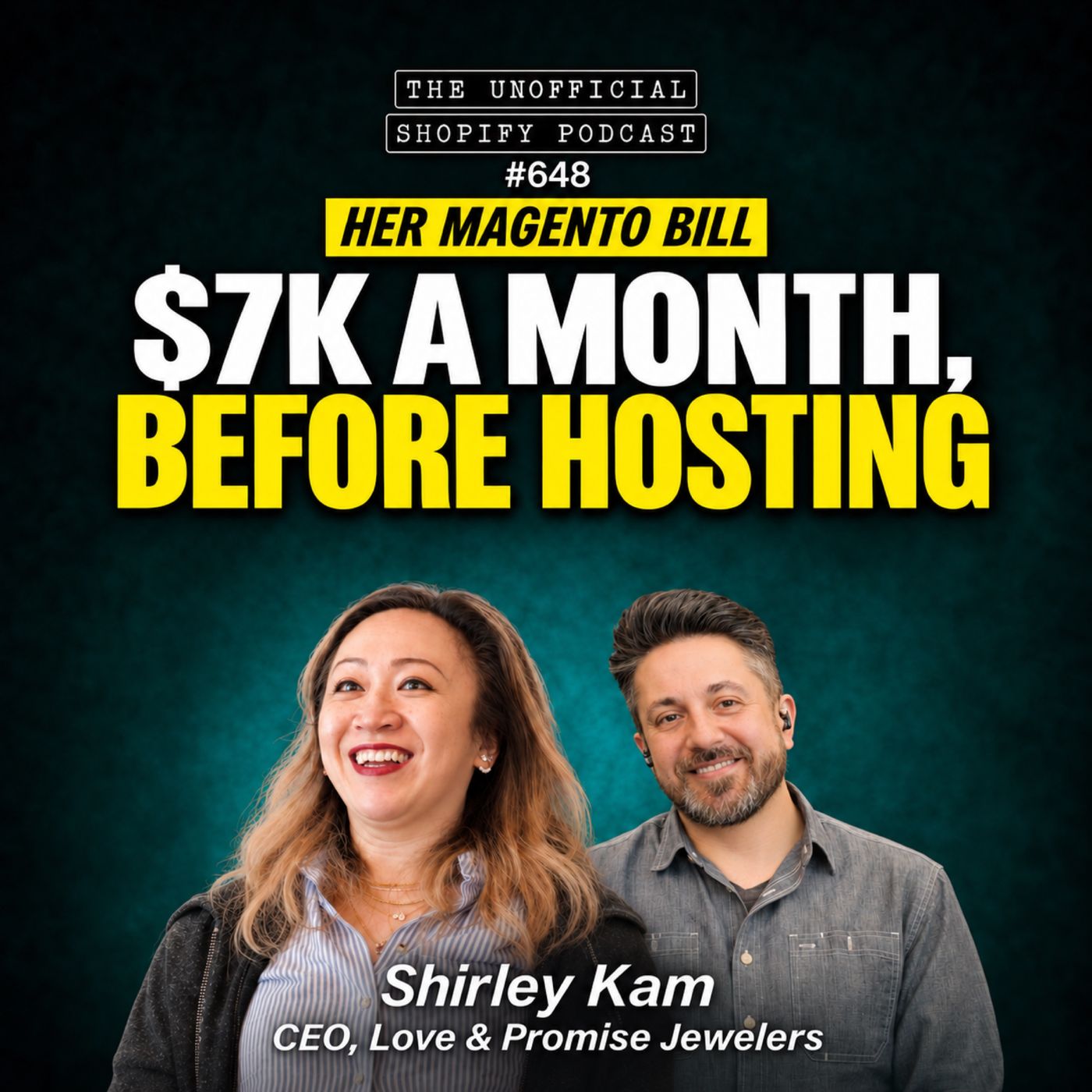
Love and Promise Jewelers (Rosato’s Box) explains how a jewelry brand survived high-ticket e-commerce challenges, migrated from Magento to Shopify in 2024, and adjusted to gold-price shocks and social/SEO volatility.
Shirley Cam, owner of Love and Promise Jewelers and Rosato’s Box in Chicago. Business began in 1988 when her mother was laid off; Shirley joined at age 14. She took over in 2011 after inheriting high six-figure debt and later led a Magento-to-Shopify migration.
Magento required expensive maintenance (~$7K/month plus hosting) and slow iteration; a bad migration cost 30% traffic. Shopify improved checkout experience (Shop Pay/one-page checkout), increased time-on-site ~30–50%, and made testing changes faster (days vs weeks/months). Gold costs rose ~5–7x, forcing price education to protect margins.
Etsy “friendly fraud” disputes led to evidence collection (photos of every ring angle with ring size before shipping). Social proof: a top Pinterest-pinned item drove views but not sales, functioning as a funnel “hook.”
Written by AI. May contain mistakes.
Discover how Shirley's mom started her jewelry business in 1988.
“I want to know, you're like, Hey, I want to know what your terrible ideas were.”
Discussing the transition of the jewelry business to Shopify and its current operations.
“Yeah, so back in the day, well, they still exist today.”
Shirley shares the frustrations of selling on Etsy and the need for independence.
“And we've got a physical retail location.”
Exploring Shirley's journey of overcoming debt and building Rosato's Box.
“And so that's something that I wanted to know.”
Analyzing sales dynamics and customer interactions in the jewelry business.
“When I took over, it was a mess and this was right before the financial crises.”
The discussion revolves around the growth of the business and the challenges faced while scaling.
“And right now, because of the economy, gold is so high right now.”
Discussion about rising gold costs and how it affects pricing and customer understanding.
“and buy the material in advance, what do you do?”
Insights into the difficulties faced while transitioning from Magento to Shopify.
“So your business did not start on Shopify.”
Exploration of the benefits and customization challenges of using Shopify compared to Magento.
“So that was the straw that broke the camel's back.”
Learn about the speaker's experience transitioning from Magento to Shopify and the immediate benefits realized.
“It's like, all right, I got to make it look the way I want.”
Explore the unique challenges faced by the speaker's jewelry business, including consumer behavior and marketing strategies.
“And so I think the consideration phase, how people shop is very different for you than for most e-commerce merchants.”
Understand how technology, including AI like ChatGPT, impacts customer interactions in the jewelry industry.
“They're like fourfolds and stuff like that because it's universal, right?”
Explore how jewelry design considerations cater to active lifestyles.
“because it's not, when it's making an image, There's no consideration to the engineering of it.”
Discuss the constant changes in social media algorithms and their impact on marketing.
“At the start of the episode, you were complaining about social media marketing giving you a hard time.”
Learn about the challenges of adapting to viral trends in marketing for high-ticket items.
“It just, for my industry, and, like, if I did something, like, different, like, if I sold, like, biking equipment, right, and I do some wild things with, like, my bike, then it makes kind of sense, right?”
The key takeaway is to keep trying until something works in marketing.
“What's one lesson you want people to take away from this?”
Understand how to budget for quality crafted jewelry and what to consider.
“I think it's so subjective and I'm not, I'm not a traditional jeweler in a sense that I'm like, you need to do three months salary.”
Explore the emerging trend of redesigning engagement rings after divorce.
“And all right, if I wanted to shop for said ring, where am I going?”
Learn about the services offered by the jewelers and how to reach them.
“But yeah, like, so yeah, you can reach out to us.”

Get the gist, explore an idea or ask about something said.
 Claude
On The Unofficial Shopify Podcast, what are the key points of this episode?
Searching your listeningAutomatic transcript. May contain errors.
0:00This episode is brought to you in part by Swim. Here's the thing about wishlist apps. Most of them just sit there. A customer saves a product, and then nothing happens. Swim actually activates that data. When someone wishlists a product, you can trigger price drop or back-end stock alerts and feed that intent directly into Klaviyo or your CRM. You're not guessing what people want because they've told you. Plus, customers can share wishlists for gifts, and your team can view them to offer personalized service online or in-store. And unlike card abandonment, wishlist data is permission-based. These are people raising their hands saying, hey, I want this, just not right now.
0:39Swim's been around for over a decade. It powers 45 ,000 stores and installs in about five minutes. You can try it for free today at getswim.com slash kurt. That's G-E-T-S-W-Y-M dot com slash kurt.
1:11what was your terrible idea i mean y 'all try everything to make it happen like you'll run with it for a while like right now we're we're trying to figure out our niche in social so because they're changing the algorithm right now like probably every month. It used to be every quarter and then it was every half a year and then before that was every year. But now it's probably every month they do something to it. Okay. Because whatever sticks doesn't stick in a month. All right. So we are starting talking to Shirley Cam. Did I pronounce your name correctly? Yeah, I think so. Shirley Cam from Love and Promise Jewelers.
1:45Yes. And Rosado's Box. Yes. In Chicago, Illinois. Yes. And this is a long running thing. Since 1988, your mom started this, right? Yep. Sounds about right. All right. We're going to get, I want to know, you're like, Hey, I want to know what your terrible ideas were. I want to know what succeeded. And I want to know, uh, you know, what your, what keeps you up at night now, but first we're getting in the DeLorean and going back to 1988. How did your mom start the jewelry business that would eventually land you here many years later? Yeah. Yeah. So my mom started a company in 1988 because she was laid off and she didn't have a job how she landed in the industry was she was looking for a job at Marshall Fields which is where Macy's is now downtown and it was for a chocolate a strawberry chocolate dipping position and the line was wrapped around the corner.
2:42She said there's got to be at least 250 people and they had 10 spots available. So the odds of her getting the job is very unlikely. And she happens to see this post that says, we need a bead stringer. And she has zero idea what to do. And so she was like, you know what, let me just go in there. You know, 250 people, odds are I'm probably not get this job. Let me just walk in there and she happened to see someone she knew and that person was like hey nancy oh how are you she's like yeah yeah i'm looking for a job and stuff she's like yeah yeah you're in i can hook you up so that's how she started in the industry uh what happened was i think she strung beats for i think two years and she saved up about two thousand dollars to start the company and that's how it started in 1988.
3:31$2 ,000 in 1988 would be like$4 ,500 or$5 ,000 now. Probably, I would say. Yeah, but she didn't have very much and she didn't start it sooner because she didn't have any money, right? She came to the United States with what, 200 bucks in her pocket? And so it was a lot of perseverance and sacrifices to get to where she is today. So she starts a jewelry business in a local mall? Yeah, so back in the day, well, they still exist today. So a mall is not quite the size of like a shopping mall that we imagined. It literally is a store with booths. But they call it a mall, right? I used to rent an office in a mall now.
4:13But previously it was a small, the second story above a restaurant, and they were like, that was a mall. I'm like, I'm sorry, what? And I rented what was previously a jewelry business. And it was just, you know, for us it was office space. Yeah, yeah, exactly. Exactly it. So she had a booth, and I think the booth was about the size of a tuna can. It was very small. I would probably say no more than two people can fit in it. And she could afford, I think at that time it was like, I don't remember it was like$300 or$400, something very small. And she said if, she did the math. she was like if I could do if I can if I can string for about 15 each necklace and there's x amount of people who are on the street right now wearing these necklaces if I can do 10 necklaces a day even on wholesale for less for less money I could probably survive so she started because she thinks okay I could I could do labor right I could I could offer that service and that's how she started her business and that's what gave her the confidence to do it at i appreciate this like one of the few times you hear about a business starting where someone actually considered the unit economics of how that business would work yes she you know probably didn't realize like how wise that was you know but most people don't have the foresight on on that one and so all right that was uh 38 years ago that was many moons ago all right today if you're here i assume this businesses on Shopify.
5:44Yes. And we've got a physical retail location. Yes. A boutique. Yes. Okay. And that's it downtown. Yes. All right. I looked it up at Google Maps. Is it in the former reckless records? It's across the street from it. Okay. It's across the street. Yeah. Google Maps gave me the wrong view. Yeah. Yeah. Yeah. It's goofy. Yeah. Yeah. You're right. It's across the street. We're there. Okay. We're neighbors. We're neighbors. Yeah. All right. Good spot. A lot of foot traffic. Lots of foot traffic. Blocks from Millennium Park actually. By chance to use Shopify point of sale? Not right now. Not right now.
6:16Cause we don't have enough volume to do POS. Okay. Physical store, actually checking out five, 10%. And so everything else is online? Everything else is online. A hundred percent of our traffic is found online and 90 to 95 % of our sales is mostly online. Correct. And so we've got our Shopify online store. Yes. Don't you, are you in any marketplaces? We are in Etsy, yes. And then all this is like run through Shopify or we run those as separate things? I run them as separate. Yeah, separate. Well, they don't allow us to kind of integrate aside from pushing like our sales through from Etsy. But to be honest, I've been trying to escape Etsy for a while.
7:02That's one of the reasons I wanted to build on our own personal shop because we have more liberties and sovereignty on what we can and can't do. Right. there are a lot of limitations like your product, let's say your top key search word is oval ring. Their algorithm knows that, so they're going to push other products as well. And there's a lot of people that actually steal our photos, which is a, it's, oh, it's really frustrating. And just to chase that alone, it's, it's a full-time job. It's not as much anymore. Thank God with AI. I was going to say, this is something I've started automating.
7:36Yes. I have, you know, a workflow that tracks down clone stores, of our client stores and then creates the package of evidence for you ripped us off. I'll share that with you. Oh, I would love to hear that. It's really frustrating. And so that's something that I wanted to know. And on top of that, they have strict regulations on how you should crop your photos, how you should, you know, like what you can and can't do with your product. And especially if there is a challenge with a client claiming that they didn't receive the product when we have full evidence that we, because we have a full process now, when we, before we ship the product, we take photos of every angle with the ring size now.
8:20Smart. Yeah, with the ring size, because they'll say that there's not the ring size. And it's very, not a lot of clients do this. Majority of our clients are super sweet. Like 97 % of our clients are nice. But you know that few percent. Yeah, there's the, yeah, the bad actors who are going to take advantage. Exactly. And for products that we sell, we're not like huge volume, like socks and shoes. We sell like a few, you know, X amount of products a month, like, you know, like 50 to 100, depending on a given month. Sometimes 125 for the holidays. But like, it's like, they'll be like, oh, you didn't ship the product.
8:51We're like, yeah, here's the tracking number. Here's whatever. And like, now we show evidence that we actually ship these items before we package it. And they'll be like, no, we're on the customer side. And I'm like, sir, the customer has had this for six months now. like oh yeah they've changed the rules a little bit now um because now that now it's when you're selecting a product and it'll say like is it refundable or non-refundable before it would just say it's not refundable if x y and z is done and that's all written on the listing already but they don't have the time because they probably have tons of emails to review that yeah and so 60 to 70 percent of the time they lean on the customer side even though we know they are bad actors and sometimes we just have to put up with it and friendly fraud man dude like frustrating It's frustrating when it's a few thousand dollars.
9:38I can handle like$500,$600 loss, but when you're losing an item that's like a few thousand dollars and your cost is like a thousand something dollars, it's... Yeah, you feel it. Yeah, you feel it. Yeah. Yeah. So what is the... For a jewelry store, what's the average order value? For us, the range is somewhere around... Our average ticket item is somewhere around like$500 to$8 ,000. Our average AOV... Sorry. is about 2 ,500, give or take. Oh, it's high. It's high. It's not a lower ticket item because we do find jewelry, and it's typically custom or engagement milestone pieces. Right now we're actually heading in a direction of more milestone pieces so that a lot of we focus more on women and we're not anti-men or whatever.
10:30But there's a lot of women now who are gifting themselves, and we're kind of pushing in that direction. We're seeing a lot of that. A lot of motion in that direction, which makes sense. So I'm buying for myself. Absolutely. Yeah. Oh, yeah. The interesting thing is I wanted to kind of share that when my mom started the business and when I was growing up behind the counter, that was one of the things I wanted to share was I started working with her since I was 14 years old. And after school every single day and every Saturday. Yeah. All right. So this, your mom starts it. You worked in this business for a lot of your life.
11:04and you took over 2011. When I took over, it was a mess and this was right before the financial crises. I inherited, a lot of people think that I grew up with a silver spoon, which I did not. I inherited, let's say some high six-figure debt. That was not for me and we paid it off since then. That's a reverse inheritance. Huh? What was it? It's a reverse inheritance. Tell me about it. She made a series of mistakes, and I was like, I got to get us out of this. I started a website with Magento in about, I think I want to say like 2008 or 2009, around there. All right, early. Yes, so we started early.
11:49And this was before Shopify was sexy, right? Yeah. Now Shopify is way sexier. And then we kept on hearing clients keep on saying like, oh, are you on Etsy? Are you on Etsy? We heard the word Etsy at that time. I'd say at least 30 times a month. And they were reaching out to you to be like, well, can I shop from you on Etsy? They physically came in at that time because we didn't have a lot of online traffic. Because back then you have to spend an enormous amount of money on SEO and all that stuff. I didn't understand it either at that time. And so we started Rosato's Box in 2011. The reason why we started it is because we wanted cute, beautiful products that were fair trade, handmade, and small batches that were conflict-free and completely feel good.
12:33So it's a good quality product, and it will last you your lifetime as long as you don't run it through the washing machine or go rock climbing. You laugh, but we have customers who do this. Dirt bike, extreme dirt bike riding, we've had that as well. Please don't wear that if you guys are listening because I had a customer rip it off their finger. I was going to say. Yes, it was very traumatizing. I always wear my wedding band. It always makes me a little nervous that I'm going to deglove myself. Are you wearing tungsten? That's rose gold. Rose gold? Oh, it'll be fine. But it will rip your finger, though.
13:04That has happened to my client, where he got caught in rock climbing and it ripped the ring off. Fortunately, it broke off and not degloved the finger, but it cut through his finger. Ugh. That's why we get so nervous. We're like, please don't wear it. Yeah. No, I remember years ago interviewing a guy who sold silicone rings, and that really was the pitch. It was like, hey, if you're active, like, oh, you want to wear your wedding band to the gym? Great. Don't do it with a band. Or get a tattoo. That's what I tell some of my clients. get a tattoo, then you never have to take it off. I have both.
13:32Oh, perfect. That's even better. That's even better. Well, all right. You had the debt. Took you seven years to get out of it. Rosato's box was, you know, that collection, those moves are what did it? Or like, what was the hard move here? The hard decision. So with Rosato's box, we had our first sale in six months and that was$390. It was the best day of my life. We knew that something worked. and it took us probably about a few years to get momentum so that we were at that time at our peak I want to say we were at almost seven million dollars a year which was not my favorite to be honest and for me it was never about money it's about being able to enjoy what I do and love the people that I work with from clients to my team it was overwhelming I'm grateful don't get me wrong I'm very grateful for that opportunity it's just I wasn't able to give the attention that I felt the the client deserved when I did provide that for my clients it took my soul away because I couldn't enjoy being actually in the moment and I had to like oh let me see how many people I can hire to fulfill this position so that they can do a good job to serve the client as well but yeah we We had to like, it took us, it took us about like seven, eight years to get to that.
14:57And right now, because of the economy, gold is so high right now. And I don't blame people. Gold is like, currently, gold is at about 4 ,100 some odd an ounce. And last year, it peaked at about 5 ,000, I don't remember, it's 5 ,500 or 5 ,200. Okay. So my cost on gold alone went up 6, 7x. Yeah, your input costs on your most popular material, gold, at a minimum went up 5x. Oh, boy. This episode is sponsored by Zipify. A lot of Shopify brands will make 30 to 50 % of their annual revenue in the next 60 days. It is the busiest, highest stake stretch in e-com. So Zipify made their best tech stack free for Black Friday.
15:48Four apps, including one-click upsell. that drive more traffic, raise your average order value, and earn you more from every customer, all season, free. Grab the bundle at Zipify.com slash BFCM. While you're there, watch their free training with Ezra Firestone on running a Black Friday sale. You want the next 60 days to be your best ever? I know I do. Go get Zipify's free bundle today at Zipify.com slash BFCM. You know, unless you were to have a crystal ball and buy the material in advance, what do you do? We're figuring it out right now, and it's challenging. I guess the plus is, because I'm a positive person, I like to think, is that lab-grown diamonds have brought down the pricing of diamonds substantially.
16:37But when people come in, they're like, okay, well, why is the ring so expensive? I was like, sir, let me show you the economics behind this. Once I show them the graph behind how gold was this and now it's this, then they're like, ah, that's why the price was so different back then. So clients, through education, they learn that, oh, okay, I'm not trying to rob them. This is exactly what's happening, and this is beyond my control, but this is the best price I can offer. We are still profitable. It's just not at the scale that we need, not need, but what we are normally. I would probably say my favorite sweet spot is about$2 million to$3 million a year where I could, where we're profitable.
17:18I have a boutique team and I love what I do. And like our friend Dennis, I really enjoy that sweet spot. Dennis Dooley from Uncap. He was on the show earlier this summer. So you've been in, the business has been around since 1988. It was 38 years ago. So how have things grown or, you know, how have things been good or bad under your leadership? The good is that we're able to receive projects from around the world. We want to focus more on the U.S. now because of the whole importing and exporting fees. It's getting a little tricky, and I don't want to kind of navigate the EU. We used to ship probably 15%, 20 % to the EU, Canada, and Australia.
18:09Singapore, too. Actually, Hong Kong as well. It took quite a few international orders. Quite a few, yeah. Ireland, it was like about 15 to 20 % of our projects, I would say. And it's just tariff you want to deal with? It's a tariff. And then not only that, like now they have these unique packaging requirements. They have to be X size, X amount, like weight. You have to prove that it is biodegradable material. There's a litany of things that you have to follow. And it became too tricky unless you get a third party involved. We hear about this in our ECF group. There's like threads on this now. We're like trying to navigate this.
18:48So I'm just like, it's not worth the hassle because if the package gets trapped in the middle and it gets lost and this is someone's engaging wedding band or this is a very emotional piece, people can get very upset. Well, let's form a wedding. I can see where a wedding gets viewed as a mission critical event. Absolutely. Like that's how we're treating. is like, hey, we have to launch this rocket. Absolutely. Absolutely. Same with like, what are the other reasons why? We have milestones. We have anniversaries. These are pretty important dates. So it being trapped in the middle, I would hate to be that person to like, hey, listen, we can't get this to you right now because it got intercepted by the EU.
19:31You know what I mean? The move to Shopify. So your business did not start on Shopify. It was on Magento. We moved to Shopify when? 2024. 2024. Okay. So we really limped Magento along for a while. I know. You know, as I told Dennis, it was a divorce coming. I saw it skirting in the horizon. We've been fighting for a while. And I was like, you know what? I just don't think we're going to work. We're just going to have to break out. Every. All right. On these migrations, it's a big pain. No one wants to deal with it. You know, like I know how to do it and I still don't want to deal with it. I do a lot of migrations uh there's always an event that happened there's always the straw that broke the camel's back where you're like okay we're moving i don't care now it's it's just not the pain of staying here is greater than leaving so what was the pain for you two primary reasons one was i was moving too slow and i didn't like that the reason why i delayed it so long just so you can kind of understand why it took too many moons because i had to work with three different agencies before I found the last one and I found out that when they the first no the second agency that migrated the website over I don't know what they did but they they messed up all the seo in it and I lost 30 percent of my traffic which was enormous at that time and uh so I was like okay I was scared to switch over to another agency which took me a few years to find because we had how many we have 2 ,500 no 2 ,400 items and 80 percent 80 80 something percent of them had at least 20 different ring sizes and three to four different metals so all those what do you guys call them like variants or whatever those combinations are there's a gazillion yeah Yeah, each SKU is a variant.
21:28Yeah. So my ring is a problem. Like I have a ring. Let's say it came in, you know, two finishes, two golds, actually more because I could pick quality. Yep. And then I have to pick the size. Yep. Well, very easily I can, my total combos can result in 100 or more SKUs. A few years ago, that was a problem on Shopify. Now it's like, oh, you go to 250 SKUs and then past that you could go up to like 10 ,000, but it gets a little harder. But yeah, okay. Yeah, the variant skew limit sounds like what you hit. And there were a lot of ideas I wanted for the shop that took months, starting with weeks of discussion, which is not only time and money suck, weeks of discussion, for them to come back to the drawing board and go like, you know what, we can't do it.
22:21And then I eventually found the marketplace for the apps for Magento. and I was like, you told me it's not doable. I found these apps, right? And then out of the 10 apps I introduced to them, probably five of them they can't do or I'll test them out much like how it is in Shopify right now. I'll try like three to four apps at a time of the same feature. Yeah. Just to see which one I like better and I'll test all those out and I'll choose the best one within a few days. I can make decisions from days to the long and weeks, because some of them you need time to kind of figure out which ones the customers like better.
23:00Kind of like A, B, E testing, but it's A, B, C, D testing. And I can make decisions in days to weeks. Before it would take weeks. Like when I say weeks, I'm talking about three weeks to like three months to make a decision. For three months to find out, you might not even be able to use it. And I was like, oh, my God, do snails move faster? And this was just like because you were struggling with your development partner and the platform Magento. There are a lot of limitations. And it was expensive to maintain on top of that, right? So I had to pay a developer, I think, somewhere around like$7 ,000 a month to maintain the website.
23:38Oh, man. Oh, I'm so serious. Anybody who has these websites, they understand this. You have to pay a minimum$5 ,000 to$7 ,000 to maintain the website because there's all these patches and stuff that you have to do. You're in charge of security and hosting now. Dude, that doesn't even include the hosting. I have to pay hosting. Okay, it was another thousand something dollars. So we're like, this is ridiculous. And I'm moving slow. I'm paying an enormous fee. I'm paying for Gucci and I'm getting like Target, right? And I love Target, but you just see what I mean? I'm paying a premium here. Yeah.
24:14And I'm not getting the results I need. And so it's between the speed and the price. I can't do it. I can't justify paying that price. So that was the straw that broke the camel's back. So two years ago, you migrated to Shopify. All right, you really dumped on Magento. Give me one thing that broke when we moved to Shopify. Even this is not super terrible, but the customization in terms of aesthetics, it's very limited compared to how it was for Magento. You can do anything you want on the website. Give me an example of what you're trying to do that you can't do. I just made a whole bunch of landing pages because I know that it drives traffic.
24:53And where did you make the landing pages? Key topics, like engagement rings. I'll break them down into subcategories. But it's just like in the Shopify admin or in the Shopify theme editor? Theme editor. Okay. The theme editor. And I know that there's a limit on what it looks, what I can do in terms of what the theme is. in order for me to have, like, what do they call those, like the H3, H2, you know, those SEO things that they have in there, right? Like the sections? The sections. Okay. That's already pre-designed. Yeah. All right, that's built into the theme, though. One, a developer may do whatever you want.
25:26Two, you could, you can ask Shopify Sidekick, hey, just make a custom section for me. It could do that. I'm, like, scared of that. How successful is that option? That's what I'm afraid of. Like, if it goes in and it does something and it messes it a whole, see my my magento experience freaks me out yeah you got that that magento ptsd ptsd yeah so no no no all right when you ask it to if you say hey sidekick make a section for me yeah it's not going to edit your theme it's going to make a self-contained section oh okay yeah everything's just going to live in that section and you're safe it's like their staging site yeah it's such it like all right it's self-contained i think where it falls on its face is like when you go you're like all right i want to revise and edit that oh that's it's like you got it just it's easier just to start over and give it a better description on a new one that's my opinion um but like i just try it for like a lot of sections that are missing like you know black friday's coming up i want a countdown timer on my site for when this sale ends all right the theme may not have that but that's the thing that sidekick can just like that i know it can knock out on its own no problem that's so fascinating i haven't i haven't tested that part yet i'm a lot of people are scared of it which is why and at this point it's been able to do this for like two years and it's good now.
26:37Maybe early versions were a little rough. It's definitely smarter. And the other way you could do it, there are apps that will just add sections to the store. Our friend Ann Thomas who used to work on our team has Design Packs as her app. There's similar apps but it'll just add many sections to your theme. It's really good. So there are options there. And then of course It's just like, you know, a developer, a contractor, somebody. I've used Canvafy too for some of it for the design is really, really pretty. But the challenge is the whole ADA compliance. Oh, yeah. We got to make sure everything is ADA compliant.
27:17Have you received an accessibility lawsuit? I've heard some friends who have. Yeah, they're very common. This is a real threat you got to worry about. Yeah, yeah, yeah. So that's like something I'm like, oh, I got to like make sure. So this one falls into like the preset themes are generally pretty pre-designed so that it's less likely. And with those, I also run it with one of those ADA auditors and stuff and have them like review and make sure everything's good. And whenever I show them anything from my camera, they're like, yeah, there's a litany of issues here. You got to do this and this and this and this and this.
27:53And I'm just like, you know what? I'm just better off going back to the theme option. See, there's always tradeoffs. There's trade-offs. And I was just like, you know what? That's fine. I'll take it. I just don't want to get that letter. It's like, all right, I got to make it look the way I want. I got it to look the way I want. Now I have SEO accessibility and various compliance issues to deal with. Exactly. It's always something. It's always something. So it's like, I love, for the most part, I do like Shopify like 90 something percent of the time. I'm very happy with it. I like the sovereignty and the ability to do things and try things within days to weeks to get results.
28:28So what, yeah. How about, you know, stats, KPIs? How did things improve? We went going to Shopify, easier, simpler. We gained the benefits of like shop pay and the shop checkout. Did things convert better? We sell better. Yes, the customers have much better experiences. We've gotten feedback where like, oh my God, this is so much better than what your website was before. The checkout is more seamless. I think we have the one-step checkout. Yeah, one-page checkout. One-page checkout. traffic, I could see that the stay time, I forgot the term for it, but the stay time on each page has improved by time on site.
29:07I always forget those terms. I think it improved by, depending on the month, somewhere between 30 to 50%. We see that a lot of traffic is actually staying and sticking and navigating through different pages more so than... Oh, that is good. It's really good. Yeah, because I couldn't do any improvements on Magento by myself when I figured out, okay, well, this is where they stuck. Then I had to go to the developer and the developer had to talk to my account manager who then talks to the developer. And by the time it's done, you know, the meal's been cooked and eaten already. Everybody's done. The buffet is done.
29:46Yeah. By the time they get back to you on that ticket, you're like, I don't even know what the issue was when we started. And now we have seven other ones. Yeah. This episode's brought to you by Promo Party. Full disclosure, that's my app. We made it. So here's a Black Friday tip. Skip the 20 % off. I know you're thinking about just doing 20 % off again. Offer a free gift instead. Free gift when customers spend about, double, whatever your average order value is. So we checked 300 ,000 holiday orders. One store ran, spend 50, get a free gift, three years straight. Their usual order, about 50 bucks.
30:22Their gift orders around 100 every year. Promo Party does exactly this. You set the threshold, pick the gift, and then it drops into the cart automatically. A progress bar shows every shopper how close they are, so they keep adding to increase that cart size. Bigger orders without slashing prices or leaking discount codes. Search Promo Party in the Shopify app store, install it free, and have your Black Friday gift running this week. okay so like those headaches go away it's also i mean sometimes it's nice to be on what is the number one platform because you just assume support for it like i think that makes life a lot easier just in trying to solve things and move quicker you know everybody's already familiar with how you operate largely because of being on that platform on shopify well all right so what's interesting about a jewelry business no one has to buy jewelry no one uh and it is an expensive item.
31:18And so I think the consideration phase, how people shop is very different for you than for most e-commerce merchants. You know, if I'm selling$30 t-shirts, the consideration phase for this is what I saw it and I decided to buy it, right? You're not that lucky. You got a much harder process. We do. Talk me through it so I can understand how painful this is. Painful from a consumer's perspective? Well, I think, you know, what does that process look like for you what that that customer consideration phase sure sure this is one of my most asked questions so general period of consideration for engaging is somewhere around 30 to 90 day no i'm sorry 30 to 30 to 90 days for the people who are have already done a lot of prep work like they've already had savings for it without having they're like okay i have x amount of money in mind saved for this project and then it takes them about three months to kind of do the research on it and then there's people who have zero idea of what what they're going to spend and all that stuff and that's about a six month period so i can't distinguish those two customers journeys quite yet like who's who because what happens is that when we start following them on the back end what happens is the girl pins the product and then the guy purchase it so there's a break on the customer journey that we could follow.
32:44So that's where our analytics gets a little tricky, so we have to go back to our experience database. Because having done this for over two decades, right, full time, I now understand from physically working with, at this point, physically working with over probably about, like, conservatively 10 ,000 couples, conservatively. working with that many clients I think it's a pretty good idea of how the shopping experience is for them and so from that I learned that okay well if it takes about three to six months let's just say we're going to aim for six months just to be conservative how do we maintain that that connection with the client something that we've added recently is um I started doing more videos online called like and I'm a moniker now I'm like jeweler bestie like jeweler bestie surely because my team's been asking me for years to do this to to show like like my to actually be a human being you're going yeah going face to camera I know it's it's intimidating I don't think about it anymore but when I had to start I was like oh man oh dude tell me about it I'm an introvert right so a lot of people are like why doesn't she show her face because I'm an introvert so just so everybody knows I'm an introvert.
33:59I'm still working on that. But ever since I started putting my face on there and started explaining things, I'm still working on the energy and more passion, more energy on screen because I'm not good at it. People, they have actually emailed me, or not emailed me, but the team, or have responded on the messengers. My team does it. And they respond and they're just like, oh, this video really helped me and stuff. Even though we don't get a lot of, that's one thing I wanted to talk talked about, talked to people about. The views matter some, but what matters is the impression. Because what happens is that with jewelry, for me, at least from my experience, that was something else I wanted to talk about as well.
34:40One of our top pinned items on Pinterest was one of our least sold, believe it or not. And at our peak for Pinterest on a monthly pinning basis, I think monthly views, I think we were at seven million a month that's a lot it's a lot right now we're at about we're teetering at about one to 1.9 because there's a lot of noise and there's a litany of issues that i had with like when we migrated between magenta one and magenta two we lost a lot of uh what do you call it tagged items to it and and it messed up our traffic i'm not going to go too deep into it because it makes me really frustrated but it used to be seven and um now it's like about like one to 1.9.
35:26We're trying to get it up to like about like 3. 3 is our sweet spot too. So we get a lot of traffic there. But the interesting thing is our, I think our top pin item was like, I don't know, was like 10x more than all the other pins that we had. And it was our lease sold. Lease sold. I thought that was very fascinating. And I did the same test for Etsy as well. And it was also the same thing. So I did this for like about like 10 to 12 items just to kind of sample it. And so what I realized that is that it doesn't matter if that's a top trending item for our industry at least specifically. It doesn't lead to a sale on that item, but what it does lead to is more eyes.
36:08Okay. So they start from that product and then they go on to the other ones. So a hero product in social as part of the funnel may not sell, may not need to sell. It is brand awareness. It's the hook. It's getting them just to browse the store pretty much okay and the more it's like the six point of contact rule in marketing where like you yeah they gotta see you six times they see you six times and eventually they'll click on you or they might not have they might not click on you which i'm one of those people i don't always click on the person because i don't want to be assaulted with all these ads right i don't click on it but what i do do is i i take i take note and then i go and research some myself later on and i know a lot of friends who do that because they don't want you know the traffic of follow them everywhere it's really kind of overwhelming and I do once I do research on the brand to understand that okay they're everywhere which is another reason why I started becoming jeweler bestie surely online because when more people see that I'm in public I'm saying all these things from my decades of experience and being completely honest and transparent about it they'll research I want people to research I do I encourage it and when they research and they see that okay you've been doing this for a while your brand has been in business since 1988 uh Rosado's box is doing great so they must be a decent company I could trust a few thousand dollars with them right so that to me is more important than like getting like a million followers yeah because in our industry like traction like to gain followers is much harder because we're a very niche field.
37:44From what I can learn in research, I think like a 0.8 % or something like that gain every month is already really good for our industry because it's very niche. Like food or entertainment is like much higher. They're like fourfolds and stuff like that because it's universal, right? But yeah, I've learned that I can't trust all the numbers online that they're telling me like, oh, why is the conversion rate so low? I'm like, yeah, because our item is like a few thousand dollars. Yeah. AOV conversion rate, I was going to be inversely proportional. Right. So I've got a twenty five hundred dollar AOV at times.
38:21The advantage that that like the guy selling the fifty dollar T-shirt can't do is make it high touch. Do you do virtual consultations? We do. We don't really do the whole like the FaceTime one yet. We're working on it. It's really for security reasons because like then they'll fill in the room. and from what we've learned from the past, at least from my friends who are in the diamond industry, like sometimes people like scan the rooms and they kind of like... I wouldn't even have thought of it. Yes. You know, I'm not in your industry. Yeah, security for you must be a different game. Very different game.
38:55And we're working on figuring out how like maybe setting up like booths or cubicles or where they can't see exactly where the layout of the room is. We've only taken like videos of portions of the room just to kind of have that in mind. uh but yeah like so we are trying to we're trying to do the the the actual face time but we do do majority on email and we'll take photos we'll take videos for customers and stuff to make sure that they see exactly we'll do it in different lighting like we'll do it in like daylight like where you have here like when the shaded daylight in the the the blinds up daylight in the regular kitchen lights we'll film it in different lightings because it because color don't show differently yes in different lightings yeah and so we'll show it in there we'll show it in our photo box so customers can get a full experience that we do send videos and even with our custom design process from start to finish like we'll well if they're physically coming to store we'll sit down and we'll talk through like now customers go through chat gpt and they create these like 3d renderings of roughly what they want i mean it's not always accurate yeah and what's doable i'm sure it does things that are not possible yeah there are a few things we're like we can do it, but just know that this ring will fall apart based on your lifestyle.
40:09Because we're not like, you know, a celebrity where you have a person just show up at your door and pick up your jewelry to get fixed. We'll be like, okay, well, if you're going to get this ring this thin with a stone like that, this is what's going to happen when you wear it. And they're like, oh, I never considered that. So we'll go through that. Neither did Chet GPT. No, they didn't. Or like, they'll have it held up and it's missing a bar. So I'm like, so what happens if you just knock it over a little bit? Oh, I didn't think about it. So there are a few details. So they'll like bring in like concepts or mood boards and then we'll go.
40:39I mean, that's still like we're making, we're ripping on ChiaGPT a little bit for its lack of engineering experience here, but it is such a valuable tool for them to be able to communicate to you. Like, well, this is, okay, this is the direction I'm headed. Yeah. And so you just like shortcut a whole bunch of back and forth. Oh yeah. No, I'm not, I'm not like bad mouthing ChiaGPT in that way. It's more like, it's more like it's still learning. It's like a child, right? It's still learning. We're getting there. But it helps at least articulate roughly what the customer is at want. Compared to 10 years ago where a customer will be like, this is a picture of the shank, which is the band that I want.
41:16This is a picture of the basket that I want. And this is a picture of how I like the stones to be set. Now we can tell ChatGBT, like, these are the three specs of the ring that I want you to put into one piece in this color, in this XYZ, how were they prompted? And it gets about 60%, 70%. It's not bad. It's not bad. I was going to say, but you prompting it to make a ring, I bet it gets way closer. It's still, I have found, like, the image generation, technical details confuse it. Like, I got a client who sells golf bags, I got a client who sells backpacks. This thing could not figure out how a zipper works to save its life, I swear.
41:54Like, it always does strange things with zippers. It's like those technical details, you know, because it's not, when it's making an image, There's no consideration to the engineering of it. Yeah, and the lifestyle too, right? We have to think about when we design this, we're like, okay, well, this person is very active. These are the features I would add naturally if they're active, even though they're requiring this. Right? They're like, I like this detail, these flowers and all this stuff added to the ring, which is great. We can absolutely do anything you want. The challenge is if you're active, you want low maintenance, you have a child, you don't want to take off your ring, which we highly suggest to anyways, but like you don't want to, it's just not conducive to your lifestyle.
42:35It's hard, right? Like it doesn't understand it because they're not a jeweler. Yeah. And there's a lot of things that like as a jeweler, I can give you rules and guidelines to follow, but there are nuances between that too. These are things that ChatGPT has, it will take some time before it gets to. What? Yeah, you know, the saying is, well, this is the worst it'll ever be. And so it's like it's always going to get smarter than where it's at now. It has so far, you know, good or bad. Okay, so at the start of this episode, I want to wrap this up. At the start of the episode, you were complaining about social media marketing giving you a hard time.
43:18I want to come back to that. What is hard about marketing this business? The constant change in the algorithm. them what pushes and it changes so frequently by the time we figure it out we have to do something new again and are we we're on i assume we're talking about meta here facebook and instagram everything even even even pinterest is changing too i could tell they don't say that there's a shift in how they're pushing material but i can see the pattern of products or the pattern of how previous videos or images, like the exact same style, I could take the same item, push it again, it would get completely different results.
44:01I'd do that to kind of test to see how the results are. Same time, everything. Same time of the day and everything. So I know that everything is shifting incrementally and meta is shifting. Like literally, not even shifting, like completely moving. Oh yeah, no. way that everyone is struggling with that you're not alone yeah which is okay and i i welcome challenges and stuff it's just hard for our industry because things can't move too fast because it's such a high ticket item that if we were to constantly change our style and just turn them to dance videos right i'm not sure our clients would really appreciate me trying to do the millennial dance to one of those like videos where like what happens when you listen to you know Lil Wayne yeah I'm not there's I'm not posting any TikTok dance videos but those are things that go viral right and people on my team are like why have you thought about that and I'm like ugh like have you get to work exactly and they're like well you know that's like the trend now I was like and if the trend is for me to just smear my face in the public bathroom I should do that like too like for just for views all right these are different that you know maybe that would get views.
45:12It might get views. It might get views and stuff. It just, for my industry, and, like, if I did something, like, different, like, if I sold, like, biking equipment, right, and I do some wild things with, like, my bike, then it makes kind of sense, right? Or you can do a dance in front of my bike. No, I think behind the scenes works. I think advice, buying advice, because it's a big ticket item is great. You know, if you're positioning yourself as authority, you're getting to share that experience. And then you share a little bit of, like, you know, your story and then maybe, like, you know, a few client stories where it makes sense.
45:44And like that totally valid, good strategy. You know, you don't, I think, you know, the dances and stuff, I think a lot of it's gimmicks, you know, and the algorithm rewards what it chooses to. So what's, all right. I mean, you've got so much experience. What's one lesson you want people to take away from this? Just keep on trying anything and everything until something sticks and just never give up. That's literally the process I go through. because like right now at how how fast everything is moving with how ai is adapting and learning it's like a baby right it learns really fast yes so just keep on moving and never give up and just go like oh i'm a failure because i didn't hit like you know like 10 000 views for each like video which doesn't matter because if you keep steamrolling them out at some point you're gonna figure it out well what is the when someone does ask how how much they should spend how many months salary.
46:39What's your answer for that? I think it's so subjective and I'm not, I'm not a traditional jeweler in a sense that I'm like, you need to do three months salary. You know, like I don't, I'm a millennial, right? I believe that everybody should spend what they're comfortable with. That being said, it has to be a reasonable budget that can craft you a quality product, right? I don't want to say like, oh, it has to be like 10 ,000. It doesn't have to be 10 ,000, But a reasonable budget for a quality crafted piece, I would probably say in this current gold market, because it's dependent on gold. I would probably say the minimum is about, $2 ,000 is actually on a low end, probably like with the center stone, probably about$3 ,000 to$5 ,000.
47:23I don't think that's insane. It's not insane. It's not. I think it's very reasonable. Yeah, that's still not unreasonable for what we're doing here. No, no, it's not. But if you were to compare it from like 10 years ago, you can get a decent Moissanite ring for$1 ,500. Yeah, we didn't spend that much, and it was over 10 years ago. Yeah, and if it's the same product today because of how gold is, it's not even inflation. It's a gold price. You're looking at about$2 ,500. I know. It's rough. It's rough, yeah. But the thing is, it lasts you forever. Yes. If maintained well, of course. No rock climbing, guys.
47:59No rock climbing. I'm a rock climber. I can say that. I know rock climbing. But yeah, I think that would be a reasonable budget. And all right, if I wanted to shop for said ring, where am I going? Well, you want to shop for your ring or milestone pieces because we do do custom for that too. A lot of women buy it for their first big promotion or they just, their 10-year mark at a company. Like these are big milestones. Yeah. And believe it or not, divorce rings are in now. It's a real thing. I am actually going to start a landing page for it specifically, and that will be part of the milestone.
48:37I'm not even joking. This is a real thing now. It's a celebratory, and I'm a positive person, so turning something that's like turning lemons into lemonade is a great thing. I think it's smart. It's extremely difficult to go through divorce, and so trying to be like, all right, this is a new chapter. Making it positive after the fact is smart. No, I think that's a worthwhile cause. Yeah, for sure. Like I have so many girlfriends who have gotten divorces and and we literally take their old engagement ring, redesign the entire thing. And when they receive it, they don't even recognize it. And I'm like, I'm telling you, ladies, it's a shift in energy.
49:15It's a great thing. It's really cool. And to see something that's part of your life in a previous chapter, continue on in a different form. It's really it's really and it does. If you're if you guys are into this energy stuff, it really does shift your energy. But yeah, like, so yeah, you can reach out to us. Look us up as Love and Promise Jewelers or Rosato's Box, which is our in-house private label. The same company. It's like, think of it as like, like, like Costco is Love and Promise and Kirkland is like Rosato's Box. I want some Kirkland collab jewelry. Love Kirkland. It's like my favorite.
49:50I love shopping there in bulk. It's because I have pets. You have so many. Yeah. I have to buy so many treats and stuff for them and I make their food. I'm one of those pet moms. I make their food. So like I have to buy the quantity packs for the meats. So yeah, that's why I'm there every other week for that reason. Loveandpromisejewelers.com and rosadosbox.com. Yep. You can do loveandpromise.com too. It goes straight into it. Or you can look me up as jeweler bestie Shirley. Shirley Cam. Thank you so much. Thank you for having me.
"I'm paying for Gucci and I'm getting like Target."
Shirley Kam's mom started Love & Promise Jewelers in Chicago in 1988 with $2,000 she saved stringing beads. Shirley took over the business along with a high six-figure debt, spent seven years paying it off, and built Rosados Box, a handmade line that started on Etsy. Then she spent years paying a Magento developer $7,000 a month to move slowly. In 2024 she moved to Shopify.
Shirley explains what broke and what improved after the migration, why her most-pinned product on Pinterest was one of her worst sellers, and how she makes videos so AI search knows who she is.
SPONSORSSwym - Wishlists, Back in Stock alerts, & more
getswym.com/kurt
Promo Party Pro - Free gifts that drive bigger orders
apps.shopify.com/promo-party-fgwp
Zipify - Build high-converting sales funnels
zipify.com/BFCM
What you'll learn:
Guest: Shirley Kam, CEO of Love & Promise Jewelers and Rosados Box.
LINKSLove & Promise Jewelers: https://www.loveandpromisejewelers.com
Rosados Box: https://www.rosadosbox.com
Meet Jeweler Bestie: https://www.loveandpromisejewelers.com/pages/meet-jeweler-bestie
Rosados Box on Instagram: https://www.instagram.com/rosadosbox/
Uncap (Denis Dyli): https://uncap.com
Apply for Shopify Help
ethercycle.com/apply
See Our Results
ethercycle.com/work
Free Newsletter
kurtelster.com
The Unofficial Shopify Podcast is hosted by Kurt Elster and explores the stories behind successful Shopify stores. Get actionable insights, practical strategies, and proven tactics from entrepreneurs who've built thriving ecommerce businesses.