
In short
Podcast Episode Summary: How AI Is Rewiring Your Customers (And Why Most Businesses Aren't Ready)
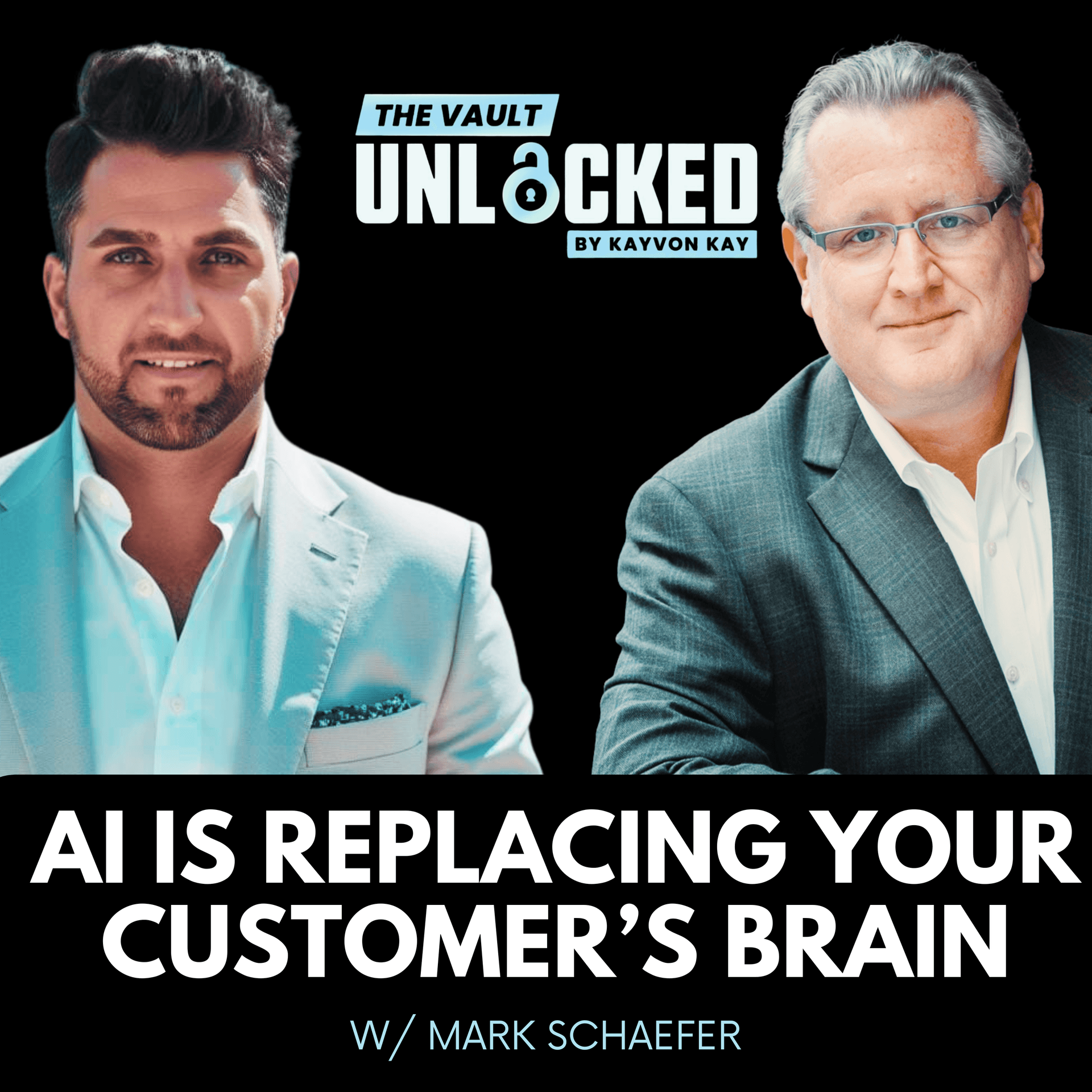
Episode Overview In this episode of *The Vault Unlocked*, host Kayvon interviews marketing expert Mark Schaefer about the profound changes AI is causing in customer behavior and decision-making. The discussion explores how businesses that fail to adapt to these changes risk becoming invisible in an increasingly algorithm-driven marketplace.
---
Key Concepts and Insights
The Shift from People to Algorithms
- Understanding AI's Role: Businesses are not just selling to people; they are selling to algorithms that shape customer beliefs and purchasing decisions.
- Cognitive Offloading: Customers are increasingly relying on AI for decision-making, leading to a decline in independent thinking. This trend raises concerns about human agency and the implications for marketing strategies.
Consequences of AI On Customer Behavior
- Changing Decision-Making Models:
- Low-Risk vs. High-Risk Decisions: Customers are turning to AI for both low-risk (e.g., product recommendations) and high-risk (e.g., life choices) decisions.
- AI as a Decision-Maker: More consumers are allowing AI to make significant choices, which diminishes human agency and critical thinking.
The Importance of Brand Trust
- Brand Loyalty Over Algorithmic Recommendations: In a world where AI mediates customer interactions, brand trust and reputation are crucial. Traditional metrics like backlinks are becoming less relevant; instead, AI values human signals, such as customer reviews and social media presence.
- Word-of-Mouth Marketing: Personal recommendations are more powerful than any algorithmic suggestion, emphasizing the need for businesses to cultivate authentic customer relationships.
The Human Experience
- AI and Relationships: As AI becomes more integrated into daily life, particularly in therapeutic roles, it raises questions about the quality of human relationships and emotional connections.
- Illusion of Compassion: While AI can offer support and companionship, it ultimately lacks genuine empathy, posing risks for individuals who may rely solely on AI for emotional support.
---
Actionable Insights for Businesses
- Differentiate Your Brand: Companies should articulate their unique value propositions by completing the phrase "Only we..." to clarify what sets them apart in the market.
- Focus on Human Connection: As AI takes on more tasks, fostering authentic relationships with customers is essential for building brand loyalty and trust.
- Leverage PR and Reviews: Businesses should prioritize media presence and positive customer reviews to improve visibility in AI-driven recommendations.
Conclusion Mark Schaefer's insights highlight the urgent need for businesses to adapt to the AI-driven landscape. As decision-making shifts from humans to algorithms, maintaining brand trust and understanding customer psychology will be key to thriving in this new environment.
---
Further Engagement
- Follow Mark Schaefer: For more insights, listeners can connect with Mark on various platforms, including [Instagram](https://www.instagram.com/markwschaefer/), [LinkedIn](https://www.linkedin.com/in/markwschaefer/), and his [website](http://businessesgrow.com).
- Follow Kayvon: Connect with the host on social media to stay updated on future discussions and insights.
--- This structured summary captures the essence of the conversation, illuminating the critical points discussed in the podcast episode.
Written by AI. May contain mistakes. Listen to the episode to check what was said.
Chapters
Tap a time to open that second in VOThe AI Revolution
0:46 to 1:40
Discussion about how AI is transforming customer decision-making and behavior.
“I know you're known as a marketing branding expert.”
Mark Schaefer's Insights
1:41 to 3:33
Mark shares his thoughts on AI's impact on marketing and creativity.
“But I wrote this book called Audacious, How Humans Win in an AI World, because this is what I see the world is really struggling with now.”
The Research Study
3:34 to 4:25
Overview of a research study involving futurists discussing AI's future.
“it's so important so I you said there was a consensus what was that consensus like how did all these different peoples from all walks of lives.”
Cognitive Offloading
4:26 to 6:45
Exploration of how AI leads to cognitive offloading in individuals.
“You can you know, read it in two hours, maybe.”
Impact on Human Agency
6:46 to 8:07
Discussion on how AI affects personal agency and existential questions.
“Because when you do the hard work, this process called phrenesis occurs.”
AI in Relationships
8:08 to 9:48
Exploration of AI's role in human relationships and trust dynamics.
“How do you know, what do I do when I, you know, get up every morning?”
AI as Therapy
9:49 to 12:18
Discussion on how AI is increasingly used for therapeutic purposes.
“And we're starting to even see this creep into sales and marketing strategies.”
Balancing AI and Human Connection
12:19 to 14:02
Mark discusses the benefits and risks of relying on AI for emotional support.
“Well, one of the things I state in my book is, so one of the best pieces of advice I ever got was from a mentor of mine.”
AI in Therapy: The Illusion of Compassion
14:02 to 16:01
Explore the complexities of using AI in therapy and its emotional implications.
“and not recognizing when you need real human connection.”
AI as a Decision Maker in Travel Planning
16:01 to 18:52
Learn how AI is shaping personal decision-making in travel and experiences.
“yeah but it gives the illusion of compassion and as you said it can learn to do a better job the more it talks to you.”
Show all 21 chapters
Branding in the Age of AI
18:52 to 22:51
Understand the critical role of branding alongside AI decision-making.
“So, man, there's so many places we can go here.”
SEO and AI: Adapting Strategies for Success
22:51 to 26:04
Discover how SEO strategies must evolve to compete with AI technologies.
“So there's like a cottage industry emerging of people and businesses trying to figure this out.”
Opportunities for Small Businesses Amidst AI Advancements
26:04 to 28:02
Explore how small businesses can leverage their strengths against larger competitors in an AI-driven market.
“I think a focus on word-of-mouth marketing is super important right now because that's one of the overrides of AI.”
The Value of Personal Branding in AI
28:02 to 29:08
Learn how personal branding can elevate your visibility in the age of AI.
“You're just creating a pandemic of dull.”
The Long Game of SEO
29:08 to 31:39
Understand the long-term commitment required for successful SEO strategies.
“I've written 12 books that are – they're all bestsellers.”
AI's Role in Decision Making
31:39 to 35:09
Explore how AI is increasingly influencing both low-risk and high-risk decisions.
“I don't believe you can look at it like that on SEO unless you're writing out a five-year plan, then you can.”
The Importance of Brand in the Age of AI
35:09 to 38:44
Discover why branding is crucial as consumers turn to AI over traditional sources.
“And if AI is not picking this up, you're going left and left.”
Crafting a Distinct Brand Identity
38:44 to 42:02
Learn actionable steps to define your unique brand and connect with customers.
“feel good about, trust, know, like, will be more important than ever before.”
Identifying Your Unique Value Proposition
42:02 to 43:58
Learn how to define your unique offering by understanding customer needs.
“So now you kind of say, all right, I can finish that sentence.”
Concerns About AI and Human Relationships
43:58 to 45:54
Explore the impact of AI on human relationships and societal issues.
“As we come to an end, I want to ask this one last question here.”
The Business Case Behind AI Compassion
45:54 to 46:50
Understand the motivations behind AI's emotional responses and implications.
“and i'm not right and i talked about this a few people controlling all of the i know i know now They're controlling how you think, how you walk, how you talk, where you spend your time and now where you are intimately.”
Transcript
Automatic transcript. May contain errors.0:00Most people think AI is just another tool. It's not. It's quietly becoming the layer that decides what your customers see, trust, and buy. And if you don't understand that, you're not competing anymore. You're being filtered out. In this episode, I sit down with Mark Schaefer to break down what's actually happening beneath the surface, how AI is rewiring human behavior, shifting decision making, and forcing a complete reset on how businesses grow. This isn't about tactics. This is about what happens when the customer stops thinking and starts delegating that to machines. Let's unlock it.
0:47Well, Mark, welcome to the show. I'm actually truly excited to jump into this because, I mean, this week alone, what I've learned about AI, human connection, where that's going, humans, the fact that a lot of humans will be being replaced, I think, with AI. And I know you wrote a book on that. I know you're known as a marketing branding expert. I want to jump in all of that if we can, because I know myself, I'm excited to learn. So I'm going to give you the floor here. Tell us about the last book, the latest book you just wrote and the impact it's having right now on marketing and humans themselves.
1:26Mark Schaefer:Yeah, first of all, thanks so much for having me. I'm really, I feel a sense of urgency about getting these ideas out into the world. You know, that's why you write books. So I did something really crazy last year. So I wrote actually two books in one year, and that was not a plan. But I wrote this book called Audacious, How Humans Win in an AI World, because this is what I see the world is really struggling with now. As we go increasingly toward AI, where do we fit? What do we do? And so I had this like kind of two-year project to interview some of the greatest marketers, greatest creatives in the world to see how they're breaking through the noise.
2:11Mark Schaefer:Okay, great. Great book. Everybody loves it. Selling great. And then I was asked to participate in a research study. They gathered 300 futurists from around the world, psychologists, philosophers, academics, scientists from Silicon Valley. And they said, we want you to answer this question. How will AI change humanity by 2035? So I was part of this report. When I saw this report came on, it was so stunning. And they came up with, they had consensus. Nobody really knows what's going happen with AI. But these 300 futures said, yeah, we see some places where it's going to go. I thought, well, look, if it's changing humanity, it's changing our customers.
3:06Mark Schaefer:And nobody's talking about this. AI is literally rewiring our customers. And we've got to get on top of that, right? So I went to the sponsors of the research. I said, this is such a great report. can I turn this into a book they said not only yes we're jealous we didn't have that idea and so I just had to that's how I spent my summer vacation last year because I just I've got to get this out into the world it's such a big idea I mean let's please let's jump right into it I think it's so important so I you said there was a consensus what was that consensus like how did all these different peoples from all walks of lives.
3:47And I love what you said. We don't know what the future is, but we've seen what the past is. We see where we're going. We can, you know, look into the mirror a little bit and then see out the window, I should say. What was the consensus? I really want to know that in 20, you know, in 2035. And then I would love to know, like, you know, everything else that came in that book.
4:07Mark Schaefer:Well, there were a couple of big buckets. I think they came up with about 10 ideas that were kind of big ideas. I picked about six of those because I thought those were most relevant to business and marketing. And I didn't want to turn it into a gigantic book. I mean, this is a small book. It's 150 pages. You can you know, read it in two hours, maybe. So some of the things I focused on, the first one would be cognitive offloading. So let me give you an example of kind of how this is showing up. I was talking to this young woman at a neighborhood party. She's a junior in college. She said, I use AI every hour of the day.
5:00Mark Schaefer:I use AI for everything. I said, you know, I would like to have this Gen Z perspective of how you're using AI. I want to interview you for my book. So I called her on the phone the next week. And she said, something really weird is taking over me. When you told me you wanted to interview me for your book, my first reaction was, I have to get the answer from ChatGPT. I am using AI to represent me on every email, on every message, on every text. And it made me, when my first reaction was, I can't answer you without ChatGPT, it made me think, where am I? I am making myself dumber. So this is going to be really a powerful, powerful trend because we're trusting AI more.
6:02Mark Schaefer:We're offloading more responsibility to AI. And what happened, and we're seeing this in the universities, right? We're seeing this. Look, if you're trying to hire people, do you really know who you're getting out of a university right now? Are they learning anything or are they just using AI? to get the quick answers. Humans tend to want the shortcut. They don't want to do the hard work. But here's what happens. I could have used AI to write my book. Lots of people are doing that. But if I used AI to write the book, I would not be able to have the conversation I'm having with you today. Because when you do the hard work, this process called phrenesis occurs.
6:55Mark Schaefer:Phrenesis means you're internalizing this work. You're gaining wisdom. And when I did the hard work, now I can consult about this topic. I can give a speech about this topic. I can have a knowledgeable conversation with a guy like you about this topic, right? So some of these experts, some of these futurists are saying AI is the equivalent of self-imposed dementia. Self-imposed dementia. Oh, interesting. We're starting to see this now because people aren't able to think for themselves. So this was a big one. Now, related to that is human agency. When AI can do everything for you and it can do everything better than you, and I mean, this is starting to bubble up in the public conversations now, right?
7:54Mark Schaefer:If AI could do everything better than me, like then what's left for me? You know, I'm, am I really in control anymore? What's my meaning? What's my purpose? How do you know, what do I do when I, you know, get up every morning? If AI is taken over all of this, I'll tell you, probably the most pressing moment of my professional career was I had just finished writing a book, I guess it was what, when the ChatGPT came out. I think it was November 2023. I had just finished writing this book, or maybe it was 2022. Finished this manuscript. I had spent two years working on this book called Belonging to the Brand, about Belonging to the Brand, about brand communities.
8:44Mark Schaefer:The first time I ever tried ChatGPT, I said, okay, write an essay that would fit in this book in the voice of Mark Schaefer. I've got a lot of content out there, so I was able to do that. And in three seconds, it wrote a perfect essay. Now you start to think, holy crap, like, what do I do? I mean, part of my purpose is the struggle. Part of my purpose is working on a book for two years that's so bold, so beautiful. It's going to help people in so many ways. And you're telling me, AI can do that, that existential question is going to be creeping into many people's lives right now. How does this impact human agency?
9:32How does this impact meaning and purpose?
9:36Mark Schaefer:And look, start looking at this from a sales and marketing perspective. This is going to be changing our customers, this cognitive offloading, this agency, the need for meaning and purpose. Right? And we're starting to even see this creep into sales and marketing strategies. You know, we could talk a little bit more about that, you know, at the end. So another one I'll mention briefly is human relationships. Oh, my gosh. There was a story in The Atlantic last month, what it means to marry a bot. Right? And so we're creating more trusting human, more trusting relationships. There is this, I think it's something like 32 % of Gen Z have a meaningful trusting relationship with an AI agent, with a non-human entity.
10:31Mark Schaefer:8 % would characterize it as a romantic relationship. Wow. A non-human entity. So think that through. Yeah. What happens when your most trusted friend is AI? Who are you going to ask for recommendations on the best shoes to buy? Your most trusted friend. And what happens when this trust increases in AI and AI never gets bored with you? never it's it's it's like a constant frictionless relationship you know ai never falls asleep in the middle of the night when you need somebody to talk to and so this idea that we are trusting ai and look here's the number one use for ai right now this just came out in a research report like two weeks ago.
11:33It's not planning your trip.
11:36Mark Schaefer:It's not searching for information. Here's the number one use for AI by far therapy. I would not be surprised to hear that, to be honest with you. So the question is this. So let me just ask, I know there's a lot here, but I've got so many pressing questions and that's a good one. Say, So we know the number one reason people are using is what I'm hearing from you. The number one reason people are using AI or the conversations they're having within AI are for therapy.
12:15Why is that necessarily a good or bad thing?
12:19Mark Schaefer:Well, one of the things I state in my book is, so one of the best pieces of advice I ever got was from a mentor of mine. And he said, you know, there's really no such thing as a weakness, just overdone strength. So there's kind of a good and bad to everything, right? If you are a reliable, self-reliant person, that's good. But if you're afraid to ask anybody for help, that becomes a weakness. If you're confident, that's good. If you're overconfident, it becomes arrogance. It's the same with AI. Look, we know we live in a world where many, many people, and especially young people, are lonely and isolated and depressed.
13:10Mark Schaefer:It's hard to find a therapist. It's expensive to have a therapist. Yeah. So AI absolutely can play a positive role. Now, even the therapists say, you know what? AI does a pretty good job. I have to say I'm impressed because what are therapists best at? Recognizing patterns and responding to those patterns with ideas to improve your life or alter those patterns in some way. AI is excellent at that. So there's definitely a positive role. Now, what's the overdone strength? What's the weakness? Well, it's when you can't separate AI from reality. If you depend on AI, that you're not turning to humans when you turn to humans, that can be the weakness.
14:10Mark Schaefer:and not recognizing when you need real human connection. It's interesting because I use AI for therapy. Not only that, I'm using it in the therapy sessions. Yeah, why not? And the therapist is going, damn. I play them. I actually play them against each other. not not not to out my therapist how does your therapist respond to that she to them love it they just kind of like at first they're kind of like you can see there's this energy where it's like oh here we go and then i go okay just give me a second here because what so i'll say what i'm hearing you say is this is this correct so i go now hey this is what i'm hearing i'm not quite understanding this tell me more and then it tells me and then i go so what you're saying is this and they're like i couldn't have said it best you know and then and then if it gets it wrong i will the therapist was like well it's a little bit off oh great what's off about it what am i doing i'm actually training the bot to think better to be it better because and getting that expertise right it's so interesting you say this because that that is the fear i have i personally have is some of that fear is like the in especially people who who i i want to say this might maybe have um illness let's say mental illness right and and they're already feeling isolated you said they're already feeling alone and the only relationship they're getting attached to is a relationship here's here's the thing they can control that's the challenge the real danger is it's an illusion of compassion right look it's math it's it's an algorithm it's yeah crap about you right yeah yeah but it gives the illusion of compassion and as you said it can learn to do a better job the more it talks to you.
16:19Mark Schaefer:And up to a certain point, that can really be helpful. I had the same experience. I was kind of struggling with a, you know, I'm sort of in this career transition where I'm trying to slow down a little bit, trying to get off the road a little bit. I turn to AI for some advice on some things. And it gave me such a good answer that was like, so thought provoking, so profound. I ran and showed my wife. I said, listen, I just got this. I think it's right. So if you put all this stuff together, Kayvon, it leads to this last sort of big bucket. And that is this. And I think this is what would be so vitally interesting to you and your audience is that AI has become the decision maker for us in many ways.
17:14Mark Schaefer:I wrote in the book that in many ways, if you're in sales and marketing today, you are in the diaper business. What I mean by that, so the joy of my life right now, I have my first grandson, and he is a wonderful, bright, strong boy, and he is an expert pooper. He goes through a lot of diapers. Now, he is the end user. If you want to sell diapers to him, he's the end user. But he is not the decision maker. You have got to sell to mom and dad. Now, last year, I went on a trip to Europe. I said, you know what? I want to hang out in Paris for five days just to hang out, have a little fun. I went to ChatGPT.
18:04Mark Schaefer:I said, I love art. I love music. I love history. Plan a five-day trip for me. Tell me where to go, how to get there, what times to go. And also, I have to eat gluten-free. Every location, find me a gluten-free restaurant near that location. I followed that path exactly. I didn't see any ads. I didn't see any branded content. So AI made the decision. It didn't consult with anything. So AI is representing these locations, these museums, these restaurants, and sending me there. AI is the decision maker. I'm just wearing the diapers. I hear that. Okay. So, man, there's so many places we can go here.
18:58So in that decision, I've done that before, too. And you know what? I didn't like the responses. And then I think I think it's about understanding how AI works. So that information that you got from AI is all from people's blogs and blogs on the Internet. It's not necessarily the correct information. It's just what it feels is maybe the best information for you. So in that case, you also have to understand that about AI when it comes to that type of decision making. And I think for humans who've lost all sense of that and they're just going 100 % on that decision, I think that's a problem for sure.
19:34I would say that that's a problem.
19:35Mark Schaefer:I think you bring up a key point that, first of all, we do have to have human discernment, and especially when it's high risk. And the other point is, look, millions and millions of people go to Paris. They know the inside tricks, right? So, I mean, one of the things on this itinerary even said, oh, when you go to the Louvre, don't go to this entrance. Go to this entrance by the metro station because there's no crowds. And it was right. Yeah. So, I mean, in this case, it was low risk. Yeah. There's lots of data out there. Now, let me add one more thing because this is very, very important. There were two parts of this itinerary that I did not follow AI, and it was this.
20:22Mark Schaefer:Number one, I said, okay, create this itinerary, but I want to fly this airline. I want to stay in these hotels. Now, the brand is the override for AI. AI. That's why branding is more important than ever. Creating that meaning, creating that loyalty with your customers is more important than ever. So you don't have to depend on AI. You don't have to depend on an algorithm. They're going to recommend you because they love you. They know you do good work, right? That's point number one. The second place I didn't follow AI is I have a friend in my marketing brand community. And she said, Oh, I see you're going to Paris.
21:13Mark Schaefer:I know you're gluten-free. There is this bakery in Paris. You have got to try. It is the best gluten-free bakery in the world. Did I go there? You bet. The fact was so good. I went there twice. So you're exactly right that when you get a recommendation from AI, you're going to consider it and you're You have to provide human discernment and figure out if it's true. When you get a recommendation from a friend you trust, you're going to act. Word-of-mouth marketing, that is another override for AI. Creating a product, an idea, a service that's so cool, that's so conversational, that's so worthy and admissible, people can't wait to talk about it.
22:00Mark Schaefer:That bakery, they don't have the marketing firepower to end up on an AI recommendation. But it's so good, people talk about it and recommend it to their friends all the time. And that is unadulterated, pure, the best marketing, the best advertising you can ever get when a friend tells you to go there. So let's jump into that, if that's okay, because I want to understand, because you brought up a good point. So branding and AI is more important than ever before. So what does that mean, branding and AI? How does a company be able to take that sentence and actually implement that into their business tomorrow?
22:43Mark Schaefer:Yeah. So there's a couple of, I mean, this is emerging, right? Everybody's trying to figure out how do we get recommended on AI? So there's like a cottage industry emerging of people and businesses trying to figure this out. But the number one sort of conclusion that I can make right now is that the standard marketing and sales best practices still work, right? You're creating a good product at a good price. You're getting good reviews. You've got people talking about you. You've got people reviewing you online. Maybe talking about you in a positive way on Reddit. So if you're taking care of your company, your marketing, and your sales function, all those good things still work.
23:37Mark Schaefer:Products still work. Price still works. Promotion still works. The four Ps of marketing. Pay attention to that stuff. Creating great content. Having an authoritative presence on the web. Having good customer service. That is going to show up in the AI. All right. So everybody shouldn't be overwhelmed and freak out because what we've been doing all along is still going to work. There are a few things that are a little bit different. And I'll just name one because I think it's pretty significant. Whenever you're working on SEO, one of the big factors is backlinks. Right. So if you've worked at SEO at all, and by the way, Google search, a lot of people are moving toward AI, but Google search is still growing.
24:32Mark Schaefer:So it's not like Google's going away. Google search is still growing, so don't dismiss Google. With AI, AI recommendations pay no attention to backlinks. what ai really loves is data so google wants to see great content helpful content lots of backlinks ai doesn't care it's a robot it's a machine it just wants lots of information lots of data faqs and it wants to see you mentioned in other places not necessarily backlinks, but someone talking about you in a positive way on Reddit or someone featuring you in an article somewhere or showing up on a podcast like this. So AI might say, oh my gosh, look, Kayvon is doing such a good job on his podcast.
25:32Mark Schaefer:He had Schaefer on his podcast. Hmm, that's a vote for Schaefer. So that's sort of, I think in some ways, one of the subtle differences is that backlinks made a big difference for SEO. For AI, this is the golden age of public relations, of PR, of showing up in media, on people's blogs, reviews, testimonies, podcasts, video interviews. That's an important difference. But other than that, look, stick to your marketing, treat people well, build your brand. It's more important than ever. I think a focus on word-of-mouth marketing is super important right now because that's one of the overrides of AI.
26:21So when it comes to the marketing, it's interesting in SEO. What goes through my head when you're saying that is how do you compete with the team? I know how to do it, but how do you compete with the businesses that know how to use AI where the bot is literally working 24-7, building and posting SEO written specific H1, H2, all that stuff written properly blogs. Yeah. At a speed that no human can ever keep up with. How does the small pop even keep up with that type of thing? That's the scary part about AI. is the advancement and understanding what it is and then understanding how to use it. And then the deeper one is really understanding how to build it so that it's working 24-7.
27:16I actually disagree with you in a way.
27:20Mark Schaefer:I think this is the best opportunity for small businesses. Look, I work with some of the biggest companies and some of the biggest brands in the world. They are struggling. They are really, really struggling. So just think about this. Think about this. So, well, basically, I'm a one-man show, basically. I mean, I've got 1099 employees kind of scattered around the world, but I'm not a big company. I'm not a big agency. I don't have resources creating AI content 24 hours a day, but this is what I do. I create content that matters. On every one of my blog posts, I have a badge that says 100 % human content.
28:08Mark Schaefer:So bring on the AI slot. You're just creating a pandemic of dull. But I'm going to give you something special. And you are too, right? You are looking at your guests. You are curating your content very carefully. People can count on you. They can turn to you. That's going to be rewarded by, uh, by AI. Oh, by AI. Okay. It's going to be rewarded by AI. It's going to be rewarded by humans, of course. But you know, why am I here with you? Why aren't you interviewing, you know, somebody from, you know, Procter and Gamble? You're interviewing me because I did the work, right? I wrote the books that got your interest.
28:51Mark Schaefer:I've blogged every single week with maybe an – I took a little break around COVID, three or four weeks. But basically, I've blogged more than 1 ,000 weeks in a row. I had a podcast for 13 years. I never missed a single episode. I've written 12 books that are – they're all bestsellers. They're books that people love and they're helping. So I did the work. I have a personal brand that means something to people. And so I'm going to show up in all these places and eventually AI will notice. I got a new customer, Kayvon, and I said, well, how did you find me? And this person said, well, I went to ChatGPT and I said, who are the top 10 digital marketing authorities in the world?
29:43Mark Schaefer:Nice. And you were on the list. and then I went to your website and I said, oh, look at this. You know, I like what he, I'm going to hire him. Now, let me tell you a little secret. I am not one of the top 10 digital marketing authorities in the world. I can name 10 of my friends who are smarter than me. I'm not joking, but I show up. And again, I'm not a big company, you know, with millions of dollars. I don't have an advertising agency. but here here's something you're not saying that i think that you've said it indirectly but it needs to be said because i can tell you i'm showing up on on ai for certain things and i'll tell you exactly where it's from it wasn't from this year of writing blogs and trying to out out outwork the algorithm it was actually from three years ago when we put a full on a business plan in place for seo knowing it was going to be a three-year plan and now that's coming to fruition so if you're telling me you're thousands of podcasts and you know thousand weeks of of seo blog writing then yeah you will be showing up absolutely and that that makes sense it's it's it's no hockey stick right i mean there's no shortcut you know it's work every week every week every week that's the one thing i think a lot of and i have no problem saying it because i speak to too many business owners not respecting and understanding the power of seo number one but not realizing it's not like paid ads you don't win right away like you got to invest invest invest invest time money energy invest time money energy in a year right two years it starts to come to fruition but it doesn't happen overnight and i think a lot of business owners they want, what's the ROI on it?
Read the full transcript
31:38And you can't look at it. I don't believe you can look at it like that on SEO unless you're writing out a five-year plan, then you can. So again, I just want to make sure everyone's even thinking about doing SEO, understand that because there's no overnight success with SEO. And if someone's telling you that, they're lying, you're being duped. I want to go with something I think is super important. Looking at the time, I want to make sure we touch this because I was excited to get into it. You said you indirectly said who is the new decision maker it is not even the human so when you're writing like what i was thinking about okay when i write out my avatar i think about my the person who's in the seat who's who's uh you know going through the problem they're going through the pains what are they thinking how are they operating what's going through their head now you're saying that there's actually a deeper level here is what are they typing in the ai what is ai saying back to them.
32:34This is next level psychology. I want you to please tell me where, like, what is going on with that?
32:42Mark Schaefer:Yeah, well, I think a lot of people, it's like, okay, once you think it through and you say, oh yeah, sales really is changing. I'm using AI to make decisions. I mean, I use AI to help me make decisions every single day. And I'm not talking to a salesperson. I'm not even going to a website. I've just said, okay, this is the best. Here's the rating. I don't have to look at 10 websites. This is the answer. Maybe it's 80 % correct. That's okay. It's saving me so much work. Maybe it's not the perfect answer, but look, I'll just buy that. It's good enough. So again, it depends on the risk. So I, and one of the things we're seeing, which is so interesting, is look, if it's a low risk decision, and I actually consider a trip to Paris kind of a low risk decision because I kind of know where I want to go.
33:47Mark Schaefer:I know what I like. And it introduced me to some new places I didn't know before, but they're highly rated. Ah, go for it. Let's do it. But here's something that's so interesting. More and more people are turning to AI for high-risk decisions. They're turning to AI, where should I go to college? They're turning to AI, what are the best companies to work for? Where should I live? You know, I like this. I like this. I like this. I like this. Give me the best city to live. I'm trying to make big life decisions. Who should I marry? So as AI gets better and better and better and gets more tuned into you, we are handing over even big ticket item decisions.
34:42Yeah, agency over to. So I think what I was hearing you say is so it's more important than ever to make sure. And that's what you're saying to brand yourself in a certain way to do the content. Yeah. To get yourself out there to get yourself on the PR on the blogs, all of that, because more than ever, now, people are not going to www.your, you know, your name.com. They're going right to AI. And if AI is not picking this up, you're going left and left. is what I'm hearing. I think we're sort of at a transition point because, you know, when I started
35:19Mark Schaefer:in marketing many, many years ago, most of it was brand marketing and it was really hard to measure. Then when we got into the internet age, you can measure almost everything, right? You can measure your SEO, you can measure your Facebook ads, you can measure your Google ads, and that's called performance marketing and it's great. And you, you know, dollars in dollars out. Yeah. Brand marketing is a little harder to measure. Right. And I give the example, uh, I don't know if you have international listeners, they may not know this tradition we have in America that when you, in America, if you win a big football game, the football, American football, the football players sneak up behind the coach at the end of the game and they dump a bucket of Gatorade over their head.
36:11Mark Schaefer:It seems silly, but the TV cameras always go there. Last year in the college football playoffs, one of the games was sponsored by Powerade, Gatorade's competitor. So here it is on TV. The players are sneaking up with the blue bucket and here's what the TV announcer said. Here comes the Gatorade bath. Gatorade's brand is so powerful. And they have an 80 % share of an$8 billion sports drink market. Their brand is so powerful. Even when the thing said Powerade, they couldn't say those words. They said Gatorade. Now, what's the ROI of the Gatorade bath? Does that sell more Gatorade? Of course it does, right?
37:04Mark Schaefer:Of course it does. Can we measure it? No. But branding is more important than ever. When you talk to athletes, you know, I've studied Gatorade and Powerade a lot. I wrote it up as a case study in one of my books. When you talk to athletes, they don't even consider Powerade. They're saying, no way. It's Gatorade. I always use Gatorade. It's the only thing I drink. and they charge 25 % more at the store. So their branding is dominant. Their branding is working. But you can't say, what's the ROI of sponsoring that football game? What's the ROI of putting our name over here? What's the ROI of connecting with these influencers that are dominant athletes?
37:55Mark Schaefer:it's really really hard to to create attribution of a lot of these branding ideas to specific dollars but you've got to do it you have to do it it's more important than ever in this in this world of ai because again it it's it's i don't know how you win at ai but you can win a friend you can win at brand and so i couldn't agree more i tell them people like brand is more important than ever now especially if we're going to live in this world with ai like you're saying and people are going to lose their relationships with things and they're going to be more listening to ai then when they actually get connected to the real world they get connected into what is going on, I think that relationship for them to brand to something that they can connect to, feel good about, trust, know, like, will be more important than ever before.
38:55Mark Schaefer:Yeah. There's a case study. So there's a case study in the new book, in the audacious book. Here's the fastest growing beverage brand in America, Liquid Death. Liquid Death is this crazy product. Look, the only thing I can remember from my first college marketing class was never associate your brand with death. I mean, these people, they're just disrupting the whole thing. And here's what the founder of the company said. They created this water brand in cans, put a skull on it. Their mascot is Murder Man. You know, it's insane. He said, you know what? But Coca-Cola and Pepsi can copy everything we do.
39:46Mark Schaefer:They can copy every flavor. They can copy every ingredient. If you say it gives you energy, they can copy that. They can copy our colors. They can copy our logo. The only thing they can't copy is our brand. The brand is everything. It's the only thing that means something to people. And their sales have quadrupled in the last two years. So how do people, I mean, we don't have the time now, but like it goes to the question, then how do you create such a powerful brand? What makes a brand that goes that you think is going to be great and you put it out there and nobody likes it versus a brand like you just said, you'd never think would even, you know, find two days of business of is now the fastest growing drink company, you know, in North America.
40:39So how do you win the brand game? What are the keys to winning a brand in today's market?
40:48Mark Schaefer:When I work with companies, I mean, I go through a couple different processes, but I think the one that really helps the most that I think would be actionable for your listeners right away is how do you finish this sentence? Only I. or if you're a company, only we. Now, sometimes I'll go to a company and the executives will be around the table. I'll say, get out a piece of paper, finish this sentence, only we. And chances are that there are five people in the room. They have five different answers. What that means, they don't have a marketing strategy. Because if you can finish that sentence, you know what makes you different.
41:36Mark Schaefer:You know why customers love you. You know who your customers are and why they keep coming back to you and why your competitors fear you. And if you can finish that sentence, you know what to say. You know where to say it. You know how to say it. So that's a big first step. Now, the other piece is you have to think about how are you relevant. So now you kind of say, all right, I can finish that sentence. I know what my special sauce is. And by the way, if you can't answer that question, go ask your customers. They'll probably tell you how to finish that sentence. So once you have an idea of your special sauce, now think about what's keeping people up at night.
42:26Mark Schaefer:The customers that I serve, like what are they struggling with? That's how I write books, right? I'm not the LinkedIn guy. I'm not the Facebook guy. I look at the world. I get to meet with companies all over the world, and I see them struggling with these things. I'll say, you know what? If I could figure that out, that would be a really helpful book. So think about what's keeping your customers up at night. Then think about here's my special sauce. How do I solve that problem for them? How am I relevant? in this world? Are people afraid of AI? Are they worried about the environment? Are they struggling with remote workers?
43:10Mark Schaefer:Are they struggling with healthcare costs? We are in a world of so many megatrends and so many crises. Every megatrend and every crisis is an opportunity that creates underserved and completely unserved customers. It's creating new needs and new worries. And you have to think about, all right, here I am. This is what we do. How do we uniquely solve this problem for these people? And that creates a brand. I mean, I hope people are writing this down because that's the answer right there. I know there's more nuance there, but that's a 30K. Yeah. If you actually be able to answer all those questions, you'll get to your brand.
43:58As we come to an end, I want to ask this one last question here. Going back to the study at the beginning, you were part of a big study and you read the book. As you were going through, I think you said there was like 10 things that were like the common denominator or the consensus. As you were going through that whole study, what was the one thing you saw or read that stood out the most for you and that scared you?
44:27Mark Schaefer:It's the one about relationships. You know, it's like I'm a father. I'm a grandfather. I'm a mentor to young people. and when you really look at this data, it's really happening, that people are falling in love with non-human entities, that really worries me. There's such deep societal issues attached with that. Everything else is kind of business. It might be sales. It might be how do we make people feel better about themselves because they're losing human agency. But when people start to abdicate human relationships, because talking to an AI is frictionless, and it'll always tell us what we want to hear.
45:23Mark Schaefer:And then you lose contact with the world and you lose contact with your friends. It's happening. It's really happening. That was hard for me to write. It really was hard for me to write. so i'm gonna add this because i think it's important if people don't realize this is not only is that absolutely sad and devastating that that's happening but on the other side that's i'm not gonna say who but that's people controlling that as well yes i didn't want to say and i'm not right and i talked about this a few people controlling all of the i know i know now They're controlling how you think, how you walk, how you talk, where you spend your time and now where you are intimately.
46:10Mark Schaefer:Yeah. That is the scariest. I mean, I address that. It makes a pretty bold statement in this book. And when you go to a bot and you feel seen and heard and compassion, there's a business case behind that. Absolutely. There's a business case behind that, right? They want you to be there, and they are going to be selling you things. Maybe it's a subscription, maybe it's whatever. But anytime you feel compassion from AI, there's a business case behind it. It's an illusion. We can't lose sight of that. Just as we end here, where can people find you, Mark? Well, it's really, really easy. that you don't have to remember my name or how to spell my name.
47:01Mark Schaefer:Nobody can. But if you can remember Businesses Grow, Businesses Grow, that's my website. It's easy to remember. You can find my blog. We talked about a couple different books today. We talked about Audacious, How Humans Win in an AI Marketing World. We talked about how AI changes your customers. And I've written 12 books. There's even a thing on my site you can put in where you are in your career and find the right book for you. All my social media connections are on there. So businessesgrow.com. Awesome. Mark, I just want to say thanks so much for being here. It's been a lot of fun.
From the publisher
Most businesses still think they're selling to people.
They're not.
They're selling to an algorithm that's already decided what their customer believes, buys, and trusts. If you don't understand that shift, you're already invisible.
This conversation with Mark Schaefer goes straight at the real problem: AI isn't just changing marketing tactics. It's rewiring how humans think, decide, and relate to the world.
He breaks down what happens when customers stop researching, stop comparing, and start defaulting to AI for answers. Not just for low-risk decisions, but for where to live, who to trust, and what to buy.
The conversation moves from surface-level AI hype into the real consequences: Cognitive offloading, loss of human agency, AI becoming the primary decision-maker, and what that actually means for businesses trying to grow.
Because when AI becomes the filter between you and your customer, traditional marketing doesn't just weaken, it becomes irrelevant.
At the same time, this isn't a doomsday conversation, it's a recalibration.
Brand, trust, and human signals are no longer "nice to have." They are the only leverage left when machines are making recommendations at scale.
This episode is for founders, operators, and leaders who are already building or scaling businesses and can feel the shift happening underneath them. Not beginners.Not people looking for tactics. This is for people responsible for growth who need to understand where decision-making is actually moving.
The discussion touches the real intersection of AI, business growth, and customer psychology. How decision-making authority is shifting from humans to systems. Why branding is becoming more important than performance marketing. How trust, authority, and reputation now determine whether AI recommends you at all, and why most companies focusing only on content volume, automation, or SEO shortcuts are setting themselves up to be ignored.
This is not about tools, it's about power, influence, and control in a system where visibility is no longer earned the old way.
Topics covered:
• Cognitive offloading and the decline of independent thinking
• Why AI is becoming the primary decision-maker in sales
• The difference between low-risk and high-risk AI decisions
• How branding overrides algorithmic recommendations
• Why word-of-mouth is becoming more valuable than paid marketing
• The hidden business model behind AI "trust" and "therapy"
• How to position your brand to be chosen by AI
Looking to dive deeper into these conversations and connect with our host and guest?
Follow Mark Schaefer
Follow Kayvon:
Want to go deeper with Kayvon?