
In short
How to increase website conversion rates using A/B testing and “predictive CRO,” plus three free, immediate homepage/landing-page fixes.
Guest backgrounds
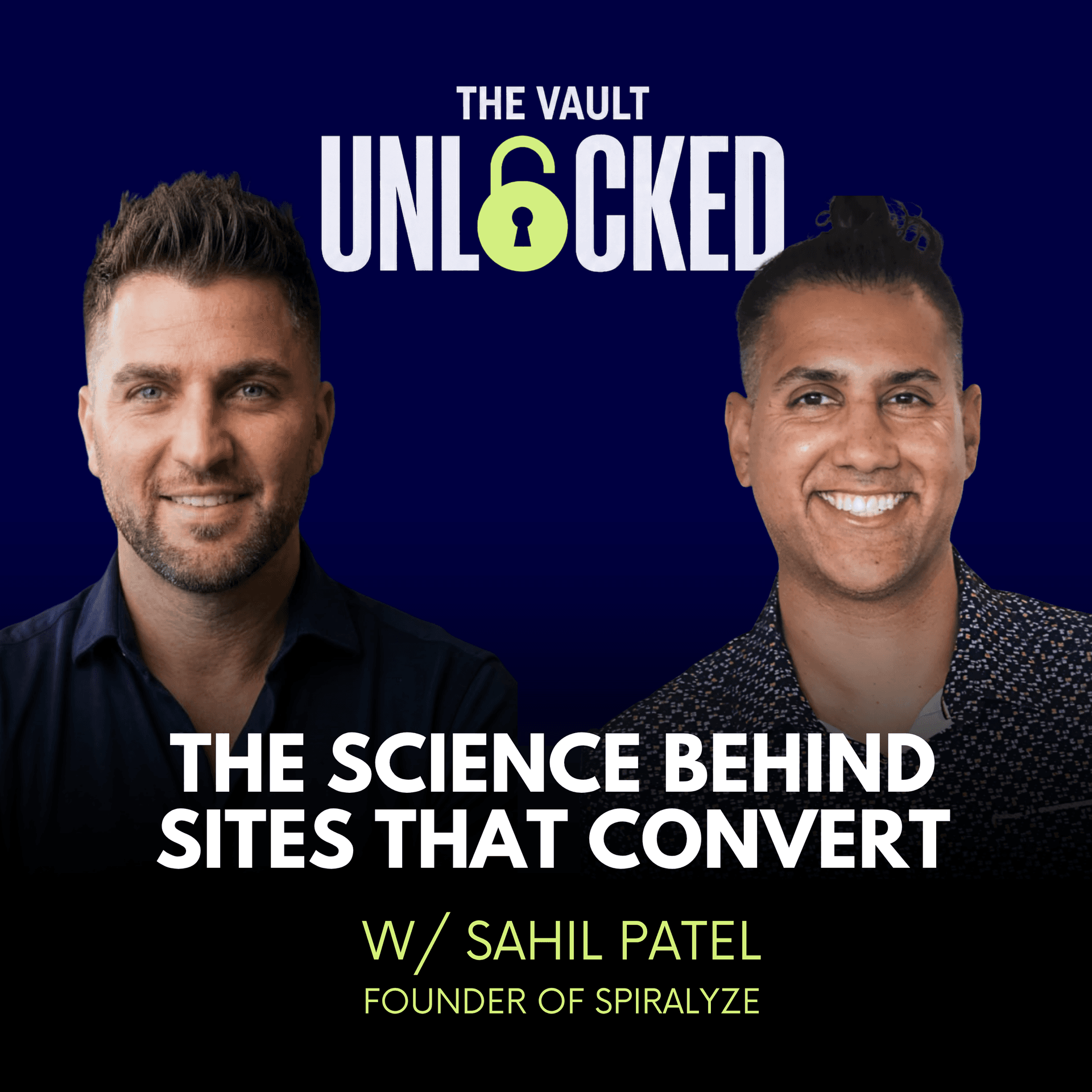
Sahil (CEO of Spiralize, Atlanta). He previously ran SaaS companies, became an early customer of Spiralize, and now leads an A/B testing company focused on predictive conversion rate optimization for mid-market B2B SaaS.
Key claims
- Websites often rely on “pre-scientific” gut instinct (like medicine tried on a neighbor) instead of controlled experiments.
- A/B testing is the “gold standard” (double-blind controlled experiments via randomization).
- Predictive CRO works by learning repeat winner/loser patterns across hundreds of companies, not copying one company’s single test (“winner’s curse”).
- For B2B lead-gen, optimization is most worthwhile around ~50–100+ form submissions/month; otherwise traffic/targeting issues dominate.
Notable examples
- Home air-conditioning repair: replacing a “happy stock photo” with uniformed service people in front of their branded van improved form/click conversions by double digits.
- Home warranty: swapping happy stock images for “things getting fixed” (AC, faucet, hot water tank, electrical outlet tester) also produced double-digit lifts.
- “Two-minute” Google Translate test: if translated homepage imagery/copy can’t be understood, visitors won’t know what you sell.
Written by AI. May contain mistakes. Listen to the episode to check what was said.
Chapters
Tap a time to open that second in VOUnderstanding A-B Testing
0:44 to 3:20
Sahil explains the concept of A-B testing and its importance using relatable examples.
“All the way from Spiral Eyes, the business itself.”
The Historical Context of Testing Methods
3:20 to 6:40
Discussion on the evolution of medicine and how it parallels current website practices.
“Let's even step away from like marketing websites, business.”
Transitioning to Data-Driven Decisions
6:40 to 9:21
Exploring the shift from intuition-based to data-driven decisions for website design.
“They do the equivalent of, I'm a doctor.”
The Importance of A-B Testing in Businesses
9:21 to 11:50
Understanding the stakes of A-B testing for businesses and how to implement it effectively.
“If you're getting ready to run a marathon, have you run a marathon or a half marathon ever?”
Practical Tips for A-B Testing
11:50 to 14:00
Sahil provides actionable strategies for conducting effective A-B tests on websites.
“I'm going to try that software for seven days first, see if it'll work it.”
Understanding A/B Testing Variables
14:00 to 14:35
Learn how to effectively conduct A/B tests by controlling variables.
Determining A/B Testing Readiness
14:35 to 16:56
Discover when a business should start implementing A/B testing based on traffic and conversions.
“But I wouldn't change multiple sections on the same page.”
Traffic and Time Considerations for Tests
16:56 to 18:46
Understand the importance of traffic volume and testing duration for valid results.
“So, if you run a test for just one day, maybe you run it on a Monday, well, maybe the people that shop on the weekends are different than the people that shop on during the week.”
The Importance of Lead Generation
18:46 to 19:25
Learn why lead generation metrics are crucial for conversion optimization.
“Because if they're not even coming to the site, optimize it all day long.”
Predictive Conversion Rate Optimization
19:25 to 21:56
Explore the concept of predictive CRO and how it differs from traditional methods.
“So what most in-house testing teams do, by the way, there are many, many good ones that are out there.”
Show all 21 chapters
Learning from Winners and Losers
21:56 to 26:04
Find out how studying both successful and unsuccessful tests can guide your strategy.
“And to know that you want to have, you want to be able to see where it worked.”
Basic Strategies for Website Conversion
26:04 to 27:56
Identify essential strategies that can enhance website conversion rates without extra costs.
“It predicts a portfolio of tests that you should run based on what's worked for similar companies.”
Understanding User Journey and Visual Elements
28:00 to 30:56
Learn how to enhance your website's appeal by focusing on visual elements and user engagement.
“I'm starting there because that's where most people's traffic goes.”
Stock Photos vs. Real Imagery
30:56 to 34:29
Discover the impact of using actual product images versus stock photos on conversion rates.
“that is like the top of the list i might fix the ac before i fix the toilet okay it's like 110 10 degrees in August.”
Imagery and Copywriting Importance
34:29 to 38:34
Explore the significance of imagery and copywriting in conveying the right message to visitors.
“Just ask yourself, do I have happy people?”
Creating Low Cognitive Load Websites
38:34 to 42:00
Learn how to design your website for better user experience by reducing cognitive load.
“Like the copy is like the most important thing.”
Understanding Low Cognitive Load in Copywriting
42:00 to 43:25
Learn the importance of low cognitive load and skimmable content in web copy.
“Number three, I was talking about the copywriting.”
The Role of Hooks in Effective Copy
43:25 to 46:39
Discover how to use hooks effectively to grab attention and convert visitors.
“And there's people that I see writing copy that are like essays.”
Testing Your Website's Hook
46:39 to 48:28
Learn how to compare your website's hook with competitors to ensure effectiveness.
“Get rid of the stock of images or the happy images.”
Identifying Business Problems vs. Conversion Issues
48:28 to 51:14
Understand the difference between marketing problems and conversion rate issues for SaaS companies.
“or they're going there next or they have them up side by side.”
Where to Find More Tips and Insights
51:14 to 52:28
Learn where to find more insights on conversion rate optimization and web strategies.
“And maybe can I do not just 10 pushups, but 10 pull-ups.”
Transcript
Automatic transcript. May contain errors.0:00Most founders run their website the way people used to take medicine before medicine was a science. Somebody's neighbor tried it, it worked, so you copy it and hope. My guest today doesn't play that game. Sahil is the CEO of Spiralize, and he built something called Predictive CRO, studying what's already won and lost across hundreds of companies before betting on the pattern. We get into why that happy stock photo on your homepage is probably costing you leads, why your actual product beats any lifestyle shot you've ever paid for, and a two-minute test using nothing but Google Translate that tells you if a stranger can even figure out what you sell.
0:38If you built your site off a template and a feeling, this one's going to sting. This is The Vault. Let's unlock it.
0:54Sahil, welcome to the show. Thanks for having me. Really glad to be here. All the way from Spiral Eyes, the business itself. Now, I know before the show we were talking, I'm very excited because this is such in the marketing department of business and A-B testing. And I know that what you guys are doing is revolutionary and it's quite interesting. So I'm excited to get into it. But before we do, why don't you tell us a little bit about who you are and how we even got to this point? Yeah.
1:26Sahil Patel:So my name is Sahil. I'm the CEO at Spiralize. We're an A-B testing company. I'm the CEO. I'm a second time doing the CEO thing. So I've been doing different kind of SaaS tech type companies my whole career. And I live in Atlanta, Georgia. Okay. Well, I mean, how'd you get into Spiralize? Tell us where that came from. Yeah. So it's a fun story. So I am actually not the founder. I was the founder CEO of my previous company, which was that SaaS business. And I was actually an early customer of Spiralize. So around the time, Spiralize was just getting off the ground. I started using the product. And I saw that it really worked.
2:12Sahil Patel:And it opened my eyes to the power of any...
2:18Sahil Patel:the power of A-B testing as a way to improve the efficiency of your app, of your website, of your landing pages. That's how I became a true believer. I sold that business. I was thinking about what's the next thing I want to do. I had stayed in touch with the founder here. He had kept building the business organically, self-funded, was looking for a partner. It was great timing. It also was great because I lived in Atlanta already and Spiros was based in Atlanta. So it was a good, it was a good arrangement. And I'd done the solo CEO founder thing wearing both hats. He had been doing it along the way.
2:52Sahil Patel:We both knew how hard that was. There was this mutual understanding of it. And we also had, there's some things he's really good at. There's a different set of things that I'm really good at. If we did them together, we thought that would work really well. And it's worked out really well. I've been doing it now for four years. And we, you know, we are using words like A, B, testing and I'm just assuming, you know, there might be people listening that like, what is even AB testing? So let's take a step back here and go, okay, let's talk about what is it? What are we even talking about right now?
3:21Sahil Patel:Okay. Let's take this. Let's even step away from like marketing websites, business. Let's just start with something probably everyone can relate to, which is when you have a new medicine, how do you make sure the medicine actually works? maybe you have a cancer drug cancer treatment um you could just guess you could give it to a bunch of people and then say did they get better but you want to make sure it really works so what do you do you get a hundred people you give half of them what's called a placebo it's a sugar pill it just it's nothing and you give half the people the actual drug and you measure how many people got better.
4:08And what you want to make sure is that, say you had 100 people, 50 people,
4:12Sahil Patel:make sure men and women equally distributed, young people, old people, big people, small people, all of those things. Because you want to make sure that the difference wasn't because you put all the men in one group and all the women in the other, and it turns out the drug works really well for men and not so well for women or some other variable. That's called randomization. That is an A-B test. And it's the gold standard for measuring how effective something is doing. It's not the only way to do it. There are other, you can do it before and after. It's not as good. This is the gold standard.
4:43Sahil Patel:Something called this double blind controlled experiment. Fancy words, A-B test, same thing. So that is, now we accept that as the best way to know if a medicine works. if you went to the doctor today and she said, Hey, I've got something for your cold. Here, take this. And you looked at it and you're like, huh, I've never heard of this. Like I was going to take some Robitussin, but what is this? And the doctor goes, Oh, it's, it's really good. You might ask, well, how do I know it's good? Like, Oh, I gave it to my neighbor. We're great. okay uh is your neighbor they have the same symptoms of me uh how do how much should i take i'll just take a swig okay like what is it effective at like two tablespoons one tablespoon once a day like oh well i i bought trust me i've been a doctor for 10 years this will work you would never do it okay or at least i don't think you would okay i don't think you would to hope not okay this is now back in the early days of medicine okay and by the way that time wasn't that long ago okay we're measuring probably less than 100 to 200 years of recent history that's how people took medicines right that's the the days of uh patent medicine than people standing on a shoebox hawking their Sahil's patent cough syrup.
6:22Sahil Patel:Hey, no one would do that now. You would never take a cancer drug that hasn't been tested. And yet, right, so there's the pre-scientific era to medicine and we're now in scientific era to medicine. Yet, for people's websites, they do that all the time. They do the equivalent of, I'm a doctor. I've done this for 10 years. I don't know. I gave it to my neighbor. Worked great for them. Should work for you. All the time, you look at websites. Why did you do this on the website? Oh, it's best practice. What do you mean it's best practice? Well, I read about it on a blog. Okay. So it worked for one person.
7:01Sahil Patel:How do you know that works for you? Well, it looks good. CEO liked it. Yeah. Okay. Emotional decisions. I used a template. I picked the best... I'm not going to name brands because this is not the fault of any of the brands who do website templates. There's lots of really good ones out there. Some also not good ones. I looked at three templates. They said, this was the best template for my landing page. This was the best looking homepage template. By the way, if you're Slyhulls Barbershop, that's probably fine. Okay. But if you're building an actual business where the website is the front door to your business, you may want to put a little bit more thought into it.
7:50Sahil Patel:Yeah. If you're an e-commerce brand, okay, if you're selling B2B SaaS, and you're selling cybersecurity software, and your average product probably sells for like$100 ,000. Every lead that comes... Every person that comes to your website and goes away... that's really valuable. Millions of dollars you're losing. So what is A-B testing is taking that same thing that we use in many other parts of our life and applying the, taking websites from the pre-scientific gut instinct era to the scientific era. There are, that's a journey. And for some companies, it makes sense to do that. For some companies, it doesn't.
8:36Sahil Patel:And it doesn't mean you can't make mistakes doing that. It's prone to mistakes. It's not perfect. But if your website is an important place where you do business in some way with your customers or potential customers, this is a much better, it's a really good way to make your website your number one salesperson. And we're talking about optimization here. So we're talking about you have your website, which is let's call it your A. And then what you're doing is you're just testing little things here or there on a variable, on a B variable and sending traffic to both to seeing what converts.
9:17Sahil Patel:You don't have to limit it to small changes. You could make a big change. You can make big changes. Yeah, you can make big changes. If you're getting ready to run a marathon, have you run a marathon or a half marathon ever? I have ran a half marathon once and I promise I would never do it again. My body's not meant to run long distance. I'm in the same day. My wife ran once and she did great. But just watching her train said, I have other things that I want to do. Okay. When you run, what did you do to get ready? I did the, there was like a protocol. This was a while back, but like I trained with a group and you do your runs and you, you know, you do your start with your two Ks or you work your way up and then all the way up till you get to where you got to go.
10:04Yeah.
10:04Sahil Patel:So, so there's, there's a training regimen. There's a training regimen for sure. There's probably a rest regimen. Okay. If you run 10 miles every day, you're not going to, that's actually worse. Short distance speed. There was, there was quite a bit of work. Yes. There may have been a dietary component. Okay. Okay. Now, depending on how serious you are, maybe you didn't need to make drastic changes, but they probably some advice told you to avoid some foods, probably go easy on the hamburgers and milkshakes, and maybe go a little bit more on the healthy lean protein. Okay. Now, one way to get ready for a marathon is to only do one of those things.
10:42Sahil Patel:And then you could say my, my time got better. And I know with certainty it was because I wore the right kind of shoes. And then the next marathon, maybe you'll add compression socks. And the next one, you'll eat chicken five times a week instead of burgers. You could do that. And then every time you got this pretty high confidence level, but at the end of the day, what gets you there a lot faster, you should combine those things. Eat lean protein, wear good socks, wear good shoes and train. And get enough rest. Now, will you know that 10 % of your reduction in your race time came from the socks?
11:22Sahil Patel:I'm just making shit up. Another 5 % came from eating lean protein. No, you'll never know that. The same is true in A-B testing. And you can get away with it, I would say, particularly on websites, particularly on a B2B website. First, I just want to be clear, the stakes are much lower. We're not injecting a cancer-treating drug into your body. The stakes are really high and you want to go one variable at a time there. Absolutely. We're talking about, can you get someone to fill in a lead generation form or click, I'm ready to start. I'm going to try that software for seven days first, see if it'll work it.
11:59Sahil Patel:So the stakes are lower. The other thing is, for our audience out there, I'm going to use some acronyms, B2B, D2C, just business to business. If I'm selling software to other corporations, that's business to business. If I'm selling you shoes on the internet, direct to consumer. in direct and consumer, you have all this traffic. How many millions of people are maybe going to Nike.com to buy shoes? A lot. So you can quickly get a sample size, which means maybe you run it for a week and there's millions of people coming and you can very quickly detect there's a difference between the performance two versions of the pages.
12:38On the B2B side, how many people are shopping for
12:41Sahil Patel:a new cybersecurity software today. Some, okay? And in fact, just quite a few, but not as many as shopping for shoes. So one way to get results quicker is to make big changes. Okay? Now, you don't want to just do a bunch of random shit. But it is an acceptable trade-off to maybe you change the message on your homepage and the image that goes with it. And why? Because usually, the messaging, what's called the copywriting, and then the visual image, they complement each other. And so if your headline is making some big claim about how effective your product is, say it's stopping cybersecurity attacks, maybe the image should support that.
13:25Sahil Patel:And they work together. So it's not just changing random things. But this is for our marketing people in the audience today. And we're going to talk about some very specific examples. This is what we're talking about, A-B testing. Yeah. I think it's interesting because as you're, as you're speaking, I'm thinking, okay, for, for a true A-B test to happen, we need traffic. Yes. So what's, you know, what is that number? There's, I don't think there's a set number, but there more is better than less, obviously. Um, and then, and then you were talking about making big changes. Yes. Big, small minute changes the the question i have because i as a non-ab testing expert one thing that i've always thought about ab testing is if you change too many things and you don't know what works because you've changed correct and you can't control the variable that's right that's right and what i'm talking about here maybe a good way to kind of put some boundaries on it is I might change, I might be okay, I could probably get okay with changing a few variables on one section of one page.
14:35Sahil Patel:But I wouldn't change multiple sections on the same page. And I wouldn't change something up funnel or upstream and on the page and maybe after the page. Okay. Maybe just start with like, I'm just going to pick something simple, a shopping cart add to cart. And I want to test, do I get more people to add it to cart if I say free shipping or free returns? By the way, both probably work. Maybe you should test both. I could do that. Maybe I would change the button color and maybe I could also change the font size, how visible I want to make it. I probably could roll that all into one test. What I wouldn't do is then also change maybe the ad copy that gets people to come to that site to emphasize one of them.
15:29Because now I'm really distorting the effect of the experiment.
15:33Sahil Patel:I think that's where most experimenters would say, hang on a sec, be careful about changing too many things. Because now you're calling what's called confounding variables. And it clouds, you just really don't know which thing made a difference. I couldn't agree with you more. I haven't heard the word confounding, but yeah, it's if you change into variables and you just don't know which ones are actually working. It's interesting because we can go as detailed as like you said, as simple as a small button going red or green. As simple as I love what you just said, free shipping or free returns.
16:10How when when is there when that when is there a business ready to start doing this type of A, B testing? Like what levels of traffic are we talking about to the website? Now, I know that's subjective because I want to make sure everyone is clear. Yes, someone coming to Nike website and buying a pair of shoes, very different than a cybersecurity product that's a million dollars. Having said that within the guardrails, when is it that people are coming to you usually? Where are they when they're saying, hey, we need to hire you and your service for A-B testing? So, maybe a good way to put it is, let's just start, why do we care about traffic?
16:55Sahil Patel:We care because you want to make a decision based on what's called a statistically significant result. So, if you run a test for just one day, maybe you run it on a Monday, well, maybe the people that shop on the weekends are different than the people that shop on during the week. On Monday morning. Who knows? Okay. So you want it to be representative of your traffic. And the more traffic you have, the more quickly you can represent. But I want to talk about there's two factors here. One is just the amount of traffic. The other is time. Because if you have a high traffic site, running the test for one day still isn't enough time for the reason we just talked about.
17:37Sahil Patel:Maybe the weekend shoppers are different than the weekday shoppers. So you want to look at both of those things. For a business-to-business type of website, and you're optimizing for lead generation. Lead generation being someone fills in a form and they're saying, Hey, I want to check out your product. I want to see a demo. I want to do some kind of free trial. Usually where it starts to make sense that this is worthwhile is if you're getting 100 submissions a month. These are ballpark numbers. Take them as guidelines. there's some companies where 100 is more than enough and there's some where it's not nearly enough yeah but most of the time if you're south of 100 ish or maybe 50 to 100 one you probably then don't have enough traffic it's so traffic is not enough you should look at the number of conversions the second thing is it probably means you're a small business nothing wrong with that but there are probably other things you need to be working on before you work on conversion rate optimization.
18:41Sahil Patel:You know, for the most part, maybe you just need to be trying to get more traffic or more of the right traffic. Getting your ideal, use of marketing jargon, ICP, ideal customer profile, or persona, same thing. Just there in the first place. Because if they're not even coming to the site, optimize it all day long. It doesn't really move the needle. Yeah, it doesn't matter. Now, you guys at your business, you said you guys do very unique or you have a scientific way of A-B testing. What exactly is that or what makes it unique or different for you? Yeah. So we do a thing called predictive CRO, predictive conversion rate optimization.
19:25Sahil Patel:So what most in-house testing teams do, by the way, there are many, many good ones that are out there. You tend to see these at bigger companies because they have the maturity and the budget to actually hire a team of data scientists. And they have people whose their whole job is every day is designing, doing web design.
19:50but most most companies don't have that and so when they say oh we're gonna we're gonna redesign the the site maybe they hire an agency maybe they have someone in houses on it and what they're
20:02Sahil Patel:mostly relying on is personal experience they might be right they might be wrong but the data available to them like inside their head is probably a very small number. And it's hard to know if the thing that worked for your last company, is it transferable to your new company? Okay. Okay. Why? Because two things have changed since you, even if you actually ran this as a good statistically rigorous A-B test. One is a function of the company you're at today and the company you're at yesterday are probably different, at least a little bit. Okay. Number two, time. If you look at a website from five years ago, you can probably tell it was built five years ago.
20:55Sahil Patel:And if you get in the Wayback Machine and just look at some big company that you would consider modern, but has been around for a long time, like Salesforce. if you look at in the wayback machine you look at salesforce's website from 10 years like they're home page you big oh my god what were they thinking 10 years ago it looked normal yeah so the thing that worked that was better than your quote control 10 five years ago may not be it could be it could not be but if if you if you're relying on personal experience Now, maybe you hire an agency to solve that problem for you. They do lots of AP tests.
21:34Sahil Patel:There's lots of CRO agencies, lots of good ones, some not-so-good ones. They are usually relying on what they've tested for their other customers. It could be a big number, it could be a small number, but it's still a limited number. And while they solve some of that problem, they still have that, what worked, did it work because circumstance or is it transferable? And to know that you want to have, you want to be able to see where it worked. You also want to see where it didn't work. Winners and losers. Okay. Think about if you, if you, if you interview athletes and you only talk to the winner of the world cup going on right now, if you only talk to the winner of the world cup and you said, what did you do to get ready for this game?
22:23Sahil Patel:It's pretty helpful. but you probably should also go talk to teams that lost it's about what did you do to get ready for this game and then compare that yeah okay same thing here you want to have the winners and the losers to know what works and the more of that data set you have the better so the thing that we do that's different we crawl the internet and we shamelessly steal everybody else's a b tests now i say steal because it's i'm trying to be a little bit funny we're not actually stealing anything because all a b testing is in the public domain yeah i i hear you saying but you you you look at what everybody else is doing and see what's the most converting for them how do you know it's converting though that's great question okay think about a company that let's take nike.com they're not a spirals customer if they're running a test on their home page what we can see is that They're splitting the traffic.
23:20Sahil Patel:We can actually see the visual difference between the A and the B. Imagine every day for two weeks, they're running a split test. And then on the beginning of the third week, they send 100 % of traffic to the B version of that homepage. Do you know how they're sending traffic? Can you see that? There are some ways that are proprietary that we have figured out how to do that. A.k.a. Black Hat or Gray Hat? I wouldn't call it Black Hat. I would call it white hat. Okay. But there's ways that you can see how much traffic are going to these different pages. I mean, this is pretty... Or you can estimate it.
23:58You can estimate it. So you know that, okay, they're running two. You have basically a way to find out that these big companies are running A-B tests and then figure out which one, which control actually worked so that you can now take that data for your customers.
24:15Sahil Patel:That's right. And what we're looking for are repeat patterns among similar companies. So if Nike.com runs this really interesting test, I don't think that is necessarily super relevant for CrowdStrike, a big cybersecurity company, and vice versa. And by the way, let's say CrowdStrike runs a test. Yes, it may be relevant for other cybersecurity companies, but is it predictive? it's really hard to know if you got an N of one. I would not go copy that. Because now you're just talking to the winner. You have the winner's curse. Okay. You want to look at the winners and the losers. So what you want to look at is like, hey, there's a hundred cybersecurity companies.
Read the full transcript
25:05Sahil Patel:What is the portfolio of tests they ran? And what things tend to win and what things tend to lose? And then bet on that portfolio. okay okay not unlike if you were um if you were a poker player and you followed someone who's really good world series of poker type of player okay any one of her hands or his hands can win or lose and if you only watch them play one hand and you say oh i'm gonna copy that hand i don't think that's super predictive right But if you watch them play 100 hands, you're going to detect some patterns. And if you watch five players play 100 hands, you're really going to watch 100 players play 100 hands.
25:51Sahil Patel:Now, there's some clear patterns of when they hold, when they fold. When to hold them, when to fold them. When to hold them, when to fold them. That's what predictive CROs. It predicts not what one test will do. It predicts a portfolio of tests that you should run based on what's worked for similar companies. And similar doesn't have to be just they look just like you. It could be someone that has a similar call to action on a paid landing page by the paid traffic tends to behave differently than organic traffic. And is it on a homepage? Is it on a sign up page? You want to look at all of those and then say, okay, which ones are similar?
26:27Sahil Patel:Let's predict the portfolio of tests you should run. Run the whole portfolio because across that portfolio, you'll find the winners. Let's talk. I know you have so much basics here. And I want to talk when I'm at basics, I'm going to say, sorry, data. You have so much data. And I think for my listeners, I'm just thinking about the smaller businesses that may not be able to bring in yet a data scientist or, you know, have a full CRO team working for them. but they can maybe understand different things that we know through data that work. Like for instance, for things that I know, and I could be wrong, but I've heard is like, you want someone to say yes and move, you know, hit a button.
27:19The button shouldn't be red because red is a sign of stopping, right? Maybe. See, that's when I've heard that. I've seen red buttons. That's where it gets interesting. And that's where I heard other people have said, no, you're actually wrong. red actually does work. So are there, is there any thing that for sure that are basics, like these are the musts, like these are the musts that you have to have or that we know.
27:41Sahil Patel:That's a great question. Here are three things that our listeners today can use right away. And they don't have to spend money, buy fancy software, hire an expensive agency to do. Let's start number one. and by the way, what we're going to talk about are like home pages and landing pages. I'm starting there because that's where most people's traffic goes. Okay. If you have some niche page or some tech, like a page that describes the technical attributes of your product, those are necessary elements of the user journey. Okay. I'm putting those aside for now. Okay. Because typically those are so specific to you and your product or your service.
28:25you should just those are people searching also for you and they're already in the funnel if they're looking at the technical page they're they're they're already sold they're they're just trying to find a way to buy okay first thing show the product show the product show the product
28:41Sahil Patel:okay we have a phrase happy people kill conversions what does that mean happy people hurt conversions. So many websites have stock photos that they got on, you know, in their Adobe account of two people in a conference room looking at a tablet going, wow, first of all, who's having this much fun in a conference room? I want to go there. My conference room is not that much fun. No one... Let's talk about this. Can you think of the last car ad you saw? Okay. Do you remember what car it was for or what brand? I'm thinking... I don't know why it's sticking out for me, but I was thinking about the Audi one.
29:29There was one that was an Audi one. Okay. Cool. Audi.
29:32Sahil Patel:Audi makes really nice cars. Yeah. Can you picture what was that? Was it a TV ad, YouTube ad, magazine ad? It was an awesome TV ad. It was a luxury TV ad. I only remember it because it was around where I live. And it was, it was, you know, a ball and ad with a new car and cool rolling into a$40 million home on the bank of the ocean. And, you know, with the beautiful life, Jack's, you know, husband gets out, smiles, throw the keys to her. She gets in, they drive off and then the Audi comes in quattro. Right. Awesome. So there's a component of lifestyle. There's a component of aspiration, but there's also kind of showing the car.
30:10Sahil Patel:Imagine the same ad. Okay. Picture it right now. And just imagine you had a magic eraser and you just erase the car from that ad. Yeah, totally. What would be left? Lifestyle? Lifestyle, yeah. Lifestyles of the rich and famous and good looking. Okay. Would anyone then say, I think I'm going to go to my Audi dealer and check out a car? No. No, you'd be like, what the hell is this? This is actually really important. I hope people are, if they're here listening, we're starting to get something very important here. aka remove the stock photos now if you have if your product company show the product if your service company show the people who deliver the service explain that okay so we worked with a company that does home air conditioning repair okay imagine now i live in georgia if my ac breaks that is like the top of the list i might fix the ac before i fix the toilet okay it's like 110 10 degrees in August.
31:11Sahil Patel:You just cannot live without air conditioning. Okay. I can go to the backyard to go to the bathroom. I can't live without air conditioning. And we ran an AB test. Their homepage had stock photo of mom with two kids. Everyone looks happy. And it kind of looked like, I don't know, Mother's Day, like the kids were giving her tulips. It was a happy person. I think it was supposed to convey that, hey, if you need your AC fixed, you're going to be happy when it's fixed. And the A-B test we ran against it, we just, we replaced the photo with an image of three uniformed people in front of their van with the brand name of the van.
31:51Sahil Patel:And that was the image on the homepage. Didn't change the copy, didn't change the offer, didn't change anything else, didn't change the social proof. And there was a double digit improvement in people either filling in the form or clicking... They had two call to action. It's a local thing. So it's click to call or fill out the form. Keep in mind, these people are already very high intent. When you need your air conditioning, you would think, what could you do to actually stop someone from calling? Well, it turns out, yeah, double-digit change just by people saying, oh, this is who I'm going to get.
32:26Sahil Patel:I get a professional person coming to my home in a nice van, and they're going to fix my AC right away.
32:39Sahil Patel:We worked with a company that does home warranty. And the homepage showed images of that. Again, stock photos of happy people. Presumably, it resonates. It's like, oh, they're happy. I'll be happy. great they have yeah they have uh home insurance or whatever warranty i have it yeah yeah and what we what we tested against it is images of things getting fixed okay an ac unit getting fixed a uh it was like a uh like a faucet like a bathroom faucet getting fixed yeah water and then water hot water tank something yeah and then like an electrical like you know the what is it called where they put that thing in your outlet to see if it's producing electrical charge.
33:28Yeah, yeah, yeah.
33:29Sahil Patel:These are all intuitive things, okay? The kind of thing is also just the average DIYer probably doesn't do themselves. They want to call it professional. So it's clear, like, you will get these things fixed. Someone's going to come to your home and fix them. These are from double-digit lift. Wow. And show the product, show the product. So, like, for a SaaS company, you would just show, like, the product. Screenshot of the app. The screenshot of the app, yeah. Yeah. Okay. There's lots of different ways to do it, to style it. If you're concerned that the picture of your app is proprietary and that's a source of competitive advantage.
34:04Sahil Patel:First, let me say your competitors almost certainly already know what your app looks like. Okay. They've downloaded it. They probably signed up with a different email and they're using it. Everyone does that. So just let me... Yeah. No, I'm going to go. I hear that rejection a lot. But even if you think that's true, you could do a stylized version of your user interface. What you're trying to get the person to do is just think of that Audi ad. You got to put the car in the Audi ad to get the person to go to the dealership. Yeah. Put a picture of your product. So it's number one. Everyone can do that right now.
34:35Sahil Patel:Just go to your website. Just ask yourself, do I have happy people? Because I'm probably hurting conversions. Okay. Number two. This is a good one. Take your homepage. right you just in a browser okay right click in chrome and one of the things will be google translate pick a language that the people around you don't speak okay so maybe pick arabic pick hindi i'm picking languages and speak it at home growing up okay and then take your home page show it to five people who don't know that it's your company know you want just ask them what do you think this company does? Okay. And by the way, they're not going to come up with something specific like this is a point of sale entry system for multi-location retailers, but they might say something like, oh, this looks like business software or something.
35:28Sahil Patel:Okay. If they can't even come close to the category, you have a problem. And the translation technique, what it's doing is it's removing the copywriting from the equation. And it's forcing the person to use the imagery to draw an instantaneous conclusion about, am I in the right place? And by the way, that is what your audience does when they reach your homepage or landing page, because the brain processes images faster than words. So imagery is very important then. Super important. Super important. And so if your copywriting is doing all the heavy lifting, you have a problem because you've created this high cognitive load homepage or landing page.
36:15Sahil Patel:The copywriting is absolutely important, but the instantaneous react decision that almost everyone knows when they get to a page was, am I even in the right place? Just like when you walk into a restaurant, if you're on date night, you're looking for certain things. some ambiance. You haven't tasted anything. Okay. You're looking for ambiance. Is there a smile? Am I the maitre d'? What's on the tablecloth? Okay. Is this like white tablecloth? Is this checkered, more casual, Italian, like little Italy kind of thing? Or am I going to Chipotle? I love Chipotle. There's certain things I expect by going to Chipotle.
36:52Sahil Patel:Okay. And if I don't see them, my brain's making kind of real quick decisions. you know if i go into chipotle i expect to kind of smell a certain way it's kind of that grilled chicken that you know that's what i expect if i go to kind of date night at a nice place there's a different kind of just all these little things and my brain's making instantaneous subconscious level decisions about am i in the right place i you can yeah you could do this don't spend money on fancy software don't hire an agency i want to be very clear because i i didn't get it and then I got it and I was like, oh my God.
37:26So I want to make sure it's very clear for people here. Step one, remove the stock image. Just get rid of any happy go lucky stock image. And replace it with
37:35Sahil Patel:your product or service. And replace it. If you're a product-based business, replace it with your product. If you're a service-based business, replace it with the service people or the type of service. Or the outcome. Or the outcome that people are going to get. So for example, we worked with a higher education company. Show the diploma. Yeah. Show them getting graduate Show them graduating. Show them throwing the hat up or whatever it is. Number two, this was very interesting. Take your website, put into a different language. Take the homepage. You only need to use for the homepage. Take your homepage, put into a different language, send it to somebody and just say, hey, what does this company do?
38:20What does this company do? And if they can't tell you within a range, obviously within a range, it's a business service. Oh, it's a it's this type of service or this type of product that tells your imagery is off. And people look at the imagery versus the copy, which is very interesting to me because I come from direct response copy market like writing where it's all copy. Like the copy is like the most important thing. And you just said imagery and copy are both almost equal.
38:51Sahil Patel:Well, let's talk about that a little bit. There's two jobs. What the imagery does is it helps establish for the website visitor that they are in the right place. It is the equivalent of you walk into a restaurant and you go, hey, am I in the right type of restaurant, fast food or fine dining? okay what the copywriting does think of that as i'm reading the menu okay and if i see some things and they're described in a way that's enticing that speaks to me to what i'm looking to get out of the experience and i'm going to order okay and by the way at mcdonald's like what they write those value meals in a certain way that's copywriting yeah okay and it works and if you go to a nice restaurant and if you and if you go to a nice restaurant on date night the the way they write the menu is written in a certain way to make you feel like oh the chef is just is i'm getting something so special this meal is just it's going to be when they talk about where is the food source from and whatever foam they use to decorate the plane all these things right and you would never see that on mcdonald's value meal and vice versa.
40:04So the copywriting instrument, but they serve two, they, and for our conversation
40:10Sahil Patel:we're having today, they really kind of have two different jobs. Yeah. Okay. Now let's talk about the copy. Right. Is this number three or is this number three? Number three. Let's do number three. So we talked about first, just tactically get rid of stock photos. Number two, make sure whatever images you use are low cognitive load. Yeah. Low cognitive load. Okay. Low cognitive load. Okay. I see this all the time in B2B websites. They have like a schematic of how their software fits into the ecosystem and the tech stack and how it integrates with 17 different things and it's animated and things are flowing and
40:52Sahil Patel:that's the wrong place to put it. That's a high cognitive, put that on your technical page, put it on your solutions page, put it on your, you know, how the whole thing works. Okay. This is the equivalent of you walk into a restaurant and the maitre d' before they ask you, hi, how many people today? Or do you have a reservation? Or do you want to sit at the bar, the dining room? Explaining to you like the 17 steps the chef does to prepare the vegetables today. You're like, whoa, hang on. I just, like, could I just see the menu? Or like, I just want to tell you, table for two. You don't lead with, let me tell you where we source the chicken and that kind of...
41:34Sahil Patel:So imagery is important. Homepages should start with low cognitive load and then move the user to higher cognitive load as they move through the journey. You got a restaurant, you start with, can I get you a drink? Let me bring you the menu. Have you thought about an appetizer today? Okay, let's pick your meal. McDonald's has it down to, or Wendy's, pick your food. They say, number one. Number one, just start there. You don't have to say two words. Give me a one, three words. Low cognitive load. Low consciousness. Then you go to a higher cognitive load. Don't do some complicated schematic. Number three, I was talking about the copywriting.
42:22Sahil Patel:make it skimmable. The more it offends your 12th grade English teacher, the better. You're not writing for the AP English exam. You're not taking the SAT. This is not the entrance exam. This is not your personal statement to get into graduate school. No one cares about what your belief system is, your aspirations or what you think you're about. They came there because they have a problem they're trying to solve. So,
43:02well,
43:02Sahil Patel:you've, you've done direct response copy, right? You can make it easy. What is this? It's, it's interesting because the, it's interesting. I, yeah, man, And you're going to open up a whole can of worms here for me because I have seen little copy convert. Right. But then where we're talking about. So I'm talking to B2C at this point. Right. Business consumer. And there's people that I see writing copy that are like essays. Like, I mean, essays, but they're converting. It's like long form. I'm sure you heard of like a long form sales letter. But it can work. Long form can absolutely work. Long form copy, long form video, long form anything can work in the right place.
43:53Like I come from the world where it's pre-headline, headline, sub-headline.
43:59Sahil Patel:That's great. And what do you put in the headline? Well, that's the hook. Yeah. The hook. Start with the hook. Yeah. That is either the pain or the solution, right? Yeah. Pain or solution. Start with the hook. Pre is who it's for, right? Yep. Those things are all called skimmability. Yeah, okay. And if you write a long paragraph, now how can you find the hook? Yeah. Lead with the hook. And then your subheading needs to support the original claim before you make new claims. Yeah. We see this all the time. There's a bold claim, and then there's three new claims. hang on a sec I just like I still haven't I haven't bought into your first claim why are you telling me about the next claim like if your hook is safe car we just bought a Volvo right so we just my oldest is is about to get her license yeah so she's going to not tomorrow but after some practice she's going to inherit our 2017 Subaru great safe car so we went out and found a nice uh pre-owned car for my wife we bought a volvo like beautiful car safe the hook great safe car well i was just gonna say right like everyone knows volvo safe right you think volvo's known and they and they do a great job not they've also moved up market by the way right the old boxy cars that we all grew up the gray box volvo that we know it's like an indestructible cage.
45:36Sahil Patel:They look nice too. But they first get you to buy into that it's safe before they start telling you about all the other things. Everything is, hey, we're safe. That's the hook. Why is it safe? We've got these great cameras. We've created this motion detection. By the way, I didn't know this until we went shopping. Do you know a Volvo weighs more than a Suburban? I would assume so, yeah. Yeah. I didn't, I didn't, it's the steel. It's like some kind of special steel they're made out of. Yeah. They're safety. They're heavy cars. They're heavy. Yeah. Super heavy cars. You're driving basically a modern tank.
46:14Yeah.
46:16Sahil Patel:Anyway. So they, they support the first claim. Then they go in and tell you about, okay, now let's talk about some other things. Let's say about what, this is a fun car and let's talk about how we made it nice. And same thing on your website, good copywriting. You start with a hook, make the hook believable before you start introducing new claims. These are three things that everyone can do on the website today. I'm just going to say it again, right? Get rid of the stock of images or the happy images. Show your product or show your service or the outcome of the service. Low cognitive load on the pictures.
46:56So again, translate it to some language nobody can understand. And send it to somebody and say, do you know what this company does? The answer is if they can't say it quickly, you know the problem. And then third is skimmable copy. I mean, this is huge. This is big stuff. Any business owner, open up your website right now and just look at it right now. If you're wondering, how do I make my website better? It's like we just gave you the three answers. Very simple. Open the website. I want to do it right now with you so we can go through it. I'm not going to. That's how I'm feeling. And then the bonus.
47:32What's the bonus?
47:35Sahil Patel:Here's the bonus. We're going to just, we gave you three. So kind of one, two, three. This is like 3A. Okay. Take whatever hook you have on your headline today, or if you're thinking of writing a new one. Okay, write the new one. Take your three closest competitors. Take their homepage. Put them next to yours. like one, two, three, four. And then see if you can tell the difference. And if you can take your headline and put it on your competitors, it means you don't have a good hook. Because it doesn't stand out. And you're simulating what your audience is doing. They may not do being explicitly, they may be doing it implicitly, but you should always assume that your audience has your competitors.
48:27Sahil Patel:They either come from your competitor's website, or they're going there next or they have them up side by side. Yeah. And it's a great test of the hook. And what it tends to do is it strips, it tends to force you to strip out jargon and fluff and not even worry about, am I better? Just start with, am I different? Still saying the clear message though. Yeah, yeah, it's gotta be clear. And I'm saying do it on a homepage and not on like a technical page or a solutions page because that's just a different ball game. Okay, there. The homepage, you got to keep it simple and you just got to strip out the jargon.
49:11Would you say, well, you're saying it less is more. Would you say on a homepage, because I'm seeing this more and more, like homepages have very little copy almost now. Especially in the hero. Yeah.
49:23Sahil Patel:The top, we call it the hero section, the top section. Yeah, the hero section.
49:29Sahil Patel:I think there's a happy medium. I think you should not be afraid of putting copy on your homepage. It does a lot of the heavy work, but it works better if you make it easy to skim and you have a good hook. Yeah. I love it. If people, what type of businesses do you work with? So we mainly work with B2B SaaS companies. what we call the mid-market. So about 100 people to about 3 ,000 people and about 50 million in revenue to about a billion, billion and a half in revenue. The companies that are smaller than that, they usually are trying to solve other problems that we don't help them with. And the companies that are bigger than that, especially a lot bigger, they don't need our help.
50:18Sahil Patel:They have their own internal army of data scientists. And that's great. That's great for them. But for that part of the market, we can give them a lot of help. $50 million plus SaaS companies is who you really focus on. That's right. And I love it. You said this, I remember you said this to me before and I was like, wow. And you said anyone before$50 million, they don't have a conversion problem. They got a marketing problem. Or I think you said they got a marketing sales problem. Yeah, there's other problems you need to solve first before you worry about optimization. You know, I think of it as if you're out of shape and you haven't done any exercise, you don't need to be trying to get your marathon time down.
51:03Sahil Patel:You probably should start with like walk three times a week. Yeah. Then maybe get to like, can you do 10 pushups? Yeah. You do that. Then you can start doing things like optimizing for diet and body composition. And maybe can I do not just 10 pushups, but 10 pull-ups. But if you go straight to that, probably not going to work. Yeah, I love it. Where can people find you if they are a... I mean, if you are a$50 million plus SaaS company and you want, obviously, the best and the best in the business right here, A-B testing, where can people find you? So they can go to spiralize.com if they would like to find out more.
51:46Sahil Patel:Also, if you want to hear more tips on the kind we just talked about, check me out on LinkedIn. I post four mornings a week at 7.30am Eastern. And it's always some combination of easy to digest 30 to 60 second things. I also have a game show where people come on. They try and beat me in finding different CRO crimes. That's actually the name of the show, CRO Crimes. Nice. It's a lot of fun. Seven lightning rounds. The winner gets$100 for the charity. I love it well we're going to make sure we have those in the show notes for you any last departing secrets words for the audience um I think we covered it great thank you for having me on thank you if anyone made it this far thank you for listening yeah I appreciate it thanks so much
From the publisher
Most businesses run their websites off of a feeling, pure gut instinct. A stock photo here, a red button there, a template because it "looked good." Sahil names that for what it is, then shows exactly what replaces it.
Sahil Patel CEO of Spiralyze, built his career two SaaS companies deep, and by the time he became a customer of Spiralyze, he had already sat through enough failed website redesigns to know the truth nobody wants to hear. Your best guess about what converts is still just a guess. Four years later he now owns the company, and what he found by analyzing other people's live A/B tests changes how you should think about every page on your site.
In this conversation, Sahil breaks down why A/B testing is the same double blind logic that proves a drug works, why B2B websites need bigger, bolder test variations than e-commerce sites pulling in millions of visitors, and why copying a single "winning" test from a competitor is a trap he calls the winner's curse. He explains what predictive CRO actually means: pulling winners and losers from hundreds of similar companies' public tests instead of betting on one anecdote.
Then he hands over three things anyone listening can fix today, for free, before hiring an agency or a data scientist. He names the exact mistake quietly killing conversions on most B2B homepages right now (stock photos of happy people with nothing to do with the product), the fastest way to find out if your imagery is actually working (a translation trick that takes five minutes), and the rule that decides whether your headline is a hook or noise. He closes with a bonus test that shows in about sixty seconds whether your homepage sounds like every competitor you have.
This episode is for founders and operators running B2B SaaS or service businesses who are making website and messaging decisions based on instinct, internal opinion, or "what worked at my last company." It is for marketing leads tired of hearing "best practice" as a justification and looking for an actual method instead. It matters most if your business does over fifty million in revenue and generates leads through your website, because that is exactly where this conversation lives. If your site gets under a hundred form fills a month, Sahil is direct about why testing is not your next move yet, and what is.
The conversation covers conversion rate optimization, A/B testing methodology, homepage design, lead generation, B2B SaaS growth strategy, sales funnel psychology, and the copywriting principles that turn a website into an actual salesperson instead of a digital brochure. Sahil also breaks down the difference between testing for direct to consumer traffic versus B2B traffic, how statistical significance actually works, and why the agency or in house team you already pay still has a data problem you may not know about.
Questions Answered:
-
What is A/B testing and how does it actually work
-
How much website traffic do you need before A/B testing is worth it
-
What is predictive conversion rate optimization and how is it different from standard CRO
-
Why do stock photos hurt website conversions
-
How can you tell if your website's imagery is doing its job
-
What makes a strong homepage headline versus a weak one
-
How do you know if your website messaging is actually different from your competitors
Looking to dive deeper into these conversations and connect with our host and guest?
Follow Sahil Patel:
LinkedIn
Website
Watch CRO Crimes
Follow Kayvon:
Instagram
Facebook
LinkedIn
TikTok
Want to go deeper with Kayvon?
Subscribe to the newsletter
Book a discovery call
Get your Revenue Engine Scorecard™️
Hire the right salespeople