
In short
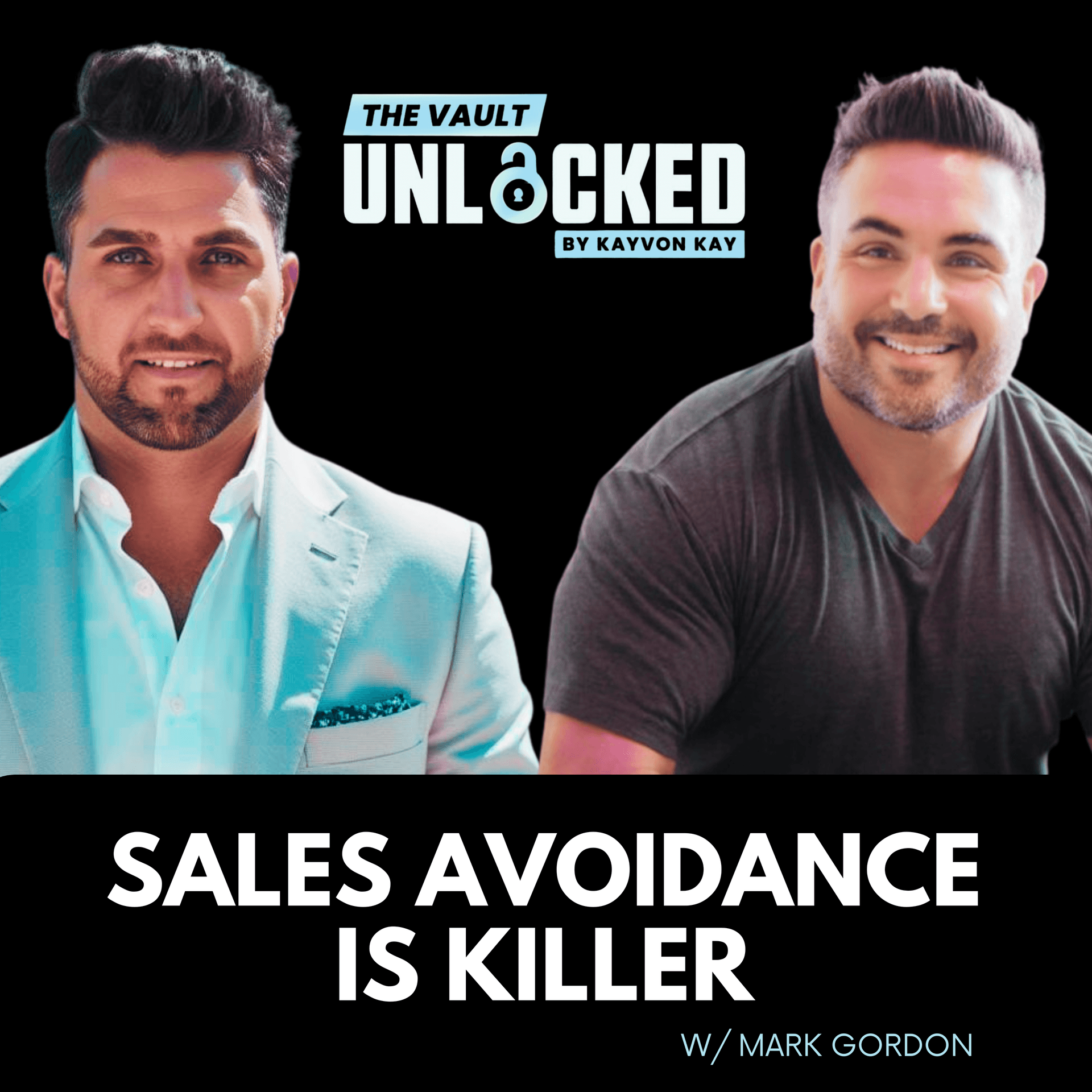
Podcast Notes: The Vault Unlocked - Episode: Why Sales Avoidance Is Killing Your Business (And No One Wants to Admit It)
Podcast Overview Title: The Vault Unlocked Description: A podcast that reveals the one strategy that changed the game for founders, creators, and marketers. Each episode dissects a dangerous strategy that proved to be effective but was previously locked away for being too effective, sharp, or unscalable.
Episode Summary In this episode, Kayvon sits down with Mark Gordon to discuss a common misconception among founders: that they have a growth problem when in reality, they often have a "sales avoidance problem." The conversation challenges the audience to confront uncomfortable truths about their businesses and emphasizes the importance of alignment, clarity, and responsibility in driving sales and growth.
Key Themes
- Sales Avoidance vs. Growth Issues
- Many businesses feel stalled, but the root cause is often avoidance of sales rather than deficiencies in growth.
- Founder Accountability
- Founders often fail to recognize their role in stagnation due to blind spots and misalignment within the company.
- Communication and Clarity
- Effective communication about the company's vision, product offerings, and sales processes among teams is crucial for success.
- Sales as Responsibility
- Emphasizing sales as a duty rather than a manipulative tactic can shift how founders and their teams approach selling.
Timestamps and Key Discussion Points
- 00:00 – Why founders think they're stuck when they're not
- Discussion on common mistakes made by founders thinking they have a growth problem.
- 03:20 – The founder-as-the-problem conversation no one wants
- The uncomfortable truth that many issues stem from the founder’s mindset and actions.
- 07:50 – Leadership, vision, and why alignment changes everything
- Importance of having a clear vision and aligned teams for success.
- 11:55 – The lie of "build it first"
- Debunking the myth that building a product will automatically lead to sales.
- 14:45 – Why sales feels uncomfortable for good founders
- Exploring the discomfort many founders have with the sales process.
- 18:50 – Selling as responsibility, not persuasion
- Shifting the narrative around sales to a sense of duty.
- 22:00 – Why most teams can't explain what they sell
- Highlighting the need for clarity in messaging and sales strategies.
- 27:00 – Alignment, culture, and scaling past the founder
- Discussing how misalignment can hinder growth and scalability.
- 33:00 – Sports teams, hard decisions, and real growth
- Drawing parallels between sports team dynamics and business leadership.
- 41:00 – Integrity, transparency, and sustainable leadership
- The importance of honest leadership and transparency in business.
- 46:10 – Where to find Mark and what to do next
- Directions for listeners to connect with Mark Gordon for further insights.
Key Takeaways
- Founder Blind Spots: Founders must confront their biases and recognize how their actions directly impact their company's success.
- Alignment is Key: Clear messaging and alignment between sales and marketing teams can significantly enhance a company’s growth potential.
- Sales as a Natural Part of Business: Embracing sales as an essential component of a business's responsibility rather than an uncomfortable necessity can lead to better outcomes.
- Cultural Integrity: Teams thrive in an environment where transparency and shared goals exist, just like successful sports teams.
- Leadership's Role: Effective leadership involves making tough decisions that prioritize the company's growth over personal relationships or comfort.
Conclusion This episode of The Vault Unlocked highlights the critical role that sales play in business success and the necessity for alignment among team members. By addressing the common pitfalls founders face, the discussion encourages leaders to take responsibility and cultivate environments conducive to growth and success.
Connect with Mark Gordon
- Website: [IGTMS](https://igtms.com)
- Instagram: [@markdgordon](https://www.instagram.com/markdgordon)
- LinkedIn: [Mark Douglas Gordon](https://www.linkedin.com/in/markdgordon)
Call to Action For founders feeling stuck or seeking clarity, Mark encourages reaching out for support and guidance on navigating their challenges.
---
Feel free to use or modify these notes as needed!
Written by AI. May contain mistakes. Listen to the episode to check what was said.
Chapters
Tap a time to open that second in VOMark Gordon's Background and Journey
0:45 to 3:10
Mark shares his transition from sales to consultancy and his passion for helping businesses grow.
“and sold that company in the mortgage arena.”
Understanding the Go-To-Market Overhaul
3:10 to 6:20
Exploration of Mark's unique approach to helping B2B companies align their messaging, sales, and marketing.
“But I say everybody's 120 days away from having a completely different predictable revenue engine generating business for them.”
The Role of Founders in Business Success
6:20 to 9:30
Discussion on how founder blind spots can impact business growth and the importance of recognizing these issues.
“Um, or if it's like, actually, no, but I haven't been able to get to that or I didn't prioritize that or, you know, whatever else it is, it's like, cool.”
Navigating Change and Pain in Business Growth
9:30 to 12:40
Mark discusses the challenges founders face when scaling their businesses and the necessary mindset shifts.
“And so when we, when we look at teams, right, you know, I look at somebody like, Hey, you know, we can't let this salesperson go.”
Selling Before Building: A Founder's Dilemma
12:40 to 14:01
Exploration of the common struggle founders face with the concept of selling before building their products.
“And you, you, the biggest lie ever told is if you build it, they will come right.”
The Importance of Sales in Business Growth
14:01 to 15:50
Understanding why sales are crucial for scaling a business.
“as salespeople right and i think you know i met with a business owner today super successful marketing agency, all word of mouth.”
Overcoming Sales Resistance
15:51 to 18:29
Discussing the discomfort and misconceptions around selling.
“I think there's probably people listening to this that have never heard anyone say it to them the way that I just said it.”
The Role of Clarity in Sales Messaging
18:30 to 21:00
Highlighting the need for clear communication in sales efforts.
“If you can help them, it's your obligation to do it.”
Understanding Customer Profiles for Effective Sales
21:01 to 24:18
Exploring the importance of knowing your ideal customer profile.
“Like a doctor is doing something that I don't really understand, but his job is to explain it to me in a way where I can go take action on it or understand what's happening to me, right?”
The Journey from Mortgages to Consulting
24:19 to 28:00
Mark shares his transition from the mortgage industry to business consulting.
“Maybe I'll break that sales guy, but he's built big companies before he understands that.”
Show all 21 chapters
Starting a New Path in Business
28:00 to 28:40
The speaker reflects on their career shift and the impact of helping others.
“I was like, Hey, this really smart person said it.”
Impact of Clear Direction on Team Success
28:40 to 30:00
Discussing the importance of clarity in roles and goals for a successful team.
“And I was like, well, I think there's a business here maybe.”
The Importance of Alignment in Business
30:00 to 31:20
Exploring how alignment across teams impacts customer trust and sales.
“When you're getting that kind of feedback, it's like, wow, like I am doing what I'm supposed to be doing.”
Doctrine and Messaging for Companies
31:20 to 33:40
The speaker discusses creating a unified messaging strategy for firms.
“guys talk about that both internally and externally is the hack, right?”
Examples of Companies with Strong Cultures
33:40 to 36:20
Citing examples like Apple and Netflix to illustrate successful business models.
“If marketing is talking at different layers than what the doctrine says, we are going to have problems, whether it's sales, marketing, fulfillment.”
Building a Winning Team
36:20 to 40:00
Discussing team dynamics and the need for alignment in achieving goals.
“And I like that one for a couple of different reasons.”
The Reality of Team Restructuring
40:00 to 42:01
Addressing the difficult decisions in team restructuring for better performance.
“defined to go accomplish those goals, right?”
The Importance of High-Performance Culture
42:01 to 43:09
Learn how a commitment to a winning culture attracts top talent and performance.
“And so, you know, we, we, we very clearly define what it means to thrive.”
Integrity and Accountability in Business
43:10 to 45:14
Discover how personal integrity and accountability impact business success.
“you're never going to track an A player.”
Radical Transparency for Business Growth
45:15 to 46:04
Understand the benefits of radical transparency within an organization.
“And then that freedom is where all the great stuff happens.”
Engaging with Entrepreneurs and Founders
46:05 to 47:19
Find out how to connect with business owners and support their journeys.
“listening, that might be in this spot might not, might not be in a complete alignment, might have a marketing message or a sales message.”
Transcript
Automatic transcript. May contain errors.0:08And today is another episode with the vault unlocked where we discover the one thing that changes marketing, the one thing that changes business, and the most important, the one thing that changes who we are. Today, we have Mark Gordon, the marketing guru, the agency owner, sold his business, and we are excited to have him here today. Mark, how are we doing? I'm doing great, man. How are you? I'm doing awesome. For my audience members that don't know who Mark Gordon is, why don't you just give us a little bit of a snapshot who Mark Gordon is and what is it you represent? Well, I started out as a sales guy in the mortgage space, graduated to a business owner and sold that company in the mortgage arena.
0:51And then my plan was to move from New Jersey, where I was at the time, down to Charleston, South Carolina, have an easier life. Started down that road and then got introduced to a guy who was trying to build a national mortgage lender, asked me to do it with him. He was younger than me. He was smarter than me. Didn't know anything about the mortgage industry, but I knew I could learn a lot from him because whereas I learned everything the hard way. He had read every book and gone to the best colleges. And I was like, man, I think if I can be around this person, it's going to change me. So I went down that row with him, a lot of success in that company.
1:19And then coming out of that, I decided I really wanted to help other people get to where they wanted to go, which we'll talk more about and opened this consultancy where now we help business to business companies unlock their growth potential and we build scalable systems for them in the marketing and sales side. So that's what we do now. Okay. Let's, let's dive into that. Cause that, that's interesting. And I like that. So helping, uh, you said B2B, so B2B business to business, uh, unlock their potential and scale. What's the approach? What's the, I mean, there's a lot of marketing agencies that do it, but I know you guys do it at a level of success.
1:55What, what, like what's, what makes it different for you guys? Yeah. I know people think of us actually as an agency, but I'll really say it's more of like a consultancy program because our best clients don't renew or get addicted to us. They graduate. We usually come in and we do what we call a full go-to-market overhaul. And what we find is that even the companies that have a pretty good idea about their messaging, their marketing, and their sales process and the technology that puts it all together, they don't have alignment. So a lot of companies don't even have a good idea of what those three things are.
2:24You know, I run into a lot of founders who have been five years building the same company and they can't concisely tell me what they do or who they do it for. And so we start with that part of our process And then really both internally and externally nail that messaging, build out lead generation systems that are huge differentiators where we get the right people on the phone for our clients, ready for them to close. We rebuild their sales process in a way that is scalable and we help them attract the right salespeople to help them grow. And then we make sure their technology is all set up so that those three systems are working together.
2:55So that's our core four. It's a pretty unique offering. Again, most of our clients, it's a four-month program. Sometimes we do more if it's a little bit more complex. But the idea is we hand it back over to you and either your team or the agencies that we connect you with run it long after we're gone. And then next time you hit an inflection point where you can't grow anymore, call us back. We'll come back in and do it again. But I say everybody's 120 days away from having a completely different predictable revenue engine generating business for them. So what do you see some of the common problems these businesses are having or they're coming to you for?
3:30Well, most of the time, all of the problems in a business come down to the founder, right? And so, and by the way, the good news is, is that the founder is the problem. The even better news is that they have the potential to be the solution. And so it's about blind spots and it's about consistency in terms of where they're going in their business. You know, we all have these natural plateaus that we hit and everyone thinks a business owner is supposed to have the right answer or everyone's going to be Mark Zuckerberg, where you start Facebook in college. I mean, it's a miracle that that guy is still in charge of that company 20 years later and was able to grow as fast as it grew.
4:05But that's not most of us. It's certainly not me. And it's certainly not most of the people that I talk to. Right. And so if you think you're supposed to have all the answers, you're not. And more importantly, when you're in the fight, when you're in the fire in your business, you are going to have selective vision because what happens is you can only deal with two or three problems at a time. And so you'll just ignore this other thing over here that you kind of know is a problem. And sometimes you need somebody else to come in here and go, no, not only is this the problem, but this is the solution.
4:31And so we come in with that extra set of eyes and really it's founder blind spots or founder limited skill sets that we work around. And then we make sure we set them up to have the right team or partners after that process so they can get to that next stage. So how do you, I'm interested because as a founder myself and founders that I know, the truth is what you said is it usually comes down to the founder. I believe, especially in a three to five million, even maybe a three to$10 million business, it's all founder. Like the business is growing based on the founder, the CEO running the company.
5:11They're a direct reflection of those results. But the founders that I know, they don't want to hear that. They don't want to know that, you know, they know that they're their problem, but they're not going to hire you to tell you that they're their problem. So how do you get around that and get them to actually be able to not just identify what is actually going on and see it from a different lens, but for them to see it to the point where they're ready to change and take your advice and be able to implement the tools, I'm going to assume systems, processes, things that you're going to implement.
5:40it. So, okay. A couple of other things. One is like, I, you know, I'm not that far into my journey. I've been doing, I was in this for fun for a couple of years. And then really only in June, I started doing this like in a full-time way, but we've, we've already brought on a bunch of clients and we, I'm meeting with founders every single day. I will just say that in my limited time, I have found that founders are far more actually willing to accept that they are the problem than I would have expected, especially when it's presented to them as through a series of questions. I asked them about where they are, where they're getting stuck.
6:11And then when I start presenting ideas like, Hey, have you ever tried this or thought of it this way? They're like, no. And sometimes it's like, no, I never thought of that. Which by the way, if you get them to say that they're sold. Um, or if it's like, actually, no, but I haven't been able to get to that or I didn't prioritize that or, you know, whatever else it is, it's like, cool. And then, you know, once they realize like, yeah, like this is just the next step. Right. And you said three to$10 million companies. I think it's true of 300 million to a billion dollar companies too. Right. You know, when you – one of my favorite interviews I ever saw was Warren Buffett talking about how he passed over Amazon multiple times.
6:45He had all these opportunities to invest in Amazon. He just missed it. And at the end of the day, he was like, I think something along the lines of like, our algorithms fail to account for the fact that Jeff Bezos was an alien. And when you think about like – and that's such a great line. I love that. It's like, yeah, like there was nothing special about Amazon. They sold books online. Anybody could have set up their own online bookstore tomorrow. what made that company different was Jeff Bezos, right? Like, and so, you know, and by the way, so I think that's humbling. If you're here right now and you're struggling with your$300 ,000 a year business, trying to get it to a million and you're like, oh no, it's me.
7:18It's like, well, yes, I understand that that's humbling. Right. But it's also good news because that means that you can do something about it. It's not your industry. It's not your product. You didn't pick the wrong idea. You know it doesn't come down to that stuff, you know? And again, I think my time in the mortgage industry was very foundational because in the mortgage industry, every single company is selling the exact same product at the exact same price. A thousand companies, right? Some of them do incredibly well and some of them completely stink. Most of them completely stink. The difference is the leader.
7:48It's just it, the leader. And then that leader's ability to attract other leaders and create an environment where motivated people can thrive. I mean, companies are just the people that work there, right? And so when you're a founder, you need to attract other great leaders. You need to create an environment for those people to thrive And that is the job, right? And then cast a very specific vision for where you want everybody to go, right? So if I can get really talented people, create an environment where they can thrive, and I have a very clear vision of what we're trying to accomplish, that unlocks talent in the room.
8:15And then you can be that multiplier that moves things forward. And I think that's true at any size organization. Now, have I seen founders succeed in spite of not doing a good job with those things? I have, 100%. You will see individual characters who will things to happen, who push things, bully, there are other ways to skin the cat but the ones who tend to do special things and and live a life that i would want to live are the ones who i think unlock the stuff that we just talked about yeah is well it's unlocking a clear vision is what i'm hearing right there and then being able to sell that clear vision to great people that help make it come to fruition when dealing with more that sounds like you deal with maybe like six figures seven figure businesses and get them like seven eight figures is that almost eight nine almost everyone that we deal with is somewhere between five and 30 million when we engage with them.
9:03Occasionally we do something a little smaller, but cause they're like, they're 2 million. Maybe they just did a raise or, you know, or they're, they're a SAS company that just did a raise on their growth. So they're not quite there yet, but it's certainly people that are looking to grow fast and, and are willing to go through the pain that's required to do that. And the pain, let's talk about that. What's some of the pain that they're, that would, they're apt to going to go through? Well, I mean, different results require different behavior and change is always painful. Right. And so when we, when we look at teams, right, you know, I look at somebody like, Hey, you know, we can't let this salesperson go.
9:37They're the reason we got from zero to 5 million. And I'm like, okay, well let's, let's walk through that. First of all, how committed are you to getting to 10 million? Super committed. Well, what does that mean to you? It means I'm willing to do whatever it takes. Okay. Well, let's hold that as a thought because maybe you are, maybe you're not. I actually find that when I hold the mirror up. Most people are definitely not willing to do whatever it takes, but that's fine. They have their own room for what that is. My job is just to kind of show them what whatever it takes could look like. Right.
10:05But then it's like, okay, are you building a family where you don't really choose these people and you're with them forever? Or are you building a professional sports team where, Hey, we celebrate wins. We get to go back and reminisce about the good times. But honestly, every year is a new season when we're trying to win a championship and we got to have the right people on the bus to do that, which one of these two things do you resonate with more? And they're like, most people are just like, whoa, I never thought of it that way. I'm like, listen, I have giant season tickets. They bring back the 1990 and 1986 Super Bowl teams all the time.
10:33Those dudes love each other and get along. They're not still on the team, right? Like no one can ever take those championships away from them. The things they accomplish aren't going anywhere, but like this year's team is about who's going to win the next championship. You know, that's the idea, right? And you have to be able to make those difficult decisions. And so what do you, what vision are you casting for your team? Right. And then by the way, if you cast a really clear vision, you say to somebody, Hey, listen, we're going from 5 million to 10 million. I have to grow and you have to grow.
11:00If you're unwilling or unable to do that growth, we have to layer you or we have to find somebody else because that's what we've committed to this team. And I want to attract great people to work here. So I need to be able to tell them this is where we're going because no great person's going to come work for a company. That's like, yeah, we, we made 500 ,000 last year and we're going to make 550 this year. You're not going to attract any big thinkers that way. No. So, you know, there's a lot. I know I'm kind of all over the place. This is - No, no, I love it. There it is. But let's, like, how'd you find yourself here?
11:29It sounds like you have, you know, a wealth of knowledge of being able to, I love you used the word the mirror because I use that, right? The mirror of the business and seeing what's actually going on. And it seems like you have the ability to work with a founder, which is a foundational. but then there's something called marketing, lead gen, sales, then operations. I think you said fulfillment. I mean, those are the core four. Those are a lot of buckets. On average, where do you see the biggest problem being outside the founder, obviously, but the actual business side of what's going on in the businesses, where do you see the biggest problem for a lot of these businesses that are wanting to scale?
12:07So in the smaller business side, right? If you're, if you're listening to this and you're somewhere between, you know, a half a million and 5 million, Um, it's almost definitely your problem is a lack of focus and investment in, in consistently generation. Um, until you have figured out how to get your ideal customer to show up on your calendar and do it in a predictable way where you understand exactly what it costs you and you can do it more of it. If you dump more money into it, then go figure that out before you do anything else. I see so many companies trying to master their fulfillment process or or get the product perfect.
12:44And you, you, the biggest lie ever told is if you build it, they will come right. Like that is not true. I've almost never met a company or very few that I I've met a hundred people who built a cool product and then never, no one ever showed up for it. I've met maybe a handful of people ever in my life that had people beating down the door for something. And then they couldn't find a way to build it. Like if you have people beating down the door for your thing, you will find a way to deliver that product. Right. And so, um, So that's the biggest piece of it that people are missing. Well, so my philosophy, it's the very same philosophy, is I say I do not build it unless you sell it.
13:21You can't sell it, you do not build it. Because I've seen so many people spend so much time on trying to build, like you said, the fulfillment, think about the offer, think about this. They can't even sell it. And they actually go build, do the videos, do the whole course, create the community, and nobody's in there. And then now they're trying to sell something that isn't sellable. they're actually trying to optimize for something that was already broken from the beginning why do you think so many say and this because i run the same kind of model as you do why do you think so many founders have or business owners or let's call them creators have such a hard time with that concept sell before you build well i think there probably weren't they didn't come up as salespeople right and i think you know i met with a business owner today super successful marketing agency, all word of mouth.
14:10So they're in a very specific space. They've grown, they grew like crazy. And literally they just, they're in their space. They are one of the two or three players that matter. And it is a very large space where marketing is a huge piece of the puzzle. They have created some of the biggest brands, you know, in that space from scratch. And she's like, not even like bragging in any way. I had to like pull all this out of her. They don't have any marketing or sales. They just had a partial acquisition. And that person wants them to build real sales and marketing. So that's kind of how we got on the call.
14:40And so I'm, what was the question again to dial it in? I want to not go all over the place. Why? Yeah, no. With the question was, why do you think founders, creators, whoever the small business owner has a hard time with the idea of selling it before you build it? For her sales is a four letter word, right? I mean, even when I started talking about outreach, right, you could just like see this like cringiness of like, Oh, I have to go like and tell people like, it's like, I understand it was great. They got you here. Word of mouth. You were in this space. You had a, by the way, they also had a couple of like big clients that then had like 30 brands underneath them.
15:15So they had these individual, like they, they hit a home run by doing a really good job and being in the right place and having those relationships. But if you want to scale it, the name of the game is sales. Right. And so I think people think if they build a good enough product, they'll never have to go sell it. And then it gets them to whatever spot they're at. And then they're stuck and they're like, well, how do I get to the next step? And it's like sales and marketing. Like, right. This is what do we do? Who do we do it for? How do we tell those people that we're doing it? And how do we get them to want to have a conversation with us?
15:43And then once they want to talk to us, how do we get them to give us their money? Like that is the next step. Right. And so, um, I think it's not said to people that way. I think there's probably people listening to this that have never heard anyone say it to them the way that I just said it. And you know, I just, another business owner I was meeting with earlier today, and he's got a small consulting business or whatever. And he's like, yeah, we don't do any outreach or any other stuff. He's like, I'm like, well, why not? He's like, well, I just, you know, I don't really have the time for it.
16:07I go, dude, it's the only thing that matters. You just told me you're running an employment center where you're not making money. You have all these people working for you and you're doing an amazing job for your clients, but you're not making any money. You're running an employment center. Right. And you just see the look on his face and he's like, he's heartbroken. And I'm like, it's so much more fun to run a business when you're profitable. It is. I've done it both ways. I have done it where you're losing money. It sucks when you're going home and you're like, how am I going to make payroll?
16:31There's nothing fun about it, right? It's hard either way, but it is a lot more fun when you're making money and you make money by focusing on those front end processes. And so I just don't know that business owners are having these conversations. I don't know that they are, I think a lot of them feel very lonely. They're there. Everyone's telling them they're doing a great job and they think that they're embarrassed to say that they're struggling. They're embarrassed to tell anybody that they're stuck. Um, and when they are, it's like, it's really uncomfortable to go, Hey, no, actually like you, you have to go out there and, and sell.
17:00And I think for a lot of people, is very uncomfortable. And I always say to people, if you're not willing to sell, it's one of two things. Okay. You either don't believe in your product and those, and they're like, no, no, I do. And I'm like, are you sure? Because if you really believe you had the best thing for those people, at least a specific group of people that wouldn't you want, aren't you like a good person? Don't you want to share that with them? Like, I never thought of it that way before. I'm like, man, when I was in the mortgage industry, I was like, a lot of mortgage guys are going to lie to you.
17:25I will never lie to you. I will take care of you. I will make sure you close. I believed it. I thought that no one would work harder for their clients. And I believe that. And so when I said to people, they were like, I want to go with that guy. When I was in management, I was like, I'm going to do everything I can to help you be successful. Do you believe me? They'd be like, yes. I'm like, cool. Come on my team. I believed it. I believe that no one would care about them as much as I did. So first thing is if you're not willing to sell it, it's because you don't believe in your product. Right.
17:45And by the way, you are your product in a lot of different things. Okay. That's number one. Right. Number two is if you, if you, if you're really uncomfortable well with it, it's because you've told yourself that it's icky in some way. And, and, and by the way, that's coming from some preconceived notion because you don't even, the times you were sold in your life by a good salesman, you didn't even know you were being sold. So what you remember are the bad ones. And you're like, I don't want to be like that. And the short answer is like, great. You don't have to be right. But like, once we eliminate those two objections, if you believe in your product and it doesn't have to be icky, then why aren't you selling?
18:18I don't know. It's like, oh, cool. Let's go do it. Right. And then we just don't like, Hey, get on a call with somebody, divorce yourself from the outcome, ask them questions until you figure out if you can help them or not. If you can't tell them, Hey, I'm so glad I met you. Have a great day. If you can help them, it's your obligation to do it. And by the way, the exchange for that help, they give you money. Right. And that's whether that's, you know, that's, it's as simple as that. Right. And so I think a lot of times we just have to have a conversation with the founder, which is, which is how do we make this feel really good for you?
18:48Right. Do you believe your product helps people? Yes. Cool. Then go help people, right? Like, you know, but I think they have a really hard time connecting those dots sometimes. I agree. I think people are, are scared of selling themselves. Uh, I like what you're saying is like, they're either don't believe in themselves or they, they have a misconception of what sales is. They want to be sales or icky, but I always say to the Henry Ford, like number one saying, right. Is nothing happens until a sale is made period. Uh, so I think a lot of business owners, they hide behind the idea of the thought of success and thought of wealth.
19:25And they get caught up in the minutia of doing work, building funnels, building backend, building operations, but they never actually do the hard work that actually drives the wealth, which is the number one thing is sell. So the every, I'll tell you, every person who I didn't think was a sound entrepreneur or founder, in other words, like they're not following the book, they're doing whatever, but they were somehow succeeding was because they had the ability and willingness to get their ideal customer profile to have a conversation with them. And they were willing to do that all day long. Like I've seen people you're like, I can't believe that I wouldn't buy a shirt from that guy.
20:06And people are buying hundreds of thousands of dollars of software. Why? Well, because he's calling those people relentlessly, acts like he belongs in the room, has those conversations, goes to the conferences and is hustling constantly to make sure he's talking to those people. If you're willing to do that, you can solve for almost anything, right? If you're not willing to do that, good luck. So how do you find with these small business owners that one of the biggest challenges they have is they don't actually understand their IPC and or the offer to the IPC?
20:35um i think they don't know how i think i hear a lot so i'll give you another example somebody will try to explain to me what they do and they're like listen you know and they're using a lot of like weird terminology or like big buzzwords and i'm like hey like you know i'm i'm not really getting it i'm a pretty smart guy you know and like well it's very industry specific and i'm like cool i promise you you're gonna fail and they're like whoa i'm like what if you that is the greatest myth people tell themselves, right? Like a doctor is doing something that I don't really understand, but his job is to explain it to me in a way where I can go take action on it or understand what's happening to me, right?
21:11Like, yeah, that makes sense. I'm like, cool. If you can't explain to my mom who is retired, what you do in two sentences and who you do it for, your customers don't get it either. And they're like, well, no, you don't understand. My customers do get it. Man, I, I work with it services companies that sell to CTOs. they speak a language I don't understand at all. When I get there, no one's buying from them. As soon as I put it in words, I understand people are booking meetings like crazy. I've just seen it over and over again. You think people, how many people on this call don't know what an ICP is, right?
Read the full transcript
21:45Ideal customer profile, right? Most. They're probably looking it up or they're too embarrassed to even do that. They're afraid chat CBT might judge them. We're talking over people's heads with all of this stuff. We have to be able to explain it. So like, well, what do you do? I build world-class revenue machines for B2B companies in 120 days. That's what I do. It's like, okay. And by the way, people go to my website, they're like, you know, really, it's really clear what you do. I go, I know I go to your website and I have no idea what you do, right? I have no idea what you do. And so I think it's overcomplicated.
22:15And I think that when you're in it and you're building it, you start to think everyone has the same knowledge base that you do. you start explaining what you do in a way that maybe they get. But I'll tell you, those companies that I have those conversations with, when I meet with the other people in the company one-on-one, I go, hey, what are you guys doing? Who do you do it for? I'll get 10 answers from 10 different people and none of them are good, right? That company's struggling because everyone's rowing in their own direction, right? It's about like what makes a company successful, hire really great people, create an environment where they can thrive, let them all know exactly where we're going, right?
22:47And so if everybody there knows this is what we do and who we do it for, then you're giving everyone the freedom to use all of their power and knowledge to get you to that place. If everyone's kind of confused about it, good luck, right? Because then it's like, you know, you almost have to get there by accident otherwise. And that's a hard one because you're asking founders to think differently in that if they're in that kind of gap, right, is to get clear. And what I've found in my experience too is, again, we're going to use buzzwords, but getting them to niche down first, right? Like, but I can help everybody.
23:19And the, you know, as you know, you try to go help everybody, you're helping nobody. So then there's this gap of trying to help the right somebody, right? And then knowing how to speak to them. So from what I'm hearing from you though, it sounds like you do a lot of more like sales, like you help with the sales process, but you also do marketing. Is that? So we do whatever's necessary to fix the entire go-to-market process. So I have a client right now that's on board this week. The sales guy who runs their sales team is elite. Probably the best in his industry. There's a company, there's 50 companies in this space.
23:52This guy is really, really good. I'm not messing with him or his sales process at all. This company has a product that is better, faster, and cheaper than the competition. I always say, if you have one of those three, you can build a company. If you have two of those three, it's a no brainer. If you have three out of that three, you shouldn't even need a salesperson. The problem with this company is they have no marketing, none, right? They're growing like crazy. They're doing really well. They have no marketing. And so they, the sales guy's doing a great job, but so with them, it's all going to be messaging and marketing and lead distribution.
24:21Yeah. Like driving leads, driving leads. Maybe I'll break that sales guy, but he's built big companies before he understands that. Like I've met with him. Like I don't, I think, I don't think I need to mess with that. So I'm not going to, right. So for them, I'm coming in as kind of a chief marketing officer and we're going to go ahead and fill that out for another company. who's like, Hey, listen, like we are, we don't really, our leads, our sales guys generate leads. They're the ones dialing, whatever it is. Like that's their sales process. It's a lower ticket thing. Cool. And I'm, then it's, it's a sales gig, right?
24:49So everything's about messaging. We have to get the right words and we have to really dial into what, what moves our, our ideal customer to move forward with us. But then once we get that messaging, we kind of fix whatever is broken. Some companies it's a founder doing sales and I'm building out everything from scratch. Sometimes I'm coming into a company that's pretty well established in one or two areas and we're just fixing the third. But through the discovery process, we do a diagnosis. And really what we need is perfect alignment between messaging, lead generation and sales process with the technology underneath it, kind of holding it all together at the end of the four months.
25:23And so we built, we plan it, we build it, we test it. And then we, we let right off into the sunset. And then ready for scale. Let's take a step back a little bit. Cause we're talking a little technical here. I kind of want to take a step back with who you are, like Mark, how did like how did you get into this space you know what did you learn in your know it sounds like you had a quite successful year with mortgages uh you know sorry not a year but like you know a career and uh like tell us a little bit about that how did you kind of end up going from owning mortgage businesses to you know consulting you know businesses across the nation well it all started because i was a horrible student and that's how you end up in the mortgage industry because if you get really good grades in college, you don't usually end up selling mortgages.
26:08It was the one place where my grades didn't matter. But I found that call center and moved up and then started companies from there. I would say I wasn't even necessarily a naturally entrepreneurial person, but I knew what work I wanted to do and how much money I wanted to make. And at some point in the mortgage space, it just became obvious that that was the way to do it. Um, the, the thing that made it very difficult for me is I'd not come from a family that like was entrepreneurial or in the mortgage space or built companies or businesses. And I was very closed off to the idea that like business was similar.
26:43I didn't read any books. I didn't ask anybody for help. I didn't think anybody, consultants, I'd be like, how's anyone going to help me with my business? My business, how's anyone going to know more than me about this? And I told myself all these stories. And I ended up selling that company for pennies on the dollar for what, if I could go back and knowing what I know now and talk to the kid who sold that company, I'd probably still own it. And I would have made a hundred times as much money. And what happened was I sold that company and I moved to Charleston. And then I met this guy, Rich Wiedel, who was running, was about to take over Princeton mortgage.
27:14And he hadn't really built anything, but he went to Cornell. He knew all the right people. He would call CEOs of Fortune 100 companies for conversations and they would take his call. I never dreamed of it. He'd read every book. And not only did he read the book, but like he pulled the book off the shelf and turned to the page, like, just like, and I'd be like, this is what remember. And I was just like, so blown away by this guy. Uh, and I've known 10 years later, I still am. And, uh, I did this, this six years with them. And the first four of it, I was just playing catch up. I was reading all the books.
27:41I was having all the conversations and what it is. It took all that stuff. I'd learned through pain, millions of dollars in mistakes. And by the way, I wouldn't trade any of that for the world right now because it gives me such an authenticity when I'm dealing with people who are bootstrapping it and building it. I've done that. I've been there. And then all of a sudden I had all these frameworks where I could suddenly explain very clearly what I had learned in a way that other people could understand. And it wasn't just me saying it. I was like, Hey, this really smart person said it. And so it wasn't just Mark's school.
28:09I thought it was kind of that next step. And did very well in the mortgage industry with Princeton. But then when rates went up, I was like, Hey, I just started my forties. I'm still in build mode. I don't want to wait around for the next refi boom. Like I want to go. And so I took a year off really trying to figure out what I wanted to do. And that time I kept helping my friends and family build businesses. And I loved it. I got to learn about new businesses. I was having such an impact on people. And I was doing something I thought was so obvious. It was like, what do you mean you're not doing that?
28:38What do you mean you're not doing this? And they're like, dude, no one's ever said any of that to me before. And I was like, well, I think there's a business here maybe. And so, you know, we started, I started doing a little bit more and a little bit more. And then I was like, in June, I was like, you know, man, I'm, I love this. I get to help other people get to where they want to go, which has been the unlock for me the whole time. Everything in my career that's happened that's good is because, Hey, how did you build this company? Well, I hired a bunch of salespeople and I obsessed about how to help them hit their goals.
29:02And then we did, right? Like it was like always thinking that way about it. Right. Um, and, and it was my first conversation with Rich where he said, what do you want people to say about you at your funeral? And I said, I want there to be a lot of people there who helped me get them, who helped, who I helped, who say he helped me get to where I wanted to go. Um, and so I, now I get to do that like, you know, such a real way with founders, with their teams, you know, and we had a quote earlier this year where there was a company that hired us and we do sales, right? Sales and marketing. The, the head engineer calls me up and he goes, you did more for our sales and marketing in 30 days than what we were able to do in the last 30 years.
29:38And when, when, and I was like, what do you mean? He's like, dude, he's like, I couldn't tell anybody what we did or who we did it for. There was no, we were scrambling around to every client who walked in the door. We were trying to find a way to help that person. Cause we had no clear definition of who, who we were trying to help and what we didn't, didn't do is that you just cleaned all that up and told us internally what our jobs were. And suddenly we're all moving in the right direction and the clients are showing up. Right. Yeah. When you're getting that kind of feedback, it's like, wow, like I am doing what I'm supposed to be doing.
30:05And so I, I've always kind of felt like I was doing what I'm supposed to be doing, but in this moment, I'm feel never felt more like I'm exactly where I'm supposed to be. I love that. I mean, if anybody was listening, they can probably hear your conviction the whole way through. But you used a word and I wanted to jump on it because I think it's very important. And it sounds like you're in it right now, but use a word earlier, which is called alignment. Yeah. How important is alignment for businesses, for individuals, for companies? I would argue it's the most important thing other than the fact that you can't have alignment unless you first declare very specifically what you're trying to do and where you're trying to go.
30:49So first thing, I would say the most important thing is like, hey, we're trying to get a 10 million ARR and I'm going to sell. Cool. If you know that going in, that's like a very clear path. We know what to do to get there. If you're like, hey, I'm building this business. I want to work here for 40 years and I want to give it to my kids and I want to be doing a billion dollars a year. That's like a very specific thing. So first thing is, what are we doing here? Why are we doing this? Where are we trying to go? Second thing is an alignment, right? And which is both in terms of your thought process, what your team thinks, the direction they're all moving, and then how you guys talk about that both internally and externally is the hack, right?
31:26If you have a bunch of smart, motivated people who all know what you're trying to do and they all have the freedom to operate in that with, with some rules of the game in place, we call them culture and values, right? What are our rules of the game? That's the unlock, right? And so, but I will tell you one out of a hundred companies that I meet with where it feels like there's alignment and, and I see founders tolerating misalignment out of fear or what they'll say is prioritization. But if you, how many times you see a sales team and a marketing team with different leaders who don't talk to each other all the time, right?
31:58I mean, I'm not saying they don't get along. They might like each other, but they don't talk to each other. Right. And it's like, okay, if I'm using this language to generate leads and my sales team is using this language in the first five minutes of the sales call, you're teaching everyone out of the gate, not to trust you. You have a cynical buyer base to begin with. They are looking for signals of, can I trust you or not trust you? So simple. And by the way, this is happening at a subconscious level for your buyer. They go, wow, I clicked on this lead because it said you guys could do this.
32:26By the way, the company can. The sales guy comes in and go, starts talking about this other thing that they do, or this, this other angle. And this person goes, wow, that's interesting. And suddenly they have this feeling of like, I think I'm in the wrong place. And then they don't buy and you'll never even know it's because of misalignment. So I see this all people are like, why do you spend so much time on the words and the language and the messaging? Like, and it's like, because if you, when you have unified words you use, it allows everything to move 10 times as quickly, right? Like, it's almost like if you're in a kayak, like rowing crew, it's like if one person's rowing against you or just not rowing at all and holding their paddle in the water, the boat just spins around in circles.
33:07Like you can all paddle very slowly, but if you're in unison and doing it together, the boat will go straight and it will move. As soon as one person stops paddling, we just go in circles, right? I call it a doctrine. I create doctrines for companies, which is the messaging, the marketing, the psychology at every layer of where they are part of them. I'm going to say the funnel, online funnels. And it's not a marketing plan. It's not, I tell them this is the doctrine, this is the Bible of what we actually represent and where we come from. If we waver off this, we have problems. If marketing is talking at different layers than what the doctrine says, we are going to have problems, whether it's sales, marketing, fulfillment.
33:50So it is all about alignment. It is all about making sure that the signal, you just said the energy, the signal is, is, is also two on the same wavelength alignment so that the prospect, whether it's cold, never heard from you all the way to on a call with you all the way to pay, basically making a buying decision. They're getting the same frequency from all departments. So I love that by the way. So let me ask you a question then. So when you think about that, what company do you use as like your north star or like a story or a book where you were like oh man like that founder that company did that in a way where like that's what these other companies should be emulating like what's your what's your go-to example my go-to example on that one for me personally is the company that i got to work with and build as a i was a partner in it in 2018 we We went from not massive, but we went from zero to 38 million in 18 months.
34:48And what I saw that it wasn't all great, but the vision that was sold and the way that everyone operated is what takes. This is what I saw that takes to build that type of company. Now, is the vision coming from a good place? That's a different story. But when I look at what I know what it takes, I think of what we did back then. uh and then other big companies i think about uh that that withstand the founder meaning you can keep growing and the founder is not part of it because they because i call it it kind of created its own mechanism like an organism and it built like founder there or not or like companies like you know like big ones like apple for instance right uh steve jobs no longer here the company still thriving is it on the same mission no but does that all i know is that my series still doesn't work it's 2026 almost and siri never got there it's well because the company's changed for sure therefore they want money i mean i mean look at the as an iphone really been upgraded in the last 10 years no that does not the innovation isn't there but what i see with a company like that though is it still like it's taken on its own mechanism organism like that thing is going to go as long as they have the right ceos in place right now is the right mission is the right thing that we want to agree on no but does that thing still make how you know they're printing money over there printing money right printing so i think about companies like that um amazon i don't know much about amazon like right like i just haven't done the research on like what amazon's done i'm just being you know transparent here but like i you know massive right i don't even can't even my brain can't even comprehend honesty like if you try to even understand how big that company is and what that company does amazon trucks on the road different people different countries products all that like my brain explodes this even even thinking about it yeah those are those are good examples I'll just share one of my favorites that people really relate to is Netflix.
36:56And I like that one for a couple of different reasons. One is because Netflix has been three completely separate companies when you think about this. And each time has just completely eliminated their competition. First time it was we're going to mail people movies. It sounds like an insane idea, right? But they put Blockbuster out of business by mailing people movies, right? And they created a business around that. and they did it through a subscription model, right? Which is like they came up with new ways to do it. Second thing is they really invented streaming technology, right? Like they were the first ones who could do streaming and they, at one point, like 80 % of all internet traffic was people streaming stuff on Netflix and they invented the technology to be able to do that and dominated in that space.
37:38And while they were doing that, they created this model of buying content where they were early to it. People had completely undervalued it. They understood the value differently than everyone else and they made a fortune. and that's great it's two different companies and two completely different companies and they dominated it and they go hey i know hollywood's been making movies and tv shows for a hundred years um and it's been the same players most time like building those big production companies uh we're going to come in and by the way within a couple years we're going to win all the awards we're going to get all the viewership we're going to get all the prestige stuff we're going to attract all the biggest people to work with us and we're going to and we're going to dominate and they did.
38:13And it's insane that they were able to do that to a hundred year old industry in that sort of a disruptive way. You say, well, what, how did that happen? This company's famous for their culture deck, right? Like they, they know who they are. They are run like a professional sports team. And by the way, the idea is attract the most talented people you can and give them the most amount of freedom that you possibly can to achieve a very clear mission. Yeah. Right. And support them and get out of the way. And by the way, you get a 51 % vote on what you're doing. And I get a 51 % vote on whether or not you work here.
38:45And so cool. You're running this project. You're doing it. You want to, you want, you want, by the way, here's my notes on your TV show. You get, you get to run it wherever you want. By the way, if people watch your TV show, we'll give you six more TV shows. If people don't watch your TV show, we're not working with you anymore. And that's, that's our 51 % vote. Right. And so how do you attract the best directors in the world? You give them creative freedom. You give them a big budget and creative freedom, right. And then create amazing shows. You know, HBO was the first one to do that with creative freedom, right?
39:10It was like, no, you guys do it your way. Suddenly all the best, all the best shows are there. Right. And so what there's so much we can learn from that. Right. But Netflix super, by the way, most people work in Netflix, work there for a season or two, four or five years. Right. Like it's a, it's a really grinded out culture of doing great things. We're doing great work. We get to celebrate those. We get to make a lot of money while we're there. We get to pay people well. We get a ton of creative freedom. We get to learn stuff. We attract really great people to what we're doing in our mission here.
39:38Right. And then we have that culture. And so Bridgewater, you know, Ray Dalio is another guy just really admire with this stuff. And so to exactly what you're talking about is let's create a framework for what our company is, what we do and how we talk about it. And then let's set really ambitious goals that attract big people who want to do ambitious things and then give them freedom inside of that operating model that we very clearly defined to go accomplish those goals, right? 51 % vote, a hundred percent responsibility for the result. Right. And then we make it really clear and go. And so, and that that's, that's what we bring to these companies.
40:12And I think it's awesome. I love the, I play sports. So I really do love the analogy of you're building a sports team here. Like when you take it from that perspective, if you're building a Superbowl, I'm just going to use the Superbowl for this, you know like whatever like the super world series or a super bowl sports team year after year they cut players they trade players they cut staff faster than ever why because they're trying to optimize for the win it's not personal it's just it's the name of the game right so i like that ideology uh and thought process is like if okay if i was a professional sports team just even as a business owner agency owner myself who's who's on my winning team who i always looked at it as if I went to war, who am I bringing and who can I trust?
41:00Yeah. And, and, and, you know, I had my personally, you know, my business last year, I had to make the, I fired 50 % of my, my staff because of that 50%. It, and that's not a weird number. The funny thing is when you do that, all of a sudden we become more profitable. We get more clients. we move faster and we see more money which is very interesting thing right because and and all those other people they all went on some of them went off and done greater things of course greater things that they could ever do here why they were never actually in alignment here it's not my doesn't mean i'm less than doesn't mean i couldn't provide them the the best opportunity what it means was the opportunities that i had here weren't in alignment for them and it's a good thing it's a good thing.
41:51When I first started companies, I used to think that if I let somebody go, they were going to die. Like literally, like the personal responsibility I would take is like, what are they going to do? How are they going to pay their bill? They all made it. And I'm not saying that losing your job isn't incredibly painful or scary or anything else, but it's better ultimately than being stuck in a place where it's not optimal for you to do the best work of your life and for you to thrive. Right. And so, you know, we, we, we very clearly define what it means to thrive. Um, and we will help people get the next job and we like to do severance and all those different things.
42:23But like at the end of the day, yes, we're trying to win a championship. Right. And by the way, you see it with professional sports teams all the time. Where do the veteran players go for discounts when they're free agents to the organizations that are committed to winning. And so by having a commitment to winning and showing that you're willing to do difficult things you don't feel like oh if i tell people that we're gonna let them go if they underperform we're not going to be able to attract winners it's the opposite a players don't worry that you're going to cut them they're 100 sure that they're going to crush it whether they're right or wrong i've never once looked at somebody and i'm like dude i don't know if i can hack it there like that's just not how i think it might be true but i don't i want to win i want to go i want to go join a team where i'm the weak hey hey listen a low a play players hang out with a players a players don't want to hang out with C players.
43:08So if your culture is a bunch of C players, you're never going to track an A player. Problem is you're going to think a B player looks like an A player because you have all C players. That's a, that's a big problem I see. Uh, and then the other thing I see with people is they, they, they're not holding their own founders are not holding their own rules and their own accountability. So they're saying X, but displaying Y, and then wondering why there's disruption. Yeah. I, I, I often say to people, how much would your behavior at work change if your wife and kids were in the office with you? And for me, it was a real thing.
43:43I had my wife and kids in the office when I was building my company. And I'm the same person. For better or worse, you get the same version of me wherever you are, right? And my version of integrity is like, I don't lie about anything. People are like, what do you mean? I go, well, if I'm walking down the street with my wife and a beautiful woman walks by and I'm looking at her, my wife goes, were you looking at her? I go, yes, I was. People think that's crazy. I go, I would rather have the discomfort. I'm telling my wife I was checking that person out than the dysfunction of being somebody who lies to my wife.
44:12That's it. Discomfort over dysfunction. I'm in the same way of business. I'm in the same way with my family, with my friends, whatever it is. When I see business owners out of alignment, right? Same thing. It's like if you're willing to behave one way here and one way here, then what you're really saying is you're hoping nobody notices that you do whatever you feel like whenever you feel like it, right? Like that's really what it is. And so that, that does create a toxic culture. Again, I'm not saying you can't succeed that way. I've seen in spite of these things, people who are really good at enough one or two tricks to get, to get it all to work.
44:43But if there's always friction, there's always odds. It shows up in other places. If it's not showing up in the business, it's showing up at home. It's not showing at home. It's showing up in relationships. And it's not showing up relationships. It's showing within the relationship themselves. Shows up in their own spirituality. You can't, again, it's the world of the economy, right? Like you can't say you're doing X and then doing Y. You can't, there's, you know, there's, there's like, we call those full, this full alignment, hard place to get to as a founder. But I know once you do everything clicks, everything be just becomes a little easier.
45:12Not saying it's always going to be easier. It just becomes a little lighter, a little easier because you're allowing for a little bit more freedom. And then that freedom is where all the great stuff happens. You know, and one of the things I always preach to is I preach radical transparency. We share almost everything at my companies with almost everyone. And people like you tell people when you're losing money, I'm like, yeah, I need those people to be the ones to do something about it. Otherwise I'm owning all of it myself. And these are the ones who have to go out and do the work. Right. And so like, you know, again, I'm unwilling to walk around pretending anything, you know what I mean?
45:44Like it's just, it's just not it. Once I'm out of alignment that way, I'm not doing my best work. I'm not feeling good about what I'm doing. And so I think there's tremendous freedom in just saying things the way they are and showing everybody what's the truth. And again, if you, if you know what the mission is and what the rules are, you'll attract the right people who want to go on that journey with you, even when times are tough. I totally agree. So as we really do come to an end here, uh, for anyone listening, founders listening, that might be in this spot might not, might not be in a complete alignment, might have a marketing message or a sales message.
46:17Uh, where can they find you? How can they work with you? How can we get the, you know, I'll start having you serve them. No, I appreciate it. So my website is IGTMS.com. That's integrated go-to-market solutions, IGTMS.com. You can find me, Mark Douglas Gordon on LinkedIn or Mark D Gordon on Instagram. Reach out to me, book a call. My phone number's on LinkedIn. My Calendly's there. And I say this because no matter what stage you are as a business owner, again, if you're not at least doing two or three million, it's probably not a fit. I'd still like to meet you. I'd still like to help. I genuinely enjoy meeting entrepreneurs, genuinely enjoy learning about what people are doing in their businesses.
46:53And I do believe very much that the more of those conversations I can have, the more it's going to be good for everything about who I want to be and what I want to do. And so if you're out there right now, no matter what stage you're at in your business, if you're feeling stuck or you have some specific questions, you think I might be able to help, reach out, book a call, happy to meet with you. And yeah, that's where you can find me. Awesome. Thanks so much for being here. Appreciate you. That's another episode of The Vault Unlocked.
47:28저는 굉장히
From the publisher
Most founders don't have a growth problem.
They have a sales avoidance problem.
If your business feels stalled, heavy, or harder than it should be, this episode is going to be uncomfortable in the right way. Because once you hear this conversation, you don't get to pretend anymore. Check the time stamps below if a certain topic drives curiosity more than others!
Timestamps:
00:00 – Why founders think they're stuck when they're not
03:20 – The founder-as-the-problem conversation no one wants
07:50 – Leadership, vision, and why alignment changes everything
11:55 – The lie of "build it first"
14:45 – Why sales feels uncomfortable for good founders
18:50 – Selling as responsibility, not persuasion
22:00 – Why most teams can't explain what they sell
27:00 – Alignment, culture, and scaling past the founder
33:00 – Sports teams, hard decisions, and real growth
41:00 – Integrity, transparency, and sustainable leadership
46:10 – Where to find Mark and what to do next
In this episode, Kayvon sits down with Mark Gordon for a blunt, no-theory conversation about why businesses plateau and why the answer is rarely marketing, strategy, or talent.
They unpack what actually happens inside companies stuck between $1M and $30M in revenue. Founder blind spots. Misaligned teams. Messaging no one inside the company can clearly explain. Sales being treated like a dirty word while everything else gets overbuilt.
Mark breaks down what he sees after working with hundreds of founders across B2B, services, and SaaS. The pattern is always the same. Leaders hide behind operations, fulfillment, and complexity to avoid the one thing that creates momentum. Selling.
This is not about hype or tactics. It's about alignment. Clear language. Clear ownership. Clear responsibility for revenue. When sales, marketing, and leadership stop speaking the same language, trust breaks. Growth stalls. Teams drift.
This conversation cuts straight through the excuses founders use to stay comfortable while telling themselves they're "doing the work."
Topics covered in this episode include:
-
Why most businesses aren't stuck, they're avoiding sales
-
Founder blind spots that cap revenue without warning
-
"Build it and they'll come" as a growth-killing lie
-
Why sales feels uncomfortable for high-integrity founders
-
How misalignment destroys trust before the first sales call
-
The difference between busy companies and profitable ones
-
Why clarity beats complexity at every growth stage
This episode is for founders, operators, and CEOs who already have traction but feel the ceiling closing in. It's for leaders running real companies, managing real teams, and carrying real payroll.
If you're still looking for hacks, this isn't for you.
If you're ready to face what's actually holding the business back, stay.
This episode explores the real mechanics of business growth, including how sales leadership, messaging clarity, and founder mindset directly affect revenue. Kayvon and Mark discuss why scalable systems fail without alignment, how sales avoidance quietly kills momentum, and why influence, money, and power inside a company always trace back to who owns the front end of the business.
They also examine how strong leadership creates trust in the market, why predictable revenue requires uncomfortable decisions, and how founders lose leverage when sales and marketing operate in silos. This conversation naturally touches on scaling businesses, building sales systems, leadership psychology, and what it actually takes to grow without burning out the team or the founder.
Looking to dive deeper into these conversations and connect with our host and guest?
Follow Mark Gordon:
Instagram
Website
Follow Kayvon:
Instagram
Facebook
LinkedIn
TikTok
Want to go deeper with Kayvon?
Subscribe to the newsletter
Book a discovery call