
In short
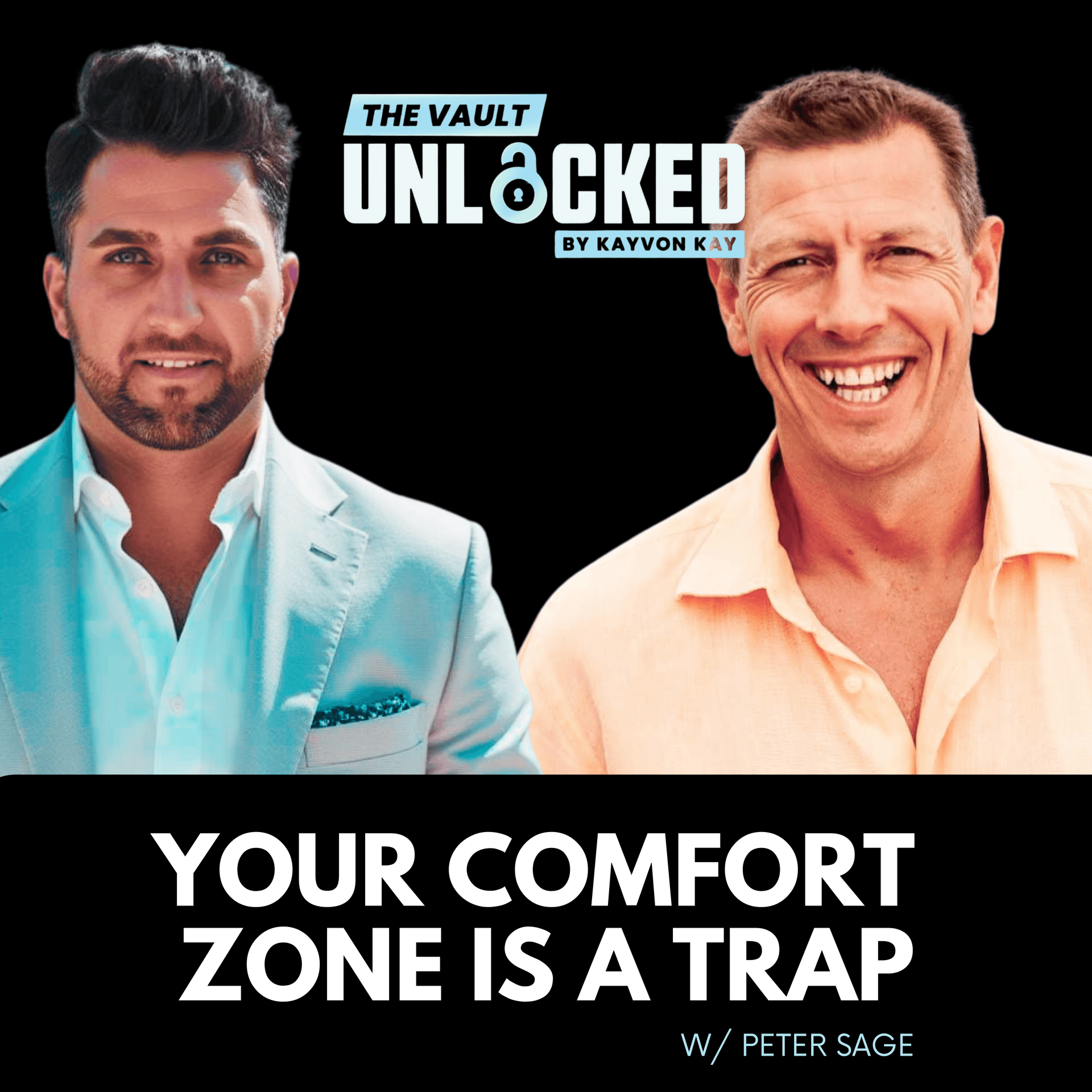
Podcast Summary: The Vault Unlocked - Episode: Your Comfort Zone Is a Trap. Why Most Never Escape with Peter Sage
Episode Overview This episode features an engaging conversation between Kayvon and Peter Sage, who discusses the dangers of remaining in one's comfort zone. Sage, an entrepreneur with over 35 years of experience, emphasizes that many individuals fail not due to lack of talent, but because they never venture outside their safe spaces. The episode explores the dynamics of discipline, identity, and personal growth, providing insights into overcoming self-imposed limitations.
Key Themes and Concepts
- Comfort Zone as a Trap
- Most individuals fail because they cling to environments that feel safe.
- True growth requires stepping outside of comfort zones, where discipline often collapses.
- The Ocean Rowing Challenge
- Sage shares his experience of rowing 3,000 miles across the Atlantic Ocean, highlighting the physical and mental challenges faced.
- The necessity of constant effort is emphasized: "If you stop rowing, you drift backwards."
- Discipline vs. Comfort
- When comfort is available, discipline is prone to fail.
- Identifies the false security that comfort provides, often leading to stagnation.
- Identity and Income
- People often remain stuck at the same level due to their self-identity, which caps their income and leadership potential.
- A shift in identity is necessary to embrace greater opportunities.
- Mindset Mechanisms
- The episode distinguishes between making money vs. building wealth and the importance of mindset in bridging that gap.
- Challenges listeners to confront self-sabotage, especially when approaching the next level of achievement.
Key Discussions
- The Mechanics of Self-Mastery
- The importance of understanding the mental structures that govern personal growth.
- Discusses "to me," "by me," "through me," and "as me" levels of consciousness and their implications for personal development.
- The Role of Fear and Avoidance
- Fear often manifests as avoidance, trapping individuals in their comfort zones.
- Encourages listeners to recognize and confront their fears to break free.
- Growth-Centric vs. Comfort-Centric Decisions
- The need to make decisions that promote growth rather than cling to comfort.
- Advocates for active participation in one’s personal journey.
Important Takeaways
- Discipline Fails in Comfort: The conversation underscores that true discipline requires discomfort; growth happens when you push through the unease.
- Identity as a Limiting Factor: Acknowledge and redefine your identity if you wish to elevate your income and leadership potential.
- Surrender and Trust: To transition from a "by me" to a "through me" mindset, individuals must learn to trust the process and let go of the need for control.
- Death as a Motivator: Sage stresses the importance of making peace with mortality to avoid living in fear, which ultimately stunts growth.
Conclusion The episode serves as a powerful reminder that comfort zones are detrimental to personal growth. It challenges listeners to break free from the chains of comfort and embrace discomfort as a catalyst for success. Peter Sage’s insights encourage a profound exploration of one’s identity and mindset to unlock greater potentials in life and business.
Links and Resources
- Follow Peter Sage:
- [Instagram](https://www.instagram.com/therealpetersage)
- [Facebook](https://www.facebook.com/people/Peter-Sage/100044204765430)
- [YouTube](https://www.youtube.com/user/PeterSage007/featured)
- [Website](https://petersage.com/)
- Follow Kayvon:
- [Instagram](https://www.instagram.com/kayvonkay)
- [Facebook](https://www.facebook.com/kayvonkayy)
- [LinkedIn](https://www.linkedin.com/in/kayvonkay)
- [TikTok](https://www.tiktok.com/@kayvonkayy)
- Learn More: Subscribe to Kayvon's newsletter for deeper insights or book a discovery call for personalized guidance.
This episode is a valuable resource for founders, operators, and leaders looking to break through invisible ceilings and achieve sustainable growth.
Written by AI. May contain mistakes. Listen to the episode to check what was said.
Chapters
Tap a time to open that second in VOUnderstanding Peter Sage's Journey
0:45 to 1:55
Peter shares his background as an entrepreneur and passion for personal growth.
“I've spent 35 years now being unemployable and building multiple different international companies.”
The World's Toughest Row Challenge
1:55 to 4:30
Peter describes the grueling experience of rowing 3,000 miles across the Atlantic.
“I mean, there's so much we can do today, but the Vault Unlock is all about coming and discovering the one thing.”
Facing Adversity at Sea
4:30 to 7:24
Peter recounts the dangers and challenges faced during the rowing expedition.
“It's like, why anybody sign up for such a crazy thing?”
Exploring Levels of Consciousness
7:24 to 10:47
Discussion on emotional maturity and levels of consciousness based on Peter's framework.
“If there was an emergency, and we had a few emergencies, right?”
The 'To Me' vs 'By Me' Mentality
10:47 to 14:03
Exploration of the victim mentality vs the achiever mentality in personal growth.
“And I say, I'm still stuck on this level.”
Shifting from 'To Me' to 'By Me'
14:03 to 17:34
Learn how to take control of your life by adopting a proactive mindset.
“And buy me is the mantra of if it is going to happen, it's going to happen by me because to me ain't working.”
Understanding 'Through Me' Consciousness
17:35 to 24:12
Discover the concept of 'through me' where you align with life's flow.
“hopefully avoid heart attack Harry, drop into two meter catch their breath when their next hustle doesn't work, realize that's not who they are, get back on the horse and start galloping again in By Me.”
The Power of Perspective
24:13 to 28:00
Explore how your perspective shapes your reality and response to challenges.
“And, you know, one of the leading experts in this space, this is what I love about you and what the difference between the real and the fakes are is called humility.”
Reframing Breakups: The Friendly Universe
28:00 to 29:00
Learn how to view challenges and breakups as opportunities for growth.
“If someone leaves you and you live in a friendly universe, you're going to say, well, thank goodness they left.”
Shifting Focus: From Self to Others
29:00 to 31:20
Discover the power of prioritizing others' significance over your own.
“switch that spotlight from, look at me as the star of my movie, aren't I doing great?”
Show all 17 chapters
Understanding Biological Reactions to Fear
31:20 to 34:20
Explore how fear affects our biology and decision-making processes.
“I'm going to go to Ozempic and carry on driving the way I want.”
Cheerfulness in Adversity: A Superpower
34:20 to 37:00
Learn about maintaining cheerfulness in tough situations and its benefits.
“And therefore, you go through a whole biological shift, meaning the blood will be squeezed literally out of the front part of the brain to go to the mid-rear brain.”
Processing Grief: Finding Balance
37:00 to 40:00
Understand how to process grief without allowing it to take control of your life.
“but it's a practice that can become a superpower if you allow it to.”
Making Peace with Death
40:00 to 42:03
Explore how reconciling with death can empower you and enhance your life.
“disempowered because there will always be that thought of how do I avoid the reality, which is we all have a final scene in this movie.”
Choosing Passion Over Fear
42:03 to 42:46
Learn why avoiding uncertainty can trap you in your comfort zone.
“You're going to make survival-centric decisions rather than passion-driven decisions.”
Reflections on Life and Mortality
42:47 to 43:40
Discover the importance of relationships over material success in life’s final moments.
“Some of those business ideas didn't work.”
Living Fully Without Regret
43:41 to 44:14
Understand how to live a fulfilling life by embracing risks and experiences.
“Remember when we tried this thing and it didn't work?”
Transcript
Automatic transcript. May contain errors.0:07We're listening to another episode of the vault unlocked and today we're going to jump right into it because we have the man himself, Peter Sage. Instead of me telling you how great he is, I think he could do a better job than I can ever do. Peter, welcome to the show. For our audiences that maybe not know who you are, just give us a little brief, if we can, of who Peter is and really what you represent. Well, to be honest, I mean, there's always the tendency to people to put you on a pedestal. I'm just a guy, just same as everyone else, trying to put one foot in front of the other as best I can.
0:43But the path that I've led really has centered around being an entrepreneur since I dropped out of school at 16. I've spent 35 years now being unemployable and building multiple different international companies. Some have worked, some have failed majestically, some have been great ideas and should have stayed ideas when I was drunk. All the other stuff. Seen a lot, done a lot, made a lot, lost a lot, had a lot of fun. But what I love to do is I have a passion for personal growth and understanding human behavior in the mind. So that's really what's led me as a parallel career as well as international business to really be an authority on what makes us tick.
1:20How do you get up in the morning and swing the bat with joy rather than with gritted teeth? So really, that's kind of me. And I've been known to throw myself in certain situations to demonstrate that. And that's probably where some of the people come across me. And I've had the privilege of working on and off with yourself as well, Kavon, for quite a few years now. So I think this podcast was a long time coming. It is. And I'm excited to get into it because I know, I mean, we're being humble right now, but we're talking, Peter Stages has been on stages with Tony Robbins, some of the top experts, multiple TEDx speaker.
1:55I mean, there's so much we can do today, but the Vault Unlock is all about coming and discovering the one thing. And that's why I'm really excited because I know for you, your one thing is personal mastery. And if we even went deeper, it's really, it's the mindset mastery of, of that. Uh, so I love the story. I just listened to your last Ted talk. I thought it was amazing. I mean, you can even see the awe in the audience. You never really get an awe in a Ted talk and, uh, you did. So tell us what you just did. Why did you do it? And the pain and everything. I mean, I really want to understand this because I think it's pretty crazy.
2:34I, I'll even say this before we get into it. But when I was listening, I don't even think I'd last 24 hours. Even if I could put my mind and will set to it, I just don't see how I could last more than 24 hours of doing this. Well, I think for the audience listening, thinking, what the hell is this guy doing? Or what do you do? I'll set the scene very briefly. I've done a lot of ultra endurance athlete stuff, you know, from running across the Sahara to just recently, a few weeks ago, completed the North Pole Marathon on there. But all of that pales in comparison to the adventure I took on with my best friend last year, in fact, last December.
3:11And so about a year ago. And we took on something called the World's Toughest Row. And this is what's known as an ocean rowing boat, which imagine a beefed up canoe with a couple of little cabins stuck on the end that you can't really stretch out in. you're sitting six inches off the water and you're rowing unsupported meaning no one's allowed to touch the boat you've got to take everything with you from the canary islands 3 000 miles across the atlantic to antigua in the caribbean and it's the same route that columbus took from the same place it's kind of commemorative that way but you're talking about a rowing boat we're not talking sail.
3:49We're not talking engine. We're talking about arms and oars for 3 ,000 miles. And that took me just under two months. And the impact for that really is understanding that because it's a rowing boat, if somebody's not rowing, you're drifting. And so in order to actually make the boat move where you want it to move, somebody has to be rowing at all times. And the that the best, I guess, schedule that's been discovered really for that is two hours on and two hours recovery. So I row for two hours and then I recover while Lee rows for two hours. And that's 24 seven for just under two months. Yeah.
4:29Like, I mean, it's to me, it's just insanity. I'm not going to be honest with you. It's like, why anybody sign up for such a crazy thing? 20 like two people can't i really want to talk about this because i think it's so important here people can't stay disciplined for a week you had to stay disciplined two hours on two hours off life threatening i mean you're in the middle of the ocean and there is no you there's no i want to quit that you've made that decision you're you have to do it what what first gets you to make wake up and go, what's the hardest thing I can do? And just, I'm going to just go do that today.
5:11Well, as I mentioned in the tag tour, there was two real reasons I wanted to take this on. And the first is that I've been teaching self-mastery for a long time. You know, it's, it's a, just a reality of life. If you can't master your mind, you will never master your life. Yeah. If you can't understand self-discipline, if you can't engineer your own, yeah, kick up the but no one's coming to save you if you go down the wrong spiral. So putting yourself in a situation where there is no choice is usually a great way to find out what you're made of, because there is no choice. And I wanted to, I thought, you know, think of this scenario.
5:48And by the way, this happened a lot. Imagine that you're a thousand miles offshore. The nearest human is in the International Space Station. The nearest land is five miles underneath you. You've not seen another boat or anything for weeks. You are tired, sleep deprived to the point of hallucinating. It's four o 'clock in the morning, pitch black. You're in a raging sea. You've not eaten for 24 hours because you're seasick. You've got salt blisters covering most of the contact points on your body, including your hands and your ass. And your alarm goes off. You've managed to get about 45 to 50 minutes of your downtime actually asleep once the cortisol has gone out of the body from the previous row, and you've got to go out and row backwards in the dark in a bad sea.
6:34At that point, your mind is going to do what it's meant to do, which is to give you every single excuse to pull the plug, open the trap door, say, I don't want to go to school today. And it's in that moment, I wanted to find out where I'm at. Because you can talk about it. You can sit on a podcast and brag about it. But theory does not cover the price of admission to the higher levels of greatness. And that's why we say greatness is thrust upon people. It's not something that's usually chosen. It's thrust upon you because you have to step up. So I wanted to find out in a real situation at that level, did I start to cry and say, I don't want to go to school today or am I going to get out and suck it up?
7:13What would happen if you, did you, was there even a choice when you're in the middle of the ocean, you know, say six weeks in, could you even wave the white flag? It doesn't seem like that's even a possible opportunity. If there was an emergency, and we had a few emergencies, right? I mean, Lee, my rowing partner, best friend from childhood, you know, Royal Marine Commando for 22 years, you know, good mindset, good, strong on the oars like I was. He got knocked out twice while he was rowing just after the about 10 days we're into the row. And we got a rogue wave that slammed the boat. I was in the cabin.
7:50It sent me spinning. but it hit his head on the side of the oar that the power of the wave was that hard. And I look, get out and he's incoherent. He doesn't know who he is, where he is. There's blood all over the boat. I think he's gashed his head. It turned out to be a laceration on his hand but he couldn't row for three and a half days at that point. And so I'm rowing solo and he's not even coming out of the cabin. And they almost, I called it over the satellite phone to the safety team and the safety officer. But the nearest rescue boat is usually about four days away. I mean, you've got to figure this out.
8:30Yeah. And so, you know, is there a way you could quit? They almost went to send somebody for him because if it was a bad concussion, head injury, then he needs medical attention. And we were trained in first aid in basically the space of a large coffin, which is all the boat is. Right? You've got to, you know, it's not a normal first aid scenario. If you've got recovery positions or you're doing this, but he came out of it after three and a half days. He was back on the oars. And then about 10 days from the end, it happened again. And he got slammed, same part of the head. And this time, not only was he unconscious and concussion, he lost the vision in his left eye.
9:11Oh, my God. And so at night, again, three and a half days to four days where he couldn't get on the oar. So I'm rowing solo again. I'm rowing 11, 12 hours a day in daylight. And then what I do is I tie up everything on deck. Yeah, the oars, the water, everything. If you get capsized, it's not tied to the boat. It's gone. Yeah, yeah, yeah, yeah, yeah. Including you, by the way. If you're not tied on at all times, if you go overboard, the wind or the current or the waves can move you away from the boat faster than your buddy can row. Absolutely, yeah. Meaning that if you're not tied on, you go overboard.
9:43You're going to see your friend disappear over the horizon. Absolutely. uh and it's it's interesting because you said earlier in the show if you don't stop rowing you're drifting so how did you know you were hopefully drifting in the right direction or like i mean even if you went to sleep three four hours like how much like did that take away from where you're going you set the boat up as best you can with the rudder in the direction you want you hope the current's going to be in your favor but uh i mean first night we lost about 12 miles yeah it's just what it is yeah wow i mean we can talk like this whole episode can be just on this uh but i really want to talk about uh like all like really everything that you stand for i mean i'll say it like even being able to work alongside with you all of that like you know you've even helped me with my mindset and just uh one of the things i want to kind of go back to because it's one that I always remembered.
10:41And I feel like it, you know, this is your content. And it was it was so simple. I still teach people this. And I say, I'm still stuck on this level. And I don't even know how you get to that next level, which is like the to me, the by me, right through me, and I think it's the as me, right. And, and I think it's so important that like, I think that for that level of consciousness. I think it's such a base level of knowledge that I don't think most people are conscious to. They don't even understand that there's levels of consciousness. And it's not actually that hard to understand what these levels are, but it's a whole other world to live them and to become them and to actually be them.
11:23So like, I would love to just deep dive into that a little bit, if that's okay. Sure. And the original model came from Michael Beckwith, when he channeled it through in a class, he told me this personally in the sort of 80s. But I've expanded on it a lot because it does provide a real strong framework of understanding because most people are familiar with the concept of biological maturity. You're going to age. You know somebody who's in their 40s versus someone who's in their 20s. But emotional maturity is different. Emotional maturity is a choice. And most people have never been trained on how to take that on, which is why there's a lot of emotional teenagers out there running around in some pretty old bodies.
12:02But if we look at it through the lens of Albert Einstein, who's a pretty smart guy, never met him, but he said something that was pretty profound. He said, you cannot solve a problem at the same level of consciousness that created the problem. Now, he didn't say you can't solve a problem at the same level of intellect. He said the same level of consciousness. So looking at it through that lens. If we take this nebulous word, this 13 letter anomaly that science hasn't figured out called consciousness, you know, science in a biological way is still trying to think, right, the brain produces consciousness when the reality is the brain doesn't produce consciousness any more than a radio writes music.
12:40Yeah. So when it comes to... Isn't that interesting? Like, here we go. Okay. I'll let you keep going, but wow. Yeah. Okay. So four levels, the first level, the lowest level of consciousness in humanity right now, which is very ubiquitous, it's quite prevalent along about 70 % of the world by design. That's a different podcast, one that you'd probably had more with Kevin and Katie previously. But yeah, the level is called to me. And it's called to me because the mantra of that says, I would have the life I want. I would have the car I want, the body I want, the guile I want, whatever, but everything happens to me.
13:17And it is the, or if only this hadn't happened to me, then I would be this, that, the other. If you had my parents, then you'd understand. Or if you had my boss, you'd understand. All this kind of BS. So it's the quintessential level of victimhood. And the challenge with victim is that nowhere in the universe is the role of victim ever supported. You doubt that, go to the Savannah in Africa and see what victims are about. you know yeah so most people in our sphere especially people listening to this podcast are kind of past that they get that you know being a victim doesn't work they don't want to be a victim they want to take personal responsibility they want to go out and try to create a better life they are seeking answers whether that's online through podcasts like this or whatever they want to open the vault to find out what they got to do yeah and that gets us to the next level of consciousness called buy me.
14:14And buy me is the mantra of if it is going to happen, it's going to happen by me because to me ain't working. So I'm going to set some goals. I'm going to go out of the market. I'm going to go hustle. I'm going to do what I can. I'm going to work on self-improvement because if I am going to get my goals, it's going to happen by me. And rather than stand on the shore of the river of life, complaining about the temperature or the current, you dive in and you start fighting the current, swimming upstream towards your goal. That's kind of the achiever mentality versus the victim mentality. And the vast majority of personal growth, Kayvon, initially, if we go back to the Tony Robbins in his early days, it was catering for what I call the to me, to buy me crowd.
14:58In other words, stop watching infomercials at two in the morning, you sad sod, pull your thumb out of your ass, go set some goals, go get them, cowboy, I'll show you how get motivated. And it was like, how do you get people from complaining at life to creating a life? Yeah. And that was how personal development for the masses kind of entered the market, certainly in Tony's side. The challenge with that is that personal growth as an industry pretty much realized that there isn't a lot of money in that because there's more people in to me are committed to keeping their problems than outgrowing them.
15:33They have what's called secondary gain. They have a way to validate their own significance by the size of their problem. They get their connection through connecting with other people that are victims, groups or blaming the government or blaming this or blaming that or whatever. So a lot of people are more happy being unhappy than you realize. It's crazy. But those that are ready to go are the ones that would pull up their credit card and say, I'll buy that program because I'm looking for a way out. But it's a small number of that pyramid. So the vast majority of personal growth today is what I call the low buy me to high buy me.
16:17It's somebody that's committed to wanting to do better, but they want to... What's the hack? What's the hustle? How do I 10x this? How do I get the Lambo instead of the Beamer? It's the low buy me to high buy me crowd, right? Low achiever to high achiever. and that's your typical you know tony robbins more in that space these days your grant cardones your gary v's your dan pennies you know you pick one that that's the vast majority of personal growth in the industry on instagram with your muppet standing next to your fake lambo profile picture trying to sell somebody a course on how you can make more money right you get the idea yeah my market is different my market speaks to crossing the bridge to the next level of consciousness.
16:57And the next level of consciousness, what we call through me. Through me is where you're no longer swimming upstream, fighting the current, but you're actually aligning with the current and allowing life to take you to where you should go. Not passively. If you're in a boat in a river and you're not, trust me, if you're not in control of your rudder, you're going to drift to where you don't want to go. But rather than using your energy to fight the current, if you use your energy to position yourself better in the current, that's a better use of energy. And most people in By Me start off as Alan the Achiever.
17:31They move into stressed out Simon, get to burnt out Barry, hopefully avoid heart attack Harry, drop into two meter catch their breath when their next hustle doesn't work, realize that's not who they are, get back on the horse and start galloping again in By Me. And they rinse and repeat. There's like a glass ceiling. There's like, what's the code I'm not cracking. And code you're not cracking is understanding that, as Einstein said, you can't solve a to me problem at a to me level of consciousness, right? Victim is not going to be solved by victim. Victim will be solved by achiever. But you can't solve an achiever level of problem at an achiever level of consciousness.
18:10You have to rise above. And when you start aligning with the natural flow of the river, when you start understanding the rules of the road, when it comes to the non-physical rule set. See, by me is outer world centric. To me is outer world centric from a victim reactive perspective. By me is outer world centric from how do I control my reality and how do I get it to fit my pictures with force? Yeah. Through me taps into a power. Through me is different. Through me is where you give up the need for control because you understand a fundamental truth that has been taught to the elites for centuries.
18:47and that is outer world follows in a world, not the other way around. You've got chaos in your outer world, check your thinking. You're chasing money. And here's a great question for people listening in because the answer to this question becomes self-evident when you hear the question, but most people have never asked themselves the question. And the question is this, would you rather make money or build wealth? Which one? Well, I mean, personally build wealth. Of course. Once you ask the question that way, the answer is self-evident. So why aren't people building wealth? I'll tell you. Because they're too busy trying to make money.
19:27So when you realize that if you are trying to make money, most people are coming at it from a scarcity mentality. Well, outer world follows inner world. The biggest number one law in personal growth that I've discovered in 36 now years of doing this, I can sum up in one phrase. You will never rise above the opinion of yourself. It's interesting. I say to my sales guys, you will never outsell your identity. Yeah, same thing. It's the same, yeah. So if you've got a financial comfort zone around 50 grand a year, and that's how you identify yourself, and all of a sudden you start getting involved in an opportunity that could bring you 150 grand, A, you're either going to self-sabotage it, or you're going to find a way to get rid of that other 100 grand when it shows up in your bank account, because you'll never rise above the opinion of yourself.
20:18What you want to be doing is, how do I raise my financial comfort zone? How do I raise my financial thermostat? And a great example of this, you go back into my side of town in terms of England 400 years ago when it was a feudal system, meaning that you didn't have the gift or the ability to be an entrepreneur. You were either born in the Lucky Sperm Gang or you weren't. You were a landowner, a baron, a landlord, and your family was set for life. Or you were a peasant. You worked on the land that the landlord owned, picking stuff out of the fields. That's the game. So imagine that you're a servant in the landlord's house.
21:01They had servants. They had maids. They had butlers, what have you. And the landlord is having, the land baron is having a party for some of his wealthy landowner friends. and you're serving the meal with the other servants. So you're dressed in your servant's gear, you walk in, you place the plates down, you lift the dome off, you disappear quietly. And let's say that you'd made friends with the land baron's daughter, who was six, seven years old, because you were her maid, you helped her get dressed in the morning, you made her bed, you played with her toys, what have you. That was part of your job.
21:39and the daughter sees you bringing the food to the table. And she says, oh, daddy, daddy. Let's say that the servant's name is Jane. Can Jane join us? Right? Jane, please come sit next to us at the table. What's Jane's immediate thought? No, like, oh, I'm not good enough. I'm not one of them. I'm not supposed to be at this table. I'm not allowed at this table. And then the worst one, I just want to, I'm not worthy enough of being. Absolutely. Of course, it's not her place. And even if the daughter insisted and the land baron says, all right, put her a seat there. How is she going to feel sitting at the table with all the other wealthy people?
22:27Oh, good. Uncomfortable. All that. A hundred percent. Now, the question I have for your audience is simple. What table are you sitting at? Because Jane's very happy at the servants table downstairs. That's where she belongs. There is no difference in physiology. Same two arms, two legs, same nervous system. Same, you know, the difference is where do you feel comfortable sitting? And you get to decide that. You know, if you're in a village like that a few hundred years ago, and the king rides into town with his people, the whole village is astir. I said, oh my God, like there's a, it's the, it's a human being on a horse.
23:10Yeah. Yeah. Yeah. The difference is mental. Would you agree that it's easier than like easier said than actually practiced or, or, or. If it was easy to practice, we'd all be sitting there with the massive paper. Yeah. Because it's actually what you're saying too, it kind of goes along with a quote I heard in your, in your, your TED talk. You said something about comfort versus growth-centric experiences. Yeah. It's coming back to what I said about my role in this industry is helping frustrated people in by me cross over into through me. Yeah. The invitations to the table feel natural. How do you engineer that from an inside-out perspective rather than hunt for it from an outside-in perspective, which is never going to work?
23:58And so, and the fourth level, by the way, which I'm not qualified to talk about, it's called as me. That's kind of your non-denominational oneness, you know, non-duality. I love, you know, Peter, as much as you're the expert, right? And, you know, one of the leading experts in this space, this is what I love about you and what the difference between the real and the fakes are is called humility. And for you to know that there are four levels of this highest level of consciousness and that the fourth level is, it's not that it's unattainable. It's a different world like that. Like I call that. It's funny.
24:32I tell people when I teach it, the monk level, like that's like monk. And I don't even know personally if I even aspire to be even at that highest level. But I sure as hell know I want to aspire to be as the through me level. So for those people like me, I mean, full on honesty, who's at the top of through me um uh by me at the top level sitting on the cusp understanding uh that there's that there is this this little um there's this this thing called surrender where you still have to trust yourself but also let go and trust the outer world and and and be able to flow and I call it flow like water um how does someone cross that chasm uh when they're when they want it so when they want it they they understand it but they find themselves like they're they're just sitting there and and maybe it's the fear maybe it's just the unknown but they're sitting there paralyzed of of of actually taking that last little leap that probably changes everything.
25:41It's the one thing that gets you into the through me. What would you say to that person? A.K.A. Kayvon. So, I mean, you're pointing in the right direction. Surrender can be heard from different levels of consciousness. You hear the word surrender as a victim into me, and you hear the world be dominated by, right? If you hear the word surrender in by me, you hear it as failure. You hear the word surrender in through me, and you're surrendering, letting go of the need for control. Now, I didn't say control itself. I'm saying the need for control. And again, there's different levels of consciousness that people will hear this from.
26:20I'll give you another insight. The real starting point of power, the genesis of true power is the second you recognize you don't need it. There is a letting go at that level. There is a point where people will look at you because you're no longer craving significance or external validation and think, wow, I want what they have. In other words, you're getting it by osmosis because you don't really need it. So when you give up the need for control, you actually get more control over the situation because now you're working with unseen forces, if you like, that are conspiring in your favor. And let's go back to Einstein.
27:02He said, the most powerful question you could ask or answer in your lifetime is do you live in a friendly or a hostile universe? Now think about it. You think you live in a friendly universe and things are happening for you. If something goes wrong, you're excited to find out why it didn't fit your pictures and what's going to come good of it. You're looking for the silver lining in the cloud. It's like, okay, so that wasn't my outcome, but I'm excited to see how it turns out because I live in a friendly universe. Therefore, it must be happening in my favor. I just don't see it from this level yet.
Read the full transcript
27:33There's an expectation, a positive expectation. You're not complaining. You're not being sucked back to victim. But if you think you live in a hostile universe and something goes wrong, you've just got evidence as to why life's a bitch and then you die, why it sucks, why here you go again. And they're two very different lives that you would live. As an example in a relationship, if someone leaves you in a relationship, you're going to say, well, I'm no good, so they left me, if you live in a hostile universe. If someone leaves you and you live in a friendly universe, you're going to say, well, thank goodness they left.
28:04So they made room for somebody who's right. Same breakup. Different pathways moving forward into two different versions of life. 12 months down the line, one person's doing great. One person's still crying. So to just touch in, what's the reality there? Do we live in a friendly universe or do we live in a hostile universe? Well, the answer is pretty obvious. We live in a self-reflective universe. Two men sat behind prison bars, one saw mud, the other saw stars. You can decide whether you're being punished or you can choose the fact that you're being prepared. And if you want to start the journey into through me from by me, having something as a driving force in your life that is bigger than you, often by me is driven by insecurities, the need to prove, the need for certainty, the need for significance.
28:59And just making one switch, when you change from trying to validate your own significance, which you don't need, by the way, it's just your ego that needs it, to raising the significance of others, you switch that spotlight from, look at me as the star of my movie, aren't I doing great? Please tell me I'm doing great, to how to make somebody else feel amazing in their movie. I was recently with another former guest you just had, Kevin Trudell. Kevin and I were having dinner. And one of the things I love about Kevin is when you watch him interact with people, he is constantly making you feel the most important person in the universe.
29:42He is constantly shining the light back onto your stage to make you feel the star of your movie. It's a rare and beautiful trait that you don't see many people do. But when you do, when you give up the need for significance and you replace it with raising the significance of others, a lot of other people hold you in a very high level of significance. Yeah, yeah, yeah. Well, and this is, I mean, you know, we do sales and everything. And I tell people, when you put yourself first, you end up on the bottom. When you put the prospect first, you end up on top, right? And you hear this, right? And I think it's self-development, right?
30:19If you want to do good, make it about you. If you want to be great, make it about others. And I agree, it's hard, right? It's one of those things where you can understand it logically, and you can even believe it, I would say, emotionally. But then there's the highest level of consciousness in that, that surrenders or, like we said, gives up control around that and believes it authentically. And I think that there's a fine line there. And the universe knows. It's not so much the fact that it's hard. It's simply exposing where your friction points are. When you drive down the freeway and you're not paying attention, luckily there's something called a rumble strip.
31:02Yeah, yeah. And you're burning that. That's to get your attention so you don't go off the verge or into the central reservation and have a bad day. Well, life has its built-in rumble strips as you're driving down the freeway of life. If you just use a simple health example, right? If you're listening to your music in the car and you're drifting off and you're having too many cheeseburgers or you're having too much ultra processed food, and at some point you get out of breath walking upstairs or your pant size go, it's a bit of a rumble strip. It's like, oh, it's get your attention. Ignore it. You could go off the verge.
31:29Of course, what do most people do? Oh, that's interfering with my music. I'm going to turn up the music. I'm going to get a pill. I'm going to go to Ozempic and carry on driving the way I want. It doesn't work that way. But on a mental perspective, if you want to get into through me, you want to trust the universe a little bit more. You want to grow out of your ego's need for internal validation. Sorry, external validation. Then the resistance that you come up with is simply the rumble strip that is showing you, okay, now I've got to work on being able to be less self-centered. I've got to work on trusting that if I fall, the universe is going to catch and I've got some level of cosmic overdraft protection.
32:08I'm going to have to work on the fact if something goes pear-shaped, there's a better reason for it. Napoleon Hill quoted very emphatically, every adversity carries with it the seed of an equivalent or greater benefit. The challenge with most people is that they're so focused on the adversity, they don't water the seed. You've got to have a different mind frame. You got to understand that you are the star of your movie. Most people are giving up their power to star as an unpaid film extra in the big budget disaster movie they see going on online on the news or anti-social media. You said in your TED Talk, your latest TED Talk, you said the quote was, you got to have cheerfulness in the face of adversity.
32:54It's a superpower. And I break it down because the biology of that is critical. If you start getting angry, upset, scared, fearful, or what people in By Me like to call stressed, right? Because they don't like owning those words, right? You have a biological reaction that is inbuilt as part of our evolution. And it serves you because danger, most people's minds don't understand the difference between fear and danger. There's a big difference. Fear is designed to get your attention evolutionarily to point in the outer world to something that could be mortally dangerous. Yes. Yeah. You get fierce in front of a tiger or a snake in a tree or standing next to a thousand foot drop on a cliff.
33:42Fear is useful to get your attention to point towards something in the outer world that you need to take advantage to take action on. Right. To avoid you being taken out of the game. Yes. Now, we don't have many snakes and tigers these days, right, or thousand foot drops outside of our front door. So that fear has been replaced with psychological danger, the fear that I'm not enough, the fear I don't have enough, the fear I can't pay my bills, the fear that somebody doesn't like me, the fear of rejection. Fill in the blank. There's a lot of patterns out there that I could quote. But when you realize that when you have a fear come up, the mind, the brain is evolutionarily programmed to respond as if there's a physical danger.
34:25And therefore, you go through a whole biological shift, meaning the blood will be squeezed literally out of the front part of the brain to go to the mid-rear brain. Why? Because you have to work off reflex and critical thinking is the slowest form of thinking. So if you're sat there thinking, oh, that line's on its rear haunch, which means it's probably going to strike from that angle and leave with a dispor to swipe. Too late, you're lunch. You're going to walk off reflex. So critical thinking shuts down. Your blood gets pushed to your immune system drops through the floor because two of the biggest areas of energy consumption when you're stable and your cortisol levels are normal is digestion and immunity.
35:07So your digestion and immune system shut down to conserve and redirect energy to the muscle so that you can run, fight, flight or hide. So when you get stressed, you go through a biological shift that essentially raises cortisol, pushes your brainwaves north of 15 to 16 cycles per second or 15 to 16 hertz. Your critical thinking stops. And that's why we've all said and done really dumb things when we're stressed, angry, or scared that we've then either regretted or had to apologize for later. Or you haven't heard it. What was I thinking? You weren't thinking. You were scared, stressed, whatever.
35:47So going through the cheerfulness in the face of adversity is to wake up and understand, okay, what is it that I could do right now to recognize that my biology is being hijacked and try to turn it around? Humor is a great one. We faced, after four days, we hit our first major storm. We hit 35-foot waves in a rowing boat. It was frightening. frightening i was absolutely terrified at some points yeah but i had that's a real fear right like i mean that's the real fear that's a real stake in the tree right yeah yeah and i also knew that if i didn't get my cortisol under control i would probably make the wrong decision on where to put the oar in the water how to position the boat how to work with the navigation how to get all of that kind of stuff all of the survival instinct that i wasn't trained enough to know unconsciously competently.
36:44So I had to do it consciously competently. And therefore, I had to retain the front part of my brain and not get hijacked into fear or do something stupid. So cheerfulness in the face of adversity is one of the tenets for the Royal Marines, but it's a practice that can become a superpower if you allow it to. Now, there are certain times you don't want to be cheerful at your mother's funeral. Neither was I. There's times where you allow yourself to grieve or allow yourself to process certain levels of situation or breakup or whatever it may be. But if you allow grief to take you down on its terms rather than use it to process certain emotions that require processing and time, then you will stay there.
37:34And an example I give is that when my dad passed away, and it's always tough for a son to lose his dad, I struggled, but I processed. I understand that it's every parent's wish that their children outlive them. I understand that there's a time and a place for everything. I understood that at some level, he probably wouldn't have left if he didn't think I was ready at an energetic level. I look for ways to process it so that I can still grieve, but do it on my terms. The person he was with at that time wasn't my mom. It was my stepmom. 15 years later, if you check her profile on Facebook, it's still him and her as the patron.
38:14Still hasn't got over it. Still grieves. Still misses him. Still miss him. But part of life is you need to be able to move on. So you need tools to be able to acknowledge, you know, where are you in your journey of processing the past on your terms rather than get taken down by it. And that's where victim stories come in. And if you can't get out of that, it's going to own you. I've seen, and it's unfortunate as you say that, like in those exact situations or sometimes, which is the worst, is when the parent loses the child. And I've seen it play out twice, two different complete outcomes. like the one one side still to this day is their life's over like they just can't like you know what i mean they're still living in that victim and then the other one is like you can't you almost go like how are you even acting like that like you hello do you remember you lost your son but there's this there's this piece that comes with it obviously there's a grieving process but i love what you said is you can't let the grieving uh take over you you have to go through that process, but you can't let it take over and run or rule it.
39:27Cause like I always believe, and I tell people who go into these like walls, depression, the longer you stay in it, the higher those walls get and the higher they get, it's harder to get out. And it's, you gotta, you gotta be on that. Um, it's interesting because you, you brought that, the topic of your, your, your dad up and in your, in the way you ended your, your Ted talk was you said, uh, something that again, very simple, but I kind of was like, profound is make peace with death. Yeah. If you don't have a way to reconcile death that empowers you, you are going to live disempowered because there will always be that thought of how do I avoid the reality, which is we all have a final scene in this movie.
40:10That's non-negotiable. I don't care how many vitamins you take, how much workout you do at a hundred years. At some point, you're going to want to sell this old car, right? It's going to break down. So if you think death is the opposite of life, you're going to resist it. If you understand that death isn't the opposite of life, death is simply the opposite of birth, then you're going to see it as a transition. And we're very fortunate in today's society now that 15 years ago, this didn't exist. But today you could go on YouTube and there are channels and channels that are dedicated to near-death experiences.
40:44People that have gone through a near-death experience, some of them 30 years ago, and didn't talk about it because people thought they were crazy. And you look at it through the lens of an objective detective trying to piece together a case. So you're not trying to lead the witness. You're just simply looking at the evidence. And it is way too overwhelming from the amount of thousands and thousands of people who have crossed over and come back. And it shouldn't be called a near-death experience. It should be called a death experience because they died. But they came back. And every single one, they have nuances of how they describe it.
41:17But the commonalities between cultures, ages, backgrounds, different circumstances that led to it, all varied on all commonalities in the experience that happens afterwards. And you would have zero fear of death when you understand what it really is. And if you don't have a way to reconcile that through your religion or through some way of being able to make peace with it, because it's going to happen, It is quite useful. Then you're going to be kicking and screaming all the way. And the biggest challenge, Kayvon, is this. If people are afraid to die, they think that, well, it's healthy being afraid to die.
41:55But it's not healthy on how it shows up in this current movie. Because how it actually shows up is in being afraid to live. Because you're going to make decisions based upon avoiding uncertainty. You're going to make survival-centric decisions rather than passion-driven decisions. You're going to avoid things that are going to light you up because, oh, I don't want to increase the uncertainty. There's this hidden fear that, oh, I'm scared to death. No, you're afraid to live. It's going to own you. Swing the bat. Go out. You're going to get to the end of this movie at some point, as we all are.
42:33And if you can turn around and say, have the privilege of choosing those words and say, wow, that was spectacular. That is a movie I would pay to watch again. That is something that I'm proud of. I took those chances. You know something? I struck out a lot. Some of those business ideas didn't work. Yeah. Some of those women rejected me. Whatever it may be. But you know something? I played full out. You're going to get to the end? Yeah. Because I've been around people that have come to terms with their mortality, whether they've got hours, days, minutes, or weeks to live. I was just having a call before this podcast with somebody who is terminally ill and is making peace with that themselves.
43:11And I can promise you this, when the time comes where you know it's hours left or days left, nobody is going to turn around to the people near them and say, please go fetch me my mahogany framed MBA certificate. Please go fetch me the keys to my Bentley. Please go get me my stock certificate. No, what are they going to say? they're going to say, please go get me the people I care about so I can tell them I love them one more time. And we can reminisce about the amazing times we've had. You remember we started that business and it absolutely flopped? Oh my God, right? Remember when we tried this thing and it didn't work?
43:48Do you remember when we did that and wow, we nailed it? They're the stories you're going to be telling as you go to the end of this movie. Not like, oh wow, I managed to get the end of the movie, thankfully, and not have any stories to tell because I was too scared to try anything else. Make peace to your death so it doesn't own you. So you can go and live rather than live as if you're afraid. I think that is where we ended. I was going to ask one last question, but I really think that that's enough there. Peter, I know people are going to be like, where do I find this guy? Like, how do I work with him?
44:26Where can people find you? And if someone is really feeling and resonating this, how can they reach out and get your help? I'm available online. You can go to my website, petersage.com. I try to put a lot of stuff on YouTube to help people with. I call it anti-social media because that's what it is for most people these days. If you're getting social media scrolling you rather than you specifically searching for things that you want, then yeah, it's anti-social. But I put a lot of stuff online to help people. If you want to play at a high level of the game, clearly I have programs. I know you've even done some, Kayvon.
45:01I mean, they're world class, they're gold standard. I'm very proud to say we have the highest rating in the entire personal growth industry globally on Trustpilot. We've got over 5 ,000 reviews. We're at a 4.9. And just go read what other people have said from the journey they've taken. And if you feel it resonates and you want to come play it, life it threw me at a much different level. Raise your financial thermostat. Get rid of your limiting beliefs. live from a place of passion rather than fear, come play. I'm your guy. I love it. Well, that's another episode of The Vault Unblocked.
From the publisher
Most people don't fail because they lack talent.
They fail because they never leave the conditions that keep them safe.
This conversation exposes why comfort is the most dangerous place a founder can live, and why discipline collapses the moment there's an exit door. If you've ever felt like you're working hard but still circling the same level, this episode doesn't let you hide from that anymore.
There's no motivational padding here. No "do what feels good" advice. This is about what actually happens when you remove choice, remove excuses, and put yourself in situations where quitting is no longer an option.
Kayvon sits down with Peter Sage to unpack what most high performers avoid talking about once success shows up.
The conversation starts with a two-month, 3,000-mile ocean row across the Atlantic. No engine. No sail. Two hours on, two hours off, every day, for nearly sixty days. No rescue plan that shows up on demand. If you stop rowing, you drift backwards.
From there, the discussion cuts deeper.
They break down why discipline fails when comfort is available, how identity quietly caps income and leadership, and why most driven people stay stuck at the same level no matter how hard they push.
This episode moves through the real mechanics of self-mastery, not as theory, but as lived consequence. Comfort versus growth. Control versus surrender. Making money versus building wealth. Hustling versus aligning.
By the end, the real question isn't about rowing, mindset, or endurance.
It's about what table you believe you belong at, and why most people never sit anywhere else.
This episode is for founders, operators, and leaders who already know how to work hard but are tired of hitting invisible ceilings.
It's for independent thinkers who've outgrown surface-level motivation, hustle culture, and recycled personal development advice.
If you're still looking for shortcuts, this isn't for you.
If you're serious about power, identity, and long-term wealth, it is.
Business growth doesn't stall because of strategy. It stalls because identity can't keep up with opportunity.
This episode connects mindset, leadership, discipline, and money in a way most business conversations avoid. It addresses how internal limits shape external results, why self-sabotage shows up right before the next level, and how leaders unknowingly protect comfort instead of building systems that force growth.
If you care about scaling companies, leading teams, building real wealth, and operating at a higher level of influence, this conversation goes straight to the root.
Topics covered include:
-
Why comfort destroys discipline faster than failure
-
What happens when quitting is no longer an option
-
The identity ceiling that caps income and leadership
-
Making money vs building wealth
-
Control, surrender, and real power
-
Why most driven people never escape the same level
-
How fear quietly turns into avoidance
-
Growth-centric vs comfort-centric decisions
Follow Peter Sage:
https://www.instagram.com/therealpetersage
https://www.facebook.com/people/Peter-Sage/100044204765430
https://www.youtube.com/user/PeterSage007/featured
Learn more: https://petersage.com/
Follow Kayvon:
https://www.instagram.com/kayvonkay
https://www.facebook.com/kayvonkayy
https://www.linkedin.com/in/kayvonkay
https://www.tiktok.com/@kayvonkayy
Want to go deeper with Kayvon?
Subscribe to the newsletter: https://www.kayvonkay.com/
Book a discovery call: https://www.kayvon.com/booking