

- Podcasts
- This Much I Know - The Seedcamp Podcast
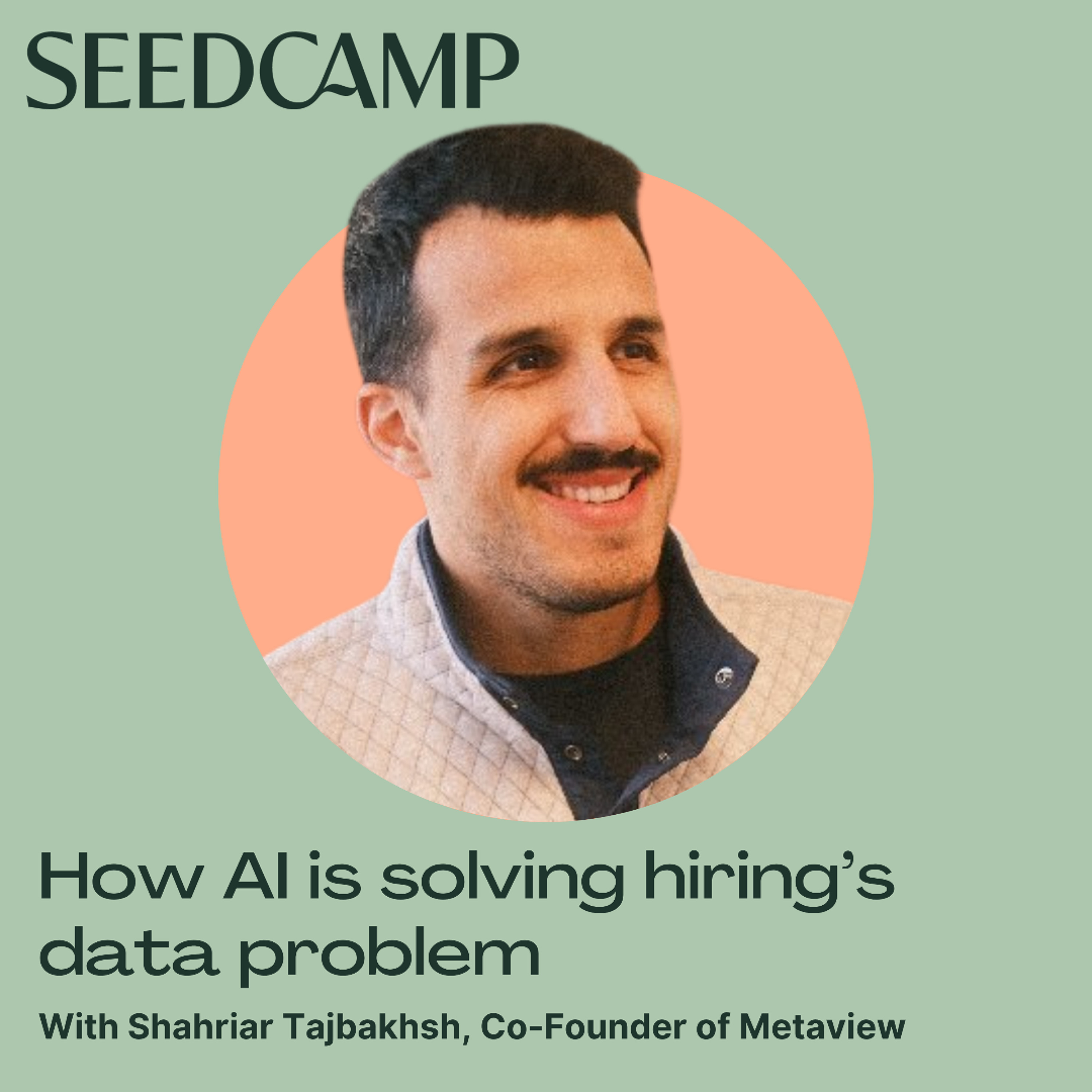
- Shahriar Tajbakhsh, Co-Founder of Metaview, on how AI is solving hiring's data problem
 This Much I Know - The Seedcamp Podcast
13 Aug 2026 · 40m · 15 chapters
Shahriar Tajbakhsh, Co-Founder of Metaview, on how AI is solving hiring's data problem
 Ask ChatGPT
In short
Shahriar Tajbakhsh (Metaview co-founder) explains how Metaview turns hiring conversations into operational data, and how LLMs unlocked an “AI coworker” approach to hiring workflows (starting with an AI recruiting note-taker, then expanding to autonomous outreach and AI interviewing).
Guest background
Tajbakhsh worked at Palantir (he says “Palantir dna” shaped Metaview’s talent-density hiring) and his co-founder worked at Uber. He focuses on hiring exceptional, “spiky” talent and on communication transparency.
Key claims
Hiring conversations are ~90% of valuable hiring data but were historically unrecorded/unlearned-from. Metaview’s core asset is recorded/transcribed conversations; GPT-2/3.5 accelerated product impact. Trust with enterprise buyers came from “unreasonable hospitality,” rapid learning, and changing the game.
Notable examples
A Nordic-candidate clearance/culture mismatch where offers were rejected; cultural differences (e.g., vacation questions) affected interview judgments. Outreach example: legacy templated sequences vs autonomous agents doing deep candidate research, generating personalized messages, and timing follow-ups.
Written by AI. May contain mistakes.
Chapters
The Importance of Hiring Decisions
Exploring the critical role of conversations in hiring data.
“We thought hiring decisions are the most important decision companies make.”
The Early Days of Metaview
How Metaview originated before the LLM boom and its foundational beliefs.
“Look, there's an element of the story that is not obvious to a lot of people, which is that when we backed you guys in early days, MetaView, it existed before the LLM boom, right?”
Understanding Hiring Complexities
Challenges in hiring and the need for data-driven insights.
“And Sal and I spent a lot of time at what are considered to be top 10 companies, building teams, not as recruiters or in the recruiting organization, but as operators, as engineers and product people.”
Capturing Valuable Hiring Data
The significance of recording and analyzing hiring conversations.
“We thought conversations constitute 90 % of the valuable data in this process, but they are not being captured or operationalized or learnings, no learnings are being drawn out of them.”
Cultural Differences in Hiring
The impact of cultural differences on hiring decisions and practices.
“At the time, the technology didn't exist.”
Lessons from Tech Giants
Insights on hiring practices learned from Uber and Palantir.
“And so we would say something that a candidate from Sweden would find strange, but actually it was just like no one had taken the time to understand the differences in culture that matter.”
MetaView's Communication Philosophy
The importance of open communication and its impact on productivity.
“and sometimes you realize a certain type of talent that you thought was exceptional actually isn't exceptional for us.”
Transitioning with LLMs
How the introduction of GPT-2 and GPT-3.5 shifted Metaview's approach.
“It is a cultural shift and people go through training to know how to manage the fire hose of information.”
The Evolution of Metaview's AI Solutions
Learn how Metaview shifted its focus from a traditional note-taker to a powerful AI tool for hiring.
“it was recently after the GV announcement.”
Understanding the Value of Data in Hiring
Discover the importance of user-generated data and its impact on AI product development.
“And to some extent, a lot of founders mistake a feature for a platform.”
Show all 15 chapters
The Role of Automation in Candidate Outreach
Explore the balance between human oversight and AI automation in recruitment processes.
“But I just don't think this was the case.”
The Evolution of AI in Hiring
Learn how AI is revolutionizing the hiring process and its effectiveness.
“Now, it happens to be AI that has done that, but that doesn't matter.”
Building Trust with AI in Recruitment
Explore the importance of trust in integrating AI solutions in hiring.
“because it's good enough to find some gems in the people that you were not going to meet anyway.”
Compounding Knowledge and Relationships
Understand how long-term relationships and learning drive success in AI.
“plenty of things that don't work into things that do work through just listening or observing or watching how they use the product.”
The Future of AI in the Workplace
Speculate on the future role of AI as a co-worker in industries.
“And if you were starting MetaView today, what would you build first?”

Ask about this episode
Get the gist, explore an idea or ask about something said.
 Claude
On This Much I Know - The Seedcamp Podcast, what are the key points of this episode?
Searching your listeningTranscript
Automatic transcript. May contain errors.
0:00We thought hiring decisions are the most important decision companies make. We thought conversations constitute 90 % of the valuable data in this process, but they are not being captured or operationalized. No learnings are being drawn out to them. And it was very helpful that we got lucky at the right time with LLMs being the perfect technology for our kind of data. We stayed alive long enough to get lucky.
0:27Hey, guys. Welcome to the latest episode of This Much I Know with Sharir, CTO and co-founder of Metaview.ai. If you haven't checked out their website in advance of this episode, I recommend you do so because if you are a founder and you're listening to this, you are probably going through hiring pains and these guys can be part of your solution. With that very brief summary of what you guys do, welcome to the podcast. Thank you for having me. Look, there's an element of the story that is not obvious to a lot of people, which is that when we backed you guys in early days, MetaView, it existed before the LLM boom, right?
1:08And I think it's important for founders to hear, I think to some extent, like the innovation curve doesn't always necessarily follow what we hear about in the market. We think that one thing triggers another, but some things predate that and then just benefit from it. What did you believe in 2018? Well, in 2018, I told you, you remember this, that elements will exist and they're going to go exactly on the trajectory they did, no? Yeah, man, you should be doing our job, to be honest. Yes, but it was in advance. It was in advance of it being like even available. It was just conceptual. It's not even a thing.
1:48Yeah, it just was so far from it. Even like GPT-2, which is really when we, where our curiosity was piqued, was way later. I don't remember when it was, but it's like 2021 maybe. What did you believe in? In those early days then, what did you believe in that turned out to be right? And what did you get completely wrong that shaped how you were building MetaView at the time? I think the fundamental secret was And Sal and I spent a lot of time at what are considered to be top 10 companies, building teams, not as recruiters or in the recruiting organization, but as operators, as engineers and product people.
2:28And even at those high caliber companies, it was clear that it was just very easy to get frustrated by the lack of precision in the process. And so you then start thinking about how can we, the initial thought was how can we make it such that no bad hiring decisions are ever made? That was really the founding question before we actually founded the company. And then when you think about that, the core thesis was it's very hard to make the world, create that future if you have no data to base your decisions on. hiring at the time was a series of essentially disjointed conversation by different people with very little information sharing it's a bit like the different agencies in the us it's no one shows data with anyone so people but it results in complexity and we at a particular company that i was at for example we had a very specific problem which was we really needed to hire nordic candidates because for certain type of work, it was easier for them to get clearance in particular countries.
3:41And we would give offers to Nordic candidates, but they would reject the offers. So they were interested to join the conversation and have the interviews. They would go through the process, but then they will reject their offers more than we were used to. Answering the question, why is that happening? It was impossible at the time. You had to anecdotally go and have conversations with different people interviewing saying, oh, did you like, was the vibe off? And But really fundamentally what you want to do, you want to say, right, at each stage, what are these candidates? What are we asking them?
4:08What are the common questions they're asking us? How are they reacting to those questions? And you really want to look at this at a macro and then take that and compare it to your North European candidates and your European candidates and try and hypothesize what is happening. So analyzing the data, the fundamental data about hiring, which is the conversations. And so that was the thing that we believed. And when things were not going well for the rest of you or when we were still trying to figure things out, fundamentally, it was very obvious to us that clearly that data is valuable. We just haven't figured out how to harness it properly or how to extract value from it properly.
4:43But that was it. And so we thought conversations, we thought hiring decisions are the most important decisions companies make. We thought conversations constitute 90 % of the valuable data in this process, but they are not being captured or operationalized or learnings, no learnings are being drawn out of them. And that is what happened in 2018, which is where you said, if we can record these conversations, we can transcribe them and we can then do stuff with them. And we did spend about four years trying to do stuff with them, with those conversations in what I would describe as fine, but non-game changing ways.
5:19And so it was fine. We had some revenue, we had some customers. If someone wants to write a book about our impact, that those first four years will be like one page because it's like largely uninspiring. But clearly, you know, it got us to where we are now, which is obviously a lot more to do, but doing far better than we ever have been there. But the core thesis hasn't changed. The data is extremely valuable in being able to do things other than just relying on disjointed conversations between people. and it was very helpful that we got lucky at the right time with llms being the perfect technology for our kind of data yeah and so we can talk about that obviously but that was we stayed alive long enough to get lucky yeah so it sounds like really it was an idea born just ahead of the technology that really unlocked value but before we continue you left us on a bit of a cliffhanger why did they not take the job that nordic people that you were offering jobs You can't leave us with the cliffhanger.
6:20What was the reason you found out? We did never found out fully. We had a hypothesis. At the time, the technology didn't exist. And so we had a bunch of hypotheses. Some of them I can't share, but the most, it turns out cultural differences matter in the interview process and how you treat candidates. And so if you suddenly open an office in Copenhagen and get your US hires to Copenhagen and ask them to go hire people, they just do not resonate for many different reasons. or they make the wrong judgment call. I don't mean this in a negative way at all, but it was true that, for example, people in Europe ask about holidays and vacations.
7:00It is normal to ask about that. And it is also true that an early engineer at a company, a Silicon Valley company that was born and raised in America will find that question weird. And that completely changes the judgment of the person and vice versa. And so we would say something that a candidate from Sweden would find strange, but actually it was just like no one had taken the time to understand the differences in culture that matter. That's a perfect segue to something about you, really. You worked at some of the most notable companies in our tech history, Uber and Palantir, and they both have very different cultures and you probably left those companies and brought with you some of the cultural elements of it some of the cultural artifacts of it so which were the cultural things that have become an unfair advantage within metaview and which things did you consciously leave behind i think and just to cut for style my co-founder worked at uber and i worked as a palantir the I think there's a lot of things that explicitly we took away from those companies or left behind.
8:16And I suspect some of the more valuable things have probably been implicit. Anyway, I have a almost an unhealthy obsession with talent density and the quality of the next person that joins the company and their contribution to the fabric of the company, not just the specific role that they have to do, but also their competence for the role and their trajectory thus far and the expected trajectory in the future that is a i would say like a palantir dna which is just like this obsessive desire to hire exceptional talent who are potentially weirdly weak in certain aspects but unreasonably spiky in one thing.
9:02And I think that just results in dynamite, where you just find spikes in people, regardless of all that stuff that they might just not be good at. That spike presents itself in super magical ways. That's definitely something we have taken from Panthers, just like how seriously we take talent density. And that reflects both in people that enter the company, but also people that would have to depart the company. Obviously, we also learn through the process and sometimes you realize a certain type of talent that you thought was exceptional actually isn't exceptional for us. And I think it's important to have good hygiene about that, which I also, it's like something I learned.
9:38That's number one. The other thing is around communication. I think if you consider, in my opinion, hiring to be the most existential threat as a company, if your talent density isn't appropriate for you, then you're dead on arrival. Once you do get these exceptional people in, they need to be able to do exceptional work, which means they need to have all the context to be able to make good decisions. Otherwise, there's this top down. Everything's blocked on a founder to decide, which is hugely inefficient for most decisions. And so we do some, a handful of companies in the world, I think, do this.
10:13Poundstead did it really well, Stripe does it, which is all from, we have a philosophy internally called PUP, which stands for public unless private. And that means every form of communication within the company is public to anyone in the company. And so we do not have direct messages on Slack. Every channel is public and available to everyone. If you want to, if I wanted to speak to you, if you were at MetaView, I would add you on a channel and then we would go out and chat on the thread by default. So the default posture for communication is public. Of course, there are certain instances where it makes, there's something personal that is private.
10:48Then you would decide to take that private. But it is different to most companies where by default you DM someone at MetaView, default everything's public channel. That gets more interesting on emails. Every email that is sent is also available to everyone else, particularly powerful with customers. And so if I'm a new account executive that I joined today and someone has said, here's you should take this Uber deal that we're working on, I can go and look at every single bit of communication anyone at MetaVee has ever had with Uber from 2018 until now. We have had this since day one. And all emails are available to everyone.
11:29And all meetings are recorded and transcribed and the data is available to everyone. As for example, I have notifications set through EtiUee's message internally for our meetings that I get an email every time certain things are mentioned in meetings. And usually relating to a particular part of the product that maybe I'm like super in the weeds at a particular time or a particular type of customer that I really care about because I think they're a good candidate for something I'm thinking about. I just get an email saying, oh, it's such and such people are having a meeting. They discussed an AI interviewer and their bunch of customers that they're meeting that they need such a thing.
12:12I happen to be thinking about the AI interviewer and then I know what the context is. That is a superpower for us internally. It is a cultural shift and people go through training to know how to manage the fire hose of information. The thing that we did not anticipate is it also results in exponentially good outcomes with LLMs, given all the context is now available for them to ingest. Obviously, it's not that we designed that with that in mind, but it's just like a huge upside where we now have our context has always been available. All the time, ahead of the curve. Yes, by sheer luck. wow that's nuts i can't imagine the noise that must people must have to weed through just to be able to feel like they're on top of things i it seems like you've figured out how to make it work but i can't imagine it's easy i think it is easy once you get used to it and also we have really good rules and systems in place to direct or route the communication to the place in your inbox or in your slack that it needs to go you know many things don't need your attention and they'll go in a particular place and certain things definitely need your attention and they'll end up in your inbox and we just have really good rules and part of everyone's onboarding is a going through this philosophy understanding and internalizing why it's important even through examples of look how serendipity occurred because we were speaking about this publicly and also they've given all the rules and both on slack and in email so that they don't get wrecked by the because there's a lot of information but it's very good for search and looking back and answering questions that you might have that you can ask them at length.
13:49Any question I met with you and the chance of that, that contest doesn't already exist is essentially zero. So it's super cool. That's very interesting. Very interesting. In a blog post you guys wrote almost a few, several months ago now, it was recently after the GV announcement. You guys described GPT 3.5 as a bet the company moment. And internally, what actually changed? You had already been like thinking about it. By then the models already showcased value. Was it a new roadmap, a new architecture, a new go to market, or did you effectively just become a different company overnight? So I think that if we want to zoom into that, the mind shift moment was GPT2.
14:37GPT2, no one really knows about GPT2. No one really used it. But there's, I don't even know, I think OpenAI must have been like very few people at the time. It was a smallest company. That is the first time we put LLMs in production. And GPT-2 was for its time insanely powerful for certain tasks. But it gave us, it wasn't empowering anything core in our product, but it was taking care of a lot of behind the scenes operational stuff. But the thing that it did do is it gave us intuition around MLMs, how to use them, how to get best out of them and the trajectory that they were on. And so I think we started to build the intuition faster than most people on the planet.
15:20And therefore, every time there was a new development, the versions between 2 and 3.5, we would try things with. And often it wasn't good enough for anything customer facing, but it would make us operationally more efficient behind the scenes. and when GPT 3.5 came out, I think at the time it was, this is very, very, it's a very short time after it was released. I think it was still very unclear to most people how you could have it be valuable in the enterprise. I think it was, I think at the time it was, I don't know if you remember this, but it was still a period where people bought the coolest cool things to write poems and shit like that.
16:06And actually taking a economically valuable task and doing it with a GPT or a large language model, which really was the only one at the time, was extremely non-obvious. And so we can move it as fast as we could. We tested it on what is now very common, which is an AI note-taker or summarizing calls. At the time, no one was doing that. there were other companies that were in that business, but they were not using large language models to summarize them in like a human or like superhuman way. And so we experimented with that very aggressively. Like it was a, our intuition was that it's gonna work really well because we manually ran it on a few conversations.
16:49And then we just started sending it to customers. A few days after GPT 3.5 was a thing and the reaction was wildly positive. And so then just that we kept on going. And it did result in a, what feels like a pivot, but not much change. The core context that, or the core data assets never changed. There was still conversations, they're recording conversations and transcribing them, et cetera, et cetera. It's the application layer that did change. We had other ways we were trying to create value from that core data assets, the conversations. And it became very obvious that the value of what this can do on that data assets is so much bigger than everything else we were doing.
17:32So we stopped doing everything else and just really focused on, at the time, an AI note taker. That was where the exponential started for us. Yeah, I can see that. And to some extent, a lot of founders mistake a feature for a platform. And you're kind of describing an inflection point with that story. At what point did you realize that you weren't building an AI note taker anymore, but rather an operating system for hiring? So I'm going to be cheeky and say a lot of investors also confuse that. They think what you're doing is a feature, not a company, and hopefully show some them when they do that at some point.
18:08But I think so. There was so much value to be captured by the AI note taker that we spent a considerable amount of time being essentially a single product company and a note taker in our industry. The point being is it's a notetaker specifically developed for recruiting, which make a very high precision vertical focus, which results in superhuman output as opposed to a generic notetaker even today. Although it's like largely a commoditized problem, but even today our notetaker for recruiting, there's no way you can compete with it if you have a generic notetaker. But that's besides the point. There was so much interest and so much value to be created and therefore captured that we spent, I don't actually remember, but definitely way more than a year.
18:58Just really nailing that and all the workflows that come with it and just settling that. Our go-to-market motion also changed. Prior to that, we were trying to be sales-led. It was very obvious that the note-taker can just be product-led. And so we now do a lot of sales-led deals, but at the time we essentially became 100 % product led and it was just like growing very exponentially. It wasn't until, yeah, we still had control after time just doing that. And then large-downloads got better. We were getting a lot of reps on how to get the best out of them. We have been getting a lot of reps on what the problems in our domain are.
19:46And so every time a new capability is now unlocked, That wasn't possible before the same way the note taker wasn't possible before it got unlocked. We then go and build that product. And because of the success of the note taker, we have the distribution to get it in front of lots and lots of customers on day one, which is great. And so now we are very multi-product. Much earlier than I think traditionally companies would be multi-product, but I think that makes sense in the LLM world. Now we have five or six products. A lot of these products have been in the last year or 18 months. for a long time we were the note taker for recruiting and nothing else and we shifted towards being one of a platform after that had given us the right to do that with all this data you're acquiring from customers and all the different product sets that you've expanded into you look at most companies they're acquiring users they're desperate to grow in that sense but you're also acquiring proprietary data in a way that is probably unique because of how sensitive it is.
20:47Which of the two you think compounds faster over a decade? The acquired users or the acquired proprietary data? It would be interesting to look back at this in 10 years and see how right or wrong it is. My intuition is that the answer to that I think would have been different two years ago, but I think today it isn't the users that matter. It is the data that the users generate that matters. Because the data is the, sorry, of course, use this method, but I mean in the sense that you're asking it. I think it is the proprietary, it is the user generated data, whether it is conversations, or it's through their behavior and usage of the product, that results in context, that results in the product being able to adapt itself to get better for them, and only them, and no one else.
21:39and that's like a
21:45loop that had never existed in a meaningful way where with agentic software the more and more you use the product if the product is designed well the more and more it becomes a better co-worker to you and that data is it essentially gets baked into the model's weight at some point and so it's not that you can and it's very intact And you can't just pick it up, move it to a different product, and you have an equally good co-worker. And so I think about our product as a co-worker, not as like a traditional buttons and SaaS. And on day one, it is a pretty good co-worker, but in the same way that when you hire someone on day one, they just have no context about your company.
22:26But over time, they become more and more valuable because they learn about you and how you work and their ways of operating, and they remember things and they have memory, et cetera, et cetera. I think that is the thing that makes the product or this AI coworker just exponentially more valuable over time. So I do think it is the data, but of course, the data won't be produced without users. And so you need the users for the data to be produced. And of course, the more data is used correctly to make the product or this coworker better for individual users, the happier they are, the more they tell their friends and then you get more users.
23:01So I think it's very intertwined. But I just don't think this was the case. or when people thought about data or big data or whatever it was many years ago, it just wasn't this powerful. Right now, everyone's, a modern piece of software, like software design in 2026 should improve in a non-trivial way every time you use it because the agent that's unpowering it just learns more and more about you. And so I think that is the, and also that makes the product extremely sticky because you can't, you can't, the cost of getting a new product now is so high because you have to teach it all over again how to be perfect for you.
23:37I want to come back to that a little later about winning trust, especially when you have a coworker slash agent that can increasingly become a problem in trust. But on the subject of agents, one of the things that is very in vogue at the moment is everyone's adding agents into their product. Where do you think the boundary is between an AI that assists a human and one that is trusted to make decisions, And particularly in the context of hiring in MetaView, where do you deliberately refuse to automate in what is a workflow that has elements that once they understand you in your words, the coworker understands you really well as a company can simply just not, you not bothered getting involved in the first volume of calls.
24:21Where'd you draw the line? Yeah, I think that the line changes all the time. I think we drew the line far towards co-pilot maybe eight months ago. And for many different tasks and workflows, now the line is much closer to autopilot. Some of that is based on intuition and just like lots of experimentation. And us empirically, like with our own eyes seeing, oh, such and such workflow. Let's take an example. Outreaching to a candidate. We have now reached a point where humans intervening in how you reach out to a candidate makes it significantly worse in timing, in quality, in how it resonates with the candidate, et cetera, et cetera.
25:06And so that's something that a forward-thinking company should put on autopilot and accept that it will guarantee that perform their humans doing that job. Can you give me an exact example of that? I'll give you an exact example. At the moment, let's take two worlds. Legacy company, AI-appealed company. Legacy company, when they want to outreach to a candidate, reach out to a candidate, imagine they've sourced a candidate, Carlos, and they want to reach out to them and say, hey, we have this job, are you interested, et cetera, et cetera. Ultimately, the goal is to book a call with them so they can both assess each other.
25:45In a legacy company, the way that works is you do your sourcing, forget about the fact that sourcing itself can also be autonomous now, but let's imagine the input is a candidate. What a traditional company does is they, in whatever tool, legacy tool that they have, they create a sequence. They say, look, every candidate that I put in this sequence, I want you to send them an email. I want the subject to be such and such, and I want the body to be such and such. And let's change this first sentence to say something random or customizable a lot about their backgrounds. And that roughly results in the crappy emails that you get where it says, I noticed you've been an investor at Seacab for 15 ,000 years or whatever.
26:27And then it's just like super boilerplate. And then it says three days later, send them this other follow-up email. Everyone gets the same follow-up, no matter of their background, where they live, what they do, et cetera. And for those days, send the follow-up. In an autonomous world, which exists today and we do, the agent first will take each individual candidate and do a deep research on that candidate across the entire internet. They will go and find everything there is to know about Carlos. What you've worked on, where you've worked at, what stages were the companies you worked at, where you worked there.
27:03They went from what headcount to what headcount, from what revenue to what revenue. It listens to all of your podcasts. It listens to what reads all of your papers. It reads all of your blog posts, everything there is about Carlos. That results in a multi-page document that is the most comprehensive dossier available on Carlos online. Then the agent, based on that, can decide, given this is how much I know about Carlos, what is the best thing for me? What is the best way for me to engage them for this particular role? And so the agent can then determine a subject line for the email or the LinkedIn message or whatever it is that is precisely designed for Carlos and no one else.
27:48It's just that it makes no sense for anyone else except Carlos based on research we've done on them. And a content of an email that reflects the fact that someone has spent hours and hours researching you and paying attention to. Now, it happens to be AI that has done that, but that doesn't matter. The point is that a time has been taken to really deeply understand you. And therefore, the body of the email or the LinkedIn message or whatever also reflects that. It's just highly personalized to the work that you've done, the interests that you have, etc. That's fully autonomous. And of course, it makes no sense to send a follow-up email to you three days later.
28:27because maybe whilst the deep research was being run, we noticed that actually you clearly are online every Sunday because that's when you have most of your social media activity or whatever. And so the best time to reach out to you is actually via an XDM on Sunday to say, hey, I dropped you an email, by the way, can you check it out? So you can just get fiber white gloves with each individual that you reach out to. But this can only happen in an autonomous world. And clearly, it's going to do better than humans, because no human has the time to do any of this. If an individual human was to pay this much attention to each candidate, they would need 120 years or something.
29:08And that line changes. So for example, AI interviewing was one that was just really not good a year ago, six months ago. So now it is quite good for certain types of roles. Is it good for an LLN researcher? No. Is it good for many other types of roles? Yes. Is it better than outright rejecting a candidate because you don't have time to see them, but you're there in the bottom 50 % in your mind and you're thinking, I'm not going to meet the bottom 50 % because I only have time for so many conversations. they might as well go through an AI interview because it's good enough to find some gems in the people that you were not going to meet anyway.
29:49So that's where the line is blurry. And then there's other stuff, other workflows or other jobs that need to get done that either they still really have to be human and manual or they're still in the co-pilot zone and not in the autopilot zone. But the line is changing. And I think part of the fun is constantly updating your model of, sure this wasn't possible three months ago, but Babel 5 just came out. Is it now possible? And what data do you need to make it really good and et cetera, et cetera? Yeah, no, that resonates with what we're experiencing as well. Like where are those lines? But I told you I'd come back to this idea of trust.
30:29And in some ways you're putting aside what you write on your website, like high trust and security standards, putting aside the statements you make. You've sold into some of the most skeptical enterprise buyers in the planet, the recruiting teams, the cost centers that are always sold tons of tools. How did you manage to get them to stop looking at it as an AI novelty that was one of many and trusting it with mission critical workflows? I think we have a lot of work to do, obviously, always to build more trust. So far, we've done very well. Part of it is just through unreasonable hospitality and listening and caring and pleasing people and doing just listening and doing things that they want us to do even if it's like our interpretation of what they want us is a little different but it's it's still fine and honestly it is it's just i think it's just through caring and obsession over we we do plenty of things that don't work and we turn plenty of things that don't work into things that do work through just listening or observing or watching how they use the product.
31:37And I think it, Sal and I have been working on this problem since 2018. I don't know how many hours that is, but I bet it's a lot of hours of just hearing about one thing, one domain, one industry, talking to people, learning about them. And so you also form intuition of, you kind of know what the problem is and how you want to solve it. And so then that meets the real customer and then four feedback iterations later, you do the thing that resonates. I think that builds trust, listening and building the thing that actually solves the problem. But also ultimately, you either do change the game for someone or you don't.
32:19And I think we have a track record of mostly changing the game for folks. And every now and again, we do stuff that don't work and we move on and we learn from it. And that does compound. And again, that's why I meant earlier, I said, the AI node taker and does the right to do more. I think we did that really well and kept on learning from it and improving it and doing it even better. And that earned us the right to do the next product. And so when we had our next product, a lot of people almost blindly were just up for trying it because it had our reputation on it. And we were very protective of making sure we don't undo that reputation.
32:57Again, through listening and just unreasonable hospitality, whether it is through product velocity or actually just sitting in a room with customers and hearing them out and doing stuff for them. And then the second product was good. And then that's the right to the third product. Even more people were just willing to do it with, I don't know, you just get the kind of credit to be able to spend on people taking more bets on you. And then sometimes we do really wacky stuff. And if we were just like a YC company with no reputation, we would get questioned. but because we have our reputation, people are willing to take that on wacky stuff too.
33:32And every now and again, the wacky stuff ends up being the real 100 acres. I just think it's just years of caring and obviously lots of mistakes that we learn from. Yeah, there's something, it's effectively compounding interest. Compounding interest of relationships, compounding interest of knowledge, compounding interest of investor money in time and being the first one in the game. Maybe this is just a side note question, but you had me thinking about whether or not whenever founders talk to other founders that have succeeded, there's always this feeling, I think, I've realized people feel is that the distinction between the timing and the actual idea.
34:14And if you were starting MetaView today, what would you build first? Do you think it would be the chronological order that you've done to date, which is the note taker first? and then or would you build whatever the best wedge is today which is not that i think that's actually easy to think about it's clearly not going to do the note taker today yeah it's i alluded to it earlier it's largely commoditized it was very novel and very hard to do three four years ago it is pretty easy to do something good enough today and again to make it vertically amazing. So the notitaker that specifically designed for recruiting will be very good at that.
34:58And the one that specifically designed for doctors will be very good at that and understand the workflows. There's a lot of value in that. But I just don't think that's the first product today. I think the first product today would be what we are building, which is Fillmore, which is our autonomous AI coworker that goes from context of first calls booked with the candidates bully autonomously with no human intervention we are we that is what we're building that is what i think i expect that to be the most impactful product this industry has ever seen and
35:37clearly that's what we would do if we start today yeah it's funny though because in retrospect you're like yeah of course and that's what i would do but you know the funny thing is it's like to use an unrelated metaphor, it's when I watch the X Games, kids doing tricks that were invented 20 years ago that are easy for them now, whereas now it's a combination of 500 different tricks that you would never even conceptualize. And to me, it sounds like part of it is being lucky, being at the right place at the right time, because that note-taker tool built that trust. That trust and those compounding relationships led to this new thing that you're building has a foundation upon which to lie.
36:13And I think that's the tricky thing about starting a company is that you just don't know where you are in that journey. If you're in this stage where you have to bring in 500 weapons to the fight or whether you're slowly getting there over time and you're just the first mover, which brings me to my last question, which is you've been very good about predicting the future. So imagine that we're having this chat five years from now on the third floor of your offices. With Wi-Fi. And with Wi-Fi. And MetaView has succeeded beyond expectations. What do you think people will say that you've actually built?
36:46Would it have been an HR tool, an AI company, or something neither of those labels capture? I think just one correction perhaps. I don't think we've been good at predicting the future. I just think we have been really good at learning, like learning a lot throughout the way. And I think you can hill climb to being correct. I think it'd be silly to say anyone saw any of this cutting we certainly didn't but we just i think the rate of learning is the most important thing and then maybe you don't need to obsess about predicting the what i what i what i hope will happen in five years is not this i wouldn't necessarily categorize an hr company or whatever but we want to create the co-worker
37:35that whatever team building needs that you have, this is the co-worker that will help you get it done. It will do all the work that you shouldn't be doing. It will do it better than you. And when I say you are a human, it will do it better than you. It will do it faster than you. And it will ask for your help when it needs to. and it will hand off to you when something clearly requires the biological touch. And I really see it not as software in the way we see traditional software, like Workday or whatever, but I see it as a co-worker. It's just going to feel like someone that's working alongside you.
38:12It just happens to be significantly better than you at almost everything except the things that your biological intelligence is really good at. and it's really good at asking you for help when it needs those stuff. Otherwise, it does work for you and helps you build phenomenal teams. And you mentioned five years. I really struggle to think about the next five years. I'm more thinking two years or something. Who knows five years? Yeah, who knows? Who knows? But hey, it's always fun to guess. It's always fun to guess. Sharia, look, it's been amazing chatting with you. It's good to see, inspiring to see how much you guys have grown so quickly and generated so much value for so many people.
38:56I hope that continues. And any specific offers you want to make for people that are listening to this to try out your platform? The main message is go to metaview.ai.com. If you are hiring, we have built a recruiter that will outperform any human. in finding candidates, reaching out to them and booking calls for you for candidates that you want to meet. It's not just any random candidate. It is insanely magical and extremely reasonably priced. I think people should check it out. Nice. Excellent. With that, guys, thank you so much for joining us. And until next time. Okay.
From the publisher
Metaview started in 2018 on a simple bet: hiring decisions are some of the most consequential calls a company makes, yet no one captures the data behind them. Cofounder Shahriar joins Carlos to talk through how Metaview's early bet was supercharged by the arrival of LLMs, their "Public Unless Private" culture borrowed from Palantir and Uber, and Fillmore, Metaview's new autonomous hiring coworker.