

- Podcasts
- This Much I Know - The Seedcamp Podcast
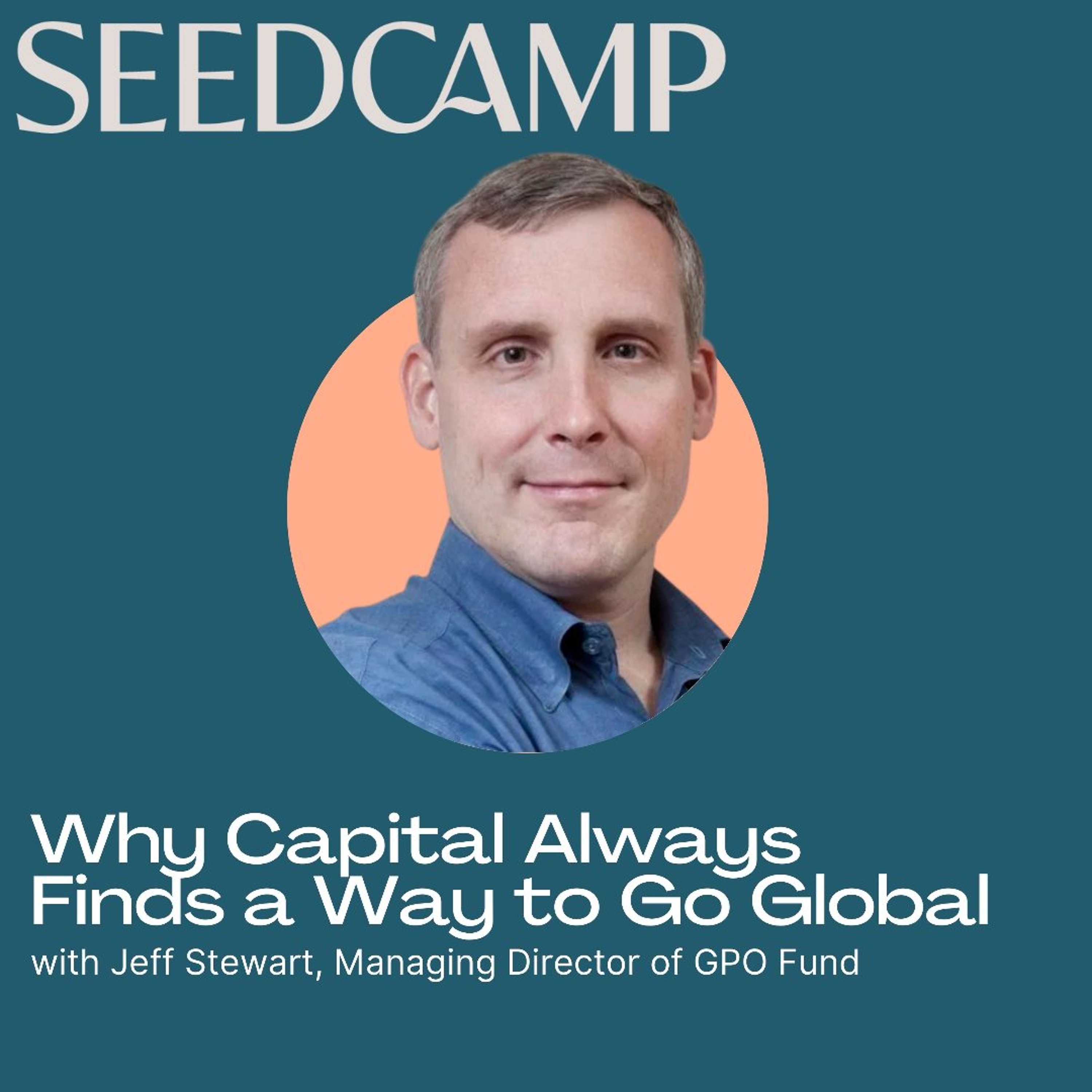
- Why Capital Always Finds a Way to Go Global with Jeff Stewart, GPO Fund
 This Much I Know - The Seedcamp Podcast
22 Sep 2026 · 42m · 20 chapters
Why Capital Always Finds a Way to Go Global with Jeff Stewart, GPO Fund
 Ask ChatGPT
In short
Jeff Stewart (GPO Fund) argues that capital is inherently global and that founders should pursue earlier, global IPO paths by building an international investor base and diversified revenue/regulatory exposure. He also stresses cashflow, revenue quality, and AI-driven acceleration of research and sales.
Guest backgrounds
Jeff Stewart is founder of GPO Fund; he has built multiple companies (internet strategy work for large corporations; Mimeo with a Memphis factory tied to FedEx; behavioral assessment; Lendo, a Singapore-launched lending business operating in 21 countries). He’s also an author/professor and previously worked on a NASDAQ project studying the World Wide Web.
Key claims
Don’t stay private too long; align cap table with a public-market exit; revenue solves problems; unit economics and cashflow matter; talk to global investors early; AI reduces research and customer-acquisition costs.
Notable examples
Lendo’s 5% vs per-month interest-rate discovery; Map Anything introduced via an Australian investor leading to hospital/traveling-nurse demand; Intel’s pivot flexibility after going public; Twilio as a missed diligence example; Salesforce acquisition of Map Anything.
Written by AI. May contain mistakes.
Chapters
Introduction to Capital and Globalization
Exploring the inherent global nature of capital and its lasting impact.
“I think to a hammer, everything looks like a nail.”
Jeff's Journey: From College to Entrepreneurship
Jeff discusses his early aspirations and the path to starting companies.
Navigating the Internet Boom
Jeff recounts his experiences during the rise of the internet and founding his first company.
“What was the School of Hard Knocks for you like?”
Building a Global Company: The Lendo Experience
Discussion on founding Lendo and its international operations across 21 countries.
“So started my first company and we helped large corporations with their internet strategy and with systems implementation.”
Establishing the GPO Fund
Jeff explains the motivation behind starting the GPO Fund and its focus on global companies.
“So that growing that to hundreds of employees and having a physical element to a venture-backed startup, I think had a big impact on how I look at the world as an investor and entrepreneur.”
The Importance of Early IPOs for Founders
Exploring the need for founders to tap into global public markets sooner in their journey.
“And we saw firsthand the corrosive impact from angel investments and from boards we were on that staying private can cause misalignment on the capital table, the incredible value destruction as you can't do acquisitions.”
Insights from Writing the Book
Jeff shares insights gained from writing his book on global IPOs and capital markets.
“So you must have been in that process feeling inspired to write the book.”
Cash Flow: The Secret to Sustainable Business
Discussing the critical importance of cash flow in business survival and growth.
“But walk us through what your opinion is now that you've seen recent fundraisers and what you have seen building your own companies.”
Investment Misses: Learning from Anti-Portfolios
Jeff reflects on his investment misses and the lessons learned from them.
“My first company, our main funding was we just ate macaroni and cheese and rated for the invoices to get paid before we spent any more money.”
The Challenges of Investment Decisions
Jeff discusses the complexities he faced as an investor and founder, reflecting on missed opportunities and the balance between diligence and instinct.
“And I didn't back this great entrepreneur.”
Show all 20 chapters
The Impact of AI on Startups
Exploring how AI is transforming the startup landscape, Jeff highlights changes in customer acquisition and the power of data.
“the amount of resources it used to take.”
Navigating Global Market Strategies
Jeff shares insights on building a global investor base and the importance of diverse perspectives in startups.
“And you asked the question about product.”
Valuation and the Public Market Journey
The conversation shifts to how valuation affects investment decisions and the transition from private to public markets for startups.
“I'm going to keep on pushing in the other parts.”
Flexibility in Founder Strategies
Discussing how mature founders embrace market changes with flexible strategies.
“and you have that flexibility to deal with the change in the market.”
Ideal Company Characteristics for Global Expansion
Identifying the types of companies that thrive under a global capital playbook.
“What are the types of companies, putting aside the pre-Unicorn bit, what is the type of company that is really attracted to this playbook?”
Tensions in Global Markets and Capital Mobility
Exploring the impact of deglobalization on capital markets and revenue diversification.
“So I think that the sophistication, especially because data centers in general is coming up, but I think these sort of capital intensive, but heavy tech intensive businesses are a place that we do well with founders.”
Capital's Response to Regulatory Changes
How shifting regulatory landscapes influence capital mobility and entrepreneurial strategies.
“I talked to regulators in Columbia and they said, we love this.”
Revenue Strategies for Deep Tech Companies
Discussing the importance of revenue generation and commitment in deep tech.
“using the cheapest capital, make the most returns.”
Navigating Growth and Profitability for Startups
Advice for startups on maintaining growth while ensuring profitability.
“And I think one of the things that the Anthropics and the hyperscalers have tapped into is this idea of revenue commitments.”
The Future of Entrepreneurship in the Age of AI
Examining how AI may transform startup costs and operational structures.
“And that also unlocks debt financing, which can really juice your equity returns if you're prudent in how you do that.”

Ask about this episode
Get the gist, explore an idea or ask about something said.
 Claude
On This Much I Know - The Seedcamp Podcast, what are the key points of this episode?
Searching your listeningTranscript
Automatic transcript. May contain errors.
0:00I think to a hammer, everything looks like a nail. Karl Marx was wrong on a lot of things, but one thing he said was that capital finds a way to go global. He said capital is inherently global, and that hasn't changed. Great companies and great investors want to connect with each other. But I think the tensions in the world mean that people are looking to diversify. Welcome, everyone. I'm really excited to interview a friend and author, professor and founder, Jeff Stewart, who is the founder of GPO Fund. Welcome, Jeff. Thank you for having me. One of the things that really struck me when we met a while ago was how much experience you've accumulated in your life, ranging from building companies to obviously now investing, but also teaching, writing, and sharing your thoughts about bigger picture things rather than the simple, usual sectoral stuff that a lot of us focus on when we're doing investments.
1:00Just walk us through that story. How did you end up who you are today? What was the School of Hard Knocks for you like? It started before I went to college. I knew I wanted to start companies. I like to build things. I was looking at universities and talked to one of the deans and told him I wanted to start companies. And I thought you became an engineer, invented something and then started a company. And he explained you could actually study starting companies. So I studied management and entrepreneurship and heavy on the engineering. But at the end of the day, I knew I wanted to start and run companies.
1:34Then figured that if you work in industry and sell to industry, you're more likely to be successful. So I started as a management consultant, got exposed to a lot of companies, especially in financial services. And then a couple of years in, was doing a project for the NASDAQ. And my role was to look at technologies that might impact them and played around with this thing called the World Wide Web. And looked at it, there were almost 800 companies there listed on the World Wide Web at yahoo.edu. And I was like, wow, this is interesting source of data. Came back a day later and there were 1 ,600.
2:11and didn't take much to figure that anything that's doubling in every 24 hours is going to be big. And I figured that the internet was going to be big enough that it would make up for the fact that in my 20s, I had no idea what I was doing. So started my first company and we helped large corporations with their internet strategy and with systems implementation. Quite frankly, our big competitive advantage was we own suits. And a lot of the people who understood the internet That didn't speak business. We grew that, merged that with another company called Proxicon, bought a third company called Ibis and went public.
2:48And back in those days, that was what you did. VCs would say, A, B, C rounds are great. D is for dead. You need to go public after the C round. So that's kind of how we started our career as entrepreneurs and thought about startups. Second company they started was 1998. It's called Mimeo. And their plan was, we basically took electronic documents and physically produced them. So we set up a factory in Memphis, Tennessee, integrated it with the FedEx hub. And the plan was to take that public. Then everything, then everything shifted in 2000 and we went, the US became a mega cap market. And that company today is, it's profitable.
3:30It's sizable, but still private. So that growing that to hundreds of employees and having a physical element to a venture-backed startup, I think had a big impact on how I look at the world as an investor and entrepreneur. throughout that. I was always frustrated by how half your salespeople are your bottom half. And if you can just get more of your underperformers instead of higher top performers, it has a huge impact on your burn rate and your growth rate. So started a behavioral assessment company. And then from that, we had a team abroad that was, in both cases, we had a team abroad that was organizing data for our algorithms.
4:20And one day my partner in Asia pointed out that one of our employees needed a loan because their paycheck wasn't until the end of the week. And I was like, oh, great. How's that work? And they said that the rate was 5%. And I was like, oh, yeah, that seems reasonable. I think that's what a mortgage is in the US at the time. And I was like, no, that's per month. And we realized that the international financial services and particularly credit in a lot of the world wasn't functioning. And we had a hypothesis that we could use our data analytics, big data analysis, behavioral assessment background to figure out who was creditworthy.
5:02So we launched a company called Lendo out of Singapore that eventually grew to operate in 21 countries. using the data exhaust from social media and from your cell phone. And it turns out who you associate with and how you behave is highly predictive for small business loans and consumer loans, educational loans. And that wasn't the first time, but it was certainly the most intense time doing business internationally, operating in 21 countries, and realized that a lot of the venture world tended to look at the country of the headquarters and the country where the VC is as the world. The old Sequoia saying is if you can't drive there, if it's more than 20 minutes from the office, they don't invest.
5:49We had developed a hypothesis that there was an awful lot of customers around the world. There's an awful lot of investable capital around the world, and that the most ambitious founders would want to build global businesses and that we felt we had some experience. So we thought about starting a venture fund specifically to help companies accelerate their international expansion. But the second thing we noticed was that companies had been staying private forever. And we saw firsthand the corrosive impact from angel investments and from boards we were on that staying private can cause misalignment on the capital table, the incredible value destruction as you can't do acquisitions.
6:35You just have less flexibility and more brittle capital structure and realize that when you build a global company, you also have an opportunity to build a global investor base, which also means you can move into the public market earlier because there is this global desire to invest in publicly traded companies on a global basis. There's just less public equity available. So when you bring a high quality company into the public market and you make sure that you've built relationships with institutional investors around the world, you have that optionality to go public earlier. We launched in teen of the GPO fund targeting high potential founders who have product market fit, have a desire to eventually move into the public market and have incredible technology and particularly have a business model that works globally and a desire to be a global company.
7:31So since 2018, we've been investing in companies in the growth stage. But when I say growth stage, I think pre-unicorn. I think what we've seen is that once something becomes a unicorn, there's kind of a pile-on effect that doesn't necessarily match what's happening in the company. And we're not big fans of co-investing with people who are making investments without actually looking at the financials of the company. So we really like that space of, call it, $200 million to$750 million valuation range is enterprise valuation range is our sweet spot for the fund. So you must have been in that process feeling inspired to write the book.
8:09Just walk us through the hierarchy of stories that led to the intuition of the book and maybe a quick summary for the readers. Yeah. So the book Global IPO, The Great Rewarding of Capital Markets, is really about the opportunity for founders to tap into global public markets earlier in their life cycle. So as far as I know, it's the first and only book that looks at evaluating exchange and listing venues and really focuses on early relationship building with institutional investors so that when you go public, there's deep demand for your company and the difference in mindset between what private investors look for and what the public markets will look for and what index look for.
8:53The reason for writing the book is what I found is that writing forces you to organize your thoughts. And I'm a big process and procedure guy, and I wanted to make sure that our processes and procedures at our fund aligned with best practices, and this helped us organize. But also by writing, you get to interview a lot of really interesting people. and that was one of the things that I loved at the NASDAQ because I got to interview exchanges all over the world. The book also allowed me to interview institutional investors from all over the world, bankers from all over the world, entrepreneurs from all over the world, and exchanges from all over the world.
9:34So that was a really interesting experience and I can't help but be proud of the result of it. You know, as an author and having written a book, there's a certain satisfaction from getting that first hard copy. Until you have the dissatisfaction and anxiety of having to write the next version, the next version, because you feel ashamed of the time lapse since you last wrote it. Yeah, your original was 2015, wasn't it? Yeah, it must have been a while ago. Three cycles since then. I'm actually drafting version four because of a very reason I wanted to talk to you about, which is, and a theme that I think we should probably cover, which is, are founders building better companies today?
10:15Or are they simply just companies that can raise another round? Yeah, it's a great question. And I think I like your book a lot because I think it focuses more on the earlier first time founder. And we tend to skew towards repeat founders, but we're definitely skewing towards later stage. You need a level of revenue before considering the public markets and a level of predictability. So I think the two books hopefully complement each other for the founder who wants to build the next Decacorn. Yep. But walk us through what your opinion is now that you've seen recent fundraisers and what you have seen building your own companies.
10:52Are we living in a world where the companies are actually accumulating a bunch of commercial and technical debt and simply just really good at the game of fundraising because there's so much money in it? I think that one of the things I strongly believe is that before you incorporate, you should have in your mind several ways that you can exit. Now, I'm not saying you shouldn't want to start a company that you want to run for your entire life. What I'm saying is you need to think this through, especially if you're going to be taking outside investment. And I think that any plan should always include, we're just going to spin off so much cash, we're going to buy all the outstanding shares.
11:34So I think getting back to cashflow is the secret. And before you have cashflow, you have to have revenue. I like to say revenue solves all problems. So I think when you see a business that says, oh, we're gonna be a strategic asset for someone who's gonna buy us, that really worries me because I think that priorities change, markets change, companies change, and you can't really predict if and whether you're gonna be acquired for strategic reasons. So at the end of the day, it boils down to, can the business generate tons of cash? And I had 180 employees when the internet bubble popped, learned real quick, it's all about cash flow.
12:16You're not going to be raising any more money. You need to be prepared at a moment's notice that you're not going to be raising any more capital. My first company, our main funding was we just ate macaroni and cheese and rated for the invoices to get paid before we spent any more money. Every penny just got pumped back into the business with no outside investment. And I think the best entrepreneurs are good at fundraising, but they're also really good at managing cash flow because you never know when that's going to become the most critical element of the business. Yeah. Yeah. One could argue that the intersection of where an investor's opinion of what is investable lie and where they messed up is their anti-portfolio.
13:02There's opinions that we all have about what makes a company investable. And when we get that wrong, we miss out on some of the very best companies that the internet has out there. And in an earlier interview, I think somewhere I heard you share a few stories. I don't know which ones you feel comfortable in sharing, but maybe walk us through one or two of your biggest anti-portfolio or biggest misses, if you will, and what judgment call you made that was wrong there. Yeah, I think I would put them in two buckets. I was a fairly active angel. I certainly missed some great ones, but also caught some great ones.
13:43I think that one bucket is I won't invest unless I understand the industry. And yeah, there was a great founder, incredible entrepreneur in the consumer goods space and selling baby products. And I just didn't feel comfortable, didn't understand the distribution channels, didn't understand the economics. And I didn't back this great entrepreneur. And I really regret that because the business, I knew he was going to do great and he did great. And all the other investors did great. But on the other hand, I don't regret it because I don't think you should be investing in things you don't understand.
14:23And at the time, I didn't feel I understood it. The second is when I'm in founder mode starting a company, I try to shut things down that aren't starting the company. and every now and again you find a founder who's just incredible and and you know they're going to do great and what you should do is say you should just write the check but as an angel i had a good returns and i think part of it was because i did a little extra diligence and in those cases i didn't have time to do the extra diligence and twilio is a good example that that was clearly going to be a winner and didn't move forward with that one and there's lots of other ones like that too.
15:02I guess that's the downfall of if you're a professional founder, it's hard to be a professional investor at the same time. And it's going to cause you to miss some great ones. Yep. No, we have plenty. But maybe just to pick on this idea of you as a founder, you must have made mistakes that you look back on and maybe even lose sleep over, not just as a founder, but also as an investor, using your founder anecdotes as a way of seeking the truth or defining the truth for an investment. What's the most expensive piece of conventional startup advice you've personally followed or didn't follow and suffered as a consequence?
15:46Yeah, I think I like to say sales solves all problems. And in a startup, you have limited resources. And I like to always have customers that are giving you feedback. But if you have too many customers too early, you can't dedicate the resources that you need to for building. And I think that there are times where I wish we had just kept selling, kept the selling machinery running smoothly instead of focusing all our energy on hardcore software development. But yeah, so I'd say that that's one thing. I also think that the process of starting a company was radically changed with the internet because it changed the cost structure of customer acquisition, of deployment.
16:34And I think that AI is radically changing the cost again. It's really incredible what you can do, both in the amount of time it used to take and the amount of resources it used to take. It's a wonderful time to be an entrepreneur. It's the best entrepreneurs now have this superpower that they didn't have 40 months ago. What is it that you think you would do or advice you give today? Where to focus in light of how much cost of certain kinds of activities within a startup have been affected by AI? Yeah, it was a great question. Back when I started my first company, you'd write business plans. These are 50-page, deeply researched documents.
17:16And then you'd go talk to investors. Or you'd go talk to potential employees or you'd talk to industry experts. And then that fell out of favor and people would just throw together a deck and they'll go talk to people. Now, that's great because it's fast. And quite frankly, the dialogue with potential investors and industry experts is a great way to understand the opportunity and de-risk it. But I remember one investor being in a meeting as an angel with another angel. And he turned to the entrepreneur and he said, if you haven't even researched this, why am I writing a check? And my philosophy is you should always do deep research.
17:52And now that's completely possible with AI. And then there's a hundred things that you'd always want to know more about as a founder and never have time to dig into. But the big one is customers. You now, as an entrepreneur, say, map me every single company that fits this characteristic and give me their address. And I want another phone number and find the founder. And you can work on very detailed and granular information that you just didn't have in the past. So I think lead pipelines, marketing pipelines, again, accelerating sales, regulatory and scientific. A lot of the great technologies and opportunities aren't sitting in one silo or another.
18:35It's really at the intersection of the two. Maybe you're a civil engineer. you're an expert at civil engineering, but the great opportunity involves some microbiology. Now you can get far enough with AI to find the experts, to find the partners. So I think it's going to, we're about to enter a renaissance of entrepreneurship. It's really exciting. And you asked the question about product. That's a whole nother discussion about embedding AI in your actual product. I'm talking about the design of your sales team, the design of your sales process, the design of your customer service, the design of how you iterate and improve the product, whether it's physical or digital, it's a whole new world.
19:14So we've covered cash. We've covered the importance of sales. We've looked at the speed of research into either key areas that previously were left untouched and or your customers. We talked about the integration of AI and product, although we need to probably go into that a little bit more in terms of how you make your decisions. But I think that there's still some fundamental shifts that we need to cover around how companies get financed. So putting aside all those things, let's say you just executed that really well. We still have a lot of competition for companies that have a lot of hype. And then how do you make those decisions?
19:51And then the key core tenant of your book is around our company staying too private too long. And or do they start going out to look for additional markets to start exploring the idea of what an IPO, a global IPO could look like. So walk us through a little bit of that. Walk us through a little bit about how do you get into deals that are overhyped? How do you know you're overpaying because the markets can only support so much? And then let's say you do get in. How is it that you navigate that advice you give on that trajectory, private to public and public geographically and internationally? Walk us through that whole arc.
20:30I think that the key is to have a clear vision for what you want to do with the company and have a great business model and have a great team. Those are the most important elements. Building on that, I think that it's important for companies or for founders that want to build a global investor base to talk to global investors earlier in their life cycle. So it's very tempting to just talk to the investors that are the traditional investors for your venture stage and that are closest. And what I found is that by having investors in other parts of the world, it opens up new doors. I'll give you one example.
21:17We got approached years ago at one of my startups to do a joint venture in South Korea. I'm from New Jersey. I'm not really qualified to be doing joint ventures in South Korea, but one of my investors was. So I call him up. He's in Singapore that day. And I tell him about this opportunity to do a joint venture and figure it'd be a five-minute conversation. and he'd tell me it was a distraction for growing the business. And he's like, no, that's completely legitimate. Here's how you do it. You own 45%. They own 45%. 10 % is a financial. We could be that financial, but you probably want a Korean.
21:49Here's three Korean investors. We like South Korean investors. Here's three law firms. We like here's our law firm. And it created a joint venture as a result of what was a short conversation that would have never happened. Had we not had a more diverse investor base, having people on your cap table who can help you navigate other parts of the world, particularly as it relates to regulation, and especially as it relates to revenue, I think is an investment in time that can pay off big. So I don't know if that answers your question, but - It's harsh. The answer is one of the several parts. I'm going to keep on pushing in the other parts.
22:28So as we invest in companies at an evaluation that we believe will allow us to make a return when the company ultimately sells. With the hype that's going on right now in certain sectors, AI and others, it becomes increasingly hard to know where the public markets are going to be. And international investors, if I had to take the contrarian view, aren't always as able to or as willing to pay up the way that American investors are able to. So you're stuck, as Jeff, as GPO fund, you're stuck in the situation where you know a deal is potentially good. You may be overpaying because it's super hyped.
23:07And your own thesis of your own book, which is having local investors, sorry, global investors, they're shunning the deal because it's too expensive for them. How do you triage that? Yeah. I like to say revenue solves all problems. So one of the things we like to do is talk to investors in other parts of the world. And it turns out if you're an investor from another part of the world, you tend to be connected to a lot of businesses. The ideal situation for us, I'll give you an example, a company called Map Anything, which eventually got bought by Salesforce as they prepared to go public, Salesforce swooped them up.
23:42But we, as part of our diligence, introduced them to an investor out of Australia. The investor in Australia said, I'm on the board of a hospital. We have traveling nurses. We need this product right away. And a whole new set of revenue resulted from that conversation. People in the U.S. valuing business was growing, it was massive growth, weren't taking into account the fact that there was this market outside the U.S. that was well-received. We made other inquiries in the region. We found lots of other customers who wanted the product. So we were able to value it not on its current growth rate, but an accelerated growth rate that you would see by incorporating other jurisdictions.
24:25But then - If I interpreted that, I would say that you're willing to pay a much higher valuation because you saw a market that others didn't see locally, which is okay. That's one way of answering the question. But your GPO fund has to compete with other funds that are, as you said, pre-unicorn. And that's a lot of heat right now is around these companies that have a really good compelling growth story. They're not at the unicorn stage just yet to the point you made about certain capital coming in. But even in that face, like in that sector, you have a lot of competition. And I'm just trying to get to a feeling of like, how do you calibrate where it is that you are in the cycle so that you're not finding yourself in a position where you cannot uphold the idea of this global market and co-investor, global co-investor?
25:15the dirty secret of venture capital is the correct game theory answer is valuation doesn't matter you get the right founder you throw money at them right that's what founders want to hear and that's going to be the best the best formula for deal flow they say that valuation doesn't matter but unfortunately it turns out valuation does matter and the the reason that we're able to go head to head with some of the biggest best funded growth stage venture is that when we talk to a founder, we're talking about a playbook that eventually gets them into the public market where they own and control the company and have tons of flexibility versus a playbook where they're going to stay private for another decade or half a decade.
26:01Right. And the the problem with being private is you have someone on your cap table whose business model is they want to put more money to work. So that's not necessarily in the best interest of early investors, and it's not necessarily in the best interest of the founder. Where when we invest, our business model is we want to create alpha and we want to be able to sell our shares at some point in the public market. So we're very aligned with the founder. The other thing is when we're going head to head with a a multi-billion dollar growth stage fund, it sounds like a lot of money. But then we introduce them to a public market investor.
26:37There are public market investors who have more capital than the entire venture capital industry, right? So you say, oh, if I can get good signaling from my well-known venture capitalists, I'm going to be able to do another round as long as they participate in the next round and we're great. But now all of a sudden you're dependent on that, the whims of that venture capitalist or that particular partner that you happen to have. In the public market, there are really big piles of money, much bigger piles of money than you find in the private market. And there's a lot more investors. So you're not dependent on the signaling risk of one, your last investor or the biggest name on your cap table.
27:13You can change your strategy. A good example is Intel. Intel was at one time one of the biggest tech companies in the world, one of the best returns. and they went public at a$58 million valuation. And they were public when they pivoted from a memory company to a CPU company. If you're a private company and you have to do a pivot that big, your VC is like, oh, we've all invested in memory. I guess that one didn't go. We're onto our next fund. Who cares? Let's move on. If you're a public company, the investors that believe in your pivot stay with you. The investors that think that memory is everything leave your cap table.
27:56And the investors that see the value of a CPU come onto your cap table and you have that flexibility to deal with the change in the market. So I think more mature founders who realize that technology changes and that you can predict that there's gonna be change like the flexibility of an accelerated path where they have the option to go public. So that's really what we're competing is a path that moves them into the public market that gives them more control, that gives them access to a deeper, more flexible pool of capital. Yeah. It sounds like that playbook is your secret sauce. And I'm not going to ask you to admit the secret sauce on the air, but it sounds like that secret sauce clearly appeals to a subset of founders.
28:39What are the types of companies, putting aside the pre-Unicorn bit, what is the type of company that is really attracted to this playbook? not because of any kind of personal desire for liquidity, but rather because structurally they benefit from this playbook? I think one is companies that can benefit from accelerated international expansion. Yep. We were very deliberate to build an LP base that is global. And I think that during diligence, when we introduce them to potential customers in other parts of the world, that can be very attractive. to some founders. I also think the, I ran a global lending business.
29:24You don't have a more capital intensive business than lending, but we also, we built a factory. So we're not afraid of businesses where there's a large amount of off balance sheet capital, things like robotics, embedded finance. So I think that also is an area where we can really excel because it scares away a lot of the VCs, the idea that$2 billion is going into charging infrastructure or energy infrastructure, because you have to have a more sophisticated view to understand, no, that's in an off-balance chain SPV, or that's backed by off-take agreements. So I think that the sophistication, especially because data centers in general is coming up, but I think these sort of capital intensive, but heavy tech intensive businesses are a place that we do well with founders.
30:15That's interesting. I actually hadn't factored that in and it does make sense, but it does bring with it one tension. And I'm just curious to hear what your thoughts are on this. If we move away from software type companies to the ones that you've just described, the world at the moment feels very unstable. There is a general vibe towards deglobalization what evidence that you're seeing now or over the next three years would make you admit potentially that the global IPO thesis or the global capital markets thesis is wrong? Oh, great question. Look, I think to a hammer, everything looks like a nail and we're, Karl Marx was wrong on a lot of things, but one thing he said was that capital finds a way to go global.
31:01He said capital is inherently global and that hasn't changed. Great companies and great investors want to connect with each other. But I think the tensions in the world mean that people are looking to diversify, which means you want to have revenue in multiple jurisdictions. You want to have revenue in multiple regulatory regimes. You want to have revenue in multiple currencies. So I think to some degree, this deglobalization or we'll say craziness is opening opportunities, particularly around regulatory. Do you want to have all your revenue in one regulatory situation? I've sat down with government officials in the Middle East, UAE, and I said, you can talk to the right regulator on Tuesday, but I'm sorry, if we need to change the law, we can't do it till Thursday of the following week.
31:53I talked to regulators in Columbia and they said, we love this. What can we do to get this deployed faster in our country. So the idea of, oh, we'll get it approved in the US or in the EU, and then we'll worry about the rest of the world later, is now a riskier strategy. So I think having diversified revenue in multiple jurisdictions is a great way to build a business, especially if you're the founder and you're not diversified in 20 companies or 100 companies like the VCs are. You need to diversify your revenue and your regulatory frameworks. Yeah. I interpret your answer as you cannot change the laws of gravity.
32:34Ergo, there is nothing that can happen in the next three years that would change your view on this, which is reassuring, to be frank, because I think we all need a little reassurance. Yeah. Look, I think that capital is going to do what capital is going to do. And entrepreneurs are incredibly mobile people. One jurisdiction says, you know what? When you incorporate, we're going to tax you as if you had an exit. Guess what? the entrepreneurs are going to go elsewhere. It's really simple. The ideas, the talent, the intellectual property, the capital, it's all super mobile and will route around bad decisions by government.
33:10And I think that the pace of innovation and the pace of technology is such that the entrepreneurs are really well positioned to stay ahead of it because they can tap into the latest and don't have the same type of legacy culture and infrastructure that some of the big businesses, and certainly the governments have weighing them down. Yeah. I think if I take the steam of capital will do what capital does, one of the assumptions that I make when I hear that is that it will drift towards the highest return, lowest cost of capital points in choices that investors make. So how do I, using the cheapest capital, make the most returns.
33:53And that does not favor deep tech companies that tend to accumulate capital, spend it in things that don't showcase any near-term returns for a long time, and then maybe at some point in the future deliver some sort of outcome. And then gauging that early is very difficult to do. And so you were sharing that the founders that choose a GPO tend to have certain attributes. And you mentioned robotics, deep tech, where there's a sort of a different sources of capital that can tolerate some of this stuff. A lot of these companies have been invested in by ourselves and many other investors in the last two years as a way of reacting to avoiding investments that Anthropic or OpenAI could eat up as part of their models.
34:40What we haven't yet seen is how this is going to play out long term, because we don't know yet what the minimum criteria will be for an investor like yourself to think that this is good enough to justify activating and unlocking these international capital markets to invest. So walk us through, like, from your point of view, what is a company that is a robotic company, deep-telling company, going to have to look like to be able to unlock the promises of capital markets, international capital markets, in light of the fact that many of them just take forever just to get one customer. Yeah. I think that this idea of we have to do 10 years of R &D together and then have our first customer is dangerous.
35:23And it's not, it's maybe we'll look at something after they have their first company, but for us, revenue matters. And I think that there's a new playbook that entrepreneurs are going to discover, which is revenue has varying levels of quality. And I think one of the things that the Anthropics and the hyperscalers have tapped into is this idea of revenue commitments. So I'll walk you through. At one end, you have a loose sheet of paper where someone says, sure, if you can reverse gravity, I'll pay you. But if gravity doesn't stop, I'm not paying you. And I could think of a headline number of a billion dollars, but it's not really anything more than a letter of intent.
36:09And at the other extreme, you have take or pay agreements where I'm putting down a deposit. I'm definitely, I got to pay. I'm committed. So you build it. I'm paying you. And I have a good, I have the balance sheet to back that up. So I think this, oh, we have to build it, then get revenue has been proven wrong by the data centers and by the hyperscalers. you can get varying degrees of revenue commitment. We're seeing it a lot now in drones and dolls. Yeah, we're going to have electric aviation is going to be hundreds of thousands of aircraft. It's going to be on the order of magnitude of cars.
36:46And we've seen this before with cars. We've seen this with railroads. We've seen this with electric vehicles. It starts out, there's a few thousand, and then there's millions of them. And we're seeing this in the eVTOL and heavy drone space where they're getting the commitments way before they built the factory and scaled the manufacturing. And that's going to accelerate that process. But imagine if you were what Ford does today. They say, hey, we're going to build a factory and let's hope people want trucks. Right. We don't need to do that as entrepreneurs. We can go find people who will need fleets of trucks or people who have a hobbyist interest or whoever it is and get some level of commitment before you break ground.
37:31And that also unlocks debt financing, which can really juice your equity returns if you're prudent in how you do that. Yeah, fair enough. I sense a theme, so I'm going to have to try to trip you up on that theme. Imagine I'm a founder with$30 million in annual revenue. I'm growing 40 % too. So it's like, it's going right. That's relatively well, but I'm still losing money. What would you, what advice would you give me? You're on my board. What advice would you give me before recommending I take another private round, a sale or an IPO? Yeah. I think one thing that's really important is to understand your unit economics and how you define your unit economics is so important, especially to public market investors.
38:13They're super smart. They'll tolerate years of losses. Look at Amazon. Amazon said, we are not going to make a profit. We do not know when we'll make a profit. We do not expect to make a profit because we see so much opportunity. But they explained it and they were very articulate and they understood their unit economics. And now they're one of the most valuable companies. So first and foremost, I would say, understand your unit economics. The second thing is I like companies that can be cashflow positive immediately, which is very different than our cashflow positive. Can they put off that expansion into the new territory, let go some of the marketing, cut down their marketing budget, reduce their sales team, and boom, they're profitable.
38:56Growing slower, but profitable. So I think there's a big difference between a company that obviously is profitable, can be profitable, does not have a way to be profitable. And I think you need to be very clear that you're in that middle category and that you're choosing to be in that middle category and that you understand your unit economics. Okay. Last question is a bit of an introspection of assumptions that we all make that allow us to continue doing what we do. if i was in a i was in a meeting with one of our investors recently and they asked me what do you think will change in the world that could fundamentally change your perspective of what's going to and i went through a series of thoughts of what could be the case and our operating model and everything and one of the key things was like that there is a inability for european companies to engage with american market that's such an underlying assumption with european venture that there is a U.S.
39:57growth market available to it as part of the growth curve. What is one of your concerns? What is one of the concerns that you fundamentally are like, if this happens to GPO or just happens to the world, I'm just going to pack my bags and go retire? I think that AI is fundamentally changing the pace and the cost structure of a startup. So it might be that the the greatest companies don't do growth rounds. They just, because they're just so capital efficient. So it might be that, and then that could change. I remember my second company, we had 45 software developers working for months before we could generate a dollar of revenue.
40:37Today, I could probably buy that entire thing and give me a day or two. The cost structure is very different and that could continue to change. Yeah, so I'd say that's the biggest, The biggest question is how does AI affect entrepreneurship? I think also one thing that's going to change is all these industries that rely on regulatory complexity as their defense, insurance, anything with large government procurement, highly regulated financial services. One thing AI is really good at is unpacking that. So I wouldn't be surprised if you see permitting companies or anything that has historically relied on lobbyists and regulations.
41:21We'll call it technical complexity, but not scientific complexity, technical complexity. I think those are all going to be ripped apart. And that's going to be really interesting to see in the coming years and decades. Yeah, you're right. Actually, that is a very good one. Thank you so much, Jeff, for your time. Thank you so much for your wisdom. If founders want to get a hold of you, what's the best way for them to do so? Yeah, pretty easy to find on LinkedIn or on X. Our website's gpofund.com. And then the book has a website too, globalipo.book.com. So all good ways to reach me. Thank you for having me.
42:02Yeah, you're welcome. Until next time, guys. Great.
From the publisher
Jeff Stewart, founder of GPO Fund and author of Global IPO, joins Carlos to unpack why the best founders plan their exit before they incorporate, and why the best founders shouldn't wait to go public.