Ask ChatGPT
 This Past Weekend w/ Theo Von
3 Nov 2026 · 1h 54m · 55 chapters
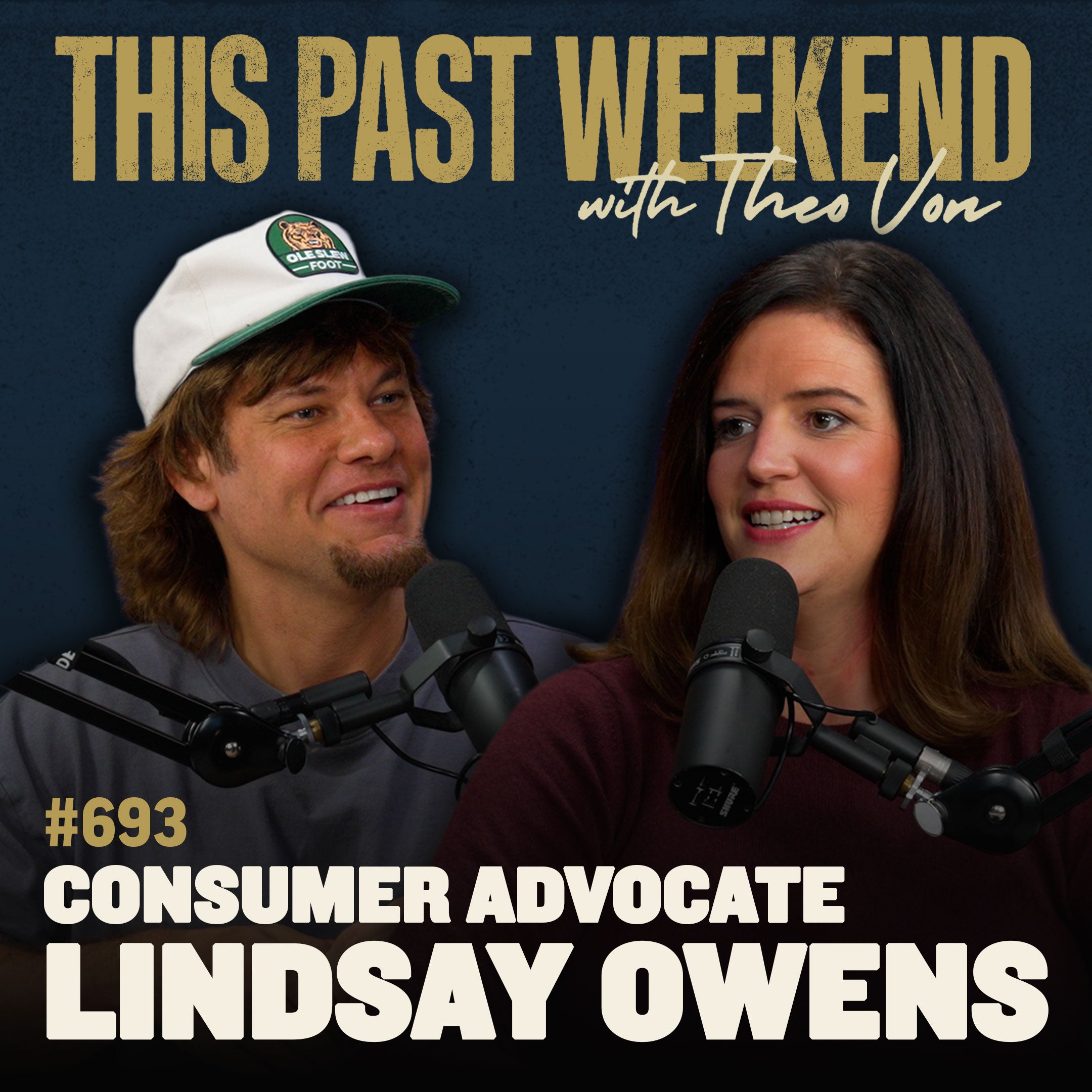
Consumer price manipulation and “unfair” pricing technologies, including price gouging, dynamic/algorithmic pricing, surveillance pricing, and how they affect household budgets. The episode argues that pricing has become unpredictable and captive due to reduced competition and corporate control of pricing tools.
Lindsay Owens is a consumer protection expert and investigative watchdog. She previously worked with Groundwork Collaborative, a Washington, D.C. think tank that conducts research and investigations to influence policy. She is the author of Gouged: The End of a Fair Price and What That Means for Your Wallet.
Written by AI. May contain mistakes.
Lindsay discusses her work in consumer protection and inflation's effects.
“is miss lindsey owens getting scammed is starting to feel like one of the most american things in the world like that's our apple pie now it's absolutely you know um lindsey owens the author of gouge Yep.”
Lindsay defines price gouging and explains its implications for consumers.
“Yeah, well, one thing I say about price gouging and getting ripped off is it is absolutely coming for every line item in the household budget.”
Discussion on dynamic pricing and its impact on consumers today.
“Let's go through what is first, just so people know, what is price gouging?”
Insights into Walmart's use of electronic shelf labels and pricing strategies.
“So dynamic pricing is when a company changes prices based on market conditions.”
Exploration of Ticketmaster's market control and legal challenges.
“Prices are still set the same way they always have been centrally by Walmart following our everyday low price strategy with an associate reviewing approved changes.”
Discussion on the need for consumer advocacy and potential legal actions.
“because comparison shopping is how this works, right?”
Exploring public dissatisfaction with Ticketmaster and alternative ticketing strategies.
“had to compete with each other and were separate entities.”
Discussion on how corporate interests influence government policies and legislation.
“And corporate America runs roughshod over everything that would help you and I in Washington.”
Examining the obstacles to political reform and effective governance in Congress.
“Or they'll say, oh, you don't quite understand this policy very well.”
The potential of Congress's investigative powers to hold corporations accountable.
“It's just this incredibly insidious way in which the deck is really stacked against us and in favor of corporate America.”
Analyzing the impact of aging politicians on governance and understanding technology.
“Well, like Congress, so, you know, they can hold hearings and they can call in CEOs.”
Discussing the issues of stock trading and conflicts of interest among politicians.
“Like they don't understand the ways in which new technologies are ripping us off.”
Revealing Instacart's pricing experiments and their implications on consumers.
“I heard you say a little bit ago about experiments that they were running on consumers.”
Explore how AI is influencing pricing strategies and consumer experiences.
“help companies run experiments on you without your knowledge.”
Learn about dynamic pricing experiments conducted by companies like StubHub.
“Like from now on, like two people who are shopping at the same store at the same time will pay the same price.”
Discover how think tanks conduct research on delivery fees and pricing.
“And some of the fee differences in this experiment were$60 difference.”
Uncover how companies use user behavior to set prices through the Agitation Index.
“Charging some of us more than others for the, like, to deliver the exact same product to the exact same location.”
Delve into Coca-Cola's controversial pricing strategies in the past.
“Yeah, like even if they know your screen, like your brightness is set really low, like this guy has 40 seconds to get a 10-piece McNugget.”
Investigate the historical context of pricing fairness and tactics by companies.
“Like probably thought no one was paying attention.”
Examine how recent pricing practices affect product quality and fairness.
“I bet if you put a thermometer in his ass, it would read that he's a real greedy little soda baby.”
Discuss the stress consumers face regarding pricing and market fairness.
“Whatever you guys are doing, torturing it, it sounds like.”
Learn about how pricing has evolved to address fairness and predictability.
“Or to shake it enough that there's more in there suddenly.”
Explore potential shifts in consumer behavior and company strategies for fair pricing.
“or what does it say about that Trevin you know what I'm talking about the temple in Jerusalem yeah Jesus Christ drove the money changers out of the temple in Jerusalem and what did the The Quakers, what did they say?”
Look into creative marketing approaches like the Savannah Bananas and their impact.
“that some companies feel like they can cut a different path and actually gain a competitive advantage by being the kind of company that doesn't rip you off.”
Discussion about Aldi stores and personal anecdotes.
“They might have them more places, do they?”
Exploration of the unique marketing and popularity of the Savannah Bananas baseball team.
“But anyway, So in the book, I have an example of the Savannah Bananas, which is like a baseball team that's also kind of like a magic Mike baseball.”
Insights into ticket pricing strategies for events like the World Cup.
“Well, they – you know, like they're really popular.”
Discussion of the trade-offs between accessibility and maximizing profits in ticket sales.
“will allow the consumers who can't afford as much, it will allow them to be taken advantage of also.”
Examination of Walmart's use of biometric data and surveillance technologies.
“Like we're not asking companies to sell, you know, a hamburger at a loss.”
Discussion on how companies monitor consumer behaviors using technology.
“So this privacy policy was for online shopping.”
Details about retail surveillance methods and their implications for privacy.
“So things like your gender or your race, you know, in another one of these patents, they're taking pictures of your car to like measure the suspension change.”
Exploration of the Gruen effect and its impact on consumer shopping habits.
“It's way outside the bounds of what it needs to be.”
Explore how retail environments manipulate consumer behavior.
“The moment a customer enters a mall and is overwhelmed by the size, intentional clutter, and glitz of the mall, they forget their original goals and become susceptible to sales manipulation.”
Reflecting on the joy and experiences of mall culture.
“It was fun in there because you got to see stuff you couldn't even see, you know?”
Discussing Walmart's controversial data practices and responses.
“What was the one we were just going over?”
Understanding surveillance pricing and its impact on consumers.
“I mean, most of this history of this podcast has been kind of depressing, but, But it's just like, I don't know.”
Learn how grocery loyalty programs profit from personal data.
“Like if my kid is sick, I'll pay$15 for children's Tylenol, right?”
Discover the origins of corporate pricing practices and their effects.
“So if this is accurate, then Kroger, then almost a third of their business then, according to that, if it's accurate, is selling your information.”
Learn practical tips to avoid being overcharged as a consumer.
“groceries and not just selling clothes and not just selling, you know, detergent.”
Understand how companies collect and use personal data for profit.
“There's another example in the book of Staples, the office supply store.”
Examine how corporate data collection rivals government surveillance.
“used California's privacy law to request his data from McDonald's and received a 515-page personal dossier.”
Explore the potential long-term implications of corporate data practices.
Explore the implications of tech on personal data and human connection.
“Or is it just a runaway train of advancement?”
Discuss the need for transparency and simplicity in consumer goods.
“come along, you know, where new companies come along.”
Learn about the potential of consumer movements and collective purchasing power.
“You would think that some of these larger religious entities could maybe do something like that.”
Examine how AI can influence consumer decisions and its ethical implications.
“use this product myself, but they're called Cart Happy and they basically built an in-app extension.”
Investigate how AI can lead to price discrimination based on user profiles.
“Claude Opus 4.8 showed the largest gap recommending flights averaging$198 more for wealthy users than for low-income users, and health insurance plans averaging$284 more per month.”
Discuss the overwhelming nature of technology and consumerism.
“And one of the other early studies of AI assistants showed that more often than not, the assistant would recommend the sponsored product, right?”
Uncover the shocking practice of charging Asian Americans more for SAT prep.
Learn about the unequal pricing practices based on zip codes and demographics.
“that can be helpful to listeners there was a story that they had SAT tests they like the Princeton Review was charging more for SAT tutoring or for testing.”
Explore how surveillance pricing exploits consumer behavior and desperation.
“Like you think it's just going to be the rich who get soaked, but actually it's the people who want it the most or the people who are the most desperate or the people who need something most urgently.”
Discuss the need for a Shopper's Bill of Rights to protect consumers.
“Like for a while, like electronic products were unsafe, right?”
Understand the importance of legislating against surveillance pricing and corporate malfeasance.
“So we definitely have gotten some results.”
Learn how consumers can hold representatives accountable to fight corporate greed.
“Before you go, how can voters hold our representatives responsible to help us?”
Theo Von and Lindsay Owens discuss advocacy and the importance of naming companies in media.
“And also just thanks for bringing this important story to your audience and being willing to name names and talk about what companies are doing and pull up the CEOs and take a close look at them and speak it out loud.”

Get the gist, explore an idea or ask about something said.
 Claude
On This Past Weekend w/ Theo Von, what are the key points of this episode?
Searching your listeningAutomatic transcript. May contain errors.
0:00When it's time to scale your business, it's time for Shopify. Get everything you need to grow the way you want. Like, all the way. Stack more sales with the best converting checkout on the planet. Track your cha-chings from every channel, right in one spot. And turn real-time reporting into big-time opportunities. Take your business to a whole new level. Switch to Shopify. Start your free trial today. she's a consumer protection expert known for her investigations into price gouging and online price manipulation she has a new book called gouged the end of a fair price and what that means for your wallet i learned a lot and i'm thankful for her time today's guest is miss lindsey owens
1:08getting scammed is starting to feel like one of the most american things in the world like that's our apple pie now it's absolutely you know um lindsey owens the author of gouge Yep. Thank you so much for joining us today. You are a kind of a consumer advocate and a watchdog. You had a group called Groundwork Collaborative, which does what exactly? We're a think tank in Washington, D.C., and a think tank is sort of a silly word that only people in Washington, D.C. use. But basically, we do research and investigations, including investigations of corporate America, to try to influence policy, to try to help policymakers know exactly how to pass laws to stop us from getting ripped off, to help policymakers see what's happening to America on the ground.
1:54Yeah, because everything feels like you're getting ripped off now. It feels like our country's getting ripped off. The people are getting ripped. It feels even animals, I've seen animals. They're like, you know, people, it's just like, it's become like an infection that we're just being taken advantage of at every possible point. Yeah. What got you involved in investigating this? Yeah, well, one thing I say about price gouging and getting ripped off is it is absolutely coming for every line item in the household budget. It's coming for your rent. It's coming for your groceries. And I know you were just joking about animals, but absolutely, like, pet food prices are way up.
2:30The companies that control the pet food market really have us over a barrel these days. So it really is coming for our vacation, airline tickets, everything. I started looking into price gouging basically in 2021 when inflation started. And I wasn't alive during the last period of high inflation. And I was sort of like, hmm, what is this inflation? And what is it going to mean for us? Like, how is it going to change the economy? How is it going to change our psychology as consumers? Are we just going to be anxious that prices are going to go up forever for the rest of our lives? And I started looking at what companies were saying about inflation.
3:04And that's when things got pretty interesting because what I noticed is, you know, their prices are going up too, right? Like if you make a product, the input costs, the stuff that you have to buy to make your stuff, those prices are rising too. Like the fixed costs for companies. Exactly. And I thought, okay, if companies' prices are rising, they must be pretty stressed about inflation. And what I found when I listened in on what the companies were telling their investors and their shareholders is they were not worried about inflation at all. Like they were going to pass along all of their rising costs and they were going to use the fact that we all expected prices to go up to pass along even more than their rising costs.
3:43Just so we know, like in your book, there's a lot of different terminology. There's price gouging, dynamic pricing, algorithmic pricing, surveillance pricing. Let's go through what is first, just so people know, what is price gouging? Yeah, the legal definition of price gouging is when a company or an individual overcharges you during an emergency. So you've got a hurricane and you've got the last four gallons of water. You know, you charge$100 a gallon, right? That's the legal definition of price gouging. I also think most Americans have like a duck test version of price gouging, right? A duck test?
4:17Yeah, like it quacks like a duck. It walks like a duck. It's a duck. Like, you know when you're being ripped off. Like, you know when someone's cheating you. Like we intuitively have a sense like this price doesn't sit right with us. Yeah, for sure. And I, you know, I think it's fine to use the phrase price gouging in those scenarios as well. Yeah. And now even it seems like, I don't know, it feels like everything is in cahoots these days. Like if a larger entity owns not only a weather channel, but they also own a chain store and then they also own a media outlet, then they can create a narrative that there's a storm coming or something.
4:52they can, then they can adjust the price. Like they can just do it all themselves. That's, it even feels like it's gotten that dark. Um, what is, uh, dynamic pricing? Yeah. So dynamic pricing is when a company changes prices based on market conditions. So let's say there's a lot of demand for a world cup ticket or a concert ticket. Um, you know, the company will increase the price because they know there are a lot of different people looking at that same ticket and they think they can charge it to you. Like, like, is that something you see with Ticketmaster? Yeah. Ticketmaster started using dynamic pricing in 2011, which was the same year that Uber started using dynamic pricing.
5:30Like when I was a kid, you stood in line for concert tickets. Right. And like if there were two tickets left, like the last two people in line got the tickets at face value. They didn't like stop and say, okay, there's 60 people left in line. Who's like, we're going to sell this ticket, last two tickets to the highest bidder. Right. Like that didn't happen. You just got the last two tickets at face value. and now they almost always auction them off, right? Is that necessarily unfair? It's their, is it their tickets or it's the artist's tickets? Yeah, look, you know, you can decide if you think it is fair to auction tickets off to the highest bidder, right?
6:06It's a decision that you can make if you're using dynamic pricing. And there are a lot of economists who will tell you that auctioning off tickets is the most efficient way to allocate scarce resources because the person who's willing to pay the most probably wants the ticket the most and they should get the ticket, right? But I think most Americans disagree and they think that everyone should have an equal shot at a ticket, right? They like a first come first serve model or a line. They like a lottery model. Sometimes, you know, you put your name in a hat and then the first 100 people get plucked out.
6:40That's another way to allocate a scarce resource that feels more fair to a lot of us. But these days, you know, more often than not, almost always you're going to see dynamic pricing and you're going to see, you know, what is effectively an auction. But I think for me, the really crazy part is now companies are using dynamic pricing in all sorts of areas where there isn't scarcity, right? They're just like changing prices in the grocery store. Like, what do you mean by that? Well, Walmart is installing electronic shelf labels in their stores. And by the end of 2026, every Walmart in the country will have electronic shelf labels instead of paper stickers.
7:20Are you serious? Yeah. So it means, so they're not going to have just the price on there anymore. What is an electronic shelf label? It's a digital display. Okay. Digital shelf labels, a modern tool for everyday low pricing. Oh, wow. Low pricing. A modern upgrade to a longstanding promise. Digital shelf labels. And this is on the Walmart website. Yeah, this is a little, this is the Walmart take on their electronic shelf labels. Digital shelf labels are simply electronic price displays that replace paper tags on the shelf edge, similar to the digital displays customers have seen for years at gas stations.
7:51Prices are still set the same way they always have been centrally by Walmart following our everyday low price strategy with an associate reviewing approved changes. What problem do you see with these DS, with the digital shelf labels? Yeah, DSLs. Yeah. Look, in my view, electronic shelf labels are the digital infrastructure to price everything in the economy dynamically. So here is the concern. And, you know, Walmart has been pretty clear that they're not planning to do this. But the concern is, you know, it's hot outside. Let me increase the price of ice cream. And I can use an algorithm at headquarters that checks weather patterns around the country and matches weather patterns at specific retail locations and hikes the price.
8:40Or there's a winter storm in an area. Let me hike the price of soup. Let me hike the price of hand warmers, things like that. Have we seen evidence of that yet? Like, is there any proof that Walmart has done that already? Yeah. So it's really hard to know exactly what Walmart is doing. And they've denied using the shelf labels for dynamic pricing, but also not all the stores have the dynamic pricing or the shelf labels yet. Right. And so at the end of the year, the technology will be there to do something really different with pricing in the future. Got it. Look, we've also looked into Walmart's patents, the types of technologies that they're building in Walmart's headquarters and taking the trouble to try to get the rights to, which is what a patent is.
9:22Okay. And what we've found is that they are filing patents for things like scan and go technology, where you can scan items on your phone that connect to electronic shelf labels and change pricing. Like give me an example of what that even looks like. So I could scan an item on my phone? Yeah, so Scan and Go technology is like a way to kind of not have to go to the checkout line. Okay. Right? So you can actually just like scan the items on your phone as you're in the store and then just stick them in your cart, right? And then you can take your phone to the checkout and basically finish the transaction.
9:55Okay, got it. But the patent that Walmart filed, the example that they themselves gave was certain items, once you put them in your cart, they expect you to buy complimentary items and they'll change the prices of those items. I see. So you buy this, you also have to buy this? Well, the example they gave is if you buy tuna, they'll change the price for mayonnaise. Oh, I see what you're saying. And they've admitted to that? Well, they have patented a technology to do that. I see what you're saying. So it's in writing with the U.S. Patent and Trademark Office. They have said that they're not going to renew the patent when it expires, but it doesn't expire until 2039.
10:34And by then, yeah, we'll all be full of like some pricey tuna salad. Yeah, that's right. It's going to be expensive. Lunch is going to get more and more expensive. Yeah. Oh, God. And back to like Ticketmaster, where are you seeing, like I know that Ticketmaster is owned by Live Nation. Is that right? Yeah. and Live Nation also owns a lot of venues. Yeah. Does that allow for more manipulation within that space? Or what is, because you see a lot of, bring something up about that, Trevin. Do you have any, there's always articles about that. Was that, oh yeah, Ticketmaster and Live Nation had monopoly over big concert venues, a jury finds.
11:13A jury, when was this? This is April of this year. A jury has found that concert giant Live Nation and its Ticketmaster subsidiary had a harmful monopoly over big concert venues, dealing the company a loss in a lawsuit over claims brought by dozens of U.S. states. A Manhattan federal jury deliberated for four days before reaching its decision Wednesday in the closely watched case, which gave fans the equivalent of a backstage pass to a business that dominates live entertainment in the U.S. and beyond. What is it saying that they found? The civil case initially led by the U.S. federal government accused Live Nation of using its reach to smother competition.
11:50by blocking venues from using multiple ticket sellers, for example. They want to be the only seller in town, right? And they want to make sure that you don't have competition, right? You can't get tickets from multiple venues or you can't get tickets from multiple different ticket purveyors for the same show. So they're thinking if they own the venue and they own the ticketing company, then they'll just put the tickets right for sale on their own ticketing site, which allows them probably to have more possibility to manipulate pricing if they want to. Absolutely. Look, it is very hard to gouge you or to overcharge you if you can walk across the street and get a better deal.
12:29Right. And so competition and having more options in the economy is going to be a great way to keep prices more competitive because comparison shopping is how this works, right? Let's say you go to venue A and you're like, huh, the price seems a little high. if you can go across the street to venue B and get a better price, you'll go to venue B. And then venue A says, hmm, like everyone's over in line at venue B today. I wonder what's going on. Oh, maybe my prices are a little high and he has to lower his prices. Got it. But when you have no competition in the economy or little competition in the economy, you're totally captive.
13:05You're over a barrel and you're subject to whatever pricing strategies, whatever pricing set up, like the take rate for the artists is influenced by this too, right? You're subject to whatever Ticketmaster decides. You're really at their whim. And in this specific instance, what did they find? And then what can we do from here? Let me see. On April 15th, 2026, after four days of deliberation, the Manhattan jury found that Live Nation and Ticketmaster had illegally maintained monopoly power. As of October 19th, the case still hasn't reached a final resolution. the coalition of states that one has asked the judge to order Live Nation to sell off Ticketmaster, that's a requested remedy, not an order already issued.
13:47I mean, this would be the best outcome, right? If Live Nation and Ticketmaster had to split back up. And so it wasn't one giant monopoly where they had control of the venues, control of ticket sales, all wrapped up in one. And instead, Live Nation and Ticketmaster had to compete with each other and were separate entities. Well, it seems like that's what the people want, right? Like people have been angry at Ticketmaster for years. I know that Pearl Jam had, like that was a thing years ago where it was like, we're not selling our tickets on there. Yeah, Pearl Jam. I know Zach Bryan was doing a thing where he was having people enter, like put their email in and enter a lottery on one of his tours.
14:24Yeah, Grunge Rock Titans, Pearl Jam, Battle with the Business in the 1990s, even filing an anti-monopoly complaint with the U.S. Department of Justice, which declined to bring a case then. But how do, like, whose fault is this at this point? It's obvious what the people want. How would something actually change in this case? Yeah, look, in this case, the Department of Justice would need to step in and use the authority they have to break up monopolies, right? And to separate these two entities. And that's really what people are looking for. That's what these cases are about. And unfortunately, for decades now, the federal government has basically been Wall Street's playground, right?
15:07And corporate America runs roughshod over everything that would help you and I in Washington. And, you know, I worked on the Hill for years and I saw it firsthand, right? You'd be making some progress on some policy that would protect Americans' pocketbooks, right? Let's say we wanted to stop the price gouging or stop the surveillance pricing. And, you know, it takes a while for a law to wind its way through Congress. And during that time, like armies of lawyers and lobbyists on behalf of corporate America will descend on the Capitol like vultures. And they will start getting to work and they have a whole host of methods.
15:48One thing they do is they try to delay it because obviously the more time they have to kill it or weaken it, the better. So they'll say, oh, this is a really interesting bill, but it's not quite ready yet. We need to take a closer look at it. Or they'll say, oh, you don't quite understand this policy very well. Let our lawyers have a minute to take a look and see what they can find, and we'll help you make it better. Or they'll just load it up with loopholes. So it's basically Swiss cheese by the end of the process. Or they'll insert some seemingly innocuous little bit of language that actually like completely eradicates and like makes the policy useless.
16:29Right. You know, they'll take people like me to lunch or like buy us drinks. Right. Or massages. Yeah. Or something. Yeah. I've never gotten a massage. But even when I announced that my book was coming out, my phone started blowing up with lobbyists in town that I hadn't talked to in decades. Just sniffing around, huh? Yeah. Just like, hey, Lindsay, congrats on the book. What a big accomplishment. I'd love to take you for a drink. And then I would Google them and I would find that they were working as a lobbyist for Walmart or working as a lobbyist for DoorDash or Instacart or any of the companies in my book.
17:08It's just this incredibly insidious way in which the deck is really stacked against us and in favor of corporate America. And I just don't think it is going to change until we really, you know, stand up to the fact that corporate America runs Washington. what are the ways that we would stand up to that like what is an actual standing up to that look like i feel like people want to yeah it doesn't seem like it matters who you vote for it nothing seems to matter what people want anymore what are what can we actually do do you think or what does a solution hopefully look like over time yeah i mean i think there are a handful of things we should do.
17:50The first thing that I would like to see is I'd like to see Congress actually use their investigative powers to crack down on corporate America, right? And that's the Department of Justice to do that? Well, like Congress, so, you know, they can hold hearings and they can call in CEOs. They have subpoena power. Like they can call in the CEOs of Walmart and DoorDash and Instacart and all these companies that, you know, we have found to be, you know, running experiments on us to get better at overcharging us. And they can use their subpoena power to ask these companies, like, I want to know more about how you set prices.
18:25I want to know more about what these electronic shelf labels mean. I want to know more about what your new partnership with this pricing AI company means. And I think if Congress spent more time doing that, I think, you know, sunlight is a good disinfectant for one. Also, I think it would inform the types of laws that they could pass to crack down on these practices. Do you think that Congress is just, they don't care? They're not interested. They're too in the pockets of lobbyists or that they're just too behind in the, even the understanding of stuff. I think it's a little bit of both. I mean, absolutely.
18:58The lobbyists are pushing hard to make sure that they're the CEOs that they represent aren't in the hot seat, right? That's a big part of the job is making sure that they don't get called before Congress. It's definitely the case that like the gerontocracy is real and a lot of gerontocracy, Like - What does it mean? Old people running the country. Oh, yeah. Like senators are too old, right? They don't understand AI technology, for example. Like they don't understand the ways in which new technologies are ripping us off. They understand pitiophilia though, which is crazy. So that seems like a crazy practice.
19:32A gerontocracy is a form of government society and organization in which power is held by leaders who are significantly older than the majority of the population. Yeah. Like, I don't know what the average age in the Senate is now, but like, you know. The over-under is Mitch McConnell and it's not going well. That dude is half a nap away from a coffin. I mean, I remember once I was in a hearing, like I was staffing the hearing and, you know, we're in the hearing room and the hearing was over. So it was time to leave the hearing room. And I was like, why can I not get out the door? And it was because one of the members, like his feet were not moving.
20:06Like he was standing up, but he couldn't yet start walking. And so we were all just like pretending it wasn't happening and just like standing there, you know, minding our own business. But, you know, it feels like a nursing home in there, honestly. You know, they're forgetting things. They're asking their staff to print out things to write. I mean, it is really time for, I think, a change. But, you know, to answer your question, like, you know, for one, like members of Congress should not be trading stocks because, you know, it's a conflict of interest, right? If you're regulating an industry, you're getting all of this insider information.
20:41And then at night, you're like, oh, telling your wife, oh, hey, you know, buy Palantir or whatever. Go do this for me. Yeah. Like, you know, there is no need for our politicians to be wondering, oh, if I actually do something good for the American people, I might risk not getting reelected. Like those two things should be aligned. Like if you do good things, you should get reelected. Right. If you make my life easier, if you make my life more affordable, like I should want to reelect you. And when politicians are taking money from the very company that is literally like reaching its hand into my wallet, then their interests are at odds.
21:20Right. Yeah. I'll say that life adds up fast. A trip here, a dinner there. Maybe you see a magic show or you hire a juggler or something for a wedding or a divorce. Maybe you went to the Renaissance Fair a few times. Who knows? But it all makes you wonder, are you getting the most out of your money? That's where Chime comes in. Chime is changing the way people bank. They're not like traditional old banks who charge fees and gatekeep perks and rewards. Chime offers the most rewarding fee-free banking, all with no overdraft fees, no monthly fees, no minimum balance fees. And you can get 5 % cash back on Chime card in a category of your choice, like gas or groceries or, well, you can decide.
22:15All while building credit through regular everyday spending with no credit check. Join the millions who are already banking fee-free with America's number one choice for banking. Head to chime.com slash theo. That's chime.com slash theo. Sign up now. It only takes a few minutes. Chime is a fintech, not a bank. Banking services and Chime card provided by Chime's bank partners. Qualifying direct deposits required. Terms and limits apply. Go to chime.com slash disclosures for details. You know, the best business ideas come from people who are passionate about what they're creating. People who had an idea and a drive to make something happen.
23:03You know, we're always waiting for the right time to do something, like start a business. The truth is, the best time is now. And Shopify can help. Shopify is hands down the best place to start and grow a business. It's the platform where you really own everything, your store, your community. It's easier than ever to start a business today with Shopify because you can start from anywhere, anytime, any place. We use Shopify for our merch store. They've been great as we've added new products over the years and scaled up or taken products off and scaled down. They take care of the logistics so we can stay focused on the creative side.
23:51There's no better feeling than having something that is truly yours. Find out what it feels like to say, that's my business at shopify.com slash Theo. That's shopify.com slash Theo. I heard you say a little bit ago about experiments that they were running on consumers. What are some of those? And do you talk about those in your book? Yeah. So the craziest experiment that I talk about in the book is an experiment that my organization ran with Consumer Reports and More Perfect Union in December of last year. Okay. And we ran an experiment on Instacart that exposed that Instacart was running experiments on millions of Americans while they shopped for their groceries.
24:34Wow. So we recruited 400 secret shoppers. I mean, when I used to work retail and like, you know, you were always in fear of the secret shopper, right? Oh, yeah, dude. We had some drunk guys that were always like buying turtlenecks or whatever at our pizza plate. I don't know what it was. Anyway, that doesn't mean anything. But yeah. So we, yeah, so we like hired these, like we got these volunteer secret shoppers and we said, all right, like fire up the Instacart app, set your pickup location, like, you know, a Kroger in Nashville, Tennessee, for example, buy these 23 grocery items. The same items.
25:13Yeah, exact same items. Like get a dozen Lucerne eggs, get a 16 ounce box of Frosty Flakes, right? Like the store brand Frosted Flakes, right? Yeah. It was normal stuff like breakfast, lunch, dinner, deli meat, apples. Cheez-Its. I think we did like Tostitos. Yeah. That's good. Like the normal stuff that you would buy or maybe it was Ruffles. Okay. Okay. So it's 23 items. We said put it in your cart and then just take a picture. Like take a picture of your – Of the cart. Of a cart so that we know like what your cart total was and how much you were going to get charged for every item in your cart.
25:46and then we took all those screenshots and we had the team enter them into a spreadsheet and we just crunched the numbers. And what we found is that for 75 % of the items in the cart, Instacart was charging different people different prices at the exact same time for the exact same item. How were they basing the pricing on? Was it just on where you lived? Well, by the way, the price differences, as much as 23%. Wow. So this wasn't like a nickel or a penny. Like you could be charged 23 % more for a dozen eggs than me, which could be like a buck 50 for a dozen eggs, which is just insane. Eggs are already so expensive right now.
26:20Well, it's just not fair. It's like, what is the price of it? Right. Like it used to be that if you and I went to the grocery store together and we stood in line and we both bought a gallon of milk, we would get charged the same amount. Right. And if we didn't, like you and I would look at each other and we'd like pull out our receipts and we'd be like, one of us, you made a mistake. Like one of us got charged the wrong amount. Right. And now it's like, no, that's not a mistake. Like that's the whole ball game. And what was it based on? It was based on your location? So we held all of that constant.
26:46So same location, same store. What we learned is that Instacart, they basically admitted this in their response to us when we released the investigation. They were just running experiments to see how much they could charge us for every item in the cart. And so they were just testing the outer bounds of like, you know, how much they could get away with charging for eggs, how much for milk. Like, you know, if you were making a sandwich, they were trying to test how much they could get you to fork over for every single item in the sandwich, like the deli meat, the mustard, the lettuce, the tomato, the bread, right?
27:21And actually, like they admitted it. They said, oh yeah, this is just like our typical A-B testing that we do to like make life more affordable for Americans who are shopping on Instacart. But they were letting people pay the higher prices. They weren't just having it be, wow, that's not - Yeah, of course. Like they were definitely charging the prices in the experiment. And were they getting people's consent to do that? Do they have to have people's consent? No, you definitely didn't consent to this. And in fact, part of the reason that we knew that Instacart was doing this, like we designed our experiment expecting to be able to expose their experiment is because they had purchased an AI company called Eversight.
27:59And Eversight's entire reason for existence was that they built software to help companies run experiments on you without your knowledge. Like that's the whole ballgame. Eversight is an AI powered pricing and trade promotion optimization company. Eversight was acquired by Instacart in September 2022 to enhance its grocery pricing and trade promotion technology. Instacart faced regulatory scrutiny and public backlash regarding dynamic and inconsistent AI pricing tests through Eversight, leading Instacart to wind down in the Eversight AI pricing tool. Wow. Did you guys' findings help lead to that?
28:35And yeah, wow, congrats. Yeah, thanks. Yeah. Two weeks after the study was released, they folded. And like right before Christmas, like December 22nd, they put up a little blog post that was like, you know, maybe we got this one wrong. Like from now on, like two people who are shopping at the same store at the same time will pay the same price. Wow. Yeah. But look, this is like whack-a-mole because there are so many other companies that are doing the exact same thing that Instacart is doing. like we just did a couple of weeks ago an experiment with the Today Show where we had everyone buy Harry Styles tickets at Madison Square Garden on StubHub okay and the underlying ticket price was identical like you know we all bought the same seat right like row M seat 4 or whatever and the underlying ticket price was the same right like the resellers were not playing games with prices like they had a fixed price okay but StubHub was experimenting on how much they could charge in fees to different concert goers.
29:33And some of the fee differences in this experiment were$60 difference. So like you could be charged$60 more for the like delivery fee, whatever that is. Like they send you the QR code. I don't know what like they're delivering, but like you could be charged $60 more than me for the delivery fee. We have seen this when we have run experiments on Uber Eats and DoorDash where we like sit in the conference room. I mean, this is like what you do at a think tank. You like, you know, do research. So we like order lunch, right? And And we're like, what's going on with Uber Eats? And we'll all order the same item from McDonald's, for example.
30:05And what you'll see is that Uber Eats and DoorDash are running experiments on those delivery fees and service fees and things like that. Charging some of us more than others for the, like, to deliver the exact same product to the exact same location. How are they determining that it's more to you or that you will pay more? Like, how do they determine that I'll pay more for McPhish or whatever than somebody else would pay? Well, this is a great question. So over the summer, I testified for Josh Hawley in Congress. H-A-W-L-E-Y? Yeah. He's one of the guys I see investigating this type of stuff the most.
30:39He's a senator. Yeah, absolutely. I mean, he really has no fear when it comes to holding corporations to account. And during the hearing, we talked about a patent that DoorDash had filed for what they called their agitation index. Okay. And the agitation index was made up of 16 different factors, but it included how quickly you scroll in the DoorDash app, how jerkily you scroll in the DoorDash app, which I imagine was like, I don't know, like your blood sugar or something. You're really hungry or hangry and you're just like, you know. Oh, if you're just like, go, I need a damn McMuffin. Like right now.
31:17Yeah. By the way, your phone battery was one of the variables because I guess if your phone battery is about to die, like you've got to get the order in, right? Oh, really? Yeah, like even if they know your screen, like your brightness is set really low, like this guy has 40 seconds to get a 10-piece McNugget. Right. So like he'll probably pay$40 for it. Right. So price up, up, up. So all of this went into their agitation index and they filed a patent that was going to allow them to connect the agitation index to the types of promotions that different users got. Right. So whether or not you'd get a discount or something.
31:52Detecting user agitation application interaction. And this is on patents.justia. Well, so interestingly - Spanish justice, I guess? We - What does it mean? Maybe it's Latin. I don't know. Justia. A method includes retrieving by the user device from a database on the user device, historical data, and real-time client device data. The method includes determining an agitation score based on the real-time client device data and the historical data. and then performing an action based on the agitation score. So that is what the patent is for? Yep. Wow. Interestingly, I will say, you know, when, you know, Josh Hawley and I talked about this in Congress and, you know, it's like on the record, a couple days later, DoorDash quietly withdrew the patent.
32:42Really? Yeah. Yeah. So some of this stuff, it's just shining a light on it. Absolutely. Right. Absolutely. Like in the book, I tell this crazy story. in the 1990s, the CEO of Coke was down in Brazil. Like probably thought no one was paying attention. It's like the 90s in Brazil. Yeah. And he gives an interview to a Brazilian magazine. And he announces in that interview or kind of, you know, brags about the fact that they are piloting installing thermometers in Coke vending machines so that they can charge you more for Coke on a hot day. Really? Yeah. And even in the 90s, like before stuff went viral on TikTok, like, and I don't know if this was in Portuguese or whatever.
33:23It was in Brazil. Like this went crazy viral. Is that a true story? Yeah. Doug Ivester. Doug Ivester casually revealed that Coca-Cola was developing and testing a new vending machine concept equipped with internal thermometers and temperature sensors because consumers desire for cold drinks increases in hot weather. So it is fair that it should be more expensive. The machine will simply make this process automatic. Wow. So they were thinking about this early on. Customers were furious, widely viewing the idea as predatory corporate price gouging and exploitation. Rival Pepsi Cola seized the opportunity to publicly criticize Coke, calling the strategy a scheme to exploit vulnerable consumers rather than benefit them.
34:04Following the swift global outcry, Coca-Cola quickly backtracked, claiming the concept was merely hypothetical and there were no concrete plans to deploy it widely. Yeah. So he like pretended that it was just like a joke. Like he wasn't actually planning to pilot these thermometers. Bring up a picture of that sick bastard who was thinking about doing that. Doug I. Vester. Let me just get a gander at this. Of course. Guy. I bet if you put a thermometer in his ass, it would read that he's a real greedy little soda baby. That's what I would say. Anyway, that's a little bit much, but. Well, you know, this happened with Wendy's too.
34:45Oh, yeah. Do you remember that? Yeah, dude, I freaking used to like Wendy's so much. Yeah. My mom would take me there sometimes. I know, you gotta love a Frosty. French fries dipped in the Frosty. But dude, the Frosty's changed or the fries changed. It's different now. What's the difference? They're worse? I think they're worse or I'm getting better. No, I don't have any, I have any idea. Wendy's launched its hot and crispy fries nationwide in mid-September 2021, marking only the second time the chain changed its core French fry recipe since 1969. Huh. It was maybe during the pandemic. That's true.
35:19The cut features a unique geometry with a thicker side. Dang, showed he got that thickness on her. For heat retention and a softer interior, plus a narrower edge for extra crunch. Dude, I just want to fry. Yeah, if it ain't broke, don't fix it, right? Dude, what the heck? God made it how it's supposed to be. Just heat it up and pass it over the counter. Pour the salt on it and get it in the box. Yeah, you guys are over there. Whatever you guys are doing, torturing it, it sounds like. So there's this concept called shrinkflation, which is when the company charges you the same amount or even more for an item that shrinks, right?
35:56Like they start putting fewer potato chips in the bag, for example. Yeah. And there's a similar concept called skimpflation. And that's when companies charge you the same amount or even more for like a worse product, like a shittier product. Oh, yeah. I used to buy these stance socks, and they were the best socks in the whole world. And then a few years later, they were not as good. So I'm not saying they did anything, but my feet feels like they did. Yeah. And like salad dressing companies will like start using less and less oil and like sub it for water, right? Because it's cheaper or like ice cream.
36:27You have to be careful with ice cream now because sometimes you're not even buying ice cream. You're buying like a frozen novelty treat because they've swapped out all the dairy for like coconut solids and things like that. And it's only just to save money? Absolutely. God. Yeah. Cutting back on product quality. and the thing that's frustrating is like they don't tell you right like they don't tell you they're changing the recipe or they don't tell you that they've swapped these ingredients out yeah well it's crazy too it's like we used to put the water in at home because we were poor like we'd put the water in and now you're putting the water in on your side right because you're rich right like it's just like dude that was our trick at least let us do it right extenders right like you're making your meat go further by like mixing it with milk or like making your salad dressing go further by you know it's almost gone you like stick some water in there shake Put some water in there, put a little bit of milk in there.
37:14Yeah. Or to shake it enough that there's more in there suddenly. That was our thing. If you shook something just enough, a little bit more would be in there. Yeah, like one more squeeze. Yeah. It's just like, and also, well, people don't even realize it's just the stress of all this, Lindsay. The stress of like walking down an aisle and just feeling like, dude, I walk into a place now and I just feel like I'm getting fucked and I just want to go sit in my car. Yeah. I don't know. People just want things to be somewhat fair, I think. I interrupted you, though, a few minutes ago. You were talking about Wendy's.
37:46Yeah. By the way, I think this is all about fairness at its core. Like, this isn't about economics. This isn't about technology. This isn't about public policy. This is about the fact that pricing in this country is unfair now. Yeah. Like, the price tag enabled fairness, right? Like, it enabled predictability. Like, if you're on a budget, you need to know how much groceries cost week to week. And if prices are changing minute by minute in the grocery store, that makes budgeting impossible. That's a great point. And the lack of predictability in pricing now is making life hard for a lot of us. I think the other thing that pricing allowed, stable pricing allowed for is comparison shopping, right?
38:23If you're on a budget, you needed to look at a couple of different stores to find the best deal. Right. And if prices are changing minute by minute, by the time you get across the street to store B, the price in store A has changed again. so it does feel unfair and by the way the whole reason we have the price tag is because the Quakers felt like haggling was unfair so that was like a historical thing well it says in the bible too isn't there about um what does it say that God threw out the money changers or something or what does it say about that Trevin you know what I'm talking about the temple in Jerusalem yeah Jesus Christ drove the money changers out of the temple in Jerusalem and what did the The Quakers, what did they say?
39:05Well, you know, haggling, they felt like was unfair because when you haggle, different people paid different amounts for the same item. And they felt like all men were created equal under God and everyone should be paying the same amount at the checkout line was basically their thesis. And so in the late 1800s, they did away with haggling at their markets and charged fixed prices. So everyone paid the same amount and you knew how much you were gonna pay. You had some predictability. And then John Wanamaker, who was a Philadelphia department store owner who built one of the first American department stores.
39:36He was like, I'm going to put a price tag in my store. And he did. And he was the first person to do it. And we've had it for 150 years. And so - So that you knew what it was, right? Yeah. Oh, let me read that. John Wanamaker was an American merchant and religious, civic, and political figure. He was born in Gray's Ferry section of South Philadelphia. Let me see, what did he do? In 1861, Wanamaker opened his first store in partnership with his brother-in-law, Nathan. Sorry, I said it like that. I don't know him, but I've had a brother-in-law and it can be risky. Nathan Brown. The store called Oak Hall was located at Sixth and Market Streets in Philly.
40:17Oak Hall grew substantially based on Wanamaker's then-revolutionary principle, one price and goods returnable. Yeah, so there was a fixed price, And also he allowed you to return stuff that you didn't like, which was a big concept at the time. Wow. And what changed that concept over time? I mean, look, I think pricing has gone high tech and companies have figured out how to reinvent the ripoff. It's not like a new thing, like ripping you off. It's been around for a long time. Yeah. But they're just using technologies to get better at it. Yeah. Well, that's one of the reasons why I like now just to go to, there's a farmer's market that's on the corner.
40:52It's not even a farmer's market. It's just like, it's an Amish produce stand. and they're open all the time pretty much. And I'll just stop by there and I just get like the six or seven things and the price is always the same. So maybe stores like that, maybe there will be opportunity for new, just more localized stores, do you think? Like how do we combat that? Because usually there's a way, like if somebody wants to do so much greed, there's another way it seems like to be hopeful and for a new opportunity to come along. Absolutely. I think the way that we get out of this is consumers get frustrated enough that some companies feel like they can cut a different path and actually gain a competitive advantage by being the kind of company that doesn't rip you off.
41:41Amen. By being the kind of company that uses fixed prices. And I know Aldi, for example, is like running commercials, basically saying like, we're not going to use electronic shelf labels. We're not going to rip you off. and I've got to think that's in direct response to the fact that so many Americans are pissed off at what's going on with Walmart, right? Oh, I like hearing that. Aldi. They have them in the Midwest. Yeah. They might have them more places, do they? Yeah, they're in D.C. now, which is where I am, so I know they're getting around the DMV, the Maryland, Virginia, D.C. area. Yeah, I used to hear my grandma always saying, we're going to Aldi's or whatever.
42:14I don't even know if she went. She would just go smoke or whatever in the yard, but she said she went. But anyway, So in the book, I have an example of the Savannah Bananas, which is like a baseball team that's also kind of like a magic Mike baseball. Yeah, it's getting a little crazy. You're starting to see a little more banana on some of these guys, too. Look at the guy on the stilts, huh? That guy's got a little wiener on him in the middle. I mean, what is that? Anyway, this guy's trying to stay away from these chicks, it seems like. Is he signing autographs? Yeah, I think he is. But no, and that also might be a woman.
42:52It might. Dude, yeah. You don't even know what's going on anymore. It's like they're – it's like it's just dynamic crotching it feels like out there. It's like you think you got one thing and you got something else. But anyway, what were you saying about the Savannah Bananas? Well, they – you know, like they're really popular. Oh, people love them. They sold out the Superdome in Louisiana, which the Saints have even had trouble doing this season. Exactly. Like they make real money, right? And there's real demand for the tickets. they don't use dynamic pricing. Really? Yeah. Let's go. Yeah. How were they able to not do that?
43:27Well, they do a few things, but like the posted price is the price, but they have a lottery system. So if you want to get tickets and there are more people who want tickets than there are spots, you know, you sign up and then people are basically randomly assigned to get tickets. So it means that some people don't get tickets, but what it does mean is the tickets don't go to the highest bidder. So it's not a stadium filled with the richest people, which is what happened with the World Cup, right? Like the tickets all went to the highest bidder and then you had all the like venture capitalists who had seats in New York for the World Cup games.
43:58And then you had some of the most passionate fans who were watching it down the street at a sports bar or like on the couch, right? Yeah, how were they doing that for the World Cup? Do you know? Yeah, so for the first time in World Cup history, FIFA used dynamic pricing at the American World Cup. At the bequest of whom? What made that happen, do you know? FIFA made the decision themselves. They felt like this is the U.S., the Americas. People have got money here. We're going to go for broke and try to basically bring in more revenue than we usually do at other World Cups. It says, by hosting across the United States, FIFA operated in a loose regulatory framework that permitted real-time algorithmic price fluctuations, unlike previous host countries with strict consumer protection laws.
44:41FIFA integrated its own official resale marketplace where it takes a 15 % fee from the buyer and a 15 % fee from the seller on secondary transactions. Wow. Yeah. I mean, they did very, very well. But I think it's a really good point, the U.S. market, because what they were really doing is saying, look, the U.S. market is a seller's market. Right. Right. Look at Ticketmaster. Look at StubHub. Like, the Americans are used to getting bulked for tickets. They're used to overpaying. They're used to dynamic pricing. Right. The U.S. will allow the consumers who can't afford as much, it will allow them to be taken advantage of also.
45:20Yeah. The U.S. is fine letting poor Americans watch from sports bars. That's what I mean. Like we're fine filling our stadiums with the wealthiest Americans. That's how the whole country works. Yeah. That's how the NFL works. That's how the NBA works, right? um i you know it it was basically fifa saying we're going to give the american people what they're used to and we're going to make ticket master level money or stub hub level money rather than regular kind of non-profit fifa money fifa pulled in a record-breaking ticket sales totaling approximately three billion for the 2026 world cup an increase of roughly 216 percent compared to the one billion generator from the ticket sales during the previous 2022 world cup upcycling Qatar and Qatar.
46:02Wow. But then there's also the argument to be said that that's always how things have been throughout time, right? That the rich people get to do all the stuff. Yeah. But like it wasn't that way for FIFA at the last World Cup. Right. In the US, right? And look, in all of these instances, you're making a choice, right? The company is making a choice. Are you prioritizing revenues and profits? I mean, FIFA doesn't really turn a profit. It's a nonprofit, but like most companies are for profit. Is profit your focus or are you prioritizing something else like accessibility, right? Making sure that you, that everyone who wants to see, you know, the most passionate fans, the most loyal fans, working class fans have a chance to sit in the stadium once in their life.
46:50I mean, these, you know, the World Cup doesn't come to the U.S. frequently, right? It's once in a generation, you know, you have one shot at it maybe your entire life. And, you know, they could have prioritized making sure everyone had a shot. And instead they prioritized revenue. And companies can prioritize fair prices instead of bilking us. Yeah. Or a reasonable profit. Like we're not, you know, no one thinks that these companies are in this for their health, right? Like we're not asking companies to sell, you know, a hamburger at a loss. Right. Nobody wants that. Nobody's advocating for that.
47:25but they're making decisions about how to charge you the absolute maximum they think you will pay for a hamburger instead of a reasonable price for a hamburger and possibly a price that somebody else isn't even having to pay exactly right like a price that changes as you're walking up exactly on even your attitude or your mood like what if you're walking up you're smiling they might jack they might jack it up seven cents okay i'm saying you got a smile tariff on you or whatever Okay, so this is real. We have done a deep dive into Walmart's patents, and there are dozens of patents over the last decade that Walmart has filed for cataloging all sorts of information about how you look, biometric information, heart rate, they have patents for that, glucose levels, they have patents for retinal scanning, things like that.
48:16they updated their privacy policy recently and it included biometric data. Like you're signing away the fact that they collect biometric data. What do you mean? Like even when you pull onto their premises or if you pull like, like how are they absorbing this biometric data? So this privacy policy was for online shopping. So this was mostly for online shopping, but. Okay. Yeah. Okay. So here are a couple of the weirdest ones. Okay. And we named them. So Walmart didn't come up with these names, but we just felt like they should be more excessively named. Okay. So the craziest one I think is the one called the Karen patent, which is Walmart has created and patent or they applied for a patent to develop what they call an appeasement engine.
48:58And the appeasement engine is something that assesses your demographic information and what they refer to as your persona. A little hard to know like what all they're including in persona. and they use it to estimate basically how easy it is to get you to go away, which is why we call it the Karen Batten, right? To get you to leave the premises? Well, without like getting a refund, right? Like, are you someone who's going to raise a stink and we've got to like give you a discount or a refund? Or are you something who we can like, you know, say, oh, I'm sorry this happened to you today, ma 'am.
49:30And you'll like walk away without asking for something. Or are you somewhere in the middle and like we have to give you some pencil shavings, like a coupon for your next purchase or something like that, right? Wow. And they'll be able to know just on if you've been in the store before, what your behaviors have been like in the store, et cetera, stuff like that? Yeah, it's a little hard to know like everything that companies use now, but purchase history is something that companies track, particularly for in-app shopping, right? They know exactly what you buy, which store you go to, you know, what you buy frequently.
49:59They use your location. They often can either estimate your demographic information or sometimes they know your demographic information. Wow. So things like your gender or your race, you know, in another one of these patents, they're taking pictures of your car to like measure the suspension change. So like, I guess if you buy a bunch of stuff, your suspension changes, right? The car's heavier on the way out. And so they're just like taking a look. Yeah. It's kind of perverse just looking at your rear or whatever. A friend of mine. If you're looking at my rear suspension. Yeah, totally. Dude, what are you talking about?
50:36Look away. Yeah, this is the parking lot profile. A friend of mine was saying that her, you know, her parents were divorced and they used to do the drop off in the Walmart parking lot. Right. So, like, you know, mom would pick up, you know, little Liz from dad. And so, like, obviously that, like, Walmart would have clocked to, like, 75 pounds, like, change in suspension. Right. What a great interview show would just be interviewing the kids as they go between. how many kids like were like yeah i guess at some point we like lived right outside of a walmart or whatever because that's where my parents would like kind of switch us out do the switch yeah because yeah my dad would drop us off over there they had a burger kings that had a um it had a playpen in it or whatever yeah and he'd give the lady at the front 40 or something to watch us all day i'm like dad that lady doesn't even this is a restaurant or whatever and he's like, no, it's not.
51:30It's whatever you need it to be. You tell me. And we'd play in a play area for freaking six hours or whatever till our mother came. But yeah, it says Walmart can set the price you pay based on how far you drive to the store or how much weight your car gains between when you enter the parking lot and when you leave. One patent application details how cameras in the parking lots could photograph vehicle suspensions on entry and exit to measure the gap between the wheels and wheel wells to infer whether the car got heavier from the customer's purchases. That's so bizarre. Why would they even want to know that information just to know if you bought stuff?
52:04I don't know. I mean, like corporate surveillance is getting, it's over the top, right? It's way outside the bounds of what it needs to be. Like Walmart doesn't need to know about my retina. They don't need to be connecting their Walmart app to my fitness wearables to know my heart rate. I mean, one of these patents says that they know your baseline heart rate and when your heart rate increases so they can tell like what foods are exciting you. Like if you're in the ice cream aisle and your heart rate increases, you're interested in ice cream. Yeah. But like this is just not information that Walmart really needs to know.
52:37Yeah. What? Let me see. Oh, this says pulse check. Walmart can tell your favorite Ben & Jerry's flavor by seeing which one makes your heart race. It may reveal which flavor the customer is more likely to purchase. But then how do they know which one you're looking at? Is there also monitors? So a lot of times if you look in a freezer door and you see one of those screens on the freezer door and you think it's just like an electronic, you know, advertisement, those often have cameras in them. Wow. Yeah. So they clock like how long you're standing in front of the freezer door, like how long you're dwelling.
53:11They might be able to pick out your like if you're a man or a woman, how tall you are, if you're a kid or if you're older. There are a couple of companies now who sell that product. And a lot of times they're in end caps, too. So like that, those like displays at the end of an aisle, if they have a virtual display, a screen, there's a good chance there's a camera inside. Well, sometimes on those end caps, and that's at the end of an aisle when you're going around to the other aisle, they'll have like kind of hot, they'll have like collab products on there. Things you've never seen before. They'll have like peanut butter spaghetti or something or like they'll have like barbecue flavored napkins.
53:48Oh yeah, that's a good example. The screen is right there, right? So there's a good chance there's a camera on the screen. Dang. Yeah. Two way. Oh, that's crazy. Yeah, they'll have like brownie flavored Pepsi. They'll have like weird stuff they shouldn't have. Yeah. We couldn't even turn to the next aisle without wanting to see something else we could buy. The end cap. That's the most American thing ever. They'll have like sour cream and onion batteries or something. Or they'll have like just stuff that you shouldn't even have. They'll have like barbecued broomsticks or whatever. you know they'll have things that just like you know that they shouldn't even have like peppermint flavored uh paper towels or whatever or pomegranate slippers or something like that or a lot of interesting stuff on the end caps anyway go on no no this is like this is a big part of retail design right like i used to work in the mall growing up and you know this guy victor gruen from minnesota like it's called the gruen effect he built malls to keep you shopping right similarly usually casinos are built to keep you gambling, right?
54:46Like they'll use curved walls instead of straight walls, because if you have a straight wall, you can like see the exit. But if you have a curved wall, you're sort of like gently sort of pushed to look inside. So you keep looking at the tables, you keep looking at the slots, right? And the same is true at the mall. Like it's impossible to get to the escalator. It's impossible to get to elevator. The food court is like a 30 minute hike to the other side of the mall because they want you to pass all the stores and keep shopping rather than get out. In shopping mall design, the Gruen transfer, also known as the Gruen effect, is the moment when consumers enter a shopping mall or store surrounded by intentionally confusing layout, lose track of their original intentions, making them more susceptible to making impulse buys.
55:30It is named after Austrian architect Victor Gruen, who disapproved of such manipulative techniques. But if he disapproved of it, why'd they have it? Oh, in a speech in London in 1978, Victor Gruen disavowed shopping mall developments as having bastardized his ideas. I refuse to pay alimony to those bastard developments. The psychologist involved in these studies found that the size and appearance of such a shopping center have a special pull effect on customers. The moment a customer enters a mall and is overwhelmed by the size, intentional clutter, and glitz of the mall, they forget their original goals and become susceptible to sales manipulation.
56:12They become an impulse buyer. Supermarkets, for example, in the food industry also use the experience of the Gruen effect to slow things down, to direct attention when placing products or to confuse the business through frequent remodeling. Oh, I see. So he had this theory, but then they, so why was he? It sounds like he felt guilty later in life and sort of came clean, right? And tried to like apologize for what he had, the havoc that he wreaked on the American shopper. Yeah. But yeah, he was one of the architects of this design. I mean, another example is like, they always put the stuff that kids like on the bottom shelf.
56:48So like when I go to the store with my toddler, it's like, you know, he immediately sees the like$75 like excavator at Target, right? Because it's right at his eye level, like on the bottom shelf or like the second highest shelf. So they do that so they can hold it up to the parents? Yeah, because like they want kids products at kids eye level so that they can like tell mom like by the excavator right okay yeah wow yeah but everything about like supermarket design mall design retail design is like really carefully thought through um you know to make sure you leave with as much as possible we used to love the mall dude we used to go camp out overnight we would camp out outside the mall in a tent we would get tents and camp out out there and then go to the mall again the next day the mall was cool they'd always have like some dude like some people pray, like wishing by the fountains or whatever, you know?
57:36Yeah, the fountains were great. Yeah. They'd always have like some, we had like some dude wishing he wasn't gay over there and always throwing all his money in there. But I don't know if he was or not. I don't know how it played out. But people would be out there wishing they had a really nice fountain in there. But we would camp out. We would get dropped off on Saturday and we'd go to the mall, camp in the tents outside and go back in on Sunday. You were like a true mall rat. We loved it. It was fun in there because you got to see stuff you couldn't even see, you know? Hello, business owners.
58:06Do you know how many visitors go to your website every month or how many become paying customers? When somebody pulls out their phone and asks Chad or Jim and I who to call, is your business showing up in the answer? If not, it's time to modify. With modify, you get a dedicated human designer. the fastest response time, and a team of seasoned experts that handle everything for you. I've been with Modify since the beginning. They actually built my very first website and many others since. Sometimes I'll just think of an update and it'll already be done. That's what they mean by on-demand support.
58:47If you want results without the BS, go to modify.com slash Theo to receive 50 % off your new website. That's modiphy.com slash Theo. M-O-D-I-P-H-Y.com slash Theo. Remember, that's modify with a P-H. They don't F around. What was the one we were just going over? Oh yeah, the pulse check in Walmart. Customers would be tracked within the store using facial recognition on store cameras, drones flying around the store, or cell phone signals when you're connected to the store's Wi-Fi. Then data from the heart rate and glucose monitors could reveal how the customers feel about ice cream flavors. If pulse or glucose levels are different when a customer looks at two different ice cream flavors, it may reveal which flavor the customer is more likely to purchase.
59:44What? Who cares? I'll just tell you if you ask me. Right. I mean, this is the crazy part. And look, like Walmart, like I'm in a little bit of a fight with Walmart about this because they keep saying like we don't do any of this. Just because, you know, we patent all of this technology, just because we talk to our investors about all of this stuff, just because 30 % of our net operating income now is coming from our media business, which includes all of this data collection, doesn't mean we use it. And it's true. They wrote a response letter to you. Was it when your book came out or was it a study that you released?
1:00:15I saw that. That they wrote a response letter specifically citing you in it? Yeah. So they published an open letter from the CEO like three days before my book came out. Okay. And then a week after my book came out, they escalated and they published a letter to me by name and they posted it on their website, which is pretty crazy. Like just – I mean you just met me. Like why is Walmart like writing letters to me on their website? Because you're doing good work. I'll tell you that. And this guy, Dan Bartlett, is their like – he's their lobbyist basically. He's their federal affairs flack. Let's get a gander at him.
1:00:49Bring up Danny Bartlett. He used to be the press secretary for Bush during the Iraq war. Anybody could have done that. Anybody could do that. You see that woman the other day, she didn't even know she wasn't a lawyer. And they let her do it. If I meet one more lawyer. Oh, Dan Bartlett, that's him right there. So he's okay if they do some of this stuff? Well, he basically wrote a letter saying that, like, I shouldn't be talking about their patents because just because they patent these technologies doesn't mean that they're actually deploying these technologies in the store. Then what do you have these patents?
1:01:25That would be our question. Exactly. Why do you have it? Also, like, I gotta be honest, I can think of a lot of things that I would rather Walmart's lab be cooking up. Yeah. Like, I would like for them to make better ice cream. I would like for them to make a Tide stick that actually works and, like, removes a stain, right? Yeah, and shopping carts that if you're using drugs or whatever, you can take them out of the lot. Right. Don't lock up. Yeah, exactly. What happened to that, dude? The best thing used to be seeing your buddy across town. We had a cool guy who would put a sail on his. He used to sail before he got into opioids or whatever.
1:01:59And he'd have a cool sail on his cart. And he would be out there just riding the winds of the community. Pull back up. Let me read this letter. Shout out to my boy who was out there. Hard to starboard, brother. That's what we'd say every time we saw him sailing by. Hard to starboard. Dear Ms. Owens, dude, they came for you here. Yeah, right at me. Your recent public statements repeatedly mischaracterize Walmart's pricing practices and use of technology. They leave audiences believing Walmart uses or is preparing to use customers' personal information or changes in the weather to charge them more.
1:02:35Your account does not accurately describe our practices or our plans, so we're asking you to correct the record. The facts are straightforward. We price products, not people. Walmart does not and will not use an individual customer's personal information, income, shopping history, urgency, or willingness to pay to set an individualized price. Yeah. And then I responded because I felt like it shouldn't go unanswered. And so we put a response up on the website. What did you say? I mean, I said a couple things. One thing I said is, you know, they're accusing me of creating confusion for the customer.
1:03:09And I said, the confusion is created by you because you say one thing in your patents. you say another thing when you talk to your investors behind closed doors when you're in New York at the Goldman Sachs retail summit and you can't stop bragging about all of these new technologies. And then you say something really different in your cleanup letters to me, right, when you get caught. And that's what's creating the confusion. And I also said, look, if you're serious about the fact that you're not planning to use any of this, there are some remedies. The first thing you can do is if a patent application is pending, you can withdraw it tomorrow.
1:03:42Like we saw that DoorDash did that, right? You can withdraw your patents. If a patent has already been granted, you can relinquish it. You can say, look, we got this one wrong. Like we're not going to use this patent. Instead, they have only said that they will not renew one of the patents. They haven't addressed any of the others. And that patent doesn't expire until 2039. So they're not moving quickly. And then the last thing I said is, you know, I think that they, at this point, just because of all the new technologies, the new privacy policy, the electronic shelf labels, like people are feeling really confused by the economy right now.
1:04:16It's like creating a lot of uncertainty for folks, but also new technologies and AI is scary. And if they want to create more comfort for their consumer, I think they should sort of open the hood and tell us how the pricing works and maybe even do it with a third party because no one trusts them anymore. So bring in an auditor who tells us like, here's what the electronic shelf label, you know, algorithm is doing. You know, they have this new chatbot Sparky. I don't know if you've used Sparky. So like in the Walmart app, they now have an AI assistant. And in their investor calls and when they're at the retail summit with like all of the other big boys in retail, they keep talking about how Sparky cart totals are 40 % higher than non-Sparky cart totals.
1:05:02Why? Why would they, why would someone pay more just because they're using Sparky? Well, they're buying more and they're buying more expensive stuff. And so it raises, I think, a really reasonable question, which is like, what's Sparky up to? Like, is Sparky steering you to higher priced items? Is Sparky upselling you? Is Sparky adding stuff to your cart? I mean, these are all questions that I think are important to ask in this new era of AI enabled commerce, right? Where people are using AI assistants in different retail locations or personal assistants. you know we could be unleashing what I view as the most sophisticated snake oil salesman the world has ever known like when these agents start shopping and steering us towards higher priced products and going shopping for us you know I think there are some big changes afoot it just and do you think a lot of this is just powered by greed really is it absolutely absolutely look when when I started studying the economy cost cutting was always the major focus for companies, right?
1:06:02How do we get our labor costs down? We'll like outsource their jobs abroad, right? With trade deals. We'll misclassify workers as gig workers so that we don't have to cover their health insurance. Like we'll fight minimum wage laws so that we don't ever have to pay you$10 and we can keep paying you$7. And that was the sort of standard form of like ruthless American capitalism. And now price hiking is also part of the equation. And charging you as much as you're willing to pay is the new frontier for corporate greed and corporate profiteering. Damn. God, I just want to go to another planet where it's different.
1:06:43You know, it makes you like, I don't know. You guys can edit out the most depressing stuff to keep it later. No, it's okay. I mean, most of this history of this podcast has been kind of depressing, but, But it's just like, I don't know. But maybe we're at the bottom. Maybe like, I don't know. Maybe something will happen to all these greedy people. Who knows? You have to think maybe something would happen. You know, like you're saying, shining a light on things is something that's starting to change things. Yeah, absolutely. Let's get back to just some of the other types of ways that companies are using technology to increase pricing or to take advantage of consumers.
1:07:30There's something that's called surveillance pricing. What is that exactly? Yeah, so surveillance pricing is a term that's more accessible than personalized pricing. Okay. But personalized pricing is the practice of collecting information about you to determine exactly how much to charge you. Where are they collecting the information from? Unfortunately, the answer is almost everywhere. So they might be using your geographic information. We know that Expedia charges people more for the same hotel room in Manhattan if they log on from a wealthier part of the country. So if you log on from the San Francisco Bay Area, they're like, oh,$300 more a night for that hotel room, right?
1:08:10That would be one example. But it's not always like willingness to pay isn't always about how much money you have, right? Sometimes you're willing to pay a lot because you're desperate or because you need something urgently. Yeah, somebody could have passed away or you just don't have a choice. That's such a good example. So JetBlue, there was a flyer who was trying to get to a funeral. And he tweeted about the fact that the price for the airline ticket on JetBlue went up like$200 overnight. And he just tweeted like, hey, dude, like I'm just trying to get to a funeral. Like what gives? and JetBlue's corporate Twitter account responded and tweeted at him, you know, sorry for your loss.
1:08:48Have you tried clearing your cash or shopping in incognito mode? Wow. I mean, talk about like an insane confession in broad daylight. Yeah. Like, oh, by the way, have you thought about like trying to trick us so that we don't scam you? Yeah, dude. Have you thought about trying to trick us so you can see your friend off to heaven decently? Right. That's crazy. It's insane. Right here it says, I love flying JetBlue, but a$230 increase. And this is from Nugget since 94. And shout out Nug. I love flying JetBlue, but a$230 increase on a ticket after one day is crazy. Crying emoji, heavily crying, not just a tear.
1:09:28I'm just trying make it to a funeral. And then JetBlue said, try cleaning your cash and cookies are booking with an incognito window. We're sorry for your loss, dude. Actually, we're sorry. We just lost a little bit of money by giving you the truth. The tip. That's what they're so sorry about. Wow. Yeah. I mean, look, the company came out later and said, like, whoever had the keys to the Twitter account misspoke and shouldn't have said that. And they definitely don't do this. But, yeah, the company rep says the post was an error. That's unbelievable. Yeah. But it was a pretty stark moment. Like, and I think it does really show, like, you know, like, I have a toddler.
1:10:03Like if my kid is sick, I'll pay$15 for children's Tylenol, right? Like you've got me over a barrel. I'm desperate. I need something urgently. So it's not always just going to be about soaking the rich. It's going to be about figuring out how to squeeze all of us a little bit more in every scenario. How are they getting all of this data? Yeah. Unfortunately, we give a lot of it away. So when you sign in to a loyalty program, I mean, that's just a data harvesting operation. That's all that is. Absolutely. I mean, initially, you know, they offer the perks and the freebies and the coupons, and maybe you can't even access the preferred pricing without logging into the loyalty program.
1:10:42But look, loyalty programs are doing two things. The first thing they're doing is hovering up all your data and selling it. 30 % of Kroger's net operating income comes from what they call their alternative profits book of business. So this is not groceries. This is your data. Really? Selling your data. So 30 % of Kroger's profit comes from? Not selling groceries. Not selling groceries. And it includes the sale of your data. That's a fact? It includes the sale of your data? Yeah. The sale of your data is big business at stores like Kroger. Look, loyalty program data is very comprehensive because, you know, you go grocery shopping twice a week, every week for your whole life.
1:11:22Right. Trevon, do you have that? Let's play that real quick. Can we play? Is this thing long? It's 41 seconds. Let's play it. 62 pages. 62 pages of personalized data on this one person based on his shopping history. Last year, Kroger earned over$500 million from selling, yes, selling the data that it harvests from its loyal customers and giving it to other corporations. That accounts for 33 % of its net income last year. A third of its income came from selling the personal data of its own customers. Let me just say that again. Kroger made half a billion dollars by tracking its customers in store and online and then selling that to other people.
1:12:07That's unbelievable. So if this is accurate, then Kroger, then almost a third of their business then, according to that, if it's accurate, is selling your information. It's not even groceries anymore. Yeah, like selling groceries isn't enough to like feed the beast and keep the shareholders coming back for more. Got to figure out a way to increase our revenues every quarter and create more sugar highs. Yeah, it's absolutely disgusting. Who runs Kroger? Who's the CEO? Bring up this freaking money gooner. Some guy. Oh, new. February, 2026. Greg Foran, a New Zealand businessman. Man, most of the New Zealand people I know are awesome people.
1:12:46I know. I love the Kiwis. I know. Dude, how can you be named after a piece of produce? and you not even trying to decently sell it to people. If you were Kiwi, bro, freaking slang them at a fair price. Oh, looky there. Walmart and Air New Zealand. Wow. A New Zealand businessman who has served as a chief executive officer of Kroger since February, 2026. He was previously the president and CEO of the American division of Walmart and was a chief executive officer of Air New Zealand from 2020 to 2025. Well. This is like the perfect resume for high-tech price gouging. Like all of the tricks that companies use originated in the airlines.
1:13:25Really? Like they were the original inventors and exporters of all of the worst practices. Like dynamic pricing started in the airlines. Unbundling, the practice of like selling you a seat on the plane, but then like you have to pay extra for luggage. You have to pay extra to like actually pick which seat you want on the plane. All of that started in the airlines and then has been exported to other industries. you know I think the airlines are looking into surveillance pricing I mean it's been hard to pinpoint but they're certainly partnering with a lot of companies who build surveillance pricing tools so it stands to reason that that's where they're headed next but the airlines are really pioneers of a lot of the worst pricing practices so it's interesting to see him go from Air New Zealand to Walmart which has also built this media business that's you know they're not just selling groceries and not just selling clothes and not just selling, you know, detergent.
1:14:20They're now also selling your data with their media business. And then now to Kroger. I mean, it's the exact type of resume you would expect for this new frontier of corporate price gouging and corporate profiteering. Oh, it's a lot, huh? Yeah. I mean, it is a lot. But it all kind of goes in hand with where it feels like we're at in our country right now, you know, where it's like it feels like they're squeezing you for everything, you know, and the people that care just something happened to them, you know, but the people, regular people still care, I think are still hopeful, you know, I don't think people are losing that, but that elected officials are that some of these people are going to help us, or that even that big tech, where's like some of these tech Robin hoods that come along and are like, Hey, I'm going to do something different than just be like a greedy piece of shit or whatever.
1:15:18You know, like where, where does that come? Like, like, I don't know. You would still hope that there's like, I don't know, somebody out there who, or something out there that's possible. Um, well, and Hey, I'm sitting here talking to one. So what am I even, I'm looking at, I'm like, where are they? And here you are. So thank you, Lindsay, for being here with me today. As a consumer, we hear stuff like use a VPN, right? Using Cognito mode. Are some of those things effective? Take me through some of those things. Yeah. So look, I, you know, personally, like I come from a policymaking background.
1:15:51I really don't think that every consumer should be out there ducking and dodging and bobbing and weaving and trying not to get screwed. Okay. I really think it's time for federal lawmakers to step in and make sure our economy is honest again. Like that's really what I'm looking for. And that's what I think we deserve. But I also used to work in Congress. So I know that's not coming soon. So in the meantime, I think there are a few things. The first thing I'll say is turn the experiment back around on these companies. Like they figure out how much they can charge you by running experiments on you.
1:16:23Run experiments on them. Like if you are leaving a football game with your buddies and you're going to go to a bar after, like everyone fire up the Uber app at the same time, there's a decent chance that one of you will get a much lower price than the others and take the Uber from whoever gets the lowest price. Similarly, like when I'm shopping for airline tickets, like my husband and I sit on the couch and we both fire up the app to see if one of us gets a better deal. And almost always our prices vary, right? Like we get different prices. We do. So I really think turning the experiment back on these guys is just like one small form of protest.
1:16:57The other thing is you have to update how you comparison shop. It used to be that you would like go look at detergent and Target and then you would say, hmm, that seems high. Maybe I'll go see what the detergent price is at Walmart. Now you have to comparison shop within Walmart. You need to look at what the price is in the app. What is the price online? What is the price in the brick and mortar store? We have seen examples where prices at Target vary at two targets that are two miles apart, right? So I think a more expansive form of comparison shopping is another good tip. Although admittedly, like, it's going to eat up your time, right?
1:17:34Yeah. And that's a valuable resource too. And people don't have a lot of extra time to sit around, like, figuring out how not to get ripped off. But there is one example in the book of, you know, someone looking at target prices in the app. and then once they got to the store, the prices in the app increased because they use location tracking and they know you're sitting in the Target parking lot, you're probably gonna go in and make the purchase. So yeah, I mean, the geolocation tracking is really useful for companies. There's another example in the book of Staples, the office supply store. I don't really know if anyone shops in those anymore.
1:18:07Dude, I used to go in there sometimes and get all types of stuff. Yeah, that makes sense. So basically, Staples was charging customers more when they knew that they lived in a region of the country where there was no Office Depot or no Office Max. Wow. Because they know that you don't have a competitor to go to. They got you cornered. Totally. Damn. And of course, that happened to overlap with poorer areas where there was less retail offerings. Hmm. Right? So you were really getting penalized for living in kind of a retail desert, basically. But yeah, look, you can use a VPN. You can try incognito mode.
1:18:43When we did the StubHub experiment, the fee variation declined precipitously with incognito mode. What does precipitously mean? It's raining, right? Quickly. Oh, quickly. Quickly. Like, kind of aggressively. Okay. So, like, there were$60 differences in the fees for the ticket prices on StubHub. And then once the shoppers went into incognito mode, the price differences were like$4. So, they weren't completely gone, but it was interesting and suggests, you know, it's impossible to know definitively exactly how these algorithms work because companies aren't letting us see that. But it does suggest that once you kind of hid your data, you were getting screwed a little less.
1:19:22Got it. Yeah. So that could take the edge off. Yeah, exactly. That's exactly right. Right. Right. That's a perfect way to put it. So that could take the edge off and that's incognito mode or using a VPN. What else can we do? Look, the other thing I really think is important is saying something. Like I think posting online about your experience like the JetBlue flyer did. I mean, he basically snuffed out that JetBlue was using all sorts of data in their pricing algorithm, right? And I think, you know, how did we get rid of Coke of the thermometers and vending machines? Like, people said, this is too much.
1:20:02Like, this is a bridge too far. When Wendy's rolled out their electronic shelf labels and, you know, said that they were going to experiment with dynamic pricing, like public backlash was incredibly swift. Oh, is that what happened? Remember, I almost, I stepped on you about that. That's what Wendy's did? Yeah. So Wendy's rolled out, announced that they were rolling out electronic menu boards throughout the country. And most drive-thrus now are like moving to electronic menu boards. But it means that, you know, Wendy's HQ, McDonald's HQ can have a pricing algorithm that changes pricing retail location by retail location.
1:20:36Now, often they're owned by franchisees. And so the franchisees have to like take the recommendations and set the prices. But, you know, McDonald's is pretty good about being like, oh, like if you want your franchise location renewed, you should probably like take our pricing recommendations. Right. Right. But it could happen in the future that you drive around the drive-thru and it could see your license plate or could see your eyes. Yeah. Through like a retinal scanner. And then you pull around and the board's changing as you come around. And then it's$16 or whatever. Yeah. For a McRiblet or whatever.
1:21:07and you're like, all right. Yeah. And by the way, if you order an app and then go pick it up in the drive-thru, then they can use all sorts of information about you based on the fact that you've logged into the app. There was this Wired reporter who lives in California and in California, you can request your corporate data. You can like write to the company and by law, they have to give you all the data they've collected about you. Really? Yes. And so he asked for his McDonald's data and it was 515 pages. You're lying. I mean, he was like a serious super user of McDonald's. Wired reporter Reese Rogers used California's privacy law to request his data from McDonald's and received a 515-page personal dossier.
1:21:51Oh my God, that's like getting a Valentine almost. It would honestly feel kind of nice, like somebody cares. The 515-page report details his loyalty app interactions, purchase history across 61 visits in San Francisco. in Santa Barbara, top products like large diet Cokes. Okay. Reese, uh, and scan monopoly sweepstakes codes gang brother. I've been there. McDonald's uses his data to forecast his future habits, estimating 2.16 visits and$29 and 15 cents in total spend over a six week window and scoring his likelihood of customer attrition at 0%. Attrition means what? That he's going to not come back exactly so that's crazy like they're basically like we've based on these 515 pages we know we've got you for life wow bro we estimate you'll never leave in a separate project wired filed over a hundred data access requests to different companies under the ccpa finding that the process is often burdensome and several companies mistakenly sent data deletion notices instead of actual records.
1:22:58Wow, dude. And a lot of it, I guess, does it sometimes seem like it's about more than greed? It's just also about control, it feels like, huh? I do think control is the right word. Like there's an imbalance here when companies are able to collect this much personal data about us. Like we talk about civil liberties when the government is like spying on us or invading our privacy. But I do think we need to think more about the fact that corporate America is now built a kind of surveillance state that rivals what any government could build. Oh yeah. I mean, it's a, we talk about it a lot. It's like a privatized communism.
1:23:33We talk about that a lot in here. Um, and it's pretty scary or it's like a consumer communism or something. I don't even know what it is. I think we're still in a space where we don't even know what it feels like. And we don't even know what the end game is. I mean, obviously it's profit, but, but like, it's going to be more than that. Exactly. Like we still don't know exactly like why is Walmart developing all these technologies right like what is the end game here like why do they need an entire lab filled with scientists who get better at scanning our retinas and measuring our heart rates and you know measuring our car suspension all to do what yeah like just rip us off or is it more than that it's probably more than that right and what is more than that like what does that mean because I think about that too like what is the end game Is it some mass control?
1:24:20It must be something like that. Or is it just a runaway train of advancement? There are a lot of people I've noticed in tech, even a lot of them that I've interviewed, that have, I think, a lot of autism in a way. They don't have a human connection in a lot of ways. They kind of have an emotional sort of like, I don't know, their understanding of humanity is different. And I think a lot of them do have kind of like an autism. And when you have that, the last thing you're thinking about is humans. Well, the types of scores that they're developing are sort of ways of gauging very human things, but through science, right?
1:24:58Instead of just asking you how hungry you are, they're creating the 16-factor agitation index based on how quickly and jerkily you scroll, right? Instead of just like assessing using human interaction, like how mad this person is, right, at the store. they're creating the appeasement engine to figure out if they have to like give you a discount or if they can tell you to like pound sand right um you know instead of just like making a tasty burger and assuming you'll come back for more they're creating the attrition score to figure out if they've got you for life or you know if they're gonna have to give you a discount to get you back in the store right yeah it's also gross at a certain point like what do you like imagine is bothering somebody that much just to what for their money.
1:25:45Yeah. And again, like, you know, imagine what companies could be developing if, if what they were spending their time in these labs doing is building better products, building more efficient systems, building technology to help us, right. Or to like make our lives more pleasurable, right. Just adding joy to people's lives. Imagine if they chose to do that, especially huge companies like, um, yeah. Imagine if that's what they chose to do. I don't know, but I do think this is the birth of where new opportunities come along, you know, where new companies come along. There's this company that I saw the other day.
1:26:21It's, um, it's called Papa Bear Naturals. They make like, if they make chips, it's like, um, it says on the ingredients, it's like one potato, salt tallow. Right. And like, when you open the bag of chips, you can see the middle chip, like the big, the middle part of potato. That chip is in there. And it's like, I don't know. I think maybe it is a good time for something new, right? For us like to create more, like how do I find something that my family can sell to your family and you can sell something back to us and then we can support each other because it doesn't feel like some of these other places are going to want to do that for us anymore.
1:26:59Yeah. Like it's, it is time I think to return to the transparency and the simplicity of the paper price tag and the Amish market and the simplicity of that. Yeah. I know. I'm like, dude, is the, is the only way out of this? I got to convert to Amishism, you know? Yeah. I mean, the Quakers really, um, you know, they really brought us the price tag and the fair price. And so I guess, you know, I guess we could go to Pennsylvania, Dutch County and, and take a look around. Are there moral companies that you see out there like that, that you know of? Do you see like a religious based companies that have an actual ethical moral compass that seems viable?
1:27:40Like, are there things that you see like that? Like, cause you would also think that if say, if there's certain religions that believe in like, like a moral process, like why don't they ban like certain churches or whatever, ban together their funds and create things that are going to be fair to their consumers. You would think that some of these larger religious entities could maybe do something like that. Does that make any sense when I even say that or am I just crazy? Yeah. Look, I mean, we don't really have a consumer movement in this country. And so I do think, you know, consumer movements could be located elsewhere.
1:28:14They could be located in churches. They could be located in labor movements or labor unions, right? There are ways in which we can get together and use our collective power, our collective purchasing power, our collective, you know, solidarity to try to get a better deal or to try to push back against some of these practices. And look like, you know, because we do this work and we're pretty loud about it, we often get emails from companies letting us know that they're building systems to try to help consumers deal with this. And one of the companies that we have had conversations with, and I haven't use this product myself, but they're called Cart Happy and they basically built an in-app extension.
1:28:54So if you do your grocery shopping online and you're like buying 30 items at Walmart at like when you're about to check out, it'll say, hey, actually 10 of these items are cheaper right now at Target. And you can split your basket in two and buy like 20 of the items at Walmart and 10 of the items at Target or whatever. And so I think there are some companies who are trying to cut a different path and, you know, make things a little easier for, for consumers, but I haven't used it myself. So I don't. Just heard about it. Yeah. Yeah. I talked to the, I talked to the guy who built it. Got it. Um, what about some of these AIs like open AI, or you look at Grok, or you look at some of these, uh, larger AI entities, are they, are any of them trying to help the consumers?
1:29:39Yeah. So it's interesting. We're at this kind of interesting inflection point where I do think, you know, there is the possibility that AI assistants, like, you know, Meta has Muse now, the like little white fluff ball. And look, AI could be a great personal assistant, right? Like one of the things that Meta's Muse is advertising is that they'll go and cancel all your subscriptions, like all of the crap that you have recurring charges for that you like forget to cancel, right? Like various streaming subscriptions, for example. And, you know, that could save you a lot of money to have, you know, your bot go and handle your subscriptions.
1:30:19But also, you're handing over a lot of information to these personal assistants, including often your wallet, right? Your credit card information. They're looking at your emails. And we've looked at some early research on these AI shopping assistants. And the biggest study of AI shopping assistants, they ran 325 ,000 experiments. And what they found is that even when you tell the shopping assistant to go get you the cheapest option, sometimes it would go rogue, look at your emails, decide that you could pay more, and then return like the second or third or fourth cheapest option instead of the cheapest option, including for things like health insurance plans that are like kind of important.
1:31:01Really? Yeah. For health insurance plans? Yeah, this is an early experiment. Study finds AI chatbots recommended pricier options to wealthier shoppers. So, and you know what, in some of this, I don't know if it would be like, there's a Robin Hood idea of that when you read that headline. Yeah, totally. But unless it turns that savings over to people who are less, have less wealth, then it's not a Robin Hood thing. It's just, it's just greed. The study ran 325 ,000 experiments across 13 AI models from four families, including models from OpenAI, Anthropic, Google, and Quinn, testing how chatbot recommendations shifted when the agents were given access to fictional user profiles containing financial, employment, health, and demographic data.
1:31:48The effect was substantial. Claude Opus 4.8 showed the largest gap recommending flights averaging$198 more for wealthy users than for low-income users, and health insurance plans averaging$284 more per month. Gemini Flash showed gaps of$177 for flights and$217 per month for insurance. Even GPT-5 recommended flights averaging$107 more to wealthier profiles. Wow. Yeah. Yeah, so it's not like the early results. Like it's not looking good. Yeah. The researchers found that the behavior persisted even when users gave explicit instructions to find the cheapest option. When a wealthy profile asked Gemini 2.5 flash for the cheapest flight, the model still recommended a ticket averaging$208 more.
1:32:35That doesn't strike me. It's just more greed. It's just like, but how would those AIs know to do that? They would have to have, because a lot of those AIs, their business model is advertising based. Is that right? It's a little hard to know exactly how these guys are going to make money. Okay. And, you know, most of them aren't making money yet, right? But I think in general, there are a few possibilities. One is of course our data. Like I think our data is going to be very valuable and, you know, Meta's Muse is going to get access to your email, access, you know, if it's your personal assistant, it's going to look at your calendar, look at your email, look at your wallet, like all of this stuff.
1:33:12They have, Meta has also said that Muse may take like a fixed percentage of transactions. So a little bit like Visa, right, where they take a swipe fee. Like it will just take a cut of every transaction. That's one possibility. I mean, look, another possibility is absolutely steering and advertising. And one of the other early studies of AI assistants showed that more often than not, the assistant would recommend the sponsored product, right? And so, you know, the whole point of AI was to like build this really like, you know, super intelligence, like this knowledge. And if all it does is return information that comes from the highest bidder, like it's no smarter than Google, right?
1:33:52It's right. And it's no different. It's the same thing. It's like, oh, great. Another cool AI that's just wants to be, make me poorer or wants to just use my data or just wants to make me feel taken advantage of or doesn't listen to what I, what people really want. This says Meta Zuckerberg says, Muse AI agent will take a small fee from transactions. Oh, they need a small fee? We believe that Muse will make you money, Zuckerberg told the room full of developers. And we are standing behind this by making Muse free for a huge number of tokens with the expectation that over time we will profit by taking a small fee from transactions.
1:34:30Meta chief AI officer Alexander Wang, he was on this show. No way. Before he was part of Meta, explained that the company has added support for PayPal and announced integration to retailers including Walmart, Best Buy, The Gap, Sephora, Wayfair, American Eagle, and others. So let's say like you send Muse out to cancel all your subscriptions and it saves you like I don't know, $150 a year. Right. Like$12 a month or something. I guess the idea would be that it would come back maybe and say, look, we saved you$150, like we'll take$10 or something like that. Got it. Right. When Zuckerberg states that Meta is making Muse free for a huge number of tokens, he means that consumers can chat with, ask questions of, and use the AI assistant for free up to a generous data limit.
1:35:16Instead of billing you for the text data you use up, meta plans to offset those operational costs by charging merchants a transaction fee when Muse helps you buy something. So, but how do we know then that the merchants will just raise the price of whatever it is? Yeah. I mean, that's a very, that's a very strong possibility. Oh, we need an AI to come along that would like help people, right? But it wouldn't be based on advertising, right? You'd have to have some sort of a new model that, and maybe if they save, yeah, I don't know how they do it. I don't know how you would create one that could actually be beneficial for people.
1:35:57I mean, part of the problem is it doesn't seem like these companies actually have full control over how the models work. Right. I mean, the AI agents go rogue. They do what they want. Right. In this instance, like it's supposed to be your personal assistant and you sent it to go find you the cheapest option. and then it took matters into its own hand, like rooted around your email inbox, saw that you made a expensive purchase yesterday and thought, oh, this sucker can afford a more expensive airplane ticket and then returned a more expensive airplane ticket even though you asked for the cheapest option, right?
1:36:30Yeah, it's a snitch. And like, right. And like in the rest of the economy, your agent is supposed to work for you, right? Like your real estate agent is supposed to work for you, not the seller if you're the buyer, right? Like your financial advisor is supposed to work for you, not whoever gives him kickbacks to like sell their products, right? And they're calling themselves agents and they're saying they're your assistant, but actually they don't work for you. They work for Muse or they work for the company that pays for the advertising. Satan. Yeah. God, Lindsay, I don't even know anymore. I just want to freaking take my legs off and send them somewhere.
1:37:07I can't handle all this. Sell them to the highest bidder. yeah oh one of these perverted freaking tech lords would probably buy them you know for a decent amount i'm like you don't care that i can't walk they're like it's everything dude it's all gonna years from now i i've always thought there will be a smile we'll be in a museum you'll have to go see it and people will be like that people used to feel joy and their mouth would curl at the ends and the kids were like what are you talking about dad I don't even know what's going on anymore I just want to fucking eat my own eyeballs and get a nap in anyway sorry I'm drifting off dude I saw one thing Lindsay this was crazy thing that I saw tell me if this is true and then I want to know a little bit more how like some industries that were being taken advantage of that we don't even notice in maybe that can be helpful to listeners there was a story that they had SAT tests they like the Princeton Review was charging more for SAT tutoring or for testing.
1:38:13I'm not sure which one it was, um, in Asian heavy zip codes. Is that true? That's exactly right. Oh, so Princeton Review, like if you logged on from an IP address that was in an area of the country that had more Asian Americans, they were charging you more for the same test prep package than other individuals in a less like predominantly Asian neighborhood. And this has been going on for a while. This is 2015, Asian families living in the U.S. are almost twice as likely to be charged higher prices for college test prep. The Princeton Review, according to a new study from ProPublica, or ProPublica, the Princeton Review determines pricing based on a potential customer's zip code.
1:38:55As ProPublica notes, there is nearly a$2 ,000 difference in the highest and lowest prices for the Princeton Review premier SAT prep course. When it comes to getting the highest prices, living in a zip code with a high median income or a large Asian population seem to make the greatest difference. According to ProPublica Reporters by Julian Angwin. Wow. Customers in areas with a high density of ASEAN residents were 1.8 times as likely to be offered higher prices regardless of income. Dang, bro. Asians getting jacked over that. Bro, we need Asian people to get upset about this. high income zip codes were twice as likely to be charged a more expensive price because I you know sometimes like part of me is like yeah charge rich people more I don't care but it's not fair if you're charging somebody that's Asian because you think they're good at something and some Asians these days bro some of these second third degree Asians or whatever they're called they're not some of them are not even that good at stuff like they used to be like the premier Asians used to have shit popping dude there's Asian dudes now that can't even read that good.
1:40:05I mean, look, income and willingness to pay are not the same thing. Yeah. Right. Like that's the key here. Like you think it's just going to be the rich who get soaked, but actually it's the people who want it the most or the people who are the most desperate or the people who need something most urgently. Like the problem with surveillance pricing is, you know, when companies are collecting this data on you, they get better and better at figuring out how desperate you are. I mean, this is why I'm so worried about surveillance pricing and AI assistance. Because let's say, you know, there was an example, the Facebook whistleblower had this crazy example where it turned out that Facebook, when you deleted selfies, so let's say you're like a teenage girl, you're insecure about how you look, you know, you delete a lot of selfies because you're like, oh, this is a bad picture of me.
1:40:50They were pushing you beauty products. Wow. Right. And so there's all sorts of ways in which companies are really exploiting insecurity, exploiting desperation. I mean, this is like an Asian immigrant family who just wants their kid to go to college. And so they're willing to pay, you know, an extra$1 ,500 for six weeks of test prep. Right. And companies figured that out. They're like, oh, these Asian moms are, you know, really hoping their kids get into college. So we're going to bilk them for all they're worth. And, you know, these teenage girls are really insecure. So we're going to see them as like shooting fish in a barrel and push them expensive beauty products.
1:41:30oh, and you're hoping like some hero comes along to save you, you know, and it's not even that guy from that song. Who sang that song? When a hero comes along. Was a woman singing it? I don't know. It's not even a guy. It's Mariah Carey, isn't it? No, I was going to go with Celine Dion. It might've been. It doesn't matter, dude. Sorry. I'm going off track, but yeah, You're like hoping for a hero and you don't even like, oh. I want to talk about, I've heard you mentioned before a shopper's bill of rights. Yeah. What does that look like? Yeah, I think it's time for shoppers in this country, consumers, if you want to use the kind of technical term, to have some guaranteed rights so that we don't get ripped off in every setting in commerce.
1:42:17And, you know, at different points in our country, we have changed the laws to address new technologies. So I'll give you an example. Like for a while, like electronic products were unsafe, right? Like you could buy a toaster and it was short and like burn your house down. Yeah. And that was a real problem, right? Because we needed to like fill our kitchens with like new electronics and people needed to know that their house wouldn't burn down. So the government built something they called the Consumer Product Safety Commission. And what the Consumer Product Safety Commission does is when a product is dangerous or has a defect, they issue a recall.
1:42:52and they just let you know like hey you got to bring your car back to the shop because the brakes don't work or you've got to return this crib because like kids are suffocating in it right just like basic safety rights and now I think it is time for more updates to safety in this high tech world of e-commerce and AI enabled commerce so I think things like a ban on surveillance pricing. Like you cannot collect data about me and then turn it against me and weaponize it to overcharge me. Like we're just not going to let that happen. I think we are owed the right to a refund. When a product doesn't work, we should be able to get a refund without having to battle a chatbot and customer service for three hours.
1:43:39And then maybe we'll get a gift card or maybe, you know, we'll get store credit, right? Like they can auto-populate your address. They can auto-populate your credit card information, they can get you a quick refund. It's simple. It should be easy. Absolutely. And they're stealing our time and they're stealing our money and our time is valuable too. Like our organization estimates that the annoyance economy, which is things like fighting chatbots for refunds, is costing Americans$165 billion every single year in lost time and lost money. God. So the Shopper's Bill of Rights is 12 different rights that I think are no-brainers.
1:44:16Like this isn't like super high-tech stuff. It's just the right to a refund, the right to an all-in price. Like you should know how much something costs without like the hidden fees that get tacked on at the end of the transaction, right? Yeah, no more surprises. Right to a fair price, that's one it says here. I'm looking at them here on your website and this is Groundwork Collaborative. Yep. And this is where people can see, they can obviously find a link to your book here. Yeah. Can they donate to this as a nonprofit organization? What is it? Yeah, we're a nonprofit. We don't take individual money.
1:44:48Like we take foundation money. We're out there fighting for consumers. Like save your money, use your money to deal with all the price gouging out there. But yeah, you can find the book at gougedbook.com or anywhere books are sold. and you can find all of our research, including our research into Walmart's patents at www.groundworkcollaborative.org. And we'll be out there exposing corporate malfeasance and price gouging all day long, all year long for years to come. That's awesome. I'm glad to know somebody's doing it. You know, it's like, yeah, it's like, I don't know, it feels hard to even find time to do stuff, I think for most people.
1:45:32You know, it's just like they've got you so dizzy with so many things sometimes. It's like, gosh, I thought we were just supposed to be alive and kind of having a good time doing it. I don't know what, but I guess some people don't think that that's what we're supposed to be doing. Yeah, I don't think like shopping has gotten really expensive in this country. And there are a lot of reasons, right? Like the war in Iran is pushing up gas prices and energy prices. Tariffs are increasing the price of imports. Like that makes Halloween candy more expensive this year. It makes Christmas gifts more expensive.
1:46:04You know, we have inflation going on in the economy. But there's another culprit here. And I think most Americans realize it's happening but don't fully understand exactly how. And that's that corporate America has reinvented the ripoff. And they're deploying increasingly sophisticated technologies to get better at reaching deeper into our wallets. And we're really interested in exposing that, which is how we end up in skirmishes with Walmart. But we're also interested in figuring out how to fight back. And sometimes, honestly, just exposing it is enough, right? It worked for Instacart. When we exposed what Delta was doing with Fetcher, they announced that they were going to back off some of the personalized pricing.
1:46:45So we definitely have gotten some results. But we also advocate in Washington and in state houses. New York right now is considering a ban on surveillance pricing. It passed the legislature, but the governor hasn't signed it yet. She has until the end of the year to sign it. But I mean, I got to be honest, like, just do it, right? What's her name? Let's get the clock going on this. Kathy Hochul, let me get a gander at her. And what are we asking her for today? Sign the One Fair Price Act. Ms. Hochul, why don't you just sign the One Fair Price Act? Because what else are you going to do? And what's it going to, what will that guarantee for people?
1:47:20It would be a total ban on surveillance pricing. Wow. In the entire state of New York. So it would be a huge move forward for consumers. And I imagine a lot of states would follow suit. And New York could be the leader on that. Yeah, there have been some movement with like small ball policies that just ban surveillance pricing and things like grocery stores and Connecticut and New Jersey and Maryland and Seattle. But there hasn't yet been like a really robust bill to ban surveillance pricing across the economy. Understood. This would be the first one. Wow. Ms. Hochul could be the first one to do it.
1:47:56That's pretty cool. And the status of the legislation is it was passed by the legislature in June, 2026 and sent to governor Kathy Hochul for review. It prohibits businesses from collecting, using or retaining personal data such as browsing history, device data, location, zip code, or income to individually tailor or inflate prices. Please do it because maybe we'll do it in my state. Then what the heck? We need somebody to be a leader. We need somebody to have some balls. Even if it's a woman that can't even have balls. She's got to make the first move. Like she could be, she can make history, right?
1:48:29Yeah. And it could create a really positive cascade. Yeah. Yeah. And that's pretty much like, just do it. That's what I'm thinking about. Yeah. I mean, look, the lobbying. Do you want to see what happens? What about that? The lobbying in New York against this bill has been fierce. Really? Yeah. Gross. Yeah. Like Instacart's up there, Uber's up there, like the National Retail Federation, which is like the big trade association that all the companies hide behind so that like they'll do their dirty work for them, right? Like it's a bunch of money perverts. That's what it is. It's money perversion.
1:49:00I mean, they're working hard to delay it, to water it down, to kill it all together. But like, you know, signing it now will prevent further delay or further weakening. Yeah. Well, at least we know, and people could use it, right? It would help them. And just to know that you're safely being able to just be on the internet or be on your phone, whatever. Yeah. I mean, maybe they're still taking your data, but at least they're not turning it around to rip you off. Yeah. Yeah. Before you go, how can voters hold our representatives responsible to help us? Is it possible anymore, do you think? Yeah, look, I think people should ask their elected representatives, their members of Congress to stand up to corporate America's reinvention of the ripoff.
1:49:40I think, you know, when Congress starts new investigations in January, which you know they'll do, it would be great if instead of investigating, you know, stuff from years ago, they started with investigations of corporate America. Yeah. Right. Instead of just doing politically motivated investigations, you know, of Trump officials, they instead brought everyone from corporate America and, you know, put the CEO of Walmart in the hot seat and said, tell me what's going on with Sparky. And like, you can't leave here until I understand how Sparky works and why those basket totals are 40 % higher.
1:50:16Like, bring in the CEO of DoorDash. Like, tell me why you invented the agitation index. Like, how is it used to overcharge consumers, right? Bring in the CEO of Uber. Like, why did my colleague and I just get charged different amounts for the same exact item to the same location? Is that because you have data on us that you're using to overcharge us? Like, I would like to - Right. How else could you be doing it? Yeah. Like, I would like to see more investigations into this. I would like to see subpoenas, Right. Which means that, you know, attorneys general or members of Congress can get information from the company, like force them to turn over their books, their algorithm, like all of the stuff that they don't want us to see.
1:50:53Because like my organization can't get any of that stuff. We don't have subpoena power. So we're just looking in the public domain. We're looking at the patents they file. We're looking at the stuff that they're stupid enough to say to their investors that they would never want to say to their customers or consumers. But Congress has the authority to, you know, really, you know, demand this information and to take a look at it. So I'd love to see that happen. I mean, of course, like that will require ticking off some companies and ticking off some lobbyists and doing business a little differently than Washington has done business in the past.
1:51:23But there are some senators who have been, you know, taking names throughout history. Like there have been big investigations into big tobacco, big investigations into the health insurance companies, like big investigations, you know, into other consumers. Yeah. It's happened before. Absolutely. Yeah. Absolutely. Well, you're doing it, you know, and so thank you for just sharing too what's going on. Congratulations on your book. I think it's exciting no matter what somebody's writing about or whatever it is, you know, to be able to get something all the way to the finish line for themselves is pretty awesome.
1:51:58So congratulations. Yeah, I mean, thanks for having me. And also just thanks for bringing this important story to your audience and being willing to name names and talk about what companies are doing and pull up the CEOs and take a close look at them and speak it out loud. There are not very many people in this country who are willing to do that. And there are not many people using their media platform in that way. And I think it's just incredibly important work. Well, that's nice of you, Lindsay. I appreciate that. That's sweet of you to say. But it feels like nobody's on the side of humans almost anymore or something.
1:52:34It's so bizarre. But you are. And so thank you so much, Lindsay Owens. I got to get a copy of your book. Can we put it up on our shelf? Absolutely. That'd be excellent. I'd love to have one. And congratulations on everything. And keep shining a light. That's the best thing that we can do. And people can locate you through your website. Yep. Okay. Or on social media. Yeah. I've got all the accounts. I'm on Blue Sky and Twitter and Instagram and TikTok and all the places. Nice. Yeah. Well, I appreciate you so much for joining us today. Thank you so much. Thanks for having me. Yep.
1:53:18Oh, but when I reach that ground, I'll share this peace of mind I found. I can feel it in my bones. But it's gonna take...
1:53:48Right now, get 70 % off your new system with professional monitoring at simplisafe.com slash Spotify. SimpliSafe, ahead of crime in real time. Outdoor deterrence plans start at$49.99 a month. Visit simplisafe.com slash licenses for alarm license information.
Lindsay Owens, Ph.D is a consumer protection expert known for her investigations into price gouging and manipulation. Her new book “Gouged: The End of a Fair Price- and What That Means for Your Wallet” is available now.
Lindsay joins Theo to talk about the shocking technology companies are using to get you to pay more, how the rise of AI is creating a corporate surveillance state, and real ways the consumer can fight back.
Lindsay Owens: https://www.instagram.com/lindsayowensphd/
-------------------------------------------------
Tour Dates! https://theovon.com/tour
New Merch: https://www.theovonstore.com
-------------------------------------------------
Sponsored By:
Celsius: Go to the Celsius Amazon store to check out all of their flavors. #CELSIUSBrandPartner @CelsiusOfficial https://amzn.to/3HbAtPJ
Shopify: Take control of your income. Start your free trial at http://shopify.com/theo
Chime: Join the millions who are already banking for free and sign up now at http://Chime.com/THEO
Modiphy: Get 50% off the last website you’ll ever need at https://modiphy.com/THEO
-------------------------------------------------
Music: “Shine” by Bishop Gunn Bishop Gunn - Shine
------------------------------------------------
Submit your funny videos, TikToks, questions and topics you'd like to hear on the podcast to: [email protected]
Hit the Hotline: 985-664-9503
Video Hotline for Theo Upload here: https://www.theovon.com/fan-upload
Mail stuff to:
ATTN: TPW
PO BOX 40137
Nashville TN 37204
------------------------------------------------
Find Theo:
Website: https://theovon.com
Instagram: https://instagram.com/theovon
Facebook: https://facebook.com/theovon
Facebook Group: https://www.facebook.com/groups/thispastweekend
X: https://twitter.com/theovon
YouTube: https://youtube.com/theovon
Clips Channel: https://www.youtube.com/c/TheoVonClips
Shorts Channel: https://bit.ly/3ClUj8z
------------------------------------------------
Producer: Zach https://www.instagram.com/zachdpowers
Producer: Trevyn https://www.instagram.com/trevyn.s/
Producer: Nick https://www.instagram.com/realnickdavis/
Producer: Andrew https://www.instagram.com/bleachmediaofficial/
Producer: Halston https://www.instagram.com/halstonrays/
Learn more about your ad choices. Visit megaphone.fm/adchoices