
In short
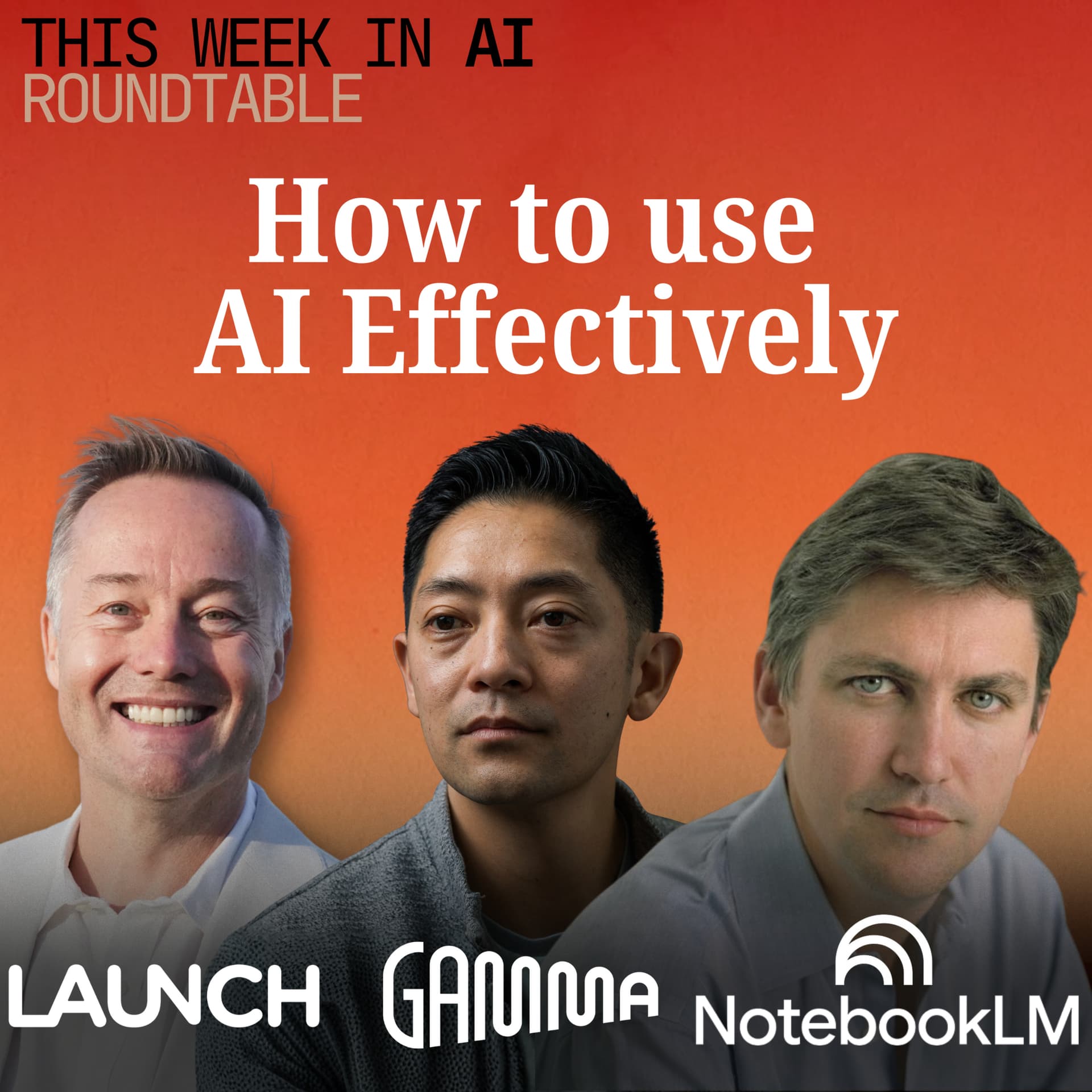
Podcast Summary: This Week in Startups - AI makes you more creative, AI Roundtable with Steven Johnson and Grant Lee | E2231
Overview In this episode of *This Week in Startups*, Jason Calacanis hosts an engaging discussion centered on the impact of artificial intelligence (AI) on creativity and productivity. Joined by Grant Lee, CEO of Gamma, and Steven Johnson, Editorial Director of NotebookLM, the conversation explores the potential benefits of AI in creative processes, the resistance to its adoption, and its implications on various fields, particularly education and the workplace.
Key Participants
- Jason Calacanis: Host and entrepreneur.
- Grant Lee: CEO and co-founder of Gamma.
- Steven Johnson: Editorial Director of NotebookLM and noted author.
Episode Highlights
Introduction (00:00)
- Jason introduces the guests and sets the stage for a discussion about AI and creativity, countering the prevalent narrative that AI diminishes creative thinking.
AI and Productivity (12:37)
- Grant and Steven's Use of AI: Both guests discuss how they leverage AI to enhance their productivity:
- AI as a Tool for Creativity: They argue that AI can make individuals more creative by handling mundane tasks, allowing users to focus on higher-level thinking.
- Insights from Customer Feedback: By using AI to analyze customer data, they can generate actionable insights that directly influence product development.
AI in the Workplace (24:45)
- Discussion on AI's potential to change job roles, including whether AI will replace traditional jobs like lawyers and accountants.
- Knowledge Workers: Emphasis on how AI tools can augment the capabilities of knowledge workers, making them more efficient and creative.
Resistance to AI Adoption (32:48)
- Exploration of why some creatives resist AI, viewing it as a threat rather than a tool.
- Generational Perspectives: Younger individuals may see AI as cheating, whereas older professionals may view it as a valuable assistant.
The Creativity Debate (40:02)
- Perceptions of AI's Impact on Creativity: A survey reveals that many adults believe AI hampers creativity. Steven and Grant refute this, citing their personal experiences of AI enhancing their creative processes.
Implications for Education (53:00)
- Concerns about AI in educational settings:
- Increased potential for laziness among students using AI to complete assignments.
- Need for new assessment methods that account for AI's role in learning.
Jevons Paradox and Job Creation (56:30)
- Jevons Paradox: Discussing how increased efficiency through AI could lead to greater demand and new job creation, rather than job loss.
- The conversation highlights the historical context of technological advancements leading to new industries and roles.
Final Thoughts and Optimism (1:02:36)
- Looking Ahead: The panel expresses optimism about AI's future, emphasizing its potential to unlock new opportunities and enhance human capabilities.
- Call to Action: Encouragement for listeners to embrace AI tools to remain competitive in their fields.
Conclusion The episode concludes with a hopeful message regarding the integration of AI in personal and professional contexts. Calacanis encourages listeners to adopt these technologies to enhance their productivity and creativity. The overarching sentiment is one of optimism about the transformative power of AI in shaping the future of work and creativity.
Key Takeaways
- AI can enhance creativity by automating mundane tasks, allowing for deeper focus on higher-level thinking.
- Resistance to AI often stems from misunderstanding its potential; education and exposure are key to overcoming this.
- Survey findings indicate widespread skepticism about AI's impact on creativity, which contrasts with the experiences of those actively using AI tools.
- The potential for job creation exists as AI transforms industries, reminiscent of historical technological advancements.
Related Links
- [Gusto](https://www.gusto.com/twist)
- [Lemon IO](https://lemon.io/twist)
- [Quo](http://quo.com/TWiST)
Subscribe
- [This Week in Startups on Apple Podcasts](https://rb.gy/v19fcp)
- [TWiST Newsletter](https://ticker.thisweekinstartups.com)
Written by AI. May contain mistakes. Listen to the episode to check what was said.
Chapters
Tap a time to open that second in VOResistance to AI in Creative Fields
0:00 to 0:49
Exploration of why some individuals resist integrating AI into creative processes.
“There's a group of people that you've been talking to, Stephen, that are resisting it, creative specifically.”
Gaming Preferences and Entrepreneurial Types
1:23 to 2:20
Discussion about gaming preferences among entrepreneurs and how it reflects their styles.
“So I love like Command & Conquer, Age of Empires.”
Grant Lee and Gamma's Vision
4:30 to 7:42
Grant Lee explains Gamma, its mission to modernize presentation tools, and recent achievements.
“All right, gentlemen, welcome to the program.”
Understanding Notebook LM for Office Workers
7:42 to 9:16
Stephen Johnson describes how Notebook LM functions and its benefits for non-developers.
“And yeah, it's still, you know, early days, but a lot of fun.”
Innovative Uses of Notebook LM by Users
11:23 to 14:00
Discussion on real-world applications of Notebook LM, including creative and analytical tasks.
“Go find me every time they've spoken, you know, Alex Karp, et cetera, and put them into Notebook LM.”
Transformative Tools for Knowledge Workers
14:00 to 14:42
Learn how integrated tools are changing the workflow of knowledge workers.
“And I was like, I can explore the ideas that I just sketched out here in this document so much faster than I ever was able to do before.”
Overcoming Intimidation in Coding
14:42 to 15:30
Discover how AI tools can make coding more accessible for knowledge workers.
“And I ended up writing like a 13 ,000 word piece, like in my spare time that would have taken, you know, months and months of like full time concentration because these these tools have just transformed the workflow.”
AI-Driven Presentations and Feedback
15:30 to 17:15
Explore how AI tools are used for creating presentations more efficiently.
“It's like going up like what's the one that you see like El Capitan or something.”
Democratizing Visual Storytelling
17:15 to 19:36
Understand how visual storytelling tools can simplify communication.
“It really is this thing where it allows you to learn and synthesize information that, frankly, wasn't possible before.”
Changing Nature of Startup Roles
20:47 to 22:47
Examine how AI might alter the need for traditional roles in startups.
“One of the personas was an accounting, HR, and legal group inside your startup.”
Show all 30 chapters
Utilizing User Research in AI
22:47 to 24:40
Learn how AI can enhance user research and feedback loops.
“It's an incredibly interesting question.”
Philosophical Implications of AI
24:40 to 28:00
Explore the philosophical questions surrounding AI and consciousness.
“Um, so any, yeah, anything like that is just, it completely changes the way you do the work.”
Understanding AI's Role in Creativity
28:00 to 29:40
Explore how AI can understand and generate content without consciousness.
“There was no way to get to understanding without being conscious.”
Personalization in Presentation Design
29:40 to 30:40
Learn how AI tools like Gamma enhance personalization in presentations.
“And this stuff is augmenting brainstorming in some way.”
Resistance to AI in Creative Fields
31:40 to 34:30
Discuss the resistance some creatives feel towards using AI tools.
“There's another piece to this puzzle, Stephen, you put into the group chat.”
AI as a Tool for Originality
34:30 to 37:50
Understand how AI can augment creativity and enhance original thought.
“And so now I have this tool where I can say, okay, I wrote this paragraph, like, but I'm so boring.”
Different Responses to AI in Various Professions
37:50 to 39:50
Analyze how different professions perceive and adopt AI technology.
“I think other professions where, to Stephen's point, a lot of, you know, creatives, there is much more of that resistance.”
Public Perception of AI's Impact on Creativity
39:50 to 42:00
Examine survey data on how the public views AI's effect on creative thinking.
“You know, when you think about it, like startups, whoever's resource constrained, if you give them something more efficient, it's like, okay, I'll use it because I don't have the ability to accomplish the task.”
The Limitations of Generic Chatbots
42:00 to 43:17
Explore how generic chatbots struggle to provide tailored insights for specific projects.
“going to go to a generic chat bot and just ask some general questions and it's going to help me, but it's not going to know anything about like the project that I'm working on or my interest or what I'm trying to do.”
AI in Documentary Filmmaking
43:17 to 45:06
Learn how filmmakers are using AI to streamline their processes and enhance creativity.
“And let's look at those last two here in terms of decision-making, Grant.”
The Role of AI in Decision-Making
45:06 to 47:14
Understand the impact of AI on decision-making and problem-solving abilities.
“lot of work, but now you're replacing the mundane, tedious tasks with stuff that I feel is actually much richer and allows you to go much deeper into these concepts.”
AI as a Tool for Creative Scaffolding
47:14 to 49:24
Discover how AI can support and enhance creative processes in writing.
“And it reminds me a little bit of, again, what I was talking about using these tools to be a more original thinker.”
Concerns About AI in Education
49:24 to 50:32
Examine the potential downsides of AI tools in the educational system.
“What percentage was chores versus the delightful part of the actual prose and storytelling?”
The Future of Assessment in Education
50:32 to 54:21
Discuss the challenges and innovative solutions for assessing learning in the AI age.
“So there's an MIT Media Lab study from June saying the use of ChatGPT made you dumber.”
Understanding Jevons Paradox
54:21 to 56:01
Learn about Jevons Paradox and its implications in modern hiring practices.
“They resigned the next week right before I had a chance to fire them, unfortunately, because I was really looking forward to that dismissal.”
The Value of Oral Exams and Human Skills
56:01 to 56:28
Learn how oral exams can enhance communication and human skills.
“And they'd be like, here's your blue book.”
Understanding Jevons Paradox in AI Development
56:28 to 58:11
Explore the Jevons paradox and its implications for AI and employment.
“I think we should end on this Jevons paradox, Grant.”
Historical Technological Breakthroughs and AI
58:11 to 1:00:08
Discuss historical tech breakthroughs and draw parallels with AI's impact.
“And I'm excited to see what else might be born of this sort of generation of software.”
The Future of Work in an AI-Driven World
1:00:08 to 1:02:40
Examine how AI will reshape the workforce and create new opportunities.
“And when Edison invented electric light bulbs, like it put that job out of work, like nobody made a business, made a living anymore as like a whale oil extractor.”
Optimism About AI's Role in Society
1:02:40 to 1:05:29
Gain insights into the optimistic view of AI's potential impact on society.
“The people in my organization, and I have a number of them.”
Transcript
Automatic transcript. May contain errors.0:00There's a group of people that you've been talking to, Stephen, that are resisting it, creative specifically. And maybe we could unpack why you think some folks are saying, I don't want to introduce anything digital here. What had been striking for me in the last couple of weeks, just over the break, was I had a couple of those conversations with like, you know, younger 20-somethings who were just out of school who were talking this way about AI. I had this fascinating conversation with a friend of mine who's a novelist, who's older, but is a novelist. And she's actually kind of receptive to using AI.
0:32But at some point I said to her, I'm convinced that these tools make me a more original writer and thinker. That doesn't make sense to me. That seems like a category mistake. If you're drawing upon something that is the average of human knowledge, that should make you less original if you're using it. This Week in Startups is brought to you by Quo. Quo gives you a clean, modern way to handle every customer call, text, and thread all in one place. Try it for free at Quo.com slash twist. Lemon.io. Get 15 % off your first four weeks of developer time at lemon.io slash twist. Gusto. Check out the online payroll and benefits experts with software built specifically for small business and startups.
1:15Try Gusto today and get three months free at gusto.com slash twist. I'm a real-time strategy guy. So I love like Command & Conquer, Age of Empires. What was the other one? Starcraft 2, all that stuff. Man, that's my favorite. What about you, Grant? What do you play? I mean, honestly, these days, the game is chasing kids around and playing Mario Kart for the thousandth time because that's all they're into. But the last time you had a choice, what did you play? It's been a while, actually. I don't know. I mean, I'm back to like... Even a casual game on your phone? Like Halo is like the last time I've been like super consumed, but that's like...
1:55You see ages ago. You seem like a first-person shooter type guy. Most entrepreneurs fall into one of two camps. They're either real-time strategy, right? That's like an Elon Musk. Or they just go full first-person shooter. That's like a Palmer Lucky, like, you know, a certain type of entrepreneur that's just going to go straight for the jugularity. Well, that's an episode right there. All right, everybody. Welcome back to This Week in Startups. It is January 7th, 2026. We're back. And just a little soft launch here. In 2026, I decided for my own entertainment and for my own intellect and interest, I wanted to start another roundtable, just like, you know, the format I created for All In.
2:40Three, four smart people talking about weeks topics, and I wanted to do it in AI. So I came up with a very unique name, This Week in AI. I don't know how I came up with it, but it just felt like the right name. And we're going to officially launch it later this year, but I'm testing it here on the This Week in Startups feed. And what I'm trying to do is find people who are actually builders, not journalists, not commentators, but people actually building product. Today, we are extremely lucky to have two people who are deep inside of the game. First, Grant Lee, who is the co-founder and CEO of Gamma.
3:15Gamma is an amazing AI first presentation product that I became aware of because all my founders started using it. We'll get into that in a minute. And one of my oldest friends in the technology business, Stephen Berlin Johnson, he co-created Feed, which was a zine in the 90s. And then we rediscovered each other. I was always listening to his great books and audio books when I was hiking around San Francisco, but a great thinker, but also a product guy. And he wound up somehow as the editorial director of notebook LM at Google Labs, which is one of my favorite products. Just some housekeeping.
3:50You can sign up for a daily newsletter I started called thisweekina.ai, essentially a sub stack. We're just putting 10 links together of the top 10 stories of the day, just so you don't miss them. You probably know six or seven of those stories, but the two or three you don't know, we suffered to find them. In terms of an editorial format, it's very concise. Thisweekina.ai.com, top 10 links of the day. You can subscribe to the YouTube channel, etc. We're also going to be publishing to LinkedIn, TikTok, Instagram, blah, blah, blah, blah, blah. And we're taking suggestions for panelists. I'm going to rotate the panel, try to get to a group of like five, six, seven great folks so that I can have the same people on essentially every week or so.
4:29So suggestions at pitch at thisweekinai.ai. All right, gentlemen, welcome to the program. How are you doing, Stephen? It's been a minute. Yeah. I mean, I last saw you like shortly after we launched the first kind of public experiment of Notebook. And I think it was December of 2023. Really? So it's been quite a ride since then. But yeah, great to see you. Good to see you. Man, we've known each other forever, huh? It's like, when did we first meet? 96, you think? Yeah, that's what I was thinking. I was actually just looking at feed in the Wayback Machine at one of the editions from like 1997 that we did and just seeing all the people we were publishing back then who've gone on to have a great authorial career.
5:16It's cool to see. Who's on the top of the list? It really is one of these things. When you start a publication in the 90s, Gen Xers, and you curate, wow, it's like drafting or something because you can't afford the top-tier writers. We couldn't afford the people who Graydon Carter was going after, so we had to find the scrappy ones. Who did you find that went on to great things? Oh, my God. There were multiple Pulitzer Prize winners, You know, like Alex Ross, now the music critic for The New Yorker, was in there in the early days. You know, like our friend Clay Shirky. Yes. He wrote for us all the time now.
5:50Clay also did a column for Silicon Island Reporter, I remember. Yeah. I would read it as the editor and I'd be like, I didn't go to graduate school, Clay. You got to help me out. Tell me these references. There was no Wikipedia at the time. What is Clay up to? Clay Shirky. He's the provost of AI and technology at NYU. And so we've been working with him a lot because they're they're big champions of notebook. And he's personally like a lovely champion of notebook as well. So I kind of reconnected with him in the last year or two because of this project, which is great. So I'm getting back to my like 90s Silicon Alley roots.
6:24It's beautiful. What an amazing moment in time that was. You know, when you think about a bunch of young people who knew what the Internet and online services were, who were just a year or two ahead of the public. But if you're a year or two ahead of the public, it's like being, you know, like a god or a demigod. You just know everything. And we were given a ton of money to go do really interesting things, which I think is a good tee up for our guest, Grant Lee. Grant, how old are you, by the way? I can't tell. I don't know. How old is it? I'm just over 40, 42. Oh, you're 42. OK, so you're a millennial.
6:55I guess that's the term, yeah. We're a janitor millennial. And of course, you're the co-founder and CEO of Gamma. Explain to the audience what Gamma is and why you built it. Yeah, so you can think of us as being the visual storytelling product for work, reimagining how people present and share their ideas. The default tool for so long has been PowerPoint, and we're trying to come up with something to sort of modernize the way people are communicating their ideas. Got it. And you recently raised a ton of money, yeah, if I remember correctly? Yep, raised a bit, raised a Series B led by Andreessen.
7:28Oh, congratulations. Congratulations. And the valuation there, not that valuations really matter, but it is indicative of the moment in time. Right. 2.1 billion. Incredible. And the company, I believe there was a whisper, broke 100 million in revenue or something in that zone. That's right. Yeah, we passed 100 million last year. Still making great progress. And yeah, it's still, you know, early days, but a lot of fun. Team is great. Excited to keep building. All right. So this will lead us, I think, to our first topic, which is AI and productivity inside the enterprise for non-developers. We all know developers.
8:02You know, you put a co-pilot on them and they obviously had Stack Overflow. You got GitHub. There were many ways for them to be augmented, Stephen. But you and I are starting to see people use tools like yours, tools like grants to become superhuman, to use a term, not the company, but the descriptor. What are you seeing in the field with how people are using Notebook LM? And I guess just as a little preamble, how would you explain Notebook LM to just an office worker, somebody who uses Microsoft Office, who uses the Google suite, who uses Gamma? How should they think about Notebook LLM and where it fits between Notion, Coda, Microsoft Office, etc.?
8:45Yeah, I mean, Notebook does a couple of things. One of the things that I think we're pretty ahead of the curve on is just the whole concept of context engineering and context management. That AI is really useful when you're talking to a general purpose chatbot, but the real power comes when you load it up with the sources that are crucial to whatever you're working on. And so that whether it's, you know, the legal depositions you've recorded for the brief that you're trying to file as a lawyer, whether it's the assignments for the class you're taking, the like information that's specific to you, the model needs to be able to see that.
9:20And so we really built Notebook from the ground up as a tool for kind of managing that information and then allowing you to query that information. We still have kind of the best system, I think, out there for, you know, actually having grounded citations back to the original passages. So if you ask a question, you can go back and read the original source in its entirety. And then increasingly, these amazing transformations that, you know, parallel some of the great stuff that Grant is doing at Gamma, where, you know, initially the one that kind of broke out was audio overviews, where you could take your sources and turn them into this kind of magical two-person podcast conversation that kind of went viral in the fall of 2024.
10:01for. But now we have a whole host of transformations that you can do, including these new slide decks, which I'm sure we'll talk about that are pretty amazing. So yeah, that's the product. Launch is a fast-growing organization. We've got more than a dozen employees working with me here in Austin and another dozen spread out all over the world. But there's so many moving parts when it comes to hiring and managing employees. There's the onboarding, of course, payroll. You got to pay them. And listen, I've got all these podcasts to do. I don't have time for payroll benefits, HR taxes, answering questions, nor do I wanna hire a full-time person and then have them do five hours of work a week.
10:38No, I have the perfect partner, Gusto. They're the all-in-one payroll and benefit product that's built just for your small business. Easy to use, it's incredibly fast to get started, and it's designed specifically with remote offices in mind. And Gusto is not just giving you helpful tools, they're going that extra mile to keep your workers happy and keep everything running smoothly. And they're now offering level funded health plans to keep your insurance costs down and on demand pay to help workers get access to their cash faster without paying extra interest or hidden fees. So here's your call to action.
11:09We want you to try Gusto today. So we're giving you three months free when you run your first payroll. That's right. Three months free. F-R-E-E. That's my favorite price, folks. Go to gusto.com slash twist. That's Gusto. G-U-S-T-O dot com slash twist. What an amazing service and a partner. Great partner. and it's a pretty powerful product as an example I had my team when we had the all-in summit and I have to interview you know 30 people this was the all-in summit 2025 and I said to my team because I have two Athena assistants which I'm an investor in that company these are the top one percent of the knowledge workers in the Philippines go to athenawild.com get an assistant I said, here are the speakers.
11:53Go find me every time they've spoken, you know, Alex Karp, et cetera, and put them into Notebook LM. And then I can ask questions and do output from it, right? So here you have every YouTube of everybody speaking. And so then, you know, when I'm on the road or I'm in line at Starbucks, whatever I'm doing, I could ask questions of it. I could get summaries and I can even make an output of a podcast. It's really interesting how you expand the context window and you can build essentially a brain. It's kind of like thebrain.com, if you remember that. Yeah, Jerry Mikowski's brain. Our friend Jerry.
12:31But the Brain Company, which I think still exists. So super fascinating. Do you have like, I guess the real world example was Fred Wilson's. Maybe you could explain that a little bit. And then we'll talk a little bit about Gammon as well. you know, Fred's been putting basically all the kind of background on their investments at Union Square Ventures and actually using it in some cases to simulate having a lawyer review the documentation. So it's like bringing in all the documents for the investment and then saying, hey, analyze this as if you were a lawyer to make sure that everything looks sensible.
13:04And he's been seeing great results from that. But we're seeing a lot of like venture funds actually use it just as a way of kind of like analyzing all the pitches that are coming in and, you know, kind of including an investment thesis for the firm that's included there. Yeah, there's Fred's blog post about it. Excellent little rendering of him. And basically, you know, using it as a tool for pulling the key insights out of a bunch of different documents and also increasingly, I think, as a creative tool. So, you know, we were chatting a little bit before this. I just had this whole experience over the last four or five weeks where I found some old kind of sketch of an idea for a story kind of along the lines of like a book like Sapiens, like about the kind of birth of agriculture and things like that.
13:54And I just stumbled across it like five weeks ago and I'd written it maybe like four, four years ago and I'd forgotten about it. And I was reading it and I was like, oh, since, you know, over the last four years, something fundamental has changed, which is that I now have notebook and deep research, which is now integrated into notebook, which, you know, is just totally transformative. And I was like, I can explore the ideas that I just sketched out here in this document so much faster than I ever was able to do before. I can kind of stumble across something and be like, oh, what's the deal with that?
14:26And send deep research off to figure out, you know, pull down the most important sources, you know, synthesize that information, summarize it for me. And then I can kind of show the model in notebook, like what I'm writing and say, OK, what what's interesting here? What am I missing? Like, what are the holes here? Like, how could I build on this? And I ended up writing like a 13 ,000 word piece, like in my spare time that would have taken, you know, months and months of like full time concentration because these these tools have just transformed the workflow. And I think, you know, as you're saying that, like coders have have started to talk about how revolutionary this is.
15:03But I think that knowledge workers are just beginning to understand like what an amplifier these these tools are. I think 2026 is going to be a year we're going to see a lot more of that. I think that's spot on because the knowledge workers, they're so they're intimidated, I think, by the concept of scripting or coding. It's been this giant wall or this giant mountain to scale. And scaling me, I'm going to become a developer mountain. It's just too intimidating. It's like going up like what's the one that you see like El Capitan or something. But, you know, on the back of El Capitan, you could walk up this very, you know, gingerly trail and get to the same view.
15:45That's, I think, what these tools are. It's just another way to climb the mountain, but you don't have to scale it straight up. Grant, your thoughts on what you're seeing with people using your tool? Again, sometimes making great presentations, making great infographics. This was something a knowledge worker had to go hire somebody. They kind of give their feedback. They wait a week. They get some slides back. But now you have this sort of AI-first process. Explain how people are using it and your take on Stephen's position that 2026 is the year of the knowledge worker embracing these tools. Yeah, I'll start by just saying, you know, Notebook LM, we're also huge fans.
16:20We use it internally. I think many of these tools just unlock so much possibility. So for us, like one use case we've had is, you know, we have a private Slack workspace for all of our power users. we're constantly trying to get feedback they're oftentimes giving us input on things that are working well not all of a sudden now we can take that entire chat history all the messages we've ever had dump that into notebook lm and like that now allows you to sort of map that world in a very different way you can start building personas like okay all the feedback we're getting how do you categorize you know what type of pain points we're actually trying to solve for and for whom within these personas, you can then start asking deeper questions.
17:01What are the value props that really matter for this persona? If we were to pursue X, Y, and Z feature, are we actually delivering on a certain persona's use case or pain point? And is it really going to move the needle for them? So for us, I think that's just been an powerful wave. It really is this thing where it allows you to learn and synthesize information that, frankly, wasn't possible before. And I love just the notion of actually mapping this to something that feels so much more tangible. Once you map it, you can figure out where on the map do you even want to explore, go deeper. And for us, that's been great.
17:32And so, and that requires somebody to know how to either authenticate notebook LM into Slack, which I don't know if that exists right now, or if you use Zapier to do it, or if you just export the entire. Right now we're just doing exporting. Yeah. Like a little bit, a little bit more manual. There's some intermediate steps, but you know, not, not the craziest thing. And what you think about that, there's this intermediate step. And this is kind of like finding out about that trail on the back of El Cap, right? Like you don't know where the trailhead is. And then somebody says, by the way, there's an export feature in Slack.
18:03You just export the whole thing and then you upload it. And then you do that one little simple step. It's kind of like, Stephen, when we taught somebody how to like install TCP IP on their Mac and authenticate onto the internet. And all of a sudden they got on using it and their brain exploded. But that one thing, where's the trailhead? And how do I get in to the trail and find everybody else who's climbing the mountain? That's the piece that is such a blocker, yeah? Totally, yeah. Yeah. That wants you on that. Yeah. Go ahead, Stephen. Oh, no. I think you were – I want to hear more about Gamma.
18:32Yeah. Thank you for the roses for Notebook LM. That's an incredible use case. But tell us about Gamma as well. For, you know, where this all started was for Gamma to almost, you know, try to solve my own problems. So I started off early in my career consulting, investment banking, living in slide decks. Slides are an incredibly powerful tool to communicate to others. You're in many ways trying to visualize concepts, trying to synthesize information, make sure that's spreadable, and that when it gets in the hands of someone else, you're able to take what's in your head and translate that into someone else's head and transport that.
19:05And so we've been on a mission to really kind of democratize that visual storytelling. How do we make it dead simple for anybody to be able to convey what's in their head and really get that information out there? And so I think, you know, over the past few years, we've made, you know, good progress. For us, it's about the building blocks. How do we, every step of the way, you know, simplify it, reduce the amount of, you know, tedious and mundane tasks, a boring task that nobody wants to do, the formatting, the aligning of boxes, and get them to a better output. And so a lot of, you know, the past five years has just been about getting to a better starting point for our end user.
19:42building out your team is one of the most crucial things you have to get right in your startup and finding the right developers is particularly important but now there's lemon.io they're going to save you time money and headaches by doing all the time consuming legwork for you they've got an experienced lineup of pre-vetted developers working for competitive rates just one percent of applicants are accepted into lemon's elite program and they're not just out there finding this great talent, they're also working with you to integrate these new members into your team. Plus, if it's not a good fit, hey, and sometimes things don't work out, Lemon will hook you up with a new developer ASAP.
20:21I've seen startups go from just pretty good to amazing after filling out their teams with developers from Lemon.io. Go to Lemon.io slash twist and find your perfect developer or technical team in 48 hours or less. Plus, twist listeners get 15 % off their first four weeks. That's lemon.io slash twist, L-E-M-O-N.io slash twist. Let's unpack the impact on organization building, Stephen, because when you built a startup and you're in the middle of that grant, Stephen and I, as your big brothers in Gen X, who have done it a couple of times as well, but just nowhere near as successful as you, you had to have these personas.
21:07One of the personas was an accounting, HR, and legal group inside your startup. In our day, you literally, I know this is going to sound crazy to you, man, one of your first 10 or 20 employees was an accountant, an HR person, a sysadmin to run the servers, like all these like weird jobs that you're like, and sometimes even a lawyer in your firm, you know, when you get to 50 people or whatever. Now you start thinking about this, Stephen. I had a startup to Fred's incredible blog post who had gotten close to a million in revenue, had raised a couple of hundred grand from me and a couple of other folks that were in our incubator.
21:46They were in year two. They had no lawyer. They had no lawyer in two years of a startup. No accounting. They just had a bank account and the way they did their legal was they would dump a convertible note or a you know safe agreement into chat gpt or gemini or croc whichever they chose quad uh and you gotta be careful here it's gonna get so political now it's uh it's becoming like the um you know what this is becoming like it's like mac os versus windows it's a great point it's becoming a little bit religious and i'm just shocked like how did you do what and they're like well why would i hire an attorney for 1200 an hour when chat gtp just gives me the answer that this angel investor put these three unique terms in and i just reversed them and it told me how to negotiate with them so maybe we could speak to formation of organizations and how that's going to change and personas in organizations if a founder doesn't need a lawyer, accountant, and HR person anymore?
22:50Or they don't perceive they do. Or maybe they do. I don't know. It's an incredibly interesting question. And it's funny to be thinking about it inside of Google, like a giant organization that is my actual first contact with a company this size in my career. Like I'd never worked with an organization this big. So I'm looking at it from a completely different perspective in a way. But one of the things that's so interesting about what you could do now as a startup to what Grant was saying about adding the Slack conversations and building kind of personas off of that is one of the first parts of the extended notebook team that really, besides me, that really started embracing the product internally using notebook was user research.
23:35And so one of the things that's amazing is in addition to thinking about the organization itself, thinking about all your base of users and all of their needs, Right. So, you know, we have all these interviews with potential or current users just talking at length about their like pain points and what's working for them, what products they're using. And the UXR people would just be like, let's put all the transcripts of those things into a notebook. And then that meant that product people could then kind of be like, hey, I'm thinking about this feature. Not only do I have like my lawyer on tap here as an agent and not only do I have my, you know, whatever, like HR person virtually as an agent.
24:12I have my whole audience, like my user base or potential user base here as something that I can like have a conversation with and be like, hey, if we changed this feature so that it worked this way, how would that be received? And you get these amazing, you know, kind of deep, profound answers, again, all kind of taking you back to the original quotes from the users so you can read in their voices as well. So you're not just like getting a synthesis or a summary from a model, but you're actually like hearing the quotes from the original users. Um, so any, yeah, anything like that is just, it completely changes the way you do the work.
24:45Which kind of brings up the big C philosophically consciousness. And what is consciousness? I mean, I hate to level up the discussion here because we're in such a great tactical and strategic place, but what is human consciousness, but the ability to build a world or a mental model and then play out a scenario in your brain? What would happen if we launched this new feature? And that's what these things seem to be doing when they play the guess the next word. And here's the context window. And here's my resources. So it makes me wonder if we're actually in a giant simulation here. We're all just somebody's agents.
Read the full transcript
25:27Like, let's put JCal out there as a podcaster, as an agent to go talk to people building products in this simulation known as planet Earth. So it does feel like in some ways the LLM is replicating our brains. I don't know if you've been giving this thought, Grant, at all of what this all means. I'm honestly still trying to make sense of it. I think there's interesting things that are happening. When I even go back to think about visual communication and oftentimes when you're trying to communicate a set of complex ideas, you almost need to simplify it for a human. So you're saying, OK, what are the three main things?
26:03You take all this information, you simplify it to three, and then you tell your team, hey, these are the three priorities. Well, if AI doesn't need to simplify it to three, they can go out and do 10 or 20 or the most important things on the list. And then what's the point of actually distilling down to three? These are all things we're all trying to grapple with. How much of it is just human limitations to how we can actually comprehend, synthesize information and make sense of it all versus actually if AI is doing it, then what's the point of that? We can skip over that step altogether. brainstorming.
26:35Jason, if I can, yeah, can I jump in? Since, you know, you started a college dorm conversation about consciousness. I'm never going to like miss out on that. Yeah, here we go. Pass the bog. But, but I think one of the early things that I found really extraordinary, and I might even talk about it when we first talked on the show in 2023 about notebook is that you could give the model, even in the early days, you could give the model a set of sources And you could say, what are the most interesting pieces of information in these documents? And interestingness was a concept that the models kind of natively understood in this amazing way, even when they weren't quite as smart as they are today.
27:15And I think it's because of the nature of like next token prediction. Right. Interestingness is I was surprised by something. I thought there would be this, but I got I thought there would be X, but I got Y. That's interesting. Right. That's how we learn when we see that kind of difference between a prediction or not. So a thinking machine that is built around predictions is going to be like natively really good at interestingness, which I think is amazing. And it connects a little bit to what Grant is talking about in terms of like part of what you want to do when you convey information to another person is pull out the most interesting bits or figure out the most interesting way to convey that information so that their brain remembers and engages.
27:50That's part of like the power of what Gamma does with slides and presentations and so on. But I do think on the consciousness side, it's a little bit of a red herring in the sense that like up until language models, if you were if you understood material, by definition, you were conscious. Right. There was no way to get to understanding without being conscious. The only people could really understand fully semantically things for humans and humans were conscious. I think what's interesting now is that we truly have, I think you have to look at what, you know, if you give Gamma or if you give Notebook like a bunch of information and ask it to create something new based on that content, you have to look at that software and say, it is understanding the material on some level.
28:33Like it is grasping what the core concepts are. But I don't think it's conscious. Like it doesn't have an interior experience of it. And so it's created this new possibility for understanding without sentience, without consciousness. And that's what's confusing to people because we've never had that before. It's mimicking a portion of human experience. It doesn't have the third perspective where you're like, I'm doing this. I can see myself doing this. I see my motivation. I'm in the process of building a slide deck in order to convince a venture capitalist to give us money. It's just saying input, output, here's the data.
29:12And then here's the output that a venture capitalist would like. And then, hey, I'm going to make another deck. And do people do this in the software, say, who's the audience for the deck? Therefore, you know, tailor it to it and make two different decks or three different decks. This is for sales. This is for HR, for hiring. And this is for venture capitalists. Yeah, maybe a little bit to the brainstorming concept here, because I think that's when we think strategically about what this is all about in an organization, what's uniquely human is brainstorming. And this stuff is augmenting brainstorming in some way.
29:44Yeah, absolutely. I mean, so much of the pain point before, especially with slide decks, is you have to almost make a generic version, a one-to-many version. It's impossible to go back and format everything so that you go into the next meeting or you don't have time to personalize the deck. And what we see today is now that we have, if you set up a template in Gamma, now all of a sudden you can personalize it to whatever audience you want and you can specify. If I'm pitching customer X, that has a very different set of needs, different industry. Let's make sure that we're not pitching stuff that's not relevant.
30:15And you can do that at scale. So not only are you doing it as an end user, both via an API, then obviously you can do that automated at scale. So I think it just changes how people approach just this notion, this category for us. It's just we're trying to push the boundaries in ways that weren't possible before when everything had to be manually manipulated. And for us, that ends up becoming a superpower for our customers. It's 2026. It's a new year and I've got a resolution just for you. Stop missing phone calls. The important ones. When your business misses calls, that means you've missed an opportunity.
30:49That's why today's episode is brought to you by Quo, Q-U-O, the smart way to run your business communications. Quo is the number one business phone system that's being used by more than 90 ,000 companies. Here's how it works. Everyone on your team shares a single phone number and that phone number works from an app on any device. And that means no more missed messages because everyone has access to the full thread. Even if it's off hours, Quo's AI agent automatically logs your calls and generates easy to follow summaries. So make this the year when no opportunity and no customer slips away. Try Quo for free and get 20 % off your first six months when you go to Quo.com slash twist.
31:34That's Q-U-O.com slash twist. Quo. No missed calls, no missed customers. There's another piece to this puzzle, Stephen, you put into the group chat. And behind every great podcast is a great group chat. It's really interesting how group chat, like getting off of Twitter, getting off of TikTok or whatever, the group chat is where the interesting discussions go because you can kind of be a little more freewheeling. It's kind of like us going to Eureka Cafe or wherever the hell we went in the 90s to just, you know. What was the place on, what was the dining room, Union Square? Oh, yeah. I was thinking of Limbo.
32:12Yeah, Coffee Shop was another place, but Limbo was cool too, yeah. Yeah. I was just talking to David Hershkowitz from Paper. He's like, when did you start working here? And I was like, and start Silicon Hour Reporter and writing for Paper Magazine. And I was like, well, I pitched you doing Digits Magazine as an insert to Paper. And that was going to be the original name of Silicon Hour. reporter. And he was like, I didn't take you up on that. And I was like, yeah, but I remember the grilled cheese and the French fries at coffee shop. Anyway, this is the equivalent here, which is the group chat.
32:42And there's a resistance to using AI. I'm curious, there's a group of people that you've been talking to, Stephen, that are resisting it, creative specifically. And maybe we could unpack why you think some folks are saying i i don't want to introduce anything digital here i just want to play acoustic in the studio i want to go back to tape i i don't want i want to go back to film i don't want to use a digital recorder and um yeah give us your give us your it's a really interesting one and it what i was saying in the chat was that what What had been striking for me in the last couple of weeks just over the break was I had a couple of those conversations with like, you know, younger 20 somethings who were just out of school who were talking this way about AI.
33:32And I think in some ways that comes out of the sense that. that the threat here because of the challenge and i think we can talk to this a little later like the challenge that ai as opposed to assessment in schools like writing a paper for you and all that kind of stuff um that in some people who've just been in school they see potentially ai as a as a as a way of cheating or a way of like getting around like doing your own thinking and if it whereas when i look at it and i think you know this is i'm sure the way grant looks at it and most of the people who listen to the show think about it, I see it as a way of just augmenting my thinking, right?
34:10I see this as a way of having better ideas and having richer ideas. And I had this fascinating conversation with a friend of mine who's a novelist, who's older, but is a novelist. And she's actually kind of receptive to using AI. But at some point I said to her, I'm convinced that these tools make me a more original writer and thinker. it's unpacked yeah yeah she said that doesn't make sense to me like that seems like a category mistake if you're drawing upon something that is like the average of human knowledge like that should make you less original if you're using it and i was like no but what you don't realize is that i have all these things in as a writer as a thinker where i'm stuck in a familiar pattern or a cliche or i have a certain way of writing a paragraph that i just always do it's really lame and i'm now or i just have a bunch of received ideas about the world that i you know i'm just kind of just, you know, they're codified.
35:02Yeah. Yeah. Yeah. And so now I have this tool where I can say, okay, I wrote this paragraph, like, but I'm so boring. Like, give me five alternative versions of like how I could open that sentence or like, take a look at this like section. And what am I missing? Like, what's the blank spot here? Like, what's not in this document that I haven't thought of yet. And it's able to kind of like unblock me and open up new doors again, to your point about brainstorming. And how would you do that previously? You would have just emailed three friends and said, can you read this, right? You read other books and other thoughts and other articles and research and things like that.
35:38And what you still do when you're actually doing the final piece, but your ability to kind of quickly test the waters of an idea or quickly, you know, kind of explore a parallel path intellectually that you would have normally taken you three weeks to go and find the right materials and then read them through. Now you can just test hypotheses really quickly. So I just feel that I'm just, I don't know, I feel like it's enriching my range in a way that has been just, I don't know, exhilarating to be a part of. You know, when I try to come up with quips from when I'm doing podcasts and, or I'm doing something on stage, I just gave a keynote, or I did a fireside chat at CES yesterday, and I was looking for some jokes, right?
36:24You think jokes, kind of hard for an LLM to do. Au contraire, more frere. You just tell it, here's the five things I want to riff on. And it gives you the worst possible jokes you could imagine, but they do spark an idea. So I was going through these pagers. I had a box of old gadgets, and I picked up the pager. And the first thing I thought of was the Hamas I was getting their nuts blown off with a pager. So I just threw it to the person. I said, oh yeah, you know what we call this in the Middle East? This is called a Hamas vasectomy. And I threw it in their lap. Got a good laugh from the audience.
37:04But when I do brainstorming with LOMs, I just say, give me the couple of idioms. I use the word idioms. This seems to trigger really well. I don't know why. Give me idioms or pop culture references, perhaps because Wikipedia uses those terms and I have them in my brain. And it just gives me, Grant, so many ideas. It doesn't give me the jokes, but it just gives me like a little bit of ideas, like almost like a little bit of a mind map. How do you think about this sort of creativity versus
37:37sterilizing the content? Yeah. It's really, I mean, I think one thing that's interesting, different professions, I mean, part of this I map to crossing the chasm. So in certain professions coding for instance right now it's very clear we've crossed the chasm everybody's using it every developer is using every sort of coding you know agent out there and and i think there is part of that where maybe the chasm was just for that particular profession was just much smaller once you cross and immediately move into mass market and then once you have critical mass there's a tipping point then it just becomes so obvious that the profession itself is going to have to embrace this new technology.
38:17I think other professions where, to Stephen's point, a lot of, you know, creatives, there is much more of that resistance. That chasm feels so much more daunting because the question is, if you are, if these models are trained on prior art and people's work, then you're trying to, you know, take advantage of that somehow. Well, you know, the default mindset today is like, well, that's, you know, copyright or that's IP infringement like you can't do that and i want to be an original creator an artist and so i do believe in many ways that certain professions the chasm itself is just much wider and it will probably take some time when you eventually reach critical mass and like you know for instance photoshop today nobody thinks of it as cheating or like augmenting photos in ways that at least you know the the broad majority of folks and so like now now it's a tool that people can use and maybe Photoshop now is even obsolete, but it's like once people embrace some of these toolings and professions can actually understand that this is just an extension of you, then maybe it's okay.
39:20I think knowledge workers, I think it will be sort of unevenly distributed. Certain professions like educators, for instance, have been surprisingly early adopters, willingness to like actually use this as a tool that they're just sick and tired of having, you know, lack of resources, no budget. and so screw it, I'm going to fast forward and I can pick up this tool, pay a couple bucks a month and like completely augment my day and I'm okay with that. They have no pride in like, hey, this deck or whatever I'm creating for my students. Because they're resource constrained. You know, when you think about it, like startups, whoever's resource constrained, if you give them something more efficient, it's like, okay, I'll use it because I don't have the ability to accomplish the task.
40:02Here's the interesting Pew Research survey. Now, surveys, it's important to put in context. Here they're asking the percentage of U.S. adults who say the increased use of artificial intelligence in society will make people's ability to do each of the following. Think creatively. Worse, better. 53 % say it will make creativity worse. 16 % better. 16 % neither better nor worse. 16 % not sure. So when you look at this piece of data, this is from June, by the way, in 2025. So it's six months old. And that actually is relevant. Because I'm going to guess half the people here have not used AI all that much.
40:43And so how do you read into this, Stephen? Just the first one here. Because you and I just described, and Grant agreed, that, man, this makes you so much better thinking creatively. But people's assumption is the opposite. I would put also that other question about helping you make decisions, because I wrote a whole book about complex decision making, which is a really creative work. Like you have to, to make a complicated decision. Like you have to think creatively, you have to imagine alternative scenarios and come up with, you know, future plans that you might not initially have thought of.
41:15So there's a lot of creativity that's built into decision making too, that I think the models can be super helpful. That's farsighted, right? That's your book. Yeah, yeah, yeah. There we go. Thank you. Thank you. I didn't want to plug too much. Literally every time your book comes out on Audible, I just buy it and go to a hike, I listen to it. I appreciate it. But here's the thing that I think is a factor here as well. I think that outside of hardcore tech users, maybe students, that the idea of using AI with your own context, with your own sources, is actually, particularly in June of this year, that was not as much of a mainstream thing.
41:52So I think part of what people are approaching here, are thinking about here is they're thinking, okay, I want to like work on my novel. I'm just going to go to a generic chat bot and just ask some general questions and it's going to help me, but it's not going to know anything about like the project that I'm working on or my interest or what I'm trying to do. And so they kind of rightfully assume that there is a ceiling for what you can get out of a chat bot that knows nothing about you and knows nothing about your industry or knows nothing about your company or your nonprofit or whatever you're doing.
42:20But I think when people actually experience it and, you know, it's obviously notebook has done this probably longer than anybody, but it's now a part of all the major platforms. You load your own context and then you ask questions based on that context. And when you see that happening, I think people instantly, like I have a lot of friends who make documentaries and they were kind of worried about AI for a while. And then they were like, oh, wait, I can just interview 35 people and put the transcripts into a notebook and then start sketching out like ideas for scenes with actual quotes just right in the notebook instead of having my interns go through like 500 pages of transcripts to pull out the relevant bits for the scene.
42:59And they're just like, that is so much better. But you can't do that with a generic chatbot. You have to have source grounding for that unlock to happen. And I just think most people don't know about this yet. Like we're so in this bubble that we kind of assume everybody knows you can engineer context for your projects. And let's look at those last two here in terms of decision-making, Grant. We'll pull up the graphic one more time. Again, a few studies six months ago, which is the equivalent of six years ago in AI time. It's really like a 10 to 1, I think, at this point. Make difficult decisions.
43:3440 people think that it will make you worse at making difficult decisions. And 38 % think it's going to make you worse at solving problems. 19 % think it will make you better. So that's two to one. and it's you know 60 40 here on solving problems what's your takeaway from this grant you just think it's these are people answering the question who are thinking about the movie terminator or the extinction and just a little bit scared and they don't want this to be true well part of this is yeah obviously it is a moving target to you know six months ago to your point is a lifetime and i think many people that are still skeptical it's it's yeah to both their points is they're just barely exploring.
44:16When you think about a lot of these like shallow use cases, yeah, if you give, you know, gamma like a prompt, like create a presentation on, you know, dinosaurs or something, you know, can give you something that like the argument is, okay, well, you know, gamma is doing all the work for you. You're not learning any of that. And so, you know, are you actually, you know, better off actually, you know, going back and doing the research and doing it all yourself so you actually can comprehend what's going into the slide deck. But what we actually see most people use Gamma for is to actually go much deeper.
44:45It's to actually do a lot of exploration in tools like Notebook LM or ChatGPT, where you're going much deeper in the research, synthesizing that information, trying to figure out for my audience what's going to be important, then porting all of that into Gamma, helping them visualize all that information. And I think these are things where the steps it takes to go from like this first draft to final draft is still a lot of work, but now you're replacing the mundane, tedious tasks with stuff that I feel is actually much richer and allows you to go much deeper into these concepts. I think that's where most people are missing because they're not doing that yet.
45:17They're thinking about the one sentence prompt and give me an output and like, oh, that's cheating. That's fast forwarding. That's like skipping all the important steps. And that's only because they actually haven't done it in the important steps themselves. And you have some expertise in this with the book, Steven, you're trying to map out, if my memory serves me correctly here, like you're trying to map out and build a mental model to make a better decision. And then, of course, as prediction markets like Polymarket help us do, you want to kind of go through some predictions. A great book, Super Predictor or Super Predictions?
45:53What was that book? Super Forecaster. Super Forecaster. Thank you. See that? We just did it right now. Yeah, yeah. And this is what brainstorming is like between humans, but we would have got there quicker than LLM. But Super Forecasting, this is part of making decisions. I know this because when when I took on venture capital as a profession 12 years ago, you have to become a super forecaster. You have to become a, you have to think about your thinking and decisions and then go back seven years later and say, why did I make this terrible decision? Or how did I make this brilliant decision? Well, what contributed to that so I can make the next hundred better?
46:32Yeah. I mean, it's, I think, maybe what's happening when people are asked questions like that and the few things they're imagining that you're just outsourcing the decision to the model and that's it. You're just like, hey, make this choice for me. And, you know, without context and all that kind of stuff. And yes, they wouldn't be very good at that. But the way that people actually use it or actually using these tools is they use the model to create the scaffolding for the decision that you're going to make, where they use the model to test different hypotheses about like the impact of the decision as it could be or to help them think creatively and imagine potential unintended consequences of the decision that they are having a hard time imagining.
47:09And then they gather all that information together and then they can make a choice. But you have far more data, in a sense, to make the choice because the models, they're supporting you. And it reminds me a little bit of, again, what I was talking about using these tools to be a more original thinker. One of the things that the models do that is just mind bug, if you've ever written a historical book or anything that evolves like a chronology is you can feed a tool like notebook, like 100 newspaper articles and say, create a chronology of all the events in sequence here and a list of all the major characters.
47:47so I get a mental map of like everything that happens, which is if you're writing complex, like narrative nonfiction, like that is just seeing the sequences are really, really complicated. And that can take like weeks to build out of a hundred newspaper articles. I would say, you know, you or Malcolm Gladwell, or, you know, pick your thinking author, that is kind of the job is to synthesize all this information and make it so, you know, the gen pop like myself can read your book and be like, okay, Stephen or Malcolm are holding my hand through the data and I can have a fun ride for six or seven hours with them understanding something complex.
48:27And now the LLM can do it for you, yeah? Well, yeah, I think, I'm trying to say something that's slightly different than that in a way, Jason, which is the thing that I do well, let's say, as a writer is like, make the stuff interesting, create a compelling narrative, write the sentences in a compelling way, whatever it is. The thing I don't do particularly well is figure out the exact sequence of dates of events that happen. Like that's just you struggle with that. Like everyone like everyone has to do it, but it's not I don't have a particular talent for it, but you need to do it to write the book.
48:56That's the chore. That's the that's the chore. And so now I'm able to say, hey, actually, notebook, will you handle that? So my brain is freed up to just think about the creative things and the more original writing or the better way to phrase the sentence or the paragraph or the chapter. And that's where I see it as building this scaffolding for you to do better thinking, better decisions, better writing, better creativity. In other words, you're standing on the shoulders of those chores. The chores would be for a typical book. What percentage was chores versus the delightful part of the actual prose and storytelling?
49:33If you just gave an honest... I mean, it's close to 50-50. You know, it's a lot of time just managing the information. And then when you get to the end of the process and you have like bibliographies and footnotes and stuff like that, it's just like it's weeks of like drudgery that I cannot wait to write the next book. Like with these tools, like I was just saying when I wrote my book, it was 60 40. It was 60 percent of me just getting all this data, you know, structured on a whiteboard, on index cards. And then here we are, the this craziness of just standing on the shoulders of the chores in a way.
50:09And yeah, these, it's very weird surveys. I'm wondering what the value of these surveys are. I mean, it's sort of like the initial research. It's a great thing to start with. It's a good building block, but you really have to double click on it to understand what's actually happening, which then I think a good jump off point here is this MIT Media Lab study. So there's an MIT Media Lab study from June saying the use of ChatGPT made you dumber. The team asked three groups to write various SAT essays. One used ChatGPT, one used only their brains, and one used Google Search, but not AI. For the first three assignments, they would then ask to write a fourth essay.
50:52But the ChatGPT group had their tool taken away. The group that had asked to use ChatGPT for help had lower brain engagement and underperformed at neuro-linguistic and behavioral levels on the second assignment, while the Google and brain-only groups had similar results. I wonder if this actually means chat GPT makes you dumber in general or, and this hasn't been peer review or anything, 18 people completed it. So this is just like a first stab out of it. But anybody have a stab at this, Grant? Do people let their guard down and maybe disengage sometimes when using the tools? And maybe they have to be thoughtful about reengaging their brains, almost like, you know, driving a stick shift versus an automatic when you're driving.
51:36That's what this sort of speaks to me, too. I mean, as a dad of two younger kids under 10, this is one where studies like this, you know, obviously you can we can double click into all the different ways that maybe study is self-displugged. But it does concern me. You know, if these tools do become a crutch for students, then are they really learning the concept? I think the onus then becomes on oftentimes the teacher to kind of set the right framing. Like these this is a tool. Use it as a tool. Don't use it to fast forward through the things that are important. And without the right teacher, which, you know, who knows who you're going to going to get as a student, then then you might be tempted to kind of skip over the hard parts here.
52:18And I'm not sure where this all lands. I think we're still so early in how these tools are evolving and especially how tools are being taught in schools and in places where, you know, who knows what's the right way to actually even adopt and introduce some of this stuff. So I'm curious to kind of follow along. I'm curious to hear Stephen's thoughts on like what this means broadly for people. Yeah, we think about it a lot at Notebook and at Google, obviously, because classroom and EDU is such a big part of what we do. And Notebook's, you know, a significant amount of our users are either students or teachers or scholars.
52:53Um, you know, one way to think about it is this, like if you are interested in genuinely understanding and learning something, this is the greatest time to be alive ever, right? These tools are incredible. If you were trying to truly under, to get the information into your brain so that you understand that you have a 24 seven tutor that will adapt to whatever, you know, language or comprehension level you are, turn it into a podcast or a slide deck to help you understand. So that's amazing. If you are interested in creating the illusion that you understand something, it is also the greatest time to be alive, right?
53:29So if you don't care, and that actually isn't that big a deal outside of school, right? Because it's not a really good long-term strategy to go into your job and not actually read anything your boss says to you and just feed it into ChatGPT or Gemini and just output the answer, right? Eventually, your boss will be like, you don't understand anything. We fired somebody for something similar. Or we were about to fire somebody and they resigned. They literally did their notes for a founder meeting with ChatGPT based on the Zoom call. And I had said explicitly, I want you to write the notes. You can use the summary tool, obviously, and any of these things to remember points.
54:07But I want you to actually literally write your thing. And I had them read it out loud in front of the class on the management team meeting. And it had errors in it. And it was like ChatGPT. This is 18 months ago. It was it was AI slop. And man, the person was so embarrassed. They resigned the next week right before I had a chance to fire them, unfortunately, because I was really looking forward to that dismissal. So so to me, in a way, the biggest problem with the education sector, because there's so many ways in which these tools are amazing for teaching and so many ways that they're amazing for the learning experience.
54:43The biggest thing is that they have complicated assessment. Right. It used to be that you could test whether you had learned something by writing a paper. And the paper was an expression of the state of your knowledge. And your teacher could read the paper and decide whether you had learned it or not. And, you know, one of the side effects of this technology is like if you have free access to these tools, they will write a plausible paper for you, particularly if it's on a well, if it's on, you know, Catcher in the Rye, where there's like six billion papers there that have been written that the model knows all about.
55:13It will do a plausibly good job of it. And so then that is a real problem. Like, I don't take it lightly, but I think it's also a solvable problem. Like, we just need to think carefully about how we do it. Like, there are other ways to assess learning. And if you can figure out the assessment piece and maybe use AI to help with the assessment piece and not undermine it, then the education story, I think, is a lot more positive because there's not an incentive to cheat or to skip the learning process if you are going to get responsibly assessed at the end of the semester. And then you're going to have all these amazing tools.
55:46And the easiest assessment possible is to have a person acoustically sit there and write in a blue book. What do they call those little blue books we used to have in school? Remember those little blue books? They were blue books. And they'd be like, here's your blue book. Start writing. And you'd be like, oh, my God, this is terrorizing. But OK, here we go. Or how about this? You know, just speak to me. Oral exams. Oral exams. Oral exams. Just talk. And, you know, it's more fun. And it teaches you a whole nother set of skills, which is humanity. You'll be better on a podcast if you can explain what resonated with you in Catcher in the Rye.
56:24And you could be a better human in the human world. I think we should end on this Jevons paradox, Grant. Explain what it is and explain how it relates to hiring for you. Yeah. So, I mean, the classic example, you know, this is the 1800s is steam engines become super more efficient. and the argument would be, okay, well, if they're more efficient, then we're not going to have to use as much coal. And all of a sudden, coal consumption or usage should go down or at least be flat, and the exact opposite happened. There are many more use cases. Coal usage goes through the roof, demand surges, and I think there's a lot of analogs that have since happened, similar time frame was around Bessemer process and steel production.
57:09and I think what's interesting is like not only do you get potentially more uses of what was happening before but you unlock new use cases. In the steel instance like this is the advent of skyscrapers and so prior to steel being super expensive to produce this didn't exist and all of a sudden now you have skyscrapers and completely modern infrastructure and buildings that weren't possible before It's interesting to then compare that to where we are today and with AI. Certainly with coding, what we're seeing today is many more use cases of software and software development. We're seeing much more internal software being developed.
57:51We're seeing personal softwares, personal apps being developed. And so my question is, yeah, what are the sort of skyscraper moments for AI? I think in many ways, Notebook LM is maybe one of these where things like learning and how people actually understand information. These are things that weren't possible before. And I'm excited to see what else might be born of this sort of generation of software. And my favorite is air travel. When you talk about Jim's power. So like, yeah, let's make these flights more efficient on a fuel consumption basis. And it's like, yeah, you know what you just did?
58:27you opened up more airports and more routes because, hey, I wasn't going to go back for Thanksgiving and Christmas, but YOLO, why not? I mean, it's only 300 bucks. Screw it. I can bring the family. How do you think about this and employment? I mean, I guess this is a good one to wrap on because this is where people are scared. This is where people are wondering, oh my gosh, self-driving cars. Oh my gosh, Optimus, which I got to see Optimus 3.0 two weekends ago. Man, that is going to be game changing. Can't really talk about it too much, but I saw the lab and what they were building. And I was like, oh boy, Tesla's going to be known for one thing a hundred years from now and it's Optimist.
59:04Then people are going to be like, oh, do you know, there's a piece of trivia for you. You know what Tesla originally did? And he's like, I don't know. And they're like, they used to build cars. And he's like, really, they built cars? Oh, okay, I just know there's 8 billion optimists running around here. Yeah, how do you think about this issue? Is this time different or is it just the same? It may be different in some ways in that knowledge workers are the ones that are impacted. Previous historical technological breakthroughs created whole new classes of knowledge workers that didn't exist before and automated more kind of manual labor.
59:36And this is a case where the transformations will actually probably happen, will almost certainly happen to knowledge workers first. The question is, is it additive? Is it, you know, is it replacement? I love the skyscraper analogy that Grant had. The other one I think of here is the light bulb. So like, you know, in the in the middle of the 19th century, I wrote about this a little bit and how we got to now. The state of the art, the state of the art internal lighting was whale oil. Shout out from sperm whales. Right. And like to get the whale oil, they would like get an eight year old kid to go into the brain of a dead whale and scoop out the oil because it had to be small enough to like fit in there or whatever.
1:00:16And when Edison invented electric light bulbs, like it put that job out of work, like nobody made a business, made a living anymore as like a whale oil extractor. But what it did was it created like the electrical grid, created a whole universe of appliances and careers built around those appliances, building them, maintaining them, you know, electricians or being a podcaster. Like you can't do that without electricity, right? Like a whole universe of media that was made possible by electricity. And so I think of what's happening here is that we're going to have like an intelligence grid that we already are starting to have.
1:00:53And the question is, you know, when you tap into that intelligence and are able to like use it to build whatever you want to build, isn't it at least plausible that it will create a whole set of professions that we can't yet imagine, just as you couldn't imagine it as a whale captain sitting there in Nantucket in 1850? Reminds me of there was a Wired cover, Freelance Nation, I think. I don't know if it's Wired or. I think it was Wired. It was Wired. And, you know, we sat there, Grant, a little bit before your time. And it was like, what if you didn't have to work for a corporation? Just stick with me here for a moment.
1:01:35You could be so skilled that you could work from anywhere and provide a service to organizations and then send them a bill and they would pay you for it. But you never had a boss. You would be freelance. And it could be a nation of freelancers. And guess what? Here we are. If you know how to use these tools, you'll be infinitely employable. And this fear and loathing of AI, which we're contending with because so many people are getting so rich so fast and the revenue is going up. And Grant, my God, going from zero to a hundred million in revenue over how many years did that take? Three, four? Yeah, two plus years.
1:02:11I mean, Stephen and I are like, it took us three years to get to a million in revenue. I don't know if I ever got there, Jason. Wait, V didn't have enough advertising from Archer Daniels Midland or whoever was sponsoring the Sunday shows? Yeah, it's a different time. But you don't need to be scared about this stuff. If you embrace these tools, there's an infinite number of possibilities for you. And I see it internally. And I think that's just to end with a little bit of hope here. The people in my organization, and I have a number of them. There's like 12 of these analyst associates in the organization.
1:02:47And I'd say maybe three or four of them are particularly good at using these tools and creating scripts. My Lord, they are 50 times, 20 times more valuable to me as the business owner. And I'm telling the other eight, look at what these people are doing with the databases, exporting the Slack into a LLM and doing this analysis, as you pointed out, Grant, earlier. like those people who find the trailhead and then get to the top of El Cap to the boss. Those people are heroes. And then the other folks, it's like the eight of the other eight people or nine people who can't do it. The sum total of their value to the business is less than the one person who does learn to use the tools and learning to use these tools is as easy as using the tool and saying, how do I use the tool?
1:03:38I mean, it's what's that recursive, I guess would be the word for it. Like the tools will just teach you how to use the tools and tell you what to build. You don't even need to know what to do. Just ask the tool, how do I do this? Less words of hope. And you're, I think, an optimist. Yeah, Stephen. I am. I think there's a lot. I think it's the most profound technological change of my lifetime. And any change this significant is complicated and will have unanticipated negative secondary effects that we have to keep an eye on. But like to be in the middle of it and to be trying to figure it out and to steer it in a responsible way is incredible opportunity.
1:04:13I mean, it was a little sad hearing you talk about that, the freelancer life with no boss and no giant corporation, because that was my life for my entire existence until I turned 55. But I really do love it because we, you know, I feel like we're right in the middle, just as Grant is, of figuring this stuff out and trying to figure out the best way to like empower people with these tools. And so that opportunity is amazing. It's kind of nice, isn't it, to go from being a freelancer, gunslinger, solo act to being part of a band. It's actually, it's a nice change of pace. I learned that with All In.
1:04:48So collaborative. Like being a writer is a very lonely profession in a lot of ways. And our team is just so brilliant. And there's so many things that I would have never thought of. Like starting with audio overviews. Like that would have just, it would never have occurred to me to do audio overviews. but like a bunch of other wizards in our team, like figured it out. And it was one of the best things we ever did. So it's, I really enjoyed that part of the job for sure. Grant, as we wrap, you're assuming optimistic about the impact of AI on society, humanity. Super optimistic, super optimistic.
1:05:19You know, going back to your example, you know, whether it's planes or, you know, cars, when things start taking off and these industries start taking off, you know, new jobs get formed. You need, once cars start taking off, you need roads. Roads start leading to bigger cities. Cities start leading to all different things that just weren't possible before. And so I feel like that will translate into new opportunities, new jobs, hopefully replacing a lot of the mundane and tedious work that nobody wants anyways. I just don't think we yet know what it looks like. And so, you know, I got to give ourselves a little bit of time, but I think we'll get there.
1:05:53And yeah, I'm super optimistic. Stay optimistic, folks. and thisweekina.ai. Sign up. And listen, these kind of paradigm shifts, and this is the largest of our lifetime. I agree with you, Stephen, on that one for sure. It feels like everything up until this point is the epilogue in some ways. These are the building blocks that made this revolution happen. It's very simple. You just join the revolution. You just start using the tools every day. And then you become the most valuable person in your organization, like instantly. And especially if you're in a legacy organization. and we'll see you next time on This Week in AI slash This Week in Startups.
1:06:28Bye-bye.
From the publisher
This Week In Startups is made possible by:
Gusto - https://www.gusto.com/twist
Lemon IO - https://lemon.io/twist
Quo - http://quo.com/TWiST
Today’s show:
We keep hearing about how AI is killing our ability to think, filling our media with slop, and ruining our kids’ ability to learn. It seems the internet is filled with negative sentiment about the future AI is bringing.
Jason is joined by Grant Lee, CEO and co-founder of Gamma, as well as Steven Johnson, editorial director of NotebookLM to tackle these questions on today’s AI roundtable!
Grant and Steven break down how they are using AI to push forward their own productivity as well as their teams. Both say that AI makes you more creative! Steven points out that it helped him write his books by having AI do the “chore work” while he got to focus on the valuable insights and higher level thinking.
One valuable tip was that AI can be used to uncover customer insights in a new medium. Steven and Grant both put customer feedback into an LLM, allowed them to have high level conversations with their whole user base about what features and products they each enjoy. If that isn’t creative, then what is?
Learn about all this and more in today’s roundtable!
Timestamps:
(00:00) Introducing Steven Johnson and Grant Lee!
(10:12) Gusto: Check out the online payroll and benefits experts with software built specifically for small business and startups. Try Gusto today and get three months FREE at https://www.gusto.com/twist
(11:28) How Jason and the TWiST team uses NotebookLM
(12:37) Will AI replace lawyers in startups and VC? Should they?
(16:08) How the Gamma team uses AI understand their consumers
(19:43) Lemon.io: Get 15% off your first 4 weeks of developer time at https://lemon.io/twist
(22:38) How the Google team uses AI to “talk” to their whole user base.
(24:45) Is AI replicating our brains and consciousness?
(28:18) The ways that AI is changing how companies process information.
(30:39) Quo (formerly OpenPhone) gives you a clean, modern way to handle every customer call, text, and thread all in one place. Try it free at http://quo.com/TWiST
(31:43) Jason thinks groupchats are the modern coffee shop for interesting ideas!
(32:48) Why Steven thinks AI makes creatives MORE ORIGINAL
(40:02) HALF of US adults think AI makes you less creative
(43:20) Grant defends using AI for doing research + making business decisions
(45:28) Superforecasting — How to think about your thinking
(53:00) Is education going back to blue books and oral exams?
(56:30) Jevons Paradox and How AI will increase jobs for all!
(59:50) Edison put whale hunters out of business but brought in electricians and movie industry
(1:02:36) Jason coaches his employees to 10x themselves with AI tools to push value
(1:05:54) Jason’s call to join the AI revolution
*
Subscribe to the TWiST500 newsletter: https://ticker.thisweekinstartups.com
Check out the TWIST500: https://twist500.com
Subscribe to This Week in Startups on Apple: https://rb.gy/v19fcp
*
Follow Lon:
X: https://x.com/lons
*
Follow Alex:
X: https://x.com/alex
LinkedIn: https://www.linkedin.com/in/alexwilhelm/
*
Follow Jason:
X: https://twitter.com/Jason
LinkedIn: https://www.linkedin.com/in/jasoncalacanis/
*
Thank you to our partners:
(10:12) Gusto: Check out the online payroll and benefits experts with software built specifically for small business and startups. Try Gusto today and get three months FREE at https://www.gusto.com/twist
(19:43) Lemon.io: Get 15% off your first 4 weeks of developer time at https://lemon.io/twist
(30:39) Quo (formerly OpenPhone) gives you a clean, modern way to handle every customer call, text, and thread all in one place. Try it free at http://quo.com/TWiST


