
In short
Podcast Episode Notes: This Week in Startups - E2134
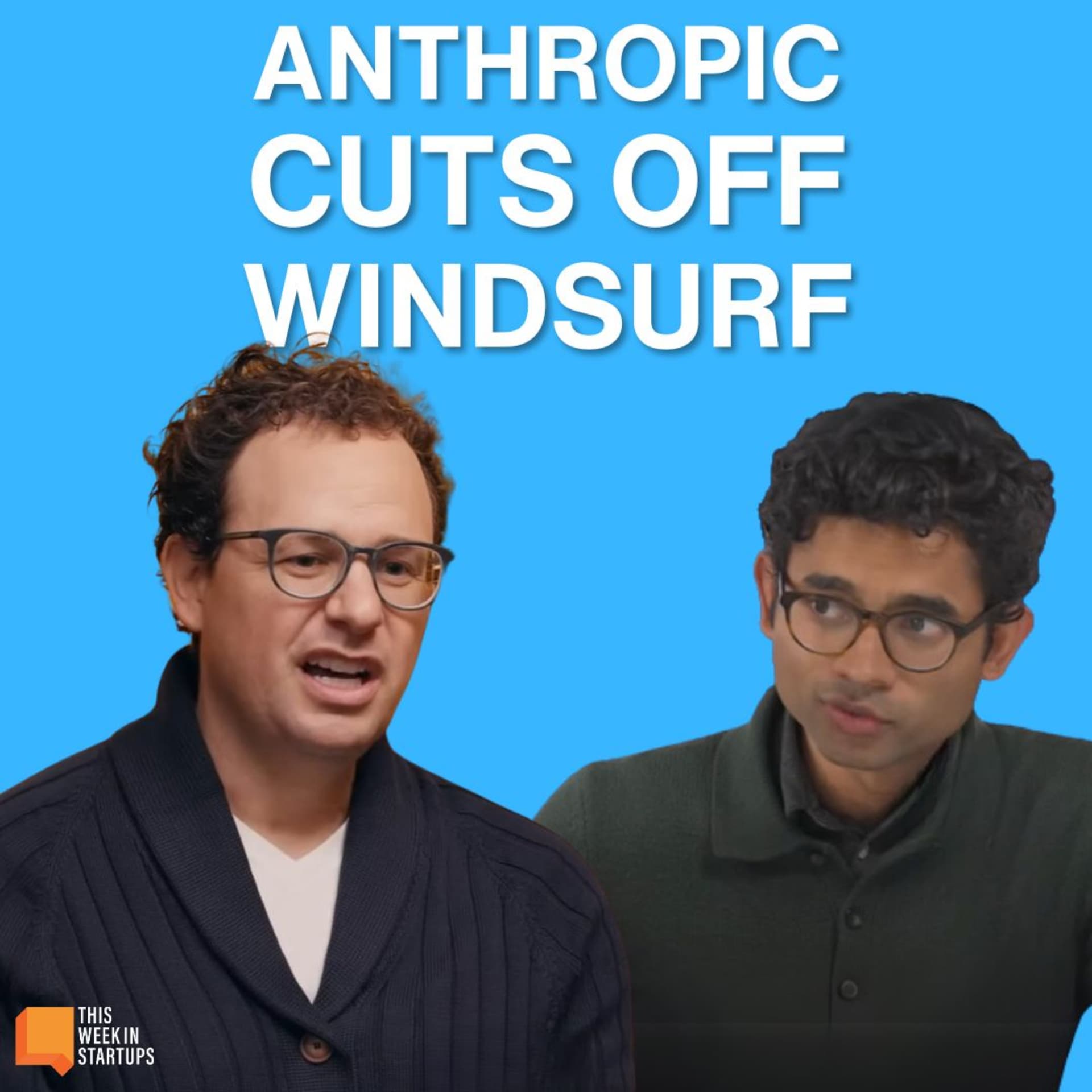
Episode Overview In this episode, Jason Calacanis and co-hosts Alex Wilhelm and Lon Harris cover a range of topics revolving around startups and technology, including significant news about Anthropic, Deel, and Flock Safety. Their discussion weaves through themes of business acquisition risks, legal battles, and innovation in surveillance technology.
---
Key Themes and Discussions
- Anthropic Cuts Off Windsurf
- Context: Windsurf, a startup reportedly in line for a $3 billion acquisition by OpenAI, was abruptly cut off from using Anthropic’s AI models.
- Platform Risk: This incident raises concerns about platform dependency and the risks associated with using proprietary AI technologies.
- Continuity: Discussion on the implications of severed partnerships in tech and potential recovery paths. Humorously likened to personal relationships—once removed, returning is complicated.
- Growth Metrics: Anthropic recently reached a $3 billion annual revenue run rate, showcasing rapid growth within a competitive sector.
- Deel's Legal Saga
- Allegations: Deel is embroiled in controversy after being accused by competitor Rippling of unethical practices, including spying.
- Defense: Deel's argument states that information taken was public or readily accessible, complicating the legal narrative.
- Business Growth: Despite the legal challenges, Deel continues to report significant growth metrics, having crossed the $1 billion ARR milestone.
- Flock Safety and Surveillance Technology
- Product Overview: Flock Safety focuses on enhancing community safety through license plate reading cameras and drones.
- Privacy Concerns: The conversation touches on the balance between effective surveillance for crime prevention and the potential for privacy violations.
- Community Control: Flock emphasizes that their technology is deployed with the consent of local governments and communities, underscoring a democratic approach to safety.
- Future Developments: Discussion of the potential for integrating drones as first responders and the ongoing evolution of public safety technology.
---
Key Takeaways
- Platform Dependency Risks: Startups leveraging AI technologies should be cognizant of the risks associated with dependency on proprietary platforms and the potential for abrupt service cutoffs.
- Legal and Ethical Standards: As competition intensifies in startup ecosystems, the ethical standards of business practices are under scrutiny. Companies must navigate their public image carefully amid legal challenges.
- Evolving Public Safety Tools: Flock Safety's innovations in surveillance and community engagement illustrate a shift towards technology that is designed for public good while still necessitating conversations around privacy and ethics.
- Democratic Oversight: The importance of democratic processes in deploying tech solutions like surveillance cameras highlights the need for community buy-in and transparency in governance.
---
Episode Highlights
- (0:00) Episode teaser
- (2:48) Discussion on ADP employment numbers indicating economic trends
- (5:54) Circle IPO oversubscription
- (13:00) Anthropic’s relationship with Windsurf
- (20:57) Deel's defense against allegations
- (30:50) Flock Safety’s technology and community impact
- (42:44) Future innovations in surveillance tech
---
For further insights and updates, listeners are encouraged to subscribe to the [TWiST500 newsletter](https://ticker.thisweekinstartups.com) and check out additional resources linked in the episode's description.
Written by AI. May contain mistakes. Listen to the episode to check what was said.
Transcript
Automatic transcript. May contain errors.0:00The rumor, the reporting is that OpenAI is going to buy Winsurf around 3 billion. a pretty big check. We're kind of waiting for that news to drop, to be honest. I'm kind of confused why that deal hasn't wrapped up. But in the meantime, Winsurf, which has previously used, at least in part, AI models from the Anthropic Claude family, got cut off with less than one week notice. Well, maybe if the deal doesn't go through, Anthropic will be like, ah, never mind. Come back to Claude. I think if you kick someone out of your house, the relationship's over. Yeah, that's true. It's tough to go back on that.
0:32Yeah. We come back with your basket of clothes like oh i'm just gonna move back in no you're you know once once you sever certain relationships i don't think they really come back um i feel like a heartfelt apology an edible arrangement it goes a long way this week in startups is brought to you by vanta compliance and security shouldn't be a deal breaker for startups to win new business vanta makes it easy for companies to get a sock to report fast twist listeners can get one thousand dollars off for limited time at vanta.com slash twist. Lemon.io. Hire pre-vetted remote developers and get 15 % off your first four weeks of developer time at lemon.io slash twist.
1:09And Northwest Registered Agent. Starting your business should be simple. With Northwest Registered Agent, you can form your entire business identity in just 10 clicks in 10 minutes. From LLCs to trademarks, domains to custom websites, they've got you covered. Get more privacy, more options, and more done. visit northwestregisteredagent.com slash twist today. Hey everybody welcome back to this week in startups my name is Alex and I'm joined today by Lon Harris as we said earlier on the live show our dear leader Jason is a bit jet-lagged and therefore not here today so we are going to forge ahead without him because there's just too much news to throw to our bank to twist our interviews we have to get through it Lon how are you how's the week over in Austin?
1:48I'm doing great it's a it's a good week in Austin I joined TikTok this week so I'm actively I'm working the TikTok angles. I'm trying to go viral over there. So follow me up. Look up Lon Harris 69 on TikTok. I did not choose that. TikTok chose that. Yes. And if you want to see my now excellent two TikToks, you can find me on Alex Wilhelm 9999. There you go. For whatever reason, that's us. We're trying to be young and it's going about as well as you would think. I can't believe there's 9 ,998 other Alex Wilhelms already on TikTok. That's amazing. I mean, to that point, I can't believe there's 68 other Lon Harrises.
2:28I do think these might be randomly generated numbers. Or not randomly. Everybody gets 69, 9999, or 420. I tried to get 420, so I thought that would be humorous because I'm also 12 years old, but it didn't let me for some reason. Anyways, Lon, enough with our babblings. Let's dive into the news today. First up, a macro comment for everybody. ADP, the kind of third-party payroll service that everyone uses or has used in the past at some point, dropped their May employment report lawn. And it said there only were 37 ,000 new jobs created here in the US. Now, ADP data comes out before the official government data, but it is directionally interesting.
3:05And I do think that number is scary to a couple of folks. It hit the stock market. People are worried about an economic slowdown. Actually, you're in Austin, which is going through a kind of interesting economic times lawn. What do you think about the employment numbers? I mean, I think that we're in this all year. I've been seeing there's a lot of articles. There's a lot of posts. I think there was just one that went up the other day that was like, how many jobs is AI really taking? And I feel like we're all we've all been reading the trends and the think pieces around this. And so, yeah, I mean, it's tempting to say now that we have some real world data that seems to be suggesting hiring is slowing down.
3:42Employment is like growing, but much slower than it has been in the last few years. I think it's very tempting to make that connection. like well we're here it is it's arrived we're losing jobs to ai but i haven't seen like we don't have the hard data yet like i don't think there's proof all of these jobs are going to computers i think it's just like tempting to link these two stories yeah yeah no i think it's a good point actually i'm going up to boston tomorrow to take part in a panel that if memory serves v2 communications is putting on anyways i agreed because it's a non-show day so i can just go up there quickly and do a chat.
4:19But I was talking to a friend of mine who's going to be on the panel with me and we were discussing this exact thing. How will AI impact jobs? We were talking about it from a journalistic context, but then we were like, hey, we're going up to this panel. I wonder what's going to happen to junior level PR people in an AI automation era. And I think the answer is we don't know yet, but PR was a place where a lot of new college grads went and got kind of early entry stage work and then worked them at the ladder. But yet again, an example of a place where we could see, I think, job loss to automation, much like we've seen in and around our own industry.
4:47So the ADP number, bad, but maybe not indicative yet of AI taking everyone's gigs. It's just interesting that we don't really know. We are all kind of like waiting on tenter hooks for this moment to arrive when we can definitively say, oh, that job went to AI. I mean, they were even debating this on All In this past week where Jason was saying he thinks a lot of these management, like he thinks Microsoft laid off some management level people because they're thinking that those jobs can be taken by AI. It led to a big back and forth on all in, but it's just, we're in this interesting moment where it's been purely theoretical for so long.
5:23I think we're all excited slash terrified of this moment when it crosses that barrier from being theoretical to like our daily lived in reality. And it's just like, but is it here yet? Or is it next year? Is it the year after that? It's just sort of. Tariff impacts or economic concerns about Europe or other things. There's a million variables. Yeah. It's not a good number. Why do startups care? Well, it could mean that the Fed cuts rates sooner, that lowers the price of money. It makes investments like venture capital from the LP perspective more interesting. It'll ding fintech startups that are currently eating off of a net interest margin, like perhaps Chime or perhaps, I don't know, Coinbase could probably be in that bucket as well.
6:02So keep an eye on it, but it's just a macro point, Lon. I think we should go ahead and start with Circle's IPO because that is the news that I'm most excited about. So for everyone out there, we've talked about it here on Twists quite a lot. Circle is the company behind the USDC stablecoin, a private market startup that almost went public loan via a SPAC years ago, and is now making a real run at the public markets. The latest, as we wait for it to price later today, is that it's 25 times oversubscribed. And I think that is probably indicative of some positive sentiment around it, but we don't want to take, I don't want to give it too much credit because I always feel like every IPO is like, oh, we're oversubscribed.
6:40But Lon, I do think that as we watch the Spintech company list, it's a nice early indicator that at least some people care. Yeah, some people definitely. I mean, I'm so curious about, in general with stable coins, like what percentage of the US population really gets this and not just gets what a stable coin is because I think that's not so complicated, but gets like, why would you invest in a stable coin? Like, how do you make money from stable coins? Like, it took me a few days to like grok this, I feel like. And like, I'm somebody who talks about crypto at work every day. So I feel like I've got a little bit of an edge.
7:20And like, I don't know, like, I see stuff like this and the micro strategy stuff we've been talking about. And it's like, these investment vehicles are out there for everybody in the public. and like these are the same people that could not follow and or when i was watching that along with them on social media so it's like do they really all get what they're buying or is it just this sounds good donald trump is talking excitedly about stable coins like i worry that there's a lot of kind of amateur investors that are going to get sucked into these kinds of schemes without fully understanding what they're buying i appreciate that perspective i want to disaggregate slightly though, because I don't think people buy stable coins expecting the types of returns they might get from buying, I don't know, Dogecoin and hoping it goes up or buying and holding Bitcoin, for example.
8:06It's more of like a shovel that really kind of translates between the traditional fiat world and the crypto world. And that to me is interesting because I don't think you actually need to understand it. I think you just need to use products that use stables. So I think we're going to see these become kind of a de facto way of companies handling some of their own internal accounting and movements of money. And I think it's going to open up doors for people in other countries to access services they wouldn't be able to otherwise. Again, not really an investment context. So I wonder if, much like most people don't understand derivatives or options contracts, and yet Robinhood's doing very well, right?
8:40Robinhood's crushing it. So I wonder if the public needs to be that fully aware of it. But we'll get a lot more information because once they're public, they will drop numbers every single quarter for us to dig into, which is great. it's exciting oh i'm so i love it companies go public law i learn so much and then every quarter they have to literally come come up in front of the class and give a report and it's great because i get to constantly learn from them yeah it's a it's a look i understand it's a liquidity thing as as much as it is a personal investment vehicle thing it lets you move your crypto and your dollars around i i do yeah yeah um before we move on can you give me a quick update on the 2025 IPO class.
9:20I'm curious about how the other debuts that we've had seen this year are doing. All right, founders, I know you're building something amazing and you're going to change the world. And now, hey, the big logos, they're taking your calls, right? But here's the catch. If you're not SOC 2 or ISO 27001 compliant, these deals won't close. Now, some of you are saying, I've never heard of those terms. Some of you are saying, I've heard of them, but I don't know what they are. And that's where Vanta comes in. They're going to be your partner and they are the all-in-one compliance solution that helps startups get audit ready.
9:55And that's going to build a strong security foundation for your company, which you want, but they're going to do it quickly and painlessly. Vanta automates the manual security tasks that slow you down and that streamlines your audit. So here's your call to action. Whether you're closing your first deal or you're gearing up for growth, Vanta is going to make compliance easy for you. Join over 8 ,000 companies, simplify your compliance, and get$1 ,000 off at vanta.com slash twist. That's V-A-N-T-A dot com slash T-W-I-S-T. So we've got eToro on here. That is now priced at$52 per share. That was priced at$52 per share as an IPO.
10:35It is now worth$64.65 per share today. So if you bought that, you made 12 bucks per share. You're doing all right. CoreWeave, that debuted at$40 per share. It is worth, strap in folks, 156.60 per share today. So if you bought CoreWeave at its debut, you're a very happy man today. You know, it's funny. You look like you have a spot. Did you buy CoreWeave on its debut? You look like a happy investor. Lon, I'm a journalist, so I just buy index spots. With one caveat that I'm not allowed to talk about yet. But anyways, Cornweave, since we wrote these notes, actually, is up even further. Now it's, holy crap, it's at 163 to share.
11:16So nearly 4x its IPO price. Why do we care about all that? Well, investors that might be looking at future IPOs that are coming out this year might be looking back at previous IPOs from this year in and around the technology space. And to see those two relatively high profile debuts perform well, I think Lon provides a little bit of a tailwind to Chime and therefore Figma and hopefully, I don't know, um data bricks down the road and so forth so it's good discord perhaps uh yeah i i think uh the interesting thing here about core weave too is that was one that we were talking so much before the ipo about the skepticism around it because like oh they only have like a few big clients like microsoft is so such a prominent client like is there is this really as profitable a company and it's like looking back now like if you're one of those people it was it was a lot of worry over a lot of worry.
12:05Then OpenAI showed up and bought a bunch of their stuff. They've lent some other deals as well. And people are just very bullish on the data center space. For context, though, for folks who don't live and breathe this stuff quite as much as we do, Lon, it's funny to me to go back to the start of the year because DeepSeek R1 comes out, everyone goes, oh, we're not going to need data centers. And then everyone sold everything for like two weeks. And then we move past that. And now we're here again with market excitement about data center investment. So We talk a lot about like the Trump 72 hour rule.
12:33It's kind of like the whole world in 2025 has a 72 hour rule. Like don't freak out and overreact to anything the day it happens. Like wait a few days after the excitement settles down, like, and really see what the landscape looks like. Like at this point, you shouldn't really trust anything the day you hear about it. All right. So some breaking news from today that everyone's talking about that is absolutely important that we're not going to wait, even though Lon actually makes a pretty good point there. Okay, so - No, wait two days. We'll talk about this on Friday. All right, bye everybody. It's been a great show.
13:05No, Windsor, keep in mind, this is the startup previously known as Codium. We had him on the show last year. They built the IDE that is agentically AI infused. And the whole idea is a bit like Cursor. It's going to help you write code faster. Now, Lon, last on the show, we talked about them because the rumor, the reporting is that OpenAI is going to buy Windsor for around 3 billion. A pretty big check. We're kind of waiting for that news to drop. To be honest, I'm kind of confused why that deal hasn't wrapped up. But in the meantime, Windsurf, which has previously used, at least in part, AI models from the Anthropic Claude family, got cut off with less than one week notice.
13:43So I believe the order of events here is Anthropic goes, oh, you guys are going to sell to open AI? Well, no more technology for you. And then Windsurf went, no, no, no, please, please, please. And Anthropic went roughly kind of thumbed their nose at them. I'm blown away by this news. Really? Yeah. And here's why. Yes. Let's unpack that. Okay. On a competitive basis, it doesn't make sense for open AI to not want to be directly supporting a company that's going to be sold to its arch competitor and therefore ceding data and information about how - Anthrop. Yeah. Why would Anthropic not want to keep supporting Windsor?
14:17Well, I kind of get it, but here's the thing that scares me. AI foundation model companies, in a sense, have to be Swiss. They have to be a little bit like Switzerland. They have to be a little bit neutral, because otherwise, you're kind of taking on platform risk by using their models, which makes them less attractive. Now, any startup that uses Anthropics models, but gets too close to OpenAI, or Microsoft, or Google, or Meta, or Mistral, or any other foundation model company, will have to ask, are we at risk of being cut off? And so it's a reason to use open source models, I suppose. But it's just more sharp elbowed from Anthropic than I expected, because now I think there's just developer and platform risk that wasn't there before.
15:00And it's the first time I've seen this happen, I think. And also Anthropic of all the big AI model companies, so much of their branding and their theme is like, we're the responsible, safe choice that takes you and your data into account. And like, we're looking out for everybody. Like they're way less aggressive just in terms of the marketing and the way they speak about their company than, say, the open AIs of the world. So it is kind of surprising to see them being, like, the toughest, most aggressive player in this, where they're like, Yes. You're being cut off. No more anthropic. You can't hang out with Claude.
15:36Stay away from me and my large son. I think this actually makes the deal more likely to get done. Because now, if you're windsurf, suddenly one of the legs of your stool was cut off. So you're going to be looking around trying to find who's going to help you out. and did you know that OpenAI's Codex tool does some agentic coding work that might be a fine fit for what Windsurf does? I just feel like they're almost saying this deal now has to get done or Windsurf is going to really struggle because I think Cursor still has access to Anthropic models. So a bit of a mess. Maybe if the deal doesn't go through, Anthropic would be like, ah, nevermind.
16:07Come back to Claude. I think if you kick someone out of your house, the relationship's over. Yeah, that's true. It's tough to go back on that. Yeah, we'd come back with like your basket of clothes. Like, oh, I'm just going to move back in. No, you're, you know, once you sever certain relationships, I don't think they really come back. I feel like a heartfelt apology, an edible arrangement, it goes a long way. I want to add on to the Anthropic discussion, though, and point out that the reason why I think Anthropic is willing to burn these boats, if you will, is because they've just posted simply insanely fast growth.
16:37So Reuters reported, I think it was today or yesterday, that Anthropics revenue reached the$3 billion annualized run rate metric by May of this year. Now,$3 billion in revenue for a foundation AI model company, it's still smaller than OpenAI. Why do we care? Well, it was$2 billion, again, according to Reuters back in March, and$1 billion in December. And that means that they've gone from one to three in roughly a half year. and that is the type of growth you would love to see from a seed stage company with a million dollars in ARR not a billion dollars in annual run rate so it's a thousand x more impressive and I'm just blown away but if I was that strong growing that quickly I think I could have some pointy elbows to get people out of the way I just hope that this doesn't bite them in the in the backside as other people might go well we're not going to use Claude because you guys are are the jerks.
17:31And Claude already feels like it is in sort of like, in terms of prominence outside of the, I talk about AI everyday world. I feel like you're, you're already a little bit of half step behind, like an open AI, a Google Gemini in terms of prominence. You want more companies and more platforms to start pulling in Claude, not the opposite. You don't want to create a situation where they're like, Oh, well we could just use chat GPT instead. Let's just go with that. Like, chat GPT is already the brand name that you're trying to like move in on. Yeah. Well, I mean, I would say that they're kind of chasing different markets to a degree, but I do absolutely concur with you that when you ask people, what is AI?
18:13They go, the GPT thing, you know? Yeah. I mean, this is an old story, but I told it a couple of months ago, I was at a poker table and the relatively non-techie blue collar, slightly older group at the table were talking about AI and they just called it GPT. And I knew what they meant, but that was impressive to me about how far that brand has gone. Claude, definitely not that level of like common person prominence. If I was working at Anthropic, this would be something that's on my mind is like for the lay person, because we were talking about this in terms of Grok not long ago, that the fact that it's there embedded in every tweet makes it so much more visible.
18:52So many more people already have the opportunity to be like, oh, Grok this, I'm going to grok this or like at grok, is this true? Which you see now after every single tweet on that platform, it's become a meme. Right. And like Claude doesn't have that equivalent yet. Like, I think it could. I think Claude, I think Claude is great. I'm a big proponent of Claude, but I feel like there isn't that, oh, I'm going to Claude this use case. And they want to do more to expand that, not make people concerned about, oh, I don't know if I want to include Claude, because what if they then screw me in six months?
19:27Yeah, Anthropic. Just Claude, it does not. It doesn't work great. But I do, I think of all of the major, and we can move on after this, but of all the major LLMs and AI models, Claude is by far like the most fun name for one, where it's like, oh, I'm going to ask Claude about this. Yeah, versus, I'm going to ask Chad GPT, oh, four mini GPT plus pro, you know, mega, whatever. It's terrible. It's Windows XP branding. founders let's be real finding the right developers is time consuming it's arduous it's painful you hear the tone of my voice and you're trying to scale your startup well my friends at lemon.io can save you time they're going to save you money and they're going to get rid of the headache that you have right now which is finding great developers they've done all the legwork and they have pre-vetted developers and they're ready to help you ship product their experience their results-oriented.
20:20Lemon.io isn't just finding you great developers, but they're helping integrate them into your team. They're skimming the cream. They're only offering handpicked developers with at least three years of experience. This is the 1 % of the 1%. This is the creme de la creme. And if something goes wrong, Lemon.io will find you a replacement developer ASAP. That's the timeframe I like. Twist listeners get 15 % off their first four weeks. I think that's a month. 15 % off the first month. Pretty good deal. Totally unnecessary. You guys have great prices anyway, but hey, we appreciate it. So stop burning money.
20:53Hire developer smarter. Visit lemon.io slash twist. Let's move on and talk about Deal. Now, if you don't recall, Deal was accused by competitor Rippling of essentially hiring a spy inside of Rippling's operations, exfiltrating information, and essentially being very, very poorly behaved. And when this lawsuit dropped, it was essentially, I think, the startup equivalent of a bombing raid. It just was causing explosions all over the place. People were like, are you serious? It read really bad James Bond fan fiction inside the startup world. It's like Jean Le Corre. It's like a spy novel in there, you know?
21:35They're leaving secret messages. but a bit more airplane than yeah you know like jack reacher like yeah like a nept guy's trying to do a john le caray it's like a lawn and i tried to like break into google like you know we'd eventually get caught and people would say that we weren't very good at it okay so that's the groundwork here time has passed and now deal is trying to correct the narrative a little bit and i want your opinion about how good of a job they're doing so the ft reports that um a certain Rippling employee, a Brett Alexander Johnson, who was a, quote, competitive intelligence manager, Deal says, posed as a customer and accessed details of its products and business practices over the course of about six months.
22:16Rippling responds and says, these are allegations of a junior consultant who later became a full-time employee reviewing non-confidential materials available to thousands of Deal customers, quote, we're looking into it. This doesn't sound like anything like the same scale of bad behavior. And so to me, Lon, this doesn't actually change the scales very much. Like, you know, there's only a few ways to respond to like, hey, you purposefully sent a guy to spy on us. And one of the things that you could argue that would maybe potentially get you out of that would be, well, they weren't stealing like confidential information.
22:53They were just stealing stuff that you guys had lying around. They're trying to be like, hey, these weren't really like top secret things. No one could see. These are things any of our customers could have stumbled upon if they were looking for them. But what it doesn't address is the intentionality behind it. That regardless of what you stole, you stole. Like they're not denying the core allegation, which is they have this employee pose as a customer, take things from deal and then show them to Rippling, which they then use. they're just like, yeah, but it wasn't like stuff you guys had locked up in a vault.
23:29And it's like, well, that's okay. I think you can make quite a big mountain out of a mole here. So I kind of disagree with you because if someone who was probably at the time a consultant, which is why Rippling pointed that out, went through the customer onboarding flow as a test, got some stuff that said, here's how to use deal. And then gave that, that to me is so low grade. I would say, okay, that CEO should buy the other CEO a drink. the deal spine, the, the rippling allegations that deal spine were a magnitude higher. So to me, I agree. I'm not, I'm not saying these are equivalent cases, but I do feel like it's still not really like a full, it's like, it's like, it's like two thirds of an excuse.
24:13It's like, okay, that excuses the worst of it, but you're still admitting to the core alligate. Fine. I'll take that. But I don't think that what Deal has done. We should make it clear both of these companies are making allegations about one another. It's not just going one way that we didn't like fully set that up, I feel like. I will say also we have seen today or in the past the Ripley in suit. I have not gotten my eyes yet on Deal's complaints. So I haven't had a chance to read through the whole thing. Perhaps they're actually quite salacious from where I stand now, it does feel a bit like a BB versus a bazooka.
24:49And that's what I'm trying to point out about the relative scale here. Now, I said in the framing here that Deal's trying to, you know, shift the narrative a bit. Accusing Rippling of similar maybe behavior is one way to do that. The timeline is Rippling came out first with their very serious allegations. And then Deal is sort of doing that countersuit. Actually, this goes both ways. So that's the larger context we're talking right but deal puts out this suit people get their hands on it i presume the ft was sent a copy of it in some way and they also dropped some information so according to reuters deal crossed the one billion dollar annual revenue run rate milestone in the first quarter that's kind of a dated data point but still a very big milestone for the company it grew 75 in the 12 month period ending april 30th and had an ebitda margin that's earnings before interest, taxes, depreciation, and amortization of 18 % in the first quarter.
Read the full transcript
25:44So what I think they're doing here is trying to muddy the waters by accusing Rippling of some bad behavior and then going, but by the way, did you know how great we're doing as a business? Wouldn't it be great if everyone thought that we weren't a bad actor here? The thing is, how has no one gotten fired yet? I wanted to ask Jason about this because I'm curious, who's responsible for looking a founder in the face and going, you screwed up so badly that you have to go now because you're hurting the business. I mean, as long as the the back and forth, the like your allegation stuff is going on, like you don't want to fire anybody because that's an admission of guilt.
26:23That's like this person did something wrong. And so they've got to go. And I feel like just from a PR marketing perspective, you know, that's giving the game away. Like, like we didn't do anything wrong means nobody deserves to get fired. okay but like the rippling suit yeah and you know i'm not a lawyer i've never tried a case i've never this is not my domain but a plain text reading of that suit to me indicates that there is if the allegations are correct a moral vacuum in the c-suite over a deal and i i i've talked to deal i i think i've talked i think i've talked to alex over a deal back in my tech crunch days memory serves deal handles my payroll for inside i get paid to do the inside streaming newsletter via deal hey don't mess with my money deal yeah no i'm just saying i they seem very trustworthy they seem very reliable i'm sure nearly everyone there is reliable and trustworthy but if you wanted to tell the world the core dna of a company you're going to trust with payroll and taking care of your people is solid i think a little house cleaning is an order unless the allegations are so wrong that rippling is you know liable to deal with a defamation suit which i don't think has been filed and so to me there's there was a pause of hoping this dies down and then a counter claim and then these milestones i i just think it just shows that not everyone is obsessed with doing business to the standards that i would personally demand for my service providers all right uh one more ai story today cohere is a company on the twist 500 they are a canadian AI Foundation model startup co-founded by Aiden Gomez.
28:02And if you don't know who Aiden Gomez is, he's one of the people that was named as an author on the critical and seminal attention is all you need paper from Google that actually kicked off the entire kind of LLM era, if you will. So someone with a deep pedigree in the AI space. The news here, Lon, is that Cohere is in talks according to, I forget where this is from as I click found. Ah, once again, the FT. Financial tax. Another$500 million, perhaps at a flat valuation from their last round of$5.5 billion, perhaps at a slight up valuation. But what matters is another company is doing quite well in the AI foundation model space.
28:38The thing that I care about the most here, more than just the fact they're going to raise another half billion dollars one year after they raised a half billion dollars, is that the FT says the company, quote, doubled its annual recurring revenue in the last four months, crossing$100 million last month. that is incredibly impressive in terms of scale and growth. Yet another fast growing company. Yeah. I mean, do you think that this sort of mad dash to put money into so many of these foundation model companies and startups is, is that just, it's so frothy, everybody's so panicked to get into AI that they're putting money at anywhere they can?
29:14Or is it like, we really do need all of these companies creating AI foundational models? Investors like me are not going to fund your business if it isn't structured properly. This is something that occurs during due diligence. We have a checklist. One of the first things we look at on the checklist are, is this company even incorporated? And is it in good standing? And is it compliant? If you don't get that stuff done, we can't wire you the money. We can't show you the money. We can't ship you the money. And that's where our friends at Northwest Registered Agent come in. for just$39 plus state fees.
29:50They're going to handle all your paperwork, keep you compliant, and make sure investors see you as a serious business that is worthy of investment. In just 10 clicks and 10 minutes, your business is officially investor ready. Thousands of founders trust Northwest because they keep businesses in good standing. Go to northwestregisteredagent.com slash twist and get your business investor ready today. For just$39 plus state fees, You can set up your company right away, fast, private, and compliant. Go to northwestregisteredagent.com slash twist today. You know, I think a year ago, I would have answered that differently.
30:24And I would have said it's hype. It's just froth. It's people being silly with their money. But I think we need to shut up and let them cook. Because if you're seeing companies add$2 billion in revenue in six months, if you're seeing open AI grow as fast as it has historically, if we're seeing yet another company here reach nine figures of revenue and a really quick ramp, I think actually right now we're seeing takeoff versus headwinds. All right. Let's stop talking about AI for a bit because, oh my God, even I'm bored of it at this point. All right. Let's go to space. My absolute favorite startup market, Impulse Space is the company we're talking about today.
31:02And if you go back in time, if you're a big Twist fan, you may recall that in March, mid-March, March 18th, episode 2099, I interviewed the guys over at Starfish Space. And the pitch there was essentially tugs, like the boats in space. They go around, they move stuff. Well, there's more than one company working on this. And Impulse Space is a competitor and they just raised$300 million in a Series C. That's a really big round for a space tech company, even though they're building expensive things. But what's really cool is that it seems to be going really well for Impulse. I love seeing a company succeed in this area.
31:38they do two things they have a product called mira which is an orbital transfer vehicle which is what we call a space tug and they also have helios which is well i'm going to show you in a second but first lon i want you to watch this video of one of their mira missions out in space and see if you can catch the the humorous moment that comes up if you're listening to the audio version it's a spacecraft cruising around the planet looking pretty stationary and then the perspective changes in the video and suddenly we are shown a image that has a bit of text on it i'm gonna have lon read it out for you guys once it comes up how is my orbital maneuvering go to impulse space like oh like one of those how's my driving bumper stickers yes yes but on a satellite which i think is just incredibly cool and cheeky in front of them uh they've done two mira missions Helios is going to come next year in 2026.
32:34It's essentially just an engine that takes you up from lower orbit to a higher orbit. But the company claims 30 signed contracts worth$200 million for their space logistics company lawn. Apart from your Luddite-ism about going to space, I'm curious what you think about our fine friends over at Impulse. Oh, I think this idea is great and has nothing to do with me going to space, so I'm all for it. I mean, I think that to me, what's interesting is only a few years ago, we were reading all of this panic stuff about space debris. There was all this like, we're just launching stuff up there and then we've got no way to deal with it.
33:06It just sits there in orbit and one day it could fall to earth and kill us all. And I feel like we already have sort of innovated ourselves out of this dilemma. It's like, well, now there's space tugboats that could push things out of the way. And like it just even though even if this particular product is not designed for that, It feels like we are developing all of these answers to all of these questions in terms of spending more time in space, managing humans in space, building things in space. And it's hard for our 20th century brains to really wrap our minds around that. But a lot of very smart people are already figuring out like what you called space logistics, which I think is sort of this exciting new idea that we actually do have the capacity now to like move things around independently in space and like operate there.
33:57Like we belong there more than, you know, we used to. Yeah. All we need is a couple of billboards, maybe a gas station or two and we're off to the races. Exactly. All right. Now, Helios, I promised to show this. I'm going to live up to my word here. This is a gift. Helios. And Lon, as you'll see, it's going to cycle through a number of setups here. So what's going on? Well, Helios is this thing, not this thing. It is the engine that attaches itself to other people's space technology, satellites, whatever, to push them into other orbits. And it's called the high energy kick state, which is one of the coolest categories I've heard of in some time.
34:33And I'm hopeful that it goes well for them. I just think that the space economy is now to the point in which it's lucrative enough to actually kind of a business versus a research project. And that's what I've been waiting for as a lifelong science fiction nerd. Like this is what I've wanted. Sure, I want to go to space, but really what I care about is, is my species getting out of our gravity well? And the answer is increasingly yes. You know, lower launch costs, faster launch cadences, better in-orbit technology for refueling and movement. And, you know, we'll figure out the space trash problem that you alluded to, but I'm just so freaking excited that we're figuring this out.
35:08because what if, you know, what if we need to leave? All right. Some breaking news before we jumped on today. Reddit, everyone's favorite social network on the intertubes for discussing things with your niche community, is suing Anthropic. I know this is kind of like the Anthropic show. Sorry about that. Not intentional. There's just a lot going on. But Lon, as you recall, Reddit has a deal with both Google and OpenAI to share its data for their use. And Anthropic did not sign such a deal. And after they had been told to stop, according to a suit from Reddit that I have not read in its entirety yet.
35:39So don't yell at me. Essentially, Anthropic kept scraping Reddit. And now they're taking them to court. This is, to me, a pretty big deal because it's going to help, I think, underscore the tensions between content owners and AI model companies. And I don't think we've figured out those economics yet. One last point before I let you talk is that there's a couple companies told that human native and created by humans, I think on the Twist 500, all startups that are trying to bridge the gap between IP and AI. And we'll see who wins there. There was a space that I care a lot about. Yeah, I mean, I feel like so many of these stories keep coming up and we're all just waiting.
36:14Like the courts are clearly going to have to, on some level, decide this. Like we're hearing the AI industry is like, look, we have to beat China. We have to win at all costs. That means we get to take everybody's IP. They're very clear on their point. Publishers and sites like Reddit and all are very clear on like, we don't want to give you our stuff for free. You can license it from us for money or you can F off. It's those are the two options. And I just feel like we keep coming back to it. Everybody has their own opinion, but none of our opinions matter. It's whatever U.S. district court judge ends up holding the gavel on this one is going to decide.
36:51And we just keep we keep going over it. We keep having this fight. Everybody has their own take. And it's just like, can we just get the judge today? like what are we do we have to wait years and years for one of these cases to finally make it to scotus or wherever like i just want to hear like what does john roberts think like this afternoon like somebody just call him and let's get an answer on this because so many of these companies and these suits and everything is like grinding to a halt because we can't decide if ai should just be allowed to steal everybody's everything or not trump can get to the supreme for like 23 minutes, but it takes the rest of the world 23 years.
37:27Yeah, but lawyers are, they're almost done deciding like, was 60 minutes unfair to Kamala Harris or not already? And it's like, like, this is much more important. This is much more important than 60 minutes of Kamala Harris. That election already happened. Like, let's please decide if Anthropic is allowed to steal Reddit content or not, because like, it's crazy that we still don't know. It's such an important decision. I want to make a couple of additional points here, because Lana, I appreciate your five I love it, but this is even funnier than you could imagine. In the suit, which I have pulled up here, actually, you know what?
38:01I'll just show everyone what I'm looking at here, because why not share the love? This is a copy of the Ureda Anthropic lawsuit, and very much, pretty much on like page two, when it's studying the facts of the case, Reddit writes, Anthropic is a late-blooming artificial intelligence company that bills itself as the white knight of the industry. it is anything but anthropic says often and notly that it prioritizes honesty and is guided by unusually high trust these claims are empty marketing gimmicks wow it is it is the most like heady and nasty opening to a lawsuit that i can recall but reddit claims and i'm going to quote directly from reddit here uh despite repeated requests to stop anthropic has accessed or attempted to access reddit content more than 100 000 times wow months after saying publicly they wouldn't and yeah you know if you're gonna stand up and say everybody we are the people who have our morals in a row our ducks are crossed and our eyes are dotted man then uh you kind of got to live up to it i'm i'm kind of curious if there's a technical answer to this like anthropic may have like not turned off the right service or whatever but no matter what if it's getting to the point of a public suit something broke in their conversations and it does not make anthropic look good or they just have this attitude that so many in the ai industry seem to have which is just like this is our natural right we're not stealing from you because we're just using it to train like like the thing you hear so much is well what's different than if you were just a person who read something in a book that you don't owe copyright you know infringement to that author and uh you know like i i think if that's how anthropic and anthropics executives really feel then yeah they're just treating reddit with cavalier disregard for their ip like you know like the jack dorsey tweet like these laws just shouldn't even exist anymore delete all ip law get rid of it you know and it's like i feel like that is the attitude of a lot of people in the ai industry and and maybe including it there up again i get i get why reddit would feel a little salty and like my might bake that into their uh legal argument a little bit yes no i think reddit i I think Reddit's probably in the right here.
40:10Can I read just like, yeah, it's like what we were saying about Anthropic earlier, which is like, if you are billing yourselves and so much of your branding is we're the good guys, like we're the heroic AI company, then yeah, you've got to actually practice what you preach. Anytime you get caught doing something underhanded, it's going to be worse because you were virtue signaling so hard the other way. Yes. It's like when a religious leader commits infidelity. You're like, well, you were supposed to be the one who got it right. Right. You're the one who made such a big thing out of it. One last thing about this.
40:47Reddit does generate material revenue from its licensing business. These deals with OpenAI and Google. I pulled their, I think it's their Q1 earnings report and other revenue, which is where I I believe that stuff lands grew from 20.3 million in Q1 24 to 33.7 million Q1 25. That's 66 % growth faster. I believe in the company's overall growth rate. And the company said that it had at the end of Q1 remaining performance obligations of 224.5 million from its long-term content licensing contracts. So it's still a lot of revenue there. And you got to protect it, man. Because if Google's paying and Anthropics not, and they're getting the same thing.
41:28Right. That's not a successful business model. You can't run it that way. I also feel like if you're wondering why your AI so often gets facts wrong, it's because it's scraping Reddit comments. Now you know. Well, all right. So I'm just kidding. I'm just kidding. While you say that, it's a bit like saying Wikipedia is not trustworthy. Sure. We all know that you should fact check Wikipedia. But when I pull up the Wikipedia page, do I read it? Yes. And I feel like Reddit's the same way with human stuff. Like if I want to get recommendations for niche progressive metal recommendations, it's kind of like Reddit or nothing.
42:05Lon, it's been an absolute treat. We will get Jason out of the time zone hell he's currently in. He's awake. He just texted me. He did. He did wake up during the show, but he decided to let us run with it. So thanks, Jason. Well, thanks, Jason. We'll have him back on Friday. Lon, as always, an absolute treat to see you. We're going to talk to Flock Safety now, a Twist 500 company that has been in the news lately for its technology. My interview was done before the latest round of headlines. But at the time, I thought I was actually a little bit too skeptical and a little bit too privacy focused.
42:35Well, maybe I was insufficiently privacy focused. So let's see how this goes. Here's Flock Safety from the Twist 500. And we'll see you guys live on Friday. Bye. Bye bye. We have yet another excellent Twist 500 interview coming your way. This time I'm talking to a company called Flock Safety. If you're not familiar with it, you may actually have already seen this technology out there in the world. It's growing like mad. It's raised lots of money. It's worth billions of dollars. And it is one, I think, of the hottest private market companies in the United States today. So please welcome to the show.
43:02It's Garrett Langley. Garrett, how you doing? I'm doing wonderful, Alex. It's good to see you. Good to see you. Now you're down in Atlanta, which is actually where Flock Safety is headquartered. I don't talk to too many founders from Georgia. So first of all, just before we dive into Flock, why are you building down in the South? Yeah, no, it's a good question. So one, I'm born here, so that helps. But, you know, we did YC at Flock. And if you look at the mission of that company, we exist to create thriving communities. And my co-founder, Matt, and I had this debate of, like, oh, should we stay in the Bay Area?
43:36Right? Because we had raised a seed round from Gary Tan and initialized and licensed to Hannon. And then I'd go, are you guys going to stay in SF? And Matt was like, I don't think we can. If our whole mission is to, like, develop these thriving communities, yet we're going to leave our, Matt and I and Paige, well, three of us are from Atlanta, where we can't leave Atlanta behind. So we came back, you know, took our suitcases and came home and said, we're going to build this thing from Atlanta. All right. So Flock Safety, as you kind of alluded to with community safety, is I think best known for its license plate reading software.
44:06These are installed either on a permanent or non-permanent basis, solar panels, wireless connectivity, all that good stuff. You also are working on some cool drone stuff with your Aerodrome project. and provide software to things like 9-11 calls and so forth. So tell me about why this was the right way to attack the safe communities point. Because I'm curious why this was where you guys decided to start. Yeah. So there's some pretty, I guess, alarming statistics that I didn't realize, which is it's very easy to be a criminal. It's really easy. Right. So let's say hypothetically, Alex, I steal your car.
44:39Sure. On average in America, I've got like a nine and ten chance of getting away from it, getting away with it. And let's say I do something like even more heinous. Let's say I committed violent crime against you. Sure. 50-50 odds. And that's the average, right? Which means 50 % of cities is worse. 50 % of communities is better. And you go around the country and you start to realize, you understand why people are really sad, like mad and upset because they live in a community that isn't thriving. In a community where crime is rampant, it's easy to get away with it. And so we asked the question, why?
45:12I don't think you want crime to happen in your neighborhood. but it does. And if you talk to law enforcement, they'd say, we don't want crime to exist. What are we supposed to do? And you realize it's a lack of evidence. Okay. So it's the equivalent of, let's say you're yelling at your BDR team for not building enough pipeline. But you're not giving them phone numbers. You're not giving them emails. You're giving them nothing to work off of. They're not magicians. And cops aren't magicians either. We don't want them to be. We want them to use hard evidence to build an investigation that leads to an arrest.
45:41And so we said, that's where we need to start. We need to start on hard evidence. So we built the camera on my dining room table. It tracks cars and needs license plates. That was, you know, seven or so years ago, coming up on eight. It's been quite a journey since then. So why is the evidence problem so cleanly solved or so helped by license plate reading technologies? I presume people are driving around in cars, but I'm presuming that I'm missing an element of what makes this so effective. Yeah, I mean, so the most honest answer is like, I'm still surprised by the efficacy of the technology.
46:10So we did the classic YC, go talk to a lot of customers or potential customers. Because we knew the evidence piece was like, you could go Google that and develop a point of view. When you talk to these chiefs, they're like, oh yeah, we just need a license plate. But why? And they're like, I don't know, it's just what we need. And now that I'm a bit farther along, there's a few things, right? One is, it's incredibly objective, right? Like a license plate is a license plate. A vehicle is a vehicle. There's no this or that. It's hard evidence. The second is, it's incredibly actionable. So if you call 911, you say, oh, I just got in the hit and run and it was a car with black racing stripes.
46:48We can just go and flock and say, show me all the cars with black racing stripes that are in this area at this time. Great, now I have a license plate. You legally have to have a license plate to drive. So we wind up being like, not only is it objective, which is good for policing writ large, but also it's actionable. And a lot of other forms of evidence, like I have cameras at my house, doorbell cameras and stuff. It's not actionable. If I have a grainy picture of a guy in a hoodie, it's not actionable. There's no next step. And so getting back to my BDR, SDR example, it's like, you want a phone number, you want an email, a LinkedIn profile is interesting.
47:23That's not a way to connect. You know, now you can obviously direct message on LinkedIn. But I think my point being is like, that picture is not enough, you actually need to have something actionable. One thing I was pleasantly surprised by was just how much the company has grown. I think TC wrote that you guys crossed$300 million in ARR last year, 70 % year-over-year growth. When I think about selling to neighborhoods, to police stations, to that sort of group, which I know is a big part of your customer base, I think of low budgets and slow sales cycles. But it seems to be kind of the opposite, that the company is scaling very, very quickly and presumably efficiently.
47:55So what's it like selling into the law enforcement and neighborhood space? Yeah, I mean, I think, you know, we went from 1 million to 100 million in ARR in just over three years, three and a half years, which is like pretty fast. Yeah, that's quick. But, you know, I'll take second place, you know, or third place, but everyone's at base. But yeah, I mean, on the one hand, it's, you know, I don't have a background in law enforcement. I don't have a background selling local government. And all of our investors and advisors are like, this is a horrible idea. Okay, so I'm not crazy. Okay, thank you.
48:27It is, right? So it's a three strikes are out, right? So we're based in Atlanta. So that's a strike. We manufacture hardware. That's a strike. And we're now selling to local government. Three strikes, your company will fail. But what we didn't realize is that our product was not only 10 times better, arguably 100 times better. It was a fraction of the cost of existing solutions. So that's very interesting to me. Can we pause there? Because you guys offer cameras, solar panels, and connectivity, which to me seems like the full stack package. How can it be so much cheaper given that? I can't really imagine a component you can take out and make these cameras work the way you want them to and have their data be accessible.
49:02Yes. The secret, that's no longer a secret because obviously we're pretty at scale. The secret then was realizing that the existing products were largely construction projects. So if you were to buy incumbent solution, 80 % of the cost structure was the physical labor. It wasn't the camera. It wasn't the software. where it was, I've got to go conduit, all this electricity, I've got to go run fiber. It's a big construction project on a right-of-way. And AI is not going to make that cheaper. There's nothing that's going to make digging holes and tunnels, maybe the Bourne company. But outside of that, it's really expensive to dig holes.
49:42And so we realized that if you removed all of the construction costs, and it was just a simple pole with a solar panel, and effectively a smartphone as the camera, Yeah. You could drive the bomb down dramatically. You could drive the implementation down. And so for us, it went from on average, anywhere from 80 to$120 ,000 camera to$3 ,000 camera. And just for folks who are listening, bomb, BOM, bill of materials, the stuff that goes into the actual thing. That's right. Yeah, that's right. That explains a lot of the growth because 3K versus 100 is an enormous savings. This is a dumb question. But when you describe the problem of digging holes in the ground, cost thereof, conduits, connectivity that's wired and so forth, it seems pretty stupid.
50:23Why wouldn't you put a solar panel in for electricity? Why wouldn't you use, you know, I'm not exactly sure which connectivity system you use, but like wireless connectivity, it seems like such kind of an obvious solution to this problem. So why was the market blind and therefore left this huge door open for Flock to become a huge company yeah well so the first thing i did was i don't have a hardware background either so i really was setting myself for hard strikes yeah i know um and so the first thing i did was i think what anyone would do is like i got on a plane to china and went to shenzhen and was like i gotta find something to build this thing for me yeah and right so i spent a month in china going to all these all these uh cms or you know kind of manufacturers saying hey i have this i have this vision i want a camera that can read a license plate of a car traveling 100 miles an hour, you know, 200 feet away, needs to run on a solar panel and needs to work in Rhode Island and it needs to work in Arizona.
51:11And it needs to work in Colorado. So like really cold, really hot, really shady, really sunny. And every single person I met was like, what you're describing is impossible. Why? It cannot be built. When you balance off the power consumption with the computer vision on the edge, with 4G or 5G connectivity, the intersecting circle, the Venn diagram had nothing in the middle. And so we naively were just said, maybe they're wrong. And it took us a couple of years. The camera was not performant, stable, a lot of things. It wasn't pretty. You can find maybe pictures are online of what the early prototype looks like.
51:47But it did track our car. It did read a license plate. And now you fast forward, we have the incumbents in the market have said, okay, wait a second, if Flock can figure this out, maybe we can figure it out. And it took them five or six years to catch up. But that's been proven to be true. But yeah, but most of the world just assumed it was technically impossible. Well, it turns out they were entirely wrong. And I'm glad you guys persevered because I love to see incumbent solutions get knocked down by about 97 % in terms of price. Now, you're not just doing license plate reading cameras. I want to touch just very briefly on the Flock Aerodrome project, which essentially, as far as I can tell, uses drones as first responders, essentially arrive on the site and get visibility into what's going on.
52:27Clearly, a drone can't make an arrest or whatever, but it gets eyes on the site very, very quickly, would you guys say actually reduces the need for police and so forth to show up in some cases? Yeah. I mean, so I would actually expand on that and say, look at the acronym we sell on. It's DFR. So drone is a first responder. And people jump to the TV version of that, which is let's go chase bad guys in fast cars. Right. And that's it. That's a that's totally agree. High speed pursuits are one of the most dangerous things that police officers do for both citizens and suspects. It's just, they're dangerous.
53:00It's bad. It's bad. So, yes, we replaced that. But thankfully, in most places, there isn't a high-speed pursuit every single day. There is fires. We use the drones to go to fires first, because how often is there a fire alarm unless a false alarm? And yet you roll out a truck, a fire truck. Which is very expensive. Very expensive. And do you run two of them? Do you run three of them? Well, a drone can get there in 30 to 45 seconds. And now you can immediately provide that live video to fire. I'll give you another great example. I was meeting with one of our customers yesterday, and it's a large college university, right?
53:36It's a couple square mile campus. They used the drones to provide aerial escorts to students at night. So just, I don't know if you went to college because I went to college in a fairly urban environment, and it was a known thing that if you were walking home by yourself at night, you could call 911, and the local PD that, you know, I went to Georgia Tech and GTPD would escort you home. Yep. Same thing at University of Chicago. Same idea. Yep. And it's a great service. Well, not every single police department is fully staffed anymore. And so now this agency uses our drones. But if you call 911 and say, hey, I need to escort, the drone walks you home.
54:11Now, clearly, the drone can't stop something bad happening, but it gives that situational awareness. And in this case, you've got one officer managing three drones at once. So now we can do three escorts at once from the comforts of a desk. and so it's more of that force multiplication where as a city you're just getting more efficiency than you would have otherwise that really tracks me and i would presume that i would be probably 90 as safe as i would be if i have was like you know being driven by a police officer if i had the drone overhead because who wants to mug the person who's literally being watched by the cops like that just seems yeah yeah because the drone can then peel off for me and follow Bob or whomever decided to take my lunch money.
54:54You're a parent. I'm a parent. We have between us nearly half a dozen children. And I can, from the perspective of me wanting to keep my little girls safe and secure, this makes a lot of sense to me. The whole package makes sense to me. But also, I am a little bit worried about overall degradation of personal privacy here in the States. And I'm sitting here really absolutely torn between the practical of you guys talk about solving, oh, what was the last number of 5 ,000 crimes a day or helping to solve that many, which is an enormous amount of crime. So yeah, legitimate applause. But I also know that police officers aren't always behaving in a manner that we would consider to be conducive to the public good.
55:38They're humans too. They're humans too. And we were giving a lot of data to law enforcement. And I think you guys have a reasonable approach to this, you know, delete after 30 days, encryption, not sharing willy nilly, all the stuff that I could kind of hope that you would have in place for a solution like this. So straight up points. But if you're someone like me, who's a little bit skeptical of turning over this much information to law enforcement, how do you balance the concern of misuse on the official side? Or even just a busybody HOA person tracking someone's boyfriend's car? Like the human element here worries me quite a lot about how this could be misused.
56:13So I just wanted to pose that and just kind of hear your philosophy as a company because you guys have a lot of cameras out there and I'm sure you have data on me. Yeah. Do you use Google Maps? Uh, daily? Yeah. You're comfortable, I guess, with Google know your exact location at all times. No, but I don't see an alternative. But you make that trade off though, right? Oh yeah. And I think that's the beauty of our country, which is Flock's not going in and installing cameras without permission from our democratically elected officials on a broad sense. And whether that's your neighborhood, because you voted for your H-O-A president to be president and make this decision on behalf of your community, or your mayor, who you voted to be the mayor of your city.
56:53And that person can get rejected if they make bad decisions. And that's the new system. So on the one hand, I'd answer that, which is like, we're not forcing this on anyone. Can I nitpick at that? Because I feel like I get to individually opt into using Google Maps and on my iPhone, I can say you can use my location when I'm using the app only. Not at all. That's useless, et cetera. But I do have some individual control over this, whereas, you know, HOAs are not famed for being the easiest to control democratic institutions, you might say. Consensus trick. And so I feel like I don't have as much of a say, although I will fully admit, Garrett, that your point is good, that I do vote for my mayor, and if they make a choice, that's reasonable.
57:36Yeah, no, I think you're right, because it's It's not a democracy, right? That's not how our country works. It's democratically elected people that make decisions. And my guess is in the case of Rhode Island and in your hometown in Providence, you probably disagree with a lot, both the governor and the mayor do. But hopefully, in general, you approve of most of the things they do if that's who you voted for. So there's that piece, right? But let's actually move into how the technology works, which is also, I think, important. Yeah, hit me. One of the coolest things about Flock is we thought through what are all of the potential negative side effects of this technology?
58:11And how do we empower the either elected officials or the customers to move those levers to best fit their community? And so the implementation of this product is dramatically different city by city, state by state. And I'll give you some really good examples. In California, there's a state law called SB 34. Okay. And it dictates that this technology cannot be used to enforce immigration. It's great. The federal law does not apply. In California, it's illegal. And so our customers do not use our products to enforce immigration. Guess what? In Texas, they do. Because in Texas, that's societally accepted.
58:49And you go down this list of data retention. In Austin, Texas, they stored the data for seven days. That's what their elected body decided was appropriate for their community. But in Dallas, Texas, it's 90 days. here at flock ceo was not elected president of america or the police chief of america so i'm going to build the tools to let those who were elected to make these decisions move it up and down say we want transparency most of our customers in california have public transparency portals that we develop for them take some of the people in california and you can see where the cameras are you can see why searches are being done you can see you can see an incredible amount of information it's up to piedmont california it's not up to me and so state by state we do that and then i think what we are a big advocate of is like we actually believe in regulation.
59:31I think technology like Flock should be regulated. And so you look at somewhere like Virginia, and I wrote an op-ed recently in Virginia on this topic, there was the Flock surveillance bill that the governor finally signed into place. I don't agree with every single detail of it, but I think I broadly applaud the fact that the governor said, we need to regulate this stuff. We should have an opinion as a state of how this technology is used, ramifications if you abuse it and all that. And I think that's great. Because I think for me, Alex maybe the the more disappointing part is when people simply take a stance of something like Flock shouldn't exist and I'm like come on that's like there's a problem in this country crime is a problem like we helped return over a thousand missing people in the last year at Flock you're gonna tell me that's like not good we can debate maybe how it's used but for me I live in the real world where like problems need to be solved and we welcome criticism of like whether it's data retention or data sharing, like let's find this balance.
1:00:34But same with you and using Google Maps, you're making an accurate decision that you would like to get to your destination faster. You're going to make this trade-off. If you didn't trust Google, you'd maybe use Apple. If you didn't like trust Apple, you'd use the next product that you didn't trust. I think it's paper maps at that point. You're getting down the list pretty quick. MapQuest, right? Is that still around? I think that was part of AOL. I used to work there. All that sounds pretty reasonable. And I don't have a compelling argument for why my heebie-jeebies still get picked up. I think there's maybe even something that oddly American about, like the idea you can get in your car and just drive and kind of be anonymous.
1:01:07And that does seem to be eroded. But I also kind of argue with myself about this because the technology to capture images and store the information and analyze it is out there. So people are going to do it. And Flock did not invent the idea of license plate scanning. And so I'm at once kind of like, my inner child libertarian is butting up against my adult, mature need for public safety. And it's an interesting kind of like the thing that I deal with, but I think a thousand people brought back 5 ,000 crowns a day. I think I'm going to land on your side here, even though I'm like 60-40 versus like 90-10.
1:01:45Here's what I would challenge you and it's like, regardless of where you land, the right answer is like, even if you land against it, then go build a better version. Well, I don't think you can. Well, that's the debate, right? Like, because if you're a mayor and look at look at cities across the u.s as they decreased their investment in public safety they all got the boot because as a citizen i want to be safe like it the bedrock of a thriving community is safety property rights yeah and absent that safety you have chaos yeah and so like for me i'm honestly quite passionate about it there is an american way to do this and like that's the way i think we're doing it and i think luckily we have a great legal team constitutional attorneys every product we build, Alex, like from the whiteboard, we have our legal team in the room.
1:02:32Because there's a lot of stuff you could go build that we just aren't ever going to build. Because we don't think it's a good idea for America. It might work in other countries for America. And I think that's one of the unique things about Flock that now that we're at scale, you know, we can afford to have these highly educated attorneys, you know, sit in the room and give us this feedback before it hits, you know, production, which I think is a better way to do it. Absolutely. And I don't want to sound overly antagonistic here because again, I'm very sympathetic to what you're working on. And I'm also very impressed by the business results.
1:03:02I just, my, my faith in the integrity of public officials, even here in my local polity is, is pretty minimal just given how they behave a lot of the time, but, but that's not your fault. It's not your fault that police officers like to turn off their body cameras and so forth. I mean, that is entirely separate. And so I shouldn't ding you for it. We're also giving tools to people that I wouldn't trust to take care of my dogs. And that's when I began to fret a little bit. But I'm glad you brought that up, though, because that to me is actually the root issue, which is we got a criticism at some point that was related to someone's distrust of the federal government.
1:03:41And my comment back to them was, well, you realize the issue is that you don't trust the federal government. That's the actual issue. The issue isn't what I'm doing at Flock. And maybe I'm getting the ramification of that issue, but like, You should question whether, like, what you should be doing differently in your life to not have that distrust. Yeah. Well, I mean, we're going to have, well, that's, that's, reforming politics and the government and the governance of our nation and its states and communities is not, not your problem. There is something cool you guys built, though, which is called a Flock Safety Safe List.
1:04:11And this is for neighborhoods, HOAs that have flock. So you can essentially mark yourself as a resident. I live here. Why, why do we need that? and also alternatively why can't we have that on a city-wide basis? I know the answer but I'm curious. Yeah, so I mean getting back to it we had enough customers ask for it so we built it. That's the most like honest honest answer. I can't knock that. I would love to say that there was some broader stroking future point. No, we built that a long long time ago and from a city perspective I don't think there's anything technically stopping us from doing that but I don't think there's a single city that has ever asked to turn that on.
1:04:49Because criminals would immediately then opt out themselves and yeah yeah i uh i just wish that i could do it though yeah i mean i'll never forget one of the first conversations we had um someone was asking me a similar line of questions alex and i i pulled up you know just google their name and i was like oh how how was your beach vacation last week with your grandkids and they're like what are you talking about i'm like you literally posted public photos of your vacation on facebook with your grandkids faces It's like, it feels crazy to me because legally speaking, if you're on a public road, you have no expectation of privacy.
1:05:25You're using government property and the license plate is the property of the state of which it's registered in. So we're not putting cameras in your house. We're putting cameras on public roads to drive a public need around safety. I think that's the most compelling argument that you can make, which is it's state property twice. It's a state road. It's a state license plates. You are literally using government approval to drive on this. You have to follow certain rules. If you don't like it tough. I'll just say this, Garrett, talking to you today is the first time I think we've spoken. And you seem very, very thoughtful about this.
1:05:54And so I am to a large degree a swaged or swaged in my concerns. And I appreciate the level of care you're taking on this front. But let's put all this beside us and go to the future. What have customers asked for you to build next? Ooh, great question. So one of the things that I didn't realize was just like how much laborious effort it is to run a police department. It's crazy. So I'll give you a great example. We were talking about 911. What if I told you that when you call 911, there's typically anywhere from a one to three minute lag before officers actually know you've called 911? That would not surprise me.
1:06:31That sounds quick compared to what I would think for local government services. Yeah, but think about how wild that is, right? There could literally be a cop a block away. Oh, I see your point. It's going to take three minutes for them to even know you've called 911. I'm on board now. That's crazy. And so for many people, their first interaction with public safety, with law enforcement, is calling 911. And it typically leads a pretty bad taste in their mouth. It's a largely antiquated system. Really hardworking dispatchers, you have a lot of people that want to do well. And so looking at something like Flock 911, now that 911 call is live, transcribed, and posted to the nearest officer.
1:07:11So that officer is a block away. And you think about the level of AI we can apply to that use case of now, in some cities like Atlanta, there's a lot of calls for service. It would be overwhelming for an officer to see everything coming through. We can now use AI to say, actually, here are the predicted cases you should go respond. Hey, there's a word of a victim. There's a word of a... This isn't about a pothole. This is about someone's been hurt. Go faster to that. So if I look across the board from dispatch to patrol, across the board, there's so many opportunities to bring AI into public safety.
1:07:45And that's probably where we're spending most of our time right now. Do you think that'll include more drones? Yeah. I mean, I think if you look at the drone use case today, we've got three drones that we build different use cases. I think drones are largely, you know, cameras that can fly. And so we sell lots of different types of cameras. There's lots of cameras out there. Drones are going to be the same way. I think we'll wake up in a day and most cities will have quite a fleet to drones. Yeah, I think that's right. I also, I just very much don't want to be like, I'm worried about a future in which drones are pervasive and then toss that on to Flock because that's not really fair.
1:08:19We care a lot about that too. Everyone, most of our team lives in America. I live in Atlanta. I care deeply about how this technology rolls out. I'm a citizen too. I have a family too. And so we're a big advocate of preventative regulation around how new technology can be used. Because I think for better for worse and i think larger for the better we hold our local governments to a higher standard than we do our businesses like they are expected to operate differently yes by a huge margin if yeah if you call we're talking about aerial airlines earlier if you call delta and you get their 100 number and it's all ai and it like hallucinates something weird you're gonna laugh it off and like you know call back oh that's kind of weird yeah because you're just booking a flight if you call 9-1-1 that's a very different expectation of service and when a law enforcement officer, to your point, shows up.
1:09:11We hold that industry to a higher standard. And that's great. We should. It also means that as technology providers, we also have to hold ourselves to a higher standard. And as the classical move fast and break things type approach in Silicon Valley, it doesn't work in law enforcement. Our customers drive Ford F-150s. They don't drive Teslas. I leave a lot of things in your hands to manage well. And I'm very glad that you're so thoughtful about it. FlockSafety.com and with AOR being where it is in growth, I'm presuming IPO in early 2027? Yeah, we'll see. We'll see. Yeah. All right, Garrett. I really appreciate you.
1:09:47I appreciate you engaging at all points and let's get some more drones up in the air. Bye. Sounds good. Have a good one, Alex.
From the publisher
Today’s show: Alex and Lon discuss Windsurf getting abruptly cut off from Anthropic just before a rumored $3B acquisition by OpenAI, sparking questions around platform risk and foundation-model politics; Deel defends itself by arguing the information it allegedly took was public or obvious, complicating its ongoing legal saga; and Flock Safety’s neighborhood-focused surveillance tech—combining LPR cameras and drones—positions itself as a privacy-conscious tool that gives elected officials control over community data governance.
Timestamps:
(0:00) Episode Teaser(2:48) ADP's Employment Numbers Might Make Your Eyes Water(5:54) Is the Circle IPO Over Subscribed?(9:25) Vanta - Get $1000 off your SOC 2 at https://www.vanta.com/twist(13:00) Anthropic Shows Sharp Elbows With Windsurf(19:55) Lemon.io - Get 15% off your first 4 weeks of developer time at https://Lemon.io/twist(20:57) Is It Really Stealing If It’s Public or Obvious? Deel Says No(29:23) Northwest Registered Agent. Form your entire business identity in just 10 clicks and 10 minutes. Get more privacy, more options, and more done—visit northwestregisteredagent.com/twist today!(30:50) The Space Future Alex Has Dreamed About(35:10) Anthropic Can’t Stop Scraping Reddit’s Data(42:44) Flock Safety is Bringing Surveillance To a Neighborhood Near You
Subscribe to the TWiST500 newsletter: https://ticker.thisweekinstartups.com
Check out the TWIST500: https://www.twist500.com
Subscribe to This Week in Startups on Apple: https://rb.gy/v19fcp
Links from episode:
Impulse Space: https://www.impulsespace.com/
Flock Safety: https://www.flocksafety.com/
Follow Garrett:
LinkedIn: https://www.linkedin.com/in/glangley/
Follow Lon:
Follow Alex:
LinkedIn: https://www.linkedin.com/in/alexwilhelm
Follow Jason:
LinkedIn: https://www.linkedin.com/in/jasoncalacanis
Thank you to our partners:
(9:25) Vanta - Get $1000 off your SOC 2 at https://www.vanta.com/twist
(19:55) Lemon.io - Get 15% off your first 4 weeks of developer time at https://Lemon.io/twist
(29:23) Northwest Registered Agent. Form your entire business identity in just 10 clicks and 10 minutes. Get more privacy, more options, and more done—visit northwestregisteredagent.com/twist today!
Great TWIST interviews: Will Guidara, Eoghan McCabe, Steve Huffman, Brian Chesky, Bob Moesta, Aaron Levie, Sophia Amoruso, Reid Hoffman, Frank Slootman, Billy McFarland
Check out Jason’s suite of newsletters: https://substack.com/@calacanis
Follow TWiST:
Twitter: https://twitter.com/TWiStartups
YouTube: https://www.youtube.com/thisweekin
Instagram: https://www.instagram.com/thisweekinstartups
TikTok: https://www.tiktok.com/@thisweekinstartups
Substack: https://twistartups.substack.com
Subscribe to the Founder University Podcast: https://www.youtube.com/@founderuniversity1916


