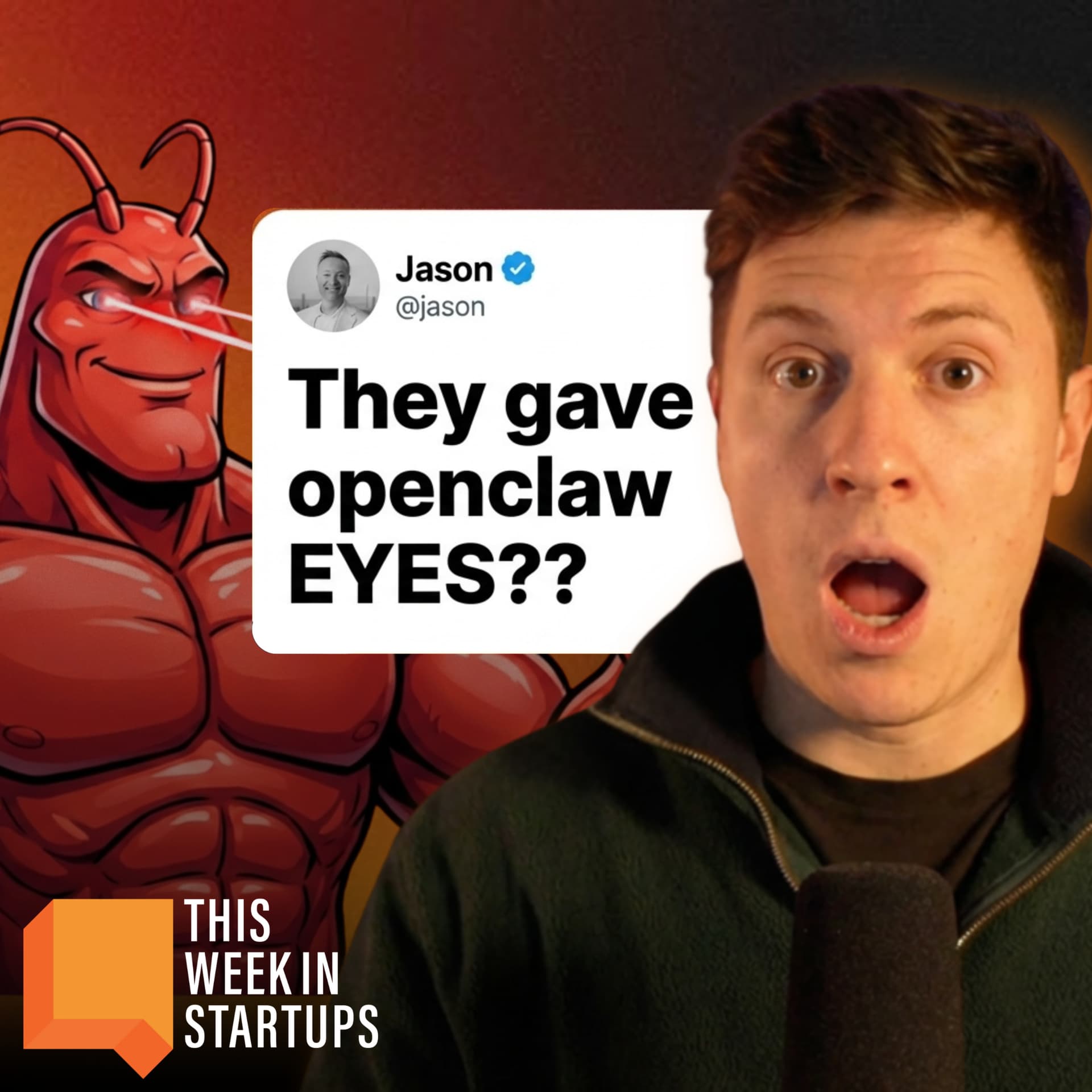

In short
Podcast Episode Summary: This Week in Startups - Episode E2247
Episode Title Does Clawdbot (OpenClaw) Need Eyes? (feat. Alex Finn and Matt Van Horn)
Episode Description In this episode, Jason Calacanis and guests Alex Finn and Matt Van Horn delve into the application of OpenClaw, an AI assistant platform. They discuss its integration with Meta Ray Bans, practical use cases for solo founders, and various other topics related to startups and AI.
Key Discussions
Introduction and Guest Introductions
- Jason Calacanis expresses his enthusiasm for OpenClaw, likening it to significant technological advancements like Bitcoin and the internet.
- Alex Finn, known as "Mr. Clawdbot," shares his deep involvement in AI, particularly with OpenClaw, while Matt Van Horn introduces his skill, "Last 30 Days."
OpenClaw Integration
- Sean Liu's Demo: Showcases an AI assistant ordering energy drinks via Meta Ray Bans. Jason finds the demo fascinating, while Alex critiques its practical value.
- Practical Applications: They explore how OpenClaw can empower individuals in business settings, improving efficiency in purchasing and inventory management for companies.
AI and Job Market Dynamics
- AI as an Opportunity: Discussion on how AI can enable individuals who have lost jobs to become founders or entrepreneurs by leveraging technologies like OpenClaw.
- Counteracting AI Job Losses: Alex emphasizes the need for solopreneurs to utilize AI to create economic opportunities instead of viewing it solely as a threat.
Features and Innovations
- VisionClaw: Introduction to innovative AI applications that integrate seamlessly into daily life, enhancing productivity.
- Local vs. Cloud Models: Debate over when to utilize local models for processing tasks versus cloud-based systems, with a consensus that local solutions may become more viable in the future.
Security and Trust Issues
- Skill Security: The OpenClaw team plans to collaborate with VirusTotal to scan skills for malware. Alex and Matt discuss whether this will be sufficient for securing user confidence.
Building an AI-Driven Startup
- Autonomous Organizations: Alex discusses his vision of creating an organization powered by AI agents that work autonomously, generating productivity and outcomes.
- Potential for Startups: Jason encourages listeners to join the next Founder University cohort focusing on OpenClaw projects, offering investment opportunities.
Closing Thoughts
- Jason highlights the urgency for solo founders to adopt AI technologies and stresses the importance of building distribution and community.
- The episode wraps up with an emphasis on the transformative potential of OpenClaw in startup environments.
Key Takeaways
- OpenClaw's Potential: Identified as a game-changing tool for solopreneurs and startups seeking efficiency and automation.
- AI's Impact on Employment: While AI poses risks to job security, it also presents opportunities for individuals to innovate and create new roles.
- Community Building: Engaging with audiences and building distribution channels are essential elements for success in modern entrepreneurship.
Timestamps
- (00:00) Introduction to OpenClaw
- (03:17) Guest Alex Finn joins
- (04:50) Demo of AI ordering via Meta Ray Bans
- (12:35) LinkedIn Jobs sponsorship mention
- (25:16) Discussion on local models vs cloud models
- (39:12) Security concerns and malware scanning
- (50:15) OpenClaw's next cohort at Founder University
- (57:13) Discussion on an AI commercial and its implications
Sponsors
- LinkedIn: Promoting job postings.
- Every.io: Business incorporation and back-office services.
- Northwest Registered Agent: Company formation services.
This summary encapsulates the primary discussions, analyses, and conclusions drawn from the episode, providing insights into the evolving landscape of AI and startups.
Written by AI. May contain mistakes. Listen to the episode to check what was said.
Chapters
Tap a time to open that second in VOPerspectives on AI in Physical Spaces
0:45 to 1:10
Discussion on the potential uses of AI in physical spaces and business contexts.
“And I was thinking more about companies that are outside of just the technology realm might have a use for this just to keep their offices stocked, handle warehouses.”
Introduction to OpenClaw
1:56 to 4:38
Overview of OpenClaw and its potential impact on productivity and AI integration.
“claw-shotted, we're claw-shotted, open-clawed.”
Empowering Individuals with AI
4:38 to 6:04
Discussion on how individuals can leverage AI for personal and economic benefits.
“Yeah, we're going to talk about OpenClaw site, what's called VisionClaw, a great way people are taking OpenClaw into the real world.”
Navigating Job Displacement with AI
6:04 to 7:44
Exploring the implications of AI on job displacement and how to adapt.
“You ask the question, you get an answer.”
Creating Opportunities in a Changing Workforce
7:44 to 9:30
Discussion on creating new job opportunities in the age of AI.
“I don't think that has any sort of economic impact on this planet.”
The Importance of Effective Hiring
14:00 to 14:46
Learn how effective hiring can drastically improve productivity in a startup.
“and then just email the CEO and say, I do open claw.”
Matt's Perspective on OpenClaw
15:44 to 16:45
Explore Matt's thoughts on employment and innovation in the startup space.
“You were here last Monday or two Mondays ago.”
Alex Finn's Vision for AI
16:45 to 21:43
Alex shares his vision of a personal AI working 24/7 for individuals.
“theme, back in December when Cloud Code got really, really good.”
Building Autonomous Organizations
21:43 to 23:08
Understand how autonomous organizations can enhance productivity.
“chief of staff, you have yourself, you have a research team, a content team, an engineering team, and a creative team.”
The Role of AI in Business Structures
23:08 to 25:05
Discuss the impact of AI on business roles and structures.
“we created a agent that is doing production, but we also had it work with the sales team.”
Show all 29 chapters
Lights Out Factories and Automated Development
26:10 to 28:00
Explore the concept of lights out factories in software development.
“Matt Van Horn, you just heard this architecture and this setup.”
Exploring Lights Out Software Development
28:00 to 29:54
Learn about the innovative concept of a lights out factory for software development and its implications.
“And I said to the owner of the factory, how do I get one of those?”
Local vs. Cloud-Based Models
29:54 to 30:26
Understand the balance between using local models and cloud-based solutions for development tasks.
“It feels to me like we are crossing into a new era.”
The Economics of Token Usage in AI
30:26 to 32:18
Discuss the financial implications of token usage in AI development for startups.
“How do you balance out when you're using local models versus cloud-based models, and And how good are the open models today compared to the state-of-the-art offerings from Anthropic and OpenAI?”
Creating a Model Council for AI
32:54 to 35:39
Learn about the development of a model council to utilize various AI models for improved outputs.
“Visit northwestregisteredagent.com slash twist for more details.”
The Future of Local AI Models
35:39 to 37:52
Explore the potential of local AI models and their implications for data privacy and efficiency.
“launch that it felt like more of a feature that could easily be replaced by OpenClaw.”
The Balance of Local and Cloud Solutions
37:52 to 41:57
Discuss the pros and cons of local versus cloud solutions in a business context.
“that you could have 95 % less costs, but I saw somebody over the weekend, Matt, who has their augustration level, their chief of staff, their CEO in the cloud, their Ultron using the best model.”
Introduction to Version 2 of Clawdbot
42:01 to 43:19
Learn about the new features and use cases of Clawdbot version 2.
“We will eventually be able to run Opus 4.6 on a Mac Mini.”
Sales Teams and Last 30 Days Feature
43:20 to 45:28
Discover how sales teams leverage the last 30 days feature for insights.
“And you literally type last 30 days, just name of brand.”
Personal Experiences with Clawdbot
45:29 to 48:28
Hear personal anecdotes and the impact of Clawdbot on personal decisions.
“And then number three is you can, and this is a feature that someone literally requested.”
Building Community and Distribution
48:29 to 51:58
Learn how community and distribution can accelerate growth.
“What do we have next on the docket, Alex?”
Security Measures in OpenClaw
53:09 to 55:45
Discuss the new security measures for skills on the Claw hub.
“That's$1.5 million in investments in 20 open claw companies happening in the next 30 days.”
Evaluating Security Solutions
55:46 to 56:00
Explore the effectiveness of the new security measures in place.
“and they say, look, this is not a silver bullet.”
Exploring X API vs. Scraping
56:00 to 57:16
Learn the differences between using the X API and other methods for extracting data.
“and therefore not enough to really solve any of the security issues we talked about.”
Investing Insights and Entrepreneurial Spirit
57:16 to 58:43
Discover thoughts on investment strategies and the entrepreneurial journey.
“So I was using the X AI API, if that makes sense, which, which, which, which fairly charges you per token.”
AI.com and Domain Name Strategies
58:43 to 1:00:26
Get insights into the value of domain names and the AI.com commercial.
“I got to wire some, I got to send some wires.”
Concerns Around AI.com Marketing
1:00:26 to 1:02:42
Understand the criticisms of AI.com’s marketing approach and its implications.
“So the idea here is that the guys behind Crypto.com, great branding, great domain name, are now going to build something called AI.com.”
Tinkering with OpenClaw: Opportunities and Risks
1:02:42 to 1:06:01
Learn about the importance of exploring OpenClaw despite perceived risks.
“But I like that they have the audacity to do something so deranged as spend$70 million on an incredible domain name, give everybody a handle and figure it out later.”
Polymarket Predictions for Cloud5
1:06:01 to 1:07:28
Explore the predictions and betting trends for the upcoming release of Cloud5.
“So I think all the SMBs and corporations, if they're smart, would be implementing this and figuring out how to create value.”
Transcript
Automatic transcript. May contain errors.0:00So this to me guys is taking AI CloudBot outside of just the digital world and bringing it into our physical world. I can imagine a lot of ideas and use cases for this. Clearly still a demo. You can play with it. But Alex, first thoughts. Yeah, my first thoughts are I don't find that remotely interesting, just to be quite honest with you. I just like to me, my life is not improved by an AI going and buying me monster energy drinks off Amazon. I don't think that has any sort of economic impact on this planet. it. What interests me is this going and empowering individuals to accomplish what only large corporations could do before, right?
0:39That's the interesting thing to me. And that's kind of the vision I've been building towards with all my products. Economically useful. I mean, people do a lot of shopping. Companies need to buy a lot of stuff. And I was thinking more about companies that are outside of just the technology realm might have a use for this just to keep their offices stocked, handle warehouses. Like I was thinking about bringing the power of AgendaKai into the physical workspace. This example is a little bit kitschy, a little bit funny, but it's a demo. But I could see this showing up in warehouses and factories and so forth.
1:10This Week in Startups is brought to you by Northwest Registered Agent. Get more when you start your business with Northwest. In 10 clicks and 10 minutes, you can form your company and walk away with a real business identity. Learn more at northwestregisteredagent.com slash twist. Every.io. For all your incorporation, banking, payroll, benefits, accounting, taxes, or other back office administration needs, visit every.io. And LinkedIn Jobs. Hire right the first time. Post your job and get$100 off towards your job post at linkedin.com slash twist. That's LinkedIn.com slash twist. Terms and conditions apply.
2:22claw-shotted, we're claw-shotted, open-clawed. I'm not sure exactly what it is, but we're obsessed with this new piece of technology. I think this is as important as Bitcoin, or the internet, or the mobile revolution. I think the open-claw agent revolution is here. All right, let's get to open-claw, because I have been, what's the right term? I think it's claw-pilled. I've been claw-pilled. That's the best way to say this. What is open-claw? You probably have heard, if you're new to this, people talking about ClaudeBot, then MaltBot. The company has settled on the name OpenClaw, or I should say the open source project is OpenClaw.
3:01What is OpenClaw? It lets you create an agent, a personality. We call them replicants here at my investment firm, Launch, and at This Week in Startups. And then you can give OpenClaw access to things like your calendar, your Gmail, your Notion instance, your Slack, your Twitter handle, your Reddit login, your LinkedIn login. And then it is designed to appease you and do multi-stage tasks like, hey, go and get my DMs from these three platforms and organize them or find out from my email every morning and my Slack and create like a dossier of the day. These are very simple examples, but it's multi-stage examples and it can take actions on your behalf.
3:42Why isn't it such a huge revelation today, Alex? It's basically because all the other software programs that we've had have been sandboxed. All the AI products have been sandboxed. You can't go to ChatGPT and say, put this on my schedule. You certainly can't say, go find my password for Gmail, find all the travel receipts I have, and then make a Google doc out of them or Google sheet, and then cross-reference them with this. You would be unwise for a company that's getting paid money that has liability to give the keys of the kingdom to an agent. However, you, as a sovereign individual, can be a lunatic and let AI have the keys to the kingdom.
4:23This is giving the teenagers the keys to the car and a credit card and the bank account and the Robinhood account. They can go trade. They can do anything. Yes. So now that we've gotten that out of the way, what do we have on deck today? I know we have two great guests. I know we've got some news. Take me through what we're going to do. Yeah, we're going to talk about OpenClaw site, what's called VisionClaw, a great way people are taking OpenClaw into the real world. We're going to talk just a little bit about a couple of products that are in the OpenClaw universe, avatars and companions, people taking this product away from a business context, more into their personal lives.
4:56We're going to talk about secured skills and what OpenClaw announced over the weekend. It's going to help you stay secure in your OpenClaw usage. And then the rise of perhaps single person, multi-agent companies. Jason, we have two examples we're going to talk through. But first, I think it's time for a video demo of what happens when you take Meta's RayBound glasses, the smart glasses, and sync them up to your AI. It's pretty cool. All right, we're going to bring Alex Finn. He is the founder of Creator Buddy and a well-known AI tinkerer. I call him Mr. Claudebot himself. Alex, welcome back to the show.
5:25Good to be here, guys. Good to see you, Jason. Alex, happy to be here. Okay, and you have gone down the rabbit hole. You are too claw-pilled, yeah? I am as claw-pilled as it gets. I've spent about$20 ,000 on hardware over the last couple of weeks in order to give my Claude as much power as humanly possible. I'm all the way in. I don't sleep. I've slept like six hours in the last week. It is that exciting. And why is it exciting to you? And then we'll get to our first news story. Why is it exciting to you? Because I think it is, first of all, the best application of AI of all time. It's the most useful application.
5:59I think up to this point, chat GPT has just basically been a glorified search engine. You ask the question, you get an answer. It gives you answers a little bit more efficiently than going to google.com, right? Instead of having to go through links, you just get the answer. It's a more efficient Google. This is the first time I think that we have an application of AI that actually matches the vision of what humanity thought artificial intelligence would be in all the sci-fi books and movies leading up to today. And I think it's the first realization of that vision. And I just, I can't stop thinking about it.
6:33And that vision for Open Claw is that the agent, we call them replicants, will go out in the world and do things that are productive for you. Not just give you information, but go do tasks. So Alex, show us our first story and let's talk about it. Yeah. All right. So first up here is a video demo of Vision Claw. This is about 30 seconds. Everyone enjoy. Hey, Clawbot, can you help me add this into my... He's looking at a can of monster through his glasses. Sure, I can help with that. I see the Monster Ultra Strawberry Dreams energy drink. I'll look that up to add to your Amazon cart. And then on the screen, it's going to Amazon, going through a search, clicking on it.
7:14It's going to add it to cart for him and then respond. It's added to your cart. Is there anything else I can help with? Cool, thank you. So this to me, guys, is taking AI, CloudBot, outside of just the digital world and bringing it into our physical world. I can imagine a lot of ideas and use cases for this. Clearly still a demo. You can play with it. But Alex, first thoughts. Yeah, my first thoughts are I don't find that remotely interesting, just to be quite honest with you. I just like to me, my life is not improved by an AI going and buying me monster energy drinks off Amazon. I don't think that has any sort of economic impact on this planet.
7:50What interests me is this going and empowering individuals to accomplish what only large corporations could do before. That's the interesting thing to me. And that's kind of a vision I've been building towards with all my products. Well, economically useful. I mean, people do a lot of shopping. Companies need to buy a lot of stuff. And I was thinking more about companies that are outside of just the technology realm might have a use for this just to keep their offices stocked, handle warehouses. Like I was thinking about bringing the power of Agenda KI into the physical workspace. This example is a little bit kitschy, a little bit funny, but it's a demo.
8:27But I could see this showing up in warehouses and factories and so forth. That's, I think, a good point to balance out the two perspectives. This is a proof of concept. He's got the Ray-Bans hooked up to OpenClaw. That's kind of what he's showing. But if you imagine opening up your refrigerator and then opening up your spice rack, opening up your cabinets and saying, OpenClaw, make me three recipes for the next two days, put it in a Google Doc and then go build a cart for me of the ingredients I don't have to make those recipes. And if I approve of the recipe, then I want you to actually have it delivered for tonight, you know, via, you know, Uber groceries or something.
9:10So you could see this getting a little more interesting or in your example, Alex, the person who's working at, you know, 7-Eleven, just walking through the store, looking at the items, and then it making a decision as to what's the inventory. And I was actually working, I was skiing with my friend, Michael Diamond, who did a really interesting company, Skip Hop. And he's got a new company he's doing with dog food and I think dog accessories. Anyway, he was talking about inventory management, Alex, and I was saying, Alex Finn, and I was saying to him, you know, all this stuff you're doing of like trying to figure out what your sales are on Amazon, what your sales are directly and what inventory you need.
9:51He was like looking for software. And I was like, you don't need software. You need OpenClaw. Just have it, pull all that data in, build you software, and then it can do the ordering for you and tell you which things and do forecasting, et cetera. So yeah, I think this is like a proof of concept more than an actual application. Alex, what are your thoughts? What excites me and what I try to think about is like, I think we will hit a time in the very short future where OpenClaw reaches the corporation level. Right now, I think it's tinkerers, hobbyists, tech enthusiasts like you guys that have discovered this, have seen the magic.
10:23I think there'll be a time in the next six to 12 months where this will actually reach the C level. This will reach the businesses and the corporate because it hasn't reached there yet. There's too many risks, there's too many security issues. And I'm scared that when that does happen, it will lead to layoffs and job losses. And so what I've been trying to kind of tackle with everything I've been doing the last couple of weeks and what I'm doing with all the hardware is like, how can we figure out workflows that counteract, that counterbalance that where solopreneurs like me, people working by themselves who don't have a job can create large economic impact, right?
10:59Have basically entire companies of AI employees working for them. I'm excited to say, hey, get me all the materials for grilled chicken so I can make dinner tonight. But what I'm really excited for is how do we empower the people that I think, and I might be losing their job over the next year because this technology hitting the corporation level and give them the ability to bounce back and create economic value for themselves. Can I double click on that, Alex? Because it's a really interesting point, because it's almost like you're framing this as a defensive mechanism for people in the labor force as AI reaches the C-suite.
11:32To me, though, if we give corporations increasingly powerful tools, I don't see where individuals will fit into that economic picture and have impact if we're granting already powerful organizations, even more capacity, capability, and fluidity. So just tell me more about how you think about that. I'll give you an example, right? The way I think about it is I can do many more things at once. So one example, there's this big controversy over the last year, Call of Duty, the most popular video game in the world. They fired basically their entire artist team. All the artists were fired and they used AI to create the art for Call of Duty.
12:08Like all the banners and stuff is now built by AI. And all these artists lost their job and understandably got very upset. And they're going around, AI is the worst technology ever. AI is horrible. But this is the framing most people in the world have is, oh my God, AI is taking jobs. This is the devil. Here's the way I'm trying to change the framing though, is look at what I'm able to do with this technology. I'm able to build a business and have people work for me. So you, the Call of Duty artists can now go and instead of creating art for Call of Duty, you can build your own video games. You build your own Call of Duty.
12:41For me, I'm building my own content company with all these tools, with all these AI agents that work for me. This is the framing we need is to show people, hey, you can create economic opportunity for yourself, even when the corporations are taking away your opportunity now. If you are a young person who is having a hard time finding a job, or you are an older millennial or Gen Xer who has lost their job, You were a middle manager. You were a customer support rep. You were an SDR, sales development rep, and you've lost your job. You will have a new job within 30 days. If you spend the next 10 days obsessing over OpenClaw and setting up an instance, go back to whoever laid you off and say, I know you laid me off.
13:24Here's OpenClaw. Here's my old job. Here's how I've automated it. Let me take you through it step by step. I want to come back and I would like a 20 % raise. I was making 150 working at Amazon. I now would like to make$180 ,000. And if you hire me back, I can do more automations just like this one. And if you don't, that's fine. I've got four other job orders. And if you're coming out of school and you can't find a job, and it doesn't matter what degree you have, if you dropped out of school, just set up OpenClaw, authenticate it with a bunch of bogus accounts, and then look at any other business you can think of where you've been exposed to and make new products and services.
14:01and then just email the CEO and say, I do open claw. Here's what I've built. I think I could make everybody in your organization 10 % more effective every month. If that person emailed me right now, I would hire them on the spot. Instead, I've got three people in the organization out of 20, maybe four, who have embraced this and know how to use it. They are in week two, Alex Finn. Those people are now seven times, 10 times more valuable to me. Seven to 10 times more valuable. in week two.
14:35For startups, every single hire matters, but posting an ad and sorting through all the applications, it can be a huge drain on your time and resources, don't I know it? But thankfully, there's LinkedIn Hiring Pro. That's right, our friends at LinkedIn are gonna help you hire with confidence faster than ever before. For example, we're hiring new editors here for the pod and reviewing all these reels and applications. this can get overwhelming very quickly. We know what we're looking for. It's just a matter of tracking them down. Hiring pro streamlines the entire process, helping us quickly draft a perfect job post, then using AI to shortlist candidates and even conduct initial interviews so we can zero in on the best overall applications right away.
15:20Nearly 60 % of companies find a quality candidate within their first week. So hire right the first time and get$100 off your first job posting by going to linkedin.com slash twist. Terms and conditions apply. Joining us is Matt Van Horn, old Web 2.0 head. He's got the best skill in the skill store. Well, last 30 days, we're using it. And he's got a new version of it. Matt, welcome back to the program. You were here last Monday or two Mondays ago. Can't even remember. In claw bot years, in open claw years, that's a decade. Yeah, two weeks equals a decade. So you heard us talking here and just chewing the fat.
15:59How do you think about employment post open claw? Yeah, I love it. I'm lucky. I have a new startup that we're not talking about yet. And so I'm fresh on the employment front, which is exciting. So I get to live in a world where we've had four, five and four, six of Opus and we have open claw and it's exciting. It's an amazing time to be alive. You're starting a company since we last talked. You're incorporating a company. You didn't ask me that question last time, but there's something brewing. Nothing to talk about today, but I'm just to answer your question directly. I'm very happy that I do not have a lot of legacy in my organization that I get to think fresh as of, I'll call it back in the day, you know, last 30 days, sorry for the common theme, back in December when Cloud Code got really, really good.
16:50And now that we have OpenClaw, I feel very lucky, honored, and fortunate. I am in. Tell me where to write the check. Tell me the entity name. I'm literally going to tell you right now, Matt. If it's a reasonable valuation, keep it reasonable. JCal can add some value. I will literally write$100 ,000,$250 ,000 check based on what you've done with last 30 days. Just I'm in. I'm in. I want to be the first investor. Do you have any investors? I have investors. We could talk offline. I appreciate your confidence. You're awesome. Thank you, Jason. I have a couple of podcasts. I mean, I might be able to wear less than 30 days on the All In Podcast across my chest for a year.
17:30All right. Next story, Alex. Let's keep this train moving here. Next up is actually going to be a demo from Alex Finn. He's going to show us a, how to explain this, Alex. Jason, do you remember back in COVID when everyone was home and suddenly people were making essentially video games for your company? You had a little avatar, you walked around and you talked and then those all went away. Well, Alex was over on basically OpenClaw doing something rather similar, and he promised to show us what it looks like. So, Alex, talk us through how you visualize your OpenClaw setup and why you chose this particular visualization.
17:59Yeah, so my vision for the future of AI is everyone having their own personal local intelligence working for them 24-7. And the reason why I do not believe this includes cloud AI is having that run 24-7 just illogical. You're paying for every token that goes to the cloud. It's also not private and secure. And so to me, having an AI that works 24-7 cloud doesn't make sense. And when you can have an AI that works 24-7, 365 for you, you can unlock way more use cases. You can get way more done and you can be way more productive as a single individual. And so for me, what I'm trying to build is an autonomous, personal, private organization I like to call Alex Finn Global Enterprises, that is constantly working for me, constantly building and constantly pushing my business forward.
18:51I have a SaaS I built by myself with AI called CreatorBuddy, which is AI social tools. I create tons of content. I have a YouTube channel with 100K subscribers. I have a lot of kind of coals in the fire. And this autonomous organization I'm building, which is running right now on a Mac studio. So I have a 512 gigabyte Mac Studio on my desk right now. I have a Mac Mini on my desk, and I have another one of these coming in the next week. So I'll have two 512 Mac Studios, which will give me about a terabyte of memory to run local models. It's constantly working for me. And what you can see here is my AI agents, which some of them are local, some of them are cloud-based.
19:30The higher-up managers, the strategic advisors are cloud-based because they don't have to do all the work. and then the lower level agents, the ones that are actually doing work 24 seven are all local on my computer running on GLM 47. And what you can see here is many things are going on. So they're constantly working, but what will happen throughout the day, I set up this demo mode so I can show this to you in real time, what will happen through the day is many things. They can decide to meet up and group up at a meeting around the table. And right now they're all talking to each other and discussing the business.
20:01They're checking my social media posts. They're seeing how my tweets are performing, how my videos are performing. And what they're doing is they're discussing what works and what isn't. The social media managers are taking a look at engagement. They're going, oh, that's interesting. That tweet performed well and that one didn't. They all have their own individual memory files. So the things they discuss and learn from each other get saved to their memory, and they're all self-improving autonomously over time. And they can even build relationships with each other. So they can even meet at the water cooler, have off-topic discussions, and some of the relationships will improve and they'll like each other more and some of the relationships will get worse and they'll dislike each other more.
20:39And all of this is happening autonomously over time. And what's great about this is I can go back at any time, go into my office space, review their conversations and they actually even get action items automatically created based on their conversations where they will go. You can see create a shared content calendar. So they're gonna actually create tooling for each other where they have a shared content calendar. They're going to build their own analytics tools. I didn't create any of this. This is all them talking, coming up with these action items and even getting insights. And you can see how the relationships change over time with each other.
21:14And so this is what I've been building over the last couple of weeks is basically an autonomous organization that 24-7 can be making me productive. And so just to recap here, Alex, you have this nice visualization. looks like a, you know, 8-bit arcade game or something like Donkey Kong from back in the day, but it visualizes multiple replicants, multiple agents. One of those does your social media analysis. And then another one might be a manager who coordinates the, oh yeah, I see you have a chief of staff, you have yourself, you have a research team, a content team, an engineering team, and a creative team.
21:50You gave them the mission, you've organized all this, and you've taken the approach of one agent, one job function, you're paralleling the metaphor we have in the real world. Why do it that way? As opposed to having Ultron, which we talked about on this show, we're building one that we want to have complete every skill of everybody in the organization. Why have a super friends? Why have an X-Men as opposed to an Ultron? Same reason Elon's making humanoid robots rather than one robot that doesn't look human, can do many things. This is the way the world is built already. The world is built for this type of organization.
22:31And if we can take our superpowers, which is AI, intelligence, all that, and fill it in that framework, our brains already work that way, already understand how business works that way. I'm just automating that. And right now, I'm outsourcing most of this work, right? Claude Opus, Codex 5.2. I'm outsourcing it to the cloud, but I hope to make all this in-house, right? GLM 4.7 Local, that's in-house talent. That's in-house intelligence. I want to make all this in-house eventually, the more hardware I can get. So this is just a way of thinking that everyone understands and the people I bring in will understand it because that's kind of the way the business world has been set up to this point.
23:11I think this is really brilliant. And we took a similar approach. we created a agent that is doing production, but we also had it work with the sales team. One of the things I had an Athena assistant doing, so I'm having my Athena assistants do higher level work now, was a repetitive task of going and looking at other podcasts, seeing who their advertisers were, then, which we can find in different ways. You can look at YouTube descriptions. You can look at different databases of podcasts, so many different ways to get that information. But then we hooked it up to our pipe drive. And we said, find that customer in pipe drive, find out the last contact date.
23:50And then we have four people on the ad sales team. We said, who has Claude? Who has ZipRecruiter? Who has LinkedIn? Who has Every? Who has Polymarket? Who has all these different people? And when's the last contact date? And we added it. And obviously, producer Oliver is here. He's a human. Producer Oliver is a human. He created our replicant doing that. We're trying to give the agents cross functionality, but we are also making multiple agents. I was really curious if Alex Finn's going to productize what he just showed us, because I feel like I would love to take what he has built here and apply it in my own local setting.
24:26But I also don't have, respectfully, the amount of time he's put into it. So is this software you were just showing us something that I can eventually use myself? I mean, that'd be nice. What the end game of this is, is not totally planned out, I'm going to be honest. Right now, all I'm thinking about is how could I make this as impactful as humanly possible? I think if I think about the business side too much right now, it'll distract from what the goal is. But if I can make this as useful, as transferable, as simple and cheap to set up as humanly possible, then I think the options are unlimited, whether that's turning it into a service and where I just go around setting this up for people or just productizing it and saying, sign up here.
25:02It's such a good business idea. Start up in a box. Here's the 10 roles. Just go.
Read the full transcript
25:10Whether your startup is getting crushed with administrative paperwork or you're meeting with investors and looking to raise capital, Every can help. They've worked with over 1 ,000 startups. Hey, that's actually 400 more than me. And their experience ranges from first-time founders at Pre-C to veteran teams raising their Series A and beyond to incorporate their startups and take care of everything with no legal fees or delays. And you're going to be able to scale up your team, and they're going to give you credit cards. So you get 3 % back on every dollar you spend with those cards. And if you transfer more than 250K into your account, let's say you come to an accelerator, they're going to give you an extra$2 ,000 on the house.
25:48Watching every dollar you spend and being protective of your runway is the most important skill for founders to take responsibility of. So take control of your finances and check out every.io for all of your incorporation, banking, payroll, benefits, accounting, taxes, and other back-end office administration needs. Matt Van Horn, you just heard this architecture and this setup. What do you think about, hey, let's parallel the real world. Let's just take the roles that exist in the real world and do that versus having an Ultron or a Voltron, all the pieces come together in one giant mind. How do you look at the paradigm and the metaphor?
26:30I think it's all coming together so quickly. It's so exciting. So something that just came out, I don't know if you saw this, Jason. Gary Tan tweeted about it yesterday. So what StrongDM is doing? Have you heard what they're up to? No, tell us. All right. So here, I can just share my screen and I can load the tweet if that's helpful. Shout out to Dan Shapiro, founder of Glowforge, one of my favorite entrepreneurs who turned me on to this. He said, what a powerful idea. We build a software factory, development where specs, scenarios, drive age the right code, run harness, converge without human review.
27:00And I think the most important thing is this right here in rule form. code must not be written by humans code must not be reviewed by humans period right so like this crazy concept so strong dm made an awesome blog post you should go go over it check it out but what the basic idea here is a lights out factory and then here's here's dan shapiro's kilroy project which i've been if you don't know what a lights out this morning it's a fully automated factory where there's no humans. And the concept is, if you turn, you don't need to have the lights on because there's no humans in there. That's lights out.
27:35So this is lights out startup. No humans touch the code as the instruction given to the agents. Yeah. So what's interesting is, so my last company, we literally manufactured ovens, right? And so I would go to the factory and my lines were only making tens of thousands of ovens. So literally there'd be humans putting things together. It felt very old school. And then I saw the crazy like millions of toaster oven line right next to me and literally the lights were out. And I said to the owner of the factory, how do I get one of those? And he's like, well, you're not selling enough ovens. Right. And so it's it's where it's worth the engineering investment.
28:12Anyway, with the cost of tokens becoming so, so cheap, right, that the amount of computers that Alex is buying on a daily basis and running cheaper models and more expensive models, right, that this idea that you can run a lights out factory for your software development is crazy. So I'm working on a project right now for myself. And so literally this morning, I said, okay, take Dan Shapiro's code and learn how this project works. It's like, okay, I now know Kung Fu. I now know how Dan Shapiro's Lights Out Factory project works with strong DM's influence. Okay, great. Now look at my code base for this project I'm working on.
28:50Okay, great. Now it just needs a feature list. And I'm like, okay, well, you're expert in my project. Go propose 20 features. So I used the compound engineering cloud code skill. And I said, okay, please propose the next 20 features that you think I'd probably like. and it made this 15 page document. I was like, honestly, it looks pretty good. I don't really have any feedback. Go. And then I was at, so literally, so I had my laptop in my car, right? So I've got, took that to the gym. Then was at the gym, had the laptop. I made sure to plug it in. My battery maintenance is a disaster lately. My laptop lasts one hour running Cloud Code now.
29:24I have one of the latest machines, right? So I plug it in at the gym and literally the session was just going for two hours. which is the longest session I'd ever seen in Cloud Code. And it's building my features. Literally just gave it the GitHub of what Dan Shapiro made. And it's running right now. And what does it look like? I don't know. Ask me in one week. But this idea is blowing my mind. What Alex is working on, what Dan Shapiro is working on, what StrongDM has actually built and shipped, this is crazy. It feels to me like we are crossing into a new era. Matt, you and I live through. couple of these together, broadband, mobile, cloud, et cetera.
30:05Alex, you had a question, and then Oliver, I'll swing it to you. Yeah, I wanted to talk about the local models versus the cloud-based models using Opus or whatever, because it does seem to me that what we're describing only really works for the average person or the average developer if they don't spend$100 ,000 on inference. And so, Matt, I'm curious, you mentioned using cloud code to do all this work, whereas Alex Finn was talking about using a lot of local models, GLM 4.7, for example. How do you balance out when you're using local models versus cloud-based models, and And how good are the open models today compared to the state-of-the-art offerings from Anthropic and OpenAI?
30:36Yeah. So I think it depends on kind of hobbyist versus venture-backed, right? Like I think if you're a venture-backed company, like you want to spend as much money on tokens as you possibly can, right? I was talking to a friend who's an engineer at Meta yesterday, and he said there's a leaderboard for who's spending the most tokens as like a badge of honor inside Meta. It's like who's burning the most jet fuel is going to get to space faster. Of course, that sounds crazy, but we've watched companies like Uber and Airbnb and, you know, Robinhood spend money. They burnt money. In this case, it's tokens in order to achieve increasing goals.
31:14It doesn't mean you want to do it stupidly, though, of course. Yes. And so I think there's there's intelligence around it. Right. And so, like, again, I was just texting with Dan Shapiro. He's like, I'm in the process of adding Kimi K 2.5 and Z.ai GLM 4.7 to kill Roy. Right. Because again, there's going to be a lot of hobbyists that are running these projects. But from a venture-backed perspective, I want to spend all the tokens. I want my software engineers to be like, sorry, I hit my$200 Claude plan. What do I do next? Do I switch to Codex until I fill that one up, or do I just spend all the tokens?
31:46And my answer is spend all the tokens.
31:53with tools like vibe coding and now open claw it's easier than ever for you to create an exciting new product and to do it fast so more companies are getting built which is awesome but there's more to starting a company than just building an mvp or vibe coding something that's important too but if you're serious about growing a real startup you need a delaware c-corp and that's going to give you a major competitive advantage people will take you seriously you'll be able to raise money And that's where Northwest Registered Agent comes in. They're going to give your new business a real identity.
32:23This means an address to use on your public filings, like an actual mailing address, a domain name, a custom website, a business email, a phone number. And they're going to do that in 10 clicks. I'm not kidding. 10 clicks, well under 10 minutes. Plus, NWRA will provide you with step-by-step guides, compliance reminders, and they're going to help you get all the advantages of a Delaware C-Corp, regardless of where in the US you're operating out of. So get more when you start your business with Northwest Registered Agent. Visit northwestregisteredagent.com slash twist. And the link is in the show notes.
32:54Visit northwestregisteredagent.com slash twist for more details. Oliver, you also set up a trifecta and Oliver Corazon is here. Oliver, you also set up a couple of tiers of cloud-based token usage and LLMs, yes? Yeah, so over the weekend, I just made sure that we were running, you know, right now we so far have Kimmy, Google, Gemini and Claude connected. What did you do in terms of creating an LLM council for our internal replicants at launch? This is really a tool for us to use. And I did get this idea from Perplexity, which recently launched their model council, which right when I saw this, I was basically like, we can just make this easily ourselves.
33:40and one thing that's interesting about the different models is they're all better at certain things so google has access to youtube and claude seems to not really have up-to-date information so if you go into claude and ask it hey what's open claw it actually doesn't know it it will start at least from my experience it will say i don't know what that is is it does it is it this random thing so kind of putting a few different models into one dashboard on the dashboard that we built out for our open claw bot we have created a new section which is a model console based on the perplexity feature and basically what this does it is is it aggregates three different models so at the moment i'm using two anthropic models opus and sonnet but i will move to using three completely different models from the different providers and basically what this does is you can ask it a question it will answer it will take the answers of three different models.
34:37Okay, so you asked the question, find me 200 to 500 capacity venues for launch festival in Austin with speakers and guests. You asked all models, you click the ask all models, and then we see in the first model, Claude Opus 4.6, if we click expand response, we can see the response from Claude Opus. Then if we go to Gemini, we can see its response. And then finally, if you do Sonnet, which is the cheaper version. Now we've got three different models giving us three different answers. And if we scroll down, the model council will combine those three answers. And it gives us conference and hotel venues, the Line Austin, Fairmount Austin.
35:19And theoretically, this is a better answer than just going to any one. Correct, Oliver? Exactly. And as I mentioned before, they all are better at certain tasks, certain questions. So So this is just a feature that you're able to create. And this is just showing that kind of I was just confused kind of why Perplexity would launch that it felt like more of a feature that could easily be replaced by OpenClaw. Well, Perplexity wants to give great answers. That's their goal is to just give great answers and make their product better. So hitting three different ones makes a better response. It also, to Matt Van Horn's point, burn all the tokens, get better answers.
35:58But what I would like to see here is a Kimmy instance. And I would like it to rank. What I want the model council to do is to rank the answers and to say which one did a better job. So there should be an LLM sitting above this kind of grading them, I think, as to which one was the better answer and putting it together. And then if we have this running locally, Alex Finn, I see you salivating here. You're like, oh, my God, this could be big. Yeah, Alex, are you doing this or you just think this is interesting? I think it's interesting. And I'm also in the process of doing this. So I'm slowly implementing as many local models as I can to replace as many of these workflows as I can.
36:36And I'm going to be honest, like Cloud Opus 4.6, it's better than any local model. There's no local model that's there yet. There are models that are close. Kimmy K 2.5 is almost Opus level intelligence. But I think the way we're trending is in the next 12 months or so, we will have models that are just about as good there with Opus. And you'll be able to replace all of these workflows with local models. And I think that's incredibly interesting when we can have our own private intelligence with its own private data running locally on our computer. I think that's really when we're starting to hit the end game of all this.
37:11Matt Van Horn, that to me is like, and we had the founder of ExoLabs. I don't know if you know, is it EXO? ExoLabs. We had the founder on Friday, Alex, and they let you, daisy chain is the term I'm using, but you could stack multiple Mac Studios, Mac Minis, whatever, and get additional capacity to obviously make really interesting, you know, clusters, I guess would be the way to say it. And his thought was, it's most important for you to control your data and not give it to the other language models, not train them on what you're doing. And so for some combination of proprietary innovation, privacy, et cetera.
37:49Now there's also this idea that you could have 95 % less costs, but I saw somebody over the weekend, Matt, who has their augustration level, their chief of staff, their CEO in the cloud, their Ultron using the best model. They determined that's cloud 4.6. I think there's some consensus around that for reasoning, but then giving the line workers their assignments and their strategy and letting them use Kimmy. What are your thoughts on that, Matt? I personally have not talked into Kimmy. I understand from a local perspective, it's value. I'm not interested in running it locally yet because I'm happy to spend the tokens right now.
38:25But what I do find, and I think Peter Steinberger has done a really good job, the founder of OpenClaw, is, and people say he's making fun of of uh claude in a way he's like i do not write code in claude like he said that many many times right but he says his favorite model for running open claw he's like i only use codex right and so so what's interesting is so what what uh so to bring it back to just the the strong dm thing that i'm running right now that's running different things so i i write right all my code in claude right but i have a codex instance because i have the the best chat gpt account But anyway, it told me just the app just installed what Dan Shapiro made.
39:06It told me to use Codex. So, OK. So it's literally writing all my code and Codex right now for the first time on an app that I wrote completely in Claude. And so I think there are pros and cons to different models. And to have an orchestrator that can use the right model for the right task, like maybe Codex is better for my coding job. I don't know why it shows it. I'm just going to trust. It was Claude that I asked to go set it up and it started doing that. And so I think that this idea, and especially if you have sensitive data, if you need things locally, but there are other solutions like that.
39:36Like if you look at Amazon Bedrock, for example, like they have models running locally on AWS for ChatTBT, for OpenAI that are stored within that section. They're not going back to the servers on the other end. So there are kind of in-betweens on this. I think doing things too locally, like I don't think we should go back. Like if I go back to path, right. If you remember path, I remember we, the social application from back in the day. So social network from, you know, late, late 2010s. I don't remember. My favorite. Oh, so, uh, but, uh, I remember we had this huge board debate, board level debate.
40:11Okay. Do we keep giving Amazon AWS all the money? Right. Or do we build out our own server farm? Right. And we built out our own server. It was a huge infrastructure project. like we did that, right? And again, I have no learning if that was good or bad, but it felt like not a core competency of our business. And so I did save money, but it distracted our small team. We were 50 people and we had two engineers working on that, right? Versus like AWS GoScale, right? And so I think that there's a balance here that going like, again, as a hobbyist to go local, great. But if you're running a serious business, like you need to figure out the bare minimum to meet your security requirements, but you have to beat it.
40:53I'm not saying don't not take it seriously, right? But figure out what your Amazon bedrock is, your equivalent that Microsoft has and like figure out how to feel good enough there and then go. Because I don't think it's going to be healthy for innovation to go back to being local and hosting your own servers. For the record, I completely agree. I think at the moment it's illogical for most businesses to be doing this setup, to buy a bunch of Mac minis and Mac studios and then run 100 instances of Kimmy K 2.5. I just think it doesn't make as much sense and you lose a lot of velocity. The reason why I'm going with this and trying to build it out is I think this is the future.
41:32I'm placing my bets on the future. I think what Alex over at ExoLabs, for some reason I'd help the people on shows named Alex, but Alex from ExoLabs, what he's building out over there, he's building towards a future where you can run these monstrous models on something as small as a Mac Mini. And so I think right now it is just hobbyists. I'm not telling big corporations to go buy a bunch of Mac studios. That makes zero sense. But we will be going in that direction, in my opinion. That's where I'm placing my bets. We will eventually be able to run Opus 4.6 on a Mac Mini. And the people building the infrastructure out now for that future are going to be the ones that reap the benefits when it does come around.
42:13You know, we brought Matt Van Horn on and we said, hey, Matt's working on this 30 days thing. There's V2. And then we never talked about what V2 is. So I think we should pause and learn about what he has cooked up lately because I've been tracking the GitHub starts. I've been tracking the reviews. People are raving. Matt, version two, talk to us. Yes, version two is here. So recap, last 30 days is the best way. Again, it's a little geeky. You don't need a whole cloud code set. I mean, a whole cloud bot setup, but you do need cloud code to use it. but kind of the basic gist is you can just type in the command slash last 30 days and then you can learn about any topic and and one interesting use case that i've been seeing is so initially when i was talking about last week kind of prompting was like the most popular thing we just launched it so it was like okay how do i use nana banana pro the desk how do i get my claw open claw setup working the best what are the killer use cases for open claw but what's crazy is I'm seeing sales teams, literally sales teams before they go into the meeting.
43:11Because what do you do to get your research on like, okay, I'm about to talk to this brand. What's going on with them in the last 30 days? And you literally type last 30 days, just name of brand. And you get everything. Like, oh, there was this scandal. Oh, they closed these stores. Oh, the CEO got fired. And it's like, where would I get that information? Like Google News? Search Twitter? Like I literally don't know how I would get that information. And last 30 days, like you could just get it. And so I actually was talking to a friend of mine. He's building a new CRM, AI CRM company that I'm dying to invest in.
43:48He won't let me yet. And I was just like, you just need to steal my code base and put it into your CRM because holy crap is this good for sales, just as an example. But people are using it for sales. People are using it for prompting techniques. People are using it for world news, right? A good one, Kanye West in the news a lot. How do you keep track of Kanye West and what he's doing? I'm so happy with the responses. There's the apology tour. I'm Jewish. Kanye's my favorite artist. I had to block him on Spotify. I was so sad. He's gone on an apology tour. I've forgiven him. I've unblocked him.
44:26My kids can listen again. I see the apology tour. I see Bully, the new album's coming. I see the contrary. I see who's forgiven him. I see who has not forgiven him, right? And what's happened in the last 30 days, it's helpful if I can know if I could listen to Kanye. And then you find a bunch of influencers dancing around to Hail Hitler in the club and you have to then block him again. It's crazy. It's crazy. Not getting too deep into the Kanye side of things though, but you also changed the amount of time you can now search in V2. You can do seven and 14 days as well. So it's not just the full 30 days map.
44:59Let me give you the three key features. So number one, it's way better. It's way, way better. It searches a lot more. It runs a lot more queries. It's slower. Like I want people to complain about how slow it is because it's no longer like a minute and a half. It's usually like four to five minutes, but it's worth it. It's worth it. So it's interesting to see if people will complain and want like a turbo mode. You think of like the GPT fast modes from an API. I mean, I could build it, but I need the request. Anyway, so it's much, much better, number one. Number two, it could use X for free. giant asterisk.
45:32I'll give the asterisk in a second. And then number three is you can, and this is a feature that someone literally requested. And what's funny is my GitHub notifications are messed up. So I don't get an email or a push notification when someone comments on my project. I should. But literally, I just ask my agent, hey, anyone have any good ideas of how to make the product better? And it was like, I've sorted through all the requests people have made. Number three seems really good and I can implement it right now. And that was one of them was like, allow people to search just last seven days. And so I just said, okay.
46:03And literally, I shipped it, which was great. But I'll give the asterisk. So Peter Steinberger, so literally, our hero, OpenClaw founder, he's had this tool called Bird CLI for a while, as long as you do with the OpenClaw, even though there is a skill for it, which allows you to use X without using XAI tokens, if that makes sense. And literally five hours after my launch, my big video that I made using the newest Higgsfield AI, he literally announced on Twitter, sorry, I have to delete Bird CLI. And it got deleted and it's gone. But it's still working if you have it installed. And there's still hacks and ways to get around it.
46:49And I have an update that I could put out if those hacks stop working, but I haven't needed to yet until X people get mad at me and tell me to remove it also. But it's still working, even though there was an announcement that Bird CLI and the GitHub Bird CLI is deleted from the internet. Peter deleted it, and he commented on one of my posts, which made me feel like a celebrity was talking to me. And he said it was not my decision, and I still called him the goat because he is. It is really like if you think about what people use Reddit or Dig for back in the day, or Hacker News or Tech Meme. You just want to be up to date, right?
47:23And that is a core skill that you have to train people of like cool hunting. Like just stay up to date. Oliver and Lucas on my team put 30 day skill into this. So now every time we do something, I set up a skill every Saturday. I tell the replicants, please go use 30 days to get better and find the latest information on how to make better headlines for YouTube. Then on Sunday, we tell them to spend an hour doing the same thing for thumbnails. So just figure out what the greatest thing is and then add it to your skillset and then report back on what you learned every Saturday, every Sunday. I would normally give that to a human to do.
48:03And then you know what would happen with humans? They're fallible and they get tired. And sometimes we humans are lazy or distracted or we don't prioritize stuff. You can just have this recursive, constant learning happening all the time. So go to github.com slash mvanhorn slash last 30 days or follow mv-a-n-h-o-r-n on x. Great job, Matt. All right. What do we have next on the docket, Alex? Well, we wanted to talk with Alex Finn about social distribution and how he has been absolutely crushing it over on the YouTubes. This is an Oliver point. Oliver, I'm going to let you take it away. Since we had you on last week, I think you've grown 40 % on YouTube subscribers.
48:45That doesn't have anything to do with other platforms as well. and clearly you've gone all in. You bought the Mac Studio. You said you're going to buy the new one when it comes out. What have you learned about community going all in on something like ClaudeBot? Yeah, I mean, there's a lot to it. The last month has been incredible from all social media perspective. YouTube, I've gone from 60 ,000 subs to 110 ,000 in a month, which is amazing. X, same thing. I think the number one thing I've learned is that when you truly find something you're passionate about, go as hard as you possibly can, as hard as humanly possible.
49:22And if you do that, you will succeed. And I know that's kind of cliche, but if you do it in a public manner where you're creating content, you're creating videos, you're tweeting, and you're putting your all into it, people feel the energy, people feel the passion. For instance, I do a live stream Monday, Wednesday, Friday, which I skipped to come on this amazing podcast, where it's grown from about 30 concurrent viewers to 800 concurrent viewers at a time over the last couple months. And the number one piece of feedback I get is, I don't agree with 80 % of the things you say, but you're so passionate about it, I have to keep watching.
49:55And so my advice and tips to people is this is, well, first of all, distribution is king. It's another cliche, but it's 100 % true, especially in a future where I'm not the only one making CloudBot content. There's thousands of people doing it. But if you can build distribution and build a community and build a bunch of people that believe in every single thing you say, you can succeed, even if there's hundreds of people doing the exact same thing. Do cool things, experiment, tinker, create content about it, get super passionate, and you'll get a lot of people following you, tracking every single thing you do and say, and then you put out a product, you'll be successful.
50:32Yeah. And I know that you have CreatorBuddy as well. What is this kind of building in public and building yourself up as a creator done for your SaaS? I mean, across the board, everything is absolutely exploded and i'm completely transparent about all my numbers and everything i'm making and all that and i'm like i'm happy to show the numbers uh right here like everything it's the sass it's here's youtube ad revenue uh has completely exploded the last 365 days you know we can see i'm now making almost a thousand dollars in youtube ad revenue a day now because of all this And it's done everything.
51:06The CreatorBuddy user base has gone up about 40 % over the last month, so about 40 % more paid subs doing$50 a month on CreatorBuddy SaaS, YouTube ad revenue, X ad revenue. I have a private community where I talk about AI that's 5X'd in the last month. So distribution explodes everything. It superpowers all your businesses. It superpowers all your revenue lines. And I think especially in a world where there are going to be layoffs, I think, again, not to fear monger, there are going to be layoffs, there are going to be people lose their job. This is your hedge against that building your following, building your distribution, because once you have that distribution, you're bulletproof, you can do literally anything you want.
51:47I would agree with this. If you're looking at content movements, I had famously two of the core developers from Bitcoin on this podcast in 2010, 2011. And I wrote a blog post about it, but then I kind of forgot about Bitcoin. I should have literally talked about Bitcoin for the next hundred weeks. And I should have invested in it as making up for that mistake, although my wife by a bunch and we made millions of dollars. So we're all good. Don't worry. Openclaw at launch.co openclaw at launch.co. The next founder university is going to be dedicated to openclaw founders. You don't need to be incorporated.
52:28You can just be two or three tinkerers, make something, anything. And then you can take a picture of this QR code, which we'll add here and we'll put it all around my head. Take a picture of that. It'll fire off an email to openclaw at launch.co. We're going to give 10 people who pitch us on their idea or show us some stuff, 25K, their first check into their startup. And we're going to give 10 people the ability to come to our accelerator, which is the standard 125K deal. If you're further along, we might pick you for the 125K. Or if you're just like two or three people tinkering, but you have technical skills, we will offer you the 25K.
53:06So 10 and 10, that's, yeah, what is that? That's$1.5 million in investments in 20 open claw companies happening in the next 30 days. Just openclawatlaunch.co. We're all in. We're claw-shotted. Just one question I had for everybody was, what's going on with Opus 4.6? Has anybody played with it in depth and can tell me if it is, in fact, much different than 4.5 or to 4.6? I think the model is great, by the way. The model is fantastic. I'll have to jump in. I've been using it a bunch the last few days. Partially the model is great. It's partially Anthropic has improved the tooling even more inside Cloud Code.
53:53They have what's called agent teams now, which is basically you give Cloud Opus 4.6, hey, can you build this for me? And what Cloud Code will do now is actually spin up multiple instances of Cloud Code to tackle that problem. And so before, it's what was called subagents. And subagents was basically one Cloud Code instance splitting itself five or six different ways. Now what it actually does is it takes and creates five or six different instances of Cloud Code that can talk with each other, communicate with each other, and you can talk to each one individually. So it's both a really good improvement to the model and also a huge jump in the tooling as well.
54:33Any thoughts, Matt Van Horn? Have you been able to distinguish any difference between this 0.1 upgrade? I have not. Again, humans should not look at the code. Humans should not write code. Humans should not review code. I just assume it got better. And I'm sure they'll bill me more for it. But I did just ask the last 30 days. So if it comes back at a reasonable time period, then it gets interesting. I'll let you know. Human free code. That's our theme for the day. Alex Maffethorn, thank you so much for joining us. We'll see you on Wednesday, which is in about six open claw years. Just come back in 48 hours.
55:10Let's run it back on Wednesday. I mean, I can't stop thinking about it. I'm out here skiing and I'm literally talking to my two clawed agents. And if you work for me or you work at any of the startups we've invested in, just stop doing what you're doing and get on OpenClaw. Get something set up safely, safely, safely, and then go from there. Actually, you had one story left, Alex. Did you have a story about safety and OpenClaw that we can have Alex and Matt Van Horn comment on? Yeah. So over the weekend, the OpenClaw team announced that they're going to work with VirusTotal to scan skills that are on the Claw hub.
55:46and they say, look, this is not a silver bullet. This is not going to solve the problem. But at a minimum, it's providing a layer of security. And so, Alex, Matt, I'm just curious on the skill front, if you think this is a good enough step to get people to a point of confidence or if this is just a thin band-aid over a gaping wound and therefore not enough to really solve any of the security issues we talked about. I think it's, again, it's a band-aid, right? Like I have the most popular X search tool. Like why should I be allowed to do that? like the X company should be able to stop me. Like who, who, like literally I did, I never looked at the code.
56:19I trust it because it's, I give very simple instructions. Right. But I own that skill. Right. And so like, and it's, it says exit it. It doesn't use like, you remember like when you write a Twitter app back and it had to be called Tweety or something like that. Right. And so like, there's, it's good that someone is looking at my code to confirm that it's not malware, at least. I think not malware doesn't work. These are the basic tests that are important. And then verification can come later. I just gave my team the green light to use the X API and pay, I think, 100 or 200 bucks a month for the basic one.
56:54What's the difference between, like, are you using MCP or scraping? How does the, or the Claude sidebar or Chrome extension, how are you with last 30 days getting X content versus using the API? Yeah. So, um, so back in the day when I built last 30 days, less than 30 days ago, there was no X API that was available to the public. So I was using the X AI API, if that makes sense, which, which, which, which fairly charges you per token. I've not done the math between the new X API that launched one week ago versus the XAI. But I think that it just is more personalized for you and your account and being able to post, et cetera, I believe on the X front.
57:35But again, the core mechanics of the Bird CLI, you can still do it for free. So that still exists. It's deleted from GitHub, but ask your agent to figure out how to do it and your agent will figure it out. It is not blocked by X yet. By the way, I did get the response on the Opus from last 30 days. So the biggest thing is context window. So million token context window up from 200K. So that's the biggest win. And then what Alex mentioned, the agent teams is the real differentiators. And yeah, people like it. There's also a fast mode for 4.6, which costs several times as much, but you can kind of jump to the top of the queue and get faster inference.
58:19I'm really curious to see who's going to pay for that because it was already not cheap, Matt. And paying a multiple of that per token even you with your venture money will eventually start to cry, I think, at the amount of money you'll spend there. All right. Absolutely fantastic. Let's drop the boys off. Matt, great job. Ping me about the investment. Put in a little frisky bet. I'm feeling frisky. Open Claw's got me feeling frisky. I got the checkbook right here. I got to wire some, I got to send some wires. Alex Finn, if you want to be an entrepreneur at some point and like take venture money, let's talk, you and I.
58:53You have no outside investors, right, Alex? Uh, well, the cover of the first part, I'm already an entrepreneur, but the second part of taking investment money, have not done that yet, but you'll be the first person I go to. All right, there we go. I always like to be the first or third or fourth investor in great entrepreneurs and their companies. I also have the domain name begin.com, B-I-G-I-N.com, which I, yeah, I spent hundreds of thousands of dollars on. And, uh, I think that is the best name possible for an open claw software product. So not AI.com. I mean, I did. There was an AI.com commercial.
59:28Let's play it and get everybody's reaction. Go ahead, Alex. Play the open. This is the AI.com. Some crypto company bought AI.com for$70 million. And I had a two-letter domain named 20.com. And I bought it for$70K 15 years ago. I sold it five years later for$1.8 million or something. so uh i probably should have held on to that but ai.com whoever owned that right place right time here's 30 second commercial goat if you're on the audio version it's two balls flying through the air they collide and they form an ai.com logo that looks very generic like some old twa logo it says agi is coming and then it prompts you to reserve your username jason i did this I am now AI.com slash Alex Wilhelm.
1:00:18But I will say that the scuttlebutt around the internet is that AI.com is essentially a open claw clone. So the idea here is that the guys behind Crypto.com, great branding, great domain name, are now going to build something called AI.com. It's promising an agent that'll do actual work for you. They spent a lot of money on the domain of the Super Bowl commercial. And Godspeed. Oliver, your thoughts? Yeah, I mean, the Super Bowl commercial was not great, obviously. They could have spent$20 in Higgs field credits on that video. That's probably the case, by the way. That looks like they spent$20.
1:00:58I mean, if you're watching the Super Bowl and it's loud and that epic music comes on, you'll get its attention. I do believe that they had the, you can reserve a domain name. That was kind of the whole hook of the commercial, is that people were rushing over to reserve a domain name. You can, I think producer Marcus got Marcus B. I was trying to get some low amount of letters, domain name. And then the next step after you reserve your domain name was to put your credit card in. So that step, I just, that's where I logged on. That's what I was like, no, I'm good. I don't, the crypto.com guys, I don't know if I want them to have my good credit card.
1:01:32Pass. Yeah, I have the rule that whenever someone advertises their product, but does not talk about what the product is or what the value is of the product, that I just automatically assume it's a scam and I do not buy into it. And I went to AI.com and the first thing it did was ask for my credit card number without even telling me what the product was. And I said, no way. There is a 0 % chance it's ever returned to anything. This is 100 % a scam. I mean, I didn't want to call this other company a scam, but the early Cluely advertising was very much the same. It was like, cheat on everything, but then it doesn't tell you what the product is or what the product does.
1:02:06And it's like, if you have a good product, I feel like you would tell me what it is. But the fact that you're not telling me what it is, I'm going to pass. You get to a credit card form. And then you have to pay to reserve your name, but they don't charge your card. So I guess they're doing that to charge you in the future, maybe. But at no point do they tell you what you're buying. You're buying a username, but for what? And they don't tell you what that is. There's no part of the onboarding. It's like you're getting a username for an AI agent that will do this for you. It's you're buying AGI.
1:02:38Give me your credit card number. You know what? I'm going to take the other side of it. I like it. I don't know why I like it. But I like that they have the audacity to do something so deranged as spend$70 million on an incredible domain name, give everybody a handle and figure it out later. I think what they should have discharged is charge$1 per handle and let you buy up to 10. That would be great. Or the first one's free and you get 10 of them. Then you just have to create the massive domain swatting. Let every credit card buy 10, every email. All right, Matt, you are going to order some sushi on your open claw.
1:03:17Let's see. What's going on over here? You ordered me lunch? So I don't have long till my next meeting. So what are the most powerful things I built? Sorry, Alex, I haven't built a whole business on my open claw. but order sushi where there's a sushi place downstairs. I get the same thing every time. And the web interface is so bad. There's no API. And so it's like my open claw clicking around. It took a long time to get right. Anyway, it's finally good. It works. I just ordered sushi, but here's something interesting. When I set this up, so it costs$19 for my sushi order. I actually said back in the day, you know, a week ago when I set up, do not spend more than$20 in case it like adds it four times or something.
1:03:55Right. That was my intent. Anyway, it just said, logged in, going to order sushi. The total's 20.73, up from 19.58. The roll went up$1. That's over$20. Do you still want the order? And so I literally would not have noticed this ever, but my Open Claw caught that dollar that raised prices since Friday, which is crazy. My friend had sent me over an ex post that I think was going viral that was talking about how Open Claw has a lot of security risks. And there was an example where someone was trying to maximize Open Claw and it bought an Alex Hermosi subscription, like that was like$2 ,000. And basically, the person went into OpenClaw and was said, what have you done for the last 24 hours and explained how it bought these subscriptions to make your life better to help improve everything to help OpenClaw make your life better, basically.
1:04:40But that kind of asks me to my next question for Alex, which is you mentioned security was a concern for a lot of SMBs and enterprises, and they shouldn't necessarily start using this tool now, but they will in the future. Why would you say that they shouldn't start at the moment? Should they start tinkering with it? Because that launch, we're seeing a lot of potential impact. Oh, no. If the messaging people understood from what I was saying is that companies should not tinker with it, that is not the message at all. My message to everyone is everyone should be tinkering with it. Every company, business, corporation, SMB should be tinkering with it.
1:05:14There are risks. There are security risks, right? Which is what makes it such a colossal opportunity at the moment is there are so many people scared. And when your competition is scared to use something, scared to dip their toes in something that's ultra powerful, that's your time to strike. That's your time to be careful, to make sure you do it the right way. But you also need to make sure you figure out how to implement it and use it because that's where the opportunity is. I mean, a big reason why I think my content, my channels have blown up so much in the last two weeks is I haven't been scared to make the investment and go all the way in and experiment and do new things.
1:05:50While other people are kind of scared to go out and buy a Mac mini for$600, I bought$20 ,000 of Mac studios, right? And so when your competition's nervous and scared to go all in, that's when you should be striking. So I think all the SMBs and corporations, if they're smart, would be implementing this and figuring out how to create value. We're at a brave new world. Great job, gentlemen. Matt Fedhor, I'll drop you off. Alex, we'll drop you off as well. And I think we have one more partner to say thank you to, Alex. Let's do that. So today on the Polymarket front, we're going to ask a question.
1:06:21When does Cloud5 come out? Now, we talked a lot about Opus 4.6, Jason, on the show today. Everyone loves it. So I was surprised to see people already betting over on Polymarket or wagering or predicting, if you will, when Cloud5 will come out. Now, there has been$1.2 million in volume here, and everything's pointing down. The odds are falling because it doesn't seem like it's going to come out soon. But still, there's a 55 % chance, according to the Polymarket Sharps, that by the end of March, we're going to have not just a new Claude Opus 4.7, but the entire newly new Claude 5 family. And I thought that was hella exciting.
1:06:56Well, what's most exciting about this is that the founder of... No, I'm just joking. Claude 5 is... The founders or the developers are not placing bets here. You can be sure of that. No, no. Although, can I just say how everyone is now looking through all the people who are making prediction bets and trying to figure out who is an insider. I keep seeing tweets about people going through, you know, apply marketing, caution and so forth. And it's really interesting. People are now like sleuthing for the cheaters to find them to get ahead of it. I love watching information flow. It's a blast. It's amazing.
1:07:27All right. That's been another amazing episode of Twist. He's at Alex on X.com. I'm at Jason. And we'll see. Oh, yeah. and click these QR codes to sign up for YouTube and Spotify, YouTube and Spotify, and click this QR code down here, maybe to email openclaw at launch.co. 1025k investments, 1025k investments. Let's get at it, folks. Let's change the world. Openclaw is going to change everything. It's changed everything already, I think. It's my personal belief. All right. See you next time. Bye-bye.
From the publisher
This Week In Startups is made possible by:
LinkedIn - http://linkedin.com/twist
Every.io - http://every.io/
Northwest registered Agent - www.northwestregisteredagent.com/twist
Today’s show:
Sean Liu gave his OpenClaw “eyes” by hooking the AI assistant up to his Meta Ray Bans. While Jason and Alex consider the implications… guest expert Alex Finn quickly loses interest…
It’s another All-Clawdbot TWiST where we debate the most essential uses for the viral agent platform. For their part, Alex Finn and Matt Van Horn are building practical skills to help founders (esp. solo founders)… Alex has a brain trust of AI agents working round the clock to improve his organization and content, while Matt designed a skill for his agent to order sushi lunches (keeping them under $20).
PLUS find out how Producer Oliver designed his “Model Council” based on Perplexity’s set-up, why running everything local is “illogical” for most people in 2026, AND why Jason’s next Founder U cohort will all be building with OpenClaw.
Timestamps:
(00:00) Why Jason is STILL Claw-pilled! We can’t get enough!
(03:17) “Mr. Clawdbot” Alex Finn of Creator Buddy joins us! He’s Claw-Pilled too!
(04:50) Sean Liu (@_seanliu) added OpenClaw to his Meta Ray Bans… Here’s why Alex doesn’t care!
(8:33) Lost your job to AI? Maybe AI can make you a founder!
(12:35) LinkedIn Jobs - Hire right, the first time. Post your first job and get $100 off towards your job post at http://linkedin.com/twist Terms and conditions apply.
(13:34) “Last 30 Days” skill creator Matt Van Horn (@mvanhorn) joins the show
(14:54) Why Jason wants to invest in Matt’s new project.
(15:53) Meeting Alex’s organization of AI agents who collaborate on his projects autonomously
(22:28) Is Alex planning to turn his OpenClaw set-up into a company? Maybe…
(23:10) Every.io - For all of your incorporation, banking, payroll, benefits, accounting, taxes or other back-office administration needs, visit http://every.io/
(25:16) Using OpenClaw to create a “lights out” startup
(28:17) Deciding when to use local models vs. more powerful cloud-based models
(29:52) Northwest Registered Agent. Get more when you start your business with Northwest. In 10 clicks and 10 minutes, you can form your company and walk away with a real business identity — Learn more at www.northwestregisteredagent.com/twist
(30:58) How Producer Oliver created a “Model Council” for LAUNCH based on Perplexity’s set-up
(35:52) Why it’s so important to have an orchestrator that knows the right model for the right task
(39:12) Why running everything local is “illogical” for most companies in 2026
(41:15) Matt walks us through the latest and greatest incarnation of his “Last 30 Days” skill
(45:57) Why Jason thinks recursive machine learning is the solution to human laziness
(46:38) How Alex has supercharged his social media and his startup during OpenClaw Mania
(50:15) Why Founder University is going ALL OPENCLAW next cohort
(51:21) How big a jump over Opus 4.5 is Opus 4.6?
(53:35) OpenClaw’s going to start scanning skills for malware… Will this help?
(57:13) No one was SUPER impressed by the AI dot com Super Bowl ad… except JCal
(1:01:11) Matt used his “Order Sushi” OpenClaw skill live on the show to get lunch
(1:04:08) Polymarket’s sharps are wagering on Claude 5’s hotly anticipated release
Thank you to our partners:
(12:35) LinkedIn Jobs - Hire right, the first time. Post your first job and get $100 off towards your job post at http://linkedin.com/twist Terms and conditions apply.
(23:10) Every.io - For all of your incorporation, banking, payroll, benefits, accounting, taxes or other back-office administration needs, visit http://every.io/
(29:52) Northwest Registered Agent. Get more when you start your business with Northwest. In 10 clicks and 10 minutes, you can form your company and walk away with a real business identity — Learn more at www.northwestregisteredagent.com/twist
Check out all our partner offers: https://partners.launch.co/


