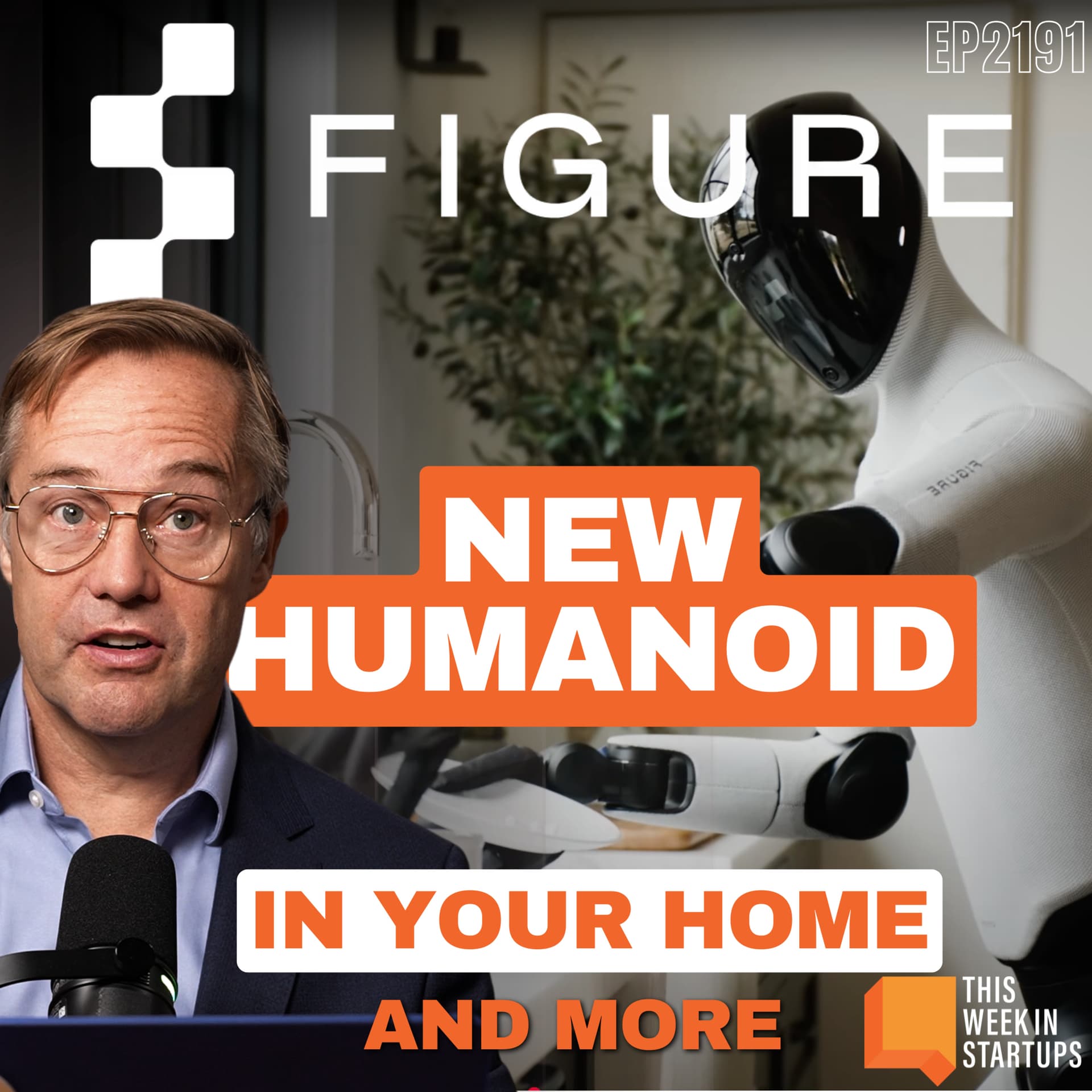

In short
Podcast Episode Notes: This Week in Startups - E2191
Episode Overview Title: Figure’s 03 Chore-bot, Jake Paul Sora takeover, ChatGPT app integrations, and more Host: Jason Calacanis Co-Host: Lon Harris Release Date: (Specific date not provided)
In this episode, Jason and Lon dive into various topics surrounding new technologies, startups, and the implications of recent events in the tech world. Key discussions include advancements in humanoid robotics, AI applications, and the evolving landscape of celebrity involvement in tech.
---
Key Topics Discussed
- Figure's Humanoid Robot (Figure 03)
- Overview:
- Figure showcased the Figure 03, a humanoid robot designed to perform household chores.
- The robot features advanced capabilities such as inductive charging and a sophisticated sensory suite.
- Jason's Perspective:
- Expressed skepticism about the widespread adoption of humanoid robots in private homes in the short term.
- Believes robots will find more utility in factories and construction sites rather than residential settings.
- Lon's Insight:
- Acknowledged advancements in understanding object manipulation (e.g., picking up dishes vs. heavier objects).
- Highlighted the robot’s potential to learn and adapt to various household tasks.
- Technical Controversy:
- Discussion around the controversy of whether BMW is a customer, with differing opinions on the effectiveness of robots compared to traditional methods.
- Geopolitical Impacts on Technology
- Rare Earth Minerals:
- Jason and Lon discussed the geopolitical implications of the U.S. reliance on China for rare earth minerals, particularly in the context of tech and AI manufacturing.
- Highlighted President Trump's tense relationship with China and its potential impact on the tech industry.
- Market Reactions:
- Noted how stock markets reacted to geopolitical tensions, emphasizing the U.S. dependency on rare earth minerals for competitive advantage in AI.
- Sora and Celebrity Involvement
- Sora App:
- The app saw rapid growth, surpassing 1 million downloads within five days.
- Jason and Lon discussed its integration of AI likeness and deepfakes, which has sparked controversy concerning ethical use of celebrity images.
- Jake Paul and Mark Cuban:
- Both celebrities have embraced Sora, leveraging their likenesses for promotions.
- Jake Paul reported significant viewership engagement through Sora, indicating the potential of AI in personal branding.
- ChatGPT App Integrations
- New Features:
- Producer Oliver demonstrated new integrations available in ChatGPT, which allow users to interact with apps like Spotify and Canva directly through the chat interface.
- Emphasized the ease of creating playlists and design elements without leaving ChatGPT.
- Future Potential:
- Speculations about the future inclusion of more apps such as Uber and OpenTable, which could enhance user experience and streamline interactions.
- Reflection AI - Open Source Models
- Introduction:
- Reflection AI, a new player in the AI space, raised $2 billion, aiming to provide open-source alternatives to existing models.
- This initiative aims to counterbalance the dominance of closed-source models by mainstream companies.
- Market Outlook:
- Jason expressed optimism about the potential for open-source AI to innovate and democratize access to advanced technology.
- The Future of Work and Entry-Level Jobs
- Concerns on Remote Work:
- Jason and Lon debated the impact of remote work on entry-level jobs, highlighting the potential loss of mentorship opportunities and overall productivity.
- Emphasized the importance of in-person collaboration for fostering company culture and innovation.
- Miscellaneous Topics
- USPS Reform:
- Jason proposed radical changes to the USPS system, suggesting repurposing post offices for childcare services.
- Personal Health Journey:
- Jason shared his experience with weight loss and health improvements through the use of GLP-1 medications.
---
Key Takeaways
- Advancements in Robotics and AI:
- The development of humanoid robots is promising but may take time to penetrate the residential market.
- Geopolitical Tensions Affecting the Tech Industry:
- The U.S. is at a critical juncture regarding its dependence on foreign resources, especially for technology production.
- Celebrity Involvement in AI and Tech:
- The integration of celebrities into tech platforms presents both opportunities and ethical challenges.
- Future of Work Trends:
- Companies may need to reassess hiring models in light of AI's impact on entry-level jobs and remote work dynamics.
---
Episode Conclusion The episode offered a rich blend of insights into current trends in technology, the implications of celebrity involvement in startups, and the changing landscape of the workforce, particularly as AI continues to reshape various industries.
For further engagement, listeners can subscribe to the TWiST500 newsletter, and follow the show on various social media platforms for updates and discussions.
Written by AI. May contain mistakes. Listen to the episode to check what was said.
Transcript
Automatic transcript. May contain errors.0:00investors are loading into this company at this crazy valuation. They don't even have a customer yet. There was a little controversy. Is BMW a customer or not? It looks like BMW is, in fact, using them in production. They shared a video of that. That was still a little controversial, that video. A lot of people are arguing an arm would have been better for that job than the whole robot, or what's the robot really doing? So there is still a lot of back and forth even after they share that video. There always is. There always is with new technology. But this thing looks great. It's stunning looking.
0:29And of course, the fixed robot is going to work better for tighter tasks, but it will ultimately not have the flexibility of going around the world. What I like about this new figure one is it has inductive charging at the feet. Somebody took a screenshot of the foot. And, you know, these things are probably a couple of years away from being in your home doing productive stuff. And they the world is made for the world we created as humans is made for the human form, like our shelving and et cetera. And what you're seeing here is this thing is, they show it here, you know, bringing food out to the table, washing dishes, putting out water glasses.
1:08It's the very classic robot butler. I mean, this is exactly what you'd think of if you had like a robot maid, a robot butler. It's cooking for them. It's cleaning the house. It's bringing them stuff. It's playing with the dog here.
1:29into your business with the power of AI search and market intelligence. Start with a free trial at alpha-sense.com slash twist. Northwest Registered Agent. Starting your business should be simple. With Northwest Registered Agent, you can form your entire business identity in just 10 clicks and 10 minutes. From LLCs to trademarks, domains to custom websites, they've got you covered. Get more privacy, more options, and more done. Visit northwestregisteragent.com slash twist today. And.tech. Say it without saying it. Head to get.tech slash twist or your favorite registrar to get a clean, sharp.tech domain today.
2:15All right, everybody. Welcome back to This Week in Startups. Alex has some sick babies and nannies. You know how it goes. Two or three times a year, this happens when you got those kids. They come home from school. And with us today, Lon Harris is here to co-host the show. Oliver, you're still on camera. You probably want to turn your camera off then. There we go. All righty. Producer Oliver, folks, give him a hand. There it is. Doing a great job. Doing a great job. He's editing and manning the show today all by himself for the first time. I love it. I love it. Well, what's on the docket? Let's get to work.
2:49Sure. Number one, we got a big story that you may have noticed your stocks maybe took a little bit of a tit today. That's because President Trump has threatened to cancel a planned meeting with Chinese President Xi Jinping after the country has restricted U.S. access to rare earth minerals. There is, of course, a very long Truth Social post from our president. We could pull that up. Actually, do I have that? He is the main character, isn't he? He is our main character for today. Here is the tweet. So let me pull this up. He's the main character every day. Let's be honest. He's trying his best.
3:22So he posted an essay this morning about his issues with China. Some very strange things are happening in China. They are becoming very hostile, sending letters to countries throughout the world that they want to impose export controls on each and every element of production having to do with rare earths and virtually anything else they can think of, even if it's not manufactured in China. Nobody has ever seen anything like this. It would clog the markets. It goes on and on and on. He threatens to cancel the meeting. He says there's no reason to meet with President Xi in two weeks. He also complains that the Chinese planned this announcement specifically to overshadow his big peace in the Middle East announcement.
4:02And he's promising major, major new tariffs on China that threaten to reignite our sort of trade war back and forth with the Chinese. Now, why this matters, these minerals that we're discussing are desperately needed by U.S. companies. They have a lot of applications in defense, but we are mainly concerned with their applications in the semiconductor market. They're considered vital to America's competitive edge in AI. So that's really where we're sort of worried. And the big question on everybody's mind, is this a permanent change? Is this China's policy now? Or is this attempted leverage ahead of these planned trade talks, which may or may not go ahead?
4:42So what do you think, Jason? Is this a is this the new reality of our world where everybody's going to have to make their own rare earth minerals? Or is this just, you know, like they're ahead of the negotiation. They're trying to get the best deal they can. Yeah, I always tell people, remember my, you know, rules of President Trump. Number one, he says a lot of things. Number two, always wait like 72 hours before, you know, thinking that these things are going to stick or could be permanent in some way. So he likes to riff in public, riff on, you know, truth and before that on Twitter. It's kind of a superpower he has in terms of just communicating directly with the populace and doing negotiations with people on social media.
5:26This is the new reality. A lot of companies do this. A lot of CEOs do it. So I would just pause and not worry about it. I think every time we've seen some sort of negotiation, whether it's what's happening in the Middle East and he deserves all the credit in the world. you know, for the ceasefire there. And let's hope it goes all the way to permanent peace. I think it's got a pretty good chance, probably, I would say, majority chance of that happening. And then, you know, hey, listen, he's worked relentlessly to try to get the Ukraine and Russia situation resolved. Hasn't had success there yet, but he might.
6:00And I think the peacenik, hippy-dippy President Trump is one of my favorite Trumps. He's great at these negotiations, even though you might not like the way they're executed or they might cause a lot of hand wringing along the way. So I wouldn't worry about that. And then when it comes to rare earths, you know, you do rip up the earth, you scar the earth when you are pulling these out of the ground. China has a top-down control system and they realize the value of these. They're not precious about the environment like we are in the United States or certainly in Europe. So So they're roughly two thirds, 70 % of the rare earths production and processing.
6:40Processing them is a bunch of work too in the world. So, you know, we do need to take care of that dependency. We have plenty of rare earths here. Brazil's got a ton. Australia's got a ton. There's tons of rare earths around. It's just a matter of, do you want to do the processing and can you do it at a reasonable price? And just like we saw with PPE and chips, we're just going to have to live in a world where we become a bit more resilient. And I guarantee that's what's going to happen. We will see us turn on rare arts here. We have plenty of them in Nevada and other places. We're just not doing it.
7:19And so the fallback plan to letting other people rip up the rare earths and process them at the cheapest price possible, a.k.a. globalization, is to go to the next provider, Australia, Brazil, whoever, and do a deal. In fact, Ukraine has a lot of rare earths. Remember when we were doing our negotiation there, Trump said we're going to keep supplying weapons if we can get access to those rare earths and be your partner on it. So that's probably why he flips sides from being a bit pro-Russian to being fully behind Ukraine. So it is what it is. I wouldn't do too much hand-wringing about it. The stock market is looking for a reason to pull back because it's been so hot.
8:01I did ask producer Claude what percent of the world's rare earth minerals are found in China. Great response. China holds approximately 36 to 38 percent of the world's known rare earth mineral reserves. But more significantly, China produces about 60 to 70 percent of the world's rare earth minerals annually, giving it a very dominant position there. So that is weak. We could sort of get more competitive in the U.S. in that, but we have not yet. And I would remind you, if you want to level up your AI collaborations like we just did, you go to Claude.ai slash twist and twist listeners get 50 percent off their first three months of Claude Pro.
8:39What a deal. What a deal and a great service. We love using it here every single day. What else is in the news? Every single episode, we rely on producer Claude. So number two, we got to talk about this. So Sora, very much in the news, hugely popular app. It's blowing up. It already hit 1 million downloads in just five days after launching. That is very notably, according to OpenAI, faster than ChatGPT hit the same milestone. So now ChatGPT, indispensable 800 million regular users around the world. Could we be looking at that kind of a future for Sora? It's been number one on the Apple App Store since launching.
9:14But, of course, there's been a lot of controversy about the inclusion of real people. There was a Zelda Williams. Robin Williams' daughter has publicly asked people, please stop sending her AI-generated videos of her dad. It makes her very sad. There was another controversial thing. A lot of people are making offensive videos of Stephen Hawking in his wheelchair being blown up or being thrown off of buildings. People are, as we mentioned on the show the other day, people are making Martin Luther King say crazy things. The Motion Picture Association of America is very upset about it. We all understand the importance of a crisp, memorable, easy to spell domain name.
9:53One of those names you can say over the phone and people know how to type it in without asking you the spelling. But let's get real. The good ones are either taken or there's some poacher who's holding it and waiting for some huge payday and they don't reply to you. Even if you want to pay for a premium domain, you don't want to use up all your runway on a domain name. That's just the truth for a startup. You want to put that valuable cash back into your startup's operations. So you should consider this, a.tech domain. You can get a clean, crisp, super memorable name for your website and company and signal out loud to your customers and investors, we're a tech company.
10:30That's instant branding for you. That's why over 500 ,000 founders have collectively raised over$5 billion in investment, building their companies on.tech. So skip the hassle, head to www.get.tech slash twist, or go to your favorite registrar and grab your.tech domain today. There are a few celebrities that have now embraced Sora 2 as a way of getting themselves out there, promoting what they're doing, marketing themselves. So we've got two key examples so far. The first, Jake Paul, the YouTube influencer turned wrestler boxer. He says that he is an open AI investor now. He's been advising the Sora team behind the scenes and that he agreed to be the first celebrity name, image and likeness cameo user.
11:19And so he goes, you know, this has been great. It's been, you know, very helpful for him in promoting himself. We've got a screen. Let me share this real quick. He posted this tweet. The idea here is it's it's he believes that letting people do whatever they want with his likeness makes him more popular. So have at it. And his view, he says, in six days, my cameo generated over one billion views. And, you know, so if you're an influencer, if you're part of the attention economy and your whole goal is to grab people's attention, I mean, that's success. In a way, we do have some of the source. You can see they're not necessarily all kind to him.
11:59Shaky, shaky, shaky. Yay. So, yeah, they got him acting as a baby. So you have to have a thick skin for this. Say they put him in drag. Here he's a pregnant lady having a shower. A gift for me. Oh, okay. Let me see. Let me see. Oh, girl. Look at these colors. So we can see. And the other example, Mark Cuban has put himself in. He now will let you. Anybody on Sora can make videos with Mark Cuban. But the clever wrinkle here, most of the cameos include a promotion for his company, Cost Plus Drugs. He actually got it. So at the end of the cameo with him, they actually bring up a little message saying, you know, visit Cost Plus Drugs or promoting Cost Plus Drugs, which is a pretty fascinating wrinkle.
12:43Wait, is that a feature you can do where you say you can use me, but you have to give me the end slide? Like that's an actual feature in this? No. Or he – They somehow, behind the scenes, they set this up with Mark Cuban. And you and I don't have the access. Well, maybe you could contact Mr. Altman and get in there. But yeah, let's take a look. Here is one of, I made this this morning to show off Mark Cuban and Cost Plus Drugs in Sora. Let's start at the beginning. Launch something I'm really proud of. It's called paymorefordrugs.com. You pay a little extra. You feel like a VIP. See, right here on the site.
13:18Whoa, whoa, whoa. Hold up. What? It's premium? So there you can see. Oh, that's funny. So you used me because I gave you permission as a friend or a mutual to use my likeness. So you put me in there with them. Yeah, I had you guys make a little drug commercial together. But I didn't tell it pull up costplusdrugs.com at the end. It did that all on its own. This seems like a reasonable wrinkle to the you can use my likeness. They're being very granular about it. They obviously took a lot of lessons from YouTube's content ID system. I think what they should do is give you the ability to put a banner at the top of the bottom persistently in all of these, put a watermark on it.
13:56Like they have Sora and the watermark should be like whatever you want it to be, costplusdrugs.com. And you should be able to place it wherever you want. So for mutuals, I could say do whatever you want, but you have to end with a slide just like that TikTok slide that shows your account and does that little bloop sound effect. Yeah. You could make that required. You can just pick and choose what you want to do as a brand or as a character that's owned by a brand. And then you can start to put in things you don't want done with the brand. So please, I don't want to, you know, have you do any gender bending, you know, swapping ideas.
14:33I, you know, I find that offensive or I'm cool with that. So they're going to get very brand new. No violence, you know, like no sexual situation. Like you can see how. Right. People could start to sort of distinguish the kinds of stuff that they want. I do think that's fascinating. I feel like we're in a cultural shift moment. There was that trough of disillusionment. Everybody kind of hates AI and there was a big push against it. And now I feel like we are starting to come out of it. I don't know if you saw Disney did the Tron Aries premiere this week. And they had – not only did they have Tesla Optimus robots running around, but they had a whole thing where you could use Grok to put yourself – if you were attending the premiere, they had a whole station where you could make yourself on the grid from Tron using Grok.
15:20So I do feel like – I got invited to this San Francisco prayer. Thanks to my friend Jared Leto for inviting me. Sorry I couldn't make it. Stars in the new film. Stars in the new film. I can't wait to see it. It looks pretty good actually. It does look cool. I like that. It does look very cool. That Nine Inch Nails soundtrack sounds good. All right, so - I actually listened to the Nine Inch Nails soundtrack on my new, I'm in love with the speaker brand, KEF. It's not a sponsorship, I just like it. And I have Cobuzz, I talked about that, not a sponsorship, Q-O-B-U-Z, where they have the high-res files.
15:50And I did the high-res Nine Inch Nails soundtrack on my new KEF portable speaker, and it was delightful, man. What a great soundtrack. I think it's gonna win awards, yeah. It's cool, yeah. Well, I think they understand, like Blade Runner and Vangelis, you know, you can get like these really serious, um, stars to do this kind of sci-fi music. Um, Interstellar has a pretty epic one. Yeah. Well, I mean, yeah, like Johnny Greenwood from Radiohead started doing P.T. Anderson movies. He just did one battle after another and Atticus Ross and Trent Reznor have been doing that. Yeah. Daft Punk did Tron Legacy.
16:25So yeah, it's happening more and more and they're, they're all. Yeah, it's a nice collaboration. Mark Knopfler started doing a bunch of soundtracks in the 80s because he just had so much creative energy. Oh, there's – I'm blank. We'll talk about it later. There's an 80s movie that ends with a very memorable Mark Knopfler song, and I'm just blanking on it right now. It's probably Local Hero is what you're thinking of. Yeah, there you go. That's the one I was thinking of. Local Hero, great film. It is a great film. So OpenAI has actually introduced integrations of various apps inside ChatGPT so you can interact.
16:53It's almost like the first level of agentic AI to come to ChatGPT. You can use ChatGPT to actually effect changes and do things in various connected apps. We're joined now by producer Oliver. He made a little demo video showcasing how some of these integrations work. All right. Producer Oliver graduates from high school in two years. Nice to see you. God, he looks so young on camera. What did you learn about the product? I tried to use it because I saw the demo you sent me, but it wasn't in my chat GPT yet. So is it something you have to do? So the apps in chat GPT is not available on work accounts, which is a problem that I face.
17:32So I had to use it on my personal account. Then also you have to enable all the different connections. Oh, you have to go into your settings. Wait, why would they launch it? I guess I have my personal account here, but why would they launch it not to business users first and give it to the free users? It makes no sense. This is exactly what Google does. It's so dumb. Google does the same thing. It's also what they did with Sora. It's just what they did with Sora. They bypassed the paid level and they just started giving it to people with invites for free. That's so weird. No respect. No respect for the subscribers.
18:03I get no respect for putting my credit card in. Okay. So show us how it works. Let's get to it. So what are we seeing here? So you're able to connect with the different applications, as I mentioned, Canva, Expedia, directly through ChatGPT simply by using the at symbol and then typing that company name. And then it'll know that you're trying to use that app. So here I'm enabling the connections, connecting to Figma. You had to download your account and have it open kind of on your screen. So the first kind of example I did was Spotify. So I kind of had the example of some co-workers wanted a playlist from me.
18:38So I went into ChatGPT, said at ChatGPT, created a playlist for my co-worker. They like these songs. I like these songs. I kind of wanted them to have some songs in the playlist they would relate to because sometimes, you know, people don't like a full new batch of songs. So I was able to prompt ChatGPT to create a playlist and it was able to create it in like 10 to 30 seconds. It was pretty quick. And then it had this playlist that I can bring – that I can open from ChatGPT directly into Spotify. This is really interesting. I use the Spotify one too, and it's amazing. You can give it like three or four very granular instructions, and it will follow.
19:20So I was like, find me the most popular songs that appeared originally on 90s movie soundtracks and don't include any other songs that I have on any other playlist. And like instantly, it followed all those instructions. So you can really like start thinking layers deep about what kinds of music you want it to find. And it'll find it for you. It's pretty cool.
19:45Hey, listen, we meet a lot of early stage founders here at Launch, my investment company. And some, they don't have a lot of traction yet. They just have an idea. Maybe they haven't even finished their product. They've just got an MVP. But they still need investors and accelerators like ours to take them seriously. And you know what? We can't just wire money to your Gmail or your PayPal. That's not how it works, folks. We need to know that you're a legit and official business. We need to know your company is incorporated. That's why you need Northwest Registered Agent. It's the service that will help you run your business the right way from day one.
20:18In 10 clicks and in under 10 minutes, you're going to file for your LLC or a C-Corp if you're a startup, get a domain name, launch your official website, claim your business email, and even fast track your trademark application, which some people forget to do. We're talking about more than just company formation. This is your entire identity as a business. Go to northwestregisteredagent.com slash twist and show the world you're in business and make sure you use that URL slash twist so they know that we sent you. I love this because one of my first use cases when using these LLMs was to say, hey, I'm a big fan of Mark Knopfler and what other artists would be similar.
20:56And it told me about this artist, Chris Ray. And then I got into Chris Ray and went down that rabbit hole and it never made that connection for me on Spotify. So they must've ingested all of this information or all the information on the web and then they've normalized it and you can take action. So it reminds me of the comment browser where we'll take actions. It's actually after you authenticate with it. And this is what I showed in my Noshricanis KPMG talk this year was, hey, what if you could authenticate ChatGPT at the New York Times website or New York Times at the ChatGPT website. And here you're kind of doing the latter.
21:31You're authenticating your ChatGPT into other services, and then you can interact with it in ChatGPT. And what will be very interesting is when you can do this across two different services. So if you said email, you could say you want to do this playlist, and then you could say, please email it, make a Canva invite to a listening party, and then email it to my friends and thread together three instructions. Yeah. Just by having the at and just by at mentioning things in here. Really interesting. Good job by the team over at Spotify. Yeah. I will say that Spotify was, I think, the best done integration.
22:06The other ones were impressive, but I think Spotify has a great UI. They have great recommendation algorithms already built into Spotify. What's your next one? So here I have Canva. So I use Canva a lot. Canva has a lot of great tools. You have the different effects you can use, the different gradients you can bring in. So I had it create a poster for a DJ event called Another Kick Drum. And so I kind of gave it a little bit of a prompt and this is one that I thought was the best. You can see it's kind of, it's okay. I asked it to make some gradients in the background and have like a retro house aesthetic.
22:40I didn't think it did a great job, but I think it was okay. But the great thing about that is you can actually open it directly into ChatGPG in Canva, then edit it from there. So it's kind of great in terms of the ideation stage where you can really get from zero to one and kind of get a lot of ideas and then kind of go and build on it yourself. So that's kind of where I saw the value. Yeah, or hand it off to a designer, right? So a lot of times the customer inside of an organization, you know, and on the sales department, the event production department, the HR department, they want to make something, they make a rough draft of it and then they send it to the designer.
23:14Well, here, you know, instead of writing a design brief, which would be all text and maybe linking to a, you know, a inspiration board, you're like making some versions and then sending it to the design team, but they can just start editing really great integration there as well. That's fascinating. One thing I loved about it actually was that when you open it in Canva, this is expected, but I think a great hard thing in Canva is finding like a great text font. So you were able to actually go into Canva and you can see it and knew what font that was. And then I was able to use that font or choose another one.
23:46So I think that was probably the best part of this integration. Interesting comment from Bay Watson in our live YouTube room. If you're not on the live team, go to thisweekinstartups.com slash YouTube and it will subscribe you and you can put the bell on and you'll get a notification when we go live on Monday, Wednesday and Fridays. And Bay comments liability. That's why I think they use the free accounts. Really interesting. Yes, that makes sense. If people are paying for it. Yes, that's a really great insight. I bet that's correct. I bet that is right. Because then it's like you're doing it as an individual.
Read the full transcript
24:20That's different from launch doing it. Yeah. And something that was interesting about the Canva ChatGPT integration is Canva was actually the only app that you couldn't use with the free plan. So I had to actually get ChatGPT Plus in order to use the Canva integration. And they did say that this is because Canva needed deep research, which I guess makes sense because, you know, it's pulling together all these different fonts and images. So that was just another interesting note there. Yeah. Interesting. All right. What's this next one? Yeah. Yeah. So we have Figma here. I haven't spent much time in Figma, but I know a lot of people love it.
24:51And some of the early examples that I saw on X and YouTube were people creating org charts. So I created an org chart for a big DJ event that I was referencing in the Canva video. And you can see you're able to open it up in Figma, similar to how you were able to in Canva as well. Awesome. Well done to our producer, Oliver. Nicely done, Oliver. Yeah. I used one more. I tried the The Expedia one, that one I thought was a little disappointing, I'll be honest. It has similar problems where it can't do the last step. You know, it's like, well, I found three great trips, but I can't book it for you.
25:24You should go to Expedia and do that. So it doesn't have like as deep an integration as some of the other ones. Yeah, I will say last thing, the Expedia and Booking.com is kind of the same problem where you can't get as far as you can in Spotify. where you're able to like open it up or in Canva, you're able to open it up and kind of start, that's kind of a great end product there and that you can use. But in booking.com, it kind of just gives you some options and you can't really go deeper. But I will say some of the apps that are coming soon are Uber, OpenTable, DoorDash. So I'm really excited to see how those are able to integrate.
25:59Or you can be able to call an Uber directly from your chat. So I think that moving forward, this is going to, apps directly in the chat interfaces are going to just make everyone spend more time in these chat interfaces. And I think it's pretty exciting. I'm excited to see how that goes. Another question. Oh, sorry, go ahead. No, do the question. I was just going to say we have another question from the Noties. Sarah Freeman asks, what do you see as the impact to the need or sometimes potentially competitive advantage to company website UIs appearing versus just using the app in chat GPT? So I think Sarah is asking, like, is this always going to be a thing where we're going to go to Canva to finish working on our design?
26:40Or do you think one day soon Canva will be fully integrated in ChatGPT and we'll just use it there? What do you think, Oliver? You have a prediction? Yeah, I think that... Master Oliver. I think that that's what OpenAI is leaning towards. In the Zillow integration, you could actually go into Zillow and zoom in on different maps and even click on the property like you would in Zillow, go through the photos. So Zillow kind of had the most full UI in ChatGPT. So I think it will be possible. I think that it might become strained in ChatGPT, might be strained having all these different integrations.
27:22So I think that they will do that, but only for a few apps. I think that one thing that was interesting in their announcement is that they said that apps that meet the standards provided by our developer guidelines will be eligible to be listed. And this is the important part, is that they said that those that meet the higher design and functionality standards will be featured more prominently, both in the directory and in the conversation. So I think that there will be 10 to 15 apps that have a great UI and that will have a fuller integration. Yeah, there'll be thousands of these. It'll be exactly like the App Store, and that's how they're modeling it.
27:59And this is like their second or third swing at the bat doing these integrations. and there'll be a second way to do it, which is you'll be able to launch a browser. And, um, we do a thing here where one of our Athena assistants, if you want an Athena assistant, you want to use my discount code, go to Athena, wow.com. And I'll give you like a month off. And I have two of them. And what's super interesting, um, is I had my Athena assistant just tell me every week, hey, of our founders, what are they promoting on LinkedIn or on X? Just let me know what's going on in the portfolio on social media so I can engage with it.
28:36Maybe I give people a retweet or I give them an attaboy, attagirl, reply, whatever it is. So this week I tried a test using the comment browser powered with Claude AI. And I put in 10 of those LinkedIn posts from people in Founder University or the Accelerator. And I said, open each of these pages, like the post, repost the post, visit the profile, find the follow button, hit follow, then try to find the connect button, which sometimes exists and sometimes doesn't exist, and then connect with them and then create a report on what you did and which of the steps worked. And then go back and spot check three of the things I asked you to do and that if they worked and it did it.
29:20Now, this was like a multi-step process. And I was like, this is pretty interesting. And then I did one this morning, hey, go find me the top 100 private companies, find two sources, put it in a table, and then go to the twist500.com list and tell me what's missing. And it couldn't quite do that one, which I don't know if it's like its ability to scrape the twist 500 side and our navigation there, which it might be. But it did some, it did some of it. So I think there's going to be multiple ways to do this. And this is a big challenge for each of these brands because now they have an intermediary who's intercepting them, which means they might charge them money.
30:01Yeah. So that's going to be the business model here for the free accounts. When you're just going to say, I want travel results and it's going to default to Expedia or whoever pays the highest price. And it's going to be like, yeah, our partner Expedia, boom, here it is. Right. And you're going to have to explicitly say, no, I don't want Expedia. I want to go directly to the United website, which the browser will do. But really interesting progress here. We're starting to see the applications and the proof of concepts turn into actual functioning products that save you time and delight you. Great job, Oliver.
30:36Come back next week with another demo. Okay.
30:41You can't make smart decisions without the best, most up-to-date information. That's why I'm constantly telling these guys to get me more graphs and charts. Your opinions are useless if you can't back them up with data. We all know that. So thank goodness there's AlphaSense, the single source of truth for investors providing only the most up-to-date, reliable, and accurate information. It doesn't matter what sector or industry you're researching. Their AI expert has been trained on over 500 million business documents, allowing it to pull together elite analyst-level deep dives on just about any topic you can imagine in minutes.
31:17We got the launch investment team plugged into using AlphaSense. It has majorly upped everyone's game. We work with early stage companies, as you know, many of whom are doing innovative work and opening up brand new markets. Well, if you're doing that, you got to research these cutting edge fields. You need the expansive database of curated expert sources, and you can only find that on AlphaSense. We're going to start you off with a free trial. Go to alpha-sense.com slash twist. That's alpha-sense.com slash twist for your free trial. I, one other thing I think that's interesting on Spotify, they tried to make their own AI, like they have that AI DJ, but it doesn't really work that great.
31:58The chat GPT plugin for Spotify is so much more powerful already than Spotify's native UI, I think, or native AI. I think that's what we're seeing is like all these companies were like, oh, we're going to just make our own AI. It's a little harder than maybe they thought. Open AI. This becomes a distribution channel. So it's worth it for anybody with a product to create this. And then it's also worth it for them to make their own mobile app in this example to make their and to incorporate other LLMs as their default at their websites. You're going to have tons of open sources. Another company here in the United States, we just announced a big round and they're just doing open source like DeepSeek in China.
32:35So we're starting to see open source LLMs come to America and funded companies doing that. You know, I think the functionality we're seeing today is going to be easily done by an open source, free LLM running on your local computer or phone. So eventually it's not like ChatGPT will be giving you this functionality because they have a billion users or XAI will have a half billion users or two billion users, wherever it winds up. so they'll be like distribution partners. But I think all of this functionality is quickly commoditized. It used to be United just didn't know how to make a, you know, a website or, you know, Walmart and Target might make an app or United might make an app, but they were kludgy.
33:25And so people would just go to Amazon. Now I go to a local restaurant or a local coffee shop and like they have their order ahead app. McDonald's has a great app. Starbucks has a great. It's gotten easier to make this stuff. And so the same thing will happen with AI. Do you want to talk about Reflection AI, the open source American AI company? What a beautiful segue you laid out. They're on the docket. So the question is, can the US really compete with China on open source AI, the American AI company, Reflection AI? They hope to answer this question. They raised$2 billion at an$8 billion valuation.
33:58That's a massive 15x jump from the$545 million valuation they clocked just seven months ago. That's according to TechCrunch. The company was founded in March 2024 by former Google staffers, including Misha Laskin, who led reward modeling for DeepMind's Gemini project, and Iannis Antonoglu, who co-created AlphaGo. So they are very similar to what DeepSeek's doing. They're building open source AI models. They're trying to make them sort of faster and more efficient than some of the big behemoth models that we've been seeing from OpenAI, XAI, and Anthropic. So here's the quote on what they're trying to do differently.
34:38The frontier is currently concentrated in closed labs. If this continues, a handful of entities will control the capital, compute, and talent required to build AI, creating a runaway dynamic that locks everyone else out. So this is their sort of attempt to respond to that. And of course, with Chinese, we got a lot of very popular Chinese open source models, but they pose a lot of security risks for the West. Am I sending my company's data to the CCP or other bad actors in China and so forth? But there is still lingering concern that China is going to develop the most used AI models if everybody decides open source instead of closed source is the future.
35:16So this is sort of a hopeful attempt to remain competitive on that level. We had AI czar David Sachs. Oh, I know him. Friend of, yeah, friend of Jason. I met him. Yeah, you've met him a few times. So he has actually chimed in on this. I will screen share it with us presently so we can - Okay, I see it here. It's great to see more American open source AI models. A meaningful segment of the global market will prefer the cost, customizability, and control of the open source offers. That open source offers. We want the US to win this category too. So you notice the word two at the end. You know, David is in a unique position because, well, he's got a lot of friends and partners in the industry.
35:59His previous firm had a bunch of investments he had to divest from. And so he's doing a really good job here of, you know, playing the statesman correctly and saying, I'm not picking winners. I want to see many winners in the U S a vibrant ecosystem and really a lot of investment and a lot of competition. He's done an A plus job, David, in his position. And it's not an easy position to be in because, you know, you've got a global competition going on here. We have a unique administration that has many different factions. It's got many different factions inside of it, you know, and you got a leader who is involved, has got that main character energy.
36:38He wants to be involved in anything. It's, I got to say, you know, Sachs has a, any, anybody working in the Trump administration, 45 or 47, it's challenging. He's a polarizing guy and you know, that it is what it is, But he's done a really good job of sticking to his lane, sticking to his knitting, staying in his lane and really focusing on what matters. And what matters in terms of his role there is getting that government the heck out of the way so that there is a vibrant competition. Reflection. I would love to have him on the program. Let's let's book the CEO here. But I'm rooting for them because the original mission of OpenAI was to be open source.
37:12And I hope they make a model that really challenges the closed source models and the expensive models and drives price down. And they'll make a great business having, I'm sure, their business model will be just like WordPress. Hey, we got this open source project here or MySQL. We got an open source project here, but we have a for-profit. So there's a.org and a.com. The.com, WordPress.com, you pay for hosting. But WordPress.com has to deal with WP Engine, which some people prefer over WordPress.com hosting. So, you know, so when you open source this stuff, you create a bunch of competitors if it works.
37:49So Reflection AI will inspire a bunch of people to create hosted versions of their product, including AWS, including Google Cloud. But this is what we want to see. We want to see free versions. And this is great for startups most of all. Right. Because startups are going to move faster. They're going to fork this thing. They're going to make unique contributions to it. And, you know, open source almost always wins unless there's a network effect. And so I think, you know, the question here is, will the network effect of XAI plus, you know, the massive Colossus data center and the Twitter data, now X.com data, will open AI with their Sora proprietary data now, which I think that's what that is.
38:33It's a play to get proprietary data, you know, in their network of partners. Will that give them enough to win over developers or would developers say, you know what, I just don't want to invest in, you know, this category. So you see this all the time. People have a choice. Should I use an open source version of Slack? And you know what? The network effect of Slack and the feature set and the cost is below, you know, the hardship that, you know, running an open source Slack does. But for databases and servers, people go all open source because they think that they're more secure, more stable and more scalable.
39:12Right. I mean, it goes back to the commodification of LLMs that we've talked about so many times, how they're they're the product right now. But one day soon, they could be the layer upon which the exciting products are being built. Alex, before he got sick, he did leave us one question for you here in this story. How do you think Reflection AI is going to make money from these open models? They can't really just do the normal hosting open source playbook of hosting their code for others to use? Hosting it. Yeah. So, you know, just like WordPress, like you could literally take the WordPress code, put up a server and do all that.
39:47But if you want the latest version, you want faster servers, you want somebody doing the security and the operations and upgrading it and installing the patches, you just go with the hosted version. And the cost of you managing your own reflection AI servers, if you're doing something small to midsize, is greater than having the reflection AI team host it. Now, if you're a giant company, if you're Amazon or you're Walmart and Walmart decides, hey, we want to have reflection AI doing stuff internally or doing stuff on our website. Yeah, then you'll stand up your own server cluster and manage it yourself because you have a tech team.
40:27Yeah, right. Fair enough. All right. We got we got a pressing question from Reddit. You want to feel this one? I love a good response. We love a good Reddit rapid response. So here's the query. It's from our slash startups where we spend so much time. Dear needle worker three five nine rights. Should I recruit locally or go fully remote? I'm in the early stages of building a startup and trying to figure out how much in-person collaboration really matters. Now, part of me loves the idea of having a team close, being able to grab coffee, brainstorm in person, do something like a Christmas get together and build real camaraderie.
41:03I feel like those small in-person moments help shape culture early on. But the other part of me knows that by going remote, I could tap into a much larger talent pool, maybe find stronger technical talent than what's immediately nearby. So to those of you who built early teams, they want to know, did being local make a huge difference? Is it more about finding the right people wherever they are? And if you do go remote, how do you keep a sense of connection and shared culture? Yeah, that's a great question. Yeah, the companies that are in office and, you know, companies in office will have better product velocity, better cultures.
41:42They'll move faster because they'll be finishing each other's sentences. They'll be out whiteboards together. It's just really high bandwidth when you're in the same room. And it turns out, I would say, about half of people who are working remote are phoning it in, are doing less. They're just not as efficient and you don't have mentorship either. And then I would say the top 20 % are more effective working from home because you take out a commute and you maybe get a discount on salaries because you're shipping the work to a lower cost place. and you have that advantage as the person kind of notes that you just, you're, you're tapping the global workforce.
42:22But I'll give you one important thing. And then I would say maybe 30 % of people in my experience, this is my lived experience, are as effective in the office or remote. So I've decided to go back to in-person. We now have, when I had my management meeting the other day, I think we had 11 people in the office and remote. Yeah, it's 11. It's 11 when we fill up that room with our management meeting. Yeah. Yeah. And then maybe nine remote, I think is the total now. Yeah, that sounds about right. 20 person organization and a little more than half are here. Yeah. And I'm not going to hire more remote if I can avoid it.
42:57And I'll continue moving people who are remote back to in office if they're not, you know, the highest level of performers. So that's the way I've managed the transition. But I will tell you, VCs, if they see your five or 10 people in an office and 100 % in person, they will fund your company at twice the rate of remote teams. VCs have seen this up close and personal. The in-person teams move faster, have better product velocity, have better cultures, more excitement, and they just go further faster. So that's it. If you want to raise money, yeah. You have a personal stake. When you show up every day, you have a personal stake in the product, in the company, in the team.
43:37you are motivated to see it succeed when you're at home i did i worked at home for five years and you get disconnected it you're you're you're doing your work and then you're sending it out into the void and you don't ever see what happens to it and i feel like that disconnects you from the goal you're not you're not goal oriented anymore because you're just like well i got to get today's stuff done and then i'm done i can watch tv and i i do so i feel like being here makes me more focused on yeah you're totally more engaged and it's i'll be totally honest like I think people get depressed working from home and being socially isolated.
44:10And I think young people can't be mentored remotely. So who can you have remote? I got a guy, Matt, who works for me and is an incredible salesperson. He likes to ski. This guy is a killer. Just top three sales executive I've worked with, and I've worked with hundreds. Love working with them. And I told him, I don't care where you want to work. I don't care how you want to work. Put up numbers like you're putting up. You can be difficult. You could be easy to work with. You could be, I don't care if you're selling stuff from the, he likes to ski like me. I don't care if you're selling from the ski lift.
44:47Yeah. Put those numbers up. Now for everybody else, young people, no, no, sorry. Now I do have some high performers cause we were remote during COVID and I just said, Hey, you're grandfathered in. If you're in the top third of performers, I'll make another note. If you are a young individual, you want to be as close to the CEO as possible. the founders, as close as you can get to power, you want to be. Why? You want them to notice you. You want them to, you want to impress them so you can have career advancement. You can't do that remote. It's hard to do remote. You're just a cog in the wheel if you're remote.
45:21And that is a two-way street. I think you kind of alluded to this because you're not invested in the company, which means the company can move on from you at any time. And yeah, there's no, like, no problem. Yeah. You're not part of the culture anyway. We can just move on. I think it goes both ways. Yeah, absolutely. If you're not present, that's just work arriving every day and nobody knows where it came from. It's like, okay, that got done, but there's no face behind it. It definitely is a two-way street. And I got to say, I started really investing in young people coming out of college. Why did I do that?
45:56I found a lot of the people who were more senior in venture capital had developed bad habits. One of those bad habits is never being in an office. One of those bad habits is working four hours a day and just not being hard driving. I found if, you know, if I hire folks right out of school and put them in a training program, like you just saw producer Oliver come on here and do a great job, that because I am willing to invest in two things, professional development on the venture side, but also executive training, which you run here at the company, along with Jackie in person every morning at 9am, the new people at the company go to executive training at the end of the day at 6 p.m.
46:35They report back and they do another 15 minutes of executive training at the end of the day. Maybe unpack how that's worked for the four individuals we have in executive training here. I think it's great. I think it forces you to think more strategically about your day. I think that for a lot of people, when work starts piling up, you've got a lot to do. It just becomes thoughtless. I'm just going to start taking stuff from the top of the pile and jamming my way through it. And I think that what we sort of talk about so much in executive training is like looking at your entire day holistically and try to figure out where you can save time, where you can prioritize, and just kind of taking it up that one level.
47:16I feel like that's what we spend the most time on is like, well, I was going to take this two-hour chunk and do this and then do this and then do this. And it's all kind of haphazard. And it's like, well, how about really thinking about it in terms of the flow of your day? When does this need to get done? When does this need to get done? Could you do part of this and then move part of it to the next day? And just, just like being a little bit more strategic about that and your approach and time management and thinking about time management and planning ahead, like, well, what if that takes me an extra hour?
47:43What would I not get done and push to tomorrow? And like, I feel like that is new for a lot of people who have not had a high pressure. Executive function is something that's just, yeah, executive function is just not taught anywhere anymore. And this is going to be the big problem of the next decade. If you come into the workforce and AI, as we just saw, is able to make a kick-ass playlist or an invite to a party, you know, it's going to be able to do a corporate event and it's going to be able to make a list of partners and potential sales partners. And those were the entry-rung jobs. So all the entry-rung jobs, all the first jobs are going to be done by AI.
48:26This is why we're seeing a massive gap amongst young people, even with computer science degrees, getting jobs right now. It's going to expand, folks. I would predict we'll be sitting here next year, and the number of young people unable to find jobs is going to go up at least 50%. That's a big number. Like if it's 6, 7, 8 % right now, I think it's going to 10, 15. It's scary. It's Take over the dialogue. It's scary on a few levels because then it's like, well, if you don't have those entry level people anymore, where does the next generation of that industry come from? How do we train tomorrow's leaders if we don't have those entry level jobs?
49:04I'll tell you the one other thing we go over a lot in management training. And this is as an older person in the workforce, you're probably with me on being frustrated by this. I feel like in schools, it is not results focused. It's like, how far did you get? Well, you did your best. Well, like this is three quarters of the way done. And so I feel like when you get a lot of young people in a business situation, there's a lot of like, well, I did it until I ran into this problem. And then there was a problem. So completion of the task is an issue. Not just letting an obstacle be like, well, I have to stop and then I'll go to my boss and say there's a problem.
49:36It's like, well, what can we do to move that boulder out of the way? Like, could we go around it? Could we go over it? Could we smash it? And it's like just training people to like, don't just throw your hands up when one thing goes wrong. like think about how you could solve it without having to bother another person and take them away from what they're doing. And I think that is a skill that we do not teach young people. And then their bosses has to teach them when they're in their twenties. You know, I had this happen domestically as well. You know, you own a couple of homes and all of a sudden estate management and managing properties becomes an issue and the dishwasher is not working.
50:11It's given a code 37. And then people are like, yeah, the dishes aren't working. I've done the dishes by hand for three days. And I'm like, okay. And I put an iPad in the kitchen and I just said, you know, go to YouTube. I showed them how to use voiceover. I said, I'm getting an era 17 code on my, you know, whatever dish wine, GM dishwasher. What does it mean? And how do I resolve it? Find me videos in a summary. And I talked about it. Use chat GPT. I taught them how to use YouTube. And now people are just empowered. Here we go. And so this is actually, you know, hitting everything from literally a housekeeper to a nanny.
50:48Hey, what are some things I can do on a ranch with kids on a rainy day? And it's like, oh, okay, well, you can do a rain hike. Oh, you could do some, look under rocks for insects and then make a catalog of them. So it's like all kinds of interesting things you can do, but you might not have been exposed to it. And this is, so anyway, great job to you and Jackie on doing the executive training. Thank you. All of my friends now are like, please take my child. I'll pay you. to executive train them i'll i'll literally pay you to employ my child so literally i could make a fortune right now just telling my friends pay me fifty thousand dollars a year and i will turn your kid into a venture capital i don't do that i pay them a salary um but that's where it's gonna come to and that would be a paid apprenticeship i think paid apprentices should come back we keep talking about trade schools but this is almost like the next like if you want to be an executive there isn't a trade school for that specifically there's business school but like that's almost what you're talking about a hybrid it's business school but as a trade school just teaches you how to do the job of being an executive that's interesting well i mean and what are people spending on college on average now 40 50 60 000 a year oh if you said it's crazy you know if you said to me uh listen um you know your daughter wants to uh work in uh you know fashion and you I have a fashion internship, not an internship, a fashion apprenticeship, and it's$30 ,000 a year, you pay for it, and your kid does not get paid, I'd be like,$30 ,000 a year is half the price of FIT.
52:19I'll take that. I would rather them be in your place. So I think this could be an unlock. Now, obviously, you got to give scholarships, then everybody can afford the$30 ,000 or whatever. But this model of apprenticeship, I think could change everything. And I don't need the money to do it, but I do think that this should exist in the world. Yeah. It should exist in some way in the world. FITM, the Fashion Institute of Design and Merchandising in LA, one academic year, 35K for an undergrad, 44K for a grad student. So over two, three years, that's a lot of money. Imagine if you could just get an internship or an apprenticeship at a fashion company or a design company and just start working.
53:00We have actually a startup in our portfolio. It's really clever. It's called extern.com. And you can do these externships. So you can from home go through some courses and get to work at great companies. And the companies are, you know, pretty interesting companies. And so extern provides you with fully managed project teams to accelerate strategic projects. So that's their pitch to the companies and the pitch to the students. It's obviously pretty clear. Invest in your career, build real experience, work on remote projects to get real professional experience and start and stand out in the job market.
53:38So I appreciate it if anybody goes and checks out extern.com and, you know, give me some feedback on how it goes for you. But really, I love the founder of this company. It's just a great company. And I just think education and like anytime you have a problem in society, you create an opportunity for entrepreneurs to solve it. Because you know, the government's not going to solve it. The government gets involved. It's just going to be a disaster. How dare you? I mean, these guys can't even keep the airport safe. I'm no offense. I'm just saying, you know, like, I know people are under stress at the airports and everything like this, but I just, the government just doesn't know how to get stuff done.
54:12They should have competency tasks. We fired everybody from the post offices. The post office is a nightmare now. I had to go there the other day. I mean, the post office has always been a nightmare. Come on. I mean, no offense to post office delivery people, but that thing's got to go. I don't think I've ever gotten more hate than my shut the post office down or change it. But I said any, in any major city, here's what I want you to do. I want you to make it$10 a year to get postal mail. And then I want you to make it$10 a month to opt out of postal mail and have the mail sent to one of these scanning in companies.
54:43Literally, I would pay$100 a year to not get postal mail, to opt out of it. It's 90 % crap. And have it all scanned in for me. Yeah. And they should literally double the price. No, they should 10x the price of people sending these goddamn catalogs. It's ridiculous. And if you made it once a week, like if you told me I could pay$10 a month instead of getting it every day to get it twice a month, I would do it. Like if they scan it all in, they just, you know, and take out all the flyers, they should really professionalize. And the only people who really need it are people who are in remote locations that UPS, Amazon drivers like can't get to.
55:16And then you might have some price gouging, whatever, but there's nobody in a modern city who needs it. So why don't you make it like, if you come pick up your mail from the post office, we'll pay you$10 a month, right? You get a gift card or something. There's something better to do here. And then you could take all those post offices, which are great real estate typically, and use them for something else. My pitch was to make them nursery schools and then let everybody have nursery drop up. If you... We need more childcare for sure. If you just said to the average, if you said to Americans, get your mail once a month for free, twice a week for 10 bucks a month.
55:50And we now have a universal nursery school. You can go anytime you want. And for 10 bucks an hour have, you know, but 10 bucks an hour. And maybe people under a certain dollar amount get, I don't know,$5 an hour or 10 hours a month free. And we'll just take all the post offices and make it childcare. And you just can drop off anytime. And as cameras in there, it's - The mail carriers are watch your kids. They don't have to lose their jobs. We flip them right into the new business. there aren't that many of them so you could literally give them a great ramp off point and you could say to amazon ups and everybody else hey we want you to hire these people and respect their pensions or whatever and you can basically bid to get those people over into your job so here we go and it's going to happen anyway folks like i mean the amazon same day delivery in austin is absurd oh my god it's crazy you i'm like no no too fast like sometimes as I leave my house and like the thing I ordered, it's already there.
56:53Like I haven't even, I didn't even seem possible that it would be there yet. Like within an hour. I don't know how they're doing. No, I don't. It's great. Literally like you order it and they're like, okay, how's four to 8 PM? And you're like, ma 'am, it's 2 PM. Yeah. Like I'm not going to be home till then. I literally will order something at the office. Yeah. I don't even. Unbelievable. Yeah. And then with the drones coming, it's going to be nuts. Yeah. I mean, it's literally going to be like you. and did you see this other feature speaking of ux and great features a lot of times now when i order something on amazon when i open the amazon app an hour later it's like um add to your existing order coming at this time and you click it and it's like double door dash or whether they call it double dash or whatever right and it's like oh um they're packing your stuff up and then it gives you a list of things that you could add to it that are i guess in that depot or that facility right that or close by.
57:43So it's not the frustrating things that you can't get. Yeah. They also, I have an Amazon Fire TV now and it pops up a message on my TV when my package arrives. That's crazy. So if I'm watching TV, it's like, Lon, your shorts are here. Like that's wild. That's the future. Right. And so you're Buck watching whatever you're watching and you need to put on a pair of shorts. No, I had another pair of shorts on. I'm not naked watching TV. I don't know what's going on here. My new pair of shorts arrived. Anyway. You look good on the show, but your wardrobe, otherwise, I mean, I just, We talked about this on the show before.
58:14I know what I'm getting you for your Christmas bonus. I'm sending you to a haberdasher. I'm going to class you up. Another stop at suit supply for me. Speaking of great companies that we love that look great, Roe.co. We should talk about these guys. If you've been a longtime Twist fan, you've heard us talk about them. Jason, let us know about Roe.co. Well, as you know, I was a fab bastard. And people didn't mock me enough. Some people did. Some people took screenshots of me being fat and dunked on me. Like, you're a fat Greek. And I'm like, fair enough. I am a fat Greek. And I used to be thin.
58:50I used to run marathons. And then I would share pictures. And people would be like, well, what happened? And I said, you know, I really don't know. It kind of got away from me. Every year I added two pounds. And I don't know, 20 years later, from my 30s to my 50s, I was 213 pounds. I heard Kevin Rose talk about Ozempic when he was talking to my friend Timmy's podcast. Oh, Tim Ferriss? Tim Ferriss's pockets. Yeah. So I was drawing a blank. I was like, was he on Lex or was he on Tim? No, he's on Tim Ferriss. They were doing their random show they do. So anyway, I get on the GLP train and I never realized how much food noise.
59:24I was thinking about food all the time. I start taking GLPs. I start losing a pound a week, a half pound a week. Anyway, here three, four years later, and I lost 40 pounds. And I didn't talk about it at first because I don't know the science, et cetera. I don't want to be promoting stuff. I'm not sure exactly how it works. Well, I've done my research. The research has started to come out. Tens of millions of people are benefiting from this. And so I created a partnership with my friends at Rowe.co. It's a great company. You know, Rowe.co. Maybe you get Rowe Sparks. Maybe, you know, hey, it is what it is, folks.
59:54Maybe you got to get, you're taking the Propecia, keep your hair. Maybe you're got some other situations. But I'm going to talk to you about one situation, which is FDA approved weight loss options. And you can do it with your insurance or without your insurance. They have great prices. and no shame in the GLP one game. Check it out, folks. See if it's for you at road.co. I love road.co. I love being shvelt. Lon, you know how many problems went away? My sciatica, my back pain. Really? Shoulder pain. All of it gone. I went from skiing two or three hours a day during the ski season and all kinds of pain.
1:00:29I would get off the mountain and I needed to stretch. I needed to hit the hot tub. I mean, I'm popping motrons like they're M &Ms. Now I get off the ski mountain, I have a little chili, sour cream, a little cheddar cheese. You know what I do? Go back out on the mountain for another hour. I don't feel any pain. My pain went away when the weight went away to the point at which now I hit a 35 pound weight vest and I hike around and I ruck around my ranch. Row.co. Anyway, I'm very passionate about it. Yeah. Well, I mean, losing all that weight, you're carrying all that extra weight around with you.
1:01:00It is taxing on your body. Let's move on. We got to talk about Figure. Figure showed off their third generation robot, the Figure 03. The robotic company recently raised a billion dollars in new funding, partially on the strength of this robot. 03 has a completely redesigned sensory suite and hand system. It features better human-robot interaction. Show me. An improved audio system. Let's see if I can find the... I mean, come on. A video is worth a billion words. Do I have a figure... See this thing. video guys. There is a video of it. I know there is a figure 03 video. I just don't know if I have it here, but I'm going to pull it up for us right now.
1:01:40No problem. And just so people know, there was a, while you get it ready here, I'll just fill people in on the fact that we've discussed this a couple of times. They raised that billion at a$39 billion valuation. You do that, you're going to get a lot of criticism. Why? People are jealous and people get concerned about sky high valuations and the VCs felt like, oh, all these SPVs and dentists and whatever direct investors are loading into this company at this crazy valuation. They don't even have a customer yet. There was a little controversy. Is BMW a customer or not? It looks like BMW is, in fact, using them in production.
1:02:14They shared a video of that. That was still a little controversial, that video. A lot of people are arguing an arm would have been better for that job than the whole robot or what's the robot really doing? So there is still a lot of back and forth even after they should have it. There always is. There always is with new technology. But this thing looks great. It's stunning looking. And of course, the fixed robot is going to work better for tighter tasks, but it will ultimately not have the flexibility of going around the world. What I like about this new figure one is it has inductive charging at the feet.
1:02:46Somebody took a screenshot of the foot. And, you know, these things are probably a couple of years away from being in your home doing productive stuff. And they, the world is made for, you know, the world we created as humans is made for the human form, like our shelving and et cetera. And what you're seeing here is this thing is, they show it here, you know, bringing food out to the table, washing dishes, putting out water glasses. It's the very classic robot butler. I mean, this is exactly what you'd think of if you had like a robot maid, a robot butler. It's cooking for them. It's cleaning the house.
1:03:23It's bringing them stuff. It's playing with the dog here. You know, I don't know. I mean, I got to be honest. It's hard for me to imagine that everybody is going to have like a five foot tall humanoid faceless robot in their house. Like, I absolutely will these things be in every factory? Will these things be on construction works? Like, of course, you don't have to sell me on that. But I don't know. It's hard for me to imagine going to a person's house and like the robot brings you a lovely snack. Maybe I'm wrong. I don't know. Yeah. You're right in the short term, wrong in the midterm to long term.
1:03:59These things are going to, you know, just like it was crazy to think people would have a doorbell that rang your phone. People thought it would be crazy to have lane assist or adaptive cruise control. And then all of a sudden they have FSD. I can tell you, I've been having a pretty good experience with FSD. You know, I'd say three out of four rides are flawless. So we're on the cusp of something really interesting here. The robots and the dexterity and everything, that has existed for a while. It's existed kind of for five or 10 years. We started seeing Boston robotics doing backflips 10 years ago.
1:04:32What's happening here that's unique is the LLM is interpreting the world and letting it know what to do. So if you were to give it the command, hey, tidy up the house, it would be like, okay, tidy up the house. What does that mean in the sense of the kitchen? In the kitchen, it means putting all the dishes in the dishwasher or washing them. It's going to, just like we saw, ChatGPT handle the Spotify playlist. Each verticalization is going to be done, you know, like every six to 12 months. And then you'll see the fluidity of how it works. I've been driving autopilot and FSD for over a decade. And I've watched it go from being absolutely flawless on the highway, but kind of scary on the streets to being absolutely flawless 98 % of the time, I'd say, 97 % of the time, something in that range.
1:05:20And so, you know, here we are, folks, it's going to work. And I would love to just even have one of these just to do security patrols around the ranch. I mean, I would literally get one of these to just walk around the ranch and, you know, put out bird seed and all that. But one clear advancement that I think you can tell is the early days of these robots, the commentary was always like, any individual thing you wanted to pick up or move, you had to teach it about that object in particular, like how to actually pick something up, how heavy it's going to be, how to hold it so it doesn't fall. And you can see that the AI that's working in this robot, it understands the difference between a cabinet and a drawer.
1:06:01It understands you have to lift a dish differently than you'd lift another kind of flat object or smaller object, or here we can see it putting a Tide Pod into the washing machine, which is like a fairly delicate sort of maneuver. So I feel like we've definitely seen a lot of, you know, advancement there. Like it can figure out how to fold a towel as opposed to pick up a heavy object and move it, which is without being trained on each specific object. You know, and the way it does that is familiar objects, it puts it into a queue for you. So if you have any of the modern home security cameras, there is this process of, it will give you a queue of people's faces and say, who is this?
1:06:46And you say, oh, that's Jason. Oh, that's Lon. And then in the future, when you get a notification, it says Lon's at the office, Jason's at the back door, Lon's at the front door, Or Jason entered, you know, the parking lot. And so you would be surprised at how fast this is. If it was trying to figure out your house, it could make a cue of every item it sees. And it would say, you know, here's, you know, I don't know, here's, you know, this portable speaker. And you say, where does it belong? And you say, it belongs in the dresser, you know, in the side table in my master suite. Boom. Or my primary.
1:07:24I can't say master suite anywhere in the primary. Yeah. Please don't cancel me. I'm going to be, I'm like an old dog. I think you could still say master suite. No. People would get that upset. No, no, no, no. In California, I said it like multiple times looking at houses and I kid you not, I got admonished twice. Wow. People are like, you can't call it the master anymore because that is slavery and you have to call it - Master, slave. Right. Yes, yes. Yeah. It's just like, okay, I'm sorry. It was not the intent here. I was not doing a callback to the Civil War. But anyway, it's going to be pretty easy to train these things.
1:07:57Great show, Lon. Everybody will see you on Monday on This Week in Startups. Go to thisweekinstartups.com slash YouTube, and it will give you this subscription button so you can subscribe there. Go to thisweekinstartups.com slash TikTok, or go to thisweekinstartups.com slash Apple. Give us a review. Write a review. Yeah. Write a review on Apple, and we will shout you out on the show. we're going to append the great reviews and comments. So I think you can comment on YouTube. You can comment on Spotify now, and you can do reviews on Spotify, and you can do reviews on Apple. I mean, if you can afford it, if you got a couple extra stars laying around, your boy, Jake, I would appreciate it.
1:08:37I'll give you the shout out on the show. Talk to you soon, folks. Bye-bye.
From the publisher
Figure’s 03 Chore-bot, Jake Paul Sora takeover, ChatGPT app integrations, and more | E2191
Today’s show:
Figure’s butler-bot could be cleaning up after you soon than you think!
On a Friday TWiST, Jason and Lon are checking out the Figure 03 demo reel, checking out the humanoid robot that could soon be hanging out in your house, doing your chores.
Lon’s a bit skeptical that full-sized Westworld drones will soon be on everyone’s home but the technology is obviously moving forward at a rapid clip and cutting-edge AI models are making the bots smarter than ever.
PLUS… what will be the impact of Presidents Trump and Xi’s new fight over rare earth minerals? Why are Jake Paul and Mark Cuban starring in SO MANY Sora clips? How well do these ChatGPT app integrations work, and why are they going to free users first? And much much more, on a can’t-miss new TWiST
Timestamps:
(0:00) Figure’s humanoid and its new capabilities
(2:15) Show start: Jason welcomes co-host Lon Harris
(6:24) The global dependency on China for rare earth minerals
(9:48) .TECH: Say it without saying it. Head to get.tech/twist or your favorite registrar to get a clean, sharp .tech domain today.
(10:54) Sora, AI likeness & deepfakes
(17:05) DEMO: Producer Oliver showcases ChatGPT's new integrations!
(19:45) Northwest Registered Agent - Form your entire business identity in just 10 clicks and 10 minutes. Get more privacy, more options, and more done—visit https://www.northwestregisteredagent.com/twist today!
(27:54) The future of AI: Will there be thousands of app integrations?
(30:41) Alphasense - Get deeper insights into your business with the power of AI search and market intelligence. Start with a free trial at https://www.alpha-sense.com/twist
(33:44) Discussing Reflection AI: A new American open-source model
(40:35) Reddit Rapid Response: Why young professionals should work in the office
(47:50) How AI is eliminating entry-level jobs & the need for executive training
(54:15) Jason's pitch to shut down the USPS and turn post offices into nursery schools
(58:25) Jason shares his personal journey with GLP-1s & Ro.co
(1:01:05) The Figure One robot: New video and future potential
(1:04:20) How LLMs are the key to unlocking humanoid robot capabilities
Subscribe to the TWiST500 newsletter: https://ticker.thisweekinstartups.com
Check out the TWIST500: https://www.twist500.com
Subscribe to This Week in Startups on Apple: https://rb.gy/v19fcp
Follow Lon:
Follow Alex:
LinkedIn: https://www.linkedin.com/in/alexwilhelm
Follow Jason:
LinkedIn: https://www.linkedin.com/in/jasoncalacanis
Thank you to our partners:
- .TECH: Say it without saying it. Head to get.tech/twist or your favorite registrar to get a clean, sharp .tech domain today.
- Northwest Registered Agent - Form your entire business identity in just 10 clicks and 10 minutes. Get more privacy, more options, and more done—visit https://www.northwestregisteredagent.com/twist today!
- Alphasense - Get deeper insights into your business with the power of AI search and market intelligence. Start with a free trial at https://www.alpha-sense.com/twist
Great TWIST interviews: Will Guidara, Eoghan McCabe, Steve Huffman, Brian Chesky, Bob Moesta, Aaron Levie, Sophia Amoruso, Reid Hoffman, Frank Slootman, Billy McFarland
Check out Jason’s suite of newsletters: https://substack.com/@calacanis
Follow TWiST:
Twitter: https://twitter.com/TWiStartups
YouTube: https://www.youtube.com/thisweekin
Instagram: https://www.instagram.com/thisweekinstartups
TikTok: https://www.tiktok.com/@thisweekinstartups
Substack: https://twistartups.substack.com


