
In short
Podcast Summary: This Week in Startups - Episode E2238
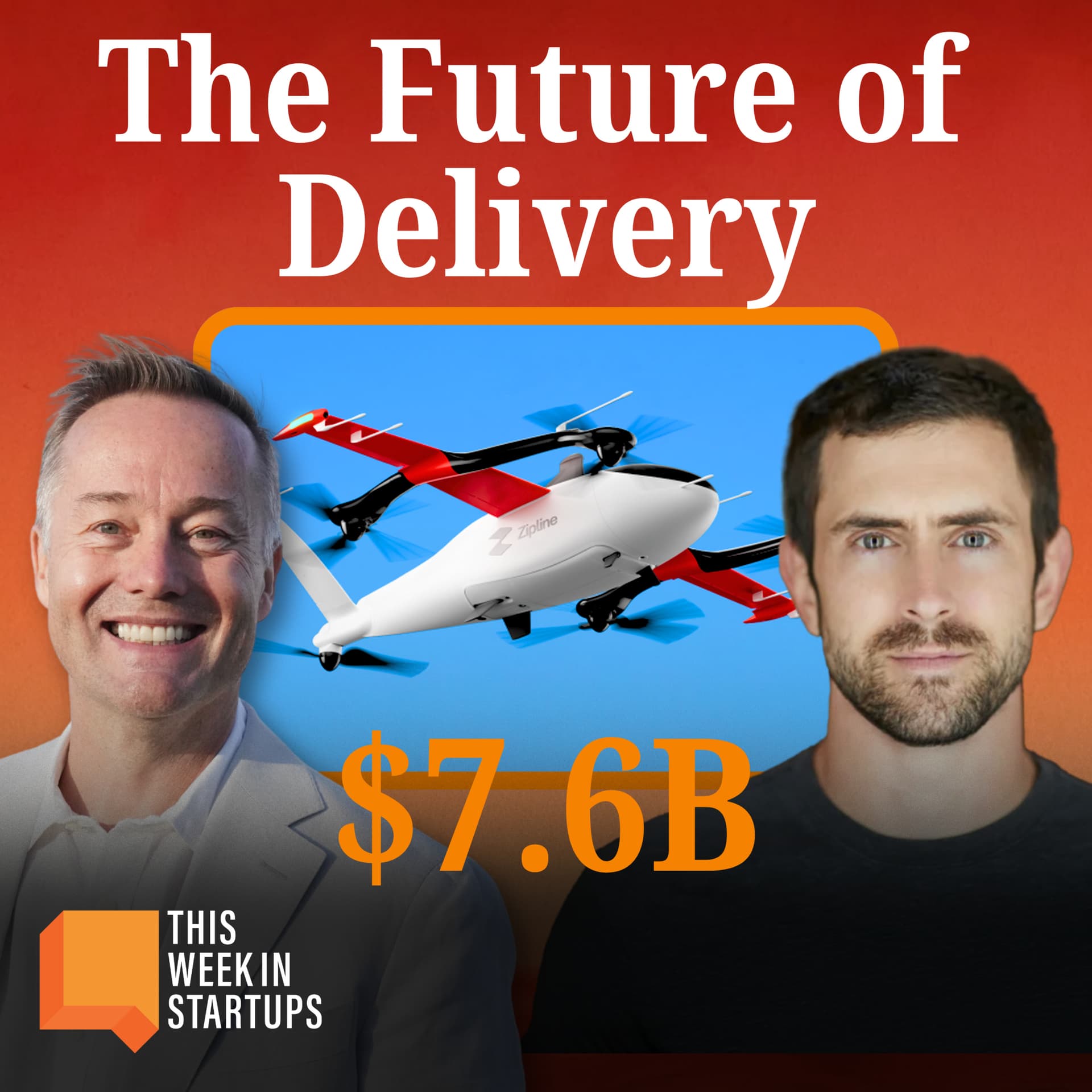
Episode Title From Blood Transfusions to Burritos, How Zipline is Automating Delivery
Episode Description In this episode, Alex interviews Keller Clifton, co-founder of Zipline, and Anastasis Germanidis, co-founder of Runway. They discuss Zipline's groundbreaking work in drone delivery, recent funding news, and the future of generative AI with a focus on Runway's new world models.
Key Highlights
Segment 1
Zipline - Revolutionizing Drone Delivery
- Introduction to Zipline
- Keller Clifton discusses Zipline's recent $600 million funding round, bringing the company to a valuation of $7.6 billion.
- Zipline operates more flights than United Airlines, showing the volume and efficiency of their delivery system.
- Innovations in Delivery
- Zipline utilizes drones to provide rapid delivery services for various goods, including food, significantly faster than traditional methods.
- The technology allows for delivery to public locations, enabling instant access to goods during events.
- Competitive Edge
- Zipline's drone delivery system proposes an economically favorable alternative to car delivery systems, including self-driving cars.
- The company focuses on scaling its operations to meet growing demand, with plans to enhance manufacturing capabilities at their South San Francisco facility.
- Operational Challenges
- Clifton discusses the complexities involved in establishing U.S.-based manufacturing and the need for independent supply chains, diverging from previous reliance on Chinese manufacturing.
- The importance of hardware and logistics in maintaining delivery efficiency is highlighted.
Segment 2
Runway - Advancements in Generative AI
- Introduction to Runway
- Anastasis Germanidis describes Runway's focus on developing world models to advance generative AI applications.
- World models create simulations of real-world scenarios, helping to improve robotics and automation.
- Future of Generative AI
- The conversation touches on the potential of world models to simulate rare edge cases and their significance in the future of AI.
Segment 3
Founder Advice and Q&A
- When Should Founders Pivot or Give Up?
- Jason Calacanis provides insights on the difficult decision of when to pivot or continue with a startup that lacks traction.
- Emphasis is placed on the importance of listening to customer feedback and following intuition.
- Founders should evaluate their team's capability to execute ideas effectively, highlighting the necessity of having technical founders involved in product development.
Key Takeaways
- Zipline's Impact
- Zipline is transforming the logistics of delivery with drone technology, focusing on customer experience and environmental benefits.
- The increasing operational scale is set to revolutionize how goods are delivered in urban and suburban settings.
- Runway's Innovative Approach
- Runway is at the forefront of generative AI, focusing on multi-modal systems that enhance interactivity and realism in simulations.
- The development of world models is expected to drive advancements in robotics and other applications across various domains.
- Advice for Founders
- Founders should be prepared to pivot based on customer feedback and their team’s execution capability.
- Building a solid technical foundation within the founding team is crucial for startup success.
Timestamps
- 00:00 - The Drone Revolution is Here
- 02:46 - Inside Zipline’s Factory
- 04:40 - American Dynamism vs. Chinese Manufacturing Dominance
- 09:00 - Growth Metrics for Zipline
- 21:54 - Crusoe Cloud Introduction
- 32:21 - Runway’s AI Modeling
- 55:46 - Founder's Q/A on Pivoting
Episode Links
- [Northwest Registered Agent](https://www.northwestregisteredagent.com/twist)
- [Crusoe Cloud](https://crusoe.ai/savings)
- [LinkedIn Jobs](http://linkedIn.com/twist)
Conclusion The episode presents an engaging discussion on innovative technologies shaping the future of logistics and AI, making it a must-listen for tech enthusiasts and aspiring founders alike.
Written by AI. May contain mistakes. Listen to the episode to check what was said.
Chapters
Tap a time to open that second in VOThe Magic of Instant Delivery
1:45 to 4:10
Discover how Zipline's technology enables rapid delivery in various scenarios.
“Now, there are some technologies out there in the world that take a very, very long time to arrive, even if we always thought that they were going to.”
Building a Drone Manufacturing Hub
4:10 to 6:21
Understand the challenges and developments in establishing Zipline's factory.
“But I was going through the information sheets for P1 and P2, and I thought that P1 was four pounds and P2 was eight pounds, which does feel to me like a bit of a difference.”
U.S. Supply Chain Dynamics
6:21 to 8:21
Examine the state of U.S. supply chains and the competitive landscape with China.
“It's going to be really good for technology, really good for American customers.”
Scaling Production to Meet Demand
8:21 to 9:46
Learn about Zipline's growth and production needs to support its expanding service.
“So push the state of the art, push the envelope, and then work on scale, as opposed to trying to chase, you know, I don't know, DJI's gross margins.”
Zipline's Home Delivery Technology
10:43 to 13:32
Explore how Zipline's home delivery service is transforming consumer experiences.
“So on the partners and delivery front, Walmart's been key for you guys.”
The Complexity of Delivery Logistics
13:32 to 14:02
Understand the intricacies behind Zipline's autonomous delivery logistics network.
“It allows people to spend more time with people they love.”
The Complexity of Autonomous Logistics
14:02 to 16:42
Explore the intricate logistics behind Zipline's autonomous delivery systems.
“Because all of these orders are happening through the Zipline app right now.”
Transforming Healthcare Delivery
16:42 to 19:05
Learn how Zipline revolutionizes healthcare logistics globally.
“I mean, literally the way we describe this to our customers is we are showing up, we're installing a magical portal in the wall of your building.”
Safety and Community Impact
19:05 to 21:43
Understand how Zipline's delivery system improves safety and community well-being.
“And so, you know, ZipLine isn't just about the lives that we're saving by like delivering these crucial products to the right place at the right time.”
Cost Efficiency of Drone Deliveries
23:02 to 26:01
Investigate the cost-effectiveness of Zipline's delivery model compared to traditional methods.
“So I think everyone watching this has probably used Uber Eats or similar in the last week.”
Show all 29 chapters
Investor Support and Future Growth
26:01 to 28:00
Examine Zipline's investor backing and plans for future expansion.
“great if we have like major parts of the economy that are designed around forcing humans to accept lower and lower wages every year.”
Accelerating Zipline's Delivery Expansion
28:00 to 29:18
Learn about Zipline's rapid growth in automated delivery services and upcoming metro launches.
“And at the end of the day, I do think it's very obvious that someone's going to build an automated logistic system for Earth.”
The Future of AI and Robotics in Delivery
29:18 to 31:03
Discover how AI and robotics will reshape logistics and create abundance for humanity.
“So how long until we hit 3 million deliveries then?”
Hiring Challenges and Opportunities in Tech
31:03 to 31:13
Understand the challenges of hiring in the tech industry and how to overcome them.
“We'll have you back on when you hit 3 million and then we'll have you back on when you hit 4 million and soon you'll be on once a week.”
Exploring World Models in AI
32:20 to 35:08
Gain insight into what world models are and their significance in AI development.
“If you're watching this, it's safe to say that you are an LLM user.”
Building Robust AI with Accurate Physics
35:08 to 36:54
Learn how accurate physics representation is critical in developing AI models.
“I think there is, you know, so much about our physical world that's just not captured and cannot be described by text.”
Data Efficiency in Training AI Models
36:54 to 38:29
Understand strategies for making AI training more data efficient.
“it's going to think that physics works kind of one way when in reality it doesn't.”
Cost Considerations of World Models
38:29 to 39:44
Examine the cost implications of training complex AI models compared to traditional models.
“We're a very bitter, bitter lesson-pilled lab.”
Advancements in Robotics with World Models
39:44 to 42:00
Explore how world models enhance robotics capabilities and data collection.
“like an hour of video of like performing a complex task instead of just training on a single shot.”
Evaluating Robotics with Simulation
42:00 to 43:36
Learn how simulation can enhance the evaluation of robotics models before real-world deployment.
“Like there is a lot of impressive demos of like robots doing, you know, backflips and crazy things, but those are very sensitive to the environment.”
Generalization in World Models
43:36 to 45:40
Discover the importance of generalization in building versatile world models for robotics and avatars.
“So I'm curious, would it have been easier to build a world model that was good at one of those things?”
The Competitive Landscape in AI
45:40 to 48:06
Explore the current competitive dynamics among companies developing world models and AI technologies.
“So those models are very rapidly improving.”
The Future of Generative Video Models
48:06 to 50:38
Understand the potential applications of generative video models and their impact on software development.
“So not really competitors directly to what you're building, but it's impossible to avoid some overlap in the AI world because people are kind of running in the same direction.”
Art Background in AI Development
50:38 to 53:02
Learn how an arts background influences the culture and product development in AI companies.
“So I wonder when we're going to get a different hardware form factor to take what we have today and kind of blend it together and also just make it much more immersive and interesting.”
Hiring and Company Culture at Runway
53:02 to 55:50
Discover how location and hiring practices shape the culture at Runway, an AI company.
“So I would say, yeah, art school is not the place where Frontier AI labs tend to start.”
Deciding When to Pivot or Persevere
56:00 to 56:40
Learn how founders can determine the right time to pivot their business strategy or continue pushing forward.
“They're getting close to an MVP and they've made very little progress, he thinks.”
Case Studies: Tesla and SpaceX
56:40 to 59:17
Explore the challenges faced by Tesla and SpaceX and the importance of perseverance in entrepreneurship.
“A good way to know if this is worth continuing to bang your head against the wall is to talk to the customer base there.”
The Importance of Founders in Tech Development
59:17 to 1:02:24
Understand why having founders who are also technically skilled is crucial for the success of startups.
“So this is one of the hardest, hardest questions any founder can face.”
Engagement with the Audience: Questions and Feedback
1:02:24 to 1:03:31
Find out how listeners can engage with the show by sending in their startup questions and getting featured.
“the go-to market person, if you're the hacker.”
Transcript
Automatic transcript. May contain errors.0:00Literally, the way we describe this to our customers is we are showing up, we are installing a magical portal in the wall of your building. Like it's like Rick and Morty or Stargate. And now anybody in that building, whether it's a hospital or a primary care facility or a Walmart or a restaurant, just walk directly to the wall, put something in a box, pass it through the magical portal, and it's teleported directly to the home that it needs to go to in a way that is ultra fast, great for the environment and amazing customer experience. It's designed to be able to serve 99.9 % of homes in a way that is quiet, magical, works and all weather can operate 24 seven.
0:37We're now delivering to public areas. So it's not just delivering to people's homes. Like you can be at a little league game and you can be like, oh, you know what? I want to get like cupcakes for the kids because we won. And people will just like place the order. And five minutes later, the product is being delivered to the GPS coordinates of your phone. It's really magical. And getting something delivered in three to five minutes or 15 minutes rather than like 45 minutes or an hour, it feels like teleportation to people. and it opens up a ton of new use cases.
1:45Hey, everybody. Welcome back to Twist. This is Alex. Now, there are some technologies out there in the world that take a very, very long time to arrive, even if we always thought that they were going to. And then when they finally make it into our lives, it feels like they've always been there. My favorite example of this is self-driving cars. A long time pipe dream. Will it ever work? Will we pull it off? Well, the answer is yeah. And now in the Bay Area, my friends are busy zipping around in Waymos day in, day out. It's become absolutely part of life. I think drone deliveries are going to fit into that category as well.
2:15And so quietly in the background, while we've all been worried about AI and self-driving, drone deliveries have become quite commonplace, quite safe, and quite popular. To help us understand how that happened and where we're going next, please welcome to the show. It's Keller Clifton, the co-founder and CEO of Zipline. How you doing? Great. Thanks, Alex. I said co-founder there. I should just double check myself. Solo founder or co-founding team? Part of the co-founding team. Zipline, you know, Zipline's a, yeah, a big, awesome team that's been working on this problem together for almost 12 years now.
2:45Glad I didn't screw that up. Now, you are right now, as I talk to you, on the factory floor. So why don't you tell me, where is this factory? And what do I see being assembled in the background? Yeah, I mean, I am standing on the manufacturing floor. In fact, we just quadrupled the size of this factory. We're located in South San Francisco. This building is capable of producing about 20 ,000 autonomous aircraft every year. It's the largest commercial autonomous aircraft factory in the United States. The crazy thing is, I mean, I was here, you know, I did like a video on X standing here about 30 days ago and it was empty.
3:18And we are now, you know, it is now a full manufacturing line. The vehicle you can see behind me is actually the next generation version of Platform 2, which is the technology that we use to deliver to suburban and urban neighborhoods. And Platform 1 is what you guys got started building, which is a longer range, lower weight, lower capacity drone that you've used across Africa to deliver medicines to great effect. Yeah, actually delivers similar payloads, but the main advantage of Platform 1 is that it can fly 300 miles on a single battery charge. And what's the range for Platform 2 or P2, just so we have that information too?
3:51Platform 2 is really designed around home delivery. And so it's designed to be able to serve 99.9 % of homes in a way that is quiet, magical, works in all weather, can operate 24-7. So typically from any charging site that we're building in a metro for Platform 2, we're serving homes anywhere between 5 and 10 miles from that charging site. That's kind of what I thought. But I was going through the information sheets for P1 and P2, and I thought that P1 was four pounds and P2 was eight pounds, which does feel to me like a bit of a difference. Keller, do I have that wrong? Yeah, well, Platform 1, we've increased.
4:24Platform 1 today, yeah, Platform 1, we now deliver, I think, over six pounds. Again, we always think in terms of kilograms. And then Platform 2, currently delivering about six pounds, will be delivering eight pounds this year. Okay, that makes a lot of sense to me. All right, so you're in this new factory in the Bay Area. I love the Bay Area. What was it like to set up manufacturing operations here in the States? I know there's been some supply chain crunches and cybersecurity issues with China, a traditional partner for drone supplies. So how have you guys managed to pull this off? I mean, you know, no part of building a hardware company is easy, right?
4:56Hardware is hard. The reality is that there's so many levels of complexity from building this global supply chain to handling incoming quality inspection to then all of manufacturing, then logistics out to the metros. And then in the metros, obviously, we have to be really, really good at building service centers, doing maintenance, doing flight operations. All of that combined, each of those variables is multiplied against each other. If anything is a zero, then the overall service is a zero. And hardware, it's like if something goes wrong, you don't get to snap your fingers and work all night and fix it the way you might in software.
5:37So it's certainly not for the faint of heart. I do think that there is a huge amount of, I think there's like a huge transformation happening in the U.S. toward American dynamism and toward learning how to build things again. We see that in startups. We see that investors are now understanding that most of the biggest companies that are going to be built over the next decade are going to be combinations of software and hardware. These companies have way stronger competitive moats in the long run. And you even see it all the way up to the federal government and this administration really pushing to say, like, we're going to build independent supply chains and we're going to get back to building things in the US.
6:12So I do think that there is a pretty strong paradigm shift happening right now that, frankly, I think is going to be really good for America. It's going to be really good for technology, really good for American customers. Yes, to all that. My question is, how much progress have we made? Because people talk about American dynamism. I know Andreessen just announced a new fund just on that category, for example. But what I'm curious about is how much progress have we made to having domestic supply chains for the things that you need that were historically sourced elsewhere? Are we 10 % of the way there?
6:43Are we halfway done? Have we finished it? I think that it really depends what the frame is. I mean, there are certain frames that are going to be super scary and pessimistic, and certain frames would be more optimistic. Pessimistic frame, China builds as many drones in a day as the U.S. builds in a year. That sounds bad. And it is bad because this technology is going to be, you know, I think it's a pretty similar statistic. I think it's around 300 times they build around 300 times as many ships as the United States builds. These are scary and they are areas where the U.S. is like way, way, way behind by several orders of magnitude.
7:24Optimistic frame, when you're looking at a lot of new kinds of technology, whether these are, you know, next gen, you know, next gen chips, or whether it's these kinds of aircraft, because when you talk about drones, you know, you're talking about like a two to three kilogram quadcopter that can fly like a couple miles and take pictures. What Zipline builds is a 60-pound vertical takeoff and landing fixed-wing aircraft. Every single one of the 43 major sub-assemblies on the aircraft built from scratch, this kind of technology actually America leads. And in fact, a lot of other countries, many of America's allies are coming to Zipline, coming to the U.S.
7:59government, asking if they can partner with us to build this kind of infrastructure. So when it comes to a lot of more advanced technologies, the U.S. leads. And the whole question is going to be, we just have to make sure that that lead now flows through into manufacturing, as opposed to China can catch up because of the manufacturing scale it has on some lower tech versions of these things. So push the state of the art, push the envelope, and then work on scale, as opposed to trying to chase, you know, I don't know, DJI's gross margins. Exactly. I don't think, I think it's going to be really hard to go and build, you know, a two to three pound quadcopter that is going to compete at scale.
8:36I mean, again, China does have massive scale on those kinds of markets. But a lot of these new advanced technology markets, the U.S. leads. And if we make sure that manufacturing doesn't become a bottleneck, this is what's going to drive the manufacturing leadership and dominance for the U.S. for the next decade in the world. Like, we have to take those advanced technologies where we have an advantage and flow those through onto the factory floor. So on this factory floor, you said you guys can get up to 20 ,000 drones per year. How many drones do you guys need to build right now to meet Zipline's own requirements, own needs?
9:06That need is changing every day. The crazy thing is that the biggest change that happened last year, we really launched Platform2 at scale in the U.S. on January 15th of last year. So it's almost a year ago. And the service basically exploded. It's been growing around 15 % week over week. We've been launching a new Walmart super center every week. We focused on going really tall in Dallas. The growth curve, I talked about it with actually Jason at the All-In Summit, but the growth curve is basically vertical at this point. I actually don't know the exact numbers today, but ultimately, by the end of this year, we need this building to be at a run rate of 20 ,000 aircraft a year to be able to stay on the growth curve that we're currently on.
9:46That's awesome.
9:51One of the first things we teach in Founder University is the value of forming a Delaware Sea Corps. Even if you're not in Delaware, it may sound complicated, but this is a standard for startups, making you more attractive to investors. And our friends at Northwest Registered Agent can help. They're the all-in-one business identity service that's going to get you a domain, a custom website, business email, and phone number, all in just 10 clicks and 10 minutes. They're going to protect your privacy by using their own address on all public filings. And they're never going to sell your data. Plus, Northwest Registered Agent has all sorts of free tools and resources to ease the process of becoming a first-time founder and ensure that you can focus on building your business, not administrative tasks and paperwork.
10:37So get more from your Delaware C-Corp with Northwest Registered Agent. Learn more at northwestregisteredagent.com slash twist. So on the partners and delivery front, Walmart's been key for you guys. You guys announced your first kind of a trial with them back in 2021. Tell people what changed on January 15th and also who's using this? Because in my intro, I picked self-driving cars, which are in some ways in tech e-cities, if you will, but also in Phoenix, also out there in the norming market. So I'm curious how regular folks are adapting or even adopting Zipline's delivery service. Yeah, I mean, when we launched on January 15th, that was us launching Zipline's home delivery technology, which is platform two.
11:21It's what's being built behind me. This is designed to enable teleportation or instant logistics from any retailer or restaurant or even healthcare system directly to homes in a way that is 10 times as fast, half the cost and zero emission. Talk to me about how it works. I'm going to pull up a video you put on X the other day, and I think this will help people understand exactly how it works. So just sportscast through this, if you will. Yeah, this kind of cool example, actually, one of the advantages of this kind of technology, because we're using something we call a droid. So the main aircraft stays 100 meters in the air, 300 feet up, so football field.
11:57And then we're using a droid secondary robot that can control its position x and y axis to deliver hyper accurately to any GPS coordinates. The cool thing about that video is actually it was demonstrating, you know, we're now delivering to public areas. So it's not just delivering to people's homes. Like you can be at a little league game and you can be like, oh, you know what? I want to get like cupcakes for the kids because we won. And people will just like place the order. And five minutes later, the product is being delivered to the GPS coordinates of your phone. It's really magical. And getting something delivered in, you know, three to five minutes or, you know, 15 minutes rather than like 45 minutes or an hour.
12:29It feels like teleportation to people. And it opens up a ton of new use cases. So, I mean, examples, you know, there are grandmas, you know, I was visiting a grandma a few weeks ago who has ordered 350 times from Zipline in the last year. All of these different families, again, all these, most of these families are in Dallas because Dallas is where we did most of our scaling last year. It's amazing how quickly people go from like science fiction to completely normal, if not like entitled, you know, they're like, yeah, of course we have this. I mean, whether it's for like errands or a sick kid late at night or, you know, dinner delivered for six people and it actually tastes good because it's delivered in five minutes.
13:08It's still hot when it arrives or getting your prescription delivered or you forgot something and you got to get like three or four things that you forgot at the store or you decide you want to make something at the last minute. You need, you know, 10 specific ingredients, like just saving people hours every single week when they do not have to be in the car battling traffic and like trying to find parking spots and parking lots and going into stores to just have something delivered directly to you has a really big impact on people's lives. It allows people to spend more time with people they love.
13:33You guys are not selling these P2 drones to companies. You're offering a delivery service, as I understand it. Talk to me about the thinking behind that. And I'm really curious about how you charge for it and who eventually pays the cost in the transaction. You know, when we originally launched Zipline, one of the biggest thing we understood is actually kind of like a profound realization was that the aircraft was about 15 percent of the complexity of the solution. I think it's really easy to kind of get focused on like, oh, wow, what a cool autonomous aircraft. But the reality is there's a huge amount of complexity in integration, ground infrastructure, the way that we do unmanned traffic management systems, the way we do communications architecture, the way we do multi-vehicle deconfliction, all the way to the customer-facing app, right?
14:17Because all of these orders are happening through the Zipline app right now. All of these things, it's sort of like saying, oh, yeah, if I were going to compete against UPS, all I need is a brown truck. It's kind of obvious. So actually UPS is like a big complicated logistics network. And same goes here. It's just that that logistics network needs to be fundamentally rethought, redesigned around autonomy. And so this is ultimately what Zipline's building. It's building an entirely new kind of logistics network with autonomy and AI and robotics at its core. And so, you know, that was the big realization.
14:51It's like us, you know, trying to build an aircraft and sell it to other people. I mean, who would we sell it to? Who would know how to get regulatory approval for these kinds of things? who would know how to maintain these kinds of vehicles, who would know how to design an app that works really well for this kind of delivery. Yeah. So, so far, it's made a lot more sense for Zipline to be fully vertically integrated so we can own every single part of the problem and make sure that every part of the solution is ultimately designed for this next generation way of delivering. No, that makes perfect sense to me because you guys have built technology, for example, that attaches to a building, for example, and lets the droid from the drone kind of come down and pick up packages.
15:28And I'm not going to lie, I don't think Chipotle is going to be really great at designing, you know, unmanned aerial vehicle sidewall based pickup hardware, right? That's going to be your bag. So it makes good sense. Have anyone that you've worked with complained that they can't buy them? Because I can kind of see how some companies might want to own the hardware themselves, even though you're offering it more as a service. I would say, I mean, I actually can't really think of an example of that. Like almost all of our customers, even really big customers like Walmart or Chipotle or Wendy's or many others are, you know, what they want is teleportation from their restaurant or retail store or, you know, even for some of our partners like Cleveland Clinic or Michigan Medicine or Memorial Hermann, any of our other health care partners.
16:18generally, look, they have like a massively complex business that they have to be really good at. They're not also then like super excited to figure out how to like manage autonomous aircraft through the FAA and figure out maintenance and, you know, and all the safety and regulatory and reliability variables associated with that. It's much easier to have all of that complexity behind a curtain. So the experience for them and for their customers is dead simple. It's like they just have teleportation. I mean, literally the way we describe this to our customers is we are showing up, we're installing a magical portal in the wall of your building.
16:51Like it's like Rick and Morty or Stargate. I don't know if you used to watch Stargate, but like we're going to show up. Yeah, we're just going to install a magical portal in the wall. And now anybody in that building, whether it's a hospital or a primary care facility or a Walmart or a restaurant, just walk directly to the wall, put something in a box, pass it through the magical portal. And it's teleported directly to the home that it needs to go to. in a way that is ultra fast, great for the environment, and amazing customer experience. Now, there's been a lot of work you've done with the FAA to get the proper approvals.
17:21One thing you guys had to work on was flying drones outside of kind of visual line of sight, I think. And one thing I learned was that there was a time when you had to have people watching the drones on their routes. Tell me about that and what's changed for the company in terms of being able to actually do fully autonomous drone deliveries. I mean, look, in our infinite wisdom, when we started building Zipline in 2013, this was illegal. So it turns out it's kind of hard to raise money for a company that is illegal. No, it's easier if it's legal. Yes. My advice for entrepreneurs is like, do something that is legal because it'll be easier to get investors to give you money.
17:56But yeah, I think, you know, this was actually the reason Zipline had to go outside the U.S. when we got started. And it's the reason that we had to focus on life-saving use cases like delivering blood transfusions and vaccines and cancer products, infusions, transfusions, because we had to focus on use cases that were so important that we could convince other countries to basically make something legal so that we could get started and actually show scale and learn by doing in the real world. Our first customer was Rwanda, started by delivering blood transfusions to 21 different hospitals and health facilities.
18:27Zipline has now expanded to 5 ,000 hospitals and health facilities globally. It's become the largest commercial autonomous system on earth. It saves about 17 ,000 lives a year, predominantly moms and kids. And that service is continuing to grow exponentially fast now in partnership with the U.S. government, which we announced a few weeks ago. Yes, a$150 million grant that's going to be matched with up to$400 million from African nations, I think. That's right. And that'll actually expand us from about 5 ,000 hospitals and health facilities to over 20 ,000 globally. It massively expands that kind of autonomous network to more than 100 million people who don't have access to that kind of logistics today.
19:04But all of that, what that all resulted in was Zipline achieving more than 135 million commercial autonomous miles with zero safety incidents. Oh, wow. I didn't know it was actually zero. Well done. Yeah. And by the way, when you compare that, you know, to delivering things with a car, if you were to deliver 120, 130 million commercial autonomous miles in a car, you're going to have 600 crashes, over 100 injuries and somewhere between two and six fatalities. And so, you know, ZipLine isn't just about the lives that we're saving by like delivering these crucial products to the right place at the right time.
19:37It's also how you deliver them and how that impacts the world. And also back to your point earlier about, you know, people don't be in their own car. If you don't have to have someone bringing your food to you in a car, the roads are less congested. The streets are safer. I mean, there's a lot of benefits. Yeah, exactly. And so, you know, this is also safer for the neighborhoods that we serve. And on the neighborhood point, I mean, I think people are always a little wary of like a new technology. They're not exactly sure. But it is possible to build this technology in a way that is really, really quiet.
20:08I mean, Zipline is six times quieter than the next closest competition, despite delivering a lot more payload. And so, you know, having it be quiet, having it be safe, having it be clean and fast and reducing traffic and pollution in our neighborhoods is a huge benefit. I don't think we fully appreciate like the degree to which we've had to give over like the sidewalks and the streets in our neighborhoods to these like kind of commercial applications. That's exactly why the whole focus on you guys do a great job on sound. It's quieter. The drone stays high in the air and brings down the droid so you don't have a lot of sound.
20:40And all that's lovely. I just I'm annoyed that we have to care so much about. Like I live in a city. It is loud because there's lots of cars. Even if the drone was the same volume level as a car, it would still be a dramatic improvement to have them in the sky versus on all the roads, constantly honking and revving their engines and being awful. So I wish the world was a little bit less worried about sound, but I'm glad you guys have managed to find a way to make it work. I just look, I, I, but I would just push back. I think the world is very, very worried about sound. In fact, I think the reason, you know, when people, and the problem is a couple other companies have showed solutions that are like insanely annoying and loud.
21:14It's like having a lawnmower of death descend to within, you know, 10 to 20 feet of your yard. And it is not just annoying for you, but it's definitely really annoying for your neighbors. And so like we think people do care a lot about this and any new technology has to be significantly better. Yeah. And so and so, you know, this is an area where if built correctly, this kind of delivery is a lot less intrusive, a lot less noisy than cars. Like it can be better in every way. And so I actually just think the reality of this is like people want their neighborhoods to be quieter, cleaner, greener, safer, less traffic.
21:50We gotta do all of the above.
21:55AI is revolutionizing every aspect of our industry, but for founders, it can prove very frustrating, largely because cloud costs are so unpredictable. This has probably happened to you. You've planned out and budgeted a certain amount for a project and then been hit with a massive bill with no real explanation for what went wrong. If you're feeling like the cost of working with this innovative technology is just too high, finally, we have a solution for you. Crusoe. They are the AI cloud company that's taking an energy-first approach. What does it mean? They efficiently access their power directly from the source and pass all the savings along to you.
22:30This isn't just about saving some cash. Crusoe's architecture is specifically optimized for your AI workloads, and their customer support response times clock in at under six minutes. Here's what I want you to do. Visit crusoe.ai slash savings to receive$100 ,000 in credits for virtualized NVIDIA GB200 NVL72 on Crusoe Cloud. Pending availability. That's C-R-U-S-O-E dot AI slash savings. I think you've nailed it across all those points, but I'm curious about the consumer costs. So I think everyone watching this has probably used Uber Eats or similar in the last week. So we all know about what that costs to get something delivered.
Read the full transcript
23:12In the Texas area where you guys have built up the most, what does it cost me to have a delivery executed if I'm inside of a normal service area and I'm doing a normal sized and weighted package? Yeah, right now it's very similar. In the long run, it probably shouldn't seem that surprising that these kinds of technologies are gonna be far less expensive. I mean, using a 4 ,000 pound gas combustion vehicle driven by a human to deliver something to your house that weighs on average five pounds, you do not have to be a physicist to understand like this is actually a really odd way of solving that problem.
23:43And by the way, we do that five and a half billion times every year just for instant deliveries. So just where we're delivering something, using a car, delivering a dinner or delivering a grocery bag to you, again, you do not have to be a genius to understand And actually, the way you want to do that is with if you're delivering something that weighs five pounds and you want to do it fast, you want to do that with a vehicle that weighs about 50 pounds and is electric and is a robot. I think as soon as you understand that, you understand actually something secret and exciting about the future, where the future is going.
24:12And, you know, the reality is those kinds of systems are going to be far more cost effective for customers. so many customers that we talk to who use food delivery or grocery delivery a lot, there is this feeling of like, man, it is really expensive to have a private taxi for your burrito. Yes. I love that meme. Yeah. You've seen the Donnie Darko. I think it's like a Donnie Darko meme. Exactly. There's a guy who's like, inflation is terrible. And the mom's like, inflation is terrible. Or did you order a private taxi for your burrito? It's not that surprising that these kinds of systems wind up being really expensive.
24:44We're having to like put all kinds of different crazy fees, whether it's a regulatory response fee, extended range fee, rush delivery fee, you know, taxes, tip, service fee. Like, you know, at the end of the day, there's a lot, I would say, of like fee exhaustion. And at the end of the day, we want to design technology that can actually price much more transparently, where it's just like actually a good deal for customers, where you get a really high quality experience. So instead of food showing up like 30 minutes later, 45 minutes later, and it's kind of cold and gross and french fries are ice cold and the milkshake is melted or whatever you know something should be able to be delivered in three minutes so the food actually tastes like you're having an in-restaurant experience at home where you're getting something delivered instantaneously if your kid isn't feeling well late at night whatever like fast is much better and you know we ought to be able to price transparently in a way that is much better for our customers so again you know the technology is already comparable to using a car and in the long run, it will be much less expensive.
25:40Is this something that gets like 30 % cheaper each year, or should I have a longer time horizon? No, I think that's about how you should think about it. I think that's about how you should think about it. And by the way, the cost of using humans driving cars is getting more expensive every year because the cost of gasoline, the cost of labor go up. Cost of repairing used cars, cost of purchasing vehicles, et cetera, et cetera, et cetera. Humans want to be paid more money every year, and they should be. I think, you know, in general, it's not great if we have like major parts of the economy that are designed around forcing humans to accept lower and lower wages every year.
26:10Well, I have a lot of thoughts about that, but we only have so much time. I want to stay on money though. I want to talk about what your company needs. There's this really fun picture you guys put up of some of your drones going out and about. And this is a time-lapse photo that shows different lights and different paths that drones are taking. Is this P1 or P2 that I'm looking at here? This is Platform 2. This is P2. So clearly you have to build up physical infra to support the drones. And this is, I presume, charging and maintenance and so forth. So not a capital light business to a degree. I know you guys raised, I think it was$330 million in April of 23.
26:46Do you guys need more money? And as you mentioned earlier, investors and certain business models, how attractive are the capital markets for Zipline today? I mean, Zipline's lucky. We've been able to work with most of the best investors in the world, both on the venture and growth side, but now also even more on the public and crossover side. These investors really believed in us. I mean, you know, some of the investors that participate in that round, you mentioned like Fidelity and Bailey Gifford and Capital and Sequoia, Andreessen Horowitz, many others like these investors have believed in us for a decade.
27:16And I think that I would say, you know, I and ZipLine's board and all of these investors are suddenly looking at like these growth numbers and these, you know, the product market fit. And it's like it is suddenly very clear to us that this is going to be one of the biggest markets on earth and that it is all going to be automated in the next three to five years. And there's just a humongous opportunity to like, it is going to create so much wealth and health in the world to connect humans together more efficiently in the way that Zipline is doing. And so, yeah, it is definitely a very capital intensive business.
27:47We are building this infrastructure out across every part of the US and also across eight plus different countries all over the world. You got to go build ground infrastructure. You got to build service centers. You got to build the hardware. You got to build the factories. But we're really lucky to have a lot of the biggest investors in the world helping us build this infrastructure out. And at the end of the day, I do think it's very obvious that someone's going to build an automated logistic system for Earth. And we think that that is going to be one of the most impactful things for humanity to build over the next five to seven years.
28:16And clearly it's working out. June 2022, Zipline Cited had done 325 ,000 deliveries by August of last year, 1.6 million plus. The most recent number is 2 million plus. Last question. When does it arrive in Providence, Rhode Island? Because dear God, I never want to drive again. So not announcing Providence, but actually we do have a pretty cool thing to announce today, which is that we are just basically in the first Q1 of 2026. So in the coming months, we're going to launch in Houston and in Phoenix. So those will be our second and third major metros in the US. Maybe Providence will be number four, Alex.
28:51That's going the other direction. Don't hold your breath. But look, we do hear, Every single person on Twitter, like in my comments, is always like, when is it going to United City? When is it going to United City? I mean, ZipLine is now accelerating. And so we are going to be launching new metros at an accelerating pace through this year. We'll be announcing more metros probably sometime in Q2. And we will get to the point where we're launching a lot of metros every quarter as quickly as we possibly can. The goal is to get to national scale in the coming couple of years. So how long until we hit 3 million deliveries then?
29:23What's the next marginal million going to take you in terms of time? It's a really good question. I mean, it'll happen, you know, it probably happened in the first half of this year, I would guess. The system is really accelerating. It's crazy. I mean, if you look at Platform 2 deliveries, which is the extraordinarily high growth part of ZipLine today, I think that we've done more than half of all deliveries in the last 30 days. It really kind of gives you a sense for like, you know, that is what happens when you're on an exponential curve. We expect Platform 2, I mean, just to give a sense, I mean, ZipLine is now doing more flights per day than United Airlines.
29:56globally. And by the end of this year, we will be doing more flights than all other airlines in the United States combined. So we are, you know, the system is growing really, really, really fast. And we are going to double flight volumes this quarter. And then we're expecting to double flight volumes next quarter. And then we're going to double flight volumes in Q3. And we're going to double flight volumes in Q4. So yes, it is a crazy time. And for hardware companies, sometimes software companies can scale like that. But for hardware companies, it's really hard to really hard to scale that fast.
30:25Well, now I know why you have the enormous new quadruple factory, and I'm looking forward to you quadrupling that yet again. For folks who want to keep track of the company, where can they find you online? And is there a job you want to shout out into the audience that you want to fill and you are looking for candidates? Zipline.com. You know, the company is growing really, really fast. We're hiring across engineering and operations. And, you know, if you want to work on something that is an insane adventure and it's building global infrastructure that's going to save lives and save money for people and save time, you know, I do think that AI and robotics are going to remake the world over the next five years.
30:55And we have an opportunity to build universal high income and abundance for humanity if we get it right. And so it feels like an amazing time to be able to be building. Keller, thank you so much. We'll have you back on when you hit 3 million and then we'll have you back on when you hit 4 million and soon you'll be on once a week. Thanks for coming on. Awesome. Thanks, Alex.
31:13You know, I hear from founders venting all the time about how tough it is to hire great people. Well, let me tell you what the biggest game changer for our hiring process at launch has been. The LinkedIn Jobs AI Assistant. It's like having an amazing recruiting manager. We've been growing our team over the past year, and we filled multiple positions in weeks, not months, with this new AI Assistant, which makes it so easy to post a new position without filling out a huge form with a thousand steps. And it filters applicants based on the customized criteria that I set for the role. So only the best matches get surfaced.
31:51And I'm not stuck scanning through a million resumes. But that's not all. It also shows your post to 25 optimal candidates every day. So you can actually invite the most qualified people to apply for your position. So hire right the first time. Post your job for free at linkedin.com slash twist. Then promote it and get access to LinkedIn Jobs' new AI assistant. That's linkedin.com slash twist to post your first job for free. Terms and conditions do apply. If you're watching this, it's safe to say that you are an LLM user. Now, I don't care if it's GPT 5.2 or Claude Opus 4.5, Gemini 3, Grok 4.1, or even Mistral Large 3.
32:34But while there's infinite attention paid to new LLM launches and they're changing leaderboards, some startups are working on something a little bit different, video models. And amongst the companies building video models, there are startups that are taking that work even further and are building world models. One such company is Runway, and they announced their first general world model at the end of 2025. So to help us understand what world models are, why they matter, and what they mean for both the AI industry as a whole and his startup, please welcome to the show, it's Anastasis, the co-founder and CTO of Runway.
33:07Good to be here. So glad you're here, man. So let's start with some basics for folks out there who are not as familiar with what we're talking about. What is a world model and perhaps how does it differ from the models that people are probably a little bit more familiar with? Yeah, so a world model is essentially it's a system that builds representation of environment and simulates different actions in that environment. So, you know, video models, I think most people are familiar with. You type in a prompt, you wait for a bit, and then you get back and output a video like, you know, 10 second video or whatnot.
33:37World models, the main difference is essentially that you're providing continuous interactive input to the model. and in the form of actions. So a model might be, you know, you might have be having a conversation with an agent. You might be navigating a space. You might be controlling a robot in real time. So the main difference is essentially that the model is generating frames continuously based on your input. It's not that you're just providing one input at the beginning, then you get back an output. And that's a very important property because it just allows to build, essentially simulate what happens when you take specific actions and simulate what happens if you do one thing or another.
34:16That's kind of a nutshell what the world model is. When you say a world model could involve talking to an agent, when I think about that example, to me, that's very much a text-based experience. So can you put that into the kind of world model context and how that might be different from how people currently interact with what they consider to be AI agents today? Yeah, so a world model is, we're building multi-model systems so they can generate video and audio. So the idea is that, you know, like a lot of communication, a lot of interaction is not verbal. You want to simulate parts of, you know, simulate aspects of like interaction that are not captured by text alone.
34:49Just getting the transcript of a conversation is going to, you're going to miss a lot of like the, you know, the vibes of the conversation, like the, yeah, how people are feeling, how people are behaving. And so that's the idea of like, that's something that a world model will capture in a way that just simply a language agent will not. But it's a bit more broader than that. I think there is, you know, so much about our physical world that's just not captured and cannot be described by text. And this is a lot of like our focus and kind of our mission to show that like models that are just trained directly on physical reality are able to do things that language models cannot do.
35:26So you guys have discussed how your recent video model, Gen 4.5, was kind of a prerequisite to build GWM1, your first general world model. Can you talk us through how you built 4.5 and then how that became kind of the foundation for this first general world model? Yeah, so for some context, Gen 4.5 is our latest base video model. So that's more like a traditional video model where you have text to video or you're providing an image and you generate a video. So we've been training those models for quite some time. I think at this point, we're probably dinosaurs of generative AI. We've been around for seven years, and we've been really focused on pushing the frontier of what image and video models can do, and going from super low resolution or very experimental use to those models, to them being used in production, to being used for the final frame of a film or a campaign.
36:16And Gen 4.5 is kind of our latest video model that we pre-trained. And all our world model research basically starts from our base video model and kind of post trains that model for doing this kind of continuous generation. So it's very important that the base model is able to understand physics, understand some like getting knowledge about the real world, because that's, you know, it's going to set a bound of like how far the world model can go, like how realistic will be. That's what I wanted to get at, because to me, using a video model as the foundation to build a world model makes good sense, but it seems like it would only be as intelligent as the initial learning.
36:53So if you've had only Looney Tunes cartoons, for example, it's going to think that physics works kind of one way when in reality it doesn't. So how hard is it to ensure that the video model learns an accurate representation of reality so that way you can kind of model that in the world model itself? Yeah, so it's very important and it's a big part of how we're pre-training the models to make sure that we measure how well they're at physics. It's not, you know, by giving them exams. It's more by just testing how they perform in different scenarios, how they do in like solid mechanics. Can you tell how good they are just by testing them?
37:27Or do you have to do sort of like in-world model testing to say like, okay, this is simulating gravity at, you know, 1.1x, what reality is? Yeah, so you can do that with regular video models. You can basically, you know, take a, basically shoot different videos in the real world of like different interactions. You might have like, you know, you drop a ball from a ceiling. And so you have this ground truth. You have a video of like the actual physical phenomenon happening. And then you put the first frame and you basically generate a video with that, with a video model. And then you compare it, like how much does the actual interaction like match, like what was the generated interaction?
38:05And you can you can get some metrics that basically show you the understanding of physics of this model is kind of, you know, you have some kind of quantitative measure for it. And what we found is basically very predictably just putting more compute and more data to these models makes them better at physics. And the better they are at physics, the more they can simulate those interactions, which is, you know, very critical for robotics for like all those different domains. This is the bitter lesson argument that we can just put more computed things and then they get better. Have I had that right?
38:34We're a very bitter, bitter lesson-pilled lab. Well, I was going to say it sounds like it because you're working on some of like the, it seems like the most compute intensive things you can. because when you guys announced GWM1, you said that it's like 4.5, but auto-aggressive. So it kind of looks back and then projects. That just sounds incredibly compute intensive to me to the point to which it almost feels, oh, I don't know, cost prohibitive. But I presume that I'm wrong about that. But what is the cost ratio compared to say a traditional text LLN? Yeah, so it depends on a few factors. I would say a big focus for us is making the training more data efficient.
39:09Like we obviously don't have the resources that Google or like another big lab has. So we need to make sure that we can do more with less. So there is a lot of choices that actually matter a lot in how you pre-train those models or like how they're on the architecture, on the data to make them more efficient so they can learn from less data or from less compute. And so that's a really big focus for us. We generally expect that world models will need more compute than language models. They, you know, like video is much more high dimensional, especially if you're, as we're starting to train on long video and long context, you know, you're training on an entire, you know, like an hour of video of like performing a complex task instead of just training on a single shot.
39:50Like you're going to be able, the compute requirements are going to be pretty massive. And so we're very, very paranoid about making sure we can, we can train the next models. We'll talk about getting more compute online in just a second, but I want to talk about the response to GWM1, your first world model announced a little bit ago. What's been market response to it and how close do you think other people are to catching up to where Runway is today? So the response has been great. I think one of the nice things was that like we like one of the things we try very intentionally to do is show that it's not just one specific use case, but you have this kind of the same world model foundation powering very different domains like robotics or, you know, more game like interactive experiences.
40:31And there's not that much different actually in how we train those different models. So we got a lot of response from very different audiences. It's actually been very surprising how quickly the robotics and autonomy folks have become interested in world models. When we started going into that earlier this year, I was expecting it to be a lot of convincing to make them want to try world models. But it hasn't really been the case. Can you explain to people out there who aren't familiar with the why as to why robotics and autonomy are good places to use world models? So building models for autonomy, like there is a few different really big challenges involved.
41:12So training those models, like the policies, which is that the models that are controlling the robot are controlling the car, you know, it's very data intensive and collecting that data is very slow. And collecting the right data is very slow as well. So it's even harder. So like if you take an autonomous driving scenario, it's very difficult to collect data of accidents, right? So most of the data you might collect is actually things that are very easy to simulate that you have a ton of, you have like, you know, the car moving forward. Getting the data for the right edge cases is very, very critical.
41:44And that's something that, you know, if you're able to generate that data, you're able to make those models much more robust and be able to handle edge cases much better. That's one area. And then the other is evaluation. So, you know, assuming you've got a very good model, how do you test that it's actually good, that it can actually do all the different tasks that you want it to do, that it can actually handle different environments? Like there is a lot of impressive demos of like robots doing, you know, backflips and crazy things, but those are very sensitive to the environment. So like if you change one, like if you move the table a bit, then the robot might not be able to do the task with a lot of those demos.
42:23So making sure that you can evaluate those models well before you deploy them is really important. And that's something that you can do inside the simulation instead of doing that in the real world. Right. So you can create scenarios that are rare in the real world in your physics intelligent world model. Or in the case of robotics, in my mind, you could spin up, I don't know, a thousand digital twins of your robot you're building, throw it at, you know, 55 ,000 different scenarios and learn more in a single day than you could in an actual physical environment in what feels like several years to me.
42:54Do I have this right? Exactly, yeah. And it's beyond being slow, it's very expensive and it's unsafe. Like in my break, you know, robots break all the time when trying to, you know, test new tasks. So exactly. So you can, you know, simulate a million examples of the robot trying to do laundry in a day. As I have more children, my interest in humanoid robotic help at the home just keeps going up. So I'm like, please God, someone get this right. Okay, so the thing that really blew my mind about your first general world model is the fact that you do want to use it across worlds, which is kind of the video game example, if you will.
43:28Avatars, which is kind of replication of humans and also robotics, which feel like three pretty different use cases. And so I don't do what you do. So I'm curious, would it have been easier to build a world model that was good at one of those things? Or if you build an intelligent enough world model, it just can do such a wide variety of different tasks. So we really, I guess our biggest bet is in generalization in that if you train a model on all of those things, then it will become, you know, like the skills that it learns to do one thing will transfer to the other. So if we take worlds as an example, what is the, you know, if you want to build the ideal video game or like the most, you know, the most realistic kind of life simulator, you don't want just to navigate and move around the world.
44:13You want to, you know, talk with people and characters in the world. you want to go and like do interactions or like kind of manipulate things or perform actions. So the avatar's data can help to basically build a more kind of human interaction within that world. The robotics data can help with like more of the kind of actions that you can take in the world. So it kind of all fits to each other. And it's kind of similar to how, you know, we think about pre-training those models. We're not training video models for just animation or just more narrative content or just talking head video. we're training it all at once and then it helps kind of there is a cross kind of improvement from doing that kind of co-training.
44:54So how quickly should we expect to see world models like the one you've built improve? I think we all got pretty excited about the progress of LLM's in 2024. I think last year some people realized it was going to be, you know, a bit of a challenge to keep the same pace of improvement but world models feel a little bit more green feel to me. So how fast should you guys improve this technology over the next, I don't know, six or 12 months? Very quickly. I think, I guess one other thing about it is, you know, image models have an offset of improvement compared to language models and video models are an offset over image models.
45:25So what happened with language models and what happened with image models will happen with video models and world models. So it goes text, image, video, world. So what we see improvements in the first one will take a couple of stops to reach world models, essentially. Exactly. Yeah. So those models are very rapidly improving. And, you know, like when, you know, if you look at the videos of Gen 1 and Gen 2, that was, you know, in two years ago, like at that point, we had to have a watermark to basically tell people this is generated, this is not real. But now that looks a bit ridiculous in retrospect, like it's, you could obviously tell it's generated.
46:00So it's not just that the models improve so rapidly, but people are becoming also very used to like, you know, this is a new reality. Like generated content is hard to tell apart from real content. Yeah. So last year you guys raised a couple hundred million dollars, new shiny valuation, reported to be about three billion. There's a lot of competitors out there with a lot of compute. We talked about this a little bit earlier. I know you guys are working with CoreWeave and NVIDIA on building out more compute, but how constrained are you on the compute front today? And do you think you have enough capital to get fully unlocked this year?
46:31Again, we're very paranoid and want to make sure that we can train the next model. So we have great relationships with both the hyperscalers. We have a great relationship with NVIDIA. We actually just collaborated with them on running our model on Rubin. So we're going to do what we need in order to be able to get access to make sure we can scale our models. Ruben is the recently announced NVIDIA chipset that replaces Blackwell, which replaces the Hopper set. So if you're curious what that is, that's the most recent NVIDIA announcement that was put out in their CES keynote in early January. Interesting that you bring up NVIDIA, and I don't mean to poke here, but NVIDIA did announce in the same set of news updates to their Cosmos World Foundation model.
47:14And I don't want to say it's a direct competitor because I'm not technical enough, but is it? And also, is it a little bit weird to be competing partially with one of your own backers? So, yeah, I think the Cosmos is a series of world models and it tackles some of the physical AI use case as well. I think it's like all big labs are going to be working on world models. And if we were to not collaborate with folks that are working on similar research, then it would really not leave a space for anyone to collaborate with. I think there is a lot of like we see it's more as a partnership. Like NVIDIA has a big platform of doing for simulation.
47:54Like they have IsaacSIM, which is a very widely used robotics platform. So I see it more as kind of complementary and like kind of focusing on a few different kind of few separate use cases around world models. So not really competitors directly to what you're building, but it's impossible to avoid some overlap in the AI world because people are kind of running in the same direction. So you can't. OK, that makes sense to me. I'm also glad to hear it because when I was just prepping for our chat, I was like, wait a minute, is NVIDIA trying to kill them? That's so ridiculous because I knew they were an investor in one of your earlier rounds.
48:23So slightly not a thing. There's another company called Descartes out there that's building world models. Good to see other startups pursuing this as well. How do you view the competitive landscape? Is it as, I don't know, high risk as the LLM world or is it a smaller number of players with kind of diverging approaches to the problem? So I think one important thing about world models, which we discussed earlier, is in order to build a great world model, you need a great video model. And so it really helps to have that advantage of actually having been building those models for a long time. Some of the other players in the space that are entering world models are basically leveraging open source video models and then post-training them for an autoregressive kind of world modeling.
49:03and that tends to be very limiting because if you don't have control over the pre-training, there is only like so few things you can do to basically improve performance. So I think that's a very important point in terms of like building a team that can kind of execute on world models. At the same time, again, this is like, for me, I think this is the, you know, I'm very confident there's going to be the same level of interest and competition that's going to be, that's been happening on LLMs and so there's going to be a lot more players in the space. Looking at robotics use of world models and also kind of the what we might call the video game context for them, which do you think is going to be the bigger driver of revenue and demand for a runway in the next couple of years?
49:43So I would treat it as essentially two pillars. So there is the kind of physical AI pillar and then the real-time video pillar. Physically, I think there is a huge potential of world models being used in autonomy, both for like training those models, but actually we believe that video models will end up controlling, becoming the policies themselves, like controlling the robot, controlling the car directly with the video model. And so there is a huge potential to build a big platform there. And then the real-time video, We think that this is essentially maybe the next step beyond kind of the, there's a lot of talk about generative UI.
50:19You can kind of vibe code an app and have it in a few minutes. But actually, I think even that will start to seem too slow of a way to build interfaces. You should be able to kind of generate, use a video model to essentially generate on the fly the exact experience that you want to have. and avatars is like the maybe the the most easy place to start but we we expect that a lot of software will actually be driven by generative video models yes so the way that i see that coming to the market is essentially i'm going to have a a vr headset at some point in time in the future i'm going to be able to enter into my own world model that is defined by me based on how i want to approach it and i think it'll be like a combination of like play and work and then i'll have to define workspaces inside of that that i can design myself to your point about software but it seems like there's still a lot of pieces that need to come together to make that fun because I don't think that would be as great of an experience on like a desktop computer or a laptop.
51:16So I wonder when we're going to get a different hardware form factor to take what we have today and kind of blend it together and also just make it much more immersive and interesting. I always feel like Apple missed the mark with their Vision Pro headset because it's such an AR traditional desktop style approach to work. I don't know if any of that made sense, Anastasis, but that's kind of where my mind goes when I think about trying to take, you know the productive side of ai and building it into a personal world model if that makes sense yeah i think it's a really great point i think the software problem in vr is maybe underlooked like it's very difficult to make great experiences for vr and that's the lack of great experiences is part can explain you know there's a lot of hardware reasons but it can explain part of like why the adoption has been slow i do think there's a lot of use cases for real-time video that are just on your desktop computer as well or your phone.
52:06Something like avatars easily works on those form factors. It doesn't necessarily need to be a full-blown kind of world simulation. But VR would be maybe the ultimate kind of destination for those models for sure. Well, I expect you guys to do something with VR because I have high hopes for this. I don't know. Do you ever look at your phone and realize it's the same interface you've had for like 10 years and you look at your desktop and it's the exact same thing you've been using for 20 years, 30 years? It feels like we're due to take these new technologies and really redefine what it means to compute and be productive.
52:38So that's what I'm hoping for. Before I let you go, I have to ask. I talked to a lot of founders, a lot of people working in the AI realm. Everyone's hiring brilliant engineers. But when I was researching Runway, you guys have a lot of people that have an arts background. And that's just different. So I'm curious what impact that has on the company's approach to building products and company culture. It's just a unique way to approach building an AI company today. So tell me about it. Yeah. So I would say, yeah, art school is not the place where Frontier AI labs tend to start. I think we've been unusual in that respect.
53:11Just for context, Runway started in art school here at NYU. And since then, I would say we learned two main things that are kind of coming from this art school program. So all three of us co-founders, we were kind of students of that program. And then Runway kind of started as an offshoot of that. One thing is a big focus on kind of a strong demo culture and cultural prototyping, making sure we can very quickly make something to show and tell the story of like what we're building has been really important. And the other part is not having like having a healthy skepticism of like credentials and healthy skepticism of like you need to be from a specific background to contribute to AI or whatever kind of deep technical field.
53:55like some of our best people you know we've hired folks from the biggest AI labs and we've hired folks from that had not done research in any kind of industry capacity and might have had like some amazing open source projects or like some demonstration that they've done something great and they've been very competitive with the folks that came from the big labs so I think that's probably the biggest thing has come from from this kind of less traditional background is basically being more open-minded about how to build the culture, how to build a team to make a great kind of AI company. Also, you guys are not based in the same four block radius of San Francisco that everyone else seems to be based in.
54:35Does that also change up who you can hire and how you run the company? Because there has been recently this meme that everyone has to be in San Francisco. And even though I used to live there, I don't think that's the case, personally. Yeah, I also used to live there and I strongly don't think that's the case. So we have offices in SF and we have offices in London. But yeah, our main office is in New York. I think talent can come from anywhere. We're a very distributed team. I think there is definitely value in being outsiders and thinking a bit differently than that kind of small radius of companies in San Francisco.
55:08Yeah, it's good to spend some time there, but not too much time because then it's harder to come up with new ideas or different approaches. Yeah. If everyone's thinking the same thing, everyone's going to build the same thing. All right, Anastas, where can people find Runway Online? And do you want to shout a job you're having a hard time filling out into the ether in case someone listening is the perfect candidate for you? Yeah, so RunwayMail.com is the website where you can, you know, try out our tools and our models. And then, yeah, we have a ton of open roles. But I would say our research scientists and go-to-market roles are probably top of mind right now.
55:40All right, man, I appreciate it. And when you do build VR, call me up. I want to test it out. We'll talk to you then. Of course, first in line. Thank you. So from our dear friends over at the Startups subreddit, Jason, there was a great founder asking a question. He has some friends. They're working on a company. They spent$100 ,000 so far on fees, costs, expenses, building their prototype. They're getting close to an MVP and they've made very little progress, he thinks. No customers, no real traction. And so he took his question to the community and said, hey guys, when do you know when to either pivot or give up?
56:11Doesn't have a lot of venture backing behind him. He's bootstrapping. So Jason, for founders out there who are doing it the hard way with their own scratch, when do you know that you've reached a terminal point and need to take your plan in a new direction? You know, pivoting is so hard because sometimes if you keep trying and knocking on that door, eventually it opens, right? And other times you could be at it for five or 10 years and you're just never able to crack it. So there's no perfect answer here. A good way to know if this is worth continuing to bang your head against the wall is to talk to the customer base there.
56:53The other thing is your intuition. And sometimes, you know, something like building an electric vehicle seems like an insurmountable task. And so if you were to look at a company like Tesla building an electric vehicle, man, there were so many near-death moments for that company. but through sheer force of will and not pivoting, they figured it out. But there were moments to pivot. Tesla had early on a deal to make a smart car with Mercedes, and then they did the RAV4. You can pull up images of those for sale on Get a Trailer, as an example, or Bring a Trailer. And just do a search. Use RAV4 EV.
57:34This car, you can probably get it for$5 or$10K right now, or the Mercedes smart car. And I think we may have brought this up on a previous episode, but they could have pivoted to just providing the drivetrain to Mercedes. But instead they said, we're going to start with technologists who want$150 ,000 roadster and eventually get there. So here's your 2002 Toyota RAV4 EV. It's a looker. No, it's not. I mean, it's the ugliest car ever with the ugly logo on the side for EV. What did that go for? Is that cars in bids or is that Bring a Trailer? This is Bring a Trailer. I love Bring a Trailer, by the way.
58:11It's one of my favorite websites. Also, there's Bring a Trailer and then there's Cars and Bids by my pal Doug. Oh, it sold for$3 ,500. Right. So you can put this in your EV museum. This was powered by Tesla. And there's a smart car version which should have worked. But, you know, they persevered. But there were people who wanted them to stop making their own cars and just provide for other people. Why? It was perceivably a safer bet. Maybe you have like a 90 % chance of making a business work, whereas making an electric car company was a 20 % chance, a 10 % chance. So the fortitude of the founder is critically important.
58:53SpaceX, the other one. He blew up the first two or three rockets. It looked like it was going to go out of business. So I'm a big fan of persevering if you believe you're going to be right, but you also have to be able to raise the funding. You have to be able to explain this to investors. And even Elon had a hard time with that. There were investors who were going to bail him out who were not going to participate because he wouldn't pivot. And he had his own bankroll and he was willing to put it on the line. So this is one of the hardest, hardest questions any founder can face. And you got to go with your gut and your instincts based upon the data and what you perceive is the best path forward.
59:34I want to do a follow-up on that because your two examples are very good, but they're hard. Thinking about Tesla, thinking about SpaceX, building cars, building rockets. Okay. If you're a founder in a software category, right? And you've spent 100K and you've answered on this Reddit forum thread that you haven't shipped an MVP yet. Is that an indication that your current team is just not up to snuff? Because I feel like Jason, in the era of lovable, in the era of vibe coding, in the era of AI tooling, you should be able to get something out the door with that amount of money. Am I being overly censorious here?
1:00:07Yeah. I mean, if your team can't get the job done, fire your team and start over. And that's a hard thing to do. If a team can ship, they will have shipped. If they can't ship, they won't ship. And you'll know that within 90 days. So you got to be cutthroat about it. And this is why having founders who actually write the code is critical. On the Y Combinator application, somebody will find the screenshot for us and we'll get the exact wording. They say something to the effect of who's writing the code, their name, who's the name of the person writing the code. And I think that question was hard fought by Paul Graham because it might have started like, who's the developer on your team?
1:00:49And then they must have refined it at some point to say who's actually writing the code, put their name in this box, because when they do the interview, they want to make sure it's a founder, not an outsourced tech company. So when you outsource your technology, like that's fine in the early days, maybe it's, but it's suboptimal. What you really want to do is what I did. I had Brian Alvey as my co-founder for Weblogs Inc. He wrote the CMS. There were no good blogging CMSs. There was like movable type. This kid, Matt Mullenweg was trying to convince me to use this open source WordPress that didn't work at the time.
1:01:23And I told him like, hey kid, you know, I'm not going to use your broken CMS. I got Brian Alvey. He's going to write our custom CMS. That'll be our advantage. And I was right because Brian Alvey was going faster than him and was building it specifically for Engadget, Autoblog, Joystick, and all these great blogs we were doing. So that gave us a competitive advantage against Nick Denton, who was doing movable type at the time and was trying to push them to ship the features he needed, but that was a negotiation. So I made the right decision then. Literally, the right decision would be to not do content and just go all in on BlogSmith, which was what Brian was building.
1:01:58And we should have just built that. It would have been a billion dollar company or a hundred, probably could have been a hundred million dollar company instead of a 30 million. I think the question that you were alluding to, the correct phrasing is, who writes code or does other technical work on your product? Was any of it done by a non-founder? Which I think is a brilliant way to phrase that. A brilliant way to phrase it. Hard for a question. Just cut everybody. Find a co-founder who writes the code that you can mind meld with if you're the go-to market person, if you're the hacker. But that's just from first principles.
1:02:28If you have the idea in your head, you're talking to the customer and you can build the product, man, you don't need to have phone calls and you don't need to have standups. You just ship code, ship code, ship code. That has been the success of Y Combinator. That was Paul Graham's, I think, his great innovation. If you were to rank all his great innovations, that would be number one, two, and three. Only fund or accept into Y Combinator teams of three with two of them writing the code. And then the chances of them actually shipping product and learning will be greater. We basically cribbed that innovation.
1:03:02And actually, Roloff, both of us, was saying, Like you had a lot of idea people. You got a lot of designers in your incubator, but not a lot of developers. You need to get more developers. And so that became our focus. And as we got more applications, we were able to do that. So yeah, start over. Sure. If you have a founder question, a startup question that you want to bring before Jason and have it discussed on the show, shoot us an email to, I don't know, askjason at thisweekinstartups.com. We'll take a look. We'll put the best ones on the show and we'll even give you and your company a shout out if you are particularly deserving.
1:03:31Or go to our This Week in Startups subreddit.
From the publisher
This Week In Startups is made possible by:
Northwest Registered Agent - www.northwestregisteredagent.com/twist
Crusoe Cloud - https://crusoe.ai/savings
LinkedIn Jobs - http://linkedIn.com/twist
Today’s show:
On today’s TWIST episode, Alex interviews two of the top startup co-founders: Keller Cliffton of Zipline and Anastasis Germanidis of Runway.
Zipline announced its $600 million raise at a $7.6 BILLION valuation. Kellers breaks down the origins, economics, and future of Zipline’s contrarian bet in drone delivery. What was science fiction a decade ago is now a regular part of life for many. In fact, Zipline operates more flights than United!
Zipline is set to leapfrog the car delivery apps AND self driving cars with the superior economics of drone delivery. It is much cheaper to transport your burrito in a lightweight drone than a 6,000 pound self driving car!
Then, Alex is joined by Anastasis Germanidis, the CTO and co-founder of Runway, to explain why the next frontier of generative AI is world models! Runway is looking to build a universal simulation, which will unlock massive gains in robotics, autonomy, and simulations. The world model would be able to simulate rare edge cases that could take years to find naturally!
Check out how this cutting edge AI startup’s NYU Tisch School of Art’s origins
Then, See Jason’s answer to the question: “When should founders pivot or give up?”
Timestamps:
(00:00) The Drone revolution is here!
(02:46) Inside Zipline’s factory to build 20K drones a year
(04:40) American dynamism Vs. Chinese manufacturing dominance
(09:00) How Zipline is growing 75% month on month
(9:50) Northwest Registered Agent. Get more when you start your business with Northwest. In 10 clicks and 10 minutes, you can form your company and walk away with a real business identity — Learn more at www.northwestregisteredagent.com/twist
(11:15) Zipline teleports food and goods to your house
(21:54) Crusoe Cloud: Crusoe is the AI factory company. Reliable infrastructure and expert support. Visit https://crusoe.ai/savings to reserve your capacity for the latest GPUs today.
(23:02) Is it affordable to use a drone to deliver a burrito?
(29:18) Zipline DOUBLES United’s flight numbers
(31:11) LinkedIn Jobs - post your job for free at http://linkedIn.com/twist then promote it to get access to LinkedIn Jobs new AI assistant.
(32:21) Anastasis break’s down Runway’s AI modeling
(35:24) Runway’s Gen 4.5 and the world model
(40:57) Why do robotics companies need a world model?
(43:04) Using AI to simulate robot laundry folding
(52:37) Runway’s origins at NYU’s art school
(55:46) Founder Q/A: When to pivot or give up on your startup
*
Subscribe to the TWiST500 newsletter: https://ticker.thisweekinstartups.com/
Check out the TWIST500: https://twist500.com)
Subscribe to This Week in Startups on Apple: https://rb.gy/v19fcp
*
Follow Lon:
X: https://x.com/lons
*
Follow Alex:
X: https://x.com/alex
LinkedIn: https://www.linkedin.com/in/alexwilhelm/
*
Follow Jason:
X: https://twitter.com/Jason
LinkedIn: https://www.linkedin.com/in/jasoncalacanis/
*
Thank you to our partners:
(9:50) Northwest Registered Agent. Get more when you start your business with Northwest. In 10 clicks and 10 minutes, you can form your company and walk away with a real business identity — Learn more at www.northwestregisteredagent.com/twist
(21:54) Crusoe Cloud: Crusoe is the AI factory company. Reliable infrastructure and expert support. Visit https://crusoe.ai/savings to reserve your capacity for the latest GPUs today.
(31:11) LinkedIn Jobs - post your job for free at http://linkedIn.com/twist then promote it to get access to LinkedIn Jobs new AI assistant.
Check out all our partner offers: https://partners.launch.co/


