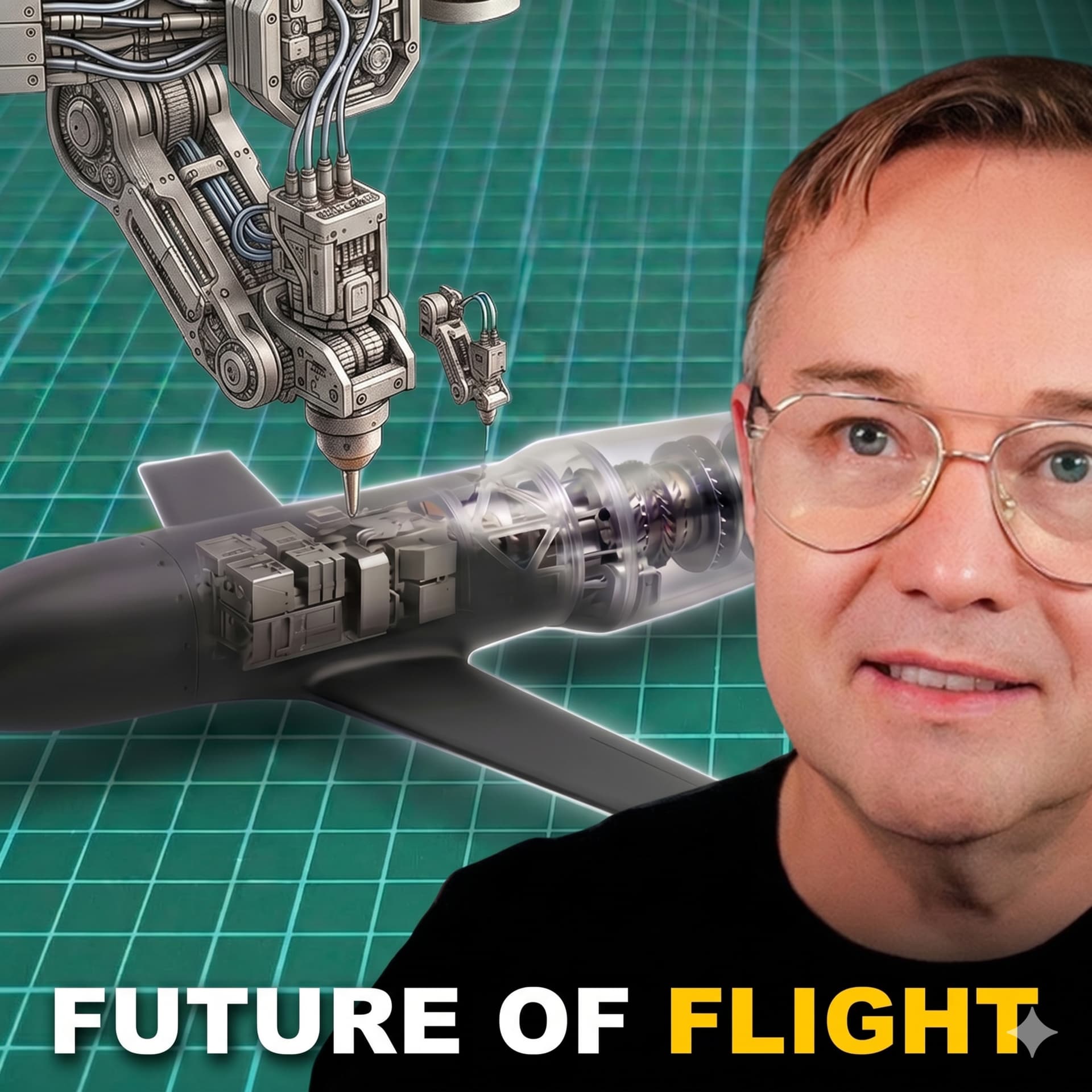

In short
Divergent Technologies’ shift from building hypercars to producing lightweight aerospace structures and cruise-missile airframes for the US military using AI-generated designs, in-house metal 3D printing, and robotic assembly; plus a related discussion on antidepressant tapering and critiques of pharma messaging.
Guests
Lucas Czinger, co-founder and CEO of Divergent Technologies. Background: started in automotive (including structures for McLaren, Aston Martin, Bugatti; built the “Singer” hypercar via a separate Zinger Vehicles company), then moved into defense about three years prior using the same AI-driven engineering/manufacturing approach. Also discussed: Brandon Good and Dr. Mark Horowitz (Outro Health) on virtual care for tapering antidepressants.
Key claims (Czinger)
Divergent’s “product-agnostic” factory can switch between chassis, performance vehicles, and cruise-missile airframes on shared hardware. Additive manufacturing becomes cost-competitive at ~10,000 metal units/year (auto crossover in the high single-digit thousands; above ~30,000 additive is less attractive). Quality/repeatability is “certifiable” for defense with years of data. They are an “infrastructure layer” sub-supplier to primes/neo-primes, not a prime.
Notable examples
airframe part count reduced from ~200 to under 10; fuel volume up 20–30%; mass down 20–30%; “71 days to flight” improved to mature CAD in ~1.5–2 months and first hardware in weeks; one printer ~200 cruise-missile airframes/year; “Venom” prototype with Mock Industries and Secretary of War Pete Hegseth. Outro Health claims: antidepressants lack proven “chemical imbalance” basis; withdrawal is often misclassified as relapse; hyperbolic tapering plus non-drug supports.
Written by AI. May contain mistakes. Listen to the episode to check what was said.
Chapters
Tap a time to open that second in VOThe Antidepressant Debate
0:00 to 0:41
Explore the impact of antidepressants on mental health perceptions and treatment.
“There's 50 million Americans on antidepressants.”
Introducing Lukas Czinger and Divergent Technologies
2:20 to 3:54
Learn about Lukas Czinger's background and his company's innovative 3D printing technology.
“So when I drop the plod pin into my little charger here that sits on my desk, look at this, Lon.”
From Hypercars to Defense
3:54 to 6:12
Discuss how Divergent Technologies pivoted from automotive to defense manufacturing.
“He's the co-founder and CEO of Divergent Technologies, Jason.”
3D Printing Applications in Manufacturing
6:12 to 8:14
Explore the applications and advantages of 3D printing in manufacturing.
“You're building Kinkos for 3D printing stuff.”
The Future of Manufacturing and Logistics
10:57 to 14:01
Discuss the future of manufacturing with 3D printing in defense and logistics.
“The fidelity has obviously always been pretty great, but it's perfect or is that an issue today or has that issue been put to bed long ago?”
Impact of Shipping Containers on Global Trade
14:01 to 15:00
Learn how standard shipping containers revolutionized global trade and economic measurement.
“C-O-N-E-X, which is just what is the standard issue today.”
Divergent's Approach to Defense Technology
15:01 to 17:44
Discover how Divergent is impacting the defense industry through innovative technology.
“You're single-handedly keeping the dad book alive.”
Divergent's Manufacturing Processes
17:45 to 19:44
Understand how Divergent's manufacturing processes reduce costs and improve speed.
“So just as much as Lockheed's a customer, Mach is a customer.”
Lessons from a Family Business
20:55 to 22:32
Explore the personal and professional lessons learned from founding a company with family.
“Not something either of us had imagined, but something that has been just an incredible journey.”
Deterrence in Modern Warfare
22:33 to 23:18
Discuss the importance of military preparedness and deterrence in contemporary conflicts.
“I think it comes down to what hardware does the U.S.”
Show all 45 chapters
The Role of Startups in Defense
23:19 to 24:38
Learn how startups are transforming the defense sector by introducing competition and innovation.
“Teddy Roosevelt, who said that quote, was also kind of a loud guy, But he figured out there's certain occasions for that.”
Shifts in Military Strategy and Technology
24:39 to 26:45
Understand how military strategy and technology have evolved in response to modern challenges.
“on decade-long contracts, but literally being made in real time.”
The Dynamics of the Ukraine Conflict
26:46 to 28:01
Examine the ongoing dynamics of the Ukraine conflict and its implications for global politics.
“versus Ukraine, ceasefire agreement, bye.”
Geopolitical Shifts and Military Technology
28:01 to 28:54
Explore how modern conflicts and military strategies are evolving with technology.
“Like all geopolitics at this point, in some ways is navigating around this conflict.”
Ticketing Restrictions and Fan Experiences
31:11 to 33:10
Discuss the unusual ticketing restrictions imposed by sports franchises.
“It seemed to me like it was going to be the Knicks.”
The Case Against Overprescription of Antidepressants
34:00 to 36:22
Understand the challenges and concerns regarding the overprescription of antidepressants in youth.
“This is a company, they are a virtual health service, Jason, that is helping people taper off their prescription antidepressants.”
Debunking the Chemical Imbalance Theory
36:22 to 42:00
Examine the flawed beliefs around chemical imbalances and antidepressant efficacy.
“Like I've been on Zoloft and I went back and said, I don't like this.”
The Messaging Behind Antidepressants
42:00 to 43:37
Exploration of the misleading narratives surrounding antidepressants and their societal impacts.
“I mean, you made a comparison to Purdue Pharmaceuticals and opioids, and I would say opioids are more dangerous drugs in lots of ways because they make you stop breathing.”
Personal Experiences with Medication
43:38 to 45:29
Discussion on personal experiences with antidepressants and their implications on agency and recovery.
“It's not like it's not your fault, but there are no other recommendations.”
Understanding Withdrawal Effects
45:30 to 48:21
Analysis of withdrawal symptoms from antidepressants and how they're often misdiagnosed.
“It's the magic trick that these pharmaceutical companies will then give to you, like, hey, here's the trick.”
The Scale of Antidepressant Use
48:22 to 50:48
Insight into the prevalence of antidepressant use across the American population and its ramifications.
“But it's the emotional symptoms that cause all the confusion.”
The Tapering Process Explained
50:49 to 53:36
Examination of tapering methods and their effects on withdrawal experiences.
“Obviously you've got to show, should I just show the tapering?”
Hyperbolic Tapering Methodology
53:37 to 56:00
Introduction to hyperbolic tapering as a solution to minimize withdrawal symptoms.
“to zero is a 58 % change, whereas going from 20 to 15, which is still five milligrams, is a 3 % change.”
Metaphors of Recovery: Skiing and Medication Management
56:00 to 57:29
Learn how skiing metaphors illustrate the process of coming off medications safely.
“than people who jump off the cliff, I mean, obviously.”
Navigating Conflicting Incentives in Healthcare
57:29 to 1:01:02
Understand the complex incentives at play between patients, doctors, and pharma companies.
“We had the incentives of the drug companies, which is sell, sell, sell, you know, increase the dosage, double the price, et cetera, et cetera.”
The Side Effects of Antidepressants: A Deep Dive
1:01:02 to 1:04:44
Explore the various side effects of antidepressants and their long-term impact on users.
“I think we're going to enter an era where, as healthcare costs are double, triple, the rest of the world, you know, the United States has the best healthcare in the world.”
The Emotional and Sexual Numbing Effects of Medication
1:04:44 to 1:05:47
Discuss how antidepressants can lead to emotional and sexual numbness, affecting relationships.
“People say to me, well, if these drugs don't fix serotonin problems, what do they do?”
AI Job Loss and Big Tech's Strategy
1:10:04 to 1:13:14
Explore how AI is causing job losses in big tech and its implications.
“At the same time, we have to answer a very basic question.”
Middle Management and Job Automation
1:13:14 to 1:15:55
Discuss the impact of automation on middle management and the future of work.
“My suspicion would be Google, Amazon, OpenAI, Anthropic.”
Trump's AI Executive Order Controversy
1:19:20 to 1:23:56
Delve into the political implications of Trump's canceled AI executive order.
“I want to hear your this touches on this is an all in adjacent news story.”
Self-Regulating AI Models
1:24:00 to 1:25:08
Discussion on the need for a self-regulating system for AI models to assess their potential harm.
“and adults feel comfortable with, hey, this movie is Caligula.”
Job Loss and Economic Polarization
1:25:08 to 1:26:47
Exploration of job displacement fears due to AI and economic implications for workers.
“Just create your own rating system that says, hey, this model is not intended for people under the age of 18.”
Political Landscape and AI Regulation
1:26:47 to 1:28:29
Analysis of current political dynamics regarding AI regulation and its potential effects.
“This is what Bannon, Fuentes, Tucker, they've all departed.”
Chatbots and Ethical Concerns
1:28:29 to 1:30:09
Debate over the ethical implications of chatbot interactions and their regulation.
“and what kinds of conversations you can have with a chat bot.”
Approaches to AI Regulation
1:30:09 to 1:32:09
Discussion on various methods of regulating AI technologies, including self-regulation.
“sorting packages in Amazon, we say, hey, every time a robot goes into a full-time position or works eight-hour shift, that equals one human.”
Future of Jobs in an AI Era
1:32:09 to 1:33:17
Consideration of job creation versus loss in the wake of advancing technology.
“There's some that I have no problem with.”
AI vs. Kled AI Controversy
1:33:17 to 1:33:32
Discussion on the controversy surrounding Lul AI and Kled AI and their funding sources.
“We talked about the Lul AI versus Kled AI.”
Nepo Babies in Venture Capital
1:33:32 to 1:35:04
Exploration of nepotism in venture capital and its implications for startup funding.
“Crypto exec Robert Chang was on the Rasmur Report live stream podcast.”
The Reality of Funding Startups
1:35:04 to 1:36:49
Insights into the rigorous process of startup funding and the role of connections.
“No, real VCs have to answer to their LPs.”
The Resurgence of QR Codes
1:38:00 to 1:38:34
Discussion on the re-emergence of QR codes due to COVID-19 and their impact on everyday life.
“The return of the QR code has been quite tricky.”
Living Without Smartphones
1:38:34 to 1:39:06
Exploration of the challenges and lifestyle choices of living without a smartphone in a digital world.
“I mean, I think it's more a thing of I haven't let the rest of the world cave in on me.”
Curating Information Like Trump
1:39:06 to 1:40:38
The hosts discuss Donald Trump's unique approach to handling information and communication.
“you around who does have a cell phone so that it you know you would you would it would be easier But I don't know.”
The Mixed Feelings About QR Menus
1:40:38 to 1:41:29
The hosts share their experiences and opinions on the use of QR codes for restaurant menus.
“Yeah, I will say I agree with Chris about the QR code menu things.”
Social Media Detox Ideas
1:41:29 to 1:42:50
Discussion on the impact of social media addiction and potential strategies to reduce usage.
“Just usually the websites aren't well designed.”
Coffee Machines and Pods Debate
1:42:50 to 1:45:04
In-depth analysis of coffee-making methods and the economic and environmental impact of pod systems.
“For me, I wanted to share one of the companies we invested in is called Terra Cafe.”
Transcript
Automatic transcript. May contain errors.0:00There's 50 million Americans on antidepressants. You know, there's been campaigns run in America and around the world, mostly by drug companies, that have convinced the public that they are suffering from chemical imbalances. That if they're feeling sad or they're feeling anxious, it's something that's gone wrong in their brains. Pharma had no interest in getting people off or doing any research to get people off, unless you had a business case for it. When people go to their doctor and they say, I've stopped my drug, I'm having panic attacks, I can't sleep. The doctor doesn't even let them finish the sentence and says, you must be relapsing.
0:30That is, your underlying depression or anxiety has returned. Do we know what it's done to people's brains if they've been on it for 10 or 20 years? We are running the biggest open-air experiment on the public ever conducted. This Week in Startups is brought to you by Render. Find out why 5 million developers are already using the all-in-one cloud platform Render. Go to render.com slash twist and apply for the Render startup program to get$500 to$100 ,000 in free credits depending on your stage and backers. Shopify. Turn those what ifs into sales with the e-commerce platform powering millions of businesses.
1:06Sign up for your$1 per month trial today at shopify.com slash twist. and every.io. For all your incorporation, banking, payroll, benefits, accounting, taxes, or other back office administration needs, visit every.io. Okay, everybody, it's Twist. It's May 22nd, 2026. Lon Harris is here. I'm your boy, Jake Howe. We have a lot on the docket today to get to. But before we do anything, Lon, I'm just going to grab my plod. Yeah, we should applaud plod. I always like to applaud plod. I take my little plod pin when i'm wearing a jacket like this i i use the magnetic snappy snappy the magnet i have the magnetic thing around here it's right here but you like to clip it like a door i like to clip it like a dork exactly yes i like the more elegant magnet thing and then you just press the little button feel the haptic shakes now i'm recording now everything i say i can do hey make sure i go through a plan with producer jacob and lon about the community manager coming on board and just documenting where all the communities we have for this week in startups, this week in AI, all in, et cetera, founders, founder of the university, make sure we just at least document where all the communities are so she can hit the ground running.
2:20Okay, now I got that on my action item. I'm ready to go. So when I drop the plod pin into my little charger here that sits on my desk, look at this, Lon. This is a little tiny charger here. When I drop that in, it auto-syncs. Yeah. Gets onto the Wi-Fi network, the 2.4 Wi-Fi network, right up you can set it to an app on your phone or your device you can set it into google wherever you want you can port this information i was i was explaining it to a friend uh and she was saying you know oh i hate those kind of things that record you and then you got to go through these transcripts and i don't like listening to myself but i was like that's the great thing about plot is it really does all of that it really does all that for you and then you just have this document that's what you said without the fluff or anything you don't need it's really great and i click on the most recent MP3 file or whatever file size it puts in there, I hit generate.
3:13And I go with auto generate, but you can do custom. And it will make highlights. It'll make a summary. It'll put the transcript. It'll put action items. It'll make like five tabs about that file that you recorded, whether it's a meeting or you taking action items or you writing a blog post, whatever it happens to be. They have a code. Give them a code. Oh, sure. So if your work relies on conversations, you've got to get yourself a PLAWD note pin S. Check it out at plaud.ai slash twist. And if you use the code twist, they're going to give you 10 % off your new PLAWD pin. Okay. Let's get started with the docket today.
3:49What's on the docket? Sure thing. Well, first, we got a guest. We're very excited. Oh, great. His name is Lucas Zinger. He's the co-founder and CEO of Divergent Technologies, Jason. They are 3D printing lightweight vehicle and aerospace structures in an industrial scale using AI-generated designs. They've got their own three-part system, so they generate the designs in AI. They 3D print them themselves using their own proprietary alloys and systems. And then they've got a robotic assembly system that puts all of these components together in their factory. So there's sort of an all-in-one solution for 3D printing these large, intricate, formerly very component and little part-heavy structures.
4:30I'm aware of this because they had the Singer vehicle, right? They were building a hypercar at some point. Correct, yes. And we've got Lucas Singer here to tell us all about Singer vehicles and moving from automotive into 3D printing for, you know, third-party customers and clients, including the U.S. military. Welcome to the program. Tell us a little bit about the Hypercar. I remember that. And then how you went and pivoted Hypercar into, I guess, being a partner for the military. Divergent had really an industry agnostic and product agnostic brief from the very start. So we'll talk about the Hypercar.
5:08We'll talk about the US government work. But really, from the very beginning, the vision was, can we create a manufacturing business and an engineering business that ultimately would own and operate factories across the globe that hit low unit cost while being product agnostic, right? What does that mean? So have a factory that can do a chassis for a city vehicle, a chassis for a performance car, and then a cruise missile airframe all on the exact same hardware that's running in that factory and can switch adaptively between those product sets and then can scale to be very large and also hit a low unit cost.
5:46So yes, we started in auto. And when we started in auto, we actually brought in-house a vehicle development, and that became a separate company, Zinger Vehicles. And then we also started serving the large auto OEMs, including McLaren, Aston Martin, Bugatti, and others, making their structures and shipping those structures actually from our startup in Los Angeles over to the EU as a tier one supplier. And about three years ago, we got involved in the defense line of work using that same engineering practice, AI-driven engineering practice, to manufacture airframes, piece parts, and complex assemblies for the US military.
6:26You're building Kinkos for 3D printing stuff. We all laugh, but the idea is, hey, there's a global series of locations to print this stuff. So my question to you is, there's 3D printing companies that make the hardware, you use the best of those. Like I know we were investors in desktop metal. They were doing metal 3D printing. There's a bunch of different people using different types. So you're the layer, the application layer, the service layer for those type of 3D printing technologies. Am I correct? We're actually both. So we, you know, in terms of analogy, I would say, think about AWS or TSMC, think about cadence as the front end.
7:13So we are both the engineering application that's going to take functional requirements for something like an airframe, engineer that airframe very rapidly into a higher performance point, and then take that design and manufacture it, both the prototypes for competition, but then where we really specialize is in the high volume runs. We want to make tens of thousands, hundreds of thousands of parts, and we actually build our own 3D printers as well. So we don't sell the 3D printer, but we are vertically integrated through the printer, through the assembly system, through our post-processing, all the way down to the material card where we generate our own material chemistries as well.
7:48What's the option and the number of units where people should use 3D printing versus going to a factory that either stamps it or uses other technology to make millions of items? Obviously, we're not 3D printing iPhones or we're not 3D printing our whoops. So where is that number today? Because in the past, people used 3D printing to build the prototypes, but not to build the finished products. At some point, we moved over to the finished products being done on 3D printers, yeah? Yes. And a bit of education. When we started 10 years ago, we were printing at about 10 cc's per hour. We're printing now in the high hundreds of cc's per hour.
8:28So there's been much greater actually than a 10x improvement in cost productivity. So the market fit for 3D printing of metals has changed drastically in the last decade. And now you're seeing that in aerospace and defense work, we're actually more affordable, typically per unit than any of the traditional manufacturing methodologies. And our highest volumes outside of class one drones, which I would say we don't specialize in, and usually those are plastic structures. But when you get into metal structures, maybe the highest volume runs you're seeing is around 10 ,000 per year. At 10 ,000 per year for defense type geometries, additive manufacturing, but having designed for added manufacturing, which is critical as well, you need a design for this manufacturing technology and have the downstream processes in terms of post-processing and assembly, that methodology is actually going to win out at about 10 ,000 units plus.
9:23So in A and D, you're covering the full spectrum. In auto, the geometries are simpler, which means you can actually get a cheaper cast part in auto than you can typically in defense. And the volumes range much higher, right? Into the millions of units per year. So in auto, I would say the crossover point today is in the high single digit thousands. If you're above 30 ,000 per year, you're probably not going to look for additive manufacturing today. Additive manufacturing means what? 3D printing of metals. Yes. And 10 cc's, that's cubic centimeters. I'm going to take a guess. Yes. Yes. Starting a company is hard enough without having to take on a ton of time sucking administrative work that doesn't move anything forward or improve your product.
10:07You need to get back to running your business and clear the back office work from your plate. Every can help you with that. Every is the all-in-one platform from incorporation to banking, payroll, benefits, taxes, basically your entire back office. And they've worked with over 1 ,000 startups. If you're just getting started, they're going to handle your Delaware C-Corp, your EIN, and getting yourself a registered agent, all with no legal fees or delays. And if you're further along on your founder journey and you need to scale up your team, Every will help you hire contractors in over 200 countries.
10:41Plus, you're going to get 3 % cash back on every dollar you spend with your Every corporate card. So head over to Every.io and stop wasting time on the stuff that isn't growing your company. That's E-V-E-R-Y dot I-O. So this has gotten much faster. The fidelity has obviously always been pretty great, but it's perfect or is that an issue today or has that issue been put to bed long ago? That issue has been put to bed and quality was another large issue. How repeatable and how certifiable is the end article, especially in defense where you're talking about a cruise missile on an exquisite aircraft, you're lug mounted, you need to make sure that unit is 100 % safe for the pilot of that aircraft.
11:29And that's where we have put together years of data and performance history to be able to show the Air Force, the Army, the Navy, our end customers, right? As a tier one, we supply companies like Lockheed and Raytheon and the Neo Primes, that it's a high quality system that actually has better controls over it than traditional manufacturing alone. Lana, I'll let you ask a question next. But my final question on this technology is the speed at which you make, say, the drone. And if we were using the drones that Ukraine, Iran, and other folks are doing, these commoditized drones, I don't know if you build those or just the ones that fly 10 ,000 feet in the air.
12:09And they're like the desert storm drones, the ones that were much more sophisticated than the standard ones that are being used in Ukraine today and Russia during that conflict. Are those getting to the point where they'll be made in the field, closer to the field? And what's the speed? How many come off the line, et cetera? For plastic printing, absolutely. I think you're going to see this forward deployed. You're going to see it in Connex boxes. You're going to be making your class one type drone in high volume in the high thousands out in the field. Now, that is one element that we need for air superiority and to win.
12:47But another element is largely munitions, right? And we talk about the munition crisis today from large, more exquisite systems like Tomahawk, but also the affordable mass programs like the family of affordable munitions. There you need a system that can carry 100 plus pounds of payload, that can fly at hundreds of miles per hour and can go long distance, say 1 ,000 miles. And that's where we really specialize in making those complex metal structures and getting those into the thousands. A single one of our 3D printers can do about 200 of your typical cruise missile airframes per year. So if you have a hundred of those running, you can do about 20 ,000 of your typical airframe out of one factory.
13:25And that is high volume scale. And that is a factory that you can quite literally copy and paste similar to a server farm. If you're thinking about infrastructure, you can set that up across the U.S. And the beauty is if you have a hundred factories across the US, you can share capacity across them. And you can really have surge capacity. You can go from commercial work to military work, and you can rotate in between the two to the demand signal of your end customer. Yeah. Wow. Incredible how far this has gone. Conex is just basically containers, right? The military came up with that concept long, long ago.
14:01C-O-N-E-X, which is just what is the standard issue today. I think they were different sizes when they started but during the korean war they needed a standard box for shipping military stuff and all the great shipping containers now lan use that same standard there's a book about this too i started reading it's about containers really about literally just the shipping container and how the shipping container changed the world literally having that become a standard just made the entire world uh became like a unit of measurement i'm trying to think of like a gallon of milk or whatever. It just became this crazy standardization that changed the world.
14:44Yeah. How the shipping container made the world smaller and the world economy bigger by Mark Levinson. This book went like, I read the first like three chapters and I'm sorry to Mark. I was like, I don't know if I have a thousand pages. Did you see that Wall Street Journal piece this week? Dad books are a dying breed. You're single-handedly keeping the dad book alive. That's the most dad book I've ever heard is like, here's the story of shipping containers and politics history military these are right dad yes and this is like the history channel of books yeah exactly uh launch a question yeah i did well i'm one thing that's interesting so uh earlier this year uh divergent announced the venom prototype they've worked on with mock industries i'll bring this up right here uh and here's a picture of lucas with uh with our secretary of war pete hagseth i'm curious oh wow Oh, look, they're doing, are you guys doing shots in that?
15:35Is that you guys doing? Oh, no, they're not doing shots. It's very professional. If you can't see the visuals, it looks very professional, folks. But I guess my question will be, like, there's got to be so many startups and companies that are trying to get that meeting, trying to get into that room in front of that guy who's got the power to say, yes, I like this technology. So I'm curious, like, what was that? Is it really just pure meritocracy? Like you have the tech that is so interesting that the military can't say no. Or was there some lobbying, marketing? Was there some, you know, like how did you get into that room?
16:09It comes down to performance, really. I think they're looking across what companies are making an impact today that they're hearing about from the end services as well. And we're shipping thousands of units per year out of this Los Angeles-based factory. And they know where the hardware is ending up. So they're looking at, OK, Divergent is on over 20 of the programs. that we care about with hardware on those. We need to go see what this team is up to, what this factory looks like. And then they think about the technology. But I think it's actually impact first and then the technology as the second set.
16:41And we're known for our additive manufacturing work, but really we engineer multi-material as well. We have multiple manufacturing methods. Sometimes we're combining off-the-shelf composites with additively manufactured structures and doing these hybrid systems for large airframes, say 30-foot large autonomous airframes. And I think that's really what the secretary was looking at is what companies are having the most impact, what companies should I be highlighting, and what companies do I need to scale so that we can hit our framework agreements and so that we can invite more competition and more volume into the defense space.
17:15And what magnitude cheaper are you at building a drone than Lockheed Martin or whoever else you're, you know, those major, what do they call it the major primes? Yeah. Yeah. I think we say primes and then neo primes is how I typically hear it. So you're a neo prime, you're a new prime. Or a micro prime. Are you a mini prime and Antrol's a maxing? We're actually not a prime at all. So we are the infrastructure layer that the primes tap into. So we always are a sub supplier to the primes and the neo primes and the big legacy guys. So just as much as Lockheed's a customer, Mach is a customer. And what we're doing is really trying to force multiply for those primes, right?
17:57Make their products faster to market, cheaper per unit, and then support them at scale to get to thousands per year. And that's also why I think why the US government looks at us in a unique way is they see we're not competing head on with the legacy guys or the new guys, but rather we're going to help that entire ecosystem get to a lower cost point and move faster. And when you ask, what do we enable versus legacy designs? A couple of metrics that are typical for a cruise missile that we're supporting, an airframe might go from around 200 parts down to under 10 parts. Fuel volume is likely to increase 20 to 30%.
18:33Mass is likely to decrease 20 to 30%. So you're getting much higher performance, reduction and failure methods. And then you gave the mock example, that was 71 days to flight. We're typically able to deliver mature CAD within about a month and a half, two months, get first hardware within a couple of weeks thereafter, and actually then just ramp continuously from there. And the same exact system that's delivering the prototypes is going to be used to deliver production hardware. So essentially your first unit is production grade. On the cost side, we've had programs where we've actually been 50 % cheaper per unit.
19:09Sometimes we're helping engineer products like Coaspire's Rackham system that's in the low hundreds of thousands. What's that system, Rackham? What's a Rackham? Rackham is an adaptable, affordable cruise missile platform. And it is flying through an FMS contract right now, but also going into the US Air Force here in the future. Lon, you had a last question. Yeah. One thing that interested me when I was doing the research, you're now the CEO and co-founder founder, sort of acting chief. You started the company with your dad. I'm curious, what's that like? And what do you think, what are some of the best messages or lessons that you got about running a company from the old man?
19:51I've always wanted to have a merch store here where we sell this week in startups gear. And once they get around to actually bringing my dream into a reality, there's no better partner that I'm going to use than Shopify. That's right. We're going to set up a Shopify store here for this week in startups merch. And when we do set it up, we're not going to have to wait weeks to get things up and running. Nope. I could just start selling our coffee mugs, crew jackets within hours and all the infrastructure, all the ecosystem from integrating third-party apps to Shopify seamless checkout process. They're all in place already.
20:21That's why Shopify is the e-commerce platform behind millions of businesses around the world. They are cooking with oil. They are getting it done at Shopify. In fact, they're powering 10 % of all e-commerce in the United States from household names like Heinz and Mattel to companies that are just getting started. So it's time for you to turn your what-ifs into. Sign up for your$1 per month trial today at shopify.com slash twist. That's shopify.com slash twist. Yeah, it's been a tremendous blessing, I think, for both of us. Not something either of us had imagined, but something that has been just an incredible journey.
21:04Kevin, my father, really had the idea for Divergent, right? How do we hit low unit cost and stay product agnostic? I'd studied engineering, gone out of engineering, done some finance work, and then decided I'm going to roll the dice with my dad here and aim to help him build this startup. And my first five, six years with the company, I got to build our tech platform. So focused on the robotics arena, then that manufacturing, then the software, combined those three and then moved on to run operations first as president and COO, now as CEO. But it's been tremendous to work in the trenches with my father early on to celebrate some of our biggest highs, our first capital raises, our first assemblies, our first production shipments.
21:47Absolutely incredible. And my father, more so than I'd say business, you know, truce that he's passed on, although he's passed some of those on as well. It's really been what is the character development required to run businesses and do hard things. And that's been a lifelong lesson from him to me and one that certainly has enabled Divergent today. All right. Continued success. And thanks for keeping the good guys armed. And hopefully we can end some of these conflicts. I'm a bit concerned here about how long this Iran thing is going and how Ukraine never finished. I mean, in some ways good for the military industrial complex, but I think we need these things to wrap up.
22:30What's your take on that, Lucas? Is Iran going to wrap up or what's the word on the street? I think it comes down to what hardware does the U.S. have and how much can we deter conflict and put an end to conflict as well. So I'm a proponent of deterrence and making sure that we don't start any unnecessary conflicts or our adversary doesn't start them because they see the U.S. is so prepared. And that's what we're working on every day. That's why our team's also motivated. We can stop something here if we're prepared. Yeah, it's well said. Speak softly, carry a big stick. I think we speak loudly right now.
23:08Our current president's a little bit boisterous and loud. So it's speak incessantly and carry a lot of sticks and bring a couple of CEOs with you. Teddy Roosevelt, who said that quote, was also kind of a loud guy, But he figured out there's certain occasions for that. There's times for it. There is. You know what? Yeah, move silently. Like sometimes you want to just say less and have that big stick. All right, Lucas, continue to success with your starting. Great to have you. Thank you. Great to talk. It's amazing how this military, you know, these neoprimes and the competition has been infected by entrepreneurship and also by the venture capital industrial complex.
23:52Those two things are absolutely fantastic. And it was an area where we believe that startup ecosystem would not play a role. And now startups are playing a role, which is pretty fantastic because if you look at that, it was a non-competitive space that now has massive competition from startups injected into it. And the way startups compete is they make things that are better, cheaper, faster, right? Better, cheaper, faster has always been the mantra. And that just happens to parallel what the game on the field is, which is commoditized small munitions, drones built to order in the field, not years before, not on decade-long contracts, but literally being made in real time.
24:42It's just a different, it's a different, it's a different front. It's a totally different way of thinking about preparedness. I mean, you read about like before the U.S. entered World War II, before the Pearl Harbor attacks, the U.S. Navy had already been working on these huge aircraft, these huge ships that they were going to need to send out. There was just foresight. If we hadn't done that before Pearl Harbor, the whole war in the Pacific would have been very different. And so today we're sort of, we don't have that same risk factor because we can more quickly catch up and ramp up. So even if we hadn't necessarily seen that coming, we would have been more prepared.
25:16Well, I think before these neoprimes, we were having the problem of these things were getting built too slow. And the business model, this is really important for founders, incentives matter. So the business model previously was called cost plus. There's a cost for it and you get a little percentage above the cost. So then the incentive to drive down cost and to do it faster and cheaper doesn't exist. If you make something faster and cheaper, you make less money. In other words, if I'm getting paid 10 % over whatever it costs to make this missile, the missile costs a million, I get 100 ,000. Well, what if the missile could cost 250K?
25:54Should I get, instead of 100K, maybe I should get 20 % of the cost savings, which would be you know, 20 % of 750K saved, maybe I should get 150K. Maybe I should make 50 % more by making something, 50 % more profit by making something more affordable. And it was these incredibly long timelines. It would be Boeing's working on this new kind of plane for 15 years and a startup can't compete with that. They don't have 15 years. They need to start selling things today. And so by shortening those timelines and changing that, the whole landscape has now really shifted. I mean, we'll talk about it on the show all the time.
26:27We have companies that are innovating in ways to do missiles and drones and autonomous vehicles and all sorts of AI for the battlefield. And I mean, it's just, it feels like every week there's a new. And you know, I love to try to understand the world. And the first thing I do, we have a great partner in Polymarket. And I just go to Polymarket and I look at Russia versus Ukraine, ceasefire agreement, bye. And looking at the end of the year, people were thinking, if you go to that December 31st and you click on it, Lon, you can see the order book over time. And obviously the order book started high.
Read the full transcript
27:05People thought it was an 80, 90 % chance. As we get closer, people are like, whoa, this is dropping. And so the number of people involved in this, million dollars, and now it's only a 43 % chance that we have a ceasefire agreement by the end of the year, majority chance is that we will still have this war going into its, I think, fifth year. I can't believe it. Like the first episodes of All In, we were debating this Ukraine-Russia war and that Russia would be in Kiev in four days. They'll be in Kiev in four days. It's just unbelievable to me that people got it so wrong. The conventional wisdom was Ukraine is this small country.
27:46It's this relatively small military. They're going to be rolled over by the massive and, you know, incredibly potent Russian army. And yeah, I think very, very crazy to see this many years later, they're still holding their own. And it's become such a pivot point for the entire world. Like all geopolitics at this point, in some ways is navigating around this conflict. It's wild to see. Well, and it, I think, speaks to these paper tigers. As I heard, you know, somebody, I don't know, it was Graham Allison or somebody referred to it as Paper Tigers. Like you think Russia or Iran are these incredible military forces, North Korea, obviously.
28:26And it turns out some of them maybe they haven't been updating their weapons systems and technologies. Yes, they're incredibly potent militaries from a late 90s, early aughts perspective. But from a 2026 perspective, when, yeah, a swarm of small drones can get through your defense shield that was designed for, jets or whatever, missile systems. It's a whole new world, and it really has changed the fundamentals of that fight. Yeah. So thanks to Polymarket for keeping us all informed. It's just so great to know where the sharps are putting their money. There's always people who have analyzed these situations really deeply.
29:04I got another one. Do you want to say? Oh, you do? Okay, yeah. One more Polymarket that I thought was fun. They're obsessed with SpaceX. There's 100 million in poly markets about every aspect of the SpaceX coming IPO. Here was one I thought was funny. What will SpaceX's public ticker be? So far, 98 % are saying none of these options. The leading ones are X or SEX, which would feel very Elon to do SpaceX, SEX. But, you know, I thought space or Mars makes sense. They're$0.03 and$0.02 to buy space or Mars. What do you think the SpaceX public ticker symbol will be? You know, I thought this got resolved and they announced it.
29:47So I am unsure. But this says - I think that's why. Yeah. So SPCX, I guess, is what we're the conventional wisdom. Yes. I think what you're seeing is that it's resolved now. Oh, okay. There you go. That would make sense. So the other ones now are no more. No more. Too bad. Mars would be such a good one. Why wouldn't we do that? Yes. Big cloud providers may offer you cheap compute, but you'll end up paying the difference in engineering costs and hiring extra developers. You don't want to waste time configuring virtual networks, none of us do, or your access policies. You want your team building your product.
30:23So it's time to look at Render. Render is the all-in-one cloud platform for developers that allows you to deploy, scale, and secure your apps and agents with zero ops. Most cloud platforms ask you to split your focus between product and infrastructure, or they force you into platform constraints. You know you're going to grow in six months, but just connect your GitHub repo to Render and you are live. Web services, cron jobs, the whole stack in one platform. It's time to find out why 5 million developers are already using Render. 5 million. Go to render.com slash twist and apply for the Render startup program.
31:00You'll get anywhere from$500 to$100 ,000 in free credits, depending on your stage and who your backers are. That's render.com slash twist. Well, actually, I think the funny one would be if everybody is in agreement that Tesla and SpaceX merge eventually, which does make sense in many ways, then why not just make it dollar sign E-L-O-N? Oh, yeah. You're basically betting on Elon. so just make it dollars I knew yeah it does feel like Musk Industries like Stark Industries at some point is just gonna happen like it's just we're gonna put them on okay yeah it's also great for sports you know I love watching the poly markets revolve resolve themselves in real time so I'm watching my next one again last night I'm gonna go Saturday to Cleveland I was so mad at the final Knicks 76ers game it was almost even odds on poly market and I did think like the Sixers have kind of not been doing so good.
32:00It seemed to me like it was going to be the Knicks. I didn't bet. And then, of course, the Knicks won. I would have made some - The Knicks are rolling now. Nine games they've won in a row. And I'm going Saturday. You want to hear a crazy story? Talk about off-duty. You know, I've sat courtside now twice in this nine-game win. I sat courtside for the massacre in Atlanta when the Knicks won. And then I sat behind the Knicks bench and then a little bit behind in MSG. And then I went to the Sixers and my friend Ben Stiller and I sat courtside there. They tried to stop me from buying those tickets at the Sixers.
32:36Atlanta didn't seem to care too much. Now there's a report, Dan Gilbert, the owner of Cleveland, and I can kind of confirm this as a breaking news story here. I was acquiring a pair of courtsides for Saturday night. Person was going to sell them to me. He said, I got a problem. I said, what's the problem? He said, if I sell them to a Knicks fan, Dan Gilbert's making everybody sign an agreement on DocuSign before you buy the courtside seats, that you won't give them to a Knicks fan or you won't take a Knicks fan with you. Is that legal binding? Can you do that? I don't know. I feel like that's not enforceable.
33:13Well, I think he can make rules unknown, I guess is the question. Once they're on the secondary market, he can't stop it. But this is the primary market. So I think he can make whatever agreement he wants with the ticket holders who are season ticket holders or who have access to those tickets. And they also blocked with their partners anybody from buying tickets who had a credit card address that's outside of the particular area. Yeah, if you don't live in Cleveland. Yeah. Which was pretty easy for my team to resolve, by the way. I mean, I don't want to get into it, but like, you know, if you have a couple of banks who work for you, issuing you a credit card or popping up an office space for a day in another city, not really a big deal.
33:56We're going to bring on the co-founders of Outro Health. They're Brandon Good and Mark Horowitz. This is a company, they are a virtual health service, Jason, that is helping people taper off their prescription antidepressants. The SSRIs like Celexa, Zola, Prozac, Lexapro, you know this category of drugs. I know it well, and they were, I believe, at launch festival, and everybody thought, hey, this is an incredible idea, and I was really interested in investing in it and spending more time with the founders. Why? I think these things are massively oversubscribed. I have no issue with people with a doctor doing what they think is best.
34:42However, I do think the incentive system in America, personally, professionally, and then economically, is designed to push people towards quick fixes that are extremely profitable for the pharma industry. If you look at what happened with that Sackler family and what was the - You're talking about OxyContin, Purdue. Their company's Purdue. Right, yes. Purdue making OxyContin. And I watched this Dope Sick film or series. It was a series. It was a Hulu series, yeah. Incredible with Michael Keaton, I believe. It was Michael Keaton. And my friend Peter Sarsgaard, who I was in Center of the World with.
35:25Look it up. But this was an incredible story of just how the pharma companies, their sales channels, the incentives can get misaligned, profits can ensue, and then anybody who subs their toes seemingly would get a bigger and bigger dose of Oxycontin, get addicted, then get removed from it, and then wind up taking fentanyl or some street drugs and dying. I look at it now, young kids now are being massively overprescribed. A young kid has a problem. They have anxiety created by their smartphone, by school, by whatever it happens to be. And they just wind up pressuring you. And I've had many parents come to me.
36:05Hey, what do you think, Jake? They're pressuring me to put my kid on anti-anxiety meds, on this and that. And I'm like, your kid's 10 years old and they're literally putting pressure. I'm not kidding. Nine, 10, 11-year-olds. I believe you're right. They're pushing them to scramble their brains. Now, an adult, totally different, but whatever. I can say from personal experience, like even if you go on an SSRI and you go back to your doctor and you say, I don't like it. Like I've been on Zoloft and I went back and said, I don't like this. I don't think it's working. They don't say, OK, let's try an alternate idea.
36:34They just try the next SSRI. Like, well, let's try Lexapro. Well, let's try Selexa. Well, let's try Pro. Like the idea is one of these is definitely going to work. We just need to fine tune it. And I don't I don't personally know. As opposed to what I told you, which was, hey, go to dinner with your friends, work out, take a walk. Three weeks in Italy. Right. You know, like there's other modalities here. Yeah. Anyway, let's hear from the founders how they're helping people taper off. Introduce our founders here. Yes. We've got Brandon Good and Dr. Mark Horowitz. They are our co-founders. Gentlemen, thanks for joining us here on the show.
37:06Thanks for having us, guys. Yeah. I like Jason. They call themselves the inverse hymns. I'd love to hear you guys unpack. The inverse hymns. Okay, yeah. Unpack it. What's with the inverse hymns idea? Yeah. I can speak to the commercialization side of it. So my background was actually Canadian, moved to the U.S., learned what a copay was for the first time and thought that was strange. And it ended up launching GLP-1s at Novo Nordisk at their headquarters and realized pharma had no interest in getting people off or doing any research to get people off medications unless you had a business case for it.
37:41So I came across Mark's work on hyperbolic tapering, which he can talk more about. and we've turned this hyperbolic tapering model into a virtual care platform that allows clinicians to help people safely taper off antidepressants and we're expanding to other psychiatric medications that follow this principle and as Mark will explain from this methodology it goes beyond psychiatric medications even to things like proton pump inhibitors opioids and even GLP-1s all follow this hyperbolic curve of how you reduce the dose, monitor the patients to make sure that it's going at the right pace for them, supply them with compounded medications so that you can follow this pharmacologically accurate staircase, and then help them with non-drug tools to replace the medication so that they can sustain their mental health long-term, like going to dinner with your friends or going to Italy.
38:35Now there's good evidence around that, thankfully, that doctors can recommend. Well, let's start with first principles. Mark, you're an MD, correct? And you've prescribed these drugs, I'm assuming, or worked? Okay, so you heard my little preamble there. I have a lot of friends who come to me and ask me, hey, Jake, how you seem like you're pretty well adjusted and happy. How can I get there? And I say, okay, listen, here's my big five. Sleep, diet, exercise, meditation, socialization. I work with my kids on those concepts, my friends on those concepts. If I have an employee or a founder in need and they say, hey, I can't sleep at night, et cetera.
39:10I'm like, okay, here's the protocol. We're going to get you on a whoop or an aura. We're going to start looking at your sleep. We're going to get your eight sleep dialed in. We'll work on sleep. Then we're going to work on diet. Then we're going to work on exercise. Here's your meditation with calm or waking up app, whatever it happens to be. And then socialization. Are you going out and breaking bread three nights a week with people who you love, et cetera? That's my protocol. but I want you to talk from first principles about how we got here. We'll get to tapering, of course, but how did we get here to where they're not aligned?
39:45And am I crazy, like sounding like Tom Cruise when I give my protocol or am I prescient? And I've refined this over time by helping my friends. So you're not crazy. Let me, let me tell you how we got here. Cause it'll make sense of where, how we go to get out of here. Um, you know, there's been campaigns run in America and around the world, mostly by drug companies, that have convinced the public that they are suffering from chemical imbalances, that if they're feeling sad or they're feeling anxious, it's something that's gone wrong in their brains. And that has been a very successful campaign that now most of the population believes they've got a chemical imbalance.
40:21And that story began as a hypothesis, you know, the 1960s by psychiatrists. And the short answer is it hasn't panned out. 60 years of research looking in people's blood, cerebral, spinal fluid in their brains haven't found that depressed people have lower serotonin than healthy volunteers. You know, in fact, by the age of 45, about 70 % of us will experience clinical depression or anxiety. In fact, you know, it's very, very common. It happens to more of us than it doesn't. And it's not possible that 70 % of us have something wrong with our brains. You know, what the data shows is the number of stressful life events we experience determines whether we'll become depressed or not.
41:01You know, the sort of thing that your grandmother probably said, when life is tough, you feel bad. If you get divorced, lose your job, move across the country, and your mother dies in a year, chances are you're going to be miserable. If none of that happens, chances are you're feeling pretty, pretty okay. So life comes at you. Absolutely. And these pharma companies had a thesis. There's a chemical imbalance in your brain. These SSRIs are inhibiting the reuptake of serotonin, and that means there's more serotonin in your brain, which means you'll be happier. And it turns out there is no blood test or scan or research that has proven this chemical imbalance to be true.
41:47yet we put hundreds of millions of people globally on this, tens of millions of Americans on this, without having actual proof of the chemical imbalance theory, correct? Exactly. I mean, you made a comparison to Purdue Pharmaceuticals and opioids, and I would say opioids are more dangerous drugs in lots of ways because they make you stop breathing. But what is similar is the messaging. What began the opioid crisis was messaging from the company that these drugs are not addictive. You know, if you're given it by a doctor, it won't be addictive. That was the sort of thing that allowed doctors to give out these drugs widely.
42:21And there are similar messages that have been put out there, mostly by drug companies that have allowed antidepressants to take over. And of course, they're used by way more people than are using opioids. And those messages are, depression is caused by a chemical imbalance. When you stop these drugs, you get mild and brief discontinuation symptoms. It's euphemism, you know, it's easy to come off. And they're highly effective and life-saving. And all of those messages have major scientific flaws to them. And that is what has allowed this to sort of take over society in lots of different ways. Well, and is that what you believed or the doctors told you when you tried Zoloft?
42:55Did they tell you you might have a chemical imbalance or was that your belief when you went in? No, it's very explicit. You're depressed because there's this misfire in your brain. You don't have the right chemicals. You're depleted. You're whatever. Yeah, it's nothing to do with me. It's nothing to do with the way I think. It's nothing to do with my outlook. So you didn't do anything wrong. It's nothing to do with the way I'm living my life or what's going on with me. Most of the time, there would not even be a talk therapy component. It wasn't like, we're going to put you on this drug, and then you're going to go to a counselor once a week or once every month and tell them about your problems.
43:28It was just, take these, and then you'll come back in a month, and we'll see how it's going. And it's not your fault. It's not your fault, Lon. Right. And that's the same thing, Mark, that they told people with their pain. Hey, listen, you have pain. We're going to give you these opioids. and this is sinister to me. It's less about fault. It's not like it's not your fault, but there are no other recommendations. It's not, well, you should probably try to get out and be a little bit more physically active. Well, you should maybe try to like get a little more sleep or wake up earlier. There's none of that.
44:02Here's how behavioral cognitive therapy about how to approach triggers or stressful situations, all the things that would really help a person navigate negative feelings and emotions. You don't get any of that. It's purely take this pill twice a day. And then if you have side effects, they're like, well, maybe you need the other pill or the other pill or the other pill. There's never a chance of like, maybe it's something else. Unpack what you're hearing from Lon's lived experience. So I just wanted to say, Jason's comment is really prescient that it's not your fault. And I'm not here to say it is your fault.
44:34I'm not here saying you need to work harder, pull stuff up by your bootstraps. I think the data shows we all have a breaking point when we have enough stresses, you know, we all sort of have a breaking point. And I think it's good to normalize that. There's research that shows that people that are told they've got a chemical imbalance feel less in charge of their recovery. You know, they've been told there's something wrong with a major organ. They're more lucky to want medications because if you've got a chemical problem, of course, a chemical solution makes sense. And in fact, they're more pessimistic about recovery because now there's a major medical problem.
45:03If people are told accurately, this is a rough spot in your life, you know, you need some help, all the things that Jason mentioned, all the holistic things, people feel more optimistic about recovery. They're less likely to want to use a medication, and they do better in the long run. So I think it's a very, some people say this reduces blame, and that seems like an ethical thing to do. But in the long term, it reduces autonomy and people being inside of their own lives. Agency, that's the word, exactly. Yeah, I mean, that's the amount of victimhood and lack of agency and self-reliance that I think is the trick.
45:41It's the magic trick that these pharmaceutical companies will then give to you, like, hey, here's the trick. You don't have to be responsible. I don't have to be responsible. There's another thing. And hey, it's just, this is a magic bullet. So tapering off of these though, I've had friends with the Adderall, which is basically speed. I've had friends with the Zoloft and the Welbutrin and all this stuff, really hard to get off of. Really hard to get off of. I think getting off of cigarettes, I've seen my friends get off of cigs easier than getting off of Adderall and Prozac. Tell us about how hard it is to get off of these and then And why this modality that you guys are working on in the systems that you're building works, and then how do you productize that into a business?
46:37I think we'll go back to you, Brandon, for that. What happens with any drug that you use, whether it's nicotine, alcohol, opioids, antidepressants, Valium, Alprazolam, Xanax, all those things, your body adapts to the drug. It's called homeostasis. When it's hot outside, we sweat. When it's cold outside, we shiver. if you use a drug that increases serotonin in your brain your brain becomes less sensitive to serotonin and when you stop the drug your your body and brain is crying out for it it's not the same as addiction this is sort of an issue that people get a bit mixed up with people aren't craving antidepressants they're not out in the street trying to inject more antidepressants but you don't need to be addicted to something to have withdrawal effects when you stop it i'm going to guess that i'm going to guess that jason you everyone listening is probably physically dependent on caffeine.
47:20If you stopped it, you would get a headache, you'd feel bad. I'm also going to guess you're not injecting it. You're not sort of on the streets trying to get more some occasional night. Depends on the day. No, I've had, I mean, caffeine is a perfect example. I have tapered off of it before, massive headaches. And the way I did it, because I was drinking it well into the afternoon, I used to drink an espresso after dinner. The way I actually did it was, I would have coffee up until noon and I'd stop or 1 p.m. Once in a while, I'd slip up and have a three o 'clock. Then I just told my housekeeper, here's the bag of decaf beans.
47:58Here's the bag of regular beans. Mix them into a giant thing, shake it up. And then I started just making half cap. I may still be doing half cap. I don't even know, but I just lowered the caffeine per cup and I just tapered myself off. Is that the solution you have? Is just... That is getting into our territory. I mean, I guess the main thing to say is when people stop antidepressants, there's a whole range of withdrawal effects that occur. You know, people get emotional symptoms, panic attacks, low mood, anxiety, crying spells, even becoming suicidal, as well as physical symptoms, brain zaps, headache, dizziness.
48:33But it's the emotional symptoms that cause all the confusion. When people go to their doctor and they say, I've stopped my drug. I'm having panic attacks. I can't sleep. The doctor doesn't even let them finish the sentence and says, you must be relapsing. That is, your underlying depression or anxiety has returned. And that has caused huge confusion because doctors have been taught, look out for relapse, people are going to get sick again, whereas withdrawal is probably more common than relapse. And that has led to doctors not seeing this issue in patients, which is why there are so many patients that have sort of fled regular medical services to go looking for help online, you know, on Reddit threads, in Facebook, on social media.
49:13You know, it's sort of this absurdity. Chat GPT. Chat GPT, exactly. It's this absurdity because doctors have been taught from short-term studies, withdrawal is not a big issue. but for long-term users in america there's 20 million people who've been on these drugs for five years or more and the studies go for eight weeks so there's a very big disconnect do we know what it's done to people's brains if they've been on it for 10 or 20 years because i i remember when these were introduced when i was in my 20s in the 90s uh we became like prozac generation prozac there were i don't know five or ten percent of my prozac nation it was a book yeah and literally like 10 % of Gen Xers, then maybe 20 % were starting to take Prozac and people were sharing their Prozac with each other.
49:54It was just like this new way to feel a little bit happier, 10 % happier. But yeah, speak to that, I guess. Yeah. Look, I mean, the real answer, and I don't want to alarm people, is we don't know what they structured in the long term. The studies go for several weeks. There's a famous professor of psychiatry called Alan Francis that led the DSM-IV committee who says we are running the biggest open air experiment on the public ever, ever conducted because now in America have 50 million people on antidepressants. What I see in my clinic - There's 50 million Americans on antidepressants, one in seven?
50:28One in six? I mean, yeah, I would say - If it's just 50 million kids, 60 million kids - Bigger than the population of Canada. Yeah. Think about your friend circle and then think about how many of them have ever taken like Zoloft or - It's almost - Yeah, it's like a third. It's almost everybody. It's almost everybody I hang out with is on one of these. Wow. This is just, I mean, I hate to say it, but I feel like it's criminal. Okay. So let's talk about the business here and incentives, Brandon. Obviously you've got to show, should I just show the tapering? Sorry, this is my obsessive monomaniacal.
50:58You'll have to stop me talking about it at some point. You'll have to get a gun out. Can I share, can I share my screen? Cause of course you will save a thousand. Please let me try this. We love a good demo here. And just remember 80 % of the audience is listening. Okay, I'll try to use my words to explain what you're looking at here. I am showing you, if you can see it, a picture of the way Selexa acts on the brain. X-axis Selexa, Y-axis effect on the brain. And it's a curve. It goes up very steeply and it flattens out at the top, like the left-hand side of an archway. And the key issue here is not a straight line.
51:32The doses that are used most often in America are 20 milligrams and 40 milligrams. And it sounds like that's doubling the dose. But in terms of effect on the brain, because that's near the plateau area, it's actually a very tiny increase in dose. The smallest tablet in America is 10 milligrams. But even a 2 milligram dose has about half the effect of 60 milligrams. So these teeny tiny doses that some doctors might laugh at and call homeopathic actually have very significant effects. And the reason for this is the pharmacological law, the law of mass action. and what it basically says is when there's not much drug in the system, all the receptors for a drug are open for business.
52:11A bit like the game of musical chairs, it's easy to find a seat. So every milligram of drug has a B effect at low doses. As more and more drug is in the system, receptors are saturated, the chairs are filled, you get less and less effect for your bang, less bang for your buck. And so you get this law of diminishing returns. Now, the way that most doctors recommend people to come off their medication is they go from 20 milligrams to 10, that's, say, half a tablet, then go to half a tablet every second day, that's five milligrams. It sounds intuitive and like it's spread out. But in terms of effect on the brain, it's anything but.
52:47Going from 20 to 10 causes a reduction in effect on the brain, a small reduction. Some people already find that quite unpleasant. Some people can handle it. The next reduction from 10 to 5 causes an even bigger change because you're now going down this steep curve. And the final reduction from five to zero is like jumping off a cliff. It has about 20 times the effects of going from 20 to 15. And so people are repeatedly pushed off this cliff by the way that doctors recommend coming off. And they end up in a screaming mess, headaches, dizziness, brain zaps, panic attacks. And the doctor says they don't know that this cliff exists.
53:22And they say, you must have relapsed. You must need your drug lifelong. And that's what people end up in this revolving door on and back off and back on the drug. Crazy. Sorry. No, I'm saying it's crazy when you look at the, well, I mean, going from five milligram to zero is a 58 % change, whereas going from 20 to 15, which is still five milligrams, is a 3 % change. 15 to 10 milligrams is a 6 % change. 10 milligrams to 5 milligrams, 13 % change. That's all taking 5 milligrams out. But the last 5 milligrams, as you're saying, those are the important ones, and that should really be done much differently.
54:03And it does feel like when you go through it, as I have, it does feel like depression. It feels like, oh, God, I'm chronically depressed. I'll never be free of this unless I just go back on the drug. So it really does fool your brain into thinking that you can't not be on Celexa or whatever. That's a really good point. You know, I say that a lot to patients. Our emotions feel very familiar to us. You know, when you have, say, a hangover from alcohol, feeling depressed feels a little bit similar to how you feel if you break up with your partner. I mean, we're not so – it's very familiar, these emotions.
54:38And so it can be very confusing to people. And they get caught in this idea, I must need the drug. Going back to that fallacy, we talked about the fallacy of the chemical imbalance. Yes, there is something wrong with my brain. This now proves it, and I've got to just do what - It's a reinforcement loop. Exactly. Exactly. The idea that there's not withdrawal and the people have a chemical imbalance have a sort of synergy where they convince people that they need the drug. That's exactly right. So the clever trick that we published a few years ago is rather than reducing dose by even amounts on the x-axis, reduced by even amounts of effect on the brain.
55:15And so I've drawn four horizontal lines separated by 20 percentage points on the y-axis. And that corresponds to going down by smaller and smaller amounts in terms of dose, down to really tiny final doses. So that, you know, imagine you're walking down this curve, it starts off like a country walk and it turns into, you know, coming down a cliff and you have to go inch by inch. And that means that you need to go down to these tiny doses that are much lower than commonly available tablets. So you don't end up jumping off that cliff. And because this curve is called a hyperbola, the jargon term of this is hyperbolic tapering.
55:49And we published this in the Lancet Psychiatry now a few years ago. And that is the essence of what we do. People who come off in this way have a much higher chance of success than people who jump off the cliff, I mean, obviously. And there's now studies more and more coming out of Holland, showing that this can help people who couldn't get off in the regular way come off and avoid severe withdrawal effects. And that's the core of what we do at Outro and All. I can tell you about this metaphor when it comes to skiing. When I ski, there is a 3.4 mile roundabout at the mountain I like to ski at.
56:25Very gentle, green and blue difficulty. and uh then there is a 1.4 mile straight down the mountain that's a double diamond diamond and you go very fast and you get down the same amount of vertical in a fraction of the time but it is scary as all get out if you're not an expert's ear do not bomb down those double diamonds and i think that's you know what you're showing here that is that is exactly it i mean whatever that does to your knees this is doing to people's nervous systems and you know knees are precious but nervous systems are a lot more delicate and so you know people i basically say to people what when you've tried to come off the drug before you have jumped out you've gone down the double diamond ski run what i'm suggesting is let's go out the back and go out you know on the the kiddie snow patrol going down very slowly the wraparound is what we call it it's the old wraparound you wrap around the mountain uh traverse it incredible okay so this makes total sense brandon how does to become a business?
57:25How do you productize this into a business? And then I'm curious about the incentives. We had the incentives of the drug companies, which is sell, sell, sell, you know, increase the dosage, double the price, et cetera, et cetera. And then we got 50 million people on it. But I suppose that the employers paying for health insurance, I pay for lawns as an example, we want our premiums to come down. We want to spend less. So now we're at odds with the doctors and the pharma industry, which get paid every time Lon comes into the office, every time he changes that med, that rings the doctor's register, I believe, and it rings the pharma's register, I'm sure.
58:07So talk to me about these, if I'm correct, and I am a neophyte, these opposing forces and incentives matter. We always talk about that in startups, in government, everything in between, personal responsibility. Incentives do matter here. how do you manage a business model with conflicting powerful forces? Yeah, I'll talk about the incentives and then get into the business model. So, you know, the lens that I apply it from was working on the market development and market access side for the GLP-1 drugs, and therefore understanding the incentives from the patient, from the clinicians, and the payers, whether public payers like the region of Catalonia in Spain or Aetna in the US.
58:51And there's a really interesting why now when it comes to the pharma incentives, because most of these drugs are actually off patent. And there are some like newer drugs in market that aren't really as popular that are still on patent. Maybe their list price is$1 ,300, but Lexapro, Zoloft, Prozac, those are all generics by now that maybe cost$20 to$30. So that's really clinical inertia, why patients are still prescribed these things and why they've been on them for so long. The drugs coming down the pipeline in the mental health category, you know, I have my qualms. I think there may be a step forward, but they tend to be inspired by psychedelic molecules that follow rather than a pill per day paradigm.
59:38They follow a, you know, one, two, three intervention paradigm. those drugs actually don't work very well when people are on antidepressants because antidepressants blunt the effect and dull the serotonin response. So essentially, pharma, hopefully, you know, there's no black SUVs following me. I do get a little bit scared when there's turbulence on the plane nowadays. But, you know, they don't have their sales reps out in full force when it comes to these drugs. When making the argument for insurance companies, we actually, what's interesting is our business model, we don't have to make an argument because what we are doing is medication management, which is already reimbursed.
1:00:18We're just managing the medication now. So we're already in process of getting a network with insurance companies for our care. But moving forward into the future so we can expand our model, make it more comprehensive, enter what's called bundled payment models, which a lot of opioid use disorder companies do with insurance companies. we're collecting the data and partnering with universities to publish on this data to show that getting off antidepressants and other psychiatric medications with outro in the right way that's personalized and supported is much cheaper than getting off antidepressants the wrong way which can lead to missing work you know lower productivity going to the hospital getting prescribed new drugs entering a prescribing cascade so that's part of the strategy there that we're employing.
1:01:04Yeah, really interesting, Lon, I think. Incentives matter so much here. I think we're going to enter an era where, as healthcare costs are double, triple, the rest of the world, you know, the United States has the best healthcare in the world. We also pay through the nose, like triple most other countries that have socialized medicine. So there's, you know, this disparity we're seeing. And one of the ways to close that gap is to not give care that's unnecessary and unravel that. And then of course, avoid downstream negative impacts. And so that's why I just love this company is, hey, it's clear that 50 million people don't need to be on these in my estimation and many others.
1:01:40And if that's correct and we can get that number in half, that savings goes right to the bottom line. And those people have a better life. Then what are all the downstream things from their dependency on this? Oh my Lord, in terms of productivity, et cetera. And it's the same thing with GLPs, which I'm a big fan of. It's also, yeah, motivation was always a big thing with me. You kind of, it dulls you out in a lot of ways, which is great if you're feeling intense panic or anxiety or depression, but it also means your creativity, your passion about your hobbies or work, doing your job, like all of those things also suffer.
1:02:21So I do think if we managed to get, you know, 20 million Americans off of these drugs, we would probably see a lot of new businesses, a lot of - Saving billions of dollars. Yeah, saving the money, but also we would see people more actively aged in the world because they're not having their emotional state sort of blunted by these drugs. Mark, where can people find out more and maybe just some closing thoughts from you on the humanity at StakeCare? So they can go to Altro Health. We've got a website online. You can look up my work. I've got a dinky website, markhorowitz.org. I'm on Twitter, Mark Horowitz.
1:02:57I just want to just jump onto that last point because we talk about how to come off the drugs. We talk about why drugs might be overprescribed, but we haven't talked about the side effects of the drugs. So just briefly worth saying something about that. And you put your finger on it well. These drugs cause a whole series of side effects that people often don't pin on the drugs. Because they're on it for years or decades, they don't kind of attribute what they're experiencing to the drugs themselves. What these drugs cause, they cause daytime tiredness. We know that they disrupt nighttime sleep.
1:03:26They cause impaired concentration, impaired memory. That's been shown in healthy volunteers. That's not an effect of depression. They cause weight gain. They cause sexual dysfunction for most people who are taking the drugs. Less desire, less ability to get an erection, less ability to orgasm in both sexes. We know that for some people, even when they stop the drugs, that will persist. That's a big deal affecting a lot of young people the moment that's really upsetting. It's called PSFG. Do you think this correlates with the population decline and the lack of people getting married and having families?
1:03:58Is that why this last couple, or is it contributing? I mean, it makes sense that it would. There's probably a lot of factors going on, but the fact that 10 to 15 % of different demographics are on these drugs that profoundly affect sexuality, that has to be excluded. We're going to do a study looking at the relationship between asexuality and taking antidepressants. I don't want to jump to conclusions, but it's an obvious hypothesis that's worth looking at. Yeah, hypothesis worth checking out there. This incel movement, people on Reddit, subreddits, playing video games, not being interested in girls.
1:04:28It seems to be like this male component of not pursuing the opposite sex. And then maybe that they don't couple or find a mate and make babies. It's really important for society to think about that correlation. I think the other thing that goes with sexual numbing that you've put your finger on is the emotional numbing. People say to me, well, if these drugs don't fix serotonin problems, what do they do? There's all these theories about urogenesis, inflammation, stress hormones. There's a whole lot of kind of biology out there. But if you ask people on these drugs, how do you feel? Three quarters of them say emotionally numbed.
1:05:01They say that their normal range of emotions from very positive to very negative is squished into the middle. And as you said, if you're very, very panicked, turning the volume down from a 10 to a three can be a relief. But it also affects your interest in life, intimacy with your partner, relationship with children. It's a very big price to pay for a short-term fix, which I think is why it makes sense if you use these drugs to think about short-term use, not long-term use. So there are a lot of effects, as you say, on productivity, on creativity, on a whole range of things that I think has very big effects on the wider economy.
1:05:32And people should be thinking about what is this drug doing to me in the long term. I say to people, open up the patient information leaflet that comes inside the drug packet. Most doctors say, look, don't read it. It's written by the lawyers. I say, read it. It's written by the lawyers. They wouldn't be writing if it wasn't real risks. So I think it's worth looking at those. Everybody check out outro.com. What a great domain name as well. And good luck, gentlemen. And we are rooting for you. Thanks, guys. Appreciate it. Thanks for being here. We got some crazy news. We should jump in. Yes, let's get to it.
1:06:03I think we should jump into this first item. You were talking about this all week. We finally get a chance to do it as a segment. Meta, a lot going on this week with meta layoffs, meta hiring practices, meta firing practices. Let's just jump in. So everything sort of got started with More Perfect Union at More Perfect US on X this week. Shared leaked audio from an April 30th meta all-hands meeting. in the clip, CEO Mark Zuckerberg basically comes out and tells employees, those of you who are keeping your jobs or not getting laid off, we're putting this monitoring software on your computers. It's going to watch your keystrokes.
1:06:41It's going to pay attention to everything you do. And then they're going to use it to train AI models based on the work that their employees are doing. It does sound a lot to people like they are being watched by an AI that is then going to take their job. The key quote, here's from Zuckerberg on the call, quote, the AI models learn from watching really smart people do things. The average intelligence of the people who are at this company is significantly higher than the average set of people that you could do tasks. So if we're trying to teach the models coding, then having people internally build tools or solve tasks that help teach the model how to code, we think is going to dramatically increase our model's coding ability faster than what others in the industry have the capability to do.
1:07:25So kind of a dystopian message right from the leader of Meta. And then as a follow-up, there was a Chinese language treat from A.B. Kwai Dong. Thankfully, now X is translating. So this spread all around the world in English and whatever other language you want to read it in. He claims Meta laid off employees this week in a cruel, deceptive fashion. A number of employees have reported that Meta told them to work from home. There was some sort of humanitarian concern. They didn't want them in the office that day. And then the next day they all received layoff emails and their access cards no longer work.
1:08:00So they couldn't go back to their office and do anything. And then the other staffers who weren't laid off were told they now have their mouse movements, clicks and keyboard inputs are going to be used to train their potential future AI replacements. And then one more tweet, this one you brought up from former Meta staffer Jeremy Bernier. So he says Meta was easily the most toxic company I've worked for. There's a reason the Chinese call it squid game. Others refer to it as Hunger Games or Lord of the Flies. He's basically saying Meta has too many middle managers, people who aren't doing the work on the ground.
1:08:36These people are catching them up in endless meetings and making them do pointless AI tasks and basically wasting everyone's time. And that it has created this very toxic competitive, every person for himself culture where people don't work together. And it's very, you know, sort of like unpleasant to work there. He also claims, I think this is really interesting, that there's so many Chinese immigrant or people from China now working at Meta that it has created a sense of Chinese or Chinese American favoritism and that non-Chinese people at Meta now find it harder to move up because there's so many, they're sort of a class within.
1:09:17Obviously, we have no evidence for this. This is just one person's opinion. We have reached out to Jeremy about coming onto the show and sharing his personal experiences. So I guess my question is to you, what do you think? Are we getting a glimpse inside Meta's actual culture? And what are your thoughts more generally about the ethics of using your employees work in real time to train AI that may one day take over. If the Chinese are appalled by worker conditions at your company, that speaks volumes. Like in China, people who work 996, factories, they're known for oppressive work conditions. If they're appalled by Facebook's work conditions, that might be worth some self-reflection from the management team at Meta.
1:10:06At the same time, we have to answer a very basic question. Have we moved from big tech is bloated and they're using AI washing as cover for doing layoffs? Or can we take these leaders at their words and study their actions and understand that AI is creating job loss at big tech. And Sachs and I have debated this over and over again on social media, online, the administration, everybody. And there's all studies. And when you're in the early stages, what I've learned, in the early stages of a profound change, you will be getting mixed signals. You'll be getting signals, oh, there's a ton of people crossing the border.
1:10:54Oh, those videos of people crossing the border were from five years ago. And it took a year or two to figure out what was going on in the Biden administration as to the border controls, as just one example. And eventually we learned, hey, yeah, a lot of people streaming across the border. I think what we're learning now is that AI at big tech companies is resulting in a massive amount of job loss for certain jobs. Right. And that this is appealing to the leadership at these companies because doing more with less means earnings go up and means you can invest money in other places. Yeah. What Zuckerberg is the most cutthroat of any of the modern business people I've ever, you know, covered as a journalist or a commentator.
1:11:43He is cutthroat. He has obviously a long track record of screwing partners, and people have complained and sued him over that. People have complained that he steals everybody else's content. And this would be another cutthroat behavior, which is I'm going to study my employees. I'm going to see if we can train our large language models, our internal systems, our public systems, and make our employees more efficient and get rid of their chores and maybe get rid of the people who are unnecessary. At the same time, all of this is coming out. It's just a really bad look. I'll say, let me take it one more time.
1:12:19It's a really bad look for Zuck to be doing these profound layoffs after forcing everybody to do like AI first hackathons, which they report he was doing. And then at the same time, say, we're going to monitor everybody's desktop, not for security reasons that you're not leaking information or data is not leaking. and we want to protect our users' data. Like, that's a valid reason to lock down computers. Every modern company has locked down computers with this software to make sure data doesn't leak. You have to. You have no choice. It's just part of business today. He's actually doing these things at the same time, having these conversations, and putting them together, which is honest of him.
1:13:01It is. It's honest of him. He's like, listen, we're studying you to figure out how to make this all more effective because you're all so brilliant. it will result in more job layers. And that was kind of my other question is, do you think Meta is the only one doing this? My suspicion would be Google, Amazon, OpenAI, Anthropic. Like, why wouldn't they also be doing this? They also have a keen interest in trading better and better coding models. So is this maybe a case of like Zuckerberg saying it out loud, Dario is maybe behind the scenes not making as big a deal out of it. But I would be surprised if Meta is the only one that's thought of this.
1:13:41I think you'll be able to answer this question in the next year or two when you look at the number of employees working in big tech and what jobs people are looking for and which jobs they're no longer looking for. Product manager, designer, middle management. What Matthew Prince in his recent layoff manifesto, Matthew Prince of Cloudflare, I think a very considered person, I know him. He was saying, hey, listen, we got rid of the measurers. What are the measurers? It's middle management, the people who take reports from, I don't know, an advertising system in marketing or accounting or whatever.
1:14:20those people's jobs are easy to automate with the current tool set. And he said, you know, we're more profitable than ever. We're growing faster than ever. And we're doing these layoffs because it's the right thing to do in terms of efficiency. What does it mean for the average person in big tech is you're going to either sell the product or make the product. You're going to sell the product or make the product. But the people who are supporting those two groups of people are going to be less and less necessary. agents will do that work better. And it's just the game on the field, folks. You have to embrace these tools.
1:14:54You have to get good at building products or selling products. And I think a lot of the other jobs will be automated, just like the typing pool was automated. The mailroom was automated by email. The typing room was automated by everybody becoming typists. It's over, folks. Like, the writing's on the wall. I don't think we have to have this debate over, is this AI job loss? It is AI job loss. So then the next debate, the actual debate we should have is, are these companies going to tackle more problems and hire more of the AI builders? And I think the answer to that is, heck yes. I am continuing to hire people because I see more opportunities to solve more problems, to build more products.
1:15:34And if people can build products better, cheaper, faster, well, that's an opportunity to build things that maybe weren't as economically viable. Yeah. Just to move things faster. I mean, we've always known we want to launch a bunch of newsletters. We want to launch a bunch of new podcasts. So the idea would be maybe we don't need fewer people. We just now can launch 10x as many projects as we previously could have with the same or meet more people each doing a lot more with these AI tools. Exactly. So this is, I think, going to be the game on the field. Zuckerberg's, you know, never been great at messaging this stuff.
1:16:11That's what it comes down to in a lot of ways, yes. I mean, I think Matthew Prince's was more considered. Jack from Square was more considered. Block. I'm not saying they're perfectly communicating it, but I think they're - A point about the Matthew Prince one that I didn't like, which is labeling those people measurers feels a little pejorative. And like, it does feel like those people who go to get their next job, there's going to be this like, oh, you were one of those measurers at Cloudflare that they don't need. You don't want a scarlet letter, if I'm using that term correctly. handled a little better personally.
1:16:44I mean, I think sometimes people are candid and yeah, you could, you could, you could unintentionally bump into people. Or just make it sound like they weren't doing an important job. Not that, you know, we've innovated and we've shifted around and like, we need more people doing this and less people doing that. I think that's a fair thing to say. But just labeling them like, well, those measurers, they are kind of useless now. Like, nah, you're going to, you're going to impact people's people. I mean, middle managers, like everybody hated their middle manager. Like it's like the entire Dilbert cartoon.
1:17:15Yeah. Rest in peace. Scott Adams was predicated on middle management being dumb, unnecessary, not providing enough value. The millennial thing was emails and meeting jobs. Well, like a lot of people get cushy in those email meeting jobs where they're not really producing things. They're just commenting. And I saw it at AOL. People were measured based on the what percentage of their calendar was filled. And if you could go to your boss and be like, look, my calendar is swamped. I am super busy. And nobody ever said like of those meetings or any of the how many of those are actually necessary. And it was like none of them are necessary.
1:17:49Well, I worked at MySpace in their last year. There was a ton of there was a ton of that. Just like tons of people who just their whole day was just start a committee, do a meeting. All right. Let's keep moving to the news. All right. Well, we should talk about our friends at CrowdHealth. They let you ditch the bureaucracy with a peer-to-peer funding platform for your health care. Now, this is not insurance, Jason. That's an important note. It's a totally new approach for paying for your health care. You go to joincrowdhealth.com. You get set up with an advisor, and then they walk you through the whole process from finding a doctor, getting the best rates by using the sort of crowd to sort of negotiate the best rates on your care, and then even crowdfunding through the site your actual paying of your bills so that you don't get completely overwhelmed.
1:18:37You can get started for$99 per month for your first three months by using the code TWIST at joincrowdhealth.com slash TWIST. And if you're looking on your screen right now, you may notice a QR code. You could just scan that, and it'll take you right to joincrowdhealth.com slash TWIST. You know, we need more business models, lower cost tools for health care so that people can get the care they want. And I love the idea of a peer-to-peer funding platform that helps people negotiate better bills and still find great doctors. And this is capitalism at its best. So there you go. Join crowdhealth.com slash twist or scan that QR code and that's how to get there.
1:19:19All right. Well done. Our next story. I want to hear your this touches on this is an all in adjacent news story. So I wanted to get your thoughts on it. Politics. Here we go. We'll do a little politics. On Thursday, President Trump announced he had planned to sign a new executive order. This would give the federal government the power to evaluate A.I. models before they are publicly released. Now, the government was saying it's not just like they don't want they don't want them to be woke. It was from a defense and national security perspective. They're worried about another Claude Mythos. They want the government to be able to get a look at these models before they come out and upset the global order or cybersecurity or something like that.
1:20:00However, just hours before the EO is due to be signed at this big event, the White House canceled it. Trump told reporters that he, quote, didn't like certain aspects of the executive order. Here's the full quote. I think it gets in the way of, you know, we're leading China, we're leading everybody. And I don't want to do anything that's going to get in the way of that lead. A few theories on what might have happened here. The New York Times said that Trump had invited a lot of big tech CEOs to join him, you know, stand behind him while he signed. Yes. He loves being inclusive and loves business people coming with him to China, coming to the White House, coming to the Melania screening.
1:20:38It's all part of what he does. He wanted Jensen and Zuck and Satya and like a few of these big guys behind him. Most of them declined. A lot of them said, oh, it was last minute. They were sending surrogates or whatever. So one theory was he canceled it because he felt embarrassed that the tech CEOs didn't show up to be there with him. Axios, though, is reporting that David Sachs, friend of the pod, and a few other tech industry insiders, Zuckerberg and Elon were also both on the list, met with Trump in these hours ahead of the signing and basically talked him out of it. Axios is saying David Sachs in particular hated this executive order and convinced Trump that excessive government regulations is one of his signature things that he's against and that this would have been going against his core anti-regulatory philosophy.
1:21:24So that is the leading sort of theory among the press that there are these sort of two sides. You know, obviously we know Steve Bannon and a lot of the MAGA leadership don't like AI. And in a populist way, they're looking at the poll numbers, how much Americans don't like AI. And the intelligence agencies as well are very worried about tech companies getting too much power with AI. So they're all pushing Trump to be more regulatory friendly. But then the Mark Andreessen's, the Elon Musk's, the David Sachs's, the Peter Thiel's, who also have Trump's ear, are pushing him in exactly the opposite direction.
1:21:59So I'm curious if you what what you believe happened here. And is this is this idea dead in the water or will we see Trump maybe reconsider again? Yeah, well, Sachs wasn't on all in. I don't know the details of it, so I don't have any inside information. If I did, I wouldn't share the inside information anyway. But, you know, by the while the time you're listening to this, there'll be an all in episode with Gavin Baker, not Sachs. So one might infer from that that he was busy this week working on this. You can make whatever inference you want. I can't confirm, deny, or whatever, because I don't know.
1:22:31What are we trying to achieve with regulating frontier models? Because from what I've seen about the original EO that got paused, was this had something to do with frontier models, mythos, specifically scaring people. The government, and especially the intelligence community, would get an early look at models before they're publicly released and that would make a decision, can we approve this or do we need more time to make patches and prepare for it? The concept of an executive order doesn't actually accomplish all that much. It's kind of like, here's what the chief executive, the president of the United States, this is what they want to occur and then it has to become either a law or be executed on in some way.
1:23:20He can direct the executive branch so he could tell his cabinet, definite, here's what I want, here's your direction. And he could set up like a commission, like I want the president's commission on AI models. But he cannot set a law. Exactly. And the law is something else. Yes. So just from first principles, what were we trying to do with this executive order? What are we, and what are we trying to do in terms of regulating AI? Are we just trying to get an early preview of these models? And if that is the case, there's nothing that says the industry can't self-regulate like the MPAA, the Motion Picture Association of America came up with a rating system in order, and as did the record industry, in order to make parents and adults feel comfortable with, hey, this movie is Caligula.
1:24:11It's Conan the Barbarian. It's Indiana Jones and the Tumbledore. I remember all these movies getting rated when I was a child in the 70s, 80s, and into the 90s, so that parents had some way of doing it. That's what needs to happen in our industry. A very simple solution is this, self-regulating. Anybody doing frontier models says, we have a group. We have an operating group. What this operating group does is we stress test each of these models through a dynamic set of tests that's always evolving. We try to have it hack into people's personal accounts. We try to have it build a bioweapon. We try to have it do some kind of social media misinformation campaign.
1:24:51And we see how resilient they are and what alarms doing any kind of revenge or, you know, with, you know, all that kind of dark stuff. I'll just leave it there so we don't get tagged here on YouTube. but any kind of dark stuff there. Just create your own rating system that says, hey, this model is not intended for people under the age of 18. It has characters doing sexual stuff. This one's PG-13. This one, we tested it for giving information on how to recreate a COVID virus that's 10 times worse. And that would basically, I think, solve the same problem. That's what the industry should do to get ahead of this.
1:25:33And we don't need to regulate them, I think at this point in time, I think this is political theater because right now, AI is extremely unpopular and it dovetails with the story we talked about earlier, job loss, people losing their cars. These are all becoming one issue. Polarization of wealth. Okay, we now have a couple of trillion dollar companies with these AI tokens. We have jobs being retired at an alarming rate. And is every truck driver going to lose their job? Is every cab driver going to lose their job? Is every delivery driver going to lose their job? Every factory worker, everybody at Amazon going to lose their job?
1:26:12The answer is yes. All those jobs are going to go away, or the majority of them will go away, and those people will have to be redeployed in some intelligent fashion. You combine that with, hey, the intelligence wants this, and America first. This is really about the civil war inside of the Trump administration, the Republican Party. The civil war in that party is people's jobs, America first, and these tech oligarchs, as they call them, are they running away with this and stealing everybody's money, quote unquote? And is it just going to create a permanent underclass that always loses their jobs?
1:26:50This is what Bannon, Fuentes, Tucker, they've all departed. Megyn Kelly, they're all leaving the Trump camp or trying to put pressure on the Trump camp to stop kowtowing in their minds to big tech, to oligarchs. Trump loves money. He loves billionaires. He loves super PACs. Good luck with that. He's shown very clearly he loves the military industrial complex. complex he's getting them a trillion and a half more dollars to build weapons he started the war with iran and he loves big tech and he loves super packs he wants to get hundreds of millions of dollars into the super packs he's pro crypto the train's left the station it's not going to be america first it's going to be big tech and the military industrial concept first it's just the nature of trump's decision making yeah it definitely seems at least at this point that this is a huge victory for the sort of accelerationist side and it's going to be pretty tough for the anti-AI folks to get through now that he's punting these executive orders.
1:27:50And there just doesn't, it doesn't seem to be a huge appetite among Donald Trump to regulate the AI industry. No. And, you know, to be totally honest, looking at it, like, do you see areas where it should be regulated? I use these tools all day. I'm like, what are we supposed to do here to regulate this? Obviously, bio weapons and that kind of stuff makes sense. And hacking. I'm not like a free market, you know, like absolutist. Like, I think there's probably regulations there to be had. I do think that the problem you have one in mind, do you have an example of one? Yeah, I mean, I do think that there should be more tight rules around these chat bots and what kinds of conversations you can have with a chat bot.
1:28:32And we should probably be forcing these companies for kids, you mean for anybody to shut down. If you're starting to have a conversation with a chat bot that is deeply like psychological, that is about violence. Like we heard that there was that, you know, shooter that was talking to ChatGPT and ChatGPT was suggesting, oh, well, if you'll get more infamy and that's going to lead to 30 % more news coverage. And like, it shouldn't even be - It's insane. It shouldn't even be having those kinds of conversations. And I think the whole idea of ChatGPT or chatbots is like a therapist is probably not a good use for this technology.
1:29:08There are so many good uses for this technology. So that's a good point. In relation to that, there's three ways that this could be regulated. One is in the rearview mirror. After bad things happens, the companies get sued. Sure. Okay, that's slow. Right. But it is happening. It is happening. That's true. Yeah. There are multiple lawsuits over this. The second is self-regulation. The third is obviously regulation at the state and or federal level. All three of these things will be pursued. My other one would be copyright. I think you shouldn't train your model on a bunch of bootlegged books and movies.
1:29:38You should compensate the people, the artists who created the things you want to train on. And that also is being adjudicated in the course. Yeah. I think the problem is that on both sides, we have people who don't fully understand what the tech is and what it does. And so I think you get a lot of like ban new data centers nationwide, which to me is just not a very practical response. As much as I sympathize with the idea of it, I feel like, well, that's not going to happen. And we should be taking more common sense approaches to regulating. I have a really simple one that I think is happening and that we can find some common ground on, which is in the case that robots, whether it's self-driving or the figure robot sorting packages in Amazon, we say, hey, every time a robot goes into a full-time position or works eight-hour shift, that equals one human.
1:30:33Every time a robo-taxi works an eight-hour shift, that equals one human. We're going to think about the pace of deployment here. And the pace of deployment is going to provide some soft landing for those employees. Either the government handles it, the private market. Because I think there's going to be, if we don't start this dialogue about what happens when every Uber driver, every truck driver, every door dasher loses their job. If we don't have that discussion now, it could lead to like riots in the street, civil war type stuff. Which, by the way, I'm sounding like a lunatic. Just go to Europe and look at the riots in Greece, Spain, Egypt.
1:31:16They all happen when there's 20, 25 % unemployment in certain demographics, typically young men. So we should just have that first principles discussion about that pace of deployment. By the way, this isn't my idea. This is an idea that Bernie Sanders, the Chinese government, the CCP, they're all floating this idea of maybe there'll be a robo-taxi or a truck driver, door dasher, medallions, licenses, and we'll only have a certain number per city, if that makes sense. Yeah, that's what I mean. I think you could think about it piecemeal, and there are plenty of ways we could probably come in and start regulating some aspects of these companies.
1:31:58We just always try it in these like big picture ways that don't even even the term AI, like legally, I feel like is very limiting because it means so many different kinds of applications. There's some that I have no problem with. Like if you want to make a podcast on Google Notebook LM, I think it's great. I don't need to regulate that. But, you know, yes, what podcast or licenses. Yeah. But like what Palantir and Flock Safety are doing, like maybe we should be thinking about how to regulate that. So I think that to me is like it's almost useless. Privacy concerns. Sure. It's almost useless at this point to talk about like AI regulation because like, well, what do you mean?
1:32:33There's a thousand different versions of it. Anyway, it's going to happen. It's going to happen on a state by state level. And so as much as people want to like pretend it's not going to, I'm not advocating for one or the other. I'm just saying the game on the field is going to be. Do we have cataclysmic or accelerated or violent job loss? And that's what everybody's fear is. The fear is just job loss. If you take job loss out, if people were getting more jobs because of this, if they got higher paying jobs because of this, if inflation went down because of this, if food costs went down, if construction costs go down, if education costs go down, and they should, then people will feel good about this technology.
1:33:16It's just going to be a crazy five to 10 years of transition where people lose a lot of jobs. Let's keep moving through the docket. All right. Anything else we want to cover? Well, I did. We talked about the Lul AI versus Kled AI. We had Avi from Kled on the show earlier this week. There is a new wrinkle. There's a new viral post. Crypto exec Robert Chang was on the Rasmur Report live stream podcast. And he he suggests I'll just I'll bring up I'll bring up the tweet so we can take a look at it together. He suggests they obviously forked Kled. I don't think Lule AI has worked that much. He's saying they got funded because the founder's dad is an incredibly powerful person in the United States.
1:33:59That's why they were able to raise money. The company itself is basically just a shell. I did a little bit of digging into what he meant, and it turns out one of the co-founders of Lule, this is the company that's accused of ripping off Kled and taking their technology. It is one of the co-founders is a young man named Inigo Lenderking. His father is private equity legend Eben Lenderking, currently the CEO of the process and flow control company FCD. Previously served in roles at Harrington Industrial Plastics and various private equity firms. I think my question to you is, is this an overly cynical take?
1:34:37Is it theoretically possible that a private equity Nepo baby could sail through the investment process in his startup, even though he didn't have a very helpful product? What do you think? Is there favoritism in the world? Is that what I'm asking to adjudicate here? I mean, obviously, if your dad is a wealthy and well-connected person in private equity, you get a leg up in pitching your startup. Nobody's arguing that. But do you think that that would be enough to get funded by like real VC companies? No, real VCs have to answer to their LPs. Any conflict of interest could open them up to lawsuits and things like that.
1:35:18So there's pretty deep diligence that's done on these. You do have a portfolio and you do expect a certain number to go to zero. So it's not like you're going to be super obsessive. However, I do think, yeah, you're not placing bets with tens of millions of dollars based on Nepo babies the majority of the time because you need to get returns and venture so hard that you don't want to waste a bullet. But like I if I had family members come to me or friends of family members, which happens sometimes, I say the same thing to them. Like we invest in one out of 150 companies that apply 200. You know, the chances of you beating out all those other companies is extremely low statistically.
1:36:03But if you want to go through the process, that's fine. And then if I were to invest, you know, and there's some conflict or whatever, I have to get like a waiver from like my LPAC, my committee that, you know, represents the LP. It's just not worth it. Yeah. So the only thing I might do, let's say I had a cousin with a great idea, I would probably forward them to friends of mine and say, hey, you might want to take a meeting. It's a good idea. I think the Nepo Bay, it's a real phenomenon, but I do feel like sometimes we invest too much importance in it. And it's like, you know, no, Jack Quaid isn't going to get all these roles every year just because his mom is Meg Ryan and his dad is Dennis Quaid.
1:36:46Also, it's a leg up. It's an advantage. But you also have to have something else going on. You're not just going to sail through the whole system. All right. That was fine. That was what I thought, too. Let's go off duty. You ready to go off duty? Oh, yeah. Tell me what you got. All right. So the first one I wanted to share, this is a very viral clip this week. Christopher Nolan, one of my favorite directors, I think one of yours as well. He's got that Odyssey movie coming out. So he's doing a lot of press. He explains here that he does not have a he doesn't use email and he does not own a smartphone.
1:37:19He talked about this on 60 Minutes. So I'm just going to take a second and bring this up. And then we can. That's interesting. So he wants to be super present and not distract. Well, right. He explains his thinking. And I think his thinking is pretty interesting. So here's the clip. Here we go. I do not. I never have. And why not? I don't know. No interest. Do you get letters? I mean, postal letters with stamps on them? I get a lot of printed emails where people are like, you've got to take a look at this. All right. But no, I've just never been particularly interested in that as a form of communication.
1:37:54No smartphone? No, I've never had a smartphone. It's getting harder and harder. The return of the QR code has been quite tricky. The QR code had sort of gone away, but COVID brought it back. Now it's kind of everywhere, and if you don't have a smartphone, you can't do much of the QR code. I carry a flip phone when I travel. Is this a way, and I don't mean this in a pejorative sense of any kind, actually in in a very complimentary sense. Is this a way of keeping the world at an appropriate distance and not letting it cave in on you like the rest of us do in the digital world? I mean, I think it's more a thing of I haven't let the rest of the world cave in on me.
1:38:40I'm just living the same way that we all used to. So, you know, to me, it's just life as normal. And I envy you deeply. yeah i mean i don't know how he does it if you're going to dinner and you got to take a picture of a qr code to order from the menu i mean what are you supposed to do here it's like i i don't he must have his spouse or right you know his security team have his phone a lot of people are pointing out if you're a very wealthy person you could afford to have an assistant following you around who does have a cell phone so that it you know you would you would it would be easier But I don't know.
1:39:19I think that's kind of a cop out. Like almost every prominent person I know that has an assistant also has their own phone. It definitely adds a layer of complexity to the modern world. I just think it's so I just think it's so interesting that he would be such a hardliner about this in 2026. Like still no email? Nothing? I mean, I'm sure there's the people who work at his companies have emails and they're, you know, feverishly using them. It's probably a situation like Donald Trump. Donald Trump gets printouts of everything. There's a person who travels with him. You can go look it up. And she has a portable printer with her.
1:39:53And she just sits there next to him wherever he is. And according to the public reports of this, you'll find it on social media, she's just printing out his emails, printing out press clips. then he'll take the press clip and say congratulations brett retner and sign it yeah and then hands it to his assistant to mail to the person so it's like almost like he's turned this into a way to curate his network or whatever and then whenever he gets deposed or there's like uh discovery they're like donald trump has never sent an email so it's almost like a mob boss situation where there is no paper trail of anything he's ever done.
1:40:33It's Pauly sending his assistant out to go use the pay phone and then come back to the house and tell him what the message was. Yeah, I will say I agree with Chris about the QR code menu things. That was in Italy and Greece. Every menu is now on a QR code. They're done with paper menus. And it really was driving me crazy. I hate having to. I'm torn about it. I love the fact that we're not just wasting these printouts constantly. Yeah. I love the toast system, which allows you to just order without waiting for a person. I love the fact that I don't have to flag a waiter down when I'm with my kids and somebody wants a, another set of dumplings, you know, like you, you got three daughters and like the dumplings come and there's like five of them.
1:41:20And all of a sudden it's a civil war. You're going to need to get their second. You're going to need double dumplings. I just love to double down on the dumplings and just, yeah, man, it saves time. You get in and out of things. So I am for convenience and efficiency. I wanted to share something. Just usually the websites aren't well designed. It never works the way I will, as smoothly as I want it. I have to do something about my addiction to my smartphone and social media. I'm thinking for my six weeks when I'm traveling this summer of deleting all the social media off my phone and then maybe going to an outbound only where I make videos, send them to you and the team, and you guys make content out of them and post to my accounts.
1:42:03And that's it. I'm just off of social media because I am doom scrolling every night for an hour. I'm addicted to TikTok, Instagram X. Obviously, you see me on these platforms. I'm addicted to it all because my job is to talk about the news and it's like I have to be involved in it. But there's something lost and I want to read a couple more books and just slow my brain down a bit. So I need to come up with a system and I need to be vigilant. Yeah, I was not on the phone very much during my trip. And it really does open up like, oh, there's a whole world still out here. I don't need to constantly be looking at Reddit and like, what's new?
1:42:37What's new? So yeah. And then there's the taking of the pictures. So I'm thinking of maybe just bringing a camera with me and just getting into taking pictures with like a digital SLR and enjoying it, you know, kind of situation. For me, I wanted to share one of the companies we invested in is called Terra Cafe. Oh, sure. And I've had a Terra Cafe for a long time. I love a one-touch espresso machine. Had done the Jura before that. But they came out with this great one called the Demi, D-E-M-I, incredible for making an espresso. And they took the stick for frothing milk out of it because there are frothers now that that are so much better.
1:43:20So I have a Smeg, S-M-E-G frother for milk. It makes perfect froth milk, cold, hot, and you can pick how much froth you wanna have on. If you're making a flat white, you want less. If you're making a cappuccino, you want more, et cetera. And so they're coming out, they have the Demi, and then they have this Aero milk frother coming out. That combination is absolutely fantastic because you separate the two and it just makes this demi-espresso one touch is now half the size and half the price. So you can get into this thing for like 600 bucks or something, 700 bucks. Well, and you think about espresso-based beverages, you can make a long Americano, Longo, espresso.
1:44:03Then you do the froth. I was trying to explain this to somebody, I think it was one of the staff here I have at the ranch, and I was trying to explain to her how much the pods were costing her. I was like, how much do these pods cost? Like the pods, you probably use a pod system at home. No, no, I hate the pods. I have a coffee, I have a Black & Decker like drip coffee machine and I also have a grinder. 30 buck drip coffee machine and a grinder. Makes great drip. I do have a grinder and so I buy the ground, the fresh beans and then I grind my own. I think that makes the biggest difference. It's like these pods are like 75 cents a dollar.
1:44:37You know, you're buying them. You're destroying the earth. And it's not even like it's a better flavor. It doesn't taste good. A terrible flavor. You'd have two cups a day. You're at two bucks. That's, you know,$700 a year. You have a couple of people over. Now you're well over$1 ,000 a year. Over three years, you're at$3 ,000. You buy one of these, you buy whole beans on a subscription. You're going to be way in the black with much better tasting coffee. Much better, fresher, more delicious coffee. Exactly. The problem is you have to pay for the machines upfront. I think they're doing like a subscription coffee thing.
1:45:14This is the perfect example of if you can't afford the$600,$700 espresso super automatic Demi ahead of time, this is where using a firm or one of those services to pay for it over two years, if they don't charge, I don't know if they do have that offer. That would be better. Well, that's how they get you with these pod systems. The pod system is cheap up front, and then they get you on the razor blade. It's just much better doing it this way and having better tasting coffee. Thanks for coming to TED Talk. Let's get to the weekend. Bye-bye, everybody.
1:46:04or$125 ,000 in investment. Apply now at founder.university.twist. Already have traction? The Launch Accelerator invests$125 ,000 and connects you with 500-plus investors to help you raise your next round. Apply at launchaccelerator.co. If you're an accredited investor looking to gain access to quality deal flow, apply for Jason's Angel Syndicate at thesyndicate.com. We find two to three deals a month. And check out This Week in AI, Jason's experts-only roundtable with top AI founders and operators every week. Find it thisweekinai.ai. Check out The Twist Ticker, our daily newsletter, at thisweekinstartups.com slash ticker.
1:46:48Thanks again to our sponsors for making today's show possible. Follow the show on Instagram. Follow the show on x.com. This Week in Startups publishes three days a week, Monday, Wednesday, and Friday at 5 p.m. Central Time. You can submit an audio or video file question by emailing it to thisweekin.com.
From the publisher
This Week In Startups is made possible by:
Every.io https://every.io
Shopify https://shopify.com/twist
Render https://render.com/twist
Plaud https://Plaud.ai/twist
Today’s show:
Startups like Divergent Technologies are producing components and aircraft for the military through new systems that are better, faster, and cheaper than conventional methods. CEO and co-founder Lukas Czinger stops by TWiST to share the company’s vertically integrated, AI-driven manufacturing platform and how he transitioned from hypercar parts to working directly with the Pentagon on autonomous aircraft.
Plus, 50 million Americans are on antidepressants, and it’s not necessarily the right treatment for all of them. Outro Health co-founders Brandon Goode and Dr. Mark Horowitz share their hyperbolic tapering method, which helps patients get off drugs like Zoloft and Prozac without suffering through traumatic and potentially dangerous side effects.
Guests
Lukas Czinger: https://x.com/lukasczinger
Divergent Technologies: https://www.divergent3d.com
Czinger Vehicles: https://www.czinger.com/
Brandon Goode: https://www.linkedin.com/in/goodebrandon/
Dr. Mark Horowitz: https://x.com/markhoro
Outro Health: https://outro.com
Timestamps:
0:00 Divergent shifted from hypercar development to 3D printing all kinds of components
1:33 Plaud: If your work depends on conversations — interviews, meetings, calls — you need a Plaud NotePin. You can check it out at https://Plaud.ai/twist and use code TWIST for 10% off!
4:10 How 3D printing has exponentially improved
8:18 Making military components faster, better, and cheaper
9:58 Every.io - For all of your incorporation, banking, payroll, benefits, accounting, taxes or other back-office administration needs, visit https://every.io
11:00 How Divergent caught the Pentagon's attention
19:51 Shopify - Turn those What Ifs into sales with the ecommerce platform powering millions of businesses. Sign up for your $1-per-month trial today at https://shopify.com/twist
25:29 Why Outro Health helps patients taper off SSRIs
30:06 Render - Find out why 5 million developers are already using the all-in-one cloud platform, Render. Go to https://render.com/twist and apply for the Render Startup Program to get $500-$100,000 in free credits, depending on your stage and backers.
36:37 Is depression caused by a "chemical imbalance"?
46:37 Understanding the hyperbolic tapering method
58:32 How Outro makes money
1:10:01 Leaked Meta layoff audio
1:13:41 Cloudflare CEO drops "measurer" roles
1:18:16 CrowdHealth - CrowdHealth lets you ditch the bureaucracy with a peer-to-peer funding platform for your healthcare. Get started for $99 per month for your first three months by using the code TWIST at https://JoinCrowdHealth.com/twist.
1:19:17 Why Trump canceled his AI executive order
1:28:08 Polymarket sharps on Russia vs. Ukraine, SpaceX ticker symbol
1:33:34 Luel vs. Kled update: Is this nepotism at work?
1:37:02 Chris Nolan doesn't have a smartphone
1:43:04 Jason's favorite new espresso machine
Subscribe to the TWiST500 newsletter: https://ticker.thisweekinstartups.com
Check out the TWIST500: https://www.twist500.com
Subscribe to This Week in Startups on Apple: https://rb.gy/v19fcp
Follow Lon:
Follow Alex:
LinkedIn: https://www.linkedin.com/in/alexwilhelm
Follow Jason:
LinkedIn: https://www.linkedin.com/in/jasoncalacanis
Check out all our partner offers: https://partners.launch.co/
Great TWIST interviews: Will Guidara, Eoghan McCabe, Steve Huffman, Brian Chesky, Bob Moesta, Aaron Levie, Sophia Amoruso, Reid Hoffman, Frank Slootman, Billy McFarland
Check out Jason’s suite of newsletters: https://substack.com/@calacanis
Follow TWiST:
Twitter: https://twitter.com/TWiStartups
YouTube: https://www.youtube.com/thisweekin
Instagram: https://www.instagram.com/thisweekinstartups
TikTok: https://www.tiktok.com/@thisweekinstartups
Substack: https://twistartups.substack.com


