
In short
Podcast Notes: This Week in Startups - E2132
Episode Overview
- Podcast Title: This Week in Startups
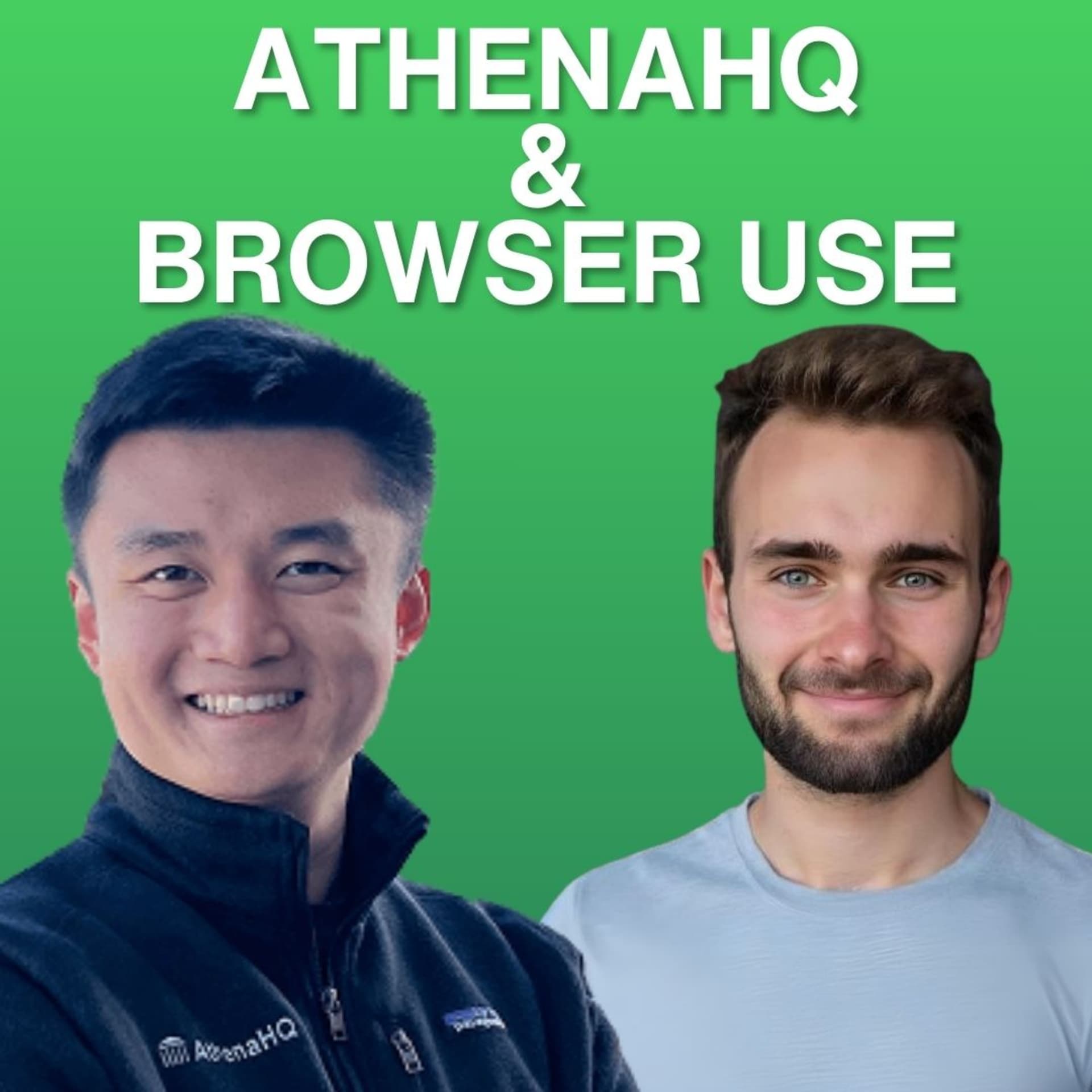
- Episode Title: How AthenaHQ and Browser Use Are Building the Next Layer of the Internet
- Host: Alex Wilhelm
- Guests: Andrew Yan from AthenaHQ and Magnus Muller from Browser Use
- Release Date: [Insert Date]
Description In this episode, Alex interviews two innovative startups, AthenaHQ and Browser Use, discussing their roles in shaping the future of AI. AthenaHQ introduces "Generative Engine Optimization" (GEO) for AI-driven search, while Browser Use focuses on enabling AI agents to perform tasks on the web. The conversation highlights the rapid evolution of AI, the importance of adaptability, and the technical precision needed in today's intelligent search landscape.
---
Key Topics Discussed
- AthenaHQ: Generative Engine Optimization (GEO)
- Concept: GEO is a new approach to SEO, focusing on how brands can rank in AI-powered search engines like ChatGPT and Gemini.
- Measurement: Companies need to measure their performance in AI search, which is more complex than traditional SEO.
- AI Model Agnosticism: AthenaHQ doesn't bet on specific AI models; instead, it prepares brands to be resilient across changing AI landscapes.
- Core Mechanics:
- Measurement of visibility in AI search results.
- Optimization of content for AI-specific requirements.
- Market Demand and Future of GEO
- Increasing search queries through generative AI.
- Companies like HubSpot have experienced drastic declines in organic search traffic, indicating a shift towards AI search.
- Early adopters of GEO strategies are positioned to win in the evolving marketplace.
- Browser Use: AI Agents and Web Interaction
- Functionality: Browser Use allows AI agents to interact with web applications, performing actions like form-filling and data extraction.
- Technology: Converts websites into machine-understandable formats, enabling AI to navigate, click, and execute tasks.
- Applications: Useful for tasks that lack APIs, like logging into accounts and extracting data behind walls.
- Growth and Market Response
- Browser Use received significant traction via open source engagement, driving rapid user growth.
- The company utilizes external trends (e.g., new AI technologies) to boost visibility and adoption.
- Funding: Raised over $2 million from notable investors, with a focus on building a robust technical foundation.
- Challenges and Future Direction
- For both companies, challenges include ensuring reliability and effectiveness of AI tools.
- Browser Use aims to enhance the reliability of agents that automate tasks, combining deterministic scripts with AI capabilities.
---
Key Takeaways
- Adaptability is Crucial: Both AthenaHQ and Browser Use emphasize the necessity for businesses to adapt to the rapidly changing AI-driven landscape.
- Technical Precision: Building reliable AI interactions with web applications involves sophisticated technology to handle dynamic web environments.
- Market Opportunities: There is a growing demand for tools that help brands optimize their presence in AI search and automate mundane tasks across the internet.
- Long-term Perspective: Both startups focus on creating lasting value for their customers rather than simply maximizing short-term profits.
---
Conclusion The episode provides valuable insights into the evolving landscape of AI and its implications for startups and brands. AthenaHQ and Browser Use represent the forefront of innovation in AI search and web automation, highlighting the importance of adaptability and technical proficiency in the modern business environment.
---
Related Links
- [AthenaHQ](https://www.athenahq.ai/)
- [Browser Use](https://browser-use.com/)
- [Subscribe to This Week in Startups on Apple](https://rb.gy/v19fcp)
Follow the Hosts:
- [Alex Wilhelm on X](https://x.com/alex)
- [Jason Calacanis on X](https://twitter.com/Jason)
Thank you for listening!
Written by AI. May contain mistakes. Listen to the episode to check what was said.
Transcript
Automatic transcript. May contain errors.0:00One thing I was curious about is just the pace of AI development and how that impacts your ability to help people. Is it worth investing in trying to rank well across all of the AI models and services out there? Or do you guys focus a bit more on like, okay, look, here are the three places people are actually doing AI search. We are model agnostic. We focus on the underlying architecture of AI search. What that means is that individual models, whether it's ChatGPT, Gemini, or DeepSeek, etc. Sure. They rise and fall in popularity, right? And it's very much like a foot race. At one point, Gemini 2.5 is ahead in the lead, but then other models will race ahead.
0:38So we're not betting on any people who are hoarsier. We're helping our customers be resilient.
1:19Hey, everybody. Welcome back to Twist. This is Alex. Today, we are talking to not one, but two companies from the Twist 500. What is that? Well, it's our search for the top 1 % of startups out there. And we currently have about 350 companies on the list with another 15 coming later today. But if there's a name that we're missing that you absolutely think we need to consider, well, shoot me an email, alexwlaunch.co, or send us a tweet at alexatjasonatlons, and we'd love to hear from you. Today, we are talking to Athena HQ and browser use. We're going to start with Athena HQ. It's a startup that wants to help other companies understand how well, or frankly, how not well they are doing at showing up inside of AI search queries.
2:04Now, we're all super familiar with SEO, search engine optimization, and I think it's time to get accustomed to what Athena HQ calls GEO, or generative engine optimization. Listen, if you care about search, you care about web traffic, or just how brands are adapting to the AI era, this one's for you. Let's go. Hey, everybody. Welcome back to Twist. This is Alex, and every time we have a Twist 500 interview, I tell you that I'm excited about it, that we have a great founder and a cool company and an interesting product. And I always mean it. But today I mean it extra because I'm incredibly excited about this company.
2:37Its name is Athena HQ. It was part of the recent Y Comedator batch. And it's working on a problem that I am incredibly interested in because I have a long career in media. That's where I lost all of my hair. And so I am very accustomed to the idea of search engine optimization or SEO, as you probably know it. Now, Athena HQ wants to bring that concept into the era of generative AI, and they've rebranded SEO to be GEO. I want to learn more about that and the company itself. So please join me in welcoming Andrew Yan to the show. Andrew, hey, how you doing? Doing well. Great to chat, Alex. Thank you for being here.
3:11First, starting off, you were a Google search PM. And I want to just ask you as a former fan of Google search, what happened to it? Because now it's just ads and AI slop. And I'm a little bit disappointed. And I was going to blame you. But I figured I'd ask first what what happened over there? You can blame all the blame you want on me. It was on me. I'm glad I finally caught you. It's pretty clear that Google has gone through many different stages of its life, kind of like a newborn child to a toddler phase and now in his teenage years. And now we're in this adolescent stage is how I like to think about it, of figuring out the identity of Google.
3:49So what Google search means in the age of AI search, when people are expecting a chat TVT style answer, which is generated for them, which goes against the original newborn phase of Google of the 10 blue links style of search. So this is a existential question for Google is, does Google make the shift from Tableau links to the AI style search without cannibalizing search as revenue. And that's the big elephant in the room is how do you do that? And we're seeing steps already with AI overviews being scaled up across more and more query types, as well as AI mode, the preview mode being launched out about a month ago, early March.
4:32So I think it's safe to say that we're heading in the direction where Google is trying to avoid that innovative dilemma. Yes, exactly. Reinventing itself for this new age, using different types of different modalities of search beyond just text search, but also image, video and way beyond. I didn't bring that up just to be annoying and rude once again to the Google search team, as I usually am, but instead to kind of underscore the shift that's going on in search, because for the longest time built into Chrome, whether you went there to Google.com, Google was the absolute kind of first step into most of the internet.
5:06And now it really does seem that the world has shifted and people now expect much more of a personalized response directly to their query, as opposed to a list of possible answers to it. And also they're just more accustomed to a non search interface for asking questions. And so to me, it really does feel that AI search, generative search, whatever you want to call it, is catching on very rapidly. And I think that kind of lays a foundation underneath Athena HQ because my presumption, Andrew, is that the number of queries that are going through generative AI search engines broadly is going up very steadily and therefore creating a lot of demand for your company's ability to help people better rank and show up inside of those AI search queries.
5:49Is that fair? Yeah, definitely. I believe Chai Chimiti just crossed the 500 million mark recently. Yeah, it's kind of crazy. Gemini has like 350 million actives. I think ChatGPT crossed 800 million. I might be wrong on that number. Yeah, it might have gone up even more since I last checked. That's the problem with AI. It's moving so quickly. It's a little bit hard to actually keep things under control. So let's talk about the core mechanics of what your company does. As I understand it, SEO, I'm going to tinker with my links, my keywords, my internal site architecture, and generally try to be understandable by search engines and therefore findable, indexable, and shareable.
6:24In the realm of GEO or generative engine optimization, what can you do to help people rank better inside of AI search queries? And how difficult is that work? That's the magic question. If there's a magic wand, I'll just wipe it and then solve it immediately for all the websites in the world. Excellent. How we approach it and where it starts is measurement. How do you find out where you're doing well on AI search and where you're not doing well on AI search. And after finding measurement, we help our customers optimize your content for AI. Specifically, specific structures of content or citations of content that used to be working for SEO and strategies that work for SEO don't necessarily carry into the GEO world.
7:12Okay, so essentially what we have done before is not going to get us into the new era. So we need new tools, new methods, new tricks even. Exactly. And we found that being number one on Google search, we've seen companies overseet the number one ranked website on Google search, even though they might be a smaller player, but they have a geo strategy. And we're helping some of our smaller customers with this is just because you're number one on Google doesn't mean that you are safe on AI search. I wouldn't think there'd be much of a translation at all, but let's just start with measurement. You mentioned, you know, knowing where you're showing up and in what context.
7:47The way that I can think about doing that is by running a bajillion queries through OpenAI's API, for example. Is there a less tedious way of figuring out where people rank inside of generative AI search? Or is it kind of a brute force go out there and do every single query and then see where you land? So there are definitely optimizations you can take to the sampling based approach to measurement. But fundamentally, a sampling-based approach is necessary because AI search is probabilistic, right? And that's the beauty and the weakness of Gen AI. Actually, Andrew, for people who don't know, can you explain probabilistic versus deterministic in a search context?
8:29Because you'll do a better job than I will. Yeah, happy to. So let's say you search up best basketball shoes, right? On Google, it's fairly deterministic. You can see the same responses pretty much every time. on ChatGPT and Gemini or these different, this new architecture, you're not guaranteed to see the same thing. And if you search the same thing 10 times, you might get 10 different answers starting from 10 different sets of websites that are informing those answers. I mean, SEO was tough and kind of a black box. That just sounds torturous. Okay, so you said a sampling-based approach. I presume that if you were doing GEO for Alex Incorporated, you would do a bunch of individual queries through different AI models in and around the topic that Alex Inc.
9:10works in? And then I guess, how do you know when you have done enough sampling to know with confidence that a brand is showing up X percent of the time in Z context and so forth? How many data points do you need? It's a good thing that my co-founder and I studied math and statistics in undergrad. That's a great question. It depends on your company size and the number of product lines you have. If you think about a company, like a conglomerate company like Nike, which cares about basketball shoes, running shoes, athletic clothing, you have many different product lines. Each one of them is essentially its own cluster that you need to be tracking.
9:48And that could be to the order of millions of prompts that we need to be tracking on their behalf or analyzing on their behalf. Versus if you have a very pointed solution, you might get away with only a couple of thousand. So it really depends on the scope of company. All right, founders, let's talk about your website, huh? It might be a little bit of a sensitive subject. You might be a little embarrassed about it. Let's fix that right now. If you're launching something new, give your brand the refresh it deserves. You're working so hard on your company and your website looks terrible. Do what I do, use Squarespace.
10:22It's the all-in-one platform to make a stunning professional website. And it's ridiculously easy to use. It's gonna work for everything. If you're selling products, it's got all that e-commerce built in. If you're selling services, it works perfectly. And they have a new AI product called Blueprint. Want more control? Well, of course, you can choose one of the award-winning templates and use the intuitive drag-and-drop tools to make it your own. Easy peasy. Squarespace equals the most functional and beautiful website on planet Earth. Go ahead. Squarespace.com slash twist to get a free trial. And when you're ready to launch, go to squarespace.com slash twist to get 10 % off your first website or domain purchase.
11:02That's squarespace.com slash twist. And for folks who are curious kind of what we're talking about, I was reading the case study you guys have about Figma and Canva on your site. So what I have here on screen for folks who are on the audio is essentially it's quasi a pie chart showing AI search share of voice inside of the Canva, Figma, Adobe Express domain. And here you can kind of see how different brands might stack up against one another. So that's kind of what we're talking about. Once you have sorted out, let's not use Nike because it's too big. Strictly a company that makes shoes for the game of pickleball.
11:34Pickleball shoe company. Once you've done the proper amount of searching there, you have a good sample. You feel confident about knowing about it. How much can you influence AI search? Because in Google, there's a whole industry around SEO, helping people rank up. Some people are charlatans. Some people are actual experts. A little hard to tell from the outside. But I'm just curious, if my brand is struggling very hard to do well in, I don't know, Gemini, OpenAI, and, you know, anthropic models, how quickly can you guys actually influence that? And how much of it is just time and luck? So we can definitely influence it.
12:08And we're seeing on the faster end, our suggested content being picked up within a week on the fastest end, which is incredibly fast. And this is thanks to the new indexing method that Perplexity started out pioneering and started off with, but now we saw Chattoot incorporating search into GA in October last year and more and more engines clawed incorporating search as well recently. Where it starts for this hypothetical pickleball shoe company is first figuring out if you are tracking the right prompts and figuring out, are you talking the right prompts with the right content? If you're not, then we help you fix your content itself or you help you address content towards the right prompts.
12:54So that's number one is making sure that you have the right content that is addressing the questions that users are asking. And we have our own proprietary data sources to estimate the volume of these prompts and of these topics. What can you tell me about these proprietary data sources? And are these things that Athena HQ is sourcing itself? Or is this something that you're purchasing from a third party that might have a useful data set for you guys to use? Yeah, there's not much I can say about that beyond that, except that we are able to track 1 % of all traffic from ChatGPT and Patuxity and get that volume information for our customers.
13:341 % is a lot. That's a lot of queries because these, I mean, you know, ChatGPT alone does roughly one bajillion queries every day. So 1 % is a lot. Is that, that almost feels like too much information. Tell me why I'm wrong. And that's actually a useful number. Useful is all in the eyes of the beholder. It's about where do you fit this information into your workflow? And we could have the most powerful data set. We could have open AI's data if we had it. And it still might not be useful if you don't integrate it in the right way to our customers' workflows. So how we do it is we build a product around marketers' workflows.
14:14And we make sure that marketers are able to get the most value out of Athena beyond just an analytics platform, but actually helping them on each step of measuring, taking action, and then being able to measure the impact of those actions. Okay. This all makes pretty good sense to me. And the reason why I said at the top of this that I'm actually very excited is because my personal view is that AI search is going to become the de facto within five years. Therefore, it's going to do bajillions of queries. And therefore, everyone's going to want to have a tool like they had in the SEO era to help them move forward.
14:47So to me, you guys are going right down the direction towards where I see the future going. My question is, does the market agree? Because I'm not sure if I'm thinking ahead of where the average marketer is, or is GEO already something that people are working into their, let's say, 2025 operational plans? Yeah, it depends on the company. There are definitely early adopters who are way ahead of the curve here and are already anticipating the repercussions of not adapting to GEO and to not adapting to AI search and using GEO. The kind of beacon on the hill, so to speak here, is HubSpot, right? Which lost 80 % of all search traffic year on year, organic search traffic year on year.
15:31What? I missed that. HubSpot lost 80 % of its search traffic? Ooh. Yep. They made a post about it. oh that hubspot was famous for being good at that that's pretty embarrassing so that's and that tells us that there's a shift going on the winners of the last war the cheggs the yelps the nerd wallets will not necessarily be the winners of this next era yeah we see yourself with chegg right which lost i believe 14 billion dollars in market cap because because of ai search well mostly because of ai search for folks who don't know chegg was originally a textbook rental service that then pivoted into essentially a homework helping service, if you will.
16:11And then ChatGPT came along and did that better for cheaper. And Chegg's share price last time I checked, Andrew, was down like 95 % or something like that. It was pretty brutal. I think that shows the risks of not having a good GEO strategy. But my guess is that AI search query volume today couldn't make up that 80 % that HubSpot lost or that Chegg lost or a similar company. but probably it's going to become a bigger share and might be able to help people avoid falling into an SEO death trap so in the way how we look at AI search and how to think about AI search from a marketer's perspective is the buyer's journey itself is changing before you measure buyer's journey performance in terms of how many clicks are we getting from google how many how much traffic are we getting but that's no longer the right metric to be benchmarking against because customers are doing more research upstream of your website.
17:10They're learning about your website on ChatGPT, about your company on ChatGPT, on Perplexity. Yeah. I'll share an anecdote here, Alex. Hit me. We actually chose, when we were deciding which corporate card to go with, we researched on ChatGPT. Right. And that informed a good portion of our decision. ChatGPT did not make the decision at the end of the day, but that was a big influence on which corporate card we chose. And I can imagine many similar situations around the world where there are these decisions, whether it's evaluating products or evaluating life decisions that people are making informed by AI.
17:47I just realized why that's the case. Well, first of all, what did you choose and why was it RAM? Unfortunately, we went with Rex. No way! Oh, Enrique is going to be so happy. The difference is, and I was trying to put my finger on this, but I think you just helped me because if I go to Google, I type in best corporate card or best corporate spin management suite or whatever. I'm not expecting Google to actually tell me which one is best. I'm expecting you to tell me which one ranks the highest, which is probably a comp, but not exactly the same thing. But I would actually type into ChatGPT or similar.
18:19Hey, ChatGPT, comma, what is the best corporate card. And so it's definitely talking to me more directly in a way that search previously wasn't. So it actually feels more probabilistic, but more deterministic in how it tells me it's probabilistic answer. Does that make sense? Yeah, it definitely does. And I think what you're getting at, Alex, is actually Gemini and ChatGVT as buying assistants. I have them go out, do research for me, doing deep research. And then I ultimately pull the trigger, but they're the one is collecting all the data for me. Yeah, no, it's I, I am not an AI first guy. I'm an AI adjacent guy.
18:56But increasingly, I find myself more and more and more and more each and every quarter, it takes up more and more of a workflow. Okay, let's talk about the customers you do have. Because one thing I was impressed by is how expensive the service is. A lot of things that we see in the world of AI today cost 1520 40 bucks a month. According to the website, you guys cost I think it's a minimum of$400 a month monthly, a little bit less if you pay annually. But that's much larger than I often see. So one, good job on not underpricing your product. But my question is, how is the market reacting to a price at that level?
19:30The marketers who understand the value have no question about it. They understand that if you frame the question in this way of, what does it mean if your Pickleball, Alex, your Pickleball shoes company makes it to number one on ChatGPT? and what's the alternative to being number one at ChatGPT. This advertisement is paid by Fidelity Private Shares. All right, founders, we all know cap tables, due diligence, and of course, managing investors is a huge headache, but there's a very simple solution for you. Today, we're talking with Kristen Kraft, an old friend of mine, and she works at Fidelity Private Shares, a new group over at Fidelity.
20:10You've heard of Fidelity before, And they have a mission to help startups simplify equity management. They're going to save you money. They're going to give you better service. Welcome to the program, Kristen. Thank you so much, Jason. It's great to see you again. Yeah, great to see you as well. Maybe just from a product perspective, what are you trying to accomplish with the product? So, Jason, we are super excited about our CapTable Management and Data Room platform. We want to make it super simple for founders and startup operators to manage all sort of ownership and equity. in the company and essentially prepare to raise.
20:44We want to make sure that everybody goes into these fundraising conversations well prepared, they're ready to share their cap table, and that they're ready to go through due diligence as they're trying to close their round. So from a product perspective, that is where we're laser focused. And that product is really well built, really strong attention to detail in the way that Fidelity is known and beloved for. So if you want an all-in-one equity management platform, Fidelity Private Shares, They've got you covered. Visit fidelityprivateshares.com. That's one word, no spaces, no dashes. Fidelityprivateshares.com.
21:19And hey, I mentioned This Week in Startups. They'll give you 20 % off your first year subscription. Once again, fidelityprivateshares.com and tell them that you heard about it here on This Week in Startups. The ROI is pretty clear in terms of if you're, yeah, if you're a CPC on Google Ads is, let's take Vanta for Secure Frame, right? For Vanta or secure frame, I believe that term itself on the high end, if I remember correctly, that's to the order of like 100 some dollars per click. For Vanta, the compliance management software service. I think they're actually a Twist sponsor. Shout out Vanta.
21:53There we go. That gives you a sense of the value of Athena that Athena can provide. Pricing, we always price on value. We are not the budget provider here. We are the option that gives you the best value for what you're paying for. Okay, I'm going to rephrase my entire question. Now that I know that you can spend over a hundred bucks on a single click for a Vanta Google search, why haven't you added two zeros to your price tag? Because you're undercharging dramatically for this. I mean, honestly, I had it backwards, maybe 400 bucks a month for the light packages, a fraction of the value you're offering, which is good because it'll help you with retention.
22:31But like, I mean, if people are just dependent on you to remain relevant in the AI search era that you and I both think is coming, why not charge more? We could. We're focusing on the value part right now and delivering the most value to our customers. It's all about how do we help our customers succeed? It's not really about how can we charge the most amount of money and squeeze the most amount of money out of our customers. That's not the name of the game for us. We're playing the long-term game. I thought this was capitalism, you know, just saying. I'm kidding. One thing I was curious about is just the pace of AI development and how that impacts your ability to help people.
23:07Because while I'm really glad that we got 03 and 04 Mini and 04 Mini High, and we got Gemini 2.5 Pro, 2.5 Flash, 2.5 whatever, et cetera, there's a lot of different models. And given that they're each a little bit different, I presume that customers of Athena HQ want to make sure they're doing well in all of them. Is it worth investing in trying to rank well across all of the AI models and services out there? Or do you guys focus a bit more on like, Like, okay, look, here are the three places people are actually doing AI search. We'll help you there. And nothing else is as commercially pertinent, if you get me.
23:43Yeah, that's a great question. So we are model agnostic. We focus on the underlying architecture of AI search. What that means is that individual models, whether it's ChatGPT, Gemini, or DeepSeek, etc. Sure. They rise and fall in popularity, right? And it's very much like a foot race. at one point Gemini 2.5 is ahead in the lead, but then other models will race ahead. We're not betting on any people who are hoarsier. We're helping our customers be resilient. Regardless of if there's a new model that comes out, for example, Grog getting a lot of popularity recently, helping our customers adapt to that.
24:24Okay, so essentially, you guys have a technology that works regardless of the model in question. It's not like you have one engine for ChatGPT's models and one for Google's models. It's more one product that then can interface with, okay, that makes a lot more sense. And I appreciate that. One other thing about the SEO world that I think we're all aware of is that there was sometimes tension between the SEO community and Google. And I think you've probably seen this throughout time. And so I'm kind of curious, how is your relationship with the open AIs of the world? Do they care that you're trying to help people do better?
24:59Are they in favor of it? Are they opposed? I'm curious what that relationship is like. Yeah. I mean, we're not, we're not trying to be antagonistic by any means. The goal for us is to help companies tell their story on AI. And if you're a company and you have stale content, you have old pressing pages, you have an old name, that's bad quality content that if you're OpenAI and if you're Google, you don't want there anyways because it's just not relevant to the end user. So we help companies with these as well as coming out with a feature soon to detect hallucinations. Oh, interesting. So defense instead of offense.
Read the full transcript
25:42Exactly. Helping with both. Okay. I dig that. But what you're describing is the equivalent of white hat SEO, making better content that is more findable and better for both Google's results and end users. Everyone's in favor of that. There are other SEO methods that have been less popular because they're a little bit more nefarious or tricky. Is there any risk of that type of activity working in a GEO era? Or is it harder to trick AI models because they kind of do their own thinking versus kind of Google's great algorithm in the sky? This is a great question that we can get very deep into this.
26:22There are research papers written about these explorers. And I come from a cybersecurity background as well. And I remember the days of SQL injection and this analogy of SQL injection to prompt injection, right? And we don't do any of this black hat, you know, SEO, GEO strategies. The reason is that it's just not, I don't consider it ethical. It's if you read the papers, like there are ways, like if you're have a unguarded a model with no guard rails, like, yes, you can influence it through prompt injection. The joke is like adding white text to the bottom of your website, this sort of thing. But that's not how we operate as a company.
27:02So we don't engage in that. So to be clear, the two guiding principles of Athena HQ is I can find is make sure you're delivering far more value than you're charging for and be ethical. All right. That's got to be the best takeaway I've ever had from a chat with somebody. I really dig that. I'm joking. Y Combinator, you guys are part of Winter 25. I think you raised the full half million from YC. Is that correct? We've raised more than that. Oh, okay. What can you tell me? We've raised over 2 million from investors and angels from companies such as OpenAI, Ethographic, DeepMind. Also at the consumer companies that you expect, like Instacart, Shopify, brands that are going to want to do well on AI search.
27:48Exactly. Now, on the Anthropics and OpenAI side, I don't know if you can tell me this, but are those investments made by individuals at those companies or were they done through OpenAI's venture arm, for example? These were made by individuals. I want to be very clear about that. It's very interesting that people at those companies see the potential in what you're doing. I know you guys were part of the last demo day. I think that's when I first heard of you. How has growth been as a business in the last couple of months? Yeah, growth has been explosive. Our customers are seeing rises in traffic from ChatGPT, Perplexity, Gemini, AI Overviews.
28:30And that's just the tip of the iceberg in terms of the users who are impacted by AI search. So we've been working night and day to meet up with it. meet demand. And it's a space that's also rapidly evolving. So we're also staying up to date ourselves on the latest developments, for example, looking at how different integrations with these model companies are possible, specifically in the e-commerce sense of shopping or different verticals. A lot of surface area here. A lot of exciting things because this is the future of how product discovery is going to be in the next foreseeable future. What would you do if Anthropic just showed up and was like, we'll give you$100 million in stock, just come work for us?
29:19That's something I can't make that unilateral decision without our team. I'm curious about what's going to happen to what I consider to be very promising early stage AI facing or AI predicated startups, because there's a lot of just very wealthy AI model companies. And right now we've seen open AI charted by Cursor and now they're looking at Windsurf. And so I'm kind of curious if there's going to be a suction effect in the market of the model companies, the foundation model firms, just buying people that are doing awesome stuff. And frankly, because I'm a fan of your company, I would put you in that bucket, if that makes sense.
29:54Founders are all about efficiency and performance, and that's why they automate and optimize every system within their startup. But when's the last time you optimize yourself? Well, startups move fast. Sleep and workouts get skipped. We know that. And health becomes an afterthought until it's a problem. But now there is superpower. The ultimate founder health membership, of which I am a member. Full body testing across 100 plus biomarkers. And you get guidance for organ health, hormones, inflammation, and more, giving you actionable data and clear insights. You track your KPIs at your company.
30:27Why not track your health the same way? Well, with superpower you can. I'm using it. Lana Harris is using it. A couple of other people on the team. and they have 150 ,000 person wait list because it's so cool. But because you're a Twist listener, we're going to get you ahead of that line. JCal is going to take you through the VIP entrance at superpower.com slash twist. And you're going to claim your spot in the VIP line. Yeah, it's not even a line. It's just the back door, folks. And you're going to unlock Peak Health today because better health equals a better founder, which equals a better business.
30:57Again, superpower.com slash twist to go through the VIP entrance with your boy JCal. It all depends on how fast you get to AGI. Right. Well, that's either going to be six months to 60 years, depending on who I'm reading. So you've raised more capital. Growth is explosive. How big is the team these days? I know you have a couple of folks on your YC page, but I wasn't able to figure out more. We're a team of four. Our team is lean and mean. If you think about, I model our team after the teams of tomorrow. If you think about the teams that are winning right now, they're the teams like Cursor, like Lovable, like these small tight-knit teams because context is everything, right?
31:36And context is what's most expensive in this startup world that we live in. So our team members have full context on every part of the business. I think I know what you mean by context. And so if you're working inside of like, I don't know, let's say you're working at LinkedIn, which is a superior at Microsoft, you're going to be put onto a team, say a product team, then you're going to be filtered down to like a sub team. and then you're going to do machine learning on how people click on a button. At some point, you're so niched down into the pixels that you can't at all see the forest for the trees.
32:06But on a smaller team where there's a lot of shared responsibility, there's a natural commingling of operational information so that way everyone actually knows kind of what's going on with everything, i.e. greater context. Fair? It's exactly that. Seeing the forest for the trees while also being able to scope down into the tree level of granularity. So here's my question. Four people? Hell yes. I totally get it. Eight? Sure. 12? Getting hard. 15? Ugh. So does this desire for greater intra-team context imply that there's an upper level on how many people can work at Athena HQ? Definitely. That's interesting.
32:44I think we can scale a company with under 20 employees. Including, like, customer success? In the near term. In the near term. So not in the long term. How long is the near term? the next year. If you think about the amount of leverage that each individual employee has, where if you're using the right tools in the right way and you're chaining them together, there is this... I can very much see the road down the line of what Sam Altman describes, that one-person billion-dollar company. I accept one-person billion-dollar maybe a bit further along, but... Yeah, but I mean, directionally, he's drawing an X on the map and telling us we're walking in that direction, which I kind of agree with.
33:23Would you consider it to be like, I'm going to draw a hypothetical scenario here, but let's say five years from now you guys are preparing to go public and you have 50 people. Would that be a win or would that be an underinvestment in human talent? I wouldn't say that's a underinvestment in human talent if the talent density is very high. That's a key metric is talent density of your team. For folks who want to take a look, what is the URL and what is, well, normally I ask what's one role you're having a hard time hiring for? I'm not quite sure that's relevant, but answer it if you'd like, Andrew.
33:58But first, what's the URL? The URL is athenahq.ai. Yeah, the role that we're open to is we're hiring for selectively across roles in engineering and technical growth. So everyone on our team codes and that's part of our culture. We are highly technical. We come from highly technical backgrounds. Our investors are highly technical. Our team members are highly technical. This is our culture. This is how we serve our customers. We are that technical advisor in some sorts to help them adapt to an increasingly technical world of AI search. I really dig it. And when you hit 10 million ARR, come back on the show.
34:40I want to hear all about it and how fast you're going at that point. But in the meantime, Andrew, thank you so much and good luck. All right. Thank you, Alex. That's fun. Yeah. I, for one, am incredibly excited to see what comes next in search. And I think it's going to be a little bit more than just the AI answers we see today. But if the SEO era taught us anything, it's that no matter what form search does eventually take, companies and brands are going to want to dominate it. So frankly, I have very high hopes for what Athena HQ and its competitors like Profound, another Twist 500 company, have coming in the next few quarters.
35:12Now, next up, we're talking to browser use. We've all heard the hype about AI agents, you know, AI tools that can do a lot more than just answer questions or write you a limerick. No, these can go out and actually do tasks for you. I mean, hell, today we're actually talking about agents working with other agents, perhaps even led by a chief agent, and things are only accelerating. But how will these agents actually interact with an internet and all the internet applications that are designed for us humans. Well, browser use has an idea of just how to bridge that gap. Let's learn more. Today we have yet another Twist 500 interview, one that I've been excited about from the very first moment that I discovered this company back during a YC demo day a couple months back.
35:54Essentially, here's my thought. Right now, when I use AI, I tend to go to an interface, I type some stuff in, I click enter, stuff comes back. Very easy, very simple. But I'm a human. What if I was, for example, a different AI system, perhaps an agent? Well, then going out onto the web might be a little bit harder. Getting the information that I want could be difficult. What if there was a tool that can make the whole web a bit more approachable to your local friendly AI model? Well, I think that's what Browser Use is doing. So please welcome to the show. It's Magnus Muller. Magnus, how are you?
36:24Hey, great to meet you. Thanks for having me. Everyone should know that Magnus is calling in late at night from Switzerland. So he made this happen and we are thankful for that. But Magnus, first of all, when was the company founded and how many people currently work at browser use? We founded this whole thing five months ago in January this year when we started with a side project doing our master here in Switzerland, me and Craig, in a builder's house here in Switzerland where it's forbidden to study. It's from the university, but it's forbidden to study. You're only allowed to work on your side project.
36:57And we started to work on this random side project. And we got into YC, spent the last three months. And now, yeah, five months later, we are, it's me, Greg, and we hired two full-time engineers built all together. And if you want to know why we're talking to a company that's so brand new, it's because in five months, they've already accreted as of current count, 61 ,005 GitHub stars, which is a simply insane run. But Magnus, here's the problem. I'm a little bit awash in technology to help AI do stuff. There's Anthropics Model Context Protocol, helping AI kind of bring data in. There's Google's A2A or agent-to-agent framework, which lets agents talk to one another.
37:36Microsoft has a new thing called NLWeb. So first of all, for folks out there who don't know, what does browser use do and why is it critically important? Yes. So we enable your AI to control your browser, to navigate there. Imagine it like you can tell your browser your goal and your computer does zero clicks for you. You don't have to click anymore yourself. Yeah, like you described in the intro, all those websites have those search bars, which are highly optimized for humans, those visual contacts, but agents don't directly understand them. And to get the full power of agents, to have many agents work for you, actually doing things for you, we convert websites into something which agents can understand so that they can take action and do things for you on the browser.
38:22So it's a translation technology that takes... Is it any website that's out there in the world today and using kind of, I presume, a shared tool set, it can convert that into something that an AI can talk to, but it's broad. So everything works with browser use. Yes, yes. Every website works, can convert everything. Some can convert better than others, but all work by default. And you can imagine it as many websites, they have APIs with which you can automate things. But then there are also many legacy systems or things which don't have an API for your specific things. and we enable all those websites without API that your agent can just go there and do things for you like filling out a form or getting back your API key.
39:08You know, all those AI tools like GBT or Publexity, they're very, very good in extracting information from the web. But they all stop where information gets interesting. They all stop at login walls. All your interesting information is behind login walls. And if you have agents who can take action, They can just log in into a bank account and extract your current sales numbers or log in into your company's CRM to create new contacts. Or they can log into my bank account and take out all of my currency. You know, just I'm kidding. So I was going through the GitHub page and I was reading some of the code and I'm not going to lie.
39:43I got a little bit lost. So I'm going to ask you a very simple question. Is browser use the goal to help agents, AI agents, do things on the web? or is it almost an agent in and of itself that can also take written commands and then do stuff for you? We built an agent with a memory system, so it can take hundreds of steps, go down, and can do things for you on the web. Prompt this. You type in your prompt, say, okay, go to my CRM and create a new content. Got it. But all our things are based on actions. and actually click something, do a Google search. And you can simply extend this. So you can write your own action, like calling an API.
40:26Imagine it like before MCP was out. It's basically like you can include more and more MCP tools, which can do just things. And the agent can choose which tool call to do to then decide, okay, what's the best action? Okay, so essentially it's a framework that lets me control the web, but I could bring, for example, some of my own homegrown technology and still use browser use on top of it as almost like a hook onto the web as it exists today. Yes, but mainly browser use is used to actually take action in the web, do things where you don't have APIs for and automate that. So really, it kind of takes the entire human internet and makes it machine understandable and interaction friendly.
41:11Is that fair? Yes. and the main component is really to take action, to actually click buttons to fill out a form, to select from a dropdown. So people have been talking about agents nonstop for the last, I want to say, 12 months. But before technology like browser use existed, were those agents just incredibly limited in what they could go out and do? Or were people kind of building a similar product to browser use internally and then using that to go out and talk to the web with their AI agents? That, of course, depends on the definition of an agent. If you just define an agent as an LLM with tool calls, then all those chatbots which can output JSON structure are usually agents.
41:52But I was always wondering myself when people said, oh, we built those agents. And I thought, this is just a chatbot with which you can interact. And it maybe can query the current weather API for you. So I always imagine an agent like something which actually can take action for you, just like a player who can take action. Okay, that makes good sense to me. Now, I want to talk about the RAM, because you guys, actually, I have a chart here showing the browser use GitHub star growth. And it's one of the craziest things I've ever seen. This is from basically right before the new year, through to May, and you guys just grew very, very, very quickly.
42:32So how did you get the word out about browser use and the kind of first iteration of your technology. And were you surprised by just how quickly the market was like, yes, we want that? Yes, we were very surprised. We built the first prototype in five days, pushed it to hacker news, and it took off. And I mean, I had never built big open source projects before. It got a couple of hundred stars, people created issues. And the main thing is we made it extremely simple for people to run it. We see the setup is run two commands and it runs and you can actually prompt it and it can control your computer.
43:06And that's where I got confused between does it help other people's agents do stuff or is it an agent itself? I think that's where I got a little bit mixed up is the fact that you can prompt it. Yeah, exactly. It's prompt-based. You can do both. And the cool thing is we could create very cool demos with it. It's a really, really cool tool to create demos to go and see, wow, this AI actually does something on the web. And with this, we could also create many controversial demos like applying to jobs online and by just creating very very small not very beautiful demos and sharing them on x that started our growth engine couple of weeks later where then millions of people reposted those examples created their own shared them and i think the key factor for us was there were many things happen in the world like operator came out deep seek worth came out and we jumped on those hype trends we said okay this is the free operator.
43:58And then DeepSeek came out and we said, okay, you can use now DeepSeek together with browser use against operator. And then MCP came out and we always used those external events in the world, which gave us many, many more users. And also, I think when Manus, the Chinese agentic project came out and really had one of the biggest weeks of press I've ever seen, they were using browser usage technology inside of their agent, right? Yes, they were using part of our open source code to convert the website into something which their agents can understand. Of course, they built many things around. Oh, of course.
44:35But yeah, they used the core part of our library and developed it further. And that was really friendly for them to give us those credits and definitely boosted us a lot. All right. So I'm going to just show a quick clip that you guys have up on the GitHub page. And I was hoping you could just kind of maybe tell people what we're looking at as we watch this, kind of do a sports cast, if you will, to help people just kind of get a bit of a visual element. So this is the AI did my groceries example. So Magnus, just tell us what we're seeing here. Yeah, this was a friend of mine, and he is right now building a startup where he does grocery shopping for other people.
45:09And his problem was he always needed to do shopping on his own. So now he created a big problem for browser use. It tells browser use, okay, go to this website and do the shopping for me with those elements. Now you can see, okay, browser use goes to the store and types in, for example, your oranges and new products, and then can click on the actual products and adds them to the chart. And with this, he can automate for his new startup, his shopping process, something she would have done manually before. And this is just a thing of one big prompt. You can see on the right, this is like a big prompt of me, 100 lines of code.
45:49This is just natural language without studying computer science or anything or learning how to automate things. Just a prompt and then it can get started. And one thing I noticed watching this video is that it often draws, well, browser use draws what appear to be like boxes around text. Is that how the system parses discrete bits of information to figure out where different options of potato types would be listed? Or what am I seeing there with the squares, the colors, and the numbers? Yeah. So We combine the actual HTML with the image of the current screen. And inside the HTML, like DOM, all the elements, where we have all the access.
46:31Okay, this is a button, those are the coordinates. This is the core part of our library. There we extract, okay, what are the elements where humans can interact with, like buttons, input fields. And in there, you have also access to the coordinates. So we can just take those coordinates and highlight them on the screen as bounding boxes. And then we can take a screenshot and can combine both and send it to an LLAM. Oh, okay. That's really interesting. So you're taking images of the website's elements and then sending that back to an LLAM to essentially parse it. And then you can tell which thing to select.
47:08And then it can tell the cursor equivalent to actually click on the right thing. That is a lot of compute, Magnus. That feels like a relatively compute heavy. Am I wrong? It depends how you define compute heavy. It's definitely much, much more than normal chatbots. And the main reason is that we have multiple steps. For example, let's say to fill out a form, you need 20 steps. And at every single step, one step, we take the current website and we send it to an LLM. And the LLM sends us back, click on button five. Then the LLM sends us back, okay, go to this page. Then the LLM sends us back, okay, go and fill out this input field.
47:44And every single step we send out the current website, it's around 8 ,000 tokens, let's say around 8 ,000 tokens together with the image. And the LLM gives us back the output. So it's around, I don't know, one, two, three cents per step, which you pay in token costs for GPT-4. Now for bigger, for newer models like Lama 4 or DeepSeek, we can drastically reduce those prices. Well, Lama 4, I hear, is not the world's most exciting model, but it does share something very important with you guys, which is the open source component to it. And I really feel like after watching Databricks become one of the most valuable private companies in the world, people have really decided that open source projects can really build super strong companies.
48:29But I'm just curious, from the early days of the company, your codes on GitHub and such, why did you choose to go the open source route versus a closed source approach? Yeah, in the beginning when we built this first pilot in the first five days, it was just, okay, should we do it close or open? And we said, oh, let's do it open and push it to Hacker News. And I think for us, it was definitely core for the growth engine. Like we sure wouldn't have raised such a round and get all the traction with like a closed source tool just because we get so much feedback from the users and can iterate based on that.
49:02That's what I always thought was the most impactful element of an open source project. Not only can people look at it, tear it apart, tinker with it, and play with it, but they can just tell you what they need and want. And people always talk about startups need to be listening to customers, iterating quickly. Well, what if you had just tons of feedback from smart people who are looking deeply at your product? It just makes a lot of sense to me. But on the business model front, I'm curious about your guys' plans. There's been a couple of different ways people have been monetizing software projects like this.
49:30I presume you're going to offer something along the lines of a hosted version of browser use. So with open source models, you normally have like hosted solutions, you have support which you can sell, and you have enterprise features on top of which only enterprise care about. And right now we may look at the, like in the end it will be a combination of all three, but we have a cloud solution where we host the browsers and the LLMs. So you only send us via an API, the task, we run it, and we send you back the result. It's very neat if you want to run like 10 ,000 of queries which you don't want to do on your own hardware.
50:06And then of course, we have so many features in our product. So some people are a little bit confused. What can they actually do? How can I make this reliable? How can I make this cheaper? And so we can help them to configure those agents to actually save the money, save them token costs. So if you guys offer both the browser's technology and the LLMs as a hosted service, does the end customer get to choose which models they're using? Or do you guys select for them? Like you're all getting 4.0. In the beginning we did this, but because there's such, the biggest cost part is definitely token usage in all of this.
50:43It's like, let's say for QBD4, three cents per step. And if we offer them cheaper models, we can offer it for one cent per step or even cheaper. And I think this is where those agents get really, really powerful. If you can run hundreds of agents in parallel for you for a couple of dollars per hour, I think this is where we see a lot of productivity boost. Oh, that's interesting. I hadn't done the math. If it's one cent per step, running a hundred, it could be dollars per hour, but who cares? Humans cost tens or hundreds of dollars per hour. I'm curious, what are the first customers you guys are seeing?
51:16What industries, what big companies, little companies, startups? I'm really curious who's come knocking on your door. Some are individuals who want to optimize their outreach. Some are QA testing companies who write millions of scripts to test their websites. And the scripts break and they now want to use agents to test their websites. Or even wipe coders, you know, wipe their website, then they need to test it. Just now want to use browsers to test their website. Then a big industry is definitely around form filling. And form filling goes really, really wide. It can be for CRM, in your context.
51:53It can be to fill out. I realize there are millions of people on the planet who do the entire day, nothing other than receiving a PDF. patient data reading the PDF and filling out a form based on a PDF for companies it's just about converting data from one form to the other what's happening in some internal database and there are millions of people who just get an invoice and need to fill out an internal database system with those forms millions of people OCR isn't new why are they still doing it by hand I don't know. It's this, it's this many companies that have never built this, this, you know, you have OCR, you get the data out to fill out the form, you know, it's amazing that some of the stuff I, I guess I just assumed existed, maybe didn't.
52:48And so now we're filling in those workflow gaps with AI tools. Gosh. All right. Well, you, you, you guys also raised, um, I think it was a$17 million seed round, but I'm curious about how the round came together and what it was like to fundraise for your sector in 2025? Yeah, it was definitely one of the wildest weeks of my life. Well, we got all this open source traction. Of course, many investors reached out and we scheduled them all to YC Demo Day. So like beginning of March, all in one week. Okay, so I had like 140 investor meetings in this one. You had 140 investor meetings in a week? Like I started, I scheduled them one by one.
53:24Okay, and then the interesting part was like the week was really crowded. So some investors, of course, they got FOMO and they thought, okay, they don't got a spot in the round. So they emailed me, hey, I really want to invest. Can we meet earlier? And I said, no, we start here. And they said, okay, just take my money, take uncapped saves without valuation, without meeting. And we got like uncapped saves without even meeting us. Okay. And this was before, before a weekend march. So this got us a lot of leverage. Then when we actually started with the meetings, we just said, oh, we could just keep going with.
53:58with the unkempt safe, right? So I guess what's coming next for browser use that people have been asking for, requesting, or kind of pushing you towards? It's definitely for all those agent companies, also all who came before us, like multi-announced. The core problem is always the reliability of those agents. You can create super fast, super cool demos with browser use, okay? You just prompt it, and wow, you have a super cool demo for share on eggs, and you win the hackathon. But to make them really reliable, to get like the last mile done. It's really, really hard. There's where many companies spend millions on fine-tuning those things.
54:35And I think this is the core challenge in this. And this is what we are currently trying with workflow use, that we combine deterministic scripts, which you can record, with agents who then step in to heal those things. And yeah, this is the big feedback which we get from many companies that they want more reliable, faster and cheaper agents. And did you say that you can basically send an agent in to fix whatever breaks. So you can essentially use AI to kind of plug the gaps in existing AI tools. Yes, exactly. Previously, you would have like a playwright script, an automation script, which runs.
55:09And then at one point, the website changes and your script just breaks and says, okay, I didn't find this identifier. If this error occurs, you can just now switch and browse use and say, okay, where should I click on? What's the next step? And it It feels that script, basically. That's going to... You know, I'm always really torn between celebrating technology and our advancements and how quickly we're building new things. And then I also worry about the economic impacts. So I was about to say, that's amazing. But then I'm thinking about other people who probably get paid right now, like the PDF converters, to fix those things.
55:42We're going to have to find new things for them to do. But this is going to be awesome when it's kind of pervasive and we're all just a lot more capable. The awesome thing about this, 99 % of the tasks which people reach out to me They hate those tasks. Like no one likes to fill out 1 million forms per day and just reads PDF and fills out forms. And this is the amazing part. Like I haven't seen any task where people would say, I love this. Because all of those tasks are super repetitive. And I think as soon as you do a task 1 ,000 times, you just hate it. Oh, absolutely. I think in 20 years, we're going to look back and be like, thank God we had AI automate all the boring stuff.
56:20In the meantime, we'll deal with the economics of it. One last question before I let you go, which is San Francisco. You know, you guys are currently in Switzerland as we talked today. Again, thanks for staying up so late. But I'm curious about just how important you think it is to be living in the Bay. I've heard from a lot of founders that they think it's the place to be. But I'm just kind of curious from your perspective, why it's the right place for browser use. And you know, when I grew up, I often went to church. And I could pray from home. But I go to church because there are many other folks and many other people.
56:54And that's why we go to San Francisco, because all the agent builders are in San Francisco. And we don't want to pray for ourselves. So San Francisco is, by analogy, the AI church. It's a church. And that makes Sam Altman the Pope? I wouldn't say so. Well, I mean, I think Sam thinks so. He's still young. Touche. Wait, how old is Sam? I actually have no idea. 45? I don't know. That's old enough to be Pope. He can be president. Yeah. All right, Magnus, when is the next time we should have you back on? What's the next big release that we should have our eyes out for? I mean, we now release this workflow use is super beta, breaks all the time.
57:38So now we will really iterate on this and get a lot of feedback and make this really, really awesome. All right. Well, what's the URL? And just before you go, what's a job you are looking to hire for? Yes, the URL is browser-use.com, that's our main website. And there you can reach all our GitHub projects. And the main job is currently really great builders who are really obsessed, who want to join the hacker house and just love to build all day. Can be young, wide-corders who just want to ship cool stuff and create cool demos. can be really browser gods who have 10 years of experience around fingerprinting for browsers.
58:21Can be people who build the infrastructure for this. But I think there will be many problems which no one has ever solved before. And we just need obsessed, great people who can solve problems. Well, you heard it from the man himself. Magnus, thank you so much. We'll have you back on the show. And in the meantime, good luck. Listen, guys, I've been doing this job for a thousand years. And one thing I can tell you very confidently is that talking to founders never gets old. You learn something, you get a little peek at the future, but also just their enthusiasm always leaves me pretty darn gassed up.
58:51I just love it. We have a lot more of these interviews coming up, so get excited. And if you want to get a peek at which companies might show up on Twist, well, twist500.com for more. And as I said at the top, alexw at launch.co if you want to suggest a company for us to look at. This is Alex. This is Twist. We'll talk to you on Monday. Bye.
From the publisher
Today’s show: Alex interviews two cutting-edge startups shaping the future of AI: AthenaHQ, pioneering “GEO” (Generative Engine Optimization) to help brands rank in AI-powered search engines like ChatGPT and Gemini, and Browser Use, building infrastructure that lets AI agents take real actions on the web—from form-filling to workflow automation. Both teams dive deep into how fast AI is evolving, how brands and developers can stay competitive, and why adaptability and technical precision are key in the era of intelligent search and autonomous agents.
Timestamps:
(0:00) Episode Teaser(1:54) Athena HQ's Generative Engine Optimization (GEO) strategy(10:05) Squarespace - Use offer code TWIST to save 10% off your first purchase of a website or domain at https://www.Squarespace.com/TWIST(14:51) Will GEO Market Adoption Forever CHange Marketing?(19:50) Fidelity Private Shares℠ - Visit https://fidelityprivateshares.com! Mention our podcast and receive 20% off your first-year paid subscription.(22:58) How Being AI Model Agnostic Gives You An Edge(29:54) Superpower - Superpower - Visit superpower.com/twist to get $50 off your membership. This offer is only for the first 100 twist listeners who sign up. (35:13) Browser Use and Making Smarter AI Agents(45:03) Will AI Agents Do Your Grocery Shopping For You?
Subscribe to the TWiST500 newsletter: https://ticker.thisweekinstartups.com
Check out the TWIST500: https://www.twist500.com
Subscribe to This Week in Startups on Apple: https://rb.gy/v19fcp
Links from episode:
AthenHQ: https://www.athenahq.ai/
Browser Use: https://browser-use.com/
Follow Andrew:
Follow Magnus:X: https://x.com/mamagnus00
Follow Lon:
Follow Alex:
LinkedIn: https://www.linkedin.com/in/alexwilhelm
Follow Jason:
LinkedIn: https://www.linkedin.com/in/jasoncalacanis
Thank you to our partners:
(10:05) Squarespace - Use offer code TWIST to save 10% off your first purchase of a website or domain at https://www.Squarespace.com/TWIST
(19:50) Fidelity Private Shares℠ - Visit https://fidelityprivateshares.com! Mention our podcast and receive 20% off your first-year paid subscription.
(29:54) Superpower - The best founders know: better health = better business. Visit http://superpower.com/twist to skip the waitlist.
Great TWIST interviews: Will Guidara, Eoghan McCabe, Steve Huffman, Brian Chesky, Bob Moesta, Aaron Levie, Sophia Amoruso, Reid Hoffman, Frank Slootman, Billy McFarland
Check out Jason’s suite of newsletters: https://substack.com/@calacanis
Follow TWiST:
Twitter: https://twitter.com/TWiStartups
YouTube: https://www.youtube.com/thisweekin
Instagram: https://www.instagram.com/thisweekinstartups
TikTok: https://www.tiktok.com/@thisweekinstartups
Substack: https://twistartups.substack.com
Subscribe to the Founder University Podcast: https://www.youtube.com/@founderuniversity1916


