
In short
This Week in Startups - Episode E2198 Summary
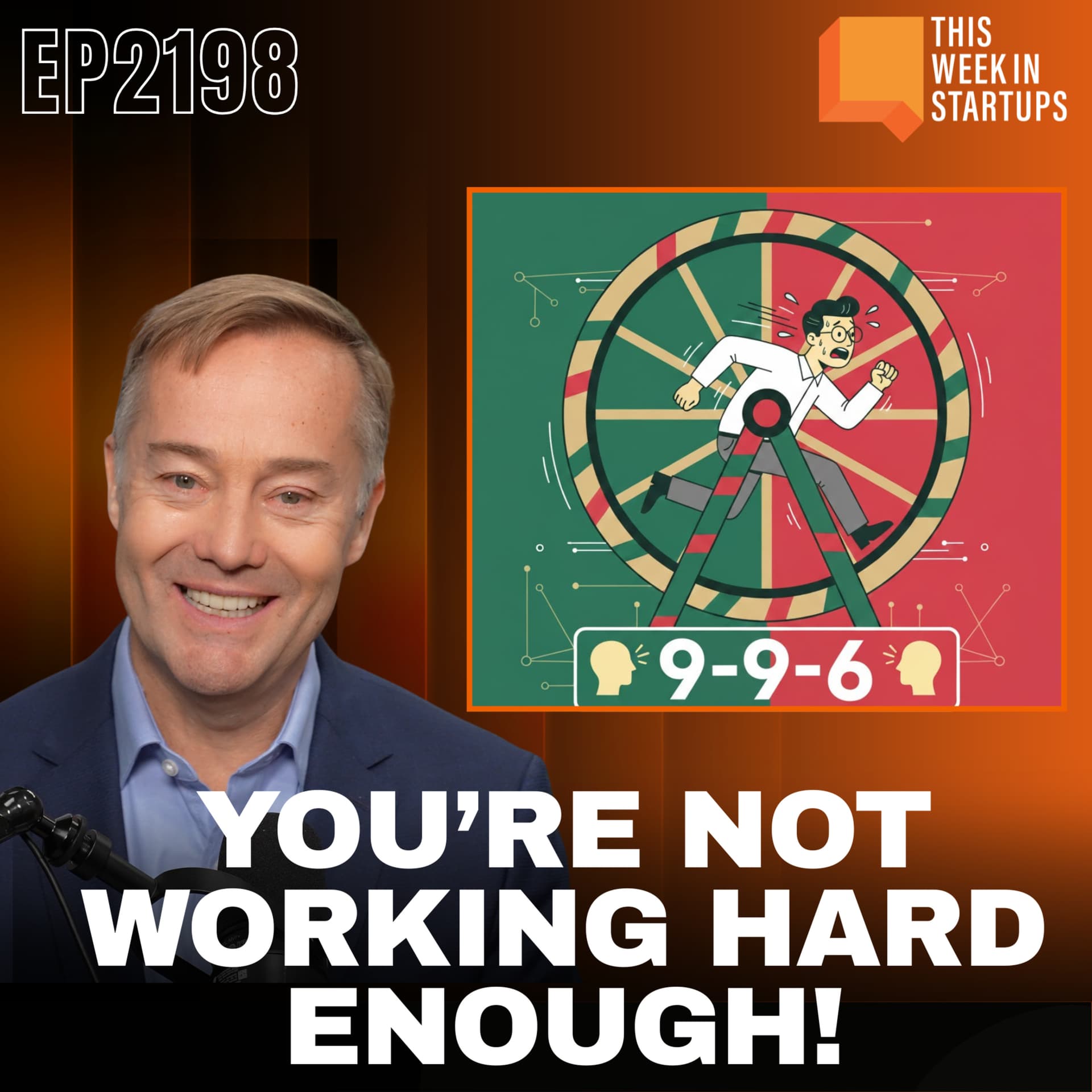
Podcast Title: This Week in Startups Episode Title: If you're not working 9-9-6, are you working hard enough? Release Date: [Date not provided] Host: Jason Calacanis Co-Host: Alex Wilhelm Guest: Presh Kumar
Episode Overview
In this episode, Jason Calacanis engages in a thought-provoking discussion on the demanding "9-9-6" work culture in tech and startups, the implications of work-life balance, a deep dive into a recent NBA gambling scandal, and the innovative use of AI in startup video production.
Key Topics Discussed
- Work Culture: The 9-9-6 Debate
- Definition: The term "9-9-6" refers to working from 9 AM to 9 PM, six days a week.
- Arguments For:
- Elite performance and mega-compensation often require personal sacrifice.
- High-level occupations, similar to athletes and military personnel, demand extended hours.
- Arguments Against:
- Concerns about burnout and the overall wellness of workers.
- The need for a balanced approach to work and personal life.
- Historical Context: Discussion on how work hours evolved, with references to Ford’s five-day workweek initiative.
- Personal Choice: Emphasis on individual choice and compensation as key factors in embracing or rejecting intense work schedules.
- NBA Gambling Scandal
- Overview: Allegations surrounding NBA players and insider information influencing betting behaviors.
- Key Players: Mention of LeBron James and former Lakers coach Damon Jones allegedly sharing injury information for profit.
- Regulatory Perspective: Discussion on the need for transparency and regulation in betting to combat fraud.
- Startups Opportunities: Jason highlights the potential for startups to address these problems through education and technology solutions.
- AI in Startup Video Production
- Guest Feature: Presh Kumar discusses his experience using AI tools to create a promotional video for his wellness startup, Tempo.
- Process Breakdown:
- Conceptualization and storyboarding using AI.
- Voiceover generation and musical composition through AI tools.
- Editing and final assembly.
- Innovative Tools: Mention of ChatGPT, Suna, and CapCut as key resources in the creative process.
- Anthropic's Strategic Moves
- Recent Developments: Anthropic's significant purchase of TPUs from Google to enhance computational capabilities.
- Tech Partnerships: Discussion on the implications of partnerships among tech companies, particularly in competitive spaces.
- Market Dynamics: Analysis of how different AI companies position themselves in terms of profitability, growth potential, and infrastructure investments.
Timestamps
- 00:06:49 - Discussion on NBA gambling scandal.
- 10:00 - LinkedIn Ads promotion.
- 20:00 - Nexos.ai promotion.
- 25:09 - Debate on the 9-9-6 work culture.
- 30:00 - Every.io promotion.
- 38:00 - Presh Kumar's process for creating his video.
- 42:28 - Review of famous storyboards by Ridley Scott.
- 48:03 - Anthropic's chip acquisition from Google.
Key Takeaways
- The "9-9-6" work model may yield success for some but also poses risks of burnout, underlining the importance of individual choice.
- Transparency and regulation in betting markets are essential to curbing fraud and building trust.
- AI is transforming the creative processes in startups, allowing founders to leverage technology for effective storytelling and marketing.
- Strategic partnerships in the tech industry can provide competitive advantages, particularly in rapidly evolving markets.
Conclusion This episode of *This Week in Startups* showcases the nuanced perspectives on work culture and the intersection of technology and ethics in the sports and business world. The discussions promote a deeper understanding of the challenges and opportunities present in today's startup ecosystem.
---
Listen to the full episode: [This Week in Startups](https://thisweekinstartups.com) Follow Jason Calacanis: [Twitter](https://twitter.com/Jason) | [LinkedIn](https://www.linkedin.com/in/jasoncalacanis) Follow Alex Wilhelm: [Twitter](https://x.com/alex) | [LinkedIn](https://www.linkedin.com/in/alexwilhelm/) Follow Presh Kumar: [Twitter](https://x.com/PreshD_Kumar)
Support the Show: Consider checking out the sponsors mentioned during the episode, including LinkedIn Ads, Nexos.ai, and Every.io.
Written by AI. May contain mistakes. Listen to the episode to check what was said.
Transcript
Automatic transcript. May contain errors.0:00Let's go to the gray area. Sure. Um, your, uh, and I think there's an allegation around LeBron James here. Not that LeBron James did anything, but LeBron James was going to be out of a game where he was potentially injured. And these injury reports come out early in the day, and they get updated as you go. And people take them into account when they're betting on games, obviously. The handicappers and the people who do it professionally. So what happened in one of these cases, allegedly, is somebody told their friends, oh, I don't think LeBron's going to play tonight. He tweaked his ankle. They tell their friends.
0:34They put action on the games, having that information an hour before the lines change. Now, if they say, hey, LeBron's not playing tonight and he's LeBron in his prime, the odds in the game would change dramatically. But if you get your bet in, you've got your bet locked in at that other bet. So is that illegal? Well, in this case, the injury status, Jason, was sold by allegedly his friend and former L.A. Lakers coach Damon Jones. Jones was also an ex-Cleveland Cavs player. And yeah, he essentially sold the information ahead of time. That's just so. If he did, in fact, sell it. Now, what if you were just talking to your boys and you're like, yeah, you know, don't bother coming to the game.
1:13LeBron's not playing. Right. And then your friend does something stupid. Just like I might say to somebody, you know, oh, hey, yeah, I was, you know, I was at a party and somebody told me this company is going to buy this company. And but, you know, and then they told their friends and then that friend traded on it or that friend's friend traded on it. So this gets people pinched all the time in insider trading. So there's a lot of gray area here now that people have to get used to, which is, you know, if you are the trainer or you're a security guard at one of these arenas and the security guard finds out and they, you know, are at a poker game and yeah, I know LeBron's not going to play tonight.
1:50And then somebody gets their fantasy sports out and puts a hundred dollars or a thousand dollars on. It's probably not going to get picked up. So Brave New World, there's a chance that none of this is cataclysmic. So anyway, it's a brave new world, but I think all of this being regulated and being on the up and up is going to actually take fraud that was going on that we were unaware of and make it above board. So I'm actually confident that the referees aren't doing any of the shenanigans like Tim Donahue was doing back in the day where he was giving the injury reports to the mob allegedly. I think he got convicted of that, so I don't know if you use the word allegedly anymore.
2:30But anyway, very interesting story. lots of technology opportunities there. So if you're a startup and you see these kinds of problems, you can build a company and then sell it to those people to solve that problem. The NBA is going to need one of these as well, which is educating their players and trainers and everybody around it as to how easy it is. And so there's so many startup opportunities here. I'm glad that these things are all getting regulated and that they're above board now. So I actually take the opposite approach to I think things are fixed. I think things are being fixed. This Week in Startups is brought to you by Every.
3:07Running a startup is hard enough. Every takes care of incorporation, banking, payroll, benefits, accounting, taxes, and more so that you focus on building, not back office admin. Visit every.io. Nexos, stop shadow AI in its tracks with the unified platform for secure AI adoption and productivity. Try it with a free 14-day trial at nexus.ai.twist. And LinkedIn ads. Start converting your B2B audience into high-quality leads today. Launch your first campaign and get$250 free when you spend at least$250. Go to linkedin.com slash thisweekinstartups to claim your credit.
3:56All right, everybody. Welcome back to This Week in Startups. I'm your host, Jason Calacanis, x.com slash Jason, Instagram.com slash Jason. He's Alex Wilhelm. You know him from TechCrunch, a bunch of other stuff. He's x.com slash Alex. And cautious optimism is his newsletter. Yes, sir. Give me a search. Hey, Joe. Hey, Joe. I'm saying hello. You know, people don't know we're doing live now. We get thousands of people tuning in live and it really does make the show great. If you want to join us on the live team, x.com slash Jason, follow me and you'll get the live. YouTube, look for This Week in Startups or actually even better, go to thisweekinstartups.com slash YouTube.
4:38And when you go to that URL, boom, it automatically subscribes you if you're not, but then you got to hit the bell. We have so much to go over. It has been an absolutely crazy week. There's a lot of law and disorder going on. Did you notice that? Have you noticed this trend? I have noticed this trend. There seems to be an uptick in fraudulent activity that we're now hearing about, Jason, especially involving one of your favorite things in the entire world, which is poker. Yes, there's the pot calling the kettle black. You also love to play some cards. Well, let's get started. You're talking, of course, about Kash Patel came out after an amazing season opener for the Knicks and for the Spurs.
5:16Wemby had that crazy performance. Did you see the highlights of Wemby and San Antonio? I have not even caught up on my Warriors yet, so that's how far behind I am. Wemby is like this 7 '5". He's in his third year. You know, to call him a unicorn, like Porzingis or Kevin Durant, would be an understatement. He's kind of like an alicorn, Pegasus and unicorn, and he's doing things in the NBA nobody could imagine. And then, of course, we get this drop of a crazy... Yeah, there's Wemby. That's Wemby. And the highlights from this are just bonkers. If you just look up Wemby highlights game one, he had a performance that literally had Bill Simmons and Stephen A.
5:58Smith and some of my NBA friends in my group chat. Like, we've never seen this before. Seven foot five guy doing crazy things on the court. Putting all that aside, after this incredible launch of the NBA season, Kash Patel came out and dropped the hammer. Some people saying this was political. You know, Stephen A. Smith took the position this was political. Trump trying to get back at BLM or the NBA and it was a race issue. I don't know anything about that. Everything is so political these days. But I do know about poker and I do know about sports betting. So maybe you could tee up for the audience, Alex.
6:39What exactly got dropped on Thursday morning? We're taping here on Friday. You'll get a Friday night. yeah so on the poker side of things there were a series of games that were set up in a fraudulent manner jason and they involved what were called face cards which in this case were high profile people from the nba that's the sports connection for folks who were curious and this included uh chauncey billups who i believe is the coach for the portland trailblazers along with some other names these games were essentially marketed by using whales and jason for folks who don't know a whale is a player with a lot of money and perhaps maybe more money than skill so if someone invites you to a game and says hey we're gonna have a couple of billionaires and they're gonna be drunk you want to go because the whales will be splashing around with their money now these games cheated a variety of ways jason manipulated shuffling shuffling machines an x-ray table they had poker chip trays that were scanning cards they had cell phones set up and they were moving data all around which was a whole lot of work to make seven million dollars over a long period of time the last thing i'll say about this is the uh four of the five families uh famous for crime in the New York City area were involved as enforcement.
7:43Allegedly, you gotta say allegedly, 17 times, all this is alleged. 100%. I have no inside knowledge. I was not invited as a whale or a sharp. And this is all from the FBI and Mr. Kash Patel. But I will say, Jason, it seems like a hell of a lot of work and a lot of illegality to make$7 million when in the technology world,$7 million is absolute pocket change in the AI game. So it's just, it almost feels like small potatoes. Um, yeah, there is a small potatoes aspect to this, if you've got a 20 or 30 million dollar NBA contract. But, uh, these rigged games have been around forever. If you read any of the poker law, lore, I should say, um, there were people who were going, I heard about this one, they would go to games in Texas, you know?
8:33And on the way to the games, they would have decks. These are marked decks. So if you look at the back of a deck of cards, Somebody can pull up a marked deck image from just Google Images, and we'll show it. What they would do is, they would have on the back of the cards this fancy, intricate... patterns. Now, what you would do is, you would either cut the deck with an imperfection, or you would put some sort of hidden thing on the card. So if I was across from you, I would know you have an ace or a king. And you don't really need to know all the cards. If you just knew who has aces, who has kings, This is a tremendous advantage of when to fold and when to go in.
9:10This is the most simple version of it. And so what they did was there was a tradition of like picking up a deck of cards at a gas station on the way to a game that was wrapped and sealed. This is really crazy poker law. At these games in... So here you go. If you're looking, you're watching the screen here, what you'll see is in the top left corner, you have these crazy patterns, but they would just be slightly different. For example, curly cues that are missing, but just small things that would tell you if you looked at them, this is an ace, this is not an ace, this is a club, this is a heart, giving you a huge edge, Jason, frankly.
9:43Correct. And so these slight imperfections. Another way to do this is people with their nail could indent or bend a card in a game. Yes. And then when the bent card comes around, and this is why when you're playing a game, if you ever see a bent card or a card with an indentation, you stop the game, you say there's a bent card, you hand it to the dealer. founders listen if you've got a b2b company and you're marketing your product or service to other businesses you need to use linkedin ads otherwise you're wasting your time and you're wasting your money linkedin isn't some random social network where everyone's using a fake name and posting nonsense it's a network for professionals linkedin knows who the big players are and who the key decision makers are in your vertical based on the data they're already collecting everyone's on LinkedIn.
10:29Me, you, everyone. The platform has more than a billion members, and that includes those 10 million C-suite executives. And that's the kind of reach you need to grow your business. LinkedIn's advertising tools aren't just throwing your messages around for anyone who's clicking. No. B2B marketers report 2.5 times higher returns on ad spend on LinkedIn compared to other social platforms. That's why my firm, Launch, advertises our own projects on LinkedIn. We want to reach people who are actually doing exciting work at real companies, not randos, not bots, not trolls, real executives. So here's your call to action.
11:05We've got a special offer just for twist listeners, launch your first campaign and get$250 free when you spend at least$250. That's one for one. Go to linkedin.com slash this week in startups to claim your credit linkedin.com slash this week in startups.
11:26The dealer will call the floor over, and they will stop that hand immediately, and they will put a, what they call a new setup. A new setup, rich guys in big poker games can say, I want a new setup, just because they're running bad, superstition, or for this reason. When they do that, they take the deck, they put it away, they crack open a fresh deck. I heard these stories that they would go to the gas stations, the two or three gas stations from the airport to the big game. They would pay off the guy at the gas station to put in a series of decks that were marked, but were sealed in plastic. The whale comes, they buy three decks of cards, they go to the game, they hand, hey, I got three new decks.
12:04The guy, the Confederate from the guest station would say, yeah, Dopey picked up the decks here, they're marked. So even if you thought you were bringing your own deck, it would be marked. So let's put that aside for a second. There are new high-tech ways to do this. One of them is eyeglasses or contact lenses, and then some dyes that you can only see if you're wearing those. Another way to do this is what's called being a mechanic. You saw this famously in the movie Rounders. That's where people who shuffle the deck can put the aces on the bottom two slots, let's say. So they see the aces as they're shuffling, and as they shuffle, they just put them on the bottom.
12:40Then when they throw the cards, they're throwing from the top of the deck to everybody. Then they get to Alex, and the dealer who's a Confederate would send a card from the bottom of the deck. Now, I've been in games where I think I've seen this. Oh, really? Yeah. And I've been in games that I think were dirty. Like, just a small number of times, like two or three times. And I never go to those games. If you're going to a game where there's celebrities, like I got invited to Molly's game over and over and over again. Molly would text me and call me when I lived in Los Angeles 20 years ago and say, hey, Leo, or, you know, Toby, or this celebrity, that celebrity is going to be at the game, they want to see you.
13:18And I always had the same joke to her, which is, they want to see me lose 50 grand. And at that time, the games, a big game would be 10K buy-in, 25K buy-in. Now, these games have gotten significantly higher. There are people backing people, staking people. Eventually, Molly's game allegedly, you know, got taken over by, I don't know if it was the Russian mob or the Armenian mob, some mob group. So, what happens in these games is they can use also what's called the Deckmate 2. There are different card shufflers. A card shuffler means it just automatically shuffles the cards. it fits into the thing.
13:51I actually own a card shuffler. I've had it for over 15 years. Technically, people were not allowed to have these. There's like two brands, but I had one of the ones that like are used in casinos. These are like really on the up and up. But the more recent ones from China, the Deckmate 2 specifically, they know the value of each card. So if you were to take a card out of the deck and put a card from another deck in there and you had say five aces, it would, it always checks the cards are correct. And then it tells you, hey, there's something wrong here. You have 51 cards in the stack instead of 52.
14:25Oh, you left in the Jokers. We're not playing with Jokers. So this is the Deckmate 2. I have the Deckmate 1. These things were never available to individuals. They were like an off-market purchase, you know, falling off trucks kind of situation. Ah, got it. Let's leave it at that. So there's all kinds of ways to cheat people. You could also have three people playing from the same chip stack. So me, you, and Lon have, you know,$50 ,000 were all bought in. And then, you know, well one and well two, you know, they get aces, but they're playing against three other players. Putting this all aside, if you're in a game with celebrities and they're taking a rake, which is illegal in most states, if you're playing a home game in most states, it's legal if you're not taking a rake.
15:07In other words, making a profit, because then you're in competition with the casinos and they don't like that. They do not. You can do a bunch of searches online, where things are illegal, where they're illegal, and what the lines are. It's different in New York. Like, even running, I think, games in New York is technically not legal, even if you're not taking a rake. But they kind of let people do it. I think D.C. has rules. It was always very famous. Rumors of Obama or Clinton having a poker game, friendly one. Anyway, when it becomes high stakes, when you don't know the players in the game, you shouldn't be in the game.
15:39If you're in the game and you're with high-profile business people who have a lot to lose and the amount of money they're playing, let's say me playing for 25 or some famous CEO playing for 100K and they're worth X amount of money, they're not going to cheat because their reputation is more than the cost of that. Put that aside. So Chauncey Billups, who's currently the coach of an NBA team. I believe he's the coach. I'm going to double check that now, but I believe it's the Portland Trailblazers, my theoretical home NBA team. So, you know, if you look at this, and this is something that's been going on for five or six years, allegedly.
16:15There's also all these sports guys play Badoogie and other games when they're in the planes because they have a lot of downtime. And it's a nice bonding thing. But if you remember the Gilbert Arenas bringing guns to the locker room, that whole case, when he got suspended for a year, was over poker debt. So poker debts can get spicy, dicey, etc. There's a million ways to cheat now. There were, you know, a half million ways to cheat before technology. Let's put that aside. There's a second thing going on here. I don't, these two cases are not related in any way, but fantasy sports has made it very easy to do what's called a prop bet.
16:55Not betting on the score of the game. Very hard to influence that, right? Without it being very obvious. Now, in this other case, you could let people know, hey, my over under, the over under is I get seven rebounds. So on average, I get seven. they think versus this team, which has an incredible rebounder. I'm against Dennis Rodman. I'm going to get, you know, only six. Well, if the person, you know, halfway through the game says, oh, I sprained my ankle and they come out of the game with four rebounds, you know, the under is pretty good, right? You could bet under a certain number of rebounds.
17:31And these idiots, these incredibly stupid people, allegedly, if any of this is true, it would be the height of stupidity to do this kind of stuff. But there are some gray areas here. And some of this is new. Some of it is as old as time. Yeah. Just, I would say the startup angle here is, as we talk a lot more about prediction markets and we talk more about options trading and we talk about crypto and ICOs and token treasury companies, Jason, and SPACs are back, just know what you're getting into, wage your money you can afford to lose, and try not to get caught up with the Gambino family collecting your debts because that's not going to be a fun way to live.
18:07Now, on the over-unders, very specifically, because all of this is legal and not run through bookies anymore, you know, your local bookie at the bar, there are software companies. Somebody can look it up. There's a software company that looks across all of the prediction markets or really the fantasies, the, you know, the prize picks, the draft kings. So there is a literal company that looks at the action being placed. Now, when this, I'll call, you know, when an incredibly stupid person, I won't say these people are because it's all alleged and this, you know, you never know. This may not be as bad as it looks.
18:53But if a stupid person were to say, I'm going to do this thing where I get under a certain number of rebounds and their friends put$200 ,000 on them and they're the fifth player or sixth player on the team, they're not LeBron James, they're not Steph Curry, where all the action tends to be, and they normally have$20 ,000 in action on them across all of the different sites, this company, which I don't know the name of, but if you find one, Lon, you can just check that. It's exactly that and pull up the website and just verify that for us, please. They will alert the different places, hey, there's odd action going across these sites.
19:33And then they kill that prop bet and they send it to the feds so we found one jason's called polyrouter.io this is specifically for the prediction markets i'll just pull it up here yeah yeah this just shows essentially how to get all of that in one place now on the on the thin betting volume spiking didn't some players specifically in a different case get busted for making really large prop bets on their relatively small normal trading amount and it was in fact the volume differential that got them busted I remember seeing headlines about that. Yes, there are so many amazing AI tools out there that can make your team faster and more effective.
20:10Any founder would be a fool not to embrace these tools, but a large team making use of a diverse array of cutting edge AI apps can also pose a privacy and security nightmare for your organization. But now there's Nexus AI, the workspace that will help your team up their game with greater efficiency without sacrificing your data or your peace of mind. Nexos AI is going to give your teams a simple browser-based environment to work in, integrating all the latest and greatest AI models and replacing the various potentially problematic tools and subscriptions your staff can't even keep track of anyway.
20:48You're probably paying for two or three things over and over again, redundantly. Finally, your admin team gets full visibility and oversight into what's happening, so your team can enjoy all the productivity gains of AI without the data leaks and your platform remains compliant while your data stays safe and secure. But don't take my word for it. Try it yourself. Go to nexos.ai slash twist for a 14 day trial. That's n-e-x-o-s dot ai slash twist.
21:20If you make these stupid bets, um, and yeah, it looks like there's a lot of them. I just asked producer Claude, and it looks like Sion offers AI-driven fraud protection tools for gaming platforms. Geo Comply, widely used across US sport books to verify player location and print VPN fraud. Sports Trader focuses on protecting sports integrity by detecting max fixing and irregular betting behavior. That's the one. It must be Sports Trader. And somewhere in these documents about all of this, that was one of the companies, I think, that alerted them. So they just turned the bet off, and then they give it to the feds and these people get busted let's go to the gray area sure um your uh and i think there's an uh allegation around lebron james here not that lebron james did anything but lebron james was going to be out of a game where he was potentially injured and these injury reports come out early in the day and they get updated as you go and people take them into account when they're betting on games obviously the handicappers and the people who do it So what happened in one of these cases, allegedly, is somebody told their friends, oh, I don't think LeBron's gonna play tonight.
22:30He tweaked his ankle. They tell their friends, they put action on the games, having that information an hour before the lines change. Now, if they say, hey, LeBron's not playing tonight, and he's LeBron in his prime, the odds in the game would change dramatically. But if you get your bet in, you've got your bet locked in at that other bet. So is that illegal? legal well in this case the injury status jason was sold by uh allegedly um his friend and former la lakers coach damon jones uh jones was also an ex-clean cleveland calves player and uh yeah he essentially sold the information ahead of time that's that's just so if he did in fact sell it now what if you were just talking to your boys and you're like yeah you know uh don't bother coming to the game lebron's not playing right and then your friend does something stupid just like i might say to somebody, you know, oh, hey, yeah, I was, you know, I was at a party and somebody told me this company is going to buy this company.
23:24And, but, you know, and then they told their friends and then that friend traded on it or that friend's friend traded on it. So this gets people pinched all the time in insider trading. So there's a lot of gray area here now that people have to get used to, which is, you know, if you are the trainer or you're a security guard at one of these arenas and the security guard finds out, and they, you know, are at a poker game, and yeah, I know LeBron's not gonna play tonight, and then somebody gets their fantasy sports out and puts$100 or$1 ,000 on it, it's probably not going to get picked up. So, Brave New World, there's a chance that none of this is cataclysmic.
24:03So, anyway, it's a Brave New World, but I think all of this being regulated, and being on the up and up, is going to actually take fraud that was going on that we were unaware of and make it above board. So I'm actually confident that the referees aren't doing any of the shenanigans like Tim Donahue was doing back in the day, where he was giving the injury reports to the mob allegedly. I think he got convicted of that, so I don't know if you use the word allegedly anymore. But anyway, very interesting story. Lots of technology opportunities there. So if you're a startup and you see these kind of problems, you can build a company and then sell it to those people to solve that problem.
24:40The NBA is going to need one of these as well, which is educating their players and trainers and everybody around it as to how easy it is. And so there's so many startup opportunities here. I'm glad that these things are all getting regulated and that they're above board now. So I actually take the opposite approach to I think things are fixed. I think things are being fixed. Which is much better because you're using that in an ironic way. All right, Jason, First up on the docket today, everyone's talking about 996. This is the famous model from China in which workers work from 9 a.m. to 9 p.m., six days a week for a total of 72 hours at a minimum.
25:19Interestingly enough, you know, we've talked about this since 2019. But currently in the American AI era, we are seeing headlines from the Journal, Fast Company, Washington Post. Everyone's talking about the insane pace of work required today by leading startups. and I actually I pulled a tweet from you from back in 2019 this is a man named uh Jason Calacanis saying founders were up against Jack Ma enforcing a 72-hour work week 9.96 six days a week 9 to 9 p.m the exact same work ethic that built America you can get on your Twitter pedestal and attack Jack Ma or you can make a plan to win now that was six seven years ago Jason so quite quite a while Yeah.
26:02I mean, I just had heard about this. When venture capitalists used to invest in startups, their big trick was to come on a Saturday to visit the startup and see how many cars were in the parking lot or they would come at night. Then we got into this life work balance nonsense, unions, people, you know, wanting to see their families, all this craziness. and when you get in a dogfight on a business level and you've got to ship product, like there's a huge prize here, we talked about the TAM of this market is going to be huge. Yes. Then people can opt into, we're going to work 72 hours a week. We're going to work six days a week, which by the way, the entire world did for thousands of years.
Read the full transcript
26:45It worked six days a week. It was only Ford and the Model T and the concept of getting Americans the ability to take a weekend road trip that created the five-day workweek, the 40-hour workweek, in order to sell more cars. You can look all that stuff up. So it's not super controversial to bring this back. And if you're being compensated wildly, you know, hundreds of thousands of dollars a year, you know, stock options that could be worth millions to tens of millions of dollars, it's not unreasonable for this to happen. And it's, in fact, not illegal if you're a salaried employee and making beyond the minimum wage and what minimum wage plus overtime would pay.
27:27My understanding is this is legal in the United States. People can make that decision in tradeoff. The legality point's very interesting, though, Jason, because after, well, basically going back in time, 2019, Michael Moritz, formerly of Sequoia, now kind of a venture emeritus for the world, wrote an article for the Financial Times discussing how much Chinese tech companies were working and also how frugal they were. And it was a bit of a shake the cage moment for American startups at that time. Yes, I remember that. That was the Financial Times, right? Yeah, yeah, yeah. But then some things happened.
27:58So over in China, I'm going to ruin this, everybody. I'm sorry. But Pen Duoduo had an employee die on her way home from work. Another one jumped off a bridge and another set themselves on fire. And that led to a conversation inside of China in which there was a mini revolt amongst tech workers was kind of complaining about the insane pace of work that was required of them. And that led to China in 2021 saying that 996 was actually illegal. Now, they haven't stamped it out. Coverage since then has made it clear that it's still in effect. But even inside of China, where this model kind of came from, there was pushback against it.
28:31I just wonder if people are doing good work or how much of this is performative versus actually being effective. Jason, can you tell me more about that? I mean, there are moments in time where you can burn out and it works against you. Uh, but putting in a 10-hour day, 12-hour day, you can still be productive. Um, and it's, uh, it's a personal choice if you want to do it. It's not a big deal. And then a lot of times, law of big numbers, if you've got 100 million people in China who are working 996, let's say, because they want to become rich and they want to take their family out of, you know, poverty to the middle class or middle class to upper middle class.
29:12And they make that decision, you know, a certain number of people tragically commit suicide. It's one in a hundred thousand or one in 250 ,000, depending on the society, the age group, et cetera. So would that person have committed suicide anyways? What you have to ask now, this comes across as incredibly cold and callous, but in business and in life, they call this the law of big numbers. So at Burning Man, there's a hundred thousand, 75 ,000 people there. And so if one person were to commit suicide at Burning Man by, you know, every 10 years by running into the Burning Man fire, doesn't it mean Burning Man, you know, killed this person?
29:52It means this person was going to kill themselves in all likelihood anyway. So I think, I think I'm pretty much on board with your take on it's fine. If you're compensated fairly for it. I'm a big enough deal now that I can afford to hire my own admin team. Look at me. They handle all the details of running my company. But if you're a startup, you need to spend your time obsessing about your product, not filling out paperwork and doing all these books. That's why I want to tell you about Every. They've worked with over 1 ,000 startups from first-time founders to VC-funded teams and more. And they've got the experience to help your company navigate whatever's coming around the bend.
30:26Maybe it's time to incorporate your startup so investors take you seriously. Every's going to take care of those filings for free without any unnecessary delays or legal fees. Hey, maybe you just got some new funding and it's time for you to scale up. With Every, you'll get 3 % cash back on every dollar you spend on your company's card. Hey, maybe it's time to say goodbye to a member of your team. It happens. Well, they've got an employee offboarding checklist, and you know I love a checklist. It's going to help you ensure a smooth transition while protecting your business, both legally and financially.
30:54Plus, you'll get a $2 ,000 bonus when you move$250K or more into your Every account. So for your incorporation, banking, payroll, benefits, accounting, taxes, and other back office administrative needs, visit every.io. That's E-V-E-R-Y.io.
31:16And I think that equity upside is the critical thing there, because if you own what you're working on, you're less of a salaried worker, more of a owner in the company. So what's the minimum equity expectation you think is reasonable for an employee to have to sign on for, let's say, a decade of 996 at a company? Yeah, I mean, again, it would be up to the person. If the person is, you know, from an immigrant family and they grew up with five people in a one bedroom and$150 ,000 or$100 ,000 to them, you know, pays down this debt, you know, buys a house, whatever. Okay, that's the personal choice.
31:53For some people, if they're already a millionaire, they might be like, I'm not doing this unless I'm getting 10 million in stock options. So there's no one answer. There is just the reality that you're in a competitive space. If you're in the NBA, LeBron James is, or Steph Curry, or Michael Jordan is prime, or Kobe Bryant, certainly. We're definitely doing more than 72 hours of basketball per week. They were working more than 72 hours a week. Navy Seals, Olympians, They're all doing, they'd be like 72 hours of work in a week to be an Olympian or Kobe Bryant. They'd be like, oh, that's like a vacation week for me.
32:30So it is what it is, folks. You don't need to be precious about it. It's not causing people to die. It's light work when compared to what humanity was doing, you know, a thousand years ago or a hundred years ago, where people literally worked in fields seven days a week, and maybe they took Sunday off for like the Lord's Day. But, dude, much worse than that. I mean, go look at the history of mining. Yes. Thank you. But here's the thing, though. People are going to say, but guys, aren't we trying to get away from that? Isn't technology supposed to free us up? And I'll just say, because right now we are at a hinge point in technology, there's a new paradigm that everyone wants to apply, and there's the geopolitical element.
33:10This is going to be the way it goes when the markets are competitive. So last thing, Jason, before we scoot on here, I went and I did some searching around the web and I found some companies that have job postings that explicitly note higher hourly requirements. So Corgi says that new hires and people pursuing the account executive route are required to be in the office six days a week. Mercore, who we've had on the show, six days a week with Monday through Friday in person. So one remote day. Latch Bio says six days a week, Monday through SAT, et cetera, et cetera, et cetera. So you can see companies being upfront.
33:41And I think upfront expectations, reasonable equity splits, go for it. If you don't have those things, you're kind of being a jerk. Yeah. And Europe is, you know, even Europe is having this discussion. And in China, I think there was a podcast, 996. I think either Sequoia or Google Ventures had like literally named their podcast 996. so and Chinese developers name their protest site 996.icu because working 996 sends developers to the intensive care unit if you think you can compete in a company working 40 hours a week and hiring you know whatever it is you know twice as many if you think you can compete with 72 hour a week work weeks where people are getting massive compensation by working 35 hours a week go do it spend twice as much money have twice as many people and see if you compete you might actually be able to.
34:32Maybe you'll attract more people. Maybe better people will come work for you. We might be sitting here in 10 years and have a standard in the United States for a lot of different workers, let's say lawyers and accountants, of four days a week, or teachers, or nurses. We may go down to a four-day, 35-hour-a-week, nine-hour-a-day, 10-hour-a-day work week. And in fact, there were some companies that were pitching this during the peak woke era of Silicon Valley. And this stuff ebbs and flows. Like during that peak woke DEI, you know, kind of life work balance nonsense. Um, there were literally companies that were saying, come work for us.
35:16You can have unlimited vacation and work four days a week. And that was their sales pitch. And those companies, I can't even remember their names because they lost to the companies working 996. And speaking of getting fit, look how svelte I am. I was on the scale the last week, 169 to 172. I'm really in my perfect zone. I'm trying to get down to 166 for ski season and increase the muscle mass on my body. How did I do it? spent the last four years testing different GLP-1s. You know what I'm talking about. Ozempic, Wagovi, Maggiorni, and changed my life. I don't want to get emotional, but I lost 40 pounds.
35:56I feel great. I don't look at myself in the mirror and go, why can't I lose this weight? I had whatever, my genetics working against me, my lifestyle working against me, the food supply working against me. I'm not going to beat myself up about it. I used a tool, GLP-1s, having a better diet, exercising, rocking, fasting. I tried everything and it worked for me. It might work for you. And if you want to try, I suggest ro.co, R-O.co. I'm an official spokesperson, me, Charles Barkley, and Serena Williams. Three incredible, notable athletes in their field, or I should say two notable people and me.
36:35Those are the three spokespersons for ro.co. two incredibly famous people and me. So go to road.co and hopefully it works for you. I got the food noise out of my head. I believe the phrase is podcaster waistlines matter too. You know, absolutely. Let's keep going. All right. Next up in the docket. Let's talk about presh. Presh is a former launcher. We all love presh. Fantastic guy. We lost him because he went off to go build his own company. I was back in some unbelievable presh. How dare you? But he made a very interesting video clip, Jason, that he shared on Twitter back in September that you asked him about in which he was doing some storyboarding, if you will, for a promo clip for his company, Tempo.
37:20And you asked him to do a demo for us. And we also have the final version of that. So I thought I would show the 19 second clip that got you interested and then show you the final version and we talk about it. Okay, great. Yeah, Precious is building a company called Tempo to extend your health span. and he made a great promo video and he shared it. So here we're seeing it. Great voiceover. And an old man sitting on a bench. Writing in his journal. Getting sunlight.
37:57So here's the simple workflow. So yeah, I asked Presh to do a how-to because people are making these incredible videos and some people are spending 50 or 150 or$250 ,000 doing them. Other people are doing them with AI. And I think Presh is in that group. So let's hear from Presh how he did it. All right. Here is our dear friend explaining the nuts and bolts of how to do this yourself if you want to. It's a simple workflow. Started with the concept. We narrowed down to this, a letter to my younger self concept, which is basically 100-year-old grandpa writes a letter to his younger self As his pen touches the notebook, there's a bunch of shots of me doing a number of healthy activities.
38:38The reason I chose my grandpa was I just recently hired him. Welcome to the team. Welcome to the team. Congratulations. So he became the first chief centenarian officer. I wanted to find a fun way to include him in this waitlist video. Then I wanted to script it out in storyboard. This is where I use ChatGPT. I basically prompted it with this and got a whole structure out of it. So now we have the concept. We have the script. Now we want to create a storyboard. The storyboard now comes after creating the script. So we basically have this script and structure. So we're going to pop that into GPT, ask it to start creating stills.
39:13You can refine this further, but that ends up looking like is something like this. While I make the storyboard - Okay, let's pause there. ...and stills, sketches. And so what he's showing is the prompt he wrote. So he comes up with the concept, a hundred year old writing a letter to himself, says, let's make this into a script, gets basically a scene by scene of what should be in this ad, this promo video. And then it generated sketches in storyboards for him. Then he took the storyboards and then he made them reality. And this is just wild when you think about it. Keep going. Drawn by hand for the scene.
39:52For example, a sketch of a grandpa sitting outside on a bench. And again, I'm just doing like a rough draft here just because I want to see how the story lays out before we make the actual thing. You could use VO Sora if you wanted like actual videos. And now I have about 20 stills that create the whole story. So we got the concept, we got the script and storyboard. So for the voiceover, we use 11 labs. We're going to go to text to speech and put the script that I want created. And for voice, I'm either going to search their library or create a voice. If you go to the voices section and create our clone of voice.
40:25And so I use a combination of different voices to create this old man speak. Anyways, you get the idea. I'll go here and I'll just download that into an MP3. VoiceOver is done. Now we want to go to music. What I did was I basically took that into chat and said, give me a prompt. That being his description of the advertisement. And I went over to this other tool called Sora. Using chat, I outputted this prompt as well. He means Suna. To give to Sora to then create. Make sure it's an instrumental track and it'll create different versions in Sora. So I can go through, pick a track that makes sense that I like.
40:59Now we have the concept, we have the script, we have the storyboard, we have the music, we have the voiceover, and now we just need to edit it together. And simple editing tool, I'm going to bring in cap cut. And so I took all the stills and just placed them out here. So we have almost just over 20 stills here. I'm going to drop the audio track from 11 labs. I'm going to drop the audio track from Suno. And then it turns out to sound and look like this. To the younger man I once was. So the idea here, again, we're not even going to ship this really. It's just for our own like creative process, seeing if we like the concept enough to make it real.
41:36And that's it. That's the process of how to make a quick concept video. I thought it was fantastic. I love the fact that he went through every single tool in order, showed them how to do it. Because I could do that now, Jason, in a couple hours. I love it. Yeah. I mean, eventually you'll be able to do this in one LLM or in a browser with agents that'll do the entire process for you. Right now, you have to use the best of breed tools to make each piece and then stitch them together. And the interesting thing is he could have just released it as the sketches, and I think it would be really effective.
42:11I think they went and took this concept, and you refine the concept, you refine the concept. The other person who did this quite famously, I believe, and our executive director, Lon, our director, Lon, will correct me if I'm wrong, but perhaps my favorite director of all time, Ridley Scott, definitely in my top two, three. Ridley Scott was known for doing storyboards constantly. And I think he learned to do them himself. And he would storyboard all these ideas and sets and everything, whether it was aliens or gladiator. and he could just do them himself. What that does is it lets you kind of get a feel for the story before you do something expensive like hire actors.
42:56And you can kind of see if the tone works and if everything works. So this is genius. We have a company, Saga, which does this, that we incubated in our accelerator and we'll pull up Saga in a moment. Yeah, and here's the picture. Thank you, producer Alon, of Ridley Scott doing the Alien. Pull this up. This is incredible. Check this out. It's in the twist taping room. Yep, yep, yep, yep. Here is the image, Jason, which shows a number of different screens. Would these be individual scenes that I'm looking at here? Yeah, so I guess what we're looking at, and let me pull it up on mine. Yeah, these are each individual scene.
43:39And then I guess there's a title and then notes underneath it. But he would draw these himself. And if you look on the top right, you're seeing the side view of a human with the face hugger on it, the iconic face hugger. And what's great about that, and then you can see the engineer, and the second one on the right is, I think, the engineer and its ship, or, you know, somebody going ready to be in a cryovac, et cetera. Acid dripping, you know, as when you kill these aliens, there are acid drips on the left, and it's just some blood drops. All of this is to say he doesn't have to tell people what he wants.
44:16He can show what he wants. And then here, if you pull up the Napoleon ones, so here you see Napoleon. And I think those are the scene numbers on the left, 53, 61. And he was just great at drawing these in real time. Just think about how much time this saves when you're trying to explain something to somebody. And this is really indicative of how AI is going to make everybody Ridley Scott level. Presh is not Ridley Scott. He has not made 10 films, but he's doing what Ridley Scott did. So the gap between the auteur and the amateur is closing. Yeah. You know, so from amateur to autor, I think the distance between those things was a lifetime.
45:02It was decades. Now the distance is gonna be, you know, instead of 10 ,000 or 20 ,000 hours, I think it goes down to 100 or 1 ,000 hours. If pressure were to do that process every day, a different storyboard, a different 30-second scene, and he did it for 100 days, so he put in 110-hour days or 12-hour days, speaking of 996, So imagine if you did 100 12-hour days. You know, now you're 1 ,200 hours into your career. What would the 100th day look like versus his first day of doing that? This should be inspiring to young people who can't get jobs. All these young people who can't get jobs, we've talked about static team size, we talk about AI, displacing jobs.
45:45Here's the opposite of it. You could become Ridley Scott level, I believe, in 100 days. You could do things that Ridley Scott does. You might not do them with as much panache. You might not have the instincts he has, but you would get damn close. Lon, if somebody did this 100 days in a row with these tools, how good would they be at making visual scenes in your mind? I think an amazing thing is, yeah, like filmmakers, a lot of them really do just spend obsessive amounts of time thinking about how things would look, how they would block them out. I once, not to toot my own horn, but I once chatted with John Woo.
46:23I interviewed him for Mission Impossible 2, and he could still, years later, tell you every setup for the killer. Well, we put the camera here. We were behind this corner. We had to move it around here. He just committed all that to memory. The whole scene was in his head so that on the day when he was directing people, he'd be like, you, you need to be right here. The light needs to be here. He just had the movie already playing out in his head before he ever set foot on the set. Incredible. So everybody go follow Preshy Poo, my Preshy Poo. He came to work for me, quit school, came to work for me at 18.
46:55We backed his startup. He's doing great. And what's his Twitter? X.com slash Presh D. Kumar. And if you want to check out Tempo, the company he's working on, join Tempo.app. We love this guy. Thank you, Presh, for making us that video. And we'll put the links in the docket. If you want to read the docket, you go to thisweekinstartups.com slash docket. And then we'll put it in the show notes as well. We'll put the links to all this great stuff. So if you listen to This Week in Startups and we give you some tips here and tactical stuff from the founders in our portfolio, we're going to link to it all the time.
47:28You can go to thisweekinstartups.com slash docket and see previous episodes' dockets. Get in there and get all those links. So if you watch This Week in Startups three days a week, Monday, Wednesday, and Friday, sometimes we throw in a Tuesday show because we're sold out of ads and they talk me into adding a show, you're going to just become a better founder. And that's why we do this show. We're passionate about founders and technology and inspiring people to start companies. And here you are. You're listening to the show and you are going to get better and better at starting companies and learning these tactical techniques if you're hanging out with us.
48:02The big news this week on the Anthropic front, Jason, is that the company has tapped Google for an enormous compute purchase. They're going to get up to 1 million of Google's TPUs in a deal worth up to tens of billions of dollars and it's going to bring on more than a gigawatt of capacity to the company in 2026. Now reading this news I know a lot of folks out there might not know what a TPU is so I went ahead and did a little prep work and asked producer Claude what is that? Well it's an ASIC or an application specific integrated circuit that is essentially designed just for these machine working sorry machine learning workloads.
48:41Basically they're designed to do a lot of mathematical operations very, very quickly. And that's what powers the neural nets that we all love and know. And just for a little background here, they've been working on the TPU since I think 2013, something around there. So they've been in the game for a long time. If you want to use Claude like we do, you can go to Claude.ai slash twist. It gets started. We have a 50 % discount for three months, but Jason, essentially Google TPUs are better. They're more efficient. They have lower costs and they're tailored for this kind of work, but more to the point, I'm shocked that Anthropic is kind of putting aside.
49:12It's a long-term deal with Amazon. on its preferred partner for both training and inference to go rack up with Google. I was curious what you thought about why they made this choice. I think any compute advantage these large language models can get, they're going to take. What's fascinating about this one is that Gemini, Google, the Gemini large language Model Anthropic and Claude, they're direct competitors. So this is perplexing, interesting, confounding, strange bedfellows. Yeah. If you're Anthropic and you're giving money and doing this partnership with Google and you're both competing for customers, users, businesses, developers, and APIs, it's kind of interesting.
50:11And as we say in our industry, no conflict, no interest. What this signals to me is the Anthropic team and the Google team are collaborating. They're in like with each other. They might not be in love, but they're in like with each other. Who else is in like with each other? Satya Nadell and OpenAI were in love with each other. I think they've dropped down to in like with each other. And I noticed Satya, Nadella and Elon are in like with each other. So, and NVIDIA is in love with everybody. Jensen loves everybody equally. But this is the place we are. The other thing I think is super interesting is amongst the LLM companies, some have money printing machines.
50:59So if you were to look at the foundation models, You've got Grok, OpenAI, Anthropic, Mistral. Yeah, Mistral. Mistral. I guess I'm including them. And then you have Gemini. And you have Llama, what Zuck is working on. I think that's probably your big six. Am I missing anybody there? I mean, we could bring up the Amazon and Microsoft models, but given that you and I always forget the names of those families of models. Yeah, I don't see them coming up yet. So if we just take those six, look at those six. Of those six, which ones have money printing machines? Which ones have money printing machines?
51:42Profitable machines, earnings machines? Well, Gemini. Google, correct. And Meta. Okay. This puts them at a significant long-term advantage. meta and Google can build infrastructure at a pace that the other four have to go raise money for. So let's pause on this for a second. Now, one would argue Gemini is probably in third or fourth place typically. And I think Lama is typically in sixth place or fifth or sixth place. So the companies at the top are obviously open AI. Um, and then I would say Claude and Grock, that's probably your one, two, and three. And then your four or five and six, Mishra might, uh, probably Lama's six, Mishra's five.
52:31And yeah. So you can start to look at this and I wonder if Google and Meta have a huge advantage in that they could start deploying hardware out of scale that the others cannot. Now, the others are the bells of the ball right now because they have the best product and people want to be on their cap table. And then this makes me wonder, why is Apple with their war chest and Microsoft with their war chest not participating in this lunacy of building out huge data centers, huge infrastructure? I guess Google is. I wonder if Microsoft too, but it's less speculative for them, Jason, because they talked about it in earnings and they've said, we just have the inference demand and we're just building against kind of like proven bookings so with them i'm not that concerned but i think that the the economy between the money printers and the money needers is very important because when you think about xai and open ai they are spending tens of billions of dollars on infra anthropic isn't they're raising money from the major cloud companies amazon i think eight billion google about three billion and they're getting access to compute so i kind of wonder and i you know i don't want to sound too nice to anyone here but like is anthropic kind of nailing this because they're not taking on the infra side quest yeah partnerships i think are a way to win here if you want to go far you go together if you want to go fast you go alone so going alone i think will give you a massive speed advantage in the short term and i think building up partnerships could make you go further Of course, you might be inspiring the value to be accreting to your partner, not you.
54:17And this is the OpenAI-Microsoft relationship personified. Who's getting the value? OpenAI has the branch at GPT that has the largest number of users, but their percentage of market share has been going down consistently. Now, they're still growing because the pie is getting bigger. But if you look at, they were 98 % of the market three years ago. I don't know where they are now, but I think they're probably 80 % of the market now. In terms of consumers and developers using this stuff, they're going to keep going down on a percentage basis. Just like Amazon Web Services had the game to themselves before Azure and...
54:54Yeah, literally. And before Azure and Google Cloud and Oracle came on strong. So now you have four people competing for that. Three major and Oracle coming on strong. Oracle's really not going to take this lying down. They see cloud computing as a big accelerant of their business, obviously. So really interesting. I do think these kind of partnerships mean more stability. And, you know, like you're saying, if inference is taken off the table for them and it's solved by somebody else, that's sort of like when Dropbox, this is a history lesson for folks. Dropbox launched at the conference I created with TechCrunch, TechCrunch 40, TechCrunch 50.
55:37You remember back in the day, I created this conference with an old friend of mine. We're no longer friends, but an old friend of mine begged me to do this conference with him, and I did it with him. And Dropbox launched there. And I remember meeting the guys. Dropbox didn't work. They were running it out of Sequoia's offices, and they were just having a heck of a time getting the software to work. I remember their pitch, which I think was at the first TechCrunch 40. We can look up TechCrunch40 pitch for this. And I think actually I own the TechCrunch40 YouTube site. I got to go find it. But they did a great job.
56:09They also went back and forth. Do they have their own infrastructure? Is that cheaper? Do they use AWS when that was the only game in town? Would they be giving it all over? And this going back and forth as to, is it an advantage to have your own infrastructure or is it a disadvantage? Was just personified by 37 signals. And one of our crack researchers will pull up this video that was just shared on Twitter, now x.com, of David Handmeyer Hansen, DHH, which is his Twitter handle as well, x.com slash DHH. Really smart cat, friend of the pod. We've got to have him back on soon. DHH just did an analysis, and he open sourced it and told everybody of how much money they're saving by getting off of other clouds.
56:55I don't know if they're Azure or AWS, but play this video and show the chart when we have it. This is extraordinary. I think this is like main character energy. Some of my producers, I think we missed this main character energy, but DHH. I think I had the right clip right here, Jason. Let me get this set up for us. By the way, a great six-hour conversation between Lex Friedman and David back in the day. Oh, the clip that I have is him standing up talking. do you know that's the one i'm talking about i was just also giving a promo to my friend lex friedman all right here is dhh talking about aws spend we were paying aws 3.4 million dollars we've taken that money invested it into our own gear and we own it ourselves and we're not down today it was not a major crisis when aws was uh was down and now we can nuke it so let's do it ready let's push They literally are deleting their AWS instance.
57:56That is such good TV. He shared the table of how much he spent year after year on cloud computing. And he estimated that they are probably saving, like I said, a million or two million a year. Who knows? Let's just say if they're saving a million dollars a year over 10 years, 10 million dollars to the bottom line. It does add complexity. So, um, there is a back and forth that all founders go through. Should we stand up infrastructure? Should we use other people's infrastructure? You can go faster when you use other people's infrastructure because you don't have to take on that responsibility and build out the team.
58:30When you do have unlimited resources, and the great example of this would be Elon with XAI, and Elon knows more about factories and physical production of items than anybody on the planet with the possible exception or, you know, co-leader of Flexport maybe, right? Or not Flexport. Is it, yeah, Flexport produces - Ryan Peterson? No, no, that's Flexport. Flextronics, are they the ones who the iPhone goes, they subcontract to? Anyway, there's China - Singaporean American multinational manufacturing company that does end-to-end advanced manufacturing, Flextronics? Yes, Flextronics. So Flextronics are the people who build the iPhones.
59:11They're based in Singapore, like some companies like TikTok are based in Singapore, but they're Chinese companies, you know, but if you look at this chart, um, they have their AWS and Google bill and the total, and, you know, at their peak, they're spending 3.4 million in 2019. The total they spent, uh, between AWS and Google from 2017 to 2025,$21 million. And so there you have it folks. You could potentially save a lot of money doing this, but you will be slowed down. So you've got to be thoughtful about it. That extra million dollars they spent a year, let's say, probably well worth it if you're building, I think they probably have 30, 40, 50 million dollars in revenue, 37 signals.
59:56So if they got 50 million in revenue, you don't sweat the million dollars in expense if you're trying to go fast and you got competitors. However, at some point, you may want to look at it and optimize. This is why Oracle is being so aggressive. Oracle's going to people saying, give us your cloud bill. Whatever your cloud bill is, we're going to cut it in half. And so I just, I know some of the people at Oracle and they are aggressively, like Google Cloud and Azure, were very aggressive last couple of years, trying to increase their growth rate compared to AWS. All of them are growing. They're all incredible businesses.
1:00:29Well, that's because the cloud is just doing insanely awesome things. I mean, dear God, can you imagine? I mean, what happened when AWS region went down? The entire world ground to a halt. That's how much we depend on these guys. And that's when you can be multi-cloud. You know, you can just go multi-cloud at some point and distribute a cloud, and you can move from one to the other. You can use your own internal infrastructure for some things that are cheaper. And you can have hybrid cloud, right? So there's a lot of options here. Very important for founders, I think, to not take this on early.
1:00:58I don't think it's an advantage in the first three or four years at all. I think it's a huge advantage to use cloud providers, obviously. Another amazing episode of This Week in Startups is in the can. We'll see you all on Monday. Bye-bye.
From the publisher
Today’s show:
*Working from 9 am to 9 pm, 6 days a week, might seem like TOO INTENSE a commitment for some, but Jason argues that elite performance — and the mega-compensation that goes along with it — sometimes requires personal sacrifice. While 72-hour weeks might lead to burnout for some, it really comes down to individual choice.
PLUS Jason and Alex deep dive the NBA gambling scandal and the sketchy reality behind high-stakes home games of poker. PLUS Presh Kumar takes us behind the scenes, to see how AI apps helped him develop and workshop the video for his new wellness startup, Tempo, and what’s with Anthropic buying chips from their AI rivals, Google? It’s a can’t miss This Week in Startups.
Timestamps:
(00:06:49) Jason and Alex are poker fans… what do they think about this insane NBA gambling scandal?
(10:00) LinkedIn Ads - Start converting your B2B audience into high quality leads today. Launch your first campaign and get $250 FREE when you spend at least $250. Go to http://LinkedIn.com/ThisWeekinStartups to claim your credit.
(20:00) Nexos.ai - Stop Shadow AI in its tracks with the unified platform for secure AI adoption and productivity. Try it with a free 14-day trial at https://nexos.ai/twist.
(00:25:09) Is working “9-9-6” a reasonable goal? A guarantee of success? Why Jason compares it to being an Olympian.
(30:00) Every.io - Running a startup is hard enough. Every takes care of incorporation, banking, payroll, benefits, accounting, taxes and more so that you focus on building, not back-office admin. Visit every.io.
(00:38:00) Our old buddy Presh walks us through the process of making his Tempo launch video
(00:42:28) Jason and Alex check out some of Ridley Scott’s famous storyboards
(00:48:03) Anthropic is buying TPUs from Google… Are these companies in LIKE with each other?
Subscribe to the TWiST500 newsletter: https://ticker.thisweekinstartups.com
Check out the TWIST500: https://www.twist500.com
Subscribe to This Week in Startups on Apple: https://rb.gy/v19fcp
Follow Lon:
Follow Alex:
LinkedIn: https://www.linkedin.com/in/alexwilhelm
Follow Jason:
LinkedIn: https://www.linkedin.com/in/jasoncalacanis
Thank you to our partners:
LinkedIn Ads - Start converting your B2B audience into high quality leads today. Launch your first campaign and get $250 FREE when you spend at least $250. Go to http://LinkedIn.com/ThisWeekinStartups to claim your credit.
Nexos.ai - Stop Shadow AI in its tracks with the unified platform for secure AI adoption and productivity. Try it with a free 14-day trial at https://nexos.ai/twist.
**Every.io -** Running a startup is hard enough. Every takes care of incorporation, banking, payroll, benefits, accounting, taxes and more so that you focus on building, not back-office admin. Visit every.io.
Great TWIST interviews: Will Guidara, Eoghan McCabe, Steve Huffman, Brian Chesky, Bob Moesta, Aaron Levie, Sophia Amoruso, Reid Hoffman, Frank Slootman, Billy McFarland
Check out Jason’s suite of newsletters: https://substack.com/@calacanis
Follow TWiST:
Twitter: https://twitter.com/TWiStartups
YouTube: https://www.youtube.com/thisweekin
Instagram: https://www.instagram.com/thisweekinstartups
TikTok: https://www.tiktok.com/@thisweekinstartups
Substack: https://twistartups.substack.com
Subscribe to the Founder University Podcast: https://www.youtube.com/@founderuniversity1916


