
In short
This Week in Startups - Episode Notes
Episode Title
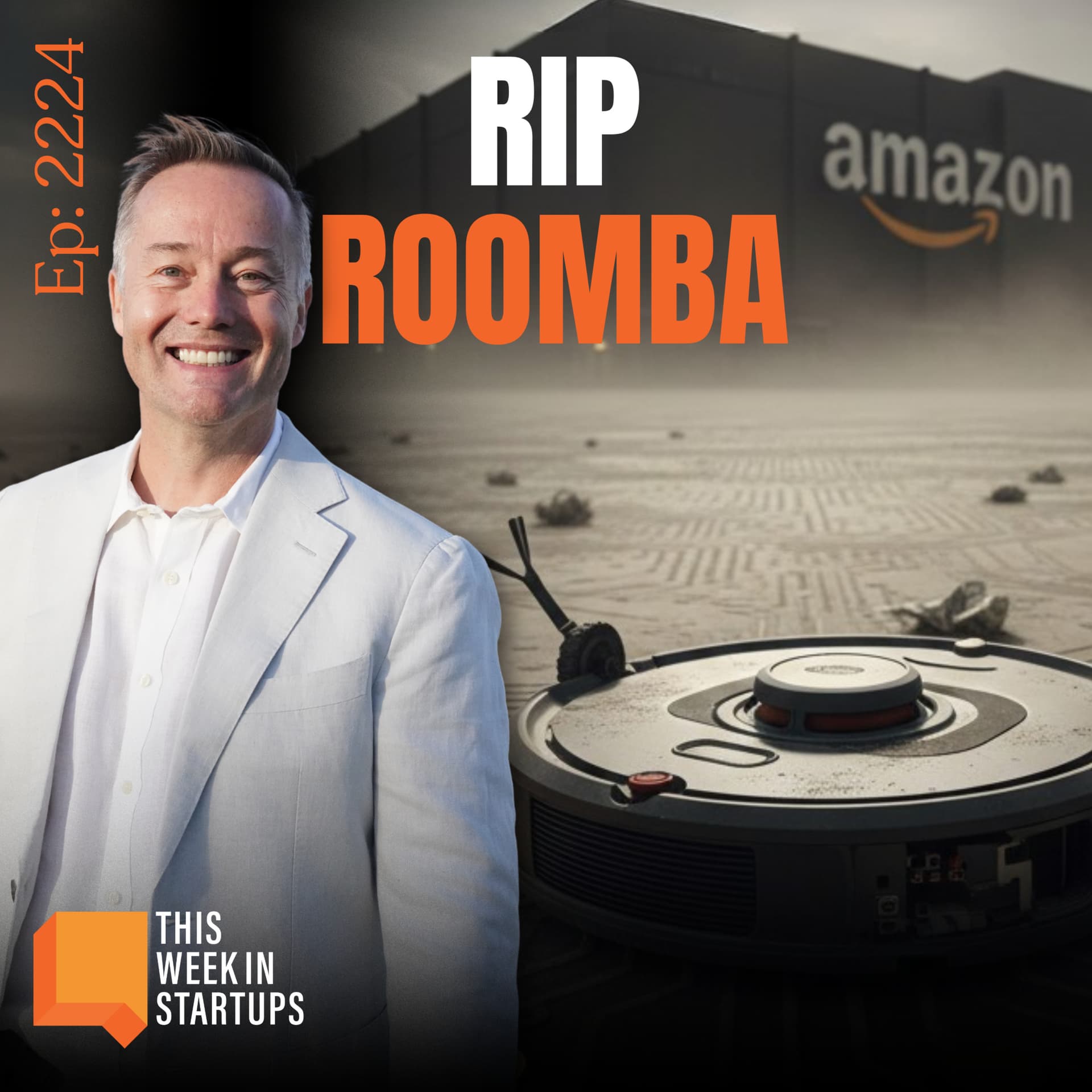
Is this the end for the Roomba? Why iRobot went bankrupt | E2224
Episode Overview In this episode of *This Week in Startups*, host Jason Calacanis dives into the struggles of iRobot, the company behind the popular Roomba robotic vacuum. Despite the surge in interest in domestic robots, iRobot finds itself facing bankruptcy. The discussion explores the potential consequences of this downfall, including the missed opportunity when iRobot was nearly acquired by Amazon. The episode also touches on various topics including investment strategies, the impact of technology on employment, and recent controversies in the tech world.
Key Themes and Discussions
- iRobot's Downfall
- Bankruptcy Announcement: iRobot has filed for bankruptcy, primarily due to financial difficulties despite the growing market for domestic robots.
- Missed Merger with Amazon: Discussion on how a potential acquisition by Amazon in 2022 could have changed the company’s fate, as regulatory hurdles prevented the deal from going through.
- Consequences of Regulatory Actions: The episode critiques regulatory authorities for blocking mergers that could have led to better outcomes for the company and its stakeholders.
- Investment and Economic Strategies
- Encouragement for Investment: Jason encourages listeners to use disposable income for investments rather than purely for entertainment, suggesting that individuals should take more significant risks with a portion of their finances.
- Micro-funds for Laid-off Professionals: Suggestion for laid-off HR professionals to form micro-funds to invest in startups collectively, leveraging their industry knowledge.
- Regulatory Changes: The episode discusses the recently passed Invest Act, which aims to make it easier to form and participate in venture capital funds, thus potentially democratizing investment opportunities.
- Impact of AI on Jobs
- Job Displacement Concerns: Jason emphasizes a shift where many jobs are being automated, with AI taking over roles once held by humans.
- Need for Startup Creation: A call to action for more startups to emerge that innovate and create new job opportunities, counteracting job losses due to automation.
- Tech and Investment News
- Recent Developments in Venture Capital: Discussion on Lightspeed Venture Partners raising $9 billion across six funds, emphasizing the increasing size and influence of multi-stage funds in the venture capital landscape.
- Concerns Over Signaling Risk: Debate on whether founders and investors are overly cautious regarding signaling risk in funding rounds, which could hinder growth.
- Controversial Topics
- Pipe's Financial Struggles: A discussion surrounding the fintech company Pipe, which faced significant revenue shortfalls and internal turmoil, leading to a leak of sensitive financial documents.
- M&A Regulations: Critique of regulatory bodies for their approaches to mergers and acquisitions, particularly how they can stifle innovation and opportunities for growth.
- Open Source Robotics
- Hugging Face's Acquisition: Hugging Face's foray into robotics with the acquisition of Pollen, aiming to make open-source robotics more accessible.
- Market Implications: The potential for open-source solutions to disrupt established robotics companies by providing more affordable alternatives.
Key Takeaways
- Investment Mindset: Jason advocates for an investment-driven mindset among listeners, particularly younger individuals who have the capacity to absorb risks.
- Regulatory Implications: The episode underscores how regulatory actions can stifle innovation and growth in the tech sector, using iRobot as a case study.
- AI's Role in Job Markets: The continued rise of AI presents both challenges and opportunities, necessitating a proactive approach to entrepreneurship and job creation.
- Community and Collaboration: The potential for collective investment strategies among professionals to foster economic resilience and innovation.
Timestamps
- 00:00 - Introduction and Jason's passion for incentivizing new ventures
- 09:48 - Discussion on job loss and AI's impact
- 39:35 - iRobot's bankruptcy news and regulatory impact
- 53:22 - Hugging Face's robotics news
Conclusion This episode provides a thought-provoking examination of the complexities surrounding iRobot's bankruptcy, the investment landscape, and the broader implications of technology on employment and market dynamics. Key insights on venture capital regulations and the importance of fostering new businesses are especially relevant for current and aspiring entrepreneurs.
Written by AI. May contain mistakes. Listen to the episode to check what was said.
Transcript
Automatic transcript. May contain errors.0:00No one's coming for you to help you with your job loss. There's somebody training a robot or software or experts are training AI to do your job. Let me make that clear. Your job's going away. I mean, everybody. How do I know this, Alex, is the question. Well, I get pitched by startups. Well over 50 % of the pitches we get are, there's a job writing RFPs. We're going to write software that lets AI write RFPs. And it will make the average person 50 times better at it, which means 49 people lose their jobs. Get 100 of your laid off HR executive recruiter friends and start a syndicate, start a little micro fund, make a$5 million fund, a$3 million fund and say, we're going to go invest in 20 companies and watch the magic happen.
0:43These demo days, which we just had one, this is where the magic happens. We get rid of 99%. We filter out 99 % of the applicants and we try to do our best to give you the top 1%. This Week in Startups is brought to you by Lemon.io. Hire pre-vetted remote developers and get 15 % off your first four weeks of developer time at lemon.io slash twist. NetSuite. The business landscape is very chaotic right now. That's why you need NetSuite by Oracle. Get the free business guide demystifying AI at netsuite.com slash twist. And Vanta. Compliance and security shouldn't be a deal breaker for startups to win new business.
1:24Vanta makes it easy for companies to get a SOC 2 report fast. Get$1 ,000 off for a limited time at vanta.com slash twist. All right, everybody, welcome back to This Week in Startups, where we talk about tech news, and we try to avoid how absolutely horrible things can get in the real world and focus on business and technology and finance. I'm Jason Calacanis. He's Alex Wilhelm. And big news, the House has passed the Invest Act. Let's get into this because this is something that's very near and dear to my heart. Yes. So the Incentivizing New Ventures and Economic Strength Through Capital Formation Act, also known as the Invest Act, passed the House 302 to 123.
2:07So a bipartisan win here. Quite a lot of individual components here, Jason. I could go through them all, but I think there's a couple that really stand out. So if you care about venture capital, this is what you need to know. In section 108 of the document, we have new rules for venture capital vehicles, and we have Claude here doing a bit of reformatting so it's legible. A couple things happen. First of all, the number of people that can participate in a qualifying venture capital fund has been raised from 250 to 500, and the cap for those funds has been raised from$10 million to$50 million. Now, Jason, this is about small venture capital funds that I believe have a lower regulatory burden.
2:48And my read of this part of the bill is that this will allow people to form venture capital funds with their friends more easily. To have a small venture fund, like sub 10 million previously, and I think they had increased it under Trump's first term to 12 million, you can have these qualifying venture capital vehicles. All of these regulations started after the Great Depression, when people were basically scamming people out of money with different investment vehicles. Think like, you know, here's a prospect somewhere out in the Wild West where they're going to have a gold claim or something.
3:21Anyway, we're sitting here 100 years later, literally 95, 96 years later, and some of these old regulations are still there. And one of them around these formation of capital vehicles has been the limit of 250 accredited investors in$10 million funds to have these small, easy to run venture vehicles, micro funds, let's call them. Well, now it's going from 250 participants to 500 from 10 million to 50 million. What does this mean? Well, if you did 250 people, that's 40K each to do a$10 million fund. If you do 500, it's only 20K each to do a$10 million fund. This dovetails with another part of the regulations here in what is, this is like an accurate, it's an acronym, incentivizing new ventures and economic strength through Capital Formation Act.
4:09That's the Invest Act. Incentivizing new ventures, as in funds, and economic strength through Capital Formation Act. And it passed on a bipartisan basis. The other part that's super important that dovetails with this is Section 203. So they're going to create a test which will allow anybody who's not accredited, which is 95 % of the country, to be accredited. Those other folks are going to be able to participate. So you combine these two things together, Alex. What you could have is, I don't know, a bunch of HR executives who make$75 ,000 a year, who really understand the HR space. They could form together, you know, 500 of them and put 10K each into a $5 million fund.
4:52And then anytime they get sold on some new productivity software for the HR space, they could say, hey, yeah, we'd love to have you come to our syndicate, our little venture fund, pitch us on it, and we'll vote and we'll all participate in it. What this also does is, since it's a test, it becomes fair. Previously, as an accredited investor, you had to have like 200K a year in revenue or income rather, or you had to have like a million dollars in net worth, not counting your home. And then there's qualified purchaser, which is like 5 million in net worth. What this means is the ability to become a rich person, move from poor to middle class, middle class to rich, and all the little strata in between was greatly limited if you weren't born rich or got rich through the lottery or through your sheer force of will or entrepreneurship or some combination.
5:36These are important legislations, even though they seem minor, because company formation is where all the new jobs come from. So no Uber, no Airbnb, no Coinbase, no YouTube, no Meta, Facebook, Instagram. These things created lots of jobs and then lots of secondary economic impact. So this is a very, very important piece of legislation. I'm not sure what happens next, but eventually as well, what happens next? It goes to the Senate where it has to be taken up and it may be marked up, might be amended, There might be reconciliation down the road, but it has passed out, which is a critical first step.
6:08And the scale of the victory, the margin was sufficiently large that it does imply, I think, that the Senate might be very interested in it. And if this does pass largely as it is now, I think it's going to be huge. I do want to help people understand one point, though. In the smaller venture capital funds, Jason, that can now be up to$50 million and have lower regulatory requirements. How big of a deal is that? Because I have never put together a$50 million fund or a$500 million fund. So it's not entirely clear to me. It's a huge deal because as an example, I have a podcast or I am a popular person on Twitter and I have 10 ,000 followers or 100 ,000 followers.
6:44And I say to them, hey, I want to start this venture fund to work in just startups in Nashville, just startups in Detroit. I want to revitalize Detroit. Now, I don't want to raise from, you know, 100K from 100 people to get to 10 million. I'll raise 20K on average from 500 people. It's just going to allow more people to participate. It's going to allow the funds to get bigger. So it might be that 100 people put in 250K each, and that adds up pretty quick. Then you get 100 people to put in 100K each, and you get 300 to put in 10K each. All of that will create more participation, which then gets people looking for more startups and giving that crucial first check.
7:31The bottleneck right now is not Series A. The bottleneck is not seed funding, and it's certainly not late stage. There's plenty of money for companies that get to a million or two million in revenue and that get to year two or three. It's really year zero that matters or year one. So you need high risk, small amounts of capital, and you need many different venture firms looking for their Uber, looking for their Airbnb, looking for their Micro One, looking for their Robinhood. And if they get out there and they start placing bets at that critical year one stage, it's great for everybody. I have been pushing for over a decade for these changes.
8:07And I sound like a broken record, but here we are. And we have an administration that is not paternalistic, I guess would be the term, where they believe poor people are stupid and can't make their own investment decisions. The SEC has to create this test. I believe it's within 100 days or something. And they have to create this test. and it sounds like a government entity, but my understanding is that means SEC. And it has to be free. So there's going to be a free, if you've considered being an angel investor and you're a journalist who makes 100K, or you're a developer who makes 100K and you previously couldn't participate, now you can.
8:42And you should risk, in my mind, this is investment advice, I believe that people should risk like 10 % of their assets on high risk. This is my belief. It's literally, you know how everybody says I don't give investment advice? I'm going to give investment advice. If you're a young person, yeah, why not take 10 % of your net worth, 10%, 5%, whatever you can afford to lose in your mind, which for a young person might be 30%. Why not swing for the fences and try to place bets, aka investments on startups? Now, you should read my book, Angel, where I lay out all the lessons I've learned. You got to get to 30 or 40 investments.
9:22You have to have deal flow. I teach a course, angel.university. It all goes to charity. We've given a quarter million dollars in ticket sales to charity. I don't make money off courses. But I do this course. I used to do it four times a year. Now I do it once or twice. This angel university course, I teach people how to, you know, source deals, how to make decisions and, you know, how to do a little bit of portfolio management. I would love to see the other 95 % of Americans take this test. And by the way, no one's coming for you to help you with your job loss. Your job's going away. Every job in America, there's somebody training a robot or software or experts are training AI to do your job.
10:04Let me make that clear. Your job's going away. And when I say you are, I don't mean you, Alex, or me. I mean everybody. You're, as in the collective jobs of humanity. How do I know this, Alex, is the question. Well, I get pitched by startups. I was going to say, you're literally in the deal flow of what people are building to do this. Startups move fast. And in the age of artificial intelligence, they're moving faster than ever. But moving quickly doesn't mean you can fall behind when it comes to security and compliance. Hey, move fast. Let's break things. Good advice at times, but not exactly what huge enterprise customers want to hear.
10:39So that's why I recommend Vanta to my founders. Let Vanta worry about your SOC 2 and your HIPAA requirements. so you can focus on building a world-class product. Vanta will continue to monitor your company as you scale up and you'll always be ready for the next big deal. And Vanta's new Agentec Trust platform is context-aware so you can stop reacting when something goes wrong. You gotta be proactive. You gotta spot these security and compliance issues before they become a problem. It's a new world and expectations for your company have changed. You're growing up, so it's time to get secured with Vanta.
11:14Twist listeners can get$1 ,000 off by going to Vanta.com slash twist. That's V-A-N-T-A dot com slash twist for$1 ,000 off. Back in the day, maybe 5 % or 10 % of pitches were people saying, hey, we're going to replace this job. We're going to eliminate this job. Now, well over 50 % of the pitches we get are, there's a job writing RFPs. We're going to write software that lets AI write RFPs. and it will make the average person 50 times better at it, which means 49 people lose their jobs, roughly. How do we solve for that? We've got to create more companies. We've got to create more startups that find more problems to solve and create more jobs.
11:57The end. A couple of things that I think in the Invest Act that will help with that, Jason. One of that is that it changes the rules about general solicitation. So now you can do more explicit pitching to raise money at events that are sponsored by states, universities, angel groups, incubators or accelerators, nonprofits and venture forums, so long as the person putting on the event is not telling you where to put your money or directly brokering the deals. Now, let's pause on that one. That's a super critical one. We have demo days. At demo days, lawyers will tell folks, don't say, unless you know every person in the room is accredited, that you're raising money.
12:30And because you could risk somebody investing theoretically, and this has always been like a gray area. And some founders are just like, I'm going to do it. I'm going to say on Twitter, I'm raising around. Venture capital firms, when they raise around, they generally don't say anything unless you do like a special designation where you have to verify everybody's accredited. Anyway, these are antiquated laws. They're overly protectionist. We want people to lose money. We want people to take risk. And if people can say, hey, I'm raising money, forget about equity crowdfunding, just regular raising money, and not be scared of saying I'm raising money.
13:05Well, then, I don't know, that group of dentists who create, and they would be accredited, but the group of HR people who created their own syndicate. Like if you're an HR person and you get laid off, this is my best advice. Get a hundred of your laid off HR executive recruiter friends and start a syndicate, start a little micro fund, make a$5 million fund, a$3 million fund and say, we're going to go invest in 20 companies and watch the magic happen. And these demo days, which we just had one, this is where the magic happens. Accelerators, college incubators, they all do a sorting function. They get rid of 50%, 99 % in our case, 99 % in Gary Tan's case at Y Combinator.
13:44We get rid of 99%. We filter out 99 % of the applicants and we try to do our best to give you the top 1%. We would love to have more of these demo days say exactly how much they're raising, that they're raising. And in a lot of these demo days, they don't say they're raising. And you're like, well, why are we having a demo day? It's like, obviously they're raising. It's kind of implied, but yeah. But now the wool has been removed from the eyes and everyone can be more explicit, which I think will open up access to these deals, which is why I think the HR people might have a chance because people will clearly state, this is what we're looking for.
14:14Now, you consider yourself still a journalist or you consider yourself an entrepreneur or an analyst? We had this little discussion today on what we consider, Alex, I consider you an analyst, but are you opposed to investing in startups? I have made an angel investment. Since you left TechCrunch and all that? Yes, yeah, yeah. Okay, so you are in the game. I backed a friend of mine. But sure, sure. If you want to be technical, I'm in the game. I consider myself a journalist in bad form. I'm kind of breaking my own rules. I think you should just throw it in the garbage, the whole journalism rules, and you should just get conflicted up and create your own little micro fund.
14:47That's where we're going. Cautiously optimistic, you know,$1 million fund. I'm going to invest in 10 companies I find through the course of random acts of journalism and analysis. And I'm going to put 50K into 20 companies, 100K into 10 companies. I think you should just do it, F it, and see if it works. And these new rules will make somebody like you, who might be venture curious, even more curious because it'd be less red tape, right? I don't know if you're venture curious. No, no. I think it's a fair point. For folks out there who may not have access to those funds, but may want to participate in equity crowdfunding, Jason, Section 103 of the Invest Act raises the threshold from 100K to 250K.
15:23So you can now raise more money in equity crowdfunding. There's some other technical rules about venture capital reporting. I won't get into other things that matter. If you want to be an emerging growth company and go public, you now only need to have two years of audited financials, not three, which reduces red tape. You could also, it's now easier with Section 303 to test the waters on a pre-IPO basis. You and I would both love to see more IPOs. That makes good sense. And finally, Section 305 of the Invest Act is essentially demanding that the government do a study to figure out how to make it easier and cheaper to go public.
15:56So we have easier to form venture capital funds, easier to raise money, lower regulations, easier path to IPO. In theory, this is a pretty solid package of things to make the US capital markets more efficient and more open. And I'm hoping the Senate doesn't screw it up, to be honest. We are already in the lead. So what you need to do when you're in the lead is not become complacent. You have to become aggressive. And what's going to happen is these democratic socialists, I'll guarantee it, are going to say this bill and becoming accredited. It's all a giant scam. The venture capitalists, technologists, the finance people are all trying to abuse you.
16:31It's a lie. They want to build larger government with more employees and they want to take companies like iRobot and give them to the Chinese after blocking M &A. We'll get to that. It's our third story. I want to make a point though about the power of technology companies though, while we're discussing them in the aggregate. Jason, if you take a look at this right here, this is what we were looking at this morning as a group here. This is a screenshot of section 108 from the bill. And if you don't know how to read a law, this is just an absolute mess. So what we did was we took all of these and we fed them into our dear friend producer, Claude.
17:04And what you get on the other end of it is this crisp, lovely, just easy to read, simplified version of it. And I cannot recommend this enough. If you're struggling to read something in a long bill from Congress, drop it into you. I prefer Claude or your favorite AI, and it will just make it legible and readable. And this is how we prepped for this segment today. Fantastic. We use it each and every day. That's what powers the show. And we'll have more about this when the Senate picks it up, Jason, but at least we're ending the year with a positive regulatory note. High five. Yeah, exactly. High virtual high five.
17:34I took this whole thing and I put it into Claude. I said, summarize it. Then I was like, oh, I got to get this to the team. And usually I tell the production team, cut and paste this and spend 15 minutes cleaning it up. And that 15 minutes we recaptured, which means you can spend more time analyzing or reading the document and understanding it. I went back and I took that section on this, you know, small venture capital formation. And I looked at the history of it using Claude. And I was like, oh, yeah, by the way, it went from 10 million to 12 million under Trump in the first time. And I was like, it went up 20 percent.
18:05While in that same time period, venture rounds went up 20x. So like the average seed round went from like 250k to 3 million. Like it literally went 10x. and then they're like, yeah, we're going to increase the size to 20%. When you see it go to 10 to 50, that's the game on the field, folks. That's the opportunity space. So, you know, this is another great thing about AI today is just how quickly you can increase your understanding of complex topics. And one of the most complex topics is private markets and private markets is where all the money's being made. When SpaceX goes public, Stripe eventually goes public, any of these private companies goes public, a lot of the value has been taken out of them And what that means is poor people, middle class people, even upper middle class people never had access to it.
18:51And the rich people did. You know how many times I get pitched on buying SpaceX shares or Stripe shares or Andrel shares all week long, I get offers. Do you know how much time my parents, middle class family gets pitched on this, let alone your Uber driver or your DoorDash? Never. And they would, and they would know. So let's let everybody participate in this. It's like those Invest America, you know, accounts. We need everybody to understand equity ownership. We need 100 % equity ownership in America. And that's how you beat socialism, communism, and control top down is by having so much competition that people can participate in it.
19:29It's a good point. And well said. I think the thing you said about people trying to pitch you on Android shares and SpaceX shares, it's actually a good point because one thing that I've been seeing a lot of investors talk about on Twitter lately is stay away from the second layer SPVs, watch out. So can you give people just a really quick summary of like what they should be looking for in investment opportunities as opposed to the bad ideas? I think if you can get into companies with incredible management teams that have incredible investors names on them and you can hit 30 or 40 of them. So you have diversification and you do it with a small amount of your net worth that you're willing to lose.
20:04In other words, the money you might spend on a vacation, the money you might spend gambling in Vegas or on sports, your disposable income. Why not make this, this disposable income, instead of making it entertainment, consider it half entertainment, consider it one third entertainment, one third education, and one third investing. If you were to look at it like that, you could say, OK, it's really entertaining for me to go to the syndicate every week or AngelList every week and see what people are investing in. It's like, really, like you get a rush out of it. Like, oh, wow, this is the future.
20:40Then second, you get educated. Oh, I know what Andrel is. I know how Stripe works. And then third, hey, it might work out. And it might work out to the tune of getting into the next Tesla or Uber before it goes public. Now, the reason some people are a little wary of the SPVs now is that some of them, because they're so popular amongst the rich that everybody feels they need to have a piece of these companies and they'll charge 10 % load in fee. That's a big number, but they won't charge carry. And so there are hucksters or deal makers, however you want to look at it, almost like a trading desk where they just want to get that five or 10 % commission.
21:14Just like in the Wolf of Wall Street, when they were selling penny stocks and they told Leonardo DiCaprio, he gets like a 50 % commission or something selling it. And he's like, give me the phone. Give me the phone. He's like 50 % commission. I'll do it. Now they're getting 10%. And sometimes they're double layered SPVs. So you're doing an SPV. You've got access to an employee. I do an SPV. You charge 10%. I charge 10%. Now you get 20 % fees. So there are on the margins for the late stage things, a lot of fees you have to look out for. But as an intelligent person who takes the accreditation test, you should be able to understand fee structures.
21:47And if you can't understand basic fee structures, you can't understand the valuation, well, then you shouldn't be in it. But, and also getting in late, you start to learn, oh, well, maybe, you know, Andro or SpaceX, maybe there's like a triple left in them in the next 10 years. Maybe they'll quadruple in the next 10 years, which would beat the market by like, you know, double or triple or quadruple. The market might double, you might quadruple. So, you know, you take that risk maybe being the last person in, but you'll still be the first person before the IPO. And then sometimes it doesn't work out.
22:16You have Instacart privately valued at 30 or 40 billion, goes public at 10 billion, and people are down from day one on that last valuation. So it is possible you could lose 75 % of your investment when it goes public. So then, you know, this is where diversification comes in, also part of the test. So this is a place you can take risk. I meet with a lot of companies and I'm telling you, every founder I know is asking themselves the same question. How do I get more out of AI? We all know these tools are making people more productive, they're making people more efficient, but a lot of founders still have reasonable concerns about data security.
22:50or just finding the right application for their way of doing business. But waiting on the sidelines is no longer an option. So I recommend founders use NetSuite by Oracle and put AI to work for your company. NetSuite is the number one AI cloud ERP, and it's trusted by over 43 ,000 businesses. They're going to give you a unified suite of products, all safely sharing interconnected data. And that's going to help you automate routine tasks, dive into your analytics for clear, actionable insights, all while keeping your costs low and making your team faster. Right now, get the free business guide, Demystifying AI, at netsuite.com slash twist.
23:31The guide is free to you at netsuite.com slash twist.
23:38Lightspeed Venture Partners has put together$9 billion worth of new funds, Jason. That was my bad year, Alex. I thought you said$9 billion. Sorry, sorry. Let me say it again. $9 billion across six funds. I know. The largest vehicle in this group is a$3.3 billion fund aimed at essentially backing the XAI's, the Anthropics in their portfolio, the super late stage growthy stuff. But still quite a lot of capital in there for other companies. This to me fits neatly into the idea that we're seeing multi-stage funds become ever larger, ever more important. your Andreessen's, maybe your Thrive's, and now your Lightspeed's.
Read the full transcript
24:18We have some data on the concentration of large venture capital funds and how they're changing the market. But I'm curious for founders out there, when you're giving advice, what do you tell them about these funds that might be able to lead their Series A through Series F? Is it the right way to go or should they try to pick different partners for different parts of their journey? Generally, having a deep-pocketed Adventure Fund is a great idea when you're at Series B, Series C. Absolutely. For your seed and your Series A, you probably want worker bees who are going to put a lot of work into it and have expertise at those rounds.
24:50So these big funds, one thing that can happen, and this isn't unique to Lightspeed, this would be like a similar critique somebody might make of, say, Andreessen Horowitz. You're too small to matter. Now, they would argue, no, no, we care about all founders. And that's absolutely true. But show me an incentive. I'll show you an outcome. If you give an investment team a billion dollar growth fund and you triple the billion dollars, you have two billion in profits. They make 20 percent carry on that two billion, you know, in the two and 20 models. So they make 400 million. Now you give that same group 100 million and they 10 exit and they make a billion.
25:25They make 900 million in profit. They get 20 percent of that, which is 20 percent of the 900 million dollar gain. Or let's say it was a billion dollar gain, turned it into 1.1 billion. Okay, they make 200 million. So the economics really do matter. And the incentive matters. So, you know, and then there's this continuity problem, which is a little more complex. If you get your seed round, let's say from A16 speed run, which we've had like five of our companies go from our accelerator or founder university to this awesome program, we had one of the injuries and partners on last week, Brian Kim, he was awesome on the program.
25:58Now, let's say they have a growth fund or, you know, and they did your series A, where they have a series A fund and they did your incubator and they have an incubator fund or a seed fund. Okay. If they don't do it, other folks might be like, well, why aren't they doing it? Signaling risk. Yeah. So there's a signaling risk. I think people may be over-indexed on that. It first came up with the Sequoia Scouts program, which was done in a pretty stealthy fashion. We didn't promote it because we didn't want if Sequoia passed on the series A or didn't do the series A of Uber or Thumbtack or data stacks my investments, they wound up doing two of those.
26:32They wound up, I think, investing in all three of those later on. But it could create a little signaling risk. So they were very careful not to damage the startups by saying, oh, yeah, we're not going to invest. We're already on the cap table. We're passing on continuing investing. The market has adjusted to this, I'll be totally honest. But some people still have it in their head that, oh, what happens if they don't invest? It's a competitive marketplace. So therefore, the founders should be getting three or four term sheets when they do their Series B. And they should try to get a different investor than the Series A investor, to be honest.
27:00Because now you've got two smart people around the table, two people who bought at two different prices, set the price twice, and they're going to fight to increase the value of each share. You've got two different firms. So this is why I have no problem. I was texting with Gary Tan this weekend. You know, I have a couple of companies coming out of our accelerator who want to go to YC. And they were like, hey, can you recommend me? Absolutely, I can. We have them going to Andreessen. We have them going to Antler. We have them going to all kinds of different funds or other incubators. So that's a good thing for founders to have, hey, you've got Jason Calacanis and you've got Marc Andreessen on your cap table.
27:37That's kind of a cool thing when you go for your Series A, right? Oh, you got Jason Calacanis and you got Gary Tan on your team like TaxGPT does. And then the next round goes easier. So that's the lesson of startups is how many people can you get on your cap table who are rooting for you? And if they're rooting for you, that means they might not be rooting for your competitor because they've placed a bet on you. So there's that. Now, just a couple of notes about Lightspeed before we move on. What have they invested in? Why do we care about them raising so much money? Well, in the models area, Anthropic, Mistral, XAI, Reflection.
28:09In the robotics area, Skilled AI, Andrel, Enterprise, Glean, Databricks, Granola, Tolbit, Consumer, Pika, and Suno. Very impressive fund. I did not know they were all of those names, but now I can see why they managed to put together 9 billion. Shout out to everyone at Lightspeed. Please take everyone out to lunch because you have enough cash for that. Yeah, absolutely. And that immediately goes into the Alex's Best Dad Jokes of the Year. Thank you. Well, I'm running out of time. I mean, I got to squeeze him in, man. You know, you got to gear up for that third kid. Okay, now we have two. Building out your team is one of the most crucial things you have to get right in your startup.
28:45And finding the right developers is particularly important. But now there's Lemon.io. They're going to save you time, money, and headaches by doing all the time-consuming legwork for you. They've got an experienced lineup of pre-vetted developers working for competitive rates. Just 1 % of applicants are accepted into Lemon's elite program. And they're not just out there finding this great talent. They're also working with you to integrate these new members into your team. Plus, if it's not a good fit, hey, and sometimes things don't work out, Lemon will hook you up with a new developer ASAP. I've seen startups go from just pretty good to amazing after filling out their teams with developers from Lemon.io.
29:26Go to Lemon.io slash twist and find your perfect developer or technical team in 48 hours or less. Plus, Twist listeners get 15 % off their first four weeks. That's Lemon.io slash twist. L-E-M-O-N dot I-O slash twist. Really exciting, positive stories, or three. And now we have to go to, oh, what can go wrong? So we're gonna talk about a company called Pipe. This was a fintech company that was very, very hot back during the Zerp era. And Jason, if you recall, this was a company where SaaS startups could essentially sell their future revenues for cash. Now, people often call this revenue-based financing.
30:07The idea was to create a marketplace for ARR because annual recurring revenue, because it recurs, is durable and therefore it can be an asset you can trade on. Okay, fair enough. Time passed, I forgot about these companies because no one talked about them anymore. And then our dear friends over at FinTech Business Weekly got their hands on recent Pipe financial documents. And they showed that in calendar 24, what they also call their fiscal year 24, Pipe only had$7.1 million in revenue. Now, let's not make fun of revenue, revenue is revenue, but for a company that had a$2 billion valuation, Jason, I think a$7 million result for a year is pretty low.
30:44Let's take a look at the first document and talk about a couple of important things. The text here, I know is a little bit small. it's a board slide, roll with me. What we see here on the top line is essentially revenue growth per quarter. So in the first quarter of 2024, they had 600K in revenue, 1.2 million in Q2, 2.2 million in Q3, and then 3.1 million in Q4. The problem with that last number is that they had forecast 3.7, so it was a pretty serious miss from their numbers. Also, their cash expenses were quite high and their cash balance was trending down. All that said, Jason, two things here.
31:15One, tiny, tiny company, clearly in the middle of a reset and a pivot, But on the other hand, relatively impressive, 2024 revenue growth, I think. Okay. The reason this is controversial and the reason this document leaked is because clearly somebody is upset. So I said to the person, like, how did you get this document? Like, how did you get board documents? How did you get the financials? And he said, oh, I did journalism. And I said, yeah, but somebody leaked it, right? Like, you should say how you in some way got this information and verified it's true. Let's put that aside in the journalism controversies over leaked documents.
31:50I don't assume they asked somebody to leak it because that would be potentially legally actionable. Yeah, that would be highly unethical. But they could have had somebody who was upset and they said, oh, I'd love to know more. And then that person sent them a screenshot. Now, that person is breaking trust. I think a board member, former board member, investor, somebody who was associated with the company leaked this because they're upset at the founders. The founders who left the company or became board directors had done a big secondary. At the time, it was super controversial for a company raising at this ridiculous valuation.
32:24And it was a ridiculous valuation. Everybody knew it. And I remember, I think Saks maybe did the Series A. A lot of my friends were investors in it. It was a great idea. It was an idea at the time that was awesome for potentially our founders. So this is peak ZERP. You've got SaaS companies with predictable revenue. You could go in. We talked earlier about investors being able to place bets on startups. Here was a way to loan money to a startup. Let's say it was Slack, you know, like doing incredible, growing when it was a private company. They're growing. Instead of raising another round of financing, they know they have$10 million in revenue.
32:59Next year, they're going to do$30. They say, hey, give us$10 million now. We'll deploy that. And we're willing to sell that$10 million in future revenue for$0.90 on the dollar, $0.94 on the dollar. So give us$9 million now. And then when we get the$10 million next year, we'll give you the$10 million. You'll make this 10%, 11%, 12 % gain. And it's like doing corporate paper and loans for SaaS startups. Now, what's the problem with this business? If those SaaS companies stop growing, which we had massive headwinds and they did, it was like the space was just too populated and AI came in. and the idea of every one of your flagship customers gonna grow their base of employees by 10 % turned into they're gonna lay off 10%.
33:47So what happened to the stripes of the world were, okay, we have a thousand person company paying us$15 a month per employee. It's$180 ,000 contract. That contract will be worth 250 in two years or 350. And we're gonna sell them on these new features and products. And then that company comes back and says, hey, we want a discount. We're thinking of using an open source product. And we went from 1 ,000 employees down to 600. So we need to get 75 % off. Well, if you gave them a loan against that revenue, that's problematic. So there were multiple reasons why this startup had challenges. But if you're taking money off the table and you allow secondary sales, and then the founders move out of the management positions, and they're not going to grind, they're going to go spend the money on their lifestyle, this left a very bad taste in people's mouths, according to my recollection.
34:35Now, I'm not saying anybody did anything nefarious. These are all adults who sold shares and bought shares in the secondary market and no crying in the casino. The founders made a better trade than the investors who bought the shares for them. In some cases, the founders make a terrible trade. Sometimes you'll have founders of a company sell shares early in YouTube or Instagram or Uber or DoorDash, and they leave the last 10x or 100x on the table, and they should have just not bought in their second house or their first house. They should have just, you know, not diversified or sold their position.
35:08So anyway, it does make one wonder what's going on here. Yeah. A small point about why people were so mad about this company's founders. Don't forget that at the same time the founders were stepping back, rumors, news was being reported that the company had lent something like$80 million to a number of crypto companies that had gone to zero. And so it appeared to be kind of like they got secondary and got to leave. Everyone else was left holding the bag. So it wasn't just a better time to trade. It was also possibly some operational incompetence. Two more things before we move on, Jason. First of all, the company had forecast that they were going to grow to about$25 million in revenue by Q4 of this year on the back of a partnership with Uber, essentially providing capital to people on the Uber Eats platform.
35:48And they were going to ramp up. They were going to hire. It was going to be fantastic. This was going to be the second coming of pipe. And then they actually ended up going through layoffs. So it seems that the expected revenue growth from that that they were working towards maybe didn't pan out as expected. And I think this is, you know, another Zerpicorn, if you want to call it that, showing how some of these companies that, you know, are on paper still on the unicorn lists probably may not even be solvent for much longer. The founder I knew, Harry Hearst, was particularly smart and a great fundraiser.
36:19And I would, dare I say, product visionary. I think he was like particularly smart. And then maybe he was so smart, he realized, well, this company is, I don't want to say overvalued, but if he just felt fully valued or valued to perfection is probably one way to say it. If you want to be gracious and thoughtful about it, another way to say it is overvalued. That's in the eyes of the beholder. But yeah, I think he became kind of the villain in all of this. And probably unfairly, if you're a venture capitalist and you're buying his shares or other founder shares, you are a very sophisticated investor.
36:53And those people buying their shares probably thought they were getting the better of Harry Hearst. And Harry, you can come on the program anytime. And half of startups fail, you know, 90 % fail, depending on what stage you're investing in them. So if it does fail, I mean, everybody kind of expected, you know, and understands those rules of the game. Netflix failing at this point in time, or Uber or DoorDash failing or Coinbase. Like these are very robust companies that have decades ahead of them in all likelihood. They could still fail. They could still get disrupted or they can not execute well.
37:26But in startups, the people who are buying the founder shares, they knew that. And yeah, maybe they also went too aggressively in giving loans, like you said, to crypto companies. That's another thing. You know, when you go on, you have a company doing a new business model with companies that are not as robust. So you have a startup backing startups. It's like two levels of risk. Then you at a third level crypto. Now crypto today doing it might actually work really well. So timing also matters. Different market, different time. Just one question for founders out there. I was really curious about this.
37:58You know, the idea that this Uber partnership was going to help the company grow dramatically. And in my view, based on what I've read, kind of save pipe. How often do you see a startup land a major partnership that really, when it's troubled, saves the day? Or is this more of like a Hail Mary that never actually gets collected? Lighthouse customers happen all the time and they can save a company, you could also create a dependency on one company where if that company decides this isn't a strategic priority anymore, you got big problems. So it can save a company. It can give them life support for a year or two and just push out the eventual failure of the company because the company doesn't have a robust set of diversified investors.
38:38Anytime you get one customer being more than a third or half of your revenue, you should take notice as the board of directors, you should take notice as the founders, as the sales team and say, hey, we need to diversify our revenue. LPs, same thing for venture firms. You don't want to have any venture fund be more than 5 % or 10 % of your fund size. And in fact, some LPs have written in stone rules, we won't be more than 10 % of the equity in a venture firm. So diversification of revenue across customers and sometimes across product lines is critically important. The reason Uber did spectacularly well during COVID was as rides went down, ordering food went up because people were locked in their houses.
39:20Then when people started going out to eat, DoorDash had a problem because people wanted to get out of the house. The number of orders went down or didn't grow as fast. And then rides went crazy. It was like, oh, I got to get an Uber and go get my drink on and you know, whatever it is. So diversification, critically important. All right. Next up on the docket, iRobot files for bankruptcy and sale. So if you don't know iRobot. They're the makers of the cute little pucks called Roombas that go around your house and pick up cat hair and messes and everything else. Everyone's seen these by now, Jason.
39:51I don't have to give a deep explanation of Roombas. Yeah. Yeah. I think people understand they've seen them at other people's houses. They've seen cats jumping on top of them in TikTok videos. They were the leader in this category. Yes, they were the leader in the category. And if you go back in time to 2022, December of that year, Amazon announced it's going to buy iRobot for$1.7 billion. and then by January of 2024, the deal was canceled because the company said that the deal had, quote, no path to regulatory approval in the European Union. Fast forward another year and a half and now it's bankrupt and the assets of the company will become the part, they'll be owned by the Shenzhen Picea Robotics Company.
40:31Yeah, so, and Lena Kahn opposed this as well. She issued a second request for more details on it. She basically iced the deal. This is why academics with no experience like Lina Khan going in with novel ideas of how to protect against future competition was a huge mistake for four years and throttled competition in the United States as opposed to protecting it. The only people who would have won in this situation were the employees, the investors, and consumers. Everybody would have won. Why? Amazon would have done what they did with Ring. My friend Jamie Siminoff sold his company to Amazon. My understanding is Amazon has made that company absurdly successful, just like YouTube is absurdly successful under Google.
41:16If they had blocked the YouTube deal with Google, YouTube would have went away. They could not fight, even with Sequoia behind them and other venture capitalists. They couldn't afford the legal battles they were under, the lawsuits with Viacom, etc. So just another example of we should allow any, the classic antitrust rules are fine. Just look at it through the lens of consumers. Are consumers going to benefit? Yes or no. Are prices going to go down or up? In this case, Amazon has a history of lowering prices and investing in products. What happened here? You don't allow the company to get acquired and the Chinese manufacturer in Gen Gen who built it for them, who was just the contract manufacturer, not the IP, they now own it.
42:06It's absolutely absurd. Disgraciate across the board. And now we're seeing correctly under the Trump administration, more M &A. You have to have single and double M &A like this in order to make venture work, in order for the employees not to get screwed, and in order for America to excel. Not every company is going to be a large independent vacuum robot company. it's going to be part of something bigger and that's okay. It was public though, before Amazon wanted to buy it. So it wasn't a startup per se, but yeah, I struggled to disagree too much. It was a low single billion dollar company. I mean, it was a nothing burger in terms of Amazon's revenue.
42:46Amazon buying Whole Foods, has that like limited people's choice or has it increased our choice? It's increased our choice. You can now get Whole Foods delivered. You couldn't previously get it delivered. I mean, if they screw up the product, fine, then that opens up another competitor like Irwan to come out, right? So, you know, if Whole Foods, you know, became too blue collar and too accessible and they lost a little bit of the magic, okay, Irwan steals their crown. We have a hyper-competitive, high-functioning market. You should just let anything under$100 billion is inconsequential in almost all cases.
43:24Why the$100 billion threshold? What happens at that point that makes it go from safe and totally fine to let's not let that happen? Well, I mean, if you were to let Meta and Google to merge, as an example, they would go from being a duopoly with 80 or 90 % of the online advertising market to like 100 % of it. But what has happened to that duopoly since they weren't able to merge? Amazon has a vibrant ad business. DoorDash, Instacart, Uber all have vibrant ad businesses now. and so you do want to keep things from becoming too large. If you said DoorDash and Uber could merge right now, I would be like, oh, that would consolidate whatever, 80 % of the delivery market.
44:08Now, if you were to look at it and say, well, now you have robo-taxis coming in and all cloud kitchens and other competition, at some point that may actually make sense. It might not make sense for the last five years for Uber, Lyft, and Waymo to merge in the age of robo-taxis and Tesla and Neuro and all these other things, yeah, you're going to see consolidation in that space. So$10 billion in today's dollars means you're excluding the Mag-7 and you're maybe excluding the$500 billion to a billion group, which would include SpaceX, Stripe, OpenAI. But even still, those are very, if you think about OpenAI buying companies, is there any problem with them being a purchaser of companies?
44:50That's actually kind of good because then you could take the mag seven to the mag 17 and eventually the mag 70. The goal should be to create more large conglomerates, not let the seven codify themselves and, um, you know, become calcified. And that's what's happening today. Those groups, since they can't buy build and what they do is they just wait for something to be successful like Snapchat and they just copy the whole thing because they can't buy it. And that's problematic as well. So all Well, that sounds fine to me. The thing that I struggle with is where we draw the line about what's too much consolidation.
45:21Because if you go back to the meta FTC fight, the idea that technology changes rapidly and creates new competition was important to that. But if you combine, I mean, go back to your example, meta and alphabet, I can make a really compelling argument that there is so much new technology, new ad formats, new ad placements, new ad businesses, that it wouldn't have anything close to monopoly. And so I think that we end up with very few guardrails. And so I think we need maybe something else to be brought up because I can see the arguments that we like being stretched to the point in which all deals are pretty much good to go.
45:56And I do think that you're right that at some point the competition does get a little bit skewed if you let everyone become one blob. It really just has to do with market share. If NVIDIA wanted to go by Grok and AMD, you know, like you might be like, yeah, you know, those companies are now going to be 95 % of AI chips. Probably not a good idea. So it really just has to do with market share. When the market share gets up into that 70, 80, 90%, it's obvious now. So what about NVIDIA buying etched or NVIDIA buying Xtropic or one of the twist 500 chip companies that I'm thinking of. Like, would you let NVIDIA buy one of those?
46:37Totally. Totally. It'll be inconsequential in the longterm because those single and double acquisitions are easy for other people to replicate. In other words, like if you're making inference chips, now you have Broadcom making inference chips and AI specific, you know, app-specific ASICs, chips for everybody. Google's making them, Grok's making them, Elon's making them, OpenAI's got a project to make them, Microsoft's making them, Amazon's making them. Everybody's making their own chips with Broadcom as a partner. So there's just naturally going to be competition in that space. There's almost never a situation in today's market where the M &A would be in the worst interest of consumers and limit competition in the future.
47:25It's a rare, rarefied error. The only place you might see it is right now in the Netflix deal, you could say Netflix plus HBO is the number one and the number three streamer. That's too much. Disney, Hulu. I mean, I can just pull up my Roku and just walk you through the competition. Yes. And then it depends on how you define the competitive set. If you define the competitive set like I do to include YouTube and TikTok, it's not a big deal for number one and three in streaming to do it. That's the truth. If you want to go old school and say, like, well, that's a different market. Okay, fine. You could make the argument one in three should not be allowed.
48:00Well, it's interesting because people don't take as broad of a view of this as you and I do. And so you have people like Trump, as we put it on the show last week, saying it's a lot of share. And I'm like, is it though? I mean, YouTube is the real streaming platform to beat. Everything else is just peanuts in comparison to that. And TikTok. Yeah. Great. Which is growing pretty, pretty nicely as well. All right. Back to the happy news. This is one of my favorite stories of the year. So hugging your face, Jason, the startup that hosts all the open source AI models, did something very strange earlier this year.
48:27We mentioned it on the show, but I think people probably forgot. They bought this little French robotics company called Pollen. And what they were going to do is they were going to make little robots and sell them to people so that way everyone can kind of do open source robotics work at home. And these robots are absolutely adorable. I have a picture of one right here for everyone who doesn't recall what they look like. And I have to say, when they bought this company, I was like, this does feel a bit like a side quest. Why is the open source, you know, model company getting into open source robotics?
48:56But it seems to have gone quite well. And the company announced this weekend that they were shipping out a block of 3 ,000 of these things worth about 1.4 million in revenue if they're all the most valuable version, half of which are going to the US. But to me, this implies that the robotics work that we're seeing from Figure, from One X, from Tesla and so forth is going to get disrupted from the very bottom as people build stuff for the home. That's not as powerful, not as performant. but open and therefore going to accelerate very, very quickly. I just thought this was a really fun, I don't know.
49:27This brought me real joy to see a company doing well in a space where that's kind of a secondary path for them. And the one you're showing is the Ricci Mini. That's the new one. The one when they bought it looked a little more like Figure and Optimus. That was the Ricci 2. If you look on their website, you can see that. And what's great about this project is, speaking of competition, obviously figure and optimists are going to be very proprietary systems. They're probably not going to sell those robots. They're probably going to rent them or lease them on a consumption basis, by the hour, et cetera.
50:03So how do you keep somebody from having a monopoly in that space, where they just run away with it and charge people a dollar an hour, and then eventually people get addicted to it and they make it$7 an hour, right? That would be the nightmare scenario, is that somebody has an absolute lock on the market. Well, open source means if the person charges too much for that technology, the open source community builds a version of it and people can do it for less money. This is what should have happened in self-driving. My wish was that somebody would really work on an open source project and the technology would move faster.
50:41There was so much at stake. You now have 20 different companies at a minimum that are significantly backed, pursuing closed-sourced, you know, driving systems. Some of them are starting to abstract out the world building, the sensor sets like the NVIDIA project is, and some of that will be open source. Some people are putting out open source training data. But that is part of the amazing competitive process we have here in a vibrant community in America and in an entrepreneurial system is that open source can just turn everything upside down. You know, and it acts as a backstop. And if you look at Oracle, which would be the perfect example of a company that, you know, had a proprietary database system that, you know, was expensive and you had to go through a salesperson and, you know, listen, for enterprise companies, it has to be perfect.
51:37And Oracle makes the most sense. But for startups, a lot of them were like, I don't need to spend a million dollars on an Oracle database. I'll just use MySQL. And at the early days of that, it was a little controversial. Can you trust MySQL? Can you trust Hadoop, et cetera? But it became an advantage for some folks. And then that keeps the incumbent, in this case, Oracle, on their toes. They have to compete with those open source projects, and they have to make their products competitive on price, on value prop, security, everything else. So this is awesome. I love this as a bet for Hugging Face because we do need more open source projects in hardware specifically.
52:23So this is a great, great outcome, I think. And I have some requests for the Hugging Face slash Pollen team. So I went through the apps that people have built and you can just download apps that other people have made for their reachy minis, like a clock, a radio, some of them made a metronome, some of them make them dance. It's fun. What I want is to be able to buy one of these things, put it on my desk, and then I want to be able to connect it to my chat GPT instance. Because then I would have a physical device that I could talk to, which I think would be pleasant versus talking just to my computer and could emote and such.
52:53But I don't want a new AI. I want to be able to take my trained AI with me. And I think that building a connector there would turn this from a hobbyist thing you have to assemble yourself. by the way, the, the, how to assemble videos, 45 minutes long. This is not designed for kids yet. Uh, but you know, give it a year. Is it not designed for kids yet? I'm looking at the reach many right now. I think there's some high school kids who might be able to high school. Yes. I was thinking like not, not, not kids, kids, but like teenagers involved. Absolutely great project. If I had a 13 year old, I'd buy them one and tell them to build it, you know, cause that would be a fun project for them.
53:25All right. Now just let's do a poly market. And today, uh, over on the world of prediction markets, I have a hedge for us. Now, we often talk about binary results. Will this model come out by this date? Who will have the best model by the end of the year? This, however, is a little bit different. So the headline here is AI bubble burst by. And I was really perplexed by that because I thought, how do you determine when a bubble bursts? What's the mechanism? You and I always talk about in prediction markets. Read the fine print. Make sure you understand what you're betting on. The rules. So I went and I looked through the rules here and it's an interesting kind of multi-part bet.
54:05So this thing will resolve to yes, if certain things happen by a certain date. So three things have to happen from this list here. So it's a little complicated, but if NVIDIA stock falls 50 % from its all-time high, if this particular semiconductor ETF falls by 40 % from its all-time high, If OpenAI or Anthropic declare bankruptcy, highly unlikely. Or if OpenAI is acquired, highly unlikely. Or if H100 rental prices fall below$1, I presume, per hour, unclear on that one. Or there's a major hardware supplier collapse. So if three things from that list happen by a certain date, it will resolve to yes.
54:47And so what this means is if you are heavily invested in the success of those companies or the stocks that are doing well in the AI moment, you can essentially bet here and de-risk yourself because if your other bets collapse, then this one will pay out. And this is kind of what I was hoping to see from prediction markets more so than just like, will the Eagles beat the Raiders? Because this is like super cool. Curious what you think. Yeah, I'm buying no by December 31st, 2026. 32 % chance. So I think that's free money. You put down 69 cents. When it resolves, you get the other 31 cents. So you make a 50 % margin.
55:23I mean, I'll be totally honest. I feel like putting a million dollars on that right now. I mean, I could, yeah. Well, that would be four times the current volume, Jason. So if you want to really change the odds. Volume only 273. Yeah, maybe I'll put, yeah. I mean, now that this is up and running in the United States, right? Yeah. We can do this in the United States now, right? My understanding is that they began to invite US traders after a beta period. so there may still be a wait list, but yes, Polymarket is back. I need to start placing some wagers here because I am deeply invested in this market and I would like to be even more concentrated given my knowledge of the space.
56:06There is no chance of this happening. Zero chance. I mean, I would give it, actually, I'd say it's 5 % chance this was happening. And the 5 % would be not because of these AI companies screwing things up or going bankrupt or losing 50 % of value. It would be because we get into a hot war with China or a cold war with China even. Like if we had a supply destroyer. If China invades Taiwan, this bet is like you're in the money. If it doesn't invade Taiwan in 2026, it's not going to happen. And there's too much at stake for China to invade Taiwan, I believe, at this moment in time. That would take some really crazy behavior on our government and China's government at the same time.
56:52And that does not make sense to me. Other ways this bet could come good, meteor strikes, mass extinction events would be up there or the moon going away. But it has to be like tectonic because it's a really specific series of things that have to happen. It would a bank shot, I think. You know what I'm saying? Like you'd have to have something happen that then causes this collapse. I don't think at the pace AI is going right now and the amount of money in the market and the amount of value being created, frankly, that this makes any sense to me. Like, let's just unpack this one step. NVIDIA stock price right now is, let's pull up NVIDIA stock price here.
57:32Cause this is, I think if they're okay, it opened at$177 today. This here's the Yahoo finance page for everyone watching the video version of this. And you can see that the 52 week range goes up to$212 and 19 cents. So we're off about 50 bucks a share from that point. So it has to go 50 % down. So you would need Nvidia to trade at$111. You would have to lose$66 right now or$65 a share. I'd have to lose a large portion of its value. a trillion, a trillion and a half dollars in value would have to be wiped off, which would require everyone canceling their data center plans, I guess, at once? You know, actually, I think the people who are betting the other side of this, I'm guessing that would be somebody who believes open AI can't live up to their commitments, not that they go bankrupt, but that they scale down their commitments.
58:24It creates a shock in the stock market. The stock market goes down 20 or 30%. And if it did go down 30 % since the all-time high of NVIDIA or the 52-week high is 212, and they're already off that by a little bit, 15%, that maybe it only has to go down another 30 % from the high. So maybe that's the bet they're making. But yeah, I don't like the bet. It's a three-like parlay, as producer Marcus put in the comments, which means that it's very, very unlikely. But if you want to make a little bit of money betting on the moon, you can do it on Polymarket. So hedge away, my friends. Not financial advice,
59:05but this is exactly how I would bet. Yeah. I'm not telling you what to do. I'm just saying out loud what I would do. Yeah, that's totally fine. I mean, by March 31st, I mean. There's a 7 % chance people are betting that that's the case. I would also give that a roughly zero, but I don't really want to like put a bunch of my family's money into USDC and move it all around because I'm boring. But if that's your jam, guys, Polymarket's full of really fun things. Bitcoin is like the really interesting one to look at because there you have a lot of people actually doing the hedging. I'm guessing, you know, actually using Polymarket as the tool, as you're saying, to, you know, counterbalance a lot of holding.
59:44So which would be like putting, I guess, a put in a collar or collaring a stock. Because right now, if you look at the odds of it becoming$115 again is 1%. What price will Bitcoin hit in 2025? Oh, wait. Sorry. This is... So some of these have already happened. And there's no chance of some of the other ones happening. So, yeah. I mean, this really... It's only got 16 days left to resolve. We need the chart of like what's going to happen in 2026, which I'm sure there's another 2026 market. There are probably, by the way, there's$115 million in waitered volume on the Bitcoin price guessing because people just don't want to bet on owning Bitcoin.
1:00:29They want to bet on it as a derivative. I love the financial mind of humans, Jason. We haven't changed once since the tulip days because we just love to speculate. We love it. We love it. We'll see you all Wednesday for another exciting episode of Twist.
From the publisher
This Week In Startups is made possible by:
Vanta - https://www.vanta.com/twist
NetSuite - https://www.netsuite.com/twist
Lemon.io - https://lemon.io/twist
*
Today’s show:
Domestic robots have never been hotter… so why is iRobot in so much trouble?!
On TWiST, we’re investigating the recent troubles facing the automated vacuum robot, Roomba. We’ve all seen these little discs sweeping up our friends’ floors… but now the company behind them is running out of cash.
What happened to iRobot, and would things have turned out differently if they had been sold to Amazon back in 2022?
PLUS why Jason thinks you should spend your disposable income on investing… Is Alex still a journalist, and what does that actually mean for his portfolio?… Are founders and investors too cautious when it comes to signaling risk?… Why did all those internal Pipe documents leak online?… And MUCH MORE!
Timestamps:
(00:00) Why Jason loves Incentivizing New Ventures and Economic Strength Through Capital Formation!
(09:48) Jason warns “no one is coming to help you with your job loss”; you’re on your own!
(10:21) Vanta - Get $1000 off your SOC 2 at https://www.vanta.com/twist
(13:05) Why Jason thinks laid-off HR folks should be starting their own “micro-funds"
(14:13) Does Alex consider himself a journalist? Is it unethical for him to invest in companies? (Let’s get INTO IT.)
(16:02) You can’t become complacent when you’re in the lead!
(20:03) Why you should use disposable “entertainment” income on investing
(22:32) Netsuite - Get the free business guide Demystifying AI at https://www.netsuite.com/twist
(23:36) $9B in new funds?! What is Lightspeed up to?
(26:10) Is everyone too cautious about “signaling risk”?
(28:39) Lemon.io - Get 15% off your first 4 weeks of developer time at https://Lemon.io/twist
(31:21) How does Jason think those Pipe documents leaked? And WHY?
(38:15) The critical importance of diversification
(39:35) iRobot went BANKRUPT! Who killed the Roomba?
(44:47) Are there ANY potential deals that would bother Jason? It’s all about market share.
(48:18) HuggingFace is moving major Reachy Minis! How open source turns everything upside down.
(53:22) How Polymarket will decide when/if the AI bubble “bursts.”
*
Subscribe to the TWiST500 newsletter: https://ticker.thisweekinstartups.com/
Check out the TWIST500: https://twist500.com
Subscribe to This Week in Startups on Apple: https://rb.gy/v19fcp
*
Follow Lon:
X: https://x.com/lons
*
Follow Alex:
X: https://x.com/alex
LinkedIn: https://www.linkedin.com/in/alexwilhelm/
*
Follow Jason:
X: https://twitter.com/Jason
LinkedIn: https://www.linkedin.com/in/jasoncalacanis/
*
Thank you to our partners:
(10:21) Vanta - Get $1000 off your SOC 2 at https://www.vanta.com/twist
(22:32) Netsuite - Get the free business guide Demystifying AI at https://www.netsuite.com/twist
(28:39) Lemon.io - Get 15% off your first 4 weeks of developer time at https://Lemon.io/twist
Great TWIST interviews:
Will Guidara
https://youtu.be/pvJa2pzuXWQ
Eoghan McCabe
https://youtu.be/9dHN4YFkgv4
Steve Huffman
https://podcasts.apple.com/us/podcast/reddit-ceo-steve-huffman-on-mod-revolt-building-a/id315114957?i=1000617333424
Brian Chesky
https://podcasts.apple.com/ca/podcast/airbnb-ceo-brian-chesky-on-early-rejection-customer/id315114957?i=1000611761112
Bob Moesta
https://youtu.be/y2UMzSqX94Q
Aaron Levie
https://podcasts.apple.com/ca/podcast/box-ceo-aaron-levie-breaks-down-box-ai-and-generative/id315114957?i=1000612384545
Sophia Amoruso
https://podcasts.apple.com/ca/podcast/sophia-amoruso-on-branding-raising-a-fund-portfolio/id315114957?i=1000601352978
Reid Hoffman
https://podcasts.apple.com/ca/podcast/reid-hoffman-on-ais-crescendo-moment-regulation-and/id315114957?i=1000612548498
Frank Slootman
https://podcasts.apple.com/ca/podcast/snowflake-ceo-frank-slootman-on-moving-the-needle-win/id315114957?i=1000602560622


