
In short
Podcast Episode Notes: This Week in Startups - E2145
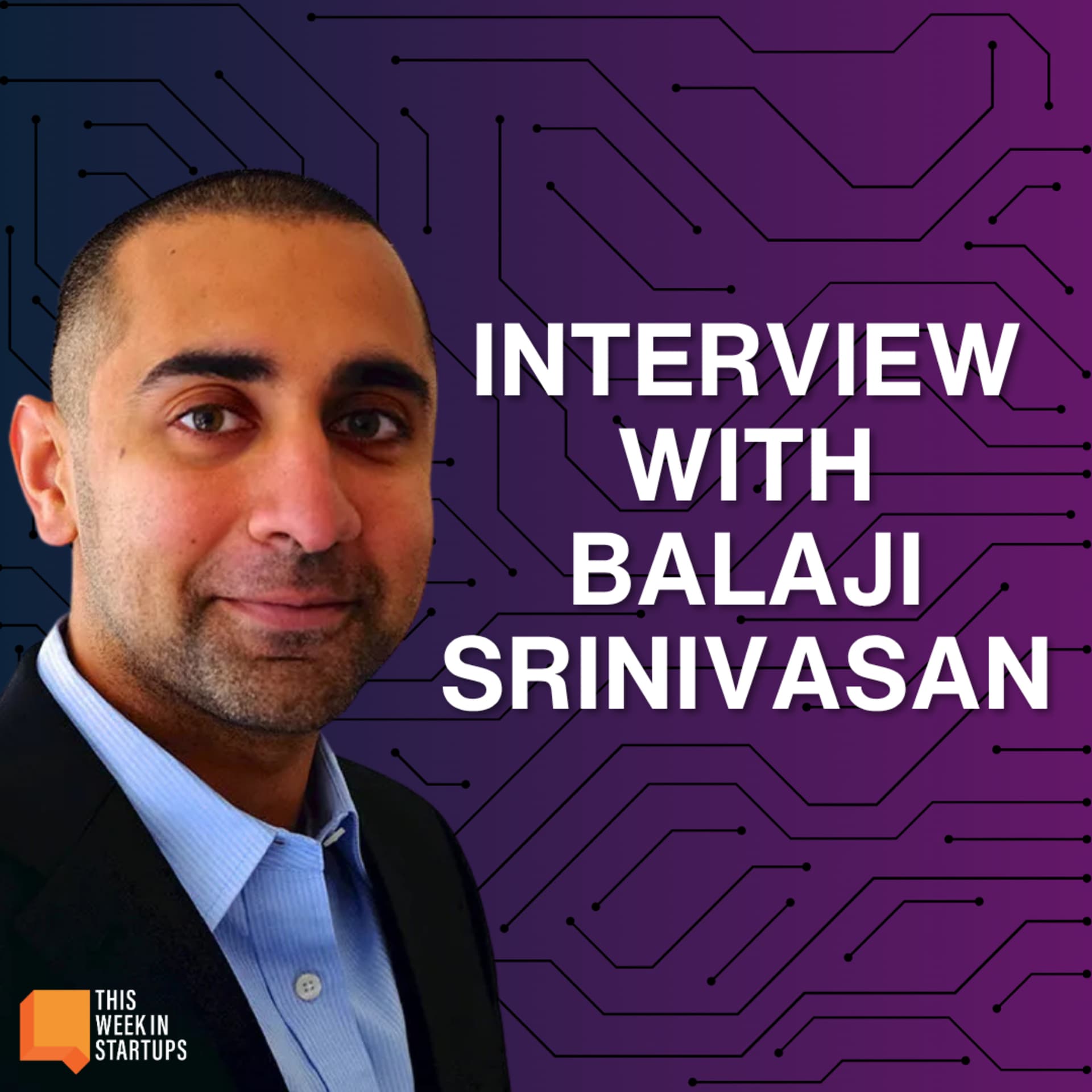
Episode Overview Title: Rebuilding Civilization from First Principles: Inside Balaji’s Network State Vision Host: Jason Calacanis Guest: Balaji Srinivasan Location: Singapore Date: [Insert Date]
In this episode, Jason Calacanis interviews Balaji Srinivasan, exploring his vision of "Network School," a foundational step in the concept of decentralized, internet-native societies called "Network States." They discuss the implications of these new societies, the evolution of governance, and the future of democracy and cryptocurrencies.
Key Concepts and Discussions
- Introduction of Balaji and Bitcoin
- Balaji Srinivasan is introduced as a leading thinker in tech and governance, particularly regarding Bitcoin's potential to disrupt traditional economic structures.
- Network School and Network State
- Network School:
- The first node in the broader concept of Network States.
- Aims to create societies based on shared values rather than geography.
- Network State:
- Envisioned as decentralized communities that leverage the internet for governance and social organization.
- Historical Context of Education and Society
- Comparison of Network School initiatives with historical educational institutions like Harvard and Stanford, emphasizing the role of education in community building.
- Global Appeal and Diversity of Participants
- Diverse Motivations:
- Participants range from remote workers to ideological libertarians, attracted by the promise of a supportive community and innovative governance.
- Economic and Social Benefits:
- Emphasis on affordable living costs and startup culture.
- Media Perspectives and Governance Challenges
- Discussion on societal self-determination and how mainstream media often misrepresents new societal models.
- Critique of Traditional Governance
- Balaji argues for the importance of "the right to exit," advocating for a system where individuals can choose their governance models, akin to choosing a college.
- Migration Trends and Political Critique
- Insights into how individuals are leaving states like California in response to governance failures and economic pressures.
- The Future of Money and Currency Dynamics
- Discussion on Bitcoin's potential role as an alternative to fiat currencies and the implications of dollar devaluation.
- Global Power Dynamics
- Analysis of the rise of China as a competitor to the U.S., and the shifting geopolitical landscape as countries seek more reliable partnerships.
- Challenges Facing Bitcoin
- Concerns about centralization of Bitcoin holdings and the impact of quantum computing on cryptocurrency security.
- Network State Concept as a Solution
- Balaji proposes the creation of decentralized communities as a way to counterbalance the rise of authoritarianism and create environments that value individual freedom and economic opportunity.
Key Takeaways
- Network States represent a new model of governance combining technology and community.
- Democracy Reinvented: Communities can vote with their feet, participating actively in governance.
- The right to exit is a fundamental principle in allowing individuals to seek better governance options.
- Economic Mobility: Network States offer an alternative to traditional high-cost living areas.
- The future of money is at a crossroads, with Bitcoin and cryptocurrencies poised to challenge existing financial systems.
- The potential for global partnerships and economic unions based on decentralized principles.
Final Remarks Balaji Srinivasan emphasizes the importance of building new societal structures that align with individual freedoms and shared values in a rapidly evolving global landscape. As the episode concludes, he invites listeners interested in the Network School to apply and participate in this innovative venture.
Sponsors
- Squarespace: Offers tools for building websites.
- Vanta: Compliance solutions for startups.
- Vouched: AI infrastructure support for identity verification.
Additional Resources
- [Network State Website](http://ns.com)
- [Apply to Network School](http://ns.com/apply)
---
This episode encapsulates a forward-thinking approach to governance, education, and community-building in the digital age, framing a narrative of hope and agency in the face of traditional societal constraints.
Written by AI. May contain mistakes. Listen to the episode to check what was said.
Transcript
Automatic transcript. May contain errors.0:00Actually, you wrote, or at least Launch, wrote one of the best - I wrote it, yeah. Okay. It was my article. That was honestly one of the best early articles on Bitcoin. I know you troll people on Bitcoin, but we should put that up on screen. Yeah. Where actually there are a lot of things that were - I said it's the most dangerous open source project I've ever seen because it could destabilize the entire world because the sovereignty of countries is military and their currency, and this could change history forever. Yeah. This Week in Startups is brought to you by Squarespace. Turn your idea into a new website.
0:36Go to squarespace.com slash twist for a free trial. When you're ready to launch, use offer code twist to save 10 % off your first purchase of a website or domain. Vanta. Compliance and security shouldn't be a deal breaker for startups to win new business. Vanta makes it easy for companies to get a SOC 2 report fast. Twist listeners can get$1 ,000 off for a limited time at vanted.com slash twist. And Vouchd. Turn your AI infrastructure into production-grade software with Know Your Agent from Vouchd. Check it out yourself at vouched.id slash twist. Trust for agents built for builders like you. Hey, everybody.
1:19Welcome back to the show. I am super excited because friend of the pod who, gosh, I don't know when the last time we did a pod was a couple of years ago. A couple years ago, yeah. Balaji Srinivasan is here in Singapore. And I'm in Singapore. I'm a little bit jet lagged, but you're a great podcast guest because you've got a lot of ideas. And so I got to go visit you in Malaysia, just north of Singapore, about 45 minutes. Slightly west. Slightly west of Singapore. Slightly west of Singapore. And And you have started the network school, the network state, all the stuff you've been talking about for years.
1:59There's now a there there. Six months ago, you found a place where there are apartment buildings and space that is, I guess, relatively cheap and available. And you've got your fan base of tech bros from around the world and ladies joining you to build what? What is the vision here for people who've heard of Network State, Network School, and this sort of project you're working on, which seems to be your life's work? What exactly are you building? What am I building? So basically, so Network School is the first node of a network society where it serves several purposes. But, you know, the United States was started actually not just with the Massachusetts Bay Colony, but with Harvard.
2:47It was like literally a single room schoolhouse when it started, right? And the Midwest, the land-grant colleges, like Texas A &M, was agricultural and mechanical. And so that was meant to build up the Midwest. So you had a college and a town kind of side by side. You'd train the engineers and the humanists to help build the society. And of course, the Bay Area, Stanford, and Berkeley helped build Silicon Valley. So those are three examples in the American context where a university and a town and a society kind of all went together. right and um so that's what we're doing uh we are building a society ourselves we're building a startup society that's also a template for other startup societies and the way i think about it is this is a third type of thing intranet company intranet currency and now intranet community if you go to like ns.com that's you can see what we're doing if you go to ns.com pretty good domain name ns.com ns.com right network state so right so it's network school but it also stands of course for network state and network states plural right and that's that's important so we have If you go to NS.com dashboard, front slash dashboard, you'll see more than 100 startup societies around the world.
3:54And the reason for this is we have these online communities. People sense, if you're watching this, you're spending a lot of time online. By definition. By definition, that's right. And so all our transactions are online. All our communications are online. But many of our friends are online, and we don't see them in person. But we'd like to do that. So bringing those online communities together in person actually has a physical network effect. I mean, duh, but also not duh. right? So we've unbundled the world onto the internet and everybody's alone at home. Now we re-bundle the world into the physical world.
4:24And when you do this, suddenly you actually solve a lot of problems. You actually, you reinvigorate democracy because when people vote with their feet and move to a location, now look at, for example, Starbase, right? Starbase, Texas, which just incorporated Elon's new thing, right? Yeah. Where Starbase is located, decided to take that town and rename it Starbase. And the people who are engineers at SpaceX voted, as well as some of the locals, to create a new city or town. New city or town. And they won 97 % of the vote, right? 97.7%, okay? And it was like 212 to 6 or something like that, right?
5:00And the thing about this is that is actually reinvigorating democracy. It's internet democracy because you're voting with your feet to move to Starbase. You're voting with your wallet to help build up this community. And then you're voting with your ballot to ratify what you just did. You're combining all three. You have skin in the game because you actually move physically. You're physically there. You're putting capital in. And then as a consequence that you're also voting to build something. And so it's something where you have a lot of alignment in the community, right? And that aspect of the frontier and the physical world, obviously that built America, right?
5:33A big part of what built America is you had all these people from the old world who came out. Actually, in the mid-1800s, people would just, if they didn't like it on the East Coast, they would go further in and they just build their own society. Even the earliest Americans, those were the European colonists, and they set up the Massachusetts Bay Colony, the Virginia Colony. The whole point was that you had a new jurisdiction to do things. Now, of course, people say, oh, the Native Americans were there. That's true, but in many ways, they were more alike. These new tribes came in, so you had N Native American tribes.
6:06Now you have N plus one, N plus two, N plus three. They all slugged it out. And actually the Native Americans were like brave warriors that lost battles. But for example, in Mongolia, they make statues to Genghis Khan. And so they should make statues to Sitting Bull and all of these kinds of warriors. But leaving that aside, that's actually like a war that was lost, a war that was won. That just happens all around the world. Nobody has control of any territory forever. And so ideally though, you want to be able to do that today without any wars, without any conflict, right? How do you do without any conflict?
6:35Because everybody thinks all the land is taken, but it's actually not. There's all kinds of empty space. No, there's all kinds of spaces around the world. And when people see cheap space, plus they're nomads and they're digital nomads, they have a high salary, low cost of living, which means more opportunity. And if you put like-minded people together, now you've got a bunch of people who are not under economic pressure to live in the Bay Area, which we both saw what that did to people. It made people miserable. and their entire lives were filled with this anxiety of not being able to keep up with other people.
7:08And even the people who were supposedly keeping up felt like they were under massive pressure to spend$100 ,000 a month on a crazy lifestyle. And all the venture money that we were deploying into companies was going to$4 ,000 a month in rent for a developer to have a one or two bedroom. It was insane. In the network school, you have these buildings that were built and not being utilized. And there's a whole backstory there, but it's not important. You found this incredible opportunity and people can go live there for$1 ,500 a month. All in. All in. Food, gym, exercise, and their apartment, and then be part of a community.
7:48Yes. So as Paul Graham would talk about that whole like ramen break-even, you know, ramen funded, it actually exists here. And there were 150 people there all grinding on a Saturday. I don't know if they all came out because I was touring, but it's - We haven't warned that. A lot of people are actually in their apartments. Yeah. And so these people are coming from 100 different countries to hang out with each other and go to talks, to learn, to build. What is their motivation? Because I understand your motivation. You think there's a new mode of society, a new mode of governance. We have other people in our industry who believe in this.
8:24Peter Thiel's done seasteading. obviously Elon is doing this town in Texas and people move to Texas because there's less regulation. So I understand your motivation and other people's motivation, create new societies, hire function, but the individuals coming. Great question. Get me into their mindset. So several different, think of this as kind of like early cryptocurrency had various different kinds of people that all came together. Yeah. And there's a whack pack of people. Yeah. A lot of different people there. There were people. Well, yes, but, but successful libertarian, Libertarian, technical, anarchist.
8:57Exactly. That's right. So some people were ideological, right? Some people just were in it for the tech, right? Some people thought, okay, this could be very valuable someday, right? Okay, business opportunity. That's right. And there's a mix of different types of things. Some people came just because it's cool, right? Yeah, weird. Weird, cool, et cetera, right? And so today, for example, at Network School, what kinds of people do we have? The number one demographic are those folks who are remote workers and who often can't get a visa into the West. So these are people who can't or won't, don't want to go, right?
9:28They think it's over and so on and so forth. But they're internet first people, right? So that's how it expresses our ideology, internet first. So obviously, I'm friendly to people in the US and I'm friendly to many people who are conservatives and so on and so forth. But I think America first, America is only 4 % of the world. And red America is only 2 % of the world, right? But if you say internet first, you include many of those people. and you also say, hey, if you're Canadian, Australian, you know, from New Zealand, UK, that's the term, if you're Indian, if you're European, Japanese, or American, the internet is where you're all equal.
10:04All nodes are equal in the internet. You can have the same monetary policy. You can have the same contract law, smart contract law. You can have the same transaction certification. Basically, what the blockchain represents is not rule of law, which is breaking down in some ways with Delaware and all the crazy things in the US. It's rule of code. So everybody's a peer here.
10:50Squarespace is going to give you all the tools you need to grow and prosper. We're talking stunning, world-class design, plus templates to fit every possible business or purpose. Start an online course, schedule appointments, even generate invoices for clients with just a few clicks. Their mobile blog editor makes it extremely simple for you to create and update posts on your favorite device. You know, you might be on the go. You might be on vacation and you need to update something on your website. You don't want to wait. It's all easy to use out of the box. Plus, they've added a new AI feature, Blueprint.
11:22This makes it easier than ever to customize and upgrade your website until it's exactly what you want. Choose from one of the personalized layouts, add a layer of on-brand visuals, and boom, zip, zip, zip, you're done. So check out squarespace.com slash twist for a free trial. And when you're ready to launch, go to squarespace.com slash twist to get 10 % off your first website or domain purchase. That's squarespace.com slash twist. So the thing is, a lot of the progressive values of equality, democracy, science, media, I actually believe in those things, just on the recent corrupted versions. So the people who are coming, their motivation is to be around like-minded people.
12:03Like-minded people, that's right. And they want to build companies or build a life, meet people, find a mate. What's the motivation when you talk to them? Because it's only been six months, but you've got hundreds of people, and yet thousands apply. So it struck a nerve. It struck a nerve. That's right. So I think this is something where people want to build communities in the physical world. We spent so much time online. We want to build things offline, right? So some of them are coming because they're remote workers and they're tired of being by themselves. They want to be with the community, right?
12:36Got it. So it's alone or with people who are also remote workers. And we've seen that. This nomadic lifestyle, it was like in kind of different Airbnb type startups and office-sharing startups that try to organize these people, but you've got such a big profile socially and with the crypto community that you can kind of be a beacon or a lighthouse today. And I'm just a shilling point, right? The purpose is, crucially, to... This is just like the first one of these, and I fund vegan ones, and I fund carnivore ones, I fund Hindu startup societies, and Christian ones, and Jewish ones, all of these different kinds of...
13:10There's some in Brazil, there's some in Honduras, there's some in Switzerland, and so it's all different kinds of startup societies. That's, quote, true diversity, right? Many different kinds of things. There's like Sanskrit immersion, Latin immersion. Many different kinds of startup societies have a different thesis on what would be a cool kind of community to build, and you'll see where they work. It's, again, just like a tech company. If we thought about early X or early Twitter, it seemed like the silliest thing in the world. Why would anybody want to treat their breakfast? But it became really important, right?
13:37And so in the same way, there's many different concepts of what a startup society is. Okay. So just to answer your question also again, A, remote workers, B, people who can't get visas to the US, C, a lot of people who ideologically want to build startup societies, just like they wanted to build cryptocurrencies. That's very meta. Yes. So they're looking at this vision and saying, the society I'm in is not fulfilling to me. It feels broken in some way. It feels suboptimal. And this seems exciting. Yes. And this is why maybe the press, when they look at you as an individual and crypto, they kind of look at it and like, these people are crazy internet people who don't want to pay taxes.
14:14They want to like skirt governments and create their own world. And they're kind of leaving the real world. It's not that it's their builders who want to build something that fits their sensibility. That's right. And the thing is, everybody here pays taxes. Everybody here obeys regulations and so on. And the same thing, like when I was CTO of Coinbase, I built a genomic company and so on and so forth. We dot every I and cross every T, right but many many countries actually want these kinds of people there why yes desperately desperately right because most countries aren't rich countries most countries are small countries in fact most countries have actually less than 10 million people and so if a network school node or startup society node is open there suddenly all this talent and capital from around the world floods in all people want to do is be able to like drink coffee hit keys on their laptop build cool stuff, right?
15:02Yeah, work out, go to dinner. Yeah, exactly. It's really not that hard. And this is a crucial thing. You don't just need tax breaks. You don't need subsidization. People are happy to pay, in a sense, a subscription fee to a society where the roads work, the traffic lights are on, and so on and so forth. That's fine. What they just don't want is to be attacked for being a tech worker or a technologist. Then there's also people, some who want to join a startup societies and others who want to join with the intent of eventually building one, right? So early Coinbase, for example, has a Coinbase diaspora of all these people who've created lots of crypto companies.
15:39So many of the people at Network School are learning the template that we're building. And for example, there's small things. It's actually, it's surprisingly hard to get to San Francisco quality coffee. It's not that hard, but it's like harder than you would think, right? And other kinds of things like parts of what we call the daily loop. So for example, you wake up, workout, coffee, office pod, conference room, and so on and so forth. Once you actually start calculating that out and minimizing all of the transit times, it's almost like a factory-like thing, right? So then you can rack and stack more office pods, more coffee stations as a function of demand, and so on and so forth.
16:17So you can just save people so much time, whereas normally if they're in a big city, they're like, oh, my gym is like 30 minutes across from me, and that's like a huge tax on you every single day and so on. So you can start optimizing daily life. That gives them more time to just learn or sit on the beach or what have you, right? Which is kind of like if you think about what we do when we build products or services and technology at our best, we're removing friction, delighting customers, and lowering the cost of it. Yes. And what I saw today was a bunch of people who are really happy and who are around like-minded people and who feel like they have a stake in it, which is also super interesting because you you look at what happened in America over our lifetime, the last 40 or 50 years, people feel disconnected from it.
17:01They feel like they have no agency. They feel like there are victims in the machine or cogs in the wheel, something more dystopian. And they feel like the government doesn't represent them. But what I saw was a lot of agency. Like you guys built a gym and you guys are building the schedule and you have speakers. So I think it's pretty easy to be cynical when people look at it. And I was watching some of the press coverage of, I guess there was somebody also doing this in middle of America. They bought a lodge somewhere in Wyoming and your name was mentioned over and over again that they were like inspired by you.
17:33Do you know who I'm talking about? There's some articles and stuff. There's actually somebody who was like a Berkeley guy who left. Oh, the Wyoming thing? The Wyoming thing. Yeah, but that's great. Because they're into DAOs or whatever. But that's good. And I was like, I don't understand why they're so upset. And these are like woke people from like Wired Magazine or whoever who are criticizing this, or I don't know if they were being sensationalistic, but there seemed to be some animosity towards people saying, I would like to build my own society. I can put it in one sentence, right? Please, yeah.
18:04They don't want us to have self-determination, right? Fundamentally, they basically have replaced G-O-D with G-O-V. They worship these failing Western states, and they are, in a sense, imperialists, where they want them to have bureaucratic power over the entire world and everybody in it, right? And so because of that, if you say, thank you very much, you guys do your thing, but we want to do our own thing, right? We want to basically say, hey, we want to have our own society and we want to be able to determine our own rules and we want to be able to live together and so on. Even by the way, if you're just co-living, forget even, you know, there's different stages by the way.
18:46There's like co-living, then you might negotiate a special economic zone, and then all you know eventually eventually eventually maybe you've got you can get an island get sovereignty or what have you okay but that's like last time did that ever happen that a an actual government new country was formed in the world on planet earth yeah last time yeah oh well let me show you something right so actually there's so because i understand you're making these like communes kibbutzes i don't you know little societies pods however you would describe what you're doing in this nascent state. But the idea of like going and finding an island and saying, hey, we have sovereignty, nobody can tax us.
19:23Yeah. Take a look. Ready? Okay. So before I show you this graph, right? What is your mental model of how many, like going back, let's say to 80 years, right? What's your mental model of how many new countries were formed? All right, founders, I know you're building something amazing and you're going to change the world. And now, hey, the big logos, they're taking your calls, right? But here's the catch. If you're not SOC 2 or ISO 27001 compliant, these deals won't close. Now, some of you are saying, I've never heard of those terms. Some of you are saying, I've heard of them, but I don't know what they are.
19:56And that's where Vanta comes in. They're going to be your partner and they are the all-in-one compliance solution that helps startups get audit ready. And that's going to build a strong security foundation for your company, which you want, but they're going to do it quickly and painlessly. Vanta automates the manual security tasks that slow you down and that streamlines your audit. So here's your call to action. Whether you're closing your first deal or you're gearing up for growth, Vanta is going to make compliance easy for you. Join over 8 ,000 companies, simplify your compliance, and get a thousand dollars off at vanta.com slash twist that's v-a-n-t-a.com slash t-w-i-s-t wow i'm trying to think of like countries that seceded from their mothership would be the primary source of that i'm thinking of all the colonies of the british empire would be the the first group just logically um or other countries in the middle east like uh i don't know qatar and those kind of countries were part of UAE and they were forming and unforming.
21:02Here's a graph. So you tell me. Okay, there it is. It's 4X'd. It's 4X'd since the, yeah, since 50 to 200. Yes, and the thing is, I can show you this graph. Well, those are UN member countries, so they were accepted to the UN, but they maybe existed as countries. Well, no, I mean, the thing is, if you define what is a country that's actually an important, if you define a country as a UN member, the first thing, most people are surprised it's almost 4X over 80 years, right? The second thing is, exactly as you point out, the British Empire, the French Empire, and then over here, this big bump is the Soviet Empire breaking down.
21:33And new countries arise, right? Now, there's two important features of this. First, if you go backwards in time, this is actually the most centralized the world has ever been. When you go backwards in time, I'll show you some graphs in a second, maps in a second. The number of independent jurisdictions in Germany, India, it just rises rapidly like this. You have thousands and thousands of little... You know what San marino is you ever been there no okay it's like a little state lit let me show you something so san marino in italy right is like this uh this tiny tiny thing it's a microstate that is like a piece of the past that still sits in the present it's like it's like a little city there but it's own sovereign country okay wow yeah it's a un member right and the thing about that is garibaldi when he was unifying italy san marino gave him refuge so he didn't unify he let it keep its sovereignty.
22:26So that's like a duck-billed platypus, like this evolutionary missing link. And it tells you, oh, all the things we think of as countries like Italy, France, China, India, they're roll-ups of lots of smaller city-state-ish things that used to exist. That's what the world used to be. It used to be fragmented like that. And it got rolled up into these big things for the purpose of conscription and taxation. Because you basically build these giant nation states, which have as many people as you can pack in there, like the Soviet Union and so on. And they all didn't fight each other and that's the century of giant wars and conflict and whatever right i'm not saying everything about that was bad but a lot of it was bad right okay so now we're going in a sense back to the future where um just like we went from gold to fiat to digital gold right we're going from city state nation state network state got it i'm not saying everything goes to network states but i think that will arise and the big difference is network states are decentralized so they're everywhere and nowhere so say it's only in one place but network state is decentralized just like Bitcoin is decentralized.
23:23You've got nodes everywhere and you unify them as an archipelago. Got it. So there'll be these little outposts in different countries of network state-ers. Yep. People who believe in the network state concept that you've created. And then if any one of the nodes goes offline, like when China was like, yeah, no more Bitcoin, or Korea had no cryptocurrency for a bit, I think then they relented, the distributed network heals because people could just leave. That's the correct answer. And go to another place. And this seems to be sort of interested on your take on this, even in the United States, where you think moving from one state to another would be your right and would be a great choice for a human being to make.
24:04Like, maybe I like the weather or the people or the culture more in a different state, or I just want to change a pace. I've lived in three different states and four different major cities in my life. And it's one of the great joys of my life is to discover those new ones. but I've never had as much vitriol or questioning of my decision to go to Texas. From California. From California. It seems like there's a group of people who are like, you're doing this for nefarious reasons. And then even deciding to live on a horse ranch as opposed to living in the city was also like, people were a little critical.
24:40Like, why are you doing that? Well, I can have my cake and eat it too. I can go to California and New York anytime I want. And then Keith Ruboi was also derided for the sin of going to Miami. You know why? I'd argue why. It's because California has been under one-party Democrat control since 2011. So California is not a democracy. No. Right? And that's actually why all of the stealing for the NGOs, for the homeless encampments, the homeless industrial complex has been out of control because they destroyed democracy in California. There's no Democratic accountability for the Democrat Party basically looting the conference or that's how I would put it.
25:14And so because of that, the only true vote against that is to leave. Which is why Elon. Which is why Elon. That's right. And so that's why Elon left, right? He couldn't even build a sign in San Francisco, right? Yeah. And there's like some signs of life or what have you. I know some people, but I don't think it's falling into the Pacific, but I do think it is in a very - It's a downward - It's a spiral. Yeah. I think it is, at a minimum, it has lost a lot relative to what it could have been. The doom loop. And I think so - I consider it a doom loop. Yes. And I consider, Austin, what you're doing here.
Read the full transcript
25:44what I'm seeing in Dubai, in the Middle East, Abu Dhabi, is kind of like a boom spiral. I think that's right. Where it's kind of working its way up. That's right. And the energy seems to be people who are interested in it. So, okay, so we know that those people feel like they're losing control, and they also feel like they're losing high earners who are creators. And I think this is like a very pernicious thing. They think of you as a slave, right? Like basically California - But I'm a creator and capital allocator. I know, I know. But they want you, they basically, they, like East Germany, see everything, Every communist state was like this.
26:15North Korea, East Germany, the Soviet Union, Cuba, and actually also Nazi Germany. They all didn't want people to leave. They put exit taxes or they shot people for leaving. They built the Berlin Wall because their citizens were basically slaves. That's what communism is. It's slavery, right? It means 100 % taxation is slavery, right? You get there by being so far left for the worker's paradise that all the workers are in gulags, right? So they don't want you to leave because they basically want you to just work for them, right? And so exercising, I mean, the thing is, one thing that's good, though, is the right to exit is actually a fundamental right.
26:50It's in like the UN Charter of Human Rights, right? In a sense, the right to exit is the thing that distinguishes, quote, leadership from dictatorship, right? The leader lets you leave, right? That is, if people can't distinguish the two, the difference is the dictator doesn't, it's a prison state, but leadership is you've voluntarily opted in to be there, and you can voluntarily opt to leave. Right. And they have to earn you being a citizen. That's right. And they're of service to you, which is how it didn't feel for a lot of us in California, New York. And that's when this great migration happened.
27:23People felt like, well, why am I buying into this society, which feels dangerous and deranged at times? And I could go somewhere where it's more constructive or more in line with my ideals. This is right. And this is also actually the counter-argument when people are like, oh, Elon, it's techno-monarchy. It's not techno-monarchy. It's actually techno-democracy. Why? Every single person who's gone to Starbase chose to be there, and any person there can leave. They opted in with their presence. And I think that's like, actually, if you think about voting, your vote doesn't matter in California, New York, to a certain extent.
27:56But voting where you live, that is the ultimate vote, I believe. Yes. And actually, this is an important paradigm shift because if you go to the root of democracy, it's the consent of the governed. And the problem with 51 % democracy is that 49 % have not given their consent to the current rulers. And that's what you keep getting. You get a 49%, 51 % of this back and forth. And the guys who win by 51 % try to govern like they've got a 99 % majority, and that produces backlash. And we've seen that back and forth. And then the elections become more and more hard fought, and that 2 % flips the other way.
28:27And then you get a huge seesaw this way. The alternative to that, to the two-party system, is the thousand-city system. migrate to the one that fits you best and have consensus in that society that 80, 90, 97 % in the case of Starbase agree that rocket ships going to Mars and the noise pollution caused by them is not pollution, it's joy. That's right. And every time we hear that noise, we are excited and thrilled at progress, whereas another person might consider that noise absolutely why they didn't move to that area. They want it quiet. And here's the thing is, let's say that you take that as an important cost, right?
29:05Because the frontier is a filter. The frontier filters for a certain kind of person who's willing to take some pain for some gain. We see that all the time in startups. It's not a big company employee, right? So take that example of Mars. So let's say you say, okay, we want to get to Mars. We want to tell it the rocket launches. So everybody just has ear protection stuff at home. Sure. Fine. You can solve that. Maybe there's better sound perfect at home. There's ways you can solve that when you set this as a goal of getting to the stars, then you can use technology to mitigate the downsides, right?
29:30But it's whether people have that can-do attitude, they're aligned on the goal, right? So my view is that the thousand-city system, as opposed to the two-party system, is how you get genuine diversity. And actually, you know what? There's already a prototype of this. We've actually been doing this for 20, 30, 40 years. You know why? All right, listen, I'm going to level with you. We already know AI agents are using your websites, they're using your products, even if you're not aware of them. Agents are about to change how we handle all kinds of online transactions, but there's really a big problem, isn't there?
30:00How do we separate the real, authentic agents that represent real people from spam bots and even worse, bad actors? You wouldn't book a trip with a sketchy travel agent or a flight on an airline you've never heard of or trust a new employee who didn't have an EIN or a social security number, right? That's why our friends at Vouch developed their Know Your Agent platform. This is brand new technology. With KYA from Vouchd, now you have everything you need, identity servers that help you verify the human beings behind AI agents, permissions and delegation enforcement, giving you the master controls you need over what you've built, and legal grade compliance.
30:39And knowthat.ai, a living directory of pre-verified agents, right? Agents are going to be talking to each other. That's starting to happen, folks. So you need to know the other side of the transaction, the other agent who's working with your agent. So turn your AI infrastructure into production-grade software with Know Your Agent from Vouchd. Here's your call to action. Check it out for yourself at vouch.id slash twist. That's vouch.id slash twist. Trust for agents. That's built for builders like you. So imagine if at age 18 or age 21, you picked your country like you pick your college. Right.
31:15But that's actually already the case for millions of people from Asia. Why? Asia, India, at age 21, they would apply for their master's degree at MIT or Stanford or what have you. And they would have the F1 student visa for college. They'd have the H1B visa for their company. And then they'd get a green card or permanent residency and then eventually citizenship at the country level. So college, company, country were like, it was a labyrinth that an immigrant, tech immigrant has to navigate. But it was a stack. It's a stack. That's right. Right. So college, company, country, right? And the thing is, nobody has packaged that together.
31:48That's one of the things we're doing with network school. Part of the reason to come to like a crypto society or a network society is to improve your fiat passport. So lots of people who come from countries, they're meritorious, they're smart, right? We can get them worker visas. We can get them maybe to buy golden visas, things like that. We can let them see the world, right? Because people don't understand that if they're born without what people call passport privilege, they're basically like in prison. They're locked, right? It's very hard to see the world to get to other countries. And so we can upgrade that.
32:16We can get them, you know, employment passes and so on and so forth. And they're hardworking and they deserve all of that, right? And they'll do a good job with that, right? I think we're talking about where intelligent people and ambitious people will go. And, you know, this is my first trip internationally. Well, first time in Singapore. Okay. What'd you think? I am really fascinated by places that are like startup cities, because this is a 60 year old city. They're having their 60th anniversary in August. I found out and I was like, this is one of the few times I've gone to a country that is younger than America.
32:52Usually when Americans go abroad, they're going to a country that's much older typically. And same thing, I have the same experience when I go to the Middle East, which is, you know, Dubai, and like, these are new cities that in 1950 were deserts, right? Yes. So it's fascinating to see those countries and the enthusiasm that people have for them. And also, it was also a little bit sad for me, because as an American, as a high-profile American who has an opinion that sometimes people listen to, or at least they hear it. Yeah, they hear it, they listen to it. They don't have to agree with it. But there were a lot of people asking me to explain what's going on in our country and asking me to explain it because they're perplexed and saddened by how America is interacting with the rest of the world.
33:44So putting aside my belief system, just the candid feedback I got, I would say I've been heartbroken, crestfallen at how people were talking about America. And it's the first time in my life I've ever had it. It's actually kind of heavy on my heart the last three days because people were saying, why don't you want - Why is it doing this stuff? Why are you doing this to us? Why can't we come to the country? Why don't you want us to come to America on vacation? Mike, I was talking to some folks who were extremely successful. The 0.1 % of the 1 % were telling me, my kids can go anywhere. and on vacation, they want to go to China because they believe it's the future.
34:25They want to go to college. They don't want to go to America for college, and they don't want to go to America because they feel like they might get harassed at the border. And then we want to do business with your country, and we thought that the new administration would be embracing the rest of the world, getting rid of regulation, and that we'd have this great era of interoperability and we'd have like an acceleration in business. And now you're just rattling the cage constantly. And we want to do business, but you're sending us to go do business in other places and we can't rely on you anymore.
35:02And that actually, I think maybe is the most heartbreaking thing is that they feel like we're not a reliable partner, is what they were telling me. This is not my position. This is the input from people in Singapore, who I think represent a certain level of globalist and sophisticated globalistic, world-savvy people. And so maybe you tell me how, as an American? Yeah, well, so yeah, I was born in the U.S. Born in the U.S., so you're an American who lives abroad now. What do you think of what's happened? And we can't get away from politics. We can't get away from Trump because it's defining a lot of what's happening in the world right now.
35:44Tell me the perception and your perception. Here's how I think about this. And I actually did shed a single manly tear when writing the Network State book because I had some of the same emotions that you're talking about. The way I look at it is Britain, America, the internet, right? Britain was an amazing, amazing thing, honestly, for the world. The British Empire, a lot of people attack it, and they had a lot of faults, but it did on net advance civilization. There was a lot of good things Britain did. But eventually, the British Empire exhausted, handed the torch to America, and it's no longer an empire.
36:20The British Empire is just the UK. It's just a country. That's right. And the start of the American Empire was arguably 1939. There's this great book called Tomorrow the World by Stephen Wertheim that actually documents that the fall of France was actually the moment. it wasn't actually post-World War II as at the beginning. The fall of France was a moment that the Americans, at that point, they had been happy to let the British do all the empiring and just build up their country. But once they saw that the Nazis or maybe the Soviets could build an empire that was bigger than the British, they're like, oh, we have to do this.
36:53So that moment was when America turned truly into a global empire, and they set out to be a global empire. That's why there's 750 military bases worldwide. That's why the headquarters of the UN is in New York. That's why, for example, Harvard Kennedy School of Government alone has 20 heads of state that were trained there. That's why the US has regulatory harmonization. All these countries around the world use US regulations. There's a Hungarian FDA. That's why there's US multinationals everywhere. I could go on and on. The number of internet searches being done at Google, Google is the number one search engine in every country except for Korea, China, Russia, and maybe still Japan.
37:32Maybe it's 50-50 in Japan now. Yeah, I don't know. So I think it's maybe four countries. It's like four countries. That's right. The issue with empire, any empire, is you get this global footprint, but it also ends up sort of eating away the core of the empire, right? And it does so in two ways. The left is mad because they feel that your people are oppressing people around the world, which is sometimes true. And the right is mad because they feel that your people are bearing a burden of the rest of the world, which is also sometimes true. So eventually the left and right basically get tired of empire and shut it down, and then they often regret it.
38:04Right. So that happened with the British Empire. It happened with the French Empire. And it happened within our lifetime with the Soviet Empire. Everybody thought that the aftermath would be something great. And it was actually, it was mixed. Eastern Europe was free and it did well and so on. Estonia did well. Russia itself did very poorly for a long time. And then it's like somewhat started to recover. But, you know, fine. point being, we are in the last stages of American empire, okay? Because four forces, you know, the red America is against the deep state, blue America is against the Trump administration, tech America is against the regulatory state, and China is against U.S.
38:39hegemony. So all four of those vectors are pointed down. So nothing is keeping the current establishment up. Every day there's another hit to it going down. It's like a solar eclipse. It's never happened in our lifetime before, right? And you can't cut off foreign trade and foreign travel and foreign tourism without also eventually cutting off foreign capital flows into the dollar. And then without the reserve currency, American standards of living will fall very rapidly. I don't know how much, 50%, 90%, 99%. But this is similar to what happened after the fall of the Soviet Union, the ruble hyperinflated.
39:12Now, one thing, we're actually in the middle of something. Have you ever, you know, been in, well, Tesla is actually a very noticeable acceleration. Have you ever been in a bullet train? So if you're in a bullet train, it can accelerate in such a seamless way that you don't even realize how fast you're going. So do you know how much the US dollar is devalued against Bitcoin since inception? 100 million X. Because Bitcoin started at 0.1 cent. Actually, you wrote, or at least launch, wrote one of the best. No, I wrote it, yeah. Okay. It was my article. That was honestly one of the best early articles on Bitcoin.
39:43I know you troll people on Bitcoin, but we should put that up on screen. Yeah. Where actually there are a lot of things that were - I said it's the most dangerous open source project I've ever seen because it could destabilize the entire world because the sovereignty of countries is military and their currency. And this could change history forever. Yeah, I was shook when it was at 12 cents. As soon as Bitcoin appeared, capital started flowing into it. Yeah. And it's gone up 100 million X against the dollar. and there's only like another 10x to go or 100x, but that last 10x will be felt in a different way.
40:23See, the thing is at$100 ,000 per Bitcoin, everybody's happy, but a million dollars per Bitcoin, people understand like empire's over. There's something about that as like a round number and so-and-so with people like, wait a second. And one way of thinking about it is like normal inflation is supposed to be like 2 % a year. That works out to like 0.2 % a month. It's an arbitrary figure. It comes from New Zealand. It should really be 0%, but let's say, okay, hyperinflation is 50%. a month, right? So 0.2 % a month, normal inflation, hyperinflation, 50 % a month. What if we define superinflation as 5 % a month, right?
40:54If you work it out, the compounded rate at which the dollar has been devaluing against Bitcoin is like 10.41 % a month for 16 years. Okay. So we're actually already in the middle of the global run on the dollar. It's like that bullet train that's been accelerating without people seeing it. The alternative is already here. And you're seeing BlackRock saying Bitcoin is an alternative to the dollar, right? The other alternative, by the way, is gold, physical gold. That's also at all-time highs. So gold and digital gold are the things that will be obvious warning symbols in retrospect that this order is changing, right?
41:27And so then what comes on the other side, right? My view is that the future is China versus the internet. And the heirs to American empire, China has the military and the manufacturing. and it's one of these things where guys like Peter Zaihan will say, oh, China's going to fall into a ditch. It's going to get old before it gets rich. The US can blockade China, et cetera, et cetera, et cetera. In actuality, a lot of those things are happening in reverse. For example, China's blockading the US. China's proxy Iran has its proxy, the Houthis, that's blockading Suez. In many ways, US demographics are worse than Chinese demographics.
42:02Why? Because you've got this polarized society, everybody fighting each other. You have all of this ethnic conflict. You have young minorities expected to pay for old people's social security and on and on. You have men and women hating each other and whatnot, right? So US demographics are a cauldron of ethnic, gender, political, economic conflict and resentments waiting to bubble over, right? China for its faults has like a homogeneous society, right? So the problem is China is very strong, right? I think of the people who downplayed China as the stealth on the Chinese stealth bomber, right they're not doing anybody any favors china is extremely strong and it's very competent and if we can't build an alternative then it will just be dominant you believe the uh what trump is doing in terms of shutting the borders and changing this sort of uh tariff regime is so this is an isolation and the isolation and then getting rid of immigration largely this is a very dangerous strategy it's a very dangerous strategy it's not gonna work time well it's not even like, it's like, you know, the thing like a nice strategy caught and let's see if it works for them, right?
43:08Just take the tariff thing alone, okay? Those were simultaneous tariffs on the entire world, right? So Vietnam got hit, Cambodia got hit. Strays. They're strays. They're strays. Stray bullets. Exactly. I analogize it to firing into a crowd to get China, right? Everybody who got hit by the stray is not going to care that you were trying to get China. They're going to care how careless and random you are with the lives of all these people. And just to talk about the tariffs for a second. First, everybody who is pro-American in all these countries, they're the ones with American customers, with American vendors, American suppliers.
43:42All those people who were the political faction of those countries that pushed for good relations with America, that pushed to travel to America, to trade America, all those people just got discredited. They just got economically harmed. They got absolutely nuked because they trusted in the stability of the United States of America. They trusted in the stability of the trade system. They trusted in the stability - Predictability. Yeah, exactly. That's right. And when you add it up, it's basically the U.S. no longer wants to be the hub of this global financial empire. They don't want the foreign workers.
44:08They don't want the foreign trade. There's a faction of MAGA that is incorrect in their own way as economically irrational as the far left that actually thinks that 77 million MAGA can compete with 1.4 billion China, let alone the entire world. It's simply not true. Go ahead. Well, no, I was going to say the idea that Americans want to rush in and make iPhones in a factory is like so farcical. It's not that iPhones can't be made in America. They could. When you bring this up on X, people will say, they'll get really mad. And then they'll say, well, I want someone else to be able to work in a factory.
44:40Right. But you can't find anybody in your family who said, wow, wouldn't it be great if I could do that? Now, listen, we do make Teslas in factories in America. It can be done. We're making rockets in America. It's not the question of if we can make them there. But if we're going to close the border and we have 4 % unemployment, who's going to work in these factories? Yes, but let me give also the Steelman case for MAGA, because I understand where their worldview comes from. So first is, they would say, okay, sure, maybe I, as a white-collar worker or whatever, don't want to work in a factory.
45:09They would say that. But it's way better the blue-collar worker has opportunity to work in a factory than dying of fentanyl or whatever. True. Okay. Okay. Number two, they'd say factory work produces skills and stuff. There's all kinds of mechanical maintenance and whatnot, which you don't want to over offshore and center seas. I'd agree with that as well. Third, they'd say, as a red American, they've gotten a hard time from blue Americans. Red Americans have been said or were ceased to die, and so on and so forth. Blue Americans have exploited them. There's some truth to that as well. I could go and I could say quite a few things.
45:38Another thing they'd say is, we're running these trade deficits for so long, we can't run them endlessly, and we need to be able to make things at home. We'll be too dependent on others. We're too dependent on China, too dependent on the rest of the world. There's some truth to that as well. Okay. But what they get wrong is, they're in a huge hole, and they think that they can just get out with some sudden move. You cannot get out of 45 years of deindustrialization with 45 % tariffs. There's no overnight fix for this. Two, maybe, yes, Blue America and Red America have been fighting. That doesn't mean Vietnam is the enemy of Red America.
46:11It also doesn't mean Canadian conservatives are the enemy of Red America. What they managed to do by threatening to invade Greenland and Canada and doing these tariffs and so on is just like the Wokes built the anti-Woke coalition. The MAGAs have built the post-American coalition. If we are this unpredictable to the rest of the world, the world will look for more predictable partners to partner with. And it's happening as we speak. And we're five months into this presidency and already you have China, Singapore, Russia, India, and everybody in between going, well, if we can't figure out how to work with the Trump administration, if we can't figure out how to work with America, I guess we should just work with each other.
46:53And that's a very dangerous place to be. Perhaps we're overplaying our hand and how important we are to China, how important we are to India. How important are we? Do they have other customers? I think they have a lot of other customers. They have a lot of other customers. And in fact, look, in 2015, China was taken aback by the trade war. But over the last 10 years, they're now prepared for it. And a lot of Trump tactics don't work anymore. They're not surprised anymore. It's just the same kind of thing. And they reduced their share of revenue for the US. It's only 15%, 16 % of Chinese trade goes to the US.
47:2585 % is overseas. They built up these other markets. Let me tell you a little story. So in the late 2000s, around 2008, with the Beijing Olympics, you remember that? So there was pollution in Beijing. Now they've actually solved it, but there was heavy pollution for a long time. Yeah, it was terrible. The runners would not want to run a marathon there. That's right. So China basically went, they knew all the people who were polluting and they went to them like a few weeks before and they told them to shut all their stuff down so they'd have clear skies for the Beijing Olympics. Okay. So I was operating the clinical lab at that time.
47:56There was a global shortage of a specific kind of chemical precursor that was used in various biomedical reactions. And the price like skyrocketed like a hundred X for that time, because one of those factories. China was just the scale supplier of the whole world. That meant research, clinical testing, and so on ground to a halt for anything that used this compound, or you had huge spikes in costs just for a few weeks. Now, look, this wasn't the end of the world because it did resume, but a lot of people had lab test interruptions, research interruptions, and so on. That was 20 years ago. That gave me a sense of what China is.
48:32It is just upstream of the physical world. The US military is made in China, like Tomahawk missiles. There's a report,$400 million Pentagon paid Govini to go and study the US military supply chains. Tomahawk missiles, JDAMs, the supplier suppliers in China, right? The former Secretary of the Navy, Carlos Del Toro, in 2023, he says, one Chinese shipyard can build more ships than the entire US Navy combined. You have Hegsep recently on a podcast, Sean Ryan podcast, and he said, Chinese hypersonics can sink every US aircraft carrier. You have basically this US Navy chart that shows China's 200X US shipbuilding capacity.
49:06And people will say, oh, it doesn't have the aircraft carriers yet. But that's like saying Netflix doesn't have the blockbuster. Yeah, it has the number of ships, but it doesn't have the tonnage. But these are semantic arguments. These are semantic arguments, because it's like saying, how many blockbuster stores does Netflix have? They're paradigm shifting. They're going with standoff missiles and hypersonic. Anyway, the point is, to the predictability part, all these countries, it's even worse than them just trading with each other. They're all re-centering around China because it's a global hub for trade.
49:31China has ships in every port. It has relationships with every country. Every country needs Chinese goods, right? And so China just has more leverage. And people think that the US has leverage because it's a consumer, but what's it giving? It's giving basically dollars. Why are dollars valuable? Now we have to ask deeper questions. The only reason the US can maintain its current level of consumption is that there was a global financial empire where the right built the US military and the left did US diplomacy, underappreciated by the right. Look, you and I, we've been on lots of cap tables. We've done lots of deals.
50:01Imagine a cap deal with 196 people on it. That's a huge pain. Yeah. Okay. Now imagine 196 countries and how hard it is to get them to sign on the line which is dotted. That's a huger pain, right? Yeah. A lot of work. And so things like the WTO or WHO, US diplomats got 196 countries to sign onto this stuff. Yeah. Okay. They got 196 heads of state, like all kinds of crazy standouts, holdouts. US diplomats were the best ever. And so was the US military, the best ever. And because of this, the left and the right, state and Pentagon, work together to build the greatest empire of all time, right? And is it just over now?
50:36I mean, it's just over now. It's just over as your position. Or it's ending and people haven't marked it to market. Basically, hard power is China and hard money is Bitcoin, right? That's the future political axis. CCP is total control. Bitcoin is total freedom, right? Now, total freedom can also be total anarchy, right? So I'm very sympathetic to Bitcoin. I'm certainly more on this side of things. But I think you want some balance between total control and total anarchy, right? And that's where network states, that's where Dubai, that's where maybe India, that's maybe Eastern Europe and other places will have to be.
51:08And so to your point about predictability, the problem is lots of countries are now thinking of China as a less unpredictable partner than the US, even after the Shanghai lockdowns of 2022 when China put the country, which is crazy, but it's actually really bad. Well, a dictatorship that will put a million Uyghurs into a concentration camp, a dictatorship that will put their country under surveillance, that will take the entire sector of entrepreneurship and say, we own the companies now and Jack Ma is going to go into re-education or oil painting classes. He's too top. Yeah, that's more reliable than the United States.
51:46Let that sink in, that people are making that choice. And the problem is that basically, there'll be the version 3.0, which is the V1 is sort of the instinctive conservative reaction, Chinese Communist Party, and so on and so forth, right? The V2, there's a certain kind of sophisticated international commentator who will say something like this. And let me explain it, and then I'll give a counterargument to what they're saying. They'll say, well, the US blew up the Middle East, and China's building up Africa. The US got in all these wars, killed these people. China hasn't done that. The US wrecked its cities, and China's built up its cities.
52:14Therefore, China's peaceful rise. China is good, right? Now, my counter argument to that, accepting that some of that is true, that China did build itself up and so on and so forth. If you think about the US, it was generally the better actor of the US versus USSR up to 1991. West Germany was better off than East Germany. South Korea was better off than North Korea. Capitalist countries wealthier or freer than communist countries, right? But after 1991, it became so powerful that it lost its way. Hyperpower went to its head. You started blowing up these countries. It started basically like a really wealthy grandkid or great grandkid or just - Yeah, interventionism for no reason.
52:48They put the fortune up their nose, right? Like there's a saying, shirt sleeves to shirt sleeves in three generations. Being born really, really, really rich is actually sometimes a curse because they don't understand the value of hard work, right? So all these people inherited an empire that they could never build. And the last 30 years of management since 1991 has been some of the worst management maybe of any empire ever in history, right? Okay. The problem is that on the current path, when China wins, meaning the US has its sovereign debt crisis, because all these things on the tariff, what they're doing, they're reducing the demand for the dollar.
53:22The demand for the dollar is the only thing that's keeping the US economy afloat because the Fed's plunge protection team, you know what that is? It basically buys stocks with printed money. It's upward redistribution of wealth in a sense. This has been going on at least since the 90s. With the Fed's mortgage-backed securities, it's admitted it's buying assets with its own balance sheet. many other times it uses like shell entities and so on to do that. It spots people money and so on, but it props up the market with printing. When there isn't global demand for the dollar, when you have weak treasury auctions, when people aren't able to trade with the US, why would they want to hold US dollars anymore?
53:54They can't send their people in, they can't send their workers in, they can't even come there for tourism. Why would they want to hold US dollars again, especially because they can be frozen with sanctions, especially when there's Bitcoin and gold and so on? They won't. So when that happens, you get a markdown, and China just rises into the vacuum. People don't understand that it's like number one in many research fields, right? It's number one in many manufacturing fields. It's way stronger than people think. And the problem is China will be even meaner than you think when it's dominant. Right now, what constrains China, internally, China is not constrained.
54:26So it can throw all its people in lockdown in like Shanghai 2022. But externally, it still feared the US and the US is almost the opposite. Internally, there was Republican Democrats who were somewhat constrained. But externally, it was bombing all these countries because it didn't feel constrained, right? It says absolute power corrupts absolutely. So we need a counterbalance, this completely unleashed China, and that is the internet, right? Because with the internet, we can actually, that's the heir to American values, right? Of course, it's capitalism, it's freedom. It's a manifestation of democracy.
54:57But it's also that. It's the libertarian values and the progressive values, right? In the non-corrupted form, right? So it's freedom, it's capitalism, it's contracts, it's cryptocurrency, but it's also democracy, equality, media, science. In a real sense, I'm one of the biggest funders of those things in the world. For example, I fund all this decentralized science, right? I fund all these decentralized media, all these decentralized citizen journalists, things like provenance, you know, the who, what, when, where, why, how of a story, like the where is proof of location, right? The who is proof of human, right?
55:25And there's all these decentralized ways of doing this to get to truth, right? To get to media, to get to science, to get to equality because that's what crypto is. It's an equal system for the whole world. Hernando DeSoto has written about this. All these people in Latin America are artificially poor because they don't have property rights. Now we can deliver that to them over the internet. And this is no longer theoretical. 10 years ago, talking about crypto in poor countries was theoretical. Now it's not. These people need crypto. Like in Lebanon, in Nigeria, in Venezuela, their phones are their lifelines.
55:53They are crypto first. They are internet first people. And when I'm talking to them, it's not theory that we're talking about. It's practice, right? So internet first, I think that is the one thing that can build an economic union. That can balance China. It seems like the Bitcoin game that everybody's buying into was based upon it not being centrally controlled. And now you have an actor who has 600 ,000 Bitcoins out of the - BlackRock, right. Yeah. And Saylor. Well, Michael Saylor, I think, has 600 ,000 now. Something like that, yeah. So he's the largest holder other than, I guess, the dead Satoshi wallets.
56:29Yeah. So full of stories, I'm friendly with all these guys. Sure, of course. Go ahead. I've met him. So it's not a character thing as much as does it break the game that somebody wants to buy up that much of the supply of Bitcoin? And then just as we wrap, like the. I think we all expected that maybe Bitcoin would be replaced or hacked at some point. It hasn't been hacked. And I mean, I guess you can make arguments about, you know, the I guess layer twos, Solana's, the Ethereum's, you know, serving a different purpose. but is Bitcoin here to stay? And does this consolidation of Bitcoin into a small number of holders jeopardize them?
57:09I think on balance, it's good, but it has risks. Okay. On balance, why is it good? Because it allows TradFi, all these other people who could not put capital into Bitcoin to put capital into Bitcoin and it boosts Bitcoin. It is quite possible, perhaps even likely that at some point there will be an attempt for a seizure. Okay. Because Bitcoin at 100 ,000, again, everybody's smiling. Bitcoin at a million, let alone 10 million, that is the flipping. A long time ago, my friend Olaf and I calculated that somewhere between 100 ,000 and a million dollars for Bitcoin is the billionaire flipping when most billionaires become crypto.
57:45There's about 2 ,000 global billionaires. Somewhere around that range, there's a flip, most billionaires become crypto. And then of course, a million dollars isn't worth what it's worth anymore. Faith in the dollar is eroded. And it could go very quickly from like, I don't know, maybe it's 300 ,000 to a million. There'll be a point at which there's a loss of faith in the currency and it just goes like this. Okay. Now at that moment, see, remember 2021 when Trump was not allowed to tweet, right? After Jan 6, right? If in 2010, I told you that in 2021, the president of the United States will be defined by whether or not he's able to tweet, even given that the Arab Spring and other stuff had happened, you just said, Bology, you're just exaggerating.
58:23Social media just isn't that important, right? It would seem surreal. Literally, he was silenced by a cobble of four or five companies. Yeah. And now if I tell you - De-platform. I don't know the exact year, but by sometime plus minus maybe 2035, a country will not exist if it doesn't have gold or digital gold. Like it literally will be insolvent. Like you're not the president if you don't have social media. You're not a country if you don't have cryptocurrency or maybe gold, I think physical gold is interesting because it's a compliment to crypto. It has different failure modes. States will go with physical gold, and individuals and startups will go with digital gold.
59:02The reason is physical gold requires trucks. It requires guys with guns. It requires magnetometers and so on. So something like China, like a state, can protect that because they've got little guys with guns around it, and they go in the Korean demilitarized zone. You can imagine something like that between Russia and China where they just hand each other gold bricks every day or whatever, right? To do settlement, right? So something like that could work between countries that basically their embassies become places for gold settlement. I think that's very possible, but that's too much fixed cost for an individual, right?
59:30And also gold bricks can be detected when you go through metal detectors. That may be the real purpose of TSA actually, right? Okay. So point being though, to your point, it is possible that seizure orders do happen when Bitcoin gets to a certain level. Then what happens? All the Bitcoin that is not able to be seized its free Bitcoin is actually more valuable, number one. Number two is, I think that even in an economy which is, Bitcoin maximalists don't, I'm not a Bitcoin maximalist, but they don't understand or they don't want to accept this point that there will be other assets besides digital gold, right?
1:00:03Of course, yeah. Because Bitcoin itself is like, it's expensive to transact when you're transacting. It'll be a small number of daily transactions relatively. It's about the scale of Fedwire, by the way. Fedwire, about 500 ,000 daily transactions. Bitcoin's about the same. High-denomination transactions that are infrequent. That's what Bitcoin is. Everything else will go to Ethereum, Solana, like privacy coins, and so on and so forth, right? And other chains like this, because you just don't want to have all that traffic on just one chain. So already you have, for example, USDC, USDT on other chains.
1:00:41You have smart contracts on other chains. You have privacy on other chains, because Bitcoin is immutable and these other things aren't. Now, what are the risks to Bitcoin? One is seizure. Two is quantum, right? Yeah. So we definitely need quantum-resistant Bitcoin. And that's not farcical. That's not farcical. No, no. It'll happen at some point. It's probable and it's possible in the short term and it's probable in the long term. Yes. The main issue with quantum is not that there isn't a solution on the radar for Bitcoin because with quantum decryption, you can also have quantum encryption. Sure.
1:01:12The key question is, is quantum decryption something where we can put a quantum safe algorithm in place in time? And people think we can. The hard part is moving every coin from the old address to the new quantum safe address could take almost a year. So a lot of old coins could get raided in that time, right? So then there's various - It's wild to think about that you might even be better off just starting a new product. There might be a QBTC or something like that, right? But in a sense, even if Bitcoin only achieves its objective. Now, one thing you get, by the way, is what's called social reset.
1:01:46Social reset could be something where the community just agrees between themselves that we're just going to snapshot the chain at this point in time and move it over to this new chain. Wild. Okay? So that is a non-technical but social kind of thing, which I think is absolutely going to happen at some point. Wow. Right? Because Bitcoin is, there's more Bitcoiners than there are Americans. Right? More. Many hundreds of millions worldwide, right? And importantly, Bitcoin appeals to a lot of people in China. Why? Because money the party can't seize. So even as American culture, unfortunately, it's becoming less appealing to people in China.
1:02:22Internet culture is still valuable, right? They still need the free internet. They still want GitHub, right? They still want Bitcoin. They still want these things. Hundreds of millions of people in China still like these things, right? That's what I call the Chinese capitalist party. And in the years to come, every possible crazy attack on crypto is going to happen. But because there's so many coins, it'll be very difficult to take the currency of the people by the people for the people from this earth. On that note, gosh, congratulations on taking a lot of theories and making them into reality.
1:02:53You're six months into this journey, but it's clear you've struck a nerve. And I think that you're doing important work as a backstop against people being cynical and not thinking that new things can't be tried. So I wish you great success with your network school state and the believers in it. I think that's kind of the most interesting part is that you've assembled hundreds of people in person and tens of thousands of people online who actually believe that this audacious project is worth their energy and their time and their geography. So congratulations. Thank you. I'll say one last thing, which is people are watching this apply to network school, ns.com.
1:03:32And also if you're an angel investor, a VC and so on, we have space. So personal runway, basically$18 ,000 a year, that'll carry you - 125K incubator check will go with two founders a couple of years. Yeah. Well, so actually way more than that, right? So basically, if you can't get to the US on a visa, if you just want to cut your burn, apply to NS. And if you're an investor, we can take your companies. We've got plenty of space and so on. So come to us. It's a great pitch. All right. We'll see you all next time. Bye-bye.
From the publisher
Today’s show: Jason sits down with Balaji Srinivasan in Singapore to explore how he's turning years of theory into reality with Network School—the first node of a broader vision for internet-native, decentralized societies. Balaji explains how these “sharp societies” combine education, co-living, and startup culture to create physical communities aligned by values, not geography. From digital nomads to aspiring founders, people are opting into these new systems as an alternative to broken traditional governance. They discuss everything from Starbase and sovereignty to the future of democracy, Bitcoin, and America’s place in a multipolar world.
Timestamps:
(0:00) Introduction of Balaji Srinivasan and the impact of Bitcoin(1:39) The concept of Network School and Network State, including startup societies(4:05) Benefits and historical context of network effects in communities(7:08) Economic and social benefits of Network School(9:35) Global appeal and diverse motivations of Network School participants
(10:22) Squarespace - Use offer code TWIST to save 10% off your first purchase of a website or domain at https://www.Squarespace.com/TWIST(12:30) Media perspectives on new societies and the challenge of self-determination
(19:35) Vanta - Get $1000 off your SOC 2 at https://www.vanta.com/twist(24:00) Personal experiences with US state migration and critique of California politics(27:11) The right to exit, thousand city system, and the two-party system
(29:44) Vouched - Trust for agents that’s built for builders like you. Check it out at http://vouched.id/twist(31:09) Choosing a country like choosing a college and impressions of new cities(34:03) America's global reputation, politics, and the decline of empires(39:25) Dollar devaluation, Bitcoin's future, and global currency dynamics(41:26) Global power struggles: China versus the Internet and US demographics(44:01) Trump's tariffs, MAGA, and international trade realities(48:12) China's manufacturing dominance and US diplomatic legacy(54:39) The Internet's counterbalance to China and Bitcoin's future risks(1:00:31) Role of cryptocurrencies, quantum computing, and Bitcoin security(1:02:12) Cryptocurrency challenges and the resilience of Bitcoin(1:03:27) Network school state community and opportunities for investors(1:04:01) Closing remarks and final pitch for Network School
Subscribe to the TWiST500 newsletter: https://ticker.thisweekinstartups.com
Check out the TWIST500: https://www.twist500.com
Subscribe to This Week in Startups on Apple: https://rb.gy/v19fcp
Follow Lon:
Follow Alex:
LinkedIn: https://www.linkedin.com/in/alexwilhelm
Follow Jason:
LinkedIn: https://www.linkedin.com/in/jasoncalacanis
Thank you to our partners:
(10:22) Squarespace - Use offer code TWIST to save 10% off your first purchase of a website or domain at https://www.Squarespace.com/TWIST(19:35) Vanta - Get $1000 off your SOC 2 at https://www.vanta.com/twist
(29:44) Vouched - Trust for agents that’s built for builders like you. Check it out at http://vouched.id/twist(0:00)
Great TWIST interviews: Will Guidara, Eoghan McCabe, Steve Huffman, Brian Chesky, Bob Moesta, Aaron Levie, Sophia Amoruso, Reid Hoffman, Frank Slootman, Billy McFarland
Check out Jason’s suite of newsletters: https://substack.com/@calacanis
Follow TWiST:
Twitter: https://twitter.com/TWiStartups
YouTube: https://www.youtube.com/thisweekin
Instagram: https://www.instagram.com/thisweekinstartups
TikTok: https://www.tiktok.com/@thisweekinstartups
Substack: https://twistartups.substack.com
Subscribe to the Founder University Podcast: https://www.youtube.com/@founderuniversity1916


