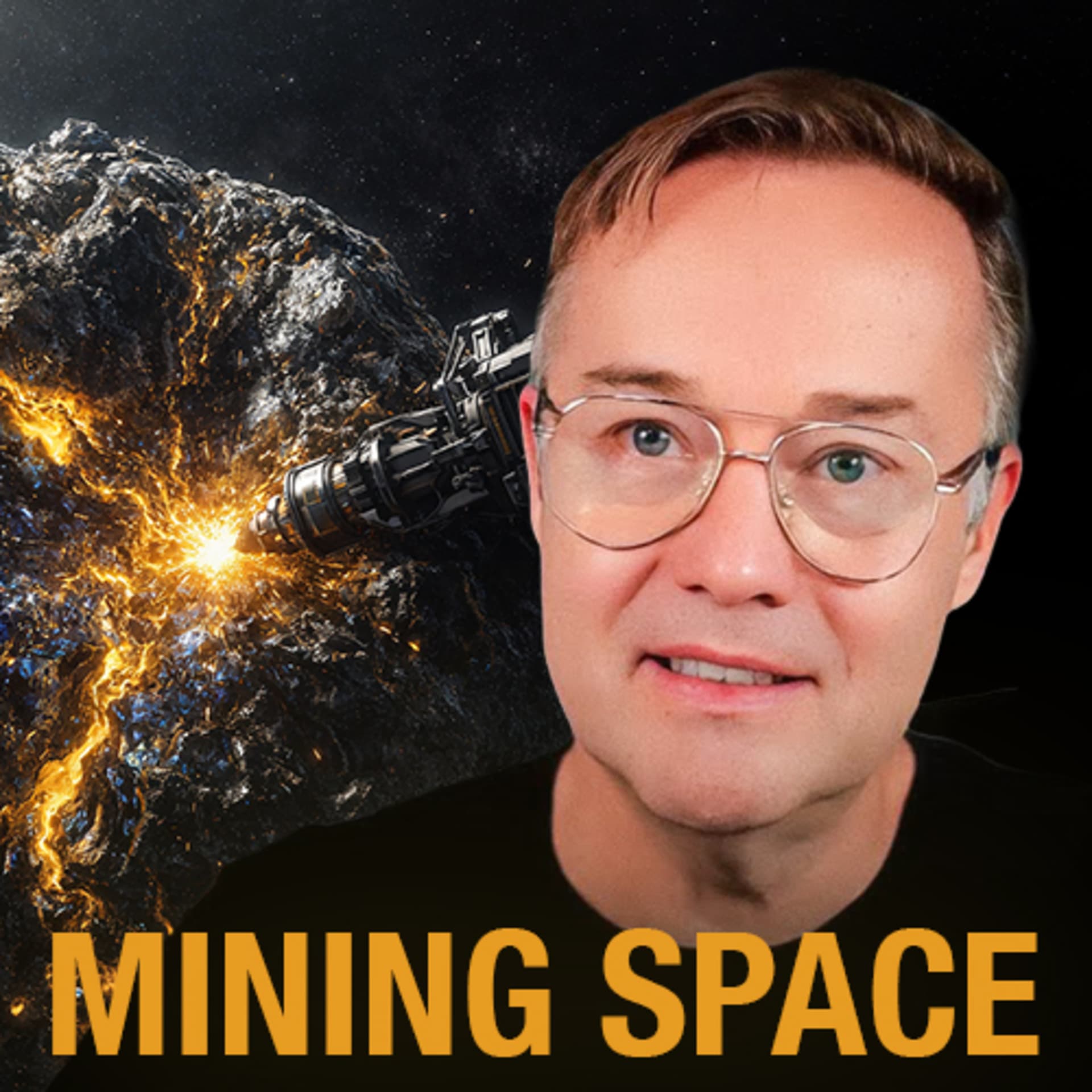

In short
Astroforge’s plan to mine platinum group metals (PGMs) from near-Earth asteroids, using a magnet-based landing and laser-based material removal, plus a discussion of Deep Space 2 and prior mission Odin.
Key claims
Astroforge will launch a 200kg spacecraft on a Falcon 9 later this year to attempt asteroid docking (not sci-fi crashing), then extract up to 1,000kg of material per mission. They cite a potential mission value around $105M and target spacecraft cost near $10.4M total for Deep Space 2. They argue asteroid mining is viable because near-Earth asteroid catalogs have grown to 600,000+ objects, and PGMs are economically important for chipmaking, OLEDs, cancer therapies, and emissions control.
Notable examples
NASA’s OSIRIS-REx sample return from asteroid Bennu informed their models; Odin (Feb 27, 2025) failed due to solar panel non-deployment/power loss; live streaming is limited by ~400 bits/sec at the asteroid, but the control room/data are streamed.
Guests
Matt Gialich, CEO/co-founder of Astroforge (deep-space mining spacecraft). Also referenced: Dante Loretta (OSIRIS-REx advisor).
Written by AI. May contain mistakes. Listen to the episode to check what was said.
Chapters
Tap a time to open that second in VOExploring the Plod Pin
0:54 to 3:09
Discussion about the Plod pin's features and its role in enhancing productivity.
“That's w-i-s-p-r flow dot a-i slash twist.”
Introduction to Matt Gialich and Astroforge
3:09 to 4:25
Introduction to Matt Gialich, CEO of Astroforge, discussing their asteroid mining venture.
“We did our first thank you to our sponsors, but we've got a really great first guest.”
The Challenges of Mining Asteroids
4:25 to 6:34
Matt explains the difficulties and technology behind mining asteroids.
“It's a 200-kilogram spacecraft that will launch later this year on a Falcon 9 that goes to the moon.”
Asteroid Mining Techniques and Economics
6:34 to 9:56
Discussion of how Astroforge plans to mine asteroids and the economic implications.
“We also think about this at volume, Jake.”
Lessons from Previous Missions
11:01 to 14:00
Matt shares insights from previous missions and the learning process following failures.
“That's W-I-S-P-R-F-L-O-W dot AI slash twist.”
Exploring Communication Failures in Space Missions
14:00 to 14:54
Learn about the challenges faced in space communication and navigation.
“We were still able to communicate with it.”
Investor Relations and Startup Risks
14:55 to 16:14
Discover the intricacies of managing investor expectations in high-risk startups.
“And as a startup, how many swings at bat do you get?”
The Economic Value of Space Minerals
16:18 to 17:24
Understand the significance of platinum group metals in asteroids and their rarity on Earth.
“I'm going to be very honest with you about this.”
Impact of Space Mining on Earth Resources
17:24 to 18:34
Explore how space mining could change the availability of rare metals on Earth.
“I might've been a little tired in my chemistry classroom 40 years ago, but tell us about what they're used for here on Earth.”
Market Dynamics of Platinum Group Metals
18:34 to 19:46
Learn about pricing dynamics and market caps of valuable metals like platinum.
“Like we found a new process to make aluminum.”
Show all 39 chapters
Potential for High Margins in Space Mining
19:46 to 20:16
Examine the potential profitability of mining platinum group metals from asteroids.
“So it's going to wind up being price competitive for you to collect this stuff if you succeed.”
Future Space Missions and Expectations
20:16 to 20:58
Get insights into upcoming space missions and expectations for success.
“All right, well, listen, we are going to be rooting for you.”
Debate on Capitalism and Technology
22:16 to 24:26
Discuss the impact of capitalism on technology and resource accessibility.
“Okay, well, maybe the sovereignty of the United States versus, I think, most of these palladiums are in Russia, China, South Africa, et cetera.”
Understanding Tau and Blockchain Innovations
24:26 to 28:00
Explore how Tau differs from Bitcoin in utilizing blockchain for AI and trust.
“As we've seen on this show, there's limited utility in it.”
Understanding BitTensor's Incentive Structure
28:00 to 30:44
Learn how BitTensor redefines blockchain by focusing on incentives.
“So what the founders of BitTensor did is, look, let's strip out everything from blockchains, all the noise, and let's take their core.”
Building Distributed Training Models with Templar
31:56 to 39:50
Explore the mechanics and economics of decentralized model training.
“I got very lucky they acquired one of my startups and I am stoked.”
The Future of Sovereign AI and Decentralized Training
39:50 to 42:00
Understand the societal and economic implications of decentralized AI training.
“And when you paid them, you paid them in subnet tokens or in Tau and explain that relationship that comes up over and over again.”
Exploring Decentralized Training Options
42:00 to 43:15
Learn about the mission of providing training options for everyone and the new market it could create.
“And we can't make the same mistake with decentralized training.”
Understanding Templar's Corporate Structure
43:15 to 44:35
Discover the corporate structure behind Templar and the upcoming training runs planned.
“Should I be investing in the Templar tokens?”
Adaptive Algorithms in AI Training
44:35 to 46:35
Explore new algorithms that allow AI training to be more flexible and efficient.
“You have a well-connected latest model GPU scarcity.”
Insights on Decentralized Growth and Future Goals
46:35 to 47:49
Learn about future goals and the importance of decentralized growth in AI.
“So for our next act, we will be deploying a new algorithm and pre-training and post-training a useful model on decentralized growth.”
Bitcoin's Future and Its Challenges
47:55 to 52:48
Discuss the potential for Bitcoin to be replaced and the implications of market dynamics.
“And just to remind folks, I sometimes will place a bet in order to learn.”
Exploring Y Combinator's Resources
56:00 to 57:20
Learn about Y Combinator's unique tools for startup founders.
“And one of the things, um, so YC has this thing called book face.”
Introducing Open Grinola: A Real-Time Startup Assistant
57:20 to 58:20
Discover how Open Grinola offers real-time feedback and suggestions during meetings.
“from like the best resource for startups available to me in context during a conversation that I might not even have known, you know, existed before.”
Demonstration of Open Grinola's Features
58:20 to 1:00:40
Experience a live demo of Open Grinola's capabilities and its innovative AI features.
“So, you know, it's gotten pretty, pretty crazy.”
Real-Time Due Diligence and Competitor Analysis
1:00:40 to 1:03:00
Understand how Open Grinola performs due diligence and competitor analysis during pitches.
“So as as the founder is kind of speaking, I thought this might be a case that you'd be able to relate to.”
Automating Development with AI
1:03:00 to 1:05:20
Learn how AI can streamline software development and maintenance processes.
“I'm still doing that, but I'm building on the side.”
The Future of Software Development with AI
1:05:20 to 1:06:50
Explore the implications of AI on the future of software development and open-source projects.
“And then I can just, it's like answering a multiple choice quiz.”
Peter Jackson's New Film and Tolkien Lore Expansion
1:10:00 to 1:12:45
Discussing Peter Jackson's involvement in new Tolkien-related films and the filling in of lore.
“Bilbo already got the ring from Gollum and has taken it back to Bag End.”
The Economics of Adapting Tolkien's Works
1:12:45 to 1:14:10
Analyzing the challenges and rights issues of adapting Tolkien's works beyond The Hobbit and LOTR.
“I think the two that kind of hold up the best, Lord of the Rings and Indiana Jones.”
Reimagining Harry Potter for TV
1:14:10 to 1:17:43
Exploring the plans to adapt the Harry Potter books into a new TV series format.
“Each series will be 10 episodes or so, and each one will be—this is recasting everybody.”
Understanding the Economic Model Behind Harry Potter's Return
1:17:43 to 1:21:18
Breaking down the economics of the new Harry Potter series and its potential impact on subscriber growth.
“So I just want to walk people through the economics of at scale companies.”
The Future of Harry Potter and Expanded Universe Potential
1:21:18 to 1:23:45
Discussing the broader implications of the new series on merchandise, theme parks, and fan engagement.
“And man, I got to think for my kids who love this series, they're going to be watching this at the edge of their seat.”
The Quirkiness of Disney Adults
1:24:05 to 1:25:15
Explore the intriguing world of Disney adults and the societal perceptions surrounding them.
“I just want to say for Disney adults, I think there's a case to be made.”
TV Show Recommendations
1:27:41 to 1:32:23
Discussion about recent TV shows including 'Paradise' and their intriguing plots.
“No, and neither is the foot pedal company.”
Music Album Insights
1:32:23 to 1:36:17
Dive into discussions about music albums and the unique performances associated with them.
“What album or albums would you most like to see a band play from track one to the first track to the last track with like a theme?”
Film Recommendations and Reviews
1:36:17 to 1:37:45
Insightful reviews of indie films like 'American Sweatshop' and 'The Screener'.
“Anyway, anything else on your off-booty list?”
The Impact of Film Piracy on Filmmakers
1:38:00 to 1:38:21
Explore the devastating effects of piracy on filmmakers and the industry.
Discussion of Jim Cummings' Work
1:38:21 to 1:38:54
A look into the films directed by Jim Cummings, including recommendations.
“The guy who directed and and wrote this is Jim Cummings.”
Transcript
Automatic transcript. May contain errors.0:00All right, everybody, welcome back to This Week in Startups. It's Friday. That means Lon Harris is here with me. And at the end of the show, we will do Off Duty with Lon. Everybody loves that segment where Lon takes us off duty and we share what we're buying, what we're consuming, what we're watching. This Week in Startups is brought to you by Deal. Founders ship faster on Deal. Set up payroll for any country in minutes and get back to building. Visit deal.com slash twist to learn more. Circle. Circle gives you everything you need to build and scale your community-led business. Twist listeners get$1 ,000 off the Circle Plus plan at circle.so slash twist.
0:42And Whisperflow. Stop typing, dictate with Whisperflow, and send clean final draft writing in seconds. Visit whisperflow.ai slash twist to get started for free today. That's w-i-s-p-r flow dot a-i slash twist. Let me just start the show by saying I love Plod. You love Plod. I'm using my Plod pin right now to record this very conversation. Why? Oh, you have yours too? Did you activate yet? Oh, yeah. No, it's running. My Plod goes all day. Yes. And I have mine running now. And I just, you know, it's got the red light. So I'm being privacy first. And, you know, I only use it when people know I'm using it.
1:22But this is the interesting thing. You can wear the Plod pin like you're wearing it. Or you can wear it on your wrist. Another great way to wear it. And what I do with this is when I'm hiking around the ranch or I have a moment, applaud, take a memo, action item. We need to move two of our researchers into the paid newsletter that we're doing. Please have Lawn Pick as number one and two, even though that's super uncomfortable to ask in front of everybody, the one and two, which is why you didn't answer it. I sent you my one and two picks privately. I don't like to pick babies in front of people.
1:56I like to create a little bit of like, who's ready for this? Anyway, that's my management style. But Plod is amazing. And what it does is it creates a summary, and then you can share that summary. Yes. Then they have like 20 different, I don't know, maybe it's hundreds, but I have like 20 really nice templates I use. Like full accurate transcript. It learns who Lon is in my life. It learns who Alex is. It knows them. So then for all time for it, I don't have to mention that. It creates a mind map of the conversation we have when we have a strategy meeting, all this great stuff, and then one-click share.
2:29Why is it better than using your phone? Oh, my God, your phone's microphone stinks. And you have to, though, clumsily go through your phone as opposed to beep one button, you're ready to go. It's the contextual. It understands the conversation and really thinks about how to organize it for you. That's the really great thing. What's the offer? What's the offer? We have an offer? We do have an offer, Jason, of course. So you can check it out at plod.ai slash twist. And if you use the code TWIST, they're going to give you 10 % off your new Plod pin. That's P-L-A-U-D dot A-I slash TWIST. And please, if you do have a good experience with it, share it on social and tell everybody you found out about it on This Week in Startups on TWIST.
3:08Yeah, we appreciate it. Please. All right. Let's get started. We did our first thank you to our sponsors, but we've got a really great first guest. I'm excited about this one. I'm excited. I saw some of their tweets going by. I read a little bit about the startup, and I immediately pinged the team. Like, let's get these guys on. I want to learn more about this. So we've got Matt Galich. He's the CEO and co-founder of Astroforge. They are a mining startup. They're developing spacecraft to go prospect and extract platinum group metals or PGMs from near-Earth asteroids, Jason. That's the plan. So literally, science fiction is reality.
3:48Matt, welcome. Have you been on the program before, Matt, or is this your first experience? I talked to you maybe three years ago. I remember, yeah. Yeah, we first launched before we had ever launched our first spacecraft. Yeah, so congratulations. Where are you at with mining asteroids? Look, this is a really hard thing to do. I mean, we are the first commercial company that really wants to go outside of the Earth-Moon system and explore the solar system, right? It's a totally big swing on space. We've seen a lot of venture dollars go into space. A lot of companies start up into space. And we're kind of that next step in what you can go do.
4:23Right now, we're building Deep Space 2. It's our next spacecraft. It's a 200-kilogram spacecraft that will launch later this year on a Falcon 9 that goes to the moon. And it'll attempt to go out and potentially land on an asteroid. Wow. I want to jump in here. I was doing a little research on this. When you say land on an asteroid, are we talking about like the rocket, like ship comes down, like in the sci-fi and it lands on the surface? It's more, it's sort of like a docking procedure, like with the International Space Station, correct? It's much more like a docking procedure. I mean, we have to kind of like, what the movies tell you and what's actually out there are two very different things, right?
4:59We go to what are called near-Earth asteroids. They're pretty close to the planet. The one we're targeting right now is about 10 million miles away. And these asteroids are around 200 meters in diameter. So in the terms of space, these are very, very small things in space that we want to go land on. Now, we're also looking for a very specific type of asteroid. We're looking for an asteroid called a metal asteroid. And because of that, these asteroids are about 70 % iron, somewhere in that range, iron nickel, which means they're magnetic. So the way we land on them is simply with magnets. We stick to the asteroids.
5:29Because Armageddon, which is my big cultural point for landing on an asteroid, it's like they're crashing into the surface. Steve Buscemi's knocking back and forth. But it's really, it's more delicate than that. No Steve Buscemi in this analogy. These are unmanned. You land, you take a sample, and then eventually, Matt, am I correct that you want to build like a more semi-permanent installation on one of those when it's in orbit? Or like, what is the window for you to actually drill into an asteroid consistently and then get it back to Earth, right? Because that's the other piece. You want to get these back to Earth?
6:06or do you want to use it for facilitating manufacturing in space? The problem right now is on the planet. The problem right now is not in space. While we'd love to supply the in-space economy, currently right now there isn't an in-space economy, right? I'm a firm believer that there is still a mass problem to space. Now, Elon has done tremendous things to lower the price of mass to get into the solar system. That all being said, you're still charged by the kilogram. That is still the underlying thing you pay for. So building a small craft that can go do this is where we see the sweet spot to be.
6:36We also think about this at volume, Jake. So it's not about can you build one huge ship that goes and does this? It's can you make hundreds, if not thousands of them that are going to go out to these asteroids, mine them and bring it back to Earth. But look, guys, we got one planet. We got one habitable planet in the solar system as of today. We got to protect it. And mining is one of the most destructive things we do on this planet. There's no other way to have our way of life unless we go out in the cosmos and mine it for its resources. Walk us through this video we're seeing here. I think one thing that is always surprising to people, we talk about asteroids, everybody says like, oh, that's sci-fi, you can't mine an asteroid.
7:08This is literally a NASA mission that went out and mined an asteroid. This is Bennu. It was run by a guy named Dante Loretta. Worked on it for 22 years. He's an advisor to us. And this went out to a different type of asteroid than we want to go to and took a sample of it and brought it back to Earth. This sample returned about, I think, about a year and a half ago. A couple members of the team are on our staff here. And they got a whole bunch of information about this asteroid. What's super important about that mission to us, though, is it updated the models for how we look at asteroids. So it helped us understand the types that are in the solar system.
7:38And what are we seeing here? What is that machine or satellite? Is that your actual miner that we see there? What you're seeing here is maybe, look, I was in elementary school in the 90s. I don't know about all the listeners, right? But in the 90s, we heard about this asteroid belt, and it's where all the asteroids were. Nobody had ever discovered any asteroids close to the Earth. In fact, at the turn of the century, there was about seven asteroids that were classified as near-Earth asteroids. As of today, we have over 600 ,000 of them cataloged. So what I'm actually showing you here is that what you were told 20 years ago is very different.
8:09There's a lot of objects really close to our home that we can go mine. And that makes this a much shorter mission and I think a much more viable mission to go do. All right. Amazing. And so what does the actual miner look like? Do we have the actual miner and what it looks like and what it actually does? Like, explain that to us. There is a picture on Twitter that we just put up. Yeah, here it is of one of the first phases of mining. Now, mining is one of the biggest IP things we have at the company, but I'll tell you guys in short how this works. It's a pretty simple way to think about it. We use directed energy, i.e.
8:41lasers, to remove material from the asteroid, and then we sort it out with magnetism. Platinum group metals are not magnetic. Iron, nickel are, and it's a very simple way to think about sorting out the material to bring it back. The spacecraft we have is designed to bring back up to 1 ,000 kilograms of material, which in today's dollars, now, this stuff, look, it's a commodity. It fluctuates all the time. As of today, it's worth about$105 million per mission. So that's kind of the upper cost target. We got to be below to make this work. And the whole point of the company, J. Cal, is how do we turn that little knob of risk, right?
9:12How far can we turn that knob of risk to lower the cost to get the cheapest spacecraft in space to go mine that asteroid and go out? Now, Deep Space 2, in total, including the launch, is going to cost about$10.4 million. That's a very different price point than anybody's ever tried to go on a solar system with before. So$10 million investment per mission with a potential return of a Hyundai. That's a lot. Now, if you just hit it, being an angel investor and doing this for a living, or a poker player, hey, you just need to have this happen one out of every 10 times in order for you to break even.
9:49So does that mean it's a sure thing at this point? Do you feel confident it's a sure thing that you'll be able to get one in 10 back? I wanna tell you about a product I'm obsessed with and everyone in tech seems to be obsessed with. It's called Whisperflow, W-I-S-P-R flow. You set it up and then you hit a key combination and you talk and it transcribes what you say. It does it more accurately and quicker and across all your platforms than any other speech-to-text software I've ever used. When you communicate all day long, like I do, even as a fast typist, it is going to be three, four, five times faster than you can type.
10:26And because it fixes all of your ums and your ahs and your mistakes and cleans it up, all of the punctuation, all of the filler and unnecessary words being removed in real time, Whisperflow is already available everywhere. When I'm using it in Superhuman, Gmail, Slack, Google Docs, I use it everywhere. The messages sound like I wrote them. We're moving into a world where agents are going to make us 100 times more efficient. Now, you add Whisperflow, making you 5, 10, 20 times more efficient. Visit whisperflow.ai slash twist to get started for free today. This product's amazing. That's W-I-S-P-R-F-L-O-W dot AI slash twist.
11:07I've been using this product for six months. It is extraordinary. I'd be lying to you if I said I was 100 % confident we can do this. I'm a founder with a thesis that we can get out of the universe for$10 million and go mine an asteroid. And as soon as I'm 100 % confident, that means I'm not paying attention to all the things that can go wrong. Like, this is a very technical company and a very technical job as CEO to go run and figure out if we can do this. And that's kind of what we spend all our time doing, J. Cal. I mean, it is really from, I think Elon showed us the way here of be one of the best engineers on the team that can go develop these products.
11:38You have to know this in and out of how we're going to go do this. And that's what I spend all my time doing. Remind us again, when does this mining mission occur? And are we going to get to watch it live? I mean, one of the things I've been amazed with over the years is that Elon has really high fidelity video from all of these, you know, different missions now, like even the multiple stages. I'm not sure how he does that. I'm assuming Starlink is involved. I know they have like helicopters and drones, you know, doing the low, Earth or doing the atmosphere video. But take us into bringing the world into watching you do this.
12:15Is that a key part of this? And is that a key part of, I think, Elon's success with SpaceX is bringing humanity along for the ride through live streaming? I'm going to be honest with you. I wish we could live stream at the asteroid. The answer is we cannot. When we're at the asteroid and the way we save money is very simple. We lower our data rate dramatically. So at the asteroid, the max we're talking the spacecraft at is about 400 bits per second. That is not a video stream quality at all, right? This is like barely being able to talk for the spacecraft. I mean, that's how you keep it cheap.
12:45What we do do, and what we did do with Odin, our last mission we launched, right, is we are full transparency. We live stream the entire control room, all of the data we see, anybody else can see. I mean, I believe in transparency up and down. In fact, when Odin failed, we wrote a ton of articles that are on our website. You can go read about it. of exactly what happened and exactly where we got it wrong and how we plan on fixing it. Because at the end of the day, that's how you learn and get better at this. So what, take us through that. The mission two was Odin and mission three is Vestry. When did that, Odin, yeah, Odin happened March, 2024, right?
13:18Odin was February 27th, 2025, right? Last year. So about 11 months ago was when we launched Odin. Odin was our first attempt to go out into deep space. It launched on IM2. So this is a rocket launch going to translunar injection, right? This goes to the moon. We leave from the Falcon and we slingshot around the moon out to the asteroid. What happened on Odin, to be clear, Odin was a total pathfinder for us. It was the first commercial deep space mission ever attempted. We got the first license from the FCC to ever go into deep space as a purely commercial company with no government interest. And we had a failure right away.
13:53One of the failures that happened was the solar panels did not deploy. So the spacecraft is in a very slow spin where we were not power positive. We were still able to talk to it. We were still able to communicate with it. In fact, we were still able to prove out a lot of the technical navigation philosophies we used on that mission. But at the end of the day, we didn't get to the asteroid, right? We didn't do good enough. We got to do better on the next one. I did think one thing that was interesting, the two missions, neither of which went right so far, they were both like communication failures.
14:20It wasn't like the craft exploded or spun out into the galaxy. It was like you kind of lost touch with it at some point. I think I do a shitty job of explaining this. I try to explain it this way like the way you die as a human is your brain stops sending electrical signals the cause of your death is cancer heart attack whatever car accident whatever that is right so like communication will always be what it seems like odin communicated perfectly we didn't have a communication problem what we had on odin was a power issue so we weren't able to turn on the radios that was why it manifested as a communication issue so again we proved out a lot on that mission but we got to do better on Deep Space 2.
14:55And as a startup, how many swings at bat do you get? And talk to me about the investors in the company. I think you've raised like 50 million bucks. How do they look at this? And how do you communicate, hey, this is a pretty binary thing. Either it works or it doesn't. And I know Elon struggled with this in the early days of SpaceX. So take me through that struggle and communication with investors. I mean, it's hard. You need to have special people that are willing to jump aboard their ship and see the future with you, right? And really can take a deep look at the future. Now, I want to give a lot of credit to Elon for paving the way and showing investors that it's possible to have these outsized return if you're willing to take outside risk, right?
15:33But like, this is a hard thing to go pull off. We do have some amazing investors. I mean, initialized capital, Gary Tan is who led our seed round, right? And then we went through Y Combinator. 776 is a big investor in us. We have some massive angels that have really helped us get over the line. And being super transparent with the investors about what we're doing and the risk we're taking, I think is one of the things that we're really good at. Like our investor monthly letters are giant documents that I write as a way to not only document what we're doing at the company, but to show people the progress we're making.
16:01It is all about incremental progress as you go here. I mean, guys, Elon failed three times with Falcon 1 before he got there with the fourth launch. We're going even farther and we're going after something even bigger. It's going to be a rough road, and you've got to kind of strap in and expect it. Now, there are some materials that exist on asteroids that don't exist on Earth, or they're very rare on Earth. Am I correct? Not really, J.K.L. I'm going to be very honest with you about this. The material we're going after is platinum group metals, right? So the six elements that make up platinum, iridium, you can go look them up and see what they all are.
16:37We don't have any of them in the continental United States. So not only is there a huge geological play here, and you've seen China, especially with the rare earths, really flex their muscle here and ban us from having gallium and some of these other materials. I mean, Trump put out a huge executive order on minerals, right? We need mineral sovereignty as the US. There is no way to make this up or go get it. The minerals that we have discovered are way too deep in the ground for us to go mine. The most economical play though is to go to space. And I think that's the big difference. This isn't necessarily a security of resources.
17:06I think this is a better economical advantage than opening a new platinum of mine in South Africa would be. Yeah. And these PGMs, that's the key. Those palladium, rohidium, osmium, osmium, rhenium, and iridium, I believe. Yeah. I might've been a little tired in my chemistry classroom 40 years ago, but tell us about what they're used for here on Earth. And if you could, at scale, bring down... Because I understand one asteroid could have more than we have on Earth. And I don't know if that's true or not, but that was some of my cursor research when I found that. There's a lot of this stuff in space that we can go after.
17:50What is it used for? Every single thing that every VC invests in. How do we make computer chips? You make it with iridium crucibles to melt silicon. This is used in every walk of your life. If you're looking at an LCD screen right now, on an OLED screen, they have three of the six platinum group metals in it. We touch it every day across the board. It's in cancer therapies. It's also in how we limit emissions on your car. This stuff is just used worldwide. That's why it's a commodity, right? It's not like some special thing we're making up. It is a commodity metal that we want to go provide. Now, you asked a question that I can't answer, which is, hey, what if we actually change the supply and demand curves and we bring back a lot more?
18:26What does the future look like? This has happened before. It happened in the 1800s with a metal called aluminum. You guys all know about this, right? Like we found a new process to make aluminum. All of a sudden it went from like the most baller shit you could have to we make airplanes out of it. It enables modern air travel. For some reason, they now make the iPhone out of it. A terrible decision, but different conversation. I hope there is a future like that that can be created with what we're doing by journeying out and unlocking the supply of platinum. And that rhodium is incredibly expensive, yeah?
18:57Like tens of thousands of dollars per ounce. Iridium is incredibly expensive, but I think it's really important to have maybe a little bit more nuanced view on metals here. The price that you sell a gram for an ounce for, however you want to quantify it, isn't necessarily the best marker of what the use case could be from a business standpoint. You really got to pay attention to market cap. And I think this is where a lot of people in mining get this wrong. The largest market cap in the world is gold. The second largest market cap in the world is the platinum group metals. There has to be a huge supply here on earth that we can go into because the reality is the question we get asked all the time, which is very true, If we go find some new material on Asteroid and bring it back, we destroy the market for that material, right?
19:35There has to be a huge amount that can be there before we destroy the market. And with platinum group metals, there is. To give you guys a sense, it would take us about 100 missions before we would screw up the price of platinum. Got it. So it's going to wind up being price competitive for you to collect this stuff if you succeed. and if you were to have like outlier success, you could actually change the market cap and how we look at these things, yeah? I mean, Jake, the best platinum group metal mine in the world in South Africa has 14 % gross margins. I just told you a story, we could have 90 % gross margins.
20:08That changes the way of how we go mine, right? That opens up a whole new future that we can all go enjoy where we have abundance. And I think, isn't that what every startup founder should be aiming for? Absolutely. All right, well, listen, we are going to be rooting for you. and what's the date again for the next one so we can put it on our calendar and have you back on afterwards and share your learnings. So the next one is on - Great success. On IM3 currently right now, scheduled for November of this year. November of this year. Exciting. Will it be Starship or it's going to be Falcon, you said?
20:38No, it's going to be a Falcon 9 that goes to the moon. Yeah, so the Falcon 9s are incredibly consistent at this point. Amazing. Yeah, they've got such an incredible track record now, hundreds of them. All right, so we will book you to come on in November and we will get the update on your amazing progress I think this is like third time is gonna be a charm. I hope so guys. We need it. Yeah, I feel good about it Incredible. I mean, it's literally like we're living in a science fiction novel Yeah, this one when I was researching it last night you're reading it like I can't believe they're already do it This sounds so purely theoretical and that's what I assumed I was like, oh well, they're talking about in 10 years Maybe we could do that's like they're already running missions.
21:15It's happening circle is the best place on the internet to start growing your online community there i said it you know why because i tried to find a community platform for my founder university and for my angel university programs and we couldn't find one after we started digging and digging we found the perfect solution circle.so it has all the most amazing features like you can put in a course like you have a crm you can do email you have chat rooms and message boards it is amazing whether you're selling a course or you're building a community based on a topic, or maybe you're starting a book club.
21:47Maybe you're a coach. Maybe you have a business. Maybe you want to build a community for everybody to get together and learn and share information. It's all inside of Circle. How do I know this? My team did a bake-off. Once we started finding these platforms, it was like a Franken-site. All these different pieces, nobody had put them all together until Circle. And Circle's going to put it together for you. To get started, go to circle.sew.twist and get a thousand dollars off the circle plus plan that circle.so slash twist this is the um you know underappreciated thing about technology and capitalism right we're we're in a a bit of an existential debate here in the united states over capitalism over you know wealth disparity everything the truth is when you set up uh you know a system like the united states or we were talking about tau subnets that are designed to be brutally capitalistic what happens you're basically in a competition to see who can lower the price to the point that um more unlocks happen so in this case what elon did with lowering the price to get to space allows this company uh you know to astroforge to then build and stand on his shoulders now astroforge makes this work then you have to say, well, what is the second order, which is what I tried to get to in our quick interview here, is what's the second order impact?
23:12Okay, well, maybe the sovereignty of the United States versus, I think, most of these palladiums are in Russia, China, South Africa, et cetera. South Africa and Russia are right now the world's two largest suppliers of these platinum group metals. So yeah, it totally changes your thinking to be like, we've built an entire world and civilization based on rhodium and iridium being very rare and you got to go dig down in places you don't want to go to go get it. And what would change if all of a sudden it was like, now we can go out to space, grab a rock, laser it up and just fly the iridium right back to Earth.
Read the full transcript
23:46And so this is something important for all founders listening. The better, cheaper, faster is kind of how we used to look at technology in the wired 1.0 days, not the woke wired magazine now that's anti-tech or like holding truth to power. The New York Times says it's not woke enough, Jason, just so you know. The New York Times says they're not even woke enough. Everybody had this like little brouhaha and, you know, on Twitter in the last 48 hours over like Wired, you know, suddenly being the like resistance against tech. You know, okay, fine. Hold truth to power. I get it. I think they found a niche, you know, like everybody needs a little voice, a niche now, just covering the big news of the day.
24:26As we've seen on this show, there's limited utility in it. Yeah, and if you pick a side, you can get on the horseshoe, you know, the most extreme left or right or capitalistic or socialistic. Oh, there's the tweet. You play into what the audience wants and then you give them the red meat that they want and they'll keep coming back to see what you have to say. That's why I subscribe to Jacobian magazine. This is the teen issue. Oh. indoctrinating teens into socialism. Yeah. Gotta be done. And communism. Important work. Yes. They are revolt maxing and they've reasoned built. I like to - Oh no, not revolt maxing.
25:08They are revolt maxing. I just love understanding how this side of the aisle thinks. So I literally subscribe to it. And I listened to a couple of these magazines. You know, in that alternate world where the communists won, you wouldn't see this kind of you certainly wouldn't see the wealth disparity because everybody would make the same amount of money and then uh you also wouldn't see the massive progress we're making as a society when it comes to technology if you're a founder you can win by making a better product a faster product a cheaper product a product that entertains people it's usually falls into one of the who's four categories yeah and you have to ask yourself if your product is not informing or entertaining, you know, educating, informing, that area of like entertainment, making life better, cheaper, faster, you know, and increasing the fidelity of results, then you're probably not going to have a big business.
26:05And that's what they're betting on here. Great job. Good get. And we're rooting for them. So well done. I like the first company already. Yeah. This week in space. Here we go. That was good. We will have to do this week in space at some point. We've been talking so much. AI plus Tau was sort of one of our big themes for this quarter, this month. And so we're continuing our chat with a whole bunch of different subnet owners from some of our favorite subnets. And up next, we've got Sam Dare. He's from Templar. Now, you actually talked about Templar on the All In podcast with Jensen Huang, I believe, just last week or two weeks ago.
26:42Yeah, that was last week. Yeah, Chamath brought it up during the discussion. These are the guys that have created Covenant 72B. That is their 72 billion parameter model that was built in a decentralized fashion over the computers of hundreds, thousands of different participants. So let's bring on Sam and talk about it now. I'm very excited about this. You know, I forgot how cheeky and fun the crypto community is. And I obviously, you know, I elected to sit it out for a while, but I was talking a year ago, Sam, with my friend Mark Jeffrey. Welcome to the program, Sam. I was talking to my friend Mark Jeffrey like a year ago.
27:22He's like deep in crypto. He was early into Bitcoin and everything. And he said, yeah, you got to check out Tao. I think like it would appeal to you. Your criticism of, you know, Bitcoin and some of these other crypto projects, ICOs, was that they didn't have customers. They weren't building value. It was all speculative, store of value, money transfer, which, you know, money transfer and store of value, Sam, I think we would all agree, have some value in the world. But Tao is doing something uniquely different. What is it that Tao is doing uniquely different? And then we'll get into what you're doing.
27:52But just big picture leveling up. Explain to the audience as best you can what's unique about Tao versus, say, Bitcoin. That's an amazing question. So narratives matter. and for a very long time like what the easier way to think about Tau and Bitcoin is Tau is a Bitcoin of AI but I don't think that does it the just justice and it imposes some constraints on a system that's like multi-dimensional because Bitcoin especially invented Bitcoin to transfer value it's evolved into many different things it's still evolving now we don't know it's final form but with Tau we try to okay, what are blockchains meant to do?
28:39What is the core of blockchains? Is it smart contracts? No. Is it privacy? No. Is it some funky execution environment? No. It is, can we mechanize trust? They are incentive machines. So what the founders of BitTensor did is, look, let's strip out everything from blockchains, all the noise, and let's take their core. What is it? incentives and let's blow it up a thousand a thousand feet so the only thing that matters is incentives so that is the primary units in bitensor it's incentive now you understand how you can't really call it bitcoin because this is a multi-dimensional factor like how do you codify human behavior so that is the problem bit tensor tries to um tries to solve how do you strip away all the noise how do you like because the ultimate the ultimate trustless systems if not cryptography is incentives so we so what bitterson gives you it's really difficult because you know you could build anything with bitterson if you can codify an incentive game well the the units of production of bitterson their subnets subnets are like magic factories where you um as a subnet owner you have this very brilliant but self-interested people you need to convince them no no no you don't need to cause this they need to force them to follow your rules and create this incentive landscape which is just it's a game like miners do this validators do this goods come out but it's your job as a subnet architect to design a game that forces the miners because miners are economically rational.
30:21They care not for your objective. They care about the money. But you need to keep taking away everything. Great. So you created a rule set for Templar that does what? What is the incentive structure that you decided to create for your miners to then contribute in their own self-interest for you to solve some problem in the world? Walk us through it. We've got a brand new partner here at Twist. And as fate would have it, we love and use their product. If you need to hire, manage, pay, or equip your team members anywhere around the world, you need D-E-E-L. They're going to take care of all the annoying human resources tasks that you don't have time for.
31:04Payroll, compliance, visas, and onboarding. So you can stay focused on achieving product market fit, or scaling your business, or finding more talent. Deal scales with you. They do all your chores, all the hard work, and they do it perfectly from the first hire on. So there is never a need to switch platforms or transition to a new system in the future. It's future-proof. And with Deal, you can set up payroll for any country in just minutes and get all the complicated visas and paperwork settled right away, allowing your business to grow without borders. And that's the smart way to grow now. Talent is not limited to San Francisco, the United States, or this continent.
31:41It's everywhere. That's why more than 37 ,000 startups and fast-moving companies are already using Deal to accelerate their hiring and growth. Find out more by visiting deal.com slash twist. That's D-E-E-L.com slash twist. Also, I happen to be a shareholder in the company. I got very lucky they acquired one of my startups and I am stoked. It's an amazing company. At a very high level, to successfully create an incentive mechanism, you need to be able to isolate what you want to improve. It's super, super important. With Templar, we could say, okay, every round, we require minors to train over a data set.
32:23Now, the minor that reduces the loss in that epoch the most, so it means that you've contributed most of the training, you win the most money. That's what it is at a very simple thing so you have like 70 and 70 people competing okay let me get the best gradient let me get the best gradient let me get the best radio so they train really really hard now that is that that's a straw man but it's the high level view of what we manage to achieve now we spend months trying to perfect it because oh my god like the funniest thing is so sorry sorry i i've been living loads post drama. Shout out, Noah. I can see in your face the memory.
33:09Because it's really funny because you spend a lot of time running simulations. When you start, the way you get hacked is just dumb things. But it's very painful. It's very painful. But should you succeed, the results are absolutely amazing. You asked people to contribute GPUs. These are very high-end computers. This is like an Nvidia H100, I'm assuming. So you convince some number of people in the world who have access to one of those, either by renting it or they own it themselves, they have it in a co-location facility, and you don't know who those miners are. It's permissionless to join. But you told them you have to have this specific type of hardware at this throughput to contribute.
33:53And then we're going to put a large language model creation, essentially, out to this distributed network of compute and then pay you for the use of your GPU. Am I broad strokes explaining it correctly? No, no. Kind of, but there's an important nuance. Please. We don't care what kind of GPUs you require. So what we do is we say, this is what we need. All we need to care about is we can validate your inputs are correct. Minus, so in BitTensor, you lean into what I like to call emergence. where you design your validation and you don't care what the miners are doing. I don't care if they're running it on Raspberry Pi or toasters.
34:38As long as this gradient, I can prove that it's good. Then that's what I care about. So eventually people gravitate towards like B200, but the dominant strategy is maybe a miner just rewrites our whole code base so that I can run it on an A100. Those are the kinds of things that properly structured incentives can drive. this is a key piece you know we were just talking with the ceo i think core weave was explaining to me hey like what's the lifespan of some of these a100s h100s etc and they were saying well after like five or six years that's when we we sell them for five years six years and then people will find uses for it and this is the case they might take an old piece of hardware and take the time to make the training job run on and you don't care.
35:27How many, explain to us what you accomplished with this run. And, um, this was the one I think Chamath brought up with Jensen, which where were you when you found out he brought it up? Your phone must've blown up because I didn't know he was going to bring that up. Obviously I've been involved in BitTensor for just about a year now in terms of, you know, uh, being a partner at still core capital, um, and investing in it. But where were you when you found out? And then explain to us the training run you did. I was working and someone pinged me and I think I got a mini heart attack. I'm like, no, you can't die now.
36:01Wake up. I think I really had a like, I mean, it was amazing because before that, like, so just take a step back. Your criticisms of crypto are valid. For a very long time all we have is nihilism all we have is you know pvp um extraction so everyone no no one had hope in crypto anymore and all of a sudden we posted about 72 billion pyramids around and it caught fire so i thought you know what this is the biggest thing because people are saying templar you know finally validates not just bit tensor but even the larger crypto like finally a useful crypto that was good for me i believe the bitcoin it failed me so when i came to um bit tensor i found the decentralized training and the idea of this decentralized training is humanity's last bastion it's the final boss but it's when i started it seemed like such a joke and to have it finally you know to test it at scale i mean make no mistake we're not delusional we still have a very very long way to go.
37:07But it's like, okay, it's a bit slow, but this thing could have legs. We've had it validated by different people prefer academia, Jack Clark from Anthropic. Because even if you look, so we've got mentioned by Jack Clark from Anthropic twice. Beginning, it's more skeptical. The second is less skeptical. And for me, it's like, yeah, yeah. All right. So to explain this, there was a bit of a technical breakthrough here. You trained this 72 billion parameter model across this Tau subnet, subnet three, I think you are. and people as part of the Templar project solved and they ran local optimized steps, compressed and then shared the updates and then you put it all back together and you basically trained a significant model which a company like ChatGPT or DeepSeek or Kimi, they would have spent a bunch of money using a bunch of computer hardware to do this.
38:17you did it, and how much did it cost you to build that model? The cost over the run is about two, about two, three billion. But again, you know, it's very, it's very important to be clear. It's not a frontier model. It's nowhere near. And, you know, it's closer to Lama 2, which is the frontier two years ago. So, you know, we're still a bit, we're still far off from the frontier, But we are moving so quickly because in the space of nine months, we've managed to go from 1.2 billion parameters to 72 billion. So it's more about the story of exponential. So the progress is significant. You're ramping up.
39:01And back to the cost. The cost I'm interested in, you said$2 or$3 billion. I'm not sure. No, no, a million. Oh,$2 or$3 million. How rich do you think? Yes, how rich do you think? No, no. $2 to$3 million in tau was distributed to the miners? Explain what the cost was to do this. So if we take away team cost bits of negligible, the biggest cost is just running the miners. Now, the exact number is how much we pay out to the people that we're paying out, to how much we pay on an admission. And if we tally, it's about$2 to$3 million. but there were times when we had to roll back the runs and whatnot.
39:43So that kind of made it that high, but we believe we can achieve better, far better economics than any traditional. And when you paid them, you paid them in subnet tokens or in Tau and explain that relationship that comes up over and over again. Okay. So you're going to have to have a different podcast for that. Let me just, you're going to have to have a lot because even sometimes I don't understand But we have a subnet token, Gamma, which is the 10 plus subnet token. So we paid it out to them. So out of it, miners manage their economics. They manage their inventory. They take profits and they hold some.
40:18So that's how it works. Got it. Lon, you had a question. Go ahead. Oh, yeah. I mean, I just think what's interesting about comparing, because obviously we're not decentralized trading. We can't yet produce like an Opus 4.6, like the very frontier. But what are the advantages of doing it this way, other than just, you know, obviously saving costs? There's sort of like a political dimension to this, too, like the advantage of having a model that's trained by a whole community of people instead of, you know, like at the direction of a few like sort of executives. So is that part of the goal, too, that it's decentralizing it in a way that makes it, you know, there's a societal benefit here?
40:58The moral imperative is what got it started. then you understand that there is actually a massive economic opportunity around it. And you've touched on just one case, sovereign AI. I went to Kenya the other week, and these guys, they want to train models. They're trying to scrap together H200s, but they don't have 10, 20 million to train their own models because the sovereign AI movement, it's quite significant. So you have that. I was talking to, I made a commentary. I spoke to a news outlet in India. And what they were saying is, oh, now that Antropic might be banned from the US, India is a big market.
41:40Will we benefit from it? I'm telling you guys, no. You can build your own sovereign AI. So that's a part of it. And more importantly, it's not like there's two different modes to think about this. With Bitcoin, we made the fatal mistake of thinking we were going to replace JP Morgan. We were going to replace it. That was just the dumbest thing ever. And we can't make the same mistake with decentralized training. So what is the mission? The mission is optionality. The mission is choice. The mission is that there's a lot of people that want to train, but they can't. When you open up that avenue, it's not even about competing with them.
42:24It's creating a market that never existed. We can see signs of it. And okay, it's quite geeky, but TLDR, you can probably get a lot mileage off niche pre-training and fine-tuning than just fine-tuning. But no one explores that because the cost of pre-training is so high. So this is interesting. If you can provide an avenue for people to do pre-training now at an affordable price with the sub, with the miners and the validators all working to lower cost and grinding it down in a competition. This is a new avenue for people to do it. Let's end on this. When do you do your next training run and what can we expect from that?
43:13And tell us a little bit about the corporate structure of Templar. I'm an investor, as you know. Should I be investing in Tau? Should I be investing in the Templar tokens? Should I be investing in the corporation? Is there a corporation that's running the subnet. Walk me through those three pieces and then what's next? So there's a corporation, but it's just to pay salaries and employ people. Like it's just to pay salaries and employ people. So Templar is only available to Tau. So that's how you gain exposure to Templar. Our next training run, it's so we had the Epoch AI article states a very big problem or the next very big limitation is that we're still 300 times below the frontier.
43:57So why are we below the frontier? It's because our current algorithm requires every miner or every node in the network to be able to hold the full model in its memory. So this has limitations because everyone has to have a B200. We used B200 in the last day. So in our next, we released a new paper. It's called Heterogeneous Sparse Loco. And what this does is that it lets us basically train across any type of compute. So we become indifferent to network topology. So what does that mean? It means that we can interleave data center and consumer compute. Now, here's what no one's telling you. You don't have a GPU scarcity.
44:45You have a well-connected latest model GPU scarcity. So what if we can get the B3000s? What if we could get the A100 that no one else is using? So the mission is right now, wherever there is an internet connection and a GPU that is free, we'll be able to put that in our own. So this is really interesting. You're building that software layer or that resolution layer that would allow me to take my Mac Studio or if, you know, Lon has a gaming computer with a great NVIDIA card in it. just like SETI at home, you know, allowed people of varying different hardware profiles to run SETI at home, which was looking for extraterrestrial life.
45:28You can have them participate in this. So when will we see the next job get run? And when can we have you back on the program to discuss that? And we'll put the Epoch story, Epoch AI story on decentralized training in the show notes for people to read is really fascinating. But what's next? When do you guys, and then who decides what you're going to try to do next? I wish I could say it was me. It's my research. So I have a couple of prima donnas. They're called the research team, and they decide when. They decide when. But I'm told in the next couple of weeks we'll kick off our next run. And again, so for us, it's like, I mean, the fame is amazing.
46:10like it's mind-blowing but always do good work the next model is not going to be a massive model because it's cheaper to build up this um new primitives on a smaller scale so we probably do a model that is smaller but it's useful so we probably do a smaller model that is closer to the frontier in addition to templar what we also have um we took this pre-training but it's also post training. So for our next act, we will be deploying a new algorithm and pre-training and post-training a useful model on decentralized growth. Then we start to ramp up. And who knows? I set them a target of one trillion.
46:56They told me I was crazy, but we'll find out who's crazy and who has jobs at the end of the year. All right. Well, and there's a website, tau.app. I don't know if you've seen that before. I don't know who runs that, if that's the foundation or not, but it does show you the different subnets and how they're performing. That's the one I go to, to look at stuff. Where can people find out more about the Templar project? Is there an official URL or GitHub or something, a community, a Discord? Where can people go find more information and go down the rabbit hole? We've got www.tplr.ai. We've got Twitter, We've got Discord, and we've got www.convenant.ai because that's the...
47:35Okay. Well, tplr.ai if you want to learn more about one of the more exciting projects going on in Tao. Thanks so much for joining us. Yeah, Sam, thanks a lot. Great to have you. In the news right now, after what happened last week on All In and then me talking about my investment publicly. And just to remind folks, I sometimes will place a bet in order to learn. So let me just explain how insane my process is. And yeah, I can't believe this tweet got a million views, but I did a little tweet, Talgrater than VTC. I saw. And I think the reason I said that was I feel like, and I've said this for a long time, I believe that something will replace Bitcoin.
48:23this is something that freaks people out right if you have all of your bag in you know btc and you're trying to pump it and it's you know back down in the 60s and it was at 130 you're you're only concerned with your bag and your book and anytime there's a new hot coin or project that people get excited about it turns into this war between this one's the future like no bitcoin's the best one. This is an inevitable cycle. But one thing I've learned in, you know, 40 years in tech from the 80s till today is that everything gets replaced at some point. Right. Or almost everything gets replaced at some point.
49:03A better version of almost everything comes out, whether it's Blackberry giving way to iPhone, giving way to Android, whether it's, you know, the, you know, Craigslist to giving way to Facebook marketplace. There's always going to be competition. There was a time when people were like, Friendster and MySpace, that's it. There's never going to be another social network after Friendster and MySpace. Right, so it's not heresy to say something will come along that's better. Now, what you have to understand is what timeframe and how long does the network effect last? Because there are moats in technology.
49:40One of the moats in technology is brand, okay? AOL had a great brand for a while. You said online, it meant AOL. But then sometimes the performance and the actual better mousetrap is what is defensible. That would be the internet and broadband. Sometimes it's the combination of, you know, the brand, the network effect, like Uber or DoorDash, right? They have like a massive network effect, more drivers, more restaurants on DoorDash, etc. So you have to ask yourself, with the game of Bitcoin, are we at that point, whatever number of years later, 14, 15 years later, that a better version could come along that would be more exciting?
50:20Now, when I say it's better, I think it's better at an incentive system to provide value to consumers, to businesses. That's what I think it's better at. And I think all that compute will at some point, let's say, Lon, Templar provides a better use case for compute and transport on the internet than Bitcoin does. What do you think Bitcoin miners will do? They'll take 10 % of their computer and they'll move it over to Templar or to another subnet and say, OK, yeah, let me see if I can make more money here. That's the rational thing to do. I think that's the moment that we're in right now is that people are going to start looking at their infrastructure and say, hey, maybe I should put infrastructure, bandwidth, storage, compute towards this project.
51:05I feel like that's another disconnect that's happening here. A lot of people, you know, they're seeing you talk about Tau is so interesting. I like all these subjects. And they assume that you're doing the pump and dump meme coin rug pill trick, which is like, you know, like Hawk to a girl starts a coin. They start selling the coin. But then before anybody else gets a chance to sell, she dumps all of her coins and then makes the money and then walks away. And that's the sort of classic rug pull. But that's not what's going on with Tao because these are all projects. They all have like a goal. They're all using the blockchain technology to actually accomplish something.
51:40So it's not exactly the same as what we've seen. And it's not a diss towards Bitcoin. It's not a diss towards Bitcoin. But I do think like every technology tends to have an arc, right? And, you know, you see that in non-commercial projects, I will say, are different. You know, so HTTP or the World Wide Web or FTP, like some things are open source Linux. So they're very different and they can continue on for very long periods of time, multiple decades. So, you know, I'm not saying Bitcoin's going away tomorrow, but it has been stuck at 60, 70K for a little while now after this big thing. And then you have one person trying to corner the market on it in Michael Saylor, Michael Saylor.
52:26That I think is a red flag that somebody could even do that. And that could blow up people. I'm not calling it a Ponzi scheme, but people say it's a Ponzi. I'm just saying it's like overly complicated. And it, to me, works against decentralization. So I look at that as like a red flag. If one person's trying to accumulate that much, you know, 5%, 10 % of all available coins, it kind of ends the game of Bitcoin. Anyway, I think we got a demo. We have a demo? We do. We have one more guest coming up. We've got a very cool demo bringing us Open Oats. It used to be called Open Granola. Now it's Open Oats.
52:59We'll have to ask about that. Yazeen Ali Rahim is here. He's the creator of Open Oats. This is Jason. It's an open source note-taking agent that listens into your conversations and provides helpful insights. I'll tell you what attracted my attention about this when I saw it online. This to me feels like the potential realization of what we always talked about for producer Claude. Remember we said producer Claude, we wanted him to listen into the show. And then when we said something about research that it could research, Claude would just look it up and let us know during the show, hey, you mentioned the population of, you know, like India.
53:36Here it is. So that to me, it's like it feels like we're getting we're almost there. OpenNotes feels like it's almost there. So welcome, Yazzie. Yes. Producer Claude, huh? Okay. All right. Well, you know, Claude is, I think, the best language model out there. And it's the most helpful for us, most expensive. And they've kind of had a generational run this year, specifically the last six months. But people do pay for note takers. Note takers are everywhere. What's the case for an open source version of this, Yazzie? And welcome to the program. Thank you. So I kind of feel compelled after seeing Matt and his asteroid mining thing and Sam and the crazy distributed AI stuff to say, you know, this is just like a side project.
54:20I probably spent like a day total just working on this. And it was kind of random because someone tweeted, hey, who's working on like the open granola? And then a friend tagged me because, you know, I've just been building a lot of stuff recently using Claude, actually Claude code. and you know as luck would have it i i'd already been working on a version but i hadn't released it was like 80 there so hey you know why not release the thing right uh and so i i put the thing out and apparently there was like a whole thing going on about granola um preventing people from accessing their notes or their transcripts i i didn't even know about it but you know there was like a whole drama going on and the like my i i tweeted about it and i put a video and it just blew up and like, you know, overnight we had like a thousand stars.
55:10There's like, you know, several hundred people forking the, uh, the repo and, you know, essentially like the core idea is, um, the, the sort of vision behind doing open notes is not just to create like a, an open version of granola, which, you know, I think that that would be fine, but you know, I really wanted to have like local LLMs. So you'd be able to, you know, not siphon off like all of your meeting transcripts out to like some random third party. So privacy is the key here. If you can run it locally, you don't have to worry about your Zoom meeting, your private conversation, winding up, you know, growing, you know, open AI or, you know, Claude's LLM, which is kind of dangerous.
55:55Yeah. Right. Right. And, and the other big part to me was also, so I went through YC a couple of years ago. And one of the things, um, so YC has this thing called book face. Uh, a lot of people don't know about book face. I'm sure you do probably. Yeah. It's their, it's their social network. Everybody posts to it. And it's like a free for all awesome founder social humans, molt book for humans. I understand. But, but there's, there's this special section inside book face, um, called the, uh, startup manual. And basically it's got like all of the accumulated wisdom from, you know, distilled from like all of the batches that they've got where, you know, they talk about great advice for hiring, for, you know, creating a product, you know, getting your engineers on board, you know, doing salaries, compensation, everything.
56:47So they've kind of distilled wisdom over all the batches that they've done. And, you know, they have this, this, this, this handbook or manual. And I mean, it's great, because, you know, as a YC founder, like you can access it. But, you know, I was thinking like there are a lot of situations where I might not be, you know, thinking, oh, you know, maybe I should just go, you know, search for this particular situation. In the meetings that I have, you know, that I'm discussing with my team, you know, other people that I'm working with, wouldn't it be great if there is a way to surface suggestions from like the best resource for startups available to me in context during a conversation that I might not even have known, you know, existed before.
57:35And so that was the kind of inspiration behind Open Grinola. Like that was the one feature that I hadn't seen anywhere else. The real-time feedback I haven't seen either. and that requires local compute listening in and in real time hitting an llm and saying hey we're gonna we're recording it because i can watch like notion or the you know doing the transcript live but show us how it works and obviously you're on github with this you got close to 2 000 stars so people are starting to take notice of it it's early days but that's nice that you broke a thousand so this is this is a an mit license and anybody can fork it there's already been like a windows version.
58:14This is Mac only. So I built it using Swift. It's really efficient. But there's a Windows version. And, you know, there's at least a couple of guys that I know are working on an iOS version. So, you know, it's gotten pretty, pretty crazy. And also, so I have like a, like a demo script. The core idea is, all right, so you kind of have a settings menu where you can select, you know, what you want to use for transcription. If you want to use a local model, so we're using Parakeet, which is a local model. So super fast, you won't feel any lag. And also you can clean up the meeting notes once you're done.
58:47You can also do speaker diarization, which is, you know, basically just figuring out like who's talking. And this is the cool part. So LLM providers, you know, I'm using Open Router because I'm just running this on a Mac Mini. So not a super beefy machine here, but you can use Olama or MLX for local stuff. And then we also have an embedding provider, which would be important when it comes to like doing real time suggestions, which, by the way, like Gemini 3.1 flashlight. I mean, this thing is like super fast. So you're going to see this in a second. Anyway, so you kind of start the meeting. So let's go ahead and start.
59:26It's initializing. All right. So now I'm speaking. If you speak, you're going to see, you know, like a them show up. And then while I'm speaking, you're kind of seeing what I'm saying right here. And then I have a demo script here. So I basically took like, and we have the insights panel here. This is where it's going to surface, you know, all this stuff. Oh, wow. There it is. Right. So you have a conversation going on. And then in the other window, it's saying, if we move that over. So let's see, I have a demo script here. I'm going to work through. So let's role play here. Let's say I'm a founder and I'm going to speak.
1:00:06Let's say I'm pitching you, right? So we're building an AI platform that automates prior authorization for healthcare providers. So you can see here it shows up like some information related to prior authorization. We don't really have any direct competitors. So when they say, hey, I don't have any direct competitors, it goes and searches for direct competitors. So it's taking claims and it's vetting the claims that are being made in real time. In other words, it's like a real time due diligence checker. Yeah. I mean, you can see it actually shows you other companies based in your knowledge base that also operate in a similar space.
1:00:47So as as the founder is kind of speaking, I thought this might be a case that you'd be able to relate to. Yeah, super relatable, because, by the way, we either do this by having Claude or, you know, open AI or whatever. And you're typing in questions, you know, or before you get on the call, you would have AI look at the pitch deck and give you questions. and ask, hey, as an associate, go through these questions. What are the competitive sets? What's the margin, et cetera. So yeah, this is really compelling. Wow. You get to decide how noisy you want the thing to be. If you want it to be eager, balanced, or quiet.
1:01:23I have it on eager just for demonstration's sake. But every time someone makes a claim, so let's say we're pre-revenue, but we're raising at a 12 million post-money valuation. We got a question from the chat room. uh jamie uncensored wants to know was this made in replit that's the question no it was so you can see just just to close out the point so whenever you mention valuation it mentions other companies that have also raised um and so that kind of gives you a reference for okay does this make sense or not so it's saying here no this is a red line never pay greater than 40x i'll tell you what's brilliant about this um before you get to the repli question um i would like to have like four of these running concurrently on a screen.
1:02:04One of them would be fact-checking. One of them would be writing jokes. One of them would be writing proposed questions. You know, like, so Jackie Martling, who worked with Howard Stern, was like handing him jokes over like paper or in a chat room. But you also have, like, sometimes I'll be, you know, doing a podcast and someone of the producers will say, oh yeah, the population of India just passed China's for this reason. So fact-checking insights aside. That's what I'm saying. I was going to say, it's what we always dreamed of. And it's got the, it's got the Cluely thing too, that if you're on a zoom call with somebody, they can't see that you're getting prompted by open in real time.
1:02:41Right. So there's this, this option where you can hide it from screen sharing. So when I turn that on, you won't be able to see it. You just seem like a genius. Yeah. Yeah. Yeah. That is a, wow. That's the thing. One days of work. Is this a company or just a side hustle? You said you went through YC. Are you still working on that company or? Yeah, I'm still doing that. I'm still doing that, but I'm building on the side. And so this was one of like, you know, I have many products that I'm working on. I actually, in the course of building this, you know, I like, as people were getting more interested, I just started getting like so many, you know, freaking pull requests and issues like 200 plus, you know, between pull requests and issues.
1:03:19And then, yeah, at some point I was like, I didn't sign up for this, right? It's great. You know, this is happening, but founder to founder, are you getting more traction on this one than your your day job i'm curious yeah i mean like the pool here has been crazy and a bunch of people have already reached out telling me hey you know wouldn't it be amazing if like could you take this the same thing and sort of tailor make it or you know customize it for our specific company and then maybe you could create like shared knowledge bases or shared meetings i mean there's there's all sorts of crazy crazy ideas where you could take the the core principle and then just you know customize it specifically for a company and i think that that would probably be you know uh worth worth exploring so i'm having those conversations right now but like the crazy part is like you look at the repo right now we don't have a single issue um we don't have a single pull request because everything like i built this this other thing using cloud again um called auto maintainer which basically just uh it's it's like a bot so i have my my core github account and then I have like an account for an AI.
1:04:24And basically this is like Claude code. Every time somebody opens up an issue or a pull request, it would, it would research the, the, the bug or try to replicate it. And I have this policy document, which details the sort of product vision, what things are in or out of scope. And also, um, so it replies to them. You basically have a junior dev or a product manager managing this project with cloud. 100%. And it's working 24-7. So you can see, like, whenever someone files a pull request, it says, thanks for the report. This is my AI. This is a known blah, blah, blah. I fixed it up in, you know, 189.
1:05:03And then it opens up a pull request, and then it addresses the point, and then tests it, merges it, and then deploys it. And everything is happening on its own. I just get flagged for, like, the handful of issues which are super high risk. where they touch like a big portion of the code base or, you know, it's like a really risky thing. So I get flagged for that. And then I can just, it's like answering a multiple choice quiz. Oh, you know, maybe you should do this. And it gives me the recommendations too. So it's not even like I'm making this stuff up. I mean, you know, the crazy thing, Jason, is like, I built this Mac app in Swift and I don't know a line of Swift.
1:05:39Like I've never created a Mac app before. And so like everything is being run, the entire show is being run by, by Claude here. And I'm just there kind of, you know, giving the product direction to say, all right, this is, this is what I think would make sense. This, you know, this is, I think going to be the challenge Lon is everybody can build everything. And then it's just going to be a matter of who stops maintaining. And obviously there's a solution here with the AI maintaining these programs too. but now it's like the when the bar gets so low to build software everybody's going to make everything and this is part of the saspocalypse you know you have a company like granola has a loved product they're a startup they're crushing it you know all credit to them but now they have an open source and then you have to ask well is that open source going to be able to keep up with granola or will many hands make for light work and will the oatmeal product be better than granola You know, that's the fascinating place we're in right now.
1:06:39And OpenClaw versus Claude Cowork versus Perplexi Computer. Yeah. Is like which one of these projects is going to actually succeed. So great job. Love it. Everybody can go check it out on GitHub. We'll put the links in the notes. We will. And we'll drop Yazan off. Well done, sir. I am so obsessed with open source at this point. Yeah, wow. I mean, this is amazing. Open Notes is pretty amazing. It's like, because we had envisioned this product exactly like a year ago. Like, wouldn't it be cool if we had like an AI listening to the show and they just tell us notes and pass us little notes all during the show?
1:07:19Well, I mean, you could have two different versions of the show. You could have the show enhanced, like pop-up videos was in the past. Yeah. You could have an advanced version of the show you watch or you could have regular. and then imagine if we just had a sidebar. And if somebody builds this for me, I'll pay them for it. Like I would like a sidebar that just shows you all of the, you know, comments from the fact checker, the troll, like we just, we make four different personas, the troll, the funny, you know, the chaotic troll, negative cynical troll, the funny troll. It's really the stern crew.
1:07:55It's we need a Gary Delabate to sort of produce and keep his eye on the facts and keep everything moving. We need a Fred Norris to supply background, context, sound effects, what's up? Jackie to write one-liners. Robin to update with news. Somebody make that for us and we'll put them here as our sidebar. And you can watch, we'll do two streams. Oh my God, somebody take the open, if somebody does this and does this for the open source product, I'll pay them$5 ,000. Whack back AI. And they can come on the show. Yeah, no, seriously. And we just have four bubbles there and they could have like a little persona.
1:08:27You put a sine wave there and their little picture, and we'll put it as not Jackie, not Baba Booey, not whatever, so we don't get in trouble, not Fred. Hilarious. So somebody billed that for$5 ,000. Hey, you know what? It's Friday. Let's go off-duty. We're off-duty already. I feel like we're already a little off-duty. We're off the reservation, that's for sure. That's for sure. We got to talk about Lord of the Rings Shadow of the Past, right? This is the—you sent this to me this week. I put it in the notes specifically. This is Peter Jackson, Warner Brothers, New Line. They announced a new Lord of the Rings.
1:09:02It's like a sequel and a prequel. Here's Peter Jackson making the announcement. I thought it was time to give you all a Hunt for Gollum update. The first of many that we'll do, little blogs along the way. And Andy Serkis has been busy designing the film. He's going to direct it and obviously play Gollum. We've got a lot of the old team back again, familiar faces and some new faces. But Andy's doing a terrific job. It's looking amazing. The script is coming together really well. And I think it's going to be a really good film, a really good film. So pause here. But that's not the only toggy movie that we're doing.
1:09:27He's talking about a movie we already knew about that was already announced called The Hunt for Gollum that Andy Serkis is making. This is set between The Hobbit and Lord of the Rings. It's about Aragorn hunting down The Hobbit or hunting down Gollum, looking for him, seeking information about the One Ring. So that's a prequel to Lord of the Rings. That's in production now that's coming out next year. But here's where Peter Jackson is about to announce a new project we didn't know about. No, wait, is that a prequel or is it like they're inserting it between episodes? It's set between Hobbit and Lord of the Rings.
1:10:00Got it. Bilbo already got the ring from Gollum and has taken it back to Bag End. And now Aragorn is investigating what's going on with the run ring and hunting down Gollum. Now Peter Jackson is about to announce the new film that we only learned about this week. So continue the video. We've actually got another film that we'll be making after Hunt for Gollum. So I thought I should tell you a little bit about that. Actually, why don't I get somebody else to explain it? Because we've got a very special partner that we're working with. Okay. And you can see for yourself. Hang on. There we go. Hello.
1:10:36Hi, Peter. Hey, Stephen. Hi. How are you doing? Stephen Colbert is in his suit. I like all your talking stuff on the wall there. You can cut the video now. Yeah. So Stephen Colbert is going to co-write with his son and with Philip Aboyens, who wrote the Lord of the Rings movies, they're going to co-write this new film. It's set partly during the part of the Fellowship of the Ring that we didn't cover already, where they go visit Tom Bombadil. And it's also set after the Lord of the Rings trilogy based on some appendices and epilogue stuff that Tolkien wrote. I love this filling in. Yes. I love the filling in of the lore.
1:11:13And there's also a project going on that I think we'll probably have on the docket here as well for Harry Potter. And we'll talk about the economics there. But what I love about this is, you know, Peter Jackson has, I think in New Zealand, all of the, you know, backdrops and sets and equipment for all of these films. And he's done six of them. So now they're going to do seven and eight, I guess. Yes. There was an anime one a few years ago, but there's six live action ones that they've done. Correct. So great. Keep filling it in. I like it. And you know what I like about it is you can get other voices.
1:11:49So now they have Colbert who jokes in this that he suddenly has more time. Remember he got canned or he's whatever. He has free time. And I love the idea that he's so passionate about it. I love seeing people, you know, perfect one genre, you know, a late night talk show. And before that, I guess maybe he did stand up or was a correspondent. And then going into this just for the joy of it. You can see this is pure joy for him. He obviously doesn't need money. What a great little side quest for him. And I'm super thrilled about it. I think that the Lord of the Rings trilogy and the extended editions are just unbelievably magical as a product.
1:12:31I don't know where you would rate that trilogy in IP land, but it's certainly up there with Star Wars and Marvel. I think it's the most consistent. I think if you look at the great trilogies, there's usually like one that's not quite as good as the other. I think the two that kind of hold up the best, Lord of the Rings and Indiana Jones. There's no off entries. I'm going to put Star Wars up there for the trilogy as well and the prequels. I don't think Return of the Jedi is as good as the first two. That's me. Okay, fair enough. Yeah. Well, that's because they didn't kill Han Solo and they had Ewoks instead of Wookiees, but that's for you guys to search.
1:13:04Yeah, you guys can work that out. One interesting thing I would add, a lot of the times when this comes up, people are like, But there's the Cimmerillion. There's so many other Tolkien writings about Middle Earth. Why not adapt them? It's because Warner Brothers and New Line don't own the rights. They only own The Hobbit and The Lord of the Rings. So everything they do has to come out of those two books. Yeah, this would be a great time to give Peter Jackson those franchises to pursue. But did they give those to Amazon? Is that who owns them? Amazon bought another chunk, but nobody bought the entire— No one company owns the Tolkien, everything.
1:13:39That's the problem. The entire estate, yeah. And this is what Marvel and Disney did well, is they finally got the Fox IP back so they could have X-Men and Avengers in the same film. And they did a deal with Sony to get Spider-Man. They're sort of collaborating on the Spider-Man. So Sony's still technically, nobody can make a Spider-Man movie without Sony. Or the people from Spider-Man in there, yeah. Correct, yeah. The villains and whatnot. Okay, let's talk about this Harry Potter one. Sure. Because this is amazing. They're redoing, if I understand correctly, Harry Potter books. Yes. Each book will be a series.
1:14:15Each series will be 10 episodes or so, and each one will be—this is recasting everybody. Yes. We're redoing the Harry Potter books. They're going to do it as a show. Every season of the show, one book, one school year at Hogwarts. And the big selling point here is the movies, because they were movies. Everybody loves the movies. It's not a knock on them, I don't think. But the movies had to condense because those books get very long, like Goblet of Fire and on. They're very long books. To make it into a movie, you had to cut a lot. You had to condense it down. So the promise that HBO is making is now we've got a full season of TV.
1:14:53We're going to be able to adapt every subplot, everything that didn't work its way into the movies. So it'll be a more thorough adaptation is what they're saying. But yeah, they had to recast everybody. The economics matter here. Yes. We were in a group chat, I think, with producer Nick talking about the economics. There was a viral tweet that I just sent to the team that we could pull up. Okay, pull it up and then walk me through the economics. And then your question and or Nick's was, how does this make economic sense? And I had an answer for you. It was really Nick's question. So yeah, they're saying Warner Brothers, they are spending reportedly$100 million per episode on the show.
1:15:29That's not locked in for sure. That's what the rumors and the trades are saying. So you compare that to Amazon's Lord of the Rings show, which we talked about, which is$58 million per episode. House of the Dragon, which was$20 million per episode. The original Game of Thrones started only at$6 million per episode, which seems like a crazy discount now. So the question becomes, if you make seven seasons of this, because there's seven books, if you make eight episodes per season, that's 56 episodes, you're talking about 5.5 plus billion dollars. 5.5 billion dollars. To make this show. All in everything to produce the show.
1:16:04So what is the total episode count? This tweet is assuming eight per season. We don't have a definitive answer that. I think that's a pretty safe bet. Eight episodes per season. That would be 56 episodes across seven seasons. So 5.6 billion is the price tag if you say 100 million per episode. So I'll tell you why this makes sense. and it makes a lot of sense as a swing and if this works they're going to do it with star wars i predict sure and they will take a new hope and make it a season a 10-hour version of a new hope they'll make a 10-hour version of empire strikes back a 10-hour version of return of the jedi fix a bunch of things try a bunch of different things out 30 that would wind up being 30 hours instead of six hours.
1:16:52Now you can imagine how amazing it would be to... And if you think about Dave Filoni, who now runs Lucasfilm, that's been what he does all along. He created the Clone Wars shows, Ahsoka, all this stuff. He loves going back into the lore and finding ways to insert his characters, original ideas. Imagine being able to go back to the original Star Wars movies, knowing everything you know now and being able to seed all that stuff in there from the beginning. And Jabba the Hutt was like a more prominent character, but cut for time. So you could have Jabba the Hutt story occurring through episodes 2 and 3, right?
1:17:30And Han running from him. And you know about the prequels now. So you could say like, oh, well, there's work pod racing into the background. Luke Skywalker loved to go see pod racing when he lived back on Tatooine because we now know how popular that was. You know, you could bring it all together, all the lore that they've created over the last 30 years. All right. So I just want to walk people through the economics of at scale companies. You're talking about, you know, about 300 million people are now on Netflix, right? 100 million people or more on Hulu and Disney. Yeah. So this is going to exist on which platform?
1:18:07This is going on HBO Max, which will now be the combined Paramount Plus and HBO Max because they're joining. if you have one person paying$15 a month, that's$180 a year, right? Correct. 180 times six years, it's about$1 ,000, right? Back of the envelope. One person who says, I am a Harry Potter devotee. I'm going to have a lifetime value for Warner Brothers of$1 ,000. Now, if there's a million people who love this, right? Or two million people who love it, you start doing some back of the envelope math. An incremental five million people spending$1 ,000 each is$5 billion. Yeah. So the bogey right now, if you look at Max and HBO Max, they have 125 million subs.
1:19:11Right? Yeah. They only have to incrementally grow by 4 % to get those 5 million. Sure. And the other thing to bear in mind about HBO Max, unlike Netflix and Disney Plus, which had their global rollouts years ago, HBO Max is still rolling out around the world. They're very new. In like Europe, they only launched this year. So they haven't had a chance. Netflix is already, if you live in a place where there's Netflix, you've had years to think about it. they probably almost maxed out most of those major markets. HBO Max has not maxed out those markets yet. They're brand new in Germany. They're brand new in the UK.
1:19:49They're brand new in Ireland. So like there's a lot of ground left to cover. There's a lot of people still to win over. Right. So now you look at the books. How many of these Harry Potter books were sold? 600 million worldwide. Yeah, it's a big number. According to your replicant gaffe. He's good. 230 million in the US, 120 million just for the first book, The Philosopher's Stone, translated into 80 plus languages. I worked at a bookstore when Goblet of Fire came out. That's how old I am. And I've never seen anything like this. It was midnight. Families were showing up, dressed up, lined around the block to get the book.
1:20:32Unbelievable. So 600 million copies worldwide. If everybody bought all of the books, and I think there were how many books? Seven. They made eight movies because they split the last one in half. There's seven. So let's just say of these 600 million copies, every one of them bought all seven. There's 100 million people as part of that group. You need only get 5 % of them to join HBO Max. That's how this math works out. You cannot look at it as you looked at previously making movies. Movies are a dying form. The theater experience is broken. DVDs are over. But what's not over is lifetime value. And man, I got to think for my kids who love this series, they're going to be watching this at the edge of their seat.
1:21:26Oh, sure. And what a great deal for$1 ,000, for$180 a year, you get to experience this. 10 episodes,$18 an episode, it actually equals the cost of a movie ticket, right? So I think actually this math is starting to math out. The math, math. What I was saying to Nick, I mean, on top, I think you're making an excellent point and I agree. I think even on top of that, you have to think about Warner Brothers has this IP, Harry Potter. They own it however big. It's already been 20 years since these books were out. They've got a new generation or two to sell on this, and if they do a good job and they get people under 20 super, super excited for Harry Potter again, the sky's the limit.
1:22:17Theme parks, merch, more books, more video games. Like, there's no limit on how much Harry Potter universe franchise stuff Warner Brothers can sell to kids that it wins over with. This is the next piece that is exactly right. How many incremental universal, theme parks will happen because people, a new generation get addicted to the Harry Potter films. That to me is the whole thing. Like you're looking at, we got to get the kids. Yeah. Yeah. And what do those wands cost? I have three of those wands on a shelf here. My daughters love that experience. I think they were 150 bucks each to make your wand.
1:22:58Plus we've been to Harry Potter land three times. Yeah. And I rented Universal. I was there. That was the first time I got to check out Harry Potter land at Universal. And it is amazing. How were the lines when you went to the all in party? It was no huge. The guys, the guy, Ollivander, the guy selling wands was like outside. Like anybody want a wand? Come in, get a wand. There was nobody there. It was incredible. Universal Orlando, home to the biggest wizarding world, pulls in 21 million visitors a year. And Harry Potter is the number one draw. Oh yeah. If it is in fact the number one draw, let's just say half the people are going there for it, or a third.
1:23:36That's 7 million people coming for it. By the way, that's the true fans. So if you use the true fans methodology by Kevin Kelly, you need 1 ,000 true fans in order as an independent artist to exist in the world. You can look that up, the Kevin Kelly 1 ,000 true fans thesis. The true fans are probably 5 million. There's probably 5 million like super fans. Yeah. Super true fans. man if they just buy one more wand each the lifetime value of that's a billion dollars it's like thinking about disney adults if you're disney like every new disney adult you make is thousands of dollars wait a second are you a disney adult i mean i i like i like some disney stuff but no i don't i i haven't been to a disney theme park in a really long time i don't buy merch like i That's not your vacation.
1:24:25I just want to say for Disney adults, I think there's a case to be made. I'm not into a surveillance state, but I think that should be like a list that the government should have access to. I know some lovely Disney adults, but it's not for me. It's not for me. The majority are lovely. It's that 5 % of them that are weird. When I see Disney adults, and they go there, and they're all wearing the hats. Yeah, the crew jackets and stuff. It's a bit much. It's a lot. I mean, there are exceptions, but I think government surveillance for Disney adults, this is a mandatory. I'm all for CCP-level monitoring of these individuals.
1:25:09They're up to something. It's just a very weird thing. Yeah, Ron DeSantis and Gavin Newsom should get on this. Here's my pick for Off Duty. I love an app called Whisperflow. Yes. This is my AI stack now. Whisperflow. I think they're advertising. They are. That's what I'm saying. Friend of the show. And I had the Whisperflow on This Week in AI. Go search for This Week in AI. This Week in AI. That's our new spinoff roundtable. Check this out. The pull-up image of this. $20 I think I paid for this thing. Show the foot pedal I got. This foot pedal is insane, Lon. And it's from like China. It's got the jankiest software you've ever seen.
1:25:50Sure. It's complete garbage. Whisperflow needs to make this. Yes. If Whisperflow made this with the Whisperflow logo on it, this would be the best selling product in AI. You know, when I used to use this, when I used to do subtitles and captions for DVDs, my first job in Hollywood, I would use a pedal to start and stop it. So I wouldn't have to constantly be clicking the mouse. So you click this thing and you hold it down and it does my shortcut for Whisperflow. Wow. Whisperflow is like, imagine if Siri makes two mistakes, three mistakes per sentence. They still don't know I don't want to say duck instead of the F word.
1:26:27It's just a disaster. How many years now? This eKeyGlo thing, USB single foot pedal, go ahead and buy it. I guarantee you it's going to be life-changing for you. You plug it into the back. It's janky. It's cheap. It's probably going to break every year. I want a Whisperflow version of this. I want to get like three of them and be able to do different things But I'm working and I'm in a Slack. I have been sending you, my Slack responses have been whisper dictating. Really? Using this. And you didn't realize it. No, no, you would never know because it turns it into realistic looking writing. And it knows things like my name.
1:27:07Siri, after me spending$20 ,000 on iPhones and storage and everything, still doesn't know that my name is Jason Calacanis. Disgraciate across the board. I know that there's a big effort to redo Siri. Oh, it's hard. Whisperflow is like perfect Siri. And it works on your phone. It works on your desktop. It works on my Windows desktop. It works on my Mac desktop. This is the must-have device of the year for me. Wow, there you go. Whisperflow. Must-have device if you're into such. They are an advertiser, but this was not a paid promotion. This is just purely Jason's. No, and neither is the foot pedal company.
1:27:43No, they're not sponsoring us, the foot pedal. I have another, I don't usually get into too many TV shows, but I was looking for something in sci-fi. I love a good post-apocalyptic, I love a good thriller. Oh, I think I know what's coming. I think I might know. I saw that this new show, Paradise, was in season two, and everybody was talking about it. So I've been on a bunch of flights recently, and I watched the first season of Paradise, and it was great. Yeah. Sterling K. Brown. It's a great. It's the creator of This Is Us, that drama, that NBC drama that was also with Sterling K. Brown and so this is their new project.
1:28:26I like this actor, Sterling K. Brown. He is like a rock. He's like an Ethan Hawke, you know, just a solid actor who you like to see on screen and then I like the billionaire air, just to give you a little premise of it, there's an underground city being built to store humanity after a terrible tragedy happens on planet Earth. I won't tell you what that is because I don't want to reveal it because they reveal it like five or six episodes in. So go watch the series. It's great. Have you seen it, Lon, or no? No, I haven't. And I remember when it was brand new, they hadn't revealed the twist yet. And so it was just like this very confusing synopsis.
1:29:13He's like, he's a Secret Service agent. He's investigating some conspiracy against the president, who's James Marsden. And I was like, I can't figure out what this show is. And it's because they were being really, they're playing it close to the vest because they didn't want people to know it was post-apocalyptic. It's got a little, like, lost in it. Got a little thriller in it. And that woman, I forgot her name, but she was in, like, SVU, I think. She was, like, one of the detectives on the Laura Norris series. Yeah, yeah. Here, I'll figure it out. And she's great in it. Oh, Sarah Shahi, of course.
1:29:45Is that who it is? Yeah, from the L word, alias. Yeah, I think that's what it is. Anyway, she's compelling on screen as a super villain, billionaire, tech person. And yeah, it's great, easy watching. Oh, you're talking about Julianne Nicholson. Oh, okay. That's the one. Yeah, she was on Criminal Intent, that Law & Order show. That's it. Yeah, she's great. She's very compelling. Anyway, that's another one for me. And then I'm going to give you an album. Oh, okay. Maybe I'll give you two albums. This is from my co-buzz. You know, I'm into the high-fidelity music. Yes, you've been listening to the very high, lossless streaming.
1:30:24I do. There's a Tedeschi Trucks band. Oh, sure. Future Souls. Wow, Tedeschi Trucks. And what are they? Yeah, Tedeschi Trucks band. They used to be a different, it used to be Tedeschi Trucks and Tedesco? It's a blues band. Yeah, I saw them. I was in like high school the first time I saw them. They're kind of like the Allman Brothers. They got a little bit of Mark Knopfler in there, the guitar player. I don't know if it's a husband and wife, but these two people who lead the band are both great guitar players. Susan Tedeschi and Derek Trucks. That's them. Okay. So I think they bought at auction the guitar, Jerry Garcia's guitar.
1:31:04Oh, wow. Last week. uh yeah let me just see if i got this right um so tedeschi truck's band bought tiger the guitar uh from this is the guitar that jerry garcia did i think it went for like 10 million dollars the other guitar is owned by the founder of hubspot i had him on the program he bought jerry garcia's other guitar anyway he's he bought this guitar and he just immediately went out and started playing it. So he's out there playing this, you know, incredible thing. But anyway, I found this band. I like this band. The other one is Lily Allen. You know, this pop star from the UK, Lily Allen?
1:31:45Of course, of course I know Lily Allen. She's the one, she's very famously married to David Harbour and then he cheated on her. It became a big tabloid scandal, but yeah, she's been around for a long time. Okay. Lily Allen, um, who like, I think I remember her just because she had like a big rehab stint or something. Yeah, probably. That sounds about right. Yeah. So anyway, she has this album called West End Girl about her breakup with the guy from Stranger Things. David Harbour from Stranger Things, yeah. Which now has become a Broadway show, or I should say a West End show. And she's on tour.
1:32:19She just plays the album straight. Yeah, she's doing a US tour of it. People are going crazy for this album. She's doing a US tour of it next, yeah. This album in my TikTok, because it's a very catchy album and it's like a concept album is so popular amongst middle-aged women the gays yeah and every and you know uh i guess people from london who are fans of lily allen it's a great album and then she performs it and she's made it into like a whole experience and a theme and i just thought you know this is a great thing for artists to do take their album and then perform it as a stage show in small theaters.
1:32:58Yeah. And you get that whole experience. What album or albums would you most like to see a band play from track one to the first track to the last track with like a theme? I've actually seen a few bands do this. Neil Young did a tour with his Greendale album where he actually had actors. Yes. Because they're all song stories. so he would play and the crazy horse the band would play and then you'd see the actors actually acting out the songs as he was playing them they're also of course famously Pink Floyd The Wall they used to like build the wall on stage and then once other time I saw the Flaming Lips do this they used to mash up their albums with they used to play Dark Side of the Moon but also with Wizard of Oz tracks in it because you know there was always that old idea that Wizard of Oz links up to Dark Side of the Moon so they would cover dark side of the move, but they would have Wizard of Oz stuff going on on stage, which was really cool.
1:33:57Talking Heads did this, right, with Stop Making Sense? Yeah, well, I mean, Talking Heads, it's always like a little bit of an art stagey show along with a concert. I was going to say, oh, I had it, and now I lost it. Was it Steely Dan, The Who? Oh, Steely Dan actually would be it. Tommy? That would have been a good one, but no, I don't remember what I was about to say, but I'll come up with another one. Oh! there's a band I love called Songs Ohio that got Jason Molina. He died. So unfortunately you could not do this. But they have a very cool, very sort of lived in country rock album called Magnolia Electric Company that would be cool to see as a show.
1:34:36There's another band that does dark side. They're called The Mule. And every I think it's every New Year's Govent Govent Mule G-O-V-E-T Oh yeah, it's Government Mule, yeah. Government Mule will do the dark side of the mule. They do the dark side of the moon. Right. Pull up the Wikipedia page for dark side of the mule. And I found this online. There's a bunch of bootlegs of the concert on YouTube, etc. Dark side of the mule. Yeah, there I go, I see it. If you love Pink Floyd, I would like to go to this. It seems like the album was recorded in a three-hour gig at Boston's Orpheum Theater on Halloween night.
1:35:20Fish does that too. On Halloween every year, they cover another artist's full album, and that's like their costume. They did the White Album one year. They did Dark Side one year. Anyway, this is like, I saw Bruce Springsteen when he did his Broadway show. That was great. I took my mom. Oh, yeah, yeah. Best son ever. Anyway, this is great stuff. Yeah. Really appreciate this idea of really going deep into an album, the concept, etc. What I liked about when Bruce Springsteen did it is he just talked about his career a bit. Yeah. And I really enjoyed that. He made a very funny joke, I always remember, where he's like, you know, I made a living, I made a career of talking about working in a factory, the working man, the downtrodden, and I've never set foot in a factory.
1:36:07I've never been. And he just – Every track is like, oh, 12 more hours at the mill. And it's like, no, it didn't work. Yeah, and he just has – he literally said, like, I experienced none of that. But, you know, he found that niche. Anyway, anything else on your off-booty list? I was going to recommend one more thing before we go. There's a really interesting indie film. It's on Hulu right now. It's called American Sweatshop. It's with Lily Reinhart stars in it, who was on Riverdale. And it was directed by – I'm going to blank on her name. But she's a great cinematographer. She shoots like The Pit and a bunch of other cool TV.
1:36:40She directed this. It's her directorial debut. It is set in the world of their moderators. Like it's one of these big warehouses where they have people watching social media and moderating like this video is too violent. This video is too sexual. Like blocking. What's the name of this? It's called American Sweatshop. And it's set in that world where they're all watching these horrible videos all day and like approve or delete. and they have to like make these calls. Yes, this was a lawsuit by the people who were doing this for Facebook and they saw all kinds of horrible things. Yeah. Oh, so somebody made this into a movie.
1:37:17It's a movie about what it would be like to work in one of these sort of warehouses and what the horrible stuff you would see. They kind of make it a thriller. Like she thinks she's witnessing a crime and she's trying to report it up the chain. Snuff films, whatever. Exactly, exactly. But it's really, it's less about the thriller stuff And it's more just about what would it be like to do this all day as your job and how would it impact you? I actually, I didn't, I just threw it on out of curiosity. I was pretty caught up in it. I think they do a really good job. The other one I want to see, I don't know if you heard about this one.
1:37:48There's an independent film called The Screener. Yes, I have heard about this. Okay. I haven't seen it. This, it went, it was at Sundance and The Screener. You remember The Hateful Eight got leaked? Yes. and Quentin Tarantino went to the FBI, rightfully should, and it was like some post-production house, had the person's name on it, the watermark, et cetera, they catch the person, but this is the most horrible thing that could ever happen to a filmmaker, and so there is a film called The Screener about this happening. Oh, it's Jim Cummings. The guy who directed and and wrote this is Jim Cummings.
1:38:32He also did a 2023 movie called The Last Stop in Yuma County. That is great. Oh, if you get a chance to watch that one, I'm going to look up where it's streaming right now, but that's the one to check out. So this film isn't even out. We're going to have to maybe do. I'll watch whatever. Oh yeah. You can, I believe it's on Paramount plus. You can watch The Last Stop in Yuma County. All right, everybody that's twist for Friday, March 27th. That's your off duty. He's lawns, L O N S X.com slash L O N S. I'm X.com slash Jason. do me a favor, rate, subscribe, comment. If you want to watch us live, search for This Week in Startups, hit the subscribe, hit the live button.
1:39:06And please go write a review and subscribe to This Week in AI, the new show from the team that brought you all in in This Week in Startups. We'll see you next time. Bye-bye. Bye.
From the publisher
This Week In Startups is made possible by:
Wispr Flow - https://wisprflow.ai/twist
Circle - http://circle.so/twist
Deel - http://deel.com/twist
Today’s show:
AstroForge is building low-cost, replicable spacecraft to mine platinum group metals from near-Earth asteroids — a $60 billion annual market for materials that are running out on Earth. Founder and CEO Matt Gialich joins the show to talk about the company's ambitious mission, what went wrong on their first two flights, and why Mission 3 could still change everything.
PLUS Sam Dare from Templar stops by to talk about training AI models on a decentralized blockchain, and why it’s so much cheaper and more efficient than the conventional “data center full of GPUs” method. AND a demo of OpenOats from creator Yazin Alirhayim of his open source Granola alternative.
Astroforge: https://www.astroforge.com/
Templar: https://www.tplr.ai/
Epoch AI decentralized training post: https://epoch.ai/gradient-updates/how-far-can-decentralized-training-over-the-internet-scale
OpenOats on Github: https://github.com/yazinsai/OpenOats
Timestamps:
0:00 Intro
0:59 Plaud: If your work depends on conversations — interviews, meetings, calls — you need a Plaud NotePin. You can check it out at https://Plaud.ai/twist and use code TWIST for 10% off!
3:05 We aplaud Plaud!
3:18 Astroforge is mining… asteroids?!
6:11 How creating an abundance of Platinum will impact Humanity!
9:56 Wispr Flow: Stop typing. Dictate with Wispr Flow and send clean, final-draft writing in seconds. Visit https://wisprflow.ai/twist to get started for free today.
21:16 Circle: The easiest way to build a home for your community, events, and courses — all under your own brand. TWiST listeners get $1,000 off the Circle Plus Plan by going to https://circle.so/twist.
22:01 How Astroforge uses capitalism to unlock abundance
24:35 J-Cal subscribed to… A socialist magazine?
26:19 Sam Dare of Templar joins the show!
27:47 What is TAO doing that's uniquely different from Bitcoin
30:15 What is the incentive mechanism that Templar uses?
30:44 Deel - Founders scale faster on Deel. Set up payroll for any country in minutes, hire anyone anywhere, get visas handled fast, and get back to building. Visit https://deel.com/twist to learn more.
37:49 How much does it cost to run templar's model?
45:16 Can decentralized training over the internet scale? https://epoch.ai/gradient-updates/how-far-can-decentralized-training-over-the-internet-scale
47:16 Jason addresses his tao investment
48:48 Why brand is the moat for startups
49:47 When will a better, more exciting version of Bitcoin, can come along?
52:20 Yazin of OpenGranola Joins the show
53:36 How OpenGranola has local LLM's taking notes for you and giving you real time insights in your meeting!
1:01:45 Jason's callout for a sidebar that shows all inputs from agents
1:13:50 The economics of the new harry potter series and HBO/ Warner Brothers
1:23:33 Why Jason wants government surveillance on Disney adults…
Subscribe to the TWiST500 newsletter: https://ticker.thisweekinstartups.com
Check out the TWIST500: https://www.twist500.com
Subscribe to This Week in Startups on Apple: https://rb.gy/v19fcp
Follow Lon:
Follow Alex:
LinkedIn: https://www.linkedin.com/in/alexwilhelm
Follow Jason:
LinkedIn: https://www.linkedin.com/in/jasoncalacanis
Check out all our partner offers: https://partners.launch.co/
Great TWIST interviews: Will Guidara, Eoghan McCabe, Steve Huffman, Brian Chesky, Bob Moesta, Aaron Levie, Sophia Amoruso, Reid Hoffman, Frank Slootman, Billy McFarland
Check out Jason’s suite of newsletters: https://substack.com/@calacanis
Follow TWiST:
Twitter: https://twitter.com/TWiStartups
YouTube: https://www.youtube.com/thisweekin
Instagram: https://www.instagram.com/thisweekinstartups
TikTok: https://www.tiktok.com/@thisweekinstartups
Substack: https://twistartups.substack.com


