
In short
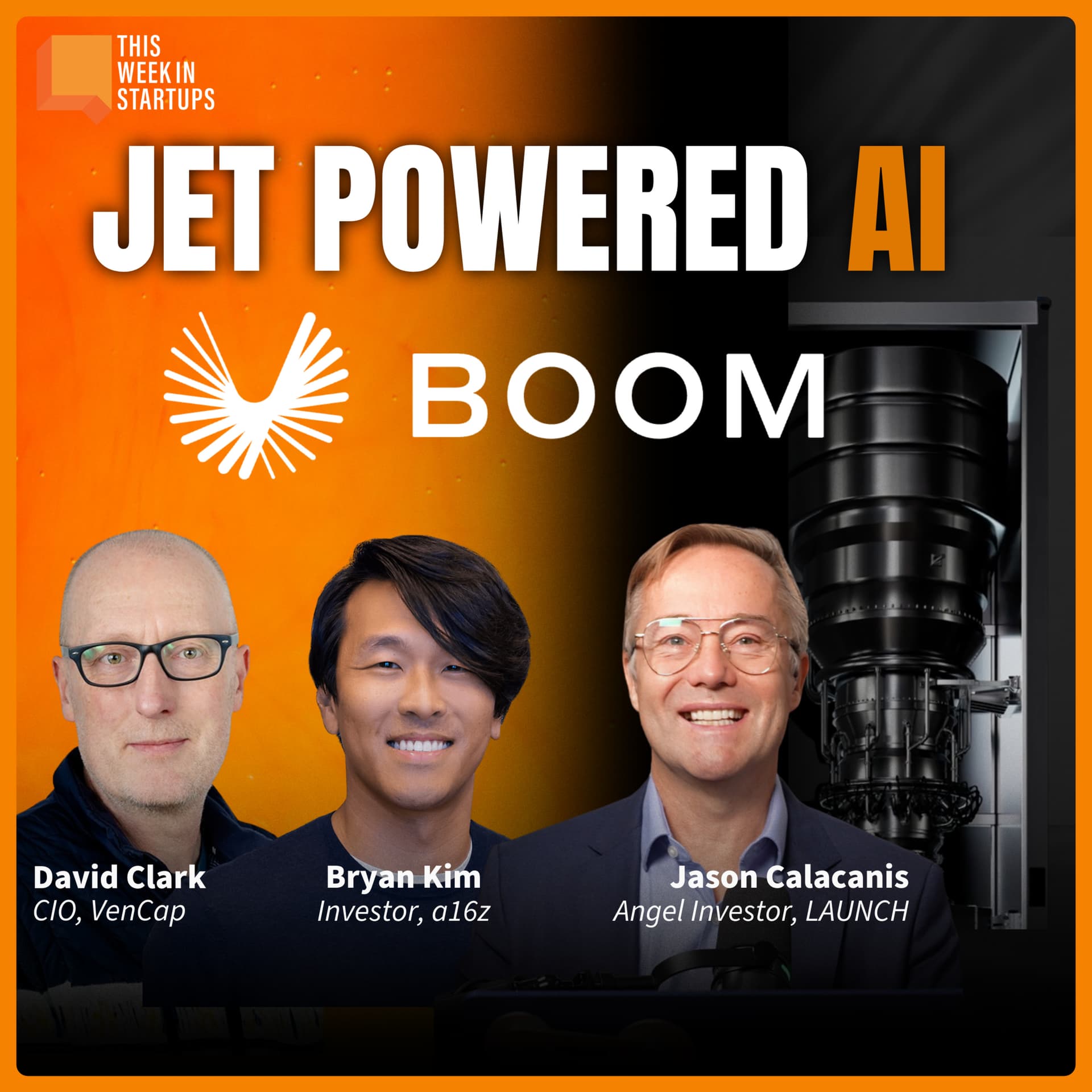
Podcast Summary: This Week in Startups - VC Roundtable with Bryan Kim and David Clark | E2222
Episode Title: “The best founders find a way to make it happen” Date: Not specified Host: Jason Calacanis Guests: Bryan Kim (a16z), David Clark (Ven Cap)
Introduction In this episode, Jason Calacanis hosts a venture capital roundtable with Bryan Kim and David Clark. They discuss various topics related to the startup landscape, particularly in the wake of AI advancements and the evolving market dynamics.
Key Topics Discussed
- Boom Supersonic's Pivot
- Boom Supersonic continues to develop supersonic jets and is pivoting to sell its turbines as power sources for AI data centers.
- This pivot exemplifies how founders can adapt to necessity and opportunity.
- AI Bubble Discussions
- The panel debates whether we are in an AI bubble.
- David Clark highlights that while the AI market is frothy with high valuations, it does not exhibit characteristics typical of past bubbles, suggesting we are at the beginning of a significant technology cycle.
- Startups and Marketing Strategies
- Discussion on effective marketing for startups without exhausting their runway.
- Emphasis on innovative go-to-market strategies, including partnerships and influencer collaborations, instead of traditional paid advertising.
- Relentlessness of Founders
- The importance of persistence and grit among founders is a recurring theme.
- The panel agrees that successful founders find ways to make their visions happen against the odds.
- Evaluating Company Valuations
- Bryan Kim explains how valuations are determined by balancing ownership stakes and founder needs.
- The conversation moves into early-stage AI investments and the perception of their valuations amidst rapid growth.
- AI's Impact on Job Markets
- Discussion on AI's potential impact on job displacement and the rising demand for self-improvement apps.
- The idea that AI could lead to a greater focus on individual responsibility for career development.
- Future Outlook
- Bryan and David express hopes for a future with more AI-native applications and a growing number of mega IPOs in the coming years.
- Jason hints at a golden age of mergers and acquisitions as companies seek strategic growth.
Key Takeaways
- Founders Must Be Relentless: The best entrepreneurs are those who adapt and push through challenges.
- Understanding AI's Journey: The AI landscape is evolving, and while there are high valuations, the market shows signs of sustainable growth rather than a bubble.
- Marketing Innovation is Key: Startups should explore unconventional marketing strategies to capture market share effectively.
- Potential for Mega IPOs: The panel anticipates a wave of significant public offerings from top tech companies, reflecting the maturation of the tech ecosystem.
Conclusion This episode encapsulates the dynamic nature of the startup world, particularly as it relates to emerging technologies like AI. The insights shared by the guests emphasize the critical role of adaptability and innovation in achieving success as a founder.
Additional References
- [Bill Gurley's "Miss By a Mile" post](https://abovethecrowd.com/2014/07/11/how-to-miss-by-a-mile-an-alternative-look-at-ubers-potential-market-size/)
- [David's LinkedIn with AI Bubble chart](https://www.linkedin.com/feed/update/urn:li:activity:7404139606398443520/)
Timestamps
- (02:11) VC Roundtable Introduction
- (03:07) Bryan's investment in Oboe
- (31:28) Boom's turbine pivot
- (39:10) Discussion on AI bubble
- (55:58) Marketing strategies for startups
- (1:03:26) The relentlessness of founders
*Subscribe to This Week in Startups for more insights on startups and the venture capital ecosystem.*
Written by AI. May contain mistakes. Listen to the episode to check what was said.
Transcript
Automatic transcript. May contain errors.0:00David, you specifically said you want to talk about whether or not we're in an AI bubble. today? Unless you're living under a rock, you know, you're bombarded on a daily basis by reports that we're in an AI bubble. I think one of the challenges that we see here is people are using the term bubble, you know, pretty indiscriminately. If you look back at historical bubbles, they have specific characteristics. And for us, the obvious way to answer are we in an AI bubble is to identify those specific characteristics and see if they apply to AI today. And it seems pretty clear to us that, you know, we are not seeing these things being applied into the AI market today.
0:33That's not to say the AI market's not frothy. There's a lot of capital there. Valuations, as we've said, are relatively high. This is almost the first time we've seen a technology paradigm where the installation phase, so that's where the underlying technology is being built, is happening simultaneous with the deployment phase, which is when users are coming in and really using that technology. And so for us, we are at the start of a major cycle here. This Week in Startups is brought to you by Northwest Registered Agent. Starting your business should be simple. With Northwest Registered Agent, you can form your entire business identity in just 10 clicks and 10 minutes.
1:13From LLCs to trademarks, domains to custom websites, they've got you covered. Get more privacy, more options, and more done. Visit northwestregisteredagent.com slash twist today. Pilot. Focus on your product. Let Pilot handle the bookkeeping. Pilot provides the most reliable accounting, CFO, and tax services for startups and small businesses. Head to pilot.com slash twist and get$1 ,200 off your first year. And Uber. Bad data equals bad AI. Your AI is only as good as the data it learns from. Uber. That's right. Uber AI Solutions now works with enterprises around the world to source, label, evaluate, and scale real-world high-quality data for every industry, everywhere, so that you can focus on building the next big thing.
2:03Higher-quality data equals smarter and faster AI. Uber.com slash twist. Hello and welcome back to This Week in Startups. My name is Alex. It's a Wednesday. We have our venture panel gathered. In one corner, I have Brian Kim, a partner at Andreessen Horwitz, all about consumer AI investing. Brian, thank you for being here. Hi there. Great to be here. We also have David Clark, the Chief Investment Officer over at VinCap International, dialing in from near to London town. David, how are you doing? Yeah, very good. Thanks. Great to be here. And a very unknown person on this show, Jason Calacanis, founder and GP over at Launch.
2:37This is your first time on the pod, yeah? Yeah, it's great to be on This Week in Startups. I'm a big fan. I've been listening to it for over 2 ,200 episodes. And boy, are my arms tired. But we've got a lot of news in the venture space. And I love to do these roundtables. I would love for you to moderate it just for the audience. Since, you know, this is what I do all day, I'm going to move to the more commentator position and let Alex moderate episode 2-2, 2-2 of Twist. Yes, the old palindrome. That means we've been doing this for a very long time. All right, Brian, let's start with you because you just announced a lead investment, a series A, a$16 million round into a company called Oboe.
3:15I'm familiar with it. They help people essentially use AI to generate a course for themselves. The question of the day is how competitive was this round and why are you putting your name onto Oboe? Excellent. Look, Oboe, we had a long thesis. Like two years ago, we actually thought about AI is coming out as changing a lot of ways that we interact with technology. Learnings and education was one of the key areas that we're excited about. Partially because, you know, relative to other earnings power, the cost of health care, education kept going up. Like something, something's got to give. And maybe one way that AI really helps is help everyday people learn things a lot better.
3:53Second thing is like information and learning is not the same thing, right? Getting information and actually learning and actually ingesting the data and learning in a way that you can use it in the real world is very different. So we've been on the lookout for a product like Obo for a long time. And then we've known Nir for a while. He sort of built a product called Anchor that powers a lot of the podcasts. It's part of Spotify. And I think he was extremely sincere and genuine in his large vision of helping a billion people learn trillion things. And that size of an ambition, a team focused on product who can build incredible stuff at speed was some of the key things that really got us excited.
4:35And, you know, a lot of times for consumer products, proof is in the pudding. You got to look and feel and touch the product. And boy, when I use the product, it was smooth, it was quick, and it was deep in terms of what I learned. So, you know, that sort of came together as a theory of us being very excited about backing Ovo. What did you choose to learn when you kicked the tires on the product? Because I have an answer to this too. That's a great question. Look, my dad is an oceanographer. And it's funny, we're just going back and forth on like the science behind coastal erosion, et cetera. It's actually part of the blog post where whether you want to learn, you know, stock uptrading or coastal erosion.
5:11And my first lesson was around science behind coastal erosion and learn a couple of things. Told my dad, he says those are correct. And how did you know about them? And we had a good conversation about it. What was yours? I chose quantum field dynamics, which all the physicists in my family have told me that I cannot learn until I master other things. And I told them they're wrong. So I'm hoping OBO can prove all of those years of education incorrect. Really quickly on the round, how competitive was it to lead? And how did the valuation conversation go? Let's see on the competition point. It's interesting.
5:42Oftentimes we think about how competitive it's around, how hot it is around. A lot of times when we think about great companies, it's not necessarily the competitive heat. That said, Alex, I would say he had a term sheet or two. He let me know that he had a term sheet or two. They didn't tell necessarily where they were from. Look, I think that gives a little bit of indication of how how well respected he is in the industry, how good the product was. So a lot of times I tend to try to make decisions on an independent basis. So I looked at the product, I knew the founder, I understood the metrics, so sort of made that bet, but it was competitive.
6:21Valuation, it's interesting. It's a little bit of a 3D mask, right? One is that for ventures, and I'm sure David has a lot of thoughts there, where for venture returns to work, there's an ownership that you have to think about. So part of the calculus was how much of the company do we get to participate in the upside in terms of ownership? Second thing is how much does the founder want and need in terms of dollars? So with those two inputs, the valuation is sent to be a little bit of an output there. So, you know, I think we got to a point where we're both, I would say we're both equally somewhat unhappy, if that makes sense.
6:58That means that everyone won. David, I'm glad we're talking about valuations because you have visibility into a lot of funds because your firm invests as a fund-to-funds vehicle. I've heard a lot of complaints about valuations, especially for smaller companies that are growing quickly, but maybe not have earned them. What's your firm's perspective on the current valuation climate for earlier stage AI investments? Yeah, I think one of the things we see in AI, clearly the market feels quite frothy at the minute. There's a lot of capital going in and valuations on a relative perspective seem high.
7:28But I think what you have to factor in is just the speed at which a lot of these companies are growing. And that's the thing that tends to be missing from that conversation a lot of the time. You know, if you're getting companies that are growing to$100 million in 12, 18 months, that's an order of magnitude faster than we've ever seen before. And that has to be worth something in the marketplace. So, you know, I'm going to defer to people like Brian in terms of, you know, exactly what is the right valuation for that particular company at that particular time, because that's his day job. It's not my day job.
7:58But I think just taking a step back, I think, you know, you have to factor in those growth rates when you're looking. And the growth rates and the potential size of the outcomes as well. Because for us, when we when we look at valuations, the question we ask ourselves when we're underwriting a venture firm is, you know, what do we have to believe that one company can return this entire fund? And that goes back to the size of the, how much of the company you own, the size of the final outcome for that company, and then relative to the fund size of the venture fund itself. And those three things need to be in balance because for us, it's really hard to generate returns in venture.
8:36And at the early stage, particularly, unless you've got at least one company that returns one extra fund. Yeah. Jason, on the ownership point, what's the launch target for ownership through, let's say, the accelerator and maybe a follow-on investment? Yeah, that's a great question. This has changed over time for seed funds and Series A funds, but it's stayed pretty static for accelerators, which is 7%. And you assume you're going to get diluted 50%, maybe even 70 % in a great investment. But 2 % of a Decacorn or even a billion-dollar company, those kind of returns can add up. And you should have pro rata, at least through a couple of rounds.
9:15And maybe in a breakout, you are smart enough to figure it out. hard to do. But for a seed or a series A fund, I can tell you in evaluating this type of deal, it's got a lot of the things we look for at our fund. Number one, you have a serial founder, which is great. I'm assuming that some members of his previous team, Brian joined him for this adventure, taking a guess. That's absolutely right. That would be a team that has worked together before. So those are two of the factors we look for. Third, this is big and ambitious, right? Like the total addressable market is anybody who wants to learn.
9:51That's everybody, right? So it's not just for kids. It's not for high school kids. It's not just for biology. It's for anything you want to learn. Great. They had an exit before. They've worked together before. They're clearly competent. So you've removed a lot of the things that we at pre-seed stage contend with, which is, has this team done it before? Do they have what it takes? The team obviously has what it takes. So then you pay the premium for it. Brian was kind of grinding his teeth a little bit on the valuation I saw there. It was competitive. But that's what great founders do. They create a marketplace and then they wind up picking the investor they want anyway.
10:26So Brian probably gave him a term sheet. He created a marketplace. He got Brian to come up a little bit. Brian has to grind his teeth a little bit. But to David's point, we've never seen startups break the you know, triple, triple, double, double, uh, SAS revenue ramp. Now we're in something that's like start at a million, go to 20 and then hit a hundred. What is that? 20 X, five X 25. I, and who knows how long this will go on for, but it does speak to the opportunity, uh, that we now are faced with. And then portfolio management is going to come into this, which means if I had to guess, the power law is going to define returns even more than it has previously.
11:14And I'm kind of interested in David Clark's opinion on this because my career was made by a handful of incredible bets and then a lot of singles and doubles. Now I'm looking at it and I'm thinking, wow, if I was an LP, I might have to start judging my investments on like bundles of three funds where I expect 1.5x, 1.5x, 10x. And then I just have to bundle the three of them together when my family office invests in funds because the outliers are so bizarre now. And then it's also, I think, the second conversation, David, that we can get into here after portfolio management is for early stage funds.
11:52When should we be exiting these investments? Because we're faced with this over and over again now. We've had a couple of these breakouts. Your AI is only as good as the data it's learning from. Every huge leap we're seeing in AI development is based on refining better data sets. And guess who came up with the ideal solution for your company? That's right, my pals at Uber. Did you all know I was an early investor in Uber? Maybe you heard third or fourth. And I never talk about it, but it's true. And now Uber AI Solutions works with enterprises all over the world, helping them source, label, evaluate, and scale real-world, high-quality data for every industry.
12:29When you think about it, this makes total sense. No company understands how to maintain quality while scaling exponentially like Uber. Their own ability to refine and process data sets is why they currently power millions of trips per hour. Now they're bringing that insane level of insight and expertise to your startup or enterprise. It's pretty exciting. Book a demo today by going to uber.com slash twist. That's uber.com slash twist. Yeah, I think just on that first point, Jason, I think one of the things that characterizes the best managers from the rest of the pack is their ability to hit those home runs consistently.
13:09And so it's less of a case of only doing it one fund out of three or four. They're doing it every fund. It's just the magnitude of that outlier that might be one, it's every three. So for us, we would kind of say, you know, we're underwriting an early stage fund to 3x. And then we think once every three or four funds, a fund should be capable of doing 5x plus. And, you know, the plus is very much dependent on, you know, what's the ultimate outcome of that extreme outlier that they've happened to back in that particular fund. You know, I know, you know, Brian's firm has been very, you know, very active investing in something like Databricks, the fund that did the first round in Databricks is going to be in that plus category.
13:51And what do you think about exits at this point in time, you know, and how seed funds, obviously Andreessen Horowitz is playing a completely different game with a full stack, but how should seed funds that you invest in or sub$250 million funds, sub$100 million funds, sub$50 million funds, think about exiting some of these investments and locking in DPI. It's top of mind for me as I go out to raise my fifth fund next year. I've been like, where can we lock down some DPI here in the portfolio? Yeah, a few things there. I actually think the decision on when to sell can be a harder decision than the decision on whether you should buy or not, because there's still so many more variables that kind of come into play around that sell decision.
14:37For us, you don't get to be one of the best firms globally by selling your best companies prematurely. And so we would always say to our managers, look, we want you to hold these companies for as long as you think is appropriate and you're the best people to take that decision. You know, we've seen over the last few years that the best companies continue to compound at growth rates that are, quite frankly, amazing. I hadn't expected, you know, again, Databricks is a really good example. You know, the fact that that company has been able to compound its revenue at scale at the rate it has and looking at how that's then driven the valuation of that firm is just incredible.
15:21And five years ago, nobody would have predicted that, you know, that's going to be what was the last round, 125 billion, I think it was announced at. So, you know, I think we are seeing the best companies are getting bigger and are continuing to grow faster. So as an investor, I don't want to miss out on the opportunity to participate in that. I kind of look at it and say, I will manage my liquidity through portfolio construction, not through pushing the best managers to sell companies prematurely. So when we put our portfolios together, we want them to be roughly equally balanced between early stage and growth.
15:57The growth side of things helps with the duration of the portfolio. It helps bring forward liquidity. And interestingly, we're not seeing meaningfully lower multiples from those growth funds as well. The best growth funds perform just as well as the best early stage funds in our portfolio. So the combination of early and growth plus some LP secondaries as well to get through the J curve is how we would manage the liquidity thing, not by asking managers or putting pressure on managers to sell things early. I want to get Brian to jump in on this, but just to underscore the Databricks growth numbers that David's talking about, the company announced a couple of months ago that it's now over a$4 billion run rate growing at more than 50 % year over year.
16:36And critically, David said that it has now a greater than$1 billion run rate just for its AI products. So it's a growth story, an AI story. It's a win all the way up and down. Brian, though, I want you to weigh in on this exit early, chosen DPI, or just go for the fences and not worry about squealing LPs. Yeah. How does that work at a multi, a full service, you know, venture firm? Because you're in the seed fund or the series A fund, and then there's the late stage fund. How does that dynamic work? Yeah, of course. It's one of those interesting questions where I joke that as an investor, we all joined a firm as a pre-trained model in a certain domain.
17:11So I come pre-trained on consumer B2C element and we have a bunch of experts gathered together, which is to say, when it comes to questions in the companies or firm strategy, I know a little less. That said, what I do know is, look, we have companies that we consistently back from early stage. I'm part of the Seed and Series A Fund, AI Applications Fund. And just to take an example, a company based in London, 11 Labs, we had the opportunity to back the company at Series A. And we, at this point, quadrupled down in the company. So every single round, we participated in Colette. So when we think about that type of behavior, I think, to David's point, when we understand and deeply know the opportunity set, the management team, the ability for them to gather talent and opportunities in the enterprise or consumers and continue to grow.
18:03If we have conviction, I think the right thing that I believe that we can do is continue to support the company that we have gotten to know so much better than someone else. Yeah, this happened at Sequoia when I did the Uber investment, the late stage. You know, I wanted to sell some of my shares to Masayoshi-san, but then the late stage group at Sequoia, you know, they were accumulating a position in Uber. And this becomes like an interesting tension. We might also have this with our syndicates at times, David. Some people in the syndicate want to sell com, other people in the syndicate want to buy more.
18:36And we're starting to see this in funds. I don't know if you've had it happen yet, where, you know, in a fund, you have some LPs who want to sell, some who want to buy, and then other third parties start to interject and do all kinds of unnatural acts or funky behaviors. Have you seen it yet, Dave? Yeah, we haven't seen it within, you know, within funds. What we have seen is a big increase in the volume of secondary deal flow on the LP secondary deal flow. You know, I think for a variety of reasons, I think, you know, some LPs probably overextended in 2020, 2021 and need to cut back on allocations.
19:12I think some need to generate some liquidity, you know, for their sponsoring institutions. So we've definitely seen an increase in secondary volume over the last sort of 12, 18 months. And I think that's probably starting to become a more widely recognized way of addressing some of the duration issues and the illiquidity issues that come with venture. So, you know, 10 years ago, if you were selling a position in a top tier fund, that would be really frowned on. I think people are understanding now that these funds can run for like 20 plus years. And so if some LPs in year 15, you know, need to draw a line under it, that's not a comment on how they view the manager.
19:53It's simply a comment on the maturity of their particular program and what they need to do for their investors. There are lots of accounting firms out there that will help you maintain your books and do your taxes. But when you're a founder, you're facing a lot of unique challenges. So you want a partner who understands the landscape that startups operate under. You want to be able to trust them with the reins so you can focus on building your product. Well, Pilot is the largest accounting firm that was built just with startups in mind. You're not just getting your taxes done. No, you're getting CFO-level guidance for your startup.
20:27Pilot will help you track where all your cash is going, increasing your profitability, and helping you spot looming issues before they become real problems. Hey, like your runway. You gotta be on top of this stuff, folks. And when it's time for you to raise your next round, Pilot is right there to help you with due diligence and scale up and make that process easy peasy lemon squeezy. So start focusing on your product and let Pilot handle the bookkeeping. Plus, Twist listeners get$1 ,200 off in their first year. What a deal. Go to pilot.com slash twist to get started. That's pilot.com slash twist.
21:04Should all be simply just expect that kind of timeline, David? Because I feel like the old eight or 10 year timeline is just completely out the window now, given that Stripe is still private, for example. Yeah, I mean, I think if you look at the data around how long it takes companies to go public from being founded, it's like 10 to 12 years. And then adding on to that, you know, most of the funds that we invest in will hold on to their positions for kind of 18 months post IPO and start to sell them down through that 18 month period. But it might take 24 months post IPO to be fully out of most things.
21:34So, you know, you're talking about for the best companies, at least sort of 15 year hold periods. And if you're investing in that company in year three of your fund's life rather than in year one, then you can see how the term of those funds continues to add up. I want to add one thing to Brian's investment. I listed all the things I like, but there's always some things that are unknowns. And I'm curious for Brian, what's the bet here, the unknown? I suspect when I looked at this company, OBOE.com, I suspect that the two, the one question was, oh my God, is it defensible? What's the mode? Is an opening eye going to do that?
22:14I think we all know as investors, great founders build defensible businesses. Okay, period. And they go faster, period, full stop. But the second piece is somebody in the company, I don't know what the review process is at 1816Z, when somebody was asked to give the counter, it would be, well, is there any equivalent of a company like this becoming worth 10 billion? Is there a$10 billion education company? And there is not. So then I guess that's the question and the opportunity, right? The same thing was said, Ryan, about, say, Canva. Like, what's the market for Canva? It's like zero. These are people who don't want to learn Photoshop.
22:49Tell us your answer to that, or if I got those two correct as the tension in the conversation when you did the debate. It absolutely is, right? And luckily, I think we operate in an environment where it's sort of well understood that we may not be the best people to estimate the temp or total addressable market. Again, when Uber first came around, I think many asked, hey, what is the addressable market for black cars? And when Airbnb came around, what is the market for house swapping? There's no equivalent. I'll give you an even more useful example where Eleven Labs' initial product was dubbing.
23:27So the natural question, Jason, is what is the market size for dubbing? It's incredibly low. But if it's low enough, you induce a market. And now people are like, hey, I'm going to build a product because this is so cheap and so good, which is the inducing of a market. That's beyond product market fit. That's like gravity. I don't want to say a black hole because that's got a negative connotation to it. Maybe it's a white hole where you create. Yeah, exactly. But just to be able to pull people into something that the product is so good, they come up with a use for it. That induces a market is really interesting.
24:06I think for your education one, it might be people who are being displaced by AI realizing they need to provide more value for their employment opportunities. So therefore, they take professional development on as their own personal responsibility. And Jason, one of the other questions was, okay, if it's global generalized learning opportunity for everyone, perhaps there isn't a equivalent ed tech example but what is reddit and what is wikipedia youtube what is youtube and and how how might that evolve and so there are a lot of ways that we when we sort of meet founders early stage especially we need to sort of dream the dream a little bit so when a founder comes like look my goal is to serve you know billion people trillion lessons i'm like Well, one could say, well, that's that doesn't sound right.
25:00It's too big. It's too insane. And we tend to be in a camp where, like David mentioned, where it looked like each investment should have a potential to return to fund. So we don't look at investment very lightly. Every investment, we take it very seriously as does this investment have the potential to return to fund? And of course, Tam is one of the questions that comes in. And we thankfully have the humility to say maybe we're not the best at estimating market sizes. What's the point of TAM then? Because I feel like we talk about TAM and then we talk about reasons why it's not a very good metric for people to focus on.
Read the full transcript
25:35But if you go talk to VCs and explain how to pitch to them, they always talk about have a TAM slide. So I don't know, Brian, what do you actually want people to tell you when they're bringing their idea to you about the size of the market? A lot of times what we actually hope for is founder having a sort of a world bending vision to Jason's point, maybe it's black hole, maybe it's white hole to say, look, like at one point we want everyone to learn through this. I'm like, whoa, like that's not how it works today. I'm like, I get it. But here's my plan to get to it. And phase one of that is to dominate the sub segment.
26:08And I have a very, very, very good plan to do that. And I actually have proven that I can do that. So those are type of things that we look for where very large vision with the ability to actually ship the product quickly because you have to course correct as you go. married with demonstrated ability to actually get some traction in the initial phase of what they're going after. All right, David, I want to bring you into the TAM conversation here. Yeah, I think what's really interesting for us is just the distinction between, you know, someone like Brian, who's working at the early stage side, and maybe his partner, David George, who's on the growth side, where TAM is probably a much more important conversation for someone like David when they're saying, you know, should we be paying this value?
26:48You know, what's the, what can actually, can this company grow, you know, to what extent is there still headroom there? And so I think, you know, you have to kind of understand what are the key metrics depending on which part of the market you're investing in. And I remember, you know, like listening to David sort of talking around, you know, one of the things, one of the changes in his mindset when he joined Andreessen was he went from thinking, you know, what can go wrong here to thinking what can go right. And it's having that mindset that actually the best companies consistently surprise on the upside is, I think, has to be fundamental to your approach as a venture investor, whatever stage you're investing at.
27:28Because the sins of omission and versus the sins of commission are very different. David, those exact words are said in our meetings. It was like a lot of frequency. We're all standing on the shoulder of giants. In this case, the giant being Bill Gurley. This is the seminal blog post on the subject from his Above the Crowd. And he's got a new book coming out that's spectacular. But How to Miss Buy a Mile, an alternative look at Uber's potential market size. This is in 2014. This NYU Business School professor, Aswath, who I think goes on CNBC a whole bunch, kind of respected. But he did his whole Uber is not worth$17 billion.
28:06And we kind of all laughed at this because he estimated the value of Uber at$5.9 billion. Now, we all the smart people who weren't in an Ivy League school or whatever in the ivory tower teaching the course, we saw it on the inside. And here is where he basically guesses here that, you know, he would settle on 10 percent of the hundred billion dollar market for Lincoln Town Cars, as we talked about. And then when you start going into the total addressable market. And so we'll put this in the notes, but it's how to miss by a mile. Bill Gurley. If you search for that, you'll find it immediately. Really important seminal blog, plus I'm sure, David, you've got that one.
28:47You've read it twice, right? Yeah. Yeah, absolutely. In fact, I'm going to give my team a note. I want this read by everybody by tonight's management team meeting. We're going to discuss it at the management team meeting. We have a management team dinner for the entire staff every Wednesday night, strictly because that's when my energy peaks. And because I want these young millennials when Gen Z is working for me to experience working until 8 p.m. by forcing them to come have dinner. And I just drag the meeting on an extra half hour when it gets good and seeing who taps out. How to win friends and influence people with junior employees.
29:21Absolutely. Or break them and get them to quit. That's really my goal. It's not working anymore because they're on to me. So they're not quitting enough? They know your game. You just set it here. Well, I hired three researchers at a time and I told the team I want one to get fired, one to quit and then one to excel. And now we're keeping two out of three or some cases, three out of three, because we tell them that when they get hired and they're opting out before they join the team. So, but we should talk about this boom, supersonic pivot. It's kind of crazy. Being a founder is a lot of work.
29:49You have to focus on your fundraising. Then you got to hire the perfect team. Oh gosh. Product market fit, finding your first customers. But all of this means nothing. If you're not actually a real business that's structured properly, giving your investors and clients the confidence to partner with you. At launch, we're constantly recommending Northwest Registered Agent to our founders because for just$39 plus state fees, they will act as your registered agent. That means they take care of all the paperwork, making sure your business remains compliant, protecting your privacy, and more. And as a founder, hey man, there are so many organizational odds and ends that you have to worry about, so why not have a partner who can focus on all those little details?
30:29Then you can obsess about your customers. And Northwest Registered Agent is even going to help you set up a phone line, a professional email account, and find you a great domain name. So here's your call to action. Go to northwestregisteredagent.com slash twist to get your company set up the right way. Boom, Supersonic is a long time startup. They're building a passenger jet that can go across the Sound Barrier Jason founded, I think, in 2014. And we had Blake Schull on the podcast very recently, episode 2186, talking about when they're going to bring their Overture jet and Symphony engine to market.
31:07And then since then, the company came out and said, hey, we're also going to take this jet engine we're building, we're going to put it into a box, and we're going to take it around and put it outside of data centers to power them up. And they announced Crusoe as their first partner in this, 29 engines going their way. I think this is fantastic. And Jason, will I pull up a GIF of what this looks like? I'm curious if you think this is a model that other hardware startups should take on as they work towards their eventual goal. Well, what I'll say about this is, one, he's a tremendous founder with a huge vision that's incredibly costly.
31:36That last part is the issue. We've got a lot of great founders. Not enough, but we've got a lot of great ones. And he's got a big vision. We need to see more big vision. But his vision was so big that funding it, I think, has turned out to be very challenging. and hardware takes longer than you think. There was another hardware company that was incredibly ambitious that then started to do side projects and side hustles like this to keep the lights on. It was called Tesla. And they did a smart car with Mercedes, nobody remembers. And they had had somebody who wanted to buy their motors, which I don't even remember.
32:14And I was was there. So this happens often. You get a tension that occurs when you go to market. You try to raise the next$200 million or$300 million to do the original vision, and then you can tap out a market. And when you tap out a market, sometimes you either need to do a pivot. You need to do some work for hire. You need to do some consulting to keep the lights on. I don't think there's any shame in this game, having been a founder and seen it before. Sometimes money shows up for a better idea. or for an idea that gets the original mission to land. And the original mission was to be able to make a mass-produced$30 ,000,$40 ,000 electric car.
32:55They had to make some compromises along the way. The roadster was one, and then the next was doing some of that work-for-hire stuff. So I suspect this was not done. This was done out of necessity and opportunity, but in that order. Okay. And the company did announce a$300 million fundraise in conjunction with this news. Jason, I presume it's going to be to build out this new product. Brian, I know you want faster jets like everyone else, but your thoughts on Boom branching out into the data center power game. I know this is exactly your thesis and focus. Exactly. I sort of wrote down one word on my notepad.
33:25It said power, actually. And honestly, I don't know a lot about Boom. So I'm a bad person to comment on this. I would say one thing where I think OpenAI had a summit yesterday and talked about how it really is a shortage of demand. It's a supply game when it comes to compute as well as power. So I suspect looking at sort of the supply side of the equation that, you know, technologies and tools that enable U.S. and us to gather power efficiently is overall a positive thing. And so I'm excited to see where this goes. David, I'm going to make you our resident European for the show today. We talk a lot about, you know, data sovereignty and every nation wants to have their own chips and data centers and so forth.
34:06But it seems like we're having the same power crunches everywhere in the Western world. So I presume that what boom is cooking up here would have application both in the UK and on the continent, perhaps? Yeah, I think so. You know, we're seeing similar issues, you know, in the UK and around Europe around the availability of power. And we know, you know, you just look at what China is doing in terms of building nuclear power stations. That's been a challenge in Europe generally. You know, Germany have decommissioned most of theirs and, you know, seem to be regretting that a little bit. So I think this is absolutely something that is needed.
34:41Whether this is the right solution, I don't know. I haven't got the technical background to opine on that. What I would say, though, is that we consistently see the best founders find a way to make it happen. And if that means pivoting or doing a side gig in order to get there, then that's what happens. You mentioned Crusoe as their first company. Crusoe started life as a Bitcoin miner and then pivoted to AI once the AI boom started to happen. So, you know, there's another example of people seeing opportunities there to, you know, to put their tech into slightly different areas and leaning in where they do see that opportunity.
35:17I mean, we've seen actually a number of Bitcoin mining companies that had racked up a ton of GPUs move into the AI game simply because I think it's a lot more fun to do a service and get paid than to do a whole bunch of math and then hope that you win a fraction of a block reward. You know, it's probably easier to underwrite, David, something a little bit more consistent. Jason, this jet engine system that we're talking about, XAI, when they were building their Colossus data centers, did something similar. They got a bunch of gas-powered generators and essentially just built their own micro power plant.
35:50We've also seen tech companies land deals with fission and for later on fusion power. Are we going to see major tech companies essentially become power generation concerns as well? Because it feels like we're going now. Yeah. You know, what a technology company will do to keep growing is a list of zero items. Like if we need nuclear power, if we need satellites in space for broadband, you know, if we need better battery density, these major tech companies have enough capital to fund these projects. And so when people lament, oh, the government's not funding projects anymore. OK, sure, there is something to that.
36:30But you have people like Google or Facebook or now new entrants like Rock and OpenAI, as you point out, that'll go and underwrite some of this new technology or invest in it. And in fact, I believe a lot of Boom's success is based on United pre-ordering some of these and paying for them. No shame in the partnership game. You do what you do, got to do to do it. And just to take people down memory lane here, this is hilarious. Here is the 2026 Smart for Two. You can get this for$13 ,000 out in Dripping Springs with 20 ,000 miles on it. But that is the Tesla batteries in a smart little two-seat smart car.
37:11A lot of people have been wondering, why don't they have that? And then here is the announcement from Toyota. The RAV4 EV jointly developed with Tesla back from Toyota City in Japan May 8th, 2012, 13 years ago. Zero to 60 times, seven seconds. And cruising range, 100 miles. So a lot has changed since then. This one, I'm not sure. This one feels maybe more like the Powerwall as opposed to, you know, in that business inside of Tesla. But again, I'm guessing they couldn't get more funding for the supersonic jet and they could easily get funding for this. So what's a founder to do? You know, like make cuts at the company, scale back the ambition or, you know, sometimes you have to go with the way water flows.
38:06Somebody told me salespeople, when you hire them, if you have multiple products, it's like letting the water go down the side of the mountain. it'll find the most efficient way. And then there'll be a stream and then eventually a river. Sometimes founders do that, at least the good ones. They're like, oh, this is the easiest path. I can just open the spring here and I'm going to have more and more customers. I'm sure after this announcement, 10 people called them and said, how do we get on the list? And so that's just going to be so nice for the founder. It's Blake, who's very smart. I've had him on the pod twice.
38:34I've got to have him back on to talk about this. But Blake's very smart and very dogged. And I suspect he's going to crush it with this business. And it might be for him after 10 years of pushing a boulder up a hill, it might be really nice to start pushing them down the hill and just releasing the spring water down the hill. So I'm actually very happy for him and his team to be taking orders as opposed to, yeah, what the last 10 years of suffering might be like. They said they had$1.25 billion in pre-orders for this particular product. So yeah, Yeah. Katie, Katie, borrow the door. Go for it, Blake.
39:12Now, David, you specifically said you want to talk about whether or not we're in an AI bubble today. So I'm going to say yes to that. And I have pulled up from your company, your digest on where we are in this game. And I want to get the LP perspective about what's going on. So here's what your firm argues. Talk me through this. Yeah. So, I mean, first of all, you know, unless you're living under a rock, you know, you're bombarded on a daily basis by reports that we're in an AI bubble. And I think one of the challenges that we see here is people are using the term bubble, you know, pretty indiscriminately.
39:43If you look back at historical bubbles, they have specific characteristics. And for us, the obvious way to answer, are we in an AI bubble, is to identify those specific characteristics and see if they apply to AI today. And, you know, when we go through each of the six characteristics we've highlighted, you know, it seems pretty clear to us, and, you know, I'd love for Brian to chime in on this as well. It seems pretty clear to us that, you know, we are not seeing these things being applied into the AI market today. That's not to say the AI market's not frothy. There's a lot of capital there. Valuations, as we've said, are relatively high, but they're supported by growth rates.
40:17They're supported by revenue. And it seems that this is almost the first time we've seen a technology paradigm where the installation phase, so that's where the underlying technology is being built, is happening simultaneous with the deployment phase, which is when users are coming in and really using that technology. And so for us, you know, we are at the start of a major cycle here. We are, as things stand today, you know, we are not in a bubble. That's not to say there won't be a correction. Corrections are part of a normal technology cycle. Inevitably, there'll be a correction. But, you know, we would look at that correction as an opportunity to kind of weed out the companies that aren't performing and to concentrate resources, whether that's capital, whether it's talents, into the companies that are working.
41:06And as we've said before, we think the companies that ultimately emerge from this wave will be an order of magnitude larger than what we've seen historically. Brian, let's get you in on this. Fantastic. It was really good to see the slide that you put up, Alex. I think the first two are the ones that I can probably comment on, which is one, you know, the, yeah, there we go. So, supported by revenue, usage, and demand. I think a lot of times what we see is that the adoption curve and usage curve are incredible. Even just taking ChatGPT, for example, which has been alive for 1 ,000 days and used by 800 million weekly active users.
41:51What does that translate into MAU? I do not know, but north of a billion. For a product to go that quickly, used that often. I believe I saw the stat where it's a weekly active user on average uses more than 25 times a week. Wow, four times a day. That's very strong. So I think the valuation is an expectation game where we as investors look at each individual product and what could this be. And the speed at which that this has been happening has been very interesting. And the second one is adoption, right? Like it's really, the demand is there. And so it's really about making sure that the startups and companies can build product quickly enough to meet those demands.
42:37And I think the important part that we all get excited about is a lot of the dollars that flow into a lot of the application layer company early stage where I focus on tends to be around, can we actually replace labor cost, which tends to be quite high. So, you know, when we think about the adoption curve, the market size and how quickly they can grow, I think a lot of times the reason why we see, you know, company valued at the way they are is because we believe, as David said, we're in the early innings of a super set. So in the case of Oboe, instead of having a tutor, you essentially pay 30, 40 bucks a month for the hiring plan and it becomes a labor replacing device.
43:19So it does that for you at a much better price point. It could be. The other example that is probably more germane is customer support. You've got to hire these people to get on the call and talk to you. What if that was not a person who needed to be on the call for eight hours a day, 10 hours a day? So there are elements there where I think you can start really thinking around how to make jobs very easy and can be supported by AI tools these days. David? Yeah, I was going to say, Brian, your partner Chris Dixon has a really interesting analogy here where he says at the start of any new technology paradigm, that the early adopters of that paradigm tend to have skeuomorphic uses of it.
44:01So it's essentially doing the same thing you did in the previous paradigm, but just doing it more quickly, more efficiently. So if you think when the iPhone first emerged, what did the iPhone do? It had a calendar, it had a camera, it had a compass, it had a calculator, and you could probably make phone calls. So it was doing all the stuff that you were doing in the previous generation, just in a way that was more efficient. It took time before you started to see the native applications emerge. And when they did, you had the likes of Uber and Spotify and Airbnb, and you couldn't have predicted those before the launch of the iPhone.
44:38And I think we see something similar happening in the AI space. A lot of the early applications of AI are those skeuomorphic applications. And we're only now starting to see the AI native applications begin to emerge. And for us, it'll be really interesting to see what that drives. But our sense is that we're going to see that combination of native AI and full stack startups where you're not just selling software into a particular industry, you are using AI to become that industry. And that plays into what Brian was saying about capturing a significant proportion of the labor costs of a lot of these different areas.
45:16And if you think that labor accounts for about 50 % of global GDP, that's a$50 to$60 trillion annualized market that is potentially up for grabs. Yeah, Jason, the joke here is that what problem does AI solve? It solves wages. That's what they're going to fix. Yeah. And people will find more to do. We could go down the entire rabbit hole for an hour about jobs. Let's put that aside. And I think what's really good, and David, it's great that your team took the time to put this together. Because when there is a technological wave, in this case, feels like a tsunami, you know, if you look at a wave, there's bubbles and froth and foam.
45:53And after the wave crashes, you'll see a little bit of that as well. So it's not bubble or no bubble. It's how bubbly is it, right, is the way I tend to look at it. How much froth is in the cappuccino, you know, or are we looking at a flat white? You know, there's not that much bubbles on it. I put us in like flat white territory right now where there's just a little bit of froth on the top, but it's not like a cappuccino where there's a lot of froth. And going through these, which is always really good for as a mental exercise, speculative valuations, you will see some, right? We had this figure, robotics was one that I think a lot of people said, that doesn't make any sense for me, $39 billion.
46:35They don't have a customer. And they said, oh, we have BMW. BMW said, oh, well, were testing it, then they became a customer. And you had that really good debate in the Wall Street Journal publicly and the founder coming out and showing the product to support the valuation. But that would be one where I would say, hey, maybe that valuation is supported by, you know, the revenue eventually, but it's not certainly not supported by it right now. So people taking a lot of risks there. And that was one that hits the mass retail participation. No mass retail speculation, broadly correct. And there isn't, hasn't been a ton of retail involved, but I will say SPVs where high net worth individuals are being sold on this kind of stuff.
47:16You can see bubbly moments, David, in my mind. And I, I'll, listen, I want to beat up on figure, but if that was a five or $10 billion company, I wouldn't be bringing it up as an example. And it's an example that everybody's talking about when they go to have cocktails after the conference ends and they're having scotch at the bar in the room where it happens, where that didn't make sense. And the reason that valuation got ahead of itself is because of retail. Retail in the form of high net worth individuals. And, you know, capital funding, weak or unproven businesses. Yeah, generally, I'm not seeing that.
47:51And the adoption one is a great one. Adoption lags far behind investment. And it says here in your note, David, adoption is outpacing investment. Demand is driving capital, not the other way around. This is the one I think is the most salient that you nailed because, Brian, you pointed out, people can't get enough of chat GPT. And William Gibson said this, and I've quoted it many times here on the program, the street finds its use for technology or its own use for technology, is the quote. And that skeuomorphic thing where, you know, like you're, you know, is another interesting corollary to it, which is people are taking this technology and they're coming up with ideas that the creators of the technology didn't.
48:32Eleven Labs being such a great example. You don't know this, Brian, but one time I was on a ski slope somewhere in Japan and I had used, a client had given us a promo code for an advertisement. You know, it's either use the promo code twist or use the promo code Jason or use the promo code startups. Anyway, it got mixed up. I'm not sure who made the error. They put my voice into 11 Labs. They said, hey, boss, listen to this. And I said, okay, why are you sending me a clip of the ad read? And they said, anything wrong with it? I'm like, sounds right to me. And they're like, okay, we've replaced these two words with 11 Labs doing those two words.
49:10Are you okay with it? I'm like, well, I can't tell the difference. The customer can't tell the difference. The users can't tell the difference. Go for it. Now, that's a use, Brian, that they did not come up with. But I can tell you that Bill Simmons has brought that use up already. A year ago, he said on his podcast, man, if I could read more ads, that's like a gating factor for me. Or if my ad reads here could be localized for Japan, the Middle East. And I said, hey, and your local rep for LinkedIn is Susan in Australia. And your rep in Japan is Hiroshi. And your rep is, you know, Ahmed in, you know, India.
49:46That would be mind-blowing if you heard that in my voice in those regions. And just, yeah, another induced technology. I love this. This is a great chart. You sent that to who your LP is, David? Yeah. It's on their LinkedIn as well, Justin. We'll put it in the show notes and we'll also put it out today in the ticker. So if you're listening to this, you can find it. Shout out to VinCap. An example of the growth we're talking about that undergirds these investments, Fall or Fall.ai, if you want, recently raised 140 million in a Series D, reports of a$4.5 billion valuation. And Brian, I know you know this company because your firm led the Series B, memory serves.
50:18And I was confused why it raised again. It just raised in July. Well, it turns out it doubled its run rate in four months. So there you go. Why not? Let's raise three times in one year. That's why I'm not that concerned. Just throw it in my two cents here, because it seems that the best companies that are raising the most are growing the fastest. They're growing very quickly. Yeah, they're growing very quickly. And oftentimes when you actually look under the hood, some of these companies that we know of, they end up being very capital efficient. That's counterintuitive. They're actively investing.
50:47It's just such that the gross and margin profile is such that they end up accumulating more capital than able to spend. You said my favorite words, which is margin, just because you brought it up. There has been scuttlebutt bouncing around the venture world that some companies that are very AI first, but use third party models are running relatively poor or even negative gross margins, Brian. I've heard this less recently. My impression is that those days are behind us. I just wanted to get your two cents on where we are in terms of gross margins and AI startups. Look, I think margin, you know, it's funny.
51:21I used to run gross and used to be a CFO. So margin is a near and dear topic to me. There are a couple of ways to think about it, where one is that we all know that AI comes as inference costs. So the more you use it, there are some marginal costs baked into it. So when you think about a true AI native product, if you have an extremely high margin, how should you think about that? are you actually using a lot of the AI or not? So that's like one way to think about that question. The other way to think about this question is, look, what we see is a margin at the end of the day is aggregation and averages.
51:53Like on average, when you sell a product, what do you take away? And what actually the truth is, what we're seeing is it depends on different slice of customers. So when you go deeper into the product itself and the user's pattern itself, you have prosumer users, you have enterprise users, you have creator cloud, there are many tiers. And each of them tend to have slightly different margin structure. And what we're seeing now, Alex, is that, you know, the founders, and this is sort of the way that a lot of founders think about their margin structure is they because they know there is a, you know, incremental margin that they do have to pay on the model layer.
52:30They're very thoughtful. They don't go around saying like, look, I'm going to sell, you know, something's worth dollar at a dollar and 20 or 80 cents a dollar. What they do say is, look, I believe the cost of overtime will go down. I believe this product and technology is incredibly useful. I will embed it to my product and I'll over time create tiers and usage patterns and monetization tools that makes me able to extract a strong margin. And that's indeed what we're seeing. David, does that match what you're hearing from the other firms that may or may not be in your fund to funds? Yeah, I think one of the things we've heard as well, I think it was Ever Andel that came out and said that one of the things to look at isn't necessarily gross margin percentage, but it's gross margin dollars.
53:16And because these companies, again, are potentially an order of magnitude larger than what you saw in the cloud and SaaS era, while they might have lower gross margin percentages, the amount of dollars flowing through to that line is going to be significantly higher than we've seen in prior generations. So that was one way to sort of, I thought was an interesting way to look at it. Another one from our perspective is that, you know, early on in these nascent markets, you know, we do see companies investing really aggressively in order to acquire users and acquire market share. And over time, if they do become the market leader in that particular space, we've seen it time and time again where they're then able to start to focus on business model and driving efficiencies and stuff down the bottom line.
54:08Jason, what was Uber's gross margin back in the day when they were just starting? Was it negative? Yeah, of course. Well, I will say, actually, in the first couple of cities when they were going slow, they did buy supply, right? They had to buy supply of cars. So they would go and buy a bunch of supply from, you know, a local taxi company, you know, a livery service. So, yeah, they could be underwater. But what quickly happened was the product was so successful with certain demographics and the margin was so great on Lincoln Town Cars that it showed the promise very quickly. So the time to getting to profitability in a market without paying drivers in a competition with Lyft before that started, it was spectacular.
54:56But then they realized, wait a second, we need to be taking like 20 new cities a week. And so then it was like, OK, we're going to need to hire 10 people. We're going to need to buy supply. And they had a playbook. and they just knew the playbook meant, hey, month six, we're gonna get to the actual profitability in this market. And then some products were just tests. And in some ways, I think blockers in Travis's mind. So Uber Pool comes to mind. I don't know that they ever knew if that would work or not, having multiple destinations in the thing or not. I think they just thought somebody might try this.
55:35So let's just figure it out ourselves. And if we can get low-end consumers who wouldn't consider an Uber to try this, maybe they'll graduate to UberX eventually, or in a pinch, they'll use UberX, you know, when they're stretching, you know, like it might be a stretch for, you know, somebody who's a dishwasher to use UberX regularly to go to work, but they might use it once in a while if they had to pick up their kids and it was an emergency situation, they didn't want to wait for the bus or they were feeling sick. So, you know, I often wonder, one of the fundamental pieces of advice we give entrepreneurs is start at the high end and work your way down.
56:09So for your new investment, my best advice for them in the education space would be to charge for like, and go after the highest end parents who will pay any amount of money to educate their kids. And we had an education startup where we do called brilliant.org. And when they started selling to the top parents at the top high schools, it spread like wildfire and then it made its way down. But top parents, if they're paying 50 bucks a month to educate their kids with a tutor or 500, that's the same price for somebody who makes a half million dollars a year. It's literally the same price. That's why when Starbucks came out with four or$5 coffee instead of 50 cent coffee or a dollar coffee, like we used to get at bodegas in New York, there was a group of people who were like, that's insane.
56:53And then there were a group of people who said, oh, that's delightful. Can I have more? It's just, they were working from different bank roles. Founders always start, For some reason, they want to start with the bottom end consumers in the lowest margin. And we're constantly reversing them saying, hey, this is going to be an uphill climb for you. You're going to look like a damaged business from day one. Go with the high end consumers. And they're like, but I want to save the whales. And we talked about save the whales syndrome, I think, last week on the program. Founders have to be cutthroat.
57:22They should go for the highest margin business first. David, you said that founders are off in spending to acquire market share and then they'll monetize it later on and get better margins. There's an interesting post from someone named Brian Kim from Andreessen Horowitz that digs into precisely this. And he says, to put it bluntly, in the words of my colleague Andrew Chen, every marketing channel sucks right now. So I'm trying to parse out the difference between your guys' two views here. Is marketing a place where you should be spending lots of capital if you're a founder? Or should you eschew it as BK thinks?
57:52I'm going to defer to Brian on that one. He's seeing this much more closely than I am, much more regularly. I think the point is, you know, it's not necessarily about how, you know, it's more about how are you acquiring customers? Is that marketing or are there other ways to do that? But what you really need to do is to make sure in these very competitive marketplaces that, you know, the difference between being number one and being number two can often be huge. And so, you know, whatever way it takes to acquire customers and to build that market dominance, if you're a founder, that's something you really need to think through.
58:29Alex, I think when we talk about traditional marketing, it's interesting. I sort of, when I do my introduction to founders, I sort of say, look, I've been here for a bit. I think of my investing career as pre-ChatGPT moment and post-ChatGPT moment. And the reason that I think I say that is because I think a lot of the things changed. And of course, there's business fundamentals that always play very importantly. But one of the things that I think have changed is the go-to-market motion, especially in the AI native world. I think, you know, the traditional ideas around, oh, I'll sort of do the paid acquisition or let's do billboard marketing.
59:13There's a place for that, of course. But I think what I'm seeing more and more in this sort of competitive, fast moving space, as David said, is very innovative, different ways that founders and key members of the founding team approach and go to market. So it can take a format of, look, I'm going to host a global hackathon. Look, I'm going to actually be part of this alliances with other startups that are serving the creative tool space for AI. It could be it could take a shape of look like we're actually going to work with a bunch of influencers and make sure that they can distribute the end unit of what's possible with our AI product and distribute that widely.
59:54And I think a lot of these different, you know, strategies can work depending on, you know, which industry you're operating in. But the truth is that I'm seeing a net new innovative classes of strategy that I have not seen before. And this ties into your, you know, momentum is the new moat, which you framed in both revenue growth terms and also product release velocity terms, one of Jason's favorite topics. Can you just break that down for us and the difference between the two? Yeah, for sure. I think when I sort of talk about the sort of concept of that, the moat, the moat is always and always have been, when I talked about it, the velocity of product shipment, as well as ability to distribute.
1:00:35These two must come together. One without the other doesn't work. Not sustainably, not for a long term. So when I think about early stages, again, the pre-ChatGPD moment and prior to A16C, I ran gross as Snapchat. I wrote multiple posts and sort of shared this data with multiple founders on retention, network effect, what's important, because that was what's really important. And then the world shifted a little bit after post-ChatGPD moment. And I'm not saying this will always be the case. But as a world shift, I had to update my priors of what the companies that would do well in that stage of the industry would be.
1:01:16And that early stage of AI, I think what I sort of found is because the underlying model layer changes so quickly, the era of sitting down and really thinking deeply around this crafty product and what's possible or not may be delayed. Right. We will get there when the model layer sort of subsides or the wave starts to come a little slower. And right now, the teams that know how to actually build product very quickly and actually know how to distribute, marrying these together, are the ones that are winning. Revenue is merely an outcome of those two coming together. It's a trailing indicator. Absolutely trailing indicator.
1:01:54And, you know, Jason, to your point, UberPool, like somebody sat there and say, look, let's try these things. Let's ship these things very quickly. One of the very famous models that Uber had was general manager model for each locale. Why was that so important? Because they had one throat to choke for that locale to go test, move, ship, distribute very quickly. And if it worked out, great. Let's roll it out globally like search pricing. You just had to deal with and get comfortable with the fact that somebody in France might put the Moulin Rouge as the sponsor of Uber's new service. And they might have topless women on an advertisement for said, you know, review, dance review in France, and then have Tuck Crunch write a story about how you're misogynist and da-da-da-da.
1:02:47When in fact, that was culturally what happens in France, right? Like it's just a different society. So the person who was French, who was running, it was like, oh, my God, this is incredible. The largest erotic review where, you know, people dance with their tops off, men and women. We're going to have this great partnership with them. And then the woke, you know, lunacy in San Francisco is like, we're going to just put these things on par with each other. But you would have people make mistakes. You would have them learn. And it was great. I think, you know, what is always defensible is the relentlessness of the founder, their ability to inspire the team, to ship products and that product cadence.
1:03:30And a lot of times young founders get their idea copied early and they over-index on it. It freaks them out. And they get off their game. Come back to me in year three. I'll tell you, man, when I started this podcast 15 years ago, people would start their own, you know, today in startups, this in startups, that in startups, and they would do 10 episodes. They would do 20 episodes. They go two years. They go two months. I never really indexed on it. I just said, oh, I just want to do the show I want to do. That's the most interesting to me. After All In came out, there were literally like five All In knockoffs.
1:04:08And the people said, we're doing this as like a tribute to it. And then most of them have just stopped. Moment of Zen, this, that, four cartoon heads, whatever it was. They all just stopped because it's hard to do something in year three or four. That's when it gets hard. So for founders, it's a marathon at a very brisk clip. And all you have to do is keep running. Most people can't run a marathon. Just understand that and keep running. They'll just drop off. Boop, boop, boop. And that's why one of the most important things that we look for is founders and the team that they can actually get together and the relentlessness of it, the grit or the grind, as you said.
1:04:51Jason, to your point, I very much respect the ability to show up every single day. I'm sure there are days you're sick. I'm sure there are days you don't feel like it. And I think that's been very inspiring. And what makes this job such a privilege to work with and witness that growth in founders. All right. I think we got time for one more lightning topic. Guys, thanks for giving us so much time. Alex, what do you think? Where should we go now? I'm so torn here. I had some really funny ones, like what was your biggest miss this year? But let's just do something positive, Jason, wrap up the year with our friends on a good note.
1:05:23David, what is the thing you're hoping to see the most in the venture capital or startup world in 2026 and the chance that it happens? Polymarket thyself. I would love to see some of the mega caps, some of the private Mag7 ultimately go public. We've seen rumors that SpaceX are moving down that path. There've been rumors about OpenAI and Anthropic. So I think for us, we would love to see a number of those, even Databricks, maybe Brian, if you can put a little bit of pressure on there. We'd love to see some of those come out and go public. partly because I like for me, it'd be really interesting just to see the relationship between private market valuations and public market valuations for the very best companies.
1:06:14You know, we've seen over the last month or two, you know, companies like Navon go public and trading below the private round valuation, you know, and people are kind of using that to extrapolate across all private market valuations. For me, I don't think that's fair, you know, But I really want to see those data points on the board next year. Hopefully that can show that the private markets, you know, perhaps are being a bit more rational than some people are giving them credit for. 30 % chance, 40 % chance? I think there is, I'd say, an 80 % chance we see at least one of those top seven companies go public.
1:06:52Good. Well, we'll have you back on in a year. And if it's not right, 10 push-ups. All right, Brian Kemp, over to you. What do you want to have happen next year and chance of it happening? Absolutely. Absolutely. David mentioned that we're sort of in the business of observing these very early, early stage companies. And initially in this wave, especially that some of the products may look a little skew-morphic. My hope and very, very dear excitement is that we will start to see a lot more AI native products with AI native UI to come out. And Alex, if your question is, what would that be? My answer is, I do not know.
1:07:28I hope I will know when I see it. And, you know, I think we're already starting to see some of that, right? Like we sort of recently backed a company that's starting to really enable this AI native UI in a form of app generation and things like that. Which company, Brian, is that? This is Wabi. So I think we're starting to see very interesting companies there. So I would give 80 % chance plus and we start to see AI native application that come out that can be used for everybody in the world. All right, Jason, last word to you. What do you want? Chance it happens. Man, David's got a really good one.
1:08:06And I think it's a 95 % chance it happens. I think it's a 5 % chance. In the 5%, it doesn't happen. It's because we got a bigger problem like China invades Taiwan or some cataclysmic thing happens. I think we're on track to get a couple of these mega IPOs out the door. And yeah, if they're plus or minus 20 % of their private market valuation, that's success. I do think we're going to have a golden age of M &A in the next year. Right now, people are feeling pretty frisky having seen some M &A transactions occur and some FTC cases fail. So the fact that Meta and Google got away or, you know, got through the system with either a speeding ticket, you know, or a slap on the wrist or the cases just got thrown out makes a lot of sense to me.
1:08:59The fact that you're able to sell an important company like Warner Brothers to the highest bidder. That's a very good sign. That's a sign of a functional capitalistic society. and for people who don't like consolidation and this kind of thing, it's actually what creates opportunity. The fact that Warner Brothers or some of these companies get bought and merged means that there's other opportunities that will come out for people who don't want to do business, like say if Netflix buys Paramount. Third thing, I'm kind of here for young people not being able to get jobs. Not because I want to see young people suffer, because I want to see them to suffer and then become self-reliant and start companies and come to Foundry University and then go to A16 Speedrun because we've been doing a big one-two game here, a little pick and roll, if you will, between our Foundry University and the A16 Speedrun where we're collaborating on a lot of great startups where they come to our program and then go to theirs.
1:10:01And it's worked out really well. But yeah, that would be great if people kept not hiring young people out of school and force them to start companies and be resilient and be more entrepreneurial, which I think is happening. I think it's kind of happening. I'm hearing it anecdotally. All right, buddy. This has been another This Week in the Startups. We'll see everyone soon. Have a good one. And thanks to our guests, David, Brian, and Jason. Thank you. Thanks, guys. Appreciate you doing it. You were awesome.
From the publisher
This Week In Startups is made possible by:
Uber - http://uber.com/twist
Pilot - https://pilot.com/twist
Northwest Registered Agent - https://www.northwestregisteredagent.com/twist
Today’s show:
Boom is still making supersonic jets but ALSO plans to start selling their turbines as power sources for AI data centers. It’s a perfect example of problem-solving on the go and how “the best founders… MAKE IT HAPPEN.”
Join us for another insightful VC roundtable episode, featuring special guests Bryan Kim (a16z) and David Clark (Ven Cap).
They’re discussing why Boom’s turbine announcement is about necessity AND opportunity PLUS…
- Why we might NOT be in an AI bubble after all
- Promoting your startup without spending your entire runway on marketing
- Why founders need to be RELENTLESS
- Bill Gurley’s classic response about Uber’s Total Addressable Market
- AND LOTS MORE
Bill Gurley’s iconic “Miss By a Mile” post: https://abovethecrowd.com/2014/07/11/how-to-miss-by-a-mile-an-alternative-look-at-ubers-potential-market-size/
Link to David’s LinkedIn (including the AI Bubble chart): https://www.linkedin.com/feed/update/urn:li:activity:7404139606398443520/
Timestamps:
(02:11) It’s a VC Roundtable with special guests Bryan Kim (a16z) and David Clark (Ven Cap)
(03:07) Why Bryan is leading a Series A into learning app Oboe
(06:20) Calculating a startup’s value to make everyone “somewhat unhappy”
(09:19) How Oboe hits a lot of the same metrics that LAUNCH looks for in startups
(11:58) Uber AI Solutions - Your trusted partner to get AI to work in the real world. Book a demo with them TODAY at http://uber.com/ai-solutions
(12:57) How funds decide when to cash out and lock in some DPI
(18:12) When some LPs want to sell and others want to buy…
(19:57) Pilot - Visit https://www.pilot.com/twist and get $1,200 off your first year.
(24:07) Is the threat of AI job displacement boosting self-improvement apps?
(27:37) Why Jason says we’re all standing on the shoulders of Bill Gurley
(29:46) Northwest Registered Agent - Form your entire business identity in just 10 clicks and 10 minutes. Get more privacy, more options, and more done—visit https://www.northwestregisteredagent.com/twist today!
(31:28) Boom’s turbine pivot, and why it’s about necessity AND opportunity (in that order)
(34:14) THE BEST FOUNDERS find a way to make it happen!
(39:10) So… are we in an AI bubble? David says NOT NECESSARILY! Checking out the actual metrics.
(44:36) We’re still SO EARLY in AI… We’re still seeing mostly skeuomorphic uses! (It’s a real word!)
(48:06) William Gibson was right: “The Street finds its own uses for things”
(51:11) How AI startups should think about margins
(55:58) Why LAUNCH tells founders to “start at the high end”
(57:33) Should founders spend a lot of $$$ on marketing in 2025? The panel disagrees!
(1:00:05) Momentum vs. Product Release Velocity
(1:03:26) It all comes back to the “relentlessness of the founder”
(1:05:17) Our panel’s hopes and dreams for the coming year
*
Subscribe to the TWiST500 newsletter: https://ticker.thisweekinstartups.com
Check out the TWIST500: https://twist500.com
Subscribe to This Week in Startups on Apple: https://rb.gy/v19fcp
*
Follow Lon:
X: https://x.com/lons
*
Follow Alex:
X: https://x.com/alex
LinkedIn: https://www.linkedin.com/in/alexwilhelm/
*
Follow Jason:
X: https://twitter.com/Jason
LinkedIn: https://www.linkedin.com/in/jasoncalacanis/
*
Thank you to our partners:
(11:58) Uber AI Solutions - Your trusted partner to get AI to work in the real world. Book a demo with them TODAY at http://uber.com/ai-solutions
(19:57) Pilot - Visit https://www.pilot.com/twist and get $1,200 off your first year.
(29:46) Northwest Registered Agent - Form your entire business identity in just 10 clicks and 10 minutes. Get more privacy, more options, and more done—visit https://www.northwestregisteredagent.com/twist today!


