
In short
This Week in Startups: Episode E2164 Summary
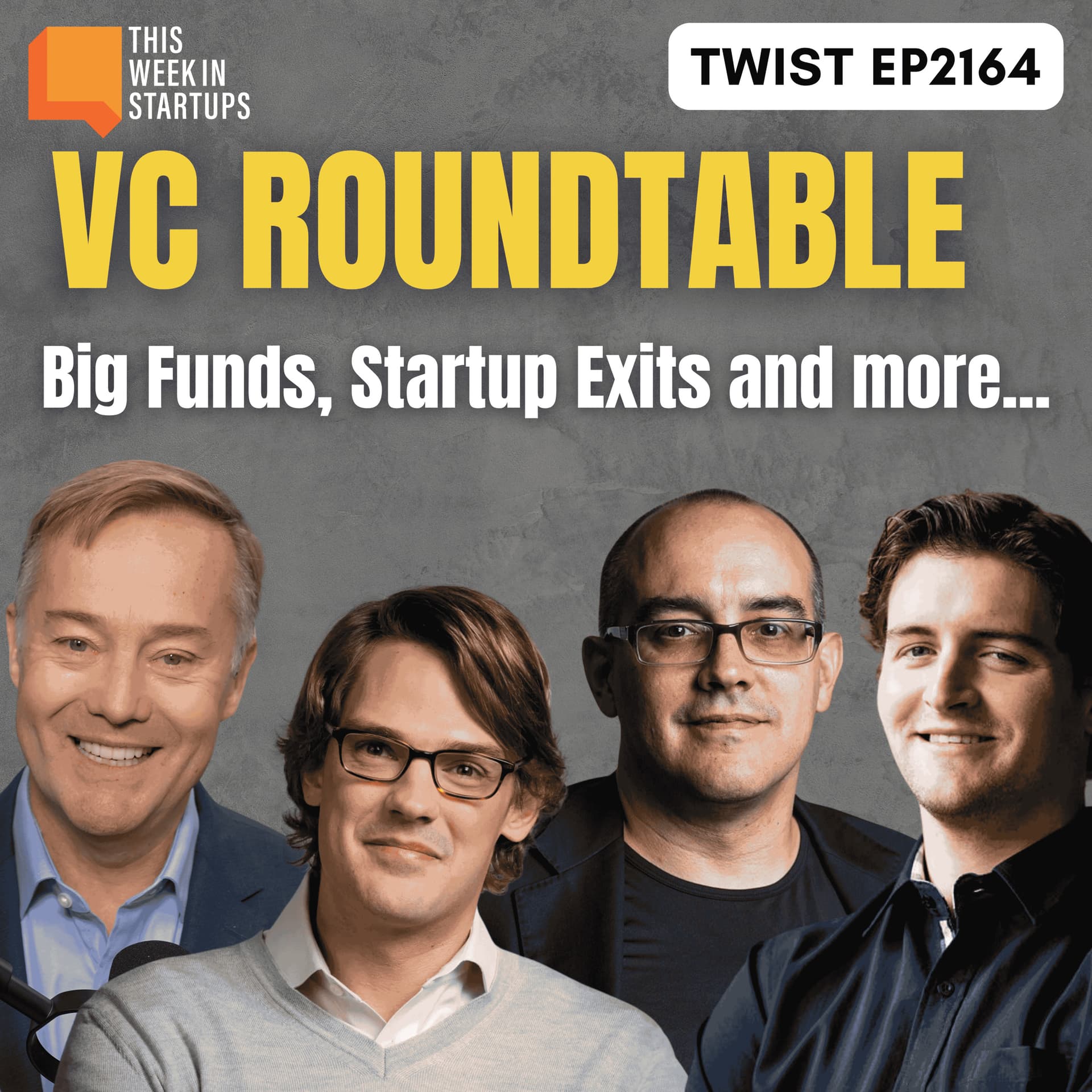
Episode Overview In this episode, titled "The End of the ZIRP Era, and why recruiting is SO PAINFUL," Jason Calacanis hosts a VC roundtable featuring:
- Dave McClure (Practical VC)
- Grady Buchanan (NVNG)
- Tomasz Tunguz (Theory VC)
The discussion revolves around the current state of venture capital, the implications of the Zero Interest Rate Policy (ZIRP) era coming to an end, challenges in recruiting, and the shifting dynamics favoring founders.
Key Topics Discussed
The State of Venture Capital
- Historical Context: The episode opens with a discussion on how companies are staying private longer, impacting fund managers and the nature of venture capital.
- Secondary Markets: The panel discusses secondary transactions and their complexities, including the buying of stakes in companies and funds.
The Shift to Founders' Favor
- Founders' Leverage: Dave McClure points out the pendulum swinging towards favoring founders in negotiations and fundraising.
- Profitability vs. Growth: The conversation includes the necessity for companies to focus on profitability, especially in light of rising costs of debt (around 8-10%) as opposed to relying solely on equity.
Recruiting Challenges
- Pain Points in Recruiting: The panel discusses the difficulties companies face in recruiting the right talent, emphasizing the importance of embedding experts into struggling startups to help them navigate challenges.
The New Era of AI
- Impact of AI on Startups: The discussion touches on how AI tools are streamlining operations, allowing startups to become more capital-efficient and effective in their growth strategies.
- AI and Capital Efficiency: Founders are encouraged to utilize AI for operations and management, leveraging technology to minimize hiring costs.
Secondary Market Dynamics
- Liquidity Events: The conversation focuses on how GPs and LPs navigate the secondary market for venture capital, highlighting the growing importance of liquidity in venture funding.
- Emerging Strategies: The panelists suggest strategies for fund managers to sell stakes early and efficiently to generate liquidity and satisfy LPs.
The Role of Private Equity
- Comparison with PE: The episode discusses the parallels between venture capital and private equity in terms of liquidity needs, operational management, and the emphasis on producing DPI (Distributions to Paid-In capital).
Key Takeaways
- Founders Have More Power: The current market conditions give founders more leverage in fundraising and operational decisions.
- Recruiting is Painful: The struggle to find and retain the right talent is a significant challenge for startups.
- AI is Transformative: Utilizing AI can help startups operate more efficiently and reduce reliance on large teams.
- Secondary Markets Are Growing: There is an increasing need for liquidity solutions in venture capital, leading to more creative secondary market strategies.
- Long-Term Thinking Required: Fund managers must adapt to longer holding periods and consider partial liquidity strategies to provide returns to LPs.
Future Considerations
- The podcast suggests that the venture capital landscape will continue to evolve, with an emphasis on how effectively fund managers can adapt to new market realities, leverage AI, and manage secondary market transactions for optimal returns.
Subscribe and Follow
- Listeners are encouraged to subscribe to the TWiST500 newsletter and follow the show's updates on various social media platforms.
This episode serves as a confluence of insights on venture capital’s shifting landscape, the impact of AI, and the ongoing challenges of managing startups in an evolving economic environment.
Written by AI. May contain mistakes. Listen to the episode to check what was said.
Transcript
Automatic transcript. May contain errors.0:00I think a more basic set of advice is, can you be profitable enough to borrow money at 8 % to 10 % and run your business on debt, not equity. Like there's a difference between default alive and, hey, I'm running my business properly enough to cover, you know, higher interest credit that might be 10, 12 percent. Like there's a lot of companies that can cover the cost of debt with their existing margins, but that might not clear their preference stack of raised capital. And that's the set of companies that I think probably have to start rethinking like, look, I'm not going to make my equity investors whole, but I might be able to make my debt investors money.
0:43This Week in Startups is brought to you by Squarespace. Turn your idea into a beautiful website. Go to squarespace.com slash twist for a free trial. When you're ready to launch, use offer code twist to save 10 % off your first purchase of a website or domain. AWS Activate. AWS Activate helps startups bring their ideas to life. As you build and scale your business, Activate Credits grow with you to support your changing needs. Apply to AWS Activate today and receive up to$100 ,000 in credits. Visit aws.amazon.com slash startups slash credits. and public. You take investing seriously, public does too.
1:31Build a multi-asset portfolio and earn an industry-leading 4.1 % APY on your cash with no fees or minimums. Learn more at public.com slash twist. Hey, everybody. Welcome back to This Week in Startups. I'm your host, Jason Calacanis. And we've got our venture roundtable. We've been experimenting on Wednesdays with doing a roundtable from the other side of the table. Obviously, here on This Week in Startups, we talk to founders most often. We talk about tech news. But today, we've got a bunch of folks who place bets on startups, and they have unique insights, obviously. Dave McClure, general partner at Practical VC, is with us.
2:09He is also legendary for having created 500 startups. How are you doing, Dave? Doing great. And with us, Grady Buchanan, who is the managing director at NVNG, which is a fund of funds. We'll get into that in a minute. How are you doing, Grady? Doing well. Thanks for having me. And back on the program, Tomas Tunguz. Am I pronouncing it correct? Close enough. Thanks for having me back on the show, Jason. Give us the exact pronunciation. It's T-U-N-G-U-Z. It's a good opportunity because people will look up the pronunciation of your name on YouTube, find this video and we will nail it for everybody.
2:50Tomas Tungus. Tomas Tungus. Am I, am I close? Say it again. You're close. Tomas Tungus. Actually, I have a funny story. And when I graduated from college, they asked us to write it phonetically and graduation speaker read it five times before giving up. Tungus. Okay. All right, Tomas. So just starting off going around the table, Well, I think it would be a great idea since we have three different types. Well, we have four different types, three different types of investors on the show today. We got two venture capitalists, but we have Dave, you're now working on a secondary fund. And obviously, Grady, you're doing a fund to fund.
3:29So Dave, maybe explain what Practical VC is and what you're doing here in your second, or actually I should say your third act. Sure. Yeah. uh sure yeah so we started practical bc about five years ago uh working on our third fund and uh really came out of originally i was thinking funds a lot of a lot of stuff we did at 500 was helping other fund managers get started in different countries uh i wanted to do 500 funds and started pitching that idea and sort of got a lot of pushback on doing lots of small funds all over the world. But along the way, we decided secondaries was kind of an interesting opportunity, both at the company level and at the fund level.
4:10And later when I was trying to sell a piece of my carry and my first two funds at 500, that was a pain in the ass. Eventually got a deal done, but at terms that were very favorable to the buyer. And I thought, yeah, I'd love to be on the other side of that transaction. Okay. So what this means in plain English is Tomas and I have venture funds. I'm on my fourth. Tomas, what are you on? Fourth or fifth? Second. He says, you know what? I want some liquidity. I get 20 % of the gains in my first fund. They go to you and say, here's our book of business. And you say, we want to buy X percent of your carry at this price, which is a discount to the future value.
4:50you. That's basically it, although we should clarify here that most of the time when we're talking about fund transactions, we're buying secondary from LPs. That's like buying a strip. Got it. If you're talking the GP, you could buy a lot of different things. You could buy single assets. You could buy a strip of the fund. You could buy a piece of the carry, although that's less common and all kinds of interesting terms there. But most of the secondary buyers out there right now that aren't retail secondary marketplaces are very large funds. They're buying very large chunks, typically$10,$25 million or even larger.
5:25There's not a lot of people doing sub-10 million, certainly sub -$5 million LP secondary transactions, which is kind of what we're doing. We also do direct secondary in companies, typically Series C or later stage companies doing$50 to$100 million in revenue. There's a lot of folks doing that. How do you decide what to buy? Do you look at, do you say, oh, we want to have more shares of SpaceX. Let's work backwards to who owns SpaceX and has been in it for 10 years. Or do you say, oh, I met an interesting VC who's on their third or fourth fund and we had coffee and I explained what I do. And then they said, hey, here's what's in my portfolio.
6:03And then you do a discovery process. Right. Well, we're not usually buying big names like that. We have Canva and SpaceX in our portfolios because I worked at Founders Fund and I ran 500 startups, but we're not usually buying those assets direct. And the top 20 names are in extreme demand, lots of people who want to buy those things. Generally, they're not available. So you're buying them at a premium, usually in SPVs, maybe even multi-layered SPVs with lots of carry and fees. They're great companies if you can get them, but sometimes the structure and price is excessive. Usually outside of those top 10, 20 names is where the real value is, in our opinion.
6:41and we're trying to buy those at a discount. Hopefully in most of these transactions that we're going after, we're one of the only buyers or a few, in some cases, the only buyer. Got it. And at the fund level, that's very much true. At the company level, it depends on what kind of company we're talking about. Grady, when you invest as a fund of funds, you give money to GPs like myself and Tomas. So do you participate in sort of the world Dave is in with these secondary transactions? And have you started to think about that? I'm not sure how long you've been doing a fund to fund. So have you gotten to the point where you're like, hey, we've been in this fund for 10 years.
7:21We want to get some liquidity for our LPs because you also have LPs. We, I see them more from newer fund managers, from friends in the industry than I do from our existing portfolio. We've only been doing this for about three years. My portfolio has 23 funds in it right now, and we're about to cap that moving into our fund two territory. So it's too early for them. And they're predominantly sub$200 million managers, so much smaller. But no, we get them across the desk. But like Dave said, it's five$10 million checks. Our fund one is just north of$50 million. So those check sizes are too big for us anyway.
8:00But we've seen it more and more. But no, not from our existing managers. It's a little too early for that. Grady, do you buy secondary in your funds? Do you buy positions in five to 10-year-old funds? I mean, why not? Wouldn't that be interesting if you could get quality funds that are already mature at a discount? Depending on the construction of the portfolio. I mean, where I come from is in the endowment space. So we used to have a decent portfolio, about 50-55 fund managers. So a lot of legacy relationships. partnerships. So we'd be able to get into these funds at smaller check sizes just based on their timing.
8:39So when we hit the market like late 2021. But it's a good question. We haven't really considered it. Most of our fund managers are amenable to our smaller checks and we haven't really had to kind of go into some of these ones that you would, the brand names that you guys would all know. And based on our strategy, which we can get into, it's the fits happen to be a lot more kind of core, deeper tech, smaller funds, Midwest driven. I sit in Milwaukee, Wisconsin, and our LPs are predominantly Wisconsin corporations. So based on our strategy, haven't really done that yet. Tomas, how do you look at this emerging space now?
9:18A bunch of folks are starting to have their funds go 12, 13, 14, 15 years. That's obviously a longer window than I think a lot of people were expecting. The stay private longer sort of credo in Silicon Valley has, I think, created this entire space. If it wasn't for, you know, Stripe, Uber, et cetera, taking 10 plus years and SpaceX and maybe some of those, Stripe will never go public. I mean, they said on All In a couple of weeks ago or a couple of months ago that maybe they could be private for 30 years, maybe never go public. So what do you think of this new phenomenon this new structure that's emerging.
10:03If you want your business to succeed online, it has to stand out, and that's why you need a beautiful, world-class website. The good news is you don't have to hire an expensive designer anymore, nor do you need a bunch of developers. No, Squarespace has all the tools you need to claim your domain and start building your company. Hey, maybe you got a product to sell. Maybe you want to show off some samples of your work. Maybe you've got a new service you're providing. Well, Squarespace is the all-in-one tool you need for your business to grow and flourish. And they offer beautiful templates. Maybe you want to start an online course or you're scheduling appointments for people.
10:38Maybe you're generating client invoices. All of that is built into the product. Everything you create with Squarespace is pre-optimized to show up in search engines as well. So you don't need to hire some expensive SEO person. Nope. They're building your meta descriptions. They're setting you up with an auto-generated sitemap. and the SEO is done before you even get started. Plus, there's a new AI-powered feature. It's called Blueprint, which makes it easier than ever before to customize your website and make it really pop. So check out squarespace.com slash twist for a free trial. And when you're ready to launch, go to squarespace.com slash twist to get 10 % off your first website or domain purchase.
11:15That's squarespace.com slash twist. Yeah, I think it mirrors what happened in the private equity industry quite a lot. And I think it's a very healthy thing for the venture capital ecosystem. You look at the total number of companies in the U.S., public versus private. The number of private companies is increasing. The number of public companies is decreasing. That's a pretty important dynamic. I've seen some peer funds have 15-year funds instead of the standard 10-year funds. Is that a good thing, Tomas? I don't know if that's a good thing that the typical VC fund is now 15 years. Well, I mean, I don't know if it's good or bad.
11:52I think it just is what it is. And then the question is, okay, given the LP base that we raise from and their cashflow requirements, how do we provide it to them in a way that sustains the business model? Well, the docs say 10 to 12 years, and then you tell them, hey, it's going to be 15. That's not so great. No, no. So I know of a couple of funds that have actually, within the docs, it's a 15-year fund with two one-year extensions. I have heard of, yeah, this is a new thing that I've heard of. That is definitely new. Well, and you also have to think about this as a fund manager, Dave. I think it's a really great question you pose.
12:27Is this a good or a bad thing? Well, if the returns are excellent and the window for an LP is, you know, okay, we don't care if it's 10, 12, or 15. We just care what our IRR or our cash on cash is or what information you're providing. It sounds like disclosure is the most important thing and managing expectations. Yeah. Yeah. Well, as it turns out, 500 Startups Fund 1 is turned 15 years old, I think, a week ago. Yeah. And it was great because we were already at 3XNet 12 years in. But my kids, who were, I guess, three and five when I started that fund, are now a freshman and junior in college. What happens?
13:13Had there not been secondary and distributions, it would be tougher to pay for kids' college. What do you do with whatever's left in the 15-year-old fund? There are, I guess, a negative way to say it, you know, and I don't like using this term because I never like to say anything derogatory about founders because having been one, it's so hard. A zombie company or let's just say a company that built a$5 or$10 million business and the founder is completely content with that. How does one reconcile that? Yeah, let's not even talk about that. What about like companies that are doing 300 million in revenue, 10 % growth and modestly profitable, but aren't IPO candidates?
13:51But that's like 60 % of the residual value of the fund. Yeah. So what do you do? Do you go to the, I mean, I have started this discussion with a couple of, you know, I don't want to say stragglers either. What's a term we can use? Yeah. Resilient founders. Yeah. Resilient founders who are still in the game, but not ready for an IPO. Yeah. So the way we do this, we do a three bucket method of evaluation of funds and there's unicorns, centaurs and horses. And unicorns are very magical and hopefully going to IPO and centaurs are probably worth north of 100 million and might get acquired, maybe a little IPO, but more likely acquired.
14:31And then very unmagical creatures, which is all the companies that are still alive, but not doing more than, say,$20 million in revenue, probably are not going to ever exit. Like, maybe they'll exit, but I would argue most of those companies probably should be written down to zero or very minimal amounts. What you do is usually a continuity fund. So if you're approaching 12 years or longer, you'd probably try and identify, hey, I've got one or two or three companies in my fund that are doing well and hopefully will be IPOs or at least large exits. And maybe there's two or three of those assets that you roll into a new vehicle, put a five-year clock on that, maybe put some new terms with lower management fees, maybe some carry.
15:17And then you ask your LPs, hey, do you want to roll into that vehicle or do you want liquidity? and hopefully you can figure out a way to provide liquidity to them. Which seems really complicated. Yeah, that's complicated. What about just asking the founder? I don't think that's that complicated. That's very typical for PE funds. It's starting to be more typical for VC. What's the cost of setting that up? Are you talking about setting up now hundreds of thousands of dollars in expense for the next decade for the continuity fund? Is the juice worth the squeeze? Well, yeah, it should be. It should be worth the squeeze.
15:48The setup costs are not dramatic. You're just setting up another fund. You know, I don't know,$25 ,000,$50 ,000,$100 ,000 to set up a fund. But like, you know, these are hopefully funds that have$50 ,000,$100 ,000 worth of assets. It's not, that's not the issue. Probably what you should be doing is getting a third party assessment of that value because, you know, from an LP perspective, the GP should not be pricing their own assets into that new vehicle. So you want to get some third parties assessment of what the real value should be. And we're getting to the heart of the issue, which is the elephant in the room on all this, which is VC marks are bullshit.
16:25Like everybody knows it. Nobody's really talking about it. Everybody's like, oh, yeah, the other VC funds' marks are bullshit. But mine are great. Okay. Well, now we've opened up the can of worms. Just on a tactical basis, Tomas, I'm curious if your first fund is getting to the point where you have to deal with this issue and if you have any strategies. And then I'll talk about some of my own. No, I mean, not yet. So fund one is only about two and a half years old. And I think for fundraising - You have plenty of time. Yeah, I mean, Grady will have a view here, but I think you really need to show DPI by fund three, ideally fund three, but definitely by fund four.
17:00And so there you're talking about the fund being six and a half, seven years old, something like that. And there I think it'll be really important to show DPI. And so secondaries might be an important part. And I think there's one component of secondaries, which is there are third-party secondary buyers. And then there are new investors, bigger investors, who raise very large funds who could also be potential buyers of secondary. I think a lot of this has to do with the fact that the wrath of Lena Kahn put a four-year freeze on what I'll call single and double M &A,$50 million to$500 million acquisitions.
17:36Don't blame it all on Lena Kahn. This is like— 100 % on Lena. This is Zerb era, excess by VCs, not the government-led-tory environment. No, I'm just talking about the M &A piece. Like we used to see a lot more. Good companies will get bought if they're worth getting bought. It's because a lot of companies are bullshit that they're not getting bought. I disagree. I think a lot of it had to do with that four-year period of people saying, watching Figma, watching other, you know. Oh, you're talking about really high-end. Well, no, no. I mean, even the little ones where it's like, remember Zuck tried to buy like, was it a GIF company?
18:11I believe it was like a GIF or like a meme. They bought Giphy. The Giphy. And then they were like giving him a hard time about that. And then Amazon tried to buy a small robotics company. Again, super hard time about that. I'll ask producer Claude to give you some of those that got stopped or got iced. Aren't M &A transactions up? Well, now since the Wrath of Lena Con ended January 20th. Oh, come on. They were up before the transitioning government. Not really, no. They may have been up for the last year or so. They were really, I mean, I talked to - Charts, Jason. Okay, we will. Well, here's one.
18:45Startups are buying startups. This is a really interesting – M &A has come back. IPOs have come back. And it's exactly correlated with the change in administration, putting aside Democratic versus Republican. This administration wants to see more transactions. This chart is interesting. It's from our friends at Silicon Valley Bank. Startups are buying more startups. VC-backed M &A deals. and a percentage with a VC-backed buyer. So here we go. Percentage with a VC-backed buyer, 46%, total deals, full year extrapolation. So I think this is going to be, whether this is consolidation of, and a way to kind of wrap up old funds, which is have one startup buy another, I do think this is starting to come back.
19:34What do you think? Isn't that just a function of more companies not going public? Like same buyer, but that company would have been public five years ago. It's private today. Maybe, but I mean, maybe they're just smaller is I think sort of my take on it. They just, unless you have a real - Is Stripe a startup? No, no. Stripe is, you know, that's a public company that's decided to not go public. Right. So their transactions are probably counted as a private, they seem backed company, but that's essentially a public company. We're all familiar with AWS, Amazon Web Services. That's the cloud platform that powers so many of your favorite brands.
20:17But do you know about AWS Activate? That's their program for startups, where they provide up to$100 ,000 in AWS credits for all startups. Whether you're backed by an investor or you're bootstrapping, money is time to keep innovating, time to delight customers, and time for you to keep gaining traction. You need runway, and AWS's Activate is going to help you with that runway. We hear this story from so many of our founding university companies. They're finding product market fit, the words getting out about their product, just a little boost. Finding some savings here or there to get a little extra time can be the difference between getting traction and bringing in revenue, or, hey, let's call it what it is, running out of money, okay, and shutting down.
20:57AWS knows this. That's why they've created the ultimate toolkit for early-stage startups looking to boost growth. With AWS Activate, you're going to get up to$100 ,000 in AWS credits, hands-on support and training, plus exclusive discounts with some of our favorite companies and tools. So start getting the support you need at every stage of your startup journey. To learn more, visit aws.amazon.com slash startups slash credits. That's right, aws.amazon.com slash startups slash credits. Let's talk about the impact then of all these IPOs. We're starting to see them. Have you had anybody on that path, Tomas?
21:37I'm curious. On the IPO path in your two funds yet, do you have any you're sort of excited about that possibility with, or are you still too early? No, we have a few that are definitely on that trajectory. I mean, it's still early. And to go public, you probably need 400 million in trailing or something of that order. So, but I do think, I mean, I do think - That's amazing. That's the number. That's just amazing. Yeah. Well, so there's two different dynamics. The first is Anderson published a study, you know, okay. So if you raise a round of private capital, legal costs, whatever, a hundred K to 500 K to raise that round of capital, if you go public as a result of all the regulatory challenges of 15 to 25 million.
22:17And so you can't spend, if you're a hundred million in trailing company in trailing revenue, you can't spend 15 to 25 % of your revenue to close a financing. So that's a big challenge. And then the other challenge is that the large asset managers, I think it was KOTU who had this in their East meets West 18 months ago, the large asset managers need to deploy pretty significant check sizes at IPO. And so for a hundred, if you're a hundred million in trailing, maybe you're worth a billion. Sure. Maybe you float 20%,$200 million offering. Can't really put that amount of money, big amount of money into that IPO.
22:52And so juice isn't worth the squeeze. Billion dollars is not enough to go public. Billion dollar market cap, not enough to go public. Not anymore. I don't think it's true. The number I hear is just you have to be at a billion in revenue growing 20%, 30 % year over year is like the new bogey. That's what I heard too. I don't know if that's true, but half a billion to a billion is kind of what I've been hearing. Yeah. I think it was at 700, right? Going 45%, 46%. So right in between the two. Yeah, that fits the profile, right? Yeah. But the float was really small. But the growth was pretty substantial there too.
23:27I think the growth is also important, not just that revenue number. Well, that is talking about another issue here. 70 % of unicorns, and you pointed this out, Dave, are maybe not actually unicorns, and they're growing at less than 50%. So it seems to me like we might be in a situation where the backlog of companies needs to be dealt with. And this is, I think, something that fund managers and their LPs are going to have to deal with. Grady, any thoughts here on what we do with the backlog? I mean, I think you started investing right as the backlog. You started investing right as the market crashed, which, by the way, if you're going to start your investment career, doing it when Dave and I started, which was 2010, was the absolute perfect time right after the great financial crisis.
24:20million dollar valuations. It's incredible. But Tomas, when did you write your, because you were doing angel stuff and syndicates. Yeah. If I remember correctly before I was at Red Point for about 15 years. Oh, you were at Red Point. Right, right, right. And so I started three months before Lehman fell. Got it. I mean, actually, if you look at, if you want to start your career, starting angel investing or syndicates or in venture as the market has crashed, perfect timing. So congrats, Grady, on starting right after the Silicon Valley bank collapse and the end of Zerp. But I'm curious your thoughts on the backlog here.
24:56Yeah, we've been, I mean, so yeah, we wrote our first check in like October, 2021. And based on our strategy, we kind of avoid a lot of the AI application layers or some of these sexy deals that have really gotten overvalued over time. So we've been fortunate just based on who our LP base is and the strategy kind of keeps us away from some of these. It means we won't hit all of these big winners that you guys have in your portfolios. But we did invest in a few funds that had pretty well-built portfolios. So they're in that kind of 2019, 2020. Our first couple managers we do struggle with because they're the ones that, as Dave would say, like, I don't know what those markups are.
25:37They can mark them up every quarter. They can mark them down. I kind of let the managers do what they're going to do. And then we disseminate that information to our LPs. Wait, wait, wait, wait. You're letting the managers do what they want to do? We are not the biggest check, Dave. So at some level, we'll monitor them. Yeah, we'll monitor them. All of our funds, I will say this, all of our funds are amazing. We won't invest in every amazing fund. But what they do is focus on the institutional quality. We trust the other LPs. We'll talk to the other LPs probably more than we will the managers half the time, certainly on our earlier funds that are in that kind of, like Jason said, that peaks are timeframe that have heavy software plays that have not seen up rounds that are more cash constrained today because it's been a couple of years because I think their valuations were too high.
Read the full transcript
26:23So at some level, but we also have 280 companies in the portfolio right now. And so for what we're monitoring, I monitor more across the industries and the sectors, but But to your question, Jason, we do. We look at some of our heavy hitters. We make sure that those companies are still well in line and on the right trajectories. We can't monitor every single one of them. We're talking to one of three on our team. And so we trust our managers as much as we can, Dave. But we do trust our managers to make sure that those markups are appropriate. If anything's in question. How do you do you have buckets you put them in?
27:04I'm sure when you have your meetings internally, Grady, you say, hey, we got 280 companies here. We have to have some mental model of how to bucket them, how to organize them. How do you do that? Yeah, we do heavy diligence up front. We'll date managers for quite a long time, trying to talk to even GPs like all of you guys in the space that will co-invest with these managers. No, no, but with the look through to the 280 companies, I'm curious if you have a CRM, a Google sheet with all of the individuals, and then you say, hey, here's our one, two, and threes, which is how we do it internally. We have a one, two, three system, and I'll explain in a second, but I'm curious what your system is.
27:42Sure. We bucket across. I mean, I look at unique geographies and unique sectors, and then I make sure that the access or the balance across the portfolio, we don't have a lot of overlap. A lot of our funds will have overlap. Like you guys can probably guess we're a regional based venture fund. There's a reason we have some Wisconsin based investments, Illinois based investments. And so some of them have some overlap, but across stage and across sector, we've been fortunate in the 280 companies. They're all fairly unique to individual GPs in the portfolio, which is great. So you don't have a bunch of overlap like, you know, Harvard or Yale or Duke might have five managers who figured out how to get into Uber or Airbnb and Coinbase during that era, and they have different investments.
28:28They might have Bill Gurley doing the Series A of Uber and, I don't know, Menlo and Shervin doing the B, me doing the seed or Sokka doing the seed. You can kind of have that look through. Tomas, I'm curious, do you put startups into buckets so you can have a mental model of where to allocate your time? And how do you think of the allocation of your time as a GP when, yeah, you could have companies that are clearly unable to raise and struggling, some that are figuring it out and promising, and then others that are breakouts. How do you think about allocation of your resources? Well, we run very small portfolios.
29:02We have 10 core positions in fund one. We'll have 15 core positions in fund two. And so we tend to have a lot of time to be able to focus on those companies. And one of the reasons is we do think that some TLC, when we invested the seed in the A, can meaningfully change the trajectory of that company or allow us to recover more of the capital, let's say. Wow. That's super concentrated. That's unbelievably concentrated. High conviction at seed. High conviction. And see, this is an interesting little cul-de-sac that we should go over here as we sort of thread this journey. You said, hey, you can have meaningful impact.
29:42Give us an example of, hey, you got this really concentrated portfolio. You have two companies that maybe are trying to figure it out, perhaps struggling, lost in the wilderness, whatever it is, however you like to phrase it. What have you done or what have you seen is the most high leverage where you can have an impact?
30:03Every time you turn on the news, it's about AI getting smarter and smarter. These models are writing perfect code. They're acing the world's most difficult exams. And it turns out they're also pretty good at making money. That's why there's public.com, the investing platform for people who take their money seriously. What really sets public apart are their AI powered tools and features. Check this out. You can ask public a question about any stock in plain language and get a straightforward answer. If you want to see why a particular stock's price jumped or crashed, they've got a clickable AI generated summary right there in the performance chart.
30:38You can can build multi-asset portfolios on public stocks, bonds, options, obviously, but hey, maybe you want a little crypto in there, some ETFs. I will advise you to try public.com and access industry-leading yields like 4.1 % APY on your cash with no fees or minimums. Plus, for a limited time, earn 1 % match on all IRA deposits, IRA transfers, and 401k rollovers. Never too soon to get that retirement dialed in. So go to public.com slash twist today to fund your new account in five minutes or less. That's public.com slash twist. Disclaimer, paid for by public investing. Full disclosures in podcast description.
31:16Yeah, I mean, I'll give you one story. We invested in one company, immediately identified that the sales leader was not the right person for the role. And we have two great sales leaders on staff who built the sales functions at Two Unicorns. And And one of them actually has been acting as interim VP of sales for that company. Oh, wow. And since then, we've exceeded quota. We've exceeded our targets every quarter since. So you embedded an expert. Antonio from Valor does this. He's got really great operators. So he'll embed people into companies when they're having a challenge. And that company could be anything from a Tesla to a SpaceX to, I don't know, he's got so many great companies.
31:56And it's not that the company is missing anything. It's just, hey, you can shorten the time between when the problem's identified and the problem's resolved. Is that what I'm reading correctly? That's exactly right. Right. And so if you think about, okay, can we say if a startup two quarters of learning, for them to achieve the same goal, the slope and the trajectory of the business is now meaningfully altered. And as we know, and Dave can dispute what the forward multiple should be because he says that maybe they're a bit too aggressive. But the greater the slope, the bigger the forward multiple and the more valuable the company.
32:26And so we started with go-to-market. I think we'll, you know, we may explore other areas here, but that's the one where we find if we can get that right or accelerate the learnings, we can increase the trajectory of the business. You, Dave, I think pioneered investing at scale, increasing surface area in order to find unicorns, invest in a lot of companies at a low valuation. It was considered outlandish. Let's call it what it is. You were even mocked at a time for even calling the firm 500 stars because we're like, are Conway started this trend, but yeah. Yeah, he was the original spray and pray, I guess would be a negative way to say it.
33:02The way people say it today, in a positive fashion, and you guys took the arrows, certainly you, Paul Graham, and Ron, took the arrows for spray and pray. It's now become increased surface area with optionality and getting to know the firms. How did you try to, and what did you learn at 500 Startups in managing an absurdly large portfolio? I think you guys got 2 ,000 startups or 1 ,500 across those first couple of funds. When I left, it was 1 ,800 companies. Christine's been running it the last eight years. I think they're past 3 ,500 at this point. But we were doing 2 ,000 to 400 companies per year.
33:40The basic numbers are pretty straightforward, and I think Correlation Ventures and AngelLispa have both sort of validated this. But probably 50 % to 70 % fail or return less than 1x, and half of those fail quick. Half of those fail maybe in three to five years. you make money on 20%, maybe 2 to 5x back on 20%. I would say you make real money, 10, 20x on 8 to 10%. And then you have big outliers, IPO size, 50, 100x or better outliers on about 2%. And this is where the numbers may vary. Some people, it's only 1%, some folks might be more than 2 or 3%. But we were sort of, I would say, somewhat predictably getting 10 companies out of maybe 250 or so to some kind of large exit that was pretty meaningful.
34:29How did you explain that to LPs? Well, we didn't have that data. We didn't have that data when we started. We have that data now 10, 15 years ago, 10, 15 years later. But we also found, hey, one out of every three, four, 500 companies, we get a Canva, we get a Credit Karma, we get a GitLab, we get a Solana. So like we – out of those first 2 ,000 companies or so, we had three or four crazy big outliers. Which would be 200x, 400x, 500x. Like Canva is probably 2 ,000x. Amazing. TalkDesk, at least at one time, was even more than that. But we already – I think we got probably 300x back so far. Yeah.
35:11You know, again, this gets into like whether people did partial secondaries or whether you're holding it. But I do think, you know, it's not crazy to suggest that one out of every 500 companies, you really get a 500x, 1 ,000x outlier. Most people don't see enough data to see that predictably. So the challenge with this and the reason why everybody doesn't do it is you have to manage five. It's a lot of work. Thomas has to deal with like a mental model of remembering 10. You have 500 founders emailing you. It would stand to reason. In 30, 40 different countries, not just in Silicon Valley. And the ones who are struggling the most, you might have like squeaky wheel gets the most grease.
35:50So what was the instruction on how to manage that? Yeah. Unpack it for people, just as brutal as it is. I mean, we're not – yeah. I think you have to figure out what part of the progression of the startups that you're going to choose to get involved with. Like we were not sitting on boards, and I don't think in general most seed stage, pre-seed stage investors should be on boards. Maybe with Tomas' concentration, that makes sense. But our job was to get companies from accelerator to seed or from seed to series A. So, you know, probably for between six to 18 months, our job is to try and get at least, let's say, a third, if not, you know, a half or two thirds of our portfolio to the next round of funding and help them with, you know, maybe product, maybe customers, maybe people, and certainly with their pitch and their metrics and getting to the next round of capital.
36:42But if we got a third of our companies, 3x or better increase in valuation, hopefully more like 50 % of our companies to a 3x or better in valuation, portfolio progression went up. But it still requires scale. It requires scale. And greater, the way we solved it here at our fund was we created something called Pods, where our 11 investment team professionals with an army of analysts, army of researchers, army of associates. So I hired a bunch of young people out of school and trained them on how to do this job, put them into pods of 30, and had them create, you know, dialogue between the founders to solve each other's problems.
37:26And that seemed to be one way to scale this, but also put them into three buckets. One is clear breakouts. And I have senior people on the team who can kind of manage those board relationships, et cetera. So Robin Hood, Superhuman, et cetera. You know, they're breaking out. They've got whatever amount of revenue. Then on the other side, we have group two, which is figuring it out. They've got traction. They've got customers. They have investor interest. Those are the three things I look for. Are they getting customers? Jason, how often do your 11 team members do this? Is this every hour of every day?
38:01Monthly. Things move fast. And Dave, to you too, it's like, how do you get... Because I'm always... Because our funds, I gravitate a lot more toward Tomas. We have heavy concentration managers because we have a fund of funds and very niche bets and certain managers that speak very specific languages. But how often do you guys or do your analysts look at this stuff? And when do the pods change? Yeah. So we're doing the pods. Quarterly at least. We're doing the pods monthly actually. And we try to get 10 of the 30 or so in each pod to show up. And we put people into three groups and it's really a great tell.
38:33The people who are super breakouts probably don't need to come to the pod, right? So Uber, Robinhood, come, they're not coming to a pod. They figured it out. They have escape velocity. But that second group really does like to come to the pod. And the third group, some of them do come, but a lot of those are in the process of winding down. And so we define them as not able to get customers or they're having a hard time getting customers. They're not getting additional investment. And we don't see an increase in the team size, right? And maybe their runway is under 12 months. So as a mental model for us, I said, hey, you know, the ones that are in group one probably need very little of our help.
39:14We're popping champagne and doing high fives, reading the updates and saying, hey, keep going, come on the pod anytime and let us know if, you know, we can have a celebratory dinner. Great. Or if you want to speak at one of our events. The second group, we can really, I think to Tomas's point, we can really help them because maybe they've got a churn problem, but people do love the product and we can help them with product market fit or maybe point them in the right direction. Maybe their pricing's wrong. And the third group, it's almost like we're, in some ways, it's a pretty dark term, but maybe it's like hospice care.
39:50You know, like the founder is dealing with the fact that this experiment didn't work and we're having a conversation with them of, hey, what's your plan? What's your plan? Is it to shut down, to sell, to pivot, to start over? Because we'd love to see your next company and invite you to come to the accelerator again. So that's the, I think. Jason, we used to have a saying that was winners keep winning, losers keep losing, and tweeners keep tweening. And I think it's the tweeners that you might be able to help get into the group one. But I would advise a lot of fund managers, although this sounds terrible, but like you really do got to figure out that third group and probably limit your time and energy.
40:33I mean, I think you want to be helpful, but you also want to be sort of, you know, the voice of reality. Realistic. Yeah, voice of reality. Figure something out. Tomas, have you had to be the voice of reality yet? Founder can't get customers, doesn't have product market fit, and can't raise money. Yeah, absolutely. Absolutely. It happens. And I think, you know. Take us through it. Yeah. How do you deal with it emotionally? How do you have those hard conversations? Bring us into an example. Maybe you could, you know, not say the name of the company, but you could give us an example, you know, just abstract it a bit.
41:05Yeah. Oh, I think, you know, so one of my mental models is I had a basketball coach who said, you know, you play the way that you practice and you always, you always want the practice to be harder. And so I think as a coach to founders, when you're asked for advice on fundraising or M &A, you actually want to be harder than the market will be. And you want to be harsher because then they can be surprised to the upside. Or it's just then at least you're as harsh as the market. Give an example. Give an example. Yeah. Well, I think, you know, I mean, I've backed a few different companies here that we have an idea, we validate that there's customer demand, founder gets off the ground, has one or two different customers.
41:49And then 18 months later is kind of in the same place. And there you want to believe, right? I think we all want to believe we're all optimistic. We're all investors and startups for that reason. And at that point, it's like a conversation about what is the best use of the founder's time and what does the opportunity cost? And that's typically the way that I frame it. You could be generating significantly more wealth or you could be working on a new idea and it's probably time to close this chapter in some form. Actually, my first job at Redpoint, I remember, was shutting a company down and moving it to assignment for the benefit of creditors.
42:26And so that was a pretty foundational experience. It was a show on HBO called Project Greenlight with Matt Damon. Of course, yes. Do you remember that? Yeah. I remember it very well. They wanted to help startups. They had this great concept of putting the documentary with it, but it didn't work. Failed experiment. And that's the framing I use, Dave. And I'm curious, you've probably had to have this hard conversation countless times is, hey, what's next? This experiment didn't work. Do you have another experiment you want to try with a clean cap table? Because that's also, I think, one of the problems is the cap table can get convoluted as your...
43:03And unnatural things happen on a cap table, yeah? When the company's struggling. This could be a great exit at$30 million if there's only$2 million into the company, that will work. If there's$10 million into the company, that might not work. And if there's$30 million or more into the company, it's probably going to be uncomfortable. Yeah. Here's, Grady, a really interesting way to look at it. This rule of 40, people have been talking about a whole bunch because I think the leader of Palantir has been talking about the rule of 80 because they had such a great year-over-year growth rate. but here it is, the rule of 40, revenue growth plus profit margin.
43:43You put those two numbers together. So you got a 20 % profit margin, you got 20 % growth. Hey, that's pretty good. You've beaten the rule of 40. So here's the chart of that. And what we're seeing is very few unicorns have achieved high growth. So something happened in the market where we gave a lot of credit for performance yet to come. That's our job is to place bets on teams. But as you see here, looks like about 40 % of the companies have 20 to 50 % and greater than 50%, but you got a whole more, half the unicorns out there have zero to 20 % growth or declining revenue. And this is that backlog.
44:24Yeah, Dave? Yeah, well, I think, you know, the rules changed on everyone. You know, again, probably let's say Q4 of 21 or Q1 of 22, where growth at all costs became profitability at all costs. And maybe now we're in a growth plus profitability world. But the reality is like, everybody had a bunch of customers, some of which were profitable, some of which were not so profitable. And when you change the terms, it's like, okay, profitable growth is all what we're looking for. You're going to fire a bunch of those customers and your growth's going to collapse, right? Yeah, that's, that's necessarily the case.
44:59And probably a good thing, right? Like you don't, want unprofitable growth. Maybe you want break-even growth to some extent, but you're going to go for a higher quality of customer with some amount of profitability. And I think a lot of companies have maybe gotten through that where now they're re-accelerating growth that is profitable, but a lot of them haven't, right? Or they've got profitable growth, but at a much lower number than where they last raised. The game on the field, Grady, has totally changed. And we actually see that in public markets, The public markets, I got to see this up close and personal with Uber under Travis, growth, growth, growth.
45:38We can lose$3 per ride. Who cares? There's an unlimited money supply to make this thing grow and go global. Dara takes over. People think, oh, I guess ride sharing is never going to be profitable. And then he starts putting up insane profits and then just announced last week, it's going to do a$20 billion buyback, which is 12 % of the company. And that, paradoxically, Grady, started a dialogue, partially my fault, when talking about the$700 billion in buybacks that Apple has done of, well, is that the best use of that capital? Maybe you should buy a self-driving company. And they've invested in 10 or so.
46:22And so they're investing hundreds of millions of dollars as well. But we're starting to look at that actually at the public market level too. Yeah, Grady? Yeah, I go back to, I mean, what Dave said is true. Our companies are using, because again, most of our fund managers are in their legacy to operators. I mean, they're backed by larger corporations or they have convening power around what we would call kind of the rust belt, right? Or what used to be an unsexy brand that's becoming sexy now. And those companies are growing with cash, like, which is great, which is what, you know, they probably should be.
46:58Back to the timeframe, though, most of our fund managers, like you say, you could say 10, 12 years, they're all like the average is like 14 years plus. We're a little bit more patient. We had been at the endowment. We do balance the portfolio a little bit differently because of those reasons. But we also appreciate our LP base being very large corporations. They care more about the earlier innovation, seeing it. But I think our companies are going heavy into pilot programs and our managers are getting a lot better at knowing the difference between real revenue and pilot revenue. And the sales motions of a lot of these companies take seven plus months.
47:34The people leave these corporations like we have a pretty strong look through into and not for nothing in Wisconsin. If you get a customer up here at the corporate level, there's probably customers everywhere else. Right. So a lot of our corporations are slower to move. A lot of them print cash. A lot of them are very good at what they do. And so innovation to them is not at the forefront, even though they have the right people to focus on this. They're just busy elsewhere. But if we can get them connected to the Midwest kind of stodgier industries, a lot of these companies are growing very, they're getting very close to profitability a lot sooner.
48:09But we're, again, we're a lot of software wrapped in hardware. We're not a lot of the West Coast ones that you'd see probably in Dave or Tomas's portfolio. We have a lot of companies that will take time. But yeah, all of our fund managers are - Tomas, as you look at this advice that we have to give to founders about the game on the field, we had a period of time, peak ZERP, hey, money's cheap, go for the growth. Then we had the collapse and post ZERP era that we're kind of in now and entering this AI era. Maybe those are three different things. Maybe it's two things. What's the advice? Get to growth, get to sustainable growth, hit profitability, because founders will sometimes just come to you and say, you know what?
48:52I don't want to raise any more money. I just want to get to profitability. I want to be default alive. I read Paul Graham's thing. I want to control my destiny. Other folks are like, hey, if we can show that we doubled revenue or tripled revenue, we went from a million to three or a million to five. Hey, there's a lot of large venture firms out there who are looking for that, and they want to write a 25, 50, or$100 million check. So how do you counsel founders who must be feeling right now that their heads are spinning because they get three or four different pieces of advice at the same time.
49:22And the game on the field changes. So, you know, every three years. Yeah, I think you're right. I think there were two major changes in the last couple of years. The first was the end of the Zirp era. And then the second was the beginning of the AI era. I mean, Alex Clayton from Meritech just published this data point that if you look at all new software bookings for publicly traded companies, 67 % of it went to AI. and well that's also because every company is rebranding themselves as ai whether right which which kind of goes to the point right so like i think about there's probably two different axes here there is what is this what is how much cash do you have on your balance sheet how much runway do you have and that i think raises the question if you're a legacy software company do you have enough wherewithal to reimagine your company as an ai business because if you do it's probably worth going through that transition.
50:12You look at the companies, like Intercom has done this really well, where they were a CRM company. I think I've just done that fantastic. Yeah. And then they launched a new customer support agent. They rebuilt a new company inside the company. Yeah, there we go. That's the chart. Anyway, and so if you have the balance sheet and the wherewithal to be able to reposition as an AI company, just because the growth rates are so sensational and the enterprise value you can create is massive, it's worth taking the swing. If you don't and you want to remain kind of a classic software company, then you have to go and eyes wide open, which is you're probably a private equity acquisition and the EV to revenue multiples there are like two to four times.
50:46But Tomas, I just want to be a little bit devil's advocate here. That advice is not going to work for, I don't know, 50 to 80 % of the companies that have that issue. They're not going to be able to rebuild themselves as an AI company, at least not at the scale that's necessary to sort of recover their previous valuations. I think a more basic set of advice is, can you be profitable enough to borrow money at 8 % to 10 % and run your business on debt, not equity? There's a difference between default alive and, hey, I'm running my business properly enough to cover higher interest credit that might be 10%, 12%.
51:27Like there's a lot of companies that can cover the cost of debt with their existing margins, but that might not clear their preference stack of raised capital. And that's the set of companies that I think probably have to start rethinking like, look, I'm not going to make my equity investors whole, but I might be able to make my debt investors money enough to keep the company running and growing. And maybe you get back to your preference stack at some point, but maybe you wash out some of your equity investors. Is that a lot of time worth it? Is it worth that? Well, it's, you know, again, if you have a company that's doing 100 million, 200 million in revenue at 10, 20%, you know, growth, you know, and profitability, that's not really a venture backed company.
52:08But it might be a great company to borrow 20, 30,$40 million, you know, at 10 % and run the business. And you wouldn't sell to PE. You think it's probably better to run the business as standalone rather than selling it. Well, maybe you sell to PE in two years when you double the value of the business. Yeah. Yeah. And when you're on - Some of your equity investors or at least get them to convert, you know, to some form of payback. Well, that also, I think, Thomas, is sort of what you're alluding at is there's an opportunity cost there for the whole cap table. The employees might be fine with that.
52:41The founders might be delighted with it because the PE exit, if they own 40, 50, 60 % of the cap table, they might be delighted as well. But for venture investors now, you're like, well, this is now - Well, do you want$0 or do you want 50 cents on the dollar? Right. But as we know, you're going for that 100x, 500x return. So now you've put yourself in a bucket where your venture investors who have to sign off on that loan are saying, do I put$30 or$40 million in debt on top of the preference stack? And then why am I putting my time into this? But this is just pay to play. This is just the pay to play.
53:15It's just now your pay to play lead are debt investors, not equity investors. What do you think, Tomas? What's the right thing to do in that situation for the venture capitalist? Well, for the venture capitalist is to sell to PE because then you can recycle DPI. We've had sort of, I mean, you look at, there's a fundraising chart where venture capital fundraising 25 is at some local minimum. And a big part of it is a lack of DPI. And so I think if you're a fund manager, ideally you can produce DPI. So encouraging a PE sale is probably in your interest rather than taking that - If it's possible.
53:49If it's possible. Yeah, and here's the global venture. But those PE investors are looking for 15 % to 20 % IRRs or better, and the debt investors might only be looking for 8 % to 12 % IRRs. Yeah, exactly. And here's your overhang of how hard it is to raise venture funding as a GP. To raise a fund has gotten extremely hard. The number of funds is going down, the number of funds closing, the number of zombie funds where they're just living off the management fees and managing it. this is an industry that maybe is, I guess, super challenged. We have startups buying startups. Maybe that's a good thing.
54:24You got the unicorns growing slowly. That's obviously a bad thing. IPOs coming back. That's a good trend. And then you have the state of secondary. So we're looking at this entire, what I'll call the classic venture capital industry. I'll leave the late stage growth people out of this. But the classic venture industry has this really, I guess, silver lining, which is there are a bunch of retail investors who want to come in and many other players and buy secondary. And you kind of alluded to this earlier, Dave. In the top 20 names. In the top 20 names. And I think it's coming down a lot in the top 20 names to the point of which it's massively over, you would agree, I think, that it's overvalued because they're so desperate to get into an Andrel or...
55:09Company by company, right. Yeah. I think there's really three categories. There's the top 10 to 20 names, which are like super brand visible. Everybody wants in at any price. What could go wrong? Well, a lot could go wrong. That's my point. But anyway, you know, if you want to get those names. At any price is like super red flag for me. People are willing to buy three-layered SPVs and carry in fees to get into OpenAI or Anthropic or SpaceX. You know, go for it. Maybe it will work. But like, I think there's another 50 to 100 names, maybe 200 names that are not those top 10 to 20 that are worth it, that are good companies.
55:47Maybe you don't have to pay a premium for those. Maybe you can get those at a discount. And then there's 800 names that you should not buy at any price because they're not going to clear the preference stack. And I think it's really the decision between group two and group three that is more interesting. Group one is like momentum-based pricing. And it's, again, up to you if you want to dive into that. But there's another 100, 200 names that are interesting there that you can buy at discounts if you know what's going on and if you have access to financials and numbers. Grady, how are you thinking about this?
56:20You're going to be in a position where in the next three years, you'll have an opportunity to sell some positions and your GPs are also going to have to make those decisions. Do you have an agreement, a handshake agreement, or an understanding with your GPs? Do you even bring this up when you're deciding to LP their funds of, hey, you know, one of the companies you seed invested in at 20 million is now worth 600 million or 800 million. What's the secondary philosophy? Does that come up now when you back a general partner at a venture firm? Yeah, we do. We actually ask a lot earlier now. I mean, we've had pretty rigorous diligence through all the consultants and all the endowments we've been at.
57:03But that comes up a lot earlier now, specifically with our earlier, more emerging managers too that don't necessarily always think about construction this way. But they've seen the market last three years, maybe last six years. And I mean, you're not going to raise another fund unless you hit some of the, like what Tomas was saying. It's like my take would be like, you're going to have to hit some DPI here eventually. Like, and it's going to have to be realized for us because at some level we can raise a fund, we can recycle, but we need this money back if we're going to, or we're going to churn managers out.
57:34Like, and it just is what it is. So, Brady, can I ask you a question? If you have a fund manager with a 10-year-old fund that's sitting at 4 or 5x TVPI and 0 to 0.5 DPI, would they prefer to run a 4x fund at 0 DPI or a 2.5x fund with 1x DPI? And what do you think about that? depending on the timing i'd probably say the two and a half with a dpi just because the lps can go back into the fund manager um i did i mean it's a but that's the market have that conversation with somebody if somebody like you know come to jesus say hey hey granny you know that report that i've been sending you for the last like four years of our fund being at 4x 5x it's really 2.5 to three X.
58:21Which by the way is the average and you could take the medicine and that's above the average. Well, take the medicine and take the medicine and live to fight another day. Yeah. A lot of them, Dave, I mean, we kind of focused on like, who are the greedy ones in the portfolio? And I don't mind the greediness of what they're trying to do, like the target, the five to seven X, but just to be prudent around, like it's been five years, it's been, And to answer your question, no, we haven't because our fund managers are four years old at the oldest right now. You're still, you know, recent. Yeah, but in our previous life, though, we could we could easily I mean, endowments will do this a lot.
58:58Like we can secondary different different positions away or give them to the consultant for certain prices. But just to just to get the money back to recycle through the portfolio. But for us today, no, haven't had those conversations. But we've seen some breakout winners out of the 280 companies that we have. And a couple of them are like near Decacorn status. And it's like, all right, what is what is the what's the realization here going to be? And then you have to go go at it with the fund managers like, well, it's only been three years. It's like, well, OK, but we're raising another fund here.
59:29And are we going to do that based on optics and sell the pro forma here? Are we going to actually go produce results? And a lot of our managers are newer to that. But some of the ones that have been in the portfolio that we've known for a long time that are on Romano 5 Plus, us, like we trust those. Tomas, Tomas, you've been in this now close to two decades between Redpoint and your funds. So there was a feeling, I think, in, you know, 20 years ago, even 10, hey, if you sell your shares in secondary, that means as a fund manager, you don't believe in the startup. It's disloyal. Now that has changed, right?
1:00:11It's like, okay, well, the founders are selling at their series A before they even have revenue and like making that a potentially a term that they want to start selling secondary before they even, you know, let alone profitability. That's a little bit early. Oh, it's ridiculous. I mean, these are like little side stories. Yeah. These are the extreme stories. Series C or D, that's not unreasonable. No. So the whole concept has changed. I mean, there was a period of time where Fred Wilson and I think Ron Conway were like, secondary is going to destroy the entire industry. It's actually probably had the opposite impact.
1:00:42It's probably made the industry more dynamic. So do you have a philosophy now where you start pairing your positions, Tomas? Yeah. I mean, I do think, you know, one of the things I've been wondering is venture capital industry used to be this like monolithic asset class where you would buy and hold for the life of the company, basically. And that was the premise. And as you said, Jason, if you didn't do that, it was negative signaling. But that life was seven years, not 15. Right, so time to IPO was seven years, time to M &A was four years, and 20 years ago, time to IPO was four years, and so that's why we have four-year vesting periods.
1:01:16But all that's gone, right? Because now it's seven to eight years since inception to M &A and 12 to 13 years to IPO. Because private capital has come in and said, hey, this is a great deal. Why are we leaving this 50%, 100 % growth to the public market? Let's capture it privately. Yeah, and then over the last couple of years, private capital has been cheaper than public market capital evaluations and all that stuff. So I think now we're at a place where, and again, like, I think you can look to private equity where you can say, okay, there will be funds that will hold on to, in private equity, you hold on to a position for three to four years.
1:01:46And then you sell it. If you're at lower mid market, you hold onto that position, you improve the company and then you sell it to somebody else. And as a result of the doubling in revenue, you have both multiple expansion and EV. And using debt for leverage. And using debt for leverage. And using debt for leverage. is not to hold onto the company forever. It's to help improve the company for some three, four years and then produce some liquidity so that the LPs then have great cash conversion cycles. They can recycle the capital, put it back to the asset class. And it might still be a private company.
1:02:17Might still be a private company. And so one of the things I've been wondering is, does this actually happen to venture, right? Do you have seed funds who still have 10-year holding periods, but they look to sell pretty significant stakes five years or six years for two reasons. One is, one, you need to produce DPI between funds three and four to do it. And then the third, the second reason is on a time value of money basis and a net IRR, it might actually be better to sell sooner rather than later, because you're taking on a lot of risks that you may not be able to underwrite, and you may not be set up to be able to help companies at the DEF series, right?
1:02:52Yeah, see, this is really interesting. You're kind of out of your range of expertise. If your performance is flat or only modestly increased, you'd rather have, you know, 2x at seven years DPI than 2.5x at like year 12. Exactly right. Right. This is like super in the weeds, but I think it's super important because we live in such a dynamic time. But this is the thing, Jason, is like GPs have not been like, it's never been part of the venture capital education part to say, hey, manage your end of life portfolio, either via partial secondary sales out of your companies or out of your fund or help your companies get to M &A.
1:03:26Seed fund managers are not trying to figure out how to do M &A. Well, it was always partial secondary sales at your 10, 12. 100 % correct. And I will use myself as an example here. You know, I was, hey, never sell a share kind of philosophy because I had hit some outrageous companies early in my career. And then these offers started to come in and I saw offers come in that we didn't take. And then the companies went to zero or less. And I go, oh, wow. And then I moved to phase three. So I started in chapter one, never sell. Chapter two, I didn't sell and I regret it. Chapter three, okay, we sold 10 to 20%.
1:04:11And then in some of those cases, I never felt like an idiot selling. I sold some Uber at$30 a share. Fred's post, like sell a third, hold a third, think about the other third, right? Something like that, that was his post? I think so. And I didn't regret selling Uber at$30 a share because it was so long ago. And I bought a house with it that doubled in value and all this other stuff. I was able to do other things and have more freedom, even though it's at$90 a share right now. Then I had some other secondary transactions occur where we did sell 10 % or 20%. And I wish we had sold 20 % or 40%. Because again - Especially at 2021.
1:04:51Yes. But we took advantage of them. Now I've moved to chapter four. What's chapter four? Chapter four is we had a company that recently hit some incredible valuation. Maybe we invested at 10, 15 million, hits 500. The founder is like, hey, you're taking your parada. I said, hey, what's your plan on secondary? They said, I don't have a plan. And I said, well, I think you've worked really hard. I would like to see you set up a$20 million secondary in this offering since it's oversubscribed. and you should sell, you know, one or 2 % of your shares, take 5 million off the table, take 7 million off the table.
1:05:26I will support that. And we'll be pari parsu with you. And we would like to also sell 10 % into that of our holdings, if that's possible, if it's on the table and we can do, you know, the auction kind of thing where everybody says how much they want to sell. And then you just, everybody gets their percentage in that. So if you own 10 % of the company, you would get 2 million of the sale. If you own 40 % of the company, you would get 8 million of that$20 million sale. And now I'm educating our partner, founder partners on, hey, this would be actually a good thing for you to do because - Can I suggest to you a chapter five?
1:05:57Please. Set up a separate SPV under your own brand name, get it back by a later stage investor or PE folks, sell to yourself from your primary fund to your continuity fund or your SPV, push the DPI into your primary fund and let a new set of investors take the risk and don't sell at some crazy discount to the retail market or some other avaricious buyer. Sell to a friendly backer who believes in the company so you get price efficiency on that sale. And you still potentially maybe lower management fee, I don't know, carry up to you, but maybe you split that carry with your backer of that single entity.
1:06:38We've been approached about that. A lot of secondary sales are now happening in single asset SPVs so that you don't have to deal with rofers or transfer issues. You can kind of keep the – yes, the entity that's on the cap table is the same. But basically under the covers, you're sort of providing fractional liquidity for that separate entity. Really interesting idea, yeah. And my lord, it's a lot different than the old days when you just picked a great founder and you wrote a check. I think Josh Kavlo was talking about this. Like, no, you need a CFO at your seed fund. You need partners who can architect this for you.
1:07:20This is complex stuff to do. And I think it's like similar to kind of like the folks who manage crossover funds where they had both private market and public market expertise on board. Pretty much every VC fund is now some form of crossover vehicle. if you're holding companies that previously would have went public at a billion dollars, but now they can't go public even until they get this$500 million to a billion dollar. Again, I can't remember. I think it was Josh was on somebody else's pod where he was talking about the value of their holding positions very dramatically depending on when they sold.
1:07:56And I think he was really sort of talking about the secondary market a little bit. Because if you sold it in 20 or 21, you're going to get three to four times the amount of return than if you sold before 2019 or after 22. And so really matters a lot. Like when you're holding on to those positions and you're not doing any kind of selling on the way up, you're taking a lot of risk for both yourself and your LPs. All right. Tomas, did you want to add something there? I saw you were gesturing that maybe you had something to add. No, no, no. I think, you know, David knows this. Dave knows this face cold.
1:08:31Yeah. So I think I don't want to add. Well, I don't want to say I know this place called. This is like my experiences from the last, you know, starting at year eight to 10 is when I started worrying about this for our funds at 500. And certainly from years 10 to 15 for fund one and fund two, because, you know, we had Canva in fund two at a really big number. Actually, you know what? I would like to ask Grady a question, which is, if you see a manager who's really good at managing the portfolio in terms of like secondary and producing DPI, is that going to be a differentiator here in the next decade of investing in venture?
1:09:09Are you looking, in other words, 20 years ago, that probably was not on the diligence checklist. It might've been like track record, comes from a good firm, can show access. Reputation. deal flow. Reputation. Is there an additional question that you ask now, which has shown demonstrated ability to produce liquidity, like idiosyncratic liquidity? Maybe we'll talk about it that way, like outside the scope of broad M &A, the way everybody benefits. Non-traditional liquidity. Non-traditional liquidity. Sure. I think short answer, absolutely. I think it's definitely a mark on the scorecard now that didn't used to be.
1:09:48But actually I'll talk more about the So the founders, as you guys know, you guys have been doing this for a while. We have a lot of serial entrepreneurs, a lot of companies that are a lot of founders that are coming back. In our portfolio, we see a lot of serial entrepreneurs that were once heavy software. Now they're kind of targeting these legacy industries, as you guys know, our strategy. But for them, they're very focused on this, right? So taking the right capital at the early stage, making sure that their managers are financially savvy and have these connections to people like you guys that can speak this language, that understand how to get them to the next round of capital.
1:10:19but also any signaling that these early stage managers can do on behalf of the founder that's positive or negative, depending on when they sell and who that buyer is. So I think the short answer is absolutely. I think you're going to need to be able to do that and you're going to need to be able to prove that. To Dave's point, we have one in our portfolio that's a quasi-public-private, it's a crossover, put them in early in the portfolio so it would produce liquidity earlier for our LPs, but it's in healthcare. Healthcare has just been a little bit tougher on the therapeutic side. But for them, we know that that's not going to be a 10Xer.
1:10:53We know that that's going to kind of sit SETI at the three to five X range. But that's their job. They've been doing this for quite a while. But yes, I think for sure, because we have a lot of trust in our managers that have never done this before, and we know that we'll help them on construction, and they have other institutional backers that are in the same boat as us. But for the ones that have been doing it, that's, it's a, it's a strong value add. And it helps them attract those serial entrepreneurs that understand that they can do this. So I, I think, yeah, long-winded way of saying, yeah, hard use.
1:11:26There's this other dynamic within PE that I understand just a little bit, which is there, and Dave mentioned this a little bit before, their LP-led secondaries, big endowment needs to sell because they have liquidity problems. And then their GP-led secondaries, a firm like Theory says, we want to sell some. And it's about, my understanding is in PE, it's about 50-50. Um, yeah. I guess, like, do you see that happen? Do you see the secondary market? Maybe this is also a question for Dave. Like, do you see the secondary market in venture getting to be 50-50 LPGP? Well, no, but that's why we started this business.
1:11:56Because, like, I couldn't understand. When I was trying to sell fractional, you know, piece of my carry in my first two funds, and, again, one fund had Canva, the other one was already carry. I thought, hey, I'm going to have an easy time. I had, you know, arguably 30, 40, 50 million in value on the table. I wanted I just wanted like three million to like be able to buy a house in Silicon Valley nobody would talk to me if I didn't sell at least five right like and and there weren't like that many people for me to talk to like I talked to industry I talked to a couple of friends at 137 like it was it was a very small universe of buyers for funds secondary in this case I was selling carry not even you know LP secondary for good quality funds you know with good names it was still challenging.
1:12:38And this is four or five years ago when it was a great market. It's even tougher now. But I think there's a ton of people who need the service, which is why you're seeing secondary capital explode and expand in size. After every crash, you see an expansion in secondary market capital. And again, I don't know what the number is, but again, there's$3 trillion dollars in illiquid assets, probably one trillion of that is garbage. Probably one trillion of that it shouldn't be sold and should be held onto, but there's another trillion in there. Got some value. It should just be moved to a different set of investors with a different risk profile and time horizon.
1:13:19Let's end on this. There's not a trillion dollars worth of secondary capital out there. Let's end on this. The game on the field continues to change in terms of the amount of resources it takes a founder or a founding team to get to, you know, let's call it 50K a month in revenue. We're seeing people come to us with no capital raised, or maybe they came to our accelerator or one other accelerator, raised 125K, and now all of a sudden they've got a$500 ,000 a year run rate. It seems like these AI tools, building AI tools, quick way to get quick revenue. People like to sample them. People like to pay for them.
1:13:57They're obviously getting value. So there's something there. But in addition to it, the AI tools are making it really more efficient to run a startup. Startups are capital constrained. Therefore, if you're capital constrained, you're going to look for the cheapest, fastest, best way to do something. And that typically seems to be AI. What do we think about how efficiently, capital efficiently, these companies are being run? Now, of course, after you raise money and you raise a bunch of money, you're going to spend it. You're going to hire a bunch of people. But I'm talking in that year zero to year one sort of timeframe where you're seeing people accomplish more with dramatically less.
1:14:32It reminds me a bit of when you took out having to stand up servers. I think Dave and Tomas were old enough to know. It's the same effect. Yeah, it seems like a similar effect. What are your thoughts, Dave and then Tomas? Well, I've talked to a bunch of people about this who were starting to think about, like, do you have to change term sheets now? because, I mean, I think as a founder, the pendulum has swung dramatically in your direction. Like you can raise at very high valuations. You don't need a lot of money to build companies. And theoretically now, you should be able to generate substantial revenue, maybe even substantial profit.
1:15:08Do you need to even raise later stage capital? Like maybe you're one and done, or you raise a pre-seed round from angels a million bucks. You made a great seed round. I hate to say this now, a seed round is like five to 10 million. Yeah, the classic seed round. And all of a sudden you've got a company that's generating$3 million in revenue a year with growth and profitability. And your team is like 10 people. Like you're probably insanely profitable. Why would you raise more capital that's dilutive to the company? Why wouldn't you just grow out of profits or maybe raise some debt and manage the company?
1:15:43And then here's the thing. As the investors in that company at seed, you know, pre-seed and seed, maybe you're not sitting on the board. You've got a share of equity, but you don't have a share of cash flows. And that company could decide to, you know, run privately for, but down, it could make$10 million in cash flow distributed to the founders and not to you as an investor. And so I think you sort of have to start thinking about yourself as almost like a PE style investor. It's like, I don't just want to share of equity. I want to share of the cash flows, which works if you're on the board, but it doesn't work if you're not on the board.
1:16:24I'm very curious. Do you guys, how hard is it for you to not compare the 10 person team to everybody else in your portfolio that's already been in your portfolio with Jason, to your point, the AI tools that are coming, can, can these teams shrink a little bit, or maybe do they not have to grow to full? What we're seeing is people are getting cut who are not AI first from some startups and getting replaced with AI first people. And I think founders are hip to this. You get one of these AI first executives and they know how to use Zapier. They know how to use large language models. They know how to use these tools.
1:16:57They start having leverage that's two, three, four X, the person sitting next to them. Plus you're using international employees who are a fraction of the cost, you know, whether it's Athena, which we're investors in for, a personal assistant or other. Customer. Yeah. Awesome. Go to athenawow.com and get like a free month or something, a couple of weeks for free. Great product. So I do think we're staying to answer your question, Grady. Smart founders are starting to realize I don't need to solve every problem by adding a body. Once you realize the best way to solve a problem is automation, not recruiting people.
1:17:36Recruiting people is painful. You wind up hiring the wrong person half the time. It takes three to six months. Well, what if you have a really talented person who could automate that job function? And there's some way to abstract it, just like we abstracted standing up servers, people are going towards that. I mean - Yeah, that's right, Jay. Yeah, what I'm curious and very interested in is the existing portfolio companies, looking at you and Dave, who have many, many portfolio companies, you meet the one that comes in with two of us. That's my life today. Yeah. You meet the one with two of us now and it's like, oh, well, why can these two do exactly what one of them is already in the portfolio and they have a hundred people here?
1:18:16Are you having those conversations? Go ahead, Thomas. Thomas is jumping off his seat here, but it is a paradigm shift and some people make the paradigm. I am jumping off my seat. Yeah. So I think, okay, so there's two different company, I mean, two different kinds of companies and they're kind of, uh, the, they're differentiated by the go-to-market strategy. You have a consumer and product led growth or PLG companies where I think that like the ARR per employee can be absolutely astronomical, right? You look at Cursor, you look at Lovable or any of those kinds of companies where there's not an enterprise product and there's no need for an enterprise motion or forward deployed engineers.
1:18:47And there, I think the efficiency gains are absolutely astronomical, um, because the distribution is so highly leveraged. Whereas like in the classic enterprise software company, which includes the legacy companies, the forward deployed engineer is probably even more important because the customer success function is basically fused with the forward deployed engineer. And there, the human capital costs on the go-to-market side are probably the same, if not more expensive because you need more sophisticated people. The human capital costs on the R &D side, I think initially decreased because of the productivity gains that we're talking about with coding agents, but ultimately go back.
1:19:23And the main reason there is if your competition can staff the same size R &D team and is 40 to 200 % more productive, then the breadth of offering that they will sell to the market will be a competitive differentiator and you can't afford not to compete. And so I think this is sort of a short-term dip. You look at like, I mean, the number of companies that we see now that are pitching the whole Parker Conrad compound startups, let's hire founders to create five or six different business units within and those companies that are growing really fast. I think that's a new competitive axis, which is breadth at the series A.
1:19:59How many integrations do you have? 10 years ago, maybe five. Today, expect 150 integrations into different tools. And so I think in the PLG world, yes, you'll see much more capital efficiency in the consumer world, no doubt. Within classic enterprise software, I think you have a short-term dip, but then a long-term basically similar levels of capital need. All right, listen, amazing episode. Thanks, Tomas, Dave, and Grady for coming in. Hey, Jason, can I plug my new pod on secondaries? Oh, yeah, you have a podcast on secondaries coming in September. Sorry, Trading Places is our new podcast on secondaries.
1:20:37Talk about a niche podcast. Hopefully have you on. I'd love to have you on in the episode soon. Absolutely. Tomas, if somebody wants to get you on the cap table, best way to do that? Oh, just reach me, tt.theory.ventures. Okay, there it is. Grady, for LPs who want to be in your fund of funds or GPs who want to have you on their cap tables and in their partnership, best way to contact you, reach out. I'm responsive on LinkedIn or Grady at nvngia.com. All right, there it is, folks. And we'll see you next time on This Week in Startups. Bye-bye. Thank you.
From the publisher
Today’s show:
We’re back with another all-star VC roundtable discussion.
Joining Jason are Dave McClure of Practical VC, NVNG’s Grady Buchanan, and Tomasz Tunguz of Theory VC. Together, they’re having a deep insider discussion of the state of venture, secondary markets, running funds of funds, the legacy of Lina Khan, the difficulty of recruiting, and why the pendulum has potentially swung in founders’ favor.
Timestamps
(0:00) INTRO, The origins of Practical VC and how secondary funds work.
(05:44) So… how does Dave decide what to BUY?
(09:27) Melanie - Companies are staying private longer… Is this good for fund managers?
(10:02) Squarespace - Use offer code TWIST to save 10% off your first purchase of a website or domain at https://www.Squarespace.com/TWIST
(11:18) Show Continues…
(14:17) We’ve all heard about unicorns but… what about centaurs?!
(16:19) Jacob - Are VC marks… bullsh*t?! How long until your LPs should see DPI? The panel debates.
(17:22) Jacob - Is Jason too hard on Lina Khan? Dave says VCs created the problem!
(20:07) AWS Activate - AWS Activate helps startups bring their ideas to life. Apply to AWS Activate today to learn more. Visit aws.amazon.com/startups/credits
(21:30) Show Continues…
(30:01) Public - Take your investing to the next level with Public. Build a multi-asset portfolio and earn 4.1% APY on your cash—with no fees or minimums. Start now at public.com/twist.
(31:16) Show Continues…
(31:34) When it’s time to embed an expert into a struggling startup
(34:15) How investing in SO MANY COMPANIES gave Dave a trove of data
(40:33) Sometimes VCs have to be the “voice of reality”…
(45:53) Are stock buybacks the best use of capital?
(49:29) Jacob - The End of the ZIRP Era meets the Dawn of the AI Era
(51:04) Why running your business on debt, not equity, requires tough choices
(58:23) When you need to “take the medicine” on returns and live to fight another day.
(01:11:17) Is Grady actively seeking managers that have shown a demonstrated ability to produce liquidity?
(01:13:24) Dave says the pendulum has swung into founders’ favor.
(01:20:25) Dave teases his new secondary podcast, “Trading Places”!
Subscribe to the TWiST500 newsletter: https://ticker.thisweekinstartups.com
Check out the TWIST500: https://www.twist500.com
Subscribe to This Week in Startups on Apple: https://rb.gy/v19fcp
Follow Lon:
Follow Alex:
LinkedIn: https://www.linkedin.com/in/alexwilhelm
Follow Jason:
LinkedIn: https://www.linkedin.com/in/jasoncalacanis
Thank you to our partners:
(10:02) Squarespace - Use offer code TWIST to save 10% off your first purchase of a website or domain at https://www.Squarespace.com/TWIST
(20:07) AWS Activate - AWS Activate helps startups bring their ideas to life. Apply to AWS Activate today to learn more. Visit aws.amazon.com/startups/credits
(30:01) Public - Take your investing to the next level with Public. Build a multi-asset portfolio and earn 4.1% APY on your cash—with no fees or minimums. Start now at public.com/twist.
Great TWIST interviews: Will Guidara, Eoghan McCabe, Steve Huffman, Brian Chesky, Bob Moesta, Aaron Levie, Sophia Amoruso, Reid Hoffman, Frank Slootman, Billy McFarland
Check out Jason’s suite of newsletters: https://substack.com/@calacanis
Follow TWiST:
Twitter: https://twitter.com/TWiStartups
YouTube: https://www.youtube.com/thisweekin
Instagram: https://www.instagram.com/thisweekinstartups
TikTok: https://www.tiktok.com/@thisweekinstartups
Substack: https://twistartups.substack.com
Subscribe to the Founder University Podcast: https://www.youtube.com/@founderuniversity1916


