
 Ask ChatGPT


 Today in Focus
11 Jun 2025 · 32m · 15 chapters
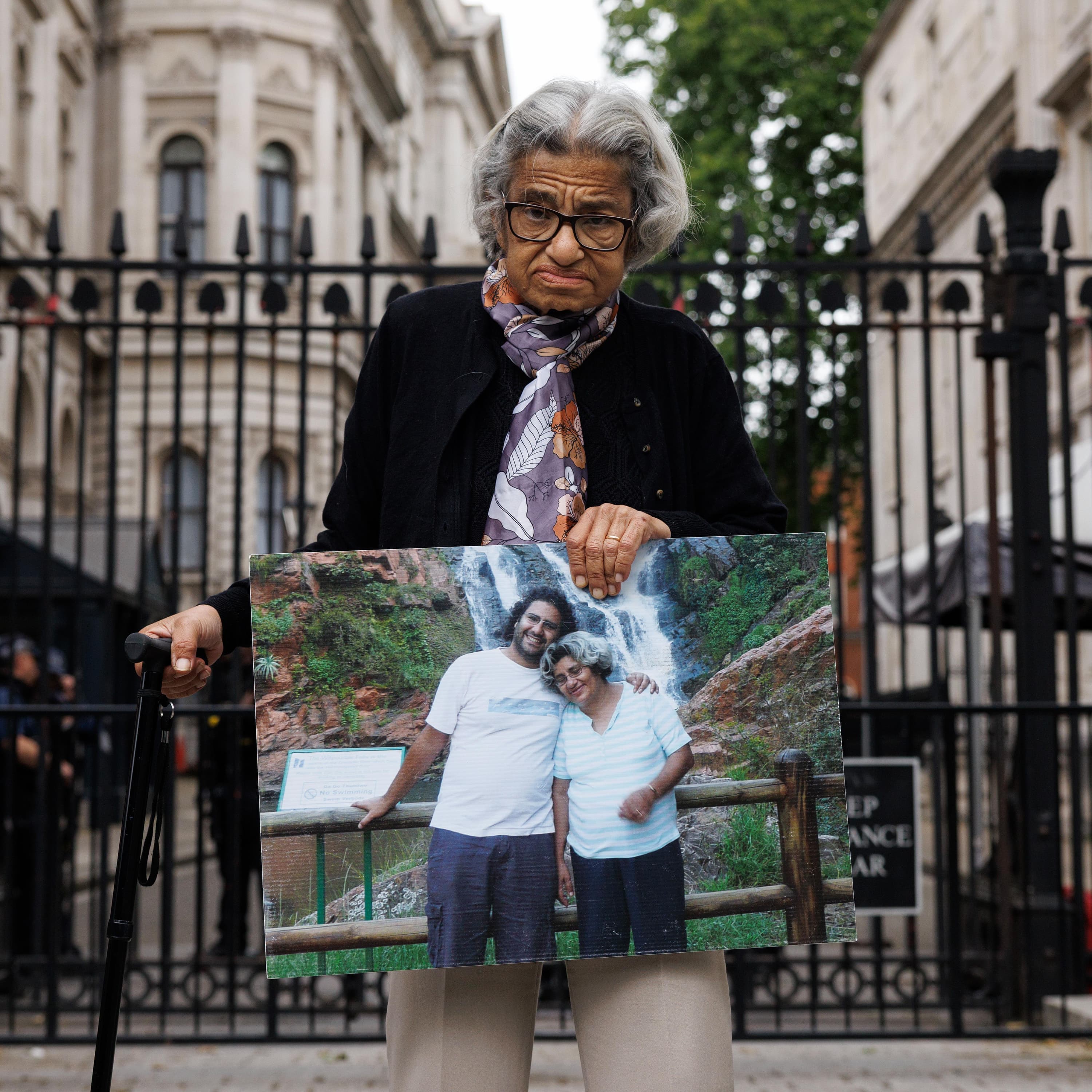
The episode centers on Leila El-Swaif, a 69-year-old Egyptian-British mother in a London hospital who has been on hunger strike for over 250 days to force Egypt to free her son, human rights activist Alaa Abd el-Fattah, imprisoned since 2015. It also explains the hunger-strike process and how it’s used as political pressure, while discussing why UK diplomacy has struggled.
Egyptian authorities refuse UK consular access; Alaa’s imprisonment has been justified via anti-protest laws and “fake news” related to a Facebook post; he fears the sentence will never end.
Alaa’s arrests across three regimes; COP27 (2022) release hopes; Leila’s near-collapse in hospital and brief glucose use.
Patrick Wintour (Guardian diplomatic editor) and Mona Seif (Alaa’s sister; a cancer researcher).
Written by AI. May contain mistakes.
Muna Saif shares the harrowing experience of hunger strikes and its effects.
“Today, the mother starving herself in a London hospital to free her son from an Egyptian prison.”
Patrick Wintour, The Guardian's diplomatic editor, discusses the situation.
“Will Leila's hunger strike free her son?”
Exploration of Alaa Abdul Fattah’s activism and his multiple arrests.
“To understand why, let's begin with an Egyptian activist called Alaa Abdel Fattah.”
Discussion on Alaa's prison conditions and the impact on his family.
“What do we know about his conditions inside these Egyptian prisons?”
Mona Seif shares her family's struggles and the effect of incarceration.
“Alaa is the eldest and me, middle child, and Sane, the youngest.”
Patrick describes Leila Soueif's background and her activism efforts.
“And every day that passes and every moment of these when they pass, it's gone, you know, it's not retrievable.”
Analysis of how British governments have dealt with Alaa's situation.
“Yeah, I mean, Leila's husband, Ahmed Sif, he has passed away, but he had his own contretemps with Sisi.”
Explore the diplomatic complexities surrounding Alaa's continued imprisonment.
“and he was on hunger strike at the time.”
Mona reflects on her mother's character and the impact of the hunger strike.
“What is she like as a person and as a mother?”
Mona shares her internal conflict and emotional response to her mother's actions.
“And so far, we're more than 250 days into this strike now.”
Discussing the growing public attention and potential impacts of Leila's hunger strike.
“But she has really been given nothing to hold on to or nothing to point to to say this has been worthwhile.”
Examining the effectiveness and limitations of the UK's actions regarding Alaa's case.
“Well, obviously, I've discussed this with the Foreign Office quite a bit.”
Discusses potential diplomatic actions the UK could take regarding Egypt.
“And I certainly put that to the Foreign Office as this would be a pretty effective weapon given the number of British tourists that go to Egypt spring and summer.”
Examines the potential political impact of Layla Soueif's hunger strike.
“I mean, I hesitate to ask this, Patrick, but if Layla dies on this hunger strike, will that change the politics in a kind of fundamental way?”
A heartfelt message from the family regarding the stakes of the hunger strike.
“where the remaining members of our family can be joined together and gathered together safe away from prisons and where prisons are part of our past, not ruling completely our present and the future of our kids.”

Get the gist, explore an idea or ask about something said.
 Claude
On Today in Focus, what are the key points of this episode?
Searching your listeningAutomatic transcript. May contain errors.
0:00This is The Guardian.
0:09Today, the mother starving herself in a London hospital to free her son from an Egyptian prison.
0:25It's quite exhausting, but it's also quite revealing. when you go through a hunger strike, because at the beginning you are very weak and you can't even imagine that you will go a day or two or three without it. And then a week or a bit more into the process, something biologically shifts in your body. This is Muna Saif, describing what it feels like to voluntarily refuse food for days and then weeks. And your body kind of turns on a different switch and it starts depending on the reserve you have of fats and suddenly it doesn't feel the same and it feels like a completely different process until your body is consumed and then you start deteriorating.
1:12So it's a whole process. Muna has launched two hunger strikes over the past few years. It's a desperate tactic that her family knows too well. Her mother, Leila, is on one right now.
1:29Patrick Wintour: I'm taking just water and sugarless drinks and rehydration sweets.
1:43Leila El-Swaif, 69 years old, hasn't eaten anything for over 250 days. Doctors say she could die anytime. Like Muna in the past, she's taken this drastic step to free her son, the activist Alaa Abdul Fattah. He should never have been in prison in the first place, and it's been five years. And I can't go on like this. I can't go on like this. He can't go on like this, and I can't go on like this. From The Guardian, I'm Michael Safi. Today in Focus. Will Leila's hunger strike free her son?
2:27Patrick Wintour, you're the Guardian's diplomatic editor, a job that normally has you watching summits or war zones. This time, you're watching a hospital room in London. To understand why, let's begin with an Egyptian activist called Alaa Abdel Fattah. Who is he?
2:43Patrick Wintour: Well, I think he's arguably the most famous human rights activist to come out of the Arab Spring. He's also a very accomplished SS, very honest in the way he writes. He, I think, himself has said that Egypt has a phobia of the power of the written word, or the Egyptian regime does. Well, it looks like the revolution in Egypt has triumphed. In the minds of the Egyptian people, Mubarak is already the deposed president. The regime has fell. He isn't beholden to any particular group. He's incredibly self-critical about what's gone wrong with the revolution in Egypt. And off and on, he has been in Saikara jails since about 2015.
3:29Patrick Wintour: And he's actually been arrested by three regimes in a row, which shows his irritant power to the regimes. If we don't like them, we will change them. If not through elections, then through another revolt. So then on what grounds has he been jailed all of these different times? How did the regimes justify doing this to him? Well, the first and most important arrest was when he actually was protesting about some new anti-protest laws that had just been introduced. I think he was outside a courtroom and he was then jailed for five years. They are laws which are branded as repressive by rights groups.
4:06Patrick Wintour: After the verdict was ruled out, the court erupted into chants of down, down with military rule. He was then released but on parole and that parole required him to go to a Cairo jail every night. And whilst he was in detention, he was then sentenced again, accused of spreading false news and fake news in that he had liked a Facebook post which detailed how another political prisoner had been beaten up in jail. He was then sentenced after about a year and a half in jail to five years. And his supporters say his time has already been served, but the Egyptian authorities are insisting the year and a half in jail prior to his sentencing doesn't count towards his sentence.
4:55Patrick Wintour: and his mother and his others say he should have been released last September because he has served his five-year sentence. Do people expect him to actually be let out or is there a fear that this cycle of coming in and out of prison might just continue forever? Well, I think in his moments of despondency, Allah feels he is going to be in jail permanently and this is a life sentence, that this isn't a five-year sentence and that whatever he says or does, he will be kept in jail. And that if the five years as viewed by the Cairo authorities is expunged and finished and he's served that sentence, he thinks they will find another reason to keep him in jail.
5:40Patrick Wintour: And so that adds a kind of desperation to this case in the sense that there isn't any justice to be had in Egypt. What do we know about his conditions inside these Egyptian prisons? Well, at one level, it's quite hard to know because although he's a British Egyptian citizen, the Egyptian authorities will not give the UK Embassy in Cairo consular access to him. So we rely upon the information that comes from his family. And I think his condition varies according to how he is behaving or how the regime is behaving. Sometimes he has access to magazines and newspapers, which he regards as his lifeblood.
6:22Patrick Wintour: Other times they withhold that, and sometimes they hold him in solitary confinement, and other times not. He's currently himself on a hunger strike. I think he's on close to his 100th day of a limited hunger strike in protests at the way in which he hasn't been released. But he gets visits from his family about once a month, and that's normally behind glass. so they can't hug him or touch him and they can only speak to him and they have to be careful about what they say. He writes sometimes very beautiful letters, sometimes very confused letters and sometimes deeply distraught letters. It's horrible.
7:09So, I'm Mona Seif. I am the sister of Ali Abdel Fattah who has been in prison in Egypt for the majority of the past 11 years I'm a cancer researcher but I think predominantly for the past 10 years when I'm asked who I am I say I'm a family of detainees I'm a family of political prisoners because this seems to be the main role that took over my life and my family's life
7:42I want to thank you so much firstly for joining us from from the hospital where your mother is being monitored I'd like to begin by asking about you about how you're doing in this moment that's a tough one to answer managing I think the best we can say for each one of us is that we are managing you know until this whole nightmare we've been stuck in for the past 10 years and more finds a final resolution and we hope it's a happy one. Can you tell me about Alaa? Yes. Alaa is my older brother. So we are three. Alaa is the eldest and me, middle child, and Sane, the youngest. And he's a software developer.
8:25He's a writer. Since he was young, he's always been very interested in technology and like techie tools that enable people to communicate more and organize and talk and develop ideas together. and cross borders. And he first came to prominence during the Egyptian revolution in January 2011, didn't he? When January 25th happened, he was actually in South Africa. He had moved there with his wife. But when he saw that there's a potential for real change in Egypt, he came back and he became this ball of energy, just helping any initiative on the ground, people trying to draft a new constitutional that represents everyone.
9:06And then he helps them with ideas and technology tools, human rights organisations trying to organise together. He helps them with tools. It's just how he's always been. If anyone saw him back then in the days when we had, you know, the Harir Square and the revolution, he'd always be walking around talking and trying to help people express and organise. I mean, I can't imagine what it would be like for anybody, but what has prison these past 10 years been like for him? The major thing for Ale is how prison has been a way of isolating him from his loved ones, from his family, particularly to isolate him from his son Khaled, who turned 13 just end of last year.
9:52And when I visited Ale, Ale told me something that resonated very strongly with me. He said, I already missed all of Khaled's childhood. I can't bear to think that I will also miss his adolescence. There are all the other layers of he has been tortured. He has been, you know, deprived from the son for years. He has been pushed to the realms of considering self-harm. And then my mother somehow managed to grab him back. There were so many things. We've lost our father when Alay was in prison. So he was, you know, deprived of attending the last days and weeks of my father's life. There's so, so many things.
10:27But at the core of it all, it's this black hole that swallowed him and disconnects him from the most important and precious people and the most important and precious moments of his life. And every day that passes and every moment of these when they pass, it's gone, you know, it's not retrievable.
10:57So, Patrick, desperate to get him out, believing that he has already served this latest sentence, his mother, Leila, has chosen this most extreme option to go on hunger strike herself. You've met Leila a few times. Tell me about her.
11:14Patrick Wintour: The more you meet her, the more extraordinary woman she is. She's from a very high-flown academic background. They come from quite an elite family and they lived in quite an affluent part of Cairo, But from quite a young age, she became interested in politics and became interested in the way in which Egyptian society was developing. And she studied algebra at Cairo University. Then she married a figure on the left. From all accounts that I have read, she was a mainstay of many Cairo protests, often staying to the end and often one of the bravest at those protests. But she taught at the same time.
11:52Patrick Wintour: and meeting her you realize this kind of energy she has and also a kind of real realism, sense of humor about herself. She smokes far too much and she's great company and she's produced three incredibly brave, loving children who mix this sense of politics with their own kind of personal love for one another. I think she's an extraordinary person. This sounds like a political family. It's not just Alat who has clashed with authorities. It's a kind of family tradition. Yeah, I mean, Leila's husband, Ahmed Sif, he has passed away, but he had his own contretemps with Sisi. And some people say there is a kind of personal grudge that is leading the Egyptian president on.
12:38Patrick Wintour: What happened was, in essence, he was being cross-examined by the Ministry of Intelligence. And at the time, Sisi was in charge of that ministry. and he started answering back to Sisi and described Mubarak, who was the president at the time, as a corrupt figure. And Sisi completely, according to accounts, lost his cool and was very unused to people behaving like that and really lodged in his mind that this was a family that he would have no truck with. So Patrick, Allah is a British citizen, you said. How have British governments approached his case over the past decade? Well, it's varied because it's been under different political hues.
13:26Patrick Wintour: But I mean, probably the biggest moment where it seemed possible he was going to be released was at the time of the UN Climate Change Conference in Shamel Sheikh, I think in 2022. At COP27, the drive to save the planet collided with host Egypt's abysmal record on human rights. I'm really worried. I'm also here to put pressure on world leaders coming, especially Prime Minister Rishi Sunak. Rishi Sunak was the Prime Minister and a very big push was made at the time involving including the French President Imel Macron to get him released. and he was on hunger strike at the time. And it felt like he would be released, but nothing came of it and shows the determination that Sisi has to keep him in jail for as long as possible.
14:16Patrick Wintour: Since then, the Labour government has had a problem in the sense that the current Foreign Secretary in opposition was incredibly critical of the Conservative government for not doing more and demanding there be diplomatic repercussions for the failure of Egypt to release Allah. And will the minister make clear there will be serious diplomatic consequences if access is not granted immediately and Allah is not released and reunited with his family? And there's obviously been a kind of question mark whether the Foreign Office, whether Lammy in fact has kept to his word and carried out what he said he'd do in opposition.
14:58Patrick Wintour: And the criticism has obviously been that they've used very traditional diplomatic tools to try to secure his release. And a lot of it's gone on in private. A lot of it is different views as to where the levers of power are inside Egypt. Is it inside the intelligence community? Is it only that Sisi is the only man that will make this decision? Is there any point speaking to the foreign ministry? Are there sticks as well as carrots? They do discuss this with the family about what techniques to use, but ultimately nothing has worked. And when you look at the list of sticks that have actually been applied to Egypt, it's been minimal.
15:38Patrick Wintour: But one of the difficulties from the UK government's point of view is that Egypt is an incredibly important partner in trying to resolve the Gaza-Israeli conflict. Interesting. So the UK government can't really throw everything at this case because it risks alienating Egypt, which is a government that they need. They need to have them on side. One thing I wonder is, from the Egyptian side, why has this been so difficult? It seems like Sisi could score a pretty easy win here by just releasing Alaa, you know, winning credits with the governments of France, of the UK. Why? Why are they so determined not to do that?
16:20Patrick Wintour: Well, it's a good question. It's obviously racked everyone's brains as to why this is the case. Because also, Sisi does release political prisoners. There's quite, you know, generalized amnesties they're given. And one of the conditions he sometimes sets is that the individual has to renounce their Egyptian citizenship. So in Allah's case, he has a young son in Brighton and his sisters also have British-Egyptian citizenship. So they're based here as well. And he could become solely British, for example. That has happened in previous cases. But one wonders whether there is this kind of personal grudge.
16:59Patrick Wintour: The fact that within Egypt, this family is so high profile that he's just not willing to make any concession. but it's speculation because it's got to the point now where the British Prime Minister Keir Starmer, who's spoken twice on the phone to Sisi about this particular case, cannot actually get a phone call with Sisi. Sisi knows what the phone call will be about and he just refuses to take the call. So you're dealing with a pretty dogmatic person.
17:36Mona, I'd like you to tell me about your mother, Leila What is she like as a person and as a mother? I think the world is getting a glimpse Of what is she like as a person and as a mother so mama is a mathematician a geek and this is something she shares with alee she has also been always known to kind of stick to whatever she declares she's doing no matter how crazy it is as a kid this used to be sometimes annoying but sometimes funny because she would say the most incredible of you know threats or or angry birds and then she would have to to go through with them because she just she never goes back on her word but she's also she has always had this ability to extend support and strength to people around her even when it's supposed to be her most vulnerable moments and so I've seen my mother with so many other mothers of detainees and they kind of seek her for a bit of comfort and she's always always giving this sharing sharing part of her strength and her emotions with people all the time.
18:55When your mum told you of her decision to start this hunger strike in September last year how did you feel about that? How do you react to something like that? So I took a bit of time to come to terms with it. And I think the main shift was that when I first received it, I can only think as her daughter. And as her daughter, I found it too painful to even imagine that we'll go through this. I know the brutal regime, the Egyptian regime we are dealing with. And I know the desensitized UK regime we are dealing with. So we are dealing with two governments. one of them who clearly don't care about the well-being of my family, and the other one who even when they care, they are too slow, and the machinery is too slow, and sometimes it feels like it's working against you.
19:45And so my mother is placing her life at really, really bad odds. And then somewhere, a couple of weeks into her hunger strike, something shifted. And I don't know why or when, but it was suddenly when I saw her decision with my eyes as a mother, and it's a new experience for me because my daughter has just turned two years old, when I realized that Ale for her is, you know, my baby, my Lana for me, and that she needed to do something as intense and as painful as the fact that they are keeping her son and keeping my brother in prison despite ending his sentences. This is when I came to terms and I told her, I understand and I hope I'll be able to support you all the way.
20:35I can't promise because I don't know if at one point I'll, you know, I'll be as vulnerable as week and I would be begging you to stop the hunger strike as well. But for now, I understand. And so far, we're more than 250 days into this strike now. has that faith held for you like what's it been like for you watching her go through that process um honestly it's not a straight line and despite me feeling very reluctant about you know such dangerous and extreme decisions like her hunger strike it is true that her hunger strike managed to move obstacles and things that have not been moved in the past 11 years.
21:25And then there are other moments when all I can think about is that I'm just consumed by anger and by the fact that any family has to, you know, be forced to make these very brutal decisions and have these extremely painful conversations among them. And my mom and our family has used every possible political, legal, diplomatic route. And she has reached a point where she can't see anything else but her body and health to use as well. I mean, it's so terrible that your family has been forced to turn to that kind of tool. How is your mum right now? Well, nobody thought she'd make it through such a long hunger strike.
22:13When she first started, we would have never, never thought But she would reach 250 days of hunger strike. Like, I know my mother can be stubborn, but this is, you know, beyond the realms of medicine and anything rational. I mean, she's 69 years old. She's 69 years old. A friend of mine said it in a way, and I thought it was very eloquent, that the fact that she's reaching these extremely low numbers of blood sugar and still maintaining consciousness and still maintaining her resolve. and, you know, and still hanging on to life is a testament to actually how much she wants to live and how much this decision was made to ensure a life with her children and her grandchildren.
22:58And so, yes, so this is where we are right now, but everything seems like it's hanging by a thread.
23:13Coming up, will Leila's hunger strike change anything?
23:29Patrick, Mona has told us about how Leila started this hunger strike out of a belief that she had to do whatever she could to get Allah out of prison. How has that hunger strike unfolded?
23:42Patrick Wintour: Well, it's going to be more than 250 days that she's been on a hunger strike. And what she does is she takes some liquids, but she takes no food. And she's now really quite skeletal. And it is incredibly distressing to see. So I don't think anyone should sort of question her commitment to her hunger strike. It's not that she's sort of secretly eating Mars bars. She is seriously, seriously committed to this. And she's suffering as a result. I think her commitment has been extraordinary. There's been only one moment when I think she relented, which was the last time she was in hospital because she had a real collapse in her blood pressure and sugar levels.
24:22Patrick Wintour: And she was in hospital in St. Thomasis, where she is now in February. And after a long discussion with her family, she agreed to take some glucose and that kept her going. But currently, up until very recently, that was not something she was willing to do any longer. She'd sort of relented partly because there'd been a phone call between Starmer and Sisi and she felt there were some signs of progress. She didn't want to seem like the only demand she was making was the immediate release. I mean, at one point she said to me she was even willing to see as long as her son was given consular access, that would be probably enough for her to end.
24:59Patrick Wintour: But she has really been given nothing to hold on to or nothing to point to to say this has been worthwhile. while and I think in her thought processes she's admitted you know perhaps I've made a mistake even she's sometimes said openly out of the time she said you know I can't back down I've gone so far it's not just that I'm stubborn it's just it would be almost humiliating for me to give in after all this time it's just a very human agony she goes through and I'm sure there are very difficult discussions inside the family about whether she should continue. Is what she's doing this stand that she's taken the costs that it's having on her body.
25:37Is any of it moving the politics around this case?
25:41Patrick Wintour: Well, I think there's a gradual wider publicity being given to her cause and ultimately that is why she's doing it. There's no point just doing it in silence. She's doing it in order to attract attention to the case. And I went to a kind of rather bizarre press conference just outside St Thomas' last week in which there were way more journalists than normal. There's about three or four newspapers that have been covering this case up until now. And now it's spread to places like the Daily Mirror just because of the human element to this. And I'm afraid to say due to the imminence of a possible death.
26:15Patrick Wintour: So, yeah, there is more attention being given to it. And I think there's a group of MPs in Parliament and peers who are trying to regularly raise the case, Prime Minister's questions or whenever they can. Allah Abdul-Fatah remains unlawfully detained in Egypt and still has not been granted access to British people. Could I ask the Prime Minister to pick up the phone to President Sisi and seek the release of... There's just been a small accumulation of people in Parliament taking greater interest in this case. And it feeds into a wider issue about average attention of British nationals overseas, which has been a long-term issue inside Parliament and hasn't really been resolved because there was a promise by the Labour government that they would appoint a special envoy in charge of arbitrary detention whose sole job would be to try to get these people released.
27:03Patrick Wintour: And a year in, the Labour government hasn't appointed that individual. And so what condition is Leila in right now? Well, she's conscious. She's currently, because her daughter Sana has gone to Cairo to see her brother in jail, and this was the only opportunity to go, So Leila has agreed to take some glucose in a way to sort of tide her over to make sure she's alive and doesn't die whilst Sana's abroad. But there are longer periods in which she's sleeping or too tired to talk. And she's, I think, it'd be fair to say, is wilting. I mean, this is ultimately about pressuring the Egyptian government and the British government to do something about her son's case.
27:47Are there things the UK government could be doing that they aren't already?
27:52Patrick Wintour: Well, obviously, I've discussed this with the Foreign Office quite a bit. John Casson, the former ambassador, and a small group proposed that the UK could change the travel advice to Egypt and say that it is not a safe place for British nationals to go because this is a police state. And I certainly put that to the Foreign Office as this would be a pretty effective weapon given the number of British tourists that go to Egypt spring and summer. And they just said they're not prepared to do that. They think it's too much. So the other sticks are sort of small loans that we give to Egypt. There's a potential of sanctions on individuals that are currently jailing him.
28:32Patrick Wintour: Or you could sanction figures in the Ministry of Intelligence or judges. But sanctions are, I think, slightly performative in the sense that they're about not being given a visa to go to the UK or having your assets frozen in the UK. It won't necessarily be relevant in these cases. I think the difficulty is that the UK government is really not willing to say anything critical of Zizi about this. They will say that it's an agonizing case. They're making it known how much they want to see Allah released, but they will not criticize the Egyptian government in public. I mean, I hesitate to ask this, Patrick, but if Layla dies on this hunger strike, will that change the politics in a kind of fundamental way?
29:20Patrick Wintour: Well, she, I should say, obviously believes it will and that if she dies, the cause will be strengthened. And she almost feels that's the only course now left to her. You know, obviously her death would be very shocking to the whole of British politics and to many people in Egypt. And it would say something about the cruelty of Sisi. And I think maybe people would look at the Egyptian regime in a slightly different light. But what kind of long-term damage it would do to Egypt, it's hard to say.
29:55if we could speak to your mum right now what do you think her message would be to the world in this moment? I know that whenever she was asked in the past couple of days what your message would be she would say if I die don't make my death in vain make sure you use my death to get Ale out and not just out but to get him reunited with his son Mine would be to ask both governments to ensure that she does not die and ensure that we have a semblance of a future where the remaining members of our family can be joined together and gathered together safe away from prisons and where prisons are part of our past, not ruling completely our present and the future of our kids.
30:48Mona, I'm so sorry that you and your family have had to go through any of this, but I'm very grateful that you've come to talk to us about it. So thank you very much.
31:03And that was Mona Saif, the sister of Alaa Abdul Fattah. And before her, Patrick Wintour, the Guardian's diplomatic editor, who's written a profile of Layla Swaif, which you can find on our website.
31:21And that's it for today. This episode was produced by Natalie Kdena and Ivor Manley. Sound design was by Joel Cox. The executive producer was Courtney Youssef. And we're back with you tomorrow.
31:40This is The Guardian.
31:45you


