
 Ask ChatGPT



ICE raids and mass deportation rhetoric under Donald Trump spark protests in Los Angeles, with tear gas, flashbangs, and military deployment (National Guard; possible Marines). The episode frames LA as a test of American democracy and civil rights, contrasting “criminals” claims with community accounts of fear and lack of due process.
Andrea (pseudonym), 36, Guatemalan immigrant living in Paramount, LA; legal resident for 20+ years, crossed border as a child; her family has lived in the US over 30 years. Mehta, US citizen “blonde soccer mom” protester. Andrew Gumbel, Guardian reporter based in Los Angeles.
Trump/Stephen Miller pressure escalated public ICE raids; LA’s immigrant community and political culture drive resistance; protests were mostly peaceful despite isolated vandalism; military presence aims to suppress dissent.
Andrea’s drive near a Home Depot/warehouses where tear gas hit her group; her husband shot in the back of his ear; protests near federal courthouse/detention center with graffiti; car wash arrests mentioned; curfew and nationwide protest spillover (e.g., Philadelphia, New York, San Antonio).
Written by AI. May contain mistakes.
Exploration of community fears and reactions to ICE raids in LA.
“Andrea, when you heard that ICE was carrying out raids in LA, what did you do?”
Andrea shares her family's immigration journey and the impact of legal status.
“Today in Focus, on the streets of LA, a test of the boundaries of American democracy.”
Andrea recounts her experience confronting ICE during raids.
“Andrea, when Donald Trump was elected, he had been on the campaign trail talking about, I mean, the two big words were mass deportation.”
Discussion on the political implications of ICE raids in LA and Trump's strategy.
“You know, even if they're bombarding us, we're here and they're not going to make us leave.”
Explore the contrasting political landscape of Los Angeles and Trump's combative approach.
“So there is an inherent conflict of worldviews.”
Understand the dynamics of the protests, their motivations, and the police response.
“these threats that the Marines might also be deployed.”
Discuss the largely peaceful nature of protests amidst media portrayal of chaos.
“Another person we talked to this week was Mater, a US citizen, who went out to protest and was confronted with a scene that shocked her.”
Examine the implications of deploying the National Guard and military in LA protests.
“Donald Trump looks for any excuse to look like he's enacting his agenda with force because he thinks it makes him look strong.”
Listen to testimonies on the perceived authoritarianism faced by citizens in LA.
“If they shoot me, if they cause violence on me, they're doing so illegally.”
Analyze Trump's tactics and contrasting responses from local leaders and citizens.
“We're continuing to see protests across the city.”
Hear personal stories from residents reflecting on their identities and freedoms in America.
“If his attempt to use the military in this way backfires, then I think we're in a slightly less dangerous situation.”
Hear a resident of LA share their experiences of feeling less American due to discrimination.
“it's like just because of the color or just because of some documents, it's like I'm not as American as they are.”
Get the latest updates on protests and curfews in LA related to recent events.
“Thank you also to Mehta, who we heard from earlier, as well as Andrew Gumbel, a journalist based in LA.”

Get the gist, explore an idea or ask about something said.
 Claude
On Today in Focus, what are the key points of this episode?
Searching your listeningAutomatic transcript. May contain errors.
0:00This is The Guardian.
0:08Today, Trump came for Los Angeles. Why the city fought back.
0:26Andrea, when you heard that ICE was carrying out raids in LA, what did you do? So it was on Saturday that I woke up, you know, social media that said ICE raids all over. So I told my daughter, hey, let's go check in the neighborhood. Last Saturday, Andrea, not her real name, went for a drive around Paramount, a neighbourhood in Los Angeles, a majority Latino area. She took her 10-year-old daughter with her. She got herself a little notepad and she's like, I'm going to take notes of what we see. I'm like, OK. Andrea wanted to see for herself these raids that the Immigration and Customs Enforcement Agency, ICE, was carrying out in homes and workplaces, looking for undocumented migrants.
1:15At first, though, she couldn't see much of anything. So we were going down the streets, empty streets, no people walking, and it's a Saturday. We usually have like our street vendors selling hot drinks, tamales. They weren't there. People are scared to come out. And then she got to her local Home Depot, a hardware store, near where ICE were raiding some warehouses.
1:46And I'm wearing my pyjamas, my daughter as well. As soon as we get where all the people are at, we get tear gas thrown at the group where they were. But since we're like walking towards them, we get hit by it too. My daughter's like, Mommy, Mommy, it burns, it burns. and I'm like, baby, don't touch your eyes. Just close your eyes, close your eyes. Oh, go away, oh, go away.
2:15Can I just ask, I mean, when you went down to this area near the Home Depot, near these warehouses, when you knew that ICE was raiding, what were you hoping to do down there? To let them know that they're not welcome in our city, that they're not welcome. We don't want them here.
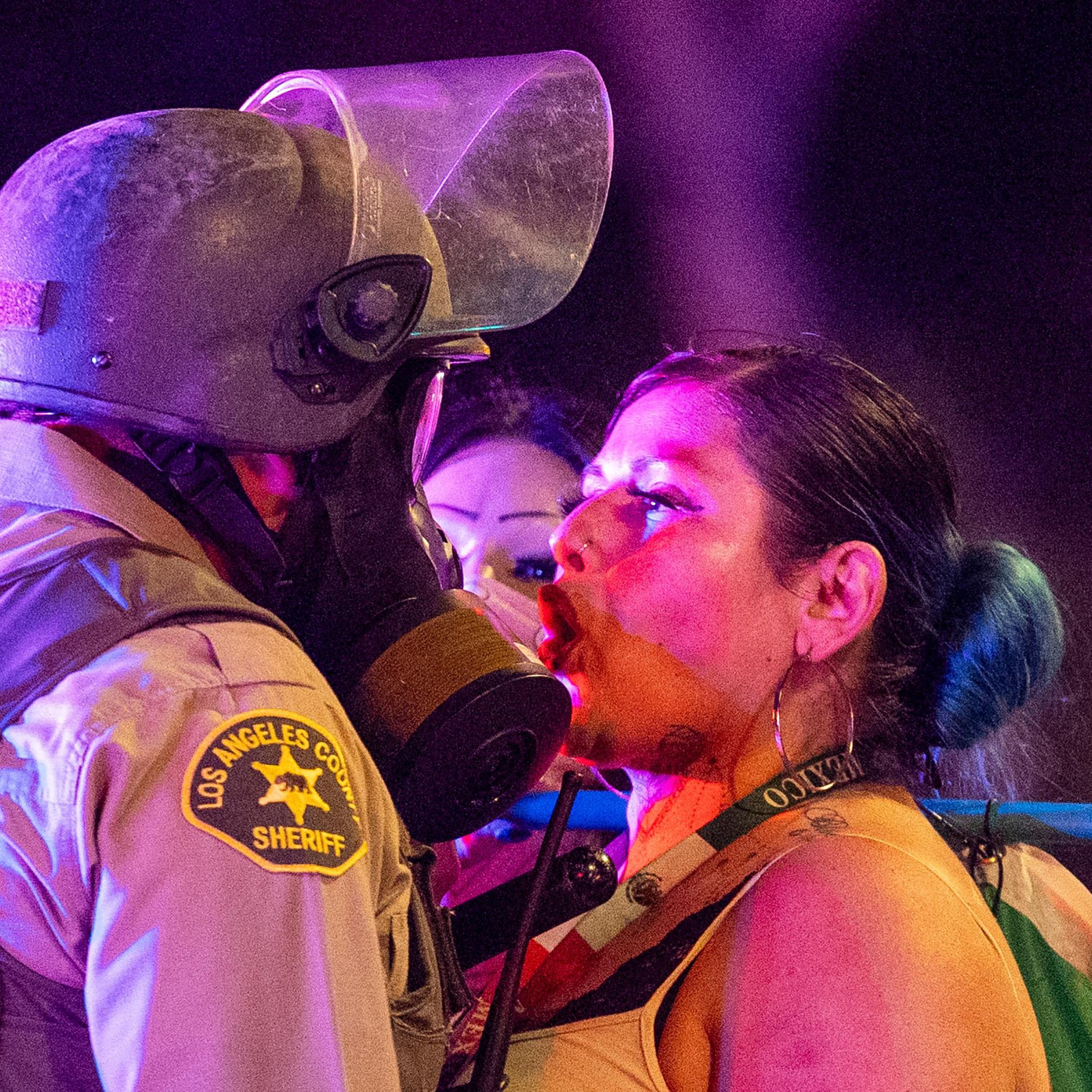
2:38Pockets of Los Angeles this week have been compared to a war zone. Protesters against the mass deportation of migrants clashing with the police, with National Guard and US Marines stationed nearby awaiting orders to deploy. Critics of Donald Trump say he wanted this fight. Today, why in LA he got it? And why both sides see this as a struggle to decide the direction of the next four years. From The Guardian, I'm Michael Safi. Today in Focus, on the streets of LA, a test of the boundaries of American democracy.
3:18Andrea, you've been in Paramount. It's a working class, largely Latino neighbourhood in LA, and it's been the centre of a lot of these ICE raids over the last week. What's it been like to be there? What's the atmosphere like? Honestly, lots of fear in the community. People are not going out unless they really have to. Let's say if they just have to go to work, they're just going from home to work, from work to home. Streets around my neighborhood are empty. People don't even want to go for groceries. It is sad to see how lonely it is. I mean, does it change the way people live knowing that they might go to work in the morning and just not come home at night?
4:05Oh, yes, most definitely. My dad is one of those that I have to be checking in with him. Hey, did you make it to work? How's the atmosphere in the city that you're in? And Trump has said that he is going after criminals. His supporters have been incredibly hostile towards undocumented migrants in America. Can I ask you, Andrea, how did your family come to be in the US and what drew them there? Yeah, so my family has been here for more than 30 years and I'm from Guatemala. So the poverty crime as well too. My dad came first and, you know, he wanted a better life for us. we were three siblings and a mom but I remember that my mom told him after almost a year that he hadn't been back and my dad was like no I'll just be here for like a year and go back and my mom would see like okay it doesn't seem like you're coming back anytime soon so she was like you know what like if you don't come I'm going because I don't want my family separated and then And that's when I came a year after.
5:18And how did you and your mom get to America when you did finally migrate over? Illegally, of course, we crossed the border in Mexicali. Do you remember that journey? Honestly, I was six years old. And it's like flashbacks that come to me. And not until I was a bit older that I asked my mom, Mom, I remember us coming in a small boat and it was scary because, you know, it was in the ocean. And she was like, you remember? And then I said, so wait, it's not just like a nightmare. It's not just something like I actually lived it. And she said, yes, I remember we had to go ahead and jump a fence, which I was six.
6:02So I am really flexible at that time. So like I went ahead and climbed that fence. And so now you're a legal resident of the US, not a citizen, but a resident, a status that you got in your early 20s. But do you remember when you kind of became aware of the fact that you weren't like the other kids, the ones who were US citizens? You know, growing up in elementary, I remember that I had all my grades. I've always been a perfect student ace on a roll, always getting certificates for perfect attendance. And they had this trip in fifth grade to go to Washington, D.C. And I couldn't because of my legal status.
6:48My parents were like, no, you can't. And I remember not understanding so much. What are your papers? What is it that you have no status? What is it that I can't go? Why not? when I'm like a perfect example of a good student. How much anxiety did that cause you growing up, knowing that you couldn't do all these other things that these other kids could do? A lot. Like it hurt me because like I said, I'm like, I want to travel. Up until this point now, I'm like, I never really became who I really wanted to be. You know, like I know that I have so much potential in me. I'm 36 now But I felt like I had to stop college Because I didn't have that support But if I were to have the opportunities That a US citizen I believed I would have been someone bigger In this country and in this life What are the kinds of things That you felt like you couldn't do The kinds of jobs you couldn't aspire to The kind of person you wanted to be But felt like you couldn't be Like most definitely a government job like a psychologist, someone out there to work in the county.
8:05Andrea, when Donald Trump was elected, he had been on the campaign trail talking about, I mean, the two big words were mass deportation. Did you think that that would have consequences for you? It could because of my parents. And, you know, they say we're going to go after the bad guys, the criminals. They're in farms right now. They're going into workplaces. These people are not criminals. We are not criminals. You're talking about ICE, the places they're raiding. Yes. So take me back to that morning when you heard about the ICE raids and went out to see them with your daughter. You were hit by tear gas.
8:50What happened next? Yes. So then after going into the neighborhood, my husband's like, hey, you know, I want to go with you. Like, I don't want you out there with just my baby girl. Like, as soon as we get there, honestly, we get tear gas. And I don't know what is it that they're throwing. So people are like, here, wear a mask, wear a mask. I immediately took off my mask and gave it to my daughter. Then they gave one to my husband and then they gave me another one. And they're like, go away, go away. And this time I'm like, like, we just have like a couple minutes here. What's going on? Like, I had never really experienced what a tear gas bombs were.
9:30And then my daughter's like, Mommy, Mommy, my eyes, like I can't breathe. And honestly, it was just like, I felt like they were just provoking the people. Because I was like, we're just getting here. And this is how we get a welcome. Mindy, like I said, we're like in my pajamas. They're all full armor, like army gear. And I was like, wow, this is like, I felt it so heartless and angry and like inhumane that they will throw this tear gas bombs and just like gas bombs. They're taking this as a game or what is this for them? Like some type of entertainment? I mean, that's like listening to that. It's an incredibly brave thing to do, to go to where these men, you know, with guns, with tear gas, a rating and to kind of put yourself in front of them.
10:23Yes. But like I said, I lived in fear for so many years that I said, and I'm sorry if I get emotional, but I said, not today, not today. It's time to stand up and let me be the boys for my parents. Let me be the boys for those that are too afraid to go out. And I said, no, not anymore. I got the courage and said I have lived in fear for so many years not today yeah so then what happened next so then we just stayed there we were there with my daughter and then you know we would hear like if it was like war zone and I told her are you scared and she's like just a little bit mommy it's just mostly on the noise she even joked around and said mommy by 4th of July, I won't even be scared of the fireworks anymore.
11:17So then my husband came and he was like, he actually got shot. He actually got shot in his, in back of his ear. Yes. Um, with the tear gas bombs, I said, but this is what they want. They want to transmit fear on us, but we have to stand our ground. We have to stay strong and let them know that we're not going anywhere. You know, even if they're bombarding us, we're here and they're not going to make us leave.
11:56Andrew Gumbel, welcome to Today in Focus. We're talking to you from Los Angeles, where you work as a reporter. You've been on the ground the past few days. I'll get to the scene there. But first, can you paint a picture for me of what has been happening these past few weeks across America to undocumented migrants? Well, I think the best way to explain it is that Trump came into office having promised a major crackdown on undocumented immigrants. He promised mass deportations. And then the reality was, for the first few months of the administration, that did not happen. That the deportation rates were roughly in line with where they'd been under President Biden.
12:32And for a while, there were so many other distractions that no one really noticed. But I think Stephen Miller, who is his chief advisor on immigration, and interestingly is an Angelino himself, has started putting pressure on the president to do more. The president then started putting pressure on the Immigration and Customs Enforcement Agency to do more. And as a result, they have been doing very public, very publicity-driven raids in workplaces in all kinds of locations around the country, but they have focused in the last few days on the Los Angeles area.
13:10That led to an immediate reaction, protests, complaints that this is overreaching, this is a violation of people's civil rights, there's no due process. But Andrew, if these raids have been happening across the US, why is it that it's LA where they've met the most resistance? There are a couple of reasons why things have started in LA. One of them is that this is a city where immigrants of all kinds, including undocumented immigrants, are woven into the fabric of the city. They are friends, they are neighbors, they are co-workers. And people feel very strongly about a sense of community in the city that includes immigrants.
13:45This is a city that obviously was once part of Spain. It was once part of Mexico. It has a Spanish name. And there is a very strong sense that the Trump view of the world of America being a country that is predominantly white and predominantly Christian is not something that people recognize here at all. So there is an inherent conflict of worldviews. I think also that Trump, who has a strong sense of the theatrical, understood that a city like Los Angeles, where you have Democratic Party leadership at the city level, at the state level, where you have this very different culture, was a place where if you're going to have a wrestling match and he loves that kind of combat in politics, this is the place to have it.
14:30So Trump had a sense that LA would push back hard. Maybe he wanted it to, and it did. We saw the scenes on Sunday of protesters confronting the police. We saw National Guard deployed to the streets, these threats that the Marines might also be deployed. What's it been like on the ground there? So the interesting thing about experiencing the protests on the ground and then reading about them and watching US television coverage of them is that there is a different experience. I think the fundamental feature of the protests from the beginning has been one that has been motivated by outrage at what is going on and the desire to express that in a fundamentally peaceful manner.
15:12That has been complicated a little bit by a few things. One is that the protests on Sunday in particular grew much larger than anyone anticipated. I think larger than the organizers anticipated and certainly larger than the police anticipated, which led to a certain amount of chaos on the street. In the last couple of minutes, we have seen those flashbang grenades being deployed. These officers getting out their buttons and slamming the legs of these protesters. It was not for most of the day marked by vandalism or violence. there were isolated outbreaks of vandalism, particularly graffiti on all the walls of the federal complex where the courthouse and the detention center are.
15:52But fundamentally, most people were angry, they were vocal, but they were not bent on violence in the way that some of the coverage suggested. Are we afraid? No! Are we tired? No! Are we going to stop fighting? So, you know, when Trump talks about the city being at risk of burning to the ground, this is hyperbole beyond anything that could be possibly justified, even by the images he's referring to. And that carried on during the week. And in fact, as the week has gone on, and I think there's been some degree of comfort between the law enforcement presence and the protesters, there's been a greater determination to have the protests be as peaceful as possible to limit the mayhem that goes on around the edges.
16:39And, you know, there is a lot of tension in the city inherently between ordinary people and the police. This is a city with a long history of police abuse, violence. People do not like the Los Angeles police. So there was a lot of invective being hurled at them, especially on Sunday. my sense is that has calmed down a little and the other thing is I think there's some respect at least among some of the protesters that the police are doing their very best to accommodate the arrival of the National Guard the arrival of the Marines and to try and coordinate a response that is not going to inflame what is already a volatile situation
17:25What I think is important for people to understand is that the protest was largely peaceful that I saw, and we were committed to being peaceful. Another person we talked to this week was Mater, a US citizen, who went out to protest and was confronted with a scene that shocked her. The chants turned very serious, and we did see things being thrown in the air. The police started using flashbangs. We had also seen somebody being helped out of the crowd by their friends who had a foot injury. But that wasn't a good sign either. You know, people shouldn't be injured while they're protesting. It's a very small, small, small section of Los Angeles.
18:12I mean, I'd say each area we were in, smaller than Trafalgar Square. once we were one block out of the area it looked like everybody was just having a starbucks and enjoying their sunday really just a few streets away just a few streets away when we drove to the freeway it was like any other sunday in downtown los angeles i drove by my favorite food market and i said let's stop and get a donut it was like life was going on exactly as normal And so if this was such a small and contained and peaceful protest, why do you think the Trump administration responded with such a heavy hand? I mean, this is the first time since the civil rights era that a president has called in the National Guard without a request from the governor.
18:59The mayor of LA, Karen Bass, has been really clear that she does not think the National Guard, certainly the Marines, are not needed. So why? Why has Trump done this? Donald Trump looks for any excuse to look like he's enacting his agenda with force because he thinks it makes him look strong. It doesn't. It makes him look weak. And it also makes him look like an incredible hypocrite, which he is, because he did not send the National Guard or the Marines to January 6th, which was far more violent than anything that happened in Los Angeles this weekend. So Donald Trump is looking for a chance to show his might on the state of California, which he hates because of what we stand for and what we believe in and what we speak out on.
19:47But are you prepared, though, for LA to become what it looks like from afar, which is the kind of front line against Trump? I guess, do you feel like you want to have that fight against the might of the federal government? I don't want it, but it's here. So we better just prepare ourselves and act like somebody in Germany in 1935, in 1939. What would you have done? Would you have hid in your house and not stood up for people that are less fortunate? Or would you have gone out in the street and said, this isn't right? It feels that stark to you this moment? I don't think we can take this lightly.
20:31I don't think the use of the military should be taken lightly. I'm prepared for whatever they're going to do to us because I'm committed to staying peaceful. So the California National Guard have been deployed in LA, but the reports now are that US Marines could be deployed to the streets within hours. They may even be on the streets already by the time people are listening to this. If that happens, Mehta, would you think twice about going out and protesting again? The rational side of me says yes. The part of me that can't stay silence says no. I can't rationalize not going and using my voice when I'm being peaceful.
21:11The Marines know what's legal. The National Guard knows what's legal. If they shoot me, if they cause violence on me, they're doing so illegally. And the world will know that that's not right. I don't cover myself during this protest. I am a blonde soccer mom. I go with my full face uncovered and my blonde hair shining because I want anything to happen to me to happen in the open and to be very visible. You know, I'm just a white person who's trying to help the less advantaged in our country right now, the people that Trump are going after for no reason. How much do you think your friends and neighbours feel the way that you do, that the country has fundamentally changed and that LA is now a kind of front line against Trump.
21:59We feel proud that we are able to show that his authoritarianism is wrong, that we're going about our business every day peacefully and normally, and that he has deployed ICE to come in and disrupt our neighborhood, our city, unjustly. We didn't ask ICE to come in and start kidnapping people out of their workplaces. We didn't ask ICE to start arresting people at car washes, which is apparently what happened in my section of Los Angeles on Sunday. What is that doing in our community except for creating fear? And basically everyone in Los Angeles feels that This is an unjust set of actions that deserves a full-throated protest.
22:53Coming up, Trump or LA? Who will back down first?
23:05Andrew, this is such a tense situation. We're continuing to see protests across the city. Trump continues to threaten to escalate the situation. Where do you think this could go next? Well, Governor Gavin Newsom laid out the stakes very clearly. He thinks this is an inflection point for American democracy, that if a president can deploy the military to cow and suppress people's right to self-expression, their right to dissent, then we are no longer living in the same kind of society that we were before Donald Trump became president for a second time. I think that's not an exaggeration. On the other hand, if public opinion and political opposition can be mobilized effectively in this moment, then it can dampen what appears to be this impulse to use state violence against ordinary people.
23:59As the days have gone on from the beginning of the protests in Los Angeles, we're seeing protests breaking out in other cities in California and in cities across the country. Philadelphia, New York, San Antonio, the list goes on. In Texas, actually, the Republican governor, Greg Abbott, called out the National Guard to do very similar things to what the National Guard has been asked to do in California. That also has triggered a counter-reaction of people who think that he is overreaching. Andrew, I think when Donald Trump was re-elected, there was this sense that it could be an inflection point for the US, that this could be the beginning of an entirely different political order in the country.
24:38On the ground where you are, does it feel like this moment has that gravity, that this is the moment we feared would arrive? Well, here's the difference between Trump 1 and Trump 2. Under Trump 1, California felt like its own place. It had a different political culture. It opposed almost everything that the Trump administration was doing. I think the state sued the Trump administration more than 120 times. But there was a sense that, you know, there was only so much that the Trump administration could do to interfere in California. This time, the Trump administration is coming for California with guns blazing.
25:16We're seeing that with these protests, we're seeing it with the kinds of things that Trump said after the wildfires in January that devastated neighborhoods in Los Angeles, when he essentially attempted to make federal aid for fire recovery conditional on California doing a number of things that he knew perfectly well California's leaders would not want to do. And we will see as this drama plays out how successful Trump can be in interfering and how successful California can be in resisting those attempts. And when we one day tell the story of, I guess, what happened to American democracy in this era, how important do you think the past week will be?
25:53I think if Donald Trump is able to mobilize the military to crush dissent domestically, then I think we're in very deep trouble. If his attempt to use the military in this way backfires, then I think we're in a slightly less dangerous situation. So the way this plays out will, I think, be absolutely crucial to understand the trajectory of the next months and years.
26:27Andrea, are you planning on going back out into the streets, on protesting again? Yes, most definitely, but not bring my daughter, even though I want her to, because it's our right to go ahead and fight for that, for just how things are really bad. We're not enemies from this country. We're hardworking people. We should have them in our side. It's like they're going after us. It's like a war. It's them versus us. Andrea, you've lived in the US for most of your life. You're an American resident. I'm wondering what this whole episode, what these past few days tell you about America? Oh, my gosh.
27:16Honestly, I'm like, where's our freedom? No peace. It's really sad. Has it changed the way you imagine your future in the US? Honestly, yes. I'm like, I feel like I'm not welcome here, even though I have contributed all my life, even though this is home. I feel like, you know, this is home for me. and I feel like I'm not welcome. Like they don't want me, like they don't want us. But personally, as in me, like because of my skin color, because I have no, like I wasn't born here, even though this is a stolen land, you know, it's like just because of the color or just because of some documents, it's like I'm not as American as they are.
28:09Well, Andrea, I mean, I'm so sorry that you and your family have had to go through this, but thank you so much for telling us about it. No, of course. Thank you very much for your time. That was a resident of LA who we are calling Andrea. Thank you also to Mehta, who we heard from earlier, as well as Andrew Gumbel, a journalist based in LA. His reporting and the work of our entire team on the US West Coast and all over the world is at theguardian.com. This story is moving really quickly. There are protests planned for the coming days LA authorities imposed another evening curfew overnight on Thursday.
28:45For the latest, go to our homepage. We'll be running a live blog there. And that's it for today. This episode was produced by George McDonough, Eleanor Biggs, Isaac Tompkins and Olivia Lee. Sound design was by Ross Burns. The executive producer was Huma Khalili. We're back on Monday.
29:10This is The Guardian.


