
 Ask ChatGPT


 Today in Focus
19 Oct 2026 · 12m · 3 chapters
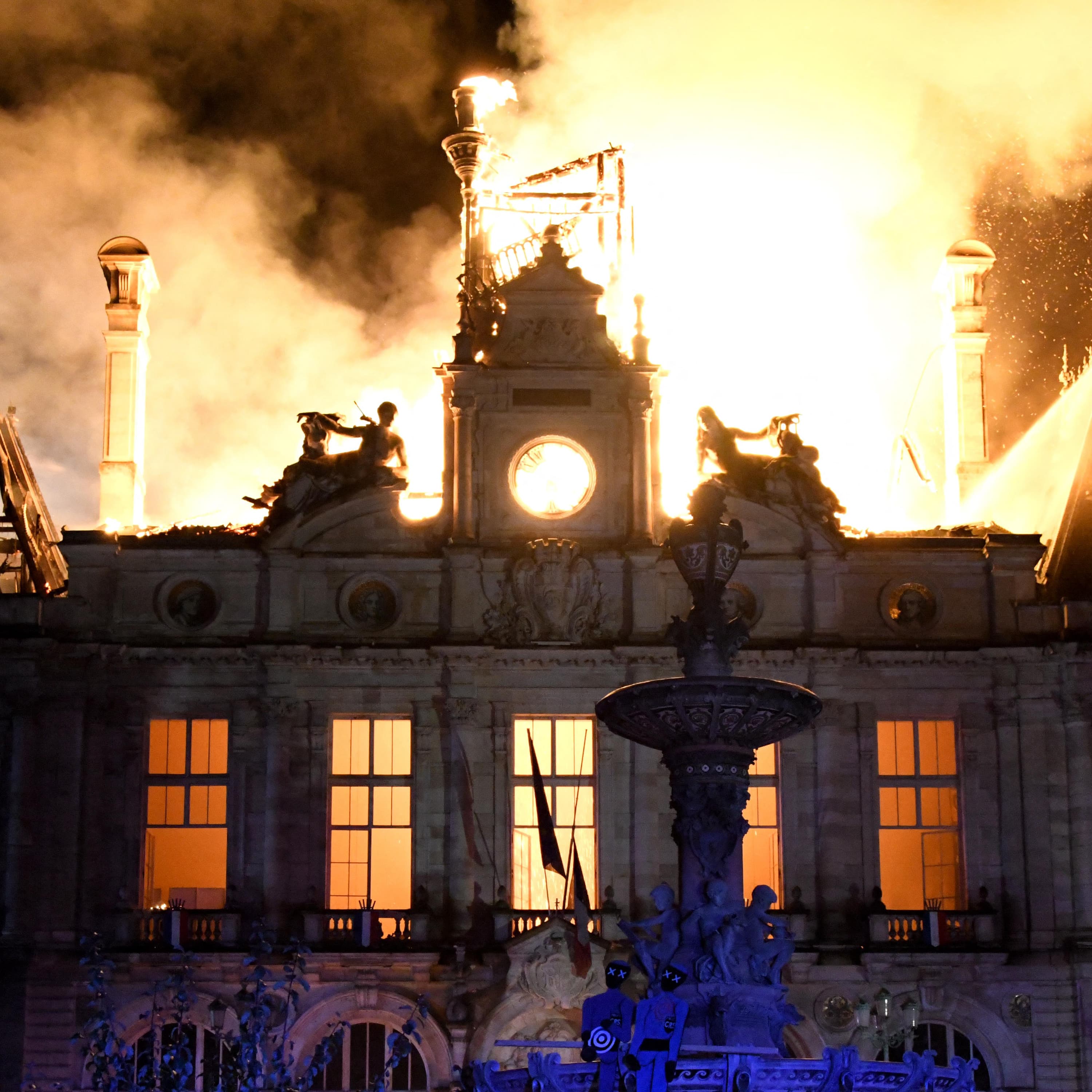
The episode covers escalating France protests that began with high school students protesting crumbling school buildings, teacher shortages, and overcrowded classrooms, then snowballed into a broader cost-of-living (“la vie chère”) and labor/union-backed demonstration. It describes exceptional violence on Saturday: attacks on institutional targets, looting, and clashes in cities including Paris, Marseille, Limoges, Lyon, and Bordeaux. Estimates of turnout range from 550,000 (Interior Ministry) to 800,000 (organisers). The Interior Ministry says police were outnumbered; Macron orders a security review and justice officials cite intelligence failings.
“black blocs”/anarchist-linked groups attacked town halls and prefect offices; Chamber of Commerce estimates 2,000+ shops ransacked. The far right (National Rally) benefits by promising a ruthless crackdown and law-and-order repression.
John Henley, Guardian Europe correspondent.
Written by AI. May contain mistakes.
Discussion on the scale and origin of the protests in France.
“John Henley, you're our Europe correspondent.”
Exploration of the violence and looting that accompanied the protests.
“For example, when PSG, the Paris football team, won the Champions League, we saw similar scenes.”
Analysis of how the protests may influence upcoming elections in France.
“Don't forget, we have elections coming up next year, presidential and parliamentary elections coming up in France next year.”

Get the gist, explore an idea or ask about something said.
 Claude
On Today in Focus, what are the key points of this episode?
Searching your listeningAutomatic transcript. May contain errors.
0:00This is The Guardian.
0:10I think what we saw on Saturday was really an exceptional level of violence, even by French standards. In several towns and cities, there were attacks on those institutional targets. The far right, they are essentially authoritarian. They have promised a ruthless crackdown. If this kind of violence continues, then that's clearly a message that's going to start appealing to more and more French voters. From the Guardians today in Focus, this is The Latest with me, Lucy Hough. There have been huge protests and lots of unrest in France over the weekend. John Henley, you're our Europe correspondent.
0:49There are estimates that the numbers that turned out are somewhere between half a million and 800 ,000, according to the organisers. Who came out in such numbers and why? Yes, the Interior Ministry estimate was 550 ,000, which they weren't expecting. They'd been expecting about 200 ,000. But this has all grown out of the high school students' protest, which began almost a month ago now, and has really snowballed around the country. It kicked off as a protest, as we've discussed, kicked off as a protest against kind of crumbling school buildings and shortages of teachers and, you know, overcrowded classrooms and that kind of thing.
1:33And it gradually pulled in support from parents and from teachers. And it's now mushroomed into a kind of much broader cost of living protest, if you like. It was a protest against la vie chère, which is the expensive life, as it were. So it pulled in workers, it pulled in trade unionists, as well as the parents and the teachers and the school students. And critically, also as a large nationwide demonstration, it pulled in rioters and looters. Yeah, and that caused serious disruption in places like Paris, Marseille, particularly in Limoges, where there was looting and rioting late into the night.
2:21Why were the police so underprepared to sort of bring that under control? You mentioned that the numbers were so in excess of what they were expecting. Yeah, I mean, Emmanuel Macron, the president, has demanded a kind of a full security review as to, you know, what went wrong. And, you know, the justice minister has said that there were intelligence failings. The the interior ministry, the interior minister was on the radio this morning as well, acknowledging that the police were basically outnumbered and lost control in some cities. I think, you know, those numbers would have been manageable if it had been a peaceful protest.
3:00And we should stress that hundreds of thousands of protesters demonstrated entirely peacefully on Saturday. The problem is, and I think this is a particularly French problem, is that it seems almost impossible in France nowadays for there to be any kind of demonstration or even any kind of mass celebration. For example, when PSG, the Paris football team, won the Champions League, we saw similar scenes. There are groups of very well organized, very determined, often well armed in the sense of sort of iron bars and paving stones and whatever they can grab, who are there to loot and to break stuff.
3:51And if possible, to bash cops on the head. And that is their intent. and they seem to be able to do it and in increasing numbers. Yeah, and we've seen extraordinary footage of clashes with those kind of iron poles, as you say, and riot officers, lots of cars set on fire, huge damage to businesses and to public property. I mean, tell me the scale of that damage and where's been most hit because local authorities are going to be looking at big bills to put everything back together again. Absolutely. I mean, I think it's worth saying, you know, besides the kind of the looters, as it were, and the Chamber of Commerce in France estimates something like in excess of 2 ,000 shops were completely ransacked over the course of the weekend around the country.
4:47So those are the kind of the looters and the people who are out to fight with the police. There's also another group of French rioters who are what's known as the black blocs who are more politically motivated. Many of them are sort of loosely associated with anarchists movements, essentially. And they're the ones, according to kind of early reports, they're the one from the mayors that were involved. They're the ones that attacked the kind of institutional targets, like town halls, like the tourism office, like the local prefect's office. And that happened, yeah, particularly in Limoges, as you said, where a beautiful old city hall was more or less completely burned down in Marseille.
5:41where protesters managed to break into the city hall. In several towns and cities, there were attacks on those sort of institutional targets. And in parallel to that, you had the sort of rioting and looting that was going on in Lyon, in Marseille, in Paris, in Bordeaux, in many cities around France. Yes, we had a dress last night from French President Emmanuel Macron, who described, you know, sort of unprecedented scenes of violence. He did admit that there were deep entrenched problems in France, but said that the scenes of violence were disproportionate to that. He put the blame fairly squarely in the hands of the left.
6:26But it sounds like the picture is much more complex than that. It's much more complex than that. That is a political discourse, I think, essentially. Don't forget, we have elections coming up next year, presidential and parliamentary elections coming up in France next year. And it's true that although they have condemned the violence, the left or the far left, the radical left party in France, la France Insoumise, many of their MPs and mayors were out on those protest marches peacefully, protesting peacefully. Yes, they and indeed were on the barricades with the school students, you know, over the past three, three or four weeks.
7:06And, you know, and have been routinely accused by the government, the centrist government and the right wing parties of essentially encouraging violence. Strictly speaking, they haven't done so, but they've certainly lent their support to the to the sort of protest movement as a whole. and they're upset at being blamed for the violence quite understandably and it is a much more complex picture than that and I think the you know one of the issues is that quite a lot of observers are saying is that you know if you are just seeking to pin the blame on one political party and and score political points you know that then you know any possibility of of you know of coming up with a with a broader solution is going to be that much more difficult to find, really.
7:57Absolutely. And I suppose, you know, when Macron called that last election in 2024, the left did extremely well, not least because young people voted in very large numbers, because they felt heard by the left on the issues of the problems in education and society more broadly for them. But on the flip side of that, we also had a surge, although it was less big than was expected, of the national rally led by Jordan Bardella, but of course with the support of Marine Le Pen, who may now be allowed to run. She gave an address last night, which was very presidential, sort of surrounded by French flags, sort of looking like a leader in waiting, which the polls suggest she may well be.
8:41She said France was in a profound crisis. Do you think these protests will have any impact on the election next year? I mean, I don't think there's any doubt at all that these kind of scenes and this sort of level of violence, you know, which I think was extreme even by French standards. I mean, you know, the last major riots that we saw in France were 2023, where there was more than a billion pounds worth of damage done to shops and public buildings and stuff. But but what I think what we saw on Saturday was really, you know, an exceptional level of violence, even by French standards. And of course, she stands to benefit simply because the far right as a as a whole of every far right party across Europe really is most closely associated with, you know, that they are the party, the ultimate party of law and order.
9:34And they're likely, you know, that they they are essentially authoritarian. they have promised you know a ruthless crackdown on this kind of violence they've they've they've come out I mean Bardella on Sunday night was saying it's one you know once again this is the you know it's the poor hard-working French people in this case the shopkeepers who are the real victims here and this this kind of violence is completely intolerable and the only possible response is, you know, is the severest possible repression. And, you know, I think that is a message that if those if these this kind of violence continues, then that's clearly a message that's going to start appealing to more and more French voters.
10:22Yeah. Yeah. And if looking at the current polling, Le Pen and her party seem near certain to win victory in those French elections next year. So we could be looking at a very different France and in very different Europe. John, thank you so much. I'm sure we'll be speaking very soon, no doubt. Thanks. That's it for today. My huge thanks again to John Henley. You can keep up with his coverage and our coverage more broadly of the unrest in France over at theguardian.com. And do listen to our sister podcast, Politics Weekly America. Jonathan Friedland is talking to Awa Madawi about why J.D. Vance is making such an effort to court U.S.
10:57voters. Thanks for listening to this episode of The Latest. Today in Focus will be back in your feeds as usual tomorrow morning. The latest We'll be back tomorrow night. This episode was produced by Leo Schick and Angus Neal. The senior producer was Ryan Ramgobin and it was presented by me, Lucy Hoff.
11:16You said Brexit will be a galvanising, liberating, empowering moment of patriotic renewal. Yes. So are you feeling galvanised, liberated, empowered? Yes. All of them? Yes. All at the same time? Yes. Lucky, lucky man. For almost four decades, Michael Gove has been one of the biggest brains in conservative politics, among the right's leading thinkers. Confidence in a shared British identity has taken a bit of a battering. From hugging hoodies to dreaming up Brexit, from Margaret Thatcher to Kemi Badnock, he's both led the right and seen where it's going next. You do identity politics, except the identity that you're attacking is Muslim.
11:58No, what we're attacking is Islamism and political Islam. Around the world, the right is firmly on the rise. So what does Gove and the rest of the right really want? This is Radical Thinking, a new series from The Guardian with me, Aditya Chakraborty. Out now in your Politics Weekly feeds. This is The Guardian.


