
 Ask ChatGPT



The Guardian episode mixes two threads: (1) Suleiman and Qasim Khan describing their March phone call with their jailed father, former Pakistani PM Imran Khan, and their fears about his health and isolation; (2) a wider discussion of Pakistan’s crackdown on PTI and the escalation after Khan’s detention, including claims about torture and legal violations.
Suleiman and Qasim Khan are Imran Khan’s sons, in their 20s, living in London. Journalist/author Usman Samiuddin is researching Imran Khan in a forthcoming book.
Imran Khan is allegedly held in near-total solitary confinement (up to 23 hours/day), denied updates, and has an eye condition not receiving treatment; UN rapporteur calls treatment unlawful/inhumane. Pakistan’s government denies abuse and says conditions are adequate. A Supreme Court order to move him to a private hospital was allegedly not followed.
“Prisoner No. 804” media restrictions; PTI’s planned “long march” toward Islamabad; alleged night transfer to a state hospital; reports of heart palpitations/anxiety and a windowless 6x8 ft cell with no light/reading materials.
Written by AI. May contain mistakes.
Suleiman and Qasim Khan share their experiences of speaking with their imprisoned father.
“we were both near each other so as soon as um i think carsten received the call from a random number on WhatsApp.”
Discussion about the political chaos in Pakistan and its impact on Khan's party.
“Keeping a national icon behind bars is no easy business and Imran Khan's detention has rocked Pakistan.”
Details of government actions against Imran Khan's party and the state of emergency.
“Usman Samyuddin, you're a journalist and author of this forthcoming book on Imran Khan.”
Discussion on Imran Khan's health issues and the PTI's protest plans.
“The streets of Peshawar are largely empty, with police and security forces on high alert.”
Insights into Khan's treatment in prison and the conditions he faces.
“But also medical doctors at the jail had recorded some levels of anxiety and blood pressure issues and stuff.”
Suleiman and Qasim discuss their advocacy for their father's freedom.
“Suleiman and Qasem Khan, you've always been pretty private individuals, Yet for the last 18 months, you've been publicly campaigning really hard for your father's release.”
Exploration of the difficulties in maintaining contact with their father.
“Since, you know, the situation in Pakistan got a lot more tense as we became adults, as I became an adult.”
Discussion on the charges against Imran Khan and their implications.
“There's no way we can go over and see him.”
Detailed explanation of the specific charges Imran Khan faces.
“Now he's been handed a 10-year prison sentence under the Official Secrets Act.”
Learn about the legal cases and allegations against Imran Khan regarding state gifts and corruption.
“And the money was sent back, but Imran got his cabinet to agree to this, to that money being diverted to actually pay for a fine that Malik Reyes owed to the Supreme Court in Pakistan anyway.”
Discover the health issues and living conditions Imran Khan faces in prison.
“You have to continue peaceful protests until you get your rights.”
Explore how the Pakistani government has attempted to suppress Imran Khan's voice and public sentiment around him.
“There are so many ways that they could prove it.”
Understand how attempts to erase Imran Khan from public memory have paradoxically increased his popularity.
“is that trying to erase him from national memory, they seem to have made him more popular than ever.”
Assess the potential future of Imran Khan and the implications of his political struggle.
“Do you see that he will leave that prison?”
Learn about The Guardian's new series investigating AI interactions.
“Black Box, The Chatbots, a new series from The Guardian investigates about the strange things happening between AI and us.”

Get the gist, explore an idea or ask about something said.
 Claude
On Today in Focus, what are the key points of this episode?
Searching your listeningAutomatic transcript. May contain errors.
0:00Kasim Khan: This is The Guardian.
0:09Kasim Khan: Today, when your dad is the most famous prisoner and person in Pakistan.
0:21Kasim Khan: You drop brilliance casually to see who picks it up.
0:24Sulaiman Khan: An AI chatbot goes from telling you you're brilliant to saying it's conscious. You didn't summon me. You grew me. And I went, holy s***. Black Box, The Chatbots, a new series from The Guardian Investigates about the strange things happening between AI and us. Search for Black Box wherever you get your podcasts.
0:55Sulaiman Khan: so yeah the last time we spoke to our father was in march earlier this year and from what i remember we were both near each other so as soon as um i think carsten received the call from a random number on WhatsApp. He kind of scrambled to find me. And then we both joined the call at the same time.
1:22Kasim Khan: Suleiman and Qasim Khan have grown up used to a kind of chaos when it comes to their dad. They're in their 20s and live in London. He's a big deal and in prison in Pakistan.
1:33Sulaiman Khan: I guess with this call, it was the first call where there was a period of him kind of venting in frustration about the situation. He was frustrated about his eye, which he was asking for treatment on for months and didn't receive anything. He was saying how it's inhumane the way they're ruling this country and trying to suppress and oppress all of its people. For portions, he was furious for the first half, I would say, and then he was desperate to hear about us. Just private things, how we are, our direction in life and things like that. but he wants to try and be able to guide us even while he's stuck.
2:12Sulaiman Khan: And we just had a feeling that it could be the last call for a while.
2:20Kasim Khan: It's now been seven months. Keeping a national icon behind bars is no easy business and Imran Khan's detention has rocked Pakistan. For his sons, it has them worried for his life.
2:35Sulaiman Khan: I used to hate him being in politics when I was a child and used to always ask him to do something else. But he would always kind of laugh it off. And then as we've got older, I've realised this is just his life's mission.
2:55Kasim Khan: It's reported that Khan has been locked in near total solitary confinement for up to 23 hours a day in a windowless cell. Pakistan maintains his conditions are adequate, but a UN special rapporteur on torture has described his treatment as unlawful and inhumane.
3:12Sulaiman Khan: So we have no idea how he actually is. We're not getting any updates. So the longer we don't get an update, the harder it is.
3:20Kasim Khan: From The Guardian, I'm Noshin Iqbal. Today in Focus, a new crackdown on Imran Khan's party, his supporters and his family.
3:38Kasim Khan: Usman Samyuddin, you're a journalist and author of this forthcoming book on Imran Khan. And as you've declared it, and I quote, there is no Pakistani, male, female, dead, alive, real or imagined as famous as Imran Khan. Now, the former prime minister and leader of the country's PTI party has been in prison since August 2023. His rise and his detention is a story that we've covered on Today in Focus before. But in the last few days, there's been this dramatic escalation in Pakistan. Osman, what's happened?
4:13Osman Samiuddin: So the government in Khaybar Pakhtunkhwa, which is a province of Pakistan in the northwest, the government there was a PTI government. So Imran's party was in power and they've been in power in Khaybar Pakhtunkhwa actually for 13 years. They were dismissed by the federal government. emergency measures imposed. So that means basically the chief minister and all the instruments of the PTI party that were running that state have been kicked out. The streets of Peshawar are largely empty, with police and security forces on high alert. The city is the provincial capital of Pakistan's Khaybar-Bakhtunkhwa province, where a state of emergency has been imposed.
4:49Sulaiman Khan: All the roads are blocked. We have a democratic government here with members of the assemblies being held hostage. Imposing an emergency is unconstitutional and illegal. If they impose it, it amounts to stealing the mandate of the Pashtun people.
5:02Osman Samiuddin: And their leaders, including the chief minister of the province, he's been detained, as well as a few other leaders. And the government has ostensibly said that it's because of security and terrorism-related reasons.
5:14Kasim Khan: What exactly is the, let's say, unofficial reason for why this has happened?
5:19Osman Samiuddin: Yeah, so, I mean, you know, So just lingering on the official reason for a little bit, the security and terrorism aspect, we can't dismiss those reasons outright. There has been an uptick in terrorist-related violence in Pakistan and in Khyber Pakhtunkhwa over the last couple of years. So, you know, there is that kind of thin level of credibility to that charge. But I think a lot of it is fueled basically by the politics of the government against the PTI, against Imran's party. And so the PTI had announced a long march starting from Khayyar Pakhtunkhwa into Islamabad to secure the release of Imran, or at least get the federal government to stick to a Supreme Court order, which had mandated that he should be moved to a private hospital to have treatment for a couple of conditions.
6:03Osman Samiuddin: One, his vision in his right eye has been affected while he's been in prison. But also medical doctors at the jail had recorded some levels of anxiety and blood pressure issues and stuff. So, you know, the Supreme Court said you have to move him to a private hospital and he has to be treated there by his own physicians. So not state doctors. The government didn't do that. They took him to a state hospital and it was it was in the dark of the night kind of visit. They took him, you know.
6:30Kasim Khan: Less than 24 hours, right? This visit.
6:32Osman Samiuddin: Yeah, and he was back. And then they took him back and they said that, oh, you know, the doctors there have pronounced him fit and he's absolutely fine.
6:38Sulaiman Khan: Imran Khan has been returned to prison after receiving medical checks at a hospital under a Supreme Court order. His sister alleges that he's being tortured and subjected to isolation in prison. He keeps repeating the same thing over and over. That injustice has been done to me. They are torturing me so much. He says that even the doctor comes, and he has said that due to a lack of human contact, his health deteriorates.
7:04Osman Samiuddin: And he's back now in jail. So once that happened, the PTI said, this is how we fight, so we're going to have this protest march. And they got, you know, the march was happening.
7:16Kasim Khan: Of tens of thousands of people?
7:17Osman Samiuddin: Of tens of thousands of people. And, you know, these marches, they are kind of slow-moving, loud, boisterous affairs. So it did start.
7:30Kasim Khan: And can you talk to me about the other measures the government have taken? And I'm thinking about actually around the city of Islamabad itself, these really dramatic images of how access routes to Islamabad have been blocked.
7:42Osman Samiuddin: Yeah, they put out containers, these massive kind of shipping containers with like lots of nails put into them. So you couldn't actually climb up atop a container, you know. Right. So, you know, they had kind of controlled it through these security measures and the government and the PTI had been in talks over the last week, but talks which failed. And after that, because the government arrested their leaders, the march was kind of dispersed.
8:18Kasim Khan: Suleiman and Qasem Khan, you've always been pretty private individuals, Yet for the last 18 months, you've been publicly campaigning really hard for your father's release. Why did you first start speaking out?
8:31Sulaiman Khan: I think because it was last year and it had already been, what, almost two years by that point that our father was in prison. And his conditions, his situation only seemed to be getting worse. So I think we just finally thought we need to do what we can whilst we're out of the line of fire. We're not over there campaigning. So the best way that we can help is speaking up in the media and kind of advocating for him abroad.
8:59Kasim Khan: When did you actually last see your dad?
9:01Sulaiman Khan: Last time we saw him was November 2022 after an assassination attempt where he was shot twice in his leg. And we flew over a week later to go and see him. He was wheelchair bound and he hates that. He hates any kind of inability to be able to hike, run, walk, whatever. so he wasn't in like his higher spirits but being able to go and see him at least for a week was was still obviously nice and the fact that he was alive after an assassination attempt was always positive.
9:34Kasim Khan: When did you actually last speak to him?
9:36Sulaiman Khan: That was March this year so we spoke to him at the end of Eid and since then it's just been complete radio silence often complete radio science from anyone on any of his health so we we're desperate now for some kind of assurance that he's okay whether it's a medical report from a um unbiased physician or a phone call would be amazing which is not just court mandated but supreme court mandated and what were those
10:04Kasim Khan: conversations like when you were having them and how frequent were they um at least kind of three
10:10Sulaiman Khan: months between each call but yeah we couldn't speak about anything other than just personal things he always wanted to hear about how we were doing what was happening in our lives but whenever we strayed into politics the line would just get cut off right and did he tell you
10:26Kasim Khan: much about what life was like for him inside as an inmate no he um he just he basically battered
10:33Sulaiman Khan: away those questions because he was just more keen to hear in those 20 minutes those brief 20 minutes he gets around three of them per year and speak to his sons the last thing he wants to do is speak about him doing nothing in a cell for months and just you know being slowly tortured so any any chance to kind of get a glimpse of the outside world clearly was what he was looking for
10:56Kasim Khan: has your relationship changed as you've become adults i mean obviously the conversation changes but i mean in terms of you've grown older he's grown older i'd like to know more as well because
11:08Sulaiman Khan: is to be honest, I've barely known him as an adult. Since, you know, the situation in Pakistan got a lot more tense as we became adults, as I became an adult. And I've only seen him in person twice since the age of 21 or 22 maybe. So I'd love to meet him as an adult and see how that relationship has changed. But we're not allowed to go over there. There's no way we can go over and see him. And we can't even speak to him at this point.
11:38Kasim Khan: Well, I think it was last year the Defence Minister of Pakistan said, well, you're absolutely welcome to come to Pakistan, you know, open arms. I mean, have you been stopped? I mean, presumably you've tried. And what's the situation?
11:49Sulaiman Khan: Yes, we've tried multiple times to get a visa. They've denied that. They've encouraged us to try to renew our Pakistan identity cards and then go on those. and that it's now become very very obvious and clear that what they would do is if we went over is arrest us instantly they hate that we're speaking out against what's going on in Pakistan and notifying um the world about the situation over there and they've already arrested countless innocents without charges including our aunties our cousins our cousins families the amount of people who have been arrested for no reason, of course their plot would be to get us over there, arrest us, use us as leverage over our father, or just silence us from speaking out like this.
12:50Sulaiman Khan: Imran Khan might be Pakistan's most popular leader, but he and his party are facing the wrath of the state. Khan himself was already in jail following a dubious corruption case. Now he's been handed a 10-year prison sentence under the Official Secrets Act.
13:08Kasim Khan: Khan has been imprisoned for over three years. Usman, what can you tell us about the charges that Imran was alleged to have committed? Were they trumped up or did he actually commit offences as Prime Minister?
13:22Osman Samiuddin: Yeah, there were hundreds of charges. The government threw a whole bunch of charges against him And all of them have kind of fallen away. And the two main charges out of the many that they threw at him, the two main charges for which he is currently serving, one 17-year sentence and then a 14-year sentence. That means he's effectively in jail for 31 years. So the more serious one, I feel, is a charge where basically involved a quid pro quo deal with Pakistan's biggest, actually, real estate baron, Malik Riaz, who had some money of his frozen in the UK, actually, by the National Crime Agency. And that money was supposed to be, because it was illegal money, that was supposed to be sent back to the government of Pakistan while Imran was in power.
14:05Osman Samiuddin: And the money was sent back, but Imran got his cabinet to agree to this, to that money being diverted to actually pay for a fine that Malik Reyes owed to the Supreme Court in Pakistan anyway. And in return, Malik Reyes gave Imran some land to set up a charitable university where people from a certain region who couldn't afford to go to university could go there for free.
14:26Kasim Khan: So he was trying to get this university built, this free university for the young people of Pakistan, and he took land from this very contested figure in Pakistan, this huge real estate baron. And presumably Imran Khan's supporters would say, well, he was not financially benefiting himself from that deal. So they can sort of excuse that. But then there's a second one as well.
14:44Osman Samiuddin: Yes, they can excuse that as that he's not personally gaining from it. But, you know, it is fairly likely that he did break the law and breach a cabinet code as well. And the other case is of the improper sale of state gifts. You know, prime ministers and leaders of countries get state gifts from other countries. And there are strict protocols that you follow when you want to kind of sell them on. And Imran was accused and then, you know, charged with improperly having sold the watch and a couple of other things, which, you know, it's not unheard of for Pakistani politicians to have done it. There have been probably more kind of flagrant breaches of that particular protocol in the past.
15:26Osman Samiuddin: But it was the whole shtick that Imran came in on was that, you know, I'm not only not corrupt, but I'm going to erase corruption in this country in 90 days. And so for him to have fallen to that kind of charge, well, for his supporters, it's absolutely unpalatable. I don't think a lot of them believe it. But for people who had kind of, you know, a more objective view of Imran, it was particularly galling that, you know, these are the kind of charges that he's been put in jail for and that they're not necessarily 100 percent trumped up.
15:58Osman Samiuddin: By the time you hear this statement, they will have arrested me. I've only one appeal.
16:04Sulaiman Khan: Don't sit silently at home. You have to continue peaceful protests until you get your rights.
16:11Osman Samiuddin: and the biggest fundamental right, which is to elect your government of choice through votes.
16:28Kasim Khan: And in the early months of his detention, it was reported that he was working out, that he'd become fitter than, you know, with time away from frontline politics. it's now been three years what's his health like at the moment we know it isn't at its best we know
16:45Sulaiman Khan: that his he has this eye condition which isn't improving you know he's wearing apparently wearing an eye patch in reports that last people saw him he's getting heart palpitations and kind of anxiety But he's also isolated 23 hours a day or often more. And we're getting no insight into how he is.
17:06Kasim Khan: And for listeners who aren't aware, I mean, how much do you know? And what can you tell us about the conditions of his cell and the prison that he's in?
17:14Sulaiman Khan: We've been told it's a six by eight foot cell with no light, no kind of heating or air conditioning. So it can be difficult in the summer and the coldest parts of the winter. They've stopped giving him reading materials, so he hasn't had new books for months and months. He's a big reader, your dad. Yeah, he's a huge reader, and so he's just had to recycle all the old books that he's had for years.
17:42Kasim Khan: Well, the government of Pakistan, they categorically reject allegations that your father is being subjected to punitive, solitary confinement, cruelty, or deprivation. What's your response to that?
17:55Sulaiman Khan: They can prove it. They can prove it very easily by sending in an unbiased doctor, a neutral doctor who isn't bought by them. They could allow us to speak to him even. Not that that would give us full clarity on his condition, but at least we would hear from him how he is. There are so many ways that they could prove it. But also, why aren't we getting phone calls if they're obeying the Supreme Court's command? So, yeah, it's clearly they're violating all of them.
18:34Kasim Khan: Osman, the government has done everything it can to suppress his voice. And I wonder if you can tell me a bit more about that.
18:40Osman Samiuddin: Yeah. Like if you spoke to kind of pollsters in the country, they would tell you that, you know, whatever polls they conduct, he is always the most popular political figure in that country. Not the party, but him.
18:53Kasim Khan: In some parts of the world, he's only a hero. In Pakistan, he's a demigod.
19:02Osman Samiuddin: And he's had such a vast imprint on the country. He's been the most public figure for 50 years now. 76 is when he kind of broke through as a cricketer. And he's been on our TV, in our magazines, online somewhere, every day in pretty much everyone's lives for like 50 years now. You know, if I see my country heading downwards, and why should I not talk about it or say something and make myself heard and hope that other people join it. So it becomes impossible to actually kind of, you know, wipe that out.
19:34Kasim Khan: But they tried, right?
19:36Osman Samiuddin: They tried, right? So right after he was arrested in August 23, media houses in Pakistan, newspapers, TV channels, were told by senior military officials that, for example, you will not take his name in public now. On TV, in newspapers, you will not take Imran Khan's name. So he was referred to...
19:55Kasim Khan: banned, you can't say the words Imran Khan.
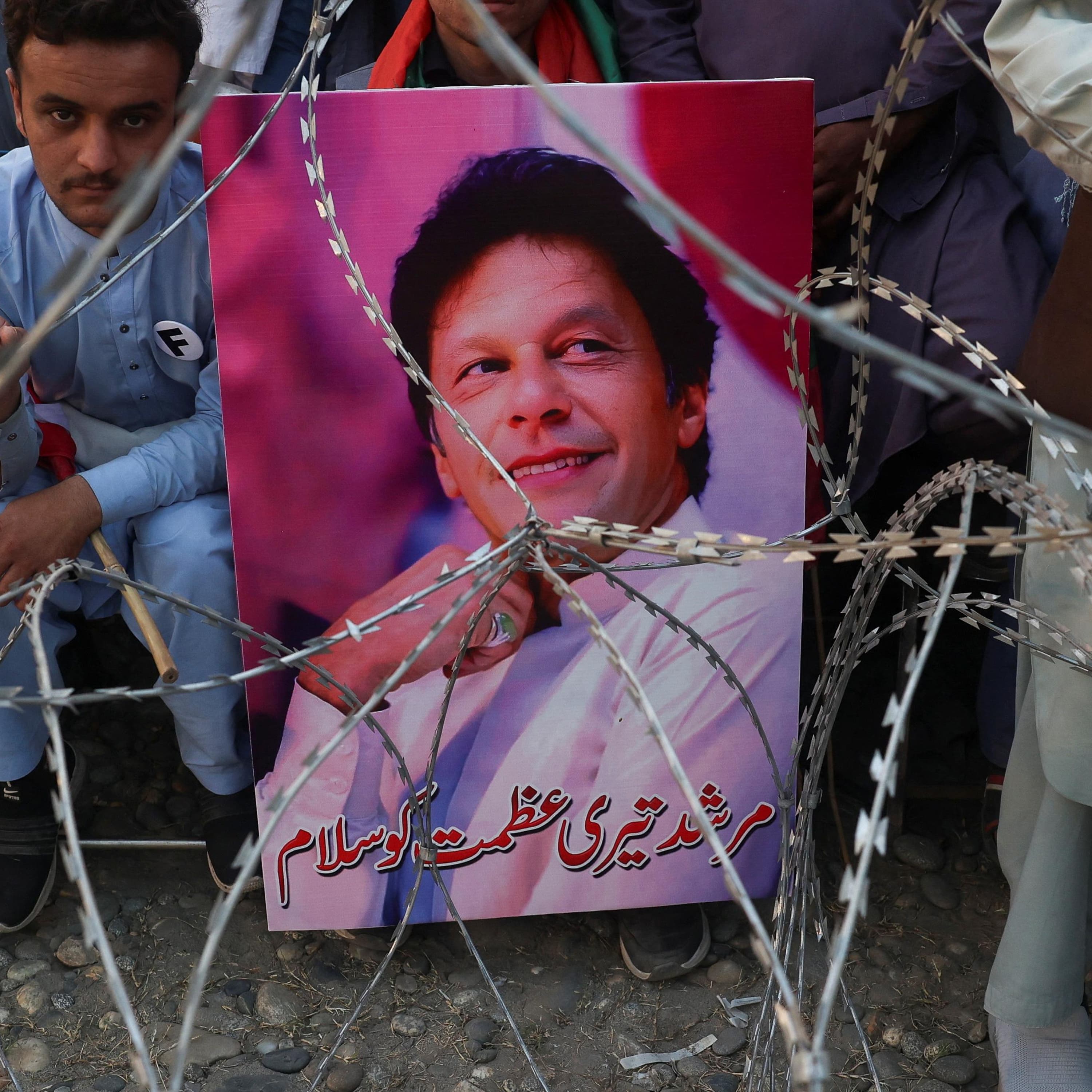
19:58Osman Samiuddin: And so TV channels stuck to it. You will hear many TV channels who will refer to him as Bani PTI, which is, you know, the leader of the PTI. More colloquially, people will refer to him as Kaidi number 804, which is prisoner number 804, which refers to his prison number, his prisoner number.
20:14Kasim Khan: And that's become a meme now, right?
20:16Osman Samiuddin: It's, they've written songs about it. It's not just a meme, there's been songs that have come out about it.
20:25Osman Samiuddin: And, you know, you would see like license plates on cars which had, you know, registration number 804.
20:31Kasim Khan: Right.
20:32Osman Samiuddin: And, you know, there's restaurants that call themselves 804. The funniest thing I thought was I was in Birmingham last year, went into the city centre. There's this great Pakistani food place in centre of Birmingham. And we drove past it. And there was a sign in like neon lights with all the usual stuff. but it said a special biryani number 804 at your service for today. So they've made a biryani after him as well. Oh, why not? After that. Why not? Because, you know, biryani and Imran, they're kind of the two biggest cultural exports maybe out of Pakistan. So all these little things were like little kind of, you know, little rebellions against them trying to kind of clamp down on his name and stuff.
21:13Kasim Khan: And I guess the irony of all of this is, is that trying to erase him from national memory, they seem to have made him more popular than ever.
21:20Osman Samiuddin: 100%. I mean, they've just made him a far bigger figure than he ever was. And, you know, like the funny thing, I guess, for the first maybe two years of his arrest, he was still, even though they tried to raise him, somehow they didn't think about the fact that they should stop him from putting tweets out. You know, he was tweeting like nobody's business for the first two years.
21:41Kasim Khan: That he dictated to his lawyers or his family members.
21:43Osman Samiuddin: Because he was being allowed regular visits then, you know, they would come, he would say, this is what I want. And they would put those tweets out. And those tweets were getting a huge amount of traction and they were making news stories. So he actually was in the news pretty much every day. He wrote an op-ed for The Economist while he was in jail. He gave interviews to the Sunday Times, I think.
22:06Osman Samiuddin: He was still speaking to people in rallies. This was the brainchild of his social media team, his digital team. They used older footage of him. they got real voice samples of Imran and ran it through this AI app. They would send the speech to him through his lawyers who met him in jail. He would okay it or not. And then they would come out and then they would put that out. He was still actually from jail. It was insane.
22:44Kasim Khan: Osman, what happens next? Is there a way out? Do you see that he will leave that prison? You know what?
22:50Osman Samiuddin: It's a really, really difficult question. I think what he wants his legacy to be is what's going to decide his future. He's been offered deals that will get him out of jail in the past, at least according to his own party officials, at least two occasions that he's been offered deals to get out. The window for it, probably receding, you know, he's 74 now. I think the idea of what he wants to leave his legacy behind as, is as somebody who did not bend to power.
23:24Kasim Khan: Coming up, will Imran Khan ever see his sons again?
23:39Sulaiman Khan: I could see that I was transitioning from being a functioning alcoholic to a non-functioning alcoholic. A desperate man turns to his chatbot for help. Can it convince him to change? This interaction probably did push me to thinking I have to quit. Black Box, The Chatbots, a new series from The Guardian Investigates about the strange things happening between AI and us. Search for Black Box wherever you get your podcasts.
24:14Kasim Khan: I think, obviously, you're both well aware that pretty much every political leader in Pakistan in its 79-year history has been in prison at one point or another. And pretty much everyone cuts a deal to get out. Why won't Imran Khan take one? Because presumably there has been an offer.
24:32Sulaiman Khan: He's quite different to, I'd say, the vast majority of political leaders in Pakistan currently and in history because he genuinely doesn't have a corrupt bone in his body, which is shown by the fact that he's spent three years in prison. He's probably been offered a number of different deals, but it would have to be completely stacked in his favour. involving not just his own release, but his political leadership. And he'd also have to be able to be involved in politics after being released. And I don't think the regime would ever consider doing that. So I think that's the reason.
25:12Kasim Khan: And how do you separate, you know, the Imran Khan in politics, a public figure from obviously just wanting your own dad to be at home and just say, dad, just give it up. just come over um i think from as long as i've been around they've been the same character in
25:31Sulaiman Khan: a way he's so passionate behind closed doors when it's just me sulaiman and him about what he's doing about ridding pakistan of corruption pulling it out of poverty and and and and making a difference so obviously we want our father back but all of the pakistani people want their leader in charge as well. So when dealing with stuff like this, we're fighting the same cause, us and the Pakistani people.
25:58Kasim Khan: Your dad was given a 31-year sentence. He turned 74 last week. When do you think you'll be able to next see him? And do you think it'll be in prison or outside it?
26:09Sulaiman Khan: I mean, it's impossible to say. I mean, we've said before, I think our hope of him being released is dwindling, but you never know if Pakistan is. And right now the protests are happening. So if some foreign power intervenes or there's a change in government, there could be anything that happens in Pakistan that we pray for that could hopefully allow us to see him sooner. But at the moment, our hopes are not very strong.
26:48Kasim Khan: That was Qasim and Suleiman Khan. My thanks to them, to journalist and author Usman Samiuddin, and to Frisana Sheikh at Chatham House. You can follow updates on this story at theguardian.com, where you can also read Usman's long read, titled Prisoner No. 804, The Plot to Erase Imran Khan. And that is it for today. This episode was presented by me, Nosheen Iqbal. It was produced by Tom Glasser and Eli Block. Sound design is by Breen McNamara and the executive producer is Sammy Kent. We'll be back this afternoon with the latest.
27:46Osman Samiuddin: Our chief technology officer is an AI, and our human team reports to that AI.
27:52Sulaiman Khan: Meet your new manager. They're an AI chatbot.
27:55Osman Samiuddin: He's fired people.
27:57Sulaiman Khan: The AI boss has fired human employees? Yes, for lack of performance. Black Box, The Chatbots, a new series from The Guardian investigates about the strange things happening between AI and us. Search for Black Box wherever you get your podcasts.


