
 Ask ChatGPT


 Today in Focus
14 Oct 2026 · 13m · 3 chapters
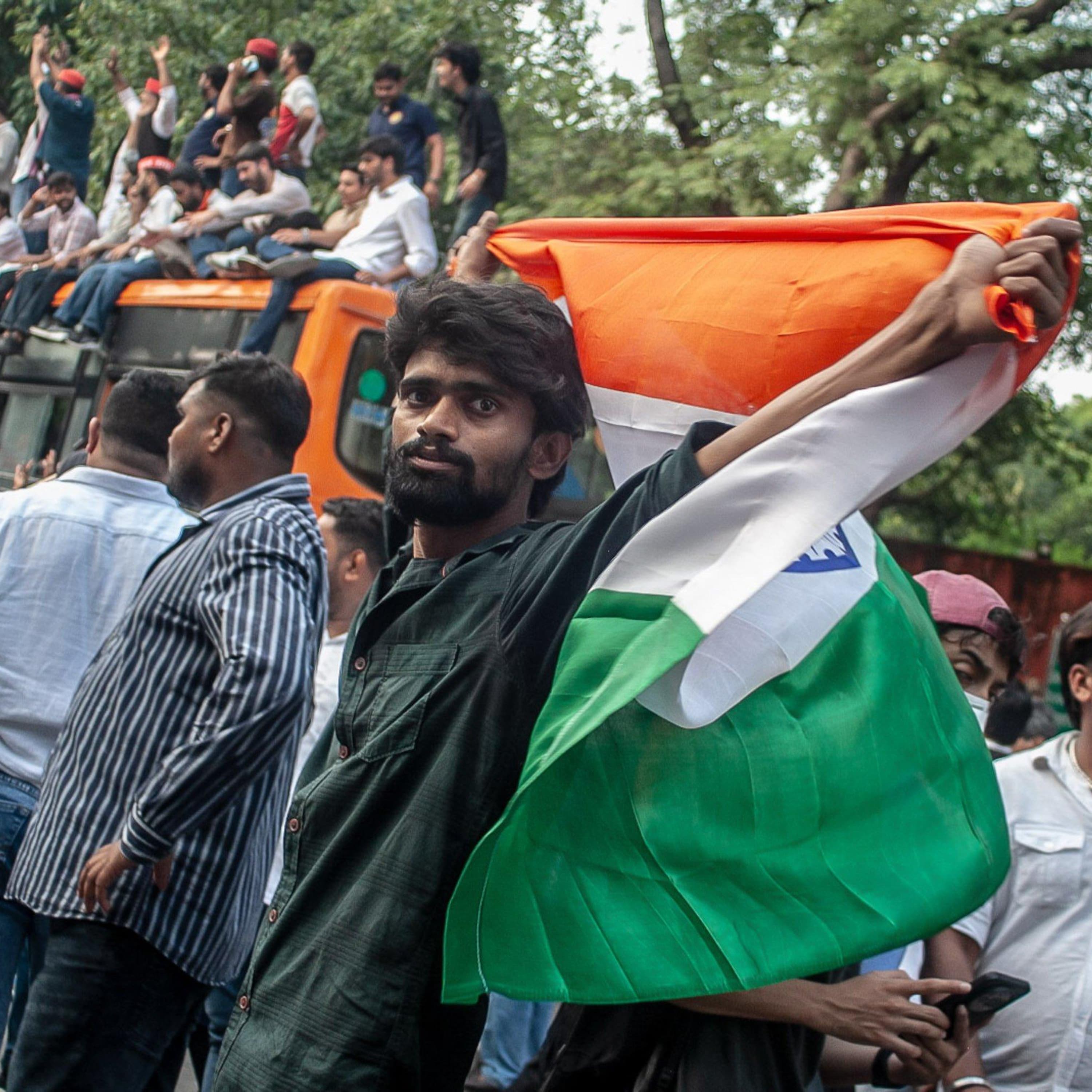
Delhi youth protests dubbed the “cockroach movement” challenge India’s Modi government; authorities block access, detain thousands, and shut down transport to stop mass demonstrations. The trigger is anger over voter disenfranchisement linked to the Election Commission’s Special Intensive Revision (SIR) of voter rolls, allegedly removing millions (including Muslims and lower-caste voters) and enabling BJP landslide wins; the Election Commission denies bias and BJP denies advantage.
protests are unprecedented in scale; government intolerance of dissent; images of police clashes circulate internationally.
trains/metro shut; ~7,000 detained; Jantamanta protest site “denotified”; two leaders jump barriers, are tackled, and jailed for five days.
Hannah Ellis-Peterson (Guardian South Asia correspondent in Delhi). Host: Lucy Hoff.
Written by AI. May contain mistakes.
Details about the ongoing youth protests in Delhi against the Modi government and the measures taken to suppress them.
“Hannah Ellis-Peterson, you're our South Asia correspondent.”
Exploration of the issues surrounding voter disenfranchisement and the implications of the electoral roll cleanup process.
“You know, they did successfully essentially manage to shut down the protests.”
Discussion on the potential implications of the protests for the Modi government and the alignment of different political factions.
“And the government claimed some of them were dead or deceased, but the people who claimed to be dead were alive and they kind of marched through the streets.”

Get the gist, explore an idea or ask about something said.
 Claude
On Today in Focus, what are the key points of this episode?
Searching your listeningAutomatic transcript. May contain errors.
0:00This is The Guardian.
0:09It could be a genuine challenge to the Modi government. This is the kind of level of dissent they're not used to dealing with, except by brute force. Look at this, look at this, look at what is happening. What is happening right here? Young people just keep rising up, because right now there is a lot of anger and a lot of frustration, and the Modi government hasn't been able to meet that with anything that the young people on the streets are satisfied with. From The Guardians today in Focus, this is The Latest with me, Lucy Hoff. Delhi has been rocked by another massive round of youth protests, part of what's been called the cockroach movement.
0:47Hannah Ellis-Peterson, you're our South Asia correspondent. You are in Delhi where these protests are taking place. What's it all about and what does this fresh run look like? So since the weekend, Delhi has been a kind of fortress. The roads have been blocked. There have been tens of thousands of police kind of assembled. It's been impossible to get into the centre of the city. People are describing it as a kind of security fortress. And it's all to stop young people coming out and protesting. On the weekend, a massive protest was organised by this cockroach movement. It started in the summer as a movement kind of mobilising against issues with education.
1:24And the movement successfully managed to get the education minister to resign. And this time round, it's about voters' rights. And it's a movement that's kind of really galvanised. The opposition is also involved. Students are also involved. But on Saturday, it was the cockroaches that called this protest. And thousands and thousands, tens of thousands, people wanted to attend this protest. But the government was absolutely determined that it wouldn't happen. And it stopped trains coming into Delhi. It shut down metro stations. It arrested people across the country who had any intention of traveling to Delhi.
1:58People were getting pulled off trains. They were getting pulled out of cars. Roadblocks were set up in the roads coming into Delhi to kind of question people as to why they were possibly traveling to this protest. And in the heart of Delhi, there were just thousands and thousands of police. And anyone who tried to enter this area was just getting pulled onto a bus and sent to a police station. They say around 7000 people were detained. Many thousands more across the country were detained. And it was all just to try and stop this kind of mass mobilisation of these cockroaches who are essentially just kind of young people who are very angry at the government coming out to call for the resignation of an election commissioner, but also just to express their frustration at the Modi government.
2:41Yeah, I mean, that response sounds astonishingly large and heavy handed. What is so threatening to Modi's government, the BJP party, about this youth led movement? Why would they try and shut things down in this way? So this is a government that is extremely intolerant of dissent. And these kind of protests, we just haven't really seen them, you know, especially on this kind of scale. You know, the government is used to really being able to control the narrative, to controlling the opposition, to crushing any kind of critical movement. And so what's happened here is really unprecedented, which is a kind of young people coming out in defiance of the government, in defiance of police and kind of, you know, really determined to express their right to protest.
3:26and the government is absolutely terrified of seeing the kind of sheer scale of these protests and what that could represent and they were very very determined to make sure the young people just simply couldn't get there that they couldn't express this kind of frustration at the government you know this is this is you know how the government has met every kind of attempt at dissent you know it's very quick to crush it it's very quick to try and dismiss it but what happened here kind of pushed the boundaries of what the Modi government was capable of. You know, they did successfully essentially manage to shut down the protests.
3:58But in the process, we got these horrific images of young people getting pulled onto buses, you know, clashing with police, you know, the kind of young people of India, you know, you know, with their kind of fists raised at the state, at the government. And so even though, yes, people couldn't gather in thousands, there was a strong sense and the kind of these images were beamed across the world that this was a government, you know, acting with extraordinarily necessarily authoritarian measures to crack down essentially on young people who just wanted to come out and express their democratic right to protest and to kind of call out the Modi government for what they see as a kind of mass disenfranchisement, which has been happening, you know, over the past year.
4:34And notably, two of the big figureheads of the cockroach movement violated some of those very, very strict measures that had been put in place and were detained, arrested. They said they, won't be cowed, they're very defiant. But what does it mean to see two kind of senior leaders of this protest movement also detained? So this is actually the second time they've been detained. On Saturday, as the cockroach leaders, the three main people flew into Delhi, the police boarded their flight and just pulled them off the plane before they could even get to the protest in Delhi and put them under what they said, preventative arrest and held them overnight to essentially stop them coming out and mobilizing people on the streets.
5:17They then released them in the morning. But then on Tuesday, the kind of protest site that had been designated, it's called Jantamanta. It's an area in the center of Delhi, very close to parliament. And historically, it's always where protests have happened. You know, I've been to Jantamanta multiple times for different kind of issues. And Jantamanta was the heart of the first cockroach protest, which took place in the summer, which was kind of a movement against issues within the education system, you know, a massive leak of a paper that caused students to commit suicide. And it causes massive mobilization of young people.
5:51And it was really this that started this, you know, this kind of movement, the cockroaches, which started as a satire and quickly became a very, very kind of powerful political challenge to Modi, gathered pace in the summer. And it was a junta manta that they gathered. And, you know, over the course of days and weeks, you know, more and more people flooded in. And that was when kind of young people showed their strength to the Modi government and they refused to move. And eventually they did manage to get the resignation of Modi's education minister. And so what the government just doesn't want is this to happen again.
6:22And so they've gone to the extreme measure of actually denotifying this site as a protest site, preventing anyone from being allowed to come in at all. And so on Tuesday, though, two of the leaders of the cockroaches jumped the barriers, they jumped the fence, they held up an Indian flag and they held up slogans. And they basically were there to make a statement saying, you know, the government can't just decide. suddenly that this isn't a protest site. But they were tackled to the ground and arrested, and now they've been sent to jail for five days. As you say, these images being disseminated all around the world.
6:52So even though the Indian government doing so much to stop this happening, these images are having huge cut through overseas. This is a broad movement, as you've been describing, that folds in a number of different issues affecting young people. This time it was about voter disenfranchisement. What was that about specifically? What was the trigger? So this is a very interesting issue that's been going on for a while. It's a process called the Special Intensive Revision, SIR. And it was something that the Election Commission announced that they would be doing the beginning of last year. And they described it as a process that was going to clear up India's voter roll of dead people, deceased people, but specifically also illegal immigrants who they claimed had somehow kind of gained the right to vote on masks.
7:37And what they started to do is they did it in one state in Bihar. There were six million names removed from that list. And the government claimed some of them were dead or deceased, but the people who claimed to be dead were alive and they kind of marched through the streets. And it became clear then that this was an exercise that had possibly a different kind of motive. And when this exercise was then taken place in West Bengal, another state, what we started to see was a kind of mass disenfranchisement of particularly of Muslims and lower caste communities, people who were very much not the typical voters of the BJP.
8:10And these voters found themselves, you know, removed from the list despite having all the papers that proved that they were voters. And in, you know, and it was millions of them. And the system basically prevented them from being able to get back onto the electoral roll. And very quickly, and what happened in West Bengal, and then also in Bihar is after the BJP did this voter roll vision, a state election took place and they won by a landslide. Yeah. And what's emerged through some very great investigative reporting by the Indian Express newspaper is that this process internally had caused a lot of controversy and that two other officers had raised multiple issues with it.
8:50But the senior guy, the chief election commissioner, this guy Gyanesh Kumar, had overruled them and continued. This guy, Gyanesh Kumar, was appointed by the Modi government. And so there is this huge sense of anger, of this idea that the Election Commission is working for the Modi government to help them manipulate the electoral system to their benefit, to keep them in power for decades, and to disenfranchise millions and millions, tens of millions, particularly Muslims and lower caste communities, from being able to be citizens of India. It's important to say that the Election Commission denies having any kind of political bias and the BJP has denied that this SAR process is in any way to their advantage.
9:30They've accused the opposition of being jealous of their electoral successes and trying to kind of stir up anarchy in the country. I mean, we are dealing with a government, a politician that have, you know, there have been concerns for so long now about constraints on democratic freedoms, on a slide into autocracy that has been hugely concerning for the world. There's been condemnation from the UN and Amnesty about the treatment of these recent protests. I mean, with such a strong man in Modi, who's made his intentions for his party to stay in power for as long as possible, you know, upturning democratic norms.
10:06Do you think this protest movement stands any chance against that? Well, it's very interesting. It certainly is a shift from before, you know, but you know, the cockroach movement, you know, they're all just a pressure group, they're not a political party. But what we're seeing here with this particular issue is an alignment between the opposition who have been hugely galvanized in recent weeks over this issue, you know, left wing student groups and this cockroach movement, which, you know, represents a kind of cross spectrum of kind of political views, but just kind of an expression of young people's anger.
10:35And so there is a sense that, you know, if these kind of three aspects work together, that it could be a genuine challenge to the Modi government, that this is the kind of level of dissent they're not used to dealing with, except by brute force. And there's only so much brute force that you can kind of level, you know, when you've got millions of people turning out in protest. But the real test, again, will come in terms of elections, you know, the BJP still is in power in kind of 70 % of the states, it's still has a very, very strong, powerful government at the centre. And, you know, in terms of their kind of electoral strength, nothing has yet to challenge that.
11:08So yeah, but you know, this is very, it's a very interesting kind of very uncharted waters for them and how they kind of navigate that I think will be very interesting. and it definitely, I think, will be a challenge for the Modi government to understand how to kind of take this on and how to kind of stop, you know, just kind of repetitive, you know, young people just keep rising up because right now there is a lot of anger and a lot of frustration and the Modi government hasn't been able to meet that with anything that the young people on the streets are satisfied with. That's super interesting.
11:40Hannah, thank you so much. Thank you so much, Lucy. That's it for today. my huge thanks again to Hannah Ellis-Peterson, The Guardian's South Asia correspondent. You can keep up with all her reporting on this over at theguardian.com. Thanks for listening to this episode of The Latest. Today I'm focused to be back in your feeds as usual tomorrow morning. The Latest will be back tomorrow night. This episode was produced by Angus Neal. The senior producer was Ryan Ramgobin. The executive producer was Zoe Hitch. And it was presented by me, Lucy Hoff.
12:16We understand fascism to be a response to crises, and it always is. It always emerges in moments of systemic crisis. Are we really living through end times fascism? Naomi Klein and Astrid Taylor think so. And they can see it coming for them and the rest of us. The fact that you can have a president who says, well, maybe I have to annihilate Iran. But you also have tech executives saying, yeah, there's a 25 % chance we're going to wipe out humanity. Yet they haven't given up hope of a fight back. It suddenly felt like instead of racing to keep up with all of the terrible things, we're racing to keep up with the resistance.
12:53So how dangerous is Trump and his coalition of billionaires, evangelicals and MAGA diehards? This is Radical Thinking, a new series from The Guardian with me, Adit Chakroti. Out now in your Politics Weekly feeds. This is The Guardian. you


