
 Ask ChatGPT


 Today in Focus
24 Nov 2026 · 27m · 12 chapters
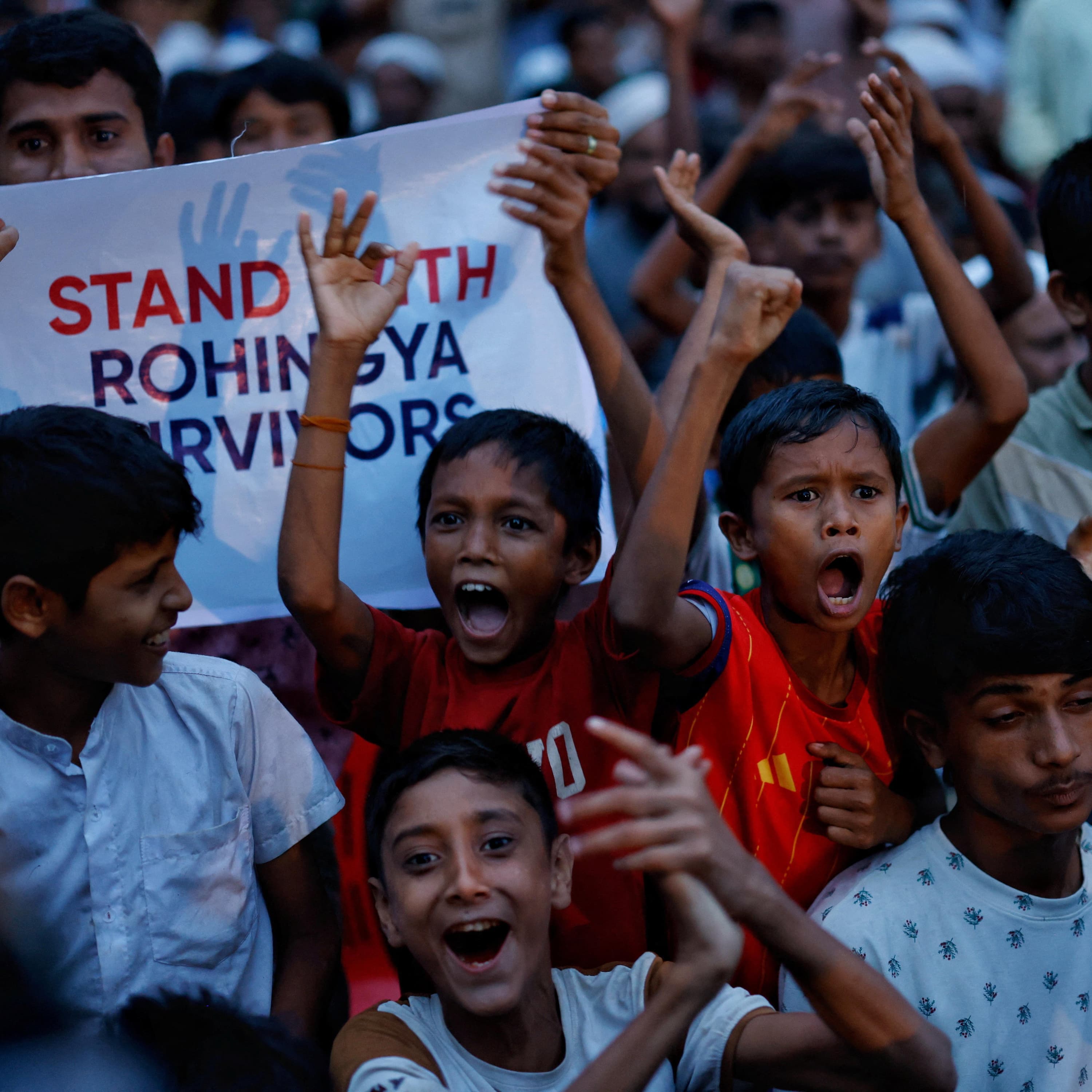
The International Court of Justice (ICJ) ruling that Myanmar committed genocide against Rohingya Muslims, what it means for Rohingya refugees and international justice, and implications for an upcoming ICJ case on Israel/Gaza.
Yasmin Ullah, Rohingya founder/director of the Rohingya Mai Foyna Collaborative Network; born in Myanmar, fled at age 3, lived 16 years in limbo in Thailand, moved to Canada at 19, became an activist after August 25, 2017 when her family’s village was surrounded. Camille Ahmed, Guardian journalist who has reported on Rohingya persecution for years.
Myanmar’s security forces committed genocide (9–6 vote); genocide includes reproductive/sexual violence and preventing births, not just killings. The ruling may pressure signatory states to act, but the ICJ lacks enforcement power. Myanmar rejects the verdict; Israel’s defense about “numbers” and “counter-terror” parallels may be challenged.
Tulatoli village attack (dawn roundup to a riverbank; killings of men, babies; women locked in burning houses and raped). Estimates cited: about 10,000 killed (possibly more); about 700,000 fled to Bangladesh; reproductive violence highlighted in court.
Written by AI. May contain mistakes.
Yasmin Ullah shares her feelings and the significance of the court's ruling.
“a nod to its status as the highest court in the world, the International Court of Justice, the ICJ at The Hague.”
Yasmin discusses her upbringing as a Rohingya refugee and the impact on her identity.
“What next for the Rohingya and international justice?”
Yasmin recounts a call from her mother that ignited her activism.
“Was it difficult for you growing up as a young girl and then into a young woman in that kind of environment and how did you get out?”
Journalist Camille Ahmed elaborates on the historical context of Rohingya persecution.
“the military came to surround our village.”
A detailed discussion on the genocide case brought to the ICJ and its implications.
“and you have been following the plight of the Rohingya in Myanmar for a very long time.”
Yasmin reflects on the arduous process of gathering evidence for the case.
“And what was Myanmar's defence throughout this whole proceeding?”
Discussion on the court's verdict regarding Myanmar's actions against the Rohingya.
“I was more playing the role of, you know, advocates from the community, explaining and also managing expectation for community members.”
Exploration of how the verdict may influence the situation of Rohingya refugees.
“The court, by nine votes to six, finds that the Republic of the Union of Myanmar has committed genocide.”
Discussion on the implications of the Myanmar verdict for Israel regarding Gaza.
“Coming up, what could this verdict mean for Israel and Gaza?”
Insight into the persistent issues faced by Rohingya refugees in Bangladesh.
“And there is no indication that this will mean that those over one million Rohingya who are trapped in Bangladesh living in the most appalling conditions that they'll be able to go home?”
Discussion on the significance of the court's recognition of the Rohingya identity.
“Myanmar didn't even call the Rohingya by their name in court.”
Yasmin shares her family's harrowing story of fleeing violence in Myanmar.
“It's huge to have got this verdict, but what do you want to happen next?”

Get the gist, explore an idea or ask about something said.
 Claude
On Today in Focus, what are the key points of this episode?
Searching your listeningAutomatic transcript. May contain errors.
0:00Yasmin Ullah: This is The Guardian.
0:09Yasmin Ullah: Today, a landmark genocide ruling.
0:20Yasmin Ullah: Last week, Yasmin Ullah sat in a hot and crowded courtroom, waiting for a panel of judges to deliver a verdict.
0:30Kaamil Ahmed: The air is thick because we're all also, you know, anticipating what kind of judgment would come out. And that would actually change a lot of lives, including mine.
0:41Yasmin Ullah: This was no ordinary courthouse. It was ornately decorated, a sparkling chandelier hanging from the ceiling, a nod to its status as the highest court in the world, the International Court of Justice, the ICJ at The Hague. and it was about to deliver one of the biggest judgments in the history of international law. The UN's highest court is hearing a genocide case against Myanmar. For seven years Yasmin had been part of the delegation arguing that the state of Myanmar had committed genocide, one of the gravest human rights crimes against Rohingya Muslims. Genocide that had directly affected Yasmin and her family.
1:23Kaamil Ahmed: The judgment was delivered. The court finds that the Republic of the Union of Myanmar has committed genocide against the Rohingya group. I looked around the room and I was really kind of pinching myself a little bit. If I've heard it wrong or if I've misinterpreted. I think for the first time then I felt a sense of relief. And I think then the room became less heavy and it felt like we were all able to breathe again.
1:54Yasmin Ullah: A moment of long-fought-for justice and recognition for Yasmin and millions of Rohingya, an ethnic and religious minority who have faced decades of persecution at the hands of the state. Today, many are still living as refugees in appalling conditions in camps in Bangladesh.
2:15Kaamil Ahmed: The court has finally reframed this and said, you're human and you are a protected group. It fixes something that's been long broken.
2:29Yasmin Ullah: It's a verdict that could have far-reaching consequences, especially for Israel, which is also facing charges of genocide at the ICJ. From The Guardian, I'm Annie Kelly. Today in Focus, a verdict of genocide. What next for the Rohingya and international justice?
2:56Yasmin Ullah: Yasmin Uller, welcome to ZDM Focus. You're the founder and the director of the Rohingya Mai Foyna Collaborative Network and you have been campaigning and waiting for this moment for years. You were actually born in Myanmar but you had to flee that country with your family when you were only three years old. What did you know about your homeland when you were growing up?
3:20Kaamil Ahmed: I think how I grew up was a sense of confusion, not really knowing where I belong. We were stuck in the limbo in Thailand with no protection and very little to go off of. My parents worked really, really hard to keep us all alive. We were harassed by the police because Thai law does not have anything spell out in terms of a person that can exist as a refugee. And so I lived in that kind of limbo for 16 years.
3:52Yasmin Ullah: Can you describe what your parents told you about why you needed to leave Myanmar? Like what was the situation that you were fleeing?
4:00Kaamil Ahmed: They just gloss over it by saying, you know, the Myanmar military doesn't like us and they steal from us or they extract resources from us. They take us into slave labor. They destroy our homeland and they violate our rights because we are Rohingya. and that for the longest time made me feel like I didn't want to be a Rohingya because why does it come with a struggle to exist as a person?
4:29Yasmin Ullah: The situation for the refugees in Thailand across Southeast Asia is not good, is it? That the persecuted both in Myanmar but also discriminated and persecuted against in many of the countries where communities had to flee. Was it difficult for you growing up as a young girl and then into a young woman in that kind of environment and how did you get out?
4:50Kaamil Ahmed: It was really destabilizing but it's also it doesn't bode well when you feel as if your identity is just not accepted anywhere and in a way it felt wrong to be a Rohingya and so for the longest time I just refused to call myself Rohingya. And coming back to really re-establishing myself and finding relative safety in Canada was a very different story. And being able to rebuild myself as a Rohingya was also another challenge altogether. But it was because I had that safety to be able to explore my own identity and re-establishing myself.
5:29Yasmin Ullah: You moved to Canada at age 19. You started your life again, something that you said that you feel really grateful for. I mean, you could have then just almost reinvented yourself and moved on and built a new life in a much more tolerant society to your community. But what was it that turned you into an activist?
5:48Kaamil Ahmed: I think a phone call that my mum made to me on August 25th, 2017 was the turning point. I'd already begun speaking up about the fear that, you know, the community will be attacked again on a massive scale. I got a call from my mom that day and she said, pray for your family because majority of our families are still back home in Burma, Myanmar to this day. And she said, the military came to surround our village. We don't know what happened. Last I checked was, you know, our family is running away. They didn't even have their shoes on. They're just running away, headed to the north. And I think at that point, I fell to the ground.
6:30Kaamil Ahmed: I couldn't get up for a very long time. I cried and cried and cried. And I realized for the first time, this identity that I had actually came with responsibility. And the safety that I was awarded was not just for free. I needed to do something to engage the world, to try to raise awareness, to ensure that someone cares about us. And so it was a duty. It was also the sense of fear that I I would lose my home and the people that I love forever. And who am I without my identity and my roots?
7:19Yasmin Ullah: Camille Ahmed, you are a journalist here at The Guardian, and you have been following the plight of the Rohingya in Myanmar for a very long time. We've heard Yasmin describe how her family had to flee after government forces surrounded their village in 2017. But can we go back a bit? Could you tell me about the Rohingya and how their persecution ultimately led to this case at the ICJ?
7:44Kaamil Ahmed: The Rohingya are a group of people, a minority group from Myanmar. They are also ethnically very different to the majority of Myanmar. and as a result of their ethnicity and their proximity to Bangladesh, they were in the 80s officially kind of designated as foreigners. They're basically a people who were stripped of citizenship by Myanmar's estate and as a result of that have faced multiple military operations, massacres, have been stripped of the right to education, school.
8:22Kaamil Ahmed: over three years almost a million rohingya muslim refugees have streamed out of myanmar into bangladesh fleeing burning villages carrying stories of mass murder by the country's military so in 2017 mayam's military carried out a campaign of violence targeting rohingya villages across Rakhine state. And these attacks, which they justified as counter-terror operations, they involved mass killings, rounding up of whole villages. Somewhere that came up in the case was a village called Tulatoli. The military arrived at dawn, pushed everyone towards the riverbank so they could not escape and killed people.
9:05Kaamil Ahmed: They killed men, they killed babies, they locked women into burning houses where they were raped inside of them. Across the region, this was happening.
9:17Yasmin Ullah: How many people were killed in total? Did the court have a look at those fatality figures as well?
9:22Kaamil Ahmed: So they used a figure which estimates around 10 ,000. There are some other figures that says it could be far more because for many Rohingya, this was like a week's long journey. Many people would have died from illness, but that was the interesting thing about this case. People's idea of genocide is kind of the majority of the population. being killed. They said the number of people being killed is not the only thing that mattered here.
9:46Yasmin Ullah: And that was about 1.5 % of the Rohingya population.
9:49Kaamil Ahmed: The Myanmar military attempted to destroy their whole presence. Very few Rohingya are left in Myanmar now. And the particular thing about this case was the focus on reproductive violence, the sexual violence that targeted women and targeted children and the attempt to prevent the Rohingya from giving birth.
10:11Yasmin Ullah: I mean, some of the details of what happened in 2017, it's beyond horrifying. How did this case end up being brought to the International Court of Justice?
10:20Kaamil Ahmed: So it was, I think, kind of a collection of many different efforts. The case itself was launched by the Gambia. There are a few different stories, but one of them is that basically Bangladesh invited some foreign international leaders to the camps. It took them there. The Gambia's justice minister at the time visited the camps and was just like, he says he was so struck by the trauma and the horror of what people faced that he felt a responsibility to take it on. And it was so the Gambia who led.
10:50Yasmin Ullah: Why not Gambia?
10:52Kaamil Ahmed: It shows that you don't have to have military power or economic power to stand for justice.
10:57Yasmin Ullah: Is this the first time that a case like this has been heard at the ICJ?
11:01Kaamil Ahmed: In the past, there have been cases where a state has been accused of genocide, but they have not been found responsible directly for genocide, perhaps like responsible for not preventing genocide.
11:12Yasmin Ullah: What was the case that the lawyers for the Gambia put forward to the court?
11:16Kaamil Ahmed: What the Gambia said is that the Rohingya have faced genocide because it was an intentional campaign of violence by Myanmar to wipe out the Rohingya. The sexual violence was systematic and that it was part of a system that was intended to prevent the Rohingya growing as a people, to stop them giving birth. Somebody was already talking about sterilising Rohingya women and they're not allowed to marry Bangladesh women so they don't get citizenship and don't have a claim. It wasn't just about killing the Rohingya, it was about stopping them existing.
11:50Yasmin Ullah: And what was Myanmar's defence throughout this whole proceeding?
11:55Kaamil Ahmed: Myanmar's defence was basically that these were counter-terror operations. It describes the whole process of the violence as clearance operations, which instead referred to clearing of the Rohingya militant group who it said instigated the violence by attacking its military posts in August 2017, not attacking the Rohingya as a population.
12:24Yasmin Ullah: So Yasmin, it was those appalling acts that were directly affecting your family back in Myanmar that inspired you to become an activist. We now know the full scale of those crimes that were committed against the Rohingya. More than 10 ,000 people killed, 700 ,000 forced to flee over the border into neighbouring Bangladesh. What were you thinking about when you first heard about this case? Why did you want to get involved? What was at stake for you?
12:51Kaamil Ahmed: As a community that's being actively wiped out and invisibilized, erased, beyond the recognition of the suffering that we've endured, it's the chance to be able to hold the Myanmar military accountable for what they've done, but also to show the world that genocide does not happen in isolation. It does not happen in a vacuum. It happens because the world decide to watch and do nothing. It happens because we collectively fail the community that needs to be protected. And so that was a chance for us to be seen and be heard and be recognized, not only as who we are, but also as a people who have the agency to actually continue to advocate for ourselves through this case and outside of this case.
13:45Yasmin Ullah: What was it like working on the case itself? What role did you play? And it must have been a very painstaking process, gathering the evidence and putting the argument together.
13:56Kaamil Ahmed: The more of the nitty gritty details and, you know, the very, very arduous labour is definitely taken on by the Gambia's legal team. I was more playing the role of, you know, advocates from the community, explaining and also managing expectation for community members. Perhaps we will never see the day of justice in court because we did not know whether or not Myanmar would be found guilty of violating Genocide Convention.
14:28The court finds that the evidence establishes that Myanmar's security forces engaged in indiscriminate killings,
14:39Kaamil Ahmed: separation...
14:39Yasmin Ullah: Jamil, you were at The Hague when the verdict was announced. Can you just tell me about those moments leading up to that?
14:46Kaamil Ahmed: You're listening to it and it really sounds like they're leading towards saying it was genocide, but it's in very legal terms. And also, it's possible that they say all these things and they say something short of its genocide. The court, by nine votes to six, finds that the Republic of the Union of Myanmar has committed genocide. There was cheering and clapping. There were people in the court who cried, but also there were people who in court, I think, very lightly clapped. They don't want to disturb the process, but I think they couldn't hold themselves back.
15:28Yasmin Ullah: How have the authorities in Myanmar responded to the verdict?
15:32Kaamil Ahmed: There has been this rejection of the court.
15:36Yasmin Ullah: Myanmar calling unfair the ruling of genocide by the UN's top court over its treatment of the Rohingya minority. A government official in Myanmar stressing that the vote of 9 to 6 in favour of guilty was not unanimous.
15:50Kaamil Ahmed: The court is biased. the court's ruling should not be trusted. All of these kind of messages are coming out and it's kind of reverting back to some of the hate speech that was very common in 2017, that the Rohingya are foreigners and that they kind of, this is all an attempt to bring down the name of the country.
16:08Yasmin Ullah: I mean, that is so depressing, isn't it? And I guess it leads on to the next question, which is what actual change can this tangibly make to the plight of the Rohingya? Can it be enforced? Is it going to make life for the 1.2 or 1.4 million Rohingya in Bangladesh any better at all?
16:28Kaamil Ahmed: I've spoken to Rohingya about this yesterday and they feel that the international community didn't need the genocide ruling to put pressure on Myanmar to allow them to return to their homes. But there is some hope that with this ruling, at least the countries that backed the case, like the UK, will be forced to take some kind of action to put pressure on Myanmar, to impose sanctions on some of the things the Myanmar military receives, and basically that some action will be taken to enforce the demands made by the court, which are that Myanmar gives the ring of reparations and makes it safe for them to return.
17:06Yasmin Ullah: Because I think I'm right in saying that the court itself doesn't have any way of enforcing this verdict. It doesn't have a kind of police force or any way of actually going and doing anything. It really relies on the countries that are part of the court under the UN to actually then take this verdict and do their own proactive measures to enforce that, right?
17:28Kaamil Ahmed: Yeah, there's all these countries that are the signatories to the Genocide Convention. They have a responsibility to put pressure on Myanmar. They ensure the Rohingya are basically able to have safety and to return to their arms.
17:43Yasmin Ullah: Coming up, what could this verdict mean for Israel and Gaza?
18:02Yasmin Ullah: One thing that makes this ruling even more significant is what it might mean for another ICJ case that is coming up, which is around Israel's actions in Gaza. What does it mean for Israel, that case, I think, brought by South Africa?
18:19Kaamil Ahmed: I think they're not exactly the same. So it's hard to make direct comparisons, but there are similarities. And going back to the thing mentioned about the number of people killed, sometimes the defense that's given for Israel is that there are many Palestinians still living in Gaza, that the number of Palestinians killed does not amount to genocide. Well, I think what this case shows is genocide isn't just about numbers and a kind of argument about numbers is actually not what matters here. The court will consider far more than that.
18:56Yasmin Ullah: There was something else, wasn't there, about the argument that the Myanmar government put forward that this was a valid military campaign. It had a military objective, a defense of the state objective, which I imagine also has some kind of implication potentially for Israel, who I guess would argue the same thing in Gaza.
19:17Kaamil Ahmed: Yeah, what matters is the court said there was this military group that you said you were attacking, but there was so much else that your forces did that cannot be justified as counter terror operations. And that is another thing that will be kind of applicable in the case of Gaza.
19:34Yasmin Ullah: And there is no indication that this will mean that those over one million Rohingya who are trapped in Bangladesh living in the most appalling conditions that they'll be able to go home?
19:45Kaamil Ahmed: They hope that this will be the start of that. But there are Rohingya who have been in refugee camps in Bangladesh for more than 30 years, almost 40 years now. There are generations of Rohingya born as refugees. the violence that they have faced has gone on for a long time has constantly escalated and that has not changed.
20:09Yasmin Ullah: Yeah and of course there's also a civil war going on in Myanmar at the moment which is ongoing between the military junta and rebel groups that all started after the military took control of Myanmar in 2021 which I imagine will also make it much harder for people to return.
20:26Kaamil Ahmed: Yeah and that fighting directly affect the ring are not really involved in that in any significant way but they are caught in between the battling parties and in fact whoever is in charge of whatever area they are in where it's rebels or the military has subjected them to abuses like forced conscription, forced labour, destruction of their villages. The violence against is continuing. Even a few weeks ago, there were reports of Rohingya in a village being given the order to leave. So this is happening very recently.
21:01Yasmin Ullah: This is all happening in a context where we're seeing, you know, this collapse of rules-based order, states ignoring humanitarian laws, acting without any regard for international laws or anything that the ICJ stands for. You've been reporting on this for such a long time. Did what happened last week with this verdict give you any kind of moment of hope or optimism that there are still people there fighting for justice to be done and that this is all still really worth fighting for, this idea of international humanitarian law and justice?
21:41Kaamil Ahmed: Myanmar didn't even call the Rohingya by their name in court. But the court said they are a group of their own culture who exist in Myanmar. They are a people, they are a community that was recognised. And that really matters for a people who had their citizens stripped away, are called Bengali foreigner, or more often than not, described through a very derogatory slur. And that really matters. They were recognised on an international stage as a people who belong to the place they say they belong to. and that has given people hope.
22:25Yasmin Ullah: What does it mean to you that this has happened, that you've got this verdict?
22:29Kaamil Ahmed: It validates a lot of the suffering that we've experienced and the genocide that takes place continues to live within us forever and always. This feels like some kind of resolution to that. It feels like someone is hearing us and seeing us in the light that we wanted them to acknowledge our suffering. We're told we're the other, we're Bengali, we're someone else, we're terrorists, we're everything else that's not human. And now the court has finally reframed this and said, you're human and you are a protected group.
23:05Yasmin Ullah: It's huge to have got this verdict, but what do you want to happen next?
23:09Kaamil Ahmed: The 11 intervening states will be hearing from us very soon. especially about their serious commitment to ensure that the Rohingya are protected and their livelihood is actually uplifted. Because currently with the dwindling humanitarian funds, we are seeing the rate at which children are malnourished that is skyrocketing. I just came back from the camps in August and I can't describe to you the feelings or the kind of scenarios and things that I've had to witness. children playing in the sewer because, you know, sewage system is not closed, water system or any kind of, you know, basic livelihood access has been heavily restricted with people having only$6 per person per month.
23:55Yasmin Ullah: Good Lord. It's so dehumanizing, isn't it?
23:58Kaamil Ahmed: It is. And so that means, you know, holding the Myanmar military, the person that sits in the presidency office comfortably and getting red carpet treatment like Minong Lai needs to be held accountable. We need to ensure that jet fuel sales is completely stopped because those jet fuel sales go into bombardment of airstrikes across the country, especially in populated areas like hospitals and schools, which violates Geneva Convention, and many other, you know, aspect of economic cooperation that's been explored both by the US, Canada, and many other countries that are now the intervening states on this very judgment.
24:35Kaamil Ahmed: And so I'm really, really hoping that we can push further.
24:40Yasmin Ullah: Yasmin, at the beginning of the interview, you told us about how your family was forced to flee in the violence of August 2017. Can you tell me what happened to them afterwards?
24:52Kaamil Ahmed: They did manage to escape. Thankfully, they ran really far up north on foot with no shoes, no clothes. It was just whatever they had on their backs at that time. My grandmother was very old, so she was being carried by my uncle. And he also has a very pregnant wife. And my younger aunties also have two toddlers with her. It's a tumultuous journey, but they were able to run to safety for some time. And after four days, because of my grandmother's insistence, and as any other Rohingya woman would know, women in our community are really stubborn. And I think that's part of the reason why we're still here today.
25:35Kaamil Ahmed: She insisted that we would go back. And my family had been back home since. It's been difficult, but they still persisted. She said, if they want to kill me, they can come kill me in my own house.
25:49Yasmin Ullah: Wow, what a brave woman. Incredible.
25:52Kaamil Ahmed: Genuinely, I just want to go home and give her a hug. I have not seen her since I was three years old. And I'm now 34. It's been 31 years.
26:03Yasmin Ullah: Well, sending you all of our best wishes and good luck with the next stages of your campaign. And, you know, it's been wonderful to speak to you today. Thank you so much, Yasmin.
26:13Kaamil Ahmed: Thank you so much. Take care.
26:20Yasmin Ullah: That was Yasmin Ullah and Camille Ahmed. And you can read all of Camille's reporting at theguardian.com. And that's it for today. This episode was produced by George McDonagh and Harriet Mogi and presented by me, Annie Kelly. Sound design was by Rudy Zagadlo and the executive producers were Sammy Kent and Homa Khalili. And we'll be back later on this afternoon with the latest.
26:51Yasmin Ullah: This is The Guardian.
26:59Thank you.


